Recovery Concepts
 What does the concept of recovery
mean?
Recovery Concepts
 Traditional perspective:
 Focus upon treatment and ‘cure’
 attain previous levels of functioning prior to illness
 Reduction or absence of symptoms/ disability
 Recovery principles developed and promoted
particularly over the past 20 yrs focus upon a
holistic approach.
 Recovery approach influenced by Service
User groups
(Bradstreet, 2004)
Recovery Concepts
 Recovery may be viewed as:
 A personal process of overcoming the negative
impact of a psychiatric disability despite its
continued presence (Deegan, 1996).
 ‘Maximising quality of life’ (Sullivan et al, 1992).
 Recovery does imply the achieving of an end
product or ‘cure’, nor does it signify that an
individual is simply stabilised or maintained in
the community (Deegan, 1996).
 A personal process of taking ownership,
responsibility for ones life and living a hopeful,
satisfying life within limitations caused by mental
ill-health (Anthony, 1993)
Recovery Concepts
• ‘Recovery is an internal, ongoing process
requiring adaptation and coping skills,
promoted by social supports, empowerment
and some form of spirituality or philosophy’
(Campbell, 1997).
 Anthony (1993) suggested that symptoms
considered components of schizophrenia are
possibly the outcomes of how individuals are
treated by both society and health systems.
 Service users tend to describe recovery in
terms pertinent to themselves: values,
attitudes, feelings, goals, skills roles etc.,
(Spaniol, 1991).
Recovery Concepts
 Factors for example:
 Institutionalisation
 socialisation into a ‘sick’ role
 Lack of rehabilitation resources
 Poverty
 Loss/ reduced of social status
 Medication side effects
 Loss of hope
impact upon chronicity.
(Harding et al., 1992)
Recovery Concepts
 Recovery has a number of meanings and no one
definition is acceptable to all stakeholders, thus the
following meanings are incorporated:
 A return to a state of wellness (i.e. following depression)
 Achievement of a personally acceptable quality of life
(e.g., following an episode of psychosis)
 A process or period of recovering (e.g. following trauma)
 A process of gaining or restoring something (e.g. one’s
sobriety)
 An act of obtaining usable resources from apparently
unusable sources (e.g. in prolonged psychosis where the
experience itself has intrinsic personal value)
 To recover optimum quality of life and have satisfaction
with life in disconnected circumstances (e.g. dementia).
(NIMHE, 2005)
Recovery Concepts
 A recovery-oriented system of mental health
treatment and care must be integrated and
include:
 the full range of hospital and community-based
services, including those in secure settings and
prisons
 self-help and peer-run services,
 users family, partner and friends
 faith communities
 individuals and groups in local communities.
(NIMHE, 2005)
Recovery Concepts
 The goals of recovery for individuals are:
 To realise personal potential.
 To function at an optimal level.
 Use support or contribute towards supporting
entities outside of the mental health services.
 Recovery principles are grounded in
recovery based Values and Values Based
Practice.
Recovery Principles
Guiding Principles:
 Principle 1
 The User decides if and when to begin the
recovery process and directs it, thus user
involvement is essential
 Principle 2
 The mental health system must be aware of
the tendency to promote dependency.
Recovery Principles
 Principle 3
 Users are more able to recover quickly when:
○ Hope is encouraged, enhanced and/or
maintained;
○ Life roles with respect to work and meaningful
activities are defined;
○ Spirituality is considered;
○ Culture is understood;
○ Educational needs as well as those of
families/significant others are identified;
○ Socialisation needs are identified;
○ They are supported to achieve their goals.
Recovery Principles
 Principle 4
 Individual differences are considered and
valued across the life span.
 Principle 5
 Recovery from mental illness is most
effective when a holistic approach is
considered; this includes psychological,
emotional, spiritual, physical and social
needs.
Recovery Principles
 Principle 6
 In order to reflect current ‘best practices’ there is
a need for an integrated approach to treatment
and care that includes Medical/biological,
Psychological, Social and Values Based
approaches. A recovery approach embraces all
of these.
 Principle 7
 Clinicians and practitioners initial emphasis on
‘hope’ and the ability to develop trusting
relationships influences the recovery of users of
services.
Recovery Principles
 Principle 8
 Clinicians and practitioners should operate from
a strengths/assets model.
 Principle 9
 Users of service with the support of clinicians,
practitioners and other supporters should
develop a recovery management or wellness
recovery action plan. This plan focuses on
wellness, the treatments and supports that will
facilitate recovery and the resources that will
support the recovery process.
Recovery Principles
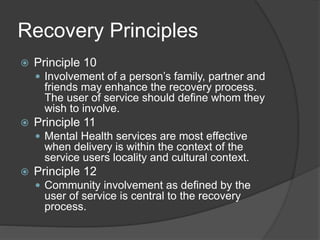
 Principle 10
 Involvement of a person’s family, partner and
friends may enhance the recovery process.
The user of service should define whom they
wish to involve.
 Principle 11
 Mental Health services are most effective
when delivery is within the context of the
service users locality and cultural context.
 Principle 12
 Community involvement as defined by the
user of service is central to the recovery
process.
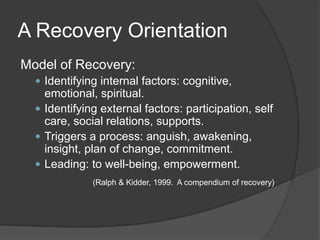
A Recovery Orientation
Model of Recovery:
 Identifying internal factors: cognitive,
emotional, spiritual.
 Identifying external factors: participation, self
care, social relations, supports.
 Triggers a process: anguish, awakening,
insight, plan of change, commitment.
 Leading: to well-being, empowerment.
(Ralph & Kidder, 1999. A compendium of recovery)
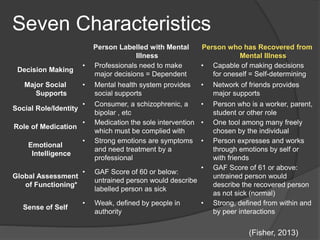
Seven Characteristics
Person Labelled with Mental
Illness
Person who has Recovered from
Mental Illness
Decision Making
• Professionals need to make
major decisions = Dependent
• Capable of making decisions
for oneself = Self-determining
Major Social
Supports
• Mental health system provides
social supports
• Network of friends provides
major supports
Social Role/Identity
• Consumer, a schizophrenic, a
bipolar , etc
• Person who is a worker, parent,
student or other role
Role of Medication
• Medication the sole intervention
which must be complied with
• One tool among many freely
chosen by the individual
Emotional
Intelligence
• Strong emotions are symptoms
and need treatment by a
professional
• Person expresses and works
through emotions by self or
with friends
Global Assessment
of Functioning*
• GAF Score of 60 or below:
untrained person would describe
labelled person as sick
• GAF Score of 61 or above:
untrained person would
describe the recovered person
as not sick (normal)
Sense of Self
• Weak, defined by people in
authority
• Strong, defined from within and
by peer interactions
(Fisher, 2013)
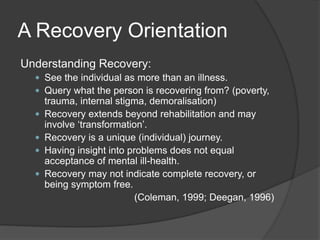
A Recovery Orientation
Understanding Recovery:
 See the individual as more than an illness.
 Query what the person is recovering from? (poverty,
trauma, internal stigma, demoralisation)
 Recovery extends beyond rehabilitation and may
involve ‘transformation’.
 Recovery is a unique (individual) journey.
 Having insight into problems does not equal
acceptance of mental ill-health.
 Recovery may not indicate complete recovery, or
being symptom free.
(Coleman, 1999; Deegan, 1996)
A Recovery Orientation
Understanding Recovery (cont):
 Service users who are severely disabled
particularly in capacity to formulate decisions
are better treated by evidenced based
interventions, with less emphasis upon recovery
model principles.
 As service users become less disabled the
principles of the recovery model can be
increasingly applied.
(Frese, et al., 2001)
A Recovery Orientation
Understanding Recovery (cont):
 The key principle of Hope:
 Can drive and facilitate development of
alternative coping strategies.
 Can promote service user self-
determination for a personal recovery
journey.
 Can develop ownership for discovering
solutions to everyday problems
(Carretta et al, 2014)
References
 Barker, P., Jackson, s., & Stevenson, C. (1998) The need for psychiatric
nursing: towards a multidimensional theory of caring. Nursing Enquiry 6,
103-111
 Brown, W. & Kandirikirira, N. (2007). Recovering mental health in Scotland.
Report on narrative investigation of mental health recovery. Glasgow:
Scottish Recovery Network.
 Borg, M., & Kristiansen, K. (2004). Recovery-oriented professionals: Helping
relationships in mental health services. Journal of Mental Health, 13(5),
493–505.
 Carretta, C., Ridner, S. and Dietrich, M. (2014) Hope, Hopelessness and
Anxiety: A Pilot Instrument Comparison Study. Archives of Psychiatric
Nursing. 28(4), pp.230-234.
 Davidson, L., O’ Connell, M., Tondora, J., et al., (2006) The top ten concerns
about recovery encountered in mental health system transformation.
Psychiatric Services. 57(5), 640-645
 Deegan, P. (1996) Recovery as a journey of the heart. Psychiatric
Rehabilitation Journal. 19, 91-97
 Garcia, B. and Petrovich, A. (2011) Strengthening the DSM: Incorporating
Resilience and Cultural Competence. New York: Springer Publishing
Company.
 Rapp, C. A. & Goscha, R. (2006) The Strengths Model Case management
with people with psychiatric disabilities (2nd Ed.) New York: Oxford.
References
 Rapp, C. A. (1998) The active ingredients of effective case management: A
research synthesis. Community Mental Health Journal. 4, 363-380.
 Rapp, C. A. (1993) Theory, Principles and Methods of the Strengths Model
of Case Management. In Harris, M. & Bergman, H. C., (Eds) Case
Management for Mentally Ill Patients: Theory and Practice. Langhorne, PA:
Harwood Academic.
 Mezzina, R., Borg, M., Marin, I., Sells, D., Topor, A., & Davidson, L. (2006).
From participation to citizenship: How to regain a role, a status, and a life in
the process of recovery. American Journal of Psychiatric Rehabilitation,
9(1), 39–61.
 McCormack, J. (2007) Recovery and strengths based practice. Glasgow:
Scottish Recovery Network.
 Mueser, K.T., Bond, G.R., Drake, R.E. & Resnick, S. G. (1998). Models of
community care for severe mental illness: A review of research on case
management. Schizophrenia Bulletin. 24 (1) 37-74.
 Shepherd, G., Boardman, J., & Slade, K. (2008) Making Recovery a Reality.
London: Sainsbury Centre for Mental Health.
 Shrank, B., Stanghellini, G. and Slade, G. (2008) Hope in Psychiatry: A
Review of the Literature. Acta Psychiatrica Scandinavica. 118(6), pp.421-
433.
Recovery concepts pptx.pptx

Recovery concepts pptx.pptx

  • 2.
    Recovery Concepts  Whatdoes the concept of recovery mean?
  • 3.
    Recovery Concepts  Traditionalperspective:  Focus upon treatment and ‘cure’  attain previous levels of functioning prior to illness  Reduction or absence of symptoms/ disability  Recovery principles developed and promoted particularly over the past 20 yrs focus upon a holistic approach.  Recovery approach influenced by Service User groups (Bradstreet, 2004)
  • 4.
    Recovery Concepts  Recoverymay be viewed as:  A personal process of overcoming the negative impact of a psychiatric disability despite its continued presence (Deegan, 1996).  ‘Maximising quality of life’ (Sullivan et al, 1992).  Recovery does imply the achieving of an end product or ‘cure’, nor does it signify that an individual is simply stabilised or maintained in the community (Deegan, 1996).  A personal process of taking ownership, responsibility for ones life and living a hopeful, satisfying life within limitations caused by mental ill-health (Anthony, 1993)
  • 5.
    Recovery Concepts • ‘Recoveryis an internal, ongoing process requiring adaptation and coping skills, promoted by social supports, empowerment and some form of spirituality or philosophy’ (Campbell, 1997).  Anthony (1993) suggested that symptoms considered components of schizophrenia are possibly the outcomes of how individuals are treated by both society and health systems.  Service users tend to describe recovery in terms pertinent to themselves: values, attitudes, feelings, goals, skills roles etc., (Spaniol, 1991).
  • 6.
    Recovery Concepts  Factorsfor example:  Institutionalisation  socialisation into a ‘sick’ role  Lack of rehabilitation resources  Poverty  Loss/ reduced of social status  Medication side effects  Loss of hope impact upon chronicity. (Harding et al., 1992)
  • 7.
    Recovery Concepts  Recoveryhas a number of meanings and no one definition is acceptable to all stakeholders, thus the following meanings are incorporated:  A return to a state of wellness (i.e. following depression)  Achievement of a personally acceptable quality of life (e.g., following an episode of psychosis)  A process or period of recovering (e.g. following trauma)  A process of gaining or restoring something (e.g. one’s sobriety)  An act of obtaining usable resources from apparently unusable sources (e.g. in prolonged psychosis where the experience itself has intrinsic personal value)  To recover optimum quality of life and have satisfaction with life in disconnected circumstances (e.g. dementia). (NIMHE, 2005)
  • 8.
    Recovery Concepts  Arecovery-oriented system of mental health treatment and care must be integrated and include:  the full range of hospital and community-based services, including those in secure settings and prisons  self-help and peer-run services,  users family, partner and friends  faith communities  individuals and groups in local communities. (NIMHE, 2005)
  • 9.
    Recovery Concepts  Thegoals of recovery for individuals are:  To realise personal potential.  To function at an optimal level.  Use support or contribute towards supporting entities outside of the mental health services.  Recovery principles are grounded in recovery based Values and Values Based Practice.
  • 10.
    Recovery Principles Guiding Principles: Principle 1  The User decides if and when to begin the recovery process and directs it, thus user involvement is essential  Principle 2  The mental health system must be aware of the tendency to promote dependency.
  • 11.
    Recovery Principles  Principle3  Users are more able to recover quickly when: ○ Hope is encouraged, enhanced and/or maintained; ○ Life roles with respect to work and meaningful activities are defined; ○ Spirituality is considered; ○ Culture is understood; ○ Educational needs as well as those of families/significant others are identified; ○ Socialisation needs are identified; ○ They are supported to achieve their goals.
  • 12.
    Recovery Principles  Principle4  Individual differences are considered and valued across the life span.  Principle 5  Recovery from mental illness is most effective when a holistic approach is considered; this includes psychological, emotional, spiritual, physical and social needs.
  • 13.
    Recovery Principles  Principle6  In order to reflect current ‘best practices’ there is a need for an integrated approach to treatment and care that includes Medical/biological, Psychological, Social and Values Based approaches. A recovery approach embraces all of these.  Principle 7  Clinicians and practitioners initial emphasis on ‘hope’ and the ability to develop trusting relationships influences the recovery of users of services.
  • 14.
    Recovery Principles  Principle8  Clinicians and practitioners should operate from a strengths/assets model.  Principle 9  Users of service with the support of clinicians, practitioners and other supporters should develop a recovery management or wellness recovery action plan. This plan focuses on wellness, the treatments and supports that will facilitate recovery and the resources that will support the recovery process.
  • 15.
    Recovery Principles  Principle10  Involvement of a person’s family, partner and friends may enhance the recovery process. The user of service should define whom they wish to involve.  Principle 11  Mental Health services are most effective when delivery is within the context of the service users locality and cultural context.  Principle 12  Community involvement as defined by the user of service is central to the recovery process.
  • 16.
    A Recovery Orientation Modelof Recovery:  Identifying internal factors: cognitive, emotional, spiritual.  Identifying external factors: participation, self care, social relations, supports.  Triggers a process: anguish, awakening, insight, plan of change, commitment.  Leading: to well-being, empowerment. (Ralph & Kidder, 1999. A compendium of recovery)
  • 17.
    Seven Characteristics Person Labelledwith Mental Illness Person who has Recovered from Mental Illness Decision Making • Professionals need to make major decisions = Dependent • Capable of making decisions for oneself = Self-determining Major Social Supports • Mental health system provides social supports • Network of friends provides major supports Social Role/Identity • Consumer, a schizophrenic, a bipolar , etc • Person who is a worker, parent, student or other role Role of Medication • Medication the sole intervention which must be complied with • One tool among many freely chosen by the individual Emotional Intelligence • Strong emotions are symptoms and need treatment by a professional • Person expresses and works through emotions by self or with friends Global Assessment of Functioning* • GAF Score of 60 or below: untrained person would describe labelled person as sick • GAF Score of 61 or above: untrained person would describe the recovered person as not sick (normal) Sense of Self • Weak, defined by people in authority • Strong, defined from within and by peer interactions (Fisher, 2013)
  • 18.
    A Recovery Orientation UnderstandingRecovery:  See the individual as more than an illness.  Query what the person is recovering from? (poverty, trauma, internal stigma, demoralisation)  Recovery extends beyond rehabilitation and may involve ‘transformation’.  Recovery is a unique (individual) journey.  Having insight into problems does not equal acceptance of mental ill-health.  Recovery may not indicate complete recovery, or being symptom free. (Coleman, 1999; Deegan, 1996)
  • 19.
    A Recovery Orientation UnderstandingRecovery (cont):  Service users who are severely disabled particularly in capacity to formulate decisions are better treated by evidenced based interventions, with less emphasis upon recovery model principles.  As service users become less disabled the principles of the recovery model can be increasingly applied. (Frese, et al., 2001)
  • 20.
    A Recovery Orientation UnderstandingRecovery (cont):  The key principle of Hope:  Can drive and facilitate development of alternative coping strategies.  Can promote service user self- determination for a personal recovery journey.  Can develop ownership for discovering solutions to everyday problems (Carretta et al, 2014)
  • 21.
    References  Barker, P.,Jackson, s., & Stevenson, C. (1998) The need for psychiatric nursing: towards a multidimensional theory of caring. Nursing Enquiry 6, 103-111  Brown, W. & Kandirikirira, N. (2007). Recovering mental health in Scotland. Report on narrative investigation of mental health recovery. Glasgow: Scottish Recovery Network.  Borg, M., & Kristiansen, K. (2004). Recovery-oriented professionals: Helping relationships in mental health services. Journal of Mental Health, 13(5), 493–505.  Carretta, C., Ridner, S. and Dietrich, M. (2014) Hope, Hopelessness and Anxiety: A Pilot Instrument Comparison Study. Archives of Psychiatric Nursing. 28(4), pp.230-234.  Davidson, L., O’ Connell, M., Tondora, J., et al., (2006) The top ten concerns about recovery encountered in mental health system transformation. Psychiatric Services. 57(5), 640-645  Deegan, P. (1996) Recovery as a journey of the heart. Psychiatric Rehabilitation Journal. 19, 91-97  Garcia, B. and Petrovich, A. (2011) Strengthening the DSM: Incorporating Resilience and Cultural Competence. New York: Springer Publishing Company.  Rapp, C. A. & Goscha, R. (2006) The Strengths Model Case management with people with psychiatric disabilities (2nd Ed.) New York: Oxford.
  • 22.
    References  Rapp, C.A. (1998) The active ingredients of effective case management: A research synthesis. Community Mental Health Journal. 4, 363-380.  Rapp, C. A. (1993) Theory, Principles and Methods of the Strengths Model of Case Management. In Harris, M. & Bergman, H. C., (Eds) Case Management for Mentally Ill Patients: Theory and Practice. Langhorne, PA: Harwood Academic.  Mezzina, R., Borg, M., Marin, I., Sells, D., Topor, A., & Davidson, L. (2006). From participation to citizenship: How to regain a role, a status, and a life in the process of recovery. American Journal of Psychiatric Rehabilitation, 9(1), 39–61.  McCormack, J. (2007) Recovery and strengths based practice. Glasgow: Scottish Recovery Network.  Mueser, K.T., Bond, G.R., Drake, R.E. & Resnick, S. G. (1998). Models of community care for severe mental illness: A review of research on case management. Schizophrenia Bulletin. 24 (1) 37-74.  Shepherd, G., Boardman, J., & Slade, K. (2008) Making Recovery a Reality. London: Sainsbury Centre for Mental Health.  Shrank, B., Stanghellini, G. and Slade, G. (2008) Hope in Psychiatry: A Review of the Literature. Acta Psychiatrica Scandinavica. 118(6), pp.421- 433.