Work Ethics
Objectives:
1. define work ethics;
2. enumerate characteristics needed in developing good work ethics;
3. get oriented on the different work ethics; and
4. practice good work ethics.
Lesson:
Imagine you are an employer of a company. There
are two applicants left after previous screenings.
But you need only one to fill in the vacant position.
Whom are you going to choose? Is it the applicant
with very good credentials besides being an honor
graduate, but during the interview, he appears to
be arrogant as seen on his ways or actions; or is it
the other applicant who is just an ordinary
graduate but seems to be humble and sincere as
what is projected in the interview?
• Most of the time many choose the second
applicant. He may not be as academically
good as the other applicant but the way he
answers during the interview revealed his
character; the interviewer considers much the
attitude. That’s why, your attitude towards
work is very important which is about our
lesson for today, Work Ethics.
Work Ethics is a group of moral
principles, standards of behavior,
or set of values regarding proper
conduct in the workplace.
(Webster Dictionary)
• Workplace ethics can be promoted by having managers
be the role model so that other employees can
understand what is acceptable at work and what is not.
Some companies provide ethics training and reward those
who adhere to the ethical standards.
There are many instances or stories you heard about
employees being fired from a job or work. What could be
the reasons? These are some of them:
1. Noncompliance with the rules and regulations
2. Harassment to fellow employees
3. Theft or stealing
4. Utterance of offensive language
5. Negligence of the responsibility
6. Troublemakers or frequent cause of conflict
7. Grievous offenses
1. Always be neat and clean including your teeth,
fingernails, face, hair and even your shoes.
2. Keep your pockets empty and as much as possible
avoid tinkling coins or keys and bulges.
3. Avoid eating candies, smoking cigarettes and
chewing gum when you are inside the office.
Professional Appearance and Grooming for the Workplace
4. Use portfolio case or light briefcase when carrying
important documents with you instead of compiling these
documents in folders and carrying these between your
armpits.
5. As much as possible get rid of tattoos and body
piercings for these will just make you look untidy and
unprofessional.
6. Wear light perfume/cologne and minimize using lots of
jewelries.
Professional Appearance and Grooming for the Workplace
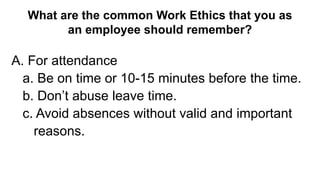
What are the common Work Ethics that you as
an employee should remember?
A. For attendance
a. Be on time or 10-15 minutes before the time.
b. Don’t abuse leave time.
c. Avoid absences without valid and important
reasons.
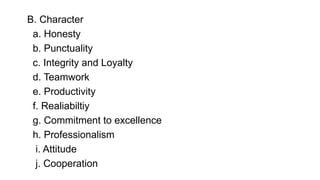
B. Character
a. Honesty
b. Punctuality
c. Integrity and Loyalty
d. Teamwork
e. Productivity
f. Realiabiltiy
g. Commitment to excellence
h. Professionalism
i. Attitude
j. Cooperation
• Work ethics are moral guidelines abided by both the
organization and employees. When a person presents an
attitude of hard work, honesty, and dedication toward his
job, he is said to have a strong work ethic. Failure to do so
can be described as a bad work ethic.
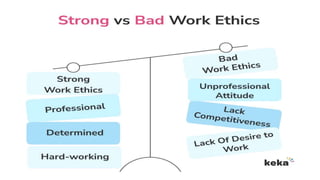
• Strong work ethics refer to being professional,
determined, hardworking, and dedicated. People with
strong work ethics prioritize projects, complete them on
time, meet deadlines, avoid blocking the workflow, and
are punctual. They often serve as role models to other
employees.
• Example:
• Allen takes great pride in his work. He gets a sense of
satisfaction from completing all his tasks on time. Before
committing to social activities, Allen makes sure to
prioritize his tasks and finish them. He tries to avoid
checking his social media or mobile phone at work. He
doesn’t forget to take enough breaks to recharge and get
back to work.
• Procrastination is something he tries to avoid at all costs.
To ensure that he has a proper work-life balance, Allen
spends his time getting work done as soon as possible,
while also ensuring high quality, so that he can commit
himself to activities outside of work.
• Allen serves as a role model for employees who have
trouble managing their work-life balance or producing
high quality works in a short amount of time.
• Bad Work Ethics
• People with bad work ethics display an unprofessional
attitude and lack competitiveness or desire to work. Their
work can lead to a lack of accountability, reliability, and
productivity. Employees with bad or weak work ethics
tend to engage in unprofessional relationships and
commit themselves to social activities without fulfilling
their work.
• Example:
• Dan is known for forming unprofessional relationships at
work. He engages in power politics and tends to openly
argue with the manager. Also known for initiating workplace
gossip, Dan deliberately abuses his lunch breaks by leaving
early and returning to work very late.
• Being negligent has caused loss of important documents,
performing tasks inefficiently, and submitting incomplete
work.
• Displaying hostility towards managers, being negligent, and
being a part of workplace gossip are a few examples of bad
work ethics.
Importance of Work Ethic
• A good work ethic indicates that an employee
consistently produces a high standard of work
while staying professional and displaying high
ambition. Having good workplace ethics ensures
that employees commit themselves to perform
their best and generating good results. Employees
who exhibit ideal work ethics inspire others to do
the same. Organizations usually reward people who
present strong work ethics and motivate others to
do the same.
• Good work ethics increase the quality of work
produced, productivity, and professionalism among
employees.
• Some examples of good work ethics include being
punctual, acting professionally, and having an
overall positive outlook toward work.
Different types of Work Ethics

Lesson-2.immersion (Work Ethics) Characteristicspptx

  • 1.
    Work Ethics Objectives: 1. definework ethics; 2. enumerate characteristics needed in developing good work ethics; 3. get oriented on the different work ethics; and 4. practice good work ethics.
  • 2.
    Lesson: Imagine you arean employer of a company. There are two applicants left after previous screenings. But you need only one to fill in the vacant position. Whom are you going to choose? Is it the applicant with very good credentials besides being an honor graduate, but during the interview, he appears to be arrogant as seen on his ways or actions; or is it the other applicant who is just an ordinary graduate but seems to be humble and sincere as what is projected in the interview?
  • 3.
    • Most ofthe time many choose the second applicant. He may not be as academically good as the other applicant but the way he answers during the interview revealed his character; the interviewer considers much the attitude. That’s why, your attitude towards work is very important which is about our lesson for today, Work Ethics.
  • 4.
    Work Ethics isa group of moral principles, standards of behavior, or set of values regarding proper conduct in the workplace. (Webster Dictionary)
  • 5.
    • Workplace ethicscan be promoted by having managers be the role model so that other employees can understand what is acceptable at work and what is not. Some companies provide ethics training and reward those who adhere to the ethical standards.
  • 6.
    There are manyinstances or stories you heard about employees being fired from a job or work. What could be the reasons? These are some of them: 1. Noncompliance with the rules and regulations 2. Harassment to fellow employees 3. Theft or stealing 4. Utterance of offensive language 5. Negligence of the responsibility 6. Troublemakers or frequent cause of conflict 7. Grievous offenses
  • 7.
    1. Always beneat and clean including your teeth, fingernails, face, hair and even your shoes. 2. Keep your pockets empty and as much as possible avoid tinkling coins or keys and bulges. 3. Avoid eating candies, smoking cigarettes and chewing gum when you are inside the office. Professional Appearance and Grooming for the Workplace
  • 8.
    4. Use portfoliocase or light briefcase when carrying important documents with you instead of compiling these documents in folders and carrying these between your armpits. 5. As much as possible get rid of tattoos and body piercings for these will just make you look untidy and unprofessional. 6. Wear light perfume/cologne and minimize using lots of jewelries. Professional Appearance and Grooming for the Workplace
  • 9.
    What are thecommon Work Ethics that you as an employee should remember? A. For attendance a. Be on time or 10-15 minutes before the time. b. Don’t abuse leave time. c. Avoid absences without valid and important reasons.
  • 10.
    B. Character a. Honesty b.Punctuality c. Integrity and Loyalty d. Teamwork e. Productivity f. Realiabiltiy g. Commitment to excellence h. Professionalism i. Attitude j. Cooperation
  • 12.
    • Work ethicsare moral guidelines abided by both the organization and employees. When a person presents an attitude of hard work, honesty, and dedication toward his job, he is said to have a strong work ethic. Failure to do so can be described as a bad work ethic.
  • 13.
    • Strong workethics refer to being professional, determined, hardworking, and dedicated. People with strong work ethics prioritize projects, complete them on time, meet deadlines, avoid blocking the workflow, and are punctual. They often serve as role models to other employees.
  • 14.
    • Example: • Allentakes great pride in his work. He gets a sense of satisfaction from completing all his tasks on time. Before committing to social activities, Allen makes sure to prioritize his tasks and finish them. He tries to avoid checking his social media or mobile phone at work. He doesn’t forget to take enough breaks to recharge and get back to work.
  • 15.
    • Procrastination issomething he tries to avoid at all costs. To ensure that he has a proper work-life balance, Allen spends his time getting work done as soon as possible, while also ensuring high quality, so that he can commit himself to activities outside of work. • Allen serves as a role model for employees who have trouble managing their work-life balance or producing high quality works in a short amount of time.
  • 16.
    • Bad WorkEthics • People with bad work ethics display an unprofessional attitude and lack competitiveness or desire to work. Their work can lead to a lack of accountability, reliability, and productivity. Employees with bad or weak work ethics tend to engage in unprofessional relationships and commit themselves to social activities without fulfilling their work.
  • 17.
    • Example: • Danis known for forming unprofessional relationships at work. He engages in power politics and tends to openly argue with the manager. Also known for initiating workplace gossip, Dan deliberately abuses his lunch breaks by leaving early and returning to work very late. • Being negligent has caused loss of important documents, performing tasks inefficiently, and submitting incomplete work. • Displaying hostility towards managers, being negligent, and being a part of workplace gossip are a few examples of bad work ethics.
  • 18.
  • 19.
    • A goodwork ethic indicates that an employee consistently produces a high standard of work while staying professional and displaying high ambition. Having good workplace ethics ensures that employees commit themselves to perform their best and generating good results. Employees who exhibit ideal work ethics inspire others to do the same. Organizations usually reward people who present strong work ethics and motivate others to do the same.
  • 20.
    • Good workethics increase the quality of work produced, productivity, and professionalism among employees. • Some examples of good work ethics include being punctual, acting professionally, and having an overall positive outlook toward work.
  • 21.
    Different types ofWork Ethics