RepublicofthePhilippines
DepartmentofEducation
Region II – Cagayan Valley
Schools Division of Cagayan
Tuao west District
Itawes National Agricultural and Technical School- Main
Bulagao, Tuao, Cagayan
What is
?
is one of the course requirement for graduation.
A Senior High School student has to undergo in
industry that directly relates to the student’s post secondary goal.
Through , the students are exposed to and become
familiar with work- related environment related to their field of
specialization to enhance their competence.
The students are able to:
a. gain a relevant and practical industrial skills under the guidance of industry
experts and workers;
b. appreciate the importance and application of principles and theories
taught in school;
c. enhance their technical knowledge and skills;
d. enrich their skills in communications and human relations; and
e. develop good work habits, attitudes, appreciation, and respect for work.
These prepare them to meet the needs and challenges of employment or
higher education after graduation.
The subject is a requirement for graduation, so
students under the K to 12 program must undergo
Work Immersion.
There has been a notion that companies are not allowed to
engage to youth below 18 yrs. Old; however, Article 130 of the
Philippine Labor Code actually sets the minimum employable age
at 15 years old.
In fact, there is also provision in the Labor Code (Art. 57 to 61
allowing for the employment of “aprentices” in highly technical
trades as long as he or she is at least 14 years old.
The minimum requirement for Work Immersion is
eighty (80) hours for our learners.
It is very necessary that learners have to be physically fit hence
some of the undertakings physical, emotional, spiritual challenges
in the workplace.
It is necessary also to require the with barangay. clearance, police
clearance and medical certificate.
They will continue the remaining subjects for their
course. They will also submit their PORTFOLIO
acquired during work immerrsion
The successful implementation of Work Immersion will depend on
the strong collaboration , support, and commitment of the school
personnel, partner institution, parents and students.
The care and diligence of the players involved in their undertaking
is necessary to have a smooth and memorable “first- hand
experience” of this program.
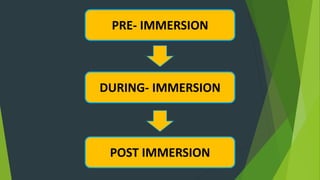
PRE- IMMERSION
DURING- IMMERSION
POST IMMERSION
PRE- IMMERSION
STEP 1: Attend the work immersion orientation. All responsibilities,
paperwork’s and other important details pertaining to the work immersion
will be explained by the immersion teacher:
o Walkthrough of the Parts of the entire Work Immersion Program;
o Explanation of the contextualized activity and scheme (Home-based
Scheme);
o Forms of Assessment; and
o Other important matters/ reminders regarding the Work Immersion.
PRE- IMMERSION
STEP 2: Attend the next immersion class. Immersion
Teacher will conduct a discussion the following topics:
oResume;
oCover letter; and
oWork Ethics
oPortfolio
PRE IMMERSION
STEP 3: Attend the next immersion class. Immersion
Teacher will identify and assign the following:
oHome-based Immersion schedule; and
oList of Tasks/ activities to be done anchored to the
learner’s specialization
DURING IMMERSION
STEP 4: The learners shall be responsible in accomplishing
the following reports (all are included in this manual and
portfolio:
oNarrative/ Diary;
oReflections; and
oEvaluation Report/ Self- Assessment Guide
POST IMMERSION
STEP 5: Evaluation of the work immersion experience and
completion of the immersion requirements.
o Presentation of Portfolio with weekly diary entries
o Writing an updated resume
o Job Interview
Work Immersion ppt..pptx

Work Immersion ppt..pptx

  • 1.
    RepublicofthePhilippines DepartmentofEducation Region II –Cagayan Valley Schools Division of Cagayan Tuao west District Itawes National Agricultural and Technical School- Main Bulagao, Tuao, Cagayan
  • 2.
  • 4.
    is one ofthe course requirement for graduation. A Senior High School student has to undergo in industry that directly relates to the student’s post secondary goal. Through , the students are exposed to and become familiar with work- related environment related to their field of specialization to enhance their competence.
  • 5.
    The students areable to: a. gain a relevant and practical industrial skills under the guidance of industry experts and workers; b. appreciate the importance and application of principles and theories taught in school; c. enhance their technical knowledge and skills; d. enrich their skills in communications and human relations; and e. develop good work habits, attitudes, appreciation, and respect for work. These prepare them to meet the needs and challenges of employment or higher education after graduation.
  • 6.
    The subject isa requirement for graduation, so students under the K to 12 program must undergo Work Immersion.
  • 7.
    There has beena notion that companies are not allowed to engage to youth below 18 yrs. Old; however, Article 130 of the Philippine Labor Code actually sets the minimum employable age at 15 years old. In fact, there is also provision in the Labor Code (Art. 57 to 61 allowing for the employment of “aprentices” in highly technical trades as long as he or she is at least 14 years old.
  • 9.
    The minimum requirementfor Work Immersion is eighty (80) hours for our learners.
  • 10.
    It is verynecessary that learners have to be physically fit hence some of the undertakings physical, emotional, spiritual challenges in the workplace. It is necessary also to require the with barangay. clearance, police clearance and medical certificate.
  • 11.
    They will continuethe remaining subjects for their course. They will also submit their PORTFOLIO acquired during work immerrsion
  • 12.
    The successful implementationof Work Immersion will depend on the strong collaboration , support, and commitment of the school personnel, partner institution, parents and students. The care and diligence of the players involved in their undertaking is necessary to have a smooth and memorable “first- hand experience” of this program.
  • 15.
  • 16.
    PRE- IMMERSION STEP 1:Attend the work immersion orientation. All responsibilities, paperwork’s and other important details pertaining to the work immersion will be explained by the immersion teacher: o Walkthrough of the Parts of the entire Work Immersion Program; o Explanation of the contextualized activity and scheme (Home-based Scheme); o Forms of Assessment; and o Other important matters/ reminders regarding the Work Immersion.
  • 17.
    PRE- IMMERSION STEP 2:Attend the next immersion class. Immersion Teacher will conduct a discussion the following topics: oResume; oCover letter; and oWork Ethics oPortfolio
  • 18.
    PRE IMMERSION STEP 3:Attend the next immersion class. Immersion Teacher will identify and assign the following: oHome-based Immersion schedule; and oList of Tasks/ activities to be done anchored to the learner’s specialization
  • 19.
    DURING IMMERSION STEP 4:The learners shall be responsible in accomplishing the following reports (all are included in this manual and portfolio: oNarrative/ Diary; oReflections; and oEvaluation Report/ Self- Assessment Guide
  • 20.
    POST IMMERSION STEP 5:Evaluation of the work immersion experience and completion of the immersion requirements. o Presentation of Portfolio with weekly diary entries o Writing an updated resume o Job Interview