LESSON
4:
SAFETY IN THE
WORKPLACE
GROUP 4
CINCO, RALPH
MALUPING, CLARENCE
MORENO, MATT STEVEN
BONGAT, SHANAMAE
CREER, CLARIZE
ESPINA, BARBARA JANE
RENOMERON, MARIA JHUNORA
OCCUPATIONAL SAFETY AND
HEALTH STANDARDS (OSHS)
THIS was formulated in 1978 in compliance with the
constitutional mandate to safeguard the workers' social
and economic well-being as well as their physical safety
and health. The Department of Labor and Employment
under Article 162 of the Labor Code of the Philippines, the
OSHS was promulgated for the guidance and compliance
of all concerned. This body of rules and regulations is
referred to as "Standards".
OSHS aims to protect every workingman and woman
against the dangers of injury, sickness or death
through safe and healthful working conditions,
thereby assuring the conservation of valuable
manpower resources and the prevention of loss or
damage to lives and properties, consistent with
national development goals and with the State's
commitment for the total development of every worker
as a complete human being.
includes any person acting
directly or indirectly in the interest
owned or controlled corporations
and institutions, as well as non-
profit of an employer, in relation to
an employee, and shall include
government- private institutions or
organizations.
"EMPLOYER"
shall mean any person hired,
permitted or suffered to work by an
employer.
"EMPLOYEE"
shall refer to the physical or
environmental conditions of work
or employment, which
substantially comply with the
provisions of these Standards.
"SAFE OR SAFETY"
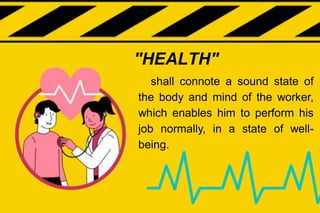
shall connote a sound state of
the body and mind of the worker,
which enables him to perform his
job normally, in a state of well-
being.
"HEALTH"
shall mean an unplanned or
unexpected occurrence that may
or may not result in personal
injury, property damage, work
stoppage or interference or any
combination thereof, which arises
out of and in the course of
employment.
"WORK ACCIDENT"
shall mean any injury or
occupational illness suffered by a
person, which arises out of or in
the course of his employment.
"WORK INQUIRY"
means the office, premises or
work site, where the workers are
habitually employed and shall
include the office or place where
the workers, who have no fixed or
definite work site, regularly report
for assignment in the course of
their employment.
"WORKPLACE"
DUTIES OF
EMPLOYERS,
WORKERS AND
OTHER PERSONS
1. Each employer covered by the provisions of
these Standards shall:
a. furnish his workers a place of employment
free from hazardous conditions that are causing or
are likely to cause death, illness or physical harm
to his workers;
b. Give complete job safety instructions to all
his workers, especially to those entering the job
for the first time, including those relating to the
familiarization with their work environment,
hazards to which the workers are exposed to and
steps taken in case of emergency;
c. Comply with the requirements of this
Standards; and
d. use only approved devices and equipment in
his workplace.
2. Each worker shall:
a. Cooperate with the employer in carrying out
the provisions of this.
b. report to his supervisor any work hazard that
may be discovered in his workplace. Standards.
c. Make proper use of all safeguards and safety
devices furnished in accordance with the
provisions of this Standards for his protection
and that of others, and shall follow all instructions
given by the employer in compliance with the
provisions of this Standards.
d. use personal protection and safety equipment
as required by the employer.
e. Follow work safe procedures.
3. It shall be the duty of any person:
including any builder or contractor or
enforcement agent, who visits, builds, renovates,
or installs devices, or conducts business in any
establishment or workplace, to comply with the
provisions of this Standards and all regulations of
the employer issued there under as well as with
other subsequent issuances of the Secretary.
SPECIFIC
GUIDELINES
that DOH
implements:
1. The employer that the properly ventilated,
and
2. The employer provide proper safety for
the workplace to compliance.
3. Other prevention and control measures
are: must workspace is disinfected,
maintained. shall also visual reminders
policies around improve.
a. Conduct daily temperature and symptom
monitoring and recording of all staff who
report for work.
b. Establish referral network for employees
who will develop symptoms.
c. Employers must enforce infection control
procedures such as physical distancing,
wearing of masks, meticulous hand hygiene,
and cough etiquette.
Appropriate PPE shall also be worn based
on the setting of their work (e.g. face shields
and masks for those who render service via
face-to- face encounters, full PPE for
frontline healthcare workers, etc.).
d. Employers shall implement activities to
promote physical and mental resilience
among their employees and workers, and
ensure other measures to reduce
transmission, contact rate and risk of
infection.
HAZARD
Hazard is anything
with potential to
cause injury, illness,
or damage.
TYPES
OF
HAZARD
PHYSICAL HAZARD
These conditions, poor lighting, poor
ventilation, insufficient facilities,
inefficient or faulty equipment or
machine, and improper work practices
like wrong use of knives.
BIOLOGICAL HAZARD
These are brought about by workers infected
with diseases or illnesses, unhygienic personal
practices that can transmit bacteria, parasites,
fungi to other workers and food and equipment
being handled. Hence, it is advised that Covid-
19 probable cases should be isolated right
away.
These are brought by poor posture when
working long periods of standing, bending,
pushing, lifting, carrying that can cause
body stress, muscle pains, and soreness,
back injury, numbness of hands, feet and
other parts of the body
ERGONOMIC HAZARD
These are brought by too much stress
from work that may cause mental
emotional strains, anxieties,
depression- losing focus on one's
work and others
PSYCHOLOGICAL
HAZARD
WHEN POTENTIAL HAZARD IS DISCOVERED,
WHAT DOES AN EMPLOYEE NEED TO DO?
• Be sure that every individual in the workplace is
aware of the problem.
• Inform or notify your supervisor. Unless you are the
supervisor, then get going on that safety committee
plan.
WHEN POTENTIAL HAZARD IS DISCOVERED,
WHAT DOES AN EMPLOYEE NEED TO DO?
• Make a follow up. Informing about the hazard is not
an assurance that problem is resolved, unless you
make follow ups.
• Record or file any reports or documents about the
problem. Identifying the hazard is not the only way to
make everyone safe. You and I have to keep ourselves
clean, to keep the food clean, and to keep the
workplace clean.
IDENTIFYING THE HAZARD IS NOT THE ONLY WAY
TO MAKE EVERYONE SAFE. YOU AND I HAVE TO
KEEP OURSELVES CLEAN, TO KEEP THE FOOD
CLEAN, AND TO KEEP THE WORKPLACE CLEAN.
A. To Keep Oneself Clean
1. Wash hands thoroughly.
2. Keep the finger nails short and clean.
3. Always wear PPE while at work.
4. Wear mask anywhere and
5. Remove all accessories before working.
B. To keep the Food Clean anytime.
1. Never handle food when you have wounds, cuts,
and infections.
2. It is best to work with clean and sanitized gloves all
times to minimize hand contact with food.
3. Refrigerate food, especially perishable ones.
4. Keep food in clean containers with cover.
5. Wash fruits and vegetables thoroughly before use.
6. Check food and containers for any possible
contamination.
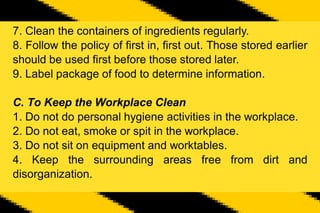
7. Clean the containers of ingredients regularly.
8. Follow the policy of first in, first out. Those stored earlier
should be used first before those stored later.
9. Label package of food to determine information.
C. To Keep the Workplace Clean
1. Do not do personal hygiene activities in the workplace.
2. Do not eat, smoke or spit in the workplace.
3. Do not sit on equipment and worktables.
4. Keep the surrounding areas free from dirt and
disorganization.
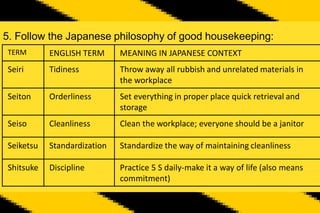
5. Follow the Japanese philosophy of good housekeeping:
TERM ENGLISH TERM MEANING IN JAPANESE CONTEXT
Seiri Tidiness Throw away all rubbish and unrelated materials in
the workplace
Seiton Orderliness Set everything in proper place quick retrieval and
storage
Seiso Cleanliness Clean the workplace; everyone should be a janitor
Seiketsu Standardization Standardize the way of maintaining cleanliness
Shitsuke Discipline Practice 5 S daily-make it a way of life (also means
commitment)
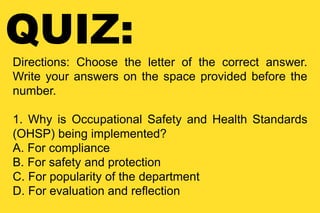
QUIZ:
Directions: Choose the letter of the correct answer.
Write your answers on the space provided before the
number.
1. Why is Occupational Safety and Health Standards
(OHSP) being implemented?
A. For compliance
B. For safety and protection
C. For popularity of the department
D. For evaluation and reflection
2. If you know you are not feeling well due to colds,
cough and fever, you prefer to stay at home and rest.
This act can help everyone in the workplace safe from
spread of the illness. What type of hazard can be
avoided?
A. Biological B. Chemical C. Ergonomic D. Physical
3. What kind of hazard causes emotional strains like
anxieties and depression?
A. Biological
B. Ergonomic
C. Physical
D. Psychological
4. What value is being inculcated in you upon the
discussion of the safety in a workplace?
A. Empathy B. Flexibility C. Obedience C. Reliability
5. You are the 3rd worker who came into a shop. You
have noticed spilled milk on the floor which could be
considered a physical hazard. What is the best thing
you have to do to avoid this hazard?
A. I will just look for a signage and put it on the wet
floor.
B. I will inform the others not to step on that wet floor.
C. I will ask my colleagues why there is spilled milk.
D. I will get a wet mop to clean and dry the floor
6. What is being referred to by this statement? It refers
to the physical or environmental conditions of work or
employment, which substantially comply with the
provisions of this Standard.
A. Safety B. Workplace C. PPE D. Health
7. What is an unplanned or expected event in the
workplace that results to injury or damage to property?
A. Recognized Hazards
B. Risks
C. Work Accident
D. Work Safety
8. Why do you need to work safely on the perspective
of the management?
A. For the most important people in our lives
B. To earn more for the family
C. To be more productive
D. To protect ourselves
9. What agency has the mandate to protect an
employee if he encounters problems with his work?
A. DILG
B. DOH
C. DOLE
D. TESDA
10. What shall you do when a potential hazard is
discovered?
A. Make sure that everyone else in your workplace is
aware of the problem.
B. Just keep quiet and avoid it.
C. Notify your supervisor.
D. Stay calm.
E. Both a & C.
GOODLUCK!!
FROM GROUP 4

LESSON-4-SAFETY-IN-THE-WORKPLACE.pptx

  • 1.
    LESSON 4: SAFETY IN THE WORKPLACE GROUP4 CINCO, RALPH MALUPING, CLARENCE MORENO, MATT STEVEN BONGAT, SHANAMAE CREER, CLARIZE ESPINA, BARBARA JANE RENOMERON, MARIA JHUNORA
  • 2.
    OCCUPATIONAL SAFETY AND HEALTHSTANDARDS (OSHS) THIS was formulated in 1978 in compliance with the constitutional mandate to safeguard the workers' social and economic well-being as well as their physical safety and health. The Department of Labor and Employment under Article 162 of the Labor Code of the Philippines, the OSHS was promulgated for the guidance and compliance of all concerned. This body of rules and regulations is referred to as "Standards".
  • 3.
    OSHS aims toprotect every workingman and woman against the dangers of injury, sickness or death through safe and healthful working conditions, thereby assuring the conservation of valuable manpower resources and the prevention of loss or damage to lives and properties, consistent with national development goals and with the State's commitment for the total development of every worker as a complete human being.
  • 4.
    includes any personacting directly or indirectly in the interest owned or controlled corporations and institutions, as well as non- profit of an employer, in relation to an employee, and shall include government- private institutions or organizations. "EMPLOYER"
  • 5.
    shall mean anyperson hired, permitted or suffered to work by an employer. "EMPLOYEE"
  • 6.
    shall refer tothe physical or environmental conditions of work or employment, which substantially comply with the provisions of these Standards. "SAFE OR SAFETY"
  • 7.
    shall connote asound state of the body and mind of the worker, which enables him to perform his job normally, in a state of well- being. "HEALTH"
  • 8.
    shall mean anunplanned or unexpected occurrence that may or may not result in personal injury, property damage, work stoppage or interference or any combination thereof, which arises out of and in the course of employment. "WORK ACCIDENT"
  • 9.
    shall mean anyinjury or occupational illness suffered by a person, which arises out of or in the course of his employment. "WORK INQUIRY"
  • 10.
    means the office,premises or work site, where the workers are habitually employed and shall include the office or place where the workers, who have no fixed or definite work site, regularly report for assignment in the course of their employment. "WORKPLACE"
  • 11.
  • 12.
    1. Each employercovered by the provisions of these Standards shall: a. furnish his workers a place of employment free from hazardous conditions that are causing or are likely to cause death, illness or physical harm to his workers; b. Give complete job safety instructions to all his workers, especially to those entering the job for the first time, including those relating to the
  • 13.
    familiarization with theirwork environment, hazards to which the workers are exposed to and steps taken in case of emergency; c. Comply with the requirements of this Standards; and d. use only approved devices and equipment in his workplace.
  • 14.
    2. Each workershall: a. Cooperate with the employer in carrying out the provisions of this. b. report to his supervisor any work hazard that may be discovered in his workplace. Standards. c. Make proper use of all safeguards and safety devices furnished in accordance with the provisions of this Standards for his protection
  • 15.
    and that ofothers, and shall follow all instructions given by the employer in compliance with the provisions of this Standards. d. use personal protection and safety equipment as required by the employer. e. Follow work safe procedures.
  • 16.
    3. It shallbe the duty of any person: including any builder or contractor or enforcement agent, who visits, builds, renovates, or installs devices, or conducts business in any establishment or workplace, to comply with the provisions of this Standards and all regulations of the employer issued there under as well as with other subsequent issuances of the Secretary.
  • 17.
  • 18.
    1. The employerthat the properly ventilated, and 2. The employer provide proper safety for the workplace to compliance. 3. Other prevention and control measures are: must workspace is disinfected, maintained. shall also visual reminders policies around improve.
  • 19.
    a. Conduct dailytemperature and symptom monitoring and recording of all staff who report for work. b. Establish referral network for employees who will develop symptoms. c. Employers must enforce infection control procedures such as physical distancing, wearing of masks, meticulous hand hygiene, and cough etiquette.
  • 20.
    Appropriate PPE shallalso be worn based on the setting of their work (e.g. face shields and masks for those who render service via face-to- face encounters, full PPE for frontline healthcare workers, etc.).
  • 21.
    d. Employers shallimplement activities to promote physical and mental resilience among their employees and workers, and ensure other measures to reduce transmission, contact rate and risk of infection.
  • 22.
    HAZARD Hazard is anything withpotential to cause injury, illness, or damage.
  • 23.
  • 24.
    PHYSICAL HAZARD These conditions,poor lighting, poor ventilation, insufficient facilities, inefficient or faulty equipment or machine, and improper work practices like wrong use of knives.
  • 25.
    BIOLOGICAL HAZARD These arebrought about by workers infected with diseases or illnesses, unhygienic personal practices that can transmit bacteria, parasites, fungi to other workers and food and equipment being handled. Hence, it is advised that Covid- 19 probable cases should be isolated right away.
  • 26.
    These are broughtby poor posture when working long periods of standing, bending, pushing, lifting, carrying that can cause body stress, muscle pains, and soreness, back injury, numbness of hands, feet and other parts of the body ERGONOMIC HAZARD
  • 27.
    These are broughtby too much stress from work that may cause mental emotional strains, anxieties, depression- losing focus on one's work and others PSYCHOLOGICAL HAZARD
  • 28.
    WHEN POTENTIAL HAZARDIS DISCOVERED, WHAT DOES AN EMPLOYEE NEED TO DO? • Be sure that every individual in the workplace is aware of the problem. • Inform or notify your supervisor. Unless you are the supervisor, then get going on that safety committee plan.
  • 29.
    WHEN POTENTIAL HAZARDIS DISCOVERED, WHAT DOES AN EMPLOYEE NEED TO DO? • Make a follow up. Informing about the hazard is not an assurance that problem is resolved, unless you make follow ups. • Record or file any reports or documents about the problem. Identifying the hazard is not the only way to make everyone safe. You and I have to keep ourselves clean, to keep the food clean, and to keep the workplace clean.
  • 30.
    IDENTIFYING THE HAZARDIS NOT THE ONLY WAY TO MAKE EVERYONE SAFE. YOU AND I HAVE TO KEEP OURSELVES CLEAN, TO KEEP THE FOOD CLEAN, AND TO KEEP THE WORKPLACE CLEAN. A. To Keep Oneself Clean 1. Wash hands thoroughly. 2. Keep the finger nails short and clean. 3. Always wear PPE while at work. 4. Wear mask anywhere and 5. Remove all accessories before working.
  • 31.
    B. To keepthe Food Clean anytime. 1. Never handle food when you have wounds, cuts, and infections. 2. It is best to work with clean and sanitized gloves all times to minimize hand contact with food. 3. Refrigerate food, especially perishable ones. 4. Keep food in clean containers with cover. 5. Wash fruits and vegetables thoroughly before use. 6. Check food and containers for any possible contamination.
  • 32.
    7. Clean thecontainers of ingredients regularly. 8. Follow the policy of first in, first out. Those stored earlier should be used first before those stored later. 9. Label package of food to determine information. C. To Keep the Workplace Clean 1. Do not do personal hygiene activities in the workplace. 2. Do not eat, smoke or spit in the workplace. 3. Do not sit on equipment and worktables. 4. Keep the surrounding areas free from dirt and disorganization.
  • 33.
    5. Follow theJapanese philosophy of good housekeeping: TERM ENGLISH TERM MEANING IN JAPANESE CONTEXT Seiri Tidiness Throw away all rubbish and unrelated materials in the workplace Seiton Orderliness Set everything in proper place quick retrieval and storage Seiso Cleanliness Clean the workplace; everyone should be a janitor Seiketsu Standardization Standardize the way of maintaining cleanliness Shitsuke Discipline Practice 5 S daily-make it a way of life (also means commitment)
  • 34.
    QUIZ: Directions: Choose theletter of the correct answer. Write your answers on the space provided before the number. 1. Why is Occupational Safety and Health Standards (OHSP) being implemented? A. For compliance B. For safety and protection C. For popularity of the department D. For evaluation and reflection
  • 35.
    2. If youknow you are not feeling well due to colds, cough and fever, you prefer to stay at home and rest. This act can help everyone in the workplace safe from spread of the illness. What type of hazard can be avoided? A. Biological B. Chemical C. Ergonomic D. Physical 3. What kind of hazard causes emotional strains like anxieties and depression? A. Biological B. Ergonomic C. Physical D. Psychological
  • 36.
    4. What valueis being inculcated in you upon the discussion of the safety in a workplace? A. Empathy B. Flexibility C. Obedience C. Reliability 5. You are the 3rd worker who came into a shop. You have noticed spilled milk on the floor which could be considered a physical hazard. What is the best thing you have to do to avoid this hazard? A. I will just look for a signage and put it on the wet floor. B. I will inform the others not to step on that wet floor. C. I will ask my colleagues why there is spilled milk. D. I will get a wet mop to clean and dry the floor
  • 37.
    6. What isbeing referred to by this statement? It refers to the physical or environmental conditions of work or employment, which substantially comply with the provisions of this Standard. A. Safety B. Workplace C. PPE D. Health 7. What is an unplanned or expected event in the workplace that results to injury or damage to property? A. Recognized Hazards B. Risks C. Work Accident D. Work Safety
  • 38.
    8. Why doyou need to work safely on the perspective of the management? A. For the most important people in our lives B. To earn more for the family C. To be more productive D. To protect ourselves 9. What agency has the mandate to protect an employee if he encounters problems with his work? A. DILG B. DOH C. DOLE D. TESDA
  • 39.
    10. What shallyou do when a potential hazard is discovered? A. Make sure that everyone else in your workplace is aware of the problem. B. Just keep quiet and avoid it. C. Notify your supervisor. D. Stay calm. E. Both a & C. GOODLUCK!! FROM GROUP 4