
College of Education
Third year
ELT
Presented by:-
Ustaza:
Designed by;-
Menu
Home
page
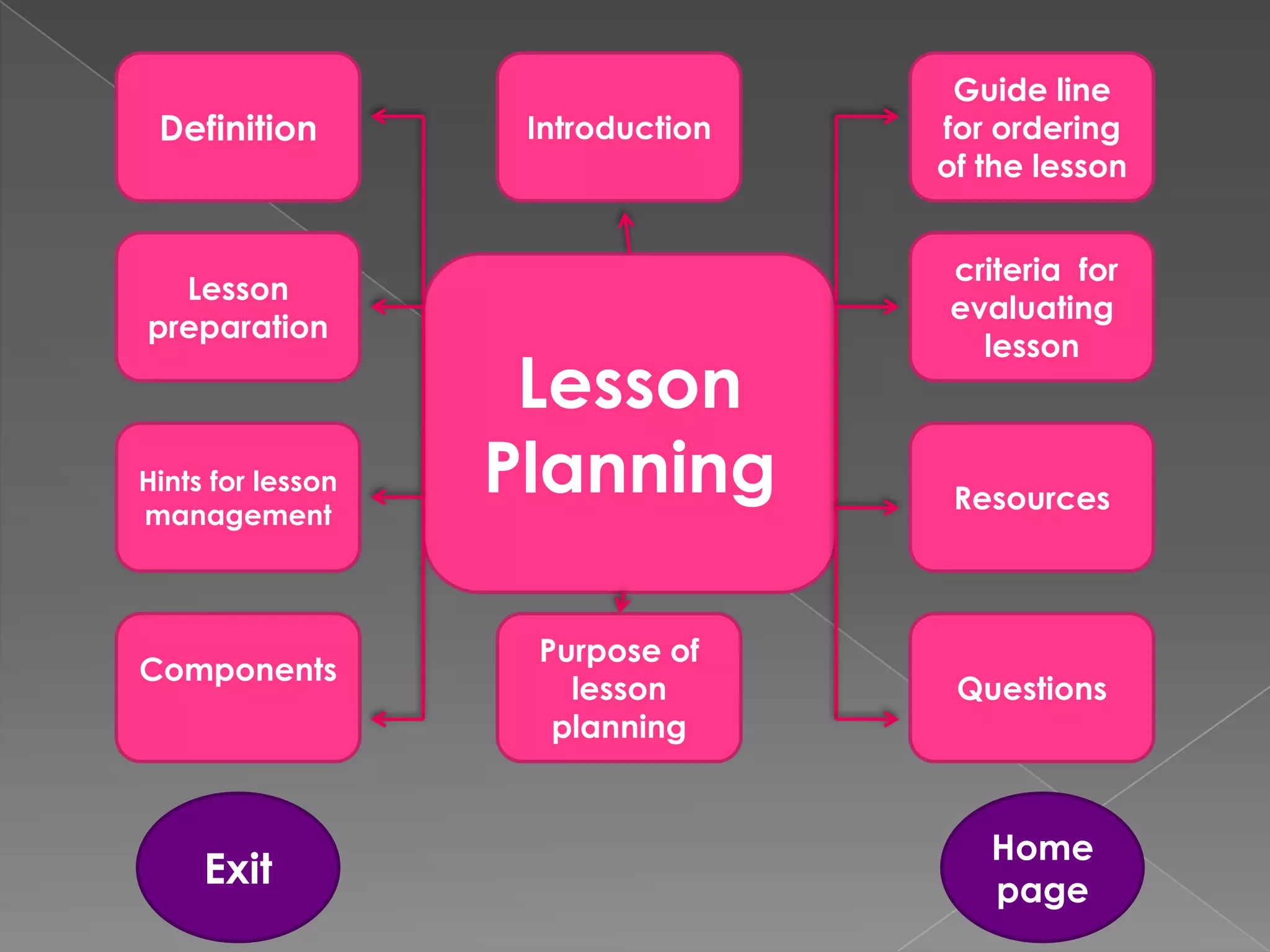
Introduction
Hints for lesson
management
Definition
criteria for
evaluating
lesson
Guide line
for ordering
of the lesson
Resources
Questions
Components
Exit
Lesson
Planning
Lesson
preparation
Purpose of
lesson
planning
Home
page
You fail to plan, you plan to fail.
Whatever you are & whenever you are
you need to plan not only for your life but
also for your students.
 One of the most important thing in
classroom management is lesson
planning & it is one of the stages of
controlling class.
 Good lesson planning is essential to the
process of learning and teaching.
Menu Back Next
 A variety show A conversation
 Climbing a mountain doing the shopping
 Eating a meal a football game
 A wedding a symphony
 A menu consulting a doctor
Menu NextBack
 Structure the lesson.
 Organize its contents/materials.
 Determine method of its delivery.
 Assess student's learning.
 Evaluate its application/effectiveness.
Menu Exit
A description or outline of (a) the goals
or OBJECTIVES a teacher has set for a
lesson (b) the activities and procedures
the teacher will use to achieve them, the
time to be allocated to each
activity, and the order to be followed,
and (c) the materials and resources
which will be used during the lesson.
Jack Richard 2002
Menu Exit
1. Level and number of students.
2. Headline of lesson .
3. Teaching aids – materials – equipments.
4. Aims (Main - Subsidiary - Personal ).
5. Procedures.
6. Assumptions.
Menu Next
7. Timetable fit.
8. Anticipate problems.
9. Possible solutions.
10. Interaction pattern.
11. Home work.
12. Timing.
Menu Back Next
Menu Back Next
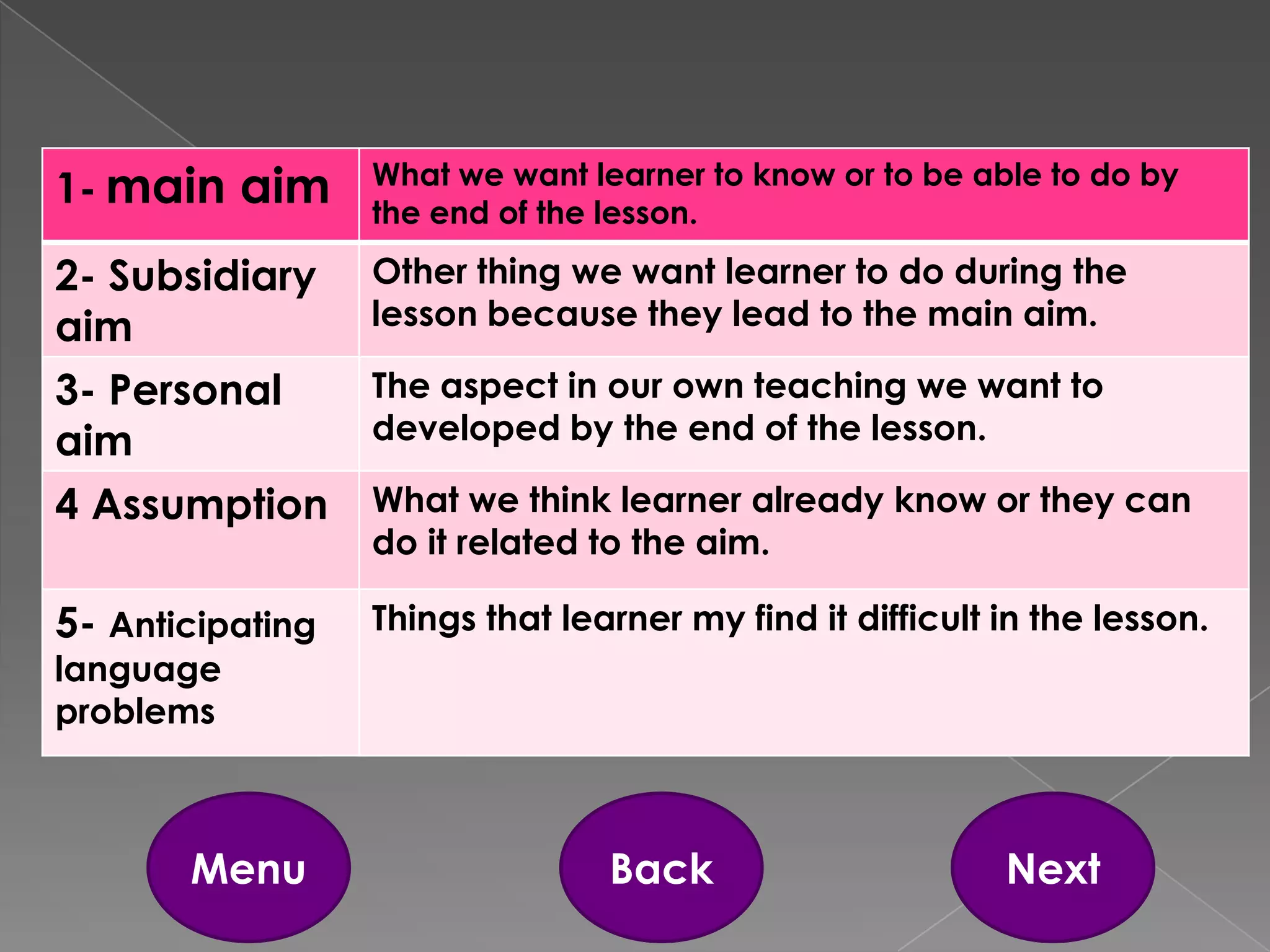
1- main aim What we want learner to know or to be able to do by
the end of the lesson.
2- Subsidiary
aim
Other thing we want learner to do during the
lesson because they lead to the main aim.
3- Personal
aim
The aspect in our own teaching we want to
developed by the end of the lesson.
4 Assumption What we think learner already know or they can
do it related to the aim.
5- Anticipating
language
problems
Things that learner my find it difficult in the lesson.
6- Number and level of the
students:-
How may students in the class
room what their level (beginner
–intermediate – advance).
7-The head line of the lesson:- What is lesson about?
8-Equipments:- What is aids that your going to
use such as black board –
computer – online materials?
9-Timetable fit :- How the lesson is connected to
the last lesson or the next one.
10-Interaction pattern:- Individual, pair, group, whole
class.
Menu Back
Menu Exit
1-Put the harder tasks earlier .
2-Have quieter activities before lively
ones.
3-Think about transactions.
4-Pull the class together at the beginning
and the end.
5-End on a positive note.
• The learners were active all the time.
• The learners were attentive all the time
• The learners enjoyed the lesson ,were
motivated.
• The lass seemed to be learning the material
well.
• The lesson went according to the plan.
• The language was used communicatively
through out.
• The learners were engaging with the foreign
language throughout.
Menu Exit
 How long before specific lesson do you
prepare?
 Do you write down lesson notes to guide
you ? Or you rely on a lesson format?
 If so, are these notes brief ( a single
page or less) or long (more than one
page)?
 What do they consist?
Menu Next
 Do you note down your objectives?
 Do you actually look at your notes
during the lesson? If so, rarely?
Occasionally ? frequently?
 What do you actually do with your
lesson notes after the lesson?
Menu Back
• Prepare more than you need
• Similarly ,note I advance which
components of the lesson you will sacrifice
if you find yourself with too little time for
everything.
• Keep a watch or a clock easily visible.
• Do not leave the giving of homework to the
last minute at the end of the lesson learners’
attention at a low ebb.
• If you have papers to distribute and a large
class . Do not try to give every paper to the
class yourself.
Menu Next
 If you are doing group work ,give
instructions and make sure these
understood before dividing them into
groups or even handing out materials.
BackMenu
 Jack. C. Richard. Longman Dictionary of
Language Teaching and Applied
Linguistics.London.NewYork.2002.
 Mary Spratt .etal .T K T. Cambridge
University. Nd.
 WWW.slideshre .com.
Menu Exit
Menu Exit

Lesson planning

  • 1.
    College of Education Thirdyear ELT Presented by:- Ustaza: Designed by;- Menu Home page
  • 2.
    Introduction Hints for lesson management Definition criteriafor evaluating lesson Guide line for ordering of the lesson Resources Questions Components Exit Lesson Planning Lesson preparation Purpose of lesson planning Home page
  • 3.
    You fail toplan, you plan to fail. Whatever you are & whenever you are you need to plan not only for your life but also for your students.  One of the most important thing in classroom management is lesson planning & it is one of the stages of controlling class.  Good lesson planning is essential to the process of learning and teaching. Menu Back Next
  • 4.
     A varietyshow A conversation  Climbing a mountain doing the shopping  Eating a meal a football game  A wedding a symphony  A menu consulting a doctor Menu NextBack
  • 5.
     Structure thelesson.  Organize its contents/materials.  Determine method of its delivery.  Assess student's learning.  Evaluate its application/effectiveness. Menu Exit
  • 6.
    A description oroutline of (a) the goals or OBJECTIVES a teacher has set for a lesson (b) the activities and procedures the teacher will use to achieve them, the time to be allocated to each activity, and the order to be followed, and (c) the materials and resources which will be used during the lesson. Jack Richard 2002 Menu Exit
  • 7.
    1. Level andnumber of students. 2. Headline of lesson . 3. Teaching aids – materials – equipments. 4. Aims (Main - Subsidiary - Personal ). 5. Procedures. 6. Assumptions. Menu Next
  • 8.
    7. Timetable fit. 8.Anticipate problems. 9. Possible solutions. 10. Interaction pattern. 11. Home work. 12. Timing. Menu Back Next
  • 9.
    Menu Back Next 1-main aim What we want learner to know or to be able to do by the end of the lesson. 2- Subsidiary aim Other thing we want learner to do during the lesson because they lead to the main aim. 3- Personal aim The aspect in our own teaching we want to developed by the end of the lesson. 4 Assumption What we think learner already know or they can do it related to the aim. 5- Anticipating language problems Things that learner my find it difficult in the lesson.
  • 10.
    6- Number andlevel of the students:- How may students in the class room what their level (beginner –intermediate – advance). 7-The head line of the lesson:- What is lesson about? 8-Equipments:- What is aids that your going to use such as black board – computer – online materials? 9-Timetable fit :- How the lesson is connected to the last lesson or the next one. 10-Interaction pattern:- Individual, pair, group, whole class. Menu Back
  • 11.
    Menu Exit 1-Put theharder tasks earlier . 2-Have quieter activities before lively ones. 3-Think about transactions. 4-Pull the class together at the beginning and the end. 5-End on a positive note.
  • 12.
    • The learnerswere active all the time. • The learners were attentive all the time • The learners enjoyed the lesson ,were motivated. • The lass seemed to be learning the material well. • The lesson went according to the plan. • The language was used communicatively through out. • The learners were engaging with the foreign language throughout. Menu Exit
  • 13.
     How longbefore specific lesson do you prepare?  Do you write down lesson notes to guide you ? Or you rely on a lesson format?  If so, are these notes brief ( a single page or less) or long (more than one page)?  What do they consist? Menu Next
  • 14.
     Do younote down your objectives?  Do you actually look at your notes during the lesson? If so, rarely? Occasionally ? frequently?  What do you actually do with your lesson notes after the lesson? Menu Back
  • 15.
    • Prepare morethan you need • Similarly ,note I advance which components of the lesson you will sacrifice if you find yourself with too little time for everything. • Keep a watch or a clock easily visible. • Do not leave the giving of homework to the last minute at the end of the lesson learners’ attention at a low ebb. • If you have papers to distribute and a large class . Do not try to give every paper to the class yourself. Menu Next
  • 16.
     If youare doing group work ,give instructions and make sure these understood before dividing them into groups or even handing out materials. BackMenu
  • 17.
     Jack. C.Richard. Longman Dictionary of Language Teaching and Applied Linguistics.London.NewYork.2002.  Mary Spratt .etal .T K T. Cambridge University. Nd.  WWW.slideshre .com. Menu Exit
  • 18.