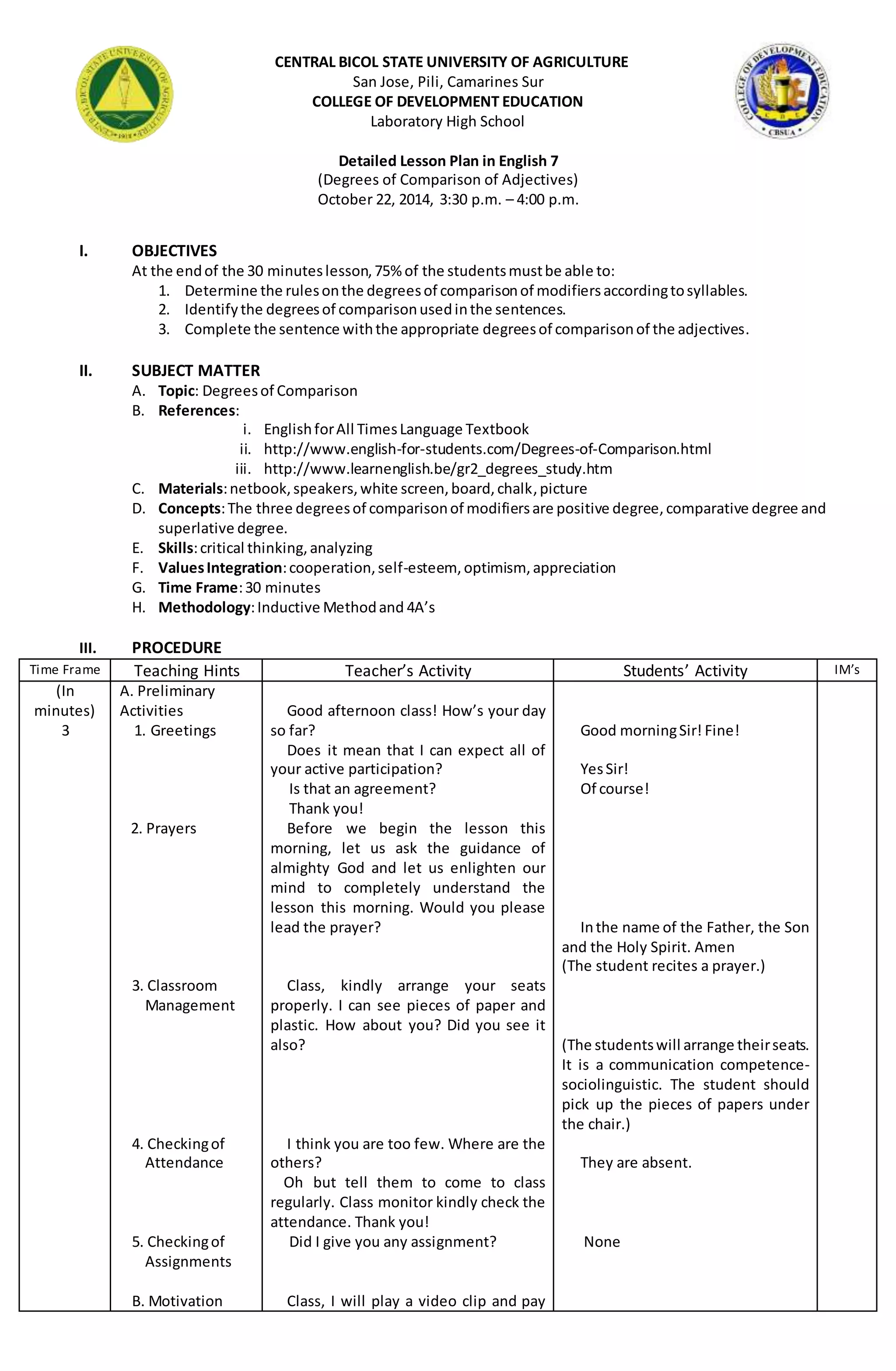
CENTRAL BICOL STATE UNIVERSITY OF AGRICULTURE 
San Jose, Pili, Camarines Sur 
COLLEGE OF DEVELOPMENT EDUCATION 
Laboratory High School 
Detailed Lesson Plan in English 7 
(Degrees of Comparison of Adjectives) 
October 22, 2014, 3:30 p.m. – 4:00 p.m. 
I. OBJECTIVES 
At the end of the 30 minutes lesson, 75% of the students must be able to: 
1. Determine the rules on the degrees of comparison of modifiers according to syllables. 
2. Identify the degrees of comparison used in the sentences. 
3. Complete the sentence with the appropriate degrees of comparison of the adjectives. 
II. SUBJECT MATTER 
A. Topic: Degrees of Comparison 
B. References: 
i. English for All Times Language Textbook 
ii. http://www.english-for-students.com/Degrees-of-Comparison.html 
iii. http://www.learnenglish.be/gr2_degrees_study.htm 
C. Materials: netbook, speakers, white screen, board, chalk, picture 
D. Concepts: The three degrees of comparison of modifiers are positive degree, comparative degree and 
superlative degree. 
E. Skills: critical thinking, analyzing 
F. Values Integration: cooperation, self-esteem, optimism, appreciation 
G. Time Frame: 30 minutes 
H. Methodology: Inductive Method and 4A’s 
III. PROCEDURE 
Time Frame Teaching Hints Teacher’s Activity Students’ Activity IM’s 
(In 
minutes) 
3 
A. Preliminary 
Activities 
1. Greetings 
2. Prayers 
3. Classroom 
Management 
4. Checking of 
Attendance 
5. Checking of 
Assignments 
B. Motivation 
Good afternoon class! How’s your day 
so far? 
Does it mean that I can expect all of 
your active participation? 
Is that an agreement? 
Thank you! 
Before we begin the lesson this 
morning, let us ask the guidance of 
almighty God and let us enlighten our 
mind to completely understand the 
lesson this morning. Would you please 
lead the prayer? 
Class, kindly arrange your seats 
properly. I can see pieces of paper and 
plastic. How about you? Did you see it 
also? 
I think you are too few. Where are the 
others? 
Oh but tell them to come to class 
regularly. Class monitor kindly check the 
attendance. Thank you! 
Did I give you any assignment? 
Class, I will play a video clip and pay 
Good morning Sir! Fine! 
Yes Sir! 
Of course! 
In the name of the Father, the Son 
and the Holy Spirit. Amen 
(The student recites a prayer.) 
(The students will arrange their seats. 
It is a communication competence-sociolinguistic. 
The student should 
pick up the pieces of papers under 
the chair.) 
They are absent. 
None
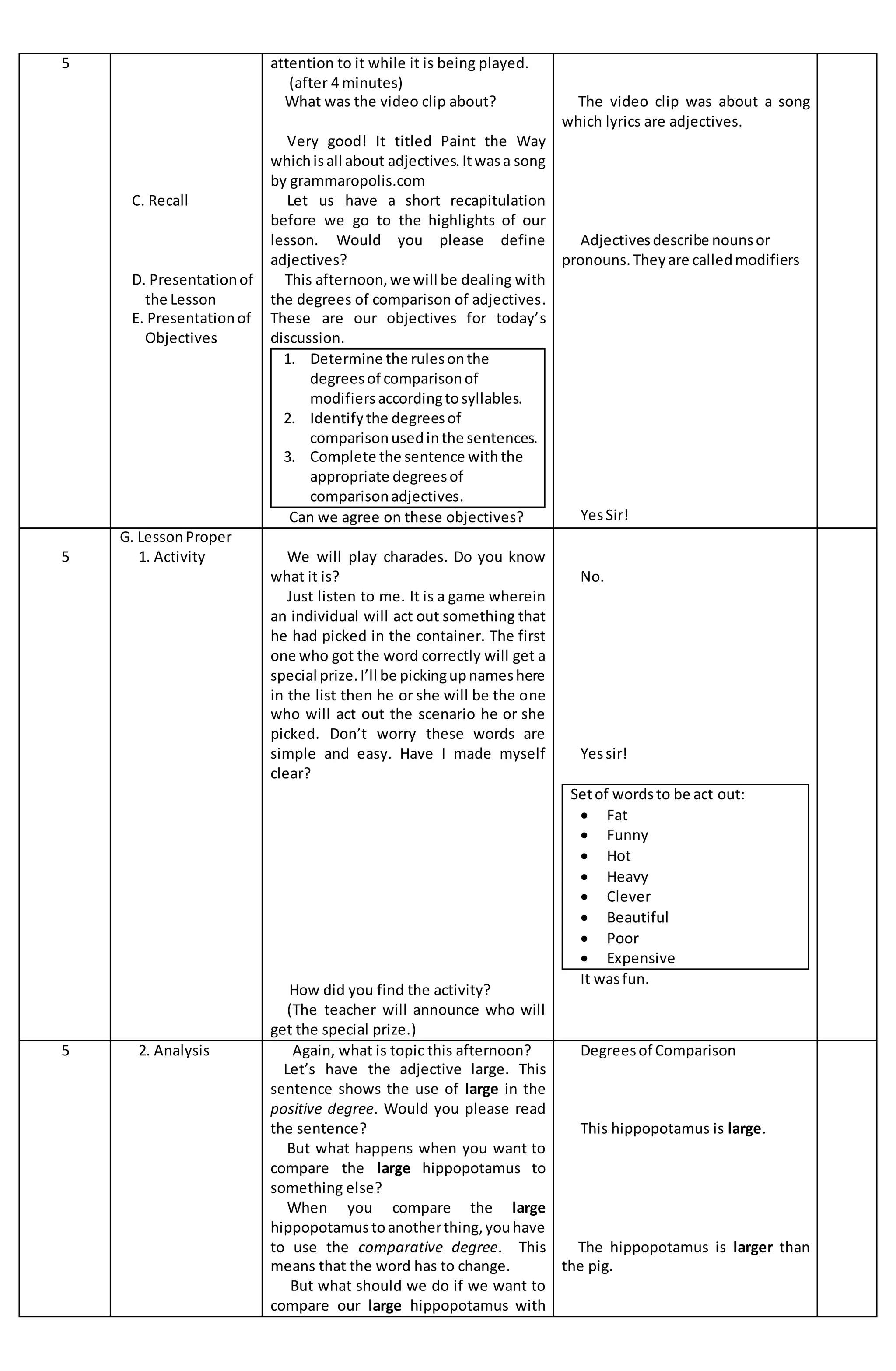
5 
C. Recall 
D. Presentation of 
the Lesson 
E. Presentation of 
Objectives 
attention to it while it is being played. 
(after 4 minutes) 
What was the video clip about? 
Very good! It titled Paint the Way 
which is all about adjectives. It was a song 
by grammaropolis.com 
Let us have a short recapitulation 
before we go to the highlights of our 
lesson. Would you please define 
adjectives? 
This afternoon, we will be dealing with 
the degrees of comparison of adjectives. 
These are our objectives for today’s 
discussion. 
1. Determine the rules on the 
degrees of comparison of 
modifiers according to syllables. 
2. Identify the degrees of 
comparison used in the sentences. 
3. Complete the sentence with the 
appropriate degrees of 
comparison adjectives. 
Can we agree on these objectives? 
The video clip was about a song 
which lyrics are adjectives. 
Adjectives describe nouns or 
pronouns. They are called modifiers 
Yes Sir! 
5 
G. Lesson Proper 
1. Activity 
We will play charades. Do you know 
what it is? 
Just listen to me. It is a game wherein 
an individual will act out something that 
he had picked in the container. The first 
one who got the word correctly will get a 
special prize. I’ll be picking up names here 
in the list then he or she will be the one 
who will act out the scenario he or she 
picked. Don’t worry these words are 
simple and easy. Have I made myself 
clear? 
How did you find the activity? 
(The teacher will announce who will 
get the special prize.) 
No. 
Yes sir! 
Set of words to be act out: 
 Fat 
 Funny 
 Hot 
 Heavy 
 Clever 
 Beautiful 
 Poor 
 Expensive 
It was fun. 
5 2. Analysis Again, what is topic this afternoon? 
Let’s have the adjective large. This 
sentence shows the use of large in the 
positive degree. Would you please read 
the sentence? 
But what happens when you want to 
compare the large hippopotamus to 
something else? 
When you compare the large 
hippopotamus to another thing, you have 
to use the comparative degree. This 
means that the word has to change. 
But what should we do if we want to 
compare our large hippopotamus with 
Degrees of Comparison 
This hippopotamus is large. 
The hippopotamus is larger than 
the pig.
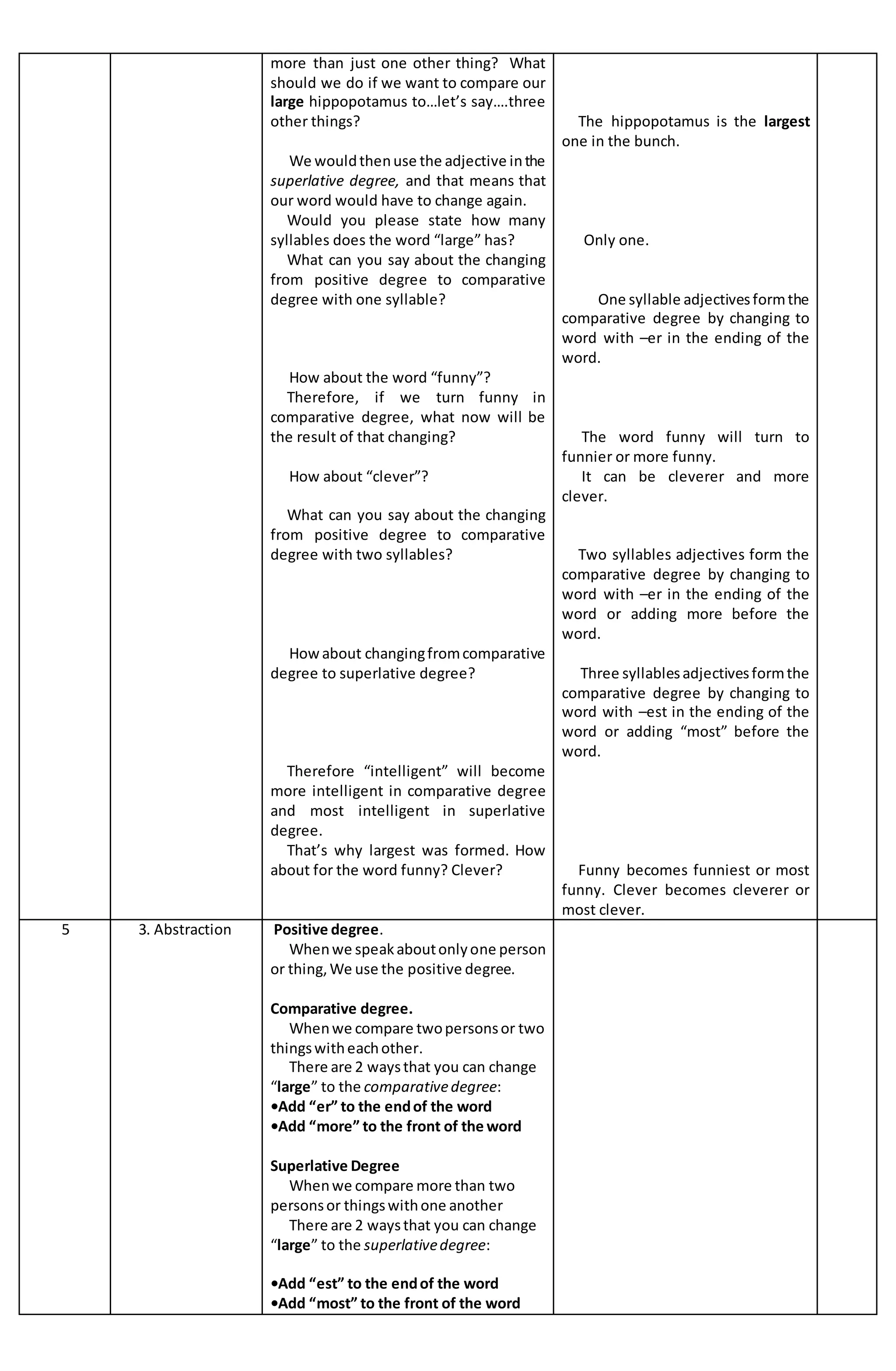
more than just one other thing? What 
should we do if we want to compare our 
large hippopotamus to…let’s say….three 
other things? 
We would then use the adjective in the 
superlative degree, and that means that 
our word would have to change again. 
Would you please state how many 
syllables does the word “large” has? 
What can you say about the changing 
from positive degree to comparative 
degree with one syllable? 
How about the word “funny”? 
Therefore, if we turn funny in 
comparative degree, what now will be 
the result of that changing? 
How about “clever”? 
What can you say about the changing 
from positive degree to comparative 
degree with two syllables? 
How about changing from comparative 
degree to superlative degree? 
Therefore “intelligent” will become 
more intelligent in comparative degree 
and most intelligent in superlative 
degree. 
That’s why largest was formed. How 
about for the word funny? Clever? 
The hippopotamus is the largest 
one in the bunch. 
Only one. 
One syllable adjectives form the 
comparative degree by changing to 
word with –er in the ending of the 
word. 
The word funny will turn to 
funnier or more funny. 
It can be cleverer and more 
clever. 
Two syllables adjectives form the 
comparative degree by changing to 
word with –er in the ending of the 
word or adding more before the 
word. 
Three syllables adjectives form the 
comparative degree by changing to 
word with –est in the ending of the 
word or adding “most” before the 
word. 
Funny becomes funniest or most 
funny. Clever becomes cleverer or 
most clever. 
5 3. Abstraction Positive degree. 
When we speak about only one person 
or thing, We use the positive degree. 
Comparative degree. 
When we compare two persons or two 
things with each other. 
There are 2 ways that you can change 
“large” to the comparative degree: 
•Add “er” to the end of the word 
•Add “more” to the front of the word 
Superlative Degree 
When we compare more than two 
persons or things with one another 
There are 2 ways that you can change 
“large” to the superlative degree: 
•Add “est” to the end of the word 
•Add “most” to the front of the word
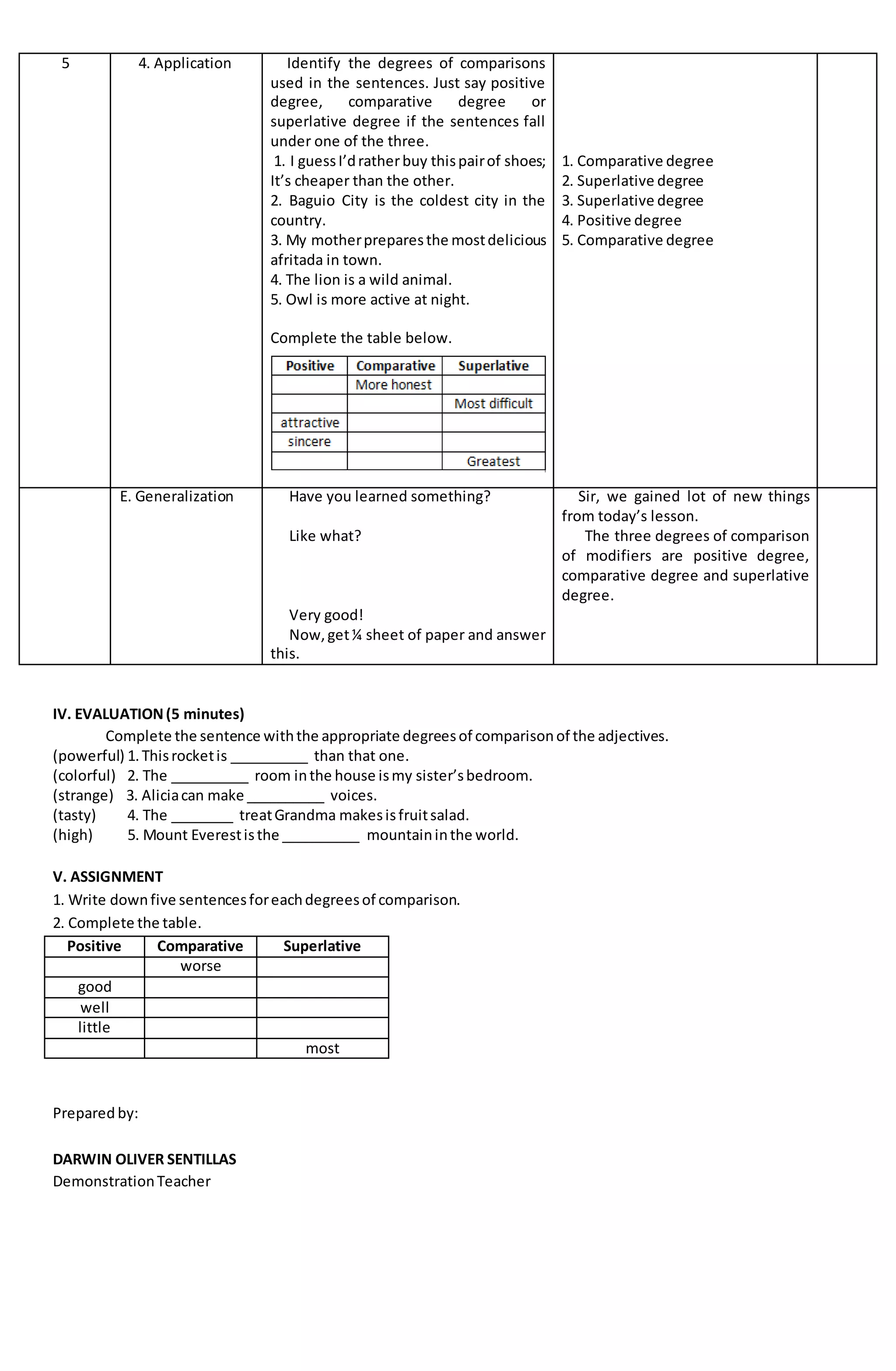
5 4. Application Identify the degrees of comparisons 
used in the sentences. Just say positive 
degree, comparative degree or 
superlative degree if the sentences fall 
under one of the three. 
1. I guess I’d rather buy this pair of shoes; 
It’s cheaper than the other. 
2. Baguio City is the coldest city in the 
country. 
3. My mother prepares the most delicious 
afritada in town. 
4. The lion is a wild animal. 
5. Owl is more active at night. 
Complete the table below. 
1. Comparative degree 
2. Superlative degree 
3. Superlative degree 
4. Positive degree 
5. Comparative degree 
E. Generalization Have you learned something? 
Like what? 
Very good! 
Now, get ¼ sheet of paper and answer 
this. 
Sir, we gained lot of new things 
from today’s lesson. 
The three degrees of comparison 
of modifiers are positive degree, 
comparative degree and superlative 
degree. 
IV. EVALUATION (5 minutes) 
Complete the sentence with the appropriate degrees of comparison of the adjectives. 
(powerful) 1. This rocket is __________ than that one. 
(colorful) 2. The __________ room in the house is my sister’s bedroom. 
(strange) 3. Alicia can make __________ voices. 
(tasty) 4. The ________ treat Grandma makes is fruit salad. 
(high) 5. Mount Everest is the __________ mountain in the world. 
V. ASSIGNMENT 
1. Write down five sentences for each degrees of comparison. 
2. Complete the table. 
Positive Comparative Superlative 
worse 
good 
well 
little 
most 
Prepared by: 
DARWIN OLIVER SENTILLAS 
Demonstration Teacher

Lesson plan on degrees of comparison

  • 1.
    CENTRAL BICOL STATEUNIVERSITY OF AGRICULTURE San Jose, Pili, Camarines Sur COLLEGE OF DEVELOPMENT EDUCATION Laboratory High School Detailed Lesson Plan in English 7 (Degrees of Comparison of Adjectives) October 22, 2014, 3:30 p.m. – 4:00 p.m. I. OBJECTIVES At the end of the 30 minutes lesson, 75% of the students must be able to: 1. Determine the rules on the degrees of comparison of modifiers according to syllables. 2. Identify the degrees of comparison used in the sentences. 3. Complete the sentence with the appropriate degrees of comparison of the adjectives. II. SUBJECT MATTER A. Topic: Degrees of Comparison B. References: i. English for All Times Language Textbook ii. http://www.english-for-students.com/Degrees-of-Comparison.html iii. http://www.learnenglish.be/gr2_degrees_study.htm C. Materials: netbook, speakers, white screen, board, chalk, picture D. Concepts: The three degrees of comparison of modifiers are positive degree, comparative degree and superlative degree. E. Skills: critical thinking, analyzing F. Values Integration: cooperation, self-esteem, optimism, appreciation G. Time Frame: 30 minutes H. Methodology: Inductive Method and 4A’s III. PROCEDURE Time Frame Teaching Hints Teacher’s Activity Students’ Activity IM’s (In minutes) 3 A. Preliminary Activities 1. Greetings 2. Prayers 3. Classroom Management 4. Checking of Attendance 5. Checking of Assignments B. Motivation Good afternoon class! How’s your day so far? Does it mean that I can expect all of your active participation? Is that an agreement? Thank you! Before we begin the lesson this morning, let us ask the guidance of almighty God and let us enlighten our mind to completely understand the lesson this morning. Would you please lead the prayer? Class, kindly arrange your seats properly. I can see pieces of paper and plastic. How about you? Did you see it also? I think you are too few. Where are the others? Oh but tell them to come to class regularly. Class monitor kindly check the attendance. Thank you! Did I give you any assignment? Class, I will play a video clip and pay Good morning Sir! Fine! Yes Sir! Of course! In the name of the Father, the Son and the Holy Spirit. Amen (The student recites a prayer.) (The students will arrange their seats. It is a communication competence-sociolinguistic. The student should pick up the pieces of papers under the chair.) They are absent. None
  • 2.
    5 C. Recall D. Presentation of the Lesson E. Presentation of Objectives attention to it while it is being played. (after 4 minutes) What was the video clip about? Very good! It titled Paint the Way which is all about adjectives. It was a song by grammaropolis.com Let us have a short recapitulation before we go to the highlights of our lesson. Would you please define adjectives? This afternoon, we will be dealing with the degrees of comparison of adjectives. These are our objectives for today’s discussion. 1. Determine the rules on the degrees of comparison of modifiers according to syllables. 2. Identify the degrees of comparison used in the sentences. 3. Complete the sentence with the appropriate degrees of comparison adjectives. Can we agree on these objectives? The video clip was about a song which lyrics are adjectives. Adjectives describe nouns or pronouns. They are called modifiers Yes Sir! 5 G. Lesson Proper 1. Activity We will play charades. Do you know what it is? Just listen to me. It is a game wherein an individual will act out something that he had picked in the container. The first one who got the word correctly will get a special prize. I’ll be picking up names here in the list then he or she will be the one who will act out the scenario he or she picked. Don’t worry these words are simple and easy. Have I made myself clear? How did you find the activity? (The teacher will announce who will get the special prize.) No. Yes sir! Set of words to be act out:  Fat  Funny  Hot  Heavy  Clever  Beautiful  Poor  Expensive It was fun. 5 2. Analysis Again, what is topic this afternoon? Let’s have the adjective large. This sentence shows the use of large in the positive degree. Would you please read the sentence? But what happens when you want to compare the large hippopotamus to something else? When you compare the large hippopotamus to another thing, you have to use the comparative degree. This means that the word has to change. But what should we do if we want to compare our large hippopotamus with Degrees of Comparison This hippopotamus is large. The hippopotamus is larger than the pig.
  • 3.
    more than justone other thing? What should we do if we want to compare our large hippopotamus to…let’s say….three other things? We would then use the adjective in the superlative degree, and that means that our word would have to change again. Would you please state how many syllables does the word “large” has? What can you say about the changing from positive degree to comparative degree with one syllable? How about the word “funny”? Therefore, if we turn funny in comparative degree, what now will be the result of that changing? How about “clever”? What can you say about the changing from positive degree to comparative degree with two syllables? How about changing from comparative degree to superlative degree? Therefore “intelligent” will become more intelligent in comparative degree and most intelligent in superlative degree. That’s why largest was formed. How about for the word funny? Clever? The hippopotamus is the largest one in the bunch. Only one. One syllable adjectives form the comparative degree by changing to word with –er in the ending of the word. The word funny will turn to funnier or more funny. It can be cleverer and more clever. Two syllables adjectives form the comparative degree by changing to word with –er in the ending of the word or adding more before the word. Three syllables adjectives form the comparative degree by changing to word with –est in the ending of the word or adding “most” before the word. Funny becomes funniest or most funny. Clever becomes cleverer or most clever. 5 3. Abstraction Positive degree. When we speak about only one person or thing, We use the positive degree. Comparative degree. When we compare two persons or two things with each other. There are 2 ways that you can change “large” to the comparative degree: •Add “er” to the end of the word •Add “more” to the front of the word Superlative Degree When we compare more than two persons or things with one another There are 2 ways that you can change “large” to the superlative degree: •Add “est” to the end of the word •Add “most” to the front of the word
  • 4.
    5 4. ApplicationIdentify the degrees of comparisons used in the sentences. Just say positive degree, comparative degree or superlative degree if the sentences fall under one of the three. 1. I guess I’d rather buy this pair of shoes; It’s cheaper than the other. 2. Baguio City is the coldest city in the country. 3. My mother prepares the most delicious afritada in town. 4. The lion is a wild animal. 5. Owl is more active at night. Complete the table below. 1. Comparative degree 2. Superlative degree 3. Superlative degree 4. Positive degree 5. Comparative degree E. Generalization Have you learned something? Like what? Very good! Now, get ¼ sheet of paper and answer this. Sir, we gained lot of new things from today’s lesson. The three degrees of comparison of modifiers are positive degree, comparative degree and superlative degree. IV. EVALUATION (5 minutes) Complete the sentence with the appropriate degrees of comparison of the adjectives. (powerful) 1. This rocket is __________ than that one. (colorful) 2. The __________ room in the house is my sister’s bedroom. (strange) 3. Alicia can make __________ voices. (tasty) 4. The ________ treat Grandma makes is fruit salad. (high) 5. Mount Everest is the __________ mountain in the world. V. ASSIGNMENT 1. Write down five sentences for each degrees of comparison. 2. Complete the table. Positive Comparative Superlative worse good well little most Prepared by: DARWIN OLIVER SENTILLAS Demonstration Teacher