KOTEBE UNIVERSITY OF EDUCATION
FACULTY: EDUCATIONAL SCIENCE
DEPARTMENT: EDUCATIONAL LEADERSHIP AND MANAGEMENT
Course Tittle: English language method of teaching I
Course Code: FLEd 3367
GROUP ASSIGNMENT
NAME ID NO
1.WARIO DIBA…………………………………………UGR/25525/14
2.Estubdink landuber…………………………………UGR/25022/14
3.Gutwich Guat……………………………………....…. UGR/25276/14
Submitted to: Dr. Alamz D.
Daily Lesson Plan Format
School: KOKEBE SECONDARY SCHOOL
Department: Educational leadership and management
Teacher’s Name: Wario Diba
Topic of the Lesson:Degree of comparison
Date: 24/04/2016 E.C Period: Second period
Objective of the lesson: By the end of this lesson, the
students will be able to:
One will understand what degree of comparison is.
To indentify kind of degree of comparison.
 will understand how to use degree comparison
 Explain and reflect rule of degree of comparison
1.Presentation:
Degrees of Comparison?
In the English language, a degree of comparison is a
form of adjective that is used to compare a person or thing
possessing the same quality with another. It is related to
the adjective or adverb in a sentence. The Collins
Dictionary defines the ‘degree of comparison’ as “the
listing of the positive, comparative, and superlative forms
of an adjective or adverb.” In other words, it can be said
that one can use the degree of comparison to make a
comparison between nouns having comparable quality or
qualities
The Three Degrees of Comparison in English Grammar
As you have already seen, the degrees of comparison are
used to make comparisons. In English grammar, there are
three degrees of comparison and they are,
I. Positive Degree of Comparison
II. Comparative Degree of Comparison
III. Superlative Degree of Comparison
I. Positive Degree of Comparison
The positive degree of comparison is basically the original
form of the adjective. This degree does not allow you to
make any comparison. It only gives the audience the
information about a particular quality possessed by a
noun.
For example:
 Lisa is happy.
 This dress is pretty.
 He looks handsome.
 The sun is bright.
 positive degree is what you use when you’re describing
an equal state between two object
 I want to look as beautiful as my mother.
 You should practice football as often as you can.
 Ayale looks as handsome as Yohanis.
ii. Comparative Degree of Comparison
The comparative degree of comparison is used to
compare between two nouns that have the same quality or
the particular quality of a noun at two different times. It
shows which one of the two has the greater or lesser
degree of the particular quality being referred to.
 . It is mostly indicated by the addition of ‘-er’ to the
end of the adjective.
 The comparative degree of comparison is always
indicated by the addition of ‘than’ after the
comparative form of the adjective.
For example:
 This bed is more comfortable than the other bed.
 Your hair is longer than hers.
 My brother is taller than me.
iii. Superlative Degree of Comparison
The superlative degree of comparison is the highest
degree of comparison. It is used to compare the similar
qualities shared by more than two nouns. It shows which
of these nouns being compared has the greatest or least
degree of the mentioned quality or qualities.
It is indicated by the use of the article ‘the’ before the
adjective and the addition of ‘-est’ to the end of the
adjective.
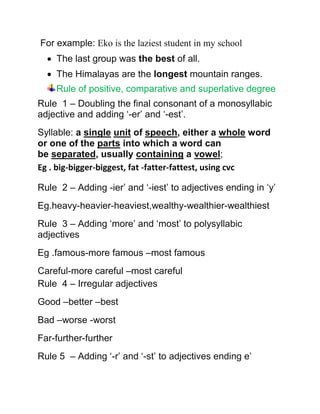
For example: Eko is the laziest student in my school
 The last group was the best of all.
 The Himalayas are the longest mountain ranges.
Rule of positive, comparative and superlative degree
Rule 1 – Doubling the final consonant of a monosyllabic
adjective and adding ‘-er’ and ‘-est’.
Syllable: a single unit of speech, either a whole word
or one of the parts into which a word can
be separated, usually containing a vowel;
Eg . big-bigger-biggest, fat -fatter-fattest, using cvc
Rule 2 – Adding -ier’ and ‘-iest’ to adjectives ending in ‘y’
Eg.heavy-heavier-heaviest,wealthy-wealthier-wealthiest
Rule 3 – Adding ‘more’ and ‘most’ to polysyllabic
adjectives
Eg .famous-more famous –most famous
Careful-more careful –most careful
Rule 4 – Irregular adjectives
Good –better –best
Bad –worse -worst
Far-further-further
Rule 5 – Adding ‘-r’ and ‘-st’ to adjectives ending e’
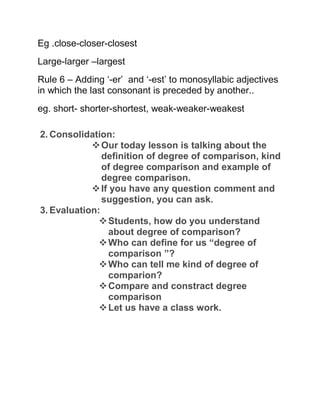
Eg .close-closer-closest
Large-larger –largest
Rule 6 – Adding ‘-er’ and ‘-est’ to monosyllabic adjectives
in which the last consonant is preceded by another..
eg. short- shorter-shortest, weak-weaker-weakest
2. Consolidation:
Our today lesson is talking about the
definition of degree of comparison, kind
of degree comparison and example of
degree comparison.
If you have any question comment and
suggestion, you can ask.
3. Evaluation:
Students, how do you understand
about degree of comparison?
Who can define for us “degree of
comparison ”?
Who can tell me kind of degree of
comparion?
Compare and constract degree
comparison
Let us have a class work.
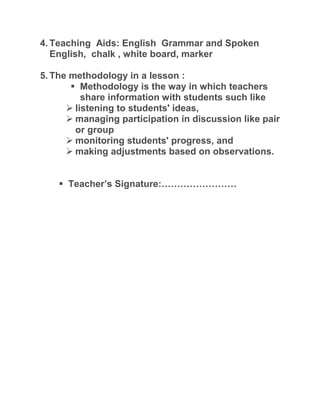
4. Teaching Aids: English Grammar and Spoken
English, chalk , white board, marker
5. The methodology in a lesson :
 Methodology is the way in which teachers
share information with students such like
 listening to students' ideas,
 managing participation in discussion like pair
or group
 monitoring students' progress, and
 making adjustments based on observations.
 Teacher’s Signature:……………………
1. Introduction:

https://www.slideshare.net/NatashaNazira1/internship-report-natasha-nazira

https://www.slideshare.net/NatashaNazira1/internship-report-natasha-nazira

  • 1.
    KOTEBE UNIVERSITY OFEDUCATION FACULTY: EDUCATIONAL SCIENCE DEPARTMENT: EDUCATIONAL LEADERSHIP AND MANAGEMENT Course Tittle: English language method of teaching I Course Code: FLEd 3367 GROUP ASSIGNMENT NAME ID NO 1.WARIO DIBA…………………………………………UGR/25525/14 2.Estubdink landuber…………………………………UGR/25022/14 3.Gutwich Guat……………………………………....…. UGR/25276/14 Submitted to: Dr. Alamz D.
  • 2.
    Daily Lesson PlanFormat School: KOKEBE SECONDARY SCHOOL Department: Educational leadership and management Teacher’s Name: Wario Diba Topic of the Lesson:Degree of comparison Date: 24/04/2016 E.C Period: Second period Objective of the lesson: By the end of this lesson, the students will be able to: One will understand what degree of comparison is. To indentify kind of degree of comparison.  will understand how to use degree comparison  Explain and reflect rule of degree of comparison 1.Presentation: Degrees of Comparison? In the English language, a degree of comparison is a form of adjective that is used to compare a person or thing possessing the same quality with another. It is related to the adjective or adverb in a sentence. The Collins Dictionary defines the ‘degree of comparison’ as “the listing of the positive, comparative, and superlative forms
  • 3.
    of an adjectiveor adverb.” In other words, it can be said that one can use the degree of comparison to make a comparison between nouns having comparable quality or qualities The Three Degrees of Comparison in English Grammar As you have already seen, the degrees of comparison are used to make comparisons. In English grammar, there are three degrees of comparison and they are, I. Positive Degree of Comparison II. Comparative Degree of Comparison III. Superlative Degree of Comparison I. Positive Degree of Comparison The positive degree of comparison is basically the original form of the adjective. This degree does not allow you to make any comparison. It only gives the audience the information about a particular quality possessed by a noun. For example:  Lisa is happy.  This dress is pretty.  He looks handsome.  The sun is bright.  positive degree is what you use when you’re describing an equal state between two object  I want to look as beautiful as my mother.
  • 4.
     You shouldpractice football as often as you can.  Ayale looks as handsome as Yohanis. ii. Comparative Degree of Comparison The comparative degree of comparison is used to compare between two nouns that have the same quality or the particular quality of a noun at two different times. It shows which one of the two has the greater or lesser degree of the particular quality being referred to.  . It is mostly indicated by the addition of ‘-er’ to the end of the adjective.  The comparative degree of comparison is always indicated by the addition of ‘than’ after the comparative form of the adjective. For example:  This bed is more comfortable than the other bed.  Your hair is longer than hers.  My brother is taller than me. iii. Superlative Degree of Comparison The superlative degree of comparison is the highest degree of comparison. It is used to compare the similar qualities shared by more than two nouns. It shows which of these nouns being compared has the greatest or least degree of the mentioned quality or qualities. It is indicated by the use of the article ‘the’ before the adjective and the addition of ‘-est’ to the end of the adjective.
  • 5.
    For example: Ekois the laziest student in my school  The last group was the best of all.  The Himalayas are the longest mountain ranges. Rule of positive, comparative and superlative degree Rule 1 – Doubling the final consonant of a monosyllabic adjective and adding ‘-er’ and ‘-est’. Syllable: a single unit of speech, either a whole word or one of the parts into which a word can be separated, usually containing a vowel; Eg . big-bigger-biggest, fat -fatter-fattest, using cvc Rule 2 – Adding -ier’ and ‘-iest’ to adjectives ending in ‘y’ Eg.heavy-heavier-heaviest,wealthy-wealthier-wealthiest Rule 3 – Adding ‘more’ and ‘most’ to polysyllabic adjectives Eg .famous-more famous –most famous Careful-more careful –most careful Rule 4 – Irregular adjectives Good –better –best Bad –worse -worst Far-further-further Rule 5 – Adding ‘-r’ and ‘-st’ to adjectives ending e’
  • 6.
    Eg .close-closer-closest Large-larger –largest Rule6 – Adding ‘-er’ and ‘-est’ to monosyllabic adjectives in which the last consonant is preceded by another.. eg. short- shorter-shortest, weak-weaker-weakest 2. Consolidation: Our today lesson is talking about the definition of degree of comparison, kind of degree comparison and example of degree comparison. If you have any question comment and suggestion, you can ask. 3. Evaluation: Students, how do you understand about degree of comparison? Who can define for us “degree of comparison ”? Who can tell me kind of degree of comparion? Compare and constract degree comparison Let us have a class work.
  • 7.
    4. Teaching Aids:English Grammar and Spoken English, chalk , white board, marker 5. The methodology in a lesson :  Methodology is the way in which teachers share information with students such like  listening to students' ideas,  managing participation in discussion like pair or group  monitoring students' progress, and  making adjustments based on observations.  Teacher’s Signature:……………………
  • 17.