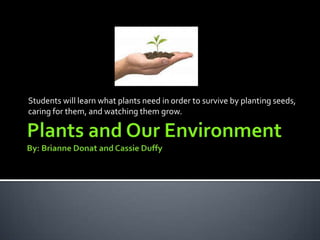
Students will learn what plants need in order to survive by planting seeds,
caring for them, and watching them grow.







4. Critical Thinking, Problem Solving, and Decision
Making Students use critical thinking skills to plan and
conduct research, manage projects, solve problems, and
make informed decisions using appropriate digital tools
and resources. Students:
a. identify and define authentic problems and significant
questions for investigation.
b. plan and manage activities to develop a solution or
complete a project.
c. collect and analyze data to identify solutions and/or
make informed decisions.
d. use multiple processes and diverse perspectives to
explore alternative solutions.


3.L.1.1 Students are able to identify the basic
structures, functions, and needs of plants in
relation to their environment.











3 bean seeds per group/ 10 groups
Paper towels (2 per group)
Tape
Plastic bag
Hand lens
Notebooks
Pencil
Water
www.kerpoof.com
Online resources for students: www.kidzone.com
, http://www.vrml.k12.la.us/curriculum/quicktip/scienc
e/plants/plants.htm











Ask students why asking questions is an important habit, especially for
scientists. Have students share their responses in a classroom
discussion. This discussion should include the idea that asking questions
then finding out the answers can help us learn more about how the world
works.
Ask students to think of one question they have about plants and have
them share their question with their neighbor.
Lead the students in a “plant question walk.” Go around the school yard
to look at as many plants as possible.
As a class, make a list on the board of questions about plants. Then try to
group the questions into two groups: questions that can be answered
through an investigation and those that cannot.
Tell the students that they will be answering questions that can be
answered through an investigation. Have them think about the plant
question that interests them the most.
Students will plant seeds and gather data to help answer their questions.








Gather all supplies needed.
Separate class into groups of two by using
www.superteachertools.com .
Hand out three beans, two paper towels, a small cup of water, a
plastic bag, and tape to each group.
Have students ‘plant’ their seeds in the bag. Dip the paper towels
into the water so that it is moist, but not dripping wet. Place the
paper towels into the bag. Place the three seeds an inch apart
from each other. Then seal the bag closed.
Tape half of the groups’ bags around the classroom and half of the
groups’ bags near a window where it will get plenty of sunlight.
Predict what might happen in the coming weeks. Document this
on a clean sheet of paper in their notebooks along with today’s
date.
One week later, document what changes have
occurred though measurements, drawings, and
a short description of observations.
 After documenting the changes for 4 weeks
students will create a representation of plant
growth using www.kerpoof.com. The
representation will include the initial question
and it’s answer, pictures, drawings, data, and
observations at each stage.
 Students will communicate these findings to the
class.









Students will learn the importance of asking
questions and developing a plan to find the
answers.
Students will learn how to collect and
organize data.
Students will learn what plants need in order
to survive.
Observe what plant parts help plants grow.
Students will learn how to use the web tool,
www.kerpoof.com, to display their findings.





Children are using real life experiences
learning about plants. They are watching the
process of how they grow and change with
different environmental conditions.
Asking questions in an important skill for
scientists.
Asking questions and finding answers can
help us learn more about how the world
works.


Children will ask questions prior to
conducting their experiment. Then they will
plant their seeds and gather data over several
weeks to watch and see how the seeds
change into plants. They will document each
week what changes have occurred.
Finally, students will create a representation
using www.kerpoof.com to present their
findings to the class.


Kerpoof representation will include:
Category

Point value

Initial question

5/5

Drawings of each stage of the
growing process

10/10

Brief summary of weekly
observations

10/10

Weekly measurements

5/5

Plants and our environment

  • 1.
    Students will learnwhat plants need in order to survive by planting seeds, caring for them, and watching them grow.
  • 2.
         4. Critical Thinking,Problem Solving, and Decision Making Students use critical thinking skills to plan and conduct research, manage projects, solve problems, and make informed decisions using appropriate digital tools and resources. Students: a. identify and define authentic problems and significant questions for investigation. b. plan and manage activities to develop a solution or complete a project. c. collect and analyze data to identify solutions and/or make informed decisions. d. use multiple processes and diverse perspectives to explore alternative solutions.
  • 3.
     3.L.1.1 Students areable to identify the basic structures, functions, and needs of plants in relation to their environment.
  • 4.
              3 bean seedsper group/ 10 groups Paper towels (2 per group) Tape Plastic bag Hand lens Notebooks Pencil Water www.kerpoof.com Online resources for students: www.kidzone.com , http://www.vrml.k12.la.us/curriculum/quicktip/scienc e/plants/plants.htm
  • 5.
          Ask students whyasking questions is an important habit, especially for scientists. Have students share their responses in a classroom discussion. This discussion should include the idea that asking questions then finding out the answers can help us learn more about how the world works. Ask students to think of one question they have about plants and have them share their question with their neighbor. Lead the students in a “plant question walk.” Go around the school yard to look at as many plants as possible. As a class, make a list on the board of questions about plants. Then try to group the questions into two groups: questions that can be answered through an investigation and those that cannot. Tell the students that they will be answering questions that can be answered through an investigation. Have them think about the plant question that interests them the most. Students will plant seeds and gather data to help answer their questions.
  • 6.
          Gather all suppliesneeded. Separate class into groups of two by using www.superteachertools.com . Hand out three beans, two paper towels, a small cup of water, a plastic bag, and tape to each group. Have students ‘plant’ their seeds in the bag. Dip the paper towels into the water so that it is moist, but not dripping wet. Place the paper towels into the bag. Place the three seeds an inch apart from each other. Then seal the bag closed. Tape half of the groups’ bags around the classroom and half of the groups’ bags near a window where it will get plenty of sunlight. Predict what might happen in the coming weeks. Document this on a clean sheet of paper in their notebooks along with today’s date.
  • 7.
    One week later,document what changes have occurred though measurements, drawings, and a short description of observations.  After documenting the changes for 4 weeks students will create a representation of plant growth using www.kerpoof.com. The representation will include the initial question and it’s answer, pictures, drawings, data, and observations at each stage.  Students will communicate these findings to the class. 
  • 8.
         Students will learnthe importance of asking questions and developing a plan to find the answers. Students will learn how to collect and organize data. Students will learn what plants need in order to survive. Observe what plant parts help plants grow. Students will learn how to use the web tool, www.kerpoof.com, to display their findings.
  • 9.
       Children are usingreal life experiences learning about plants. They are watching the process of how they grow and change with different environmental conditions. Asking questions in an important skill for scientists. Asking questions and finding answers can help us learn more about how the world works.
  • 10.
     Children will askquestions prior to conducting their experiment. Then they will plant their seeds and gather data over several weeks to watch and see how the seeds change into plants. They will document each week what changes have occurred. Finally, students will create a representation using www.kerpoof.com to present their findings to the class.
  • 11.
     Kerpoof representation willinclude: Category Point value Initial question 5/5 Drawings of each stage of the growing process 10/10 Brief summary of weekly observations 10/10 Weekly measurements 5/5