Lesson Development
Kindergarten
Merhama H. Pandi
MT-1/ TIC
Purpose of Lesson Planning/Planning for a lesson
-The sole purpose of lesson plan is to outline the
program for a lesson in simple details, which will
include the lesson’s objective, how the objective is
going to be achieved and a way of testing how well
the objective was received by the learners.
The content focus and messages are written in the first person point of
view, in the voice of the child. The content focus is the main topic for
the week while the messages are the emphasis points for the day.
Messages that are content-rich may run across two or three days.
The content focus acts as the theme around which all concepts and
lessons revolve. It starts from “I belong to a Kindergarten Class” and “I
am me” in Quarter 1, “I belong to a family” in Quarter 2, “I belong to
a community” in Quarter 3, and “I am part of a bigger community” in
Quarter 4. These themes follow the ecological systems that start with
the self, then goes out to a bigger social system (the family,
community, and bigger community).
Content Focus and Daily Messages
“I belong to a Kindergarten Class” is the springboard on
the first week as the learners become familiar with the
routine, rules, peers, and teachers in the Kindergarten
classroom.
Smooth transitions are ensured from week to week and
from one quarter to the next. Week 10 is dedicated as
a wrap-up/summary/review week to solidify the
concepts learned throughout the quarter. The foci for
these weeks are “I am me” (Q1), “I have a family”
(Q2), and “We are members of a community” (Q3).
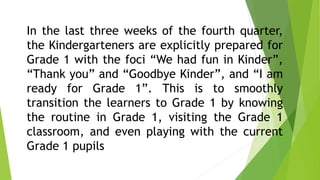
In the last three weeks of the fourth quarter,
the Kindergarteners are explicitly prepared for
Grade 1 with the foci “We had fun in Kinder”,
“Thank you” and “Goodbye Kinder”, and “I am
ready for Grade 1”. This is to smoothly
transition the learners to Grade 1 by knowing
the routine in Grade 1, visiting the Grade 1
classroom, and even playing with the current
Grade 1 pupils
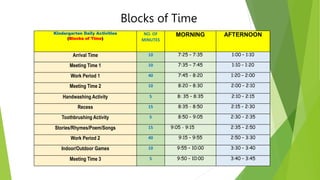
Kindergarten Daily Activities
(Blocks of Time)
NO. OF
MINUTES
MORNING AFTERNOON
Arrival Time 10 7:25 – 7:35 1:00 – 1:10
Meeting Time 1 10 7:35 – 7:45 1:10 – 1:20
Work Period 1 40 7:45 - 8:20 1:20 – 2:00
Meeting Time 2 10 8:20 – 8:30 2:00 – 2:10
Handwashing Activity 5 8: 35 – 8:35 2:10 – 2:15
Recess 15 8:35 - 8:50 2:15 – 2:30
Toothbrushing Activity 5 8:50 – 9:05 2:30 – 2:35
Stories/Rhymes/Poem/Songs 15 9:05 - 9:15 2:35 – 2:50
Work Period 2 40 9:15 – 9:55 2:50 – 3:30
Indoor/Outdoor Games 10 9:55 – 10:00 3:30 – 3:40
Meeting Time 3 5 9:50 – 10:00 3:40 – 3:45
Blocks of Time
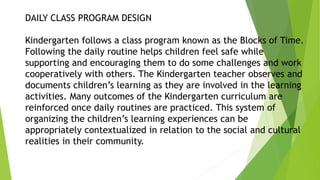
DAILY CLASS PROGRAM DESIGN
Kindergarten follows a class program known as the Blocks of Time.
Following the daily routine helps children feel safe while
supporting and encouraging them to do some challenges and work
cooperatively with others. The Kindergarten teacher observes and
documents children’s learning as they are involved in the learning
activities. Many outcomes of the Kindergarten curriculum are
reinforced once daily routines are practiced. This system of
organizing the children’s learning experiences can be
appropriately contextualized in relation to the social and cultural
realities in their community.
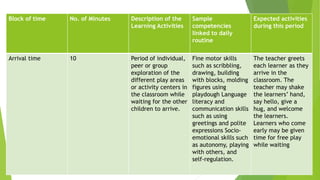
Block of time No. of Minutes Description of the
Learning Activities
Sample
competencies
linked to daily
routine
Expected activities
during this period
Arrival time 10 Period of individual,
peer or group
exploration of the
different play areas
or activity centers in
the classroom while
waiting for the other
children to arrive.
Fine motor skills
such as scribbling,
drawing, building
with blocks, molding
figures using
playdough Language
literacy and
communication skills
such as using
greetings and polite
expressions Socio-
emotional skills such
as autonomy, playing
with others, and
self-regulation.
The teacher greets
each learner as they
arrive in the
classroom. The
teacher may shake
the learners’ hand,
say hello, give a
hug, and welcome
the learners.
Learners who come
early may be given
time for free play
while waiting
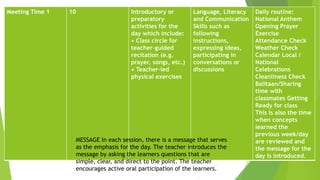
Meeting Time 1 10 Introductory or
preparatory
activities for the
day which include:
• Class circle for
teacher-guided
recitation (e.g.
prayer, songs, etc.)
• Teacher-led
physical exercises
Language, Literacy
and Communication
Skills such as
following
instructions,
expressing ideas,
participating in
conversations or
discussions
Daily routine:
National Anthem
Opening Prayer
Exercise
Attendance Check
Weather Check
Calendar Local /
National
Celebrations
Cleanliness Check
Balitaan/Sharing
time with
classmates Getting
Ready for class
This is also the time
when concepts
learned the
previous week/day
are reviewed and
the message for the
day is introduced.
MESSAGE In each session, there is a message that serves
as the emphasis for the day. The teacher introduces the
message by asking the learners questions that are
simple, clear, and direct to the point. The teacher
encourages active oral participation of the learners.
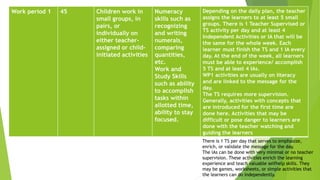
Work period 1 45 Children work in
small groups, in
pairs, or
individually on
either teacher-
assigned or child-
initiated activities
Numeracy
skills such as
recognizing
and writing
numerals,
comparing
quantities,
etc.
Work and
Study Skills
such as ability
to accomplish
tasks within
allotted time,
ability to stay
focused.
Depending on the daily plan, the teacher
assigns the learners to at least 5 small
groups. There is 1 Teacher Supervised or
TS activity per day and at least 4
Independent Activities or IA that will be
the same for the whole week. Each
learner must finish the TS and 1 IA every
day. At the end of the week, all learners
must be able to experience/ accomplish
5 TS and at least 4 IAs.
WP1 activities are usually on literacy
and are linked to the message for the
day.
The TS requires more supervision.
Generally, activities with concepts that
are introduced for the first time are
done here. Activities that may be
difficult or pose danger to learners are
done with the teacher watching and
guiding the learners
There is 1 TS per day that serves to emphasize,
enrich, or validate the message for the day.
The IAs can be done with very minimal or no teacher
supervision. These activities enrich the learning
experience and teach valuable selfhelp skills. They
may be games, worksheets, or simple activities that
the learners can do independently.
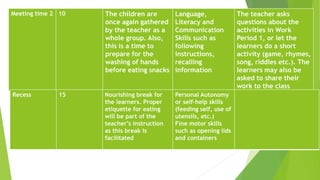
Meeting time 2 10 The children are
once again gathered
by the teacher as a
whole group. Also,
this is a time to
prepare for the
washing of hands
before eating snacks
Language,
Literacy and
Communication
Skills such as
following
instructions,
recalling
information
The teacher asks
questions about the
activities in Work
Period 1, or let the
learners do a short
activity (game, rhymes,
song, riddles etc.). The
learners may also be
asked to share their
work to the class
Recess 15 Nourishing break for
the learners. Proper
etiquette for eating
will be part of the
teacher’s instruction
as this break is
facilitated
Personal Autonomy
or self-help skills
(feeding self, use of
utensils, etc.)
Fine motor skills
such as opening lids
and containers
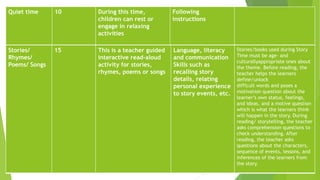
Quiet time 10 During this time,
children can rest or
engage in relaxing
activities
Following
instructions
Stories/
Rhymes/
Poems/ Songs
15 This is a teacher guided
interactive read-aloud
activity for stories,
rhymes, poems or songs
Language, literacy
and communication
Skills such as
recalling story
details, relating
personal experience
to story events, etc.
Stories/books used during Story
Time must be age- and
culturallyappropriate ones about
the theme. Before reading, the
teacher helps the learners
define/unlock
difficult words and poses a
motivation question about the
learner’s own status, feelings,
and ideas, and a motive question
which is what the learners think
will happen in the story. During
reading/ storytelling, the teacher
asks comprehension questions to
check understanding. After
reading, the teacher asks
questions about the characters,
sequence of events, lessons, and
inferences of the learners from
the story.
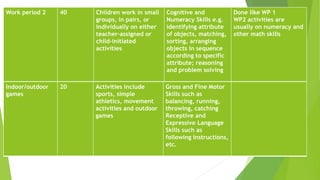
Work period 2 40 Children work in small
groups, in pairs, or
individually on either
teacher-assigned or
child-initiated
activities
Cognitive and
Numeracy Skills e.g.
identifying attribute
of objects, matching,
sorting, arranging
objects in sequence
according to specific
attribute; reasoning
and problem solving
Done like WP 1
WP2 activities are
usually on numeracy and
other math skills
Indoor/outdoor
games
20 Activities include
sports, simple
athletics, movement
activities and outdoor
games
Gross and Fine Motor
Skills such as
balancing, running,
throwing, catching
Receptive and
Expressive Language
Skills such as
following instructions,
etc.
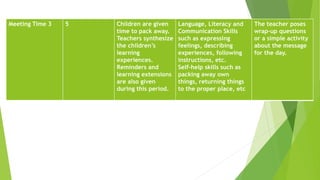
Meeting Time 3 5 Children are given
time to pack away.
Teachers synthesize
the children’s
learning
experiences.
Reminders and
learning extensions
are also given
during this period.
Language, Literacy and
Communication Skills
such as expressing
feelings, describing
experiences, following
instructions, etc.
Self-help skills such as
packing away own
things, returning things
to the proper place, etc
The teacher poses
wrap-up questions
or a simple activity
about the message
for the day.
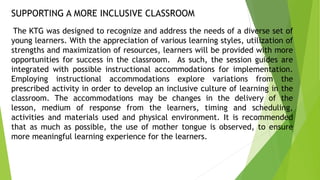
SUPPORTING A MORE INCLUSIVE CLASSROOM
The KTG was designed to recognize and address the needs of a diverse set of
young learners. With the appreciation of various learning styles, utilization of
strengths and maximization of resources, learners will be provided with more
opportunities for success in the classroom. As such, the session guides are
integrated with possible instructional accommodations for implementation.
Employing instructional accommodations explore variations from the
prescribed activity in order to develop an inclusive culture of learning in the
classroom. The accommodations may be changes in the delivery of the
lesson, medium of response from the learners, timing and scheduling,
activities and materials used and physical environment. It is recommended
that as much as possible, the use of mother tongue is observed, to ensure
more meaningful learning experience for the learners.
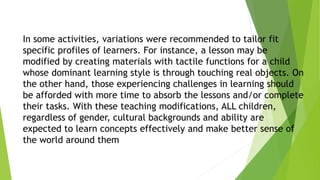
In some activities, variations were recommended to tailor fit
specific profiles of learners. For instance, a lesson may be
modified by creating materials with tactile functions for a child
whose dominant learning style is through touching real objects. On
the other hand, those experiencing challenges in learning should
be afforded with more time to absorb the lessons and/or complete
their tasks. With these teaching modifications, ALL children,
regardless of gender, cultural backgrounds and ability are
expected to learn concepts effectively and make better sense of
the world around them
THE HIDDEN CURRICULUM IN THE KINDERGARTEN CLASSROOM
“Hidden curriculum refers to the unwritten, unofficial, and often unintended lessons,
values, and perspectives that students learn in school. While the ‘formal’ curriculum
consists of the courses, lessons, and learning activities students participate in, as well as
the knowledge and skills educators intentionally teach to students, the hidden curriculum
consists of the unspoken or implicit academic, social, and cultural messages that are
communicated to students while they are in school.”
In the Kindergarten classroom, the hidden curriculum is given utmost importance. These
include the values that are explicit in the “Standards and Competencies for Five-Year-Old
Filipino Children” but implicitly conveyed through the teacher’s words and actions, and the
overall classroom environment. For example, when the Kindergarteners do an art activity,
they learn and exhibit competencies in Sining and KalusugangPisikal at Pagpapaunlad ng
Kakayahang Motor, particularly Kasanayang “fine motor”. But equally, or often more
important than these skills, are the traits and values we want them to learn, which are
under the domains of Pagpapaunlad sa Kakayahang Sosyo-Emosyunal (SE) and
KagandahangAsal (KA).
Application
MELCs- Quarter 2 , week 10
• Identify what we wear and use for each kind of weather
• Observe safety practices in different kinds of weather
• Trace, copy, and write the letters of the alphabet: straight lines (A,E,F,H,I L,T), combination of
straight and slanting lines (K, M,N, V, W, X, Y, Z), combination of straight and curved lines (B, C,
D, G, J, O, P, Q, R, S, U), rounded strokes with loops
• Write one’s given name
Let us use the MELC. Quarter 2, week 10 Most Essential Learning Competencies. Use the Content Focus and
the daily messages as your guide where to revolve your lessons. Let us have 5 groups to work on the
development of the lesson flow.
Group 1- Monday ( My family provides my clothes that protect my body)
Group 2-Tuesday ( I wear clothes in different weather conditions and occasions)
Group 3-Wednesday ( There are people who make our clothes and other items of clothing
Group 4- Thursday ( Filipino families have traditional clothes)
Group 5- Friday ( I can take care of my clothes)
Use the blocks of time for the lesson flow
Arrival Time- 10 mins
Meeting Time 1- 10 mins
Work Period 1- 45 mins
Meeting Time 2 – 10 mins
Work Period 2- 45 mins
Story/rhymes/ poems/song- 15 mins
indoor/ outdoor game- 20 mins
Meeting Time 3- 10 mins
Let us use a manila paper for our activities
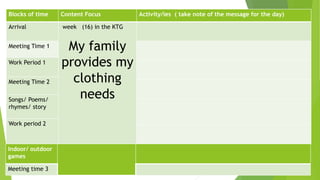
Use the template.
Blocks of time Content Focus Activity/ies ( take note of the message for the day)
Arrival week (16) in the KTG
My family
provides my
clothing
needs
Meeting Time 1
Work Period 1
Meeting Time 2
Songs/ Poems/
rhymes/ story
Work period 2
Indoor/ outdoor
games
Meeting time 3
Sharing of output per group
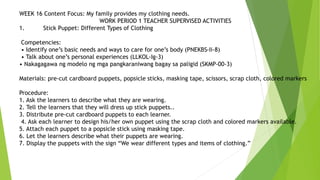
WEEK 16 Content Focus: My family provides my clothing needs.
WORK PERIOD 1 TEACHER SUPERVISED ACTIVITIES
1. Stick Puppet: Different Types of Clothing
Competencies:
• Identify one’s basic needs and ways to care for one’s body (PNEKBS-Ii-8)
• Talk about one’s personal experiences (LLKOL-Ig-3)
• Nakagagawa ng modelo ng mga pangkaraniwang bagay sa paligid (SKMP-00-3)
Materials: pre-cut cardboard puppets, popsicle sticks, masking tape, scissors, scrap cloth, colored markers
Procedure:
1. Ask the learners to describe what they are wearing.
2. Tell the learners that they will dress up stick puppets..
3. Distribute pre-cut cardboard puppets to each learner.
4. Ask each learner to design his/her own puppet using the scrap cloth and colored markers available.
5. Attach each puppet to a popsicle stick using masking tape.
6. Let the learners describe what their puppets are wearing.
7. Display the puppets with the sign “We wear different types and items of clothing.”
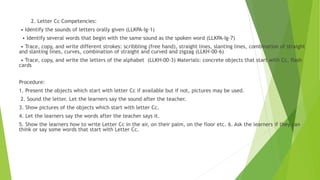
2. Letter Cc Competencies:
• Identify the sounds of letters orally given (LLKPA-Ig-1)
• Identify several words that begin with the same sound as the spoken word (LLKPA-Ig-7)
• Trace, copy, and write different strokes: scribbling (free hand), straight lines, slanting lines, combination of straight
and slanting lines, curves, combination of straight and curved and zigzag (LLKH-00-6)
• Trace, copy, and write the letters of the alphabet (LLKH-00-3) Materials: concrete objects that start with Cc, flash
cards
Procedure:
1. Present the objects which start with letter Cc if available but if not, pictures may be used.
2. Sound the letter. Let the learners say the sound after the teacher.
3. Show pictures of the objects which start with letter Cc.
4. Let the learners say the words after the teacher says it.
5. Show the learners how to write Letter Cc in the air, on their palm, on the floor etc. 6. Ask the learners if they can
think or say some words that start with Letter Cc.
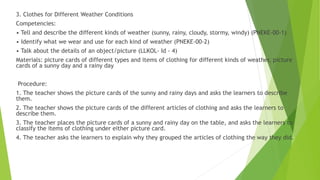
3. Clothes for Different Weather Conditions
Competencies:
• Tell and describe the different kinds of weather (sunny, rainy, cloudy, stormy, windy) (PNEKE-00-1)
• Identify what we wear and use for each kind of weather (PNEKE-00-2)
• Talk about the details of an object/picture (LLKOL- Id - 4)
Materials: picture cards of different types and items of clothing for different kinds of weather, picture
cards of a sunny day and a rainy day
Procedure:
1. The teacher shows the picture cards of the sunny and rainy days and asks the learners to describe
them.
2. The teacher shows the picture cards of the different articles of clothing and asks the learners to
describe them.
3. The teacher places the picture cards of a sunny and rainy day on the table, and asks the learners to
classify the items of clothing under either picture card.
4. The teacher asks the learners to explain why they grouped the articles of clothing the way they did.
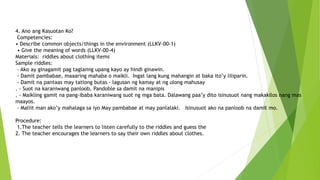
4. Ano ang Kasuotan Ko?
Competencies:
• Describe common objects/things in the environment (LLKV-00-1)
• Give the meaning of words (LLKV-00-4)
Materials: riddles about clothing items
Sample riddles:
- Ako ay ginagamit pag taglamig upang kayo ay hindi ginawin.
- Damit pambabae, maaaring mahaba o maikli. Ingat lang kung mahangin at baka ito’y liliparin.
- Damit na pantaas may tatlong butas - lagusan ng kamay at ng ulong mahusay
. - Suot na karaniwang panloob, Pandoble sa damit na manipis
. - Maikling gamit na pang-ibaba karaniwang suot ng mga bata. Dalawang paa’y dito isinusuot nang makakilos nang mas
maayos.
- Maliit man ako’y mahalaga sa iyo May pambabae at may panlalaki. Isinusuot ako na panloob na damit mo.
Procedure:
1.The teacher tells the learners to listen carefully to the riddles and guess the
2. The teacher encourages the learners to say their own riddles about clothes.
5. Traditional Filipino Clothes
Competencies:
• Nabibigyang-pansin ang linya, kulay, hugis at tekstura ng magagandang bagay na gawa ng tao (SKPK-
00-2)
• Nakikilala at iginagalang ang pagkakaiba-iba ng tao: kultura (kasuotan) (SEKPP-Ib-1)
Materials: pictures of traditional Filipino clothes (barong tagalog, baro’t saya, Maria Clara dress,
patadyong, kimona, terno, balintawak, tribal clothes, royal clothes, etc.), actual traditional Filipino
clothing if available, map of the Philippines
Procedure:
1. The teacher shows the pictures of traditional Filipino clothes, says what they are called, and points
to the map to indicate where they are worn by Filipinos in the different regions of the Philippines.
Highlight the traditional clothes in your region if there are any.
2. The teacher asks the learners to describe the traditional clothes and ask questions about them.
3. The teacher lets the learners touch and describe actual traditional Filipino clothes (if available).
6. Laundry Day
Competencies:
• Naipakikita ang wastong pangangalaga sa mga pansariling kagamitan sa paglilinis at pag-aayos ng
katawan (KPKPKK-00-2)
• Nailalarawan ang nagagawa ng mga tagapag-alaga (KMKPPam-00-6)
• Identify sequence of events (MKSC-00-9)
Materials: plastic tub, water, laundry soap, handkerchiefs for hand washing, clothesline and clothespins, a
child’s shirt, a pair of short pants, and a pair of socks for folding
Procedure:
1. Ask the learners to say who washes their clothes at home and describe how it is done (either by hand
washing or by using a washing machine). If common answer is their mother or any female member of their
family, stress that even their father or the boys in the family can do the laundry. Stress on washing clothes
as not the sole responsibility of women.
2. Let the learners follow the sequence of washing clothes: Separate whites from colored items. Fill the
tub with enough amount of water, Add a small amount of laundry soap. Soak the handkerchief in the
soapy water and scrub their hands gently while holding the handkerchief to wash away the dirt.
3. To save on water and laundry soap, let the learners take turns in washing their handkerchiefs and throw
the water away after all the learners are done.Fill the tub with clean water again for rinsing. After all the
learners have rinsed their handkerchiefs, they may hang them to dry.
4. The teacher demonstrates how to properly fold a shirt, a pair of short pants, and socks.
5. The learners take turns in folding the clothes.
WORK PERIOD 1 INDEPENDENT ACTIVITIES
1. Letter Mosaic (Cc)
Competencies:
• Identify the letters of the alphabet (mother tongue, orthography) (LLKAK-Ih-3)
• Give the sound of each letter (mother tongue, orthography) (LLKAK-Ih-7)
• Nakagugupit at nakakapagdidikit ng iba’t-ibang hugis na may iba’t-ibang tekstura (SKMP-00-4)
Materials: cut out colored papers for pasting, glue, outline of letter Cc
Procedure:
1.Learners take a sheet with the outline of letter Cc.
2. Learners paste the cut out colored papers on the letter outline.
3. Learners say the sound of the letter Cc while pasting,
2.Lacing Cards
Competencies:
• Nakagagawa ng modelo ng mga pangkaraniwang bagay sa paligid (SKMP-00-3)
• Complete patterns (MKSC-00-19)
Materials: lacing cards (outline of clothes: dress, long pants, t-shirt, short pants, jacket,
etc.), yarn, masking tape
Procedure:
1. Make lacing cards by outlining different kinds of clothes on cardboard or construction
paper.
2. Punch holes of equal distance from each other on the edges of the lacing cards.
3. Attach a piece of string/yarn to each lacing card which should be long enough to lace
the entire card.
4. Wrap the end of the string/yarn with masking tape so that the learners can hold it
easily.
5. Have learners choose which clothing card to lace. 6. Have learners lace each card and
complete the pattern (up and down).
3. Dress -Up Play
Competencies:
• Nailalarawan ang nagagawa ng mga tagapag-alaga/Nanay/Tatay/ Lolo/Lola, atbp. (KMKPPam-00-6)
• Talk about likes/dislikes (LLKOL-Ic-15)
Materials: clothes worn by family members, accessories (bags, shoes, fake jewelry)
Procedure:
1. Set up the dress up play area with different clothes and accessories that family members wear.
2. Allow the learners to play dress up with the clothes.
3. Let the learners talk about the clothes their family members wear. Take note that there might
be articles of clothing that both boys and girls wear.
WORK PERIOD 2 TEACHER SUPERVISED ACTIVITIES
1. Fashion Chart
Competencies:
• Sort and classify objects (clothes) according to use (MKSC-00-6)
• Create simple pictographs (MKAP-00-2)
• Discuss simple pictographs (MKAP-00-3)
Materials: chart (see example below), old magazines or drawings of different clothes worn on
different occassions, scissors, glue
Procedure:
1. Show the learners the fashion chart and explain the categories.
2. Cut out pictures of clothes for the categories on the fashion chart.
3. Ask the learners to paste or glue the cut out pictures on their corresponding boxes.
4. Ask the learners to explain their categorization. Are there items of clothing that they can wear in
all occasions?
2. How Many Pockets? Zippers? Buttons?
Competencies:
• Count objects with one-to-one correspondence up to quantities of 10 (MKC-00-7)
• Collect data on one variable through observation (MKAP-00-1)
• Create a simple pictograph (MKAP-00-2)
• Discuss simple pictographs (MKAP-00-3)
• Compare groups and decide which is more or less, of they are equal (MKC-00-8)
Materials: a chart for organizing data, pencils, felt tip pens
Procedure:
1. Show the chart to the learners and explain that they are going to count the pockets, zippers,
and buttons on the clothes that they are wearing and write down how many they are.
2. Assist the learners in writing their name and the numerals on the chart.
3. Engage the learners in discussing the simple pictograph. Let them compare the quantities.
3-Paper Shirt (Origami)
Competencies:
• Naisasagawa ang mga sumusunod na kasanayan sa pagtiklop ng papel (KPKFM-00-1.2)
• Nakaguguhit, nakapagpipinta at nakapagkukulay ng iba’t ibang bagay o gawain (SKMP-00-2)
Materials: big colored, square papers for folding, felt tip pens
Procedure: Assist the learners in doing the following-
1. Fold paper down approximately 1.5 inches from the top
2. Make 2 cuts, one each side long about 2 inches long
3. Flip paper over both sides towards the center to form the collar of the shirt
4. Make 2 diagonal to form the shoulders.
5. Ask the learners to put their own designs on the folded shirt. Remind them that they can
make their own pattern.
4. Tie Dye Shirts Part 2
*Please refer to Tie Dye Shirts Part 1 in Indoor/Outdoor Games for materials.
Procedure:
1. Take the T-shirt out of the bag and remove the elastic bands. Pour the salt and 1⁄2 cup (125ml)
of water into a large bowl. Soak the T-shirt into the salt water to set the dye and then wring the
T-shirt out.
2. Rinse the dyed T-shirt in clean water several times until the water runs clear— take care when
you rinse, as splashes of water may stain you and your clothes as the food coloring rinses off.
3. Wring the t-shirt out a final time and hang out to dry—preferably in the sun.
5. Number Clothesline
Competencies:
• Arrange three numbers from least to greatest/greatest to least (MKC-00-6)
• Match numerals to a set of concrete objects from 0 to 10 (MKC-00-4)
• Identify the numbers that come before, after, or in between (MKC-00-5)
Materials: 6 clotheslines, clothespins, cardboard cut outs of numerals 0 to 5, cardboard cut-outs of
items of clothing (e.g. t-shirts, socks, short pants, hats, dresses, bags, shoes)
Procedure:
1. Set up 6 clothesline within the learners’ reach.
2. Ask the learners to hang the numerals on the clothesline in sequence (one numeral per clothesline)
3. Ask the learners to hang the corresponding quantities of clothing items per clothesline.
WORK PERIOD 2 Independent Activities
1. Clothes Memory Game
Competencies:
• Match object, pictures based on properties /attributes in one-to-one correspondence
(MKAT-00-1)
• Tell which objects/pictures are the same based on color, shape, size, direction, and other
details (T-shirt with collar and without collar) (LLKVPD-Id-1)
Materials: two sets of picture cards of different items of clothing
Procedure:
1. All the picture cards are randomly placed on the table face down.
2. Each player turns over two cards during his/her turn. If he/she gets a pair of identical
letter cards, he/she gets to keep the pair and takes another turn.
3. If the letter cards do not match, the player puts back the cards into their original places.
4. The player who is able to get the most number of pairs wins the game.
2. Clothes Domino
Competencies: • Match picture to picture (MKAT-00-1) • Talk about the details of a picture (LLKOL-Id-4)
Materials: domino cards of different clothing items
Procedure:
1. All domino cards are placed on the table/floor face down.
2. Each player gets 7 domino cards.
3. The player with a “double” begins play
4. Each player in turn names the item of clothing that matches the ones on the table/floor.
5. The game continues until all the players have matched their domino cards with the ones on the
table/floor.
3. Dress –Up Play
Competencies:
• Nailalarawan ang nagagawa ng mga tagapag-alaga/Nanay/Tatay/ Lolo/Lola, atbp. (KMKPPam-00-6)
• Talk about likes/dislikes (LLKOL-Ic-15)
Materials: clothes worn by family members, accessories (bags, hats, sunglasses, shoes, fake jewelry)
Procedure:
1. Set up the dress up play area with different clothes and accessories that family members wear.
2. Allow the learners to play dress up with the clothes.
3. Let the learners talk about the clothes their family members wear. Take note that there might be
articles of clothing that both boys and girls wear.
4. Dress up sequence
Competency:
• Identifies sequence of events (before, after, first, next, last) (MKSC-00-9)
Materials: dressing up stories in picture cards (putting on socks and shoes, going out on a rainy day,
going out on a sunny day, going to swim, going to church, going to a birthday party, etc.) in three or
four parts, envelopes for each story sequence
Procedure:
1. Each story sequence of 3 to 4 cards are placed in an envelope,
2. Learners pick an envelope and arrange the picture cards in sequence.
3. Learners tell the story using what they see in the picture cards.
INDOOR/OUTDOOR GAMES
1. Sorting Clothes
Competencies:
• Sort and classify objects according to use (MKSC-00-6)
• Nakikilala at iginagalang ang pagkakaiba-iba ng tao: kasarian, kasuotan (SEKPP-Ib-1)
• Nakapaghihintay ng kanyang pagkakataon (KAKPS-00-12)
Materials: a box of assorted clothes and clothing items that only boys, only girls, and both boys and girls
can wear, a box with a picture of a boy, a box with a picture of a girl, a box with a picture of a boy and a
girl
Procedure:
1. Learners sit down in a circle with the boxes in the middle.
2. The teacher explains what the boxes are for.
3. Learners take turns in getting an item of clothing from the box, and transferring it to the box marked
for boys, girls, or boys and girls.
4. After the learners all have had a turn, the teacher leads the discussion on how the items of clothing
were grouped.
5. Ask the learners to say what other items of clothing are for boys only, for girls only, or for both boys
and girls.
2. Fashion Show
Competencies:
• Nagpapakita ng kahandaan na sumubok ng bagong karanasan (SEKPSE-IIIc-6)
• Group objects that are alike (MKSC-00-5)
• Describe what they are wearing (LLKV-00-2)
Materials: the clothes that the learners brought from home (assigned per weather condition
and occasion)
Procedure:
1. Give the learners time to put on their assigned clothes for the fashion show.
2. Ask the learners to form groups according to the clothes they are wearing.
3. The groups take turns in walking around the classroom and describing what they are
wearing.
4. The teacher leads the discussion about dressing up appropriately according to the weather
and the occasion
5. Tie Dye Shirts
Competencies:
• Nabibigyang pansin ang linya, kulay, hugis, at tekstura ng magagandang bagay (SKPK-00-2)
• Naipakikita ang kahandaan na sumubok ng bagong karanasan (SEKPSE-IIIc-6)
Materials: basin for soaking the shirts, water, vinegar, rubber bands, food coloring, squirt bottle per color,
salt, plastic bags, plastic aprons/smock, plain colored t-shirts, disposable gloves, clothesline and hangers
Procedure: The teacher and volunteer parents assist the learners in doing the following
1.Put your T-shirt into a large plastic bowl and pour over the vinegar and 1⁄2 cup (125ml) water—this helps
prepares the fabric for the dye. Leave to soak for about 30 minutes.
2.Lift the T-shirt out of the bowl and squeeze it to wring it out. Roll the T-shirt into a long sausage shape and
then tie three or four elastic bands around the fabric, spacing them however you like. You could pinch it
together in the middle and secure with an elastic band to create a spiral design, or tie knots in the T-shirt for
yet another tie-dye design.
3. Fill the squirt bottle with 1⁄2 cup (125ml) water and add eight drops of food coloring. Put the cap on the
bottle and shake to mix well
4.Place your T-shirt on your activity mat and put on a pair of rubber gloves. Squirt the food coloring mixture
onto one area of the T-shirt, then turn it over and squirt the rest of the color mixture onto the other side.
5.Repeat steps 3 and 4 with your other food coloring colors, mixing up the colors in the squirt bottle and
staining a different area of the T-shirt each time.
6.When your T-shirt is completely soaked in food coloring and water, place the T-shirt roll into a plastic bag
and leave to rest in the bag overnight
6. Dance to “Paru-parong Bukid”
Competencies:
• Naisasagawa ang paggalaw/pagkilos ng iba’t-ibang bahagi ng katawan
na saliw ng awitin ng may kasiyahan (KPKGM-Ia-1)
• Nakagagalaw, nakasasabay, nakaiindak at nakasasayaw sa himig na
napapakinggan (SKMP-00-9)
Materials: a musical recording of “Paru-parong Bukid’
Procedure:
1. Let the learners sing along the musical recording of “Paru-Parong
Bukid.”
2. Let the learners dance freely to the music.
3. Help the learners perform a simple choreography to the song.
7. Dress-Up Relay
Competencies:
• Nagagamit ang mga kilos lokomotor at di-lokomotor sa paglalaro, pageehersisyo, pagsasayaw (KPKGM-
Ig-3
• Nakapaghihintay ng kanyang pagkakataon (KAKPS-00-12)
Materials: two chairs, two hats and two jackets (or any appropriate clothing item for the game)
Procedure:
1. Learners form two teams and make two lines.
2. In front of each line, about two meters away, is a chair with a hat,and a jacket.
3. The first player of each team runs to the chair, puts on the hat and the jacket, and then runs back to
his/her team. He/she removes all the dress-up items and gives them to the next player,
4. The next player puts on the hat and the jacket, runs around the chair, and goes back to the line to
take off the items of clothing and pass them on to the next player.
5. The game goes on and ends when the last player on both lines has had a turn to dress up, run around
the chair, and return to the line.

Lesson Development- kindergarten.pptx

  • 1.
  • 2.
    Purpose of LessonPlanning/Planning for a lesson -The sole purpose of lesson plan is to outline the program for a lesson in simple details, which will include the lesson’s objective, how the objective is going to be achieved and a way of testing how well the objective was received by the learners.
  • 3.
    The content focusand messages are written in the first person point of view, in the voice of the child. The content focus is the main topic for the week while the messages are the emphasis points for the day. Messages that are content-rich may run across two or three days. The content focus acts as the theme around which all concepts and lessons revolve. It starts from “I belong to a Kindergarten Class” and “I am me” in Quarter 1, “I belong to a family” in Quarter 2, “I belong to a community” in Quarter 3, and “I am part of a bigger community” in Quarter 4. These themes follow the ecological systems that start with the self, then goes out to a bigger social system (the family, community, and bigger community). Content Focus and Daily Messages
  • 4.
    “I belong toa Kindergarten Class” is the springboard on the first week as the learners become familiar with the routine, rules, peers, and teachers in the Kindergarten classroom. Smooth transitions are ensured from week to week and from one quarter to the next. Week 10 is dedicated as a wrap-up/summary/review week to solidify the concepts learned throughout the quarter. The foci for these weeks are “I am me” (Q1), “I have a family” (Q2), and “We are members of a community” (Q3).
  • 5.
    In the lastthree weeks of the fourth quarter, the Kindergarteners are explicitly prepared for Grade 1 with the foci “We had fun in Kinder”, “Thank you” and “Goodbye Kinder”, and “I am ready for Grade 1”. This is to smoothly transition the learners to Grade 1 by knowing the routine in Grade 1, visiting the Grade 1 classroom, and even playing with the current Grade 1 pupils
  • 6.
    Kindergarten Daily Activities (Blocksof Time) NO. OF MINUTES MORNING AFTERNOON Arrival Time 10 7:25 – 7:35 1:00 – 1:10 Meeting Time 1 10 7:35 – 7:45 1:10 – 1:20 Work Period 1 40 7:45 - 8:20 1:20 – 2:00 Meeting Time 2 10 8:20 – 8:30 2:00 – 2:10 Handwashing Activity 5 8: 35 – 8:35 2:10 – 2:15 Recess 15 8:35 - 8:50 2:15 – 2:30 Toothbrushing Activity 5 8:50 – 9:05 2:30 – 2:35 Stories/Rhymes/Poem/Songs 15 9:05 - 9:15 2:35 – 2:50 Work Period 2 40 9:15 – 9:55 2:50 – 3:30 Indoor/Outdoor Games 10 9:55 – 10:00 3:30 – 3:40 Meeting Time 3 5 9:50 – 10:00 3:40 – 3:45 Blocks of Time
  • 7.
    DAILY CLASS PROGRAMDESIGN Kindergarten follows a class program known as the Blocks of Time. Following the daily routine helps children feel safe while supporting and encouraging them to do some challenges and work cooperatively with others. The Kindergarten teacher observes and documents children’s learning as they are involved in the learning activities. Many outcomes of the Kindergarten curriculum are reinforced once daily routines are practiced. This system of organizing the children’s learning experiences can be appropriately contextualized in relation to the social and cultural realities in their community.
  • 8.
    Block of timeNo. of Minutes Description of the Learning Activities Sample competencies linked to daily routine Expected activities during this period Arrival time 10 Period of individual, peer or group exploration of the different play areas or activity centers in the classroom while waiting for the other children to arrive. Fine motor skills such as scribbling, drawing, building with blocks, molding figures using playdough Language literacy and communication skills such as using greetings and polite expressions Socio- emotional skills such as autonomy, playing with others, and self-regulation. The teacher greets each learner as they arrive in the classroom. The teacher may shake the learners’ hand, say hello, give a hug, and welcome the learners. Learners who come early may be given time for free play while waiting
  • 9.
    Meeting Time 110 Introductory or preparatory activities for the day which include: • Class circle for teacher-guided recitation (e.g. prayer, songs, etc.) • Teacher-led physical exercises Language, Literacy and Communication Skills such as following instructions, expressing ideas, participating in conversations or discussions Daily routine: National Anthem Opening Prayer Exercise Attendance Check Weather Check Calendar Local / National Celebrations Cleanliness Check Balitaan/Sharing time with classmates Getting Ready for class This is also the time when concepts learned the previous week/day are reviewed and the message for the day is introduced. MESSAGE In each session, there is a message that serves as the emphasis for the day. The teacher introduces the message by asking the learners questions that are simple, clear, and direct to the point. The teacher encourages active oral participation of the learners.
  • 10.
    Work period 145 Children work in small groups, in pairs, or individually on either teacher- assigned or child- initiated activities Numeracy skills such as recognizing and writing numerals, comparing quantities, etc. Work and Study Skills such as ability to accomplish tasks within allotted time, ability to stay focused. Depending on the daily plan, the teacher assigns the learners to at least 5 small groups. There is 1 Teacher Supervised or TS activity per day and at least 4 Independent Activities or IA that will be the same for the whole week. Each learner must finish the TS and 1 IA every day. At the end of the week, all learners must be able to experience/ accomplish 5 TS and at least 4 IAs. WP1 activities are usually on literacy and are linked to the message for the day. The TS requires more supervision. Generally, activities with concepts that are introduced for the first time are done here. Activities that may be difficult or pose danger to learners are done with the teacher watching and guiding the learners There is 1 TS per day that serves to emphasize, enrich, or validate the message for the day. The IAs can be done with very minimal or no teacher supervision. These activities enrich the learning experience and teach valuable selfhelp skills. They may be games, worksheets, or simple activities that the learners can do independently.
  • 11.
    Meeting time 210 The children are once again gathered by the teacher as a whole group. Also, this is a time to prepare for the washing of hands before eating snacks Language, Literacy and Communication Skills such as following instructions, recalling information The teacher asks questions about the activities in Work Period 1, or let the learners do a short activity (game, rhymes, song, riddles etc.). The learners may also be asked to share their work to the class Recess 15 Nourishing break for the learners. Proper etiquette for eating will be part of the teacher’s instruction as this break is facilitated Personal Autonomy or self-help skills (feeding self, use of utensils, etc.) Fine motor skills such as opening lids and containers
  • 12.
    Quiet time 10During this time, children can rest or engage in relaxing activities Following instructions Stories/ Rhymes/ Poems/ Songs 15 This is a teacher guided interactive read-aloud activity for stories, rhymes, poems or songs Language, literacy and communication Skills such as recalling story details, relating personal experience to story events, etc. Stories/books used during Story Time must be age- and culturallyappropriate ones about the theme. Before reading, the teacher helps the learners define/unlock difficult words and poses a motivation question about the learner’s own status, feelings, and ideas, and a motive question which is what the learners think will happen in the story. During reading/ storytelling, the teacher asks comprehension questions to check understanding. After reading, the teacher asks questions about the characters, sequence of events, lessons, and inferences of the learners from the story.
  • 13.
    Work period 240 Children work in small groups, in pairs, or individually on either teacher-assigned or child-initiated activities Cognitive and Numeracy Skills e.g. identifying attribute of objects, matching, sorting, arranging objects in sequence according to specific attribute; reasoning and problem solving Done like WP 1 WP2 activities are usually on numeracy and other math skills Indoor/outdoor games 20 Activities include sports, simple athletics, movement activities and outdoor games Gross and Fine Motor Skills such as balancing, running, throwing, catching Receptive and Expressive Language Skills such as following instructions, etc.
  • 14.
    Meeting Time 35 Children are given time to pack away. Teachers synthesize the children’s learning experiences. Reminders and learning extensions are also given during this period. Language, Literacy and Communication Skills such as expressing feelings, describing experiences, following instructions, etc. Self-help skills such as packing away own things, returning things to the proper place, etc The teacher poses wrap-up questions or a simple activity about the message for the day.
  • 15.
    SUPPORTING A MOREINCLUSIVE CLASSROOM The KTG was designed to recognize and address the needs of a diverse set of young learners. With the appreciation of various learning styles, utilization of strengths and maximization of resources, learners will be provided with more opportunities for success in the classroom. As such, the session guides are integrated with possible instructional accommodations for implementation. Employing instructional accommodations explore variations from the prescribed activity in order to develop an inclusive culture of learning in the classroom. The accommodations may be changes in the delivery of the lesson, medium of response from the learners, timing and scheduling, activities and materials used and physical environment. It is recommended that as much as possible, the use of mother tongue is observed, to ensure more meaningful learning experience for the learners.
  • 16.
    In some activities,variations were recommended to tailor fit specific profiles of learners. For instance, a lesson may be modified by creating materials with tactile functions for a child whose dominant learning style is through touching real objects. On the other hand, those experiencing challenges in learning should be afforded with more time to absorb the lessons and/or complete their tasks. With these teaching modifications, ALL children, regardless of gender, cultural backgrounds and ability are expected to learn concepts effectively and make better sense of the world around them
  • 17.
    THE HIDDEN CURRICULUMIN THE KINDERGARTEN CLASSROOM “Hidden curriculum refers to the unwritten, unofficial, and often unintended lessons, values, and perspectives that students learn in school. While the ‘formal’ curriculum consists of the courses, lessons, and learning activities students participate in, as well as the knowledge and skills educators intentionally teach to students, the hidden curriculum consists of the unspoken or implicit academic, social, and cultural messages that are communicated to students while they are in school.” In the Kindergarten classroom, the hidden curriculum is given utmost importance. These include the values that are explicit in the “Standards and Competencies for Five-Year-Old Filipino Children” but implicitly conveyed through the teacher’s words and actions, and the overall classroom environment. For example, when the Kindergarteners do an art activity, they learn and exhibit competencies in Sining and KalusugangPisikal at Pagpapaunlad ng Kakayahang Motor, particularly Kasanayang “fine motor”. But equally, or often more important than these skills, are the traits and values we want them to learn, which are under the domains of Pagpapaunlad sa Kakayahang Sosyo-Emosyunal (SE) and KagandahangAsal (KA).
  • 18.
  • 19.
    MELCs- Quarter 2, week 10 • Identify what we wear and use for each kind of weather • Observe safety practices in different kinds of weather • Trace, copy, and write the letters of the alphabet: straight lines (A,E,F,H,I L,T), combination of straight and slanting lines (K, M,N, V, W, X, Y, Z), combination of straight and curved lines (B, C, D, G, J, O, P, Q, R, S, U), rounded strokes with loops • Write one’s given name Let us use the MELC. Quarter 2, week 10 Most Essential Learning Competencies. Use the Content Focus and the daily messages as your guide where to revolve your lessons. Let us have 5 groups to work on the development of the lesson flow. Group 1- Monday ( My family provides my clothes that protect my body) Group 2-Tuesday ( I wear clothes in different weather conditions and occasions) Group 3-Wednesday ( There are people who make our clothes and other items of clothing Group 4- Thursday ( Filipino families have traditional clothes) Group 5- Friday ( I can take care of my clothes)
  • 20.
    Use the blocksof time for the lesson flow Arrival Time- 10 mins Meeting Time 1- 10 mins Work Period 1- 45 mins Meeting Time 2 – 10 mins Work Period 2- 45 mins Story/rhymes/ poems/song- 15 mins indoor/ outdoor game- 20 mins Meeting Time 3- 10 mins
  • 21.
    Let us usea manila paper for our activities Use the template.
  • 22.
    Blocks of timeContent Focus Activity/ies ( take note of the message for the day) Arrival week (16) in the KTG My family provides my clothing needs Meeting Time 1 Work Period 1 Meeting Time 2 Songs/ Poems/ rhymes/ story Work period 2 Indoor/ outdoor games Meeting time 3
  • 23.
  • 24.
    WEEK 16 ContentFocus: My family provides my clothing needs. WORK PERIOD 1 TEACHER SUPERVISED ACTIVITIES 1. Stick Puppet: Different Types of Clothing Competencies: • Identify one’s basic needs and ways to care for one’s body (PNEKBS-Ii-8) • Talk about one’s personal experiences (LLKOL-Ig-3) • Nakagagawa ng modelo ng mga pangkaraniwang bagay sa paligid (SKMP-00-3) Materials: pre-cut cardboard puppets, popsicle sticks, masking tape, scissors, scrap cloth, colored markers Procedure: 1. Ask the learners to describe what they are wearing. 2. Tell the learners that they will dress up stick puppets.. 3. Distribute pre-cut cardboard puppets to each learner. 4. Ask each learner to design his/her own puppet using the scrap cloth and colored markers available. 5. Attach each puppet to a popsicle stick using masking tape. 6. Let the learners describe what their puppets are wearing. 7. Display the puppets with the sign “We wear different types and items of clothing.”
  • 25.
    2. Letter CcCompetencies: • Identify the sounds of letters orally given (LLKPA-Ig-1) • Identify several words that begin with the same sound as the spoken word (LLKPA-Ig-7) • Trace, copy, and write different strokes: scribbling (free hand), straight lines, slanting lines, combination of straight and slanting lines, curves, combination of straight and curved and zigzag (LLKH-00-6) • Trace, copy, and write the letters of the alphabet (LLKH-00-3) Materials: concrete objects that start with Cc, flash cards Procedure: 1. Present the objects which start with letter Cc if available but if not, pictures may be used. 2. Sound the letter. Let the learners say the sound after the teacher. 3. Show pictures of the objects which start with letter Cc. 4. Let the learners say the words after the teacher says it. 5. Show the learners how to write Letter Cc in the air, on their palm, on the floor etc. 6. Ask the learners if they can think or say some words that start with Letter Cc.
  • 26.
    3. Clothes forDifferent Weather Conditions Competencies: • Tell and describe the different kinds of weather (sunny, rainy, cloudy, stormy, windy) (PNEKE-00-1) • Identify what we wear and use for each kind of weather (PNEKE-00-2) • Talk about the details of an object/picture (LLKOL- Id - 4) Materials: picture cards of different types and items of clothing for different kinds of weather, picture cards of a sunny day and a rainy day Procedure: 1. The teacher shows the picture cards of the sunny and rainy days and asks the learners to describe them. 2. The teacher shows the picture cards of the different articles of clothing and asks the learners to describe them. 3. The teacher places the picture cards of a sunny and rainy day on the table, and asks the learners to classify the items of clothing under either picture card. 4. The teacher asks the learners to explain why they grouped the articles of clothing the way they did.
  • 27.
    4. Ano angKasuotan Ko? Competencies: • Describe common objects/things in the environment (LLKV-00-1) • Give the meaning of words (LLKV-00-4) Materials: riddles about clothing items Sample riddles: - Ako ay ginagamit pag taglamig upang kayo ay hindi ginawin. - Damit pambabae, maaaring mahaba o maikli. Ingat lang kung mahangin at baka ito’y liliparin. - Damit na pantaas may tatlong butas - lagusan ng kamay at ng ulong mahusay . - Suot na karaniwang panloob, Pandoble sa damit na manipis . - Maikling gamit na pang-ibaba karaniwang suot ng mga bata. Dalawang paa’y dito isinusuot nang makakilos nang mas maayos. - Maliit man ako’y mahalaga sa iyo May pambabae at may panlalaki. Isinusuot ako na panloob na damit mo. Procedure: 1.The teacher tells the learners to listen carefully to the riddles and guess the 2. The teacher encourages the learners to say their own riddles about clothes.
  • 28.
    5. Traditional FilipinoClothes Competencies: • Nabibigyang-pansin ang linya, kulay, hugis at tekstura ng magagandang bagay na gawa ng tao (SKPK- 00-2) • Nakikilala at iginagalang ang pagkakaiba-iba ng tao: kultura (kasuotan) (SEKPP-Ib-1) Materials: pictures of traditional Filipino clothes (barong tagalog, baro’t saya, Maria Clara dress, patadyong, kimona, terno, balintawak, tribal clothes, royal clothes, etc.), actual traditional Filipino clothing if available, map of the Philippines Procedure: 1. The teacher shows the pictures of traditional Filipino clothes, says what they are called, and points to the map to indicate where they are worn by Filipinos in the different regions of the Philippines. Highlight the traditional clothes in your region if there are any. 2. The teacher asks the learners to describe the traditional clothes and ask questions about them. 3. The teacher lets the learners touch and describe actual traditional Filipino clothes (if available).
  • 29.
    6. Laundry Day Competencies: •Naipakikita ang wastong pangangalaga sa mga pansariling kagamitan sa paglilinis at pag-aayos ng katawan (KPKPKK-00-2) • Nailalarawan ang nagagawa ng mga tagapag-alaga (KMKPPam-00-6) • Identify sequence of events (MKSC-00-9) Materials: plastic tub, water, laundry soap, handkerchiefs for hand washing, clothesline and clothespins, a child’s shirt, a pair of short pants, and a pair of socks for folding Procedure: 1. Ask the learners to say who washes their clothes at home and describe how it is done (either by hand washing or by using a washing machine). If common answer is their mother or any female member of their family, stress that even their father or the boys in the family can do the laundry. Stress on washing clothes as not the sole responsibility of women. 2. Let the learners follow the sequence of washing clothes: Separate whites from colored items. Fill the tub with enough amount of water, Add a small amount of laundry soap. Soak the handkerchief in the soapy water and scrub their hands gently while holding the handkerchief to wash away the dirt. 3. To save on water and laundry soap, let the learners take turns in washing their handkerchiefs and throw the water away after all the learners are done.Fill the tub with clean water again for rinsing. After all the learners have rinsed their handkerchiefs, they may hang them to dry. 4. The teacher demonstrates how to properly fold a shirt, a pair of short pants, and socks. 5. The learners take turns in folding the clothes.
  • 30.
    WORK PERIOD 1INDEPENDENT ACTIVITIES 1. Letter Mosaic (Cc) Competencies: • Identify the letters of the alphabet (mother tongue, orthography) (LLKAK-Ih-3) • Give the sound of each letter (mother tongue, orthography) (LLKAK-Ih-7) • Nakagugupit at nakakapagdidikit ng iba’t-ibang hugis na may iba’t-ibang tekstura (SKMP-00-4) Materials: cut out colored papers for pasting, glue, outline of letter Cc Procedure: 1.Learners take a sheet with the outline of letter Cc. 2. Learners paste the cut out colored papers on the letter outline. 3. Learners say the sound of the letter Cc while pasting,
  • 31.
    2.Lacing Cards Competencies: • Nakagagawang modelo ng mga pangkaraniwang bagay sa paligid (SKMP-00-3) • Complete patterns (MKSC-00-19) Materials: lacing cards (outline of clothes: dress, long pants, t-shirt, short pants, jacket, etc.), yarn, masking tape Procedure: 1. Make lacing cards by outlining different kinds of clothes on cardboard or construction paper. 2. Punch holes of equal distance from each other on the edges of the lacing cards. 3. Attach a piece of string/yarn to each lacing card which should be long enough to lace the entire card. 4. Wrap the end of the string/yarn with masking tape so that the learners can hold it easily. 5. Have learners choose which clothing card to lace. 6. Have learners lace each card and complete the pattern (up and down).
  • 32.
    3. Dress -UpPlay Competencies: • Nailalarawan ang nagagawa ng mga tagapag-alaga/Nanay/Tatay/ Lolo/Lola, atbp. (KMKPPam-00-6) • Talk about likes/dislikes (LLKOL-Ic-15) Materials: clothes worn by family members, accessories (bags, shoes, fake jewelry) Procedure: 1. Set up the dress up play area with different clothes and accessories that family members wear. 2. Allow the learners to play dress up with the clothes. 3. Let the learners talk about the clothes their family members wear. Take note that there might be articles of clothing that both boys and girls wear.
  • 33.
    WORK PERIOD 2TEACHER SUPERVISED ACTIVITIES 1. Fashion Chart Competencies: • Sort and classify objects (clothes) according to use (MKSC-00-6) • Create simple pictographs (MKAP-00-2) • Discuss simple pictographs (MKAP-00-3) Materials: chart (see example below), old magazines or drawings of different clothes worn on different occassions, scissors, glue Procedure: 1. Show the learners the fashion chart and explain the categories. 2. Cut out pictures of clothes for the categories on the fashion chart. 3. Ask the learners to paste or glue the cut out pictures on their corresponding boxes. 4. Ask the learners to explain their categorization. Are there items of clothing that they can wear in all occasions?
  • 34.
    2. How ManyPockets? Zippers? Buttons? Competencies: • Count objects with one-to-one correspondence up to quantities of 10 (MKC-00-7) • Collect data on one variable through observation (MKAP-00-1) • Create a simple pictograph (MKAP-00-2) • Discuss simple pictographs (MKAP-00-3) • Compare groups and decide which is more or less, of they are equal (MKC-00-8) Materials: a chart for organizing data, pencils, felt tip pens Procedure: 1. Show the chart to the learners and explain that they are going to count the pockets, zippers, and buttons on the clothes that they are wearing and write down how many they are. 2. Assist the learners in writing their name and the numerals on the chart. 3. Engage the learners in discussing the simple pictograph. Let them compare the quantities.
  • 35.
    3-Paper Shirt (Origami) Competencies: •Naisasagawa ang mga sumusunod na kasanayan sa pagtiklop ng papel (KPKFM-00-1.2) • Nakaguguhit, nakapagpipinta at nakapagkukulay ng iba’t ibang bagay o gawain (SKMP-00-2) Materials: big colored, square papers for folding, felt tip pens Procedure: Assist the learners in doing the following- 1. Fold paper down approximately 1.5 inches from the top 2. Make 2 cuts, one each side long about 2 inches long 3. Flip paper over both sides towards the center to form the collar of the shirt 4. Make 2 diagonal to form the shoulders. 5. Ask the learners to put their own designs on the folded shirt. Remind them that they can make their own pattern.
  • 36.
    4. Tie DyeShirts Part 2 *Please refer to Tie Dye Shirts Part 1 in Indoor/Outdoor Games for materials. Procedure: 1. Take the T-shirt out of the bag and remove the elastic bands. Pour the salt and 1⁄2 cup (125ml) of water into a large bowl. Soak the T-shirt into the salt water to set the dye and then wring the T-shirt out. 2. Rinse the dyed T-shirt in clean water several times until the water runs clear— take care when you rinse, as splashes of water may stain you and your clothes as the food coloring rinses off. 3. Wring the t-shirt out a final time and hang out to dry—preferably in the sun.
  • 37.
    5. Number Clothesline Competencies: •Arrange three numbers from least to greatest/greatest to least (MKC-00-6) • Match numerals to a set of concrete objects from 0 to 10 (MKC-00-4) • Identify the numbers that come before, after, or in between (MKC-00-5) Materials: 6 clotheslines, clothespins, cardboard cut outs of numerals 0 to 5, cardboard cut-outs of items of clothing (e.g. t-shirts, socks, short pants, hats, dresses, bags, shoes) Procedure: 1. Set up 6 clothesline within the learners’ reach. 2. Ask the learners to hang the numerals on the clothesline in sequence (one numeral per clothesline) 3. Ask the learners to hang the corresponding quantities of clothing items per clothesline.
  • 38.
    WORK PERIOD 2Independent Activities 1. Clothes Memory Game Competencies: • Match object, pictures based on properties /attributes in one-to-one correspondence (MKAT-00-1) • Tell which objects/pictures are the same based on color, shape, size, direction, and other details (T-shirt with collar and without collar) (LLKVPD-Id-1) Materials: two sets of picture cards of different items of clothing Procedure: 1. All the picture cards are randomly placed on the table face down. 2. Each player turns over two cards during his/her turn. If he/she gets a pair of identical letter cards, he/she gets to keep the pair and takes another turn. 3. If the letter cards do not match, the player puts back the cards into their original places. 4. The player who is able to get the most number of pairs wins the game.
  • 39.
    2. Clothes Domino Competencies:• Match picture to picture (MKAT-00-1) • Talk about the details of a picture (LLKOL-Id-4) Materials: domino cards of different clothing items Procedure: 1. All domino cards are placed on the table/floor face down. 2. Each player gets 7 domino cards. 3. The player with a “double” begins play 4. Each player in turn names the item of clothing that matches the ones on the table/floor. 5. The game continues until all the players have matched their domino cards with the ones on the table/floor.
  • 40.
    3. Dress –UpPlay Competencies: • Nailalarawan ang nagagawa ng mga tagapag-alaga/Nanay/Tatay/ Lolo/Lola, atbp. (KMKPPam-00-6) • Talk about likes/dislikes (LLKOL-Ic-15) Materials: clothes worn by family members, accessories (bags, hats, sunglasses, shoes, fake jewelry) Procedure: 1. Set up the dress up play area with different clothes and accessories that family members wear. 2. Allow the learners to play dress up with the clothes. 3. Let the learners talk about the clothes their family members wear. Take note that there might be articles of clothing that both boys and girls wear.
  • 41.
    4. Dress upsequence Competency: • Identifies sequence of events (before, after, first, next, last) (MKSC-00-9) Materials: dressing up stories in picture cards (putting on socks and shoes, going out on a rainy day, going out on a sunny day, going to swim, going to church, going to a birthday party, etc.) in three or four parts, envelopes for each story sequence Procedure: 1. Each story sequence of 3 to 4 cards are placed in an envelope, 2. Learners pick an envelope and arrange the picture cards in sequence. 3. Learners tell the story using what they see in the picture cards.
  • 42.
    INDOOR/OUTDOOR GAMES 1. SortingClothes Competencies: • Sort and classify objects according to use (MKSC-00-6) • Nakikilala at iginagalang ang pagkakaiba-iba ng tao: kasarian, kasuotan (SEKPP-Ib-1) • Nakapaghihintay ng kanyang pagkakataon (KAKPS-00-12) Materials: a box of assorted clothes and clothing items that only boys, only girls, and both boys and girls can wear, a box with a picture of a boy, a box with a picture of a girl, a box with a picture of a boy and a girl Procedure: 1. Learners sit down in a circle with the boxes in the middle. 2. The teacher explains what the boxes are for. 3. Learners take turns in getting an item of clothing from the box, and transferring it to the box marked for boys, girls, or boys and girls. 4. After the learners all have had a turn, the teacher leads the discussion on how the items of clothing were grouped. 5. Ask the learners to say what other items of clothing are for boys only, for girls only, or for both boys and girls.
  • 43.
    2. Fashion Show Competencies: •Nagpapakita ng kahandaan na sumubok ng bagong karanasan (SEKPSE-IIIc-6) • Group objects that are alike (MKSC-00-5) • Describe what they are wearing (LLKV-00-2) Materials: the clothes that the learners brought from home (assigned per weather condition and occasion) Procedure: 1. Give the learners time to put on their assigned clothes for the fashion show. 2. Ask the learners to form groups according to the clothes they are wearing. 3. The groups take turns in walking around the classroom and describing what they are wearing. 4. The teacher leads the discussion about dressing up appropriately according to the weather and the occasion
  • 44.
    5. Tie DyeShirts Competencies: • Nabibigyang pansin ang linya, kulay, hugis, at tekstura ng magagandang bagay (SKPK-00-2) • Naipakikita ang kahandaan na sumubok ng bagong karanasan (SEKPSE-IIIc-6) Materials: basin for soaking the shirts, water, vinegar, rubber bands, food coloring, squirt bottle per color, salt, plastic bags, plastic aprons/smock, plain colored t-shirts, disposable gloves, clothesline and hangers Procedure: The teacher and volunteer parents assist the learners in doing the following 1.Put your T-shirt into a large plastic bowl and pour over the vinegar and 1⁄2 cup (125ml) water—this helps prepares the fabric for the dye. Leave to soak for about 30 minutes. 2.Lift the T-shirt out of the bowl and squeeze it to wring it out. Roll the T-shirt into a long sausage shape and then tie three or four elastic bands around the fabric, spacing them however you like. You could pinch it together in the middle and secure with an elastic band to create a spiral design, or tie knots in the T-shirt for yet another tie-dye design. 3. Fill the squirt bottle with 1⁄2 cup (125ml) water and add eight drops of food coloring. Put the cap on the bottle and shake to mix well 4.Place your T-shirt on your activity mat and put on a pair of rubber gloves. Squirt the food coloring mixture onto one area of the T-shirt, then turn it over and squirt the rest of the color mixture onto the other side. 5.Repeat steps 3 and 4 with your other food coloring colors, mixing up the colors in the squirt bottle and staining a different area of the T-shirt each time. 6.When your T-shirt is completely soaked in food coloring and water, place the T-shirt roll into a plastic bag and leave to rest in the bag overnight
  • 45.
    6. Dance to“Paru-parong Bukid” Competencies: • Naisasagawa ang paggalaw/pagkilos ng iba’t-ibang bahagi ng katawan na saliw ng awitin ng may kasiyahan (KPKGM-Ia-1) • Nakagagalaw, nakasasabay, nakaiindak at nakasasayaw sa himig na napapakinggan (SKMP-00-9) Materials: a musical recording of “Paru-parong Bukid’ Procedure: 1. Let the learners sing along the musical recording of “Paru-Parong Bukid.” 2. Let the learners dance freely to the music. 3. Help the learners perform a simple choreography to the song.
  • 46.
    7. Dress-Up Relay Competencies: •Nagagamit ang mga kilos lokomotor at di-lokomotor sa paglalaro, pageehersisyo, pagsasayaw (KPKGM- Ig-3 • Nakapaghihintay ng kanyang pagkakataon (KAKPS-00-12) Materials: two chairs, two hats and two jackets (or any appropriate clothing item for the game) Procedure: 1. Learners form two teams and make two lines. 2. In front of each line, about two meters away, is a chair with a hat,and a jacket. 3. The first player of each team runs to the chair, puts on the hat and the jacket, and then runs back to his/her team. He/she removes all the dress-up items and gives them to the next player, 4. The next player puts on the hat and the jacket, runs around the chair, and goes back to the line to take off the items of clothing and pass them on to the next player. 5. The game goes on and ends when the last player on both lines has had a turn to dress up, run around the chair, and return to the line.