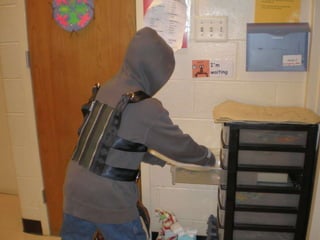
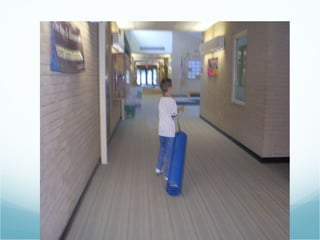
Entrance Routine Purpose: Establishes a Routine Promotes independence Signals the start of the school day
 
Sensory Purpose: Gives children the opportunity to get their sensory systems ready for their day. Heavy work (taking down the chairs, pulling a heavy crate) Rolling the ball on student Heavy blanket Swing Get ready board
 
Schedule Purpose:  Children review their day. Point out changes that may occur that are out of the ordinary. Eliminates surprises and reduces anxiety.
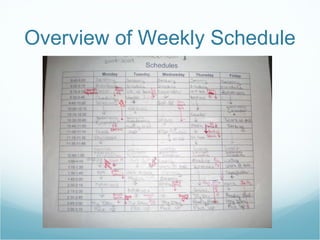
Overview of Weekly Schedule
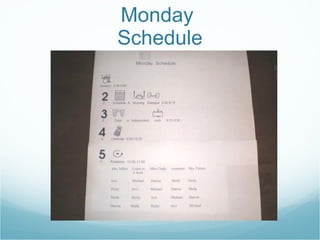
Monday  Schedule
Morning Dialogue Purpose: Encourages listening  Encourages sharing  Encourages the give and take of conversation.
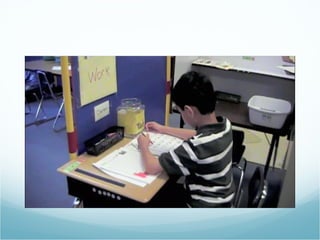
Independent Work Purpose: Reinforce independence Review learned skills Answers the 4 questions: What do I have to do? How much do I have to do? How do I know when I’m finished? What do I do when I’m finished?
Independent Work (Cont.) Allows teacher to continuously re-evaluate students abilities and to slowly increase their level of independence. This will generally entail little by little taking away some of the structure.
 
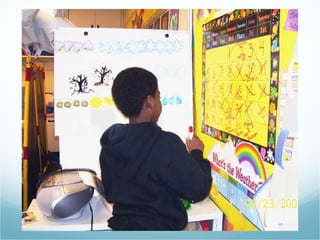
Calendar/Circle Time Purpose: Students focus on the day of the week, the date, the month and the year. Students focus on the weather and the appropriate clothing for the weather. Students practice basic skills, (skip counting, logo reading, sight word flash cards, telling time and counting money).
 
Rotations Purpose: Student learns a new skill, (new skills are generally taught in one-to-one configurations) Teachers and Assistants can assess progress Data can be collected Keep all students engaged whether they are working with an adult or working on their own.
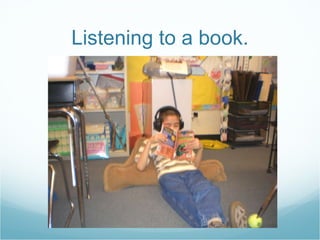
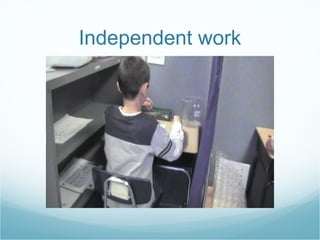
Rotations (cont.) What are rotations? The students move from location to location within the classroom for a specified amount of time. Each student has the opportunity during rotations to take part in the following kinds of activities.
Listening to a book.
Independent work
Rotations (Cont.) Management of Rotations: The student needs to rotate into areas that they can manage independently when not one-to-one with a teacher. For example if a student can not manage the computer independently then computer time for that child will not be successful.
Rotations (Cont.) The teacher is the orchestrator of rotations.  The teacher must manage the children they are working with one-on-one and the children who are working in the different rotation areas. It might be wise to start with short rotation times in the beginning, maybe 5 min.  Then as students become accustomed to that length of time they can slowly increase the time.  I usually set my rotations for 15 minute intervals.
You Choose What is You Choose? A time for children to participate in an activity of their choosing. Children are given a defined number of choices.  You choose is usually about 15 minutes in duration.
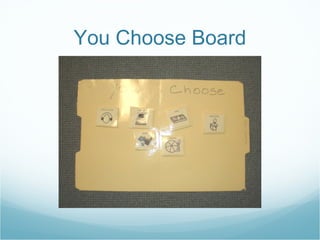
You Choose Board
You Choose Purpose: Children have an opportunity to make a choice about their school day. Teacher and assistants can access the kinds of activities children prefer to participate in.  These preferred activities can be used as rewards.
Peer Buddies Purpose: Improve social skills Improve communication skills Improve cooperation skills Learn the give and take of conversation
Peer Buddies (Cont.) Opportunities : Lunch Time/Recess Reading Buddies- A short time period each day where typical children can read to or be read to by a child with autism. Gym Buddies- Typical children help and are role models during gym class.
Peer Buddies (Cont.) Peer Buddies Class A weekly 30 minute class, each child with autism is paired with one typical child. Activities: games, crafts, food preparation, playground games, dancing…..
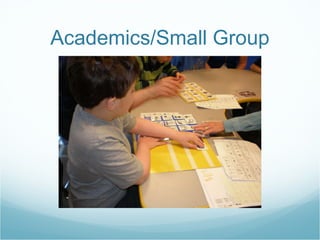
Academics/Small Group
Academics/Small Group (Cont.) Purpose: To have children work together learning the same skill. To have children work together learning parallel skills. To have children practice turn taking skills.
Academics/Small Group (Cont.) Purpose: To practice being part of a group. To use the peer group within the classroom as role models.
Relaxation Purpose: Quiet time after recess Get student ready for afternoon lessons Time to use some sensory strategies
Relaxation What does it look like? Calming music Children lay down on mats Lights are turned down Everyone is quiet
Art/Music/GYM Purpose: Enrichment Students have to adapt to different teachers, rules, rooms and activities.
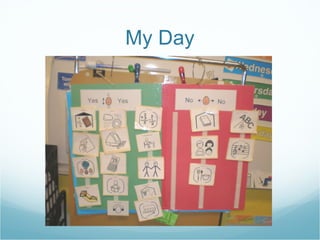
My Day
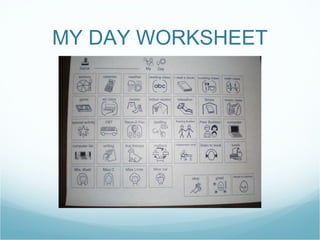
MY DAY WORKSHEET
My Day Purpose: Children recall the activities of the school day. Children record for their parent’s the activities of the school day. Children put the picture of the activity under the correct Yes or No heading.
What To Do On Monday or Where Do I Start? Look at the Physical Arrangement of the room Easiest or hardest child? Train para-professional how to use schedule Train independent work system
Where Do I Start (cont.) Move tasks 1:1 to independent Independent work to new settings
Remember!!!!! Assess Structure Re-assess Re-structure Re-assess Re-structure ETC.

Michelle No Pictures

  • 1.
    Entrance Routine Purpose:Establishes a Routine Promotes independence Signals the start of the school day
  • 2.
  • 3.
    Sensory Purpose: Giveschildren the opportunity to get their sensory systems ready for their day. Heavy work (taking down the chairs, pulling a heavy crate) Rolling the ball on student Heavy blanket Swing Get ready board
  • 4.
  • 5.
    Schedule Purpose: Children review their day. Point out changes that may occur that are out of the ordinary. Eliminates surprises and reduces anxiety.
  • 6.
  • 7.
  • 8.
    Morning Dialogue Purpose:Encourages listening Encourages sharing Encourages the give and take of conversation.
  • 9.
    Independent Work Purpose:Reinforce independence Review learned skills Answers the 4 questions: What do I have to do? How much do I have to do? How do I know when I’m finished? What do I do when I’m finished?
  • 10.
    Independent Work (Cont.)Allows teacher to continuously re-evaluate students abilities and to slowly increase their level of independence. This will generally entail little by little taking away some of the structure.
  • 11.
  • 12.
    Calendar/Circle Time Purpose:Students focus on the day of the week, the date, the month and the year. Students focus on the weather and the appropriate clothing for the weather. Students practice basic skills, (skip counting, logo reading, sight word flash cards, telling time and counting money).
  • 13.
  • 14.
    Rotations Purpose: Studentlearns a new skill, (new skills are generally taught in one-to-one configurations) Teachers and Assistants can assess progress Data can be collected Keep all students engaged whether they are working with an adult or working on their own.
  • 15.
    Rotations (cont.) Whatare rotations? The students move from location to location within the classroom for a specified amount of time. Each student has the opportunity during rotations to take part in the following kinds of activities.
  • 16.
  • 17.
  • 18.
    Rotations (Cont.) Managementof Rotations: The student needs to rotate into areas that they can manage independently when not one-to-one with a teacher. For example if a student can not manage the computer independently then computer time for that child will not be successful.
  • 19.
    Rotations (Cont.) Theteacher is the orchestrator of rotations. The teacher must manage the children they are working with one-on-one and the children who are working in the different rotation areas. It might be wise to start with short rotation times in the beginning, maybe 5 min. Then as students become accustomed to that length of time they can slowly increase the time. I usually set my rotations for 15 minute intervals.
  • 20.
    You Choose Whatis You Choose? A time for children to participate in an activity of their choosing. Children are given a defined number of choices. You choose is usually about 15 minutes in duration.
  • 21.
  • 22.
    You Choose Purpose:Children have an opportunity to make a choice about their school day. Teacher and assistants can access the kinds of activities children prefer to participate in. These preferred activities can be used as rewards.
  • 23.
    Peer Buddies Purpose:Improve social skills Improve communication skills Improve cooperation skills Learn the give and take of conversation
  • 24.
    Peer Buddies (Cont.)Opportunities : Lunch Time/Recess Reading Buddies- A short time period each day where typical children can read to or be read to by a child with autism. Gym Buddies- Typical children help and are role models during gym class.
  • 25.
    Peer Buddies (Cont.)Peer Buddies Class A weekly 30 minute class, each child with autism is paired with one typical child. Activities: games, crafts, food preparation, playground games, dancing…..
  • 26.
  • 27.
    Academics/Small Group (Cont.)Purpose: To have children work together learning the same skill. To have children work together learning parallel skills. To have children practice turn taking skills.
  • 28.
    Academics/Small Group (Cont.)Purpose: To practice being part of a group. To use the peer group within the classroom as role models.
  • 29.
    Relaxation Purpose: Quiettime after recess Get student ready for afternoon lessons Time to use some sensory strategies
  • 30.
    Relaxation What doesit look like? Calming music Children lay down on mats Lights are turned down Everyone is quiet
  • 31.
    Art/Music/GYM Purpose: EnrichmentStudents have to adapt to different teachers, rules, rooms and activities.
  • 32.
  • 33.
  • 34.
    My Day Purpose:Children recall the activities of the school day. Children record for their parent’s the activities of the school day. Children put the picture of the activity under the correct Yes or No heading.
  • 35.
    What To DoOn Monday or Where Do I Start? Look at the Physical Arrangement of the room Easiest or hardest child? Train para-professional how to use schedule Train independent work system
  • 36.
    Where Do IStart (cont.) Move tasks 1:1 to independent Independent work to new settings
  • 37.
    Remember!!!!! Assess StructureRe-assess Re-structure Re-assess Re-structure ETC.