BLOCKS OF TIME
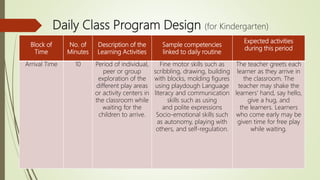
Daily Class Program Design (for Kindergarten)
Block of
Time
No. of
Minutes
Description of the
Learning Activities
Sample competencies
linked to daily routine
Expected activities
during this period
Arrival Time 10 Period of individual,
peer or group
exploration of the
different play areas
or activity centers in
the classroom while
waiting for the
children to arrive.
Fine motor skills such as
scribbling, drawing, building
with blocks, molding figures
using playdough Language
literacy and communication
skills such as using
and polite expressions
Socio-emotional skills such
as autonomy, playing with
others, and self-regulation.
The teacher greets each
learner as they arrive in
the classroom. The
teacher may shake the
learners’ hand, say hello,
give a hug, and
the learners. Learners
who come early may be
given time for free play
while waiting.
Block of
Time
No. of
Minutes
Description of
the Learning
Activities
Sample competencies
linked to daily routine
Expected activities
during this period
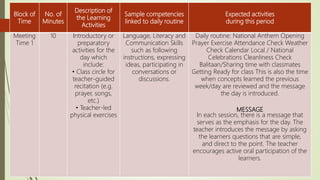
Meeting
Time 1
10 Introductory or
preparatory
activities for the
day which
include:
• Class circle for
teacher-guided
recitation (e.g.
prayer, songs,
etc.)
• Teacher-led
physical exercises
Language, Literacy and
Communication Skills
such as following
instructions, expressing
ideas, participating in
conversations or
discussions.
Daily routine: National Anthem Opening
Prayer Exercise Attendance Check Weather
Check Calendar Local / National
Celebrations Cleanliness Check
Balitaan/Sharing time with classmates
Getting Ready for class This is also the time
when concepts learned the previous
week/day are reviewed and the message
the day is introduced.
MESSAGE
In each session, there is a message that
serves as the emphasis for the day. The
teacher introduces the message by asking
the learners questions that are simple,
and direct to the point. The teacher
encourages active oral participation of the
learners.
Block of
Time
No. of
Minutes
Description of
the Learning
Activities
Sample
competencies
linked to daily
routine
Expected activities
during this period
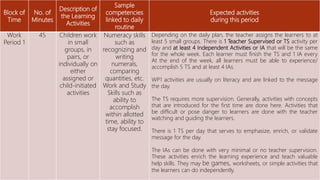
Work
Period 1
45 Children work
in small
groups, in
pairs, or
individually on
either
assigned or
child-initiated
activities
Numeracy skills
such as
recognizing and
writing
numerals,
comparing
quantities, etc.
Work and Study
Skills such as
ability to
accomplish
within allotted
time, ability to
stay focused.
Depending on the daily plan, the teacher assigns the learners to at
least 5 small groups. There is 1 Teacher Supervised or TS activity per
day and at least 4 Independent Activities or IA that will be the same
for the whole week. Each learner must finish the TS and 1 IA every
At the end of the week, all learners must be able to experience/
accomplish 5 TS and at least 4 IAs.
WP1 activities are usually on literacy and are linked to the message
the day.
The TS requires more supervision. Generally, activities with concepts
that are introduced for the first time are done here. Activities that
be difficult or pose danger to learners are done with the teacher
watching and guiding the learners.
There is 1 TS per day that serves to emphasize, enrich, or validate
message for the day.
The IAs can be done with very minimal or no teacher supervision.
These activities enrich the learning experience and teach valuable
help skills. They may be games, worksheets, or simple activities that
the learners can do independently.
Block of
Time
No. of
Minutes
Description of the
Learning Activities
Sample competencies
linked to daily routine
Expected activities
during this period
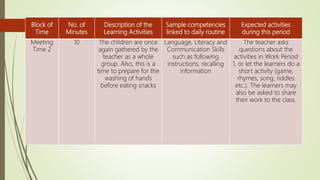
Meeting
Time 2
10 The children are once
again gathered by the
teacher as a whole
group. Also, this is a
time to prepare for the
washing of hands
before eating snacks
Language, Literacy and
Communication Skills
such as following
instructions, recalling
information
The teacher asks
questions about the
activities in Work Period
1, or let the learners do a
short activity (game,
rhymes, song, riddles
etc.). The learners may
also be asked to share
their work to the class.
Block of
Time
No. of
Minutes
Description of the
Learning Activities
Sample competencies
linked to daily routine
Expected activities
during this period
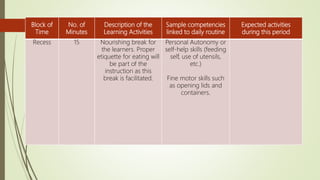
Recess 15 Nourishing break for
the learners. Proper
etiquette for eating will
be part of the
instruction as this
break is facilitated.
Personal Autonomy or
self-help skills (feeding
self, use of utensils,
etc.)
Fine motor skills such
as opening lids and
containers.
Block of
Time
No. of
Minutes
Description of the
Learning Activities
Sample competencies
linked to daily routine
Expected activities
during this period
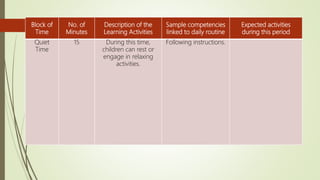
Quiet
Time
15 During this time,
children can rest or
engage in relaxing
activities.
Following instructions.
Block of
Time
No. of
Minutes
Description of the
Learning Activities
Sample competencies
linked to daily routine
Expected activities
during this period
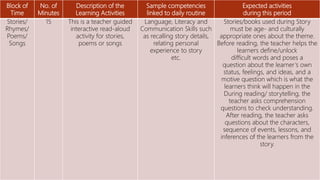
Stories/
Rhymes/
Poems/
Songs
15 This is a teacher guided
interactive read-aloud
activity for stories,
poems or songs
Language, Literacy and
Communication Skills such
as recalling story details,
relating personal
experience to story
etc.
Stories/books used during Story
must be age- and culturally
appropriate ones about the theme.
Before reading, the teacher helps the
learners define/unlock
difficult words and poses a
question about the learner’s own
status, feelings, and ideas, and a
motive question which is what the
learners think will happen in the
During reading/ storytelling, the
teacher asks comprehension
questions to check understanding.
After reading, the teacher asks
questions about the characters,
sequence of events, lessons, and
inferences of the learners from the
story.
Block of
Time
No. of
Minutes
Description of the
Learning Activities
Sample competencies
linked to daily routine
Expected activities
during this period
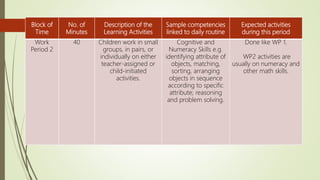
Work
Period 2
40 Children work in small
groups, in pairs, or
individually on either
teacher-assigned or
child-initiated
activities.
Cognitive and
Numeracy Skills e.g.
identifying attribute of
objects, matching,
sorting, arranging
objects in sequence
according to specific
attribute; reasoning
and problem solving.
Done like WP 1.
WP2 activities are
usually on numeracy and
other math skills.
Block of
Time
No. of
Minutes
Description of the
Learning Activities
Sample competencies
linked to daily routine
Expected activities
during this period
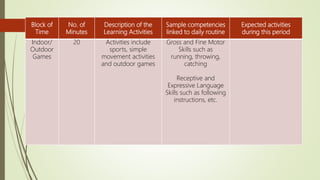
Indoor/
Outdoor
Games
20 Activities include
sports, simple
movement activities
and outdoor games
Gross and Fine Motor
Skills such as
running, throwing,
catching
Receptive and
Expressive Language
Skills such as following
instructions, etc.
Block of
Time
No. of
Minutes
Description of the
Learning Activities
Sample competencies
linked to daily routine
Expected activities
during this period
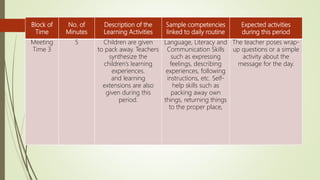
Meeting
Time 3
5 Children are given
to pack away. Teachers
synthesize the
children’s learning
experiences.
and learning
extensions are also
given during this
period.
Language, Literacy and
Communication Skills
such as expressing
feelings, describing
experiences, following
instructions, etc. Self-
help skills such as
packing away own
things, returning things
to the proper place,
The teacher poses wrap-
up questions or a simple
activity about the
message for the day.
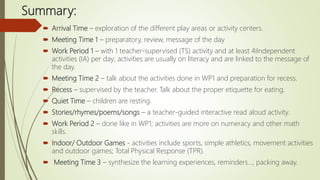
Summary:
 Arrival Time – exploration of the different play areas or activity centers.
 Meeting Time 1 – preparatory, review, message of the day
 Work Period 1 – with 1 teacher-supervised (TS) activity and at least 4iIndependent
activities (IA) per day; activities are usually on literacy and are linked to the message of
the day.
 Meeting Time 2 – talk about the activities done in WP1 and preparation for recess.
 Recess – supervised by the teacher. Talk about the proper etiquette for eating.
 Quiet Time – children are resting.
 Stories/rhymes/poems/songs – a teacher-guided interactive read aloud activity.
 Work Period 2 – done like in WP1; activities are more on numeracy and other math
skills.
 Indoor/ Outdoor Games - activities include sports, simple athletics, movement activities
and outdoor games; Total Physical Response (TPR).
 Meeting Time 3 – synthesize the learning experiences, reminders…, packing away.
Thank you!!!

BLOCKS_OF_TIME.pptx

  • 1.
  • 2.
    Daily Class ProgramDesign (for Kindergarten) Block of Time No. of Minutes Description of the Learning Activities Sample competencies linked to daily routine Expected activities during this period Arrival Time 10 Period of individual, peer or group exploration of the different play areas or activity centers in the classroom while waiting for the children to arrive. Fine motor skills such as scribbling, drawing, building with blocks, molding figures using playdough Language literacy and communication skills such as using and polite expressions Socio-emotional skills such as autonomy, playing with others, and self-regulation. The teacher greets each learner as they arrive in the classroom. The teacher may shake the learners’ hand, say hello, give a hug, and the learners. Learners who come early may be given time for free play while waiting.
  • 3.
    Block of Time No. of Minutes Descriptionof the Learning Activities Sample competencies linked to daily routine Expected activities during this period Meeting Time 1 10 Introductory or preparatory activities for the day which include: • Class circle for teacher-guided recitation (e.g. prayer, songs, etc.) • Teacher-led physical exercises Language, Literacy and Communication Skills such as following instructions, expressing ideas, participating in conversations or discussions. Daily routine: National Anthem Opening Prayer Exercise Attendance Check Weather Check Calendar Local / National Celebrations Cleanliness Check Balitaan/Sharing time with classmates Getting Ready for class This is also the time when concepts learned the previous week/day are reviewed and the message the day is introduced. MESSAGE In each session, there is a message that serves as the emphasis for the day. The teacher introduces the message by asking the learners questions that are simple, and direct to the point. The teacher encourages active oral participation of the learners.
  • 4.
    Block of Time No. of Minutes Descriptionof the Learning Activities Sample competencies linked to daily routine Expected activities during this period Work Period 1 45 Children work in small groups, in pairs, or individually on either assigned or child-initiated activities Numeracy skills such as recognizing and writing numerals, comparing quantities, etc. Work and Study Skills such as ability to accomplish within allotted time, ability to stay focused. Depending on the daily plan, the teacher assigns the learners to at least 5 small groups. There is 1 Teacher Supervised or TS activity per day and at least 4 Independent Activities or IA that will be the same for the whole week. Each learner must finish the TS and 1 IA every At the end of the week, all learners must be able to experience/ accomplish 5 TS and at least 4 IAs. WP1 activities are usually on literacy and are linked to the message the day. The TS requires more supervision. Generally, activities with concepts that are introduced for the first time are done here. Activities that be difficult or pose danger to learners are done with the teacher watching and guiding the learners. There is 1 TS per day that serves to emphasize, enrich, or validate message for the day. The IAs can be done with very minimal or no teacher supervision. These activities enrich the learning experience and teach valuable help skills. They may be games, worksheets, or simple activities that the learners can do independently.
  • 5.
    Block of Time No. of Minutes Descriptionof the Learning Activities Sample competencies linked to daily routine Expected activities during this period Meeting Time 2 10 The children are once again gathered by the teacher as a whole group. Also, this is a time to prepare for the washing of hands before eating snacks Language, Literacy and Communication Skills such as following instructions, recalling information The teacher asks questions about the activities in Work Period 1, or let the learners do a short activity (game, rhymes, song, riddles etc.). The learners may also be asked to share their work to the class.
  • 6.
    Block of Time No. of Minutes Descriptionof the Learning Activities Sample competencies linked to daily routine Expected activities during this period Recess 15 Nourishing break for the learners. Proper etiquette for eating will be part of the instruction as this break is facilitated. Personal Autonomy or self-help skills (feeding self, use of utensils, etc.) Fine motor skills such as opening lids and containers.
  • 7.
    Block of Time No. of Minutes Descriptionof the Learning Activities Sample competencies linked to daily routine Expected activities during this period Quiet Time 15 During this time, children can rest or engage in relaxing activities. Following instructions.
  • 8.
    Block of Time No. of Minutes Descriptionof the Learning Activities Sample competencies linked to daily routine Expected activities during this period Stories/ Rhymes/ Poems/ Songs 15 This is a teacher guided interactive read-aloud activity for stories, poems or songs Language, Literacy and Communication Skills such as recalling story details, relating personal experience to story etc. Stories/books used during Story must be age- and culturally appropriate ones about the theme. Before reading, the teacher helps the learners define/unlock difficult words and poses a question about the learner’s own status, feelings, and ideas, and a motive question which is what the learners think will happen in the During reading/ storytelling, the teacher asks comprehension questions to check understanding. After reading, the teacher asks questions about the characters, sequence of events, lessons, and inferences of the learners from the story.
  • 9.
    Block of Time No. of Minutes Descriptionof the Learning Activities Sample competencies linked to daily routine Expected activities during this period Work Period 2 40 Children work in small groups, in pairs, or individually on either teacher-assigned or child-initiated activities. Cognitive and Numeracy Skills e.g. identifying attribute of objects, matching, sorting, arranging objects in sequence according to specific attribute; reasoning and problem solving. Done like WP 1. WP2 activities are usually on numeracy and other math skills.
  • 10.
    Block of Time No. of Minutes Descriptionof the Learning Activities Sample competencies linked to daily routine Expected activities during this period Indoor/ Outdoor Games 20 Activities include sports, simple movement activities and outdoor games Gross and Fine Motor Skills such as running, throwing, catching Receptive and Expressive Language Skills such as following instructions, etc.
  • 11.
    Block of Time No. of Minutes Descriptionof the Learning Activities Sample competencies linked to daily routine Expected activities during this period Meeting Time 3 5 Children are given to pack away. Teachers synthesize the children’s learning experiences. and learning extensions are also given during this period. Language, Literacy and Communication Skills such as expressing feelings, describing experiences, following instructions, etc. Self- help skills such as packing away own things, returning things to the proper place, The teacher poses wrap- up questions or a simple activity about the message for the day.
  • 12.
    Summary:  Arrival Time– exploration of the different play areas or activity centers.  Meeting Time 1 – preparatory, review, message of the day  Work Period 1 – with 1 teacher-supervised (TS) activity and at least 4iIndependent activities (IA) per day; activities are usually on literacy and are linked to the message of the day.  Meeting Time 2 – talk about the activities done in WP1 and preparation for recess.  Recess – supervised by the teacher. Talk about the proper etiquette for eating.  Quiet Time – children are resting.  Stories/rhymes/poems/songs – a teacher-guided interactive read aloud activity.  Work Period 2 – done like in WP1; activities are more on numeracy and other math skills.  Indoor/ Outdoor Games - activities include sports, simple athletics, movement activities and outdoor games; Total Physical Response (TPR).  Meeting Time 3 – synthesize the learning experiences, reminders…, packing away.
  • 13.