1. What is the Particles
2. What is Romaji (Roman Alphabet)
3. special Hiragana ん
4. The Particle も
particles
Particles are probably one of the most difficult and
confusing aspects of Japanese sentences. A particle
(joshi) is a word that shows the relationship of a word,
a phrase, or a clause to the rest of the sentence.
Some particles have English equivalents. Others have
functions similar to English prepositions, but since
they always follow the word or words they mark, they
are post-positions. There are also particles that have a
peculiar usage which is not found in English. Most
particles are multi-functional.
Romaji is the romanization of the Japanese
Language. Famous Japanese loanwords in the
English language, such as Tokyo, Sushi and
Karaoke, are examples of Romaji.
The main function of Romaji is for writing human
names and place names in English. And it is
always used in the beginner's Japanese textbook
for foreign learners. But we have to emphasize
that the Japanese people never use Romaji to
write their language. That's why you need to learn
Hiragana and Katakana.
What is Romaji?
In Japanese dictionaries, ん is usually the last Hiragana listed, just like the
letter "z". But we choose to learn it in Lesson 5 because ん is a
frequently used Hiragana and it is easy to remember.
ん looks like the letter "n" (or "h"). And its pronunciation is exactly the
same as the "n" as in "sun", "pan" or "June". In other words, you can think
of it as the letter 'n' used at the end of a word. And I think you will never
forget this Hiragana after this lesson.
Just think of it as the letter "n" in English
ん is never used at the beginning of a word. And different from other
Hiragana characters, which represent one syllable, ん does not by itself
form a syllable. So あ and ん are not pronounced separately as a-n, but
continuously as "an".
The special Hiragana ん
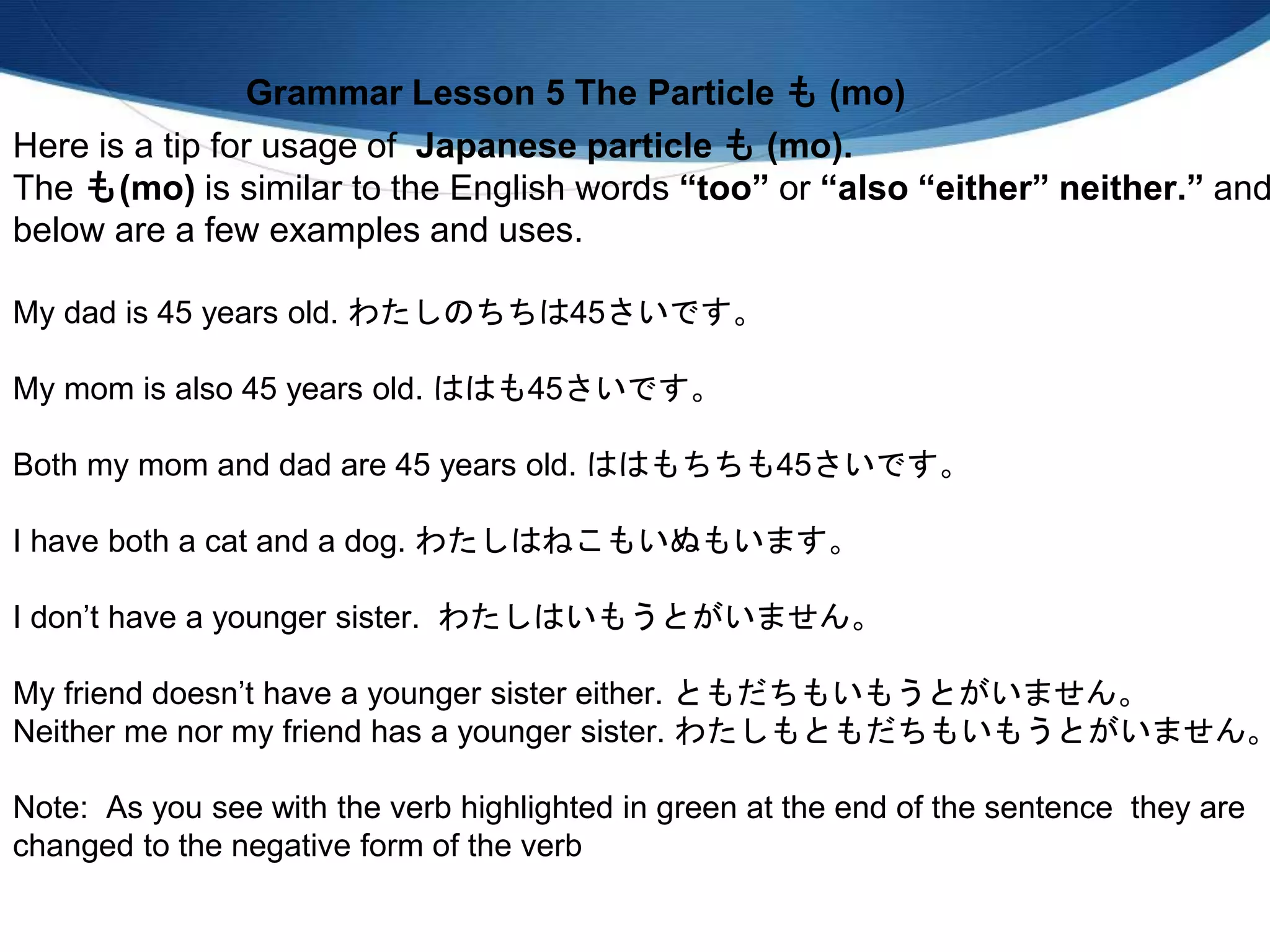
Here is a tip for usage of Japanese particle も (mo).
The も(mo) is similar to the English words “too” or “also “either” neither.” and
below are a few examples and uses.
My dad is 45 years old. わたしのちちは45さいです。
My mom is also 45 years old. ははも45さいです。
Both my mom and dad are 45 years old. ははもちちも45さいです。
I have both a cat and a dog. わたしはねこもいぬもいます。
I don’t have a younger sister. わたしはいもうとがいません。
My friend doesn’t have a younger sister either. ともだちもいもうとがいません。
Neither me nor my friend has a younger sister. わたしもともだちもいもうとがいません。
Note: As you see with the verb highlighted in green at the end of the sentence they are
changed to the negative form of the verb
Grammar Lesson 5 The Particle も (mo)

Lesson 5(slide share)

  • 1.
    1. What isthe Particles 2. What is Romaji (Roman Alphabet) 3. special Hiragana ん 4. The Particle も
  • 2.
    particles Particles are probablyone of the most difficult and confusing aspects of Japanese sentences. A particle (joshi) is a word that shows the relationship of a word, a phrase, or a clause to the rest of the sentence. Some particles have English equivalents. Others have functions similar to English prepositions, but since they always follow the word or words they mark, they are post-positions. There are also particles that have a peculiar usage which is not found in English. Most particles are multi-functional.
  • 3.
    Romaji is theromanization of the Japanese Language. Famous Japanese loanwords in the English language, such as Tokyo, Sushi and Karaoke, are examples of Romaji. The main function of Romaji is for writing human names and place names in English. And it is always used in the beginner's Japanese textbook for foreign learners. But we have to emphasize that the Japanese people never use Romaji to write their language. That's why you need to learn Hiragana and Katakana. What is Romaji?
  • 4.
    In Japanese dictionaries,ん is usually the last Hiragana listed, just like the letter "z". But we choose to learn it in Lesson 5 because ん is a frequently used Hiragana and it is easy to remember. ん looks like the letter "n" (or "h"). And its pronunciation is exactly the same as the "n" as in "sun", "pan" or "June". In other words, you can think of it as the letter 'n' used at the end of a word. And I think you will never forget this Hiragana after this lesson. Just think of it as the letter "n" in English ん is never used at the beginning of a word. And different from other Hiragana characters, which represent one syllable, ん does not by itself form a syllable. So あ and ん are not pronounced separately as a-n, but continuously as "an". The special Hiragana ん
  • 5.
    Here is atip for usage of Japanese particle も (mo). The も(mo) is similar to the English words “too” or “also “either” neither.” and below are a few examples and uses. My dad is 45 years old. わたしのちちは45さいです。 My mom is also 45 years old. ははも45さいです。 Both my mom and dad are 45 years old. ははもちちも45さいです。 I have both a cat and a dog. わたしはねこもいぬもいます。 I don’t have a younger sister. わたしはいもうとがいません。 My friend doesn’t have a younger sister either. ともだちもいもうとがいません。 Neither me nor my friend has a younger sister. わたしもともだちもいもうとがいません。 Note: As you see with the verb highlighted in green at the end of the sentence they are changed to the negative form of the verb Grammar Lesson 5 The Particle も (mo)