PARTICLES The words that hold a Japanese sentence together
The function of particles Particles in Japanese join parts of the sentence together. A particle can tell us a lot about the word before it.
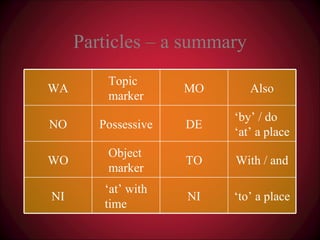
Particles – a summary WA Topic marker MO Also NO Possessive DE ‘ by’ / do ‘at’ a place WO Object marker TO With / and NI ‘ at’ with time NI ‘ to’ a place
Flickr photo by  Davi M は Note : This particle is actually written with hiragana “ ha ”
The Topic Marker  は は   [wa] tells us the topic of the sentence. It tells us  W H A T is being discussed. It is hard to translate into English but it is similar to saying ‘ as for … ’.
Examples for   は ぼく  は  12さい です。 I am 12 years old. ( As for  me, I’m 12). ひろ  は  せんせい です。 Hiro is a teacher. ( As for  Hiro, [he’s] a teacher.
The Possessive  の Flickr photo by  Spitzgogo
The Possessive  の の   [no] can act like ‘apostrophe s’ in English. It tells us who owns something. It also serves to join 2  no uns together when they relate to each other.  Eg . Tomorrow morning, Tuesday next week, and so on.
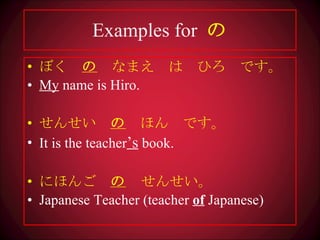
Examples for  の ぼく  の  なまえ は ひろ です。 My  name is Hiro. せんせい  の  ほん です。 It is the teacher ’s  book. にほんご  の   せんせい。 Japanese Teacher (teacher  of  Japanese)
The object marker  を Flickr photo by  tanakawho Flickr photo by  El Negro Magnifico
The object marker  を を   [wo] tells us the  object  of the verb. If the verb is ‘do’, it tells us  what  we are doing. If the verb is ‘eat’, it tells us  what  we are eating. ‘ Eat a hamburger’ – hamburger is the object ‘ Play tennis’ – tennis is the object.
Examples for  を   まど  を  あけてください。 Please open the door. ひろ は おんがく  を  ききます。 Hiro listens to music.
Flickr photo by  B Tal Flickr photo by  an untrained eye Movement “ to ” a place に
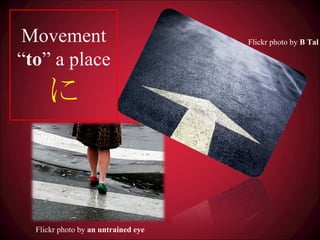
The particle  に に   [ni] tells us the place we are  going   to . Example : かわ  に  いきます。   Go   to  the river
Time “at” which something occurs に Flickr photo by  Joe Penniston Flickr photo by  Robbert van der Steeg
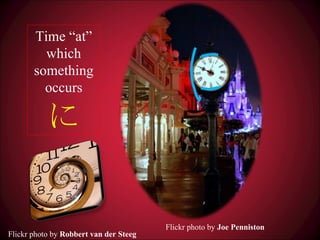
The particle  に It also tells us the  time we do something . It comes after the TIME or DAY of the week. Example : ろくじ  に  おきます。  Wake up  at  6:00
The “location” of something: “ in” / “on” に Flickr photo by  John Althouse Cohen
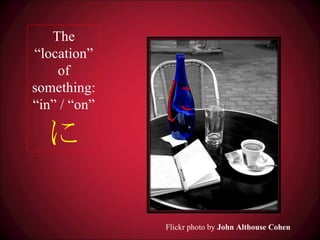
The particle  に It also indicates the  location of something . “on the table” etc. Example : いす の うえ  に  あります。  It is  on  the chair.
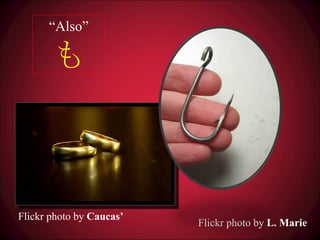
Flickr photo by  L. Marie “ Also” も Flickr photo by  Caucas’
The particle  も も   means “also” It can replace  を   or   は   but can be used together with  に  or   へ
Examples for  も すし を たべます。さしみ も たべます。 I eat sushi. I  also  eat sashimi. とうきょう に いきます。おおさか  に も  いきます。 I will go to Tokyo.   I will  also  go to Osaka.
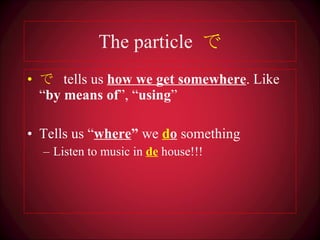
The  particle   で で  tells us  how we get somewhere . Like “ by means of ”, “ using ” Tells us “ where ”  we  d o  something Listen to music in  de  house!!!
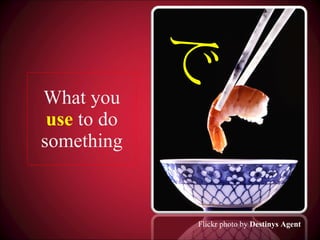
What you  use  to do something Flickr photo by  Destinys Agent で
Where u do  de  activity で Flickr photo by  moriza
How  you  get  somewhere Flickr photo by  rAmmoRRison で
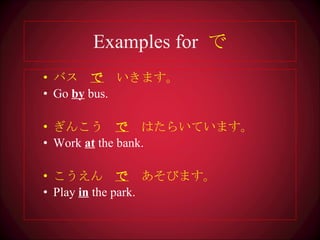
Examples for  で バス  で  いきます 。 Go  by  bus. ぎんこう  で  はたらいています。 Work  at  the bank. こうえん  で  あそびます。 Play  in  the park.
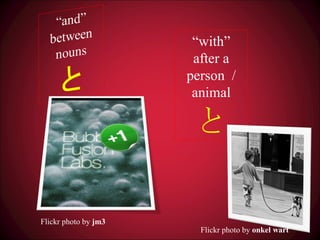
“ with” after a person  / animal と Flickr photo by  jm3 Flickr photo by  onkel wart
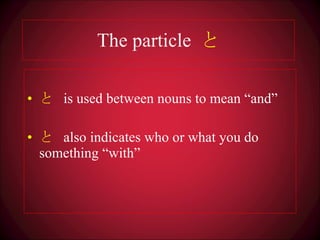
The particle  と と   is used between nouns to  mean “and” と   also indicates who or what you do something “with”
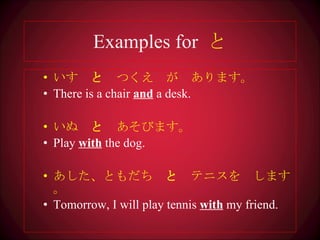
Examples for  と いす  と  つくえ が あります。 There is a chair  and  a desk. いぬ  と  あそびます 。 Play  with  the dog. あした、ともだち  と  テニスを します。 Tomorrow, I will play tennis  with  my friend.

Particles Explanation

  • 1.
    PARTICLES The wordsthat hold a Japanese sentence together
  • 2.
    The function ofparticles Particles in Japanese join parts of the sentence together. A particle can tell us a lot about the word before it.
  • 3.
    Particles – asummary WA Topic marker MO Also NO Possessive DE ‘ by’ / do ‘at’ a place WO Object marker TO With / and NI ‘ at’ with time NI ‘ to’ a place
  • 4.
    Flickr photo by Davi M は Note : This particle is actually written with hiragana “ ha ”
  • 5.
    The Topic Marker は は   [wa] tells us the topic of the sentence. It tells us W H A T is being discussed. It is hard to translate into English but it is similar to saying ‘ as for … ’.
  • 6.
    Examples for は ぼく  は  12さい です。 I am 12 years old. ( As for me, I’m 12). ひろ  は  せんせい です。 Hiro is a teacher. ( As for Hiro, [he’s] a teacher.
  • 7.
    The Possessive の Flickr photo by Spitzgogo
  • 8.
    The Possessive の の   [no] can act like ‘apostrophe s’ in English. It tells us who owns something. It also serves to join 2 no uns together when they relate to each other. Eg . Tomorrow morning, Tuesday next week, and so on.
  • 9.
    Examples for の ぼく  の  なまえ は ひろ です。 My name is Hiro. せんせい  の  ほん です。 It is the teacher ’s book. にほんご  の   せんせい。 Japanese Teacher (teacher of Japanese)
  • 10.
    The object marker を Flickr photo by tanakawho Flickr photo by El Negro Magnifico
  • 11.
    The object marker を を   [wo] tells us the object of the verb. If the verb is ‘do’, it tells us what we are doing. If the verb is ‘eat’, it tells us what we are eating. ‘ Eat a hamburger’ – hamburger is the object ‘ Play tennis’ – tennis is the object.
  • 12.
    Examples for を まど  を  あけてください。 Please open the door. ひろ は おんがく  を  ききます。 Hiro listens to music.
  • 13.
    Flickr photo by B Tal Flickr photo by an untrained eye Movement “ to ” a place に
  • 14.
    The particle に に   [ni] tells us the place we are going to . Example : かわ  に  いきます。 Go to the river
  • 15.
    Time “at” whichsomething occurs に Flickr photo by Joe Penniston Flickr photo by Robbert van der Steeg
  • 16.
    The particle に It also tells us the time we do something . It comes after the TIME or DAY of the week. Example : ろくじ  に  おきます。 Wake up at 6:00
  • 17.
    The “location” ofsomething: “ in” / “on” に Flickr photo by John Althouse Cohen
  • 18.
    The particle に It also indicates the location of something . “on the table” etc. Example : いす の うえ  に  あります。  It is on the chair.
  • 19.
    Flickr photo by L. Marie “ Also” も Flickr photo by Caucas’
  • 20.
    The particle も も means “also” It can replace を or は but can be used together with に or へ
  • 21.
    Examples for も すし を たべます。さしみ も たべます。 I eat sushi. I also eat sashimi. とうきょう に いきます。おおさか  に も  いきます。 I will go to Tokyo.   I will also go to Osaka.
  • 22.
    The particle で で tells us how we get somewhere . Like “ by means of ”, “ using ” Tells us “ where ” we d o something Listen to music in de house!!!
  • 23.
    What you use to do something Flickr photo by Destinys Agent で
  • 24.
    Where u do de activity で Flickr photo by moriza
  • 25.
    How you get somewhere Flickr photo by rAmmoRRison で
  • 26.
    Examples for で バス  で  いきます 。 Go by bus. ぎんこう  で  はたらいています。 Work at the bank. こうえん  で  あそびます。 Play in the park.
  • 27.
    “ with” aftera person / animal と Flickr photo by jm3 Flickr photo by onkel wart
  • 28.
    The particle と と is used between nouns to mean “and” と also indicates who or what you do something “with”
  • 29.
    Examples for と いす  と  つくえ が あります。 There is a chair and a desk. いぬ  と  あそびます 。 Play with the dog. あした、ともだち  と  テニスを します。 Tomorrow, I will play tennis with my friend.