What motivates you to study?
How do you like to
communicate?
 Types of Speech Context
Types of Interpersonal
Contexts
Types of Speech Styles
Lesson Objectives
• differentiate types of speech contexts;
• explain the importance of effective
communication skills;
• practice effective interpersonal skills and
intrapersonal skills
Types of Speech Contexts
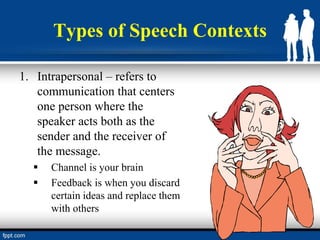
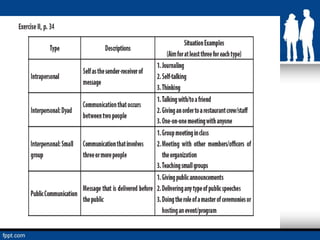
1. Intrapersonal – refers to
communication that centers
one person where the
speaker acts both as the
sender and the receiver of
the message.
 Channel is your brain
 Feedback is when you discard
certain ideas and replace them
with others
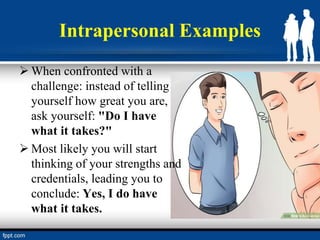
Intrapersonal Examples
 When confronted with a
challenge: instead of telling
yourself how great you are,
ask yourself: "Do I have
what it takes?"
 Most likely you will start
thinking of your strengths and
credentials, leading you to
conclude: Yes, I do have
what it takes.
Types of Speech Context
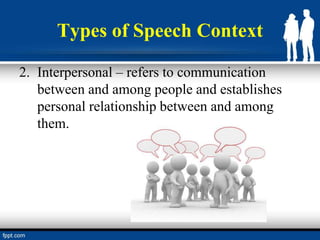
2. Interpersonal – refers to communication
between and among people and establishes
personal relationship between and among
them.
Types of Interpersonal Context
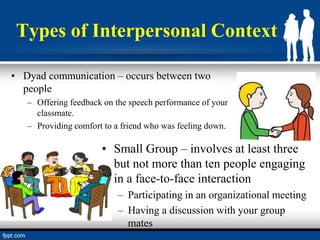
• Dyad communication – occurs between two
people
– Offering feedback on the speech performance of your
classmate.
– Providing comfort to a friend who was feeling down.
• Small Group – involves at least three
but not more than ten people engaging
in a face-to-face interaction
– Participating in an organizational meeting
– Having a discussion with your group
mates
Types of Speech Context
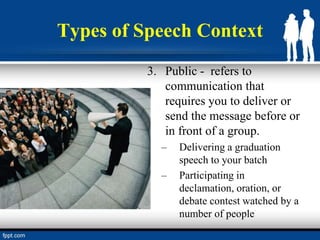
3. Public - refers to
communication that
requires you to deliver or
send the message before or
in front of a group.
– Delivering a graduation
speech to your batch
– Participating in
declamation, oration, or
debate contest watched by a
number of people
Types of Speech Context
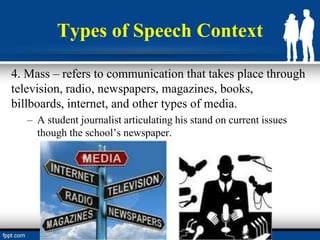
4. Mass – refers to communication that takes place through
television, radio, newspapers, magazines, books,
billboards, internet, and other types of media.
– A student journalist articulating his stand on current issues
though the school’s newspaper.
SPEECH STYLES
Types of Speech Styles
- context dictates and affects the way people
communicate, which results in various speech
style.
1. Intimate
• private, which occurs between or among close
family members or intimate individuals
• The language used in this style may not be
shared in public.
– Telling your bf/gf that you love them
– Telling your best friend about your deepest
and darkest problems
– Asking your family for advice about serious
matters
2. Casual
• style common among peers and friends
• Jargon, slang, street language, gay language or
vulgar words are used.
• Its casual language uses words or phrases
• that are shortened like:
• – “I’m doin’ it my way” (doing)
• – “Lemme go!” (let me go)
• ----“Freak out” (Scared)
3. Consultative
• This is the standard style.
• Professional and mutually acceptable language
is a must.
– communication between teachers and students,
– employers and employees,
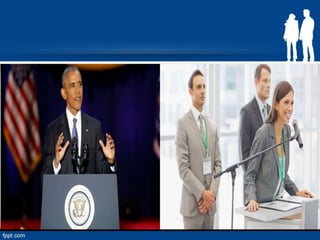
– doctor and patient, judge and lawyer, or
– President and his/her constituents.
4. Formal
• used in formal settings and is a one way
communication
– Sermons by priests and ministers,
– State of the Nation Address of the President
– Formal speeches
– Pronouncement by judges
5. Frozen
• “frozen” in time and remains unchanged
• It mostly occurs in ceremonies.
– Preamble of the Constitution
– Lord’s prayer
– Allegiance to the country or flag
WHY DO WE HAVE TO BE AWARE ABOUT
THE DIFFERENT SPEECH STYLE?
• The appropriate language should be used because it
may result in confusion if the setting and context do
not match the language.
• The language should also be apt to the speech style
because it reflects the formality of the situation.
• It also affects the relationship of the participants.

LESSON 3- Speech-Context-and-Styles.pptx

  • 1.
    What motivates youto study? How do you like to communicate?
  • 2.
     Types ofSpeech Context Types of Interpersonal Contexts Types of Speech Styles
  • 3.
    Lesson Objectives • differentiatetypes of speech contexts; • explain the importance of effective communication skills; • practice effective interpersonal skills and intrapersonal skills
  • 5.
    Types of SpeechContexts 1. Intrapersonal – refers to communication that centers one person where the speaker acts both as the sender and the receiver of the message.  Channel is your brain  Feedback is when you discard certain ideas and replace them with others
  • 6.
    Intrapersonal Examples  Whenconfronted with a challenge: instead of telling yourself how great you are, ask yourself: "Do I have what it takes?"  Most likely you will start thinking of your strengths and credentials, leading you to conclude: Yes, I do have what it takes.
  • 7.
    Types of SpeechContext 2. Interpersonal – refers to communication between and among people and establishes personal relationship between and among them.
  • 8.
    Types of InterpersonalContext • Dyad communication – occurs between two people – Offering feedback on the speech performance of your classmate. – Providing comfort to a friend who was feeling down. • Small Group – involves at least three but not more than ten people engaging in a face-to-face interaction – Participating in an organizational meeting – Having a discussion with your group mates
  • 9.
    Types of SpeechContext 3. Public - refers to communication that requires you to deliver or send the message before or in front of a group. – Delivering a graduation speech to your batch – Participating in declamation, oration, or debate contest watched by a number of people
  • 10.
    Types of SpeechContext 4. Mass – refers to communication that takes place through television, radio, newspapers, magazines, books, billboards, internet, and other types of media. – A student journalist articulating his stand on current issues though the school’s newspaper.
  • 12.
  • 13.
    Types of SpeechStyles - context dictates and affects the way people communicate, which results in various speech style.
  • 15.
    1. Intimate • private,which occurs between or among close family members or intimate individuals • The language used in this style may not be shared in public. – Telling your bf/gf that you love them – Telling your best friend about your deepest and darkest problems – Asking your family for advice about serious matters
  • 17.
    2. Casual • stylecommon among peers and friends • Jargon, slang, street language, gay language or vulgar words are used. • Its casual language uses words or phrases • that are shortened like: • – “I’m doin’ it my way” (doing) • – “Lemme go!” (let me go) • ----“Freak out” (Scared)
  • 19.
    3. Consultative • Thisis the standard style. • Professional and mutually acceptable language is a must. – communication between teachers and students, – employers and employees, – doctor and patient, judge and lawyer, or – President and his/her constituents.
  • 21.
    4. Formal • usedin formal settings and is a one way communication – Sermons by priests and ministers, – State of the Nation Address of the President – Formal speeches – Pronouncement by judges
  • 23.
    5. Frozen • “frozen”in time and remains unchanged • It mostly occurs in ceremonies. – Preamble of the Constitution – Lord’s prayer – Allegiance to the country or flag
  • 24.
    WHY DO WEHAVE TO BE AWARE ABOUT THE DIFFERENT SPEECH STYLE? • The appropriate language should be used because it may result in confusion if the setting and context do not match the language. • The language should also be apt to the speech style because it reflects the formality of the situation. • It also affects the relationship of the participants.

Editor's Notes

  • #13 The context of speeches/communication affects the way people communicate which results to various speech styles To introduce the concept of speech styles, ask your students how they would ask each of the following people to wait for them/give them a moment: • Classmates (trend in the answers must generally follow a casual speech style) • Close family members or boyfriends/girlfriends (trend in answers must generally follow the intimate speech style) • Cashier at a store (trend in answers must generally follow the consultative speech style) Use the answers to point out that although students were basically sending the same message to each of the given people, they phrased differently depending on who they were talking to.
  • #16 This style is used in conversations between people who are very close and know each other quite well because having a maximum of shared background information – It is characterized by an economy of words, with a high incidence of significant nonverbal communication, such as gesture, facial expression, eye contact and so on.
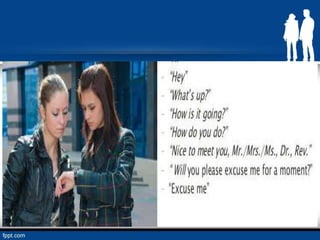
  • #18 – The use of language is general -You also use casual language when you want to get to know someone on a more personal level, or you want the person to feel at ease. -simple greeting with those you know well might probably be the causal: – “Hi” – “Hey” – “What’s up?” – “How is it going?” – “How do you do?” – “Nice to meet you, Mr./Mrs./Ms., Dr., Rev.” – “ Will you please excuse me for a moment?” – “Excuse me”
  • #20 It is unplanned speech This speech style uses listener participation and feedback – The two defining features of this style are: (a)the speaker supplies background information (b)the listener participates continuously
  • #22 -It uses formal words and expressions -This speech style is expected to be presented in complete sentences with specific word usage
  • #24 Also known as fixed speech It is most the most formal communicative style that is often used in respectful situation or formal Ceremony