COMMUNICATIVE
STRATEGY
Oral Communication
in Context
5 minutes WARM-UP ACTIVITY
Watch the two videos in the following link.
Compare and contrast the two meetings and
answer the following:
https://www.youtube.com/watch?v=rtBDS8eriF
w
https://www.youtube.com/watch?v=3WrZMzqp
FTc
5 minutes WARM-UP ACTIVITY
1. Compare and contrast the two videos on how they
begin the meeting.
2. Compare and contrast how does each member
share their insights.
3. Compare and contrast the flow of communication
occurred.
4. Compare and contrast how was the meeting
adjourned.
Group Task
 With your group, record your conversation as you
talk about the best tourist spot in Sorsogon.
 Answer the self-assessment in the next slide and
determine how well you participate in a
conversation.
Communicative Strategy
Communicative strategies are plans
or ways to share information effectively
in conversations. They help manage
interactions, address communication
breakdowns, and achieve specific goals.
Communicative Strategy
Key strategies include nomination,
restriction, turn-taking, topic control,
topic shifting, repair, and termination.
These strategies ensure clear
communication, maintain focus, and
facilitate smooth transitions in
conversations.
Types of Communicative Strategies
1. Nomination
A speaker carries out nomination to
collaboratively and productively establish a
topic. Basically, when you employ this
strategy, you try to open a topic with the
people you are talking to.
Types of Communicative Strategies
1. Nomination
Examples:
 There’s a new film to be released next week
 Hello! How are you?
 I have something to tell you.
 Have you heard about the latest news?
Types of Communicative Strategies
2. Restriction
It refers to any limitation you may have as a
speaker. When communicating in the
classroom, in a meeting, or while hanging out
with your friends, you are typically given
specific instructions that you must follow.
These instructions confine you as a speaker
and limit what you can say.
Types of Communicative Strategies
2. Restriction
Examples:
 You are only allowed to speak in English.
 In our meeting, we will only be talking about
the result of our advertisement.
 I need to talk to you about our project, but
please keep your responses limited to yes or
no.
Types of Communicative Strategies
3. Turn-taking
Sometimes people are given unequal opportunities to talk
because others take much time during the conversation.
Turn-taking pertains to the process by which people
decide who takes the conversational floor. There is a code
of behavior behind establishing and sustaining a
productive conversation, but the primary idea is to give all
communicators a chance to speak.
Types of Communicative Strategies
3. Turn-taking
Examples:
 What do you think about that?
 That's my point, so now it's your turn to
speak.
 I'll let you take the floor after I'm done
with this last thought.
Types of Communicative Strategies
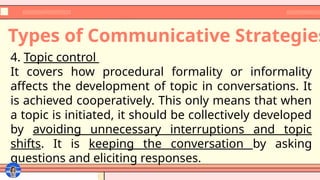
4. Topic control
It covers how procedural formality or informality
affects the development of topic in conversations. It
is achieved cooperatively. This only means that when
a topic is initiated, it should be collectively developed
by avoiding unnecessary interruptions and topic
shifts. It is keeping the conversation by asking
questions and eliciting responses.
Types of Communicative Strategies
4. Topic Control
 You are excited, aren’t you?
 It was unexpected, wasn’t it?
 Okay
 Go on.
 Yeah
 I agree
Types of Communicative Strategies
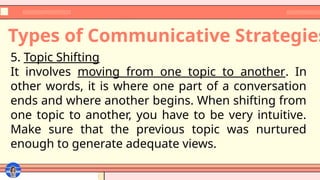
5. Topic Shifting
It involves moving from one topic to another. In
other words, it is where one part of a conversation
ends and where another begins. When shifting from
one topic to another, you have to be very intuitive.
Make sure that the previous topic was nurtured
enough to generate adequate views.
Types of Communicative Strategies
5. Topic Shifting
 By the way…
 In addition to what you said…
 Speaking of…
 Which reminds me of…
Types of Communicative Strategies
6. Repair
It refers to how speakers address the problems in
speaking, listening, and comprehending that they
may encounter in a conversation. For example, if
everybody in the conversation seems to talk at the
same time, give way and appreciate other’s initiative
to set the conversation back to its topic.
Types of Communicative Strategies
6. Repair
 I think you said the meeting was on
Thursday, but did you mean Tuesday?
 Let me rephrase that; what I meant to
say was...
 Can we speak one at a time?
Types of Communicative Strategies
7. Termination
It refers to the conversation participants’
close-initiating expressions that end a topic in
a conversation. Most of the time, the topic
initiator takes responsibility to signal the
end of the discussion as well.
Types of Communicative Strategies
7. Termination
 Well, I should probably get going now.
 It was great talking to you, but I have to go
to a meeting.
 Alright, I'll see you later. Bye for now!
 To conclude this meeting, we will have new
digitally produced ad tomorrow.
Quiz. True or False
1. The communicative strategy of Restriction is used to limit the
conversation to a specific topic.
2. Topic Shifting is a strategy used to abruptly change the subject
of a conversation without any transition.
3. A person who says "What do you think?" is most likely using
the communicative strategy of Turn-taking.
4. Repair is a strategy used to correct or adjust a mistake in a
conversation.
5. The communicative strategy of Topic Control is about making
sure only one person gets to talk.
Quiz. True or False
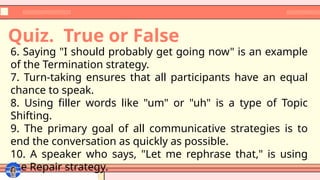
6. Saying "I should probably get going now" is an example
of the Termination strategy.
7. Turn-taking ensures that all participants have an equal
chance to speak.
8. Using filler words like "um" or "uh" is a type of Topic
Shifting.
9. The primary goal of all communicative strategies is to
end the conversation as quickly as possible.
10. A speaker who says, "Let me rephrase that," is using
the Repair strategy.
Group Task. Identify the communicative strategy in the
script.
Priya : “Okay team—that’s the plan. Let’s start our discussion by choosing our project
working title.”
Priya (continuing): “Once we’ve agreed on a title, we’ll stick to one thing at a time, okay?”
Juan :“Sounds good. I’d suggest ‘EcoZoom’ since it’s about local green messaging.”
Ella (E): “I like ‘EcoZoom App.’ And it signals speed and zooming in on neighbourhood data.”
Marcus (M): “Agreed, EcoZoom App it is. Before we move on to features, can we finish on the
title, please?” (Carl tries to introduce schedule.)
Ella :“By the way, since Maria posted earlier about timeline, shall we talk about badges and
incentives next?” Marcus (M): “Sure—just one sec: I think I mis‑labeled our slide. I meant the
rewards mock‑up is on slide 5, not 6.”
Juan: “No worries. I saw slide 5. The badge feature looks great.”
Priya: “Let’s wrap this up: title EcoZoom App, feature‑list draft by tomorrow, and tentative
incentives board. Any final quick notes?” “
Ella :“Looks clear. Thanks for keeping it tight and focused!”
Marcus: Yes, thanks.
Identify the type of communicative strategy in each
statement.
1. “Do you have anything to say?”
2. “One of the essential lessons I gained from the discussion
is the
importance of sports and wellness to a healthy lifestyle.”
3. “Excuse me? I think we should speak one at a time, so we
can clearly
understand what we want to say about the issue.”
4. “Go on with your ideas. I’ll let you finish first before I say
something.”
5. “Have you heard the news about the latest achievement of
Identify the type of communicative strategy in each
statement.
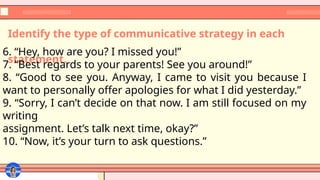
6. “Hey, how are you? I missed you!”
7. “Best regards to your parents! See you around!”
8. “Good to see you. Anyway, I came to visit you because I want
personally
offer apologies for what I did yesterday.”
9. “Sorry, I can’t decide on that now. I am still focused on
writing
assignment. Let’s talk next time, okay?”
10. “Now, it’s your turn to ask questions.”
Identify the type of communicative strategy in each
statement.
6. “Hey, how are you? I missed you!”
7. “Best regards to your parents! See you around!”
8. “Good to see you. Anyway, I came to visit you because I
want to personally offer apologies for what I did yesterday.”
9. “Sorry, I can’t decide on that now. I am still focused on my
writing
assignment. Let’s talk next time, okay?”
10. “Now, it’s your turn to ask questions.”
THANK YOU
Follow me on my Youtube Channel
https://www.youtube.com/@educstream

COMMUNICATIVE STRATEGY-LESSON AND EVALUATION.pptx

  • 1.
  • 2.
    5 minutes WARM-UPACTIVITY Watch the two videos in the following link. Compare and contrast the two meetings and answer the following: https://www.youtube.com/watch?v=rtBDS8eriF w https://www.youtube.com/watch?v=3WrZMzqp FTc
  • 3.
    5 minutes WARM-UPACTIVITY 1. Compare and contrast the two videos on how they begin the meeting. 2. Compare and contrast how does each member share their insights. 3. Compare and contrast the flow of communication occurred. 4. Compare and contrast how was the meeting adjourned.
  • 4.
    Group Task  Withyour group, record your conversation as you talk about the best tourist spot in Sorsogon.  Answer the self-assessment in the next slide and determine how well you participate in a conversation.
  • 7.
    Communicative Strategy Communicative strategiesare plans or ways to share information effectively in conversations. They help manage interactions, address communication breakdowns, and achieve specific goals.
  • 8.
    Communicative Strategy Key strategiesinclude nomination, restriction, turn-taking, topic control, topic shifting, repair, and termination. These strategies ensure clear communication, maintain focus, and facilitate smooth transitions in conversations.
  • 9.
    Types of CommunicativeStrategies 1. Nomination A speaker carries out nomination to collaboratively and productively establish a topic. Basically, when you employ this strategy, you try to open a topic with the people you are talking to.
  • 10.
    Types of CommunicativeStrategies 1. Nomination Examples:  There’s a new film to be released next week  Hello! How are you?  I have something to tell you.  Have you heard about the latest news?
  • 11.
    Types of CommunicativeStrategies 2. Restriction It refers to any limitation you may have as a speaker. When communicating in the classroom, in a meeting, or while hanging out with your friends, you are typically given specific instructions that you must follow. These instructions confine you as a speaker and limit what you can say.
  • 12.
    Types of CommunicativeStrategies 2. Restriction Examples:  You are only allowed to speak in English.  In our meeting, we will only be talking about the result of our advertisement.  I need to talk to you about our project, but please keep your responses limited to yes or no.
  • 13.
    Types of CommunicativeStrategies 3. Turn-taking Sometimes people are given unequal opportunities to talk because others take much time during the conversation. Turn-taking pertains to the process by which people decide who takes the conversational floor. There is a code of behavior behind establishing and sustaining a productive conversation, but the primary idea is to give all communicators a chance to speak.
  • 14.
    Types of CommunicativeStrategies 3. Turn-taking Examples:  What do you think about that?  That's my point, so now it's your turn to speak.  I'll let you take the floor after I'm done with this last thought.
  • 15.
    Types of CommunicativeStrategies 4. Topic control It covers how procedural formality or informality affects the development of topic in conversations. It is achieved cooperatively. This only means that when a topic is initiated, it should be collectively developed by avoiding unnecessary interruptions and topic shifts. It is keeping the conversation by asking questions and eliciting responses.
  • 16.
    Types of CommunicativeStrategies 4. Topic Control  You are excited, aren’t you?  It was unexpected, wasn’t it?  Okay  Go on.  Yeah  I agree
  • 17.
    Types of CommunicativeStrategies 5. Topic Shifting It involves moving from one topic to another. In other words, it is where one part of a conversation ends and where another begins. When shifting from one topic to another, you have to be very intuitive. Make sure that the previous topic was nurtured enough to generate adequate views.
  • 18.
    Types of CommunicativeStrategies 5. Topic Shifting  By the way…  In addition to what you said…  Speaking of…  Which reminds me of…
  • 19.
    Types of CommunicativeStrategies 6. Repair It refers to how speakers address the problems in speaking, listening, and comprehending that they may encounter in a conversation. For example, if everybody in the conversation seems to talk at the same time, give way and appreciate other’s initiative to set the conversation back to its topic.
  • 20.
    Types of CommunicativeStrategies 6. Repair  I think you said the meeting was on Thursday, but did you mean Tuesday?  Let me rephrase that; what I meant to say was...  Can we speak one at a time?
  • 21.
    Types of CommunicativeStrategies 7. Termination It refers to the conversation participants’ close-initiating expressions that end a topic in a conversation. Most of the time, the topic initiator takes responsibility to signal the end of the discussion as well.
  • 22.
    Types of CommunicativeStrategies 7. Termination  Well, I should probably get going now.  It was great talking to you, but I have to go to a meeting.  Alright, I'll see you later. Bye for now!  To conclude this meeting, we will have new digitally produced ad tomorrow.
  • 23.
    Quiz. True orFalse 1. The communicative strategy of Restriction is used to limit the conversation to a specific topic. 2. Topic Shifting is a strategy used to abruptly change the subject of a conversation without any transition. 3. A person who says "What do you think?" is most likely using the communicative strategy of Turn-taking. 4. Repair is a strategy used to correct or adjust a mistake in a conversation. 5. The communicative strategy of Topic Control is about making sure only one person gets to talk.
  • 24.
    Quiz. True orFalse 6. Saying "I should probably get going now" is an example of the Termination strategy. 7. Turn-taking ensures that all participants have an equal chance to speak. 8. Using filler words like "um" or "uh" is a type of Topic Shifting. 9. The primary goal of all communicative strategies is to end the conversation as quickly as possible. 10. A speaker who says, "Let me rephrase that," is using the Repair strategy.
  • 25.
    Group Task. Identifythe communicative strategy in the script. Priya : “Okay team—that’s the plan. Let’s start our discussion by choosing our project working title.” Priya (continuing): “Once we’ve agreed on a title, we’ll stick to one thing at a time, okay?” Juan :“Sounds good. I’d suggest ‘EcoZoom’ since it’s about local green messaging.” Ella (E): “I like ‘EcoZoom App.’ And it signals speed and zooming in on neighbourhood data.” Marcus (M): “Agreed, EcoZoom App it is. Before we move on to features, can we finish on the title, please?” (Carl tries to introduce schedule.) Ella :“By the way, since Maria posted earlier about timeline, shall we talk about badges and incentives next?” Marcus (M): “Sure—just one sec: I think I mis‑labeled our slide. I meant the rewards mock‑up is on slide 5, not 6.” Juan: “No worries. I saw slide 5. The badge feature looks great.” Priya: “Let’s wrap this up: title EcoZoom App, feature‑list draft by tomorrow, and tentative incentives board. Any final quick notes?” “ Ella :“Looks clear. Thanks for keeping it tight and focused!” Marcus: Yes, thanks.
  • 26.
    Identify the typeof communicative strategy in each statement. 1. “Do you have anything to say?” 2. “One of the essential lessons I gained from the discussion is the importance of sports and wellness to a healthy lifestyle.” 3. “Excuse me? I think we should speak one at a time, so we can clearly understand what we want to say about the issue.” 4. “Go on with your ideas. I’ll let you finish first before I say something.” 5. “Have you heard the news about the latest achievement of
  • 27.
    Identify the typeof communicative strategy in each statement. 6. “Hey, how are you? I missed you!” 7. “Best regards to your parents! See you around!” 8. “Good to see you. Anyway, I came to visit you because I want personally offer apologies for what I did yesterday.” 9. “Sorry, I can’t decide on that now. I am still focused on writing assignment. Let’s talk next time, okay?” 10. “Now, it’s your turn to ask questions.”
  • 28.
    Identify the typeof communicative strategy in each statement. 6. “Hey, how are you? I missed you!” 7. “Best regards to your parents! See you around!” 8. “Good to see you. Anyway, I came to visit you because I want to personally offer apologies for what I did yesterday.” 9. “Sorry, I can’t decide on that now. I am still focused on my writing assignment. Let’s talk next time, okay?” 10. “Now, it’s your turn to ask questions.”
  • 29.
    THANK YOU Follow meon my Youtube Channel https://www.youtube.com/@educstream