Chapter III
METHODOLOGY
Research Design
The Sample
The Instruments
Intervention
Data Collection Procedure
Chapter
Content
ALAN S. ABERILLA
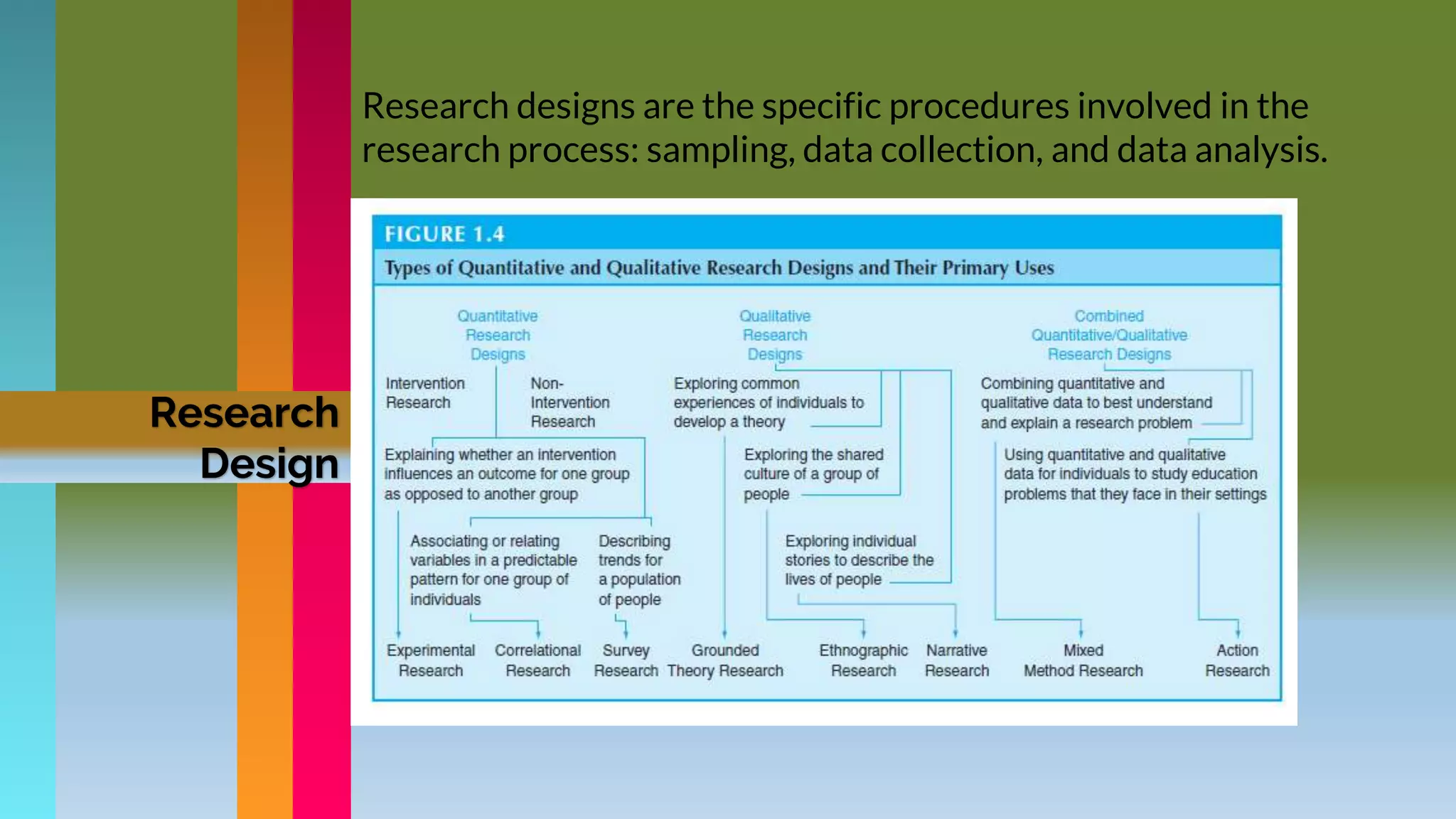
Research designs are the specific procedures involved in the
research process: sampling, data collection, and data analysis.
Research
Design
The first step leading to the process of collecting
quantitative data is to identify the people and places
you plan to study.
This involves determining which group of people will
you study, who, specifically, these people are, and how
many of them you will need to involve.
Identifying the representative group that will take part
in the study is an important aspect of the research that
you need to specify.
The Sample
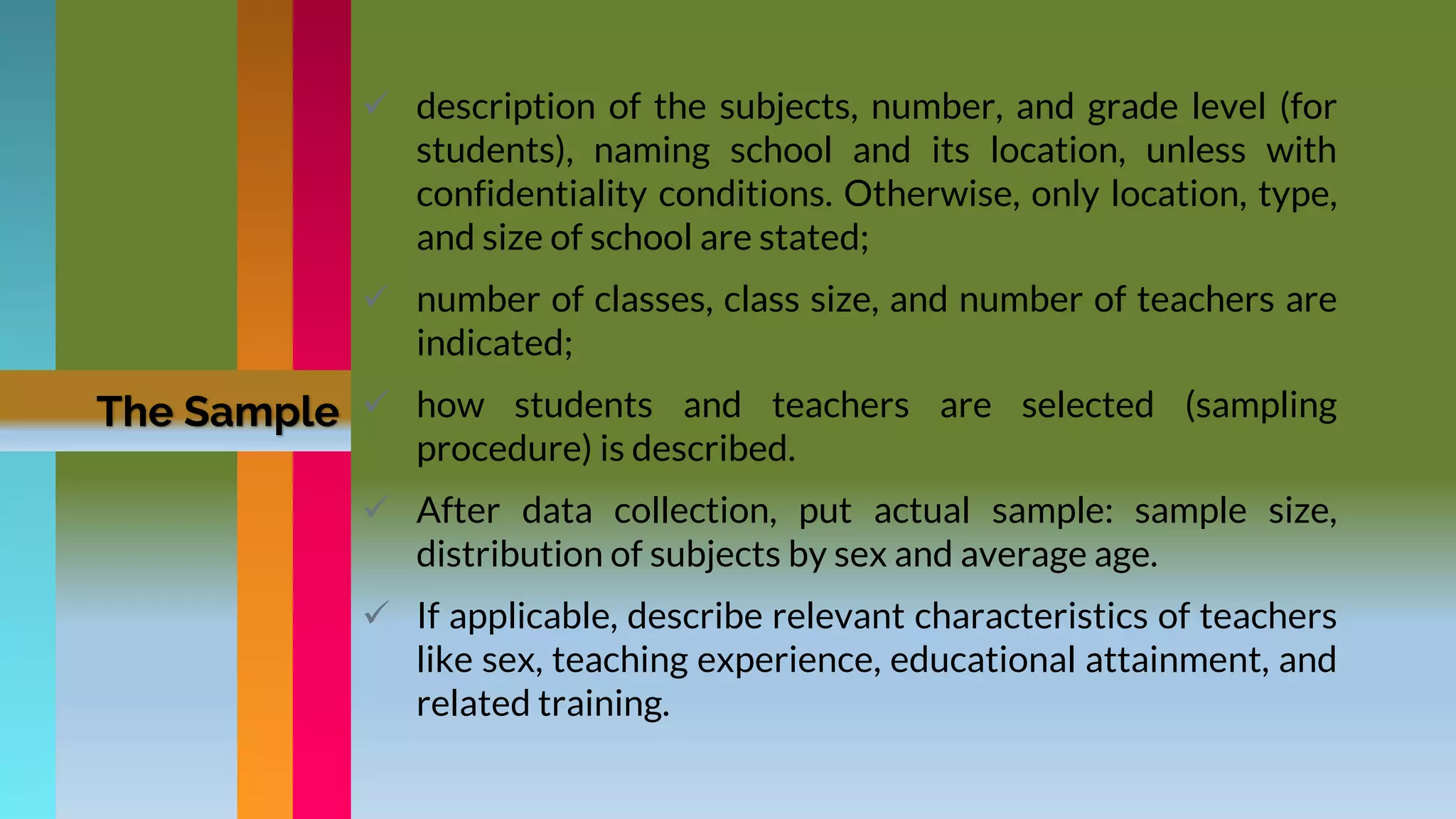
 description of the subjects, number, and grade level (for
students), naming school and its location, unless with
confidentiality conditions. Otherwise, only location, type,
and size of school are stated;
 number of classes, class size, and number of teachers are
indicated;
 how students and teachers are selected (sampling
procedure) is described.
 After data collection, put actual sample: sample size,
distribution of subjects by sex and average age.
 If applicable, describe relevant characteristics of teachers
like sex, teaching experience, educational attainment, and
related training.
The Sample
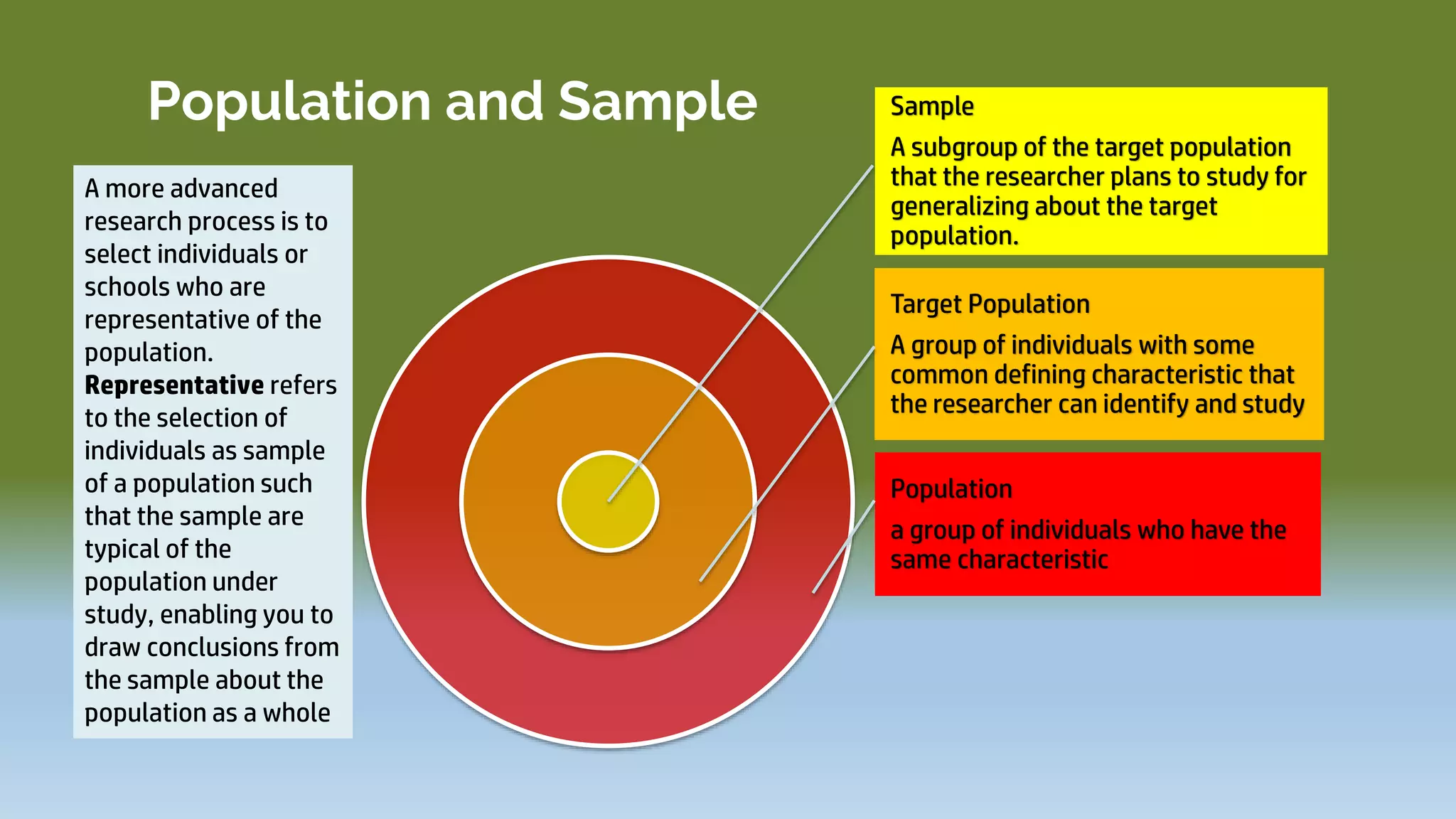
Population and Sample Sample
A subgroup of the target population
that the researcher plans to study for
generalizing about the target
population.
Target Population
A group of individuals with some
common defining characteristic that
the researcher can identify and study
Population
a group of individuals who have the
same characteristic
A more advanced
research process is to
select individuals or
schools who are
representative of the
population.
Representative refers
to the selection of
individuals as sample
of a population such
that the sample are
typical of the
population under
study, enabling you to
draw conclusions from
the sample about the
population as a whole
Sampling Techniques
Probability Sampling Techniques
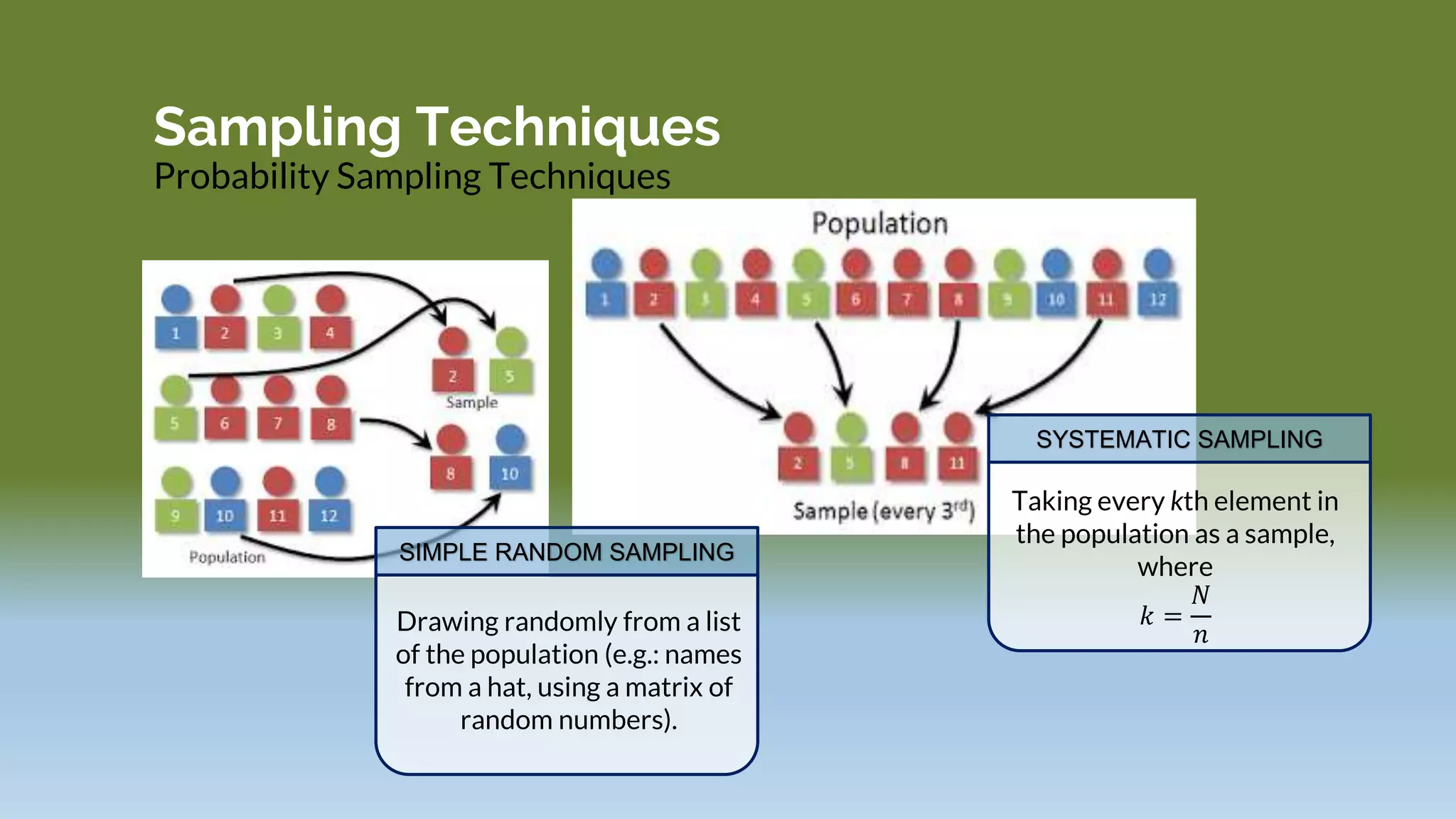
Drawing randomly from a list
of the population (e.g.: names
from a hat, using a matrix of
random numbers).
Taking every kth element in
the population as a sample,
where
𝑘 =
𝑁
𝑛
SIMPLE RANDOM SAMPLING
SYSTEMATIC SAMPLING
Sampling Techniques
Probability Sampling Techniques
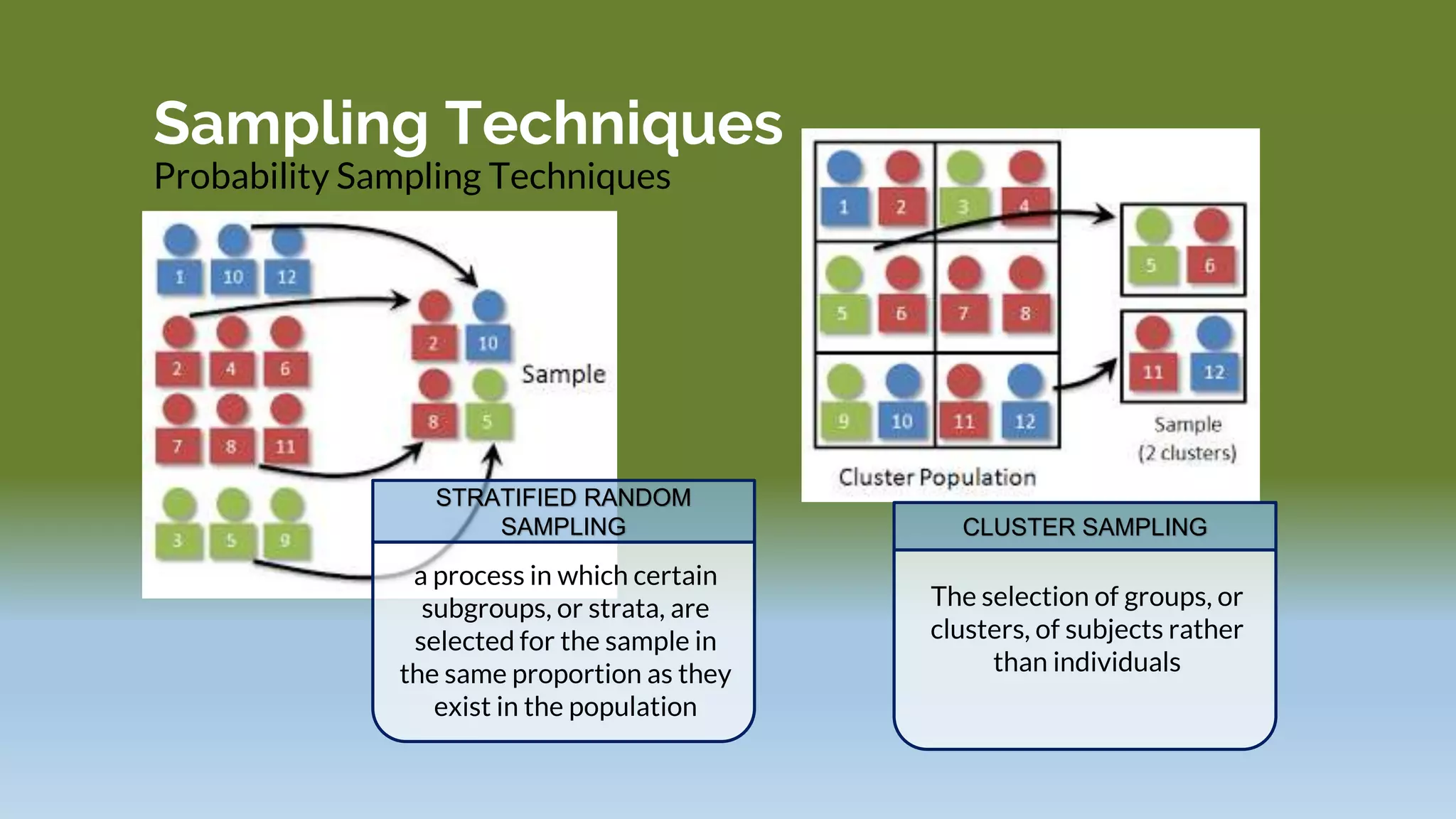
a process in which certain
subgroups, or strata, are
selected for the sample in
the same proportion as they
exist in the population
STRATIFIED RANDOM
SAMPLING
The selection of groups, or
clusters, of subjects rather
than individuals
CLUSTER SAMPLING
Sampling Techniques
Non-probability Sampling Techniques
3
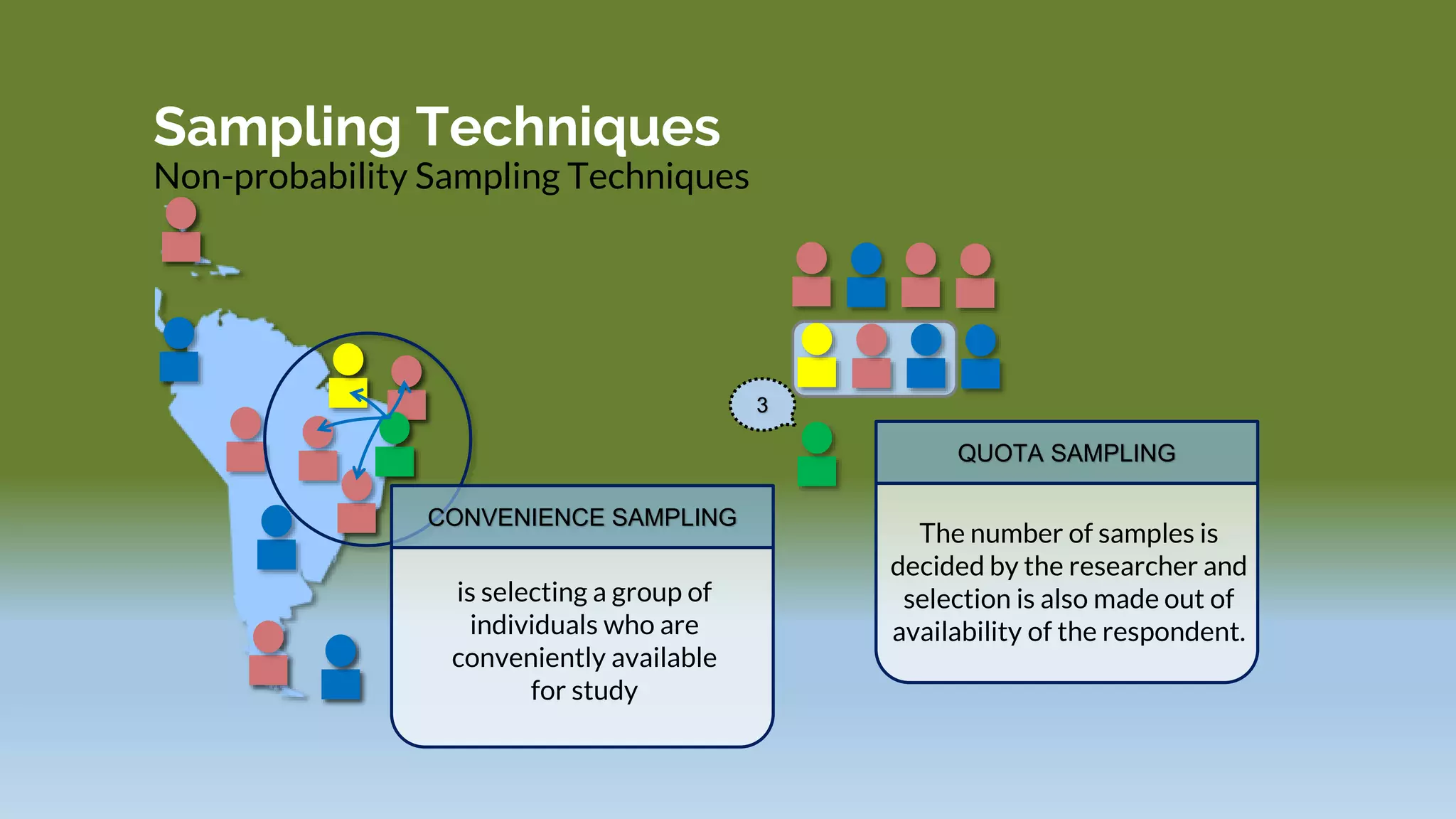
is selecting a group of
individuals who are
conveniently available
for study
CONVENIENCE SAMPLING
The number of samples is
decided by the researcher and
selection is also made out of
availability of the respondent.
QUOTA SAMPLING
Sampling Techniques
Non-probability Sampling Techniques
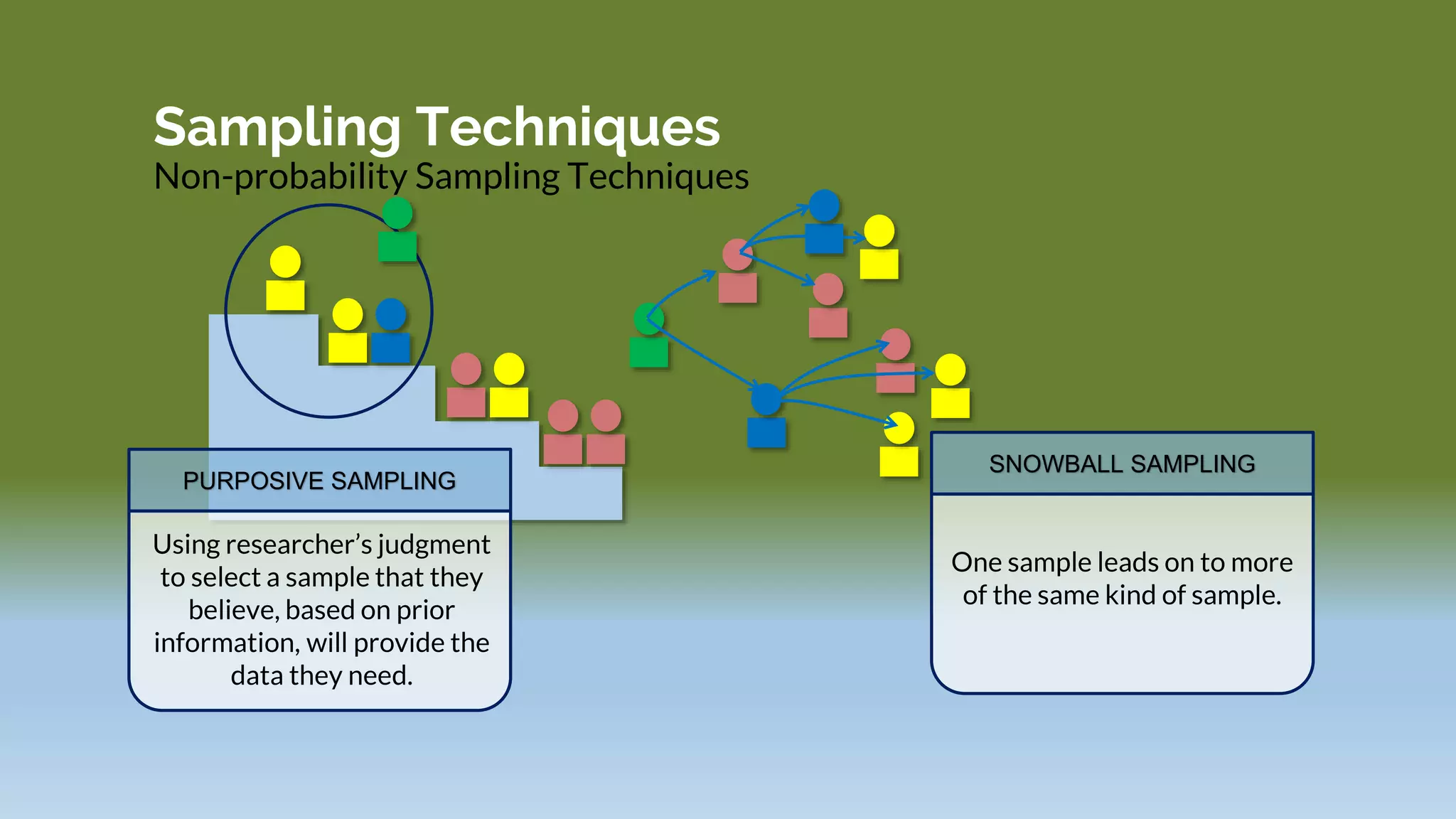
Using researcher’s judgment
to select a sample that they
believe, based on prior
information, will provide the
data they need.
PURPOSIVE SAMPLING
One sample leads on to more
of the same kind of sample.
SNOWBALL SAMPLING
 This refers to the questionnaire or data gathering
tool to be constructed, validated and
administered.
 If the instrument is prepared by the researcher, it
should be tested for validity and reliability.
However, if the instrument is standardized, the
student should indicate its description as to its
items, scoring and qualification.
 The researcher must explain its parts, and how
the instrument will be validated. The instrument
to be used should be appended (except for
standardized).
The Instrument
CRITERIA for CHOOSING a GOOD INSTRUMENT
 Is it recent?
 Is it widely cited? Are reviews available?
 Is it reliable?
 Is it valid?
 Does the procedure for recording data fit the research
questions in your study?
 Does the instrument contain accepted scales of
measurement?
Creswell, 2012
The Instrument
Validity and
Reliability
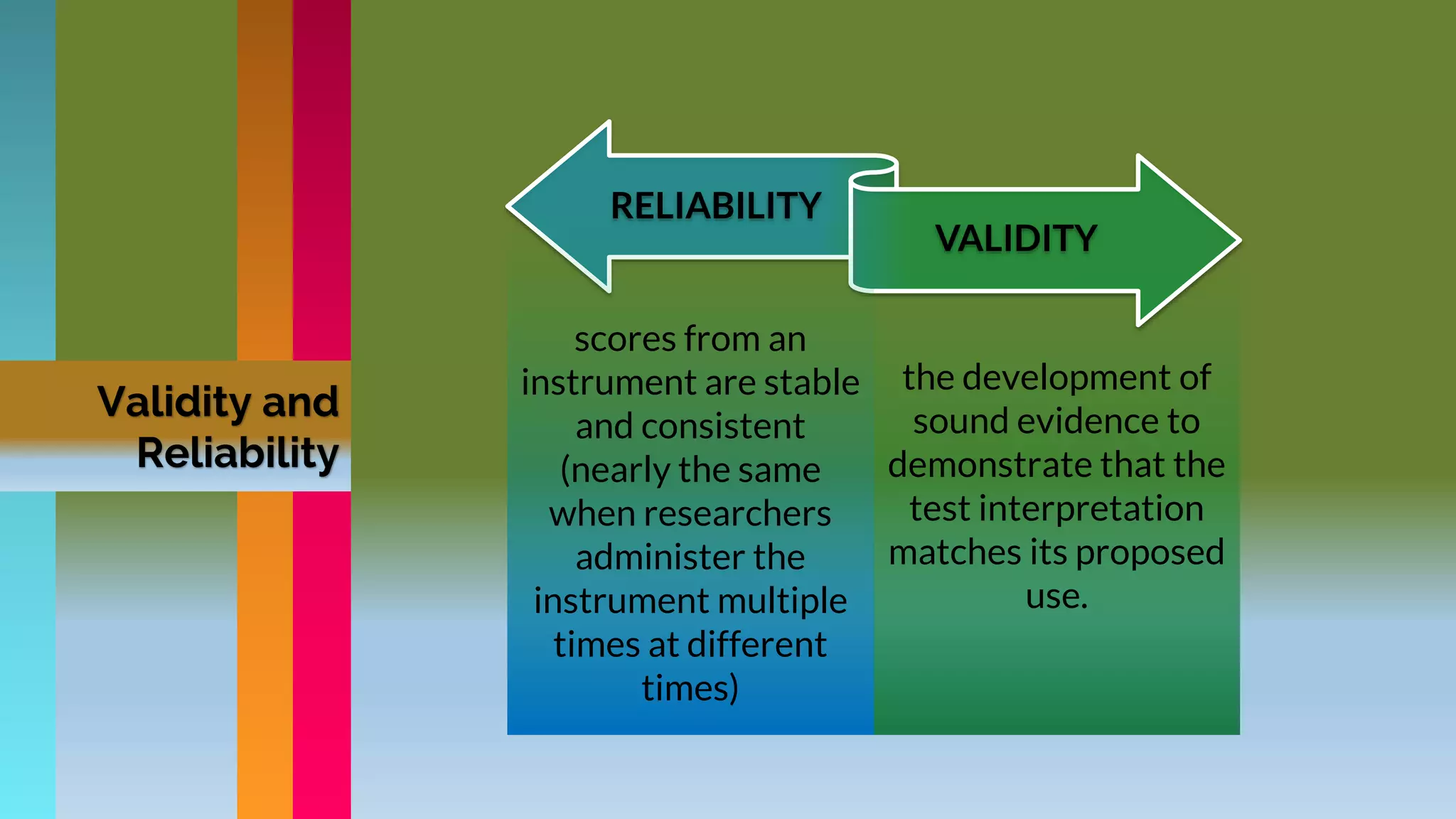
the development of
sound evidence to
demonstrate that the
test interpretation
matches its proposed
use.
RELIABILITY
VALIDITY
scores from an
instrument are stable
and consistent
(nearly the same
when researchers
administer the
instrument multiple
times at different
times)
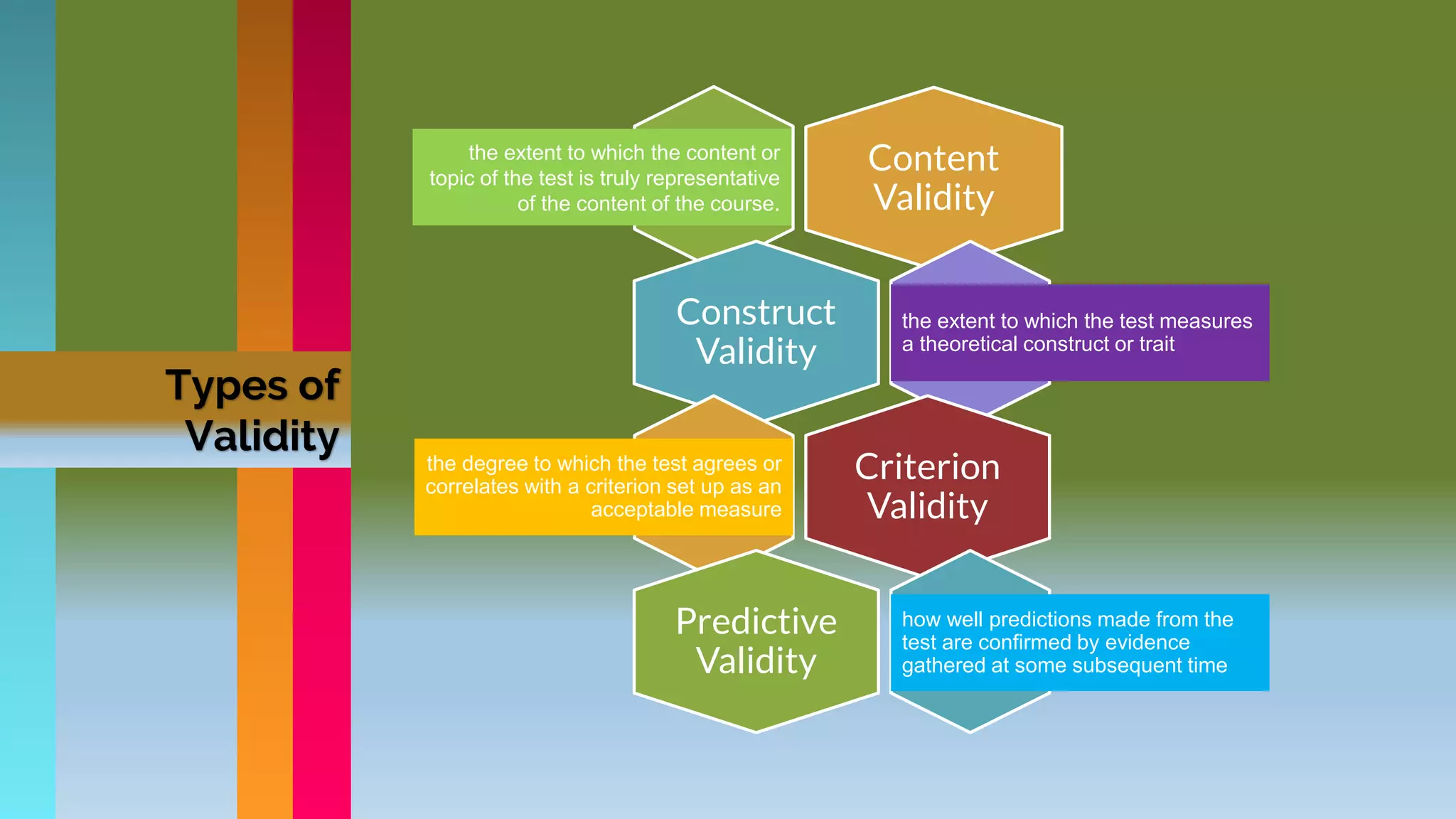
Types of
Validity
Content
Validity
Construct
Validity
Criterion
Validity
Predictive
Validity
the extent to which the content or
topic of the test is truly representative
of the content of the course.
the extent to which the test measures
a theoretical construct or trait
the degree to which the test agrees or
correlates with a criterion set up as an
acceptable measure
how well predictions made from the
test are confirmed by evidence
gathered at some subsequent time
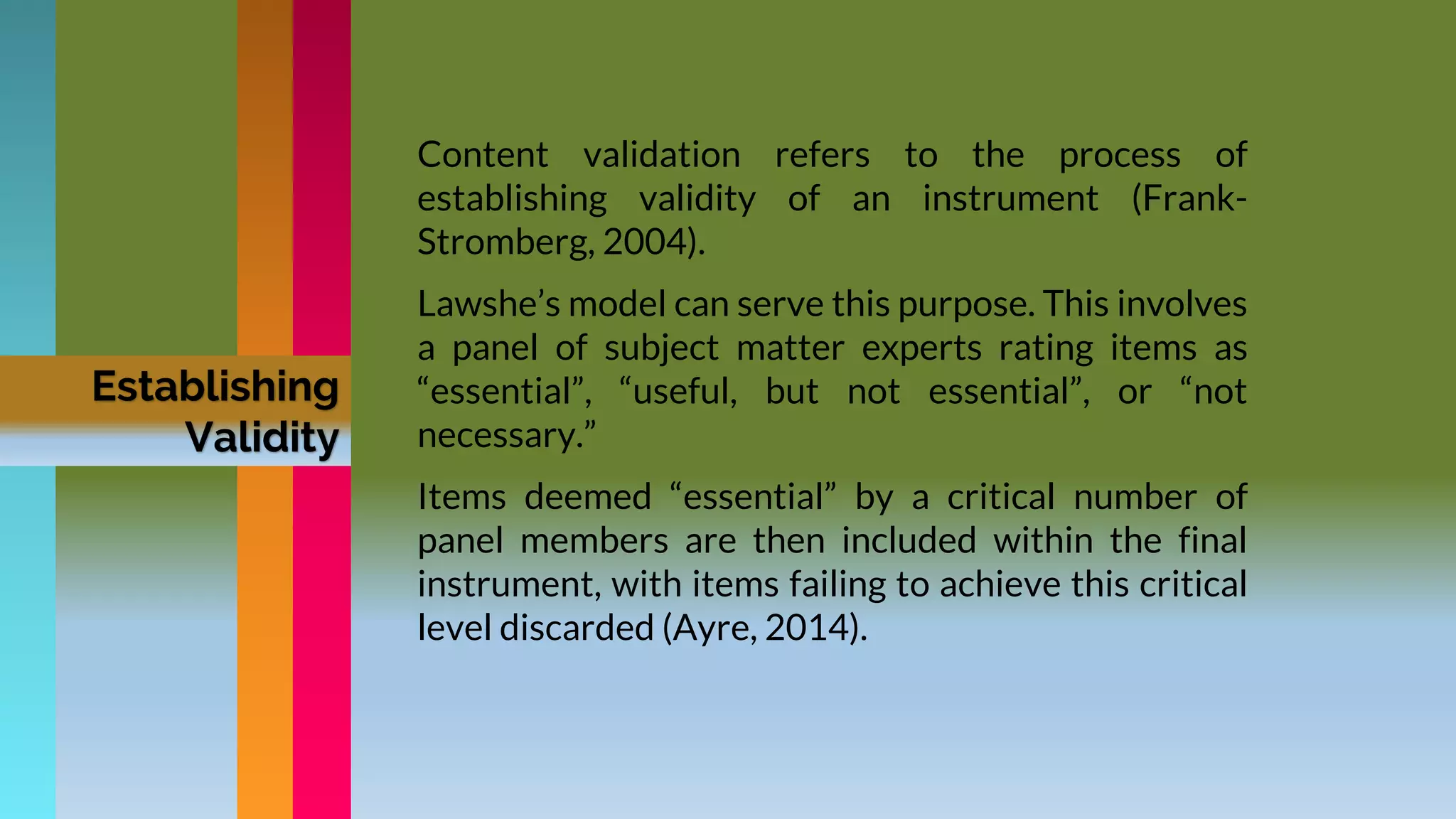
Establishing
Validity
Content validation refers to the process of
establishing validity of an instrument (Frank-
Stromberg, 2004).
Lawshe’s model can serve this purpose. This involves
a panel of subject matter experts rating items as
“essential”, “useful, but not essential”, or “not
necessary.”
Items deemed “essential” by a critical number of
panel members are then included within the final
instrument, with items failing to achieve this critical
level discarded (Ayre, 2014).
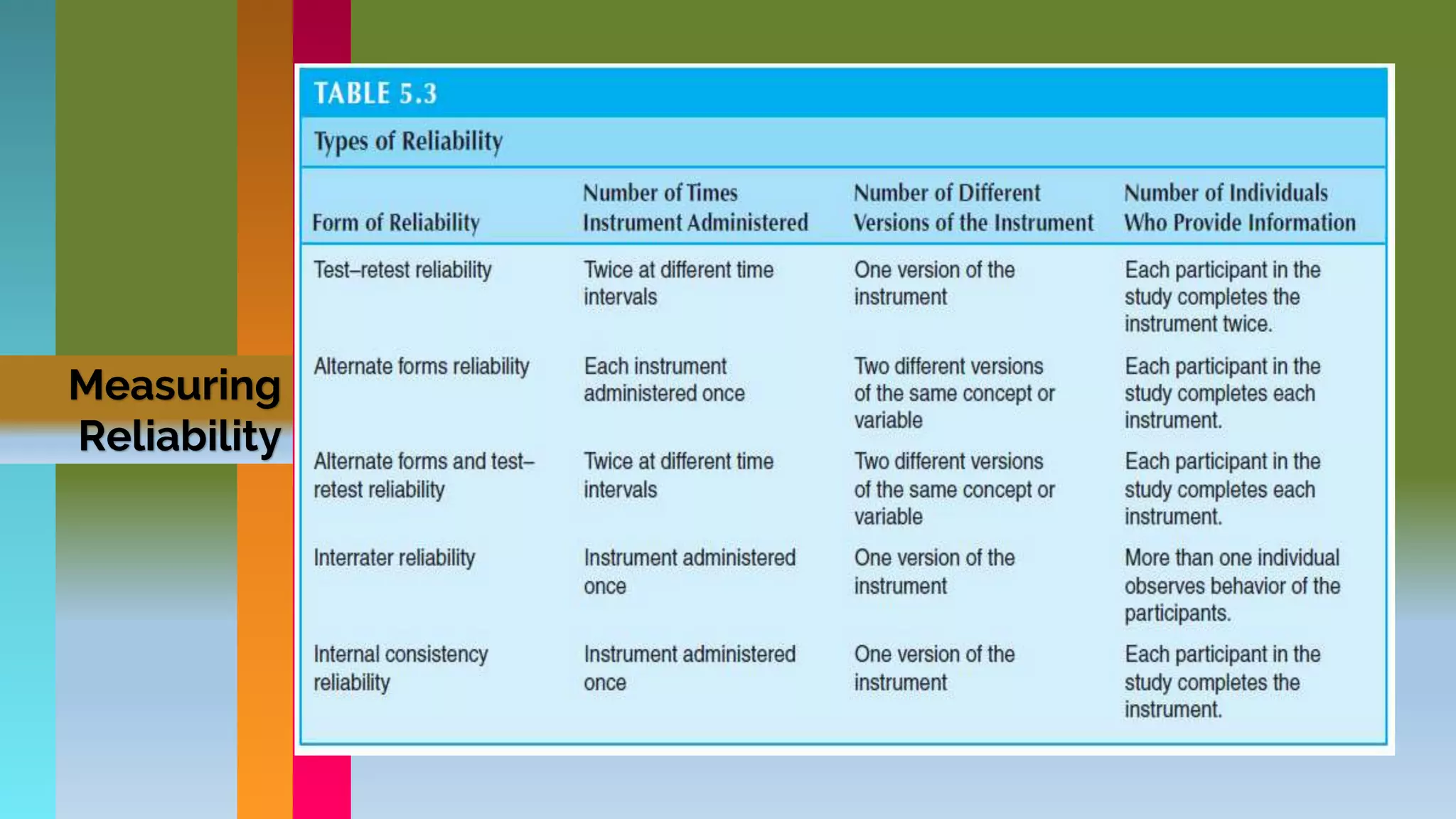
Measuring
Reliability
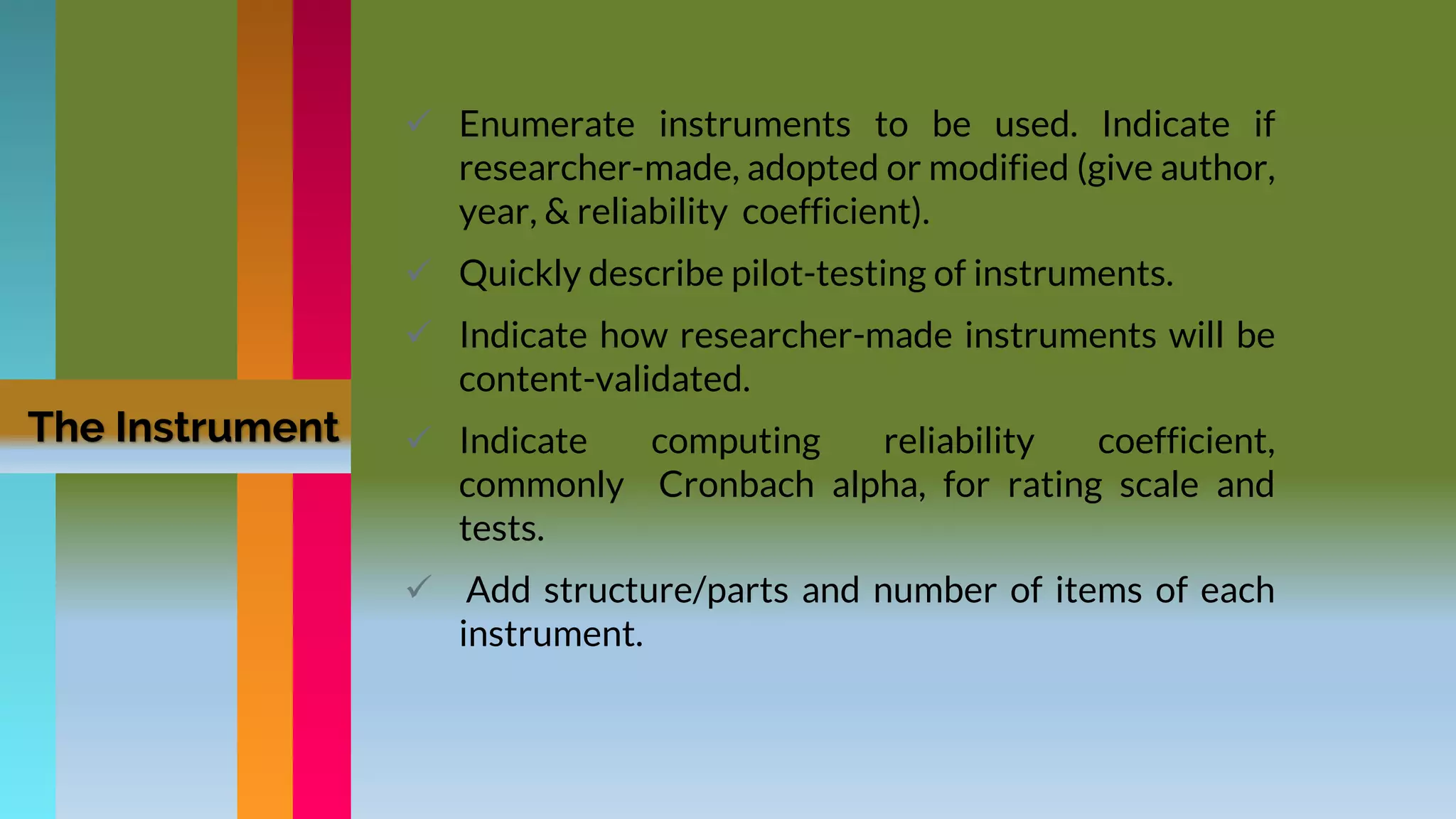
The Instrument
 Enumerate instruments to be used. Indicate if
researcher-made, adopted or modified (give author,
year, & reliability coefficient).
 Quickly describe pilot-testing of instruments.
 Indicate how researcher-made instruments will be
content-validated.
 Indicate computing reliability coefficient,
commonly Cronbach alpha, for rating scale and
tests.
 Add structure/parts and number of items of each
instrument.
The Instrument
 Add Table of Specifications for researcher-
made tests.
 Add details of content validation: who the
experts are without naming them.
 Add details of pilot-testing (when and who),
and describe group (similar to group to which
instruments will be eventually administered).
The
Intervention
 Clearly and completely describe how the intervention will
be implemented, such that the reader can replicate the
intervention.
 Describe what happens in comparison group.
Data Collection
Procedure
 Quickly describe whose permission will be
sought and arrangements to make to administer
instruments.
 Describe when instruments will be administered
and who will administer them.
 Add details on arrangements and
administration of instruments, if needed.
Data Analysis
Procedure
This section indicates how the data will be analyzed and
reported; it should specify the qualitative and/or
quantitative methods that will be used in analyzing the
data gathered for the research.
In writing this section,
 Describe analysis to be done for each research
question, following sequence in Statement of
Problem.
 State if tests of hypotheses will be done and for what
purpose.
 Indicate that tests of hypotheses will be done at . 05
level of significance.
Data Analysis
Procedure
 Level of significance or p value = no. of cases out
of 100 cases that results are due to chance
alone.
 Add scoring system for instruments.
 Avoid giving formulas or standard procedures
for statistical tools (reader is expected to know
these or look them up in statistics references).
Data Analysis
Procedure
BULLYING INCIDENCE AND GRADE 11 STUDENTS’
ATTENDANCE
THE SAMPLE
Alangalang National High School, Alangalang, Leyte Region
8 is purposively selected due to its big size. One section with a
class of forty (40) Grade 11 students is randomly selected. The
study will be accomplished for the School Year (SY) 2017-2018.
THE INSTRUMENTS
There will be one (1) self-made questionnaire for the study
with three (3) questions. The first questions is based on bullying
experience, second is on the type of bullying experience, and the
third is the number of absences. The questionnaire will be pilot
tested to five students who are not part of the research. The
questionnaire is subjected to content validity of experts.
Example
DATA COLLECTION PROCEDURE
The researchers will seek written permission from the
principal of Alangalang Senior High School for the conduct of the
study. An inform consent will also be provided to the students.
The parents will also be asked through a written permission.
The respondents will be oriented on the research objectives and
outcomes. The researchers will administer the following the self-
made questionnaire.
DATA ANALYSIS
All the data will be compiled and treated based on
parametric and non-parametric measures. The data on the
frequency of bullying incidence and attendance will be treated to
simple percentage and will be presented through a bar graph. The
test of difference on two groups will be based on one-paired T-
test for independent sample.
Example
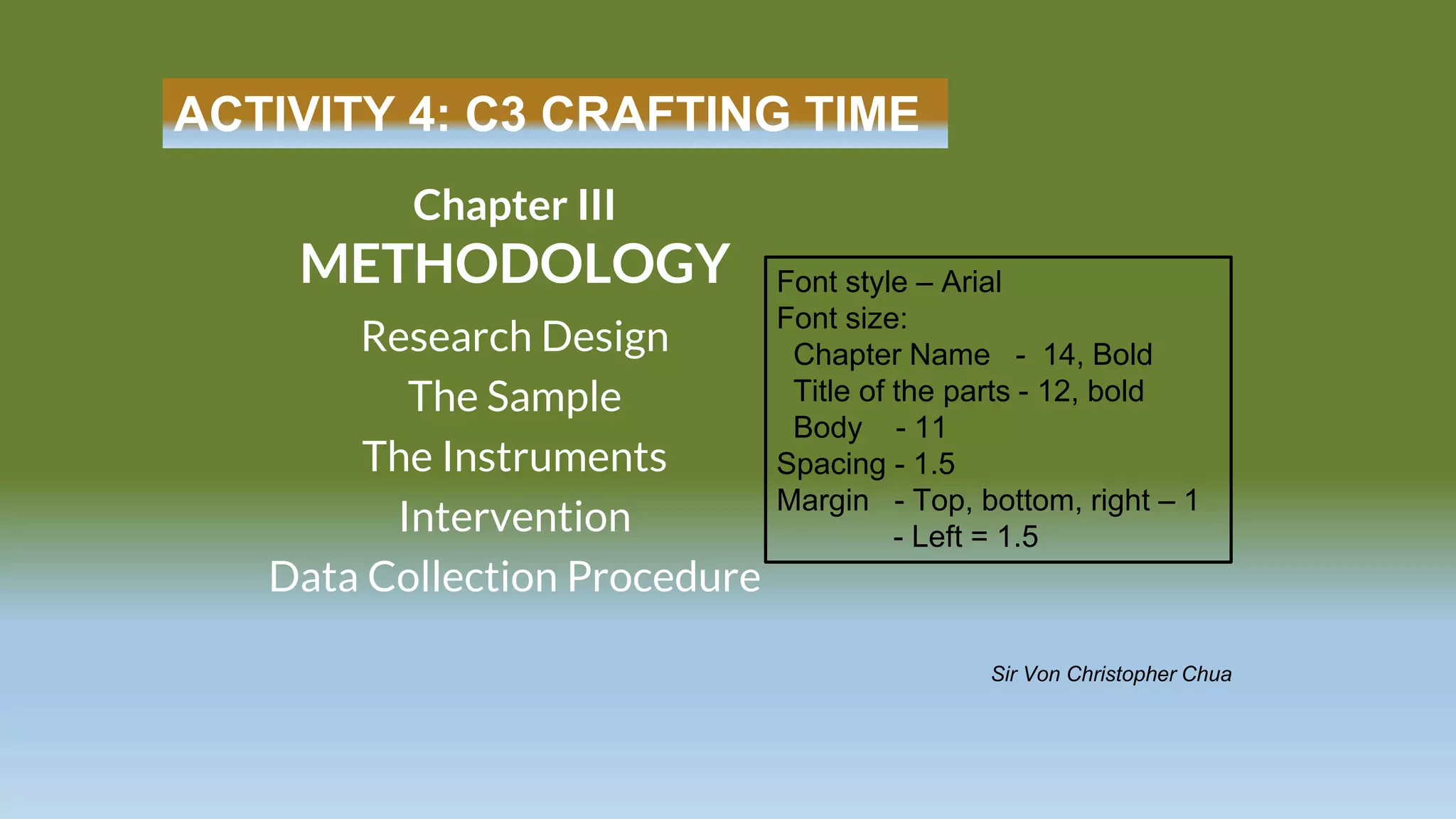
ACTIVITY 4: C3 CRAFTING TIME
Research Design
The Sample
The Instruments
Intervention
Data Collection Procedure
Chapter III
METHODOLOGY
Sir Von Christopher Chua
Font style – Arial
Font size:
Chapter Name - 14, Bold
Title of the parts - 12, bold
Body - 11
Spacing - 1.5
Margin - Top, bottom, right – 1
- Left = 1.5
GOOD LUCK
KEEP SAFE
GOD BLESS
Sir A

Lesson 5 chapter 3

  • 1.
    Chapter III METHODOLOGY Research Design TheSample The Instruments Intervention Data Collection Procedure Chapter Content ALAN S. ABERILLA
  • 2.
    Research designs arethe specific procedures involved in the research process: sampling, data collection, and data analysis. Research Design
  • 3.
    The first stepleading to the process of collecting quantitative data is to identify the people and places you plan to study. This involves determining which group of people will you study, who, specifically, these people are, and how many of them you will need to involve. Identifying the representative group that will take part in the study is an important aspect of the research that you need to specify. The Sample
  • 4.
     description ofthe subjects, number, and grade level (for students), naming school and its location, unless with confidentiality conditions. Otherwise, only location, type, and size of school are stated;  number of classes, class size, and number of teachers are indicated;  how students and teachers are selected (sampling procedure) is described.  After data collection, put actual sample: sample size, distribution of subjects by sex and average age.  If applicable, describe relevant characteristics of teachers like sex, teaching experience, educational attainment, and related training. The Sample
  • 5.
    Population and SampleSample A subgroup of the target population that the researcher plans to study for generalizing about the target population. Target Population A group of individuals with some common defining characteristic that the researcher can identify and study Population a group of individuals who have the same characteristic A more advanced research process is to select individuals or schools who are representative of the population. Representative refers to the selection of individuals as sample of a population such that the sample are typical of the population under study, enabling you to draw conclusions from the sample about the population as a whole
  • 6.
    Sampling Techniques Probability SamplingTechniques Drawing randomly from a list of the population (e.g.: names from a hat, using a matrix of random numbers). Taking every kth element in the population as a sample, where 𝑘 = 𝑁 𝑛 SIMPLE RANDOM SAMPLING SYSTEMATIC SAMPLING
  • 7.
    Sampling Techniques Probability SamplingTechniques a process in which certain subgroups, or strata, are selected for the sample in the same proportion as they exist in the population STRATIFIED RANDOM SAMPLING The selection of groups, or clusters, of subjects rather than individuals CLUSTER SAMPLING
  • 8.
    Sampling Techniques Non-probability SamplingTechniques 3 is selecting a group of individuals who are conveniently available for study CONVENIENCE SAMPLING The number of samples is decided by the researcher and selection is also made out of availability of the respondent. QUOTA SAMPLING
  • 9.
    Sampling Techniques Non-probability SamplingTechniques Using researcher’s judgment to select a sample that they believe, based on prior information, will provide the data they need. PURPOSIVE SAMPLING One sample leads on to more of the same kind of sample. SNOWBALL SAMPLING
  • 10.
     This refersto the questionnaire or data gathering tool to be constructed, validated and administered.  If the instrument is prepared by the researcher, it should be tested for validity and reliability. However, if the instrument is standardized, the student should indicate its description as to its items, scoring and qualification.  The researcher must explain its parts, and how the instrument will be validated. The instrument to be used should be appended (except for standardized). The Instrument
  • 11.
    CRITERIA for CHOOSINGa GOOD INSTRUMENT  Is it recent?  Is it widely cited? Are reviews available?  Is it reliable?  Is it valid?  Does the procedure for recording data fit the research questions in your study?  Does the instrument contain accepted scales of measurement? Creswell, 2012 The Instrument
  • 12.
    Validity and Reliability the developmentof sound evidence to demonstrate that the test interpretation matches its proposed use. RELIABILITY VALIDITY scores from an instrument are stable and consistent (nearly the same when researchers administer the instrument multiple times at different times)
  • 13.
    Types of Validity Content Validity Construct Validity Criterion Validity Predictive Validity the extentto which the content or topic of the test is truly representative of the content of the course. the extent to which the test measures a theoretical construct or trait the degree to which the test agrees or correlates with a criterion set up as an acceptable measure how well predictions made from the test are confirmed by evidence gathered at some subsequent time
  • 14.
    Establishing Validity Content validation refersto the process of establishing validity of an instrument (Frank- Stromberg, 2004). Lawshe’s model can serve this purpose. This involves a panel of subject matter experts rating items as “essential”, “useful, but not essential”, or “not necessary.” Items deemed “essential” by a critical number of panel members are then included within the final instrument, with items failing to achieve this critical level discarded (Ayre, 2014).
  • 15.
  • 16.
    The Instrument  Enumerateinstruments to be used. Indicate if researcher-made, adopted or modified (give author, year, & reliability coefficient).  Quickly describe pilot-testing of instruments.  Indicate how researcher-made instruments will be content-validated.  Indicate computing reliability coefficient, commonly Cronbach alpha, for rating scale and tests.  Add structure/parts and number of items of each instrument.
  • 17.
    The Instrument  AddTable of Specifications for researcher- made tests.  Add details of content validation: who the experts are without naming them.  Add details of pilot-testing (when and who), and describe group (similar to group to which instruments will be eventually administered).
  • 18.
    The Intervention  Clearly andcompletely describe how the intervention will be implemented, such that the reader can replicate the intervention.  Describe what happens in comparison group.
  • 19.
    Data Collection Procedure  Quicklydescribe whose permission will be sought and arrangements to make to administer instruments.  Describe when instruments will be administered and who will administer them.  Add details on arrangements and administration of instruments, if needed.
  • 20.
    Data Analysis Procedure This sectionindicates how the data will be analyzed and reported; it should specify the qualitative and/or quantitative methods that will be used in analyzing the data gathered for the research. In writing this section,  Describe analysis to be done for each research question, following sequence in Statement of Problem.  State if tests of hypotheses will be done and for what purpose.  Indicate that tests of hypotheses will be done at . 05 level of significance.
  • 21.
    Data Analysis Procedure  Levelof significance or p value = no. of cases out of 100 cases that results are due to chance alone.  Add scoring system for instruments.  Avoid giving formulas or standard procedures for statistical tools (reader is expected to know these or look them up in statistics references).
  • 22.
  • 23.
    BULLYING INCIDENCE ANDGRADE 11 STUDENTS’ ATTENDANCE THE SAMPLE Alangalang National High School, Alangalang, Leyte Region 8 is purposively selected due to its big size. One section with a class of forty (40) Grade 11 students is randomly selected. The study will be accomplished for the School Year (SY) 2017-2018. THE INSTRUMENTS There will be one (1) self-made questionnaire for the study with three (3) questions. The first questions is based on bullying experience, second is on the type of bullying experience, and the third is the number of absences. The questionnaire will be pilot tested to five students who are not part of the research. The questionnaire is subjected to content validity of experts. Example
  • 24.
    DATA COLLECTION PROCEDURE Theresearchers will seek written permission from the principal of Alangalang Senior High School for the conduct of the study. An inform consent will also be provided to the students. The parents will also be asked through a written permission. The respondents will be oriented on the research objectives and outcomes. The researchers will administer the following the self- made questionnaire. DATA ANALYSIS All the data will be compiled and treated based on parametric and non-parametric measures. The data on the frequency of bullying incidence and attendance will be treated to simple percentage and will be presented through a bar graph. The test of difference on two groups will be based on one-paired T- test for independent sample. Example
  • 25.
    ACTIVITY 4: C3CRAFTING TIME Research Design The Sample The Instruments Intervention Data Collection Procedure Chapter III METHODOLOGY Sir Von Christopher Chua Font style – Arial Font size: Chapter Name - 14, Bold Title of the parts - 12, bold Body - 11 Spacing - 1.5 Margin - Top, bottom, right – 1 - Left = 1.5
  • 26.