Rounding And Estimating
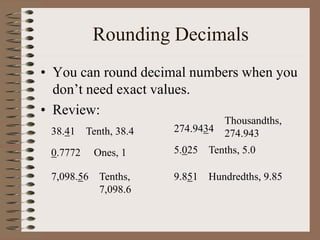
Rounding Decimals
• You can round decimal numbers when you
don’t need exact values.
• Review:
38.41
0.7772
7,098.56
274.9434
5.025
9.851
Tenth, 38.4
Ones, 1
Tenths,
7,098.6
Thousandths,
274.943
Tenths, 5.0
Hundredths, 9.85
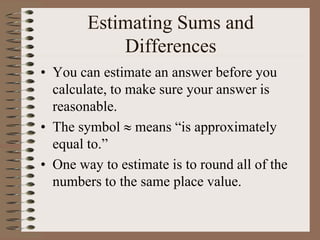
Estimating Sums and
Differences
• You can estimate an answer before you
calculate, to make sure your answer is
reasonable.
• The symbol  means “is approximately
equal to.”
• One way to estimate is to round all of the
numbers to the same place value.
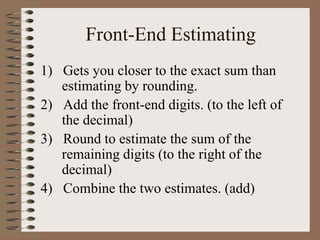
Front-End Estimating
1) Gets you closer to the exact sum than
estimating by rounding.
2) Add the front-end digits. (to the left of
the decimal)
3) Round to estimate the sum of the
remaining digits (to the right of the
decimal)
4) Combine the two estimates. (add)
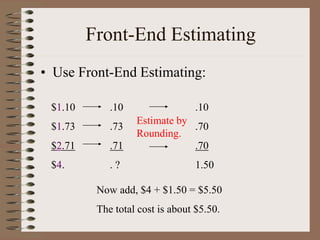
Front-End Estimating
• Use Front-End Estimating:
$1.10
$1.73
$2.71
$4.
.10
.73
.71
. ?
Estimate by
Rounding.
.10
.70
.70
1.50
Now add, $4 + $1.50 = $5.50
The total cost is about $5.50.
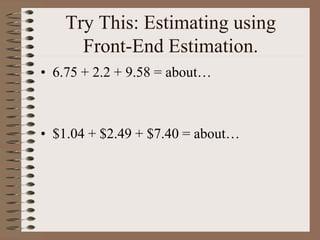
Try This: Estimating using
Front-End Estimation.
• 6.75 + 2.2 + 9.58 = about…
• $1.04 + $2.49 + $7.40 = about…
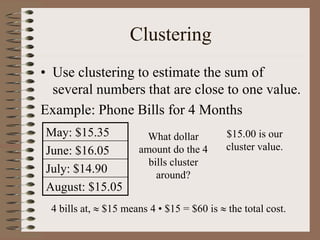
Clustering
• Use clustering to estimate the sum of
several numbers that are close to one value.
Example: Phone Bills for 4 Months
May: $15.35
June: $16.05
July: $14.90
August: $15.05
What dollar
amount do the 4
bills cluster
around?
$15.00 is our
cluster value.
4 bills at,  $15 means 4 • $15 = $60 is  the total cost.
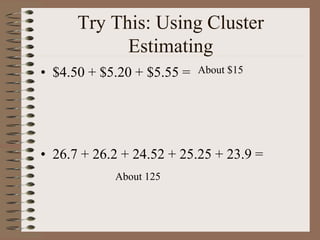
Try This: Using Cluster
Estimating
• $4.50 + $5.20 + $5.55 =
• 26.7 + 26.2 + 24.52 + 25.25 + 23.9 =
About $15
About 125
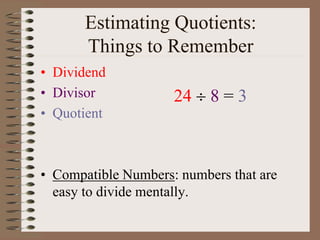
Estimating Quotients:
Things to Remember
• Dividend
• Divisor
• Quotient
• Compatible Numbers: numbers that are
easy to divide mentally.
24  8 = 3
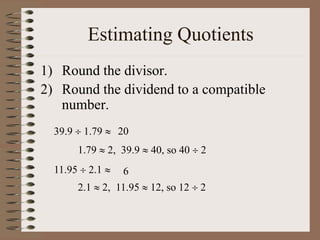
Estimating Quotients
1) Round the divisor.
2) Round the dividend to a compatible
number.
39.9  1.79 
11.95  2.1 
1.79  2, 39.9  40, so 40  2
20
2.1  2, 11.95  12, so 12  2
6

Estimating Strategies_2.ppt

  • 1.
  • 2.
    Rounding Decimals • Youcan round decimal numbers when you don’t need exact values. • Review: 38.41 0.7772 7,098.56 274.9434 5.025 9.851 Tenth, 38.4 Ones, 1 Tenths, 7,098.6 Thousandths, 274.943 Tenths, 5.0 Hundredths, 9.85
  • 3.
    Estimating Sums and Differences •You can estimate an answer before you calculate, to make sure your answer is reasonable. • The symbol  means “is approximately equal to.” • One way to estimate is to round all of the numbers to the same place value.
  • 4.
    Front-End Estimating 1) Getsyou closer to the exact sum than estimating by rounding. 2) Add the front-end digits. (to the left of the decimal) 3) Round to estimate the sum of the remaining digits (to the right of the decimal) 4) Combine the two estimates. (add)
  • 5.
    Front-End Estimating • UseFront-End Estimating: $1.10 $1.73 $2.71 $4. .10 .73 .71 . ? Estimate by Rounding. .10 .70 .70 1.50 Now add, $4 + $1.50 = $5.50 The total cost is about $5.50.
  • 6.
    Try This: Estimatingusing Front-End Estimation. • 6.75 + 2.2 + 9.58 = about… • $1.04 + $2.49 + $7.40 = about…
  • 7.
    Clustering • Use clusteringto estimate the sum of several numbers that are close to one value. Example: Phone Bills for 4 Months May: $15.35 June: $16.05 July: $14.90 August: $15.05 What dollar amount do the 4 bills cluster around? $15.00 is our cluster value. 4 bills at,  $15 means 4 • $15 = $60 is  the total cost.
  • 8.
    Try This: UsingCluster Estimating • $4.50 + $5.20 + $5.55 = • 26.7 + 26.2 + 24.52 + 25.25 + 23.9 = About $15 About 125
  • 9.
    Estimating Quotients: Things toRemember • Dividend • Divisor • Quotient • Compatible Numbers: numbers that are easy to divide mentally. 24  8 = 3
  • 10.
    Estimating Quotients 1) Roundthe divisor. 2) Round the dividend to a compatible number. 39.9  1.79  11.95  2.1  1.79  2, 39.9  40, so 40  2 20 2.1  2, 11.95  12, so 12  2 6