Unit II_Creative
Expression Through
Painting
Nature – common theme in paintings.
- Many artist use the beauty of natural surroundings, creating an
artistic expression through art.
Art  can help you become more connected with nature, as you paint scenes
from nature, you will become more aware of the interesting colors, lines, shapes,
forms, and other details of it.
Painting is the application of color paints or other media to a surface to
produce a picture or an artwork.
Lesson 1
20XX presentation title 3
Nature in Painting
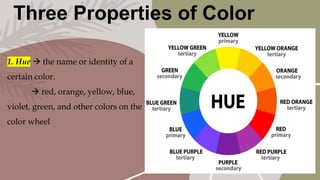
Three Properties of Color
1. Hue  the name or identity of a
certain color.
 red, orange, yellow, blue,
violet, green, and other colors on the
color wheel
5
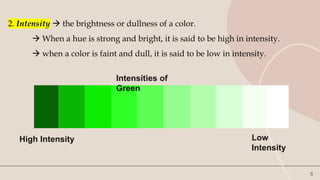
2. Intensity  the brightness or dullness of a color.
 When a hue is strong and bright, it is said to be high in intensity.
 when a color is faint and dull, it is said to be low in intensity.
Intensities of
Green
High Intensity Low
Intensity
6
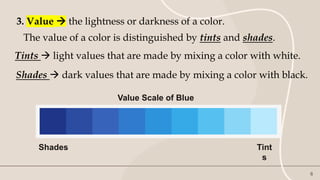
3. Value  the lightness or darkness of a color.
The value of a color is distinguished by tints and shades.
Tints  light values that are made by mixing a color with white.
Shades  dark values that are made by mixing a color with black.
Shades Tint
s
Value Scale of Blue
7
Types of Paints
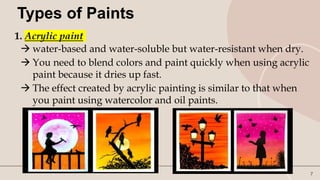
1. Acrylic paint
 water-based and water-soluble but water-resistant when dry.
 You need to blend colors and paint quickly when using acrylic
paint because it dries up fast.
 The effect created by acrylic painting is similar to that when
you paint using watercolor and oil paints.
8
Types of Paints
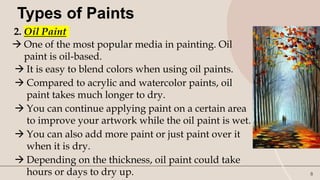
2. Oil Paint
 One of the most popular media in painting. Oil
paint is oil-based.
 It is easy to blend colors when using oil paints.
 Compared to acrylic and watercolor paints, oil
paint takes much longer to dry.
 You can continue applying paint on a certain area
to improve your artwork while the oil paint is wet.
 You can also add more paint or just paint over it
when it is dry.
 Depending on the thickness, oil paint could take
hours or days to dry up.
9
Types of Paints
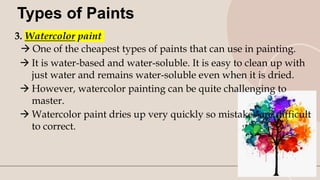
3. Watercolor paint
 One of the cheapest types of paints that can use in painting.
 It is water-based and water-soluble. It is easy to clean up with
just water and remains water-soluble even when it is dried.
 However, watercolor painting can be quite challenging to
master.
 Watercolor paint dries up very quickly so mistakes are difficult
to correct.
10
Types of Paints
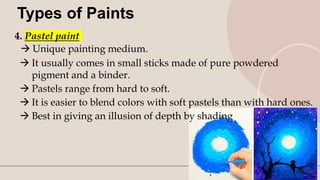
4. Pastel paint
 Unique painting medium.
 It usually comes in small sticks made of pure powdered
pigment and a binder.
 Pastels range from hard to soft.
 It is easier to blend colors with soft pastels than with hard ones.
 Best in giving an illusion of depth by shading
11
Types of Paints
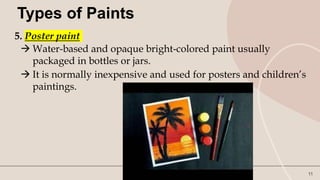
5. Poster paint
 Water-based and opaque bright-colored paint usually
packaged in bottles or jars.
 It is normally inexpensive and used for posters and children’s
paintings.
Methods of Painting
1. Paintbrush painting
 Most popular method of painting.
 You can experiment with a variety of paintbrushes to paint
from broad to fine details.
 You can use hatching brushstrokes or brushing with front and
back motion.
Methods of Painting
2. Sponge painting
 Technique of applying paint to the surface with a sponge.
 You can easily paint on a surface with different types of
inexpensive sponges.
 You can use sponges for mural painting or painting large areas.
Methods of Painting
3. Finger painting
 An art technique of spreading paints on paper or on any other
surface by using the fingers, hands, or arms instead of a
paintbrush.
15
Visual Artists and Art Styles
1. Cubism
 An art style in which subjects are represented as cubes or other
geometric shapes, often shown from many different angles at
the same time.
 It was developed in the early twentieth century by
Pablo Picasso a famous Spanish artist,
Georges Braque  a well-known French artist.
 In their artworks, organic forms were disassembled,
deconstructed into geometric shapes, and reconstructed into
cube images.
• Filipino national artist,
pioneered the art of
cubism in the
Philippines.
• He used the transparent
cubism technique in his
painting Mother and
Child
20XX presentation title 16
Vicente Manansala
20XX presentation title 17
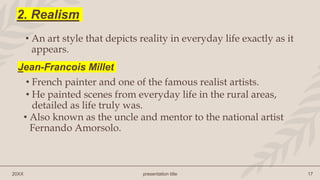
2. Realism
• An art style that depicts reality in everyday life exactly as it
appears.
• French painter and one of the famous realist artists.
• He painted scenes from everyday life in the rural areas,
detailed as life truly was.
Jean-Francois Millet
• Also known as the uncle and mentor to the national artist
Fernando Amorsolo.
18
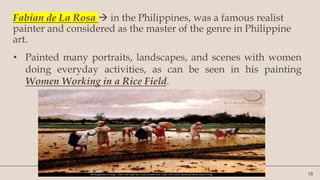
Fabian de La Rosa  in the Philippines, was a famous realist
painter and considered as the master of the genre in Philippine
art.
• Painted many portraits, landscapes, and scenes with women
doing everyday activities, as can be seen in his painting
Women Working in a Rice Field.
19
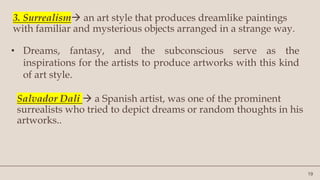
3. Surrealism an art style that produces dreamlike paintings
with familiar and mysterious objects arranged in a strange way.
• Dreams, fantasy, and the subconscious serve as the
inspirations for the artists to produce artworks with this kind
of art style.
Salvador Dali  a Spanish artist, was one of the prominent
surrealists who tried to depict dreams or random thoughts in his
artworks..
20XX presentation title 20
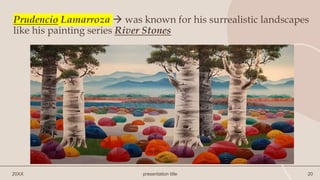
Prudencio Lamarroza  was known for his surrealistic landscapes
like his painting series River Stones
20XX presentation title 21
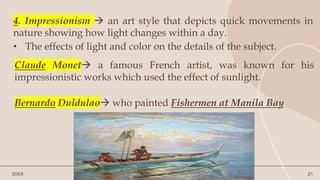
4. Impressionism  an art style that depicts quick movements in
nature showing how light changes within a day.
• The effects of light and color on the details of the subject.
Claude Monet a famous French artist, was known for his
impressionistic works which used the effect of sunlight.
Bernardo Duldulao who painted Fishermen at Manila Bay
22
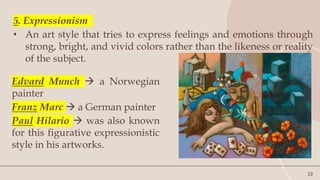
5. Expressionism
• An art style that tries to express feelings and emotions through
strong, bright, and vivid colors rather than the likeness or reality
of the subject.
Edvard Munch  a Norwegian
painter
Franz Marc  a German painter
Paul Hilario  was also known
for this figurative expressionistic
style in his artworks.
23
6. Abstract
• An art style that represents no specific subject or has no
recognizable subject
Wassily Kandinsky
• A Russian artist, was considered the first to create an abstract
artwork.
24
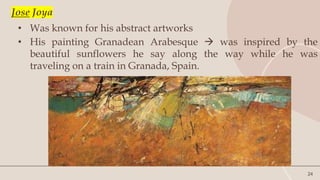
Jose Joya
• Was known for his abstract artworks
• His painting Granadean Arabesque  was inspired by the
beautiful sunflowers he say along the way while he was
traveling on a train in Granada, Spain.
Activity 1
25
• Pottery is one of the ancient art forms in the Philippines. Pots
come in a variety of shapes and decorative designs and are
usually made of clay. The designs are usually geometric with a
stylized nature theme. Clay pots are functional too. Big clay pots
are functional too. Big clay pots or jars are used for storing food,
water, rice grains, and the like.
• In this activity you will experience painting geometric shapes
and patterns of nature on a clay jar.
What you will Need
26
• Sheets of old newspaper
• Medium-sized clay jar
• Acrylic paints (red, blue, and yellow)
• Paintbrushes (small and big)
• Small plastic palette
• Plastic dish with water.
What will you do
27
1. Cover your work area with sheets of old newspaper to prevent paint spills on
the table or floor.
2. Take the medium-sized clay jar and turn it upside down
3. Brush the outside portion of the jar with the acrylic paint of your choice using
a big paintbrush. It might take a few coats of paint to cover the jar
completely. Then turn it over to paint the inside portion.
4. Put the jar in a safe place and let it dry. It might take one or two days for the
paint to dry.
5. When the jar is completely dry, decorate it by painting geometric shapes or
patterns of nature with acrylic paints using a small paintbrush. Explore
mixing paints of your chosen colors on the small plastic with the small
paintbrush.
What will you do
28
6. When you are done painting your clay jar, allow it to dry. Then ask your self
the following questions.
• What geometric shapes and patterns of nature did I create for my
paintings?
• Why did I choose these geometric shapes and patterns of nature in
decorating the clay jar?
• How important is the choice of colors in my painting?
• How could I enhance my painting clay jar?
Lesson 2
20XX presentation title 29
Harmony in Painting
30
Harmony
• one of the most important principles of art.
• Harmony in painting is the arrangement of colors and objects
to create a picture that is pleasing to the eye of the viewer.
31
Harmonies of Related Color Schemes
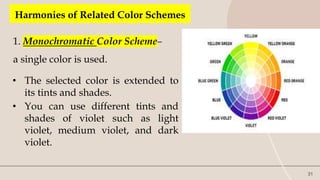
1. Monochromatic Color Scheme–
a single color is used.
• The selected color is extended to
its tints and shades.
• You can use different tints and
shades of violet such as light
violet, medium violet, and dark
violet.
32
Harmonies of Related Color Schemes
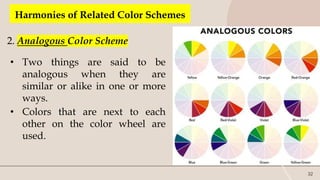
2. Analogous Color Scheme
• Two things are said to be
analogous when they are
similar or alike in one or more
ways.
• Colors that are next to each
other on the color wheel are
used.
33
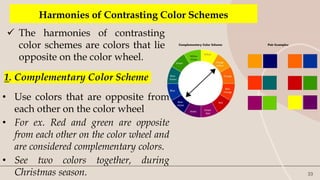
Harmonies of Contrasting Color Schemes
 The harmonies of contrasting
color schemes are colors that lie
opposite on the color wheel.
1. Complementary Color Scheme
• Use colors that are opposite from
each other on the color wheel
• For ex. Red and green are opposite
from each other on the color wheel and
are considered complementary colors.
• See two colors together, during
Christmas season.
34
Harmonies of Contrasting Color Schemes
2. Split –Complementary Color Scheme
• Three colors are used in the split-complementary
color scheme.
• It includes a main color and the two colors on each
side of its opposite color on the color wheel
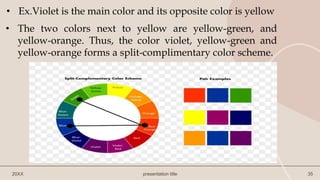
20XX presentation title 35
• Ex.Violet is the main color and its opposite color is yellow
• The two colors next to yellow are yellow-green, and
yellow-orange. Thus, the color violet, yellow-green and
yellow-orange forms a split-complimentary color scheme.
36
Harmonies of Contrasting Color Schemes
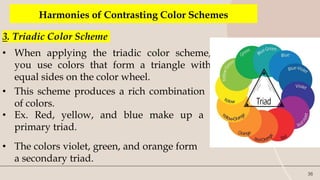
3. Triadic Color Scheme
• When applying the triadic color scheme,
you use colors that form a triangle with
equal sides on the color wheel.
• This scheme produces a rich combination
of colors.
• Ex. Red, yellow, and blue make up a
primary triad.
• The colors violet, green, and orange form
a secondary triad.
20XX presentation title 37
• Harmony is very important in painting
• There is harmony in painting when all the elements of design
work well together. Likewise, it is important to have a balanced
and harmonious relationship within and among the members
of the family.
• Family members love and respect each other. They must be
willing to listen to one another and work together. A family
that works in harmony stays healthy and happy.
20XX presentation title 38
• Your family is like a friend and your friends can become
your family. Friends are usually one of the biggest strengths
in a person’s life, apart from their family.
• What do you think makes a relationship with your friends
great?
• Have you ever thought what life is without people around
you?
Activity 2
39
• The sunset is one of the most common subjects for landscape painting.
What you will Need
• Pencil
• Ruler
• Sheet of Oslo paper
• Acrylic paints
• Broad and flat paintbrush
• Paint palette board
• Fine paintbrush
• Paint a sunset with mountains and trees in this activity
What will you do
40
1. Study the photograph of a sunset with mountains and trees
2. Using the pencil and ruler, lightly draw a horizon line across the sheet of
Oslo paper
3. Sketch mountain ranges on the middle ground. Use your imagination to
enhance your sketch
4. Draw the outline of trees on the bottom part of the paper.
5. Using the broad and flat paintbrush, paint the sky with orange and yellow
acrylic paints to show the setting sun. Blend the paints well as you use light,
medium, and dark values for the sky.
6. Paint the mountain ranges using blue, violet, and a little of white acrylic
paints. Blend the colors well using a palette board
What will you do
41
7. Using mixtures of green and blue acrylic paint, brush the shape of the trees
and other details of your drawing. You can choose other color mixtures for the
objects you desire to include in the painting.
8. When you are done, allow the painting to dry. Then ask yourself the following
questions.
a. What color scheme is used in the area to create a sunset scene?
b. Which part of the painting looks interesting to me? Why?
c. Are the colors of mountains, trees, and skies created in the right
tints and shades?
d. How can I enhance my sunset painting?
Lesson 3
20XX presentation title 42
Creating Moods in
Painting
43
• Colors can have certain effects on people. A person may
experience a particular mood when he or she sees a certain color.
• Another color may affect him or her differently.
• Colors can also affect the composition of a painting.
• The colors create harmony along the repetition of colors and
unify the scene.
• Colors can bring out feelings of happiness, sadness, calmness,
excitement, or even anger.
44
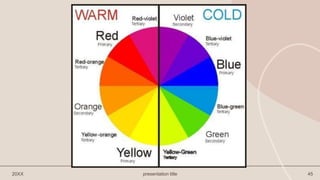
• Warm colors include red, yellow, and orange
• These colors express passion, heat, excitement, energy, and
anger.
• For example, when red is used in paintings, the color may
indicate violence or blood.
Warm Colors
• They can have intense emotional effects on people.
• The color yellow tends to give off the feeling of cheerfulness and
vibrant energy, while the color orange evokes the feeling of
enthusiasm and warmth
20XX presentation title 45
46
• Include blue, green, and violet
• These colors usually express calmness and peace.
• For example: when blue is used in designing a bedroom, it helps
create a soothing environment
Cool Colors
• They are used to open up small spaces and make these area
seem larger.
• It makes the person occupying the room feel relaxed and rested.
• Green, on the other hand, is commonly used to depict hope and
encouragement, while violet symbolizes royalty and wealth.
Activity 3
47
• Create a Mood with Complementary Colors
What you will Need
• Acrylic paint or any type of paint
• Mixing container
• Palette knife
• Paintbrushes
• Paper or newsprint
• Pencil
• ¼ white cartolina
• Create anything to express a mood in your painting using complementary
colors
What will you do
48
1. Using acrylic paints, mix three pairs of complementary colors in a mixing
container with your palette knife
2. Make a chart of colors with their tints and shades on newsprint or paper with
the use of your paintbrush
3. Using a pencil, draw a picture of yourself doing your favorite hobby or sport
activity on a sheet of white paper. Choose the colors that convey the mood of
your activity..
4. Paint your drawing with various tints and shades of the colors you chose and
express the mood you want to convey.
20XX presentation title 49
5. Allow your painting to dry. Then ask yourself the following questions:
a. What mood is created with the use of complementary colors in my
painting?
b. How do the colors affect each other in the painting?
c. Which area in my painting do I find most difficult to create?
d. Did all the color I chose to show an interesting mood? Why?
thank you

UNit II_Arts_Q2_Creative Expression Through Painting.pptx

  • 1.
  • 2.
    Nature – commontheme in paintings. - Many artist use the beauty of natural surroundings, creating an artistic expression through art. Art  can help you become more connected with nature, as you paint scenes from nature, you will become more aware of the interesting colors, lines, shapes, forms, and other details of it. Painting is the application of color paints or other media to a surface to produce a picture or an artwork.
  • 3.
    Lesson 1 20XX presentationtitle 3 Nature in Painting
  • 4.
    Three Properties ofColor 1. Hue  the name or identity of a certain color.  red, orange, yellow, blue, violet, green, and other colors on the color wheel
  • 5.
    5 2. Intensity the brightness or dullness of a color.  When a hue is strong and bright, it is said to be high in intensity.  when a color is faint and dull, it is said to be low in intensity. Intensities of Green High Intensity Low Intensity
  • 6.
    6 3. Value the lightness or darkness of a color. The value of a color is distinguished by tints and shades. Tints  light values that are made by mixing a color with white. Shades  dark values that are made by mixing a color with black. Shades Tint s Value Scale of Blue
  • 7.
    7 Types of Paints 1.Acrylic paint  water-based and water-soluble but water-resistant when dry.  You need to blend colors and paint quickly when using acrylic paint because it dries up fast.  The effect created by acrylic painting is similar to that when you paint using watercolor and oil paints.
  • 8.
    8 Types of Paints 2.Oil Paint  One of the most popular media in painting. Oil paint is oil-based.  It is easy to blend colors when using oil paints.  Compared to acrylic and watercolor paints, oil paint takes much longer to dry.  You can continue applying paint on a certain area to improve your artwork while the oil paint is wet.  You can also add more paint or just paint over it when it is dry.  Depending on the thickness, oil paint could take hours or days to dry up.
  • 9.
    9 Types of Paints 3.Watercolor paint  One of the cheapest types of paints that can use in painting.  It is water-based and water-soluble. It is easy to clean up with just water and remains water-soluble even when it is dried.  However, watercolor painting can be quite challenging to master.  Watercolor paint dries up very quickly so mistakes are difficult to correct.
  • 10.
    10 Types of Paints 4.Pastel paint  Unique painting medium.  It usually comes in small sticks made of pure powdered pigment and a binder.  Pastels range from hard to soft.  It is easier to blend colors with soft pastels than with hard ones.  Best in giving an illusion of depth by shading
  • 11.
    11 Types of Paints 5.Poster paint  Water-based and opaque bright-colored paint usually packaged in bottles or jars.  It is normally inexpensive and used for posters and children’s paintings.
  • 12.
    Methods of Painting 1.Paintbrush painting  Most popular method of painting.  You can experiment with a variety of paintbrushes to paint from broad to fine details.  You can use hatching brushstrokes or brushing with front and back motion.
  • 13.
    Methods of Painting 2.Sponge painting  Technique of applying paint to the surface with a sponge.  You can easily paint on a surface with different types of inexpensive sponges.  You can use sponges for mural painting or painting large areas.
  • 14.
    Methods of Painting 3.Finger painting  An art technique of spreading paints on paper or on any other surface by using the fingers, hands, or arms instead of a paintbrush.
  • 15.
    15 Visual Artists andArt Styles 1. Cubism  An art style in which subjects are represented as cubes or other geometric shapes, often shown from many different angles at the same time.  It was developed in the early twentieth century by Pablo Picasso a famous Spanish artist, Georges Braque  a well-known French artist.  In their artworks, organic forms were disassembled, deconstructed into geometric shapes, and reconstructed into cube images.
  • 16.
    • Filipino nationalartist, pioneered the art of cubism in the Philippines. • He used the transparent cubism technique in his painting Mother and Child 20XX presentation title 16 Vicente Manansala
  • 17.
    20XX presentation title17 2. Realism • An art style that depicts reality in everyday life exactly as it appears. • French painter and one of the famous realist artists. • He painted scenes from everyday life in the rural areas, detailed as life truly was. Jean-Francois Millet • Also known as the uncle and mentor to the national artist Fernando Amorsolo.
  • 18.
    18 Fabian de LaRosa  in the Philippines, was a famous realist painter and considered as the master of the genre in Philippine art. • Painted many portraits, landscapes, and scenes with women doing everyday activities, as can be seen in his painting Women Working in a Rice Field.
  • 19.
    19 3. Surrealism anart style that produces dreamlike paintings with familiar and mysterious objects arranged in a strange way. • Dreams, fantasy, and the subconscious serve as the inspirations for the artists to produce artworks with this kind of art style. Salvador Dali  a Spanish artist, was one of the prominent surrealists who tried to depict dreams or random thoughts in his artworks..
  • 20.
    20XX presentation title20 Prudencio Lamarroza  was known for his surrealistic landscapes like his painting series River Stones
  • 21.
    20XX presentation title21 4. Impressionism  an art style that depicts quick movements in nature showing how light changes within a day. • The effects of light and color on the details of the subject. Claude Monet a famous French artist, was known for his impressionistic works which used the effect of sunlight. Bernardo Duldulao who painted Fishermen at Manila Bay
  • 22.
    22 5. Expressionism • Anart style that tries to express feelings and emotions through strong, bright, and vivid colors rather than the likeness or reality of the subject. Edvard Munch  a Norwegian painter Franz Marc  a German painter Paul Hilario  was also known for this figurative expressionistic style in his artworks.
  • 23.
    23 6. Abstract • Anart style that represents no specific subject or has no recognizable subject Wassily Kandinsky • A Russian artist, was considered the first to create an abstract artwork.
  • 24.
    24 Jose Joya • Wasknown for his abstract artworks • His painting Granadean Arabesque  was inspired by the beautiful sunflowers he say along the way while he was traveling on a train in Granada, Spain.
  • 25.
    Activity 1 25 • Potteryis one of the ancient art forms in the Philippines. Pots come in a variety of shapes and decorative designs and are usually made of clay. The designs are usually geometric with a stylized nature theme. Clay pots are functional too. Big clay pots are functional too. Big clay pots or jars are used for storing food, water, rice grains, and the like. • In this activity you will experience painting geometric shapes and patterns of nature on a clay jar.
  • 26.
    What you willNeed 26 • Sheets of old newspaper • Medium-sized clay jar • Acrylic paints (red, blue, and yellow) • Paintbrushes (small and big) • Small plastic palette • Plastic dish with water.
  • 27.
    What will youdo 27 1. Cover your work area with sheets of old newspaper to prevent paint spills on the table or floor. 2. Take the medium-sized clay jar and turn it upside down 3. Brush the outside portion of the jar with the acrylic paint of your choice using a big paintbrush. It might take a few coats of paint to cover the jar completely. Then turn it over to paint the inside portion. 4. Put the jar in a safe place and let it dry. It might take one or two days for the paint to dry. 5. When the jar is completely dry, decorate it by painting geometric shapes or patterns of nature with acrylic paints using a small paintbrush. Explore mixing paints of your chosen colors on the small plastic with the small paintbrush.
  • 28.
    What will youdo 28 6. When you are done painting your clay jar, allow it to dry. Then ask your self the following questions. • What geometric shapes and patterns of nature did I create for my paintings? • Why did I choose these geometric shapes and patterns of nature in decorating the clay jar? • How important is the choice of colors in my painting? • How could I enhance my painting clay jar?
  • 29.
    Lesson 2 20XX presentationtitle 29 Harmony in Painting
  • 30.
    30 Harmony • one ofthe most important principles of art. • Harmony in painting is the arrangement of colors and objects to create a picture that is pleasing to the eye of the viewer.
  • 31.
    31 Harmonies of RelatedColor Schemes 1. Monochromatic Color Scheme– a single color is used. • The selected color is extended to its tints and shades. • You can use different tints and shades of violet such as light violet, medium violet, and dark violet.
  • 32.
    32 Harmonies of RelatedColor Schemes 2. Analogous Color Scheme • Two things are said to be analogous when they are similar or alike in one or more ways. • Colors that are next to each other on the color wheel are used.
  • 33.
    33 Harmonies of ContrastingColor Schemes  The harmonies of contrasting color schemes are colors that lie opposite on the color wheel. 1. Complementary Color Scheme • Use colors that are opposite from each other on the color wheel • For ex. Red and green are opposite from each other on the color wheel and are considered complementary colors. • See two colors together, during Christmas season.
  • 34.
    34 Harmonies of ContrastingColor Schemes 2. Split –Complementary Color Scheme • Three colors are used in the split-complementary color scheme. • It includes a main color and the two colors on each side of its opposite color on the color wheel
  • 35.
    20XX presentation title35 • Ex.Violet is the main color and its opposite color is yellow • The two colors next to yellow are yellow-green, and yellow-orange. Thus, the color violet, yellow-green and yellow-orange forms a split-complimentary color scheme.
  • 36.
    36 Harmonies of ContrastingColor Schemes 3. Triadic Color Scheme • When applying the triadic color scheme, you use colors that form a triangle with equal sides on the color wheel. • This scheme produces a rich combination of colors. • Ex. Red, yellow, and blue make up a primary triad. • The colors violet, green, and orange form a secondary triad.
  • 37.
    20XX presentation title37 • Harmony is very important in painting • There is harmony in painting when all the elements of design work well together. Likewise, it is important to have a balanced and harmonious relationship within and among the members of the family. • Family members love and respect each other. They must be willing to listen to one another and work together. A family that works in harmony stays healthy and happy.
  • 38.
    20XX presentation title38 • Your family is like a friend and your friends can become your family. Friends are usually one of the biggest strengths in a person’s life, apart from their family. • What do you think makes a relationship with your friends great? • Have you ever thought what life is without people around you?
  • 39.
    Activity 2 39 • Thesunset is one of the most common subjects for landscape painting. What you will Need • Pencil • Ruler • Sheet of Oslo paper • Acrylic paints • Broad and flat paintbrush • Paint palette board • Fine paintbrush • Paint a sunset with mountains and trees in this activity
  • 40.
    What will youdo 40 1. Study the photograph of a sunset with mountains and trees 2. Using the pencil and ruler, lightly draw a horizon line across the sheet of Oslo paper 3. Sketch mountain ranges on the middle ground. Use your imagination to enhance your sketch 4. Draw the outline of trees on the bottom part of the paper. 5. Using the broad and flat paintbrush, paint the sky with orange and yellow acrylic paints to show the setting sun. Blend the paints well as you use light, medium, and dark values for the sky. 6. Paint the mountain ranges using blue, violet, and a little of white acrylic paints. Blend the colors well using a palette board
  • 41.
    What will youdo 41 7. Using mixtures of green and blue acrylic paint, brush the shape of the trees and other details of your drawing. You can choose other color mixtures for the objects you desire to include in the painting. 8. When you are done, allow the painting to dry. Then ask yourself the following questions. a. What color scheme is used in the area to create a sunset scene? b. Which part of the painting looks interesting to me? Why? c. Are the colors of mountains, trees, and skies created in the right tints and shades? d. How can I enhance my sunset painting?
  • 42.
    Lesson 3 20XX presentationtitle 42 Creating Moods in Painting
  • 43.
    43 • Colors canhave certain effects on people. A person may experience a particular mood when he or she sees a certain color. • Another color may affect him or her differently. • Colors can also affect the composition of a painting. • The colors create harmony along the repetition of colors and unify the scene. • Colors can bring out feelings of happiness, sadness, calmness, excitement, or even anger.
  • 44.
    44 • Warm colorsinclude red, yellow, and orange • These colors express passion, heat, excitement, energy, and anger. • For example, when red is used in paintings, the color may indicate violence or blood. Warm Colors • They can have intense emotional effects on people. • The color yellow tends to give off the feeling of cheerfulness and vibrant energy, while the color orange evokes the feeling of enthusiasm and warmth
  • 45.
  • 46.
    46 • Include blue,green, and violet • These colors usually express calmness and peace. • For example: when blue is used in designing a bedroom, it helps create a soothing environment Cool Colors • They are used to open up small spaces and make these area seem larger. • It makes the person occupying the room feel relaxed and rested. • Green, on the other hand, is commonly used to depict hope and encouragement, while violet symbolizes royalty and wealth.
  • 47.
    Activity 3 47 • Createa Mood with Complementary Colors What you will Need • Acrylic paint or any type of paint • Mixing container • Palette knife • Paintbrushes • Paper or newsprint • Pencil • ¼ white cartolina • Create anything to express a mood in your painting using complementary colors
  • 48.
    What will youdo 48 1. Using acrylic paints, mix three pairs of complementary colors in a mixing container with your palette knife 2. Make a chart of colors with their tints and shades on newsprint or paper with the use of your paintbrush 3. Using a pencil, draw a picture of yourself doing your favorite hobby or sport activity on a sheet of white paper. Choose the colors that convey the mood of your activity.. 4. Paint your drawing with various tints and shades of the colors you chose and express the mood you want to convey.
  • 49.
    20XX presentation title49 5. Allow your painting to dry. Then ask yourself the following questions: a. What mood is created with the use of complementary colors in my painting? b. How do the colors affect each other in the painting? c. Which area in my painting do I find most difficult to create? d. Did all the color I chose to show an interesting mood? Why?
  • 50.