




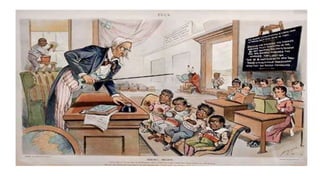


Tall, blond,
fair-skinned
and sharp-
nosed. This is
the image a lot
of Filipinos
carry in their
heads of the
ideal physical
appearance
that they
RACE, GENDER, CLASS
Philippine Setting
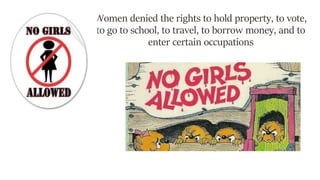
Women denied the rights to hold property, to vote,
to go to school, to travel, to borrow money, and to
enter certain occupations
Filipino society assigned to men the role of breadwinner
and to women the role of housekeeper.
o“Man’s World” outside the home was viewed as a harsh
and heartless jungle in which men needed strength and
aggression.
o“Woman’s World” was the home, and her job was to
comfort and care for husband and children, maintain
harmony, and teach her children to conform to society’s
norms.
Popular Stereotypes
 The oversimplified mental images of what men and women are
supposed to be and to some extent, it persist.
MEN – supposed to be ambitious, aggressive, strong and
should hold back their emotions and must not cry; expected to
be sexually aggressive and experienced; supposed to be
independent, fit to be a leaders; and, expected to be logical,
rational and objective.
WOMEN – supposed to be shy, easily intimidated, passive,
demure; expected to worry about their appearance and aging;
expected to be emotional, even to cry easily; expected to be
sexually passive and inexperienced; believe to be dependent, in
need of male protection; and, expected to be inconsistent and
intuitive.
AGREE OR DISARGEE
boys are more confident in their abilities in Science than
girls
Girls are more anxious towards Mathematics than boys
Boys than girls expect to have a career in engineering or
computing
Girls than boys expect to have a career in health service
Girls spend more than an hour more per week than boys
doing homework
Boys tend to have a more negative attitudes towards
schools
Boys spend more time on the internet than girls (playing
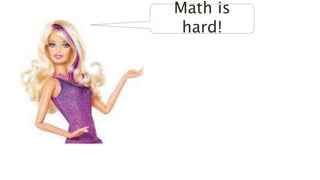
Math is
hard!
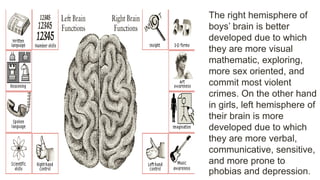
The right hemisphere of
boys’ brain is better
developed due to which
they are more visual
mathematic, exploring,
more sex oriented, and
commit most violent
crimes. On the other hand
in girls, left hemisphere of
their brain is more
developed due to which
they are more verbal,
communicative, sensitive,
and more prone to
phobias and depression.
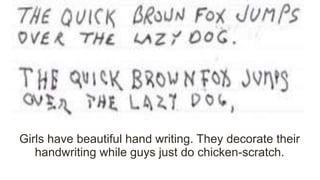
Girls have beautiful hand writing. They decorate their
handwriting while guys just do chicken-scratch.
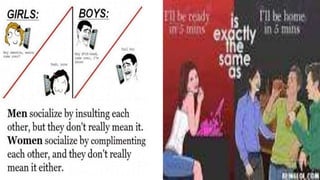
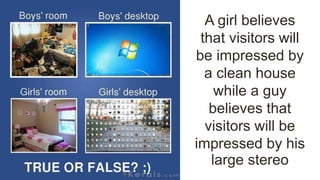
A girl believes
that visitors will
be impressed by
a clean house
while a guy
believes that
visitors will be
impressed by his
large stereo
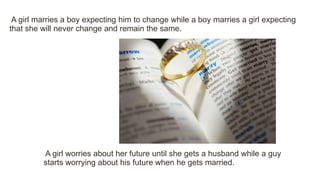
A girl worries about her future until she gets a husband while a guy
starts worrying about his future when he gets married.
A girl marries a boy expecting him to change while a boy marries a girl expecting
that she will never change and remain the same.
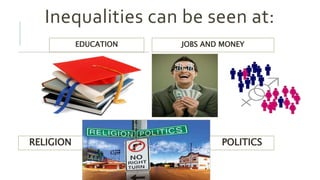
Inequalities can be seen at:
EDUCATION JOBS AND MONEY
POLITICSRELIGION
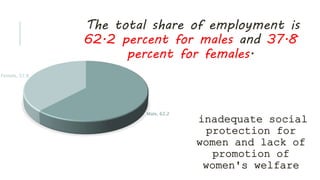
The total share of employment is
62.2 percent for males and 37.8
percent for females.
Male, 62.2
Female, 37.8
inadequate social
protection for
women and lack of
promotion of
women's welfare
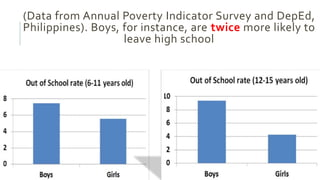
(Data from Annual Poverty Indicator Survey and DepEd,
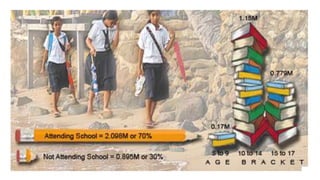
Philippines). Boys, for instance, are twice more likely to
leave high school
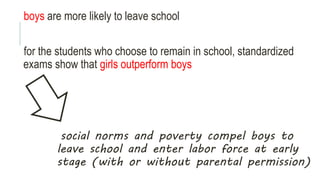
boys are more likely to leave school
for the students who choose to remain in school, standardized
exams show that girls outperform boys
social norms and poverty compel boys to
leave school and enter labor force at early
stage (with or without parental permission)
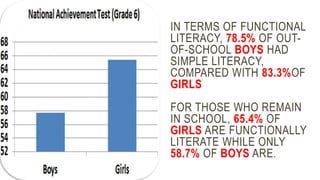
IN TERMS OF FUNCTIONAL
LITERACY, 78.5% OF OUT-
OF-SCHOOL BOYS HAD
SIMPLE LITERACY,
COMPARED WITH 83.3%OF
GIRLS
FOR THOSE WHO REMAIN
IN SCHOOL, 65.4% OF
GIRLS ARE FUNCTIONALLY
LITERATE WHILE ONLY
58.7% OF BOYS ARE.
MEN’S LIBERATION
Freedom in expressing emotion
Freedom from social expectation
Social Relationships
Freedom from competition
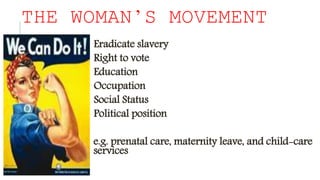
THE WOMAN’S MOVEMENT
Eradicate slavery
Right to vote
Education
Occupation
Social Status
Political position
e.g. prenatal care, maternity leave, and child-care
services
Race matters to the extent that
racial injustice persists. Take the
case of our OFWs who, like slaves,
are held captive, their movements
severely restricted and monitored.
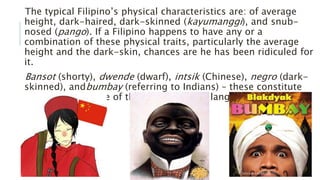
The typical Filipino’s physical characteristics are: of average
height, dark-haired, dark-skinned (kayumanggi), and snub-
nosed (pango). If a Filipino happens to have any or a
combination of these physical traits, particularly the average
height and the dark-skin, chances are he has been ridiculed for
it.
Bansot (shorty), dwende (dwarf), intsik (Chinese), negro (dark-
skinned), andbumbay (referring to Indians) – these constitute
but a small sample of the discriminatory language Filipinos are
capable of.
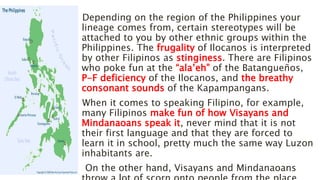
Depending on the region of the Philippines your
lineage comes from, certain stereotypes will be
attached to you by other ethnic groups within the
Philippines. The frugality of Ilocanos is interpreted
by other Filipinos as stinginess. There are Filipinos
who poke fun at the “ala’eh” of the Batangueños,
P-F deficiency of the Ilocanos, and the breathy
consonant sounds of the Kapampangans.
When it comes to speaking Filipino, for example,
many Filipinos make fun of how Visayans and
Mindanaoans speak it, never mind that it is not
their first language and that they are forced to
learn it in school, pretty much the same way Luzon
inhabitants are.
On the other hand, Visayans and Mindanaoans
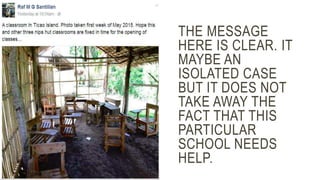
THE MESSAGE
HERE IS CLEAR. IT
MAYBE AN
ISOLATED CASE
BUT IT DOES NOT
TAKE AWAY THE
FACT THAT THIS
PARTICULAR
SCHOOL NEEDS
HELP.
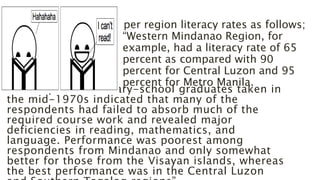
A survey of elementary-school graduates taken in
the mid-1970s indicated that many of the
respondents had failed to absorb much of the
required course work and revealed major
deficiencies in reading, mathematics, and
language. Performance was poorest among
respondents from Mindanao and only somewhat
better for those from the Visayan islands, whereas
the best performance was in the Central Luzon
per region literacy rates as follows;
“Western Mindanao Region, for
example, had a literacy rate of 65
percent as compared with 90
percent for Central Luzon and 95
percent for Metro Manila.
A study made by Jobstreet.com revealed that 77 percent
of employers still prefer graduates coming from the top
four schools of the country, namely, University of the
Philippines (UP), Ateneo de Manila University, (ADEMU),
University of Santo Tomas (UST) and De La Salle
University (DLSU).
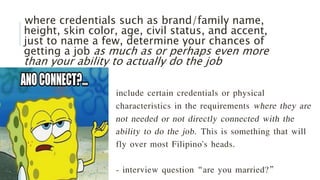
include certain credentials or physical
characteristics in the requirements where they are
not needed or not directly connected with the
ability to do the job. This is something that will
fly over most Filipino's heads.
- interview question “are you married?”
where credentials such as brand/family name,
height, skin color, age, civil status, and accent,
just to name a few, determine your chances of
getting a job as much as or perhaps even more
than your ability to actually do the job
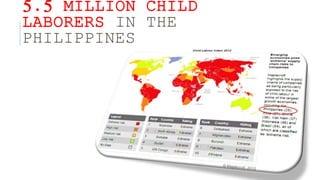
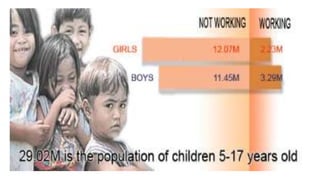
5.5 MILLION CHILD
LABORERS IN THE
PHILIPPINES
Race, gender, class
Race, gender, class

Race, gender, class

  • 2.
    Tall, blond, fair-skinned and sharp- nosed.This is the image a lot of Filipinos carry in their heads of the ideal physical appearance that they
  • 3.
  • 4.
    Women denied therights to hold property, to vote, to go to school, to travel, to borrow money, and to enter certain occupations
  • 5.
    Filipino society assignedto men the role of breadwinner and to women the role of housekeeper. o“Man’s World” outside the home was viewed as a harsh and heartless jungle in which men needed strength and aggression. o“Woman’s World” was the home, and her job was to comfort and care for husband and children, maintain harmony, and teach her children to conform to society’s norms.
  • 6.
    Popular Stereotypes  Theoversimplified mental images of what men and women are supposed to be and to some extent, it persist. MEN – supposed to be ambitious, aggressive, strong and should hold back their emotions and must not cry; expected to be sexually aggressive and experienced; supposed to be independent, fit to be a leaders; and, expected to be logical, rational and objective. WOMEN – supposed to be shy, easily intimidated, passive, demure; expected to worry about their appearance and aging; expected to be emotional, even to cry easily; expected to be sexually passive and inexperienced; believe to be dependent, in need of male protection; and, expected to be inconsistent and intuitive.
  • 7.
    AGREE OR DISARGEE boysare more confident in their abilities in Science than girls Girls are more anxious towards Mathematics than boys Boys than girls expect to have a career in engineering or computing Girls than boys expect to have a career in health service Girls spend more than an hour more per week than boys doing homework Boys tend to have a more negative attitudes towards schools Boys spend more time on the internet than girls (playing
  • 8.
  • 9.
    The right hemisphereof boys’ brain is better developed due to which they are more visual mathematic, exploring, more sex oriented, and commit most violent crimes. On the other hand in girls, left hemisphere of their brain is more developed due to which they are more verbal, communicative, sensitive, and more prone to phobias and depression.
  • 11.
    Girls have beautifulhand writing. They decorate their handwriting while guys just do chicken-scratch.
  • 12.
    A girl believes thatvisitors will be impressed by a clean house while a guy believes that visitors will be impressed by his large stereo
  • 13.
    A girl worriesabout her future until she gets a husband while a guy starts worrying about his future when he gets married. A girl marries a boy expecting him to change while a boy marries a girl expecting that she will never change and remain the same.
  • 16.
    Inequalities can beseen at: EDUCATION JOBS AND MONEY POLITICSRELIGION
  • 18.
    The total shareof employment is 62.2 percent for males and 37.8 percent for females. Male, 62.2 Female, 37.8 inadequate social protection for women and lack of promotion of women's welfare
  • 19.
    (Data from AnnualPoverty Indicator Survey and DepEd, Philippines). Boys, for instance, are twice more likely to leave high school
  • 20.
    boys are morelikely to leave school for the students who choose to remain in school, standardized exams show that girls outperform boys social norms and poverty compel boys to leave school and enter labor force at early stage (with or without parental permission)
  • 21.
    IN TERMS OFFUNCTIONAL LITERACY, 78.5% OF OUT- OF-SCHOOL BOYS HAD SIMPLE LITERACY, COMPARED WITH 83.3%OF GIRLS FOR THOSE WHO REMAIN IN SCHOOL, 65.4% OF GIRLS ARE FUNCTIONALLY LITERATE WHILE ONLY 58.7% OF BOYS ARE.
  • 24.
    MEN’S LIBERATION Freedom inexpressing emotion Freedom from social expectation Social Relationships Freedom from competition
  • 25.
    THE WOMAN’S MOVEMENT Eradicateslavery Right to vote Education Occupation Social Status Political position e.g. prenatal care, maternity leave, and child-care services
  • 28.
    Race matters tothe extent that racial injustice persists. Take the case of our OFWs who, like slaves, are held captive, their movements severely restricted and monitored.
  • 29.
    The typical Filipino’sphysical characteristics are: of average height, dark-haired, dark-skinned (kayumanggi), and snub- nosed (pango). If a Filipino happens to have any or a combination of these physical traits, particularly the average height and the dark-skin, chances are he has been ridiculed for it. Bansot (shorty), dwende (dwarf), intsik (Chinese), negro (dark- skinned), andbumbay (referring to Indians) – these constitute but a small sample of the discriminatory language Filipinos are capable of.
  • 30.
    Depending on theregion of the Philippines your lineage comes from, certain stereotypes will be attached to you by other ethnic groups within the Philippines. The frugality of Ilocanos is interpreted by other Filipinos as stinginess. There are Filipinos who poke fun at the “ala’eh” of the Batangueños, P-F deficiency of the Ilocanos, and the breathy consonant sounds of the Kapampangans. When it comes to speaking Filipino, for example, many Filipinos make fun of how Visayans and Mindanaoans speak it, never mind that it is not their first language and that they are forced to learn it in school, pretty much the same way Luzon inhabitants are. On the other hand, Visayans and Mindanaoans
  • 33.
    THE MESSAGE HERE ISCLEAR. IT MAYBE AN ISOLATED CASE BUT IT DOES NOT TAKE AWAY THE FACT THAT THIS PARTICULAR SCHOOL NEEDS HELP.
  • 34.
    A survey ofelementary-school graduates taken in the mid-1970s indicated that many of the respondents had failed to absorb much of the required course work and revealed major deficiencies in reading, mathematics, and language. Performance was poorest among respondents from Mindanao and only somewhat better for those from the Visayan islands, whereas the best performance was in the Central Luzon per region literacy rates as follows; “Western Mindanao Region, for example, had a literacy rate of 65 percent as compared with 90 percent for Central Luzon and 95 percent for Metro Manila.
  • 35.
    A study madeby Jobstreet.com revealed that 77 percent of employers still prefer graduates coming from the top four schools of the country, namely, University of the Philippines (UP), Ateneo de Manila University, (ADEMU), University of Santo Tomas (UST) and De La Salle University (DLSU).
  • 36.
    include certain credentialsor physical characteristics in the requirements where they are not needed or not directly connected with the ability to do the job. This is something that will fly over most Filipino's heads. - interview question “are you married?” where credentials such as brand/family name, height, skin color, age, civil status, and accent, just to name a few, determine your chances of getting a job as much as or perhaps even more than your ability to actually do the job
  • 38.
    5.5 MILLION CHILD LABORERSIN THE PHILIPPINES