Lab Activity
“Bean-otypes”
warm up
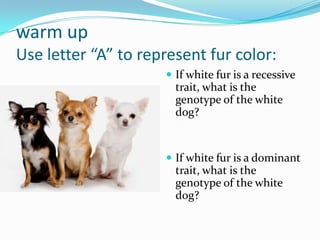
Use letter “A” to represent fur color:
                      If white fur is a recessive
                       trait, what is the
                       genotype of the white
                       dog?


                      If white fur is a dominant
                       trait, what is the
                       genotype of the white
                       dog?
today’s schedule
 Pick-up daily notes/handout package
 Complete the warm-up:
  *The warm-up will be displayed on the smartboard as students enter.
 Discuss the warm-up.
  PowerPoint begins at this point:
 5-Alive Recap: Lively 5 minute review/recap of previous lesson
  *if this goes over 5 min that is fine
 Introduce today’s topic and objectives (will be written in hand-out as well as on
  whiteboard)
   Group assignments (by me, pre-determined)
   Bean-otype lab activity: complete in small groups
   Discuss lab as class
   Homework will be independent practice on genotypes, phenotypes, &
    Punnett squares
   Turn in lab pages upon exiting
common core
MSDE (2012):
INDICATOR
3.3.2 The student will illustrate and explain how expressed traits are
   passed from parent to offspring.

Assessment limits:
 phenotypes (expression of inherited characteristics)
 dominant and recessive traits
 sex-linked traits (X-linked only; recessive phenotypes are more often
  expressed in the male)
 genotypes (represented by heterozygous and homozygous pairs of
  alleles)
 Punnett square (use to predict and/or interpret the results of a genetic
  cross; translate genotypes into phenotypes - monohybrid only)
 pedigree (use to interpret patterns of inheritance within a family)
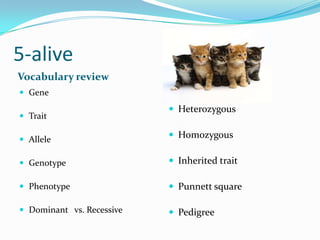
5-alive
Vocabulary review
 Gene
                            Heterozygous
 Trait

 Allele
                            Homozygous


 Genotype                  Inherited trait

 Phenotype                 Punnett square

 Dominant vs. Recessive    Pedigree
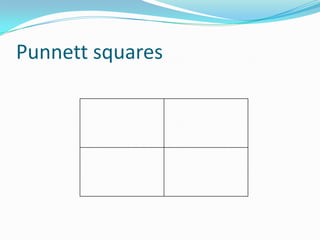
Punnett squares
Punnett squares practice
 B=brown eyes, b=blue eyes
1. Homozygous dominant mom and a heterozygous dad
2. Heterozygous dominant mom and a heterozygous dad
3. Recessive mom and a heterozygous dad


 R=red petals, r=brown petals
1. Homozygous dominant and a heterozygous
2. Heterozygous dominant and a heterozygous
3. Recessive and a heterozygous
So what…..
 What if we are in the flower selling business and we
 want to determine how many red roses we are going to
 produce since the red roses sell for more money.

 What if your dog is having puppies and your want to
 determine what they may look like

 What if….
objectives
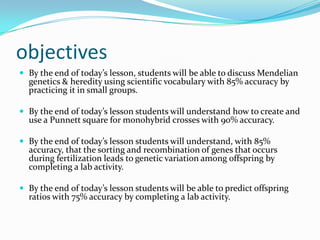
 By the end of today’s lesson, students will be able to discuss Mendelian
  genetics & heredity using scientific vocabulary with 85% accuracy by
  practicing it in small groups.

 By the end of today’s lesson students will understand how to create and
  use a Punnett square for monohybrid crosses with 90% accuracy.

 By the end of today’s lesson students will understand, with 85%
  accuracy, that the sorting and recombination of genes that occurs
  during fertilization leads to genetic variation among offspring by
  completing a lab activity.

 By the end of today’s lesson students will be able to predict offspring
  ratios with 75% accuracy by completing a lab activity.
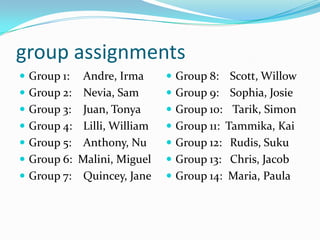
group assignments
 Group 1:    Andre, Irma       Group 8:     Scott, Willow
 Group 2:    Nevia, Sam          Group 9: Sophia, Josie
 Group 3:    Juan, Tonya         Group 10: Tarik, Simon
 Group 4:    Lilli, William      Group 11: Tammika, Kai
 Group 5:    Anthony, Nu         Group 12: Rudis, Suku
 Group 6:   Malini, Miguel       Group 13: Chris, Jacob
 Group 7:    Quincey, Jane       Group 14: Maria, Paula
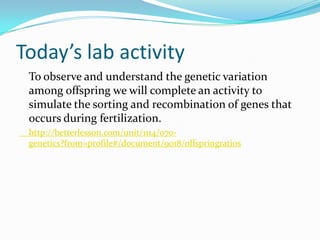
Today’s lab activity
 To observe and understand the genetic variation
 among offspring we will complete an activity to
 simulate the sorting and recombination of genes that
 occurs during fertilization.
 http://betterlesson.com/unit/1114/070-
 genetics?from=profile#/document/9018/offspringratios
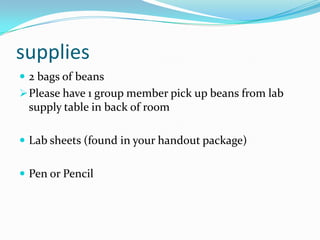
supplies
 2 bags of beans
 Please have 1 group member pick up beans from lab
 supply table in back of room

 Lab sheets (found in your handout package)


 Pen or Pencil
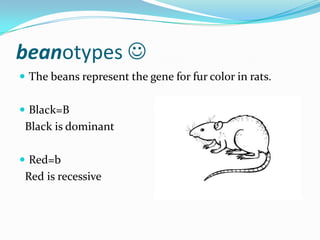
beanotypes 
 The beans represent the gene for fur color in rats.


 Black=B
 Black is dominant

 Red=b
 Red is recessive
methods
 To be completed collaboratively
 Work in small groups
 Discuss results as a class


 See the lab activity “Offspring, offspring, everywhere”
  for complete directions (in handout package)
results
 Each member of the group will fill in their own results
  table and write the answers to the results questions.

 We will discuss results as a class


 Labs will be turned in at the end of class
if you finish early…
 please review the vocabulary list from yesterday and
 quietly discuss the terms with your group member.

 Please discuss your lab results with your group
 member.
homework
 Worksheet: found in handout package


 http://yellowjacketscience.com/uploads/monohybrid_
 crosses1.pdf
Exit ticket
 Today I will collect your labs instead of an exit ticket
references
 Vieira. (n.d.). Monohybrid crosses worksheet.
 Retrieved from
 http://yellowjacketscience.com/uploads/monohybrid_
 crosses1.pdf

Lesson 2 mendelian genetics & heredity lab

  • 1.
  • 2.
    warm up Use letter“A” to represent fur color:  If white fur is a recessive trait, what is the genotype of the white dog?  If white fur is a dominant trait, what is the genotype of the white dog?
  • 3.
    today’s schedule  Pick-updaily notes/handout package  Complete the warm-up: *The warm-up will be displayed on the smartboard as students enter.  Discuss the warm-up. PowerPoint begins at this point:  5-Alive Recap: Lively 5 minute review/recap of previous lesson *if this goes over 5 min that is fine  Introduce today’s topic and objectives (will be written in hand-out as well as on whiteboard)  Group assignments (by me, pre-determined)  Bean-otype lab activity: complete in small groups  Discuss lab as class  Homework will be independent practice on genotypes, phenotypes, & Punnett squares  Turn in lab pages upon exiting
  • 4.
    common core MSDE (2012): INDICATOR 3.3.2The student will illustrate and explain how expressed traits are passed from parent to offspring. Assessment limits:  phenotypes (expression of inherited characteristics)  dominant and recessive traits  sex-linked traits (X-linked only; recessive phenotypes are more often expressed in the male)  genotypes (represented by heterozygous and homozygous pairs of alleles)  Punnett square (use to predict and/or interpret the results of a genetic cross; translate genotypes into phenotypes - monohybrid only)  pedigree (use to interpret patterns of inheritance within a family)
  • 5.
    5-alive Vocabulary review  Gene  Heterozygous  Trait  Allele  Homozygous  Genotype  Inherited trait  Phenotype  Punnett square  Dominant vs. Recessive  Pedigree
  • 6.
  • 7.
    Punnett squares practice B=brown eyes, b=blue eyes 1. Homozygous dominant mom and a heterozygous dad 2. Heterozygous dominant mom and a heterozygous dad 3. Recessive mom and a heterozygous dad  R=red petals, r=brown petals 1. Homozygous dominant and a heterozygous 2. Heterozygous dominant and a heterozygous 3. Recessive and a heterozygous
  • 8.
    So what…..  Whatif we are in the flower selling business and we want to determine how many red roses we are going to produce since the red roses sell for more money.  What if your dog is having puppies and your want to determine what they may look like  What if….
  • 9.
    objectives  By theend of today’s lesson, students will be able to discuss Mendelian genetics & heredity using scientific vocabulary with 85% accuracy by practicing it in small groups.  By the end of today’s lesson students will understand how to create and use a Punnett square for monohybrid crosses with 90% accuracy.  By the end of today’s lesson students will understand, with 85% accuracy, that the sorting and recombination of genes that occurs during fertilization leads to genetic variation among offspring by completing a lab activity.  By the end of today’s lesson students will be able to predict offspring ratios with 75% accuracy by completing a lab activity.
  • 10.
    group assignments  Group1: Andre, Irma  Group 8: Scott, Willow  Group 2: Nevia, Sam  Group 9: Sophia, Josie  Group 3: Juan, Tonya  Group 10: Tarik, Simon  Group 4: Lilli, William  Group 11: Tammika, Kai  Group 5: Anthony, Nu  Group 12: Rudis, Suku  Group 6: Malini, Miguel  Group 13: Chris, Jacob  Group 7: Quincey, Jane  Group 14: Maria, Paula
  • 11.
    Today’s lab activity To observe and understand the genetic variation among offspring we will complete an activity to simulate the sorting and recombination of genes that occurs during fertilization. http://betterlesson.com/unit/1114/070- genetics?from=profile#/document/9018/offspringratios
  • 12.
    supplies  2 bagsof beans  Please have 1 group member pick up beans from lab supply table in back of room  Lab sheets (found in your handout package)  Pen or Pencil
  • 13.
    beanotypes   Thebeans represent the gene for fur color in rats.  Black=B Black is dominant  Red=b Red is recessive
  • 14.
    methods  To becompleted collaboratively  Work in small groups  Discuss results as a class  See the lab activity “Offspring, offspring, everywhere” for complete directions (in handout package)
  • 15.
    results  Each memberof the group will fill in their own results table and write the answers to the results questions.  We will discuss results as a class  Labs will be turned in at the end of class
  • 16.
    if you finishearly…  please review the vocabulary list from yesterday and quietly discuss the terms with your group member.  Please discuss your lab results with your group member.
  • 17.
    homework  Worksheet: foundin handout package  http://yellowjacketscience.com/uploads/monohybrid_ crosses1.pdf
  • 18.
    Exit ticket  TodayI will collect your labs instead of an exit ticket
  • 19.
    references  Vieira. (n.d.).Monohybrid crosses worksheet. Retrieved from http://yellowjacketscience.com/uploads/monohybrid_ crosses1.pdf

Editor's Notes

  • #7 At this point, draw a few Punnett squares on the white board; ask students to explain how and why we use them.
  • #8 Ask for volunteers to fill in the Punnett squares for each of these crosses
  • #9 This discussion leads us into today’s lab activity. Ask students if they can think of any other ways this would be helpful.
  • #10 Today we are going to do a lab activity which will really tie all of this together
  • #11 The group number indicates at which computer station the students will work.