IMAGERY
&
FIGURATI
VE
LANGUAG
E
Prepared by
JC GONZAGA
w w w . u n ti t l e d a d r e s s . c o m
What is Imagery
 Imagery is a language used by
poets, novelists and other writers
to create images in the mind of
the reader.
 Imagery includes figurative and
metaphorical language to
improve the reader’s experience
through their senses.
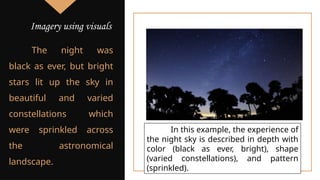
The night was
black as ever, but bright
stars lit up the sky in
beautiful and varied
constellations which
were sprinkled across
the astronomical
landscape.
In this example, the experience of
the night sky is described in depth with
color (black as ever, bright), shape
(varied constellations), and pattern
(sprinkled).
Imagery using visuals
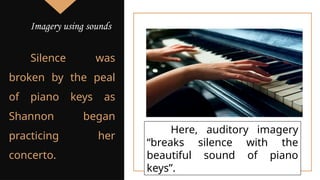
Silence was
broken by the peal
of piano keys as
Shannon began
practicing her
concerto.
Here, auditory imagery
“breaks silence with the
beautiful sound of piano
keys”.
Imagery using sounds
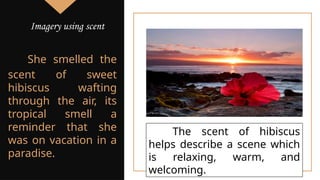
She smelled the
scent of sweet
hibiscus wafting
through the air, its
tropical smell a
reminder that she
was on vacation in a
paradise.
The scent of hibiscus
helps describe a scene which
is relaxing, warm, and
welcoming.
Imagery using scent
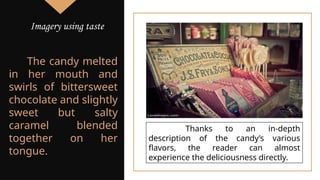
The candy melted
in her mouth and
swirls of bittersweet
chocolate and slightly
sweet but salty
caramel blended
together on her
tongue.
Thanks to an in-depth
description of the candy’s various
flavors, the reader can almost
experience the deliciousness directly.
Imagery using taste
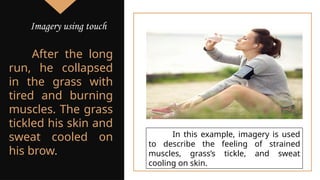
After the long
run, he collapsed
in the grass with
tired and burning
muscles. The grass
tickled his skin and
sweat cooled on
his brow.
In this example, imagery is used
to describe the feeling of strained
muscles, grass’s tickle, and sweat
cooling on skin.
Imagery using touch
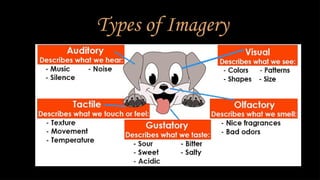
Types of Imagery
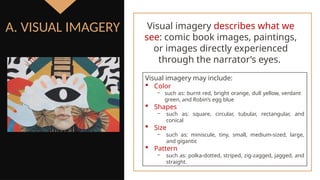
Visual imagery may include:
 Color
‒ such as: burnt red, bright orange, dull yellow, verdant
green, and Robin’s egg blue
 Shapes
‒ such as: square, circular, tubular, rectangular, and
conical
 Size
‒ such as: miniscule, tiny, small, medium-sized, large,
and gigantic
 Pattern
‒ such as: polka-dotted, striped, zig-zagged, jagged, and
straight.
A. VISUAL IMAGERY Visual imagery describes what we
see: comic book images, paintings,
or images directly experienced
through the narrator’s eyes.
Auditory imagery may include:
 Enjoyable sounds
‒ beautiful music, birdsong, and the voices of
a chorus
 Noises
‒ the bang of a gun, the sound of a broom
moving across the floor, and the sound of
broken glass shattering on the hard floor
 The lack of noise describing a peaceful
calm or eerie silence.
B. AUDITORY IMAGERY Auditory imagery describes
what we hear, from music to
noise to pure silence.
Olfactory imagery may include:
 Fragrances
‒ such as perfumes, whiff of enticing
food and drink, and aromatic scent
of blooming flowers
 Odors
‒ rotting trash, body odors, or a
stinky wet dog, rancid smell of
chemical
C. OLFACTORY IMAGERY
Olfactory Imagery
describes what we smell.
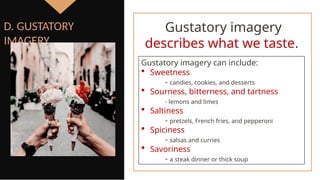
Gustatory imagery can include:
 Sweetness
- candies, cookies, and desserts
 Sourness, bitterness, and tartness
- lemons and limes
 Saltiness
- pretzels, French fries, and pepperoni
 Spiciness
- salsas and curries
 Savoriness
- a steak dinner or thick soup
D. GUSTATORY
IMAGERY
Gustatory imagery
describes what we taste.
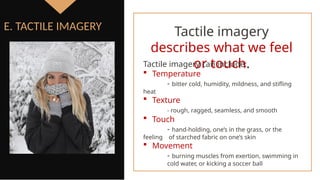
E. TACTILE IMAGERY Tactile imagery
describes what we feel
or touch.
Tactile imagery can include:
 Temperature
- bitter cold, humidity, mildness, and stifling
heat
 Texture
- rough, ragged, seamless, and smooth
 Touch
- hand-holding, one’s in the grass, or the
feeling of starched fabric on one’s skin
 Movement
- burning muscles from exertion, swimming in
cold water, or kicking a soccer ball
IMPORTANCE OF USING IMAGERY
 We experience life through our senses, a strong composition should appeal
to them through the use of imagery.
 Descriptive imagery launches the reader into the experience of a warm
spring day, scorching hot summer, crisp fall, or harsh winter.
 It allows readers to directly sympathize with
characters and narrators as they imagine having
the same sense experiences.
 Imagery helps build compelling poetry,
convincing narratives, vivid plays, well-designed
film sets, and descriptive songs.
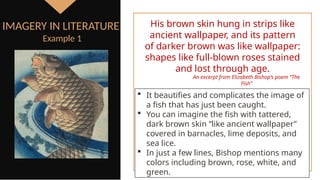
 It beautifies and complicates the image of
a fish that has just been caught.
 You can imagine the fish with tattered,
dark brown skin “like ancient wallpaper”
covered in barnacles, lime deposits, and
sea lice.
 In just a few lines, Bishop mentions many
colors including brown, rose, white, and
green.
IMAGERY IN LITERATURE
Example 1
His brown skin hung in strips like
ancient wallpaper, and its pattern
of darker brown was like wallpaper:
shapes like full-blown roses stained
and lost through age.
An excerpt from Elizabeth Bishop’s poem “The
Fish”
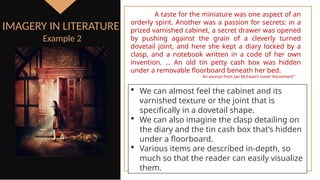
 We can almost feel the cabinet and its
varnished texture or the joint that is
specifically in a dovetail shape.
 We can also imagine the clasp detailing on
the diary and the tin cash box that’s hidden
under a floorboard.
 Various items are described in-depth, so
much so that the reader can easily visualize
them.
IMAGERY IN LITERATURE
Example 2
A taste for the miniature was one aspect of an
orderly spirit. Another was a passion for secrets: in a
prized varnished cabinet, a secret drawer was opened
by pushing against the grain of a cleverly turned
dovetail joint, and here she kept a diary locked by a
clasp, and a notebook written in a code of her own
invention. … An old tin petty cash box was hidden
under a removable floorboard beneath her bed.
An excerpt from Ian McEwan’s novel “Atonement”
FIGURES
OF
SPEECH
Imagery. Figures of Speech. Diction
L e a r n a b o u t l a n g u a g e i n w r i ti n g
w w w . u n ti t l e d a d r e s s . c o m
Figure of Speech is a
departure from the ordinary
form of expression, or the
ordinary course of ideas in
order to produce a greater
effect.
Figure of Speech
 A figure of speech is a figurative language in the
form of a single word or phrase.
 It can be a special repetition, arrangement or
omission of words with literal meaning, or a phrase
with a specialized meaning not based on the literal
meaning of the words.
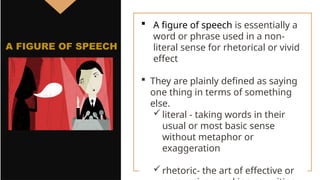
 A figure of speech is essentially a
word or phrase used in a non-
literal sense for rhetorical or vivid
effect
 They are plainly defined as saying
one thing in terms of something
else.
literal - taking words in their
usual or most basic sense
without metaphor or
exaggeration
rhetoric- the art of effective or
A FIGURE OF SPEECH
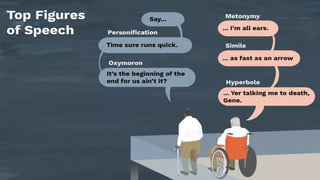
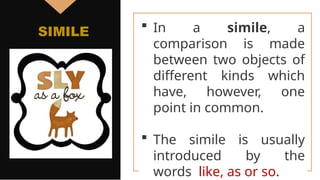
 In a simile, a
comparison is made
between two objects of
different kinds which
have, however, one
point in common.
 The simile is usually
introduced by the
words like, as or so.
SIMILE
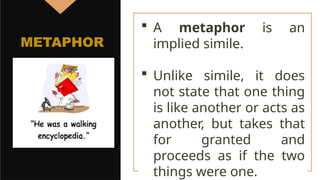
 A metaphor is an
implied simile.
 Unlike simile, it does
not state that one thing
is like another or acts as
another, but takes that
for granted and
proceeds as if the two
things were one.
METAPHOR
Every simile can be compressed into a
metaphor and every metaphor can
expanded into a simile.
Thus,
 Akash fought like a lion. (Simile)
 Akash was a lion in the fight.
(Metaphor)
REMEMBER!
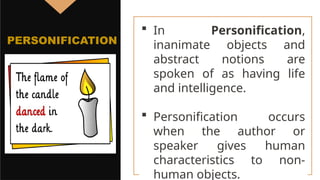
 In Personification,
inanimate objects and
abstract notions are
spoken of as having life
and intelligence.
 Personification occurs
when the author or
speaker gives human
characteristics to non-
human objects.
PERSONIFICATION
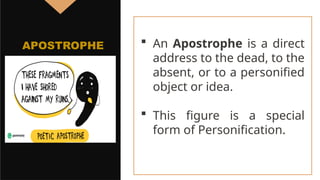
 An Apostrophe is a direct
address to the dead, to the
absent, or to a personified
object or idea.
 This figure is a special
form of Personification.
APOSTROPHE
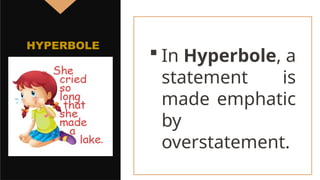
 In Hyperbole, a
statement is
made emphatic
by
overstatement.
HYPERBOLE
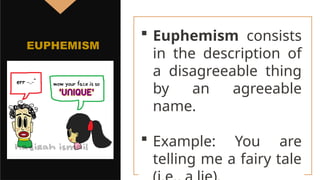
 Euphemism consists
in the description of
a disagreeable thing
by an agreeable
name.
 Example: You are
telling me a fairy tale
EUPHEMISM
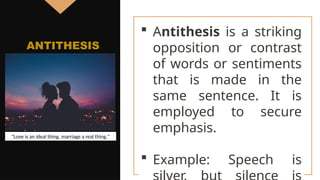
 Antithesis is a striking
opposition or contrast
of words or sentiments
that is made in the
same sentence. It is
employed to secure
emphasis.
 Example: Speech is
ANTITHESIS
"Love is an ideal thing, marriage a real thing."
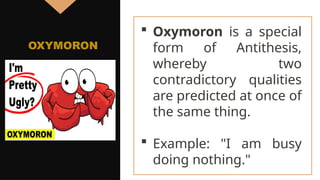
 Oxymoron is a special
form of Antithesis,
whereby two
contradictory qualities
are predicted at once of
the same thing.
 Example: "I am busy
doing nothing."
OXYMORON
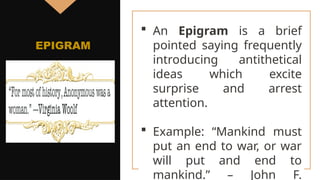
 An Epigram is a brief
pointed saying frequently
introducing antithetical
ideas which excite
surprise and arrest
attention.
 Example: “Mankind must
put an end to war, or war
will put and end to
mankind.” – John F.
EPIGRAM
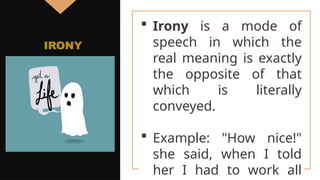
 Irony is a mode of
speech in which the
real meaning is exactly
the opposite of that
which is literally
conveyed.
 Example: "How nice!"
she said, when I told
her I had to work all
IRONY
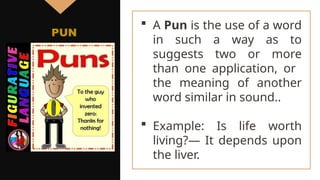
 A Pun is the use of a word
in such a way as to
suggests two or more
than one application, or
the meaning of another
word similar in sound..
 Example: Is life worth
living?— It depends upon
the liver.
PUN
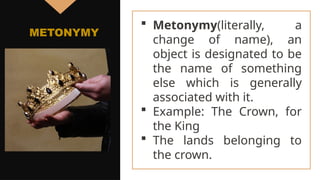
 Metonymy(literally, a
change of name), an
object is designated to be
the name of something
else which is generally
associated with it.
 Example: The Crown, for
the King
 The lands belonging to
the crown.
METONYMY
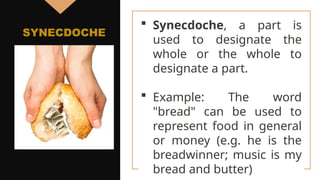
 Synecdoche, a part is
used to designate the
whole or the whole to
designate a part.
 Example: The word
"bread" can be used to
represent food in general
or money (e.g. he is the
breadwinner; music is my
bread and butter)
SYNECDOCHE
Synecdoche in Literature
A boy has been admitted to the hospital. The nurse
says, “He’s in good hands.”
The boy is not literally being taken care
of by two hands. Rather, he is being taken
care of by an entire hospital system,
including nurses, assistants, doctors, and
many others. This is an example of
microcosmic synecdoche, as a part signifies a
whole.
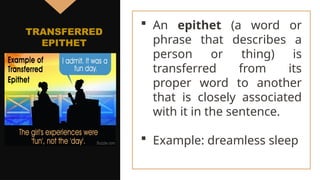
 An epithet (a word or
phrase that describes a
person or thing) is
transferred from its
proper word to another
that is closely associated
with it in the sentence.
 Example: dreamless sleep
TRANSFERRED
EPITHET
From forth the fatal loins of these two
foes
A pair of star-cross’d lovers take their life;
Whose misadventured piteous
overthrows
Do with their death bury their parents’
strife.
Romeo and Juliet (William Shakespear)
Epithet in Literature
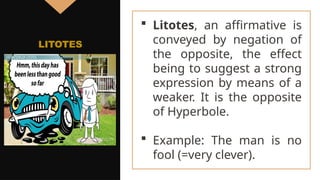
 Litotes, an affirmative is
conveyed by negation of
the opposite, the effect
being to suggest a strong
expression by means of a
weaker. It is the opposite
of Hyperbole.
 Example: The man is no
fool (=very clever).
LITOTES
Litotes in Literature
I cannot say that I think you are very
generous to the ladies; for, whilst
you are proclaiming peace and good-
will to men, emancipating all nations,
you insist upon retaining an absolute
power over wives. (Abigail Adams,
letter to John Adams)
 Climax is the
arrangement of a series
of ideas in the order of
increasing importance.
 Example: "There are three
things that will endure:
faith, hope, and love. But
the greatest of these is
love."
CLIMAX
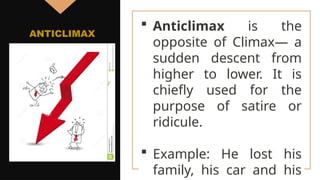
 Anticlimax is the
opposite of Climax— a
sudden descent from
higher to lower. It is
chiefly used for the
purpose of satire or
ridicule.
 Example: He lost his
family, his car and his
ANTICLIMAX
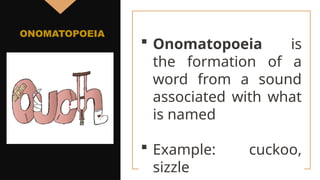
 Onomatopoeia is
the formation of a
word from a sound
associated with what
is named
 Example: cuckoo,
sizzle
ONOMATOPOEIA
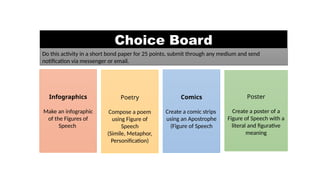
Choice Board
Infographics
Make an infographic
of the Figures of
Speech
Poetry
Compose a poem
using Figure of
Speech
(Simile, Metaphor,
Personification)
Comics
Create a comic strips
using an Apostrophe
(Figure of Speech
Poster
Create a poster of a
Figure of Speech with a
literal and figurative
meaning
Do this activity in a short bond paper for 25 points, submit through any medium and send
notification via messenger or email.

CREATIVE WRITING WEEK three to four: Imagery.pptx

  • 1.
    IMAGERY & FIGURATI VE LANGUAG E Prepared by JC GONZAGA ww w . u n ti t l e d a d r e s s . c o m
  • 2.
    What is Imagery Imagery is a language used by poets, novelists and other writers to create images in the mind of the reader.  Imagery includes figurative and metaphorical language to improve the reader’s experience through their senses.
  • 4.
    The night was blackas ever, but bright stars lit up the sky in beautiful and varied constellations which were sprinkled across the astronomical landscape. In this example, the experience of the night sky is described in depth with color (black as ever, bright), shape (varied constellations), and pattern (sprinkled). Imagery using visuals
  • 5.
    Silence was broken bythe peal of piano keys as Shannon began practicing her concerto. Here, auditory imagery “breaks silence with the beautiful sound of piano keys”. Imagery using sounds
  • 6.
    She smelled the scentof sweet hibiscus wafting through the air, its tropical smell a reminder that she was on vacation in a paradise. The scent of hibiscus helps describe a scene which is relaxing, warm, and welcoming. Imagery using scent
  • 7.
    The candy melted inher mouth and swirls of bittersweet chocolate and slightly sweet but salty caramel blended together on her tongue. Thanks to an in-depth description of the candy’s various flavors, the reader can almost experience the deliciousness directly. Imagery using taste
  • 8.
    After the long run,he collapsed in the grass with tired and burning muscles. The grass tickled his skin and sweat cooled on his brow. In this example, imagery is used to describe the feeling of strained muscles, grass’s tickle, and sweat cooling on skin. Imagery using touch
  • 11.
  • 12.
    Visual imagery mayinclude:  Color ‒ such as: burnt red, bright orange, dull yellow, verdant green, and Robin’s egg blue  Shapes ‒ such as: square, circular, tubular, rectangular, and conical  Size ‒ such as: miniscule, tiny, small, medium-sized, large, and gigantic  Pattern ‒ such as: polka-dotted, striped, zig-zagged, jagged, and straight. A. VISUAL IMAGERY Visual imagery describes what we see: comic book images, paintings, or images directly experienced through the narrator’s eyes.
  • 13.
    Auditory imagery mayinclude:  Enjoyable sounds ‒ beautiful music, birdsong, and the voices of a chorus  Noises ‒ the bang of a gun, the sound of a broom moving across the floor, and the sound of broken glass shattering on the hard floor  The lack of noise describing a peaceful calm or eerie silence. B. AUDITORY IMAGERY Auditory imagery describes what we hear, from music to noise to pure silence.
  • 14.
    Olfactory imagery mayinclude:  Fragrances ‒ such as perfumes, whiff of enticing food and drink, and aromatic scent of blooming flowers  Odors ‒ rotting trash, body odors, or a stinky wet dog, rancid smell of chemical C. OLFACTORY IMAGERY Olfactory Imagery describes what we smell.
  • 15.
    Gustatory imagery caninclude:  Sweetness - candies, cookies, and desserts  Sourness, bitterness, and tartness - lemons and limes  Saltiness - pretzels, French fries, and pepperoni  Spiciness - salsas and curries  Savoriness - a steak dinner or thick soup D. GUSTATORY IMAGERY Gustatory imagery describes what we taste.
  • 16.
    E. TACTILE IMAGERYTactile imagery describes what we feel or touch. Tactile imagery can include:  Temperature - bitter cold, humidity, mildness, and stifling heat  Texture - rough, ragged, seamless, and smooth  Touch - hand-holding, one’s in the grass, or the feeling of starched fabric on one’s skin  Movement - burning muscles from exertion, swimming in cold water, or kicking a soccer ball
  • 17.
    IMPORTANCE OF USINGIMAGERY  We experience life through our senses, a strong composition should appeal to them through the use of imagery.  Descriptive imagery launches the reader into the experience of a warm spring day, scorching hot summer, crisp fall, or harsh winter.  It allows readers to directly sympathize with characters and narrators as they imagine having the same sense experiences.  Imagery helps build compelling poetry, convincing narratives, vivid plays, well-designed film sets, and descriptive songs.
  • 18.
     It beautifiesand complicates the image of a fish that has just been caught.  You can imagine the fish with tattered, dark brown skin “like ancient wallpaper” covered in barnacles, lime deposits, and sea lice.  In just a few lines, Bishop mentions many colors including brown, rose, white, and green. IMAGERY IN LITERATURE Example 1 His brown skin hung in strips like ancient wallpaper, and its pattern of darker brown was like wallpaper: shapes like full-blown roses stained and lost through age. An excerpt from Elizabeth Bishop’s poem “The Fish”
  • 19.
     We canalmost feel the cabinet and its varnished texture or the joint that is specifically in a dovetail shape.  We can also imagine the clasp detailing on the diary and the tin cash box that’s hidden under a floorboard.  Various items are described in-depth, so much so that the reader can easily visualize them. IMAGERY IN LITERATURE Example 2 A taste for the miniature was one aspect of an orderly spirit. Another was a passion for secrets: in a prized varnished cabinet, a secret drawer was opened by pushing against the grain of a cleverly turned dovetail joint, and here she kept a diary locked by a clasp, and a notebook written in a code of her own invention. … An old tin petty cash box was hidden under a removable floorboard beneath her bed. An excerpt from Ian McEwan’s novel “Atonement”
  • 21.
    FIGURES OF SPEECH Imagery. Figures ofSpeech. Diction L e a r n a b o u t l a n g u a g e i n w r i ti n g w w w . u n ti t l e d a d r e s s . c o m Figure of Speech is a departure from the ordinary form of expression, or the ordinary course of ideas in order to produce a greater effect.
  • 22.
    Figure of Speech A figure of speech is a figurative language in the form of a single word or phrase.  It can be a special repetition, arrangement or omission of words with literal meaning, or a phrase with a specialized meaning not based on the literal meaning of the words.
  • 23.
     A figureof speech is essentially a word or phrase used in a non- literal sense for rhetorical or vivid effect  They are plainly defined as saying one thing in terms of something else. literal - taking words in their usual or most basic sense without metaphor or exaggeration rhetoric- the art of effective or A FIGURE OF SPEECH
  • 24.
     In asimile, a comparison is made between two objects of different kinds which have, however, one point in common.  The simile is usually introduced by the words like, as or so. SIMILE
  • 25.
     A metaphoris an implied simile.  Unlike simile, it does not state that one thing is like another or acts as another, but takes that for granted and proceeds as if the two things were one. METAPHOR
  • 26.
    Every simile canbe compressed into a metaphor and every metaphor can expanded into a simile. Thus,  Akash fought like a lion. (Simile)  Akash was a lion in the fight. (Metaphor) REMEMBER!
  • 27.
     In Personification, inanimateobjects and abstract notions are spoken of as having life and intelligence.  Personification occurs when the author or speaker gives human characteristics to non- human objects. PERSONIFICATION
  • 28.
     An Apostropheis a direct address to the dead, to the absent, or to a personified object or idea.  This figure is a special form of Personification. APOSTROPHE
  • 29.
     In Hyperbole,a statement is made emphatic by overstatement. HYPERBOLE
  • 30.
     Euphemism consists inthe description of a disagreeable thing by an agreeable name.  Example: You are telling me a fairy tale EUPHEMISM
  • 31.
     Antithesis isa striking opposition or contrast of words or sentiments that is made in the same sentence. It is employed to secure emphasis.  Example: Speech is ANTITHESIS "Love is an ideal thing, marriage a real thing."
  • 32.
     Oxymoron isa special form of Antithesis, whereby two contradictory qualities are predicted at once of the same thing.  Example: "I am busy doing nothing." OXYMORON
  • 33.
     An Epigramis a brief pointed saying frequently introducing antithetical ideas which excite surprise and arrest attention.  Example: “Mankind must put an end to war, or war will put and end to mankind.” – John F. EPIGRAM
  • 34.
     Irony isa mode of speech in which the real meaning is exactly the opposite of that which is literally conveyed.  Example: "How nice!" she said, when I told her I had to work all IRONY
  • 35.
     A Punis the use of a word in such a way as to suggests two or more than one application, or the meaning of another word similar in sound..  Example: Is life worth living?— It depends upon the liver. PUN
  • 36.
     Metonymy(literally, a changeof name), an object is designated to be the name of something else which is generally associated with it.  Example: The Crown, for the King  The lands belonging to the crown. METONYMY
  • 37.
     Synecdoche, apart is used to designate the whole or the whole to designate a part.  Example: The word "bread" can be used to represent food in general or money (e.g. he is the breadwinner; music is my bread and butter) SYNECDOCHE
  • 38.
    Synecdoche in Literature Aboy has been admitted to the hospital. The nurse says, “He’s in good hands.” The boy is not literally being taken care of by two hands. Rather, he is being taken care of by an entire hospital system, including nurses, assistants, doctors, and many others. This is an example of microcosmic synecdoche, as a part signifies a whole.
  • 39.
     An epithet(a word or phrase that describes a person or thing) is transferred from its proper word to another that is closely associated with it in the sentence.  Example: dreamless sleep TRANSFERRED EPITHET
  • 40.
    From forth thefatal loins of these two foes A pair of star-cross’d lovers take their life; Whose misadventured piteous overthrows Do with their death bury their parents’ strife. Romeo and Juliet (William Shakespear) Epithet in Literature
  • 41.
     Litotes, anaffirmative is conveyed by negation of the opposite, the effect being to suggest a strong expression by means of a weaker. It is the opposite of Hyperbole.  Example: The man is no fool (=very clever). LITOTES
  • 42.
    Litotes in Literature Icannot say that I think you are very generous to the ladies; for, whilst you are proclaiming peace and good- will to men, emancipating all nations, you insist upon retaining an absolute power over wives. (Abigail Adams, letter to John Adams)
  • 43.
     Climax isthe arrangement of a series of ideas in the order of increasing importance.  Example: "There are three things that will endure: faith, hope, and love. But the greatest of these is love." CLIMAX
  • 44.
     Anticlimax isthe opposite of Climax— a sudden descent from higher to lower. It is chiefly used for the purpose of satire or ridicule.  Example: He lost his family, his car and his ANTICLIMAX
  • 45.
     Onomatopoeia is theformation of a word from a sound associated with what is named  Example: cuckoo, sizzle ONOMATOPOEIA
  • 46.
    Choice Board Infographics Make aninfographic of the Figures of Speech Poetry Compose a poem using Figure of Speech (Simile, Metaphor, Personification) Comics Create a comic strips using an Apostrophe (Figure of Speech Poster Create a poster of a Figure of Speech with a literal and figurative meaning Do this activity in a short bond paper for 25 points, submit through any medium and send notification via messenger or email.