Organic Molecule: Nucleic Acids
Prepared by:
MR. KEVIN FRANCIS E. MAGAOAY
Faculty, SHS Biology Department
C h a p t e r 11
Learning Objectives:
 Define nucleic acids
 Describe the synthesis of nucleic acids
 Characterize and enumerate the components of
nucleotide
 Differentiate DNA and RNA
 Describe central dogma
 Learn the process of transcription and translation
Overview:
 Definition of nucleic acid
 Component of nucleotide
 Classifications of nucleic acids
 Structure of nucleic acids
 Central dogma
Nucleic Acid
 The most important macromolecule for the
continuity of life
 Nucleic acids carry the genetic blueprint of a
cell and carry instructions for the functioning of
the cell
 Provide information to make proteins
Nucleic Acid
 The monomer of nucleic acid is nucleotides
and when combined together forms a
polynucleotide which is the major component
of nucleic acid
Nucleotide
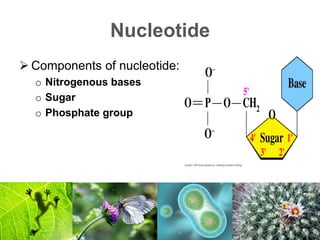
 Components of nucleotide:
o Nitrogenous bases
o Sugar
o Phosphate group
Nitrogenous Bases
Classified into:
 Purines: are bases such as Adenine and
Guanine
 Pyrimidines: are bases such as Cytosine,
Thymine and Uracil
Nitrogenous Bases
Sugar
 The general name for the sugar component of
nucleotide is ribose
 The sugar component of RNA is D-ribose and in
DNA is 2-Deoxy-D-ribose
 The combination of sugar and nitrogenous base
is known as nucleoside
Sugar
Nucleoside
Base Sugar Nucleoside
Adenine Deoxy-D-ribose Deoxyadenosine
Guanine Deoxy-D-ribose Deoxyguanosine
Thymine Deoxy-D-ribose Deoxythymidine
Cytosine Deoxy-D-ribose Deoxycytidine
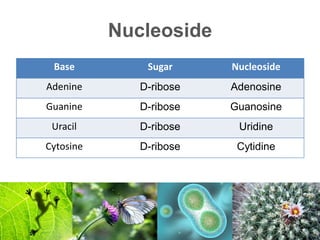
Nucleoside
Base Sugar Nucleoside
Adenine D-ribose Adenosine
Guanine D-ribose Guanosine
Uracil D-ribose Uridine
Cytosine D-ribose Cytidine
Phosphate Group
 Is the third component of
nucleotide
 When phosphate group
bond to -C𝐻2OH of a
nucleoside, the result is
nucleotide
Two Major Types of Nucleic Acids
Deoxyribonucleic Acid
 Is the genetic material
found in all living
organisms
 Composed of two strands
Ribonucleic Acid
 Mostly involved in protein
synthesis
 Composed of one strand
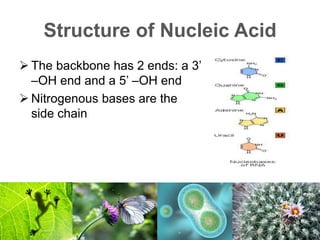
Structure of Nucleic Acid
 The primary structure is the sequence of
nucleotides itself which has two parts: the
backbone of the molecule and the bases that
are the side chain group
 The backbone of DNA consists of sugar and
phosphate group
Structure of Nucleic Acid
 The backbone has 2 ends: a 3’
–OH end and a 5’ –OH end
 Nitrogenous bases are the
side chain
Structure of Nucleic Acid
 The secondary structure of DNA
is the established 3 –
dimensional structure
 DNA is composed of 2 strands
entwined around each other in a
double helix
 Bidirectional: Leading and
Lagging Strands
Types of RNA
 Messenger RNA (mRNA)
Carry the genetic information
from DNA in the nucleus
directly to the cytoplasm
 Ribosomal RNA (rRNA)
Ensures the proper alignment
of mRNA and ribosomes
Types of RNA
 Transfer RNA (tRNA)
Carries the correct amino
acid to the site of protein
synthesis
Central Dogma
Central Dogma
 Transcription: DNA-RNA
 Translation: RNA-codon of amino acid
 In complementary base pairing, A, T, G and C
on the template DNA strand specify U, A, C and
G respectively, on the RNA strand being
synthesized
Sample problems
1. What amino acid sequence is produced from the
RNA sequence: ACGAAAGAA?
2. Using the codon chart, what is the sequence of
amino acids that is produced when CCAAGCTCT
is translated? (hint: CCAAGCTCT is a DNA
sequence)
3. How many codons are present in the sequence:
AUGCCGAAACGU?
Sample problems
4. What amino acids are produced from the codon
sequence AUGCCGAAACGU?
5. The sequence of a short DNA segment is
ATGGCAATA. What would be the sequence of the
complementary strand after transcription and
translation?
6. What is the corresponding RNA sequence of the DNA
strand: GCTTTTCAAAAA?
Sample problems
7. What is the codon sequence of the DNA
sequence; GCTTTTCAAAAA?
8. Using the codon chart, what is the sequence of
amino acids that is produced when the DNA
sequence AGCCAATGC is translated?

Lesson 12 Nucleic Acids

  • 1.
    Organic Molecule: NucleicAcids Prepared by: MR. KEVIN FRANCIS E. MAGAOAY Faculty, SHS Biology Department C h a p t e r 11
  • 2.
    Learning Objectives:  Definenucleic acids  Describe the synthesis of nucleic acids  Characterize and enumerate the components of nucleotide  Differentiate DNA and RNA  Describe central dogma  Learn the process of transcription and translation
  • 3.
    Overview:  Definition ofnucleic acid  Component of nucleotide  Classifications of nucleic acids  Structure of nucleic acids  Central dogma
  • 4.
    Nucleic Acid  Themost important macromolecule for the continuity of life  Nucleic acids carry the genetic blueprint of a cell and carry instructions for the functioning of the cell  Provide information to make proteins
  • 5.
    Nucleic Acid  Themonomer of nucleic acid is nucleotides and when combined together forms a polynucleotide which is the major component of nucleic acid
  • 6.
    Nucleotide  Components ofnucleotide: o Nitrogenous bases o Sugar o Phosphate group
  • 7.
    Nitrogenous Bases Classified into: Purines: are bases such as Adenine and Guanine  Pyrimidines: are bases such as Cytosine, Thymine and Uracil
  • 8.
  • 9.
    Sugar  The generalname for the sugar component of nucleotide is ribose  The sugar component of RNA is D-ribose and in DNA is 2-Deoxy-D-ribose  The combination of sugar and nitrogenous base is known as nucleoside
  • 10.
  • 11.
    Nucleoside Base Sugar Nucleoside AdenineDeoxy-D-ribose Deoxyadenosine Guanine Deoxy-D-ribose Deoxyguanosine Thymine Deoxy-D-ribose Deoxythymidine Cytosine Deoxy-D-ribose Deoxycytidine
  • 12.
    Nucleoside Base Sugar Nucleoside AdenineD-ribose Adenosine Guanine D-ribose Guanosine Uracil D-ribose Uridine Cytosine D-ribose Cytidine
  • 13.
    Phosphate Group  Isthe third component of nucleotide  When phosphate group bond to -C𝐻2OH of a nucleoside, the result is nucleotide
  • 14.
    Two Major Typesof Nucleic Acids
  • 15.
    Deoxyribonucleic Acid  Isthe genetic material found in all living organisms  Composed of two strands
  • 16.
    Ribonucleic Acid  Mostlyinvolved in protein synthesis  Composed of one strand
  • 17.
    Structure of NucleicAcid  The primary structure is the sequence of nucleotides itself which has two parts: the backbone of the molecule and the bases that are the side chain group  The backbone of DNA consists of sugar and phosphate group
  • 18.
    Structure of NucleicAcid  The backbone has 2 ends: a 3’ –OH end and a 5’ –OH end  Nitrogenous bases are the side chain
  • 19.
    Structure of NucleicAcid  The secondary structure of DNA is the established 3 – dimensional structure  DNA is composed of 2 strands entwined around each other in a double helix  Bidirectional: Leading and Lagging Strands
  • 20.
    Types of RNA Messenger RNA (mRNA) Carry the genetic information from DNA in the nucleus directly to the cytoplasm  Ribosomal RNA (rRNA) Ensures the proper alignment of mRNA and ribosomes
  • 21.
    Types of RNA Transfer RNA (tRNA) Carries the correct amino acid to the site of protein synthesis
  • 22.
  • 23.
    Central Dogma  Transcription:DNA-RNA  Translation: RNA-codon of amino acid  In complementary base pairing, A, T, G and C on the template DNA strand specify U, A, C and G respectively, on the RNA strand being synthesized
  • 24.
    Sample problems 1. Whatamino acid sequence is produced from the RNA sequence: ACGAAAGAA? 2. Using the codon chart, what is the sequence of amino acids that is produced when CCAAGCTCT is translated? (hint: CCAAGCTCT is a DNA sequence) 3. How many codons are present in the sequence: AUGCCGAAACGU?
  • 25.
    Sample problems 4. Whatamino acids are produced from the codon sequence AUGCCGAAACGU? 5. The sequence of a short DNA segment is ATGGCAATA. What would be the sequence of the complementary strand after transcription and translation? 6. What is the corresponding RNA sequence of the DNA strand: GCTTTTCAAAAA?
  • 26.
    Sample problems 7. Whatis the codon sequence of the DNA sequence; GCTTTTCAAAAA? 8. Using the codon chart, what is the sequence of amino acids that is produced when the DNA sequence AGCCAATGC is translated?