CHAPTER 5:
HOW SOCIETY
IS ORGANIZED
Lesson 1
We interact with others on a daily basis
 Interaction is always present
 In Abraham Maslow's hierarchy of needs,
belongingness is part of one of his major
needs that motivate human behavior.
 The need to belong refers to a human
emotional need to affiliate with and be
accepted by members of a group. This
may include the need to belong to a
peer group at school, to be accepted by
co-workers, to be part of an athletic
team, and to be part of a religious group.
 The study of social groups is the main
focus of many sociologists because these
groups illustrate how human behavior is
shaped by group life and how group life is
affected by individuals.
What are social groups and
how do they organize social
life?
Social Aggregates
➢a simple collection of people
who happened to be in a
particular place but do not
significantly interact or identify
with one another.
Social Categories
people who share common
characteristics (such as gender,
occupation, status) but do not
necessarily interact or identify with
one another
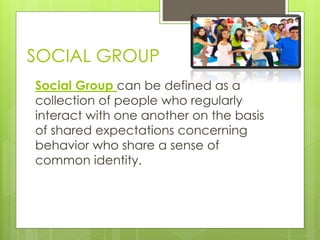
SOCIAL GROUP
Social Group can be defined as a
collection of people who regularly
interact with one another on the basis
of shared expectations concerning
behavior who share a sense of
common identity.
Social groups can be formed from
social aggregates and social
categories
SOCIAL GROUPS CATEGORIES
1. Primary Group - is typically a small social
group (small- scale society) whose
members share close, personal, enduring
relationships. These groups are marked by
members' concern for one another, in
shared activities and culture. Examples
include family, childhood friends, and
highly influential social groups.
The concept of the primary group
was introduced by Charles Horton
Cooley, a sociologist from the
Chicago School of sociology.
2. Secondary Group Are larger and
less intimate, and more specialized
groups where members engage in an
impersonal and objective- oriented
relationship for a limited time.
workmates
classmates
Clubs/ organization
peer
3. Reference group is a group to which we
compare ourselves. Reference groups,
such as college freshmen, serve as a
standard to which we measure our
behaviors and attitudes.
➢ We use reference groups in order to
guide our behavior and attitudes and
help us to identify social norms.
➢ Hence it may also be called as “ identity
association group” since their creation is
fueled by a person’s desire to provide a
character connection.
This may be classified as in groups or out
groups
In Group: social groups to which an
individual feels he/she belongs. One feel
loyalty and respect for these groups.
Example: fraternity
Out group: social groups that an
individual does not identify with. One feels
antagonism and contempt for these
groups.
Example: Sports team opponent
Groups may influence their members in a
variety of ways, from their thinking to their
actual behavior. Sometimes violent
behaviors and certain forms of biases
result. With this we can appreciate the
insight that groups are part of our social
psyches, in thoughts and in actions.
Examples of this phenomenon are the
Holocaust , the Guyana mass suicides, ISIS
terrorism ( or terrorism in general ).
When this happens, a groupthink– a
process by which the members of a
group ignore ways of thinking and
plans of action that go against the
group consensus– is said to be taking
place.
To ponder:
“The larger the group, the more toxic, the
more of your beauty as an individual you
have to surrender for the sake of group
thought. And when you suspend your
individual beauty you also give up a lot of
your humanity. You will do things in the name
of a group that you would never do on your
own. Injuring, hurting, killing, drinking are all
part of it, because you've lost your identity,
because you now owe your allegiance to this
thing that's bigger than you are and that
controls you.” – George Carlin
Written work 1
1. How does human group form? Is it
different from an aggregate of people?
2. Do you think it is possible for a primary
group to be formed out of secondary
group? How?
3. Cite an example of your own or
somebody else’s experience. How did it
happen?
4. What is the significance of reference
group in terms of personality and
education?Give concrete examples.
11. Give atleast three examples of in-
group and out group
A. Examples of in-group
1.______________________
2.______________________
3.______________________
B. Examples of out-Group
1.______________________
2.______________________
3.______________________
2. As a student who is your reference
group? Why do you consider it as a
reference group?
Try to analyze the groups that you have had in
the past and present. For your SCAFFOLD #1,
choose one group that you think you most
associate with and have had the most
memorable impact.
Describe that group and enumerate the impacts
it had on you as a social person
SCAFFOLD 1
lesson 1 SOCIAL GROUPS-.pdf

lesson 1 SOCIAL GROUPS-.pdf

  • 1.
    CHAPTER 5: HOW SOCIETY ISORGANIZED Lesson 1
  • 2.
    We interact withothers on a daily basis
  • 3.
     Interaction isalways present  In Abraham Maslow's hierarchy of needs, belongingness is part of one of his major needs that motivate human behavior.
  • 5.
     The needto belong refers to a human emotional need to affiliate with and be accepted by members of a group. This may include the need to belong to a peer group at school, to be accepted by co-workers, to be part of an athletic team, and to be part of a religious group.
  • 6.
     The studyof social groups is the main focus of many sociologists because these groups illustrate how human behavior is shaped by group life and how group life is affected by individuals.
  • 7.
    What are socialgroups and how do they organize social life?
  • 8.
    Social Aggregates ➢a simplecollection of people who happened to be in a particular place but do not significantly interact or identify with one another.
  • 9.
    Social Categories people whoshare common characteristics (such as gender, occupation, status) but do not necessarily interact or identify with one another
  • 10.
    SOCIAL GROUP Social Groupcan be defined as a collection of people who regularly interact with one another on the basis of shared expectations concerning behavior who share a sense of common identity.
  • 11.
    Social groups canbe formed from social aggregates and social categories
  • 12.
    SOCIAL GROUPS CATEGORIES 1.Primary Group - is typically a small social group (small- scale society) whose members share close, personal, enduring relationships. These groups are marked by members' concern for one another, in shared activities and culture. Examples include family, childhood friends, and highly influential social groups.
  • 13.
    The concept ofthe primary group was introduced by Charles Horton Cooley, a sociologist from the Chicago School of sociology.
  • 15.
    2. Secondary GroupAre larger and less intimate, and more specialized groups where members engage in an impersonal and objective- oriented relationship for a limited time.
  • 17.
  • 18.
    3. Reference groupis a group to which we compare ourselves. Reference groups, such as college freshmen, serve as a standard to which we measure our behaviors and attitudes. ➢ We use reference groups in order to guide our behavior and attitudes and help us to identify social norms. ➢ Hence it may also be called as “ identity association group” since their creation is fueled by a person’s desire to provide a character connection.
  • 19.
    This may beclassified as in groups or out groups In Group: social groups to which an individual feels he/she belongs. One feel loyalty and respect for these groups. Example: fraternity Out group: social groups that an individual does not identify with. One feels antagonism and contempt for these groups. Example: Sports team opponent
  • 20.
    Groups may influencetheir members in a variety of ways, from their thinking to their actual behavior. Sometimes violent behaviors and certain forms of biases result. With this we can appreciate the insight that groups are part of our social psyches, in thoughts and in actions. Examples of this phenomenon are the Holocaust , the Guyana mass suicides, ISIS terrorism ( or terrorism in general ).
  • 21.
    When this happens,a groupthink– a process by which the members of a group ignore ways of thinking and plans of action that go against the group consensus– is said to be taking place.
  • 22.
    To ponder: “The largerthe group, the more toxic, the more of your beauty as an individual you have to surrender for the sake of group thought. And when you suspend your individual beauty you also give up a lot of your humanity. You will do things in the name of a group that you would never do on your own. Injuring, hurting, killing, drinking are all part of it, because you've lost your identity, because you now owe your allegiance to this thing that's bigger than you are and that controls you.” – George Carlin
  • 23.
    Written work 1 1.How does human group form? Is it different from an aggregate of people? 2. Do you think it is possible for a primary group to be formed out of secondary group? How? 3. Cite an example of your own or somebody else’s experience. How did it happen? 4. What is the significance of reference group in terms of personality and education?Give concrete examples.
  • 24.
    11. Give atleastthree examples of in- group and out group A. Examples of in-group 1.______________________ 2.______________________ 3.______________________ B. Examples of out-Group 1.______________________ 2.______________________ 3.______________________
  • 25.
    2. As astudent who is your reference group? Why do you consider it as a reference group?
  • 26.
    Try to analyzethe groups that you have had in the past and present. For your SCAFFOLD #1, choose one group that you think you most associate with and have had the most memorable impact. Describe that group and enumerate the impacts it had on you as a social person SCAFFOLD 1