Learning Intention and Success
Criteria
 Learning Intention: Students will understand how to
model the changing opinions or proportions of a
population can be expressed using matrices.
 Success criteria: Students can convert between a
worded problem, a transition diagram and a transition
matrix, and can interpret the information given in any
of these forms.
Motivation
 Consider a small town that has two restaurants, Mia’s
Pizza and Dan’s Dumplings.
 Of the people that frequent each restaurant, there are
likely some who will never change which restaurant
they prefer, while others will switch from one
restaurant to another for variety.
 We want to be able to predict how many people will be
at each restaurant at any given time.
Example
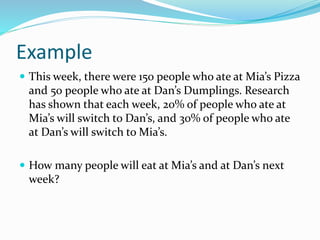
 This week, there were 150 people who ate at Mia’s Pizza
and 50 people who ate at Dan’s Dumplings. Research
has shown that each week, 20% of people who ate at
Mia’s will switch to Dan’s, and 30% of people who ate
at Dan’s will switch to Mia’s.
 How many people will eat at Mia’s and at Dan’s next
week?
 This week, there were 150 people who ate at Mia’s Pizza and 50 people
who ate at Dan’s Dumplings. Research has shown that each week, 20%
of people who ate at Mia’s will switch to Dan’s, and 30% of people who
ate at Dan’s will switch to Mia’s.
 How many people will eat at Mia’s and at Dan’s next week?
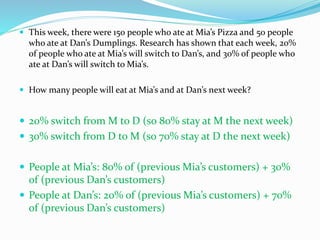
 20% switch from M to D (so 80% stay at M the next week)
 30% switch from D to M (so 70% stay at D the next week)
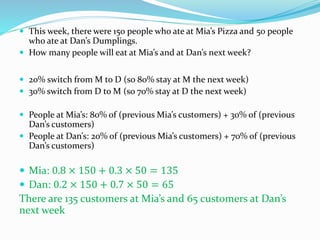
 People at Mia’s: 80% of (previous Mia’s customers) + 30%
of (previous Dan’s customers)
 People at Dan’s: 20% of (previous Mia’s customers) + 70%
of (previous Dan’s customers)
 This week, there were 150 people who ate at Mia’s Pizza and 50 people
who ate at Dan’s Dumplings.
 How many people will eat at Mia’s and at Dan’s next week?
 20% switch from M to D (so 80% stay at M the next week)
 30% switch from D to M (so 70% stay at D the next week)
 People at Mia’s: 80% of (previous Mia’s customers) + 30% of (previous
Dan’s customers)
 People at Dan’s: 20% of (previous Mia’s customers) + 70% of (previous
Dan’s customers)
 Mia: 0.8 × 150 + 0.3 × 50 = 135
 Dan: 0.2 × 150 + 0.7 × 50 = 65
There are 135 customers at Mia’s and 65 customers at Dan’s
next week
Converting to Matrices
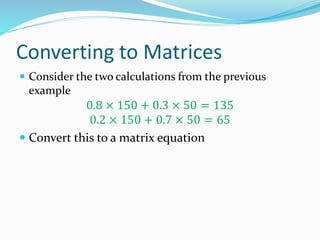
 Consider the two calculations from the previous
example
0.8 × 150 + 0.3 × 50 = 135
0.2 × 150 + 0.7 × 50 = 65
 Convert this to a matrix equation
Converting to Matrices
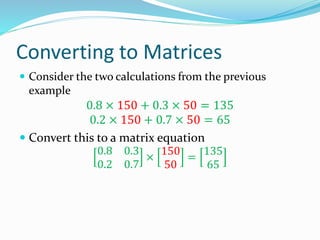
 Consider the two calculations from the previous
example
0.8 × 150 + 0.3 × 50 = 135
0.2 × 150 + 0.7 × 50 = 65
 Convert this to a matrix equation
0.8 0.3
0.2 0.7
×
150
50
=
135
65
The Matrix Equation
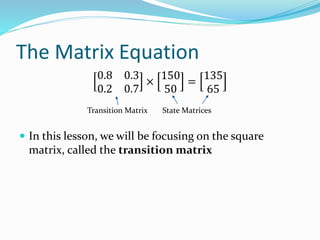
0.8 0.3
0.2 0.7
×
150
50
=
135
65
 In this lesson, we will be focusing on the square
matrix, called the transition matrix
Transition Matrix State Matrices
The Transition Matrix
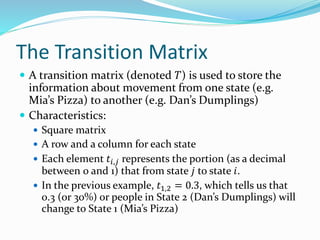
 A transition matrix (denoted 𝑇) is used to store the
information about movement from one state (e.g.
Mia’s Pizza) to another (e.g. Dan’s Dumplings)
 Characteristics:
 Square matrix
 A row and a column for each state
 Each element 𝑡𝑖,𝑗 represents the portion (as a decimal
between 0 and 1) that from state 𝑗 to state 𝑖.
 In the previous example, 𝑡1,2 = 0.3, which tells us that
0.3 (or 30%) or people in State 2 (Dan’s Dumplings) will
change to State 1 (Mia’s Pizza)
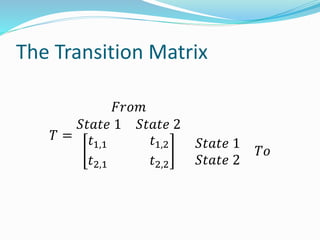
The Transition Matrix
𝑇 =
𝐹𝑟𝑜𝑚
𝑆𝑡𝑎𝑡𝑒 1 𝑆𝑡𝑎𝑡𝑒 2
𝑡1,1 𝑡1,2
𝑡2,1 𝑡2,2
𝑆𝑡𝑎𝑡𝑒 1
𝑆𝑡𝑎𝑡𝑒 2
𝑇𝑜
The Transition Matrix
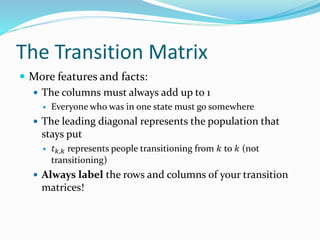
 More features and facts:
 The columns must always add up to 1
 Everyone who was in one state must go somewhere
 The leading diagonal represents the population that
stays put
 𝑡 𝑘,𝑘 represents people transitioning from 𝑘 to 𝑘 (not
transitioning)
 Always label the rows and columns of your transition
matrices!
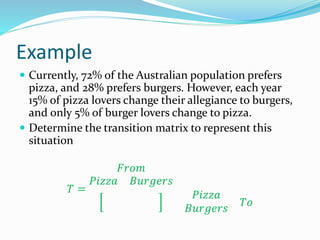
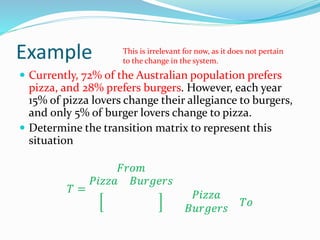
Example
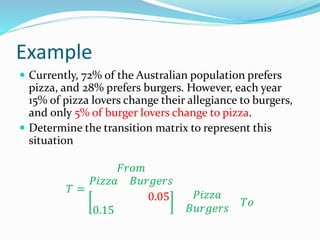
 Currently, 72% of the Australian population prefers
pizza, and 28% prefers burgers. However, each year
15% of pizza lovers change their allegiance to burgers,
and only 5% of burger lovers change to pizza.
 Determine the transition matrix to represent this
situation
𝑇 =
𝐹𝑟𝑜𝑚
𝑃𝑖𝑧𝑧𝑎 𝐵𝑢𝑟𝑔𝑒𝑟𝑠
𝑃𝑖𝑧𝑧𝑎
𝐵𝑢𝑟𝑔𝑒𝑟𝑠
𝑇𝑜
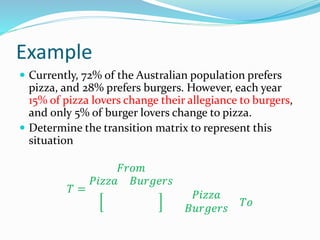
Example
 Currently, 72% of the Australian population prefers
pizza, and 28% prefers burgers. However, each year
15% of pizza lovers change their allegiance to burgers,
and only 5% of burger lovers change to pizza.
 Determine the transition matrix to represent this
situation
𝑇 =
𝐹𝑟𝑜𝑚
𝑃𝑖𝑧𝑧𝑎 𝐵𝑢𝑟𝑔𝑒𝑟𝑠
𝑃𝑖𝑧𝑧𝑎
𝐵𝑢𝑟𝑔𝑒𝑟𝑠
𝑇𝑜
This is irrelevant for now, as it does not pertain
to the change in the system.
Example
 Currently, 72% of the Australian population prefers
pizza, and 28% prefers burgers. However, each year
15% of pizza lovers change their allegiance to burgers,
and only 5% of burger lovers change to pizza.
 Determine the transition matrix to represent this
situation
𝑇 =
𝐹𝑟𝑜𝑚
𝑃𝑖𝑧𝑧𝑎 𝐵𝑢𝑟𝑔𝑒𝑟𝑠
𝑃𝑖𝑧𝑧𝑎
𝐵𝑢𝑟𝑔𝑒𝑟𝑠
𝑇𝑜
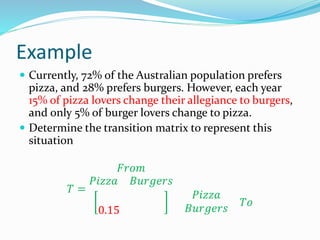
Example
 Currently, 72% of the Australian population prefers
pizza, and 28% prefers burgers. However, each year
15% of pizza lovers change their allegiance to burgers,
and only 5% of burger lovers change to pizza.
 Determine the transition matrix to represent this
situation
𝑇 =
𝐹𝑟𝑜𝑚
𝑃𝑖𝑧𝑧𝑎 𝐵𝑢𝑟𝑔𝑒𝑟𝑠
0.15
𝑃𝑖𝑧𝑧𝑎
𝐵𝑢𝑟𝑔𝑒𝑟𝑠
𝑇𝑜
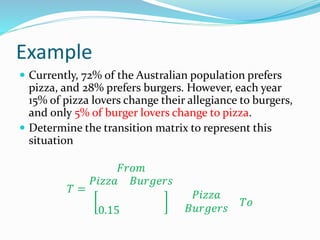
Example
 Currently, 72% of the Australian population prefers
pizza, and 28% prefers burgers. However, each year
15% of pizza lovers change their allegiance to burgers,
and only 5% of burger lovers change to pizza.
 Determine the transition matrix to represent this
situation
𝑇 =
𝐹𝑟𝑜𝑚
𝑃𝑖𝑧𝑧𝑎 𝐵𝑢𝑟𝑔𝑒𝑟𝑠
0.15
𝑃𝑖𝑧𝑧𝑎
𝐵𝑢𝑟𝑔𝑒𝑟𝑠
𝑇𝑜
Example
 Currently, 72% of the Australian population prefers
pizza, and 28% prefers burgers. However, each year
15% of pizza lovers change their allegiance to burgers,
and only 5% of burger lovers change to pizza.
 Determine the transition matrix to represent this
situation
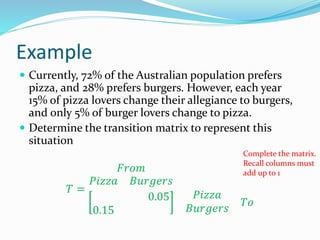
𝑇 =
𝐹𝑟𝑜𝑚
𝑃𝑖𝑧𝑧𝑎 𝐵𝑢𝑟𝑔𝑒𝑟𝑠
0.05
0.15
𝑃𝑖𝑧𝑧𝑎
𝐵𝑢𝑟𝑔𝑒𝑟𝑠
𝑇𝑜
Example
 Currently, 72% of the Australian population prefers
pizza, and 28% prefers burgers. However, each year
15% of pizza lovers change their allegiance to burgers,
and only 5% of burger lovers change to pizza.
 Determine the transition matrix to represent this
situation
𝑇 =
𝐹𝑟𝑜𝑚
𝑃𝑖𝑧𝑧𝑎 𝐵𝑢𝑟𝑔𝑒𝑟𝑠
0.05
0.15
𝑃𝑖𝑧𝑧𝑎
𝐵𝑢𝑟𝑔𝑒𝑟𝑠
𝑇𝑜
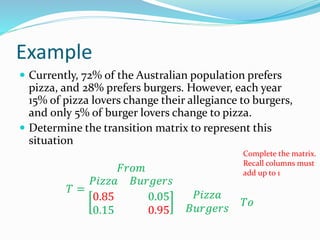
Complete the matrix.
Recall columns must
add up to 1
Example
 Currently, 72% of the Australian population prefers
pizza, and 28% prefers burgers. However, each year
15% of pizza lovers change their allegiance to burgers,
and only 5% of burger lovers change to pizza.
 Determine the transition matrix to represent this
situation
𝑇 =
𝐹𝑟𝑜𝑚
𝑃𝑖𝑧𝑧𝑎 𝐵𝑢𝑟𝑔𝑒𝑟𝑠
0.85 0.05
0.15 0.95
𝑃𝑖𝑧𝑧𝑎
𝐵𝑢𝑟𝑔𝑒𝑟𝑠
𝑇𝑜
Complete the matrix.
Recall columns must
add up to 1
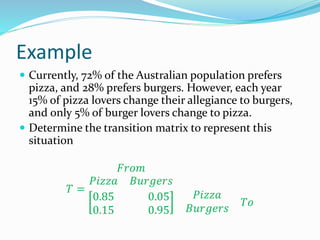
Example
 Currently, 72% of the Australian population prefers
pizza, and 28% prefers burgers. However, each year
15% of pizza lovers change their allegiance to burgers,
and only 5% of burger lovers change to pizza.
 Determine the transition matrix to represent this
situation
𝑇 =
𝐹𝑟𝑜𝑚
𝑃𝑖𝑧𝑧𝑎 𝐵𝑢𝑟𝑔𝑒𝑟𝑠
0.85 0.05
0.15 0.95
𝑃𝑖𝑧𝑧𝑎
𝐵𝑢𝑟𝑔𝑒𝑟𝑠
𝑇𝑜
Transition Diagrams
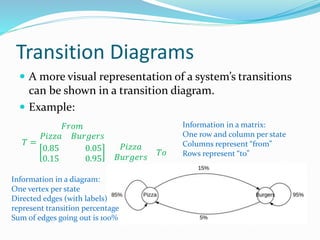
 A more visual representation of a system’s transitions
can be shown in a transition diagram.
 Example:
𝑇 =
𝐹𝑟𝑜𝑚
𝑃𝑖𝑧𝑧𝑎 𝐵𝑢𝑟𝑔𝑒𝑟𝑠
0.85 0.05
0.15 0.95
𝑃𝑖𝑧𝑧𝑎
𝐵𝑢𝑟𝑔𝑒𝑟𝑠
𝑇𝑜
Information in a matrix:
One row and column per state
Columns represent “from”
Rows represent “to”
Information in a diagram:
One vertex per state
Directed edges (with labels)
represent transition percentage
Sum of edges going out is 100%
One More Example
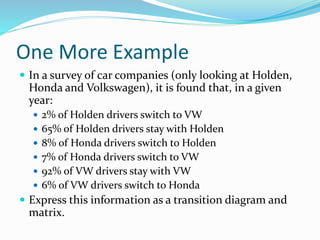
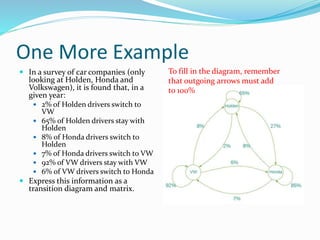
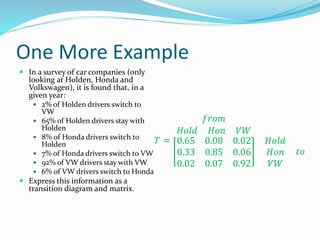
 In a survey of car companies (only looking at Holden,
Honda and Volkswagen), it is found that, in a given
year:
 2% of Holden drivers switch to VW
 65% of Holden drivers stay with Holden
 8% of Honda drivers switch to Holden
 7% of Honda drivers switch to VW
 92% of VW drivers stay with VW
 6% of VW drivers switch to Honda
 Express this information as a transition diagram and
matrix.
One More Example
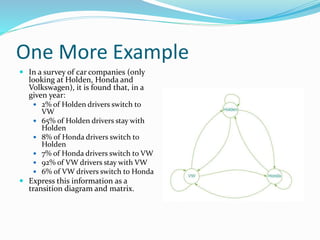
 In a survey of car companies (only
looking at Holden, Honda and
Volkswagen), it is found that, in a
given year:
 2% of Holden drivers switch to
VW
 65% of Holden drivers stay with
Holden
 8% of Honda drivers switch to
Holden
 7% of Honda drivers switch to VW
 92% of VW drivers stay with VW
 6% of VW drivers switch to Honda
 Express this information as a
transition diagram and matrix.
One More Example
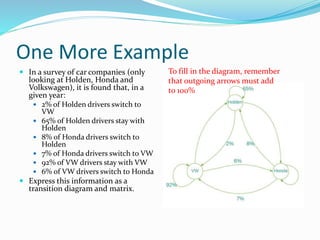
 In a survey of car companies (only
looking at Holden, Honda and
Volkswagen), it is found that, in a
given year:
 2% of Holden drivers switch to
VW
 65% of Holden drivers stay with
Holden
 8% of Honda drivers switch to
Holden
 7% of Honda drivers switch to VW
 92% of VW drivers stay with VW
 6% of VW drivers switch to Honda
 Express this information as a
transition diagram and matrix.
To fill in the diagram, remember
that outgoing arrows must add
to 100%
One More Example
 In a survey of car companies (only
looking at Holden, Honda and
Volkswagen), it is found that, in a
given year:
 2% of Holden drivers switch to
VW
 65% of Holden drivers stay with
Holden
 8% of Honda drivers switch to
Holden
 7% of Honda drivers switch to VW
 92% of VW drivers stay with VW
 6% of VW drivers switch to Honda
 Express this information as a
transition diagram and matrix.
To fill in the diagram, remember
that outgoing arrows must add
to 100%
One More Example
 In a survey of car companies (only
looking at Holden, Honda and
Volkswagen), it is found that, in a
given year:
 2% of Holden drivers switch to
VW
 65% of Holden drivers stay with
Holden
 8% of Honda drivers switch to
Holden
 7% of Honda drivers switch to VW
 92% of VW drivers stay with VW
 6% of VW drivers switch to Honda
 Express this information as a
transition diagram and matrix.
𝑇 =
𝑓𝑟𝑜𝑚
𝐻𝑜𝑙𝑑 𝐻𝑜𝑛 𝑉𝑊
0.65 0.08 0.02
0.33 0.85 0.06
0.02 0.07 0.92
𝐻𝑜𝑙𝑑
𝐻𝑜𝑛
𝑉𝑊
𝑡𝑜

Lesson 9 a introduction to transition matrices

  • 2.
    Learning Intention andSuccess Criteria  Learning Intention: Students will understand how to model the changing opinions or proportions of a population can be expressed using matrices.  Success criteria: Students can convert between a worded problem, a transition diagram and a transition matrix, and can interpret the information given in any of these forms.
  • 3.
    Motivation  Consider asmall town that has two restaurants, Mia’s Pizza and Dan’s Dumplings.  Of the people that frequent each restaurant, there are likely some who will never change which restaurant they prefer, while others will switch from one restaurant to another for variety.  We want to be able to predict how many people will be at each restaurant at any given time.
  • 4.
    Example  This week,there were 150 people who ate at Mia’s Pizza and 50 people who ate at Dan’s Dumplings. Research has shown that each week, 20% of people who ate at Mia’s will switch to Dan’s, and 30% of people who ate at Dan’s will switch to Mia’s.  How many people will eat at Mia’s and at Dan’s next week?
  • 5.
     This week,there were 150 people who ate at Mia’s Pizza and 50 people who ate at Dan’s Dumplings. Research has shown that each week, 20% of people who ate at Mia’s will switch to Dan’s, and 30% of people who ate at Dan’s will switch to Mia’s.  How many people will eat at Mia’s and at Dan’s next week?  20% switch from M to D (so 80% stay at M the next week)  30% switch from D to M (so 70% stay at D the next week)  People at Mia’s: 80% of (previous Mia’s customers) + 30% of (previous Dan’s customers)  People at Dan’s: 20% of (previous Mia’s customers) + 70% of (previous Dan’s customers)
  • 6.
     This week,there were 150 people who ate at Mia’s Pizza and 50 people who ate at Dan’s Dumplings.  How many people will eat at Mia’s and at Dan’s next week?  20% switch from M to D (so 80% stay at M the next week)  30% switch from D to M (so 70% stay at D the next week)  People at Mia’s: 80% of (previous Mia’s customers) + 30% of (previous Dan’s customers)  People at Dan’s: 20% of (previous Mia’s customers) + 70% of (previous Dan’s customers)  Mia: 0.8 × 150 + 0.3 × 50 = 135  Dan: 0.2 × 150 + 0.7 × 50 = 65 There are 135 customers at Mia’s and 65 customers at Dan’s next week
  • 7.
    Converting to Matrices Consider the two calculations from the previous example 0.8 × 150 + 0.3 × 50 = 135 0.2 × 150 + 0.7 × 50 = 65  Convert this to a matrix equation
  • 8.
    Converting to Matrices Consider the two calculations from the previous example 0.8 × 150 + 0.3 × 50 = 135 0.2 × 150 + 0.7 × 50 = 65  Convert this to a matrix equation 0.8 0.3 0.2 0.7 × 150 50 = 135 65
  • 9.
    The Matrix Equation 0.80.3 0.2 0.7 × 150 50 = 135 65  In this lesson, we will be focusing on the square matrix, called the transition matrix Transition Matrix State Matrices
  • 10.
    The Transition Matrix A transition matrix (denoted 𝑇) is used to store the information about movement from one state (e.g. Mia’s Pizza) to another (e.g. Dan’s Dumplings)  Characteristics:  Square matrix  A row and a column for each state  Each element 𝑡𝑖,𝑗 represents the portion (as a decimal between 0 and 1) that from state 𝑗 to state 𝑖.  In the previous example, 𝑡1,2 = 0.3, which tells us that 0.3 (or 30%) or people in State 2 (Dan’s Dumplings) will change to State 1 (Mia’s Pizza)
  • 11.
    The Transition Matrix 𝑇= 𝐹𝑟𝑜𝑚 𝑆𝑡𝑎𝑡𝑒 1 𝑆𝑡𝑎𝑡𝑒 2 𝑡1,1 𝑡1,2 𝑡2,1 𝑡2,2 𝑆𝑡𝑎𝑡𝑒 1 𝑆𝑡𝑎𝑡𝑒 2 𝑇𝑜
  • 12.
    The Transition Matrix More features and facts:  The columns must always add up to 1  Everyone who was in one state must go somewhere  The leading diagonal represents the population that stays put  𝑡 𝑘,𝑘 represents people transitioning from 𝑘 to 𝑘 (not transitioning)  Always label the rows and columns of your transition matrices!
  • 13.
    Example  Currently, 72%of the Australian population prefers pizza, and 28% prefers burgers. However, each year 15% of pizza lovers change their allegiance to burgers, and only 5% of burger lovers change to pizza.  Determine the transition matrix to represent this situation 𝑇 = 𝐹𝑟𝑜𝑚 𝑃𝑖𝑧𝑧𝑎 𝐵𝑢𝑟𝑔𝑒𝑟𝑠 𝑃𝑖𝑧𝑧𝑎 𝐵𝑢𝑟𝑔𝑒𝑟𝑠 𝑇𝑜
  • 14.
    Example  Currently, 72%of the Australian population prefers pizza, and 28% prefers burgers. However, each year 15% of pizza lovers change their allegiance to burgers, and only 5% of burger lovers change to pizza.  Determine the transition matrix to represent this situation 𝑇 = 𝐹𝑟𝑜𝑚 𝑃𝑖𝑧𝑧𝑎 𝐵𝑢𝑟𝑔𝑒𝑟𝑠 𝑃𝑖𝑧𝑧𝑎 𝐵𝑢𝑟𝑔𝑒𝑟𝑠 𝑇𝑜 This is irrelevant for now, as it does not pertain to the change in the system.
  • 15.
    Example  Currently, 72%of the Australian population prefers pizza, and 28% prefers burgers. However, each year 15% of pizza lovers change their allegiance to burgers, and only 5% of burger lovers change to pizza.  Determine the transition matrix to represent this situation 𝑇 = 𝐹𝑟𝑜𝑚 𝑃𝑖𝑧𝑧𝑎 𝐵𝑢𝑟𝑔𝑒𝑟𝑠 𝑃𝑖𝑧𝑧𝑎 𝐵𝑢𝑟𝑔𝑒𝑟𝑠 𝑇𝑜
  • 16.
    Example  Currently, 72%of the Australian population prefers pizza, and 28% prefers burgers. However, each year 15% of pizza lovers change their allegiance to burgers, and only 5% of burger lovers change to pizza.  Determine the transition matrix to represent this situation 𝑇 = 𝐹𝑟𝑜𝑚 𝑃𝑖𝑧𝑧𝑎 𝐵𝑢𝑟𝑔𝑒𝑟𝑠 0.15 𝑃𝑖𝑧𝑧𝑎 𝐵𝑢𝑟𝑔𝑒𝑟𝑠 𝑇𝑜
  • 17.
    Example  Currently, 72%of the Australian population prefers pizza, and 28% prefers burgers. However, each year 15% of pizza lovers change their allegiance to burgers, and only 5% of burger lovers change to pizza.  Determine the transition matrix to represent this situation 𝑇 = 𝐹𝑟𝑜𝑚 𝑃𝑖𝑧𝑧𝑎 𝐵𝑢𝑟𝑔𝑒𝑟𝑠 0.15 𝑃𝑖𝑧𝑧𝑎 𝐵𝑢𝑟𝑔𝑒𝑟𝑠 𝑇𝑜
  • 18.
    Example  Currently, 72%of the Australian population prefers pizza, and 28% prefers burgers. However, each year 15% of pizza lovers change their allegiance to burgers, and only 5% of burger lovers change to pizza.  Determine the transition matrix to represent this situation 𝑇 = 𝐹𝑟𝑜𝑚 𝑃𝑖𝑧𝑧𝑎 𝐵𝑢𝑟𝑔𝑒𝑟𝑠 0.05 0.15 𝑃𝑖𝑧𝑧𝑎 𝐵𝑢𝑟𝑔𝑒𝑟𝑠 𝑇𝑜
  • 19.
    Example  Currently, 72%of the Australian population prefers pizza, and 28% prefers burgers. However, each year 15% of pizza lovers change their allegiance to burgers, and only 5% of burger lovers change to pizza.  Determine the transition matrix to represent this situation 𝑇 = 𝐹𝑟𝑜𝑚 𝑃𝑖𝑧𝑧𝑎 𝐵𝑢𝑟𝑔𝑒𝑟𝑠 0.05 0.15 𝑃𝑖𝑧𝑧𝑎 𝐵𝑢𝑟𝑔𝑒𝑟𝑠 𝑇𝑜 Complete the matrix. Recall columns must add up to 1
  • 20.
    Example  Currently, 72%of the Australian population prefers pizza, and 28% prefers burgers. However, each year 15% of pizza lovers change their allegiance to burgers, and only 5% of burger lovers change to pizza.  Determine the transition matrix to represent this situation 𝑇 = 𝐹𝑟𝑜𝑚 𝑃𝑖𝑧𝑧𝑎 𝐵𝑢𝑟𝑔𝑒𝑟𝑠 0.85 0.05 0.15 0.95 𝑃𝑖𝑧𝑧𝑎 𝐵𝑢𝑟𝑔𝑒𝑟𝑠 𝑇𝑜 Complete the matrix. Recall columns must add up to 1
  • 21.
    Example  Currently, 72%of the Australian population prefers pizza, and 28% prefers burgers. However, each year 15% of pizza lovers change their allegiance to burgers, and only 5% of burger lovers change to pizza.  Determine the transition matrix to represent this situation 𝑇 = 𝐹𝑟𝑜𝑚 𝑃𝑖𝑧𝑧𝑎 𝐵𝑢𝑟𝑔𝑒𝑟𝑠 0.85 0.05 0.15 0.95 𝑃𝑖𝑧𝑧𝑎 𝐵𝑢𝑟𝑔𝑒𝑟𝑠 𝑇𝑜
  • 22.
    Transition Diagrams  Amore visual representation of a system’s transitions can be shown in a transition diagram.  Example: 𝑇 = 𝐹𝑟𝑜𝑚 𝑃𝑖𝑧𝑧𝑎 𝐵𝑢𝑟𝑔𝑒𝑟𝑠 0.85 0.05 0.15 0.95 𝑃𝑖𝑧𝑧𝑎 𝐵𝑢𝑟𝑔𝑒𝑟𝑠 𝑇𝑜 Information in a matrix: One row and column per state Columns represent “from” Rows represent “to” Information in a diagram: One vertex per state Directed edges (with labels) represent transition percentage Sum of edges going out is 100%
  • 23.
    One More Example In a survey of car companies (only looking at Holden, Honda and Volkswagen), it is found that, in a given year:  2% of Holden drivers switch to VW  65% of Holden drivers stay with Holden  8% of Honda drivers switch to Holden  7% of Honda drivers switch to VW  92% of VW drivers stay with VW  6% of VW drivers switch to Honda  Express this information as a transition diagram and matrix.
  • 24.
    One More Example In a survey of car companies (only looking at Holden, Honda and Volkswagen), it is found that, in a given year:  2% of Holden drivers switch to VW  65% of Holden drivers stay with Holden  8% of Honda drivers switch to Holden  7% of Honda drivers switch to VW  92% of VW drivers stay with VW  6% of VW drivers switch to Honda  Express this information as a transition diagram and matrix.
  • 25.
    One More Example In a survey of car companies (only looking at Holden, Honda and Volkswagen), it is found that, in a given year:  2% of Holden drivers switch to VW  65% of Holden drivers stay with Holden  8% of Honda drivers switch to Holden  7% of Honda drivers switch to VW  92% of VW drivers stay with VW  6% of VW drivers switch to Honda  Express this information as a transition diagram and matrix. To fill in the diagram, remember that outgoing arrows must add to 100%
  • 26.
    One More Example In a survey of car companies (only looking at Holden, Honda and Volkswagen), it is found that, in a given year:  2% of Holden drivers switch to VW  65% of Holden drivers stay with Holden  8% of Honda drivers switch to Holden  7% of Honda drivers switch to VW  92% of VW drivers stay with VW  6% of VW drivers switch to Honda  Express this information as a transition diagram and matrix. To fill in the diagram, remember that outgoing arrows must add to 100%
  • 27.
    One More Example In a survey of car companies (only looking at Holden, Honda and Volkswagen), it is found that, in a given year:  2% of Holden drivers switch to VW  65% of Holden drivers stay with Holden  8% of Honda drivers switch to Holden  7% of Honda drivers switch to VW  92% of VW drivers stay with VW  6% of VW drivers switch to Honda  Express this information as a transition diagram and matrix. 𝑇 = 𝑓𝑟𝑜𝑚 𝐻𝑜𝑙𝑑 𝐻𝑜𝑛 𝑉𝑊 0.65 0.08 0.02 0.33 0.85 0.06 0.02 0.07 0.92 𝐻𝑜𝑙𝑑 𝐻𝑜𝑛 𝑉𝑊 𝑡𝑜