English for Academic and
Professional Purposes
Arlon Baga
Academic Writing
What is academic writing?
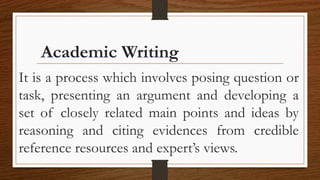
Academic Writing
It is a process which involves posing question or
task, presenting an argument and developing a
set of closely related main points and ideas by
reasoning and citing evidences from credible
reference resources and expert’s views.
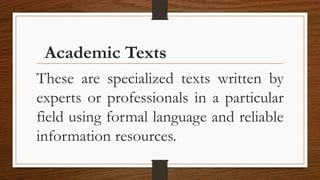
Academic Texts
These are specialized texts written by
experts or professionals in a particular
field using formal language and reliable
information resources.
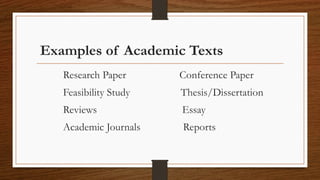
Examples of Academic Texts
Research Paper Conference Paper
Feasibility Study Thesis/Dissertation
Reviews Essay
Academic Journals Reports
Academic Language
It refers to the oral, written, auditory, and visual
language proficiency required to learn effectively in
schools and academic programs. It is also the
language used in classroom lessons, books, tests, and
assignments. It is the language that students are
expected to learn and achieve fluency in.
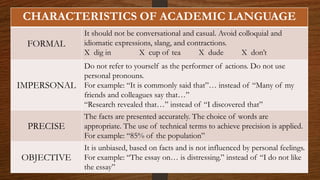
CHARACTERISTICS OF ACADEMIC LANGUAGE
FORMAL
It should not be conversational and casual. Avoid colloquial and
idiomatic expressions, slang, and contractions.
X dig in X cup of tea X dude X don’t
IMPERSONAL
Do not refer to yourself as the performer of actions. Do not use
personal pronouns.
For example: “It is commonly said that”… instead of “Many of my
friends and colleagues say that…”
“Research revealed that…” instead of “I discovered that”
PRECISE
The facts are presented accurately. The choice of words are
appropriate. The use of technical terms to achieve precision is applied.
For example: “85% of the population”
OBJECTIVE
It is unbiased, based on facts and is not influenced by personal feelings.
For example: “The essay on… is distressing.” instead of “I do not like
the essay”
Nature of an
Academic Text
Structure
Unlike fiction or journalistic writing, the overall
structure of an academic text is formal and logical
(Introduction, Body, Conclusion). It must be
cohesive and possess a logically organized flow of
ideas; this means that various parts are connected to
form a unified whole.
Language
It is important to use unambiguous language. Clear
topic sentences enable a reader to follow your line of
thinking without difficulty. Formal language and the
third person point-of view should be used. Technical
language appropriate to the area of study may also be
used, however it does not mean using “big words” just
for the sake of doing so.
Citation
Citing sources in the body of the paper and
providing a list of references as either footnotes or
endnotes is a very important aspect of an academic
text. It is essential to always acknowledge the source
of any ideas, research findings, data, or quoted text
that have been used in a paper as a defense against
allegations of plagiarism.
Evidence-based Arguments
What is valued in an academic text is that
opinions are based on a sound understanding
of the pertinent body of knowledge and
academic debates that exist within, and often
external to a specific discipline.
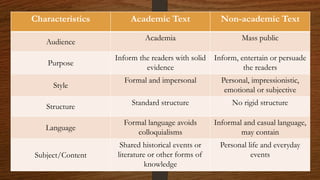
Characteristics Academic Text Non-academic Text
Audience Academia Mass public
Purpose
Inform the readers with solid
evidence
Inform, entertain or persuade
the readers
Style
Formal and impersonal Personal, impressionistic,
emotional or subjective
Structure Standard structure No rigid structure
Language
Formal language avoids
colloquialisms
Informal and casual language,
may contain
Subject/Content
Shared historical events or
literature or other forms of
knowledge
Personal life and everyday
events
Characteristics of Academic Text
• Academic texts use formal language and reliable information
resources.
• Academic texts are intended for educated audience.
• The contents of an academic text must have the clarity of the text’s
purpose and thesis statement.
• The structure of section, sentences, and paragraphs of an academic
article should be clear.
Characteristics of Academic Text
• The language and style of academic texts must be formal.
• The tone of academic texts is expressed by the use of appropriate syntax,
point of view, diction, and the level of formality in writing.
• Academic writing often uses third person of view, which provides
objectively.
• Academic writing must follow proper mechanics in writing which focuses
on the rules of the written language including, capitalization, punctuation,
and spelling.
Plagiarism
What is plagiarism?
Plagiarism
It is the act of using another
person’s words or ideas without
giving credit to that person.
Ways to avoid plagiarism
•Cite your references
•Use quotations
•Paraphrase

Academic-Text.pdf POWER POINT PRESENTATIONS

  • 1.
    English for Academicand Professional Purposes Arlon Baga
  • 2.
    Academic Writing What isacademic writing?
  • 3.
    Academic Writing It isa process which involves posing question or task, presenting an argument and developing a set of closely related main points and ideas by reasoning and citing evidences from credible reference resources and expert’s views.
  • 4.
    Academic Texts These arespecialized texts written by experts or professionals in a particular field using formal language and reliable information resources.
  • 5.
    Examples of AcademicTexts Research Paper Conference Paper Feasibility Study Thesis/Dissertation Reviews Essay Academic Journals Reports
  • 6.
    Academic Language It refersto the oral, written, auditory, and visual language proficiency required to learn effectively in schools and academic programs. It is also the language used in classroom lessons, books, tests, and assignments. It is the language that students are expected to learn and achieve fluency in.
  • 7.
    CHARACTERISTICS OF ACADEMICLANGUAGE FORMAL It should not be conversational and casual. Avoid colloquial and idiomatic expressions, slang, and contractions. X dig in X cup of tea X dude X don’t IMPERSONAL Do not refer to yourself as the performer of actions. Do not use personal pronouns. For example: “It is commonly said that”… instead of “Many of my friends and colleagues say that…” “Research revealed that…” instead of “I discovered that” PRECISE The facts are presented accurately. The choice of words are appropriate. The use of technical terms to achieve precision is applied. For example: “85% of the population” OBJECTIVE It is unbiased, based on facts and is not influenced by personal feelings. For example: “The essay on… is distressing.” instead of “I do not like the essay”
  • 8.
  • 9.
    Structure Unlike fiction orjournalistic writing, the overall structure of an academic text is formal and logical (Introduction, Body, Conclusion). It must be cohesive and possess a logically organized flow of ideas; this means that various parts are connected to form a unified whole.
  • 10.
    Language It is importantto use unambiguous language. Clear topic sentences enable a reader to follow your line of thinking without difficulty. Formal language and the third person point-of view should be used. Technical language appropriate to the area of study may also be used, however it does not mean using “big words” just for the sake of doing so.
  • 11.
    Citation Citing sources inthe body of the paper and providing a list of references as either footnotes or endnotes is a very important aspect of an academic text. It is essential to always acknowledge the source of any ideas, research findings, data, or quoted text that have been used in a paper as a defense against allegations of plagiarism.
  • 12.
    Evidence-based Arguments What isvalued in an academic text is that opinions are based on a sound understanding of the pertinent body of knowledge and academic debates that exist within, and often external to a specific discipline.
  • 13.
    Characteristics Academic TextNon-academic Text Audience Academia Mass public Purpose Inform the readers with solid evidence Inform, entertain or persuade the readers Style Formal and impersonal Personal, impressionistic, emotional or subjective Structure Standard structure No rigid structure Language Formal language avoids colloquialisms Informal and casual language, may contain Subject/Content Shared historical events or literature or other forms of knowledge Personal life and everyday events
  • 14.
    Characteristics of AcademicText • Academic texts use formal language and reliable information resources. • Academic texts are intended for educated audience. • The contents of an academic text must have the clarity of the text’s purpose and thesis statement. • The structure of section, sentences, and paragraphs of an academic article should be clear.
  • 15.
    Characteristics of AcademicText • The language and style of academic texts must be formal. • The tone of academic texts is expressed by the use of appropriate syntax, point of view, diction, and the level of formality in writing. • Academic writing often uses third person of view, which provides objectively. • Academic writing must follow proper mechanics in writing which focuses on the rules of the written language including, capitalization, punctuation, and spelling.
  • 16.
  • 17.
    Plagiarism It is theact of using another person’s words or ideas without giving credit to that person.
  • 18.
    Ways to avoidplagiarism •Cite your references •Use quotations •Paraphrase