Including Constraints
ObjectivesAfter completing this lesson, you should be able to do the following:Describe constraintsCreate and maintain constraints
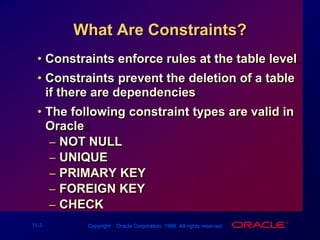
What Are Constraints?Constraints enforce rules at the table level.Constraints prevent the deletion of a table if there are dependencies.The following constraint types are valid in Oracle:NOT NULLUNIQUE PRIMARY KEYFOREIGN KEYCHECK
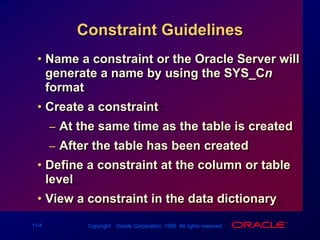
Constraint GuidelinesName a constraint or the Oracle Server will generate a name by using the SYS_Cn format.Create a constraint:At the same time as the table is createdAfter the table has been createdDefine a constraint at the column or table level.View a constraint in the data dictionary.
Defining ConstraintsCREATE TABLE [schema.]table	    (columndatatype [DEFAULT expr]		[column_constraint],		...		[table_constraint][,...]);CREATE TABLE emp(     empno  NUMBER(4),     ename  VARCHAR2(10),  	     ...     deptno  NUMBER(7,2) NOT NULL,     CONSTRAINT emp_empno_pk PRIMARY KEY (EMPNO));
Defining ConstraintsColumn constraint levelTable constraint levelcolumn [CONSTRAINT constraint_name] constraint_type,column,...[CONSTRAINT constraint_name] constraint_type  (column, ...),
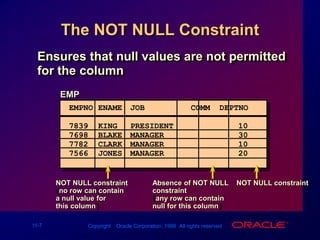
The NOT NULL ConstraintNOT NULL constraint(no row can containa null value forthis column)Absence of NOT NULL constraint(any row can containnull for this column)NOT NULL constraintEnsures that null values are not permitted for the columnEMP EMPNO ENAME JOB		 ...  COMM  DEPTNO     7839KINGPRESIDENT107698BLAKEMANAGER307782CLARKMANAGER107566JONESMANAGER20  ...
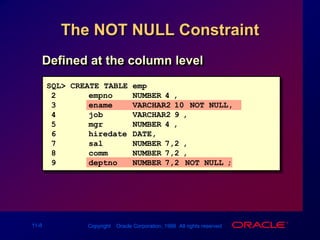
The NOT NULL ConstraintDefined at the column levelSQL> CREATE TABLE emp(2empno NUMBER(4),3enameVARCHAR2(10) NOT NULL,4jobVARCHAR2(9),5mgrNUMBER(4),6hiredateDATE,7salNUMBER(7,2),8commNUMBER(7,2),9deptnoNUMBER(7,2) NOT NULL);
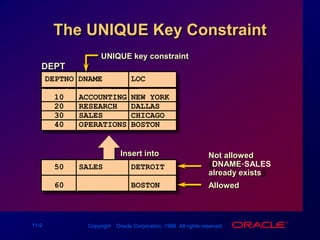
The UNIQUE Key ConstraintInsert intoNot allowed (DNAME-SALES already exists)50SALESDETROIT60BOSTONAllowedUNIQUE key constraintDEPT DEPTNO DNAME     LOC     ------ ----------	--------10ACCOUNTINGNEW YORK20RESEARCHDALLAS30SALESCHICAGO40OPERATIONSBOSTON
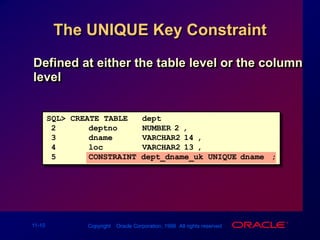
The UNIQUE Key ConstraintDefined at either the table level or the column level SQL> CREATE TABLE   dept(2deptno   NUMBER(2),3dname  VARCHAR2(14),4loc  VARCHAR2(13),5CONSTRAINT dept_dname_uk UNIQUE(dname));
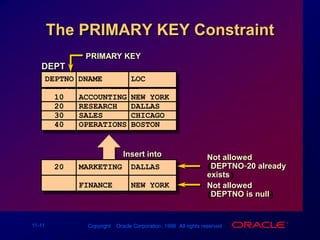
The PRIMARY KEY ConstraintInsert intoNot allowed (DEPTNO-20 already exists)20MARKETINGDALLASFINANCENEW YORKNot allowed(DEPTNO is null)PRIMARY KEYDEPT DEPTNO DNAME     LOC     ------ ----------	--------10ACCOUNTINGNEW YORK20RESEARCHDALLAS30SALESCHICAGO40OPERATIONSBOSTON
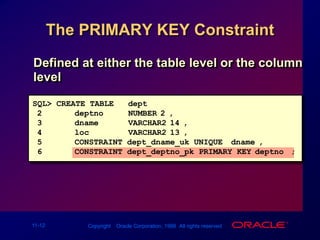
The PRIMARY KEY ConstraintDefined at either the table level or the column levelSQL> CREATE TABLE   dept(2deptno   NUMBER(2),3dname  VARCHAR2(14),4loc  VARCHAR2(13),5CONSTRAINT dept_dname_uk UNIQUE (dname),6CONSTRAINT dept_deptno_pk PRIMARY KEY(deptno));
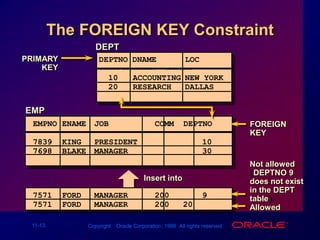
The FOREIGN KEY ConstraintNot allowed(DEPTNO9 does not exist in the DEPT table)7571FORDMANAGER	 ...  20097571FORDMANAGER	 ...  20020Insert intoAllowedDEPT PRIMARYKEYDEPTNO DNAME     LOC     ------ ----------	--------10ACCOUNTINGNEW YORK20RESEARCHDALLAS  ...EMP EMPNO ENAME JOB		 ...  COMM  DEPTNO     7839KINGPRESIDENT107698BLAKEMANAGER30  ...FOREIGNKEY
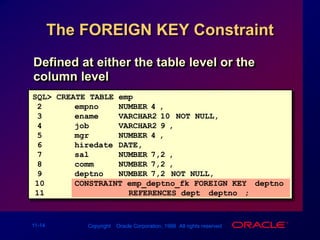
The FOREIGN KEY ConstraintDefined at either the table level or the column levelSQL> CREATE TABLE emp(2empno NUMBER(4),3enameVARCHAR2(10) NOT NULL,4jobVARCHAR2(9),5mgrNUMBER(4),6hiredateDATE,7salNUMBER(7,2),8commNUMBER(7,2),9deptnoNUMBER(7,2) NOT NULL,10CONSTRAINT emp_deptno_fk FOREIGN KEY (deptno)11REFERENCES dept (deptno));
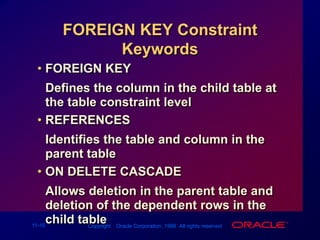
FOREIGN KEY Constraint KeywordsFOREIGN KEYDefines the column in the child table atthe table constraint levelREFERENCESIdentifies the table and column in the parent tableON DELETE CASCADEAllows deletion in the parent table and deletion of the dependent rows in the child table
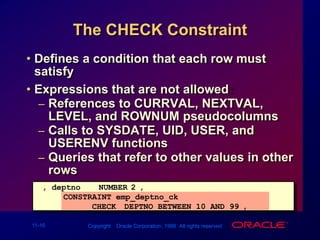
The CHECK ConstraintDefines a condition that each row must satisfyExpressions that are not allowed:References to CURRVAL, NEXTVAL, LEVEL, and ROWNUM pseudocolumns Calls to SYSDATE, UID, USER, and USERENV functionsQueries that refer to other values in other rows..., deptnoNUMBER(2),      CONSTRAINT emp_deptno_ck              CHECK (DEPTNO BETWEEN 10 AND 99),...
Adding a Constraint  ALTER TABLEtable  ADD [CONSTRAINT constraint] type (column);Add or drop, but not modify, a constraintEnable or disable constraintsAdd a NOT NULL constraint by using the MODIFY clause
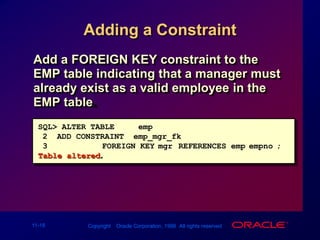
Adding a ConstraintAdd a FOREIGN KEY constraint to the EMP table indicating that a manager must already exist as a valid employee in the EMP table.SQL> ALTER TABLE     emp2  ADD CONSTRAINT  emp_mgr_fk 3FOREIGN KEY(mgr) REFERENCES emp(empno);Table altered.
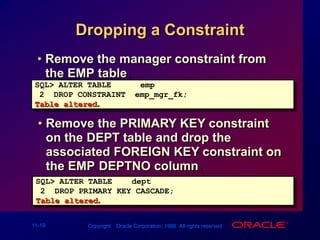
Dropping a ConstraintRemove the manager constraint from the EMP table.SQL> ALTER TABLE  emp2  DROP CONSTRAINT  emp_mgr_fk;Table altered.Remove the PRIMARY KEY constraint on the DEPT table and drop the associated FOREIGN KEY constraint on the EMP.DEPTNO column.SQL> ALTER TABLEdept2  DROP PRIMARY KEY CASCADE;Table altered.
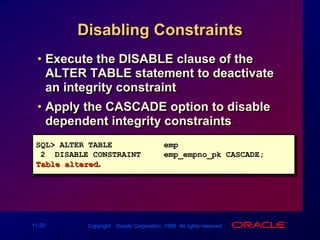
Disabling ConstraintsExecute the DISABLE clause of the ALTER TABLE statement to deactivate an integrity constraint.Apply the CASCADE option to disable dependent integrity constraints.SQL> ALTER TABLEemp2  DISABLE CONSTRAINTemp_empno_pk CASCADE;Table altered.
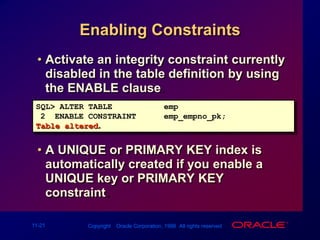
Enabling ConstraintsActivate an integrity constraint currently disabled in the table definition by using the ENABLE clause. A UNIQUE or PRIMARY KEY index is automatically created if you enable a UNIQUE key or PRIMARY KEY constraint.SQL> ALTER TABLEemp2  ENABLE CONSTRAINTemp_empno_pk;Table altered.
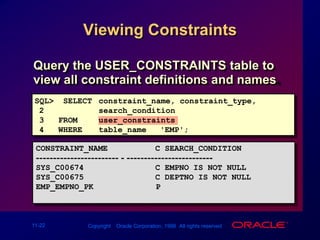
Viewing ConstraintsQuery the USER_CONSTRAINTS table to view all constraint definitions and names.SQL>  SELECTconstraint_name, constraint_type,2search_condition3   FROMuser_constraints4   WHEREtable_name = 'EMP';CONSTRAINT_NAME          C SEARCH_CONDITION------------------------ - ------------------------- SYS_C00674               C EMPNO IS NOT NULL  SYS_C00675               C DEPTNO IS NOT NULLEMP_EMPNO_PK     P...
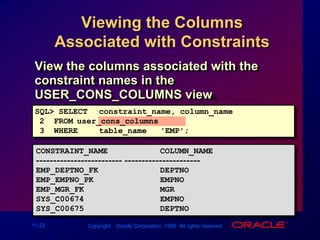
Viewing the Columns Associated with ConstraintsView the columns associated with the constraint names in the USER_CONS_COLUMNS view.SQL> SELECTconstraint_name, column_name2  FROMuser_cons_columns3  WHEREtable_name = 'EMP';CONSTRAINT_NAME           COLUMN_NAME------------------------- ----------------------EMP_DEPTNO_FK             DEPTNOEMP_EMPNO_PK              EMPNOEMP_MGR_FK                MGRSYS_C00674                EMPNOSYS_C00675                DEPTNO
SummaryCreate the following types of constraints:NOT NULLUNIQUEPRIMARY KEYFOREIGN KEYCHECKQuery the USER_CONSTRAINTS table to view all constraint definitions and names.
Practice OverviewAdding constraints to existing tablesAdding more columns to a tableDisplaying information in data dictionary views

Les11 Including Constraints

  • 1.
  • 2.
    ObjectivesAfter completing thislesson, you should be able to do the following:Describe constraintsCreate and maintain constraints
  • 3.
    What Are Constraints?Constraintsenforce rules at the table level.Constraints prevent the deletion of a table if there are dependencies.The following constraint types are valid in Oracle:NOT NULLUNIQUE PRIMARY KEYFOREIGN KEYCHECK
  • 4.
    Constraint GuidelinesName aconstraint or the Oracle Server will generate a name by using the SYS_Cn format.Create a constraint:At the same time as the table is createdAfter the table has been createdDefine a constraint at the column or table level.View a constraint in the data dictionary.
  • 5.
    Defining ConstraintsCREATE TABLE[schema.]table (columndatatype [DEFAULT expr] [column_constraint], ... [table_constraint][,...]);CREATE TABLE emp( empno NUMBER(4), ename VARCHAR2(10), ... deptno NUMBER(7,2) NOT NULL, CONSTRAINT emp_empno_pk PRIMARY KEY (EMPNO));
  • 6.
    Defining ConstraintsColumn constraintlevelTable constraint levelcolumn [CONSTRAINT constraint_name] constraint_type,column,...[CONSTRAINT constraint_name] constraint_type (column, ...),
  • 7.
    The NOT NULLConstraintNOT NULL constraint(no row can containa null value forthis column)Absence of NOT NULL constraint(any row can containnull for this column)NOT NULL constraintEnsures that null values are not permitted for the columnEMP EMPNO ENAME JOB ... COMM DEPTNO 7839KINGPRESIDENT107698BLAKEMANAGER307782CLARKMANAGER107566JONESMANAGER20 ...
  • 8.
    The NOT NULLConstraintDefined at the column levelSQL> CREATE TABLE emp(2empno NUMBER(4),3enameVARCHAR2(10) NOT NULL,4jobVARCHAR2(9),5mgrNUMBER(4),6hiredateDATE,7salNUMBER(7,2),8commNUMBER(7,2),9deptnoNUMBER(7,2) NOT NULL);
  • 9.
    The UNIQUE KeyConstraintInsert intoNot allowed (DNAME-SALES already exists)50SALESDETROIT60BOSTONAllowedUNIQUE key constraintDEPT DEPTNO DNAME LOC ------ ---------- --------10ACCOUNTINGNEW YORK20RESEARCHDALLAS30SALESCHICAGO40OPERATIONSBOSTON
  • 10.
    The UNIQUE KeyConstraintDefined at either the table level or the column level SQL> CREATE TABLE dept(2deptno NUMBER(2),3dname VARCHAR2(14),4loc VARCHAR2(13),5CONSTRAINT dept_dname_uk UNIQUE(dname));
  • 11.
    The PRIMARY KEYConstraintInsert intoNot allowed (DEPTNO-20 already exists)20MARKETINGDALLASFINANCENEW YORKNot allowed(DEPTNO is null)PRIMARY KEYDEPT DEPTNO DNAME LOC ------ ---------- --------10ACCOUNTINGNEW YORK20RESEARCHDALLAS30SALESCHICAGO40OPERATIONSBOSTON
  • 12.
    The PRIMARY KEYConstraintDefined at either the table level or the column levelSQL> CREATE TABLE dept(2deptno NUMBER(2),3dname VARCHAR2(14),4loc VARCHAR2(13),5CONSTRAINT dept_dname_uk UNIQUE (dname),6CONSTRAINT dept_deptno_pk PRIMARY KEY(deptno));
  • 13.
    The FOREIGN KEYConstraintNot allowed(DEPTNO9 does not exist in the DEPT table)7571FORDMANAGER ... 20097571FORDMANAGER ... 20020Insert intoAllowedDEPT PRIMARYKEYDEPTNO DNAME LOC ------ ---------- --------10ACCOUNTINGNEW YORK20RESEARCHDALLAS ...EMP EMPNO ENAME JOB ... COMM DEPTNO 7839KINGPRESIDENT107698BLAKEMANAGER30 ...FOREIGNKEY
  • 14.
    The FOREIGN KEYConstraintDefined at either the table level or the column levelSQL> CREATE TABLE emp(2empno NUMBER(4),3enameVARCHAR2(10) NOT NULL,4jobVARCHAR2(9),5mgrNUMBER(4),6hiredateDATE,7salNUMBER(7,2),8commNUMBER(7,2),9deptnoNUMBER(7,2) NOT NULL,10CONSTRAINT emp_deptno_fk FOREIGN KEY (deptno)11REFERENCES dept (deptno));
  • 15.
    FOREIGN KEY ConstraintKeywordsFOREIGN KEYDefines the column in the child table atthe table constraint levelREFERENCESIdentifies the table and column in the parent tableON DELETE CASCADEAllows deletion in the parent table and deletion of the dependent rows in the child table
  • 16.
    The CHECK ConstraintDefinesa condition that each row must satisfyExpressions that are not allowed:References to CURRVAL, NEXTVAL, LEVEL, and ROWNUM pseudocolumns Calls to SYSDATE, UID, USER, and USERENV functionsQueries that refer to other values in other rows..., deptnoNUMBER(2), CONSTRAINT emp_deptno_ck CHECK (DEPTNO BETWEEN 10 AND 99),...
  • 17.
    Adding a Constraint ALTER TABLEtable ADD [CONSTRAINT constraint] type (column);Add or drop, but not modify, a constraintEnable or disable constraintsAdd a NOT NULL constraint by using the MODIFY clause
  • 18.
    Adding a ConstraintAdda FOREIGN KEY constraint to the EMP table indicating that a manager must already exist as a valid employee in the EMP table.SQL> ALTER TABLE emp2 ADD CONSTRAINT emp_mgr_fk 3FOREIGN KEY(mgr) REFERENCES emp(empno);Table altered.
  • 19.
    Dropping a ConstraintRemovethe manager constraint from the EMP table.SQL> ALTER TABLE emp2 DROP CONSTRAINT emp_mgr_fk;Table altered.Remove the PRIMARY KEY constraint on the DEPT table and drop the associated FOREIGN KEY constraint on the EMP.DEPTNO column.SQL> ALTER TABLEdept2 DROP PRIMARY KEY CASCADE;Table altered.
  • 20.
    Disabling ConstraintsExecute theDISABLE clause of the ALTER TABLE statement to deactivate an integrity constraint.Apply the CASCADE option to disable dependent integrity constraints.SQL> ALTER TABLEemp2 DISABLE CONSTRAINTemp_empno_pk CASCADE;Table altered.
  • 21.
    Enabling ConstraintsActivate anintegrity constraint currently disabled in the table definition by using the ENABLE clause. A UNIQUE or PRIMARY KEY index is automatically created if you enable a UNIQUE key or PRIMARY KEY constraint.SQL> ALTER TABLEemp2 ENABLE CONSTRAINTemp_empno_pk;Table altered.
  • 22.
    Viewing ConstraintsQuery theUSER_CONSTRAINTS table to view all constraint definitions and names.SQL> SELECTconstraint_name, constraint_type,2search_condition3 FROMuser_constraints4 WHEREtable_name = 'EMP';CONSTRAINT_NAME C SEARCH_CONDITION------------------------ - ------------------------- SYS_C00674 C EMPNO IS NOT NULL SYS_C00675 C DEPTNO IS NOT NULLEMP_EMPNO_PK P...
  • 23.
    Viewing the ColumnsAssociated with ConstraintsView the columns associated with the constraint names in the USER_CONS_COLUMNS view.SQL> SELECTconstraint_name, column_name2 FROMuser_cons_columns3 WHEREtable_name = 'EMP';CONSTRAINT_NAME COLUMN_NAME------------------------- ----------------------EMP_DEPTNO_FK DEPTNOEMP_EMPNO_PK EMPNOEMP_MGR_FK MGRSYS_C00674 EMPNOSYS_C00675 DEPTNO
  • 24.
    SummaryCreate the followingtypes of constraints:NOT NULLUNIQUEPRIMARY KEYFOREIGN KEYCHECKQuery the USER_CONSTRAINTS table to view all constraint definitions and names.
  • 25.
    Practice OverviewAdding constraintsto existing tablesAdding more columns to a tableDisplaying information in data dictionary views