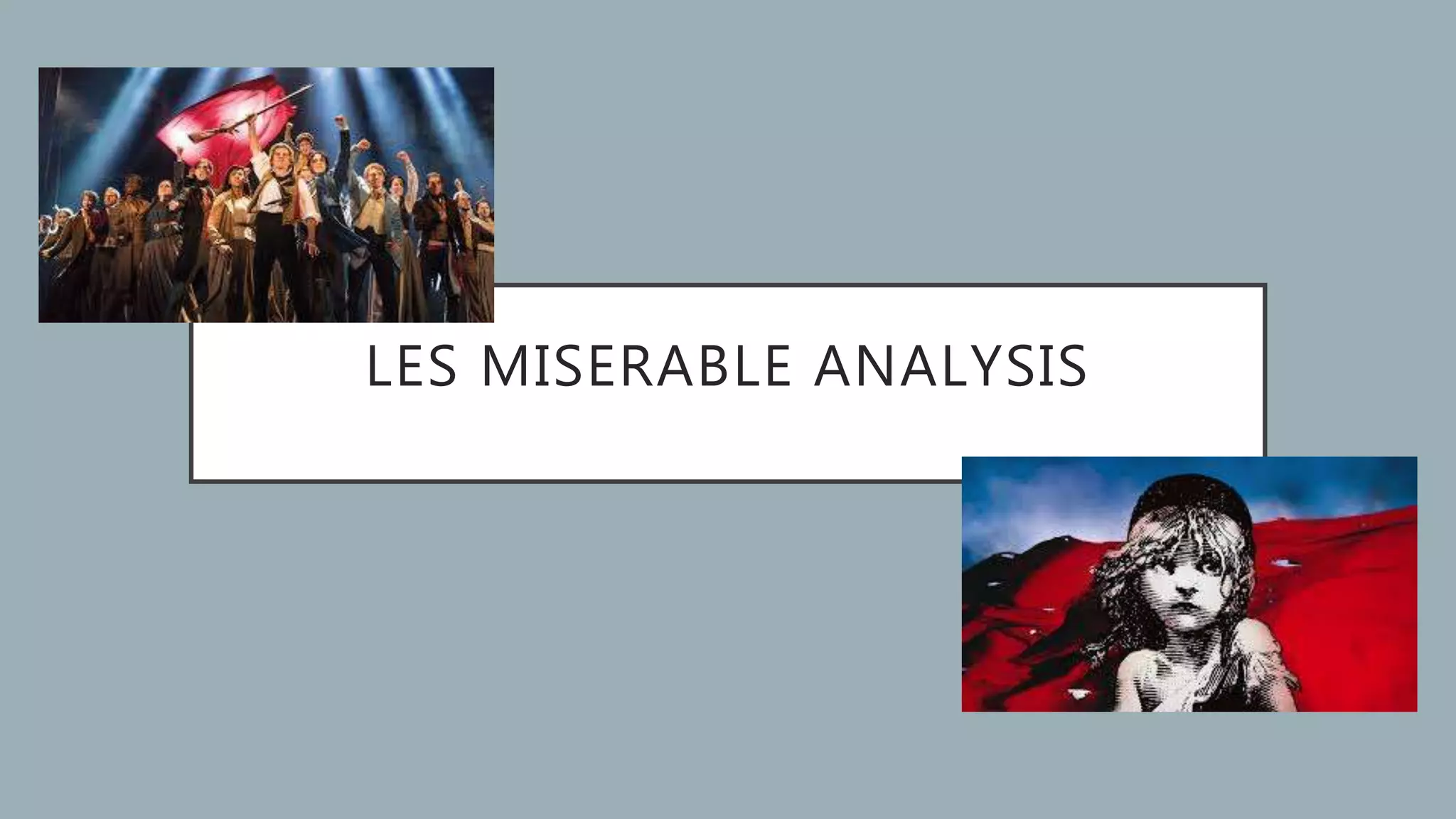
LES MISERABLE ANALYSIS
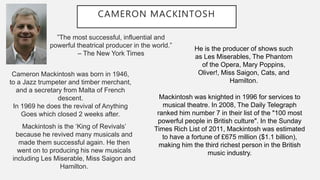
CAMERON MACKINTOSH
”The most successful, influential and
powerful theatrical producer in the world.”
– The New York Times
Cameron Mackintosh was born in 1946,
to a Jazz trumpeter and timber merchant,
and a secretary from Malta of French
descent.
In 1969 he does the revival of Anything
Goes which closed 2 weeks after.
Mackintosh is the ‘King of Revivals’
because he revived many musicals and
made them successful again. He then
went on to producing his new musicals
including Les Miserable, Miss Saigon and
Hamilton.
He is the producer of shows such
as Les Miserables, The Phantom
of the Opera, Mary Poppins,
Oliver!, Miss Saigon, Cats, and
Hamilton.
Mackintosh was knighted in 1996 for services to
musical theatre. In 2008, The Daily Telegraph
ranked him number 7 in their list of the "100 most
powerful people in British culture". In the Sunday
Times Rich List of 2011, Mackintosh was estimated
to have a fortune of £675 million ($1.1 billion),
making him the third richest person in the British
music industry.
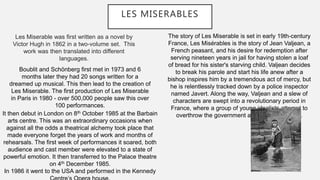
LES MISERABLES
Les Miserable was first written as a novel by
Victor Hugh in 1862 in a two-volume set. This
work was then translated into different
languages.
Boublit and Schönberg first met in 1973 and 6
months later they had 20 songs written for a
dreamed up musical. This then lead to the creation of
Les Miserable. The first production of Les Miserable
in Paris in 1980 - over 500,000 people saw this over
100 performances.
It then debut in London on 8th October 1985 at the Barbain
arts centre. This was an extraordinary occasions when
against all the odds a theatrical alchemy took place that
made everyone forget the years of work and months of
rehearsals. The first week of performances it soared, both
audience and cast member were elevated to a state of
powerful emotion. It then transferred to the Palace theatre
on 4th December 1985.
In 1986 it went to the USA and performed in the Kennedy
The story of Les Miserable is set in early 19th-century
France, Les Misérables is the story of Jean Valjean, a
French peasant, and his desire for redemption after
serving nineteen years in jail for having stolen a loaf
of bread for his sister's starving child. Valjean decides
to break his parole and start his life anew after a
bishop inspires him by a tremendous act of mercy, but
he is relentlessly tracked down by a police inspector
named Javert. Along the way, Valjean and a slew of
characters are swept into a revolutionary period in
France, where a group of young idealists attempt to
overthrow the government at a street barricade.
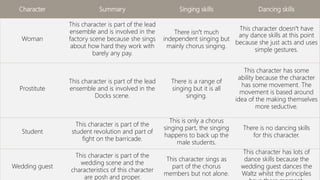
Character Summary Singing skills Dancing skills
Woman
This character is part of the lead
ensemble and is involved in the
factory scene because she sings
about how hard they work with
barely any pay.
There isn’t much
independent singing but
mainly chorus singing.
This character doesn’t have
any dance skills at this point
because she just acts and uses
simple gestures.
Prostitute
This character is part of the lead
ensemble and is involved in the
Docks scene.
There is a range of
singing but it is all
singing.
This character has some
ability because the character
has some movement. The
movement is based around
idea of the making themselves
more seductive.
Student
This character is part of the
student revolution and part of
fight on the barricade.
This is only a chorus
singing part, the singing
happens to back up the
male students.
There is no dancing skills
for this character.
Wedding guest
This character is part of the
wedding scene and the
characteristics of this character
are posh and proper.
This character sings as
part of the chorus
members but not alone.
This character has lots of
dance skills because the
wedding guest dances the
Waltz whilst the principles

Les miserable anaylsis

  • 1.
  • 2.
    CAMERON MACKINTOSH ”The mostsuccessful, influential and powerful theatrical producer in the world.” – The New York Times Cameron Mackintosh was born in 1946, to a Jazz trumpeter and timber merchant, and a secretary from Malta of French descent. In 1969 he does the revival of Anything Goes which closed 2 weeks after. Mackintosh is the ‘King of Revivals’ because he revived many musicals and made them successful again. He then went on to producing his new musicals including Les Miserable, Miss Saigon and Hamilton. He is the producer of shows such as Les Miserables, The Phantom of the Opera, Mary Poppins, Oliver!, Miss Saigon, Cats, and Hamilton. Mackintosh was knighted in 1996 for services to musical theatre. In 2008, The Daily Telegraph ranked him number 7 in their list of the "100 most powerful people in British culture". In the Sunday Times Rich List of 2011, Mackintosh was estimated to have a fortune of £675 million ($1.1 billion), making him the third richest person in the British music industry.
  • 3.
    LES MISERABLES Les Miserablewas first written as a novel by Victor Hugh in 1862 in a two-volume set. This work was then translated into different languages. Boublit and Schönberg first met in 1973 and 6 months later they had 20 songs written for a dreamed up musical. This then lead to the creation of Les Miserable. The first production of Les Miserable in Paris in 1980 - over 500,000 people saw this over 100 performances. It then debut in London on 8th October 1985 at the Barbain arts centre. This was an extraordinary occasions when against all the odds a theatrical alchemy took place that made everyone forget the years of work and months of rehearsals. The first week of performances it soared, both audience and cast member were elevated to a state of powerful emotion. It then transferred to the Palace theatre on 4th December 1985. In 1986 it went to the USA and performed in the Kennedy The story of Les Miserable is set in early 19th-century France, Les Misérables is the story of Jean Valjean, a French peasant, and his desire for redemption after serving nineteen years in jail for having stolen a loaf of bread for his sister's starving child. Valjean decides to break his parole and start his life anew after a bishop inspires him by a tremendous act of mercy, but he is relentlessly tracked down by a police inspector named Javert. Along the way, Valjean and a slew of characters are swept into a revolutionary period in France, where a group of young idealists attempt to overthrow the government at a street barricade.
  • 4.
    Character Summary Singingskills Dancing skills Woman This character is part of the lead ensemble and is involved in the factory scene because she sings about how hard they work with barely any pay. There isn’t much independent singing but mainly chorus singing. This character doesn’t have any dance skills at this point because she just acts and uses simple gestures. Prostitute This character is part of the lead ensemble and is involved in the Docks scene. There is a range of singing but it is all singing. This character has some ability because the character has some movement. The movement is based around idea of the making themselves more seductive. Student This character is part of the student revolution and part of fight on the barricade. This is only a chorus singing part, the singing happens to back up the male students. There is no dancing skills for this character. Wedding guest This character is part of the wedding scene and the characteristics of this character are posh and proper. This character sings as part of the chorus members but not alone. This character has lots of dance skills because the wedding guest dances the Waltz whilst the principles