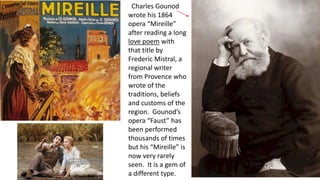
Charles Gounod
wrote his 1864
opera “Mireille”
after reading a long
love poem with
that title by
Frederic Mistral, a
regional writer
from Provence who
wrote of the
traditions, beliefs
and customs of the
region. Gounod’s
opera “Faust” has
been performed
thousands of times
but his “Mireille” is
now very rarely
seen. It is a gem of
a different type.
1904 Nobel laureate
Frédéric Mistral wrote
about his beloved
Provence in a long
poem – “Mireille”, the
basis of Gounod’s opera
Mistral wrote about aspects of Provence in his poem,
that Gounod then put into his opera “Mireille”, using
Mistral’s plot. There is a distinctive dress, food, and
dances. Some of this can be traced back thousands of
years, like the folk dances shown in cave paintings.
And Provence had (and still does a little) several
language dialects like Provencal and Languedoc.
A group line dance called the Farandole is very
ancient and we will see a brief bit in the opera.
The opera also features two widely held beliefs
in Provence – witches and sylphs. Sylphs were
the airy spirits of young girls who drowned
themselves because of unrequited love.
Delibes’ ballet “Les Sylphides” is based on that
theme.
There were witch trials (and burnings) in Aix-en-Provence
in 1611. But these beliefs persisted up to the present.
In the opera the character Taven, an older woman, lives
alone and outside the village – clearly a witch!
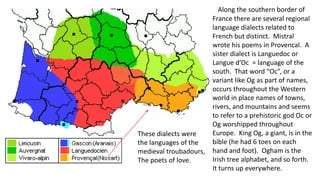
Along the southern border of
France there are several regional
language dialects related to
French but distinct. Mistral
wrote his poems in Provencal. A
sister dialect is Languedoc or
Langue d’Oc = language of the
south. That word “Oc”, or a
variant like Og as part of names,
occurs throughout the Western
world in place names of towns,
rivers, and mountains and seems
to refer to a prehistoric god Oc or
Og worshipped throughout
Europe. King Og, a giant, is in the
bible (he had 6 toes on each
hand and foot). Ogham is the
Irish tree alphabet, and so forth.
It turns up everywhere.
These dialects were
the languages of the
medieval troubadours,
The poets of love.
In the opera the heroine Mireille hurries to see her
wounded lover and takes a short cut through the Crau
desert – Yes, Provence has a small desert!! - mostly a
flat plain with a gazillion rocks. This terrain and the
brutal sun nearly does her in.
It is a universal trait of
humanity that in every country,
no matter how small - even tiny
Litchenstein, Andora, Monaco
(500 acres) and even Vatican
City (109 acres) – the people in
their north think they are hard
working and the people in their
south are lazy fun-loving goof
offs. Here in the US this is even
true within each state. And
Provence, within France, is no
exception. Van Gogh moved
from grey dour constricted
Normandy in the north down to
sunny, happy Arles in the south.
His painting changed then
dramatically and became full of
life and color.

Mireille email

  • 1.
    Charles Gounod wrote his1864 opera “Mireille” after reading a long love poem with that title by Frederic Mistral, a regional writer from Provence who wrote of the traditions, beliefs and customs of the region. Gounod’s opera “Faust” has been performed thousands of times but his “Mireille” is now very rarely seen. It is a gem of a different type.
  • 2.
    1904 Nobel laureate FrédéricMistral wrote about his beloved Provence in a long poem – “Mireille”, the basis of Gounod’s opera
  • 3.
    Mistral wrote aboutaspects of Provence in his poem, that Gounod then put into his opera “Mireille”, using Mistral’s plot. There is a distinctive dress, food, and dances. Some of this can be traced back thousands of years, like the folk dances shown in cave paintings. And Provence had (and still does a little) several language dialects like Provencal and Languedoc. A group line dance called the Farandole is very ancient and we will see a brief bit in the opera. The opera also features two widely held beliefs in Provence – witches and sylphs. Sylphs were the airy spirits of young girls who drowned themselves because of unrequited love. Delibes’ ballet “Les Sylphides” is based on that theme.
  • 4.
    There were witchtrials (and burnings) in Aix-en-Provence in 1611. But these beliefs persisted up to the present. In the opera the character Taven, an older woman, lives alone and outside the village – clearly a witch!
  • 5.
    Along the southernborder of France there are several regional language dialects related to French but distinct. Mistral wrote his poems in Provencal. A sister dialect is Languedoc or Langue d’Oc = language of the south. That word “Oc”, or a variant like Og as part of names, occurs throughout the Western world in place names of towns, rivers, and mountains and seems to refer to a prehistoric god Oc or Og worshipped throughout Europe. King Og, a giant, is in the bible (he had 6 toes on each hand and foot). Ogham is the Irish tree alphabet, and so forth. It turns up everywhere. These dialects were the languages of the medieval troubadours, The poets of love.
  • 6.
    In the operathe heroine Mireille hurries to see her wounded lover and takes a short cut through the Crau desert – Yes, Provence has a small desert!! - mostly a flat plain with a gazillion rocks. This terrain and the brutal sun nearly does her in.
  • 7.
    It is auniversal trait of humanity that in every country, no matter how small - even tiny Litchenstein, Andora, Monaco (500 acres) and even Vatican City (109 acres) – the people in their north think they are hard working and the people in their south are lazy fun-loving goof offs. Here in the US this is even true within each state. And Provence, within France, is no exception. Van Gogh moved from grey dour constricted Normandy in the north down to sunny, happy Arles in the south. His painting changed then dramatically and became full of life and color.