Leonardo da Vinci
            Present by Group 6
School of science , Mea Fah Luang University
Content
•Life

•Relationships and influences

•Painting

•Observation and invention

•Leonardo the legend
Life
Leonardo da Vinci
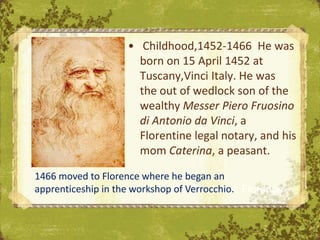
• Childhood,1452-1466 He was
                      born on 15 April 1452 at
                      Tuscany,Vinci Italy. He was
                      the out of wedlock son of the
                      wealthy Messer Piero Fruosino
                      di Antonio da Vinci, a
                      Florentine legal notary, and his
                      mom Caterina, a peasant.

1466 moved to Florence where he began an
apprenticeship in the workshop of Verrocchio. Florence
                                   The Uffizi,
• Verrocchio's workshop, 1466–1476 Leonardo would have
  been exposed to both theoretical training and a vast
  range of technical skills as well as the artistic skills.

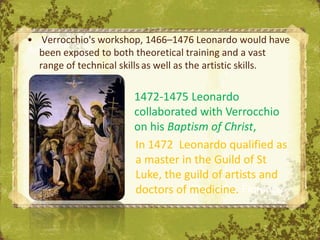
                        1472-1475 Leonardo
                        collaborated with Verrocchio
                        on his Baptism of Christ,
                        In 1472 Leonardo qualified as
                        a master in the Guild of St
                        Luke, the guild of artists and
                        doctors of medicine. Florence
                                   The Uffizi,
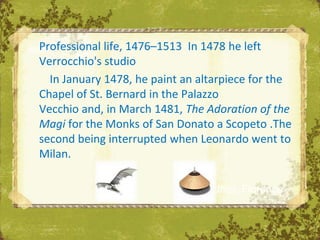
Professional life, 1476–1513 In 1478 he left
Verrocchio's studio
  In January 1478, he paint an altarpiece for the
Chapel of St. Bernard in the Palazzo
Vecchio and, in March 1481, The Adoration of the
Magi for the Monks of San Donato a Scopeto .The
second being interrupted when Leonardo went to
Milan.

                             The Uffizi, Florence
• In 1482, Lorenzo de' Medici sent Leonardo
  to Milan, bearing the lyre as a gift, to
  secure peace with Ludovico il Moro, Duke
  of Milan. At this time Leonardo wrote an
  often-quoted letter describing the many
  marvelous and diverse things about army
  weapon.
                          The Uffizi, Florence
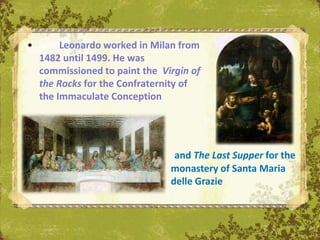
•        Leonardo worked in Milan from
    1482 until 1499. He was
    commissioned to paint the Virgin of
    the Rocks for the Confraternity of
    the Immaculate Conception


                                 and The Last Supper for the
                                monastery of Santa Maria
                                delle Grazie
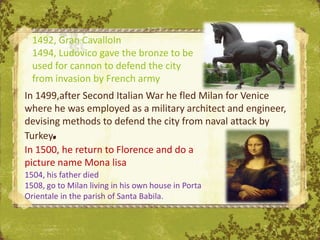
1492, Gran CavalloIn
  1494, Ludovico gave the bronze to be
  used for cannon to defend the city
  from invasion by French army
In 1499,after Second Italian War he fled Milan for Venice
where he was employed as a military architect and engineer,
devising methods to defend the city from naval attack by
Turkey.
In 1500, he return to Florence and do a
picture name Mona lisa
1504, his father died
1508, go to Milan living in his own house in Porta
Orientale in the parish of Santa Babila.
Old age, 1513–1519 From September 1513 to 1516,
Leonardo spent much of his time living in the Belvedere(a
building that build to have a great view)in the Vatican in
Rome,

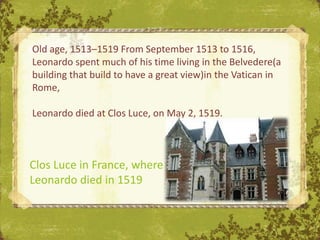
Leonardo died at Clos Luce, on May 2, 1519.


Clos Luce in France, where
Leonardo died in 1519
Relationships and influences

      Leonardo da Vinci
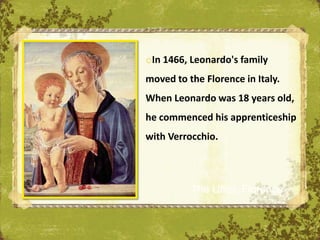
oIn 1466, Leonardo's family
moved to the Florence in Italy.
When Leonardo was 18 years old,
he commenced his apprenticeship
with Verrocchio.


          The Uffizi, Florence
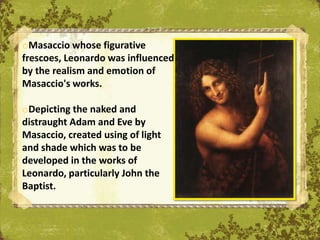
oMasaccio whose figurative
frescoes, Leonardo was influenced
by the realism and emotion of
Masaccio's works.

oDepicting the naked and
distraught Adam and Eve by
Masaccio, created using of light
and shade which was to be
developed in the works of
Leonardo, particularly John the
Baptist.                            The Uffizi, Florence
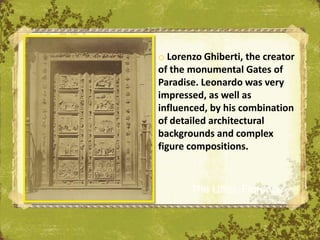
o Lorenzo Ghiberti, the creator
of the monumental Gates of
Paradise. Leonardo was very
impressed, as well as
influenced, by his combination
of detailed architectural
backgrounds and complex
figure compositions.


       The Uffizi, Florence
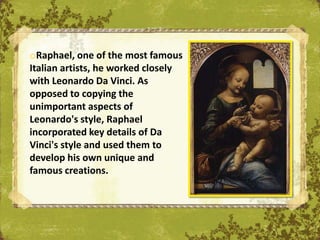
oRaphael, one of the most famous
Italian artists, he worked closely
with Leonardo Da Vinci. As
opposed to copying the
unimportant aspects of
Leonardo's style, Raphael
incorporated key details of Da
Vinci's style and used them to
develop his own unique and
famous creations.
                                     The Uffizi, Florence
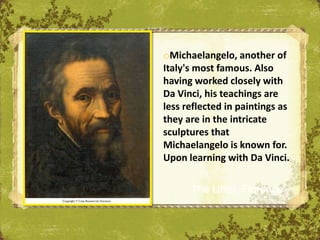
oMichaelangelo, another of
Italy's most famous. Also
having worked closely with
Da Vinci, his teachings are
less reflected in paintings as
they are in the intricate
sculptures that
Michaelangelo is known for.
Upon learning with Da Vinci.

      The Uffizi, Florence
Personal life
• Within Leonardo's lifetime, his extraordinary powers of
  invention, his "outstanding physical beauty", "infinite
  grace", "great strength and generosity", "regal spirit and
  tremendous breadth of mind" as described by Vasari, as well as
  all other aspects of his life, attracted the curiosity of others.
• Leonardo had many friends who are now renowned either in
  their fields or for their historical significance.
• Beyond friendship, Leonardo kept his private life secret.
  Leonardo's most intimate relationships were perhaps with his
  pupils Salai and Melzi. Melzi, writing to inform Leonardo's
  brothers of his death, described Leonardo's feelings for his
                                              The Uffizi, Florence
  pupils as both loving and passionate.
Assistants and pupils
• Gian Giacomo Caprotti da Oreno, nicknamed Salai or Il
  Salaino entered Leonardo's household in 1490.
       Salai executed a number of paintings under the name
  of Andrea Salai, but although Vasari claims that Leonardo
  "taught him a great deal about painting", his work is
  generally considered to be of less artistic merit than
  others among Leonardo's pupils, such as Marco d’Oggione
  and Boltraffio.
       In 1515, he painted a nude version of the Mona
  Lisa, known as Monna Vanna.         The Uffizi, Florence
Assistants and pupils
• Count Francesco Melzi:
     In 1506, Count Francesco Melzi, the son of a
  Lombard aristocrat, who is considered to have
  been his favourite student.
     Melzi inherited the artistic and scientific
  works, manuscripts, and collections of Leonardo
  and administered the estate.
                               The Uffizi, Florence
Painting
Leonardo da Vinci
- Despite the recent awareness and
  admiration of Leonardo as a scientist and
  inventor

- These paintings are famous for a variety of
  qualities which have been much imitated
  by students and discussed at great length
  by connoisseurs and critics Uffizi, Florence
                            The
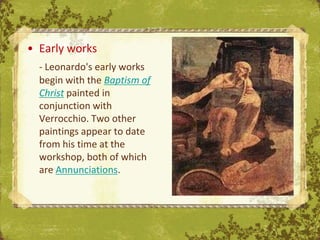
• Early works
  - Leonardo's early works
  begin with the Baptism of
  Christ painted in
  conjunction with
  Verrocchio. Two other
  paintings appear to date
  from his time at the
  workshop, both of which
  are Annunciations.
                              The Uffizi, Florence
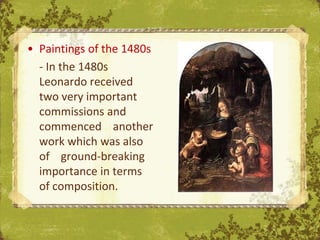
• Paintings of the 1480s
  - In the 1480s
  Leonardo received
  two very important
  commissions and
  commenced another
  work which was also
  of ground-breaking
  importance in terms
  of composition.          The Uffizi, Florence
• Paintings of the 1490s
  - Leonardo's most famous painting of the 1490s
  is The Last Supper, painted for the refectory of
  the Convent of Santa Maria della Grazie in Milan.
• Paintings of the 1500s
  - Among the works created by Leonardo in the
  16th century is the small portrait known as
  the Mona Lisa or "la Gioconda", the laughing one.
  In the present era it is arguably the most famous
  painting in the world.          The Uffizi, Florence
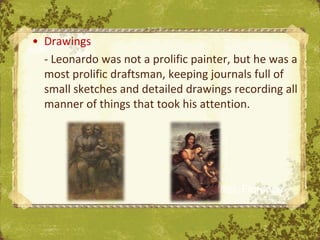
• Drawings
  - Leonardo was not a prolific painter, but he was a
  most prolific draftsman, keeping journals full of
  small sketches and detailed drawings recording all
  manner of things that took his attention.


                               The Uffizi, Florence
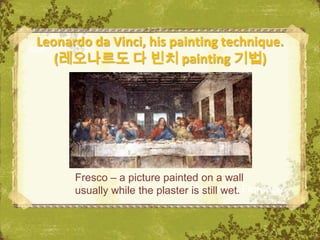
Leonardo da Vinci, his painting technique.
   (레오나르도 다 빈치 painting 기법)


      Fresco – a picture painted on a wall
      usually while the plaster The Uffizi, Florence
                                is still wet.
painting style and result because of it.

• The traditional wall painting style is to
  paint once more on the wall before the
  plaster is dried
• Used the dyes mixed oil paint with tempera
• it caused the painting to be damaged
  quickly.                   The Uffizi, Florence
The last supper
• It was painted by Fresco on the wall of the
  old city of Jerusalem by Leonardo da Vinci
  when he lived in Mlian around 1495.
• He expressed the anecdote that Jesus Chris
  t was seated with his disciples to celebrate
  the Passover and he said “one of you will b
  etray me”                  The Uffizi, Florence
• In the paint, he expressed his theme by using very
  special method which he described that someone
  would betray the Christ and the reaction from the
  disciples after they heard the news.

• Also Jesus Christ was still while the disciples were
  debating who would be the betrayer.
• There was a reason why Leonardo da Vinci portra
  yed like this concept.
                                 The Uffizi, Florence
Observation and invention

     Leonardo da Vinci
Journals and notes
• Leonardo studies in science and engineering are
  as impressive and innovative as his artistic work.

• Leonardo's writings are mostly in mirror-image
  cursive.

• There are compositions for paintings, studies of
  details , faces , emotions and etc.
                                The Uffizi, Florence
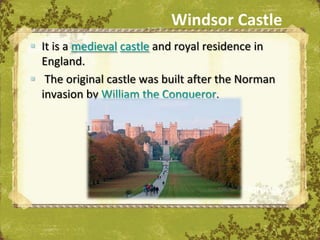
Windsor Castle
 It is a medieval castle and royal residence in
  England.
 The original castle was built after the Norman
  invasion by William the Conqueror.


                               The Uffizi, Florence
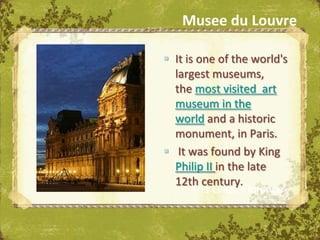
Musee du Louvre

 It is one of the world's
  largest museums,
  the most visited art
  museum in the
  world and a historic
  monument, in Paris.
 It was found by King
  Philip II in the late
  12th century.
     The Uffizi, Florence
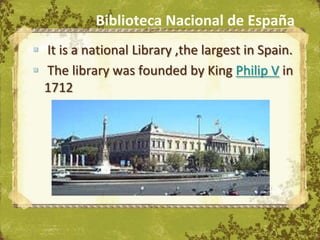
Biblioteca Nacional de España
 It is a national Library ,the largest in Spain.
 The library was founded by King Philip V in
  1712


                             The Uffizi, Florence
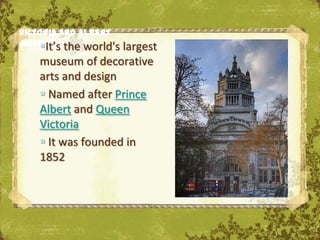
Victoria and Albert
Museum the world's
     It’s         largest
   museum of decorative
   arts and design
    Named after Prince
   Albert and Queen
   Victoria
    It was founded in
   1852

                             The Uffizi, Florence
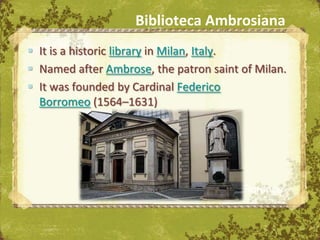
Biblioteca Ambrosiana
 It is a historic library in Milan, Italy.
 Named after Ambrose, the patron saint of Milan.
 It was founded by Cardinal Federico
  Borromeo (1564–1631)


                              The Uffizi, Florence
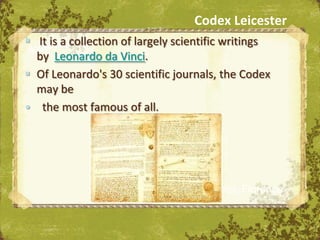
Codex Leicester
 It is a collection of largely scientific writings
  by Leonardo da Vinci.
 Of Leonardo's 30 scientific journals, the Codex
  may be
• the most famous of all.


                                  The Uffizi, Florence
Anatomy
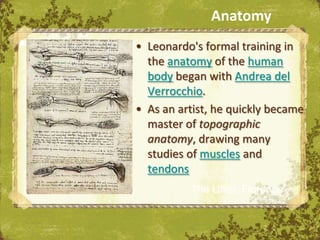
Anatomy   • Leonardo's formal training in
            the anatomy of the human
            body began with Andrea del
            Verrocchio.
          • As an artist, he quickly became
            master of topographic
            anatomy, drawing many
            studies of muscles and
            tendons
                    The Uffizi, Florence
Engineering and
                   inventions
• For much of his life, Leonardo was
  fascinated by the phenomenon of flight
  and producing many studies of the flight of
  birds
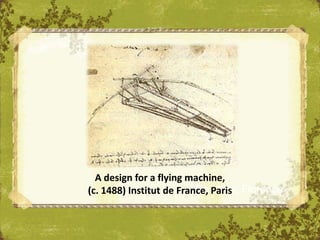
• c. 1505 Codex on the Flight of Birds, as well
  as plans for several flying machines
  resembling a helicopter.

                             The Uffizi, Florence
A design for a flying machine,
(c. 1488) Institut de France, Paris Florence
                         The Uffizi,
Leonardo the legend

  Leonardo da Vinci
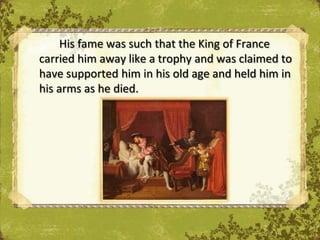
His fame was such that the King of France
carried him away like a trophy and was claimed to
have supported him in his old age and held him in
his arms as he died.
Introduced his chapter on Leonardo da
    Vinci with the following words:
• According to Baldassare Castiglione 1528 ,
  "... Another of the greatest painters in this world
  looks down on this art in which he is
  unequalled ...“
• According to Anonimo Gaddiano“ 1540 ,
  "His genius was so rare and universal that it can
  be said that nature worked a miracle on his
  behalf ...".
• According to Giorgio 1568 ,
      In the normal course of events many men and
  women are born with remarkable talents; but
  occasionally, in a way that transcends nature, a
  single person is marvellously endowed by Heaven
  with beauty, grace and talent in such abundance
  that he leaves other men far behind, all his
  actions seem inspired and indeed everything he
  does clearly comes from God rather than from
  human skill.
• According to Henry Fuseli 1801 ,
   "Such was the dawn of modern art, when
  Leonardo da Vinci broke forth with a splendour
  that distanced former excellence: made up of all
  the elements that constitute the essence of
  genius ...“
• According to A. E. Rio who wrote in 1861:
   "He towered above all other artists through the
  strength and the nobility of his talents."
• According to Hippolyte Taine 1866 ,
   "There may not be in the world an example of
  another genius so universal, so incapable of
  fulfilment, so full of yearning for the infinite, so
  naturally refined, so far ahead of his own century
  and the following centuries."
• Liana Bortolon, writing in 1967, said:
  "Because of the multiplicity of interests that
  spurred him to pursue every field of knowledge ...
  Leonardo can be considered, quite rightly, to
  have been the universal genius par
  excellence, and with all the disquieting overtones
  inherent in that term. Man is as uncomfortable
  today, faced with a genius, as he was in the 16th
  century. Five centuries have passed, yet we still
  view Leonardo with awe."
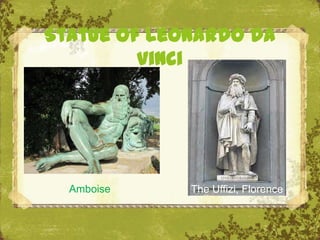
Statue of Leonardo da
         Vinci


  Amboise    The Uffizi, Florence
THANK YOU


      The Uffizi, Florence

Leonardo da vinci

  • 1.
    Leonardo da Vinci Present by Group 6 School of science , Mea Fah Luang University
  • 2.
  • 3.
  • 4.
    • Childhood,1452-1466 Hewas born on 15 April 1452 at Tuscany,Vinci Italy. He was the out of wedlock son of the wealthy Messer Piero Fruosino di Antonio da Vinci, a Florentine legal notary, and his mom Caterina, a peasant. 1466 moved to Florence where he began an apprenticeship in the workshop of Verrocchio. Florence The Uffizi,
  • 5.
    • Verrocchio's workshop,1466–1476 Leonardo would have been exposed to both theoretical training and a vast range of technical skills as well as the artistic skills. 1472-1475 Leonardo collaborated with Verrocchio on his Baptism of Christ, In 1472 Leonardo qualified as a master in the Guild of St Luke, the guild of artists and doctors of medicine. Florence The Uffizi,
  • 6.
    Professional life, 1476–1513In 1478 he left Verrocchio's studio In January 1478, he paint an altarpiece for the Chapel of St. Bernard in the Palazzo Vecchio and, in March 1481, The Adoration of the Magi for the Monks of San Donato a Scopeto .The second being interrupted when Leonardo went to Milan. The Uffizi, Florence
  • 7.
    • In 1482,Lorenzo de' Medici sent Leonardo to Milan, bearing the lyre as a gift, to secure peace with Ludovico il Moro, Duke of Milan. At this time Leonardo wrote an often-quoted letter describing the many marvelous and diverse things about army weapon. The Uffizi, Florence
  • 8.
    Leonardo worked in Milan from 1482 until 1499. He was commissioned to paint the Virgin of the Rocks for the Confraternity of the Immaculate Conception and The Last Supper for the monastery of Santa Maria delle Grazie
  • 9.
    1492, Gran CavalloIn 1494, Ludovico gave the bronze to be used for cannon to defend the city from invasion by French army In 1499,after Second Italian War he fled Milan for Venice where he was employed as a military architect and engineer, devising methods to defend the city from naval attack by Turkey. In 1500, he return to Florence and do a picture name Mona lisa 1504, his father died 1508, go to Milan living in his own house in Porta Orientale in the parish of Santa Babila.
  • 10.
    Old age, 1513–1519From September 1513 to 1516, Leonardo spent much of his time living in the Belvedere(a building that build to have a great view)in the Vatican in Rome, Leonardo died at Clos Luce, on May 2, 1519. Clos Luce in France, where Leonardo died in 1519
  • 11.
  • 12.
    oIn 1466, Leonardo'sfamily moved to the Florence in Italy. When Leonardo was 18 years old, he commenced his apprenticeship with Verrocchio. The Uffizi, Florence
  • 13.
    oMasaccio whose figurative frescoes,Leonardo was influenced by the realism and emotion of Masaccio's works. oDepicting the naked and distraught Adam and Eve by Masaccio, created using of light and shade which was to be developed in the works of Leonardo, particularly John the Baptist. The Uffizi, Florence
  • 14.
    o Lorenzo Ghiberti,the creator of the monumental Gates of Paradise. Leonardo was very impressed, as well as influenced, by his combination of detailed architectural backgrounds and complex figure compositions. The Uffizi, Florence
  • 15.
    oRaphael, one ofthe most famous Italian artists, he worked closely with Leonardo Da Vinci. As opposed to copying the unimportant aspects of Leonardo's style, Raphael incorporated key details of Da Vinci's style and used them to develop his own unique and famous creations. The Uffizi, Florence
  • 16.
    oMichaelangelo, another of Italy'smost famous. Also having worked closely with Da Vinci, his teachings are less reflected in paintings as they are in the intricate sculptures that Michaelangelo is known for. Upon learning with Da Vinci. The Uffizi, Florence
  • 17.
    Personal life • WithinLeonardo's lifetime, his extraordinary powers of invention, his "outstanding physical beauty", "infinite grace", "great strength and generosity", "regal spirit and tremendous breadth of mind" as described by Vasari, as well as all other aspects of his life, attracted the curiosity of others. • Leonardo had many friends who are now renowned either in their fields or for their historical significance. • Beyond friendship, Leonardo kept his private life secret. Leonardo's most intimate relationships were perhaps with his pupils Salai and Melzi. Melzi, writing to inform Leonardo's brothers of his death, described Leonardo's feelings for his The Uffizi, Florence pupils as both loving and passionate.
  • 18.
    Assistants and pupils •Gian Giacomo Caprotti da Oreno, nicknamed Salai or Il Salaino entered Leonardo's household in 1490. Salai executed a number of paintings under the name of Andrea Salai, but although Vasari claims that Leonardo "taught him a great deal about painting", his work is generally considered to be of less artistic merit than others among Leonardo's pupils, such as Marco d’Oggione and Boltraffio. In 1515, he painted a nude version of the Mona Lisa, known as Monna Vanna. The Uffizi, Florence
  • 19.
    Assistants and pupils •Count Francesco Melzi: In 1506, Count Francesco Melzi, the son of a Lombard aristocrat, who is considered to have been his favourite student. Melzi inherited the artistic and scientific works, manuscripts, and collections of Leonardo and administered the estate. The Uffizi, Florence
  • 20.
  • 21.
    - Despite therecent awareness and admiration of Leonardo as a scientist and inventor - These paintings are famous for a variety of qualities which have been much imitated by students and discussed at great length by connoisseurs and critics Uffizi, Florence The
  • 22.
    • Early works - Leonardo's early works begin with the Baptism of Christ painted in conjunction with Verrocchio. Two other paintings appear to date from his time at the workshop, both of which are Annunciations. The Uffizi, Florence
  • 23.
    • Paintings ofthe 1480s - In the 1480s Leonardo received two very important commissions and commenced another work which was also of ground-breaking importance in terms of composition. The Uffizi, Florence
  • 24.
    • Paintings ofthe 1490s - Leonardo's most famous painting of the 1490s is The Last Supper, painted for the refectory of the Convent of Santa Maria della Grazie in Milan. • Paintings of the 1500s - Among the works created by Leonardo in the 16th century is the small portrait known as the Mona Lisa or "la Gioconda", the laughing one. In the present era it is arguably the most famous painting in the world. The Uffizi, Florence
  • 25.
    • Drawings - Leonardo was not a prolific painter, but he was a most prolific draftsman, keeping journals full of small sketches and detailed drawings recording all manner of things that took his attention. The Uffizi, Florence
  • 26.
    Leonardo da Vinci,his painting technique. (레오나르도 다 빈치 painting 기법) Fresco – a picture painted on a wall usually while the plaster The Uffizi, Florence is still wet.
  • 27.
    painting style andresult because of it. • The traditional wall painting style is to paint once more on the wall before the plaster is dried • Used the dyes mixed oil paint with tempera • it caused the painting to be damaged quickly. The Uffizi, Florence
  • 28.
    The last supper •It was painted by Fresco on the wall of the old city of Jerusalem by Leonardo da Vinci when he lived in Mlian around 1495. • He expressed the anecdote that Jesus Chris t was seated with his disciples to celebrate the Passover and he said “one of you will b etray me” The Uffizi, Florence
  • 29.
    • In thepaint, he expressed his theme by using very special method which he described that someone would betray the Christ and the reaction from the disciples after they heard the news. • Also Jesus Christ was still while the disciples were debating who would be the betrayer. • There was a reason why Leonardo da Vinci portra yed like this concept. The Uffizi, Florence
  • 30.
    Observation and invention Leonardo da Vinci
  • 31.
    Journals and notes •Leonardo studies in science and engineering are as impressive and innovative as his artistic work. • Leonardo's writings are mostly in mirror-image cursive. • There are compositions for paintings, studies of details , faces , emotions and etc. The Uffizi, Florence
  • 32.
    Windsor Castle  Itis a medieval castle and royal residence in England.  The original castle was built after the Norman invasion by William the Conqueror. The Uffizi, Florence
  • 33.
    Musee du Louvre It is one of the world's largest museums, the most visited art museum in the world and a historic monument, in Paris.  It was found by King Philip II in the late 12th century. The Uffizi, Florence
  • 34.
    Biblioteca Nacional deEspaña  It is a national Library ,the largest in Spain.  The library was founded by King Philip V in 1712 The Uffizi, Florence
  • 35.
    Victoria and Albert Museumthe world's It’s largest museum of decorative arts and design  Named after Prince Albert and Queen Victoria  It was founded in 1852 The Uffizi, Florence
  • 36.
    Biblioteca Ambrosiana  Itis a historic library in Milan, Italy.  Named after Ambrose, the patron saint of Milan.  It was founded by Cardinal Federico Borromeo (1564–1631) The Uffizi, Florence
  • 37.
    Codex Leicester  Itis a collection of largely scientific writings by Leonardo da Vinci.  Of Leonardo's 30 scientific journals, the Codex may be • the most famous of all. The Uffizi, Florence
  • 38.
    Anatomy Anatomy • Leonardo's formal training in the anatomy of the human body began with Andrea del Verrocchio. • As an artist, he quickly became master of topographic anatomy, drawing many studies of muscles and tendons The Uffizi, Florence
  • 39.
    Engineering and inventions • For much of his life, Leonardo was fascinated by the phenomenon of flight and producing many studies of the flight of birds • c. 1505 Codex on the Flight of Birds, as well as plans for several flying machines resembling a helicopter. The Uffizi, Florence
  • 40.
    A design fora flying machine, (c. 1488) Institut de France, Paris Florence The Uffizi,
  • 41.
    Leonardo the legend Leonardo da Vinci
  • 42.
    His fame wassuch that the King of France carried him away like a trophy and was claimed to have supported him in his old age and held him in his arms as he died.
  • 43.
    Introduced his chapteron Leonardo da Vinci with the following words: • According to Baldassare Castiglione 1528 , "... Another of the greatest painters in this world looks down on this art in which he is unequalled ...“ • According to Anonimo Gaddiano“ 1540 , "His genius was so rare and universal that it can be said that nature worked a miracle on his behalf ...".
  • 44.
    • According toGiorgio 1568 , In the normal course of events many men and women are born with remarkable talents; but occasionally, in a way that transcends nature, a single person is marvellously endowed by Heaven with beauty, grace and talent in such abundance that he leaves other men far behind, all his actions seem inspired and indeed everything he does clearly comes from God rather than from human skill.
  • 45.
    • According toHenry Fuseli 1801 , "Such was the dawn of modern art, when Leonardo da Vinci broke forth with a splendour that distanced former excellence: made up of all the elements that constitute the essence of genius ...“ • According to A. E. Rio who wrote in 1861: "He towered above all other artists through the strength and the nobility of his talents."
  • 46.
    • According toHippolyte Taine 1866 , "There may not be in the world an example of another genius so universal, so incapable of fulfilment, so full of yearning for the infinite, so naturally refined, so far ahead of his own century and the following centuries."
  • 47.
    • Liana Bortolon,writing in 1967, said: "Because of the multiplicity of interests that spurred him to pursue every field of knowledge ... Leonardo can be considered, quite rightly, to have been the universal genius par excellence, and with all the disquieting overtones inherent in that term. Man is as uncomfortable today, faced with a genius, as he was in the 16th century. Five centuries have passed, yet we still view Leonardo with awe."
  • 48.
    Statue of Leonardoda Vinci Amboise The Uffizi, Florence
  • 49.
    THANK YOU The Uffizi, Florence