
Challenge the future
Delft
University of
Technology
Shear in Reinforced Concrete Slabs
under Concentrated Loads close to Supports
Eva Lantsoght
2
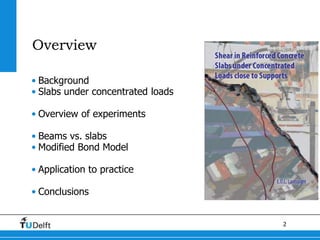
Overview
• Background
• Slabs under concentrated loads
• Overview of experiments
• Beams vs. slabs
• Modified Bond Model
• Application to practice
• Conclusions
3
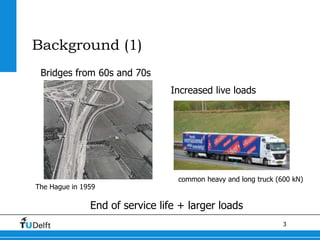
Background (1)
Bridges from 60s and 70s
The Hague in 1959
Increased live loads
common heavy and long truck (600 kN)
End of service life + larger loads
4
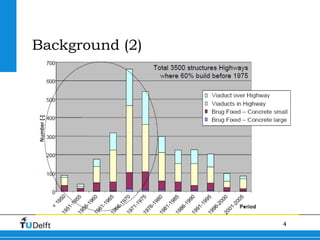
Background (2)
5
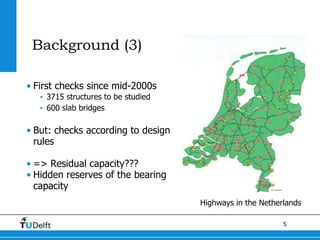
Background (3)
• First checks since mid-2000s
• 3715 structures to be studied
• 600 slab bridges
• But: checks according to design
rules
• => Residual capacity???
• Hidden reserves of the bearing
capacity
Highways in the Netherlands
6
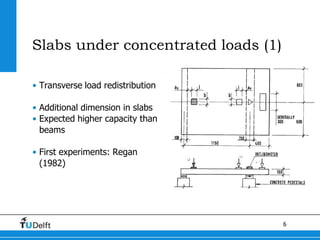
Slabs under concentrated loads (1)
• Transverse load redistribution
• Additional dimension in slabs
• Expected higher capacity than
beams
• First experiments: Regan
(1982)
7
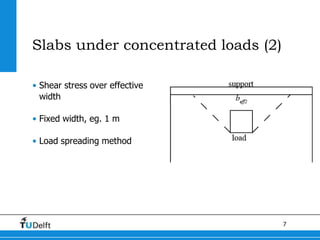
Slabs under concentrated loads (2)
• Shear stress over effective
width
• Fixed width, eg. 1 m
• Load spreading method
8
Goals
• Assess shear capacity of slabs
under concentrated loads
• Determine effective width in
shear
9
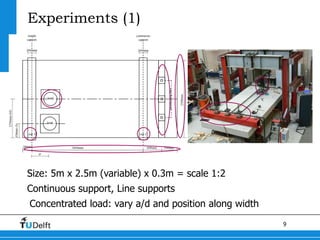
Experiments (1)
Size: 5m x 2.5m (variable) x 0.3m = scale 1:2
Continuous support, Line supports
Concentrated load: vary a/d and position along width
10
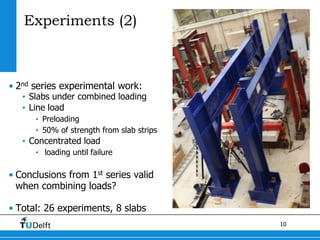
Experiments (2)
• 2nd series experimental work:
• Slabs under combined loading
• Line load
• Preloading
• 50% of strength from slab strips
• Concentrated load
• loading until failure
• Conclusions from 1st series valid
when combining loads?
• Total: 26 experiments, 8 slabs
11
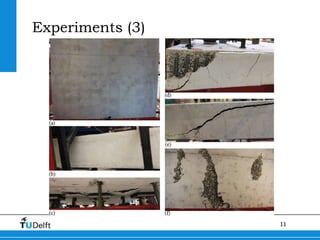
Experiments (3)
12
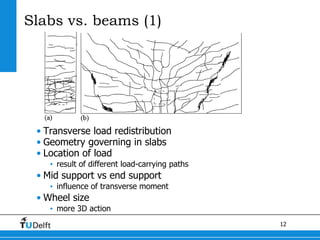
Slabs vs. beams (1)
• Transverse load redistribution
• Geometry governing in slabs
• Location of load
• result of different load-carrying paths
• Mid support vs end support
• influence of transverse moment
• Wheel size
• more 3D action
13
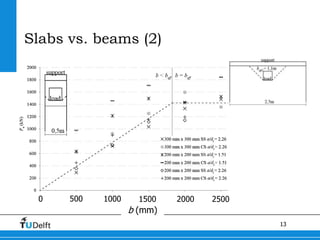
Slabs vs. beams (2)
5000 1000 1500 2000 2500
b (mm)
14
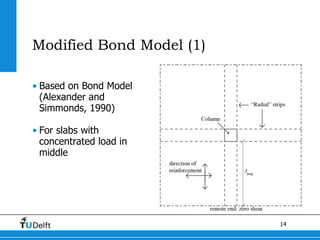
Modified Bond Model (1)
• Based on Bond Model
(Alexander and
Simmonds, 1990)
• For slabs with
concentrated load in
middle
15
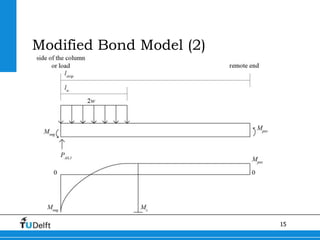
Modified Bond Model (2)
16
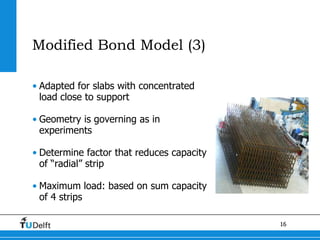
Modified Bond Model (3)
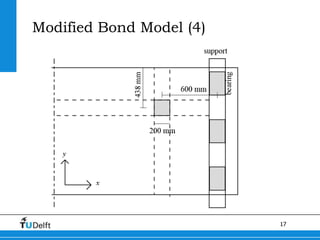
• Adapted for slabs with concentrated
load close to support
• Geometry is governing as in
experiments
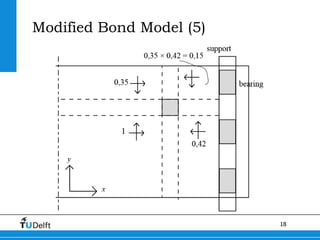
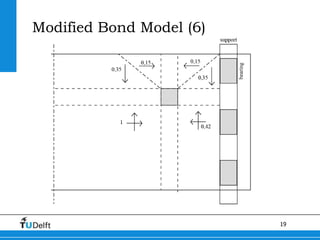
• Determine factor that reduces capacity
of “radial” strip
• Maximum load: based on sum capacity
of 4 strips
17
Modified Bond Model (4)
18
Modified Bond Model (5)
19
Modified Bond Model (6)
20
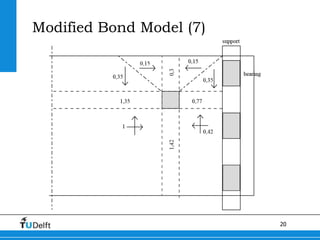
Modified Bond Model (7)
21
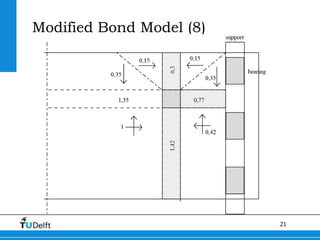
Modified Bond Model (8)
22
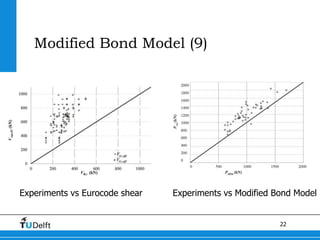
Modified Bond Model (9)
Experiments vs Eurocode shear Experiments vs Modified Bond Model
23
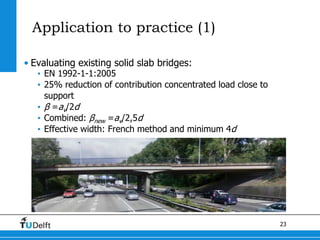
Application to practice (1)
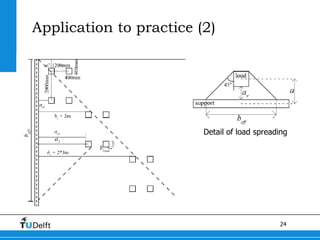
• Evaluating existing solid slab bridges:
• EN 1992-1-1:2005
• 25% reduction of contribution concentrated load close to
support
• β =av/2d
• Combined: βnew =av/2,5d
• Effective width: French method and minimum 4d
24
Application to practice (2)
Detail of load spreading
25
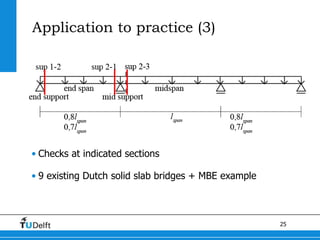
Application to practice (3)
• Checks at indicated sections
• 9 existing Dutch solid slab bridges + MBE example
26
Application to practice (4)
• Shear stresses: influence of recommendations
• QS-EC2: wheel loads at av = 2,5dl
• QS-VBC: wheel loads at av = dl
• QS-EC2 18% reduction in loads
• Shear capacity:
• QS-EC2: vRd,c ~ ρ, d
• low reinforcement + deep section = small shear capacity
• QS-VBC: τ1 ~ fck only
• QS-EC2 improved selection ability
27
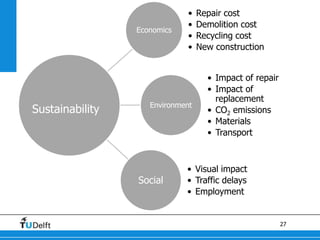
Economics
• Repair cost
• Demolition cost
• Recycling cost
• New construction
Environment
• Impact of repair
• Impact of
replacement
• CO2 emissions
• Materials
• Transport
Social
• Visual impact
• Traffic delays
• Employment
Sustainability
28
Summary & Conclusions
• Slabs under concentrated loads behave
differently in shear than beams
• Beneficial effect of transverse load
redistribution
• Modified Bond Model improvement as
compared to Eurocode
• Application to practice: reduction in
loads
29
Contact:
Eva Lantsoght
E.O.L.Lantsoght@tudelft.nl
+31(0)152787449

Lekenpraatje

  • 1.
    Challenge the future Delft Universityof Technology Shear in Reinforced Concrete Slabs under Concentrated Loads close to Supports Eva Lantsoght
  • 2.
    2 Overview • Background • Slabsunder concentrated loads • Overview of experiments • Beams vs. slabs • Modified Bond Model • Application to practice • Conclusions
  • 3.
    3 Background (1) Bridges from60s and 70s The Hague in 1959 Increased live loads common heavy and long truck (600 kN) End of service life + larger loads
  • 4.
  • 5.
    5 Background (3) • Firstchecks since mid-2000s • 3715 structures to be studied • 600 slab bridges • But: checks according to design rules • => Residual capacity??? • Hidden reserves of the bearing capacity Highways in the Netherlands
  • 6.
    6 Slabs under concentratedloads (1) • Transverse load redistribution • Additional dimension in slabs • Expected higher capacity than beams • First experiments: Regan (1982)
  • 7.
    7 Slabs under concentratedloads (2) • Shear stress over effective width • Fixed width, eg. 1 m • Load spreading method
  • 8.
    8 Goals • Assess shearcapacity of slabs under concentrated loads • Determine effective width in shear
  • 9.
    9 Experiments (1) Size: 5mx 2.5m (variable) x 0.3m = scale 1:2 Continuous support, Line supports Concentrated load: vary a/d and position along width
  • 10.
    10 Experiments (2) • 2ndseries experimental work: • Slabs under combined loading • Line load • Preloading • 50% of strength from slab strips • Concentrated load • loading until failure • Conclusions from 1st series valid when combining loads? • Total: 26 experiments, 8 slabs
  • 11.
  • 12.
    12 Slabs vs. beams(1) • Transverse load redistribution • Geometry governing in slabs • Location of load • result of different load-carrying paths • Mid support vs end support • influence of transverse moment • Wheel size • more 3D action
  • 13.
    13 Slabs vs. beams(2) 5000 1000 1500 2000 2500 b (mm)
  • 14.
    14 Modified Bond Model(1) • Based on Bond Model (Alexander and Simmonds, 1990) • For slabs with concentrated load in middle
  • 15.
  • 16.
    16 Modified Bond Model(3) • Adapted for slabs with concentrated load close to support • Geometry is governing as in experiments • Determine factor that reduces capacity of “radial” strip • Maximum load: based on sum capacity of 4 strips
  • 17.
  • 18.
  • 19.
  • 20.
  • 21.
  • 22.
    22 Modified Bond Model(9) Experiments vs Eurocode shear Experiments vs Modified Bond Model
  • 23.
    23 Application to practice(1) • Evaluating existing solid slab bridges: • EN 1992-1-1:2005 • 25% reduction of contribution concentrated load close to support • β =av/2d • Combined: βnew =av/2,5d • Effective width: French method and minimum 4d
  • 24.
    24 Application to practice(2) Detail of load spreading
  • 25.
    25 Application to practice(3) • Checks at indicated sections • 9 existing Dutch solid slab bridges + MBE example
  • 26.
    26 Application to practice(4) • Shear stresses: influence of recommendations • QS-EC2: wheel loads at av = 2,5dl • QS-VBC: wheel loads at av = dl • QS-EC2 18% reduction in loads • Shear capacity: • QS-EC2: vRd,c ~ ρ, d • low reinforcement + deep section = small shear capacity • QS-VBC: τ1 ~ fck only • QS-EC2 improved selection ability
  • 27.
    27 Economics • Repair cost •Demolition cost • Recycling cost • New construction Environment • Impact of repair • Impact of replacement • CO2 emissions • Materials • Transport Social • Visual impact • Traffic delays • Employment Sustainability
  • 28.
    28 Summary & Conclusions •Slabs under concentrated loads behave differently in shear than beams • Beneficial effect of transverse load redistribution • Modified Bond Model improvement as compared to Eurocode • Application to practice: reduction in loads
  • 29.