 
Dr. ir. Eva Lantsoght
3/2/2018 Sound Applications in Engineering
1
 General applications
 Applications in bridge engineering
o NDT techniques
o Acoustic emission
o => Proof loading
 Summary
3/2/2018 Sound Applications in Engineering 2
 Sound in Engineering? Acoustic
Engineering
o Design, analysis and control of sound
 Applications
o Noise control: reduce unwanted noise
o Ultrasound
o Programming digital sound of
synthesizers
3/2/2018 Sound Applications in Engineering 3
 Design of building ~ sound experience
 Depends on the use of the building
o Theatre: good speech intelligibility
o Concert hall: quality of sound of music
o Offices: pleasant space, not too noisy
3/2/2018 Sound Applications in Engineering 4
3/2/2018 Sound Applications in Engineering 5
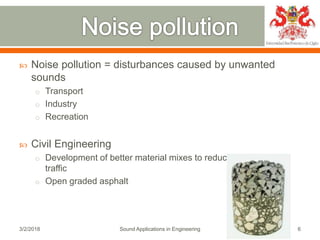
 Noise pollution = disturbances caused by unwanted
sounds
o Transport
o Industry
o Recreation
 Civil Engineering
o Development of better material mixes to reduce noise levels of
traffic
o Open graded asphalt
3/2/2018 Sound Applications in Engineering 6
 Used in The Netherlands (ZOAB)
 “Whisper asphalt”
 Very porous mix
o More coarse material
o Less fine material
 Advantages
o Noise reduction: 4dB at 120km/h
o Drainage of water – no aqua planning
o No rutting
 Disadvantages
o Less friction => longer distance when breaking
o Raveling problems
o Shorter lifetime than regular asphalt
3/2/2018 Sound Applications in Engineering 7
 Extending the service life of existing bridges
o Improved calculation methods
o Improved inspection methods
o Improved rehabilitation methods
 Inspection:
o Visual inspection
o Non-destructive inspection
o Destructive inspection
o Proof loading
3/2/2018 Sound Applications in Engineering 8
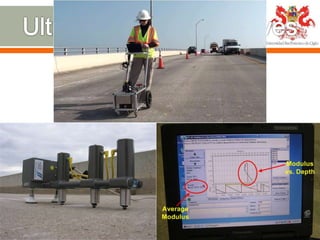
 Non-destructive testing method
 Evaluation of material properties (e.g. E-modulus)
 For near surface zone
 Surface wave dispersion
o Velocity of propagation as function of frequency and wavelength
o In layered system
o To obtain information about layer thickness and E
3/2/2018 Sound Applications in Engineering 9
3/2/2018 Sound Applications in Engineering 10
 More commonly used – with electro-magnetic waves (not
sound waves)
 Objects inside depth of concrete
o Reinforcement
o Wire meshes
 Produces contour maps of subsurface features
3/2/2018 Sound Applications in Engineering 11
 Fast methods:
o Where sound changes from clear ringing to mute and hollow
 Finds delaminations in concrete
3/2/2018 Sound Applications in Engineering 12
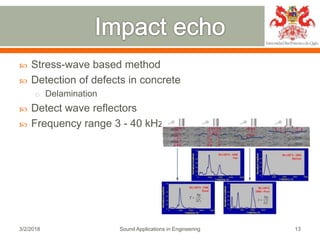
 Stress-wave based method
 Detection of defects in concrete
o Delamination
 Detect wave reflectors
 Frequency range 3 - 40 kHz
3/2/2018 Sound Applications in Engineering 13
 Dynamic response characteristics to a given impulse
excitation
 Lower range than impact echo
o 0 – 1kHz
3/2/2018 Sound Applications in Engineering 14
 Combine methods to get
overview of condition of
bridge
 More info: FHWA
o https://fhwaapps.fhwa.dot.gov
/ndep/
 Acoustic waves emitted by material
 Caused by irreversible change in internal structure
o Crack formation
o Plastic deformation
 Transient elastic waves
 < 1kHz – 100MHz
o For applications: 100 kHz – 100 MHz
 Event => measurement “hit”
3/2/2018 Sound Applications in Engineering 16
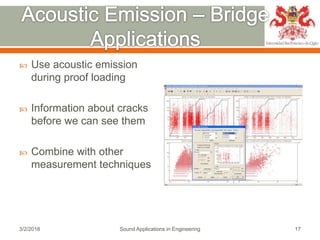
 Use acoustic emission
during proof loading
 Information about cracks
before we can see them
 Combine with other
measurement techniques
3/2/2018 Sound Applications in Engineering 17
3/2/2018 Sound Applications in Engineering 18
 Levels of assessment of bridges
o Hand calculation
o Linear finite element calculation
o Non-linear finite element calculation
o Probabilistic analysis
o Coupling probabilistic + NLFEA
 Still uncertainties?
o Proof loading until different load levels
• No permanent damage
• Unfit for use level
• Repair level
3/2/2018 Sound Applications in Engineering 19
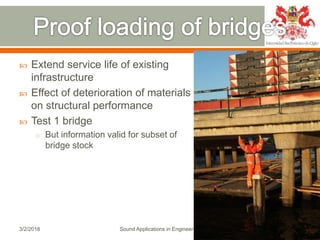
 Extend service life of existing
infrastructure
 Effect of deterioration of materials
on structural performance
 Test 1 bridge
o But information valid for subset of
bridge stock
3/2/2018 Sound Applications in Engineering 20
 Proof loading to assess capacity of
existing bridge
 Study cracks and deformations for
applied loads
 Crack formation: acoustic
emissions measurements
 Ruytenschildtbrug: testing to failure
 Sound in Engineering – many
applications
 General applications: think
about effects of sound for
buildings, pavements, ..
 Application to bridges
o NDT techniques for better
inspection
o Acoustic emission as measurement
technique
o Acoustic emission used in proof
loading
3/2/2018 Sound Applications in Engineering 23
Contact:
Eva Lantsoght
E.O.L.Lantsoght@tudelft.nl
elantsoght@usfq.edu.ec

Sound in engineering

  • 1.
      Dr. ir.Eva Lantsoght 3/2/2018 Sound Applications in Engineering 1
  • 2.
     General applications Applications in bridge engineering o NDT techniques o Acoustic emission o => Proof loading  Summary 3/2/2018 Sound Applications in Engineering 2
  • 3.
     Sound inEngineering? Acoustic Engineering o Design, analysis and control of sound  Applications o Noise control: reduce unwanted noise o Ultrasound o Programming digital sound of synthesizers 3/2/2018 Sound Applications in Engineering 3
  • 4.
     Design ofbuilding ~ sound experience  Depends on the use of the building o Theatre: good speech intelligibility o Concert hall: quality of sound of music o Offices: pleasant space, not too noisy 3/2/2018 Sound Applications in Engineering 4
  • 5.
  • 6.
     Noise pollution= disturbances caused by unwanted sounds o Transport o Industry o Recreation  Civil Engineering o Development of better material mixes to reduce noise levels of traffic o Open graded asphalt 3/2/2018 Sound Applications in Engineering 6
  • 7.
     Used inThe Netherlands (ZOAB)  “Whisper asphalt”  Very porous mix o More coarse material o Less fine material  Advantages o Noise reduction: 4dB at 120km/h o Drainage of water – no aqua planning o No rutting  Disadvantages o Less friction => longer distance when breaking o Raveling problems o Shorter lifetime than regular asphalt 3/2/2018 Sound Applications in Engineering 7
  • 8.
     Extending theservice life of existing bridges o Improved calculation methods o Improved inspection methods o Improved rehabilitation methods  Inspection: o Visual inspection o Non-destructive inspection o Destructive inspection o Proof loading 3/2/2018 Sound Applications in Engineering 8
  • 9.
     Non-destructive testingmethod  Evaluation of material properties (e.g. E-modulus)  For near surface zone  Surface wave dispersion o Velocity of propagation as function of frequency and wavelength o In layered system o To obtain information about layer thickness and E 3/2/2018 Sound Applications in Engineering 9
  • 10.
    3/2/2018 Sound Applicationsin Engineering 10
  • 11.
     More commonlyused – with electro-magnetic waves (not sound waves)  Objects inside depth of concrete o Reinforcement o Wire meshes  Produces contour maps of subsurface features 3/2/2018 Sound Applications in Engineering 11
  • 12.
     Fast methods: oWhere sound changes from clear ringing to mute and hollow  Finds delaminations in concrete 3/2/2018 Sound Applications in Engineering 12
  • 13.
     Stress-wave basedmethod  Detection of defects in concrete o Delamination  Detect wave reflectors  Frequency range 3 - 40 kHz 3/2/2018 Sound Applications in Engineering 13
  • 14.
     Dynamic responsecharacteristics to a given impulse excitation  Lower range than impact echo o 0 – 1kHz 3/2/2018 Sound Applications in Engineering 14
  • 15.
     Combine methodsto get overview of condition of bridge  More info: FHWA o https://fhwaapps.fhwa.dot.gov /ndep/
  • 16.
     Acoustic wavesemitted by material  Caused by irreversible change in internal structure o Crack formation o Plastic deformation  Transient elastic waves  < 1kHz – 100MHz o For applications: 100 kHz – 100 MHz  Event => measurement “hit” 3/2/2018 Sound Applications in Engineering 16
  • 17.
     Use acousticemission during proof loading  Information about cracks before we can see them  Combine with other measurement techniques 3/2/2018 Sound Applications in Engineering 17
  • 18.
    3/2/2018 Sound Applicationsin Engineering 18
  • 19.
     Levels ofassessment of bridges o Hand calculation o Linear finite element calculation o Non-linear finite element calculation o Probabilistic analysis o Coupling probabilistic + NLFEA  Still uncertainties? o Proof loading until different load levels • No permanent damage • Unfit for use level • Repair level 3/2/2018 Sound Applications in Engineering 19
  • 20.
     Extend servicelife of existing infrastructure  Effect of deterioration of materials on structural performance  Test 1 bridge o But information valid for subset of bridge stock 3/2/2018 Sound Applications in Engineering 20
  • 21.
     Proof loadingto assess capacity of existing bridge  Study cracks and deformations for applied loads  Crack formation: acoustic emissions measurements  Ruytenschildtbrug: testing to failure
  • 23.
     Sound inEngineering – many applications  General applications: think about effects of sound for buildings, pavements, ..  Application to bridges o NDT techniques for better inspection o Acoustic emission as measurement technique o Acoustic emission used in proof loading 3/2/2018 Sound Applications in Engineering 23
  • 24.