Symposium
SEPT20Years – The Co-existence of Nature, Economy
and Society as Base for Sustainable Economic
Development, Leipzig, 24 November 2012


PES and REDD+ for sustainable land
management in developing countries
– case studies from Latin America, South East Asia, and Africa

Udo Nehren,
Cologne University of Applied Sciences
1


Higher Education Excellence in Development
Cooperation – exceed

 — The CNRD is one of five competence centers for
   development cooperation in Germany, funded by the
   German Ministery of Economic Cooperation and
   Development (BMZ)
 — CNRD is coordinated by the Institute for Technology and
   Resources Management in the Tropics and Subtropics (ITT)
   at Cologne University of Applied Sciences
2


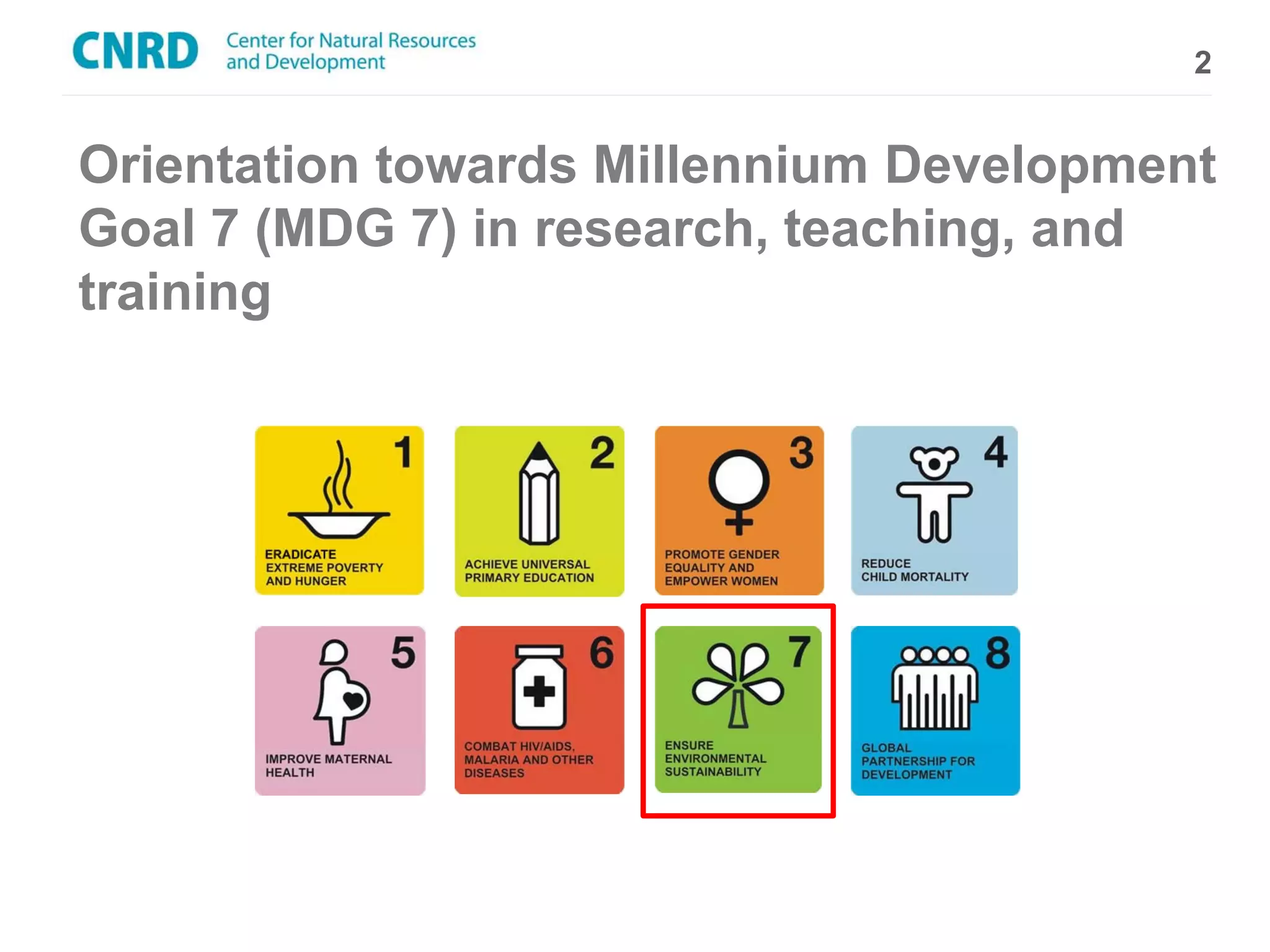
Orientation towards Millennium Development
Goal 7 (MDG 7) in research, teaching, and
training
3


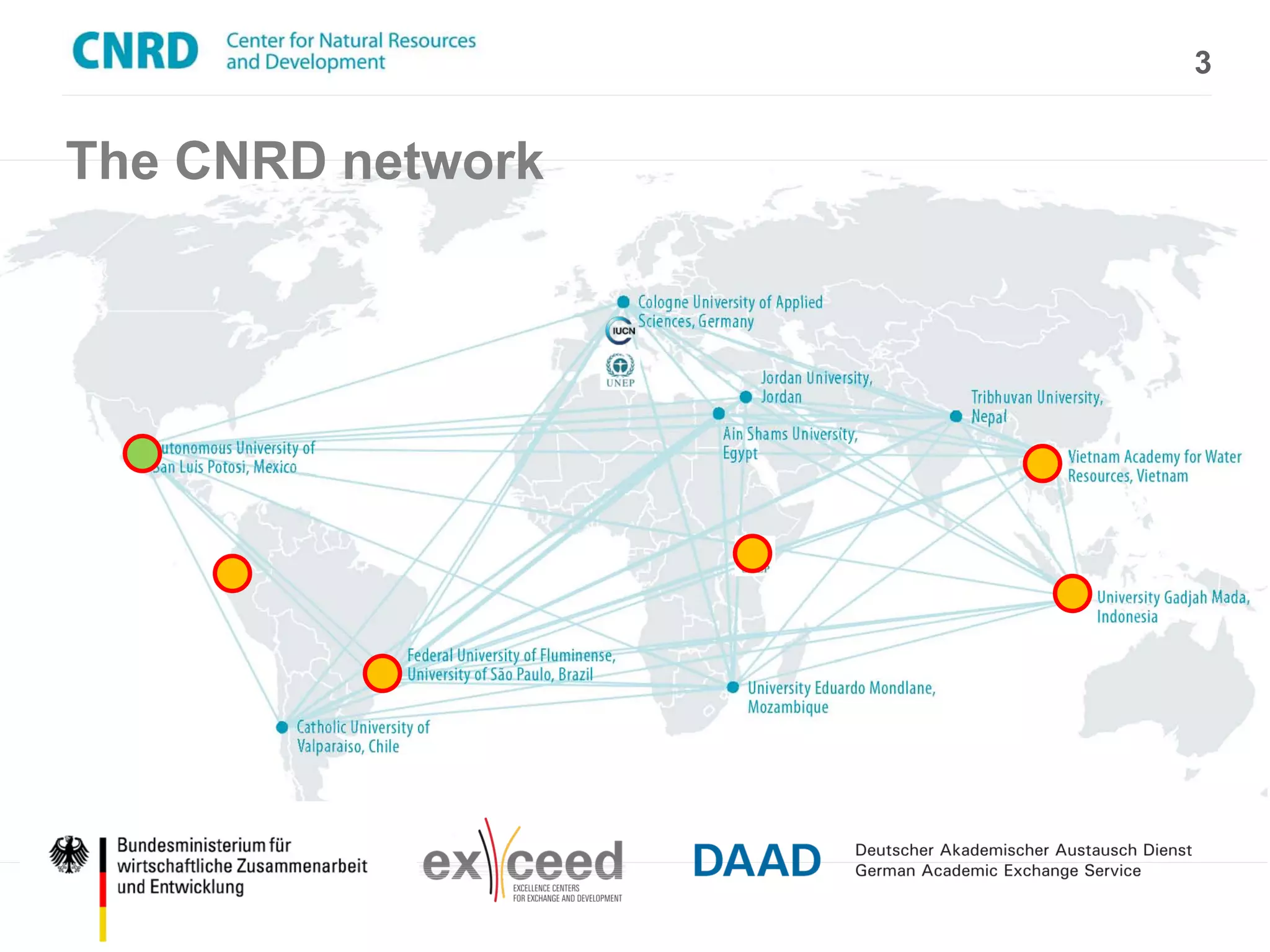
The CNRD network
4


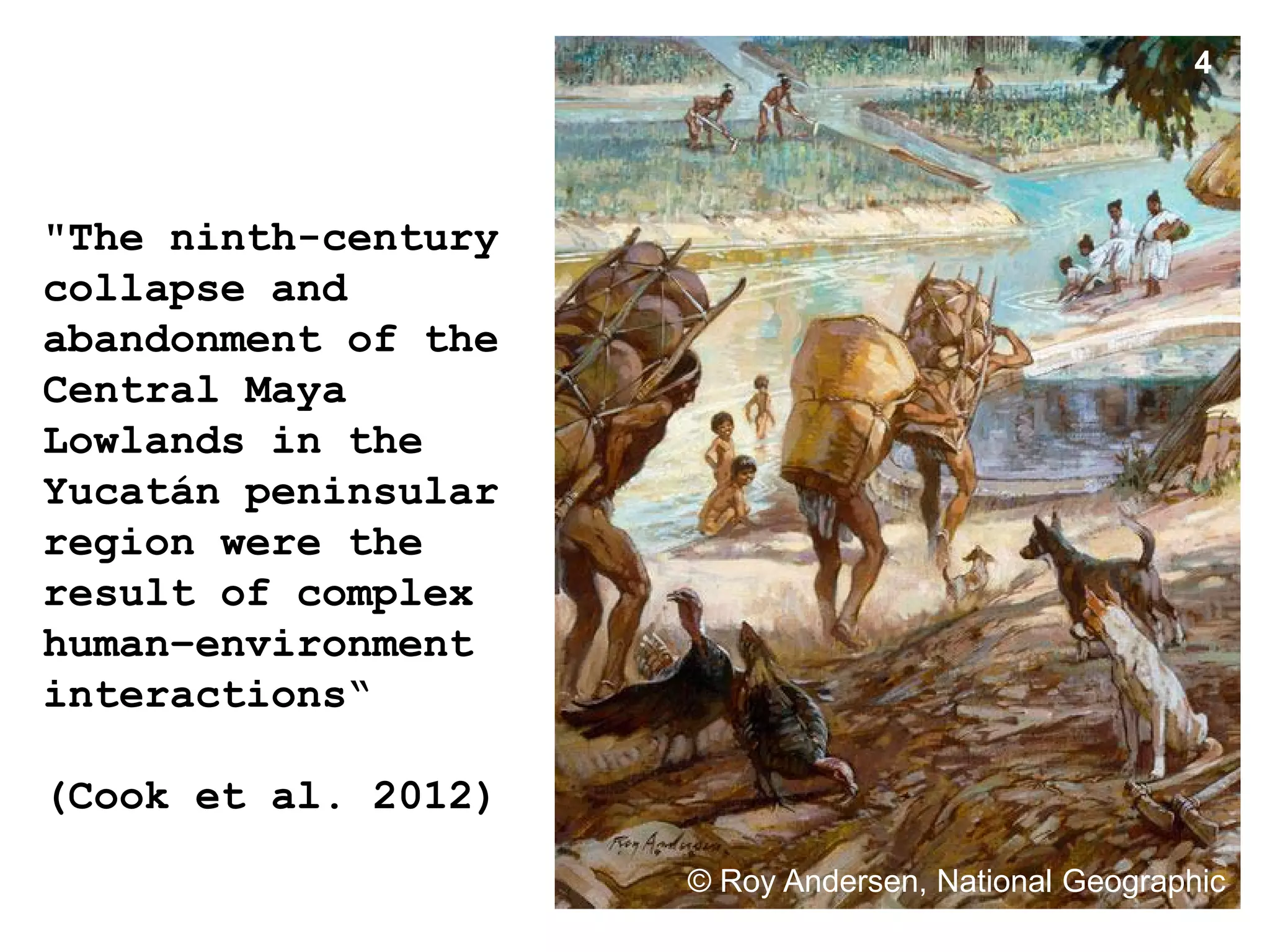
"The ninth-century
collapse and
abandonment of the
Central Maya
Lowlands in the
Yucatán peninsular
region were the
result of complex
human–environment
interactions“

(Cook et al. 2012)
                     © Roy Andersen, National Geographic
5


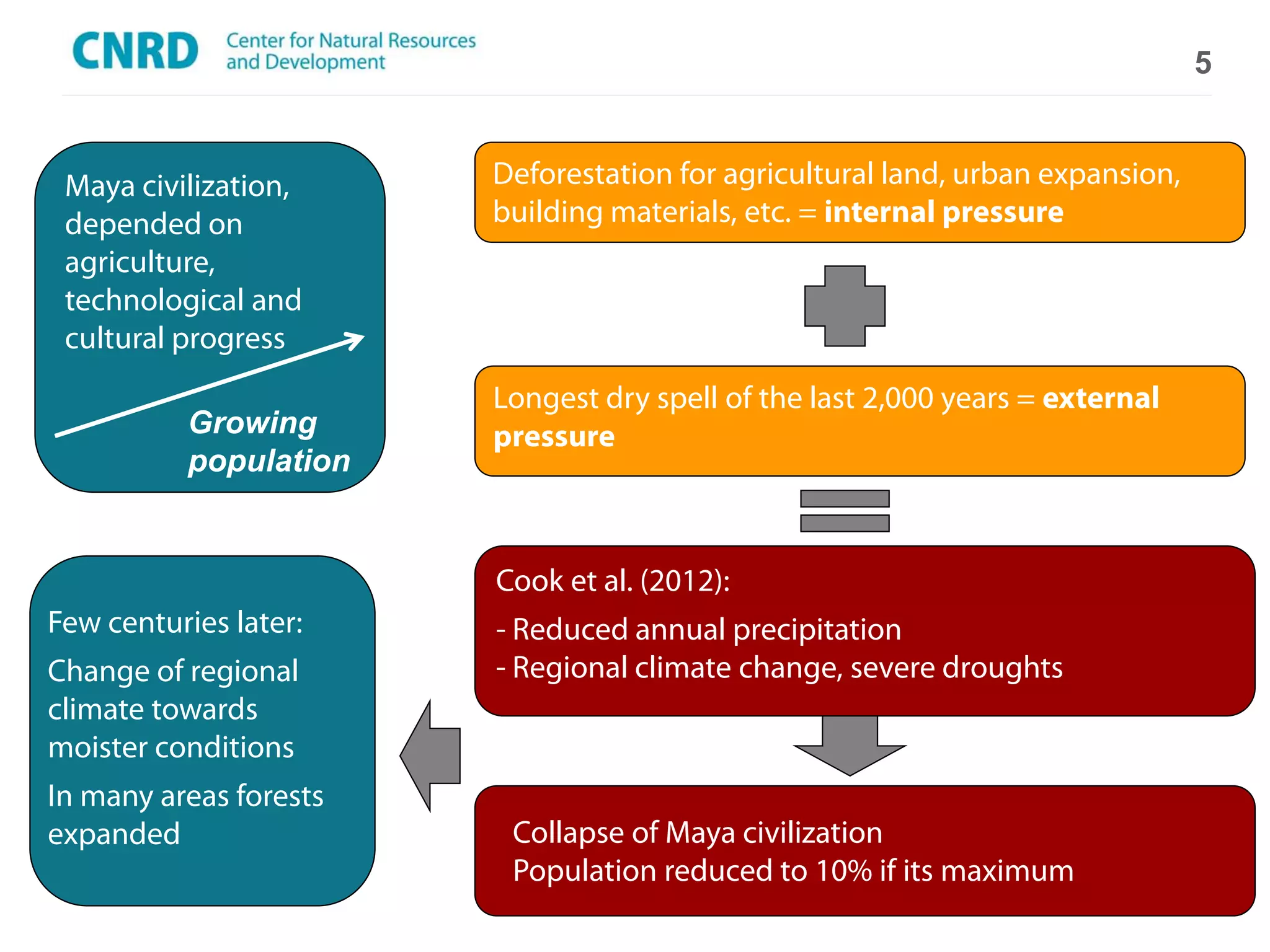
 Maya civilization,     Deforestation for agricultural land, urban expansion,
 depended on            building materials, etc. = internal pressure
 agriculture,
 technological and
 cultural progress
                        Longest dry spell of the last 2,000 years = external
          Growing       pressure
          population


                        Cook et al. (2012):
Few centuries later:    - Reduced annual precipitation
Change of regional      - Regional climate change, severe droughts
climate towards
moister conditions
In many areas forests
expanded                 Collapse of Maya civilization
                         Population reduced to 10% if its maximum
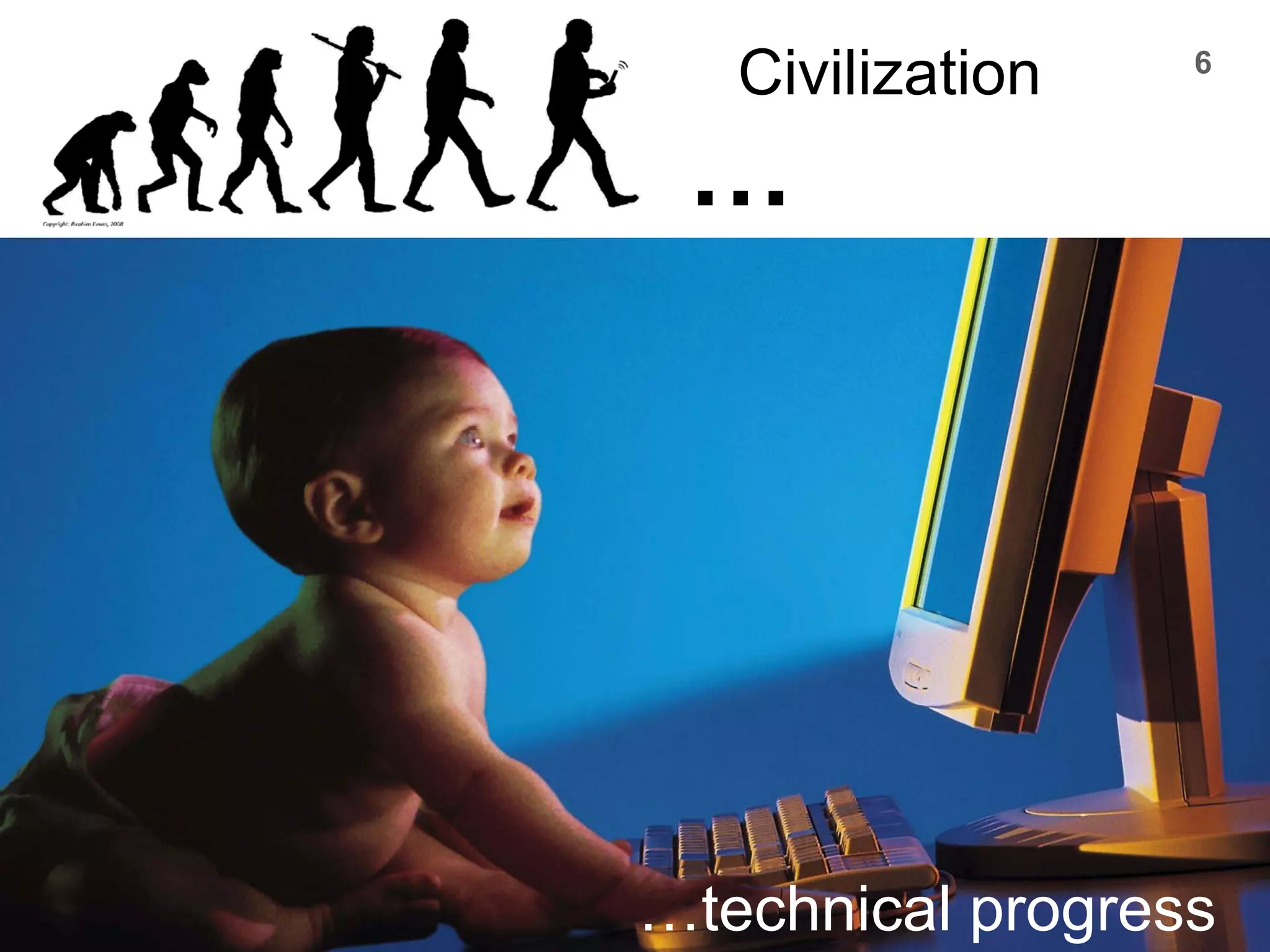
Civilization   6


 …


…technical progress
7
8


Fotos Yucatán Kultur
und Karst
Slides Nummerieren


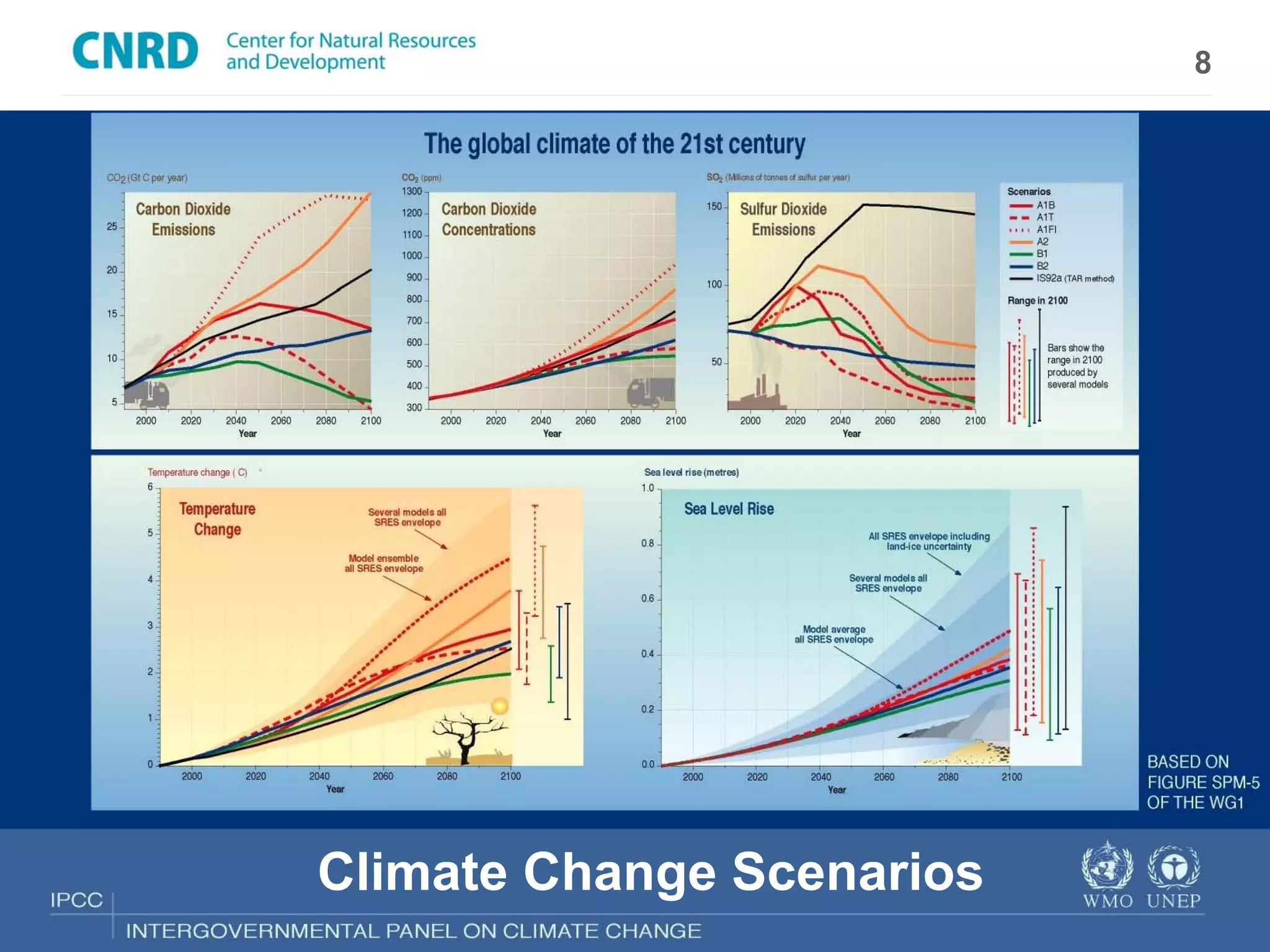
       Climate Change Scenarios
9


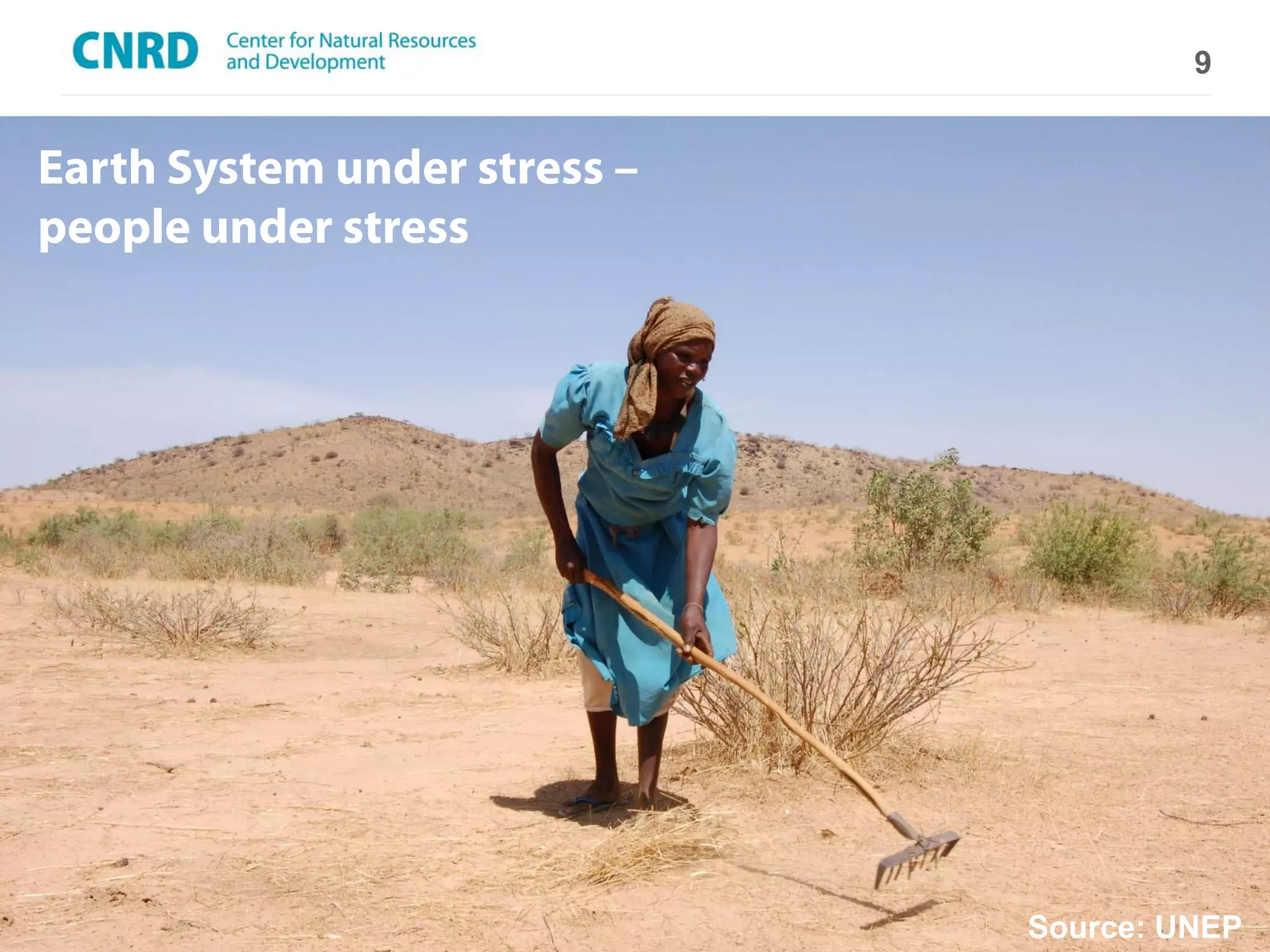
Earth System under stress –
people under stress


                              Source: UNEP
10


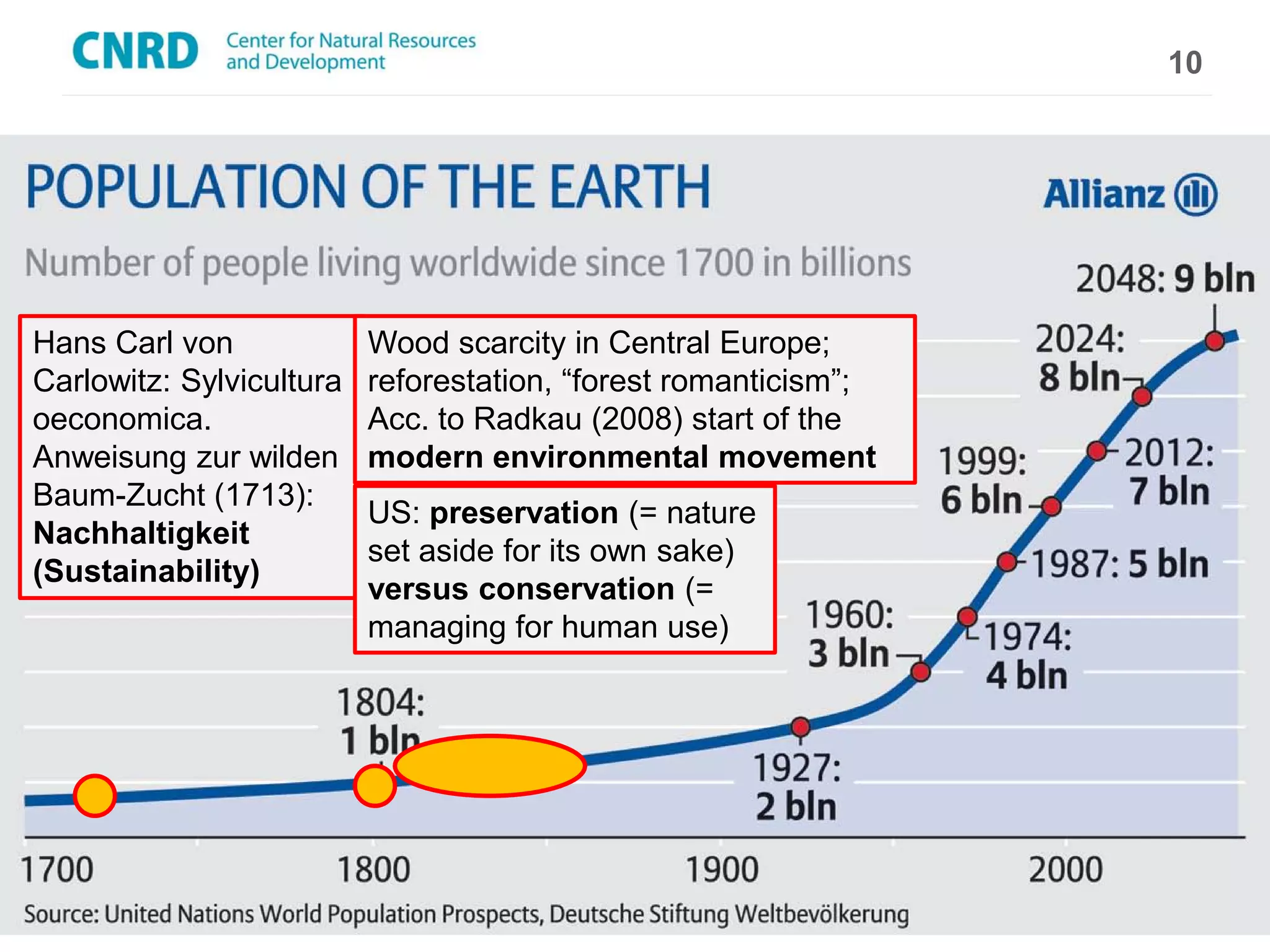
Hans Carl von             Wood scarcity in Central Europe;
Carlowitz: Sylvicultura   reforestation, “forest romanticism”;
oeconomica.               Acc. to Radkau (2008) start of the
Anweisung zur wilden      modern environmental movement
Baum-Zucht (1713):
                          US: preservation (= nature
Nachhaltigkeit
                          set aside for its own sake)
(Sustainability)
                          versus conservation (=
                          managing for human use)
10


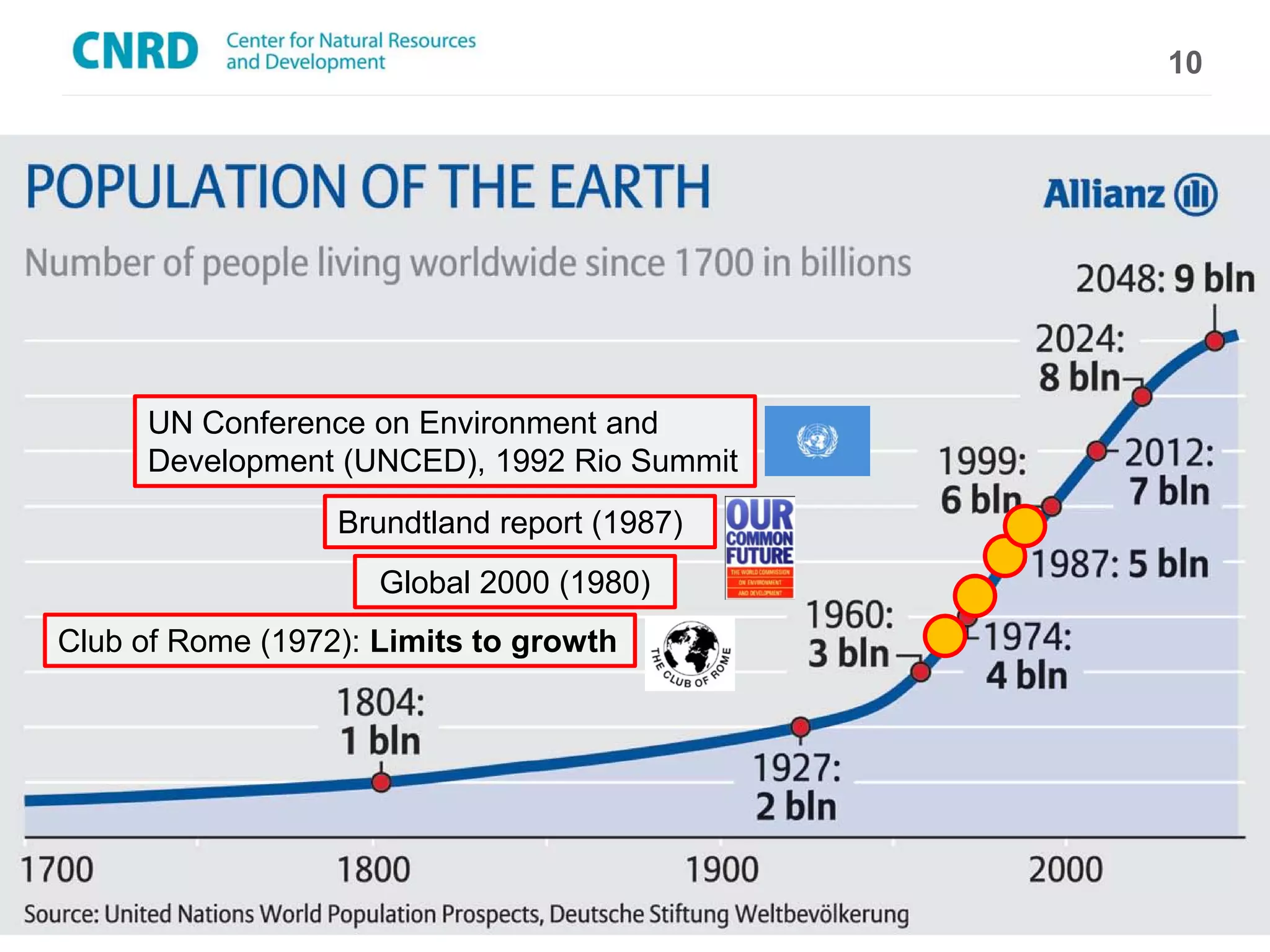
     UN Conference on Environment and
     Development (UNCED), 1992 Rio Summit
                  Brundtland report (1987)
                     Global 2000 (1980)
Club of Rome (1972): Limits to growth
10


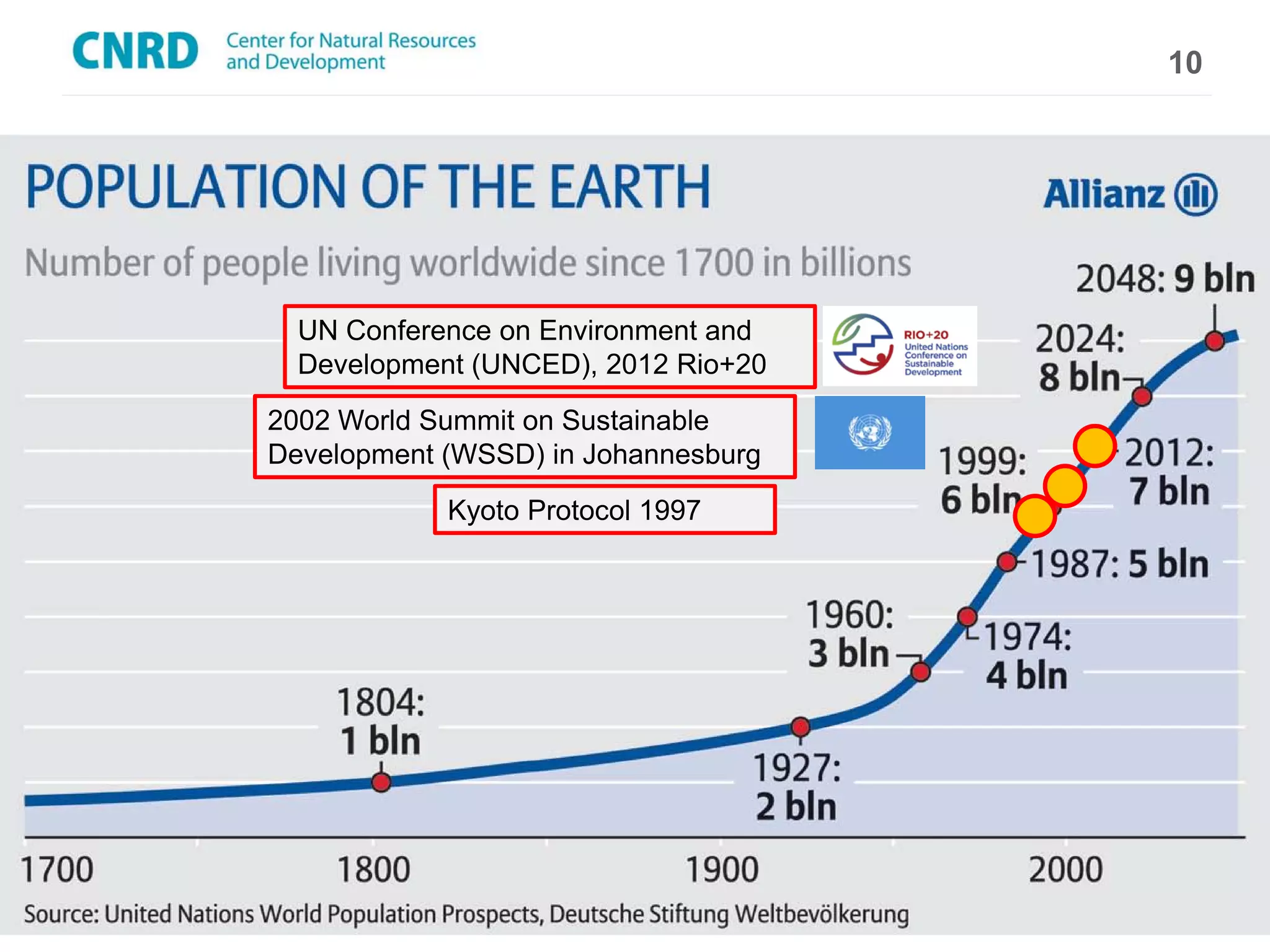
  UN Conference on Environment and
  Development (UNCED), 2012 Rio+20
2002 World Summit on Sustainable
Development (WSSD) in Johannesburg
            Kyoto Protocol 1997
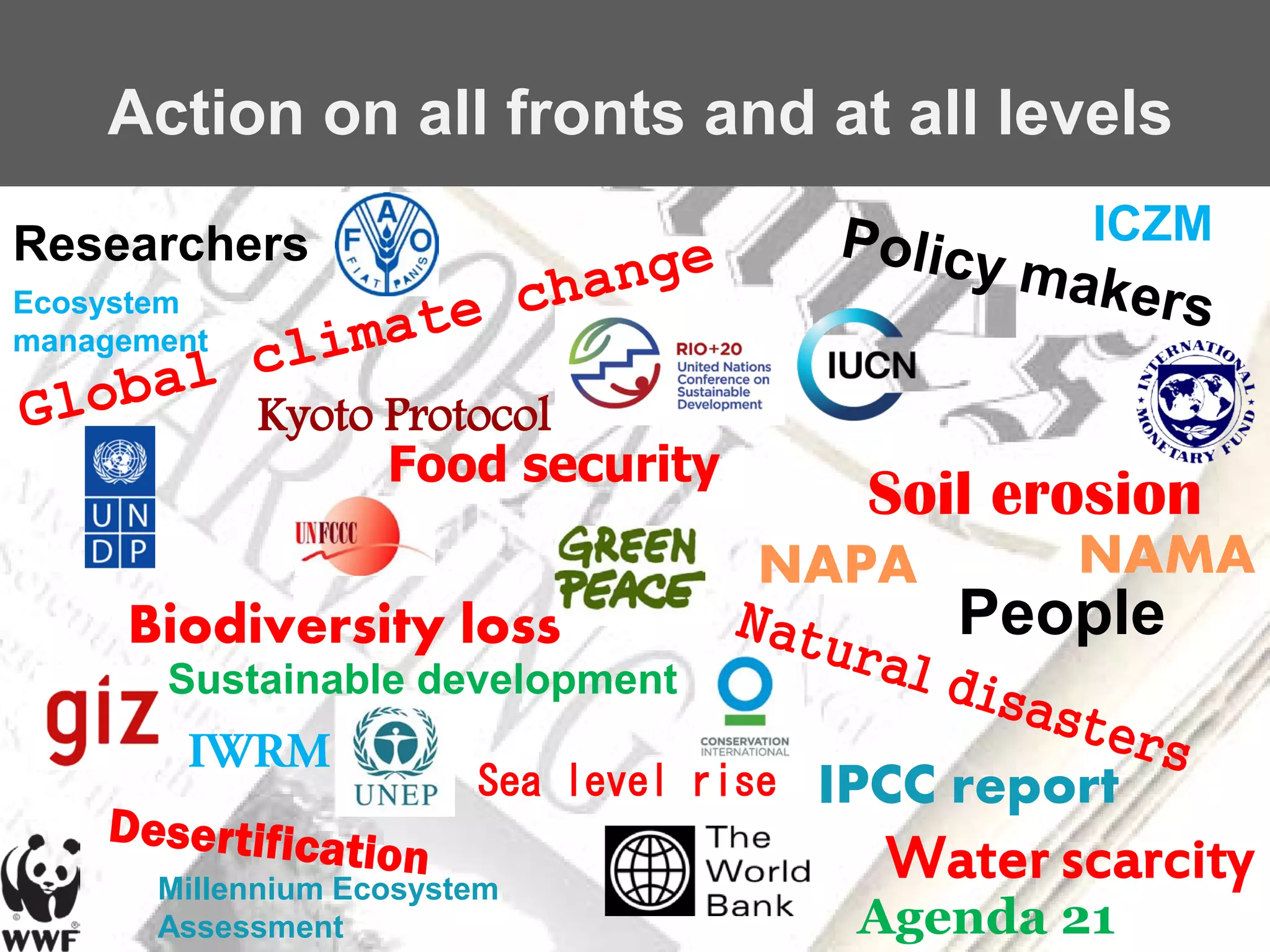
Action on all fronts and at all levels
Researchers                                        ICZM
Ecosystem
management

             Kyoto Protocol
                   Food security
                                          Soil erosion
                                             People
       Sustainable development
        IWRM
                         Sea level rise

       Millennium Ecosystem
                                          Water  scarcity  
       Assessment                         Agenda 21
12


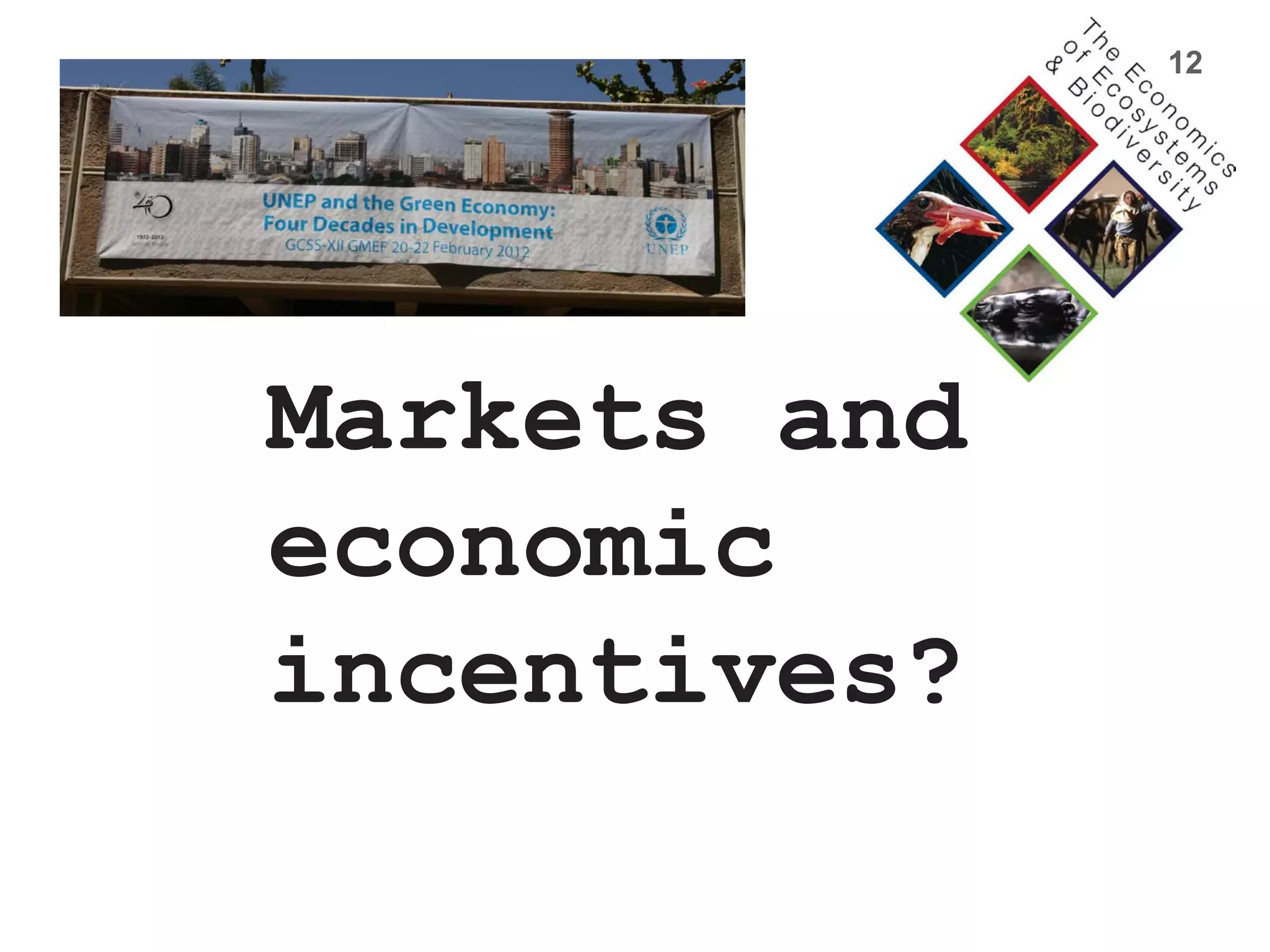
Markets and
economic
incentives?
13


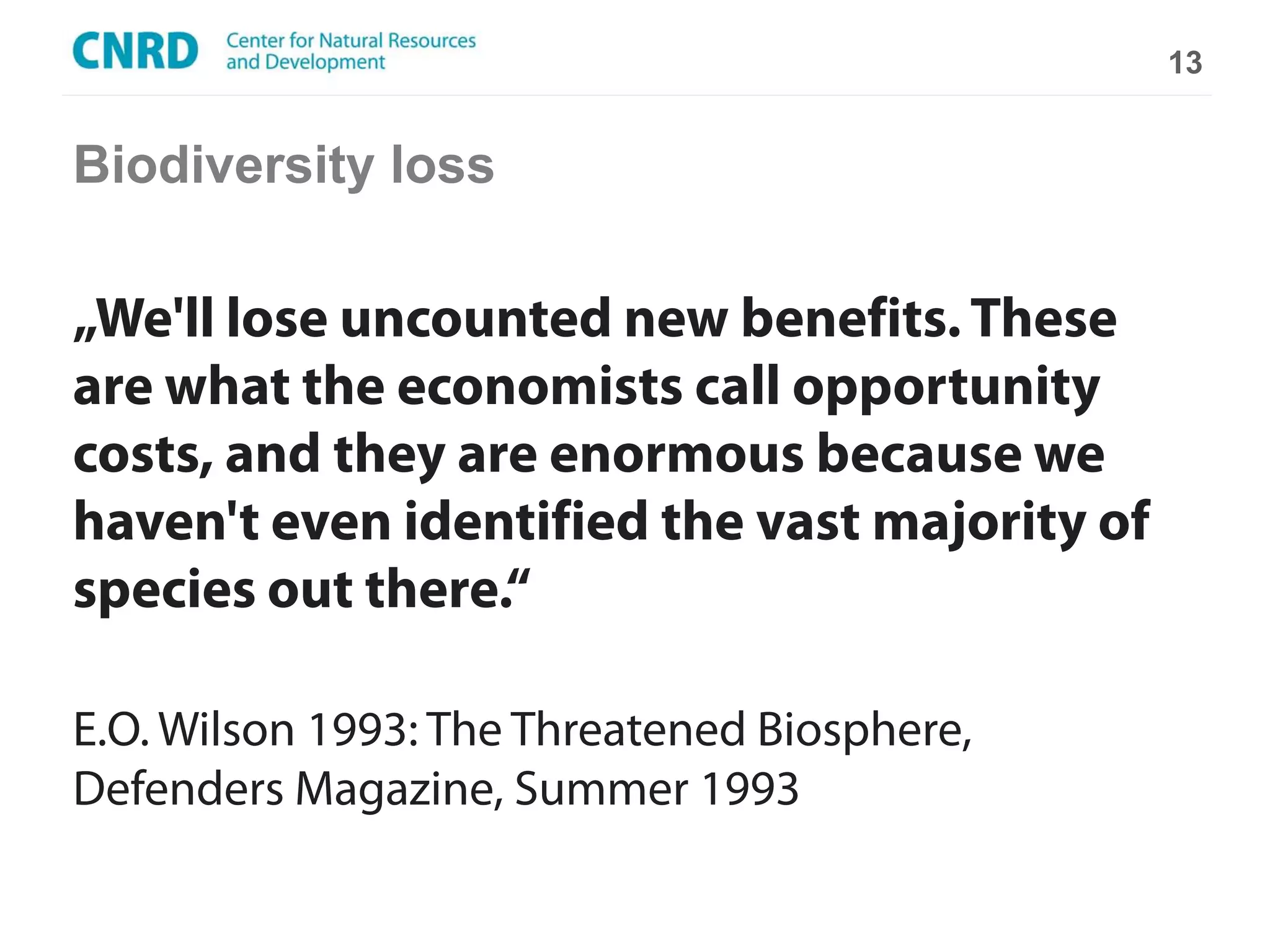
Biodiversity loss

„We'll lose uncounted new benefits. These
are what the economists call opportunity
costs, and they are enormous because we
haven't even identified the vast majority of
species out there.“

E.O. Wilson 1993: The Threatened Biosphere,
Defenders Magazine, Summer 1993
14


The crucial role of tropical and
   subtropical ecosystems
15


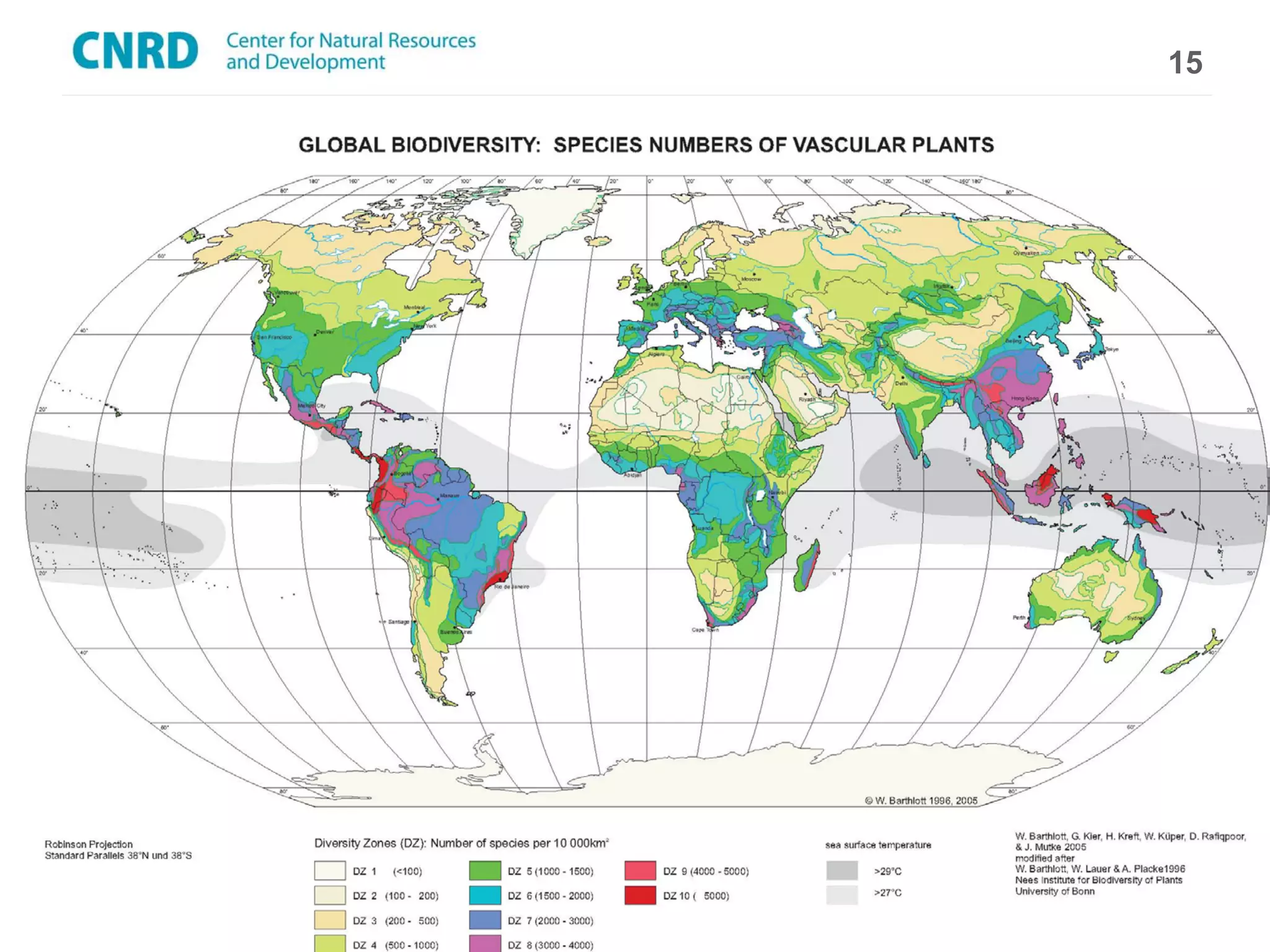
Significance of tropical and subtropical
Ecosystems
16


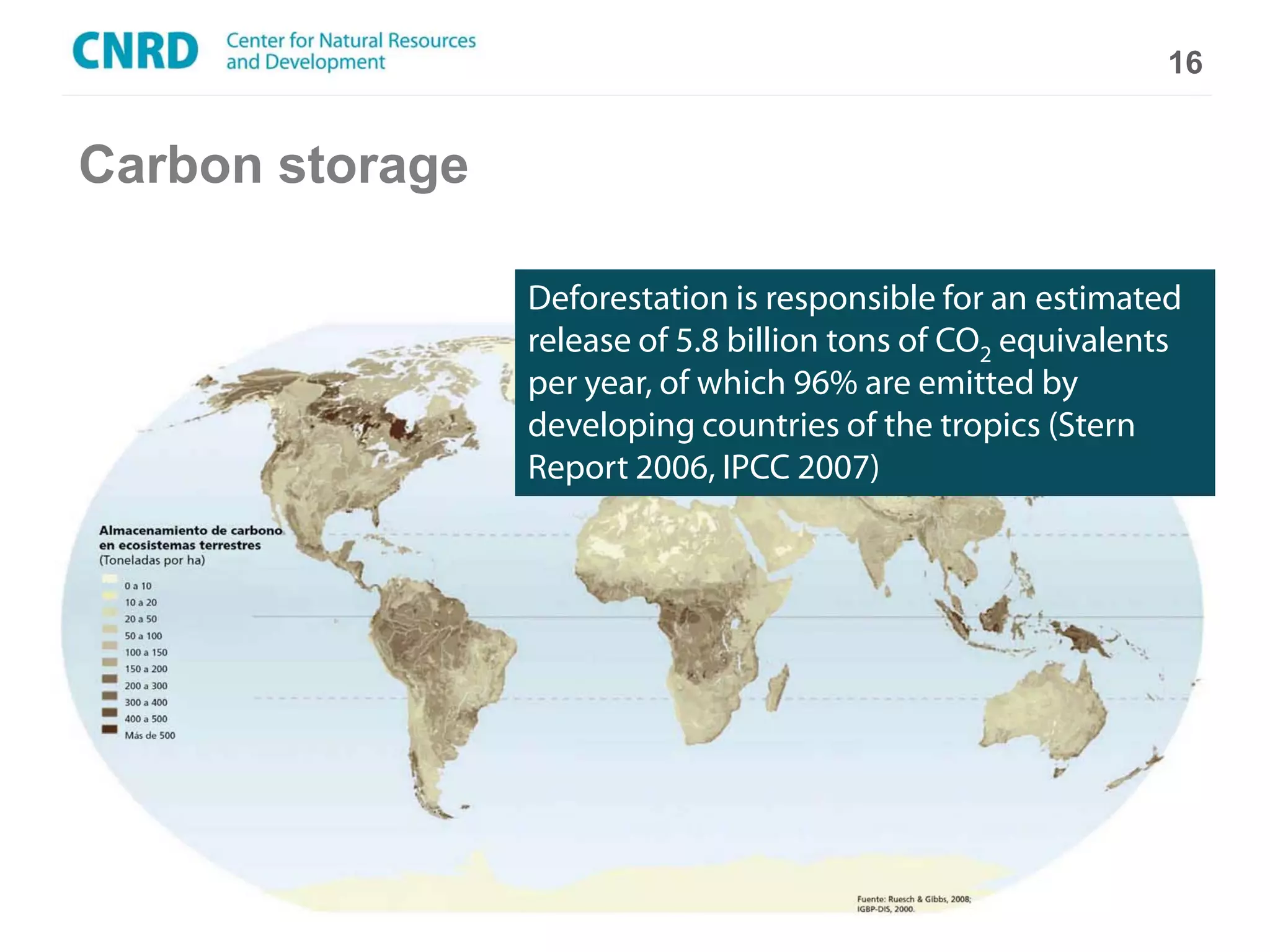
Carbon storage

                 Deforestation is responsible for an estimated
                 release of 5.8 billion tons of CO2 equivalents
                 per year, of which 96% are emitted by
                 developing countries of the tropics (Stern
                 Report 2006, IPCC 2007)
17


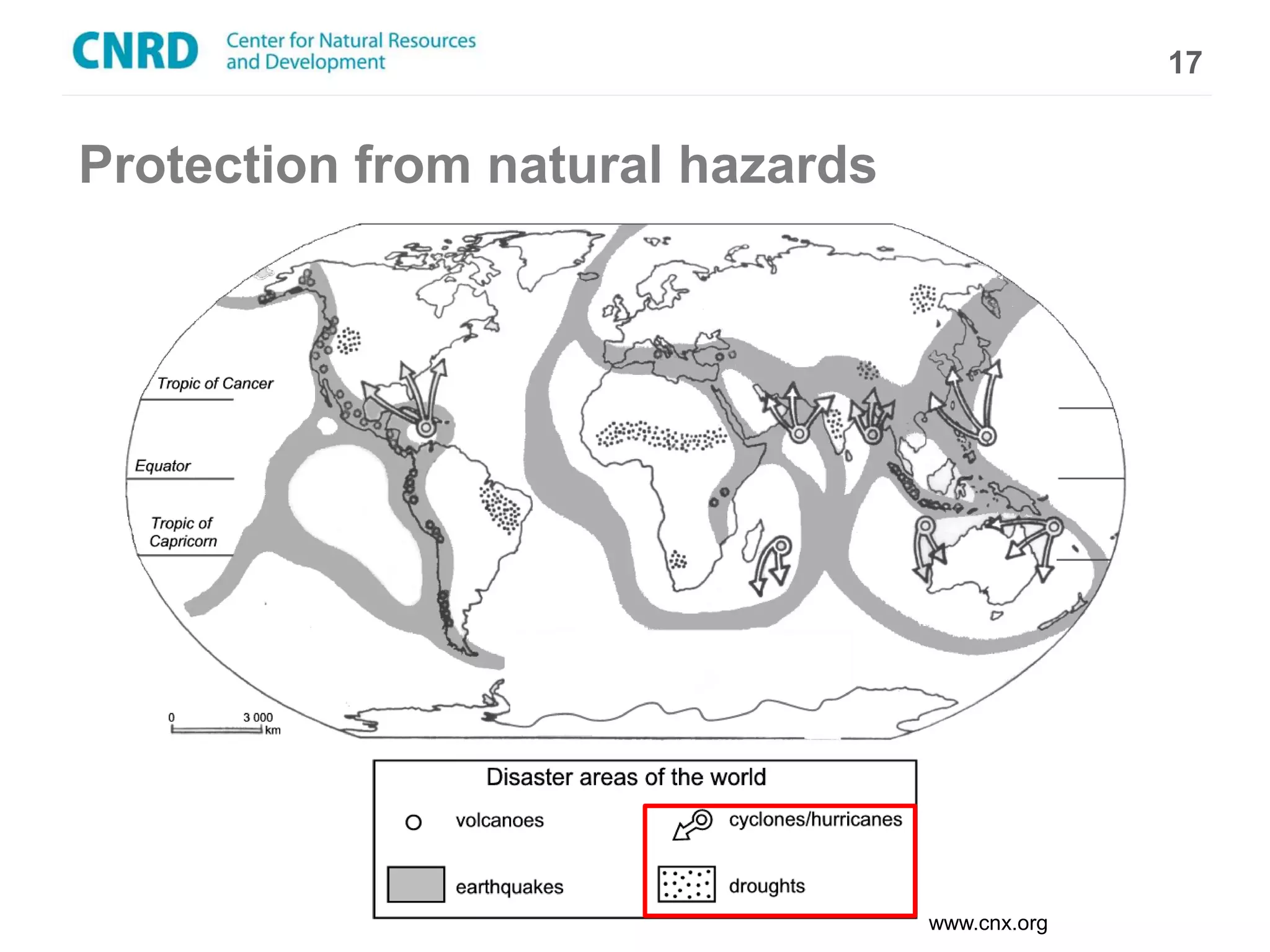
Protection from natural hazards


                                  www.cnx.org
18


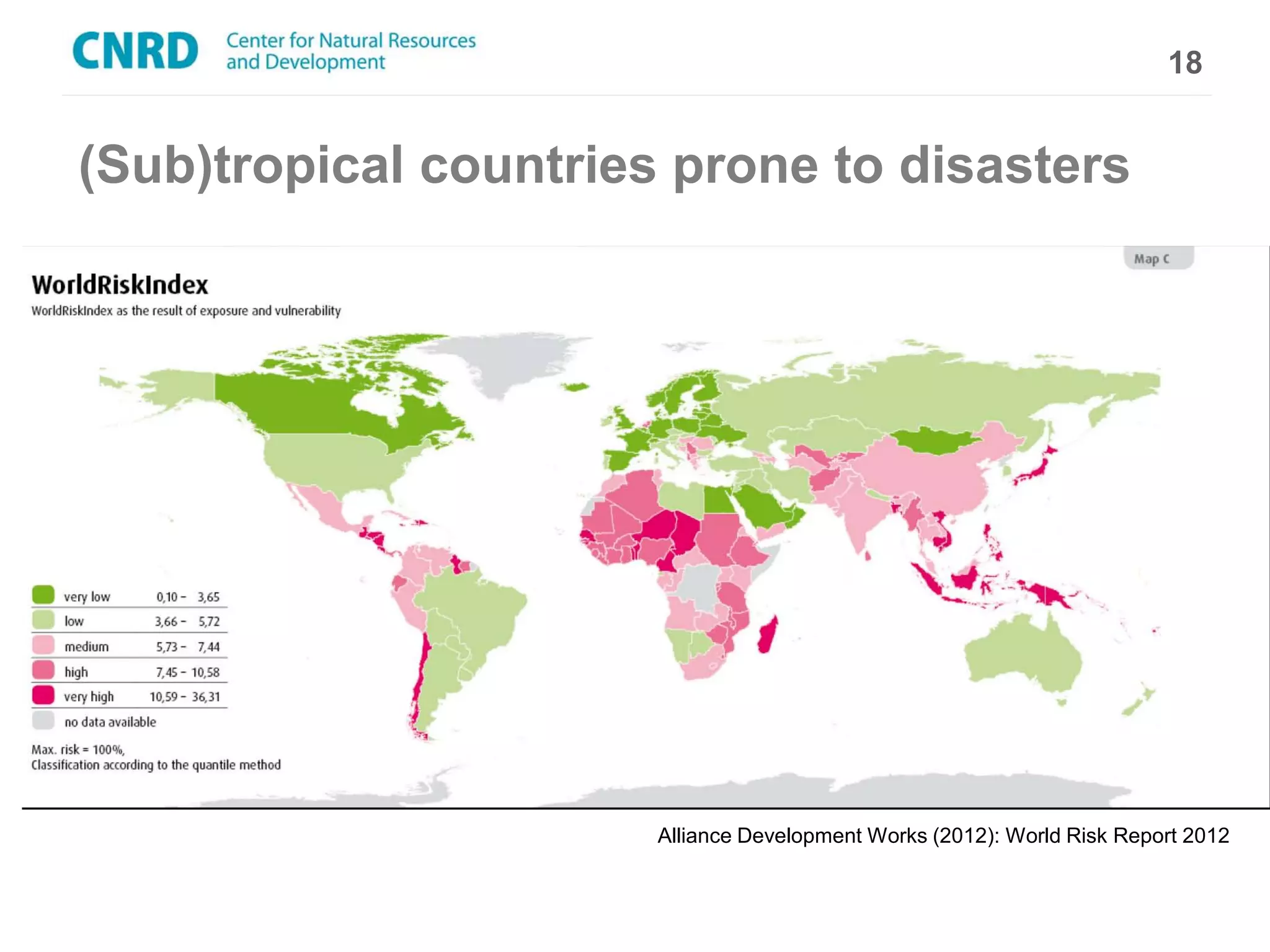
(Sub)tropical countries prone to disasters


                       Alliance Development Works (2012): World Risk Report 2012
19


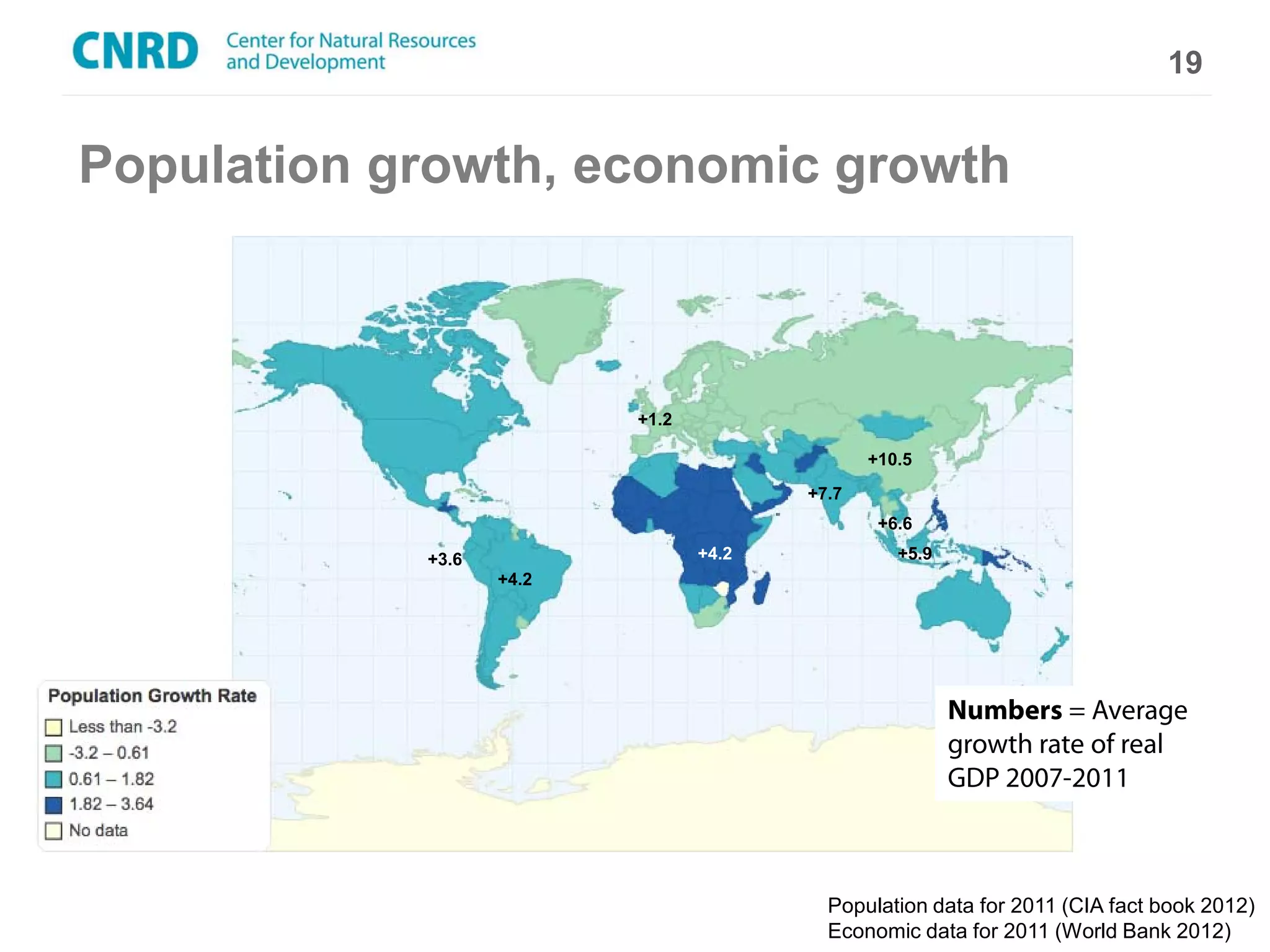
Population growth, economic growth


                          +1.2

                                               +10.5
                                        +7.7
                                                +6.6

            +3.6                 +4.2             +5.9
                   +4.2


                                                         Numbers = Average
                                                         growth rate of real
                                                         GDP 2007-2011


                                          Population data for 2011 (CIA fact book 2012)
                                          Economic data for 2011 (World Bank 2012)
20


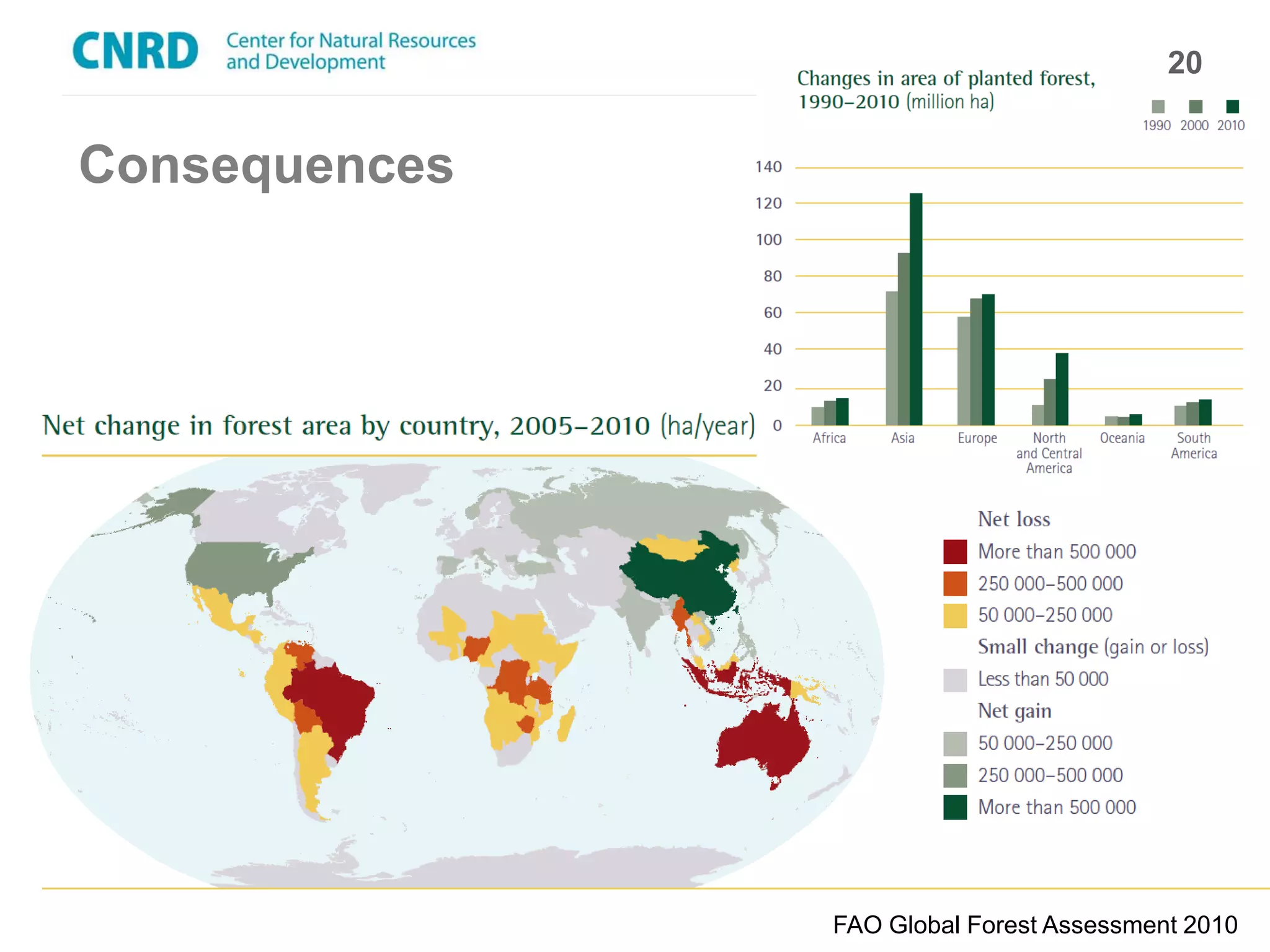
Consequences


               FAO Global Forest Assessment 2010
21


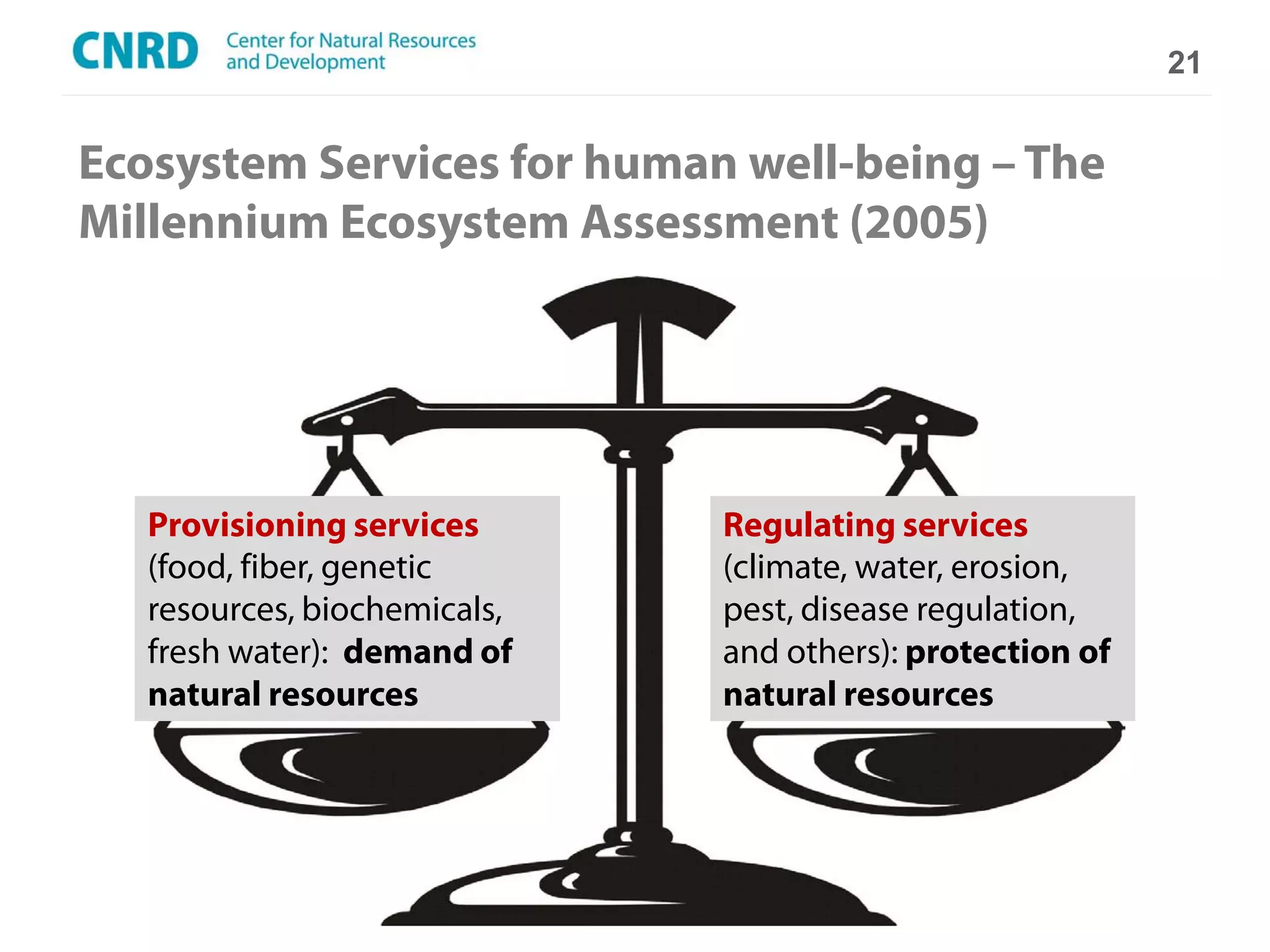
Ecosystem Services for human well-being – The
Millennium Ecosystem Assessment (2005)


   Provisioning services      Regulating services
   (food, fiber, genetic      (climate, water, erosion,
   resources, biochemicals,   pest, disease regulation,
   fresh water): demand of    and others): protection of
   natural resources          natural resources
22


Mechanismen:
CDM
REDD+
Paying people for sustainable forest
and land use management?
PES
23


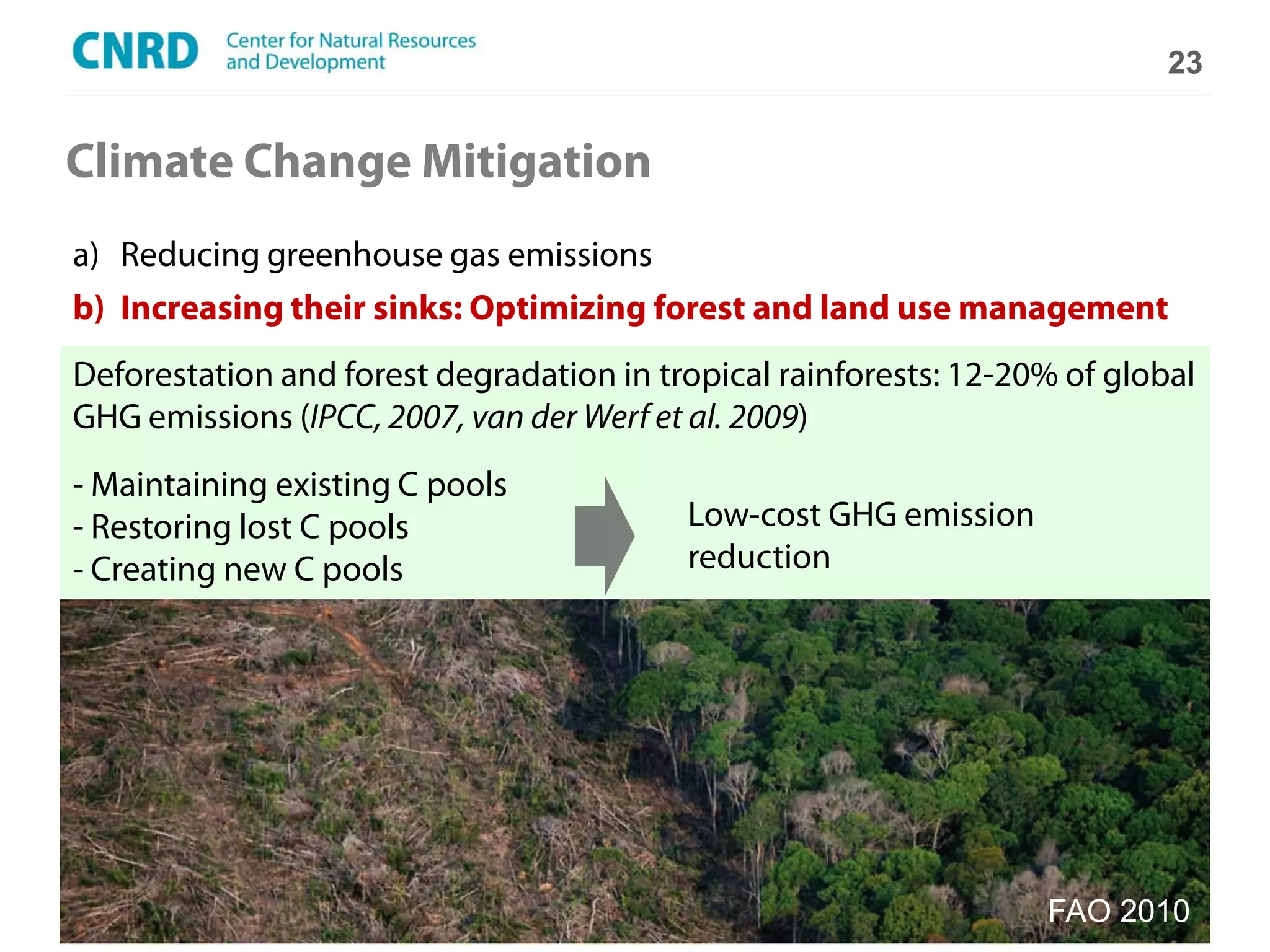
Climate Change Mitigation
a) Reducing greenhouse gas emissions
b) Increasing their sinks: Optimizing forest and land use management
Deforestation and forest degradation in tropical rainforests: 12-20% of global
GHG emissions (IPCC, 2007, van der Werf et al. 2009)
- Maintaining existing C pools
- Restoring lost C pools                  Low-cost GHG emission
- Creating new C pools                    reduction


                                                                   FAO 2010
24


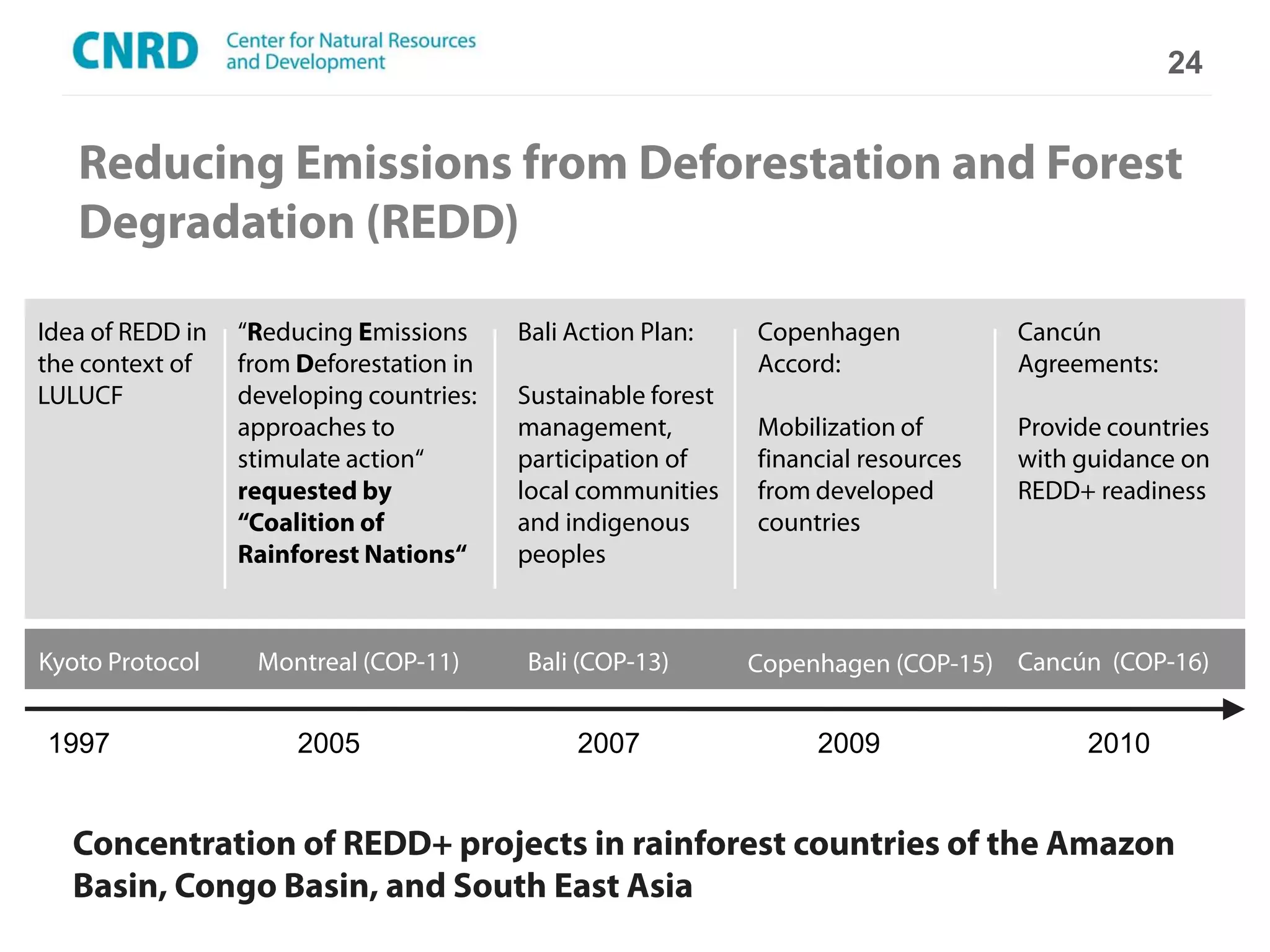
   Reducing Emissions from Deforestation and Forest
   Degradation (REDD)

Idea of REDD in   “Reducing Emissions     Bali Action Plan:    Copenhagen            Cancún
the context of    from Deforestation in                        Accord:               Agreements:
LULUCF            developing countries:   Sustainable forest
                  approaches to           management,          Mobilization of       Provide countries
                  stimulate action“       participation of     financial resources   with guidance on
                  requested by            local communities    from developed        REDD+ readiness
                  “Coalition of           and indigenous       countries
                  Rainforest Nations“     peoples


Kyoto Protocol     Montreal (COP-11)      Bali (COP-13)        Copenhagen (COP-15) Cancún (COP-16)


1997                   2005                    2007                 2009                   2010


   Concentration of REDD+ projects in rainforest countries of the Amazon
   Basin, Congo Basin, and South East Asia
25


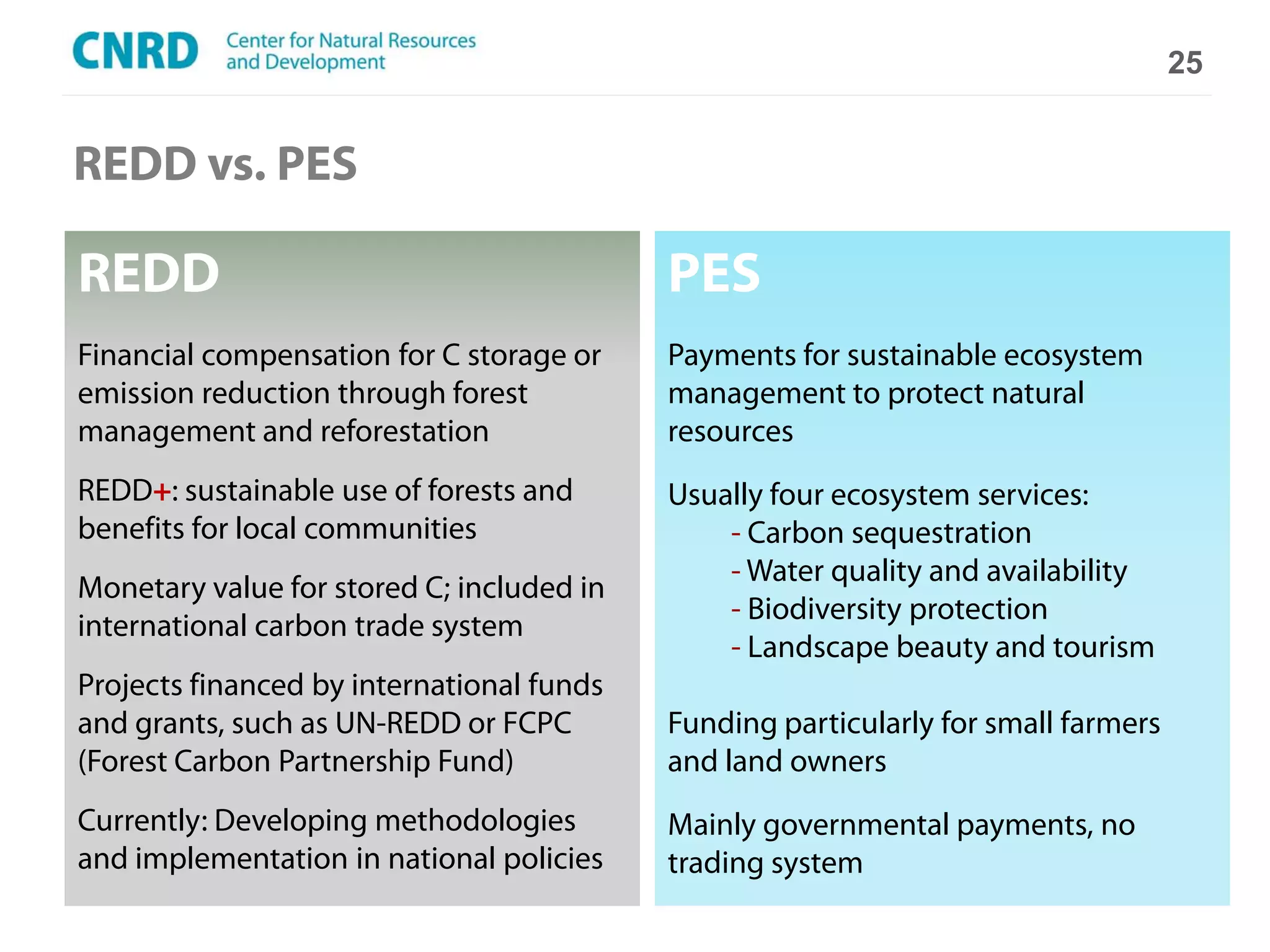
REDD vs. PES

REDD                                       PES
Financial compensation for C storage or    Payments for sustainable ecosystem
emission reduction through forest          management to protect natural
management and reforestation               resources
REDD+: sustainable use of forests and      Usually four ecosystem services:
benefits for local communities                 - Carbon sequestration
                                               - Water quality and availability
Monetary value for stored C; included in
                                               - Biodiversity protection
international carbon trade system
                                               - Landscape beauty and tourism
Projects financed by international funds
and grants, such as UN-REDD or FCPC        Funding particularly for small farmers
(Forest Carbon Partnership Fund)           and land owners
Currently: Developing methodologies        Mainly governmental payments, no
and implementation in national policies    trading system
Case study I: Ecuador                         26


  Potentials and Risks of REDD+ implementation
      in indigenous community lands in the
               Ecuadorian Amazon
Toa Loaiza-Lange, Udo Nehren, Gerhard Gerold
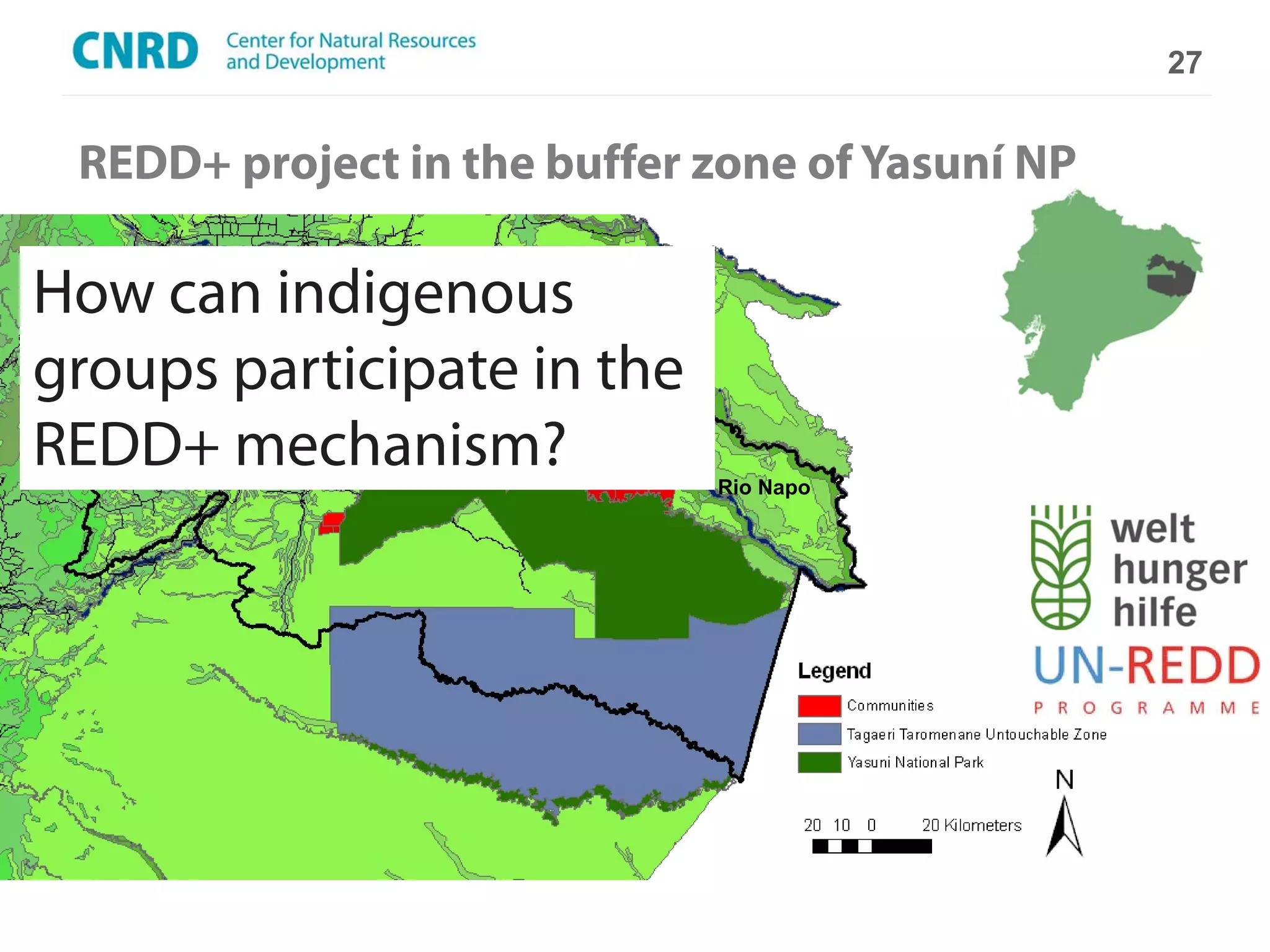
27


 REDD+ project in the buffer zone of Yasuní NP

How can indigenous
groups participate in the
REDD+ mechanism?             Rio Napo
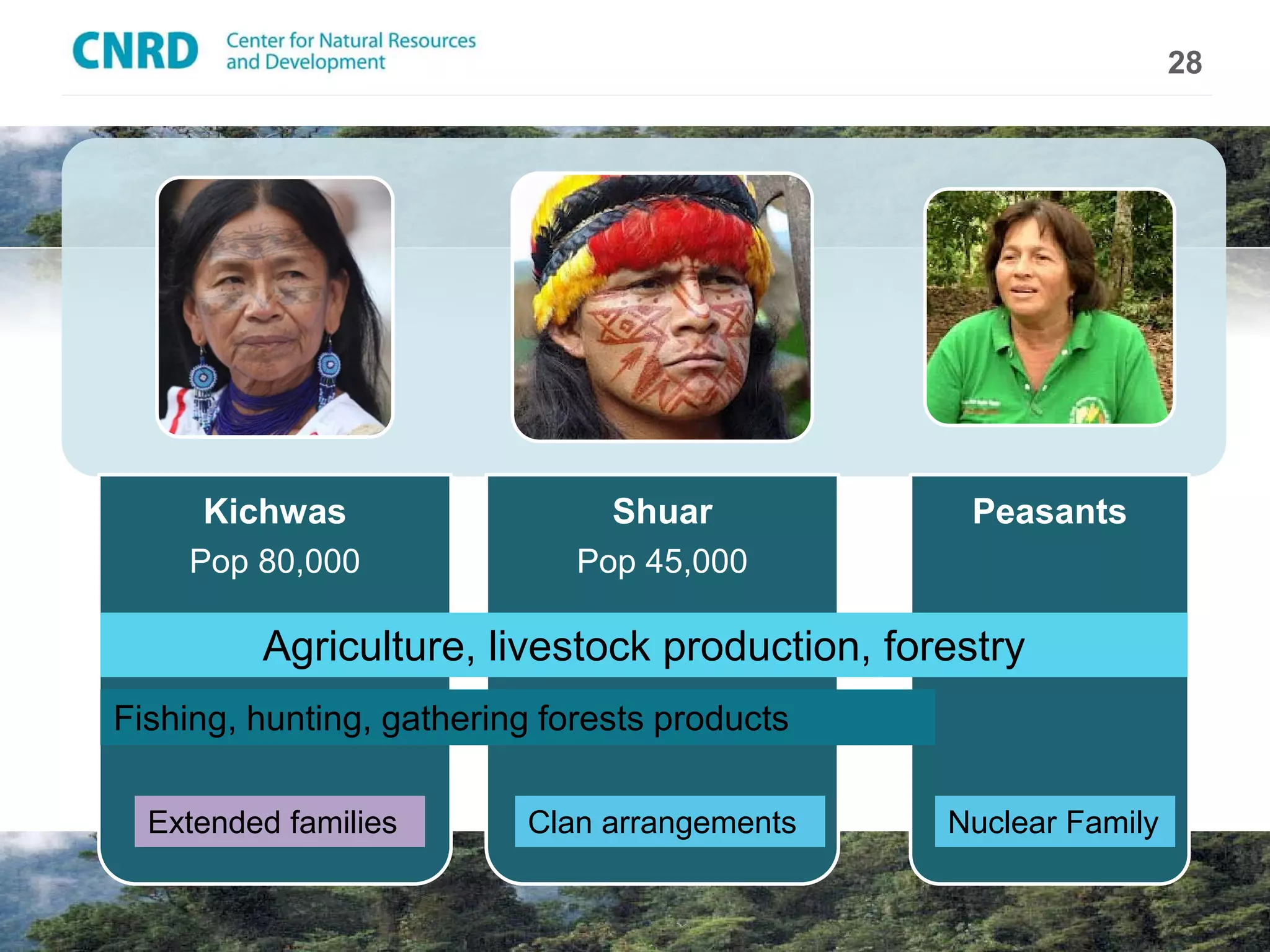
28


     Kichwas                    Shuar           Peasants
    Pop 80,000                Pop 45,000

         Agriculture, livestock production, forestry
Fishing, hunting, gathering forests products

  Extended families       Clan arrangements    Nuclear Family
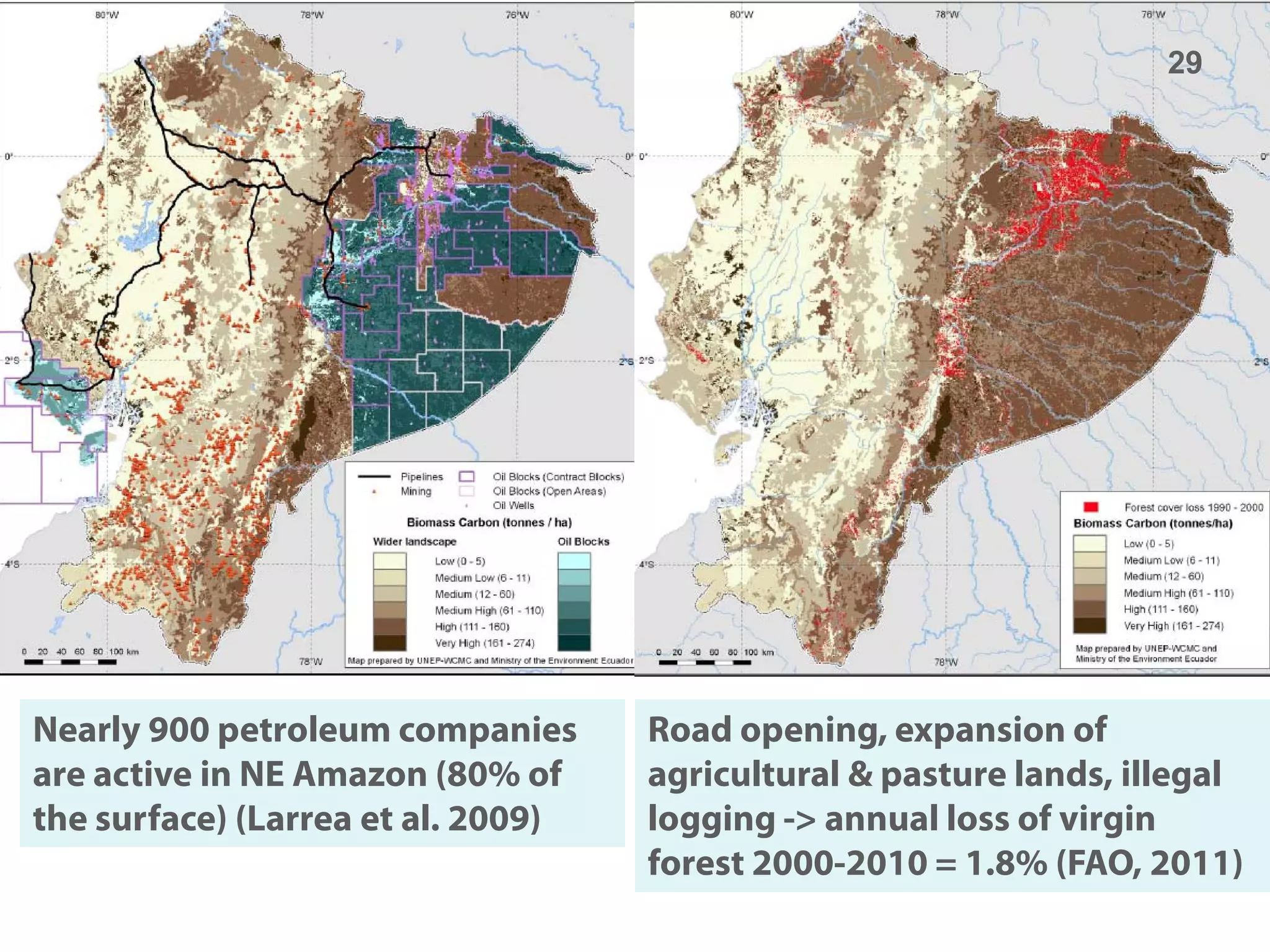
29


Nearly 900 petroleum companies      Road opening, expansion of
are active in NE Amazon (80% of     agricultural & pasture lands, illegal
the surface) (Larrea et al. 2009)   logging -> annual loss of virgin
                                    forest 2000-2010 = 1.8% (FAO, 2011)
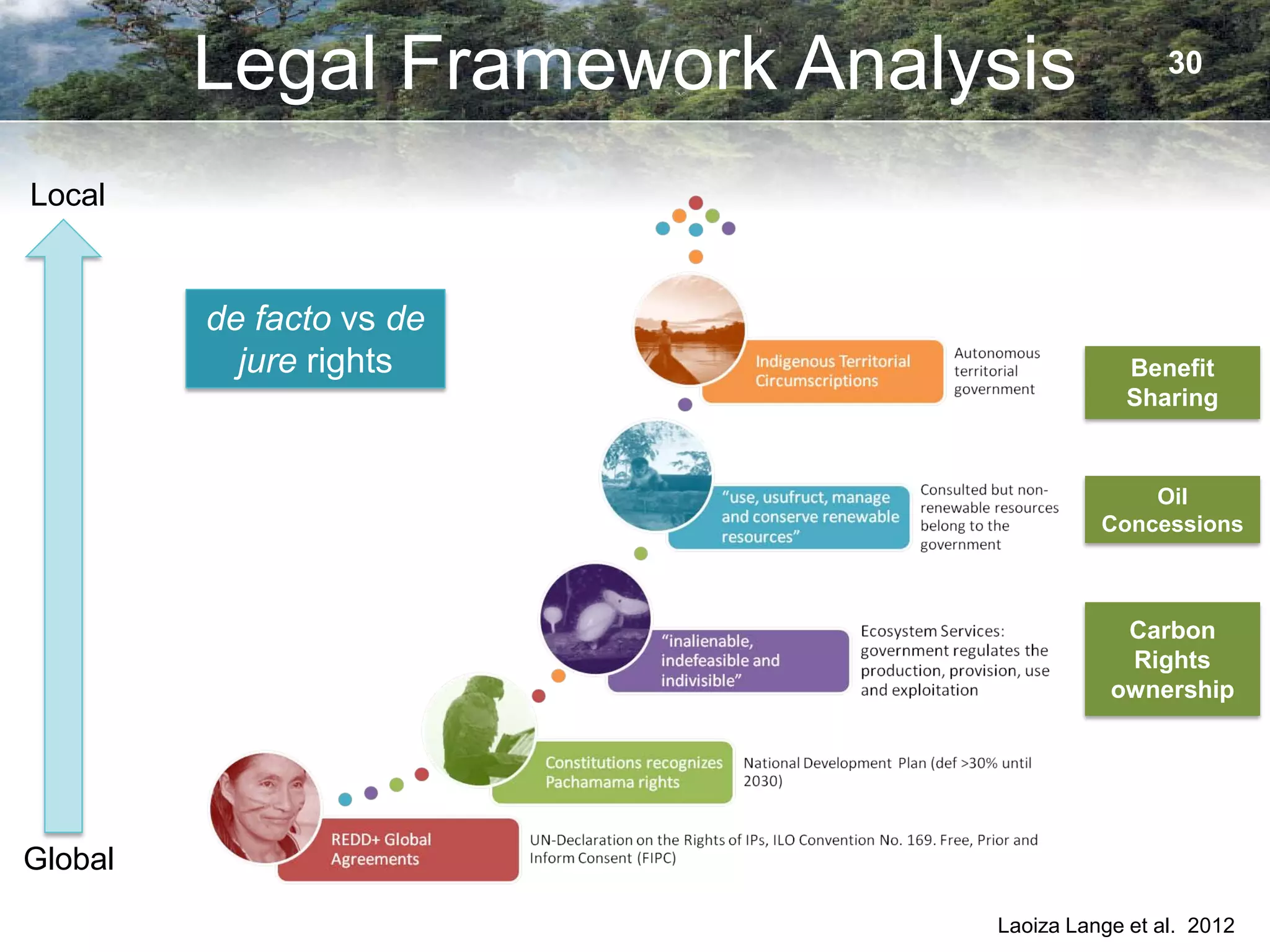
Legal Framework Analysis
          Legal issues in Indigenous                     30


Local
                          territories

         de facto vs de
           jure rights                               Benefit
                                                     Sharing


                                                      Oil
                                                  Concessions


                                                    Carbon
                                                    Rights
                                                   ownership


Global
                                        Laoiza Lange et al. 2012
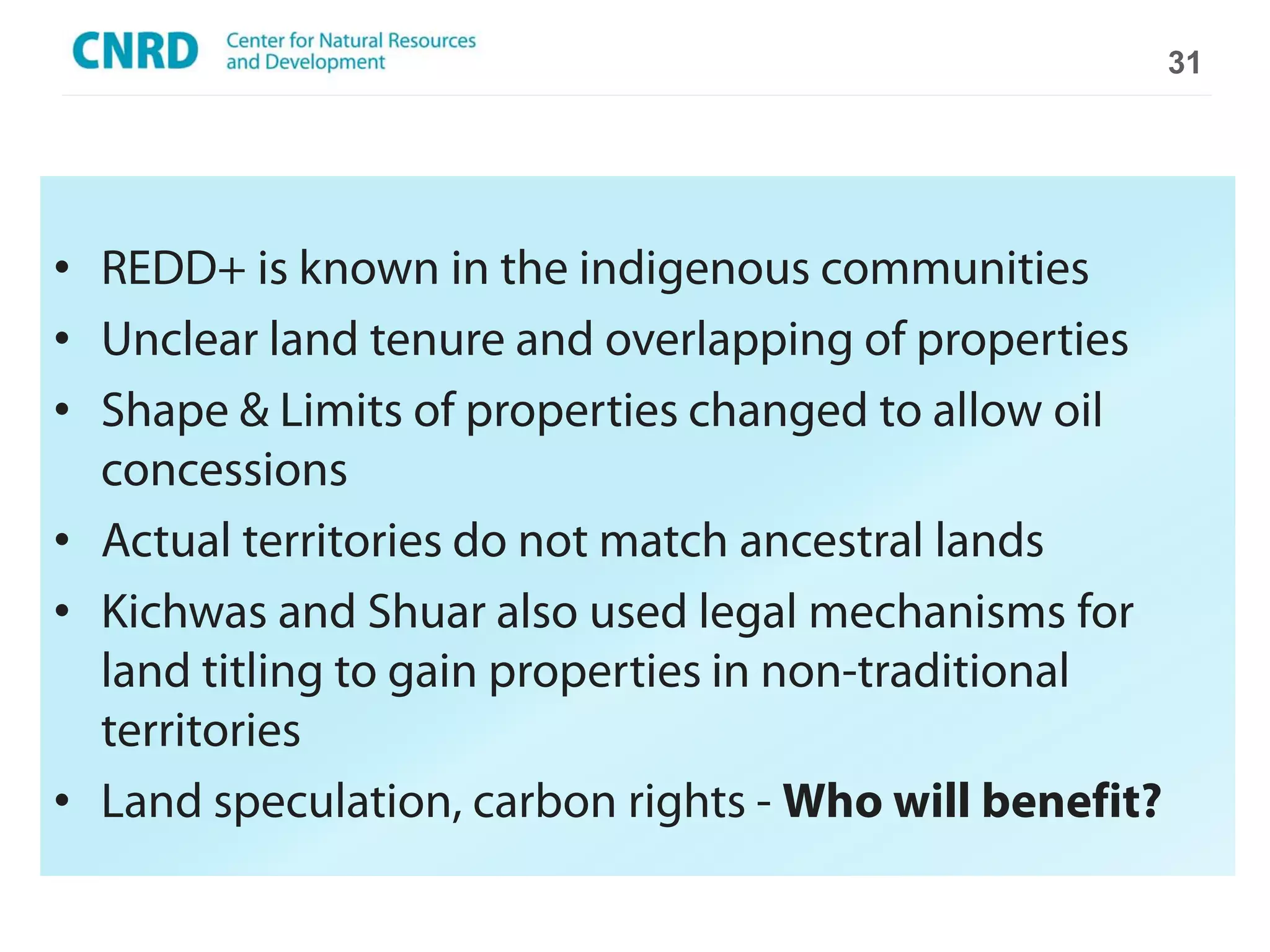
31


• REDD+ is known in the indigenous communities
• Unclear land tenure and overlapping of properties
• Shape & Limits of properties changed to allow oil
  concessions
• Actual territories do not match ancestral lands
• Kichwas and Shuar also used legal mechanisms for
  land titling to gain properties in non-traditional
  territories
• Land speculation, carbon rights - Who will benefit?
32

Case study II: Atlantic Forest of Brazil
                          Potential natural forest area
                          ~1.0-1.5 million km²        *)


                          Percentage of original forest area
                          ~ 8.0% *) / 11.4-16.0% **)

                          Highly fragmented
                          ~ 232,000 forest fragments *)

                          One of 25 biodiversity hotspots ***)

                          *)    Fundação SOS Mata Atlântica / INPE 2009
                          **)   Ribeiro et al. 2009
                          ***)   Myers et al. 2000
            Climate Change Scenarios
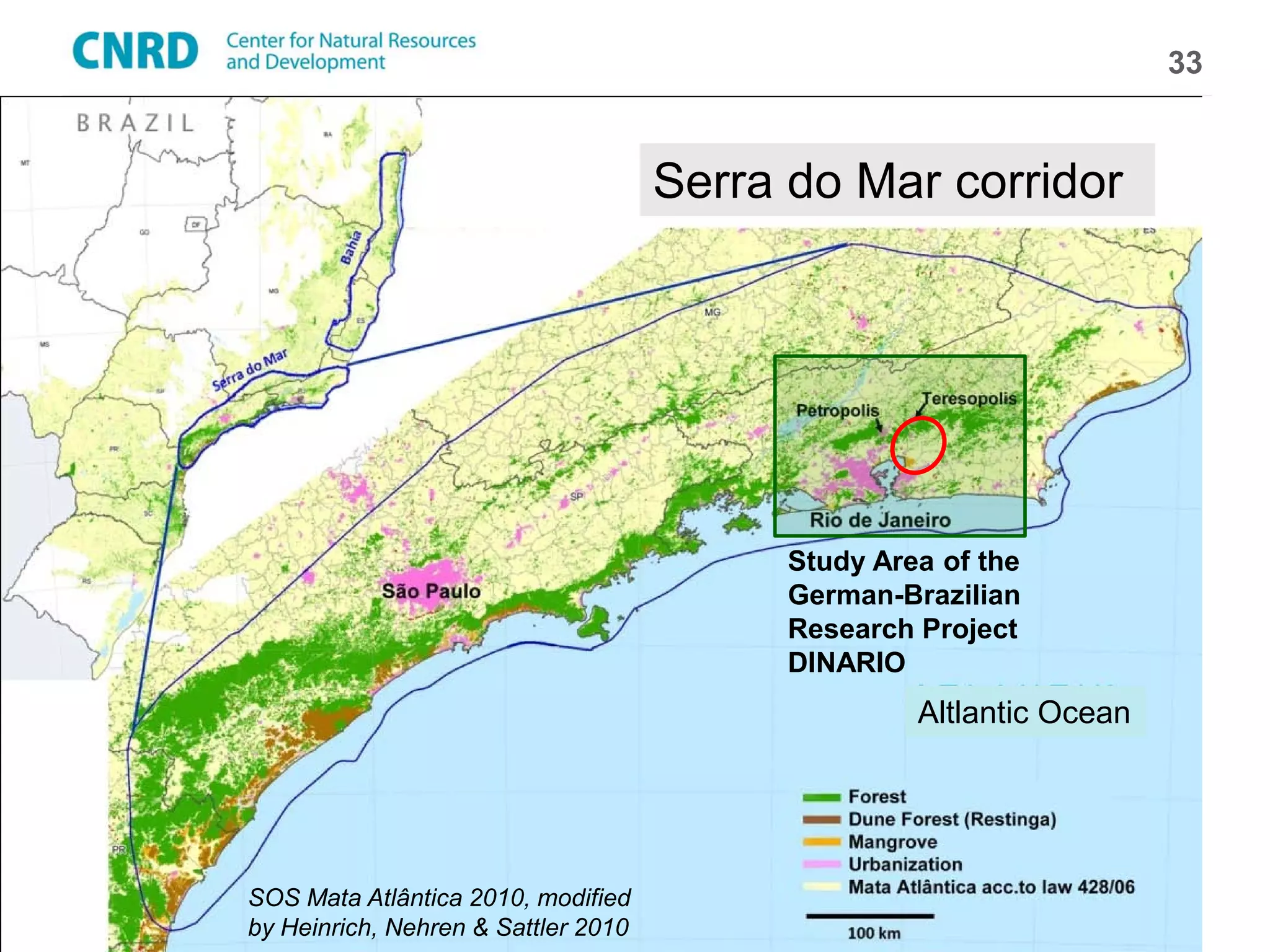
33


                                     Serra do Mar corridor


                                           Study Area of the
                                           German-Brazilian
                                           Research Project
                                           DINARIO
                                                    Altlantic Ocean


      Climate Change Scenarios
SOS Mata Atlântica 2010, modified
by Heinrich, Nehren & Sattler 2010
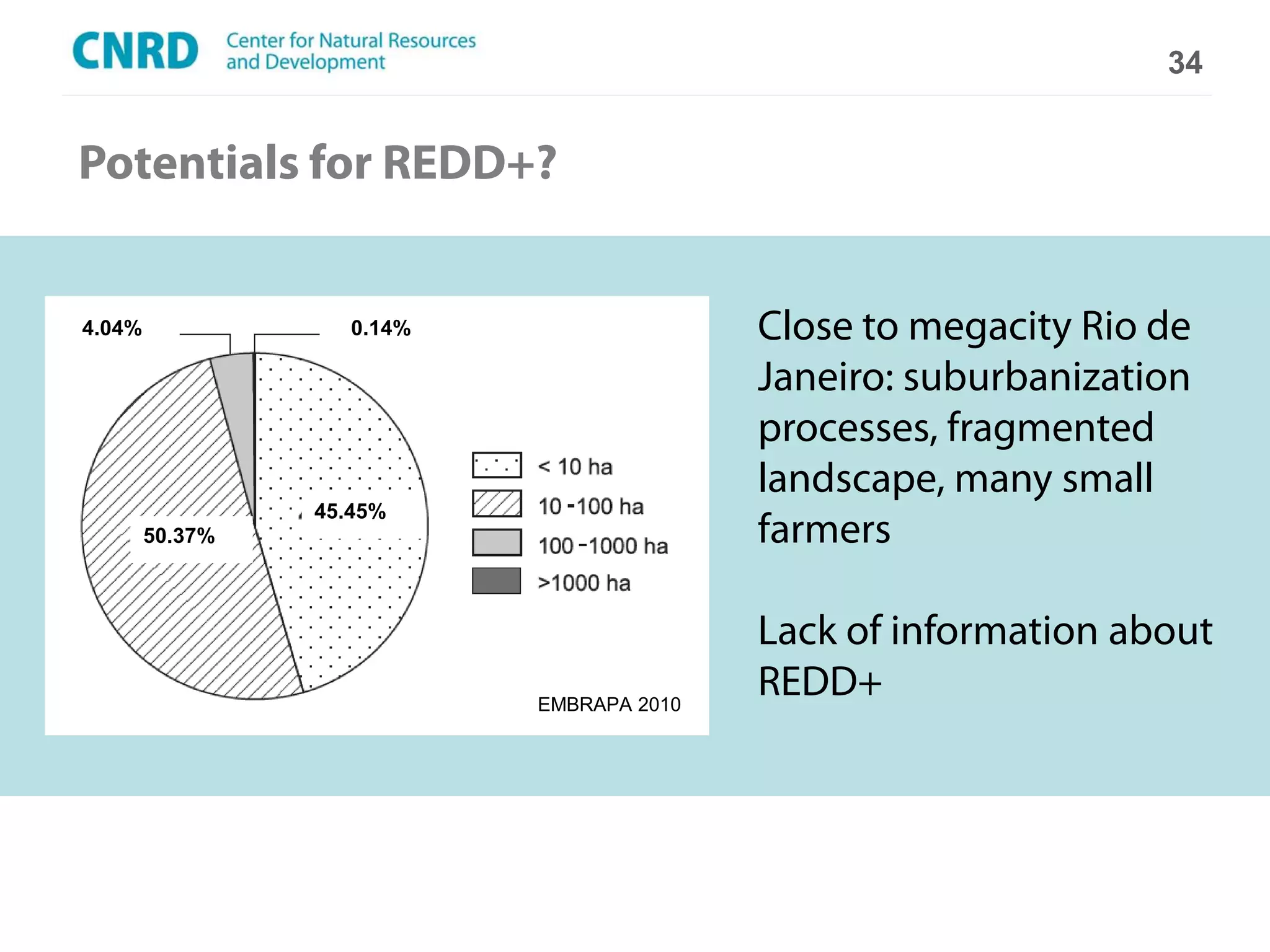
34


Potentials for REDD+?


4.04%               0.14%                  Close to megacity Rio de
                                           Janeiro: suburbanization
                                           processes, fragmented
                                           landscape, many small
                 45.45%
        50.37%                             farmers

                                           Lack of information about
                            EMBRAPA 2010
                                           REDD+
35

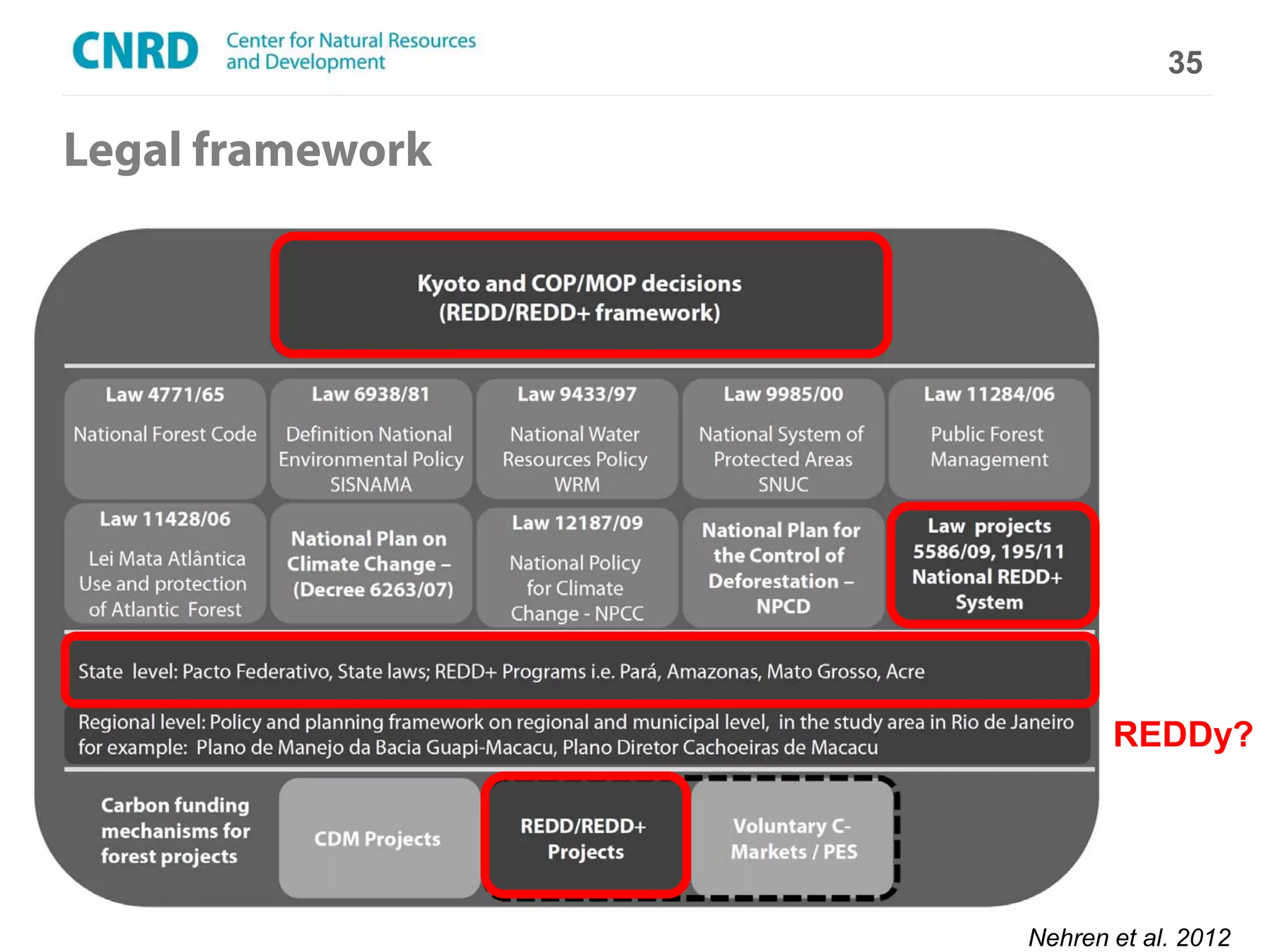
Legal framework


                                          REDDy?


        Climate Change Scenarios
                                   Nehren et al. 2012
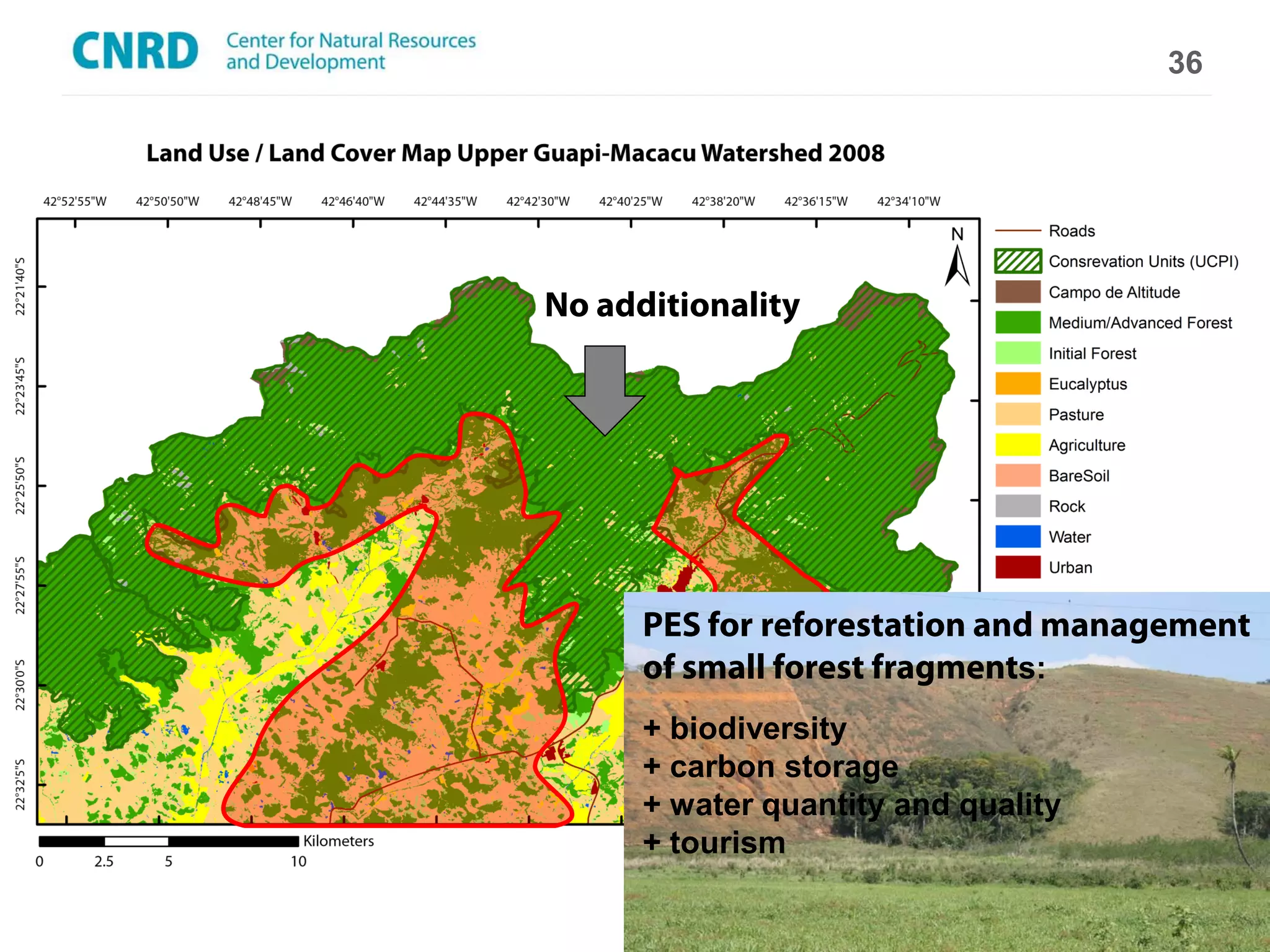
36

                         Upper Guapi-
                         Macacu watershed


No additionality


      PES for reforestation and management
      of small forest fragments:
      + biodiversity
      + carbon storage
      + water quantity and quality
      + tourism
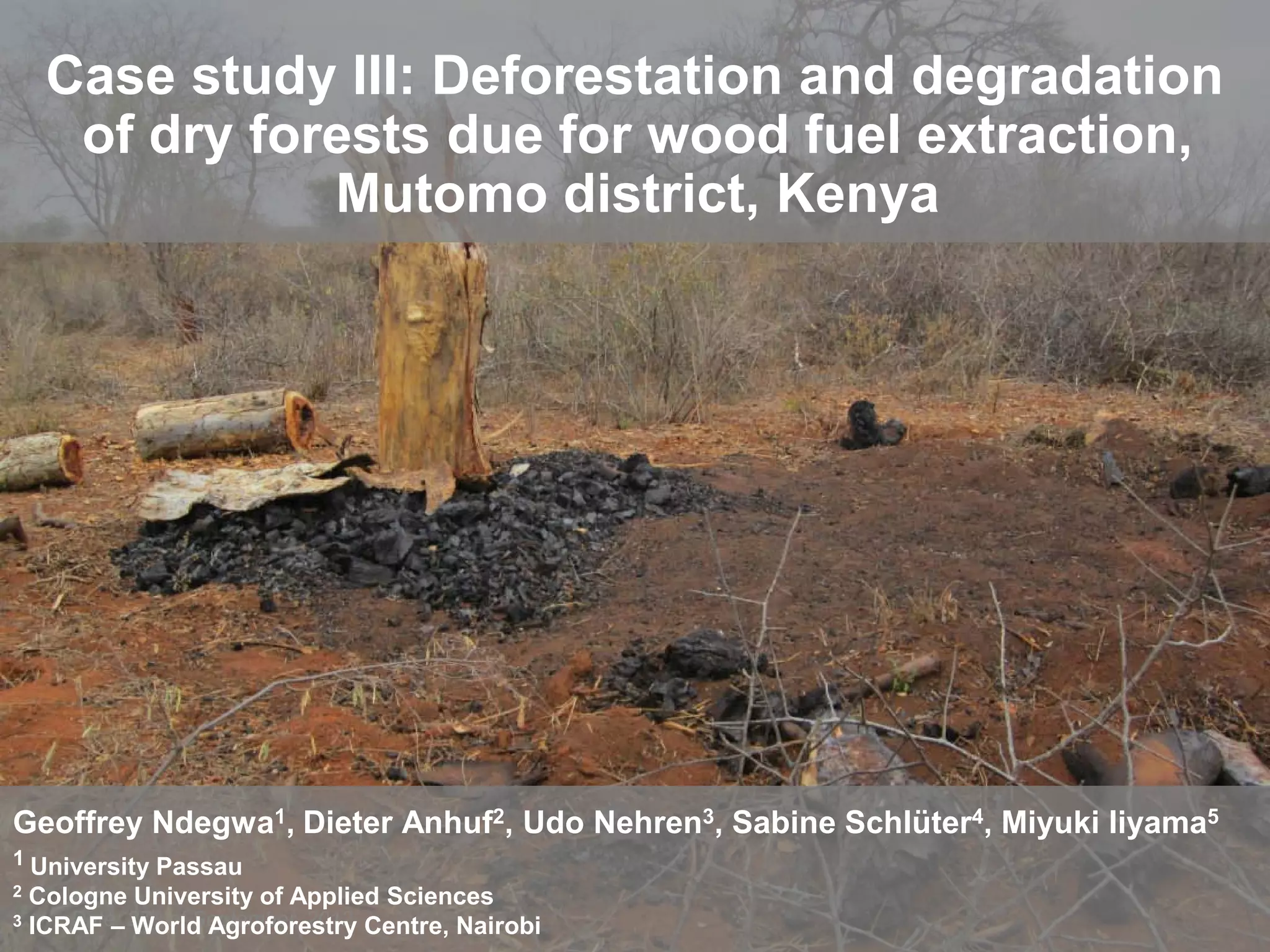
Case study III: Deforestation and degradation
      of dry forests due for wood fuel extraction,
                Mutomo district, Kenya


Geoffrey Ndegwa1, Dieter Anhuf2, Udo Nehren3, Sabine Schlüter4, Miyuki Iiyama5
1 University Passau
2   Cologne University of Applied Sciences
              th
3   ICRAF – 27 of September, 2012 Centre, Nairobi
       Date: World Agroforestry
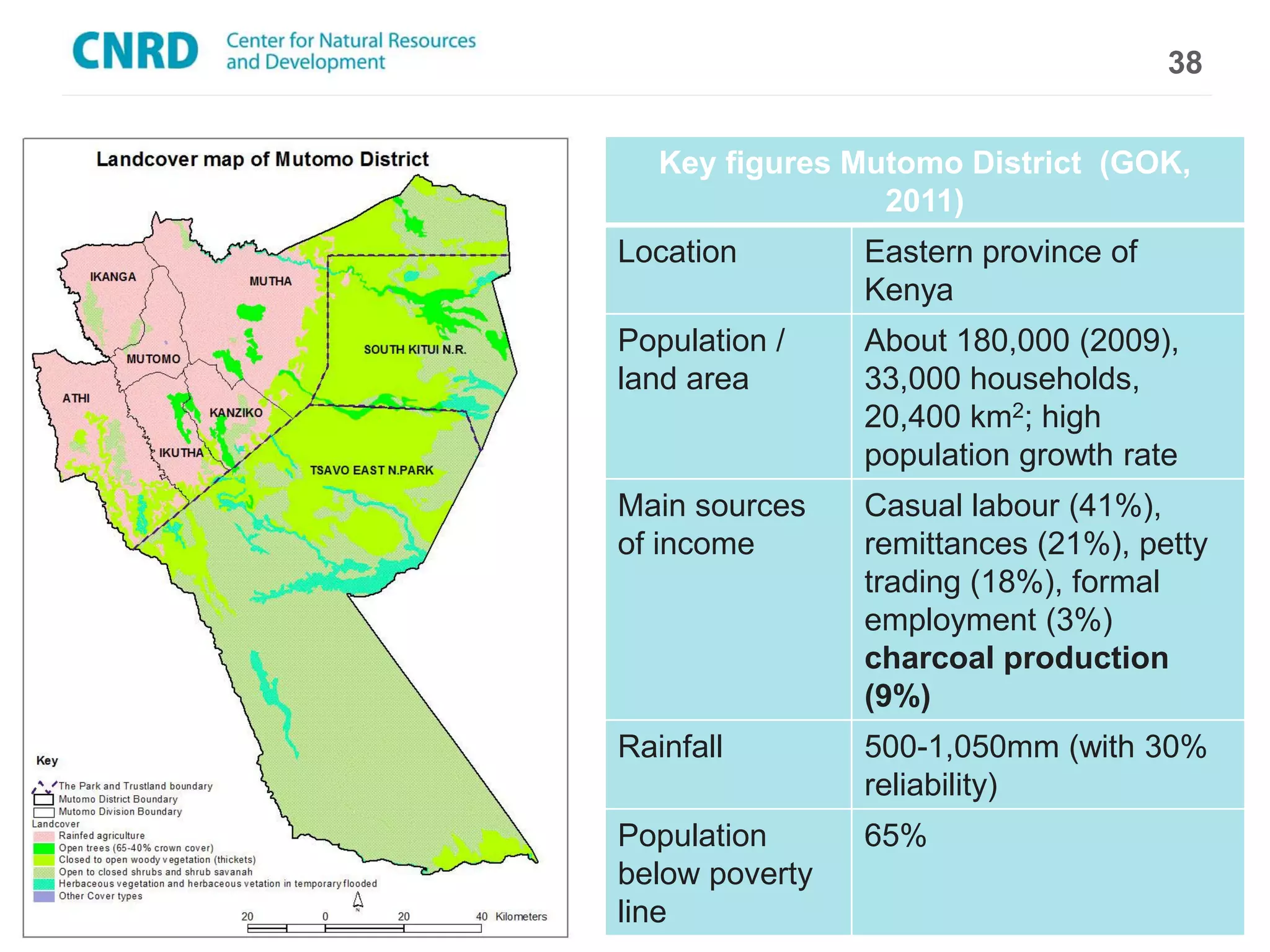
38


   Key figures Mutomo District (GOK,
                 2011)
Location        Eastern province of
                Kenya
Population /    About 180,000 (2009),
land area       33,000 households,
                20,400 km2; high
                population growth rate
Main sources    Casual labour (41%),
of income       remittances (21%), petty
                trading (18%), formal
                employment (3%)
                charcoal production
                (9%)
Rainfall        500-1,050mm (with 30%
                reliability)
Population      65%
below poverty
line
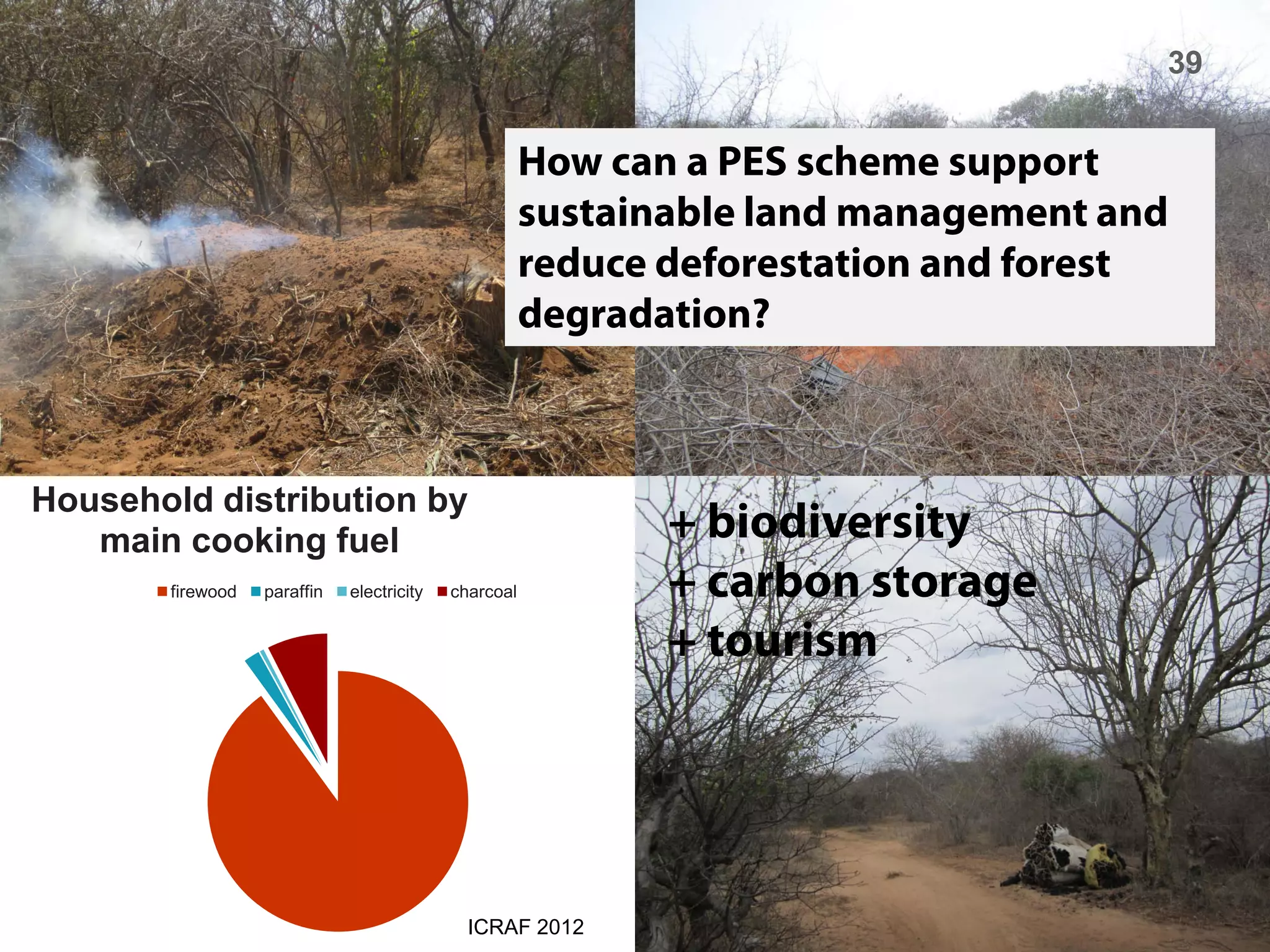
39


                                                      How can a PES scheme support
                                                      sustainable land management and
                                                      reduce deforestation and forest
                                                      degradation?


Household distribution by
   main cooking fuel                                         + biodiversity
       firewood   paraffin   electricity   charcoal          + carbon storage
                                                             + tourism


                                             ICRAF 2012
40

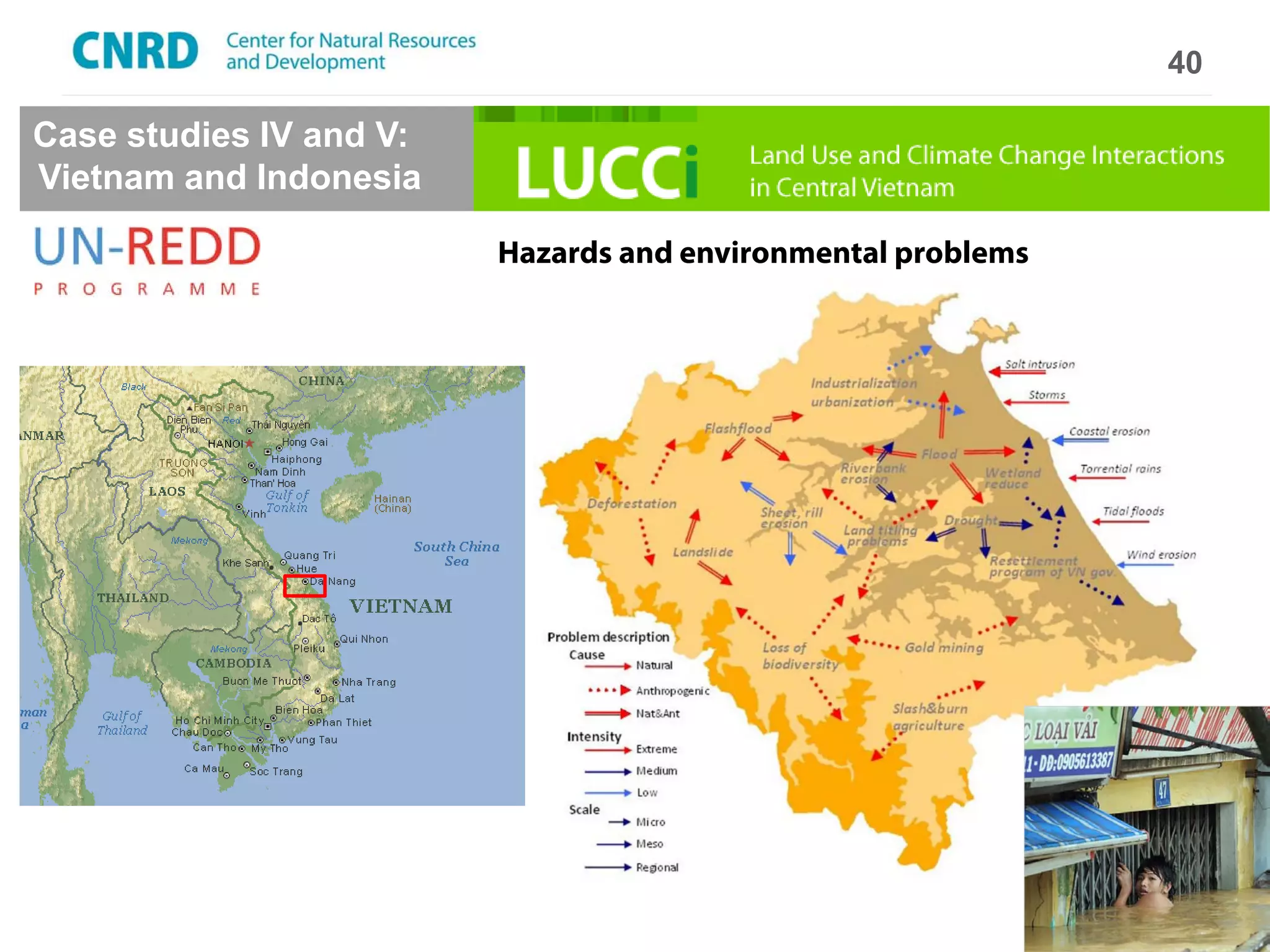
Case studies IV and V:
Vietnam and Indonesia

                         Hazards and environmental problems
41


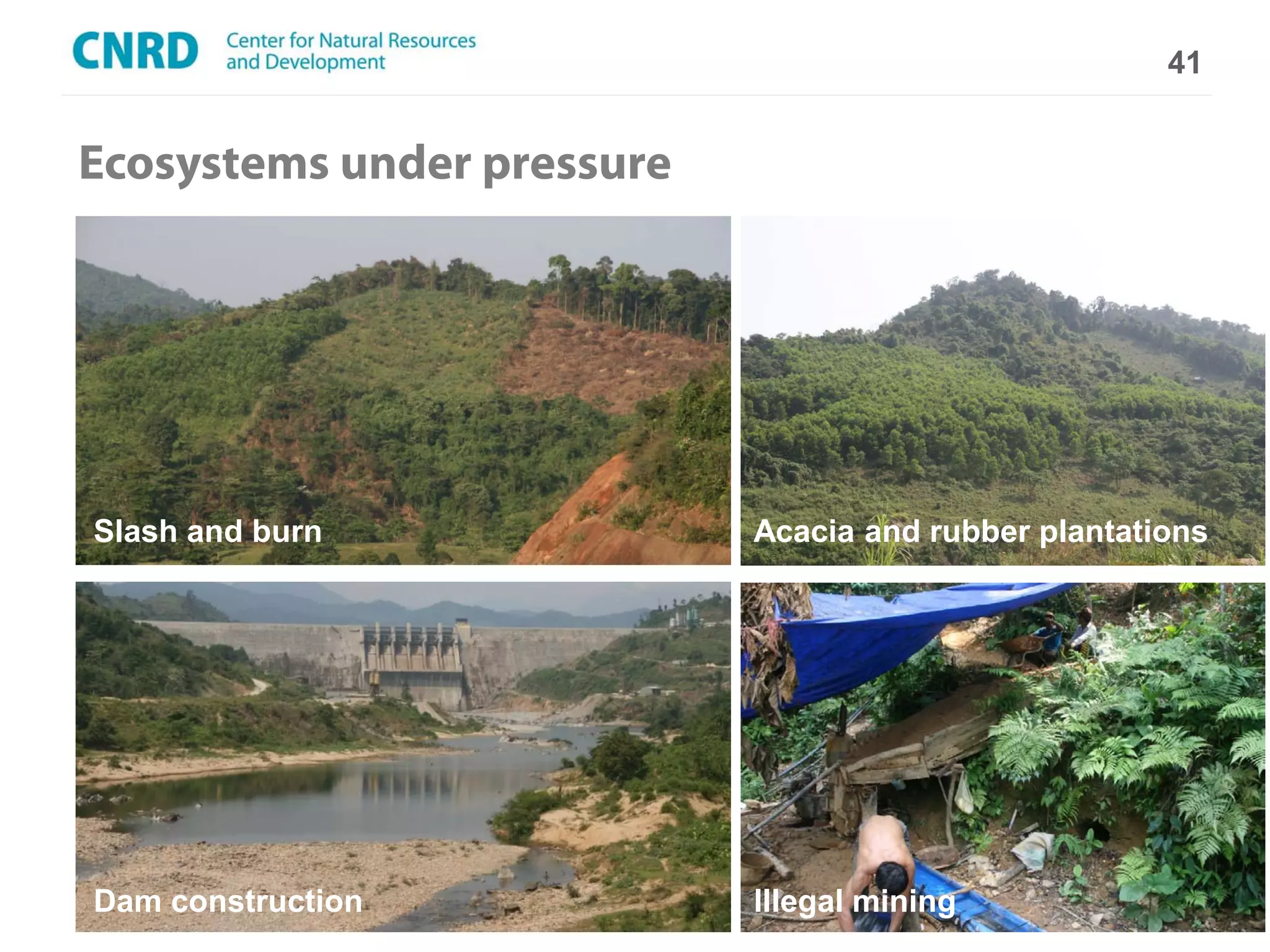
Ecosystems under pressure


Slash and burn                 Acacia and rubber plantations


                   Climate Change Scenarios
Dam construction               Illegal mining
42

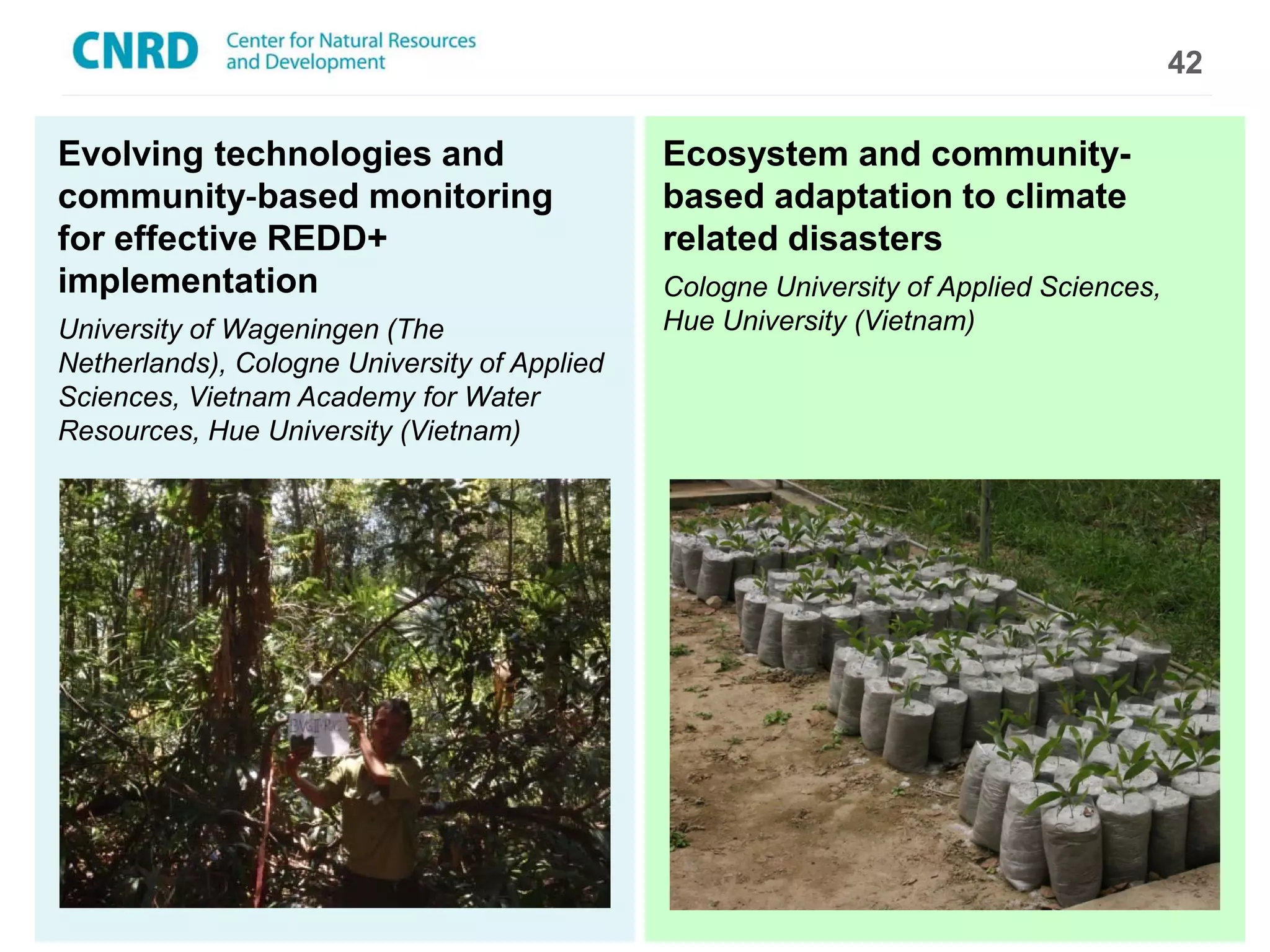
Evolving technologies and                     Ecosystem and community-
community-­‐based monitoring                  based adaptation to climate
for effective REDD+                           related disasters
implementation                                Cologne University of Applied Sciences,
University of Wageningen (The                 Hue University (Vietnam)
Netherlands), Cologne University of Applied
Sciences, Vietnam Academy for Water
Resources, Hue University (Vietnam)
43

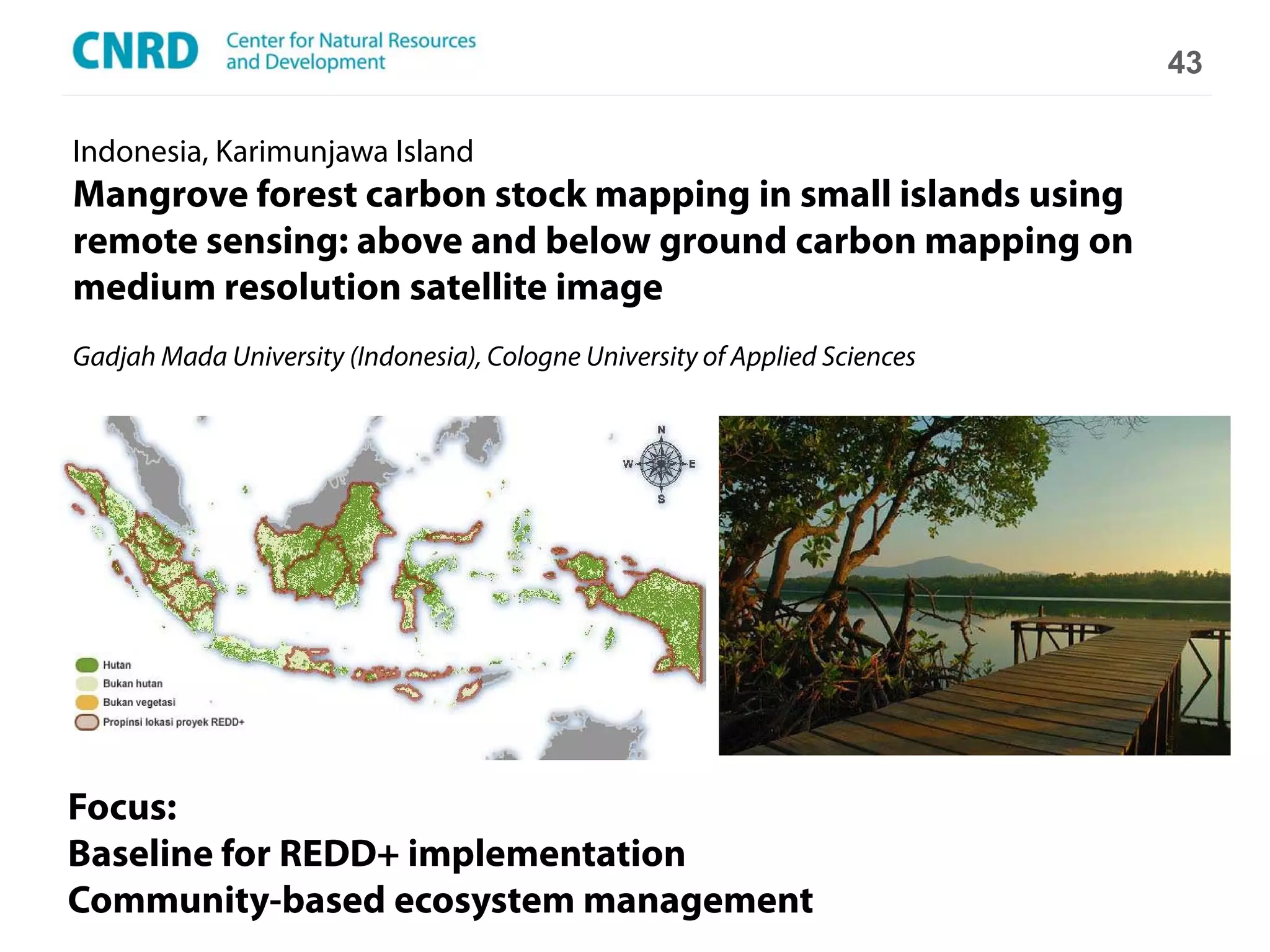
Indonesia, Karimunjawa Island
Mangrove forest carbon stock mapping in small islands using
remote sensing: above and below ground carbon mapping on
medium resolution satellite image
Gadjah Mada University (Indonesia), Cologne University of Applied Sciences


Focus:
Baseline for REDD+ implementation
               Climate Change Scenarios
Community-based ecosystem management
44


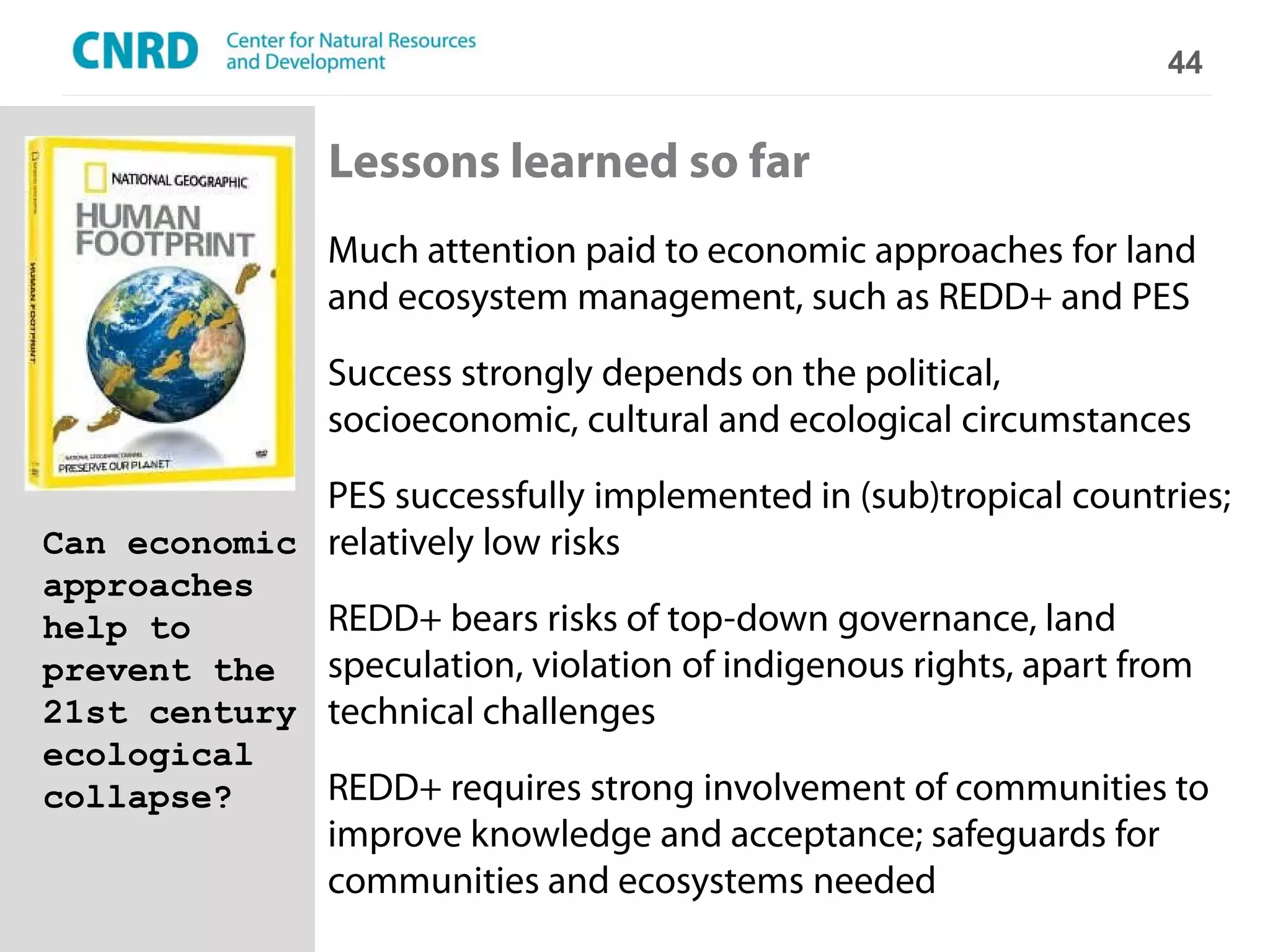
                Lessons learned so far
                Much attention paid to economic approaches for land
                and ecosystem management, such as REDD+ and PES
                Success strongly depends on the political,
                socioeconomic, cultural and ecological circumstances
             PES successfully implemented in (sub)tropical countries;
Can economic relatively low risks
approaches
help to         REDD+ bears risks of top-down governance, land
prevent the     speculation, violation of indigenous rights, apart from
21st century    technical challenges
ecological
collapse?       REDD+ requires strong involvement of communities to
                improve knowledge and acceptance; safeguards for
                communities and ecosystems needed
Thank you very much for your
         attention
     And thanks to the PhD students:

         Toa Loaiza Lange (Ecuador)
      Vanesa Rodriguez (Bolivia, Brazil)
          Geoffrey Ndegwa (Kenya)
       Arun Pratihast (Nepal, Vietnam)
     Pramaditya Wicaksono (Indonesia)
20
THE CO-EXISTENCE OF NATURE, ECONOMY AND SOCIETY
 AS BASE FOR SUSTAINABLE ECONOMIC DEVELOPMENT

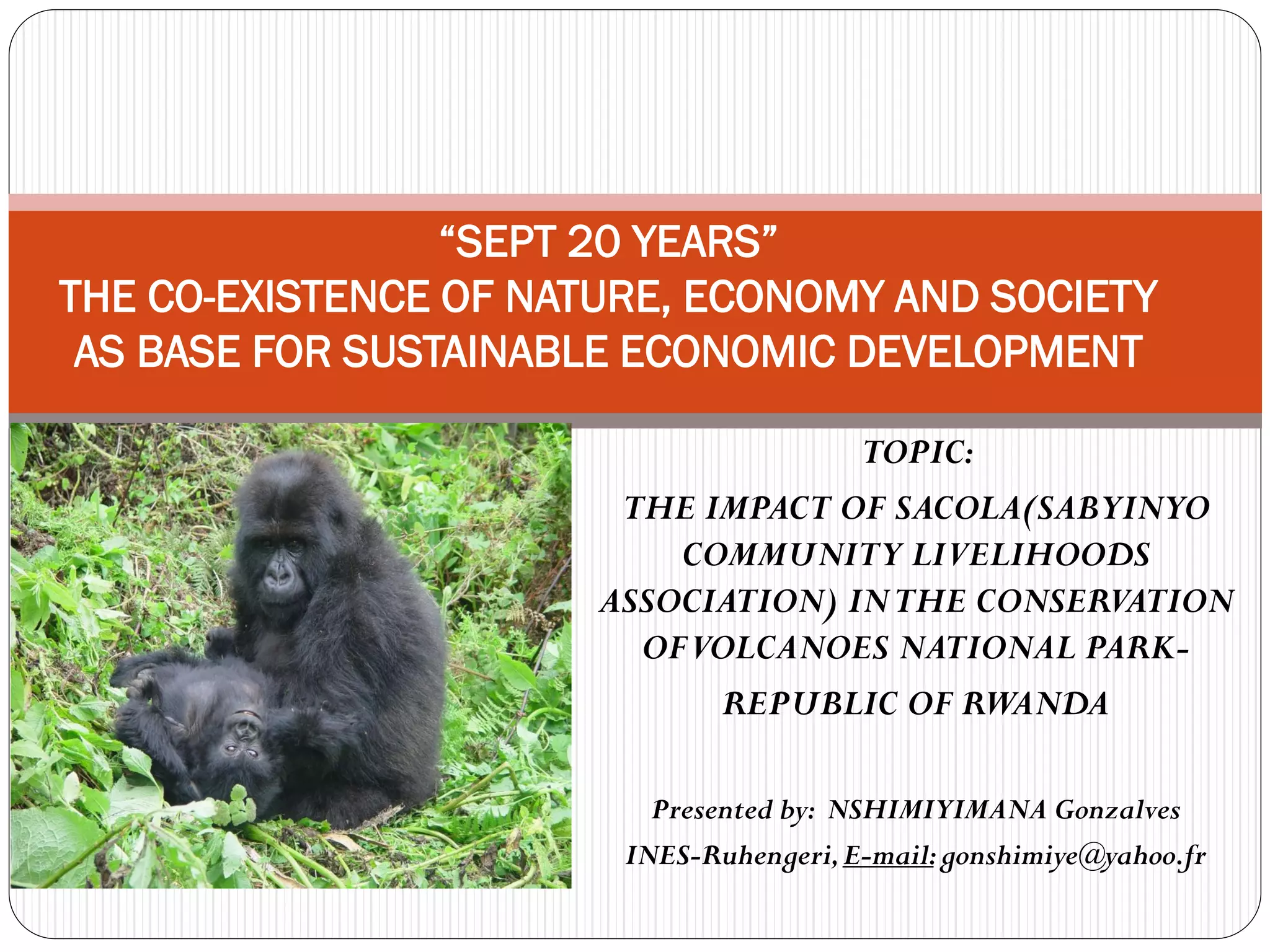
                                     TOPIC:
                        THE IMPACT OF SACOLA(SABYINYO
                           COMMUNITY LIVELIHOODS
                       ASSOCIATION) IN THE CONSERVATION
                         OF VOLCANOES NATIONAL PARK-
                              REPUBLIC OF RWANDA

                          Presented by: NSHIMIYIMANA Gonzalves
                        INES-Ruhengeri, E-mail: gonshimiye@yahoo.fr
Outline
    1.  BASIC INFORMATION ABOUT RWANDA
      1. Akagera National Park (East of Rwanda)
      2. Nyungwe National Park (South of Rwanda)
      3. Volcanoes National Park (North Rwanda)
    2. SACOLA : THE COEXISTANCE OF NATURE, ECONOMY AND
        SOCIETY
      1. The nature of SACOLA
      2. Main achievements of SACOLA (socio-cultural, economic, tourism)
    3. Conclusion: Overall impact


2   SMEs: Coexistance of Nature, Economy and Society
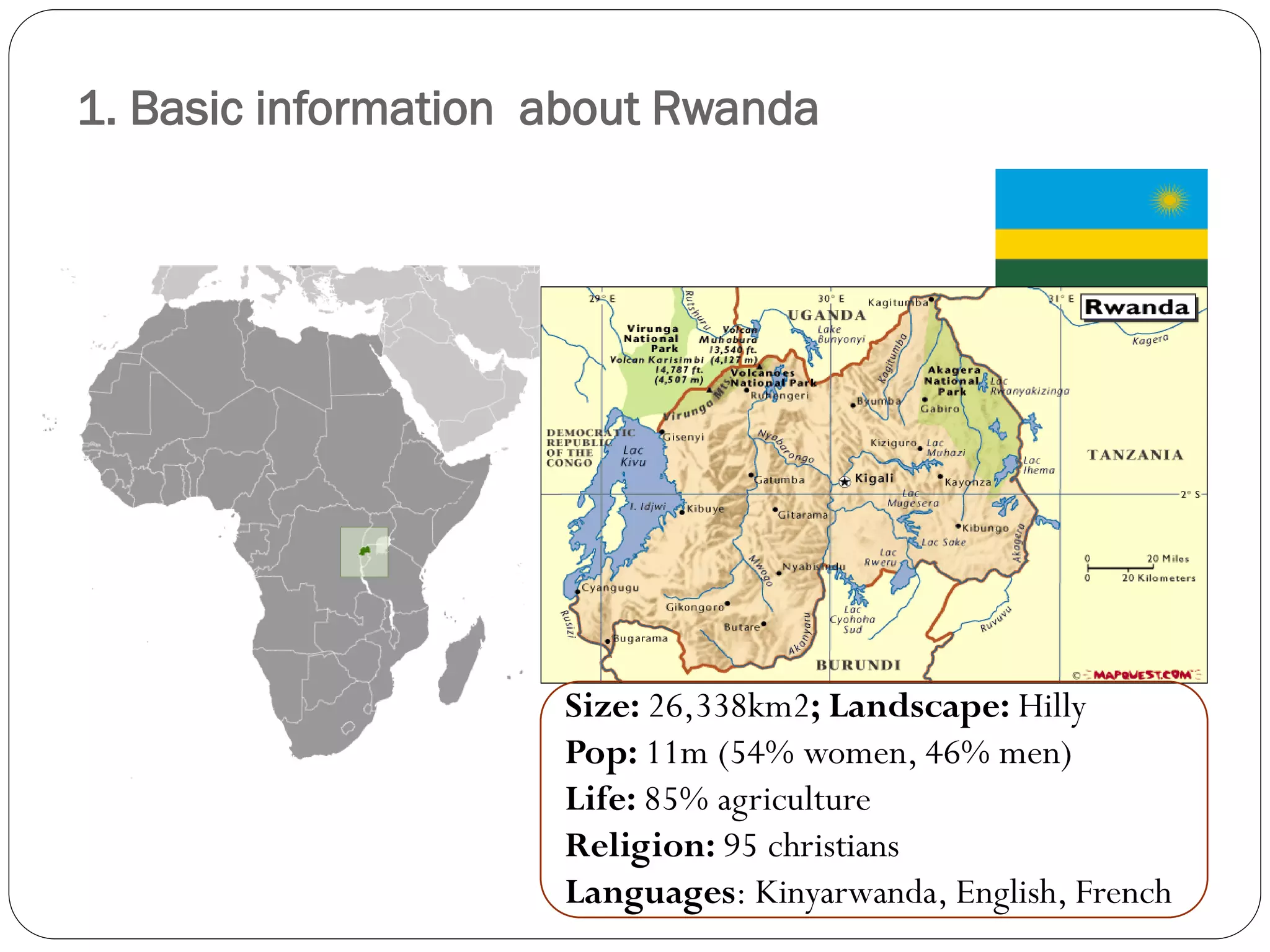
1. Basic information about Rwanda


                     Size: 26,338km2; Landscape: Hilly
                     Pop: 11m (54% women, 46% men)
                     Life: 85% agriculture
                     Religion: 95 christians
                     Languages: Kinyarwanda, English, French
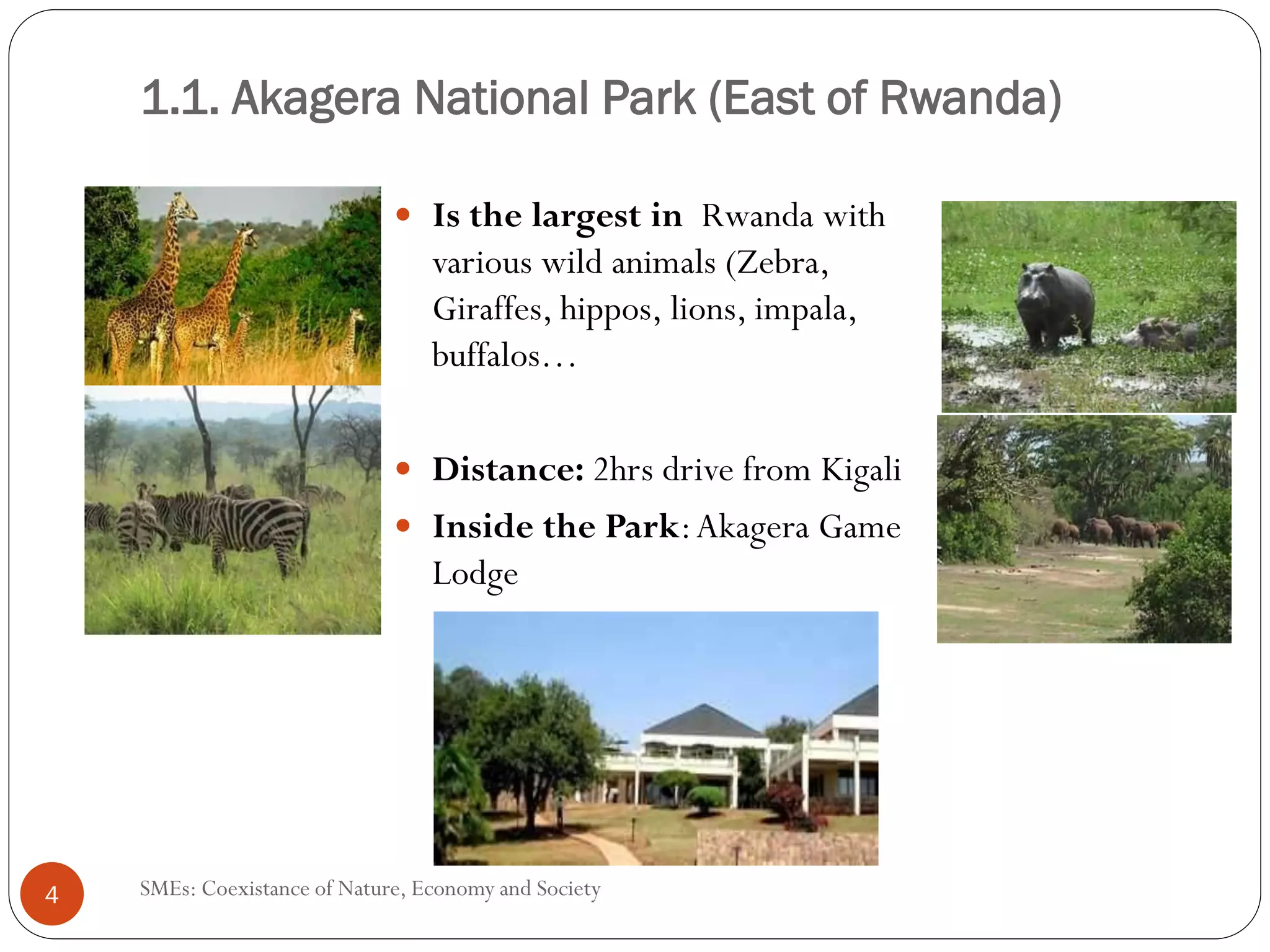
1.1. Akagera National Park (East of Rwanda)

                                  Is the largest in Rwanda with
                                  various wild animals (Zebra,
                                  Giraffes, hippos, lions, impala,


                                  Distance: 2hrs drive from Kigali
                                  Inside the Park: Akagera Game
                                  Lodge


4   SMEs: Coexistance of Nature, Economy and Society
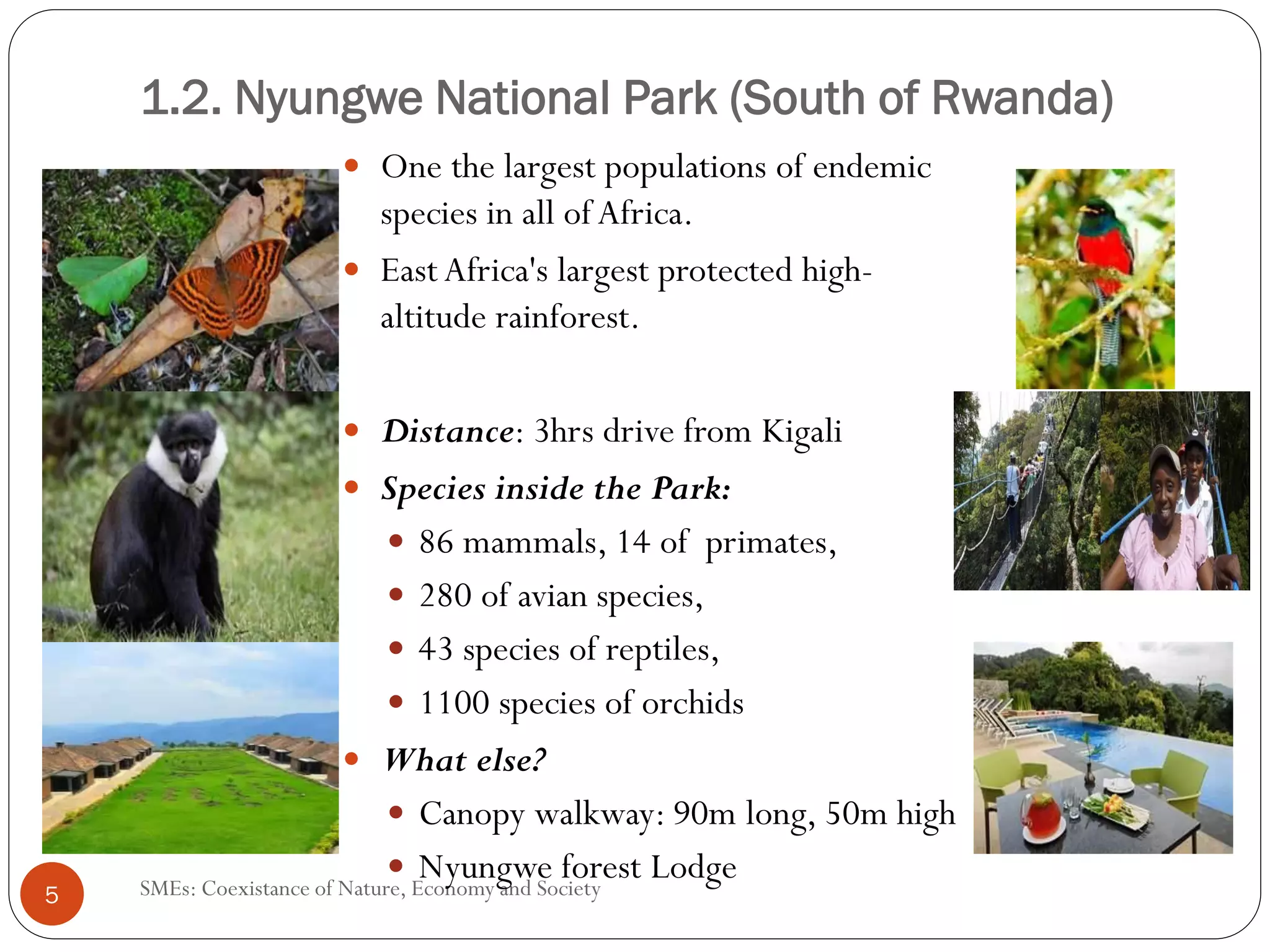
1.2. Nyungwe National Park (South of Rwanda)
                      One the largest populations of endemic
                      species in all of Africa.
                      East Africa's largest protected high-
                      altitude rainforest.

                             Distance: 3hrs drive from Kigali
                             Species inside the Park:
                                  86 mammals, 14 of primates,
                                  280 of avian species,
                                  43 species of reptiles,
                                  1100 species of orchids
                             What else?
                                  Canopy walkway: 90m long, 50m high
                                  Nyungwe forest Lodge
    SMEs: Coexistance of Nature, Economy and Society
5
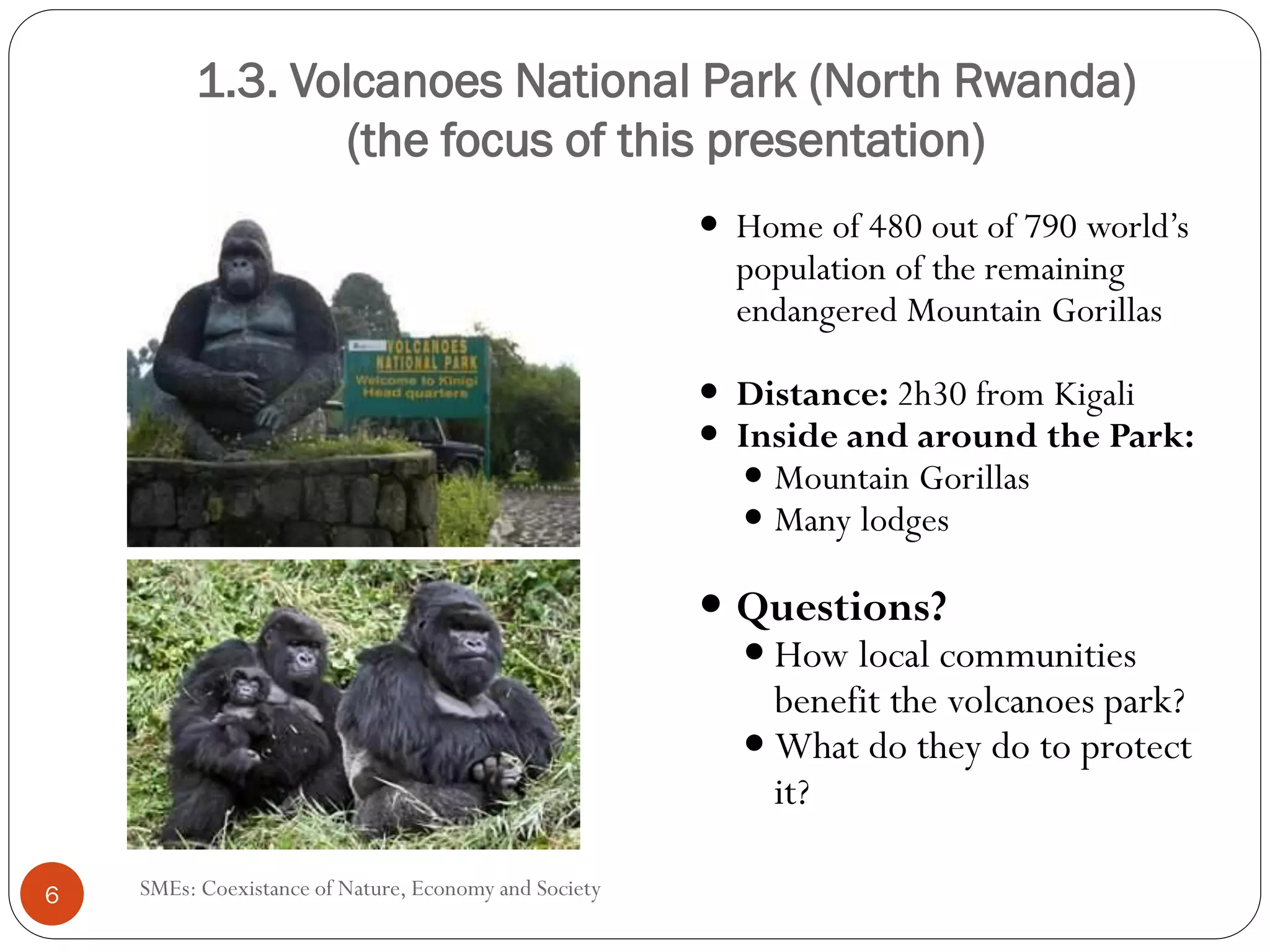
1.3. Volcanoes National Park (North Rwanda)
                (the focus of this presentation)
                                                       Home
                                                       population of the remaining
                                                       endangered Mountain Gorillas

                                                       Distance: 2h30 from Kigali
                                                       Inside and around the Park:
                                                         Mountain Gorillas
                                                         Many lodges

                                                       Questions?
                                                         How local communities
                                                         benefit the volcanoes park?
                                                         What do they do to protect
                                                         it?

6   SMEs: Coexistance of Nature, Economy and Society
2. SACOLA : THE COEXISTANCE OF NATURE, ECONOMY
AND SOCIETY
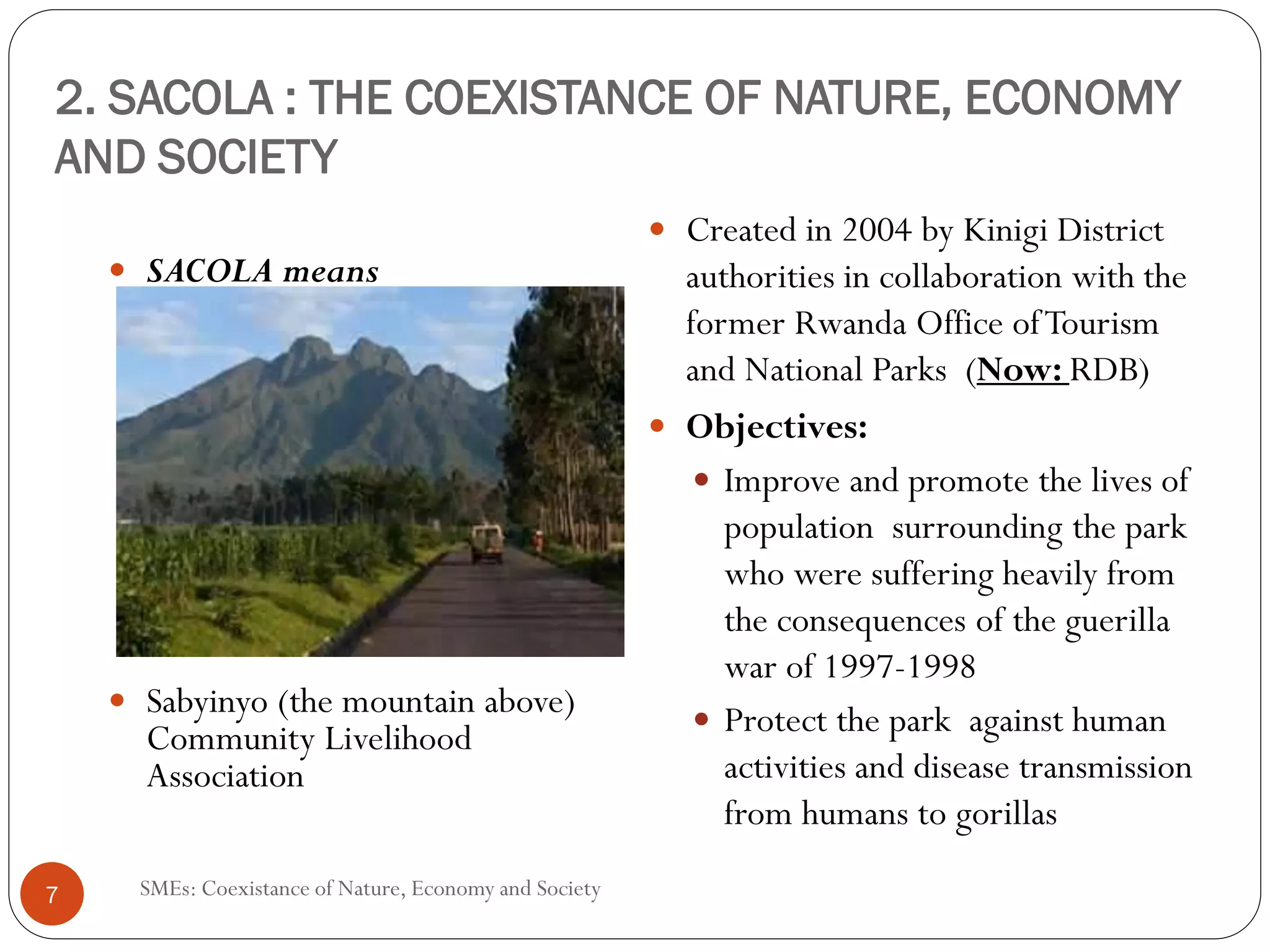
                                                       Created in 2004 by Kinigi District
    SACOLA means                                       authorities in collaboration with the
                                                       former Rwanda Office of Tourism
                                                       and National Parks (Now: RDB)
                                                       Objectives:
                                                          Improve and promote the lives of
                                                          population surrounding the park
                                                          who were suffering heavily from
                                                          the consequences of the guerilla
                                                          war of 1997-1998
    Sabyinyo (the mountain above)                         Protect the park against human
    Community Livelihood
    Association                                           activities and disease transmission
                                                          from humans to gorillas

7   SMEs: Coexistance of Nature, Economy and Society
2.1. The nature of SACOLA

1.   Domains of Intervention:                           3. Tools used:
     Socio- cultural                                       Community cooperatives
     Economic                                              born after                     .
     Tourism                                                  UNICOPAV (Ex-poachers,
                                                             Amizero poters club, crafters,
2.   Means
                                                             bee-keepers),
     Using, supporting and
                                                             ANNICO (Producers of
     synchronizing services provided
                                                             tourism products made in
     by local organizations and
                                                             Bamboos)
     communities
                                                             Muhisimbi (tourism guides)
     Profit sharing with surrounding
     communities.

8    SMEs: Coexistance of Nature, Economy and Society
2.2. Main achievements of SACOLA
    1. Socio-cultural
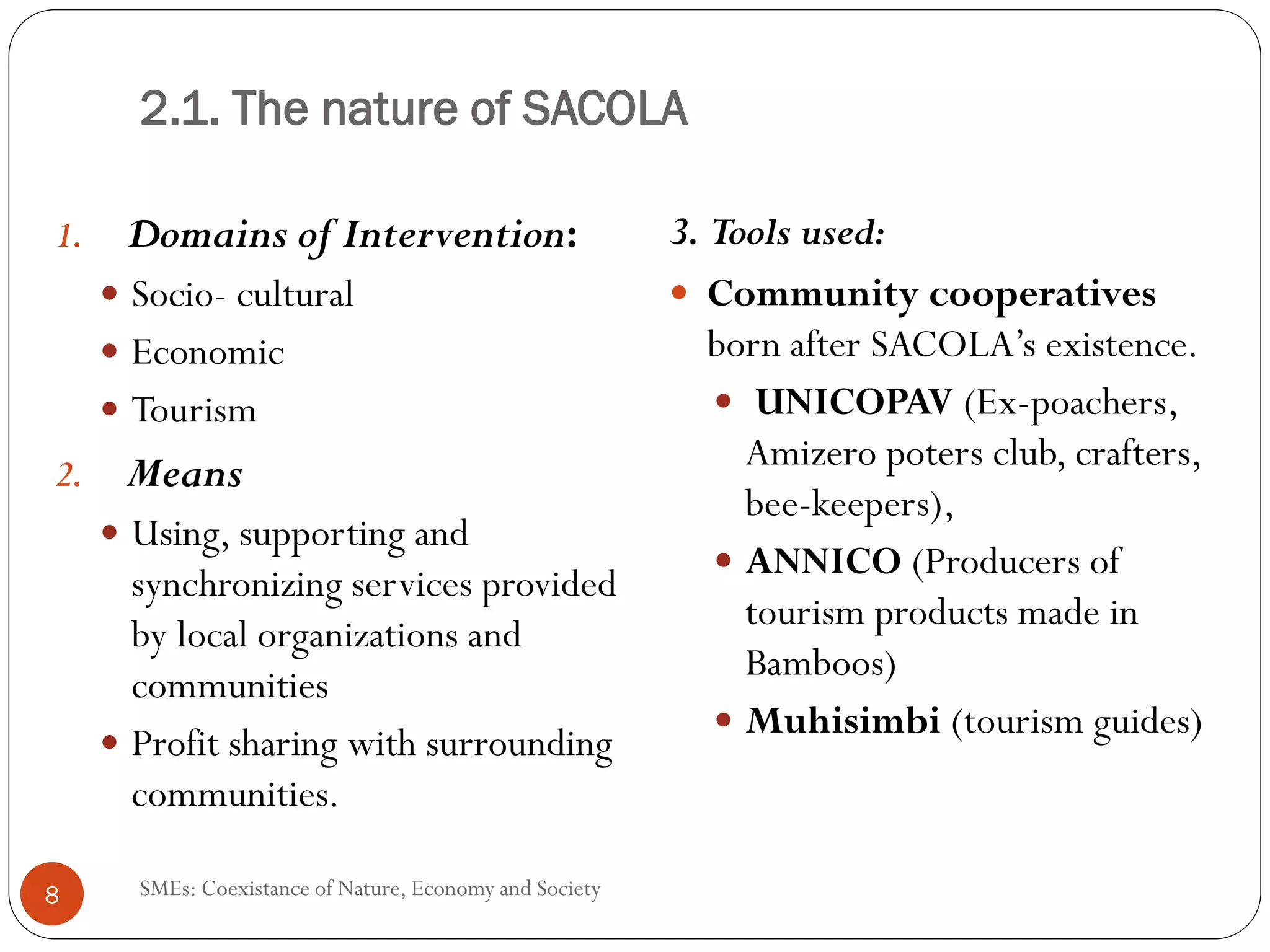
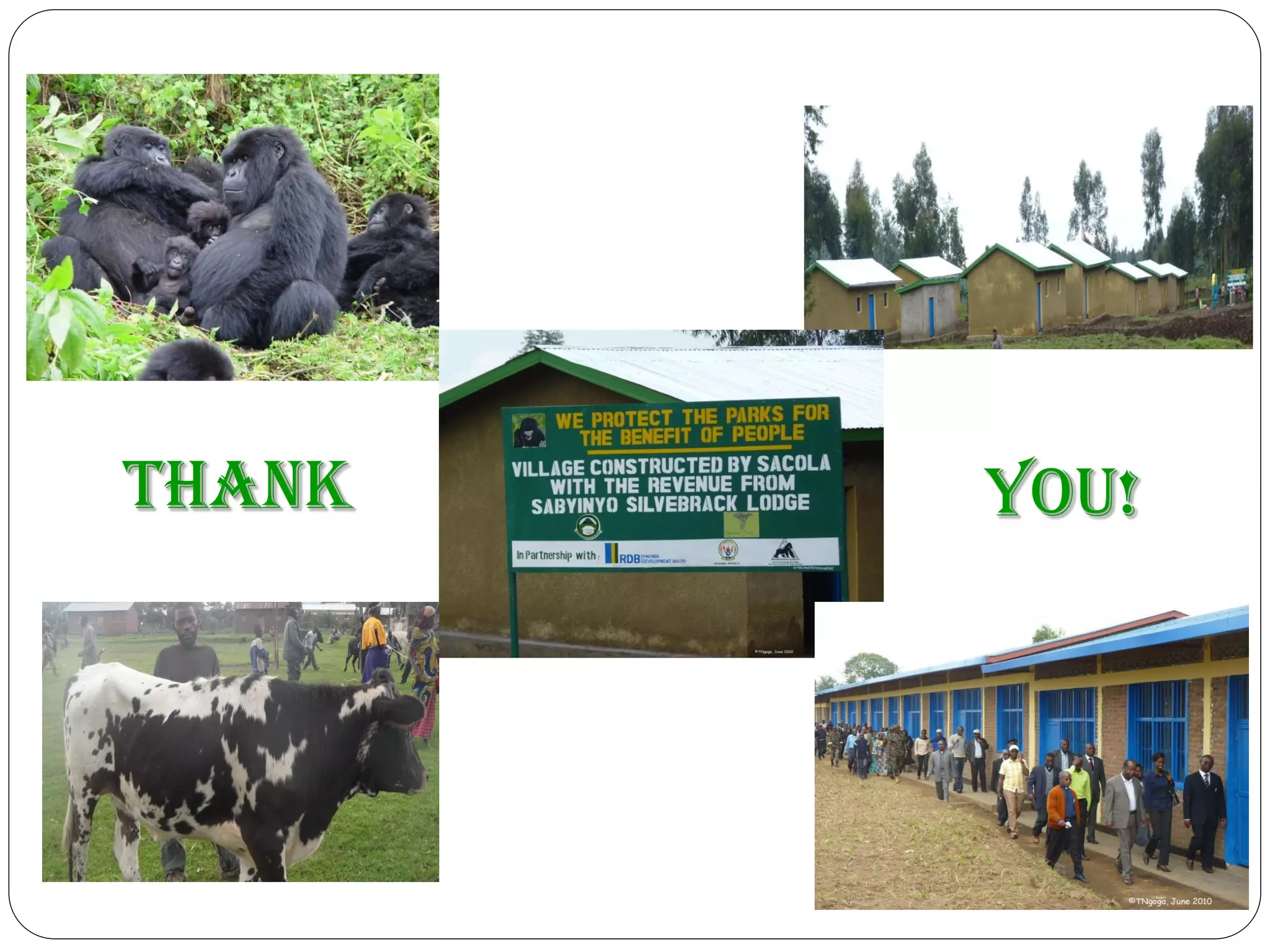
                          Construction of full houses
                             31 for genocide survivors
                             20 for other vulnerables:
                          2,600 iron sheets + nails (16m Rwf)

                          Cows donated in the program
                          one cow per family:
                            150 cows from 2010 to 2012

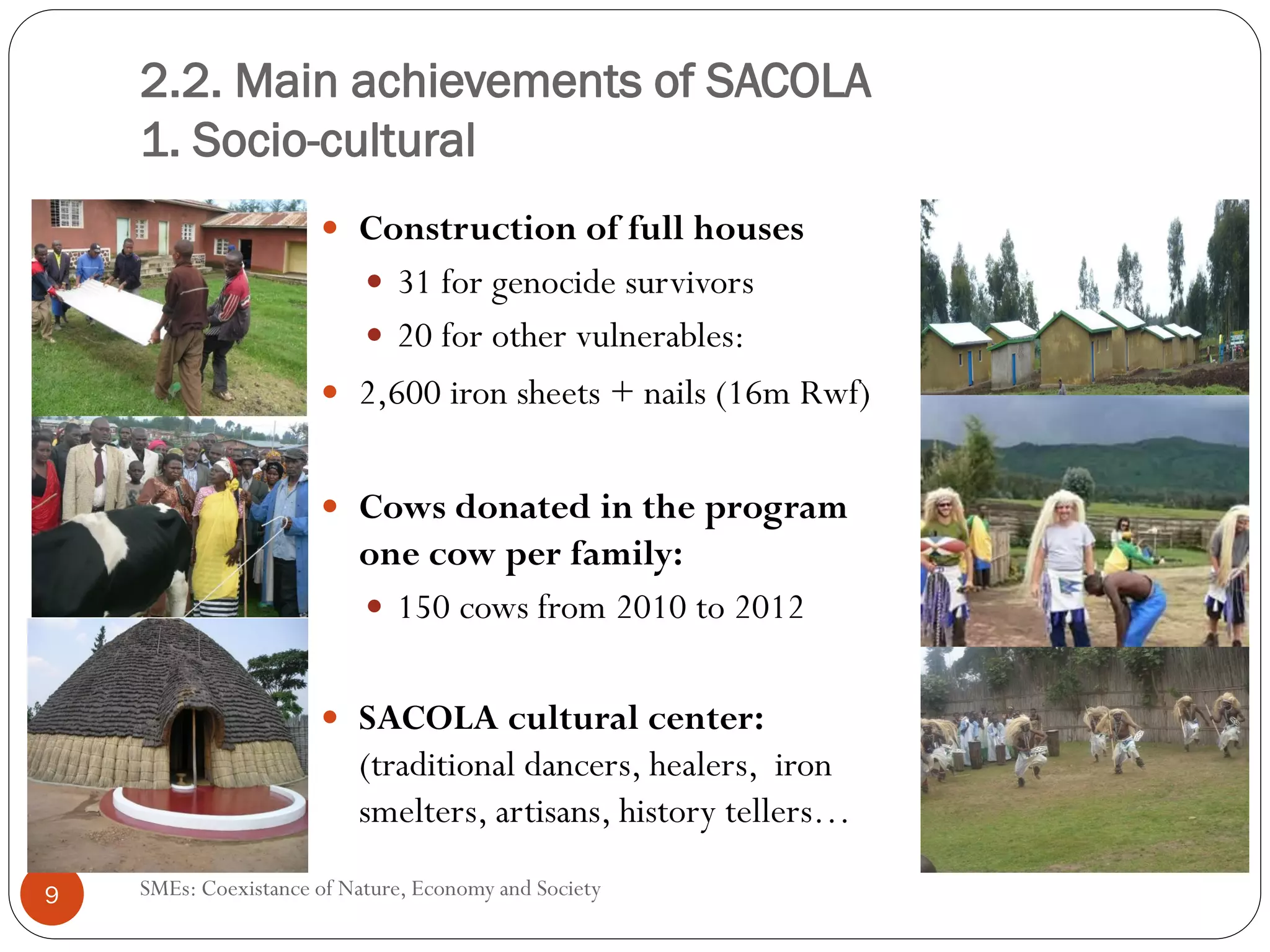
                          SACOLA cultural center:
                          (traditional dancers, healers, iron


9   SMEs: Coexistance of Nature, Economy and Society
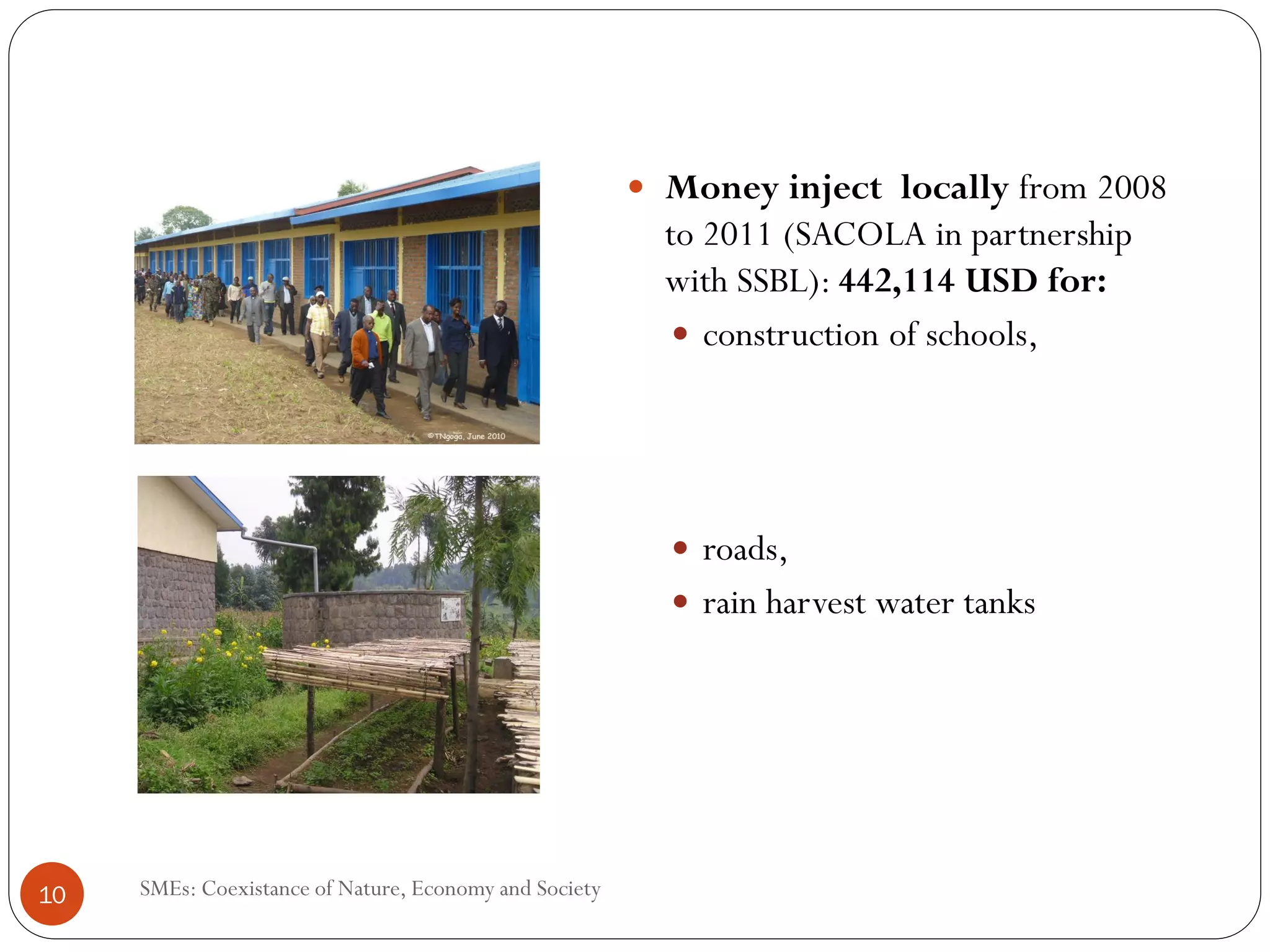
Money inject locally from 2008
                                                        to 2011 (SACOLA in partnership
                                                        with SSBL): 442,114 USD for:
                                                           construction of schools,


                                                          roads,
                                                          rain harvest water tanks


10   SMEs: Coexistance of Nature, Economy and Society
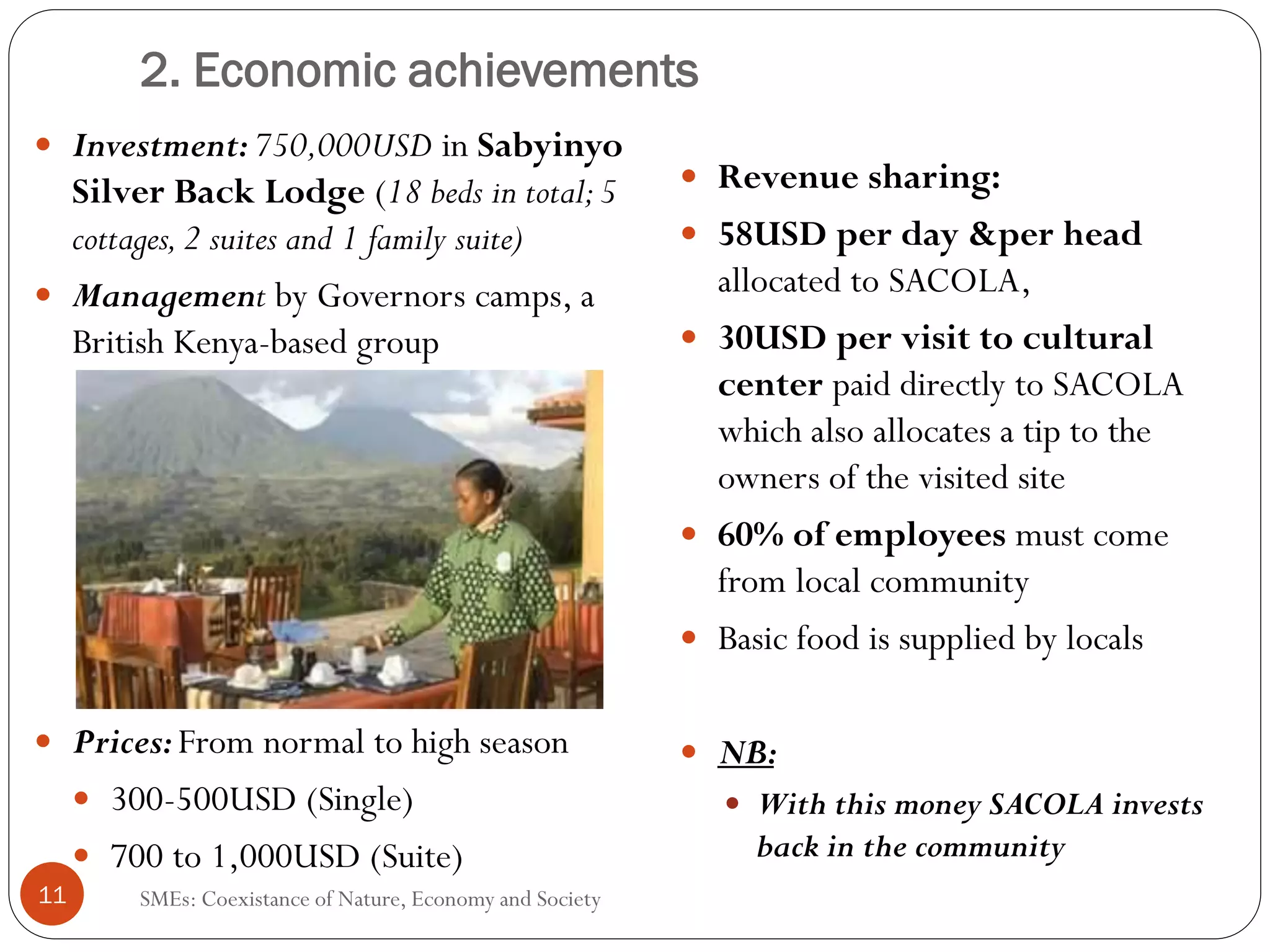
2. Economic achievements
     Investment: 750,000USD in Sabyinyo
     Silver Back Lodge (18 beds in total; 5                 Revenue sharing:
     cottages, 2 suites and 1 family suite)                 58USD per day &per head
     Management by Governors camps, a                       allocated to SACOLA,
     British Kenya-based group                              30USD per visit to cultural
                                                            center paid directly to SACOLA
                                                            which also allocates a tip to the
                                                            owners of the visited site
                                                            60% of employees must come
                                                            from local community
                                                            Basic food is supplied by locals

     Prices: From normal to high season                     NB:
       300-500USD (Single)                                    With this money SACOLA invests
       700 to 1,000USD (Suite)                                back in the community
11       SMEs: Coexistance of Nature, Economy and Society
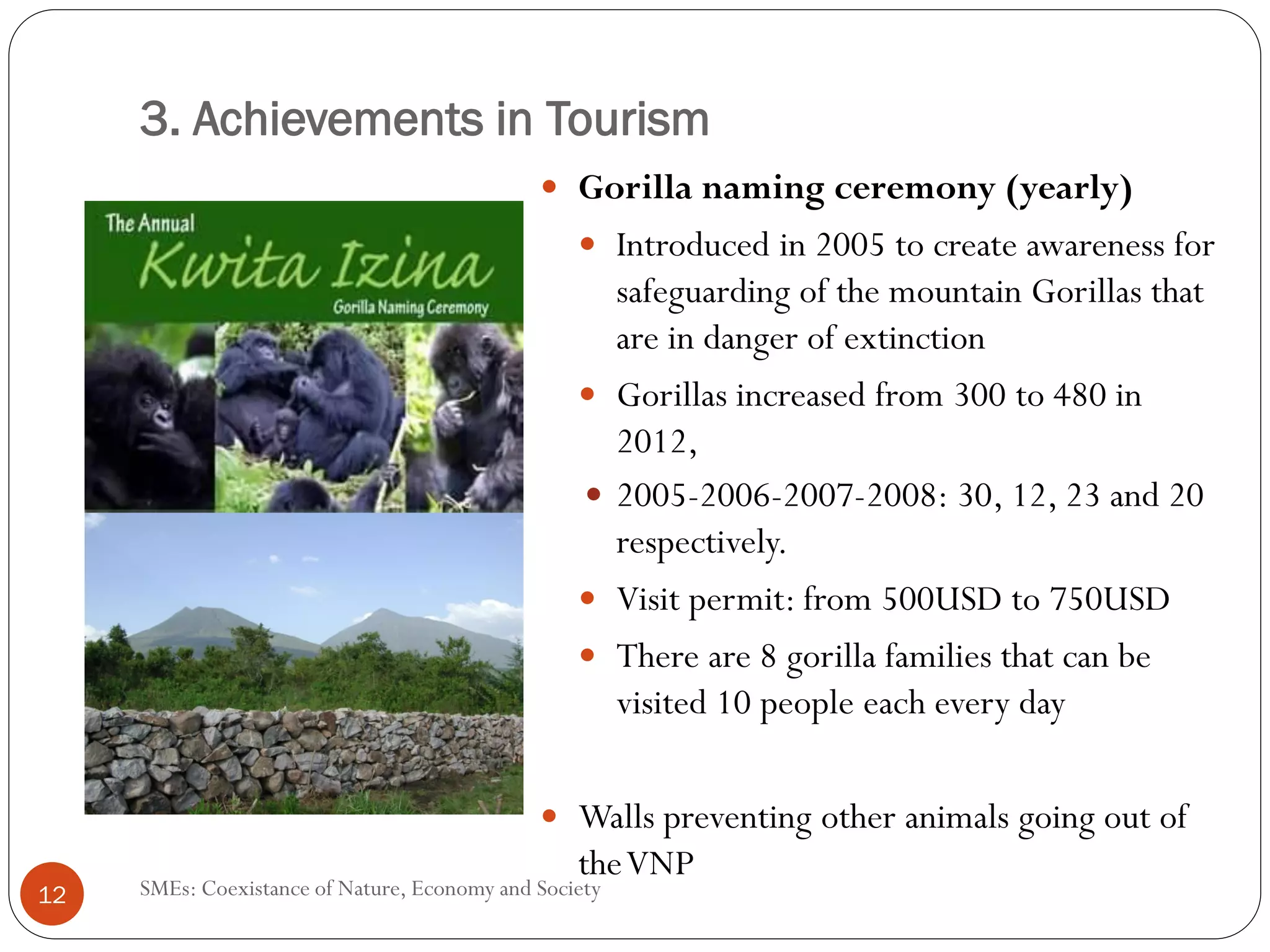
3. Achievements in Tourism
                                                  Gorilla naming ceremony (yearly)
                                                    Introduced in 2005 to create awareness for
                                                    safeguarding of the mountain Gorillas that
                                                    are in danger of extinction
                                                    Gorillas increased from 300 to 480 in
                                                    2012,
                                                    2005-2006-2007-2008: 30, 12, 23 and 20
                                                    respectively.
                                                    Visit permit: from 500USD to 750USD
                                                    There are 8 gorilla families that can be
                                                    visited 10 people each every day

                                                  Walls preventing other animals going out of
                                                  the VNP
12   SMEs: Coexistance of Nature, Economy and Society
Conclusion:Overall impact
 1.   Social benefits:                                   2. Economic benefits:
      Improved education, health                             Hotel construction,
      care,                                                  Job creation and food market
      Community united around                                Revenue sharing
      one cause
      Problems, experiences and
      solutions sharing
                                                         3.Tourism benefits
      Openness toward the outside                              Environmental conservation
      world                                                    Increased number of Gorillas
                                                               Increased cost of Gorilla visit
                                                               permit

13    SMEs: Coexistance of Nature, Economy and Society
TtHhAaNnKk     YyOoUu!  
Sources
        Interview with Florence                         Secretary,
        Founder, One of Gorilla Naming Personalities in 2010
        www.nyungwe.org
        www.igcp.org


15   SMEs: Coexistance of Nature, Economy and Society

Leipzig 5 u 6

  • 1.
    Symposium SEPT20Years – TheCo-existence of Nature, Economy and Society as Base for Sustainable Economic Development, Leipzig, 24 November 2012 PES and REDD+ for sustainable land management in developing countries – case studies from Latin America, South East Asia, and Africa Udo Nehren, Cologne University of Applied Sciences
  • 2.
    1 Higher Education Excellencein Development Cooperation – exceed — The CNRD is one of five competence centers for development cooperation in Germany, funded by the German Ministery of Economic Cooperation and Development (BMZ) — CNRD is coordinated by the Institute for Technology and Resources Management in the Tropics and Subtropics (ITT) at Cologne University of Applied Sciences
  • 3.
    2 Orientation towards MillenniumDevelopment Goal 7 (MDG 7) in research, teaching, and training
  • 4.
  • 5.
    4 "The ninth-century collapse and abandonmentof the Central Maya Lowlands in the Yucatán peninsular region were the result of complex human–environment interactions“ (Cook et al. 2012) © Roy Andersen, National Geographic
  • 6.
    5 Maya civilization, Deforestation for agricultural land, urban expansion, depended on building materials, etc. = internal pressure agriculture, technological and cultural progress Longest dry spell of the last 2,000 years = external Growing pressure population Cook et al. (2012): Few centuries later: - Reduced annual precipitation Change of regional - Regional climate change, severe droughts climate towards moister conditions In many areas forests expanded Collapse of Maya civilization Population reduced to 10% if its maximum
  • 7.
    Civilization 6 … …technical progress
  • 8.
  • 9.
    8 Fotos Yucatán Kultur undKarst Slides Nummerieren Climate Change Scenarios
  • 10.
    9 Earth System understress – people under stress Source: UNEP
  • 11.
    10 Hans Carl von Wood scarcity in Central Europe; Carlowitz: Sylvicultura reforestation, “forest romanticism”; oeconomica. Acc. to Radkau (2008) start of the Anweisung zur wilden modern environmental movement Baum-Zucht (1713): US: preservation (= nature Nachhaltigkeit set aside for its own sake) (Sustainability) versus conservation (= managing for human use)
  • 12.
    10 UN Conference on Environment and Development (UNCED), 1992 Rio Summit Brundtland report (1987) Global 2000 (1980) Club of Rome (1972): Limits to growth
  • 13.
    10 UNConference on Environment and Development (UNCED), 2012 Rio+20 2002 World Summit on Sustainable Development (WSSD) in Johannesburg Kyoto Protocol 1997
  • 14.
    Action on allfronts and at all levels Researchers ICZM Ecosystem management Kyoto Protocol Food security Soil erosion People Sustainable development IWRM Sea level rise Millennium Ecosystem Water  scarcity   Assessment Agenda 21
  • 15.
  • 16.
    13 Biodiversity loss „We'll loseuncounted new benefits. These are what the economists call opportunity costs, and they are enormous because we haven't even identified the vast majority of species out there.“ E.O. Wilson 1993: The Threatened Biosphere, Defenders Magazine, Summer 1993
  • 17.
    14 The crucial roleof tropical and subtropical ecosystems
  • 18.
    15 Significance of tropicaland subtropical Ecosystems
  • 19.
    16 Carbon storage Deforestation is responsible for an estimated release of 5.8 billion tons of CO2 equivalents per year, of which 96% are emitted by developing countries of the tropics (Stern Report 2006, IPCC 2007)
  • 20.
    17 Protection from naturalhazards www.cnx.org
  • 21.
    18 (Sub)tropical countries proneto disasters Alliance Development Works (2012): World Risk Report 2012
  • 22.
    19 Population growth, economicgrowth +1.2 +10.5 +7.7 +6.6 +3.6 +4.2 +5.9 +4.2 Numbers = Average growth rate of real GDP 2007-2011 Population data for 2011 (CIA fact book 2012) Economic data for 2011 (World Bank 2012)
  • 23.
    20 Consequences FAO Global Forest Assessment 2010
  • 24.
    21 Ecosystem Services forhuman well-being – The Millennium Ecosystem Assessment (2005) Provisioning services Regulating services (food, fiber, genetic (climate, water, erosion, resources, biochemicals, pest, disease regulation, fresh water): demand of and others): protection of natural resources natural resources
  • 25.
    22 Mechanismen: CDM REDD+ Paying people forsustainable forest and land use management? PES
  • 26.
    23 Climate Change Mitigation a)Reducing greenhouse gas emissions b) Increasing their sinks: Optimizing forest and land use management Deforestation and forest degradation in tropical rainforests: 12-20% of global GHG emissions (IPCC, 2007, van der Werf et al. 2009) - Maintaining existing C pools - Restoring lost C pools Low-cost GHG emission - Creating new C pools reduction FAO 2010
  • 27.
    24 Reducing Emissions from Deforestation and Forest Degradation (REDD) Idea of REDD in “Reducing Emissions Bali Action Plan: Copenhagen Cancún the context of from Deforestation in Accord: Agreements: LULUCF developing countries: Sustainable forest approaches to management, Mobilization of Provide countries stimulate action“ participation of financial resources with guidance on requested by local communities from developed REDD+ readiness “Coalition of and indigenous countries Rainforest Nations“ peoples Kyoto Protocol Montreal (COP-11) Bali (COP-13) Copenhagen (COP-15) Cancún (COP-16) 1997 2005 2007 2009 2010 Concentration of REDD+ projects in rainforest countries of the Amazon Basin, Congo Basin, and South East Asia
  • 28.
    25 REDD vs. PES REDD PES Financial compensation for C storage or Payments for sustainable ecosystem emission reduction through forest management to protect natural management and reforestation resources REDD+: sustainable use of forests and Usually four ecosystem services: benefits for local communities - Carbon sequestration - Water quality and availability Monetary value for stored C; included in - Biodiversity protection international carbon trade system - Landscape beauty and tourism Projects financed by international funds and grants, such as UN-REDD or FCPC Funding particularly for small farmers (Forest Carbon Partnership Fund) and land owners Currently: Developing methodologies Mainly governmental payments, no and implementation in national policies trading system
  • 29.
    Case study I:Ecuador 26 Potentials and Risks of REDD+ implementation in indigenous community lands in the Ecuadorian Amazon Toa Loaiza-Lange, Udo Nehren, Gerhard Gerold
  • 30.
    27 REDD+ projectin the buffer zone of Yasuní NP How can indigenous groups participate in the REDD+ mechanism? Rio Napo
  • 31.
    28 Kichwas Shuar Peasants Pop 80,000 Pop 45,000 Agriculture, livestock production, forestry Fishing, hunting, gathering forests products Extended families Clan arrangements Nuclear Family
  • 32.
    29 Nearly 900 petroleumcompanies Road opening, expansion of are active in NE Amazon (80% of agricultural & pasture lands, illegal the surface) (Larrea et al. 2009) logging -> annual loss of virgin forest 2000-2010 = 1.8% (FAO, 2011)
  • 33.
    Legal Framework Analysis Legal issues in Indigenous 30 Local territories de facto vs de jure rights Benefit Sharing Oil Concessions Carbon Rights ownership Global Laoiza Lange et al. 2012
  • 34.
    31 • REDD+ isknown in the indigenous communities • Unclear land tenure and overlapping of properties • Shape & Limits of properties changed to allow oil concessions • Actual territories do not match ancestral lands • Kichwas and Shuar also used legal mechanisms for land titling to gain properties in non-traditional territories • Land speculation, carbon rights - Who will benefit?
  • 35.
    32 Case study II:Atlantic Forest of Brazil Potential natural forest area ~1.0-1.5 million km² *) Percentage of original forest area ~ 8.0% *) / 11.4-16.0% **) Highly fragmented ~ 232,000 forest fragments *) One of 25 biodiversity hotspots ***) *) Fundação SOS Mata Atlântica / INPE 2009 **) Ribeiro et al. 2009 ***) Myers et al. 2000 Climate Change Scenarios
  • 36.
    33 Serra do Mar corridor Study Area of the German-Brazilian Research Project DINARIO Altlantic Ocean Climate Change Scenarios SOS Mata Atlântica 2010, modified by Heinrich, Nehren & Sattler 2010
  • 37.
    34 Potentials for REDD+? 4.04% 0.14% Close to megacity Rio de Janeiro: suburbanization processes, fragmented landscape, many small 45.45% 50.37% farmers Lack of information about EMBRAPA 2010 REDD+
  • 38.
    35 Legal framework REDDy? Climate Change Scenarios Nehren et al. 2012
  • 39.
    36 Upper Guapi- Macacu watershed No additionality PES for reforestation and management of small forest fragments: + biodiversity + carbon storage + water quantity and quality + tourism
  • 40.
    Case study III:Deforestation and degradation of dry forests due for wood fuel extraction, Mutomo district, Kenya Geoffrey Ndegwa1, Dieter Anhuf2, Udo Nehren3, Sabine Schlüter4, Miyuki Iiyama5 1 University Passau 2 Cologne University of Applied Sciences th 3 ICRAF – 27 of September, 2012 Centre, Nairobi Date: World Agroforestry
  • 41.
    38 Key figures Mutomo District (GOK, 2011) Location Eastern province of Kenya Population / About 180,000 (2009), land area 33,000 households, 20,400 km2; high population growth rate Main sources Casual labour (41%), of income remittances (21%), petty trading (18%), formal employment (3%) charcoal production (9%) Rainfall 500-1,050mm (with 30% reliability) Population 65% below poverty line
  • 42.
    39 How can a PES scheme support sustainable land management and reduce deforestation and forest degradation? Household distribution by main cooking fuel + biodiversity firewood paraffin electricity charcoal + carbon storage + tourism ICRAF 2012
  • 43.
    40 Case studies IVand V: Vietnam and Indonesia Hazards and environmental problems
  • 44.
    41 Ecosystems under pressure Slashand burn Acacia and rubber plantations Climate Change Scenarios Dam construction Illegal mining
  • 45.
    42 Evolving technologies and Ecosystem and community- community-­‐based monitoring based adaptation to climate for effective REDD+ related disasters implementation Cologne University of Applied Sciences, University of Wageningen (The Hue University (Vietnam) Netherlands), Cologne University of Applied Sciences, Vietnam Academy for Water Resources, Hue University (Vietnam)
  • 46.
    43 Indonesia, Karimunjawa Island Mangroveforest carbon stock mapping in small islands using remote sensing: above and below ground carbon mapping on medium resolution satellite image Gadjah Mada University (Indonesia), Cologne University of Applied Sciences Focus: Baseline for REDD+ implementation Climate Change Scenarios Community-based ecosystem management
  • 47.
    44 Lessons learned so far Much attention paid to economic approaches for land and ecosystem management, such as REDD+ and PES Success strongly depends on the political, socioeconomic, cultural and ecological circumstances PES successfully implemented in (sub)tropical countries; Can economic relatively low risks approaches help to REDD+ bears risks of top-down governance, land prevent the speculation, violation of indigenous rights, apart from 21st century technical challenges ecological collapse? REDD+ requires strong involvement of communities to improve knowledge and acceptance; safeguards for communities and ecosystems needed
  • 48.
    Thank you verymuch for your attention And thanks to the PhD students: Toa Loaiza Lange (Ecuador) Vanesa Rodriguez (Bolivia, Brazil) Geoffrey Ndegwa (Kenya) Arun Pratihast (Nepal, Vietnam) Pramaditya Wicaksono (Indonesia)
  • 49.
    20 THE CO-EXISTENCE OFNATURE, ECONOMY AND SOCIETY AS BASE FOR SUSTAINABLE ECONOMIC DEVELOPMENT TOPIC: THE IMPACT OF SACOLA(SABYINYO COMMUNITY LIVELIHOODS ASSOCIATION) IN THE CONSERVATION OF VOLCANOES NATIONAL PARK- REPUBLIC OF RWANDA Presented by: NSHIMIYIMANA Gonzalves INES-Ruhengeri, E-mail: gonshimiye@yahoo.fr
  • 50.
    Outline 1. BASIC INFORMATION ABOUT RWANDA 1. Akagera National Park (East of Rwanda) 2. Nyungwe National Park (South of Rwanda) 3. Volcanoes National Park (North Rwanda) 2. SACOLA : THE COEXISTANCE OF NATURE, ECONOMY AND SOCIETY 1. The nature of SACOLA 2. Main achievements of SACOLA (socio-cultural, economic, tourism) 3. Conclusion: Overall impact 2 SMEs: Coexistance of Nature, Economy and Society
  • 51.
    1. Basic informationabout Rwanda Size: 26,338km2; Landscape: Hilly Pop: 11m (54% women, 46% men) Life: 85% agriculture Religion: 95 christians Languages: Kinyarwanda, English, French
  • 52.
    1.1. Akagera NationalPark (East of Rwanda) Is the largest in Rwanda with various wild animals (Zebra, Giraffes, hippos, lions, impala, Distance: 2hrs drive from Kigali Inside the Park: Akagera Game Lodge 4 SMEs: Coexistance of Nature, Economy and Society
  • 53.
    1.2. Nyungwe NationalPark (South of Rwanda) One the largest populations of endemic species in all of Africa. East Africa's largest protected high- altitude rainforest. Distance: 3hrs drive from Kigali Species inside the Park: 86 mammals, 14 of primates, 280 of avian species, 43 species of reptiles, 1100 species of orchids What else? Canopy walkway: 90m long, 50m high Nyungwe forest Lodge SMEs: Coexistance of Nature, Economy and Society 5
  • 54.
    1.3. Volcanoes NationalPark (North Rwanda) (the focus of this presentation) Home population of the remaining endangered Mountain Gorillas Distance: 2h30 from Kigali Inside and around the Park: Mountain Gorillas Many lodges Questions? How local communities benefit the volcanoes park? What do they do to protect it? 6 SMEs: Coexistance of Nature, Economy and Society
  • 55.
    2. SACOLA :THE COEXISTANCE OF NATURE, ECONOMY AND SOCIETY Created in 2004 by Kinigi District SACOLA means authorities in collaboration with the former Rwanda Office of Tourism and National Parks (Now: RDB) Objectives: Improve and promote the lives of population surrounding the park who were suffering heavily from the consequences of the guerilla war of 1997-1998 Sabyinyo (the mountain above) Protect the park against human Community Livelihood Association activities and disease transmission from humans to gorillas 7 SMEs: Coexistance of Nature, Economy and Society
  • 56.
    2.1. The natureof SACOLA 1. Domains of Intervention: 3. Tools used: Socio- cultural Community cooperatives Economic born after . Tourism UNICOPAV (Ex-poachers, Amizero poters club, crafters, 2. Means bee-keepers), Using, supporting and ANNICO (Producers of synchronizing services provided tourism products made in by local organizations and Bamboos) communities Muhisimbi (tourism guides) Profit sharing with surrounding communities. 8 SMEs: Coexistance of Nature, Economy and Society
  • 57.
    2.2. Main achievementsof SACOLA 1. Socio-cultural Construction of full houses 31 for genocide survivors 20 for other vulnerables: 2,600 iron sheets + nails (16m Rwf) Cows donated in the program one cow per family: 150 cows from 2010 to 2012 SACOLA cultural center: (traditional dancers, healers, iron 9 SMEs: Coexistance of Nature, Economy and Society
  • 58.
    Money inject locallyfrom 2008 to 2011 (SACOLA in partnership with SSBL): 442,114 USD for: construction of schools, roads, rain harvest water tanks 10 SMEs: Coexistance of Nature, Economy and Society
  • 59.
    2. Economic achievements Investment: 750,000USD in Sabyinyo Silver Back Lodge (18 beds in total; 5 Revenue sharing: cottages, 2 suites and 1 family suite) 58USD per day &per head Management by Governors camps, a allocated to SACOLA, British Kenya-based group 30USD per visit to cultural center paid directly to SACOLA which also allocates a tip to the owners of the visited site 60% of employees must come from local community Basic food is supplied by locals Prices: From normal to high season NB: 300-500USD (Single) With this money SACOLA invests 700 to 1,000USD (Suite) back in the community 11 SMEs: Coexistance of Nature, Economy and Society
  • 60.
    3. Achievements inTourism Gorilla naming ceremony (yearly) Introduced in 2005 to create awareness for safeguarding of the mountain Gorillas that are in danger of extinction Gorillas increased from 300 to 480 in 2012, 2005-2006-2007-2008: 30, 12, 23 and 20 respectively. Visit permit: from 500USD to 750USD There are 8 gorilla families that can be visited 10 people each every day Walls preventing other animals going out of the VNP 12 SMEs: Coexistance of Nature, Economy and Society
  • 61.
    Conclusion:Overall impact 1. Social benefits: 2. Economic benefits: Improved education, health Hotel construction, care, Job creation and food market Community united around Revenue sharing one cause Problems, experiences and solutions sharing 3.Tourism benefits Openness toward the outside Environmental conservation world Increased number of Gorillas Increased cost of Gorilla visit permit 13 SMEs: Coexistance of Nature, Economy and Society
  • 62.
    TtHhAaNnKk   YyOoUu!  
  • 63.
    Sources Interview with Florence Secretary, Founder, One of Gorilla Naming Personalities in 2010 www.nyungwe.org www.igcp.org 15 SMEs: Coexistance of Nature, Economy and Society