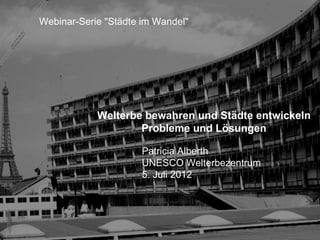
Webinar-Serie "Städte im Wandel"


            Welterbe bewahren und Städte entwickeln
                    Probleme und Lösungen

                      Patricia Alberth
                      UNESCO Welterbezentrum
                      5. Juli 2012
1954: Convention for the Protection of Cultural Property in the Event of Armed
Conflict with Regulations for the Execution of the Convention

       1970: Convention on the Means of Prohibiting and Preventing the Illicit Import,
       Export and Transfer of Ownership of Cultural Property

                  1972: Convention concerning the Protection of the World Cultural and
                  Natural Heritage


   2001: Convention on the Protection of the Underwater Cultural Heritage

            2003: Convention for the Safeguarding of the Intangible Cultural Heritage

      2005: Convention on the Protection and Promotion of the Diversity of Cultural Expressions
1972 Convention
Concerning the Protection of
the World Cultural and Natur
al Heritage
Origins of the Convention
              The Safeguarding of Abu Simbel


Threatened by the construction of a high dam 1959 the temple
  was safeguarded by an international campaign initiated by
Criteria for Inscription on the World Heritage List


(i)                  (ii)                 (iii)


(iv)                   (v)                (vi)


 (vii)               (viii)   (ix)                (x)


                                     Outstanding Universal Value
Purpose of the World Heritage Convention

“[…] ensuring the identification, protection,
conservation, presentation and transmission to
future generations of the cultural and natural
heritage around the world considered to be of
outstanding value to humanity.”

II Article 4, Convention Concerning the Protection of the World Cultural and Natural
Heritage, 1972
The Convention does not
 replace national legislation or
the primary responsibility of
  the national authority. The
               Convention is a
      supplementary authority.
Establishing the World Heritage List
Phases

 Tentative List
 Nomination
 Inscription
 Reactive monitoring
                         List in Danger
 State of conservation
                         Delisting
 Periodic Reporting
Who is Who

•   States Parties (189)
•   The General Assembly
•   The World Heritage Committee
•   UNESCO World Heritage Centre
•   Advisory Bodies
The World Heritage List


962 sites in 157 States Parties

745 cultural
188 natural
 29 mixed
Global Perspective


                Europe and North
                America: 462


                                          Arab
                                          States:
                                          73      Asia and the
    Latin America                                 Pacific: 213
    and the
    Caribbean: 128          Africa: 86


 In 1994, the World Heritage Committee launched the Global Strategy
   for a Balanced, Representative and Credible World Heritage List.
Paradigm Shift in Heritage Conservation


Old Approach               New Approach

 monuments of princes,      places and spaces of
 priests and politicians       ordinary people

management by central      community management
   administration
        elite use               popular use
36th session of the World Heritage Committee
    Saint Petersburg, Russian Federation
           24 June – 6 July 2012
Juli 2012: 26 neue Welterbestätten
Bahrain: Perlenzucht als Zeugnis einer Inselökonomie
Belgien: Bedeutende Orte des wallonischen Bergbaus
Brasilien: Kulturlandschaft Rio de Janeiro
China: Xanadu – ehemalige Hauptstadt des Mongolenherrschers Kublai Khan
Côte d’Ivoire: Historischer Stadtkern von Grand-Bassam
Deutschland: Markgräfliches Opernhaus Bayreuth
Frankreich: Bergbaugebiet Nord-Pas de Calais
Indonesien: Kulturlandschaft auf Bali: das Subak-System als Manifestation der Tri Hita Karana-
Philosophie
Iran: Jame-Moschee in Isfahan
Iran: Mausoleum Gonbad-e Qābus
Israel: Stätten der menschlichen Evolution im Karmel-Gebirge
Kanada: Kulturlandschaft Grand Pré
Malaysia: Archäologische Stätten im Lenggong-Tal
Marokko: Rabat – moderne Hauptstadt mit historischem Kern
Palästina: Geburtskirche Jesu Christi und Pilgerweg in Bethlehem
Portugal: Garnisonsstadt Elvas und ihre Befestigungsanlage
Schweden: Holzbauernhäuser in der Provinz Hälsingland
Senegal: Kulturlandschaften der Bassari, Fula und Bedik
Spanien/Slowenien: Historische Stätten der Quecksilbergewinnung: Almadén und Indrija
Türkei: Neolithische Stätte Çatalhöyük
China: Fossilienfundstätte von Chengjiang
Indien: Westghats-Gebirge
Kongo (Republik), Kamerun, Zentralafrikanische Republik: Sangha Tri-Nationalpark
Russland: Naturpark Lena-Felsen
Tschad: Seenlandschaft von Ounianga
Palau: Südliche Lagune der Rock Islands
UNESCO-Welterbestätten in Deutschland:
Aachener Dom (1978)                              Luthergedenkstätten in Eisleben und Wittenberg
Speyerer Dom (1981)                              (1996)
Würzburger Residenz und Hofgarten (1981)         Klassisches Weimar (1998)
Wallfahrtskirche "Die Wies" (1983)               Wartburg (1999)
Schlösser Augustusburg und Falkenlust in Brühl   Museumsinsel Berlin (1999)
(1984)                                           Gartenreich Dessau-Wörlitz (2000)
Dom und Michaeliskirche in Hildesheim (1985)     Klosterinsel Reichenau (2000)
Römische Baudenkmäler, Dom und                   Industriekomplex Zeche Zollverein in Essen
Liebfrauenkirche                                       (2001)
von Trier (1986)                                 Altstädte von Stralsund und Wismar (2002)
Hansestadt Lübeck (1987)                         Oberes Mittelrheintal (2002)
Schlösser und Parks von Potsdam und Berlin       Rathaus und Roland in Bremen (2004)
(1990)                                           Muskauer Park (2004)
Kloster Lorsch (1991)                            Grenzen des Römischen Reiches:
Bergwerk Rammelsberg, Altstadt von Goslar        Obergermanisch-raetischer Limes (2005)
und Oberharzer Wasserwirtschaft (1992)           Altstadt von Regensburg mit Stadtamhof (2006)
Altstadt von Bamberg (1993)                      Siedlungen der Berliner Moderne (2008)
Klosteranlage Maulbronn (1993)                   Wattenmeer (2009)
Stiftskirche, Schloss und Altstadt von           Alte Buchenwälder Deutschlands (2011)
Quedlinburg (1994)                               Fagus-Werk in Alfeld (2011)
Völklinger Hütte (1994)                          Prähistorische Pfahlbauten um die Alpen (2011)
Grube Messel (1995)                              Markgräfliches Opernhaus Bayreuth (2012)
Kölner Dom (1996)
Das Bauhaus und seine Stätten in Weimar und
Dessau (1996)
Top Ten

•   Italy     47
•   Spain     44
•   China     43
•   France    38
•   Germany   37
•   Mexico    31
•   India     29
•   UK        28
•   Russia    25
•   USA       21
Tentativliste: Deutsche Welterbestätten im Wartestand

Kassel, Wasserspiele und Herkules im Bergpark Wilhelmshöhe
Höxter, Karolingisches Westwerk und Civitas Corvey
Hamburg, Speicherstadt und Chilehaus mit Kontorhausviertel
Montan- und Kulturlandschaft Erzgebirge
Halle, Franckesche Stiftungen
Naumburger Dom und hochmittelalterliche Herrschaftslandschaft an
Saale und Unstrut
Denkmäler und Stätten der Wikinger – Danewerk und Haithabu
Heidelberg, Schloss und Altstadt
Das architektonische und städtebauliche Werk von Le Corbusier – zwei
Häuser der Weißenhofsiedlung in Stuttgart
Welterbe im urbanen
Kontext
Cultural Landscapes ● Cultural Routes,
Canals and Railways ● Rock Art Sites
● Modern Heritage ● Industrial Heritage
● Historic Cities and City Centres
Historic Centre of Vienna
Date of Inscription: 2001
Criteria: (ii)(iv)(vi)
Property: 371 ha
Buffer zone: 462 ha


Palace and Gardens of
Schönbrunn
Date of Inscription: 1996
Criteria: (i)(iv)
Property : 186 ha
Buffer zone: 261 ha
Liverpool – Maritime Mercantile City
Date of Inscription: 2004
Criteria: (ii)(iii)(iv)
Property: 136 ha
Buffer zone: 751 ha


                                       © UNESCO/van Oers
© Peel Holdings
Historic Centre of Macao
Date of Inscription: 2005
Criteria: (ii)(iii)(iv)(vi)
Property: 16 ha
Buffer zone: 107 ha


                              © Serge Dos Santos
Statement of Outstanding Universal Value

Criterion (ii): The strategic location of Macao on the Chinese territory, and the special
relationship established between the Chinese and Portuguese authorities favoured an
important interchange of human values in the various fields of culture, sciences,
technology, art and architecture over several centuries.

Criterion (iii): Macao bears a unique testimony to the first and longest-lasting
encounter between the West and China. From the 16th to the 20th centuries, it was
the focal point for traders and missionaries, and the different fields of learning. The
impact of this encounter can be traced in the fusion of different cultures that
characterise the historic core zone of Macao.

Criterion (iv): Macao represents an outstanding example of an architectural ensemble
that illustrates the development of the encounter between the Western and Chinese
civilisations over some four and half centuries, represented in the historical route, with
a series of urban spaces and architectural ensembles, that links the ancient Chinese
port with the Portuguese city.

Criterion (vi): Macao has been associated with the exchange of a variety of cultural,
spiritual, scientific and technical influences between the Western and Chinese
civilisations. These ideas directly motivated the introduction of crucial changes in
China, ultimately ending the era of imperial feudal system and establishing the
modern republic.
UNESCO
Recommendation on the
Historic Urban
Landscape (HUL), a 'soft-
law' (non-binding) to assist
Member States in meeting
the urban challenges of
tomorrow.
UNESCO World Heritage Centre
    7, Place de Fontenoy
     75352 Paris 07 SP
            France
    http://whc.unesco.org

2012 daad webinar2

  • 1.
    Webinar-Serie "Städte imWandel" Welterbe bewahren und Städte entwickeln Probleme und Lösungen Patricia Alberth UNESCO Welterbezentrum 5. Juli 2012
  • 2.
    1954: Convention forthe Protection of Cultural Property in the Event of Armed Conflict with Regulations for the Execution of the Convention 1970: Convention on the Means of Prohibiting and Preventing the Illicit Import, Export and Transfer of Ownership of Cultural Property 1972: Convention concerning the Protection of the World Cultural and Natural Heritage 2001: Convention on the Protection of the Underwater Cultural Heritage 2003: Convention for the Safeguarding of the Intangible Cultural Heritage 2005: Convention on the Protection and Promotion of the Diversity of Cultural Expressions
  • 3.
    1972 Convention Concerning theProtection of the World Cultural and Natur al Heritage
  • 4.
    Origins of theConvention The Safeguarding of Abu Simbel Threatened by the construction of a high dam 1959 the temple was safeguarded by an international campaign initiated by
  • 5.
    Criteria for Inscriptionon the World Heritage List (i) (ii) (iii) (iv) (v) (vi) (vii) (viii) (ix) (x) Outstanding Universal Value
  • 6.
    Purpose of theWorld Heritage Convention “[…] ensuring the identification, protection, conservation, presentation and transmission to future generations of the cultural and natural heritage around the world considered to be of outstanding value to humanity.” II Article 4, Convention Concerning the Protection of the World Cultural and Natural Heritage, 1972
  • 7.
    The Convention doesnot replace national legislation or the primary responsibility of the national authority. The Convention is a supplementary authority.
  • 9.
    Establishing the WorldHeritage List Phases  Tentative List  Nomination  Inscription  Reactive monitoring  List in Danger  State of conservation  Delisting  Periodic Reporting
  • 10.
    Who is Who • States Parties (189) • The General Assembly • The World Heritage Committee • UNESCO World Heritage Centre • Advisory Bodies
  • 11.
    The World HeritageList 962 sites in 157 States Parties 745 cultural 188 natural 29 mixed
  • 12.
    Global Perspective Europe and North America: 462 Arab States: 73 Asia and the Latin America Pacific: 213 and the Caribbean: 128 Africa: 86  In 1994, the World Heritage Committee launched the Global Strategy for a Balanced, Representative and Credible World Heritage List.
  • 13.
    Paradigm Shift inHeritage Conservation Old Approach New Approach monuments of princes, places and spaces of priests and politicians ordinary people management by central community management administration elite use popular use
  • 14.
    36th session ofthe World Heritage Committee Saint Petersburg, Russian Federation 24 June – 6 July 2012
  • 15.
    Juli 2012: 26neue Welterbestätten Bahrain: Perlenzucht als Zeugnis einer Inselökonomie Belgien: Bedeutende Orte des wallonischen Bergbaus Brasilien: Kulturlandschaft Rio de Janeiro China: Xanadu – ehemalige Hauptstadt des Mongolenherrschers Kublai Khan Côte d’Ivoire: Historischer Stadtkern von Grand-Bassam Deutschland: Markgräfliches Opernhaus Bayreuth Frankreich: Bergbaugebiet Nord-Pas de Calais Indonesien: Kulturlandschaft auf Bali: das Subak-System als Manifestation der Tri Hita Karana- Philosophie Iran: Jame-Moschee in Isfahan Iran: Mausoleum Gonbad-e Qābus Israel: Stätten der menschlichen Evolution im Karmel-Gebirge Kanada: Kulturlandschaft Grand Pré Malaysia: Archäologische Stätten im Lenggong-Tal Marokko: Rabat – moderne Hauptstadt mit historischem Kern Palästina: Geburtskirche Jesu Christi und Pilgerweg in Bethlehem Portugal: Garnisonsstadt Elvas und ihre Befestigungsanlage Schweden: Holzbauernhäuser in der Provinz Hälsingland Senegal: Kulturlandschaften der Bassari, Fula und Bedik Spanien/Slowenien: Historische Stätten der Quecksilbergewinnung: Almadén und Indrija Türkei: Neolithische Stätte Çatalhöyük China: Fossilienfundstätte von Chengjiang Indien: Westghats-Gebirge Kongo (Republik), Kamerun, Zentralafrikanische Republik: Sangha Tri-Nationalpark Russland: Naturpark Lena-Felsen Tschad: Seenlandschaft von Ounianga Palau: Südliche Lagune der Rock Islands
  • 16.
    UNESCO-Welterbestätten in Deutschland: AachenerDom (1978) Luthergedenkstätten in Eisleben und Wittenberg Speyerer Dom (1981) (1996) Würzburger Residenz und Hofgarten (1981) Klassisches Weimar (1998) Wallfahrtskirche "Die Wies" (1983) Wartburg (1999) Schlösser Augustusburg und Falkenlust in Brühl Museumsinsel Berlin (1999) (1984) Gartenreich Dessau-Wörlitz (2000) Dom und Michaeliskirche in Hildesheim (1985) Klosterinsel Reichenau (2000) Römische Baudenkmäler, Dom und Industriekomplex Zeche Zollverein in Essen Liebfrauenkirche (2001) von Trier (1986) Altstädte von Stralsund und Wismar (2002) Hansestadt Lübeck (1987) Oberes Mittelrheintal (2002) Schlösser und Parks von Potsdam und Berlin Rathaus und Roland in Bremen (2004) (1990) Muskauer Park (2004) Kloster Lorsch (1991) Grenzen des Römischen Reiches: Bergwerk Rammelsberg, Altstadt von Goslar Obergermanisch-raetischer Limes (2005) und Oberharzer Wasserwirtschaft (1992) Altstadt von Regensburg mit Stadtamhof (2006) Altstadt von Bamberg (1993) Siedlungen der Berliner Moderne (2008) Klosteranlage Maulbronn (1993) Wattenmeer (2009) Stiftskirche, Schloss und Altstadt von Alte Buchenwälder Deutschlands (2011) Quedlinburg (1994) Fagus-Werk in Alfeld (2011) Völklinger Hütte (1994) Prähistorische Pfahlbauten um die Alpen (2011) Grube Messel (1995) Markgräfliches Opernhaus Bayreuth (2012) Kölner Dom (1996) Das Bauhaus und seine Stätten in Weimar und Dessau (1996)
  • 17.
    Top Ten • Italy 47 • Spain 44 • China 43 • France 38 • Germany 37 • Mexico 31 • India 29 • UK 28 • Russia 25 • USA 21
  • 18.
    Tentativliste: Deutsche Welterbestättenim Wartestand Kassel, Wasserspiele und Herkules im Bergpark Wilhelmshöhe Höxter, Karolingisches Westwerk und Civitas Corvey Hamburg, Speicherstadt und Chilehaus mit Kontorhausviertel Montan- und Kulturlandschaft Erzgebirge Halle, Franckesche Stiftungen Naumburger Dom und hochmittelalterliche Herrschaftslandschaft an Saale und Unstrut Denkmäler und Stätten der Wikinger – Danewerk und Haithabu Heidelberg, Schloss und Altstadt Das architektonische und städtebauliche Werk von Le Corbusier – zwei Häuser der Weißenhofsiedlung in Stuttgart
  • 19.
  • 20.
    Cultural Landscapes ●Cultural Routes, Canals and Railways ● Rock Art Sites ● Modern Heritage ● Industrial Heritage ● Historic Cities and City Centres
  • 22.
    Historic Centre ofVienna Date of Inscription: 2001 Criteria: (ii)(iv)(vi) Property: 371 ha Buffer zone: 462 ha Palace and Gardens of Schönbrunn Date of Inscription: 1996 Criteria: (i)(iv) Property : 186 ha Buffer zone: 261 ha
  • 25.
    Liverpool – MaritimeMercantile City Date of Inscription: 2004 Criteria: (ii)(iii)(iv) Property: 136 ha Buffer zone: 751 ha © UNESCO/van Oers
  • 26.
  • 27.
    Historic Centre ofMacao Date of Inscription: 2005 Criteria: (ii)(iii)(iv)(vi) Property: 16 ha Buffer zone: 107 ha © Serge Dos Santos
  • 28.
    Statement of OutstandingUniversal Value Criterion (ii): The strategic location of Macao on the Chinese territory, and the special relationship established between the Chinese and Portuguese authorities favoured an important interchange of human values in the various fields of culture, sciences, technology, art and architecture over several centuries. Criterion (iii): Macao bears a unique testimony to the first and longest-lasting encounter between the West and China. From the 16th to the 20th centuries, it was the focal point for traders and missionaries, and the different fields of learning. The impact of this encounter can be traced in the fusion of different cultures that characterise the historic core zone of Macao. Criterion (iv): Macao represents an outstanding example of an architectural ensemble that illustrates the development of the encounter between the Western and Chinese civilisations over some four and half centuries, represented in the historical route, with a series of urban spaces and architectural ensembles, that links the ancient Chinese port with the Portuguese city. Criterion (vi): Macao has been associated with the exchange of a variety of cultural, spiritual, scientific and technical influences between the Western and Chinese civilisations. These ideas directly motivated the introduction of crucial changes in China, ultimately ending the era of imperial feudal system and establishing the modern republic.
  • 30.
    UNESCO Recommendation on the HistoricUrban Landscape (HUL), a 'soft- law' (non-binding) to assist Member States in meeting the urban challenges of tomorrow.
  • 31.
    UNESCO World HeritageCentre 7, Place de Fontenoy 75352 Paris 07 SP France http://whc.unesco.org

Editor's Notes

  • #12 830 sites are listed: 644 cultural, 162 natural, and 24 mixed properties, in 138 States Parties The World Heritage List includes 812 properties in 137 States Parties, including     - 628 natural,     - 160 natural, and     -  24 mixed properties   To date, there are 50 properties on World Heritage List have been included as cultural landscapes (as of 1 June 2006)
  • #13 43 121 11 175
  • #15 43 121 11 175