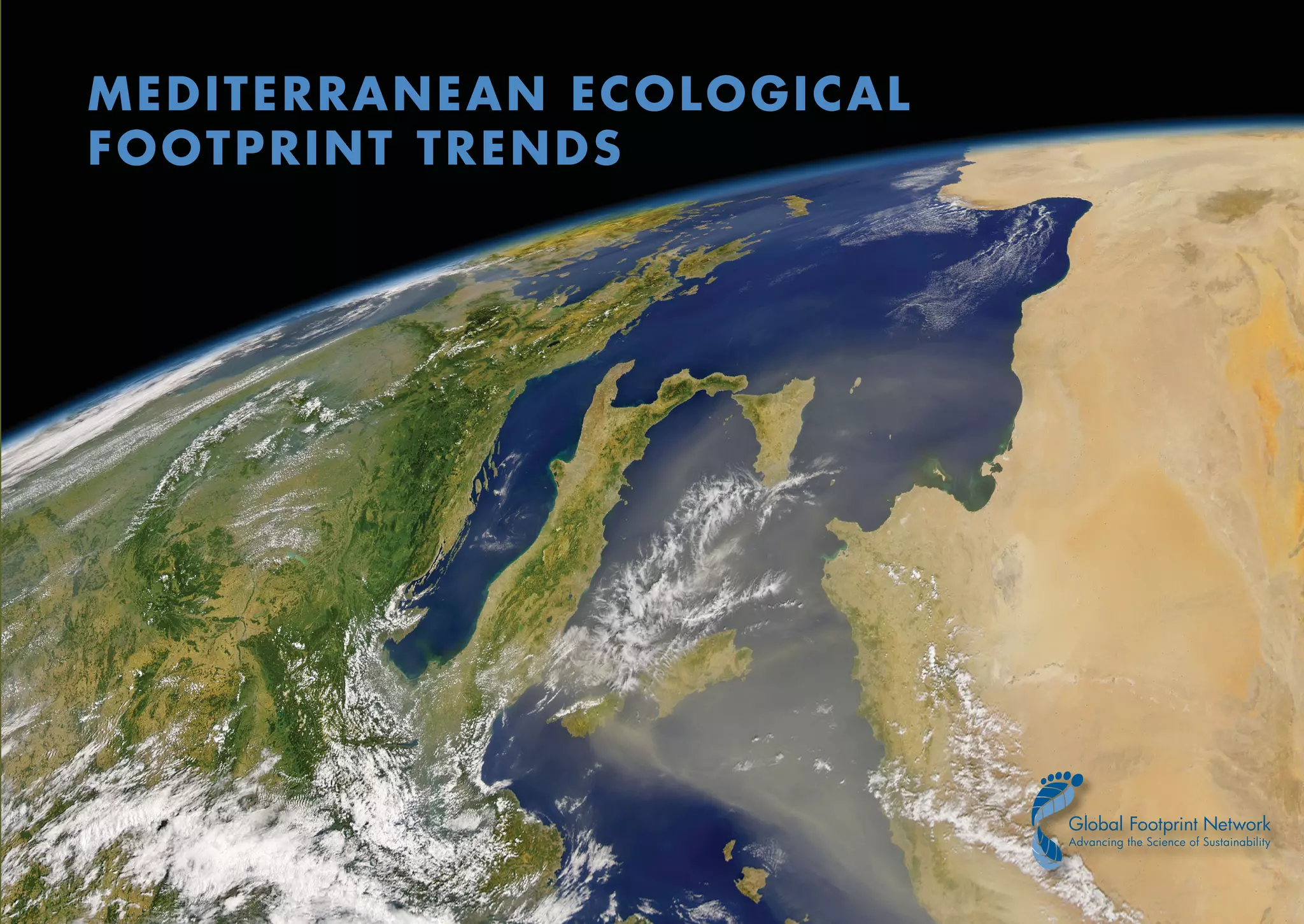
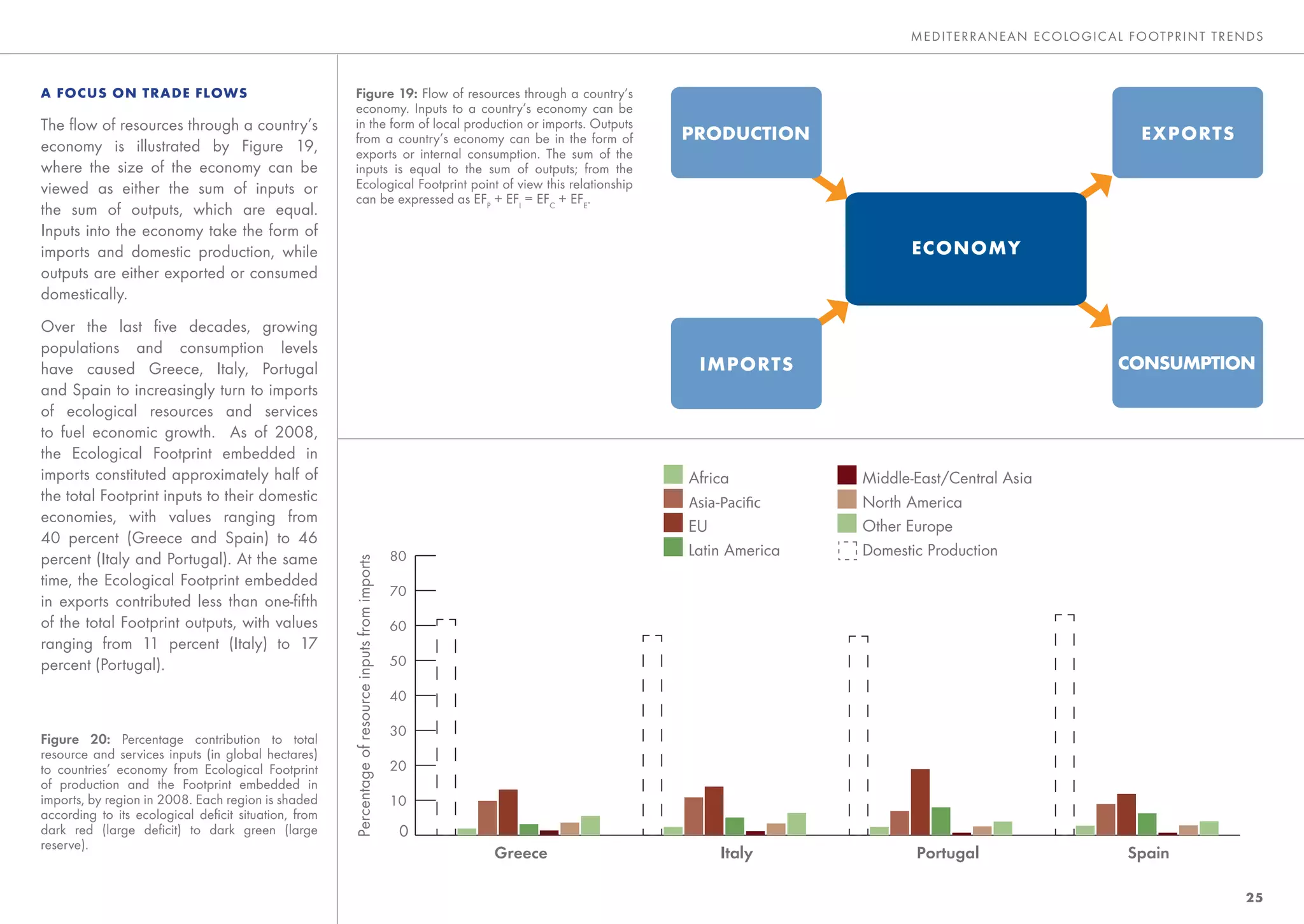
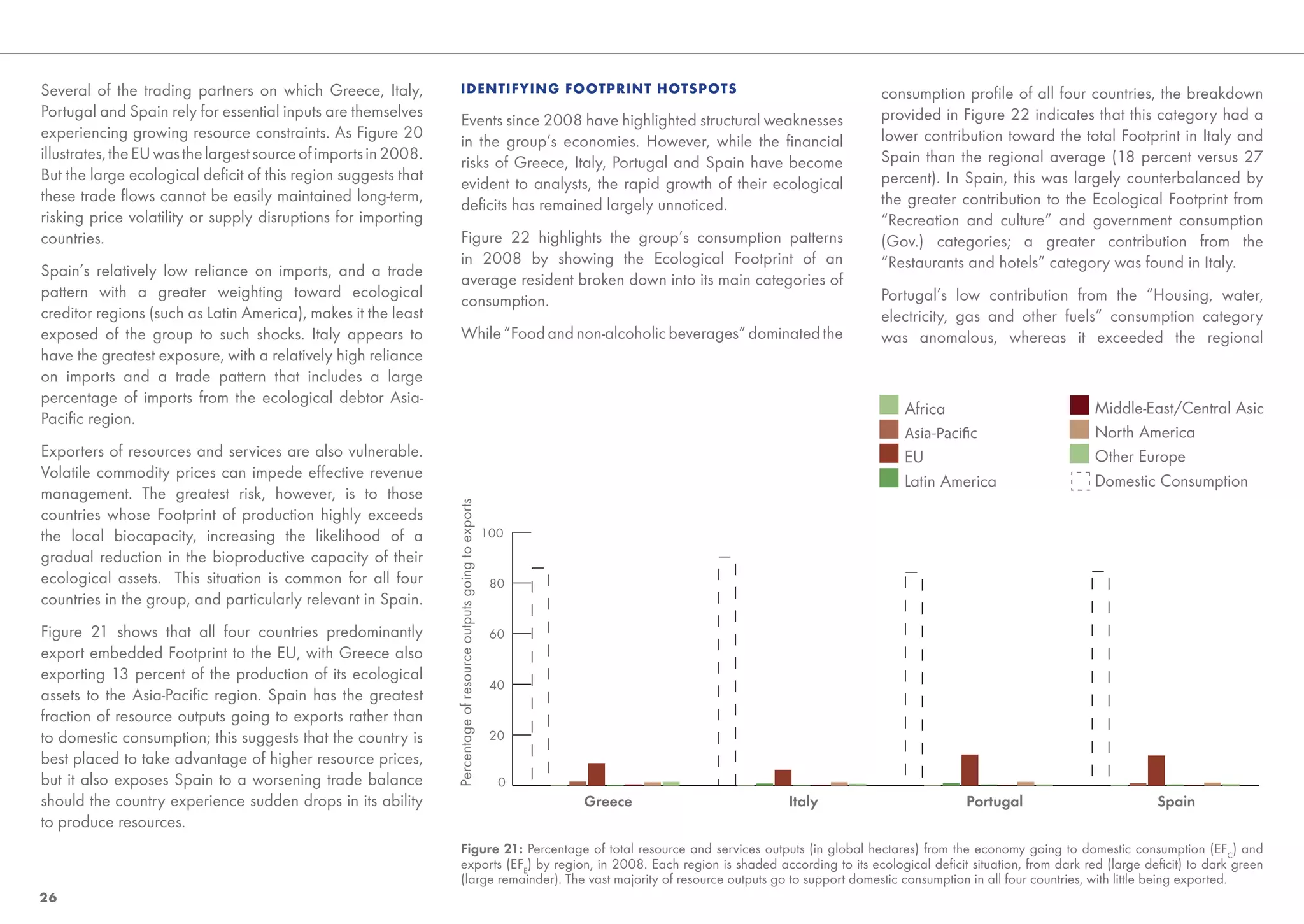
MEDITERRANEAN ECOLOGICAL
FOOTPRINT TRENDS
CONTENT

Global Footprint Network                     1   Global Footprint Network                     EDITOR
   Foreword                                      Promotes a sustainable economy by            Alessandro Galli
                                                 advancing the Ecological Footprint,          Scott Mattoon
Foreword Plan Blue                           2
                                                 a tool that makes sustainability
Introduction                                 3   measureable.
                                                                                              AUTHORS
The Ecological Footprint                     8
                                                                                              Alessandro Galli
                                                 Funded by:
of World Regions                                                                              David Moore
                                                 MAVA Foundation
                                                 Established in 1994, it is a family-led,     Nina Brooks
Drivers of Mediterranean Ecological
Footprint and biocapacity changes                Swiss-based philanthropic foundation         Katsunori Iha
                                            10
over time                                        whose mission is to engage in strong         Gemma Cranston
                                                 partnerships to conserve biodiversity
Mapping consumption, production             13   for future generations.                      CONTRIBUTORS AND REVIEWER
and trade activities for the
Mediterranean Region                                                                          Jean-Pierre Giraud
                                                 In collaboration with:                       Steve Goldfinger
Mediterranean Ecological Footprint          17   WWF Mediterranean                            Martin Halle
of nations                                       Its mission is to build a future in which    Pati Poblete
                                                 people live in harmony with nature.
Linking ecological assets and               20                                                Anders Reed
                                                 The WWF Mediterranean initiative aims
economic competitiveness                                                                      Mathis Wackernagel
                                                 at conserving the natural wealth of the
Toward sustainable development:             22   Mediterranean and reducing human
human welfare and planetary limits               footprint on nature for the benefit of all.   DESIGN
                                                                                              MaddoxDesign.net
National Case Studies                       24
                                                 UNESCO Venice
Conclusions                                 28   Is developing an educational and             ADVISORS
                                                 training platform on the application         Deanna Karapetyan
Appendix A                                  32   of the Ecological Footprint in SEE and       Hannes Kunz
  Calculating the Ecological Footprint           Mediterranean countries, using in             (Institute for Integrated Economic
                                                 particular the network of MAB Biosphere
Appendix B                                  35                                                 Research - www.iier.ch)
                                                 Reserves as special demonstration and
  The carbon-plus approach                                                                    Paolo Lombardi
                                                 learning places.
Appendix C
                                                                                               (WWF Mediterranean Programme)
                                            36
  Ecological Footprint: Frequently asked         Plan Bleu                                    André Schneider
  questions                                      Plan Bleu aims to produce information         (André Schneider Global Advisory SA)
                                                 and knowledge in order to alert              Yves de Soye
Glossary of Ecological Footprint terms      38
                                                 decision-makers and other stakeholders
References                                  40   to environmental risks and sustainable
                                                 development issues in the Mediterranean,
Biocapacity and Ecological Footprint Data   42   and to shape future scenarios to guide
                                                 decision-making processes.
GLOBAL FOOTPRINT NETWORK FOREWORD
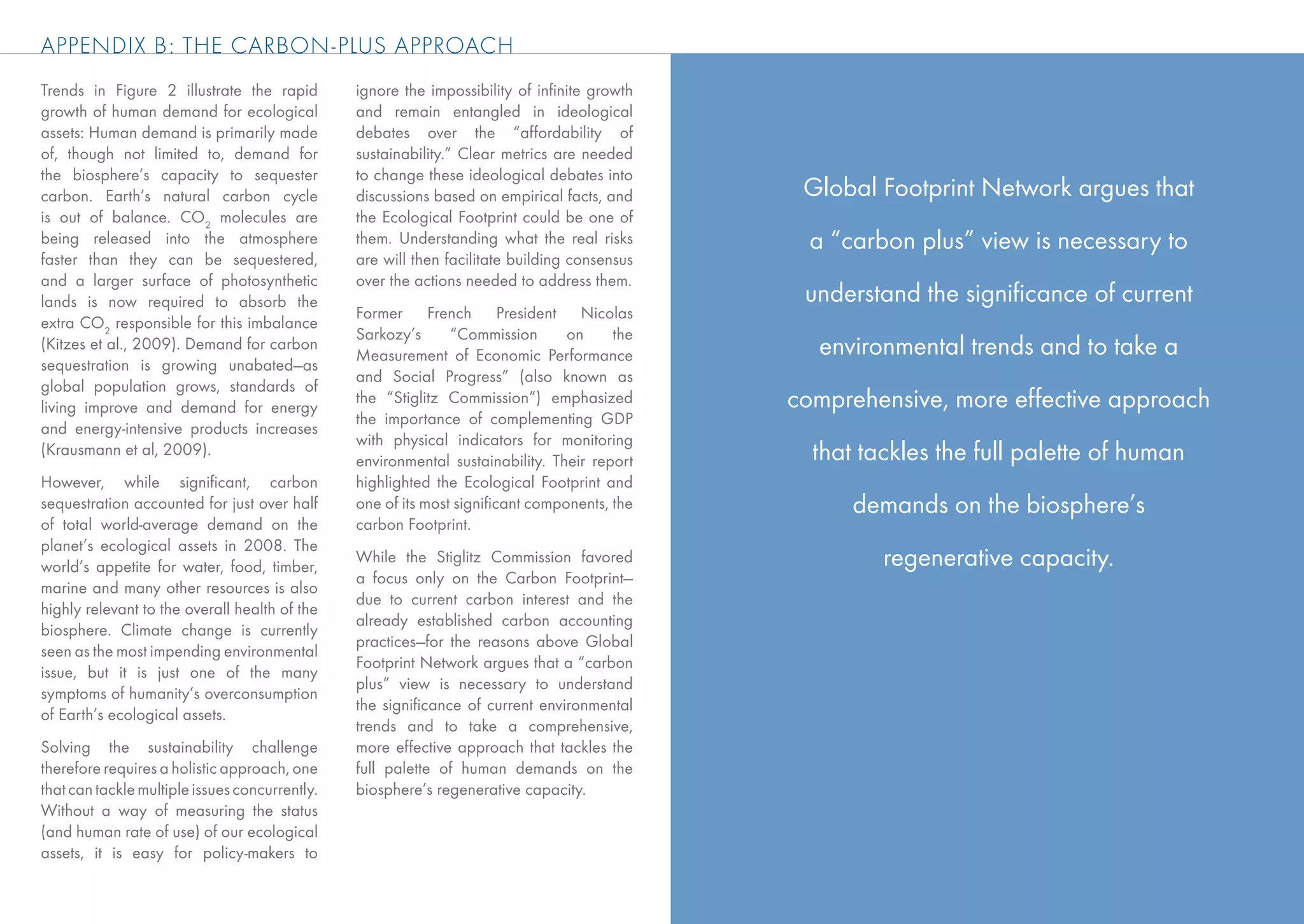
                                          Yes, ecological health is important—all agree—but what’s in it for our economies? This is
                                          the question we address with the Mediterranean Footprint report. We believe that if we
                                          carefully look at the resource trends, the link will be obvious. We will see that it is in each
                                                                                                                                            I   n a world of growing ecological

                                                                                                                                                overshoot—when our demands for

                                                                                                                                            nature’s products and services exceed
                                          country’s most central self-interest to combat ecological deficits and overreliance on fossil
                                          fuel quickly and aggressively.                                                                    the planet’s ability to renew them—the

                                                                                                                                            winning economic strategies will be
                                          Such action does not depend on whether our global neighbors follow suit. In fact, each
                                          country’s own actions will become more urgent and valuable the less others do.                    those that manage biocapacity on the

                                                                                                                                            one hand, and reduce demand for it
                                          Let me spell out the argument: Why would it be in any individual country’s interest to address
                                          a problem that seems to be global in nature?                                                      on the other.

Mathis Wackernagel                        Consider the nature of the most prominent environmental challenge: Climate change. Even           Those countries and cities trapped
President, Global Footprint Network       though climate change transcends country boundaries, the fossil fuel dependence that              in energy- and resource-intensive
www.footprintnetwork.org
                                          contributes to it carries growing economic risks for the emitting country—particularly for
                                                                                                                                            infrastructure (and economic activities)
many of the Mediterranean countries paying for expensive oil-imports. Working our way out of this addiction takes time, and the
longer we wait to radically rethink and retool our societies, the costlier and harder it will be.                                           will become dangerously fragile, and

                                                                                                                                            will not be able to adapt in time to meet
But climate change is not an issue in isolation. Rather, it is a symptom of a broader challenge: Humanity’s systematic overuse of the
planet’s finite resources.                                                                                                                   the emerging resource constraints. But

                                                                                                                                            those which do, and build economies
Our natural systems can only generate a finite amount of raw materials (fish, trees, crops, etc.) and absorb a finite amount of waste
(such as carbon dioxide emissions). Global Footprint Network quantifies this rate of output through a measure called “biocapacity.”          that work with, rather than against,
Biocapacity is as measurable as GDP—and, ultimately, more significant, as access to basic living resources underlies every economic          nature’s budget will be able to secure
activity a society can undertake.
                                                                                                                                            the wellbeing of their people.
For centuries, we have treated biocapacity as an essentially limitless flow. Today, though, humanity’s demand for biocapacity
outstrips global supply by 50 percent. In the Mediterranean region, as this report shows, demands on biocapacity now exceed the
region’s supply by more than 150 percent.
PLAN BLEU FOREWORD


                                                                                                                              T
                                         In 1989, Plan Bleu published a pioneering report on “Futures for the Mediterranean         he “State of the Environment and
                                         Basin” which recommended a design for the Mediterranean Strategy for                       Development in the Mediterranean”,
                                         Sustainable Development (MSSD). With the issuance of an update in 2005,
                                                                                                                              published by Plan Bleu in 2009, attempted to
                                         entitled “A sustainable future for the Mediterranean: the Blue Plan’s environment
                                         and development outlook” the report’s recommendations were adopted by the            provide answers regarding water and energy.

                                         Barcelona Convention Contracting Parties at their 14th conference in Portoroz,       The promotion of water demand management
                                         Slovenia, 8-11 November 2005.                                                        and the use of related indicators, such as

                                         Plan Bleu’s key function as the “Mediterranean Environment and Development           efficiency demand per sector and exploitation
                                         Observatory” (MEDO), draws heavily upon its expertise in sustainable                 index of the renewable resources, should aid
                                         development indicators. Within MEDO, 134 initial indicators were selected
                                                                                                                              better inclusion of water scarcity. The main
                                         and adapted to the follow-up of the implementation of Agenda 21 in the
Hugues Ravenel                                                                                                                responses to the growth of the major
                                         Mediterranean. Of these, 34 priority indicators were subsequently chosen to
Director, Plan Bleu
                                         monitor the progress made by the Mediterranean countries focusing upon the           socio-economic drivers and environmental
www.planbleu.org
                                         objectives defined for 9 MSSD priority issues including:                              pressures are a) to develop more sustainable
                                                                                                                              energy consumption and b) encourage
    Improving integrated water resource and water demand management;
                                                                                                                              diversification of energy sources with a bigger
    Ensuring sustainable management of energy;                                                                                share of renewable energy.
    Mitigating and adapting to the effects of climate change.
                                                                                                                              The MSSD and the related indicators are being
                                                                                                                              revised by taking into account the impact of
In addition, some composite indicators such as the Human Development Index (HDI) and Ecological Footprint were
considered to monitor overall progress in terms of sustainable development.                                                   climate change on the Mediterranean environment
                                                                                                                              and society. All this work on indicators and MSSD
The MSSD priority indicators are unable to fully describe the complexity and diversity of sustainable development
issues in the Mediterranean regions. Some additional indicators were thus selected, defined and populated in order to          is also linked to the activities of the Centre for
tackle priority issues such as: water, energy, tourism, the conservation of rural and coastal areas. These analyses, widely   Mediterranean Integration in Marseille and the
disseminated in Plan Bleu publications and continuously updated, are nicely complemented by the analysis of Ecological        priority areas of the Union for the Mediterranean.
Footprint and biocapacity trends in the Mediterranean region that is included in this report.


2
MEDITE RRANEAN E CO LO GIC AL FO OTP RINT TRENDS
INTRODUCTION
WHAT’S AT STAKE                                                                           TRACKING HUMAN DEMAND ON
Since the rise of agriculture, the           the performance of their economies are       BIOCAPACIT Y:
Mediterranean region has been shaped         undermining the health of their ecological
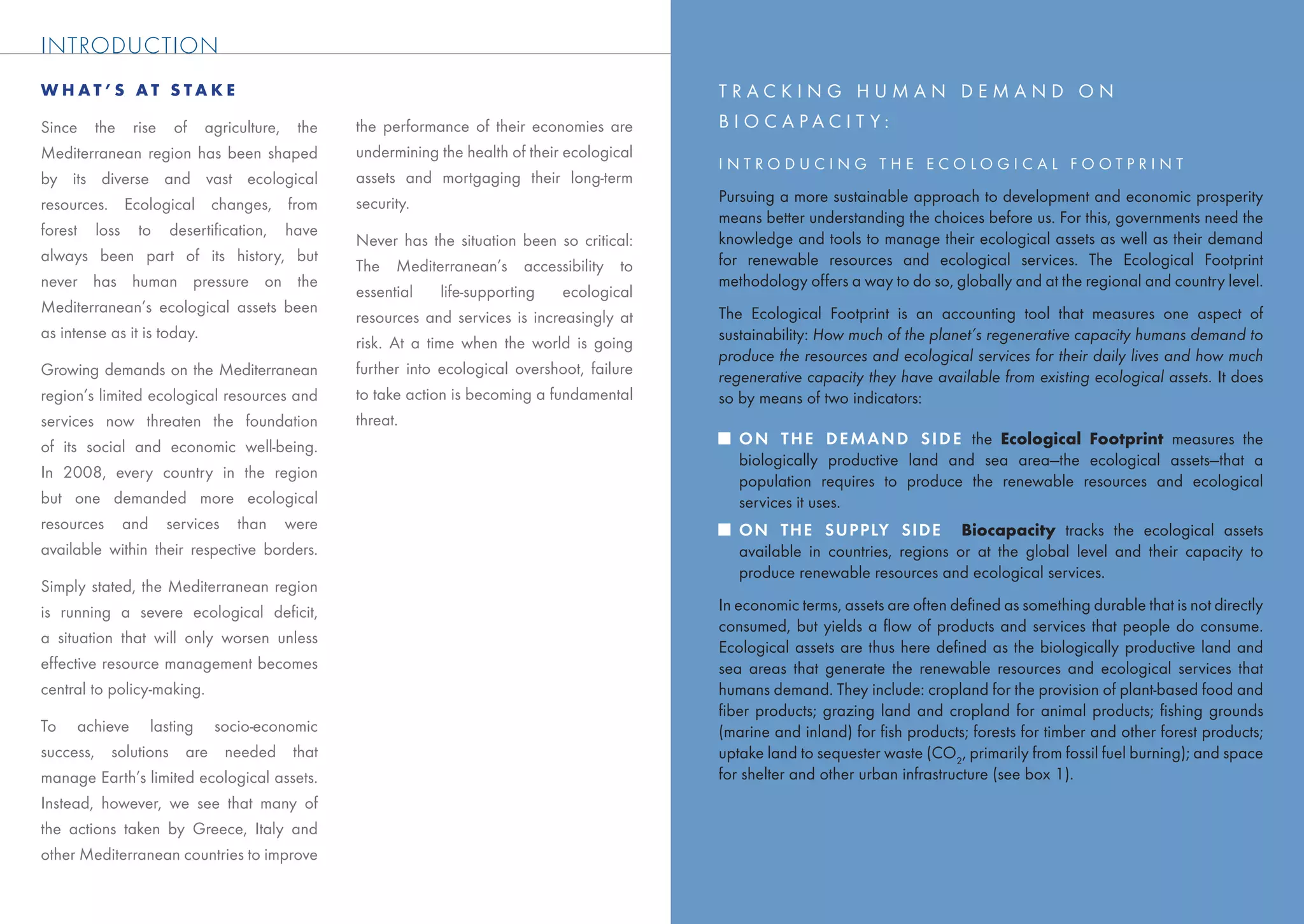
                                                                                          INTRODUCING THE ECOLOGICAL FOOTPRINT
by its diverse and vast ecological           assets and mortgaging their long-term
resources. Ecological changes, from          security.                                    Pursuing a more sustainable approach to development and economic prosperity
                                                                                          means better understanding the choices before us. For this, governments need the
forest loss to desertification, have                                                       knowledge and tools to manage their ecological assets as well as their demand
                                             Never has the situation been so critical:
always been part of its history, but                                                      for renewable resources and ecological services. The Ecological Footprint
                                             The Mediterranean’s accessibility to
never has human pressure on the                                                           methodology offers a way to do so, globally and at the regional and country level.
                                             essential     life-supporting  ecological
Mediterranean’s ecological assets been                                                    The Ecological Footprint is an accounting tool that measures one aspect of
                                             resources and services is increasingly at
as intense as it is today.                                                                sustainability: How much of the planet’s regenerative capacity humans demand to
                                             risk. At a time when the world is going
                                                                                          produce the resources and ecological services for their daily lives and how much
Growing demands on the Mediterranean         further into ecological overshoot, failure   regenerative capacity they have available from existing ecological assets. It does
region’s limited ecological resources and    to take action is becoming a fundamental     so by means of two indicators:
services now threaten the foundation         threat.
of its social and economic well-being.                                                       O N T H E D E M A N D S I D E the Ecological Footprint measures the
                                                                                             biologically productive land and sea area—the ecological assets—that a
In 2008, every country in the region
                                                                                             population requires to produce the renewable resources and ecological
but one demanded more ecological                                                             services it uses.
resources and services than were                                                             ON THE SUPPLY SIDE Biocapacity tracks the ecological assets
available within their respective borders.                                                   available in countries, regions or at the global level and their capacity to
                                                                                             produce renewable resources and ecological services.
Simply stated, the Mediterranean region
is running a severe ecological deficit,                                                    In economic terms, assets are often defined as something durable that is not directly
                                                                                          consumed, but yields a flow of products and services that people do consume.
a situation that will only worsen unless
                                                                                          Ecological assets are thus here defined as the biologically productive land and
effective resource management becomes                                                     sea areas that generate the renewable resources and ecological services that
central to policy-making.                                                                 humans demand. They include: cropland for the provision of plant-based food and
                                                                                          fiber products; grazing land and cropland for animal products; fishing grounds
To achieve lasting socio-economic                                                         (marine and inland) for fish products; forests for timber and other forest products;
success, solutions are needed that                                                        uptake land to sequester waste (CO2, primarily from fossil fuel burning); and space
manage Earth’s limited ecological assets.                                                 for shelter and other urban infrastructure (see box 1).
Instead, however, we see that many of
the actions taken by Greece, Italy and
other Mediterranean countries to improve

                                                                                                                                                                            3
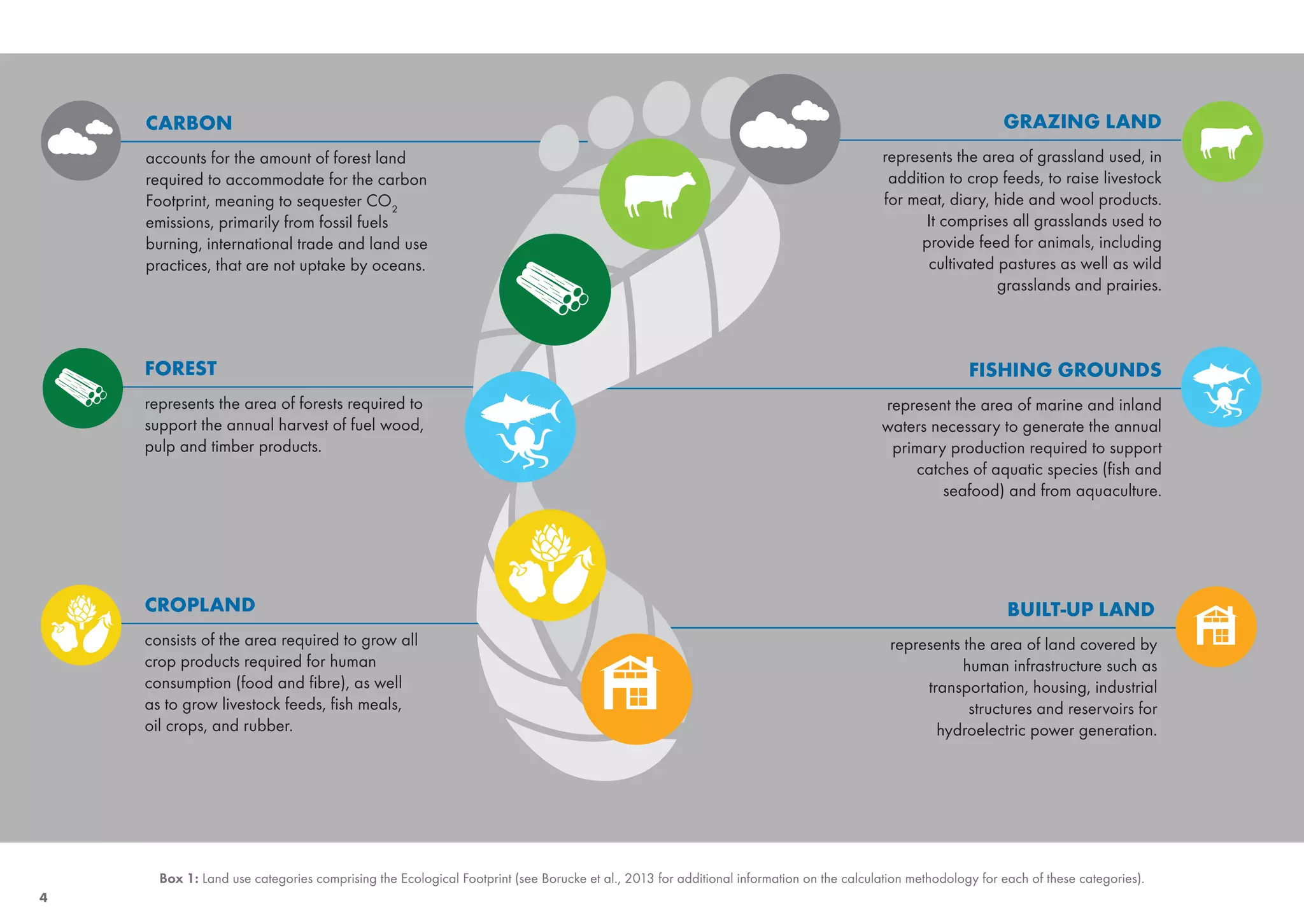
CARBON                                                                                                                                                   GRAZING LAND
    accounts for the amount of forest land                                                                                             represents the area of grassland used, in
    required to accommodate for the carbon                                                                                              addition to crop feeds, to raise livestock
    Footprint, meaning to sequester CO2                                                                                                for meat, diary, hide and wool products.
    emissions, primarily from fossil fuels                                                                                                    It comprises all grasslands used to
    burning, international trade and land use                                                                                                provide feed for animals, including
    practices, that are not uptake by oceans.                                                                                                 cultivated pastures as well as wild
                                                                                                                                                         grasslands and prairies.


    FOREST                                                                                                                                             FISHING GROUNDS
    represents the area of forests required to                                                                                         represent the area of marine and inland
    support the annual harvest of fuel wood,                                                                                           waters necessary to generate the annual
    pulp and timber products.                                                                                                           primary production required to support
                                                                                                                                           catches of aquatic species (fish and
                                                                                                                                               seafood) and from aquaculture.


    CROPLAND                                                                                                                                                  BUILT-UP LAND
    consists of the area required to grow all                                                                                            represents the area of land covered by
    crop products required for human                                                                                                                human infrastructure such as
    consumption (food and fibre), as well                                                                                                     transportation, housing, industrial
    as to grow livestock feeds, fish meals,                                                                                                          structures and reservoirs for
    oil crops, and rubber.                                                                                                                      hydroelectric power generation.


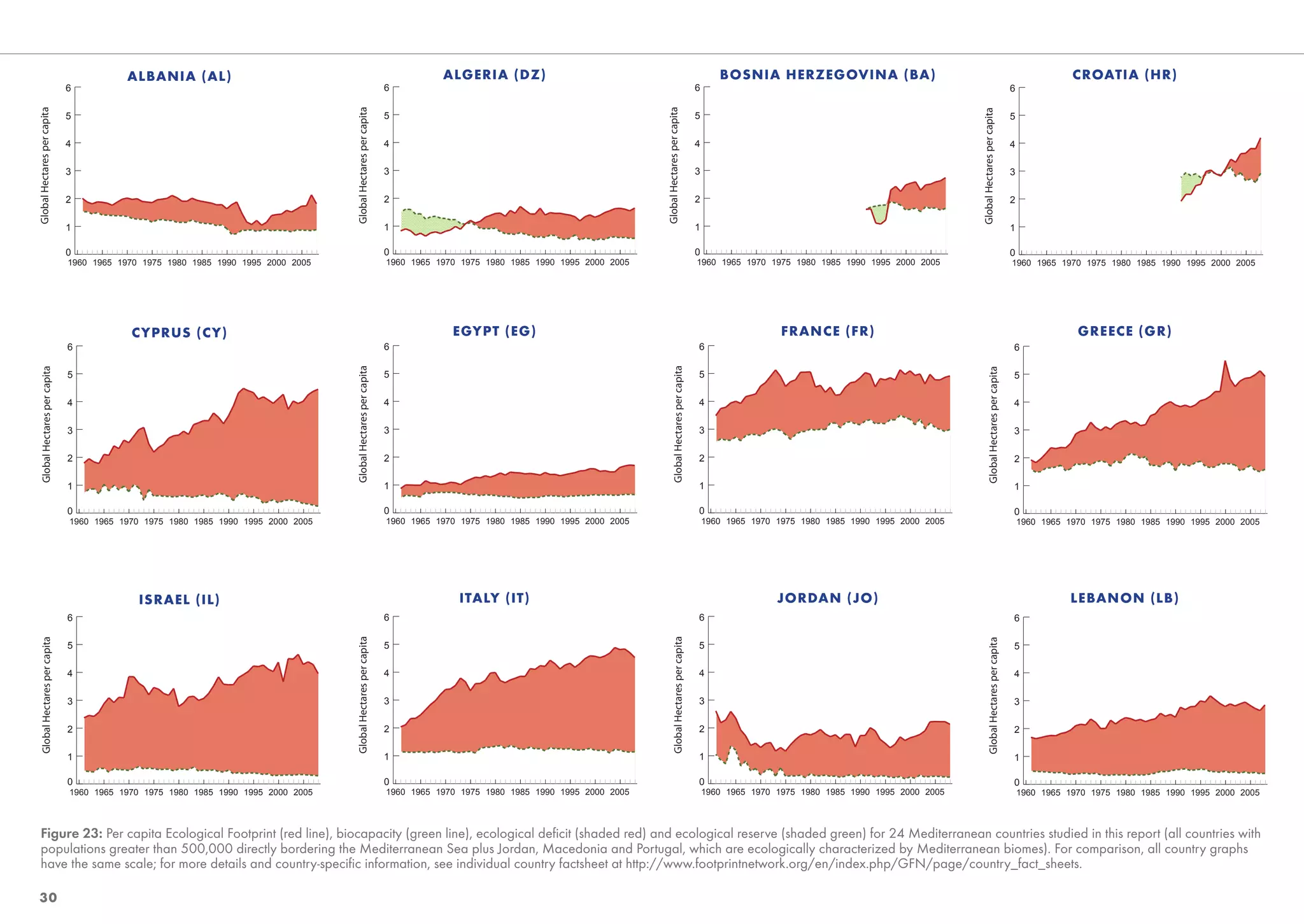
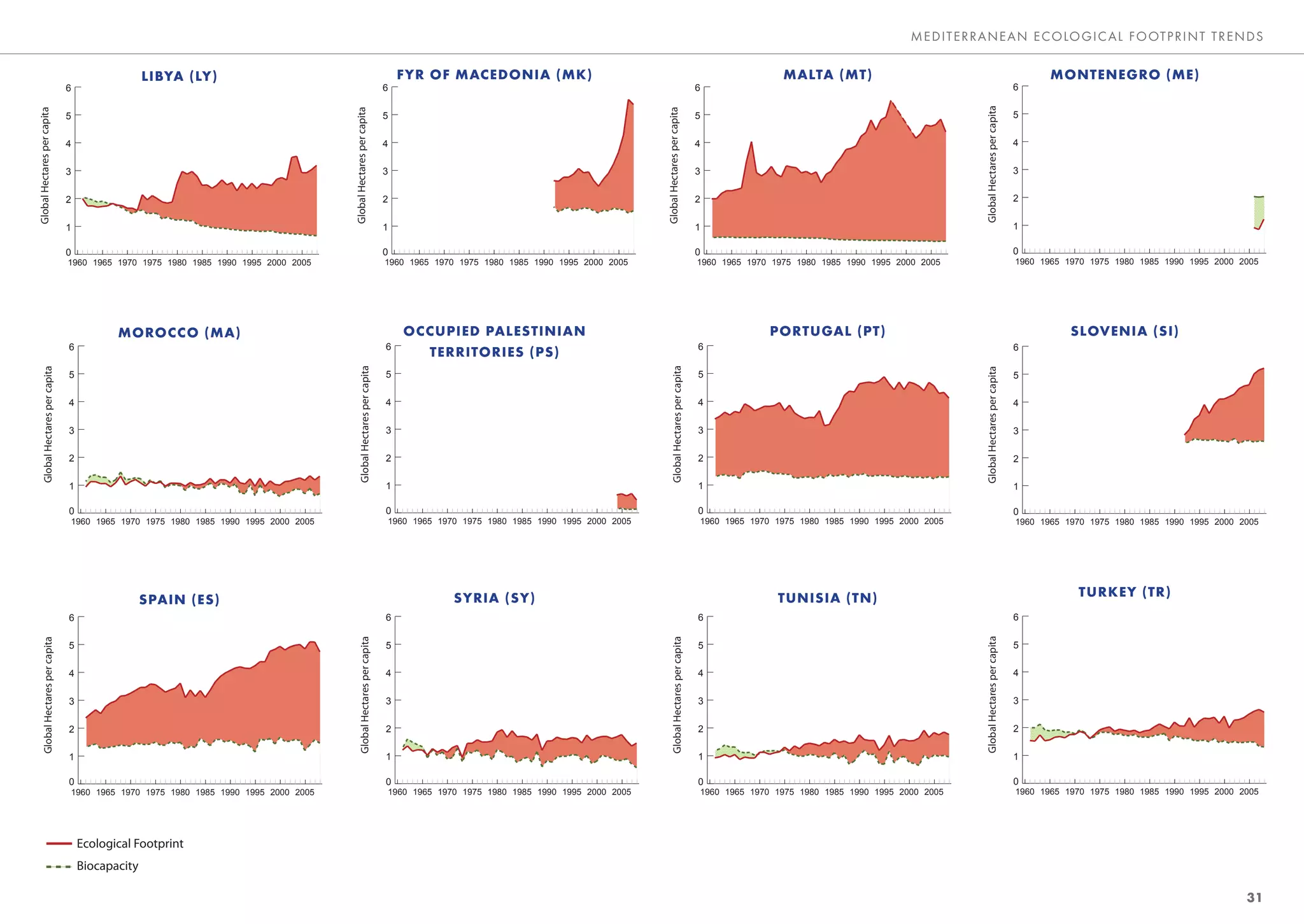
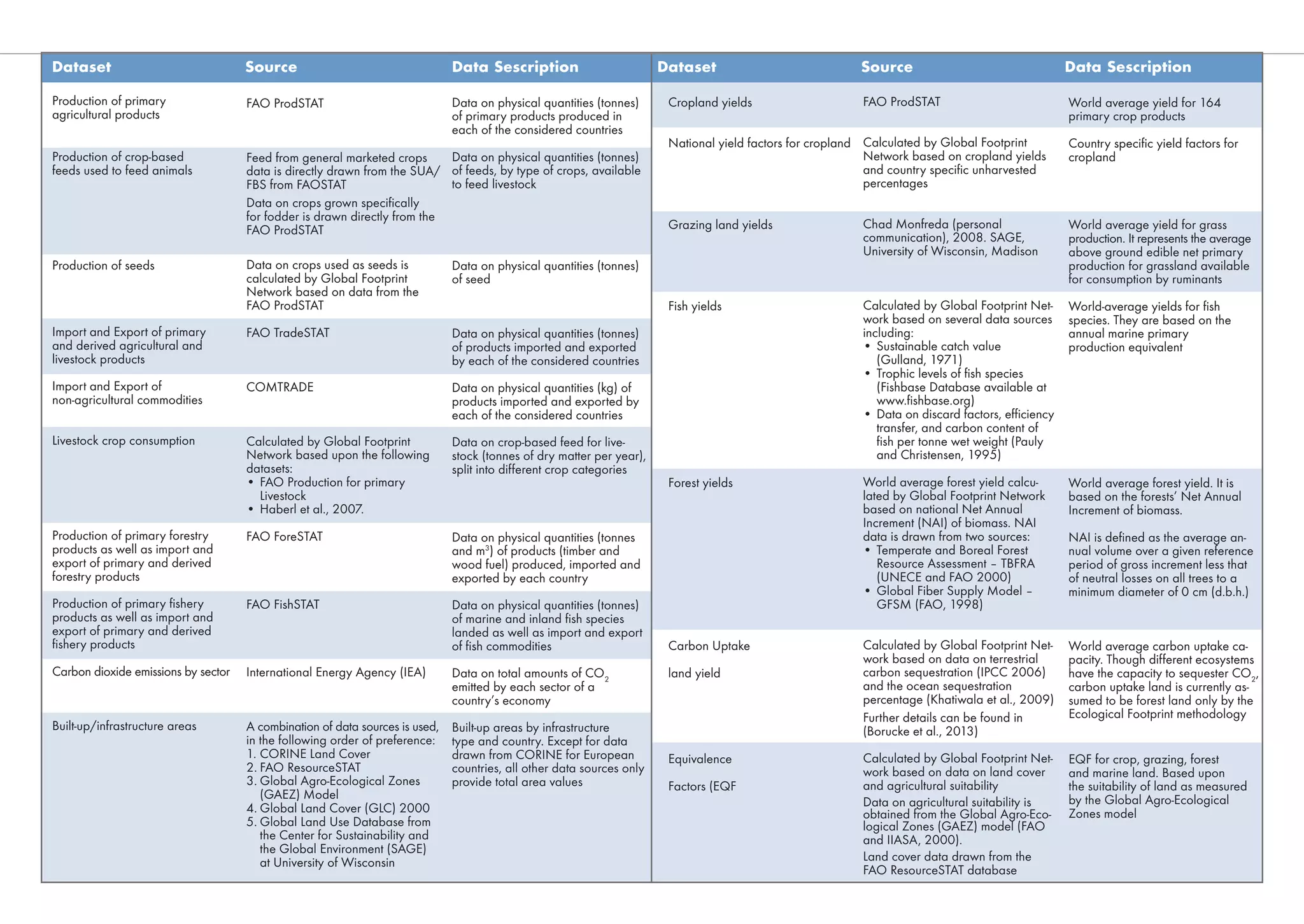
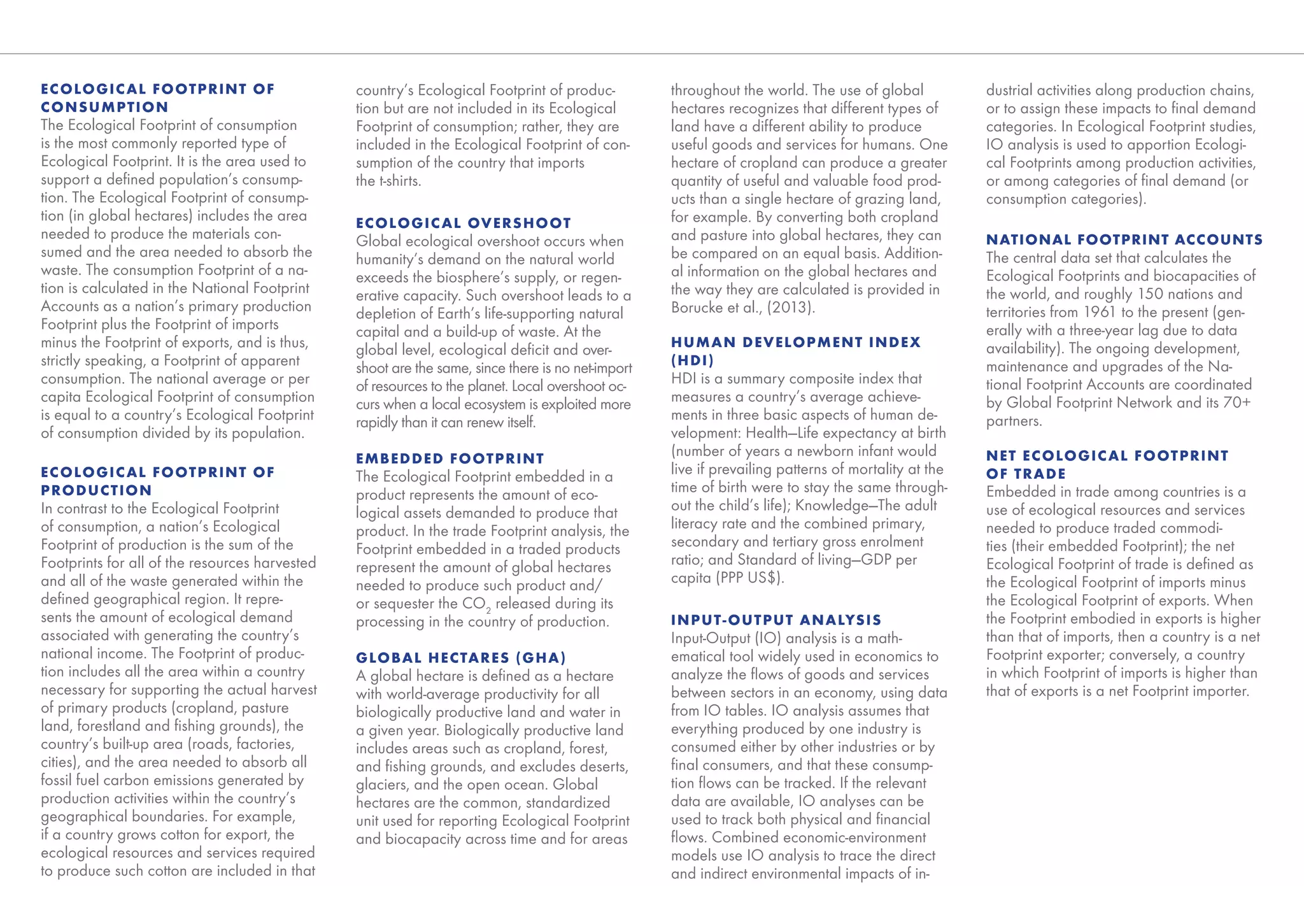
      Box 1: Land use categories comprising the Ecological Footprint (see Borucke et al., 2013 for additional information on the calculation methodology for each of these categories).
4
MEDITE RRANEAN E CO LO GIC AL FO OTP RINT TRENDS


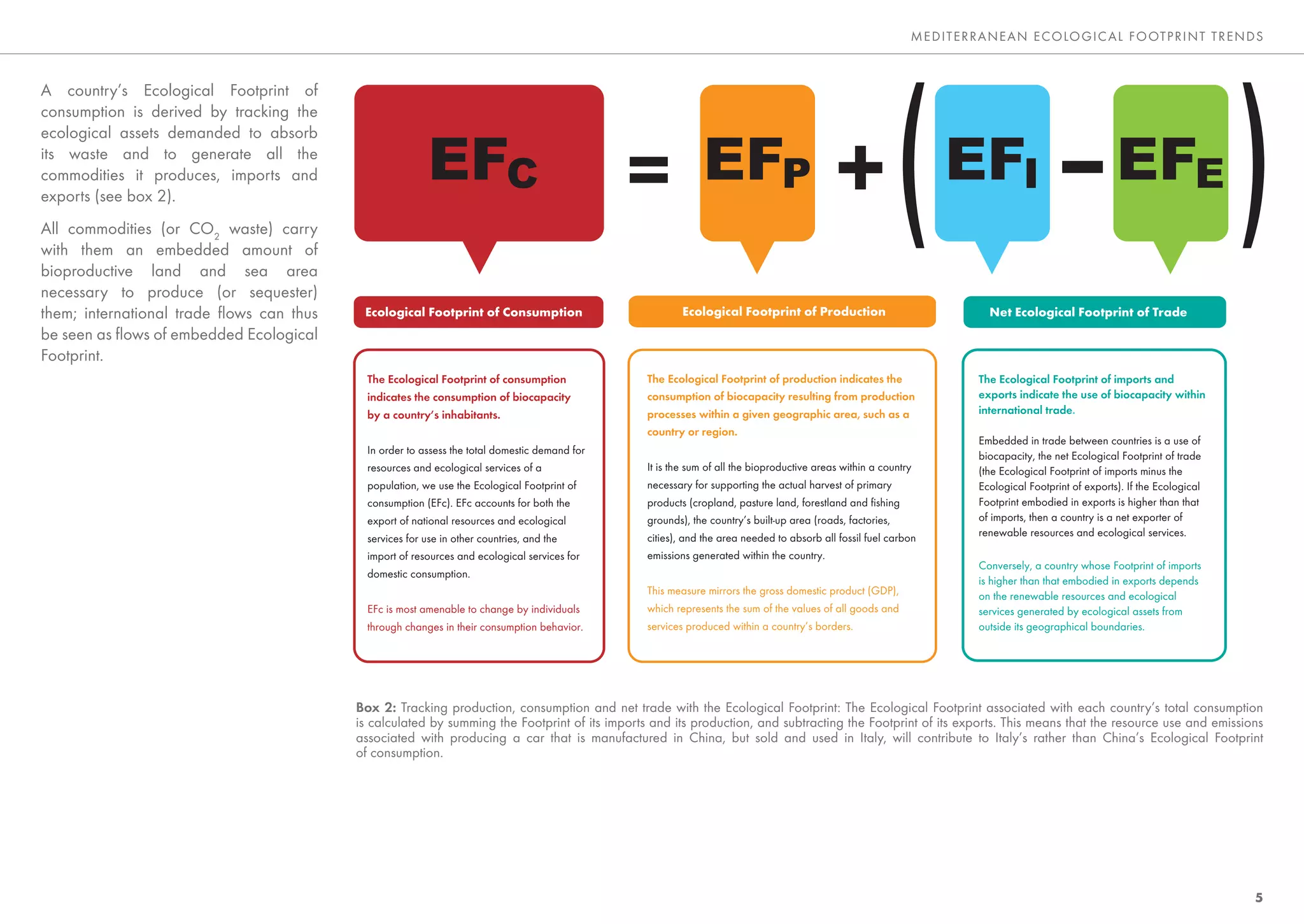
A country’s Ecological Footprint of
consumption is derived by tracking the
ecological assets demanded to absorb
its waste and to generate all the
commodities it produces, imports and
exports (see box 2).
All commodities (or CO2 waste) carry
with them an embedded amount of
bioproductive land and sea area
necessary to produce (or sequester)
them; international trade flows can thus    Ecological Footprint of Consumption                         Ecological Footprint of Production                             Net Ecological Footprint of Trade
be seen as flows of embedded Ecological
Footprint.
                                            The Ecological Footprint of consumption            The Ecological Footprint of production indicates the                 The Ecological Footprint of imports and
                                            indicates the consumption of biocapacity           consumption of biocapacity resulting from production                 exports indicate the use of biocapacity within
                                            by a country’s inhabitants.                        processes within a given geographic area, such as a                  international trade.
                                                                                               country or region.
                                                                                                                                                                    Embedded in trade between countries is a use of
                                            In order to assess the total domestic demand for                                                                        biocapacity, the net Ecological Footprint of trade
                                            resources and ecological services of a             It is the sum of all the bioproductive areas within a country        (the Ecological Footprint of imports minus the
                                            population, we use the Ecological Footprint of     necessary for supporting the actual harvest of primary               Ecological Footprint of exports). If the Ecological
                                            consumption (EFc). EFc accounts for both the       products (cropland, pasture land, forestland and fishing             Footprint embodied in exports is higher than that
                                            export of national resources and ecological        grounds), the country’s built-up area (roads, factories,             of imports, then a country is a net exporter of
                                                                                               cities), and the area needed to absorb all fossil fuel carbon        renewable resources and ecological services.
                                            services for use in other countries, and the
                                            import of resources and ecological services for    emissions generated within the country.
                                                                                                                                                                    Conversely, a country whose Footprint of imports
                                            domestic consumption.
                                                                                                                                                                    is higher than that embodied in exports depends
                                                                                               This measure mirrors the gross domestic product (GDP),               on the renewable resources and ecological
                                            EFc is most amenable to change by individuals      which represents the sum of the values of all goods and              services generated by ecological assets from
                                            through changes in their consumption behavior.     services produced within a country’s borders.                        outside its geographical boundaries.


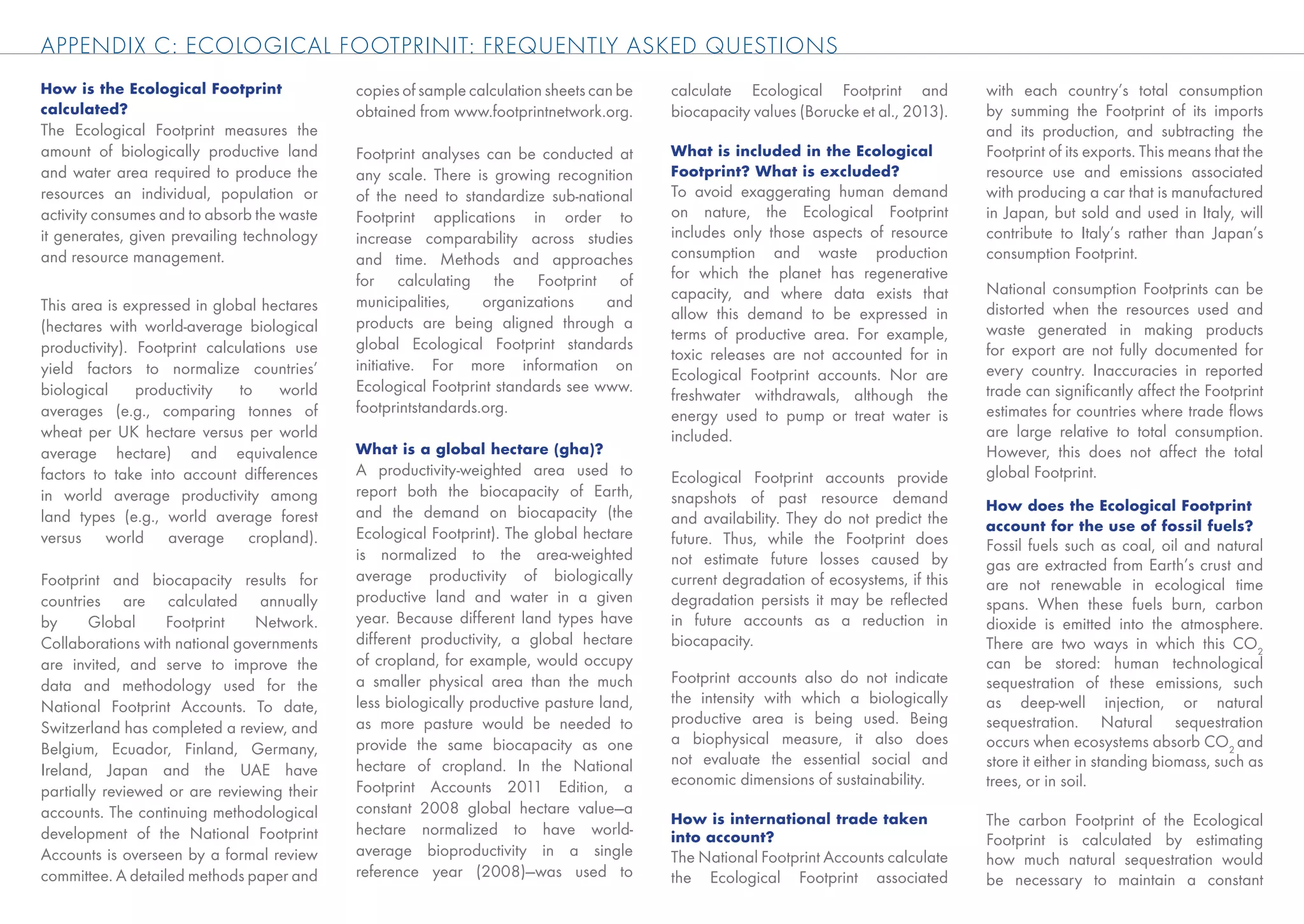
                                          Box 2: Tracking production, consumption and net trade with the Ecological Footprint: The Ecological Footprint associated with each country’s total consumption
                                          is calculated by summing the Footprint of its imports and its production, and subtracting the Footprint of its exports. This means that the resource use and emissions
                                          associated with producing a car that is manufactured in China, but sold and used in Italy, will contribute to Italy’s rather than China’s Ecological Footprint
                                          of consumption.


                                                                                                                                                                                                                          5
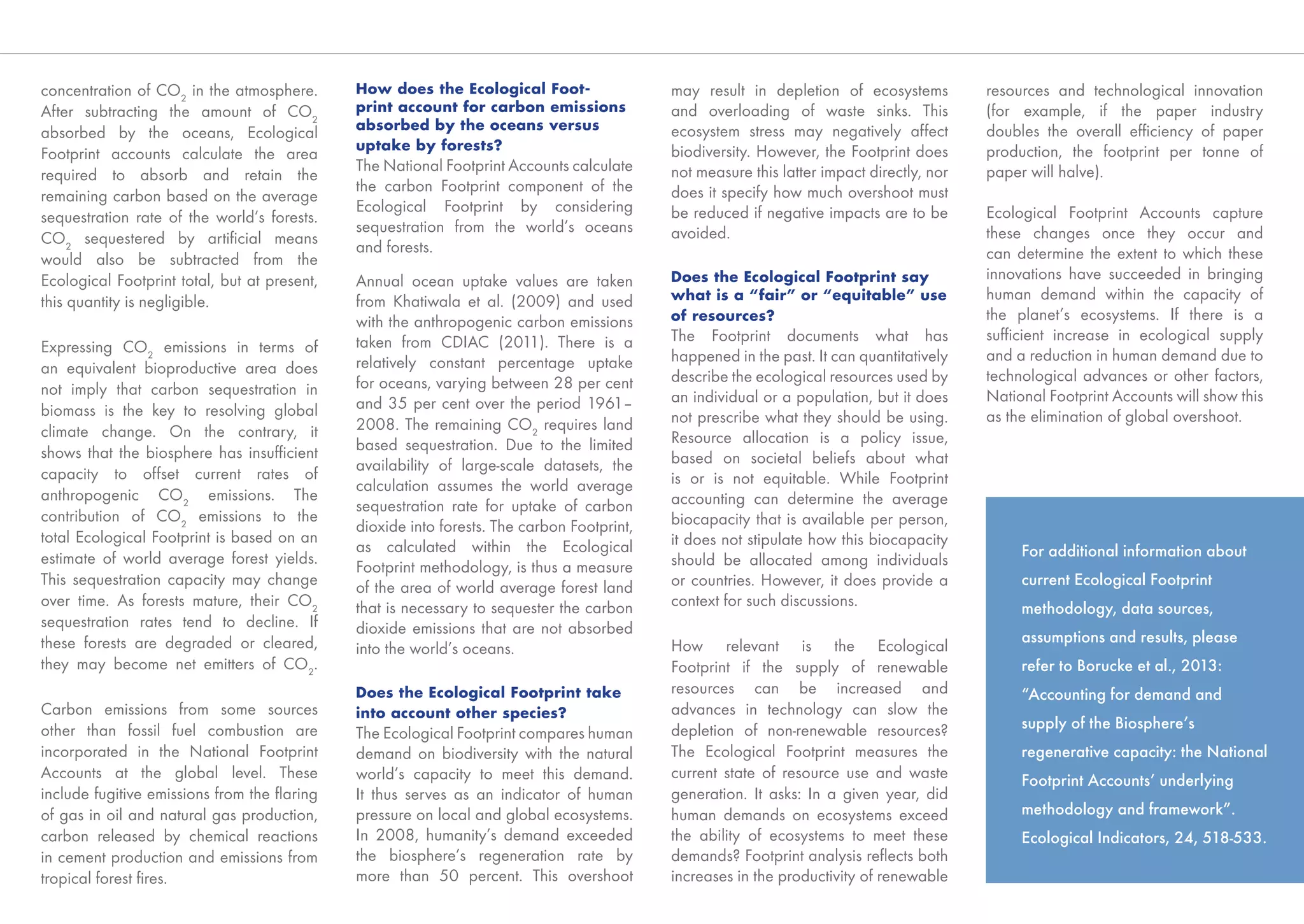
Both Ecological Footprint and biocapacity results are           GLOBAL ECOLOGICAL OVERSHOOT                                                 2011). In other words, in 2008 human demand on the
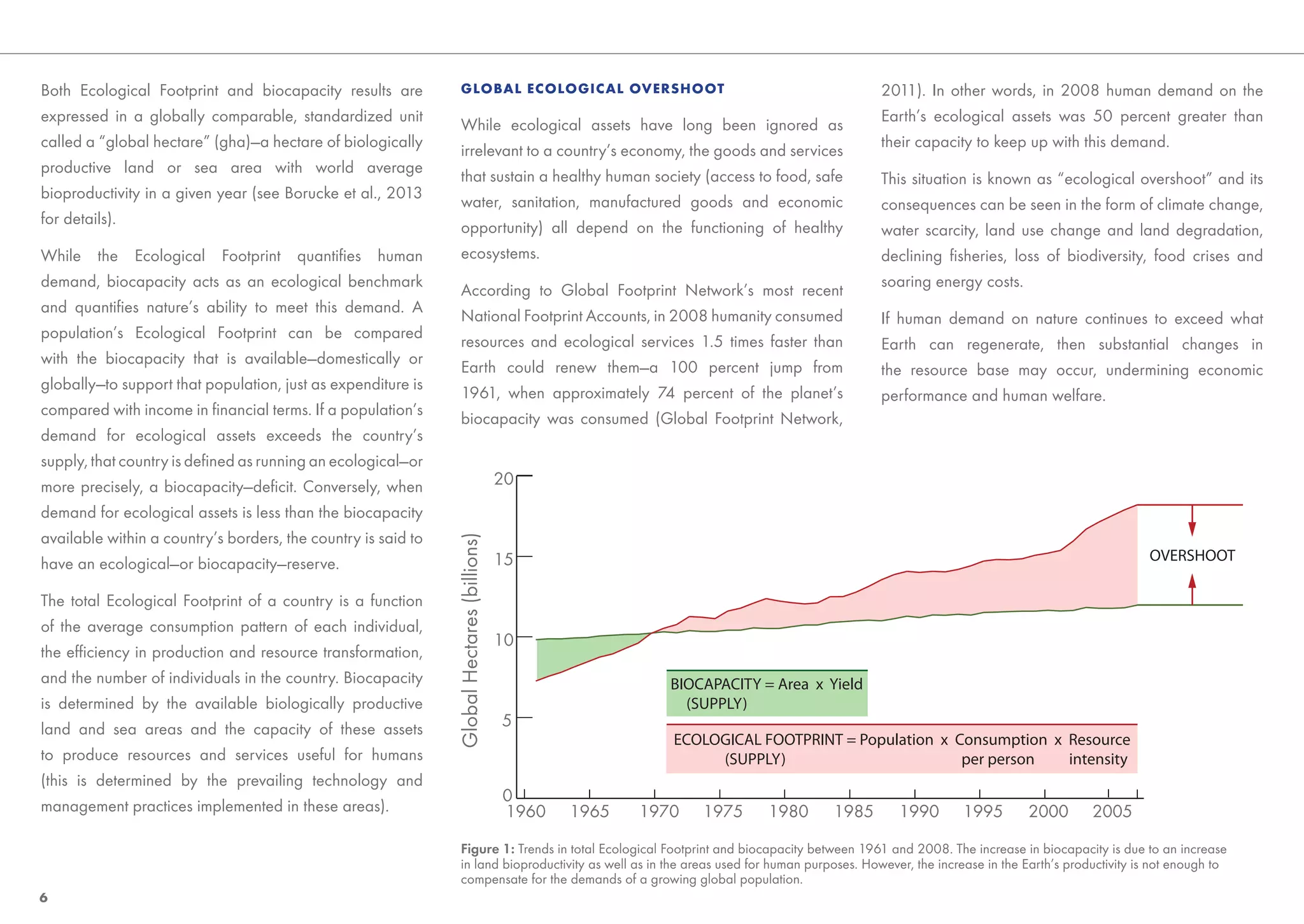
expressed in a globally comparable, standardized unit                                                                                       Earth’s ecological assets was 50 percent greater than
                                                                While ecological assets have long been ignored as
called a “global hectare” (gha)—a hectare of biologically                                                                                   their capacity to keep up with this demand.
                                                                irrelevant to a country’s economy, the goods and services
productive land or sea area with world average
                                                                that sustain a healthy human society (access to food, safe                  This situation is known as “ecological overshoot” and its
bioproductivity in a given year (see Borucke et al., 2013
                                                                water, sanitation, manufactured goods and economic                          consequences can be seen in the form of climate change,
for details).
                                                                opportunity) all depend on the functioning of healthy                       water scarcity, land use change and land degradation,
While the Ecological Footprint quantifies human                  ecosystems.                                                                 declining fisheries, loss of biodiversity, food crises and
demand, biocapacity acts as an ecological benchmark                                                                                         soaring energy costs.
                                                                According to Global Footprint Network’s most recent
and quantifies nature’s ability to meet this demand. A
                                                                National Footprint Accounts, in 2008 humanity consumed                      If human demand on nature continues to exceed what
population’s Ecological Footprint can be compared
                                                                resources and ecological services 1.5 times faster than                     Earth can regenerate, then substantial changes in
with the biocapacity that is available—domestically or
                                                                Earth could renew them—a 100 percent jump from                              the resource base may occur, undermining economic
globally—to support that population, just as expenditure is
                                                                1961, when approximately 74 percent of the planet’s                         performance and human welfare.
compared with income in financial terms. If a population’s
                                                                biocapacity was consumed (Global Footprint Network,
demand for ecological assets exceeds the country’s
supply, that country is defined as running an ecological—or
more precisely, a biocapacity—deficit. Conversely, when                                      20

demand for ecological assets is less than the biocapacity
available within a country’s borders, the country is said to
                                                               Global Hectares (billions)


                                                                                            15                                                                                              OVERSHOOT
have an ecological—or biocapacity—reserve.

The total Ecological Footprint of a country is a function
of the average consumption pattern of each individual,
                                                                                            10
the efficiency in production and resource transformation,
and the number of individuals in the country. Biocapacity                                                    BIOCAPACITY = Area x Yield
is determined by the available biologically productive                                                         (SUPPLY)
land and sea areas and the capacity of these assets                                         5
                                                                                                             ECOLOGICAL FOOTPRINT = Population x Consumption x Resource
to produce resources and services useful for humans                                                               (SUPPLY)                        per person   intensity
(this is determined by the prevailing technology and
                                                                                            0
management practices implemented in these areas).                                           1960   1965   1970   1975     1980     1985        1990        1995       2000        2005

                                                                Figure 1: Trends in total Ecological Footprint and biocapacity between 1961 and 2008. The increase in biocapacity is due to an increase
                                                                in land bioproductivity as well as in the areas used for human purposes. However, the increase in the Earth’s productivity is not enough to
                                                                compensate for the demands of a growing global population.
6
MEDITE RRANEAN E CO LO GIC AL FO OTP RINT TRENDS


Humanity crossed the threshold in              Spain offer a particular example of the
1971, when the world went into global          interplay between ecological constraints
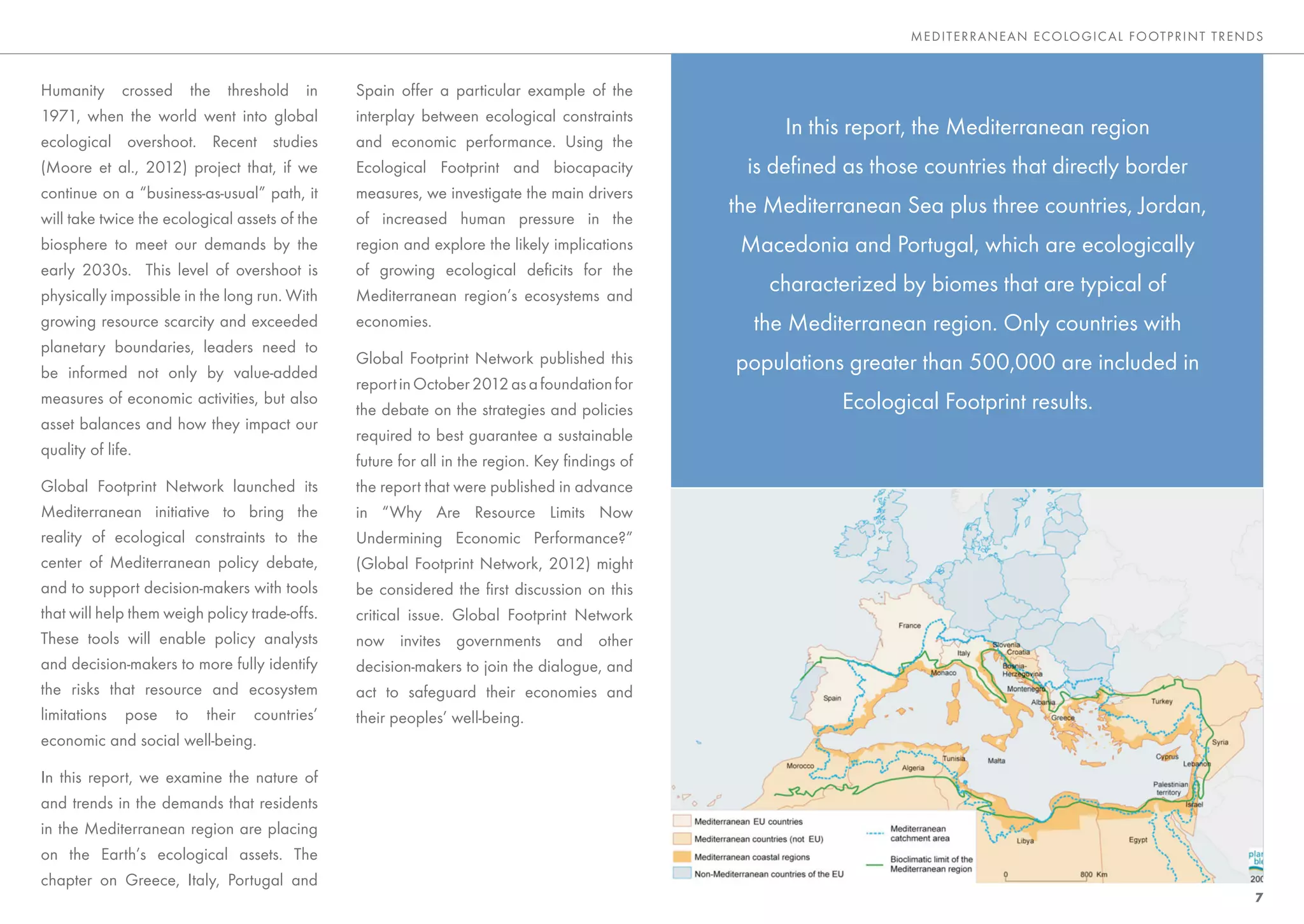
                                                                                                    In this report, the Mediterranean region
ecological overshoot. Recent studies           and economic performance. Using the
(Moore et al., 2012) project that, if we       Ecological Footprint and biocapacity             is defined as those countries that directly border
continue on a “business-as-usual” path, it     measures, we investigate the main drivers
will take twice the ecological assets of the   of increased human pressure in the
                                                                                              the Mediterranean Sea plus three countries, Jordan,
biosphere to meet our demands by the           region and explore the likely implications      Macedonia and Portugal, which are ecologically
early 2030s. This level of overshoot is        of growing ecological deficits for the
physically impossible in the long run. With    Mediterranean region’s ecosystems and
                                                                                                  characterized by biomes that are typical of
growing resource scarcity and exceeded         economies.                                       the Mediterranean region. Only countries with
planetary boundaries, leaders need to
                                               Global Footprint Network published this        populations greater than 500,000 are included in
be informed not only by value-added
                                               report in October 2012 as a foundation for
measures of economic activities, but also
                                               the debate on the strategies and policies                  Ecological Footprint results.
asset balances and how they impact our
                                               required to best guarantee a sustainable
quality of life.
                                               future for all in the region. Key findings of
Global Footprint Network launched its          the report that were published in advance
Mediterranean initiative to bring the          in “Why Are Resource Limits Now
reality of ecological constraints to the       Undermining Economic Performance?”
center of Mediterranean policy debate,         (Global Footprint Network, 2012) might
and to support decision-makers with tools      be considered the first discussion on this
that will help them weigh policy trade-offs.   critical issue. Global Footprint Network
These tools will enable policy analysts        now invites governments and other
and decision-makers to more fully identify     decision-makers to join the dialogue, and
the risks that resource and ecosystem          act to safeguard their economies and
limitations pose to their countries’           their peoples’ well-being.
economic and social well-being.

In this report, we examine the nature of
and trends in the demands that residents
in the Mediterranean region are placing
on the Earth’s ecological assets. The
chapter on Greece, Italy, Portugal and
                                                                                                                                                                7
THE ECOLOGICAL FOOTPRINT OF WORLD REGIONS
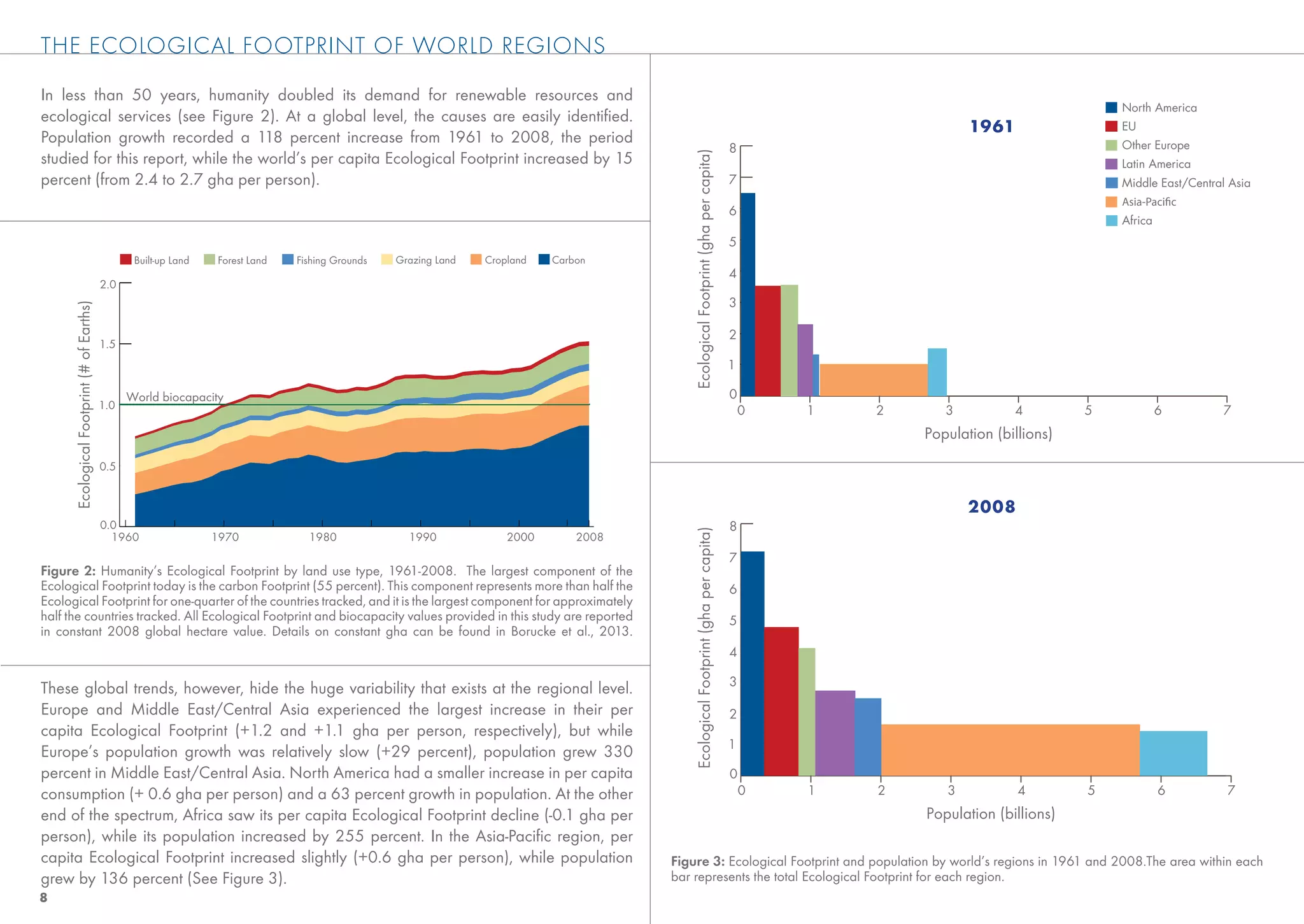
In less than 50 years, humanity doubled its demand for renewable resources and
                                                                                                                                                                                                                               North America
ecological services (see Figure 2). At a global level, the causes are easily identified.
                                                                                                                                                                                                          1961                 EU
Population growth recorded a 118 percent increase from 1961 to 2008, the period                                                                                                                                                Other Europe
                                                                                                                                                                                   8


                                                                                                                                           Ecological Footprint (gha per capita)
studied for this report, while the world’s per capita Ecological Footprint increased by 15                                                                                                                                     Latin America
percent (from 2.4 to 2.7 gha per person).                                                                                                                                          7                                           Middle East/Central Asia

                                                                                                                                                                                   6
                                                                                                                                                                                                                               Africa
                                                                                                                                                                                   5
                                                  Built-up Land   Forest Land   Fishing Grounds   Grazing Land   Cropland   Carbon
                                                                                                                                                                                   4
                                           2.0
                                                                                                                                                                                   3
      Ecological Footprint (# of Earths)


                                                                                                                                                                                   2
                                           1.5
                                                                                                                                                                                   1

                                                 World biocapacity                                                                                                                 0
                                           1.0                                                                                                                                         0   1   2      3          4         5            6        7
                                                                                                                                                                                                   Population (billions)
                                           0.5


                                                                                                                                                                                                          2008
                                           0.0                                                                                                                                     8


                                                                                                                                           Ecological Footprint (gha per capita)
                                             1960                 1970            1980              1990             2000       2008
                                                                                                                                                                                   7
Figure 2: Humanity’s Ecological Footprint by land use type, 1961-2008. The largest component of the
Ecological Footprint today is the carbon Footprint (55 percent). This component represents more than half the                                                                      6
Ecological Footprint for one-quarter of the countries tracked, and it is the largest component for approximately
half the countries tracked. All Ecological Footprint and biocapacity values provided in this study are reported                                                                    5
in constant 2008 global hectare value. Details on constant gha can be found in Borucke et al., 2013.
                                                                                                                                                                                   4

                                                                                                                                                                                   3
These global trends, however, hide the huge variability that exists at the regional level.
Europe and Middle East/Central Asia experienced the largest increase in their per                                                                                                  2
capita Ecological Footprint (+1.2 and +1.1 gha per person, respectively), but while
                                                                                                                                                                                   1
Europe’s population growth was relatively slow (+29 percent), population grew 330
percent in Middle East/Central Asia. North America had a smaller increase in per capita                                                                                            0
consumption (+ 0.6 gha per person) and a 63 percent growth in population. At the other                                                                                                 0   1   2      3           4        5            6         7

end of the spectrum, Africa saw its per capita Ecological Footprint decline (-0.1 gha per                                                                                                          Population (billions)
person), while its population increased by 255 percent. In the Asia-Pacific region, per
capita Ecological Footprint increased slightly (+0.6 gha per person), while population                                                 Figure 3: Ecological Footprint and population by world’s regions in 1961 and 2008.The area within each
grew by 136 percent (See Figure 3).                                                                                                    bar represents the total Ecological Footprint for each region.
8
MEDITE RRANEAN E CO LO GIC AL FO OTP RINT TRENDS


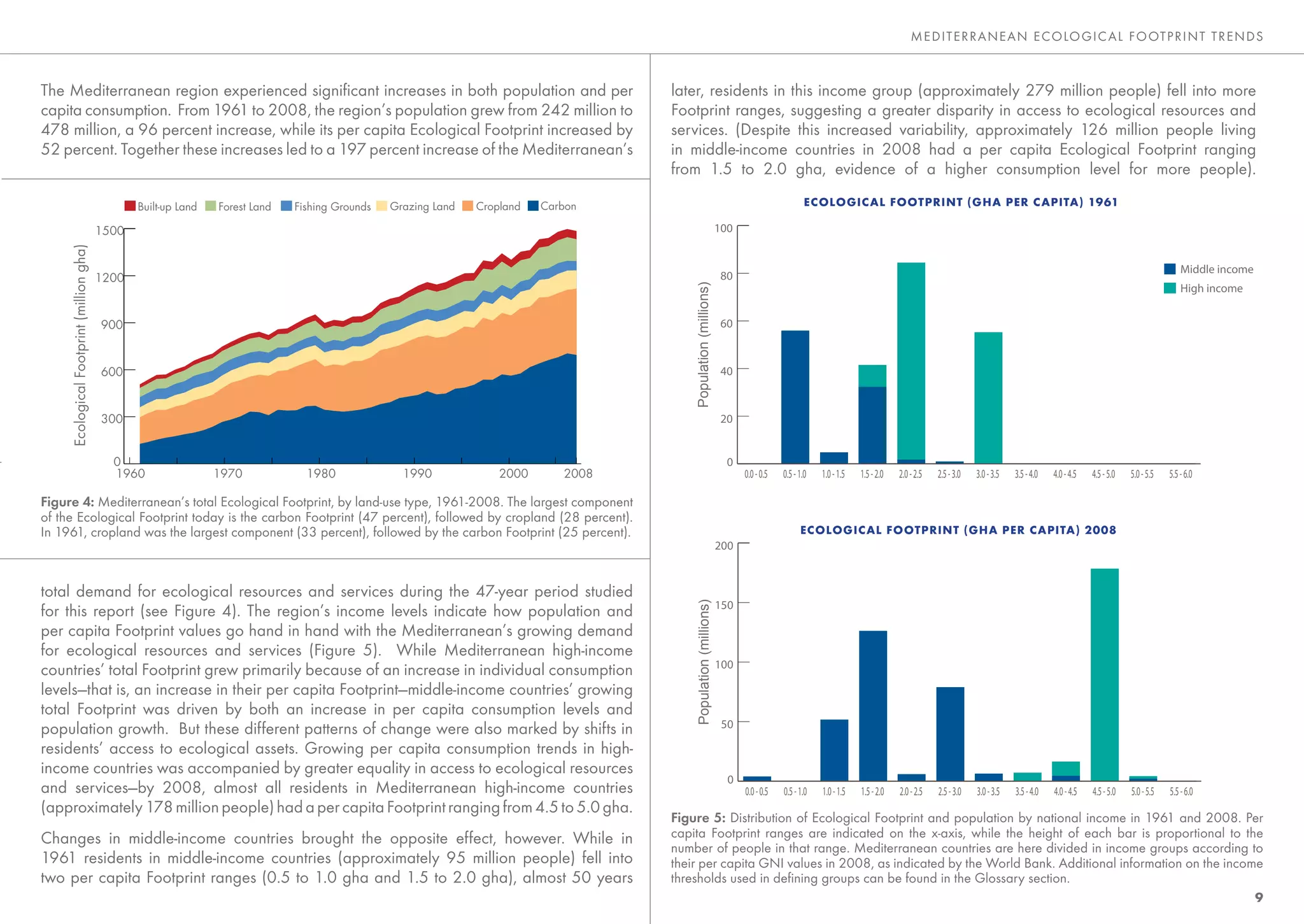
The Mediterranean region experienced significant increases in both population and per                                                 later, residents in this income group (approximately 279 million people) fell into more
capita consumption. From 1961 to 2008, the region’s population grew from 242 million to                                              Footprint ranges, suggesting a greater disparity in access to ecological resources and
478 million, a 96 percent increase, while its per capita Ecological Footprint increased by                                           services. (Despite this increased variability, approximately 126 million people living
52 percent. Together these increases led to a 197 percent increase of the Mediterranean’s                                            in middle-income countries in 2008 had a per capita Ecological Footprint ranging
                                                                                                                                     from 1.5 to 2.0 gha, evidence of a higher consumption level for more people).

                                                 Built-up Land   Forest Land   Fishing Grounds   Grazing Land   Cropland   Carbon                                                          ECOLOGICAL FOOTPRINT (GHA PER CAPITA) 1961

                                          1500                                                                                                                   100
     Ecological Footprint (million gha)


                                                                                                                                                                                                                                                                                                               Middle income
                                          1200                                                                                                                    80


                                                                                                                                         Population (millions)
                                                                                                                                                                                                                                                                                                               High income


                                          900                                                                                                                     60


                                          600                                                                                                                     40


                                          300                                                                                                                     20


                                            0                                                                                                                      0
                                            1960                 1970            1980              1990             2000      2008                                     0.0 - 0.5   0.5 - 1.0   1.0 - 1.5   1.5 - 2.0   2.0 - 2.5   2.5 - 3.0   3.0 - 3.5   3.5 - 4.0   4.0 - 4.5   4.5 - 5.0   5.0 - 5.5   5.5 - 6.0

Figure 4: Mediterranean’s total Ecological Footprint, by land-use type, 1961-2008. The largest component
of the Ecological Footprint today is the carbon Footprint (47 percent), followed by cropland (28 percent).
In 1961, cropland was the largest component (33 percent), followed by the carbon Footprint (25 percent).                                                                                 ECOLOGICAL FOOTPRINT (GHA PER CAPITA) 2008
                                                                                                                                                                 200


total demand for ecological resources and services during the 47-year period studied
                                                                                                                                                                 150


                                                                                                                                         Population (millions)
for this report (see Figure 4). The region’s income levels indicate how population and
per capita Footprint values go hand in hand with the Mediterranean’s growing demand
for ecological resources and services (Figure 5). While Mediterranean high-income
                                                                                                                                                                 100
countries’ total Footprint grew primarily because of an increase in individual consumption
levels—that is, an increase in their per capita Footprint—middle-income countries’ growing
total Footprint was driven by both an increase in per capita consumption levels and
population growth. But these different patterns of change were also marked by shifts in                                                                           50

residents’ access to ecological assets. Growing per capita consumption trends in high-
income countries was accompanied by greater equality in access to ecological resources
                                                                                                                                                                   0
and services—by 2008, almost all residents in Mediterranean high-income countries                                                                                      0.0 - 0.5   0.5 - 1.0   1.0 - 1.5   1.5 - 2.0   2.0 - 2.5   2.5 - 3.0   3.0 - 3.5   3.5 - 4.0   4.0 - 4.5   4.5 - 5.0   5.0 - 5.5   5.5 - 6.0
(approximately 178 million people) had a per capita Footprint ranging from 4.5 to 5.0 gha.
                                                                                                                                     Figure 5: Distribution of Ecological Footprint and population by national income in 1961 and 2008. Per
Changes in middle-income countries brought the opposite effect, however. While in                                                    capita Footprint ranges are indicated on the x-axis, while the height of each bar is proportional to the
                                                                                                                                     number of people in that range. Mediterranean countries are here divided in income groups according to
1961 residents in middle-income countries (approximately 95 million people) fell into                                                their per capita GNI values in 2008, as indicated by the World Bank. Additional information on the income
two per capita Footprint ranges (0.5 to 1.0 gha and 1.5 to 2.0 gha), almost 50 years                                                 thresholds used in defining groups can be found in the Glossary section.
                                                                                                                                                                                                                                                                                                                               9
DRIVERS OF MEDITERRANEAN ECOLOGICAL FOOTPRINT AND BIOCAPACITY CHANGES OVER TIME
The Mediterranean region is characterized by its geographic, climatic and cultural
                                                                                                                                                          Built-up Land    Forest Land       Fishing Grounds    Grazing Land          Cropland   Carbon
diversity. Countries in the region have varying development levels and a wide range of
                                                                                                                                                    3.5
economic activities. A crossroads of the East and West, the region has lived and still lives


                                                                                                     Ecological Footprint (gha per capita)
through a turbulent, intertwined history. But every country in the Mediterranean shares an                                                          3.0
environmental fragility, with residents demand for ecological resources and services far
exceeding the regenerative capacity of their own ecological assets.                                                                                 2.5


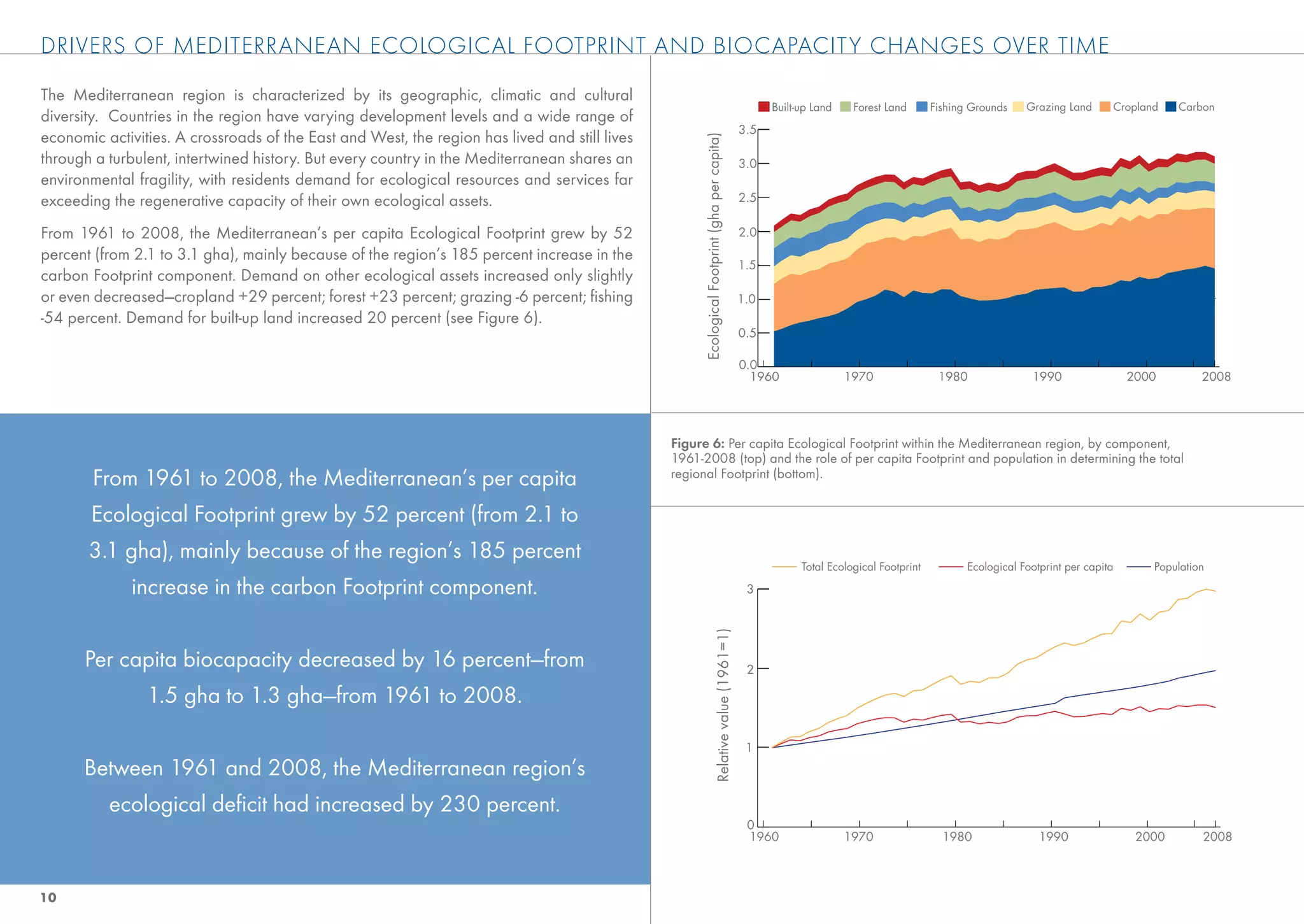
From 1961 to 2008, the Mediterranean’s per capita Ecological Footprint grew by 52                                                                   2.0
percent (from 2.1 to 3.1 gha), mainly because of the region’s 185 percent increase in the
                                                                                                                                                    1.5
carbon Footprint component. Demand on other ecological assets increased only slightly
or even decreased—cropland +29 percent; forest +23 percent; grazing -6 percent; fishing                                                              1.0
-54 percent. Demand for built-up land increased 20 percent (see Figure 6).
                                                                                                                                                    0.5

                                                                                                                                                    0.0
                                                                                                                                                      1960                1970                1980               1990                   2000          2008


                                                                                               Figure 6: Per capita Ecological Footprint within the Mediterranean region, by component,
                                                                                               1961-2008 (top) and the role of per capita Footprint and population in determining the total
       From 1961 to 2008, the Mediterranean’s per capita                                       regional Footprint (bottom).


       Ecological Footprint grew by 52 percent (from 2.1 to
       3.1 gha), mainly because of the region’s 185 percent
                                                                                                                                                                Total Ecological Footprint          Ecological Footprint per capita          Population

            increase in the carbon Footprint component.                                                                                              3


                                                                                                                          Relative value (1961=1)
      Per capita biocapacity decreased by 16 percent—from                                                                                            2

            1.5 gha to 1.3 gha—from 1961 to 2008.

                                                                                                                                                     1
      Between 1961 and 2008, the Mediterranean region’s
        ecological deficit had increased by 230 percent.
                                                                                                                                                     0
                                                                                                                                                     1960                 1970                 1980                1990                  2000         2008


10
MEDITE RRANEAN E CO LO GIC AL FO OTP RINT TRENDS


                                          Built-up Land   Forest Land     Fishing Grounds      Grazing Land       Cropland          During this time, improvements in agricultural practices and other environmental factors
                                 2.0                                                                                                slightly increased the productivity of the Mediterranean region’s ecological assets, thus
                                                                                                                                    contributing to an increase in the region’s total biocapacity. However, as population
                                                                                                                                    growth outstripped gains in productivity (Figure 7), per capita biocapacity decreased by
    Global Hectares Per Capita


                                 1.5                                                                                                16 percent—from 1.5 gha to 1.3 gha—from 1961 to 2008.
                                                                                                                                    These changes in biocapacity, consumption and population trends had a profound impact
                                                                                                                                    on the region’s ability to meet its own demands. In 1961, residents in the region had
                                 1.0
                                                                                                                                    already used more resources and ecosystem services than the Mediterranean ecosystems’
                                                                                                                                    could renew. Less than 50 years later, the region’s ecological deficit had increased by
                                 0.5
                                                                                                                                    230 percent (Figure 8).


                                                                                                                                                                    4
                                 0.0
                                   1960         1970               1980               1990                2000               2008


                                                                                                                                       Global hectares per capita
                                                                                                                                                                    3

Figure 7: Per capita biocapacity within the Mediterranean region, by component, 1961-2008 (top)
and its contributing factors (bottom).
                                                                                                                                                                    2


                                                                                                                                                                    1

                                               Area        Bioccapacity per capita     Yield         Population

                                  3
                                                                                                                                                                    0
                                                                                                                                                                    1960   1965   1970   1975    1980   1985   1990   1995   2000   2005
      Relative value (1961=1)


                                                                                                                                    Figure 8: Mediterranean region’s per capita Ecological Footprint (red line), and biocapacity (green line).
                                  2                                                                                                 The widening gap between demand and supply expanded the ecological deficit (shaded red) 230 percent
                                                                                                                                    from 1961 to 2008, ever increasing the region’s ecological debt over time.


                                  1


                                                                                                                                                                        Today, the Mediterranean region’s total Ecological
                                  0
                                  1960          1970             1980                1990              2000            2008
                                                                                                                                                                           Footprint exceeds local biocapacity by more
                                                                                                                                                                                            than 150 percent.
                                                                                                                                                                                                                                             11
IN 2008, THE COMPONENTS                    Decisions made by governments and
                                           businesses have a substantial influence on
OF THE MEDITERRANEAN’S
                                           the region’s Ecological Footprint. Citizens
                                                                                           Gross Fixed Capital Formation
ECOLOGICAL FOOTPRINT                       have no direct control over how a country                                                                                                             Other
                                           produces its electricity, for example, or
WERE:
                                           the intensity of its agricultural production.        Government
                                                                                                                                                                        Recreation and culture                                           Food and non-
                                                                                                                                                                                                                                         alcoholic beverages
                                           However, individuals’ daily activities                                                                                       Alcoholic beverages,
                                           are also primary Footprint drivers:                                                                                          tobacco and narcotics


     short-lived goods and services        Socio-economic factors, development
                                           level and wealth, the food, goods and
     directly paid by households           services consumed, as well as the wastes                                                                                                Transportation


     (driven by individual behavior,       generated, all contribute to the region’s per                                                                                                                                Housing, water,
                                           capita Footprint.                                                    Households                                                                                              electricity, gas and other fuels

     78 percent of the total Footprint);
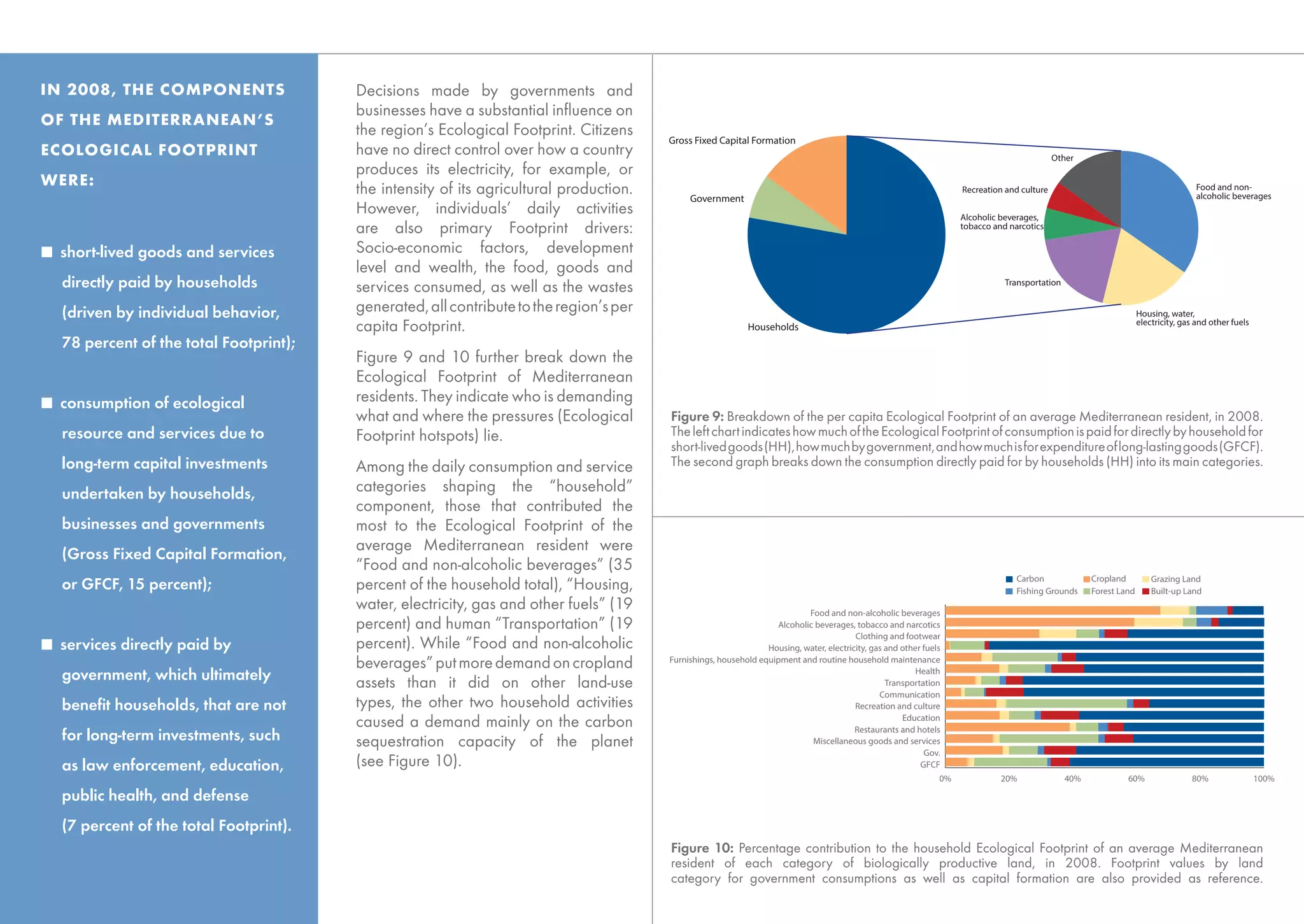
                                           Figure 9 and 10 further break down the
                                           Ecological Footprint of Mediterranean
     consumption of ecological             residents. They indicate who is demanding
                                           what and where the pressures (Ecological        Figure 9: Breakdown of the per capita Ecological Footprint of an average Mediterranean resident, in 2008.
     resource and services due to          Footprint hotspots) lie.                        The left chart indicates how much of the Ecological Footprint of consumption is paid for directly by household for
                                                                                           short-lived goods (HH), how much by government, and how much is for expenditure of long-lasting goods (GFCF).
     long-term capital investments         Among the daily consumption and service         The second graph breaks down the consumption directly paid for by households (HH) into its main categories.

     undertaken by households,             categories shaping the “household”
                                           component, those that contributed the
     businesses and governments            most to the Ecological Footprint of the
                                           average Mediterranean resident were
     (Gross Fixed Capital Formation,
                                           “Food and non-alcoholic beverages” (35
                                                                                                                                                                                      Carbon              Cropland          Grazing Land
     or GFCF, 15 percent);                 percent of the household total), “Housing,                                                                                                 Fishing Grounds     Forest Land       Built-up Land
                                           water, electricity, gas and other fuels” (19                                       Food and non-alcoholic beverages
                                           percent) and human “Transportation” (19                                    Alcoholic beverages, tobacco and narcotics
                                                                                                                                            Clothing and footwear
     services directly paid by             percent). While “Food and non-alcoholic                                  Housing, water, electricity, gas and other fuels
                                           beverages” put more demand on cropland          Furnishings, household equipment and routine household maintenance
                                                                                                                                                             Health
     government, which ultimately          assets than it did on other land-use                                                                      Transportation
                                                                                                                                                   Communication
     benefit households, that are not       types, the other two household activities                                                        Recreation and culture
                                           caused a demand mainly on the carbon                                                                          Education
                                                                                                                                            Restaurants and hotels
     for long-term investments, such       sequestration capacity of the planet                                                Miscellaneous goods and services
                                                                                                                                                               Gov.
     as law enforcement, education,        (see Figure 10).                                                                                                   GFCF
                                                                                                                                                                   0%             20%               40%            60%                 80%                 100%

     public health, and defense
     (7 percent of the total Footprint).
                                                                                           Figure 10: Percentage contribution to the household Ecological Footprint of an average Mediterranean
                                                                                           resident of each category of biologically productive land, in 2008. Footprint values by land
                                                                                           category for government consumptions as well as capital formation are also provided as reference.
12
MAPPING CONSUMPTION PRODUCTION AND TRADE ACTIVITIES FOR THE MEDITERRANEAN REGION
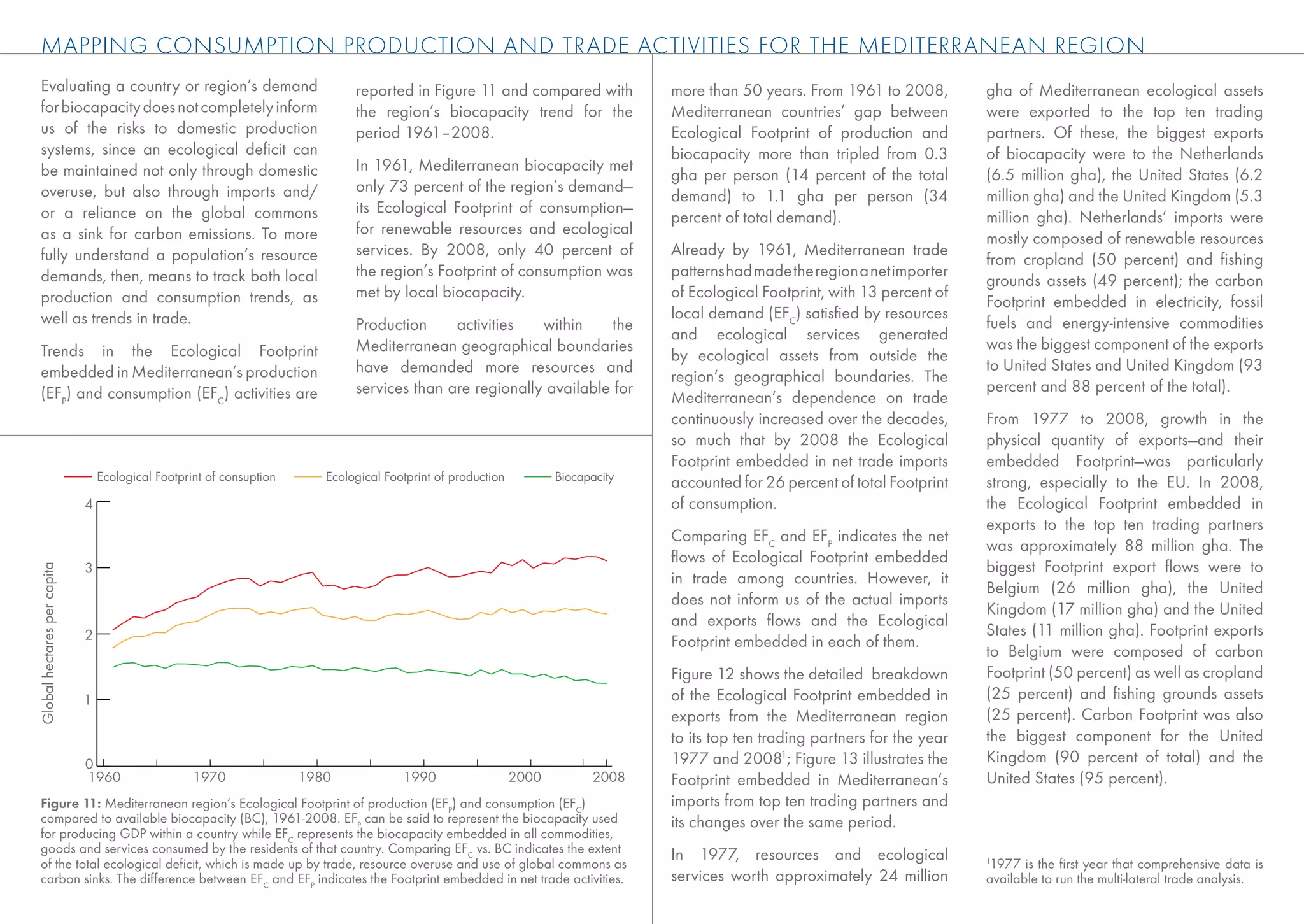
Evaluating a country or region’s demand                                       reported in Figure 11 and compared with              more than 50 years. From 1961 to 2008,         gha of Mediterranean ecological assets
for biocapacity does not completely inform                                    the region’s biocapacity trend for the               Mediterranean countries’ gap between           were exported to the top ten trading
us of the risks to domestic production                                        period 1961–2008.                                    Ecological Footprint of production and         partners. Of these, the biggest exports
systems, since an ecological deficit can                                                                                            biocapacity more than tripled from 0.3         of biocapacity were to the Netherlands
be maintained not only through domestic                                       In 1961, Mediterranean biocapacity met
                                                                                                                                   gha per person (14 percent of the total        (6.5 million gha), the United States (6.2
overuse, but also through imports and/                                        only 73 percent of the region’s demand—
                                                                                                                                   demand) to 1.1 gha per person (34              million gha) and the United Kingdom (5.3
or a reliance on the global commons                                           its Ecological Footprint of consumption—
                                                                                                                                   percent of total demand).                      million gha). Netherlands’ imports were
as a sink for carbon emissions. To more                                       for renewable resources and ecological
                                                                                                                                                                                  mostly composed of renewable resources
fully understand a population’s resource                                      services. By 2008, only 40 percent of                Already by 1961, Mediterranean trade
                                                                                                                                                                                  from cropland (50 percent) and fishing
demands, then, means to track both local                                      the region’s Footprint of consumption was            patterns had made the region a net importer
                                                                                                                                                                                  grounds assets (49 percent); the carbon
production and consumption trends, as                                         met by local biocapacity.                            of Ecological Footprint, with 13 percent of
                                                                                                                                                                                  Footprint embedded in electricity, fossil
well as trends in trade.                                                                                                           local demand (EFC) satisfied by resources
                                                                              Production     activities   within     the                                                          fuels and energy-intensive commodities
                                                                                                                                   and ecological services generated
Trends in the Ecological Footprint                                            Mediterranean geographical boundaries                                                               was the biggest component of the exports
                                                                                                                                   by ecological assets from outside the
embedded in Mediterranean’s production                                        have demanded more resources and                                                                    to United States and United Kingdom (93
                                                                                                                                   region’s geographical boundaries. The
(EFP) and consumption (EFC) activities are                                    services than are regionally available for                                                          percent and 88 percent of the total).
                                                                                                                                   Mediterranean’s dependence on trade
                                                                                                                                   continuously increased over the decades,       From 1977 to 2008, growth in the
                                                                                                                                   so much that by 2008 the Ecological            physical quantity of exports—and their
                                                                                                                                   Footprint embedded in net trade imports        embedded Footprint—was particularly
                                 Ecological Footprint of consuption      Ecological Footprint of production          Biocapacity
                                                                                                                                   accounted for 26 percent of total Footprint    strong, especially to the EU. In 2008,
                             4                                                                                                     of consumption.                                the Ecological Footprint embedded in
                                                                                                                                                                                  exports to the top ten trading partners
                                                                                                                                   Comparing EFC and EFP indicates the net
                                                                                                                                                                                  was approximately 88 million gha. The
                                                                                                                                   flows of Ecological Footprint embedded
                             3                                                                                                                                                    biggest Footprint export flows were to
Global hectares per capita


                                                                                                                                   in trade among countries. However, it
                                                                                                                                                                                  Belgium (26 million gha), the United
                                                                                                                                   does not inform us of the actual imports
                                                                                                                                                                                  Kingdom (17 million gha) and the United
                                                                                                                                   and exports flows and the Ecological
                             2                                                                                                                                                    States (11 million gha). Footprint exports
                                                                                                                                   Footprint embedded in each of them.
                                                                                                                                                                                  to Belgium were composed of carbon
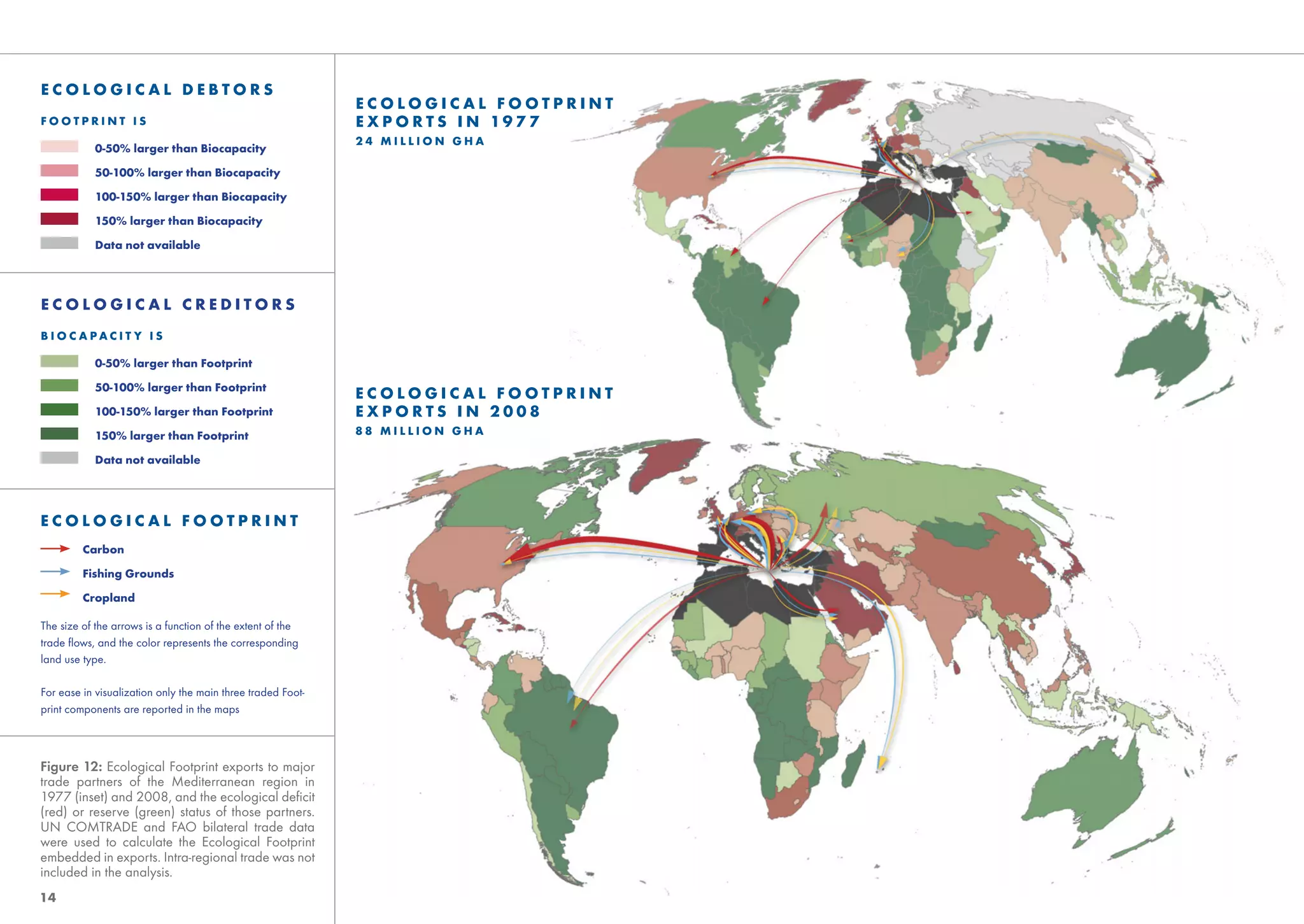
                                                                                                                                   Figure 12 shows the detailed breakdown         Footprint (50 percent) as well as cropland
                             1                                                                                                     of the Ecological Footprint embedded in        (25 percent) and fishing grounds assets
                                                                                                                                   exports from the Mediterranean region          (25 percent). Carbon Footprint was also
                                                                                                                                   to its top ten trading partners for the year   the biggest component for the United
                             0                                                                                                     1977 and 20081; Figure 13 illustrates the      Kingdom (90 percent of total) and the
                             1960                  1970               1980             1990                   2000         2008    Footprint embedded in Mediterranean’s          United States (95 percent).
Figure 11: Mediterranean region’s Ecological Footprint of production (EFP) and consumption (EFC)                                   imports from top ten trading partners and
compared to available biocapacity (BC), 1961-2008. EFP can be said to represent the biocapacity used                               its changes over the same period.
for producing GDP within a country while EFC represents the biocapacity embedded in all commodities,
goods and services consumed by the residents of that country. Comparing EFC vs. BC indicates the extent                            In 1977, resources and ecological
of the total ecological deficit, which is made up by trade, resource overuse and use of global commons as                                                                          1
                                                                                                                                                                                  1977 is the first year that comprehensive data is
carbon sinks. The difference between EFC and EFP indicates the Footprint embedded in net trade activities.                         services worth approximately 24 million        available to run the multi-lateral trade analysis.
ECOLOGICAL DEBTORS
                                                             ECOLOGICAL FOOTPRINT
FOOTPRINT IS                                                 E X P O R T S I N 197 7
                                                             24 MILLION GHA
            0-50% larger than Biocapacity

            50-100% larger than Biocapacity
            100-150% larger than Biocapacity

            150% larger than Biocapacity

            Data not available


ECOLOGICAL CREDITORS
BIOC APACIT Y IS

            0-50% larger than Footprint

            50-100% larger than Footprint
                                                             ECOLOGICAL FOOTPRINT
            100-150% larger than Footprint                   EXPORTS IN 2008
            150% larger than Footprint                       88 MILLION GHA

            Data not available


ECOLOGICAL FOOTPRINT
         Carbon

         Fishing Grounds

         Cropland

The size of the arrows is a function of the extent of the
trade flows, and the color represents the corresponding
land use type.

For ease in visualization only the main three traded Foot-
print components are reported in the maps


Figure 12: Ecological Footprint exports to major
trade partners of the Mediterranean region in
1977 (inset) and 2008, and the ecological deficit
(red) or reserve (green) status of those partners.
UN COMTRADE and FAO bilateral trade data
were used to calculate the Ecological Footprint
embedded in exports. Intra-regional trade was not
included in the analysis.
14
ME DITE RRANEAN E CO LO GIC AL FO OTP RINT TRENDS


The large contribution of the carbon           gha) and Saudi Arabia (1.8 million gha).      The same situation, however, also offers
Footprint in the region’s exports, and the                                                   opportunity. The majority of the region’s
                                               The Ecological Footprint embedded in
fact that export revenues are needed to                                                      ecological resource and service exports
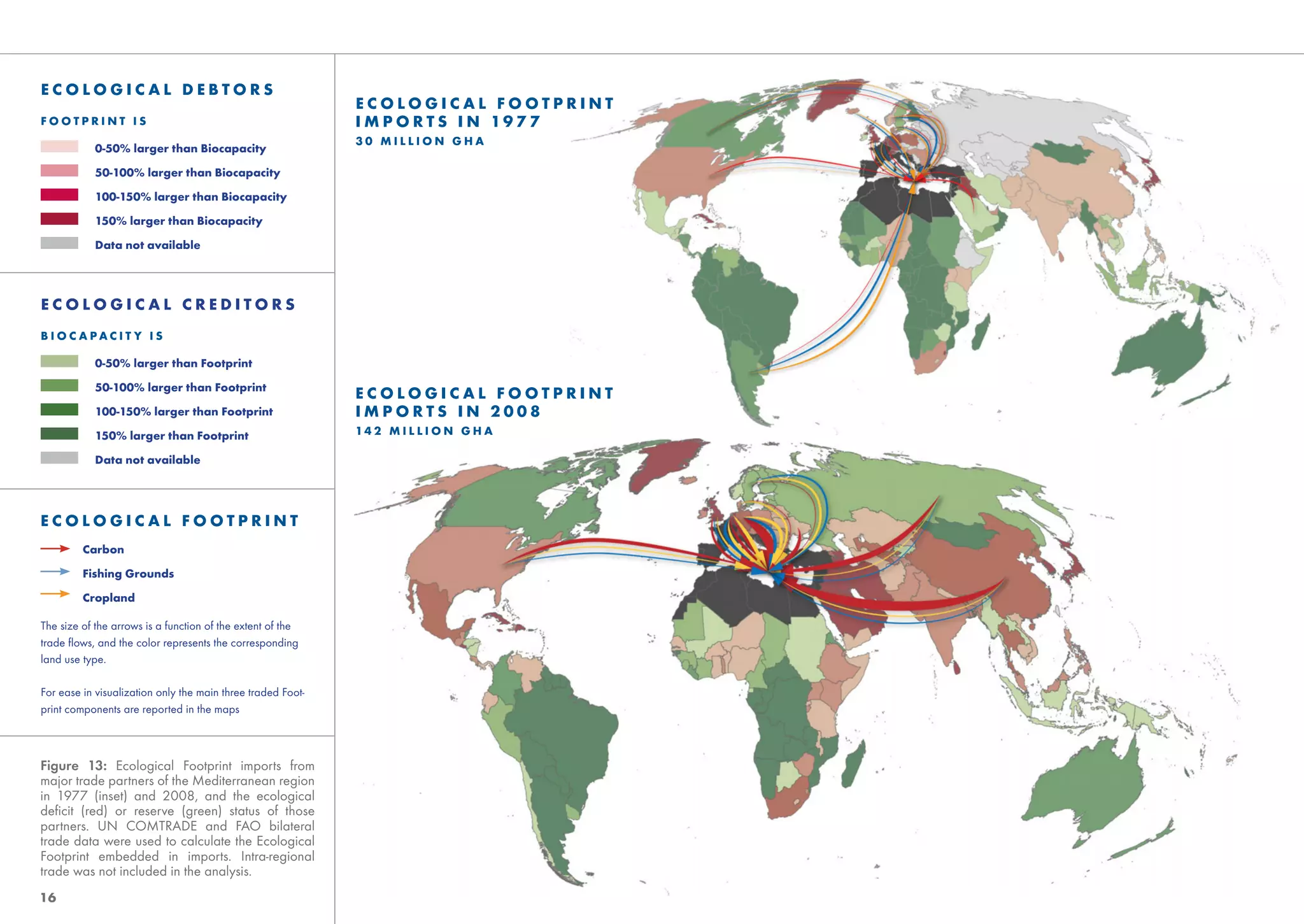
                                               the Mediterranean’s imports increased
pay for imports, suggest that the region is                                                  are now to countries that are experiencing
                                               to 142 million gha in 2008, primarily
highly exposed to energy price volatility.                                                   ecological deficits (Brazil and the Russian
                                               because of the carbon Footprint
Such volatility is likely to expand with oil                                                 Federation are the primary exceptions). In
                                               component. In 2008, carbon Footprint
shortages or carbon pricing.                                                                 an era of tightening resource constraints,
                                               accounted for 52 percent of the total
                                                                                             Mediterranean countries that improve
At the same time, carbon Footprint             imports, followed by imports of resources
                                                                                             their resource efficiency and sustain a
exposes importing countries to risk as well:   from cropland and fishing grounds assets
                                                                                             positive ecological trade balance would
The increasing costs of imported fossil        (24 percent each). Electricity, fossil
                                                                                             benefit from increased commodity prices
fuels are already a significant burden on       fuels and energy-intensive commodities
                                                                                             and improve their economic performance
economies depending on importing them;         (determining carbon Footprint imports)
                                                                                             and the well-being of their populations.
carbon taxes would cause even more             were mostly imported from Germany
stress on economies, with the greatest         (19 million gha), China (15 million gha)
impact on those countries with a high          and the Russian Federation (11 million
carbon Footprint demand.                       gha), while renewable resources were
                                               imported primarily from Belgium (7.5
The Ecological Footprint embedded in
                                               million gha), Netherlands (7 million gha)
imports to the Mediterranean from the
                                               and Germany (6 million gha).
region’s top ten trading partners also
changed significantly from 1977 to              As the region increased its Ecological
2008, from approximately 30 million            Footprint imports, trade patterns shifted
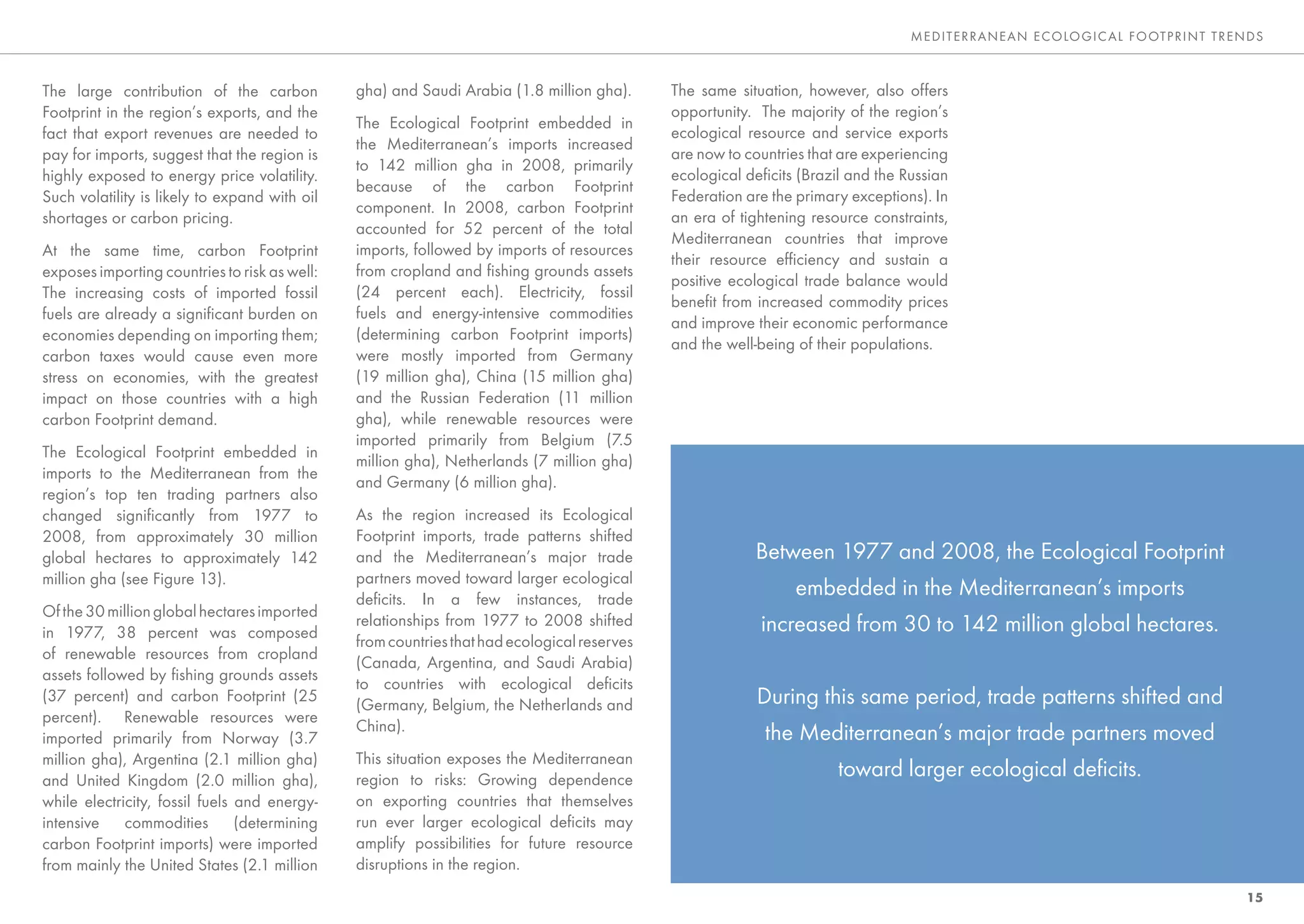
global hectares to approximately 142           and the Mediterranean’s major trade                       Between 1977 and 2008, the Ecological Footprint
million gha (see Figure 13).                   partners moved toward larger ecological
                                               deficits. In a few instances, trade
                                                                                                             embedded in the Mediterranean’s imports
Of the 30 million global hectares imported
                                               relationships from 1977 to 2008 shifted                   increased from 30 to 142 million global hectares.
in 1977, 38 percent was composed
                                               from countries that had ecological reserves
of renewable resources from cropland
                                               (Canada, Argentina, and Saudi Arabia)
assets followed by fishing grounds assets
                                               to countries with ecological deficits
(37 percent) and carbon Footprint (25
                                               (Germany, Belgium, the Netherlands and                    During this same period, trade patterns shifted and
percent). Renewable resources were
                                               China).                                                    the Mediterranean’s major trade partners moved
imported primarily from Norway (3.7
million gha), Argentina (2.1 million gha)      This situation exposes the Mediterranean
and United Kingdom (2.0 million gha),          region to risks: Growing dependence
                                                                                                                  toward larger ecological deficits.
while electricity, fossil fuels and energy-    on exporting countries that themselves
intensive commodities (determining             run ever larger ecological deficits may
carbon Footprint imports) were imported        amplify possibilities for future resource
from mainly the United States (2.1 million     disruptions in the region.
                                                                                                                                                                               15
ECOLOGICAL DEBTORS
                                                             ECOLOGICAL FOOTPRINT
FOOTPRINT IS                                                 I M P O R T S I N 197 7
                                                             30 MILLION GHA
            0-50% larger than Biocapacity

            50-100% larger than Biocapacity
            100-150% larger than Biocapacity

            150% larger than Biocapacity

            Data not available


ECOLOGICAL CREDITORS
BIOC APACIT Y IS

            0-50% larger than Footprint

            50-100% larger than Footprint
                                                             ECOLOGICAL FOOTPRINT
            100-150% larger than Footprint                   IMPORTS IN 2008
            150% larger than Footprint                       14 2 M I L L I O N G H A

            Data not available


ECOLOGICAL FOOTPRINT
         Carbon

         Fishing Grounds

         Cropland

The size of the arrows is a function of the extent of the
trade flows, and the color represents the corresponding
land use type.

For ease in visualization only the main three traded Foot-
print components are reported in the maps


Figure 13: Ecological Footprint imports from
major trade partners of the Mediterranean region
in 1977 (inset) and 2008, and the ecological
deficit (red) or reserve (green) status of those
partners. UN COMTRADE and FAO bilateral
trade data were used to calculate the Ecological
Footprint embedded in imports. Intra-regional
trade was not included in the analysis.
16
ME DITE RRANEAN E CO LO GIC AL FO OTP RINT TRENDS
MEDITERRANEAN ECOLOGICAL FOOTPRINT OF NATIONS
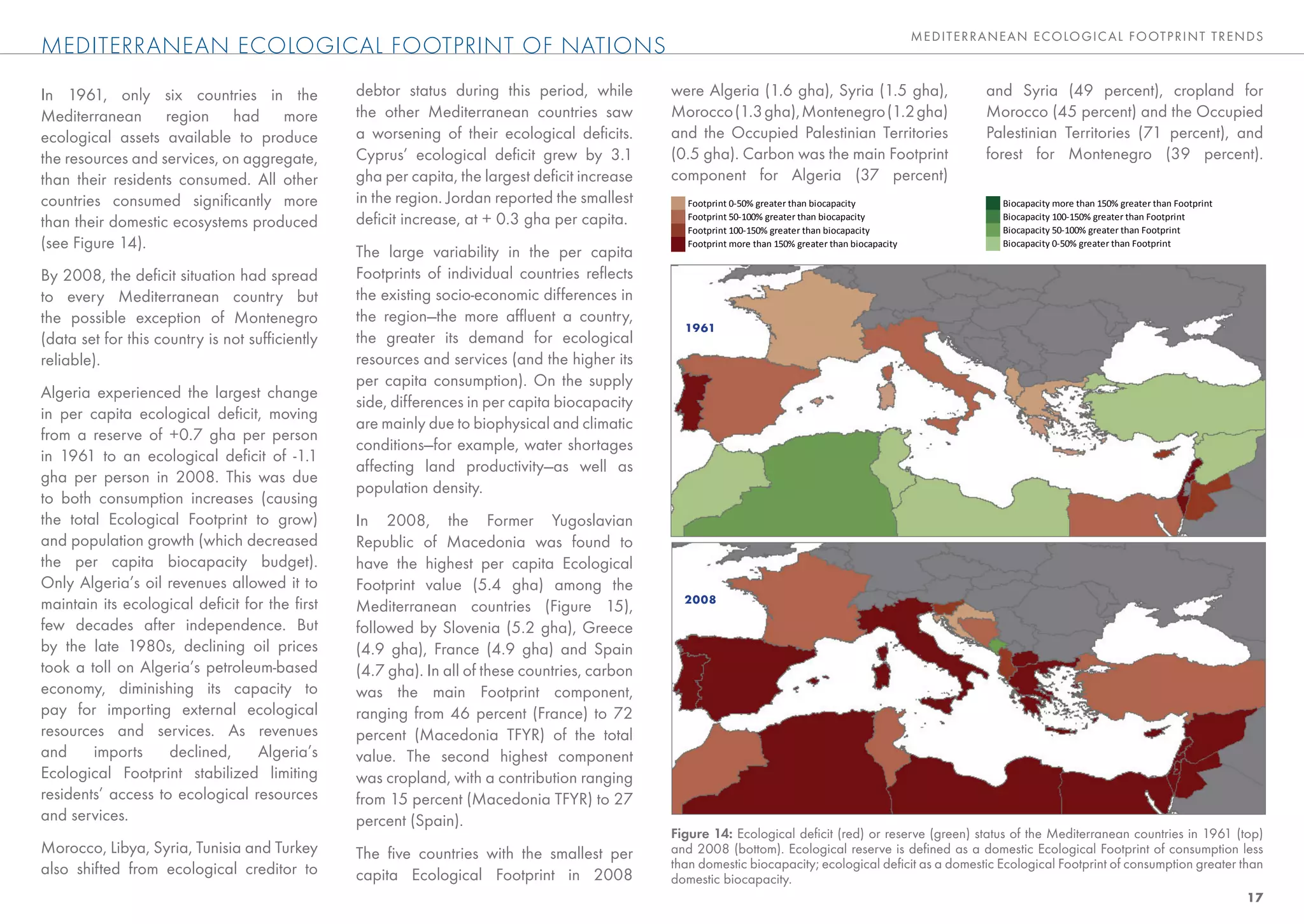
In 1961, only six countries in the              debtor status during this period, while        were Algeria (1.6 gha), Syria (1.5 gha),                         and Syria (49 percent), cropland for
Mediterranean region had more                   the other Mediterranean countries saw          Morocco (1.3 gha), Montenegro (1.2 gha)                          Morocco (45 percent) and the Occupied
ecological assets available to produce          a worsening of their ecological deficits.       and the Occupied Palestinian Territories                         Palestinian Territories (71 percent), and
the resources and services, on aggregate,       Cyprus’ ecological deficit grew by 3.1          (0.5 gha). Carbon was the main Footprint                         forest for Montenegro (39 percent).
than their residents consumed. All other        gha per capita, the largest deficit increase    component for Algeria (37 percent)
countries consumed significantly more            in the region. Jordan reported the smallest       Footprint 0-50% greater than biocapacity                        Biocapacity more than 150% greater than Footprint

than their domestic ecosystems produced         deficit increase, at + 0.3 gha per capita.         Footprint 50-100% greater than biocapacity                      Biocapacity 100-150% greater than Footprint
                                                                                                  Footprint 100-150% greater than biocapacity                     Biocapacity 50-100% greater than Footprint
(see Figure 14).                                                                                  Footprint more than 150% greater than biocapacity               Biocapacity 0-50% greater than Footprint
                                                The large variability in the per capita
By 2008, the deficit situation had spread        Footprints of individual countries reflects
to every Mediterranean country but              the existing socio-economic differences in
the possible exception of Montenegro            the region—the more affluent a country,
                                                                                                 1961
(data set for this country is not sufficiently   the greater its demand for ecological
reliable).                                      resources and services (and the higher its
                                                per capita consumption). On the supply
Algeria experienced the largest change
                                                side, differences in per capita biocapacity
in per capita ecological deficit, moving
                                                are mainly due to biophysical and climatic
from a reserve of +0.7 gha per person
                                                conditions—for example, water shortages
in 1961 to an ecological deficit of -1.1
                                                affecting land productivity—as well as
gha per person in 2008. This was due
                                                population density.
to both consumption increases (causing
the total Ecological Footprint to grow)         In 2008, the Former Yugoslavian
and population growth (which decreased          Republic of Macedonia was found to
the per capita biocapacity budget).             have the highest per capita Ecological
Only Algeria’s oil revenues allowed it to       Footprint value (5.4 gha) among the
maintain its ecological deficit for the first                                                      2008
                                                Mediterranean countries (Figure 15),
few decades after independence. But             followed by Slovenia (5.2 gha), Greece
by the late 1980s, declining oil prices         (4.9 gha), France (4.9 gha) and Spain
took a toll on Algeria’s petroleum-based        (4.7 gha). In all of these countries, carbon
economy, diminishing its capacity to            was the main Footprint component,
pay for importing external ecological           ranging from 46 percent (France) to 72
resources and services. As revenues             percent (Macedonia TFYR) of the total
and     imports     declined,    Algeria’s      value. The second highest component
Ecological Footprint stabilized limiting        was cropland, with a contribution ranging
residents’ access to ecological resources       from 15 percent (Macedonia TFYR) to 27
and services.                                   percent (Spain).
                                                                                               Figure 14: Ecological deficit (red) or reserve (green) status of the Mediterranean countries in 1961 (top)
Morocco, Libya, Syria, Tunisia and Turkey       The five countries with the smallest per        and 2008 (bottom). Ecological reserve is defined as a domestic Ecological Footprint of consumption less
also shifted from ecological creditor to                                                       than domestic biocapacity; ecological deficit as a domestic Ecological Footprint of consumption greater than
                                                capita Ecological Footprint in 2008            domestic biocapacity.
                                                                                                                                                                                                                      17
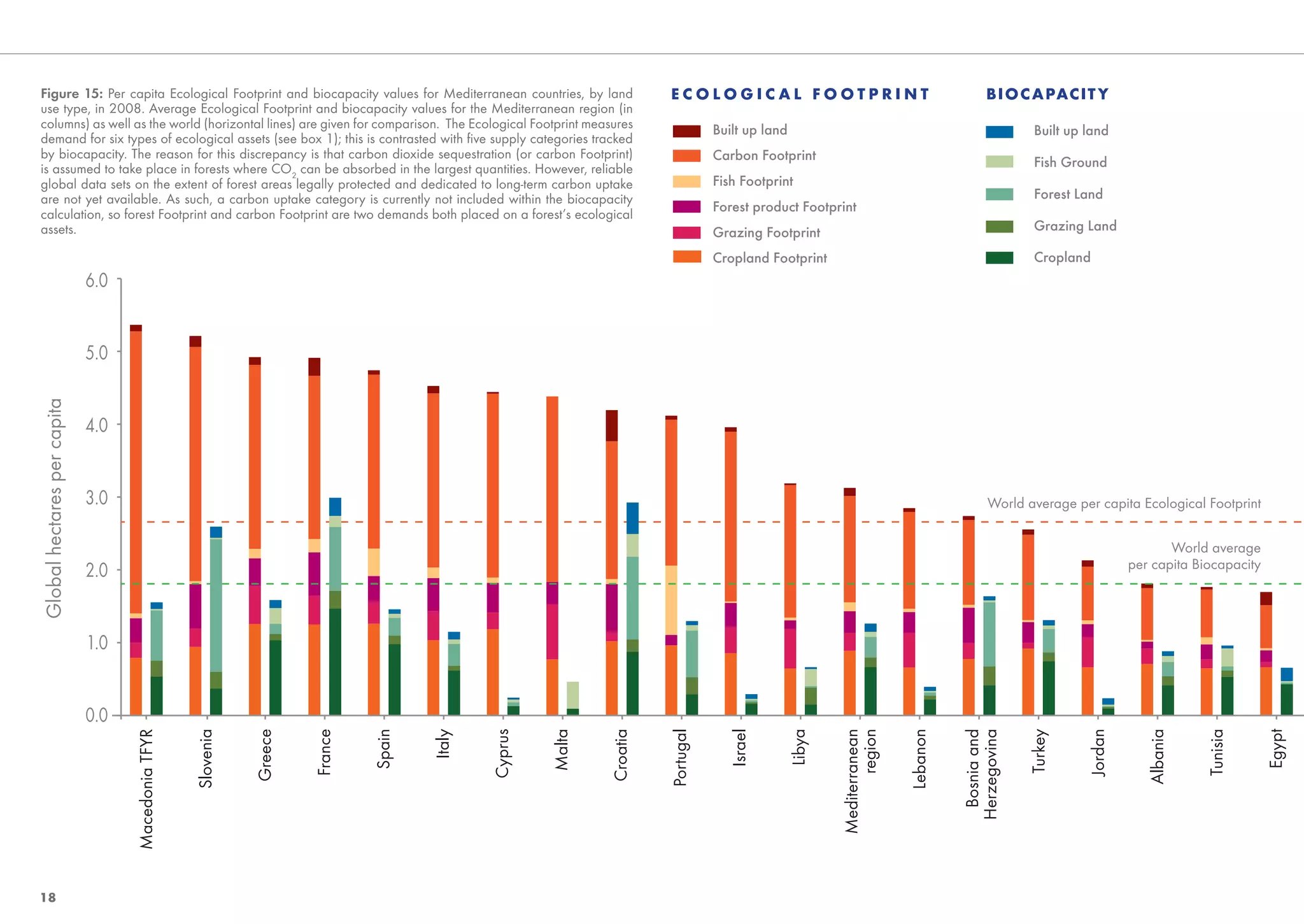
Figure 15: Per capita Ecological Footprint and biocapacity values for Mediterranean countries, by land                      ECOLOGICAL FOOTPRINT                                                B I OC A PAC I T Y
use type, in 2008. Average Ecological Footprint and biocapacity values for the Mediterranean region (in
columns) as well as the world (horizontal lines) are given for comparison. The Ecological Footprint measures                           Built up land                                                     Built up land
demand for six types of ecological assets (see box 1); this is contrasted with five supply categories tracked
by biocapacity. The reason for this discrepancy is that carbon dioxide sequestration (or carbon Footprint)                             Carbon Footprint
is assumed to take place in forests where CO2 can be absorbed in the largest quantities. However, reliable                                                                                               Fish Ground
global data sets on the extent of forest areas legally protected and dedicated to long-term carbon uptake                              Fish Footprint
are not yet available. As such, a carbon uptake category is currently not included within the biocapacity                                                                                                Forest Land
calculation, so forest Footprint and carbon Footprint are two demands both placed on a forest’s ecological
                                                                                                                                       Forest product Footprint
assets.                                                                                                                                Grazing Footprint                                                 Grazing Land

                                                                                                                                       Cropland Footprint                                                Cropland
                             6.0


                             5.0
Global hectares per capita


                             4.0


                             3.0                                                                                                                                                                 World average per capita Ecological Footprint

                                                                                                                                                                                                                                  World average
                                                                                                                                                                                                                           per capita Biocapacity
                             2.0


                             1.0


                             0.0
                                   Macedonia TFYR


                                                    Slovenia


                                                               Greece


                                                                        France


                                                                                 Spain


                                                                                         Italy


                                                                                                 Cyprus


                                                                                                          Malta


                                                                                                                  Croatia


                                                                                                                            Portugal


                                                                                                                                          Israel


                                                                                                                                                       Libya


                                                                                                                                                                       region

                                                                                                                                                                                Lebanon

                                                                                                                                                                                           Bosnia and
                                                                                                                                                                                          Herzegovina

                                                                                                                                                                                                        Turkey


                                                                                                                                                                                                                  Jordan


                                                                                                                                                                                                                              Albania


                                                                                                                                                                                                                                        Tunisia


                                                                                                                                                                                                                                                    Egypt
                                                                                                                                                               Mediterranean

18
ME DITE RRANEAN E CO LO GIC AL FO OTP RINT TRENDS


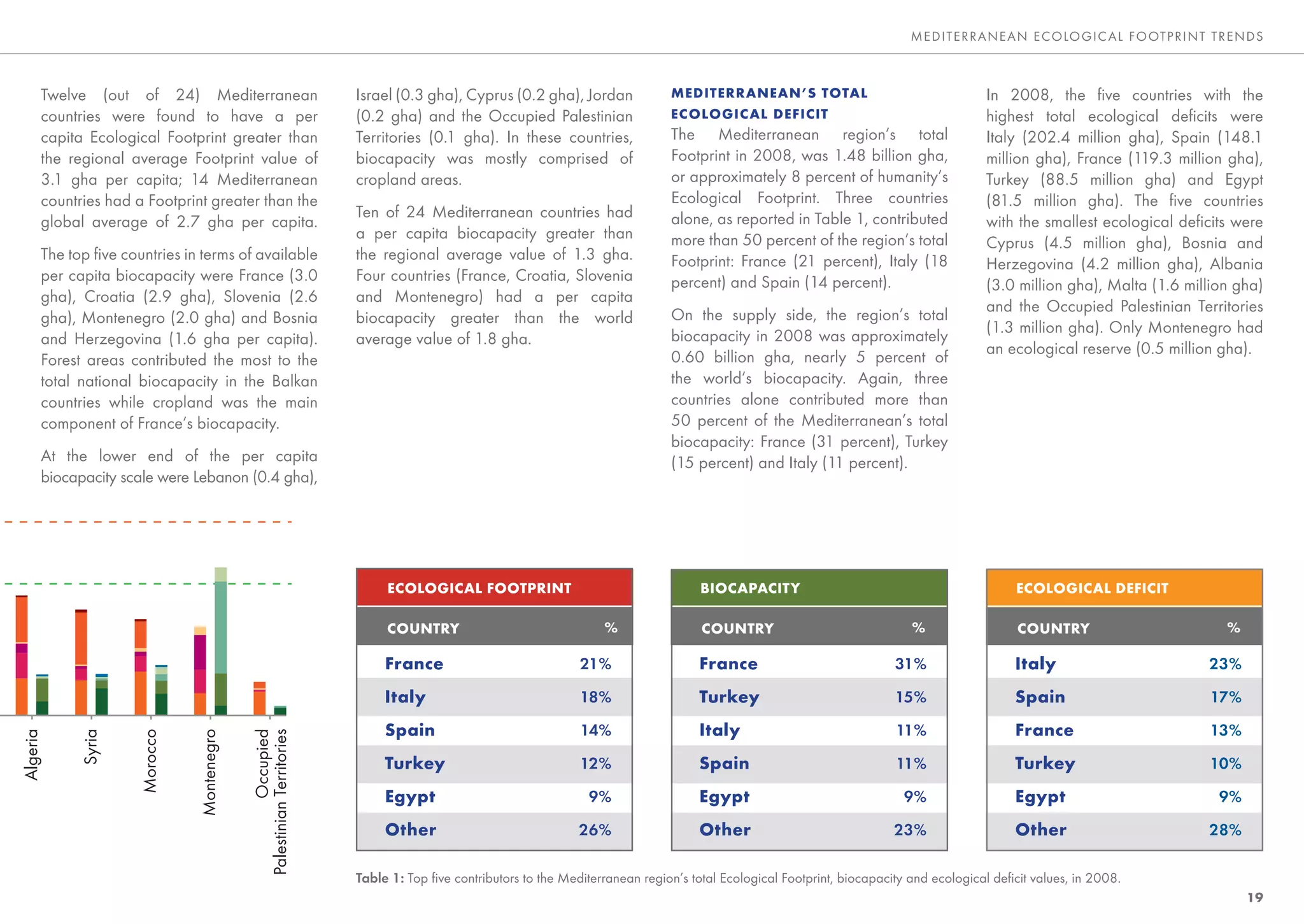
      Twelve (out of 24) Mediterranean                                Israel (0.3 gha), Cyprus (0.2 gha), Jordan              MEDITERRANEAN’S TOTAL                                    In 2008, the five countries with the
      countries were found to have a per                              (0.2 gha) and the Occupied Palestinian                  ECOLOGICAL DEFICIT                                       highest total ecological deficits were
      capita Ecological Footprint greater than                        Territories (0.1 gha). In these countries,              The Mediterranean region’s total                         Italy (202.4 million gha), Spain (148.1
      the regional average Footprint value of                         biocapacity was mostly comprised of                     Footprint in 2008, was 1.48 billion gha,                 million gha), France (119.3 million gha),
      3.1 gha per capita; 14 Mediterranean                            cropland areas.                                         or approximately 8 percent of humanity’s                 Turkey (88.5 million gha) and Egypt
      countries had a Footprint greater than the                                                                              Ecological Footprint. Three countries                    (81.5 million gha). The five countries
                                                                      Ten of 24 Mediterranean countries had                   alone, as reported in Table 1, contributed
      global average of 2.7 gha per capita.                                                                                                                                            with the smallest ecological deficits were
                                                                      a per capita biocapacity greater than                   more than 50 percent of the region’s total               Cyprus (4.5 million gha), Bosnia and
      The top five countries in terms of available                     the regional average value of 1.3 gha.                  Footprint: France (21 percent), Italy (18                Herzegovina (4.2 million gha), Albania
      per capita biocapacity were France (3.0                         Four countries (France, Croatia, Slovenia               percent) and Spain (14 percent).                         (3.0 million gha), Malta (1.6 million gha)
      gha), Croatia (2.9 gha), Slovenia (2.6                          and Montenegro) had a per capita
                                                                                                                              On the supply side, the region’s total                   and the Occupied Palestinian Territories
      gha), Montenegro (2.0 gha) and Bosnia                           biocapacity greater than the world
                                                                                                                              biocapacity in 2008 was approximately                    (1.3 million gha). Only Montenegro had
      and Herzegovina (1.6 gha per capita).                           average value of 1.8 gha.
                                                                                                                              0.60 billion gha, nearly 5 percent of                    an ecological reserve (0.5 million gha).
      Forest areas contributed the most to the
      total national biocapacity in the Balkan                                                                                the world’s biocapacity. Again, three
      countries while cropland was the main                                                                                   countries alone contributed more than
      component of France’s biocapacity.                                                                                      50 percent of the Mediterranean’s total
                                                                                                                              biocapacity: France (31 percent), Turkey
      At the lower end of the per capita                                                                                      (15 percent) and Italy (11 percent).
      biocapacity scale were Lebanon (0.4 gha),


                                                                           ECOLOGICAL FOOTPRINT                                     BIOCAPACITY                                              ECOLOGICAL DEFICIT

                                                                           COUNTRY                                %                 COUNTRY                               %                  COUNTRY                       %

                                                                           France                             21%                  France                              31%                  Italy                       23%

                                                                           Italy                              18%                  Turkey                              15%                  Spain                       17%

                                                                           Spain                              14%                  Italy                               11%                  France                      13%
            Syria


                     Morocco


                               Montenegro

                                                        Occupied
                                            Palestinian Territories
Algeria


                                                                           Turkey                             12%                  Spain                               11%                  Turkey                      10%

                                                                           Egypt                                9%                 Egypt                                9%                  Egypt                         9%

                                                                           Other                              26%                  Other                               23%                  Other                       28%

                                                                      Table 1: Top five contributors to the Mediterranean region’s total Ecological Footprint, biocapacity and ecological deficit values, in 2008.
                                                                                                                                                                                                                               19
LINKING ECOLOGICAL ASSETS AND ECONOMIC COMPETITIVENESS
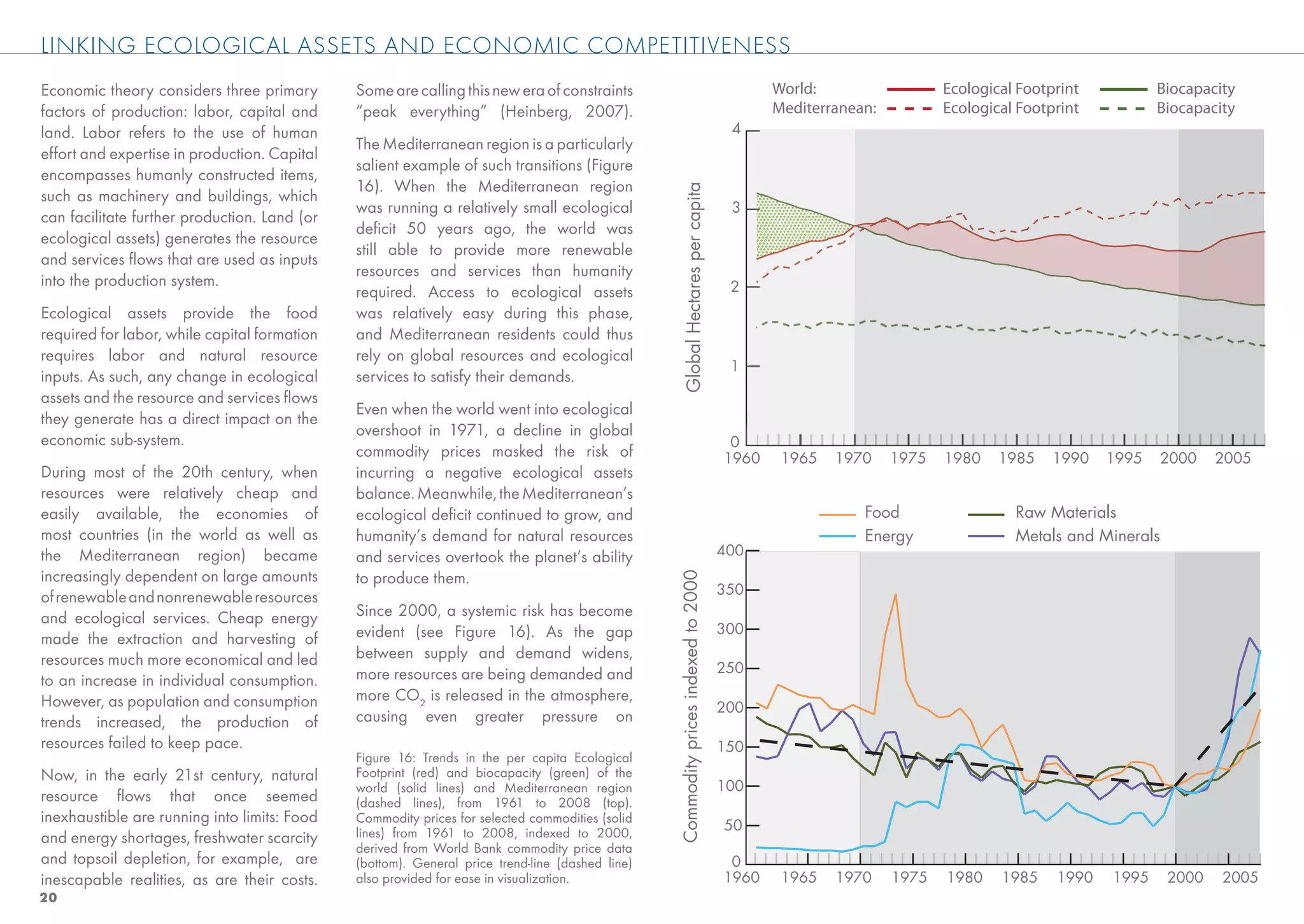
Economic theory considers three primary       Some are calling this new era of constraints                                                 World:                  Ecological Footprint          Biocapacity
factors of production: labor, capital and     “peak everything” (Heinberg, 2007).                                                          Mediterranean:          Ecological Footprint          Biocapacity
land. Labor refers to the use of human                                                                                               4
                                              The Mediterranean region is a particularly
effort and expertise in production. Capital
                                              salient example of such transitions (Figure
encompasses humanly constructed items,
                                              16). When the Mediterranean region


                                                                                                     Global Hectares per capita
such as machinery and buildings, which
                                              was running a relatively small ecological                                              3
can facilitate further production. Land (or
                                              deficit 50 years ago, the world was
ecological assets) generates the resource
                                              still able to provide more renewable
and services flows that are used as inputs
                                              resources and services than humanity
into the production system.                                                                                                          2
                                              required. Access to ecological assets
Ecological assets provide the food            was relatively easy during this phase,
required for labor, while capital formation   and Mediterranean residents could thus
requires labor and natural resource           rely on global resources and ecological
                                                                                                                                     1
inputs. As such, any change in ecological     services to satisfy their demands.
assets and the resource and services flows
                                              Even when the world went into ecological
they generate has a direct impact on the
                                              overshoot in 1971, a decline in global
economic sub-system.                                                                                                                 0
                                              commodity prices masked the risk of                                                   1960    1965   1970     1975   1980    1985    1990   1995     2000   2005
During most of the 20th century, when         incurring a negative ecological assets
resources were relatively cheap and           balance. Meanwhile, the Mediterranean’s
easily available, the economies of            ecological deficit continued to grow, and                                                                 Food                  Raw Materials
most countries (in the world as well as       humanity’s demand for natural resources                                                                  Energy                Metals and Minerals
the Mediterranean region) became              and services overtook the planet’s ability                                            400
increasingly dependent on large amounts


                                                                                                 Commodity prices indexed to 2000
                                              to produce them.
                                                                                                                                    350
of renewable and nonrenewable resources
and ecological services. Cheap energy         Since 2000, a systemic risk has become
                                              evident (see Figure 16). As the gap                                                   300
made the extraction and harvesting of
resources much more economical and led        between supply and demand widens,
                                              more resources are being demanded and                                                 250
to an increase in individual consumption.
However, as population and consumption        more CO2 is released in the atmosphere,
                                                                                                                                    200
trends increased, the production of           causing even greater pressure on
resources failed to keep pace.                                                                                                      150
                                              Figure 16: Trends in the per capita Ecological
Now, in the early 21st century, natural       Footprint (red) and biocapacity (green) of the
                                              world (solid lines) and Mediterranean region                                          100
resource flows that once seemed                (dashed lines), from 1961 to 2008 (top).
inexhaustible are running into limits: Food   Commodity prices for selected commodities (solid
                                                                                                                                    50
and energy shortages, freshwater scarcity     lines) from 1961 to 2008, indexed to 2000,
                                              derived from World Bank commodity price data
and topsoil depletion, for example, are       (bottom). General price trend-line (dashed line)                                       0
inescapable realities, as are their costs.    also provided for ease in visualization.                                              1960    1965   1970     1975   1980    1985    1990   1995     2000   2005
20
ME DITE RRANEAN E CO LO GIC AL FO OTP RINT TRENDS

                                                                                                                                 Ecological Deficit (Reserve)         Financial Deficit (surplus)
ecosystems and biodiversity. The growing        least partly due to ecological overshoot,
                                                                                                 COUNTRY                                   [Million gha]                             [Billion USD]
mismatch between global demand and              as the economic sub-system is susceptible
supply of ecological resources and              to changes in the availability of both           Albania                                                3.0                                     2.0
services has led to a gradual tightening        renewable and non-renewable resources.           Algeria                                               37.4                                  (34.4)
of international commodity markets,                                                              Bosnia and Herzegovina                                 4.2                                     2.6
                                                Non-renewable resources’ supply and              Croatia                                                5.6                                     6.1
resulting in rising prices and heightened
                                                demand are highly inelastic. Large               Cyprus                                                 4.5                                     3.9
price volatility.
                                                price variations—as demonstrated by the          Egypt                                                 81.5                                     1.4
With consumption exceeding local                international oil and mineral prices—are         France                                              119.3                                     49.9
availability, dependence on biocapacity         needed to balance supply and demand,             Greece                                                37.7                                    51.3
from outside the region’s geographical          especially for fossil fuels. Renewable           Israel                                               26.0                                    (1.8)
boundaries will likely continue and             natural resources, in contrast, have             Italy                                               202.4                                     66.3
push the region to increasingly turn            historically experienced supply increase         Jordan                                                11.1                                     2.0
toward international trade for access to        in response to additional demand, and            Lebanon                                              10.2                                      4.1
ecological resources and services. But          their prices are thus highly susceptible to      Libya                                                15.5                                   (35.7)
                                                                                                 Macedonia TFYR                                         7.8                                     1.2
as countries become more dependent on           supply-demand imbalances.
                                                                                                 Malta                                                  1.6                                     0.5
external ecosystems, they expose their
                                                The increasing scarcity of global                Montenegro                                           (0.5)                                        -
economies to price volatility and possible
                                                renewable resources—as well as the               Morocco                                              19.6                                      4.5
supply disruption. Access to ecological                                                                                                                                                        31.9
                                                increased price of fossil resources              Portugal                                             30.0
resources and services become subject not                                                        Slovenia                                               5.3                                     3.8
only to “physical limits” (the total amount     used for their extraction—caused prices
                                                                                                 Spain                                               148.1                                   154.5
globally available) but also “economic          to reach historic highs in 2008. As
                                                                                                 Syria                                                 17.4                                   (0.5)
limits” (the ability of countries to purchase   global renewable resource availability                                                                                                          1.7
                                                                                                 Tunisia                                                8.3
these resources and services).                  diminishes and oil prices keep climbing,         Turkey                                               88.5                                     41.5
                                                this volatility will increase, with severe
Over the last five decades, many of the          implications for the trade balance            Table 2: Ecological assets balance and current account balance for each Mediterranean country, in
world’s limited resources have become           of many Mediterranean countries.              2008. Ecological assets balance values are calculated as total Ecological Footprint of consumption minus
more expensive (World Bank, 2012).                                                            total biocapacity. Current account balance values are drawn from the World Bank (2011). No data were
                                                                                              available for the Occupied Palestinian Territories.
Prices have become highly reactive to           The degree of dependence on external
supply-demand imbalances. During the            ecological assets for imports of resources    income (or GDP levels) by liquidating                   ecological services, as well as weakened
Russian droughts and wildfires of 2010,          makes responding to important price           their ecological or financial assets, or                 financially through large debts, will
a drop in grain production led to a 70          hikes challenging and could further           both. Table 2 shows the ecological assets               face growing difficulties in accessing
percent increase in wheat prices over a         negatively affect a country’s capacity to     balance and the current account balance                 the required resources and services.
single month. The drought experienced by        maintain its economic output. Over the        for each Mediterranean country in 2008.                 This might have crippling effects for its
the U.S. Midwest in the summer of 2012          past few decades, economic success            Results show that ecological deficits are                future economic performance. To ensure
will also likely impact prices. Such price or   has translated into higher resource           coupled with fiscal deficits (indicated                   long-term economic prosperity and
supply shocks can cause severe economic         consumption levels that are no longer         by the negative account balance) in the                 competitiveness, decisions are needed
imbalances in countries and sometimes           sustainable. Countries’ efforts to drive      majority of the Mediterranean countries.                that recognize ecological assets—both
lead to social unrest. The high volatility      their competitive advantage could lead to     Any economic actor who is both highly                   dependence on and access to—as among
of commodity prices in recent years is at       a race to disaster, as they maintain their    dependent on external resources and                     the key drivers of economic success.
                                                                                                                                                                                                       21
TOWARDS SUSTAINABLE DEVELOPMENT: HUMAN WELFARE AND PLANETARY LIMITS
Mediterranean countries’ ability to           above the median value to have “High         France, Greece, Israel, Italy, Malta,
harvest local primary resources and           Human Development.”                          Portugal, Slovenia and Spain) had Very
import commodities from the global                                                         High Human Development (above 75th                    Human development in the
                                              According to Global Footprint Network
market has played an important role in                                                     percentile). No data were available for               Mediterranean region increased
                                                                                                                                          Human development in the Mediter-
                                              calculations, there were 1.8 global
guaranteeing their citizens a high degree                                                  the Occupied Palestinian Territories.          ranean region increased from 1980 to
                                                                                                                                                 from 1980 to 2008—from
                                              hectares per person of biocapacity
of well-being. However, in a world of                                                                                                     2008—from Medium to Very High. In
growing ecological overshoot, neither
                                              available on the planet in 2008 (this        During      the   same      period,    the     2008,Medium to Very High. In 2008,
                                                                                                                                                  Mediterranean countries were
                                              amount should also provide for wild          Mediterranean’s per capita Ecological          classified as follow: countries
                                                                                                                                                 Mediterranean
continued access to primary resources
                                              species which are in competition with        Footprint increased by 7 percent (reaching            were classified as follows:
nor long-term improvements in human
                                              human demands). Therefore, a minimum         the value of 3.1 gha in 2008), causing         ·         Medium Human Development:
welfare are guaranteed. Countries                                                                                                         Algeria, Egypt, Jordan, Morocco,
                                              condition for global sustainability would    the average regional consumption habits
that pursue a path toward sustainable                                                                                                                MEDIUM HUMAN
                                                                                                                                          Syria, Tunisia and Turkey;
                                              be a per capita Ecological Footprint of      to move away from the sustainable
development will be best positioned to                                                                                                    ·         High Human Development:
                                                                                                                                                     DEVELOPMENT
                                              less than 1.8 gha on average (and            consumption quadrant. In 2008, only            Albania, Bosnia and Herzegovina,
meet their future needs.
                                              less if the population increases). Future    six Mediterranean countries (Algeria,                     Algeria, Egypt, Jordan, Morocco,
                                                                                                                                          Croatia, Lebanon, Libya, Macedonia
Caring for the Earth, published in            generations’ ability to meet their           Egypt, Montenegro, Morocco, Syria              TFYR and Montenegro; Turkey;
                                                                                                                                                     Syria, Tunisia and
1991 by IUCN, WWF and UNEP,                   own demands is compromised if this           and Tunisia) had a Footprint of less than      ·         Very High Human Develop-
                                              biocapacity budget is exceeded.              the global average available per capita        ment: Cyprus, France, Greece, Israel,
defined sustainable development as a                                                                                                                  HIGH HUMAN
                                                                                           biocapacity of 1.8 global hectares.            Italy, Malta, Portugal, Slovenia and
commitment to “improving the quality of       UNDP’s latest Human Development                                                             Spain. DEVELOPMENT
human life while living within the carrying   Report (UNDP, 2011) estimates that           The Mediterranean region has made                         Albania, Bosnia and
capacity of supporting ecosystems.”           human development in the Mediterranean       noticeable progress the last 30 years          Only Algeria, Egypt, Montenegro,
                                                                                                                                                     Herzegovina, Croatia, Lebanon,
                                                                                                                                          Morocco, Syria and Tunisia had a Foot-
One way to assess countries’ progress         region increased greatly from 1980           in implementing policies that enable
toward sustainability (represented by the                                                                                                            Libya, Macedonia TFYR and
                                                                                                                                          print of less than the global average
                                              to 2008—from Medium (the regional            residents to improve the quality of their      available per capita biocapacity of 1.8
lower-right “sustainable consumption”                                                      life. But this has come at the cost of                    Montenegro;
                                              average HDI value in 1980 was 0.58) to                                                      global hectares.
quadrant of Figure 17) is by using the        Very High (regional HDI value in 2008        growing ecological overshoot.
Ecological Footprint and biocapacity          was 0.75).                                                                                           VERY HIGH HUMAN
metrics to measure supply of and demand                                                    Exceeding the regenerative capacity of
                                                                                                                                                   DEVELOPMENT
on supporting ecosystems, and the United      In 2008, seven Mediterranean countries       the global ecological assets compromises
                                              (Algeria, Egypt, Jordan, Morocco, Syria,     future generations’ ability to meet their               Cyprus, France, Greece, Israel,
Nations Development Programme’s
(UNDP) Human Development Index                Tunisia and Turkey) were classified as        own demands. With the apparent increase                 Italy, Malta, Portugal, Slovenia
(HDI) to measure quality of life.             having Medium Human Development,             in resource shortages, even current                     and Spain.
                                              that is a value of HDI between the 25th      generations might be unable to replicate
The HDI index is comprised of three           and 50th percentile of all countries;        the improvements in human welfare seen               Only Algeria, Egypt, Montenegro,
elements: Education, health, and living       seven countries (Albania, Bosnia and         in the recent past. If rapid progress is not
                                                                                                                                                Morocco, Syria and Tunisia had
standards, with each component weighted       Herzegovina, Croatia, Lebanon, Libya,        made toward living within the means of
equally. Education is approximated by                                                      the planet, governments will not be able             a Footprint of less than the global
                                              Macedonia TFYR and Montenegro)
years of schooling; health is approximated    were classified as having High Human          to safeguard recent achievements and                 average available per capita
by life expectancy; living standards are      Development, that is a value of HDI          move toward sustainable development.                 biocapacity of 1.8 global hectares.
approximated by Gross National Income         between the 50th and 75th percentile of
per capita. UNDP considers countries          all countries; and nine countries (Cyprus,
22
MEDITE RRANEAN E CO LO GIC AL FO OTP RINT TRENDS


                                                                                                                                                       12


                                                                                               High HD
                                                           Low HD
                                                        Medium HD


                                                                                                               Very high HD
                                                                                                                                                       10


                                                                                                                                                              Ecological Footprint (global hectares per person)
                                                                                                                                                       8


                                                                                                                                                       6
                                                                                                    MK
                                                                                                                    SI
                                                                                                                     FR       GR
                                                                                                             CY     IT
                                                                                                          HV     MT ES                                 4
                                                                                                              PT     IL
                                                                                                LY
                                                                                       TR LB
                                                                                       JO    BA
                                                                            EG        TN     AL                                                        2
World biocapacity (2008)                                                                                                                               2
                                                                           SY         DZ
                                                                                               World’s S ustainable
                                                                 MA
                                                                                     PS      Development Quadrant
0
 0.2                                 0.4                                 0.6                                  0.8                                  1.0

                                                     United Nations Human Development Index

Figure 17: Human Development Index (x-axis) and per capita Ecological Footprint (y-axis) for Mediterranean countries. HDI and Footprint positions in 2008 are
highlighted with blue dots. The Mediterranean region’s overall trend from 1980 to 2008 is shown with the red dotted line. A low average Ecological Footprint and a
high HDI score are the necessary minimum conditions for globally replicable sustainable human development (indicated by the bottom-right quadrant).
                                                                                                                                                                   23
NATIONAL CASE STUDIES
Greece, Italy, Portugal and Spain have historically           GREECE                                                                                             ITALY
contributed a large share of the economic output of
                                                                                                    EF-consumption          EF-production   Biocapacity                                                EF-consumption          EF-production   Biocapacity
the Mediterranean region (in 2008, the group had a                                         6                                                                                                  6
combined GDP of over US $2.2 trillion, compared with
the region’s total GDP of $4.8 trillion). These same four                                  5                                                                                                  5


                                                                                                                                                                 Global hectares per capita
                                                              Global hectares per capita
countries were also responsible for 40 percent of the                                      4                                                                                                  4
Mediterranean’s total Ecological Footprint, with Italy and
                                                                                           3                                                                                                  3
Spain having the highest total ecological deficits in the
region in 2008.                                                                            2                                                                                                  2


Among the group, Greece had both the highest per                                           1                                                                                                  1

capita Ecological Footprint of consumption (4.9 gha) and                                   0                                                                                                  0
                                                                                           1960   1970               1980            1990       2000      2008                                1960   1970               1980            1990       2000      2008
the highest per capita biocapacity (1.6 gha) in 2008
(Figure 18). It was followed by Spain (4.7 gha), Italy        PORTUGAL                                                                                                    SPAIN
(4.5 gha) and Portugal (4.1 gha) in Footprint size, and by
Spain (1.5 gha), Portugal (1.3 gha) and Italy (1.1 gha) in                                          EF-consumption          EF-production   Biocapacity                                                EF-consumption          EF-production   Biocapacity

                                                                                                                                                                                              6
available biocapacity.                                                                     6


                                                                                                                                                                                              5


                                                                                                                                                                 Global hectares per capita
                                                                                           5
                                                              Global hectares per capita
All countries in the group had large ecological deficits
from 1961 to 2008; by 2008, Greece, Italy, and Spain                                       4                                                                                                  4

all had similar-sized per capita deficits (approximately 3.3                                3                                                                                                  3
gha), while Portugal had the smallest (2.8 gha). Portugal
was also the sole country in the group to significantly                                     2                                                                                                  2

narrow its ecological deficit in the last decade, from 3.4                                  1                                                                                                  1

gha per capita in 1998 to 2.8 gha per capita in 2008
                                                                                           0                                                                                                  0
(-18 percent).                                                                             1960   1970               1980            1990       2000      2008                                1960   1970               1980            1990       2000      2008


Biocapacity from local assets was found to contribute         Figure 18: Ecological Footprint of production (EFP) and consumption activities (EFC) compared to available biocapacity (BC), for Greece, Italy,
less to each country’s total ecological resource and          Portugal and Spain, 1961-2008.
service demand than the regional average (40 percent)
in 2008: 32 percent of the total Ecological Footprint of
consumption in Greece, 31 percent in Portugal and Spain,      relatively high reliance on local production activities to                                         Ecological Footprint of consumption, and to 34 percent of
and 25 percent in Italy.                                      meet the demand for ecological resources and services                                              Portugal’s. This indicates a higher degree of dependence
                                                              of their residents. The Footprint embedded in net trade                                            on ecological resources and services from outside national
Among the group, Greece and Spain had the highest per         activities contributed the least to the Ecological Footprint                                       geographical borders compared to Greece and Spain.
capita Ecological Footprint of production (3.5 gha and        of consumption (28 percent in Greece and 22 percent in                                             The gap between Ecological Footprint of production and
3.7 gha, respectively) and the gap between this latter        Spain).                                                                                            biocapacity contributed to 37 percent (Italy) and 34
and biocapacity contributed to 40 percent (Greece) and                                                                                                           percent (Portugal) of the total Ecological Footprint.
47 percent (Spain) of the total demand. This indicates a      Conversely, the Ecological Footprint embedded in
                                                              trade activities contributed to 37 percent of Italy’s total
24
MEDITE RRANEAN E CO LO GIC AL FO OTP RINT TRENDS


A FOCUS ON TRADE FLOWS                               Figure 19: Flow of resources through a country’s
                                                     economy. Inputs to a country’s economy can be
The flow of resources through a country’s             in the form of local production or imports. Outputs
                                                     from a country’s economy can be in the form of             PRODUCTION                                           EXPORTS
economy is illustrated by Figure 19,                 exports or internal consumption. The sum of the
where the size of the economy can be                 inputs is equal to the sum of outputs; from the
viewed as either the sum of inputs or                Ecological Footprint point of view this relationship
                                                     can be expressed as EFP + EFI = EFC + EFE.
the sum of outputs, which are equal.
Inputs into the economy take the form of
imports and domestic production, while                                                                                                ECONOMY
outputs are either exported or consumed
domestically.
Over the last five decades, growing
populations and consumption levels
have caused Greece, Italy, Portugal                                                                              IMPORTS                                          CONSUMPTION
and Spain to increasingly turn to imports
of ecological resources and services
to fuel economic growth. As of 2008,
the Ecological Footprint embedded in
imports constituted approximately half of                                                                       Africa          Middle-East/Central Asia
the total Footprint inputs to their domestic                                                                                    North America
economies, with values ranging from
                                                                                                                EU              Other Europe
40 percent (Greece and Spain) to 46
                                                                                                  80            Latin America   Domestic Production
percent (Italy and Portugal). At the same
                                                     Percentage of resource inputs from imports


time, the Ecological Footprint embedded
                                                                                                  70
in exports contributed less than one-fifth
of the total Footprint outputs, with values                                                       60
ranging from 11 percent (Italy) to 17
percent (Portugal).                                                                               50

                                                                                                  40

                                                                                                  30
Figure 20: Percentage contribution to total
resource and services inputs (in global hectares)
to countries’ economy from Ecological Footprint                                                   20
of production and the Footprint embedded in
imports, by region in 2008. Each region is shaded                                                 10
according to its ecological deficit situation, from
dark red (large deficit) to dark green (large                                                       0
reserve).
                                                                                                       Greece        Italy             Portugal                    Spain

                                                                                                                                                                                   25
Several of the trading partners on which Greece, Italy,                IDENTIFYING FOOTPRINT HOTSPOTS                                             consumption profile of all four countries, the breakdown
Portugal and Spain rely for essential inputs are themselves                                                                                       provided in Figure 22 indicates that this category had a
                                                                       Events since 2008 have highlighted structural weaknesses
experiencing growing resource constraints. As Figure 20                                                                                           lower contribution toward the total Footprint in Italy and
                                                                       in the group’s economies. However, while the financial
illustrates, the EU was the largest source of imports in 2008.                                                                                    Spain than the regional average (18 percent versus 27
                                                                       risks of Greece, Italy, Portugal and Spain have become
But the large ecological deficit of this region suggests that                                                                                      percent). In Spain, this was largely counterbalanced by
                                                                       evident to analysts, the rapid growth of their ecological
these trade flows cannot be easily maintained long-term,                                                                                           the greater contribution to the Ecological Footprint from
                                                                       deficits has remained largely unnoticed.
risking price volatility or supply disruptions for importing                                                                                      “Recreation and culture” and government consumption
countries.                                                             Figure 22 highlights the group’s consumption patterns                      (Gov.) categories; a greater contribution from the
                                                                       in 2008 by showing the Ecological Footprint of an                          “Restaurants and hotels” category was found in Italy.
Spain’s relatively low reliance on imports, and a trade
                                                                       average resident broken down into its main categories of
pattern with a greater weighting toward ecological                                                                                                Portugal’s low contribution from the “Housing, water,
                                                                       consumption.
creditor regions (such as Latin America), makes it the least                                                                                      electricity, gas and other fuels” consumption category
exposed of the group to such shocks. Italy appears to                  While “Food and non-alcoholic beverages” dominated the                     was anomalous, whereas it exceeded the regional
have the greatest exposure, with a relatively high reliance
on imports and a trade pattern that includes a large
percentage of imports from the ecological debtor Asia-
                                                                                                                                                      Africa                            Middle-East/Central Asia
Pacific region.
                                                                                                                                                                                        North America
Exporters of resources and services are also vulnerable.                                                                                              EU                                Other Europe
Volatile commodity prices can impede effective revenue                                                                                                                                  Domestic Consumption
                                                                                                                                                      Latin America
management. The greatest risk, however, is to those
                                                                 Percentage of resource outputs going to exports


countries whose Footprint of production highly exceeds
the local biocapacity, increasing the likelihood of a                                                              100
gradual reduction in the bioproductive capacity of their
ecological assets. This situation is common for all four                                                            80
countries in the group, and particularly relevant in Spain.
Figure 21 shows that all four countries predominantly                                                               60
export embedded Footprint to the EU, with Greece also
exporting 13 percent of the production of its ecological
                                                                                                                    40
assets to the Asia-Pacific region. Spain has the greatest
fraction of resource outputs going to exports rather than
to domestic consumption; this suggests that the country is                                                          20
best placed to take advantage of higher resource prices,
but it also exposes Spain to a worsening trade balance                                                               0
should the country experience sudden drops in its ability                                                                Greece   Italy                          Portugal                           Spain
to produce resources.
                                                                       Figure 21: Percentage of total resource and services outputs (in global hectares) from the economy going to domestic consumption (EFC) and
                                                                       exports (EFE) by region, in 2008. Each region is shaded according to its ecological deficit situation, from dark red (large deficit) to dark green
                                                                       (large remainder). The vast majority of resource outputs go to support domestic consumption in all four countries, with little being exported.
26
ME DITE RRANEAN E CO LO GIC AL FO OTP RINT TRENDS


average in the “Alcoholic beverages, tobacco and                  Household - food and non-alcoholic beverages                               Household - recreation and culture
narcotics” category. Greece saw a large contribution to                                                                                      Household - other Household
                                                                  Household - transportation
its Ecological Footprint from private and public investment
                                                                  Household - housing, water, electricity, gas and other fuels               Government
(GFCF), and a correspondingly low contribution from
government consumption.                                           Household - alcoholic beverages, tobacco and narcotics                     Gross Fixed Capital Formation

The “Transportation” category was a significant
contributor to all four countries’ Ecological Footprint.


                                                                                                                   MEDITERRANEAN REGION
      Examination of the group’s specific
      areas of ecological resource
      dependence identifies Footprint hotspots
      and indicates potential areas of
      intervention for government and private
      sector decision-makers. With differences
      among Greece, Italy, Portugal and                               PORTUGAL                               ITALY                             GREECE                                 SPAIN

      Spain, the analysis identified “Food and
      non-alcoholic beverages”, personal
      “Transportation” and “Housing, water,
      electricity, gas and other fuels” as the
      consumption categories with the highest
      Ecological Footprint, which would
      benefit from timing government and
      businesses actions.
                                                              Figure 22: Breakdown of the per capita Ecological Footprint of an average resident in Greece, Italy, Portugal and Spain, in 2008, as a
                                                              percentage of the Mediterranean average. The chart indicates how much of the Ecological Footprint of consumption is paid for directly by
                                                              government (Gov.), how much is for expenditure of long-lasting goods (GFCF) and how much is directly paid for by household for short-lived
                                                              goods within 6 main consumption categories.
                                                                                                                                                                                                           27
CONCLUSIONS
                                  Global Footprint Network’s Ecological        Key findings show the socio-                   INCOME AND FOOTPRINT SIZE
                                  Footprint Initiative in the Mediterranean    economic implications of resource         The higher the income of a country, the
                                  Region is based on a simple premise:         constraints in the Mediterranean          greater was its demand for ecological
                                  Human societies and economies depend
“Global Footprint Network,                                                     and the precarious position of            resources and services. Three countries
                                  on the biosphere’s many resources and
                                                                               individual countries and the              alone contributed more than 50 percent
                                  life-supporting ecological services. As
                                                                               region as a whole:                        of the region’s total Ecological Footprint
MAVA Foundation, Plan Bleu,       demand on these ecological resources
                                  and services increases, accelerating                                                   in 2008: France (21 percent), Italy (18
                                  global ecological overshoot and pushing                                                percent) and Spain (14 percent).
WWF Mediterranean and
                                  more countries into large ecological
                                                                                   DEMAND OUTSTRIPS                         BIOCAPACITY IS UNEQUALLY
                                  deficits, economic success can no longer
UNESCO Office in Venice                                                         SUPPLY                                    DISTRIBUTED
                                  be secured without carefully managing
                                  and tracking the demand on, and              From 1961 to 2008, the                    Three countries alone provided more
call on governments and           availability of, the regenerative capacity   Mediterranean’s per capita                than 50 percent of the biocapacity of the
                                  of Earth’s ecological assets. Tools are      Ecological Footprint grew by 52           region: France (31 percent), Turkey (15
international institutions to     thus needed to illustrate the scale of       percent (from 2.1 to 3.1 gha) while       percent) and Italy (11 percent).
                                  change we are witnessing, and to             per capita biocapacity decreased
consider Ecological Footprint     provide a platform for weighing the policy   by 16 percent (from 1.5 gha to               PER CAPITA ECOLOGICAL
                                  options that will help nations remain        1.3 gha). In less than 50 years, the      FOOTPRINT RANKINGS
and biocapacity to assess the     competitive in an increasingly resource-     Mediterranean region nearly tripled       The Former Yugoslavian Republic of
                                  constrained world.                           its demands for ecological resources      Macedonia had the region’s largest per
state of ecological assets, and   This report aimed at providing an            and services, and increased its           capita Ecological Footprint (5.4 gha) in
                                  overview of the ecological demand and        ecological deficit by 230 percent.         2008, followed by Slovenia (5.2 gha)
to measure progress towards       supply situation for the Mediterranean                                                 and Greece (4.9 gha). The smallest per
                                                                                   SUPPLY AND DEMAND                     capita Footprint were found in Morocco
                                  region and its countries—their ecological
                                                                               TODAY                                     (1.3 gha), Montenegro (1.2 gha) and the
sustainable development           bank statements—through use of the           As of 2008, the region’s Ecological       Occupied Palestinian Territories (0.5 gha).
                                  Ecological Footprint and biocapacity         Footprint exceeds its local biocapacity
and green economy in the          indicators. Global Footprint Network has     by more than 150 percent, and the
                                  published this report and its executive      ecological deficit situation had spread
Mediterranean region.”
                                  summary, “Why Are Resource Limits Now        to every Mediterranean country
                                  Undermining Economic Performance?”,          (Montenegro is a possible exception,
                                  to stimulate a deeper investigation into     but data is incomplete).
                                  the implications of growing ecological
                                  deficits for the Mediterranean region’s
                                  ecosystems and economies.
28
PER CAPITA BIOCAPACITY                         ONE EXCEPTION TO REGIONAL                   The Mediterranean region has been              Mediterranean countries manage their
RANKINGS                                       TRENDS                                         running an ecological deficit for more          supply of and demand on biocapacity
France (3.0 gha), Croatia (2.9 gha)            Portugal is the sole country in the            than 50 years, with its Ecological Footprint   will be central to their long-term ability to
and Slovenia (2.6 gha) had the most            Mediterranean region to have significantly      increasingly exceeding biocapacity. With       remain economically competitive and to
per capita biocapacity available, while        narrowed its ecological deficit in recent       local ecological constraints, economic         provide for the well-being of their people.
Cyprus (0.2 gha), Jordan (0.2 gha)             years (an 18 percent decrease between          growth has therefore depended ever
and the Occupied Palestinian Territories       1998 and 2008). But the country’s per
                                                                                              more on importing biocapacity. The
                                                                                              disparity between demand and supply—
(0.1 gha) had the least. The disparity in      capita deficit (2.8 gha) is still higher than
                                                                                              the ecological deficit—has made the
per capita biocapacity is mainly due to        the regional average (1.9 gha).
                                                                                              economic stability of the Mediterranean
biophysical and climatic conditions—for                                                       region and countries highly dependent
example, water shortages affecting land            HUMAN DEVELOPMENT
                                                                                              on the availability of healthy global
productivity—as well as population density.    Human development (as measured                 ecological assets, and the financial
                                               by the HDI) has significantly increased         capacity to pay for these assets.
    INDIVIDUAL COUNTRY TRENDS                  in the Mediterranean region over the
Algeria experienced the most significant        last 30 years. But this has come at the        However, Global Footprint Network’s
change, moving from the largest                cost of growing ecological deficits, as an
                                                                                              data show that global ecological
                                                                                              overshoot also increased during the
ecological reserve in the region in            increasing per capita Footprint has
                                                                                              47-year period analyzed for this study.
1961 to an ecological deficit in 2008.          caused regional consumption habits to
                                                                                              By 2008, humanity was using 52 percent
Morocco, Libya, Syria, Tunisia and Turkey      exceed minimum conditions for                  more resources and ecological services
also shifted from ecological creditor to       global sustainability.                         than were available globally. A global
debtor status during this period, while the                                                   competition for biocapacity is heating up.
other Mediterranean countries saw an              FOOTPRINT HOTSPOTS AND
increase in their ecological deficits. Cyprus   MITIGATION OPPORTUNITIES                       These trends have led Mediterranean
                                               “Food and non-alcoholic beverages”,            economies into a particularly vulnerable
experienced the largest deficit increase,
                                               “Transportation” and “Housing, water,
                                                                                              position, as the region’s ongoing
and Jordan the smallest.
                                                                                              economic crisis further constrains its
                                               electricity, gas and other fuels” are
                                                                                              ability to meet resource and ecological
    REGION’S BIGGEST                           the consumption categories most
                                                                                              service needs.
ECOLOGICAL DEBTORS                             contributing to the Ecological Footprint
In 2008, the five Mediterranean countries       of Mediterranean’s residents. Actions          How can the region address these risks?
with the highest total ecological deficits      and policies are needed in these priority      Even in this resource-constrained world,
were Italy, Spain, France, Turkey and          areas to improve efficiency in the use of       countries can remain economically
Egypt. Italy alone, with an ecological         ecological assets and to start reversing       successful. Indeed, with the right tools,
                                                                                              leaders can choose strategies that both
deficit of more than 200 million global         ecological deficits.
                                                                                              reverse the trends of shrinking supply
hectares, contributed to almost a
                                                                                              and growing demand and help their
quarter of the Mediterranean’s total
                                                                                              populations thrive in this new era. But how
ecological deficit.
ALBANIA (AL)                                                                     ALGERIA (DZ)                                                                            BOSNIA HERZEGOVINA (BA)                                                                                 CROATIA (HR)
                                 6                                                                                6                                                                                           6                                                                                               6


                                                                                     Global Hectares per capita


                                                                                                                                                                      Global Hectares per capita
Global Hectares per capita


                                                                                                                                                                                                                                                                      Global Hectares per capita
                                 5                                                                                5                                                                                           5                                                                                               5

                                 4                                                                                4                                                                                           4                                                                                               4

                                 3                                                                                3                                                                                           3                                                                                               3

                                 2                                                                                2                                                                                           2                                                                                               2

                                 1                                                                                1                                                                                           1                                                                                               1

                                 0                                                                                0                                                                                           0                                                                                               0
                                 1960 1965 1970 1975 1980 1985 1990 1995 2000 2005                                1960 1965 1970 1975 1980 1985 1990 1995 2000 2005                                           1960 1965 1970 1975 1980 1985 1990 1995 2000 2005                                               1960 1965 1970 1975 1980 1985 1990 1995 2000 2005


                                             CYPRUS (CY)                                                                       EGYPT (EG)                                                                                         FRANCE (FR)                                                                                 GREECE (GR)
                                 6                                                                                6                                                                                           6                                                                                               6
                                                                                     Global Hectares per capita


                                                                                                                                                                                 Global Hectares per capita
    Global Hectares per capita


                                                                                                                                                                                                                                                                                 Global Hectares per capita
                                 5                                                                                5                                                                                           5                                                                                               5

                                 4                                                                                4                                                                                           4                                                                                               4

                                 3                                                                                3                                                                                           3                                                                                               3

                                 2                                                                                2                                                                                           2                                                                                               2

                                 1                                                                                1                                                                                           1                                                                                               1

                                 0                                                                                0                                                                                           0                                                                                               0
                                 1960 1965 1970 1975 1980 1985 1990 1995 2000 2005                                1960 1965 1970 1975 1980 1985 1990 1995 2000 2005                                               1960 1965 1970 1975 1980 1985 1990 1995 2000 2005                                               1960 1965 1970 1975 1980 1985 1990 1995 2000 2005


                                               ISRAEL (IL)                                                                      ITALY (IT)                                                                                       JORDAN (JO)                                                                                LEBANON (LB)
                                 6                                                                                6                                                                                           6                                                                                               6
                                                                                     Global Hectares per capita


                                                                                                                                                                                 Global Hectares per capita
    Global Hectares per capita


                                                                                                                                                                                                                                                                                 Global Hectares per capita
                                 5                                                                                5                                                                                           5                                                                                               5

                                 4                                                                                4                                                                                           4                                                                                               4

                                 3                                                                                3                                                                                           3                                                                                               3

                                 2                                                                                2                                                                                           2                                                                                               2

                                 1                                                                                1                                                                                           1                                                                                               1

                                 0                                                                                0                                                                                           0                                                                                               0
                                 1960 1965 1970 1975 1980 1985 1990 1995 2000 2005                                1960 1965 1970 1975 1980 1985 1990 1995 2000 2005                                               1960 1965 1970 1975 1980 1985 1990 1995 2000 2005                                               1960 1965 1970 1975 1980 1985 1990 1995 2000 2005


Figure 23: Per capita Ecological Footprint (red line), biocapacity (green line), ecological deficit (shaded red) and ecological reserve (shaded green) for 24 Mediterranean countries studied in this report (all countries with
populations greater than 500,000 directly bordering the Mediterranean Sea plus Jordan, Macedonia and Portugal, which are ecologically characterized by Mediterranean biomes). For comparison, all country graphs
have the same scale; for more details and country-specific information, see individual country factsheet at http://www.footprintnetwork.org/en/index.php/GFN/page/country_fact_sheets.

30
ME DITE RRANEAN E CO LO GIC AL FO OTP RINT TRENDS

                                                       LIBYA (LY)                                                                 FYR OF MACEDONIA (MK)                                                                                 MALTA (MT)                                                              MONTENEGRO (ME)
                                     6                                                                                        6                                                                                        6                                                                                 6


                                                                                                                                                                                                                                                                            Global Hectares per capita
                                                                                         Global Hectares per capita


                                                                                                                                                                                  Global Hectares per capita
Global Hectares per capita


                                     5                                                                                        5                                                                                        5                                                                                 5

                                     4                                                                                        4                                                                                        4                                                                                 4

                                     3                                                                                        3                                                                                        3                                                                                 3

                                     2                                                                                        2                                                                                        2                                                                                 2

                                     1                                                                                        1                                                                                        1                                                                                 1

                                     0                                                                                        0                                                                                        0                                                                                 0
                                     1960 1965 1970 1975 1980 1985 1990 1995 2000 2005                                        1960 1965 1970 1975 1980 1985 1990 1995 2000 2005                                        1960 1965 1970 1975 1980 1985 1990 1995 2000 2005                                 1960 1965 1970 1975 1980 1985 1990 1995 2000 2005


                                                MOROCCO (MA)                                                                      OCCUPIED PALESTINIAN                                                                               PORTUGAL (PT)                                                                  SLOVENIA (SI)
                                     6                                                                                        6                                                                                        6                                                                                 6
                                                                                                                                    TERRITORIES (PS)
                                                                                                 Global Hectares per capita


                                                                                                                                                                                          Global Hectares per capita
        Global Hectares per capita


                                                                                                                                                                                                                                                                            Global Hectares per capita
                                     5                                                                                        5                                                                                        5                                                                                 5

                                     4                                                                                        4                                                                                        4                                                                                 4

                                     3                                                                                        3                                                                                        3                                                                                 3

                                     2                                                                                        2                                                                                        2                                                                                 2

                                     1                                                                                        1                                                                                        1                                                                                 1

                                     0                                                                                        0                                                                                        0                                                                                 0
                                     1960 1965 1970 1975 1980 1985 1990 1995 2000 2005                                        1960 1965 1970 1975 1980 1985 1990 1995 2000 2005                                        1960 1965 1970 1975 1980 1985 1990 1995 2000 2005                                 1960 1965 1970 1975 1980 1985 1990 1995 2000 2005


                                                                                                                                           SYRIA (SY)                                                                                  TUNISIA (TN)                                                                  TURKEY (TR)
                                                       SPAIN (ES)
                                     6                                                                                        6                                                                                        6                                                                                 6


                                                                                                                                                                                                                                                                            Global Hectares per capita
                                                                                                 Global Hectares per capita


                                                                                                                                                                                          Global Hectares per capita
        Global Hectares per capita


                                     5                                                                                        5                                                                                        5                                                                                 5

                                     4                                                                                        4                                                                                        4                                                                                 4

                                     3                                                                                        3                                                                                        3                                                                                 3

                                     2                                                                                        2                                                                                        2                                                                                 2

                                     1                                                                                        1                                                                                        1                                                                                 1

                                     0                                                                                        0                                                                                        0                                                                                 0
                                     1960 1965 1970 1975 1980 1985 1990 1995 2000 2005                                        1960 1965 1970 1975 1980 1985 1990 1995 2000 2005                                        1960 1965 1970 1975 1980 1985 1990 1995 2000 2005                                 1960 1965 1970 1975 1980 1985 1990 1995 2000 2005


                                         Ecological Footprint
                                         Biocapacity

                                                                                                                                                                                                                                                                                                                                                       31
APPENDIX A: CALCULATING THE ECOLOGICAL FOOTPRINT
The National Footprint Accounts track          The Ecological Footprint calculates                                                         Annual demand for manufactured or
countries’ use of ecological services and      the combined demand for ecological                                                          derivative products (e.g., flour or wood
resources as well as the biocapacity           resources and services wherever they                                                        pulp), is converted into primary product
available in each country. As with             are located and presents them as the          where D is the annual demand of a             equivalents (e.g., wheat or roundwood)
any resource accounts, they are static,        global average area needed to support         product and Y is the annual yield of the      through the use of extraction rates. These
quantitative descriptions of outcomes,         a specific human activity. This quantity       same product (Monfreda et al., 2004;          quantities of primary product equivalents
for any given year in the past for which       is expressed in units of global hectares,     Galli et al., 2007). Yield is expressed       are then translated into an Ecological
data exist. The detailed calculation           defined as hectares of bioproductive           in global hectares. In practice, global       Footprint. The Ecological Footprint also
methodology of the most updated                area with world average bioproductivity.      hectares are estimated with the help of two   embodies the energy required for the
Accounts—the       National      Footprint     By expressing all results in a common         factors: The yield factors (that compare      manufacturing process.
Accounts 2011 Edition—is described             unit, biocapacity and Footprints can be       national average yield per hectare to
in Borucke et al. (2013). The National         directly compared across land use types       world average yield in the same land
                                                                                                                                           CONSUMPTION , PRODUCTION , AND
Footprint Accounts 2011 Edition                and countries.                                category) and the equivalence factors
                                                                                                                                           TRADE
calculates the Ecological Footprint and                                                      (which capture the relative productivity
                                               Demand for resource production and
biocapacity for about 150 countries and                                                      among the various land and sea area           The National Footprint Accounts calculate
                                               waste assimilation are translated into
regions, from 1961 to 2008. A short                                                          types).                                       the Footprint of a population from a
                                               global hectares by dividing the total
description of the methodology and                                                                                                         number of perspectives. Most commonly
                                               amount of a resource consumed by the          Therefore, the formula of the Ecological
the data needs is also provided below.                                                                                                     reported is the Ecological Footprint of
                                               yield per hectare, or dividing the waste      Footprint becomes:
                                               emitted by the absorptive capacity per                                                      consumption of a population, typically
ECOLOGICAL FOOTPRINT
                                               hectare. Yields are calculated based on                                                     just called the Ecological Footprint. The
The National Footprint Accounts 2011
                                               various international statistics, primarily                                                 Ecological Footprint of consumption for a
Edition track human demand for resources
                                               those from the United Nations Food                                                          given country measures the biocapacity
and ecological services in terms of six
                                               and Agriculture Organization (FAO             where P is the amount of a product            demanded by the final consumption of all
major land use types (cropland, grazing
                                               ResourceSTAT Statistical Databases).          harvested or waste emitted (equal to          the residents of the country. This includes
land, forest land, carbon Footprint, fishing
                                               Yields are mutually exclusive: If two crops   D above), YN is the national average          their household consumption as well
grounds, and built-up land). With the
                                               are grown at the same time on the same        yield for P, and YF and EQF are the           as their collective consumption, such as
exception of built-up land and forest for
                                               hectare, one portion of the hectare is        yield factor and equivalence factor,          schools, roads, fire brigades, etc., which
carbon dioxide uptake, the Ecological
                                               assigned to one crop, and the remainder       respectively, for the country and land        serve the household, but may not be
Footprint of each major land use type is
                                               to the other. This avoids double counting.    use type in question. The yield factor is     directly paid for by the households.
calculated by summing the contributions of
a variety of specific products. Built-up land   This follows the same logic as measuring      the ratio of national- to world-average
                                                                                                                                           In contrast, a country’s primary production
reflects the bioproductivity compromised        the size of a farm: Each hectare is only      yields. It is calculated as the annual
                                                                                                                                           Ecological Footprint is the sum of the
by infrastructure and hydropower. Forest       counted once, even though it might            availability of usable products and varies
                                                                                                                                           Footprints for all resources harvested
land for carbon dioxide uptake represents      provide multiple services.                    by country and year. Equivalence factors
                                                                                                                                           and waste generated within the country’s
the carbon absorptive capacity of a                                                          translate the area supplied or demanded
                                               The Ecological Footprint, in its most                                                       geographical borders. This includes all
world average hectare of forest needed                                                       of a specific land use type (e.g., world
                                               basic form, is calculated by the following                                                  the area within a country necessary for
to absorb anthropogenic CO2 emissions,                                                       average cropland, grazing land, etc.)
                                               equation:                                                                                   supporting the actual harvest of primary
after having considered the ocean                                                            into units of world average biologically
                                                                                                                                           products (cropland, grazing land, forest
sequestration capacity (also called the                                                      productive area (global hectares)
                                                                                                                                           land, and fishing grounds), the country’s
carbon Footprint).                                                                           and vary by land use type and year.
                                                                                                                                           infrastructure and hydropower (built-up
32
MEDITE RRANEAN E CO LO GIC AL FO OTP RINT TRENDS


land), and the area needed to absorb          capacity is occupied by infrastructure            Center for Global Trade Analysis. The           by combining the Ecological Footprint
fossil fuel carbon dioxide emissions          (built-up land). In short, it measures the        GTAP 7 Data Base contains data for 113          of household consumption, government
generated within the country (carbon          ability of available terrestrial and aquatic      global regions and 57 industry sectors.         consumption, and gross fixed capital with
Footprint).                                   areas to provide ecological resources             Environmentally extended input-output           the results from the National Footprint
                                              and services. A country’s biocapacity for         analysis for the Ecological Footprint           Accounts by land use type.
The difference between the production
                                              any land use type is calculated as:               requires three key calculations in order to
and consumption Footprint is trade, shown
                                                                                                obtain results by industry sectors and final
by the following equation:
                                                                                                demand: (1) Leontief inverse, (2) physical
                                              where BC is the biocapacity, A is the             intensity for Ecological Footprint, and (3)
                                              area available for a given land use type,         total Footprint intensity.
                                              and YF and EQF are the yield factor and
where EFC is the Ecological Footprint                                                           The Leontief inverse calculation provides
                                              equivalence factor, respectively, for the
of consumption, EFP is the Ecological                                                           the direct and indirect requirements of
                                              country land use type in question.
Footprint of production, and EFI and                                                            any industry supplied by other industries
EFE are the Footprints of imported and                                                          to deliver one unit of output for final
exported commodity flows, respectively.        ENVIRONMENTALLY EXTENDED                          demand. The physical intensity for the
                                              INPUT-OUTPUT ANALYSIS FOR THE                     Ecological Footprint is calculated by
                                              ECOLOGICAL FOOTPRINT                              dividing the Ecological Footprint by each
BIOCAPACIT Y                                                                                    land use type reported in the National
                                              Two sets of data are utilized to link Greece,     Footprint Accounts by the total output
A national biocapacity calculation starts
                                              Italy, Portugal and Spain’s Ecological            for final demand, including imports. This
with the total amount of bioproductive
                                              Footprint with economic activities: (1)           represents the direct required Footprint per
land—or ecological assets¬—available.
                                              National Footprint Accounts and (2)               unit of currency spent. The total Footprint
“Bioproductive” refers to land and water
                                              national input-output tables presented in         intensity provides the direct and indirect
that supports significant photosynthetic
                                              basic prices.                                     Footprints of industrial sectors to provide
activity and accumulation of biomass,
ignoring barren areas of low, dispersed       Monetary input-output tables were first            one unit of production to final demand—
productivity. This is not to say that areas   proposed by Wassily Leontief in the               including the entire supply chain. This
such as the Sahara Desert, Antarctica, or     early 20th century. The use of input-             total Footprint intensity is calculated by
Alpine mountaintops do not support life;      output analysis to support physical flow           multiplying the physical intensity by the
their production is simply too widespread     accounting gained early acceptance                Leontief inverse.
to be directly harvestable by humans.         for energy and pollution analysis in the          Results are then presented according to the
Biocapacity is an aggregated measure of       1970s. Environmentally Extended Input-            final demand categories such as household
the amount of land available, weighted        Output (EEIO) models have been utilized           consumption, government consumption,
by the productivity of that land. It          for material and energy flow accounting            and gross fixed capital formation. The
represents the ability of the biosphere to    and land use accounting to forecast               household consumption results can be
produce crops, livestock (pasture), timber    trends and measure eco-efficiency.                 further disaggregated according to the
products (forest), and fish, as well as to                                                       Classification of Individual Consumption
uptake carbon dioxide in forests. It also     For the analysis in this report, we utilize the
                                              Global Trade, Assistance, and Production          by Purpose (COICOP). A Consumption
includes how much of this regenerative                                                          Land Use Matrix (CLUM) can be created
                                              (GTAP) data from Purdue University
                                                                                                                                                                                     33
Dataset                              Source                                   Data Sescription                         Dataset                            Source                                  Data Sescription

Production of primary                FAO ProdSTAT                             Data on physical quantities (tonnes)      Cropland yields                    FAO ProdSTAT                           World average yield for 164
agricultural products                                                         of primary products produced in                                                                                     primary crop products
                                                                              each of the considered countries
                                                                                                                        National yield factors for cropland Calculated by Global Footprint        Country specific yield factors for
Production of crop-based             Feed from general marketed crops      Data on physical quantities (tonnes)                                             Network based on cropland yields      cropland
feeds used to feed animals           data is directly drawn from the SUA/ of feeds, by type of crops, available                                             and country specific unharvested
                                     FBS from FAOSTAT                      to feed livestock                                                                percentages
                                     Data on crops grown specifically
                                     for fodder is drawn directly from the
                                     FAO ProdSTAT                                                                       Grazing land yields                Chad Monfreda (personal                World average yield for grass
                                                                                                                                                           communication), 2008. SAGE,            production. It represents the average
                                                                                                                                                           University of Wisconsin, Madison       above ground edible net primary
Production of seeds                  Data on crops used as seeds is           Data on physical quantities (tonnes)                                                                                production for grassland available
                                     calculated by Global Footprint           of seed                                                                                                             for consumption by ruminants
                                     Network based on data from the
                                     FAO ProdSTAT                                                                       Fish yields                        Calculated by Global Footprint Net-    World-average yields for fish
                                                                                                                                                           work based on several data sources     species. They are based on the
Import and Export of primary         FAO TradeSTAT                            Data on physical quantities (tonnes)                                         including:                             annual marine primary
and derived agricultural and                                                  of products imported and exported                                            • Sustainable catch value              production equivalent
livestock products                                                            by each of the considered countries                                             (Gulland, 1971)
                                                                                                                                                           • Trophic levels of fish species
Import and Export of                 COMTRADE                                 Data on physical quantities (kg) of                                             (Fishbase Database available at
non-agricultural commodities                                                  products imported and exported by                                               www.fishbase.org)
                                                                              each of the considered countries                                             • Data on discard factors, efficiency
                                                                                                                                                              transfer, and carbon content of
Livestock crop consumption           Calculated by Global Footprint           Data on crop-based feed for live-                                               fish per tonne wet weight (Pauly
                                     Network based upon the following         stock (tonnes of dry matter per year),                                          and Christensen, 1995)
                                     datasets:                                split into different crop categories
                                     • FAO Production for primary                                                       Forest yields                      World average forest yield calcu-      World average forest yield. It is
                                       Livestock                                                                                                           lated by Global Footprint Network      based on the forests’ Net Annual
                                     • Haberl et al., 2007.                                                                                                based on national Net Annual           Increment of biomass.
                                                                                                                                                           Increment (NAI) of biomass. NAI
Production of primary forestry       FAO ForeSTAT                             Data on physical quantities (tonnes                                          data is drawn from two sources:        NAI is defined as the average an-
products as well as import and                                                and m3) of products (timber and                                              • Temperate and Boreal Forest          nual volume over a given reference
export of primary and derived                                                 wood fuel) produced, imported and                                               Resource Assessment – TBFRA         period of gross increment less that
forestry products                                                             exported by each country                                                        (UNECE and FAO 2000)                of neutral losses on all trees to a
                                                                                                                                                           • Global Fiber Supply Model –          minimum diameter of 0 cm (d.b.h.)
Production of primary fishery         FAO FishSTAT                             Data on physical quantities (tonnes)                                            GFSM (FAO, 1998)
products as well as import and                                                of marine and inland fish species
export of primary and derived                                                 landed as well as import and export
fishery products                                                               of fish commodities                        Carbon Uptake                      Calculated by Global Footprint Net-    World average carbon uptake ca-
                                                                                                                                                           work based on data on terrestrial      pacity. Though different ecosystems
Carbon dioxide emissions by sector   International Energy Agency (IEA)        Data on total amounts of CO2              land yield                         carbon sequestration (IPCC 2006)       have the capacity to sequester CO2,
                                                                              emitted by each sector of a                                                  and the ocean sequestration            carbon uptake land is currently as-
                                                                              country’s economy                                                            percentage (Khatiwala et al., 2009)    sumed to be forest land only by the
                                                                                                                                                           Further details can be found in        Ecological Footprint methodology
Built-up/infrastructure areas        A combination of data sources is used,   Built-up areas by infrastructure                                             (Borucke et al., 2013)
                                     in the following order of preference:    type and country. Except for data
                                     1. CORINE Land Cover                     drawn from CORINE for European            Equivalence                        Calculated by Global Footprint Net-    EQF for crop, grazing, forest
                                     2. FAO ResourceSTAT                      countries, all other data sources only                                       work based on data on land cover       and marine land. Based upon
                                     3. Global Agro-Ecological Zones          provide total area values                 Factors (EQF                       and agricultural suitability           the suitability of land as measured
                                        (GAEZ) Model                                                                                                                                              by the Global Agro-Ecological
                                     4. Global Land Cover (GLC) 2000                                                                                       Data on agricultural suitability is
                                                                                                                                                           obtained from the Global Agro-Eco-     Zones model
                                     5. Global Land Use Database from                                                                                      logical Zones (GAEZ) model (FAO
                                        the Center for Sustainability and                                                                                  and IIASA, 2000).
                                        the Global Environment (SAGE)
                                        at University of Wisconsin                                                                                         Land cover data drawn from the
                                                                                                                                                           FAO ResourceSTAT database
APPENDIX B: THE CARBON-PLUS APPROACH
Trends in Figure 2 illustrate the rapid         ignore the impossibility of infinite growth
growth of human demand for ecological           and remain entangled in ideological
assets: Human demand is primarily made          debates over the “affordability of
of, though not limited to, demand for           sustainability.” Clear metrics are needed
the biosphere’s capacity to sequester           to change these ideological debates into
carbon. Earth’s natural carbon cycle            discussions based on empirical facts, and      Global Footprint Network argues that
is out of balance. CO2 molecules are            the Ecological Footprint could be one of
being released into the atmosphere              them. Understanding what the real risks         a “carbon plus” view is necessary to
faster than they can be sequestered,            are will then facilitate building consensus
and a larger surface of photosynthetic          over the actions needed to address them.
lands is now required to absorb the                                                            understand the significance of current
                                                Former French President Nicolas
extra CO2 responsible for this imbalance
                                                Sarkozy’s      “Commission      on     the
(Kitzes et al., 2009). Demand for carbon
                                                Measurement of Economic Performance             environmental trends and to take a
sequestration is growing unabated—as
                                                and Social Progress” (also known as
global population grows, standards of
living improve and demand for energy
                                                the “Stiglitz Commission”) emphasized         comprehensive, more effective approach
                                                the importance of complementing GDP
and energy-intensive products increases
                                                with physical indicators for monitoring
(Krausmann et al, 2009).
                                                environmental sustainability. Their report      that tackles the full palette of human
However, while significant, carbon               highlighted the Ecological Footprint and
sequestration accounted for just over half      one of its most significant components, the          demands on the biosphere’s
of total world-average demand on the            carbon Footprint.
planet’s ecological assets in 2008. The
world’s appetite for water, food, timber,
                                                While the Stiglitz Commission favored                  regenerative capacity.
                                                a focus only on the Carbon Footprint—
marine and many other resources is also
                                                due to current carbon interest and the
highly relevant to the overall health of the
                                                already established carbon accounting
biosphere. Climate change is currently
                                                practices—for the reasons above Global
seen as the most impending environmental
                                                Footprint Network argues that a “carbon
issue, but it is just one of the many
                                                plus” view is necessary to understand
symptoms of humanity’s overconsumption
                                                the significance of current environmental
of Earth’s ecological assets.
                                                trends and to take a comprehensive,
Solving the sustainability challenge            more effective approach that tackles the
therefore requires a holistic approach, one     full palette of human demands on the
that can tackle multiple issues concurrently.   biosphere’s regenerative capacity.
Without a way of measuring the status
(and human rate of use) of our ecological
assets, it is easy for policy-makers to
APPENDIX C: ECOLOGICAL FOOTPRINIT: FREQUENTLY ASKED QUESTIONS
How is the Ecological Footprint             copies of sample calculation sheets can be   calculate Ecological Footprint and           with each country’s total consumption
calculated?                                 obtained from www.footprintnetwork.org.      biocapacity values (Borucke et al., 2013).   by summing the Footprint of its imports
The Ecological Footprint measures the                                                                                                 and its production, and subtracting the
amount of biologically productive land      Footprint analyses can be conducted at       What is included in the Ecological           Footprint of its exports. This means that the
and water area required to produce the      any scale. There is growing recognition      Footprint? What is excluded?                 resource use and emissions associated
resources an individual, population or      of the need to standardize sub-national      To avoid exaggerating human demand           with producing a car that is manufactured
activity consumes and to absorb the waste   Footprint applications in order to           on nature, the Ecological Footprint          in Japan, but sold and used in Italy, will
it generates, given prevailing technology   increase comparability across studies        includes only those aspects of resource      contribute to Italy’s rather than Japan’s
and resource management.                    and time. Methods and approaches             consumption and waste production             consumption Footprint.
                                            for calculating the Footprint of             for which the planet has regenerative
                                                                                         capacity, and where data exists that         National consumption Footprints can be
This area is expressed in global hectares   municipalities,    organizations    and                                                   distorted when the resources used and
                                                                                         allow this demand to be expressed in
(hectares with world-average biological     products are being aligned through a                                                      waste generated in making products
                                                                                         terms of productive area. For example,
productivity). Footprint calculations use   global Ecological Footprint standards                                                     for export are not fully documented for
                                                                                         toxic releases are not accounted for in
yield factors to normalize countries’       initiative. For more information on                                                       every country. Inaccuracies in reported
                                                                                         Ecological Footprint accounts. Nor are
biological     productivity   to    world   Ecological Footprint standards see www.                                                   trade can significantly affect the Footprint
                                                                                         freshwater withdrawals, although the
averages (e.g., comparing tonnes of         footprintstandards.org.                      energy used to pump or treat water is        estimates for countries where trade flows
wheat per UK hectare versus per world                                                    included.                                    are large relative to total consumption.
average hectare) and equivalence            What is a global hectare (gha)?                                                           However, this does not affect the total
factors to take into account differences    A productivity-weighted area used to         Ecological Footprint accounts provide        global Footprint.
in world average productivity among         report both the biocapacity of Earth,        snapshots of past resource demand
                                            and the demand on biocapacity (the                                                        How does the Ecological Footprint
land types (e.g., world average forest                                                   and availability. They do not predict the    account for the use of fossil fuels?
versus world average cropland).             Ecological Footprint). The global hectare    future. Thus, while the Footprint does       Fossil fuels such as coal, oil and natural
                                            is normalized to the area-weighted           not estimate future losses caused by         gas are extracted from Earth’s crust and
Footprint and biocapacity results for       average productivity of biologically         current degradation of ecosystems, if this   are not renewable in ecological time
countries are calculated annually           productive land and water in a given         degradation persists it may be reflected      spans. When these fuels burn, carbon
by      Global     Footprint    Network.    year. Because different land types have      in future accounts as a reduction in         dioxide is emitted into the atmosphere.
Collaborations with national governments    different productivity, a global hectare     biocapacity.                                 There are two ways in which this CO2
are invited, and serve to improve the       of cropland, for example, would occupy                                                    can be stored: human technological
data and methodology used for the           a smaller physical area than the much        Footprint accounts also do not indicate      sequestration of these emissions, such
                                            less biologically productive pasture land,   the intensity with which a biologically      as deep-well injection, or natural
National Footprint Accounts. To date,
                                            as more pasture would be needed to           productive area is being used. Being         sequestration. Natural sequestration
Switzerland has completed a review, and
                                            provide the same biocapacity as one          a biophysical measure, it also does          occurs when ecosystems absorb CO2 and
Belgium, Ecuador, Finland, Germany,
                                            hectare of cropland. In the National         not evaluate the essential social and        store it either in standing biomass, such as
Ireland, Japan and the UAE have
                                            Footprint Accounts 2011 Edition, a           economic dimensions of sustainability.       trees, or in soil.
partially reviewed or are reviewing their
accounts. The continuing methodological     constant 2008 global hectare value—a
                                                                                         How is international trade taken             The carbon Footprint of the Ecological
development of the National Footprint       hectare normalized to have world-            into account?                                Footprint is calculated by estimating
Accounts is overseen by a formal review     average bioproductivity in a single          The National Footprint Accounts calculate    how much natural sequestration would
committee. A detailed methods paper and     reference year (2008)—was used to            the Ecological Footprint associated          be necessary to maintain a constant
concentration of CO2 in the atmosphere.       How does the Ecological Foot-                 may result in depletion of ecosystems          resources and technological innovation
After subtracting the amount of CO2           print account for carbon emissions            and overloading of waste sinks. This           (for example, if the paper industry
                                              absorbed by the oceans versus                 ecosystem stress may negatively affect         doubles the overall efficiency of paper
absorbed by the oceans, Ecological
                                              uptake by forests?                            biodiversity. However, the Footprint does      production, the footprint per tonne of
Footprint accounts calculate the area
                                              The National Footprint Accounts calculate     not measure this latter impact directly, nor   paper will halve).
required to absorb and retain the
                                              the carbon Footprint component of the         does it specify how much overshoot must
remaining carbon based on the average
                                              Ecological Footprint by considering           be reduced if negative impacts are to be       Ecological Footprint Accounts capture
sequestration rate of the world’s forests.
                                              sequestration from the world’s oceans         avoided.                                       these changes once they occur and
CO2 sequestered by artificial means
                                              and forests.                                                                                 can determine the extent to which these
would also be subtracted from the
Ecological Footprint total, but at present,   Annual ocean uptake values are taken          Does the Ecological Footprint say              innovations have succeeded in bringing
this quantity is negligible.                  from Khatiwala et al. (2009) and used         what is a “fair” or “equitable” use            human demand within the capacity of
                                              with the anthropogenic carbon emissions       of resources?                                  the planet’s ecosystems. If there is a
                                              taken from CDIAC (2011). There is a           The Footprint documents what has               sufficient increase in ecological supply
Expressing CO2 emissions in terms of                                                                                                       and a reduction in human demand due to
                                              relatively constant percentage uptake         happened in the past. It can quantitatively
an equivalent bioproductive area does                                                       describe the ecological resources used by      technological advances or other factors,
not imply that carbon sequestration in        for oceans, varying between 28 per cent
                                              and 35 per cent over the period 1961–         an individual or a population, but it does     National Footprint Accounts will show this
biomass is the key to resolving global                                                      not prescribe what they should be using.       as the elimination of global overshoot.
climate change. On the contrary, it           2008. The remaining CO2 requires land
                                              based sequestration. Due to the limited       Resource allocation is a policy issue,
shows that the biosphere has insufficient                                                    based on societal beliefs about what
capacity to offset current rates of           availability of large-scale datasets, the
                                              calculation assumes the world average         is or is not equitable. While Footprint
anthropogenic CO2 emissions. The                                                            accounting can determine the average
                                              sequestration rate for uptake of carbon
contribution of CO2 emissions to the                                                        biocapacity that is available per person,
                                              dioxide into forests. The carbon Footprint,
total Ecological Footprint is based on an                                                   it does not stipulate how this biocapacity
                                              as calculated within the Ecological                                                               For additional information about
estimate of world average forest yields.                                                    should be allocated among individuals
                                              Footprint methodology, is thus a measure
This sequestration capacity may change        of the area of world average forest land      or countries. However, it does provide a            current Ecological Footprint
over time. As forests mature, their CO2       that is necessary to sequester the carbon     context for such discussions.                       methodology, data sources,
sequestration rates tend to decline. If       dioxide emissions that are not absorbed
these forests are degraded or cleared,                                                                                                          assumptions and results, please
                                              into the world’s oceans.                      How relevant is the Ecological
they may become net emitters of CO2.                                                        Footprint if the supply of renewable                refer to Borucke et al., 2013:
                                              Does the Ecological Footprint take            resources can be increased and                      “Accounting for demand and
Carbon emissions from some sources            into account other species?                   advances in technology can slow the
other than fossil fuel combustion are                                                       depletion of non-renewable resources?               supply of the Biosphere’s
                                              The Ecological Footprint compares human
incorporated in the National Footprint        demand on biodiversity with the natural       The Ecological Footprint measures the               regenerative capacity: the National
Accounts at the global level. These           world’s capacity to meet this demand.         current state of resource use and waste             Footprint Accounts’ underlying
include fugitive emissions from the flaring    It thus serves as an indicator of human       generation. It asks: In a given year, did
of gas in oil and natural gas production,     pressure on local and global ecosystems.      human demands on ecosystems exceed                  methodology and framework”.
carbon released by chemical reactions         In 2008, humanity’s demand exceeded           the ability of ecosystems to meet these             Ecological Indicators, 24, 518-533.
in cement production and emissions from       the biosphere’s regeneration rate by          demands? Footprint analysis reflects both
tropical forest fires.                         more than 50 percent. This overshoot          increases in the productivity of renewable
GLOSSARY OF ECOLOGICAL FOOTPRINT TERMS
ASSETS                                          Footprint should not be confused with the        C ONSUMPTION                                    EC OLOGIC AL DEFICIT
Durable capital that is either owned or         “Carbon Footprint” indicator used in the         COMPONENTS                                      (or biocapacity deficit)
able to be used in production, whether          climate change debate. This latter indicates     (also consumption categories)                   he difference between the biocapacity and
natural, manufactured, or human. Assets         the tonnes of carbon (or tonnes of carbon        Ecological Footprint analyses can allocate      the Ecological Footprint of consumption of
are not directly consumed, but yield prod-      per euro) that are directly and indirectly       total Footprint among consumption com-          a region or country. An ecological deficit
ucts and/or services that people do con-        caused by an activity or are accumulated         ponents, typically Food, Shelter, Mobility,     occurs when the Ecological Footprint of a
sume. Ecological assets are defined as the       over the life stages of a product, rather        Goods, and Services—often with further          population exceeds the biocapacity pro-
biologically productive land and sea areas      than demand on bioproductive area (see           resolution into sub-components. Consistent      duced by the ecological assets available
that generate the renewable resources and       Galli et al., 2012 for details).                 categorization across studies allows for        in the country where that population lives.
ecological services that humans demand.                                                          comparison of the Footprint of individual       If there is a regional or national ecological
                                                C OMPETITIVENESS                                 consumption components across regions,          deficit, it means that the region is importing
BIOC APACIT Y                                   The ability of a country to maintain and         and the relative contribution of each cat-      biocapacity through trade or liquidating
The ability of ecological assets to produce     secure its prosperity.                           egory to the region’s overall Footprint.        regional ecological assets. In contrast, eco-
useful biological materials and ecological                                                                                                       logical overshoot cannot be compensated
services such as absorbing CO2 emissions                                                                                                         through trade.
                                                C ONSUMPTION                                     C OUNTRY IN C OME C ATEGORIES
generated by humans, using current man-         Use of goods or services. The term con-          Countries are assigned to high-, middle- or
agement schemes and extraction technolo-                                                         low-income categories based on World            EC OLOGIC AL RESERVE
                                                sumption has two different meanings,
gies. Biocapacity is measured in global                                                          Bank income thresholds; for this report,        (or Biocapacity reserve):
                                                depending on context. As commonly used
hectares. Useful biological materials are                                                        the 2008 Gross National Income (GNI)            Again determined by the comparison
                                                in Footprint analyses, it refers to the use of
defined as those materials that the human                                                         per person was used as threshold. This is       between the biocapacity and the Ecologi-
                                                goods or services. A consumed good or
economy actually demanded in a given                                                             calculated by dividing the gross national       cal Footprint of consumption of a region
                                                service embodies all the resources, includ-
year. Biocapacity includes only biologi-                                                         income of each country (converted to            or country, an ecological reserve exists
                                                ing energy, necessary to provide it to the
cally productive land: cropland, forest, fish-                                                    US dollars using the World Bank Atlas           when the biocapacity of a region exceeds
                                                consumer (aka embedded Footprint). In
ing grounds, grazing land, built-up land;                                                        method), by the mid-year population (for        its population’s Ecological Footprint of
                                                full life-cycle accounting, everything used
deserts, glaciers, and the open ocean are                                                        more information see The World Bank,            consumption. Ecological reserve is thus the
                                                along the production chain is taken into ac-
excluded.                                                                                        2012). The categories are: Low income:          converse of ecological deficit. Although a
                                                count, including any losses along the way.
                                                                                                 ≤US$1,026 GNI per person; Middle in-            country in ecological reserve may still im-
                                                For example, consumed food includes not
                                                                                                 come: US$1,026 -12,475 GNI per person           port natural resources, over-use individual
C ARBON FOOTPRINT                               only the plant or animal matter people eat
                                                                                                 (combines World Bank categories of lower        components of domestic resources, and
When used in Ecological Footprint studies,      or waste in the household, but also that lost
                                                                                                 middle and upper middle income); High           emit carbon dioxide to the global com-
it indicates the demand on biocapacity          during processing or harvest, as well as all
                                                                                                 income: ≥US$12,475 GNI per person.              mons, an ecological reserve indicates that
required to sequester (through photosyn-        the energy used to grow, harvest, process
                                                                                                                                                 a country may be capable of maintaining
thesis) the carbon dioxide (CO2) emissions      and transport the food.
                                                                                                 CURRENT ACC OUNT BAL AN CE                      its current lifestyle utilizing only domesti-
from fossil fuel combustion. Although fossil    As used in Input Output analysis, consump-
                                                                                                 It indicates the difference between a coun-     cally available ecological assets.
fuels are extracted from Earth’s crust and      tion has a strict technical meaning. Two
are not regenerated in human time scales,       types of consumption are distinguished:          try’s savings and its investment. When the
their use demands ecological services if        intermediate and final. According to              balance is positive (Current account sur-       EC OLOGIC AL FOOTPRINT
the resultant CO2 is not to accumulate in       (economic) System of National Accounts           plus), it measures the portion of a country’s   A measure of the biologically productive
the atmosphere. The Ecological Footprint        terminology, intermediate consumption            saving invested abroad; conversely, when        land and sea area—the ecological as-
therefore includes a carbon Footprint com-      refers to the use of goods and services by       the balance is negative (Current account        sets—that a population requires to produce
ponent, which represents the biocapacity        a business in providing goods and services       deficit), it measures the portion of domestic    the renewable resources and ecological
(typically that of unharvested forests) need-   to other businesses. Final consumption           investment financed by foreigners’ savings.      services it uses.
ed to absorb that fraction of fossil CO2 that   refers to non-productive use of goods and
is not absorbed by the ocean. The carbon        services by households, the government,
Footprint component of the Ecological           the capital sector, and foreign entities.
EC OLOGIC AL FOOTPRINT OF                       country’s Ecological Footprint of produc-          throughout the world. The use of global           dustrial activities along production chains,
C ONSUMPTION                                    tion but are not included in its Ecological        hectares recognizes that different types of       or to assign these impacts to final demand
The Ecological Footprint of consumption         Footprint of consumption; rather, they are         land have a different ability to produce          categories. In Ecological Footprint studies,
is the most commonly reported type of           included in the Ecological Footprint of con-       useful goods and services for humans. One         IO analysis is used to apportion Ecologi-
Ecological Footprint. It is the area used to    sumption of the country that imports               hectare of cropland can produce a greater         cal Footprints among production activities,
support a defined population’s consump-          the t-shirts.                                      quantity of useful and valuable food prod-        or among categories of final demand (or
tion. The Ecological Footprint of consump-                                                         ucts than a single hectare of grazing land,       consumption categories).
tion (in global hectares) includes the area     EC OLOGIC AL OVERSHOOT                             for example. By converting both cropland
needed to produce the materials con-            Global ecological overshoot occurs when            and pasture into global hectares, they can        NATIONAL FOOTPRINT ACCOUNTS
sumed and the area needed to absorb the         humanity’s demand on the natural world             be compared on an equal basis. Addition-          The central data set that calculates the
waste. The consumption Footprint of a na-       exceeds the biosphere’s supply, or regen-          al information on the global hectares and         Ecological Footprints and biocapacities of
tion is calculated in the National Footprint    erative capacity. Such overshoot leads to a        the way they are calculated is provided in        the world, and roughly 150 nations and
Accounts as a nation’s primary production       depletion of Earth’s life-supporting natural       Borucke et al., (2013).                           territories from 1961 to the present (gen-
Footprint plus the Footprint of imports         capital and a build-up of waste. At the                                                              erally with a three-year lag due to data
minus the Footprint of exports, and is thus,    global level, ecological deficit and over-          HUMAN DEVELOPMENT INDEX                           availability). The ongoing development,
strictly speaking, a Footprint of apparent      shoot are the same, since there is no net-import   (HDI)                                             maintenance and upgrades of the Na-
consumption. The national average or per        of resources to the planet. Local overshoot oc-    HDI is a summary composite index that             tional Footprint Accounts are coordinated
capita Ecological Footprint of consumption      curs when a local ecosystem is exploited more      measures a country’s average achieve-             by Global Footprint Network and its 70+
is equal to a country’s Ecological Footprint    rapidly than it can renew itself.                  ments in three basic aspects of human de-         partners.
of consumption divided by its population.                                                          velopment: Health—Life expectancy at birth
                                                EMBEDDED FOOTPRINT
                                                                                                   (number of years a newborn infant would           NET EC OLOGIC AL FOOTPRINT
EC OLOGIC AL FOOTPRINT OF                       The Ecological Footprint embedded in a             live if prevailing patterns of mortality at the   OF TRADE
PRODUCTION                                      product represents the amount of eco-              time of birth were to stay the same through-      Embedded in trade among countries is a
In contrast to the Ecological Footprint         logical assets demanded to produce that            out the child’s life); Knowledge—The adult        use of ecological resources and services
of consumption, a nation’s Ecological           product. In the trade Footprint analysis, the      literacy rate and the combined primary,           needed to produce traded commodi-
Footprint of production is the sum of the       Footprint embedded in a traded products            secondary and tertiary gross enrolment            ties (their embedded Footprint); the net
Footprints for all of the resources harvested   represent the amount of global hectares            ratio; and Standard of living—GDP per             Ecological Footprint of trade is defined as
and all of the waste generated within the       needed to produce such product and/                capita (PPP US$).                                 the Ecological Footprint of imports minus
defined geographical region. It repre-           or sequester the CO2 released during its                                                             the Ecological Footprint of exports. When
sents the amount of ecological demand           processing in the country of production.           I N P U T - O U T P U T A N A LYS I S             the Footprint embodied in exports is higher
associated with generating the country’s                                                           Input-Output (IO) analysis is a math-             than that of imports, then a country is a net
national income. The Footprint of produc-       GLOBAL HECTARES (GHA)                              ematical tool widely used in economics to         Footprint exporter; conversely, a country
tion includes all the area within a country     A global hectare is defined as a hectare            analyze the flows of goods and services            in which Footprint of imports is higher than
necessary for supporting the actual harvest     with world-average productivity for all            between sectors in an economy, using data         that of exports is a net Footprint importer.
of primary products (cropland, pasture          biologically productive land and water in          from IO tables. IO analysis assumes that
land, forestland and fishing grounds), the       a given year. Biologically productive land         everything produced by one industry is
country’s built-up area (roads, factories,      includes areas such as cropland, forest,           consumed either by other industries or by
cities), and the area needed to absorb all      and fishing grounds, and excludes deserts,          final consumers, and that these consump-
fossil fuel carbon emissions generated by       glaciers, and the open ocean. Global               tion flows can be tracked. If the relevant
production activities within the country’s      hectares are the common, standardized              data are available, IO analyses can be
geographical boundaries. For example,           unit used for reporting Ecological Footprint       used to track both physical and financial
if a country grows cotton for export, the       and biocapacity across time and for areas          flows. Combined economic-environment
ecological resources and services required                                                         models use IO analysis to trace the direct
to produce such cotton are included in that                                                        and indirect environmental impacts of in-
REFERENCES
Abdullatif, L., Alam, T., 2011. The UAE         Daniels, P., Hyslop, S. 2006. Almanac      Galli, A., Wiedmann, T., Ercin, E.,         and Fisheries Working Papers, No.
Ecological Footprint Initiative: Summary        of World History. Washington, D.C.:        Knoblauch, D., Ewing, B., Giljum, S.        52, OECD Publishing. http://dx.doi.
report 2007-2010. Available at: http://         National Geographic Society.               2012. Integrating Ecological, Carbon        org/10.1787/5kg0t00nrthc-en
awsassets.panda.org/downloads/                                                             and Water footprint into a “Footprint
                                                DeFries, R.S., Foley, J.A., Asner, G.P.,                                               Khatiwala, S. et al., 2009.
en_final_report_ecological_footprint.pdf                                                    Family” of indicators: Definition and role
                                                2004. Land-use choices: balancing                                                      Reconstruction of the history of
                                                                                           in tracking human pressure on the planet.
Barnard, L., Cooney, H., Edwards, C.,           human needs and ecosystem function.                                                    anthropogenic CO2 concentrations in
                                                                                           Ecological Indicators, 16, 100-112.
Etherington, K., Imwold, D., Jackson, H.,       Front. Ecol. Environ., 2 (5), 249–257.                                                 the ocean. Nature, 462, 346-350.
Lord, M., Nally, J., Savage, A., Taylor,                                                   Global Footprint Network,
                                                Diamond, J. 2006. Collapse: How                                                        Kitzes, J., A. Galli, S.M. Rizk, A.
M. 2010. All of History. Elanora Heights,                                                  2011. National Footprint Accounts
                                                Societies Choose to Succeed or Fail.                                                   Reed and M. Wackernagel. 2008.
Australia: Millenium House.                                                                2011 Edition. Available at: www.
                                                London: Penguin Books.                                                                 Guidebook to the National Footprint
                                                                                           footprintnetwork.org.
Barnosky, A.D., Hadly, E.A.,                    DG Environment, 2008. Potential of                                                     Accounts: 2008 Edition. Oakland:
Bascompte, J., Berlow, E.L., et al., 2012.      the Ecological Footprint for monitoring    Global Footprint Network, 2011.             Global Footprint Network.
Approaching a state shift in Earth’s            environmental impact from natural          Resource Constraints and Economic
                                                                                                                                       Kitzes, J., Galli, A, Bagliani, M., Barrett,
biosphere. Nature, 486, 52-58.                  resource use. Available on-line: http://   Performance in Eastern Europe and
                                                                                                                                       J., et al., 2009. A Research Agenda for
                                                ec.europa.eu/ environment/natres/          Central Asia. Report to UNDP Bratislava,
Blainey, G. 2005. A Short History of                                                                                                   Improving National Ecological Footprint
                                                studies.htm                                Global Footprint Network, Oakland, and
the 20th Century. Chicago: Ivan R. Dee                                                                                                 Accounts. Ecological Economics, 68 (7),
                                                                                           UNDP, Bratislava. Available at: http://
Publisher.                                      Dobbs, R., Oppenheim, J., Thompson,                                                    1991– 2007.
                                                                                           www.undp.org/
Borucke, M., Moore, D., Cranston, G.,           F., Brinkman, M., Zornes, M. 2011.                                                     Krausmann, F., Gingrich, S.,
                                                Resource Revolution: Meeting the           Global Footprint Network,
Gracey, K., Iha, K., Larson, J., Lazarus, E.,                                                                                          Eisenmenger, N., Erb, K.H., Haberl, H.,
                                                World’s energy, material, food and         2012. Why Are Recourse Limits Now
Morales, J.C., Wackernagel, M., Galli,                                                                                                 Fischer-Kowalski, M., 2009. Growth
                                                water needs. McKinsey & Company.           Undermining Economic Performance?
A. 2013. Accounting for demand and                                                                                                     in global materials use, GDP and
                                                                                           Available at: www.footprintnetwork.org/
supply of the Biosphere’s regenerative          Eurostat 2006. http://epp.eurostat.                                                    population during the 20th century.
                                                                                           med
capacity: the National Footprint                ec.europa.eu/cache/ITY_OFFPUB/KS-                                                      Ecological Economics, 68(10),
Accounts’ underlying methodology and            AU-06-001/EN/KS-AU-06-001-EN.PDF           Heinberg, R. 2007. Peak Everything:         2696–2705.
framework. Ecological Indicators, 24,                                                      Waking Up to the Century of Decline in
                                                Ewing B., S. Goldfinger, A. Oursler,                                                    Monfreda, C., Wackernagel, M.,
518-533. Also available at: http://www.                                                    Earth’s Resources. Forest Row: Clairview
                                                A. Reed, D. Moore, M. Wackernagel.                                                     Deumling, D., 2004. Establishing
footprintnetwork.org/images/uploads/                                                       Books Ltd.
                                                2010. The Ecological Footprint Atlas                                                   national natural capital accounts based
Methods_Paper_2011.pdf
                                                2010. Oakland: Global Footprint            Hoekstra, A.Y., 2009. Human                 on detailed Ecological Footprint and
Butchart, S.H.M., Walpole, M., Collen,          Network.                                   appropriation of natural capital: a         biological capacity assessments. Land
B., van Strien, A., et al., 2010. Global                                                   comparison of ecological footprint and      Use Policy, 21(3), 231-246.
biodiversity: indicators of recent declines.    Galli, A., Kitzes, J., Wermer, P.,         water footprint analysis. Ecological
                                                Wackernagel, M., Niccolucci, V.,                                                       Moore, D., Galli, A., Cranston, G.R.,
Science, 328, 1164–1168.                                                                   Economics, 68, 1963–1974.
                                                Tiezzi, E., 2007. An Exploration of the                                                Reed, A. 2012. Projecting future human
Costanza, R. 1997. The value of the             Mathematics behind the Ecological          Huchet-Bourdon, M., 2011.                   demand on the Earth’s regenerative
world’s ecosystem services and natural          Footprint. International Journal of        Agricultural Commodity Price Volatility:    capacity. Ecological Indicators, 16, 3-10.
capital. Nature, 387, 253-260.                  Ecodynamics, 2(4), 250-257.                An Overview. OECD Food, Agriculture
40
ME DITE RRANEAN E CO LO GIC AL FO OTP RINT TRENDS


Robinson, J., Bradley, M., Busby,            Mediterranean, UNEP/MAP, Athens,             at http://data.worldbank.org/
P., Connor, D., et al., 2006. Climate        October 2009.                                data-catalog/commodity-price-data
Change and Sustainable Development:                                                       [Accessed May 2012].
                                             UNEP/MAP-Plan Bleu , Benoit
Realizing the Opportunity. Ambio, 35(1),
                                             Guillaume (dir.), Comeau Aline (dir.)
2-8.
                                             (2005). A sustainable future for
Rockström, R., Steffen, W., Noone,           the Mediterranean: the Blue Plan’s
K., Persson, A., et al., 2009. A safe        environment and development outlook.
operating space for humanity. Nature,        Earthscan
461, 472-475.
                                             Wackernagel, M., B. Schulz, D.
Sen, A. 2001. Development as freedom.        Deumling, A. Callejas Linares, M.
Oxford University Press, Oxford.             Jenkins, V. Kapos, C. Monfreda, J. Loh,
                                             N. Myers, R. Norgaard and J. Randers.
Turner, G.H., 2008. A comparison of
                                             2002. Tracking the ecological overshoot
The Limits to Growth with 30 years of
                                             of the human economy. Proc. Natl. Acad.
reality. Global Environmental Change,
                                             Sci., 99(14), 9266-9271.
18, 397-411.
                                             Wackernagel, M., L. Onisto, P.
UNDP (United Nations Development
                                             Bello, Al. C. Linares, I. S. L. Falfán, J.
Programme), 2011. Human Development
                                             M. García, A. I. S. Guerrero, Ma. G.
Report 2011. Sustainability and Equity:
                                             S. Guerrero. 1999a. National natural
A Better Future for All. Published for the
                                             capital accounting with the ecological
United Nations Development Programme
                                             footprint concept. Ecological Economics,
(UNDP).
                                             29, 375-390.
UNEP (United Nations Environment
                                             Wackernagel, M., Lewan, L.,
Programme), 2007. GEO4 Global
                                             Hansson, C.B., 1999b. Evaluating the
Environment Outlook: environment for
                                             use of natural capital with the ecological
development. Progress Press Ltd, Malta.
                                             footprint. Ambio, 28, 604–612.
UNEP Mediterranean Strategy for
                                             World Bank, 2011. World
Sustainable development: a framework
                                             Development Indicators & Global
for environmental sustainability and
                                             Development Finance (World
shared prosperity. Mediterranean Action
Plan (MAP), Mediterranean Commission         Bank, Washington, DC, December
on Sustainable Development (MCSD),           2011. Available at: http://databank.
2006                                         worldbank.org.
UNEP/MAP-Plan Bleu State of the              World Bank, 2012. Commodity Price
Environment and Development in the           Data (a.k.a. Pink Sheet). Available
                                                                                                                                                                            41
E C O LO G I C A L F O OTPR I NT C O M PO NE NTS

                                                               Total        Per capita                                                                      Fishing
                                                          Ecological        Ecological          Cropland       Grazing land              Forest            ground             Carbon             Built up
     C O U N T RY                         Population       Footprint         Footprint          Footprint         Footprint            Footprint          Footprint          Footprint          Footprint

                                                  [-]   [million gha]   [gha per capita]   [gha per capita]   [gha per capita]   [gha per capita]   [gha per capita]   [gha per capita]   [gha per capita]

     Albania                             3,181,000             5.76               1.81               0.71               0.21               0.09               0.02               0.71               0.06
     Algeria                            34,428,000            56.74               1.65               0.51               0.35               0.13               0.02               0.62               0.02
     Bosnia and Herzegovina              3,774,000            10.34               2.74               0.78               0.22               0.48               0.04               1.16               0.05
     Croatia                             4,418,000            18.53               4.19               1.02               0.13               0.66               0.07               1.89               0.43
     Cyprus                              1,077,000             4.78               4.44               1.19               0.23               0.41               0.07               2.54               0.00
     Egypt                              78,323,000          132.80                1.70               0.66               0.07               0.16               0.03               0.59               0.18
     France                             62,098,000          304.96                4.91               1.25               0.39               0.60               0.18               2.24               0.25
     Greece                             11,292,000           55.57                4.92               1.26               0.53               0.38               0.13               2.53               0.11
     Israel                              7,092,000            28.07               3.96               0.86               0.36               0.33               0.01               2.33               0.06
     Italy                              59,891,000          271.00                4.52               1.03               0.40               0.46               0.14               2.39               0.10
     Jordan                              5,849,000            12.46               2.13               0.66               0.41               0.18               0.05               0.74               0.09
     Lebanon                             4,167,000            11.87               2.85               0.66               0.48               0.28               0.05               1.33               0.05
     Libya                               6,150,000            19.60               3.19               0.65               0.54               0.12               0.04               1.82               0.02
     Macedonia TFYR                      2,053,000            11.01               5.36               0.79               0.21               0.33               0.07               3.87               0.09
     Malta                                 414,000             1.81               4.38               0.77               0.76               0.31                    -             2.55                    -
     Montenegro                           629,000              0.77               1.22               0.31               0.32               0.48               0.11                    -                  -
     Morocco                            31,321,000            41.45               1.32               0.60               0.21               0.06               0.05               0.37               0.03
     Occupied Palestinian Territories    3,827,000             1.77               0.46               0.33               0.05                    -             0.00               0.09                    -
     Portugal                           10,635,000           43.78                4.12               0.96                    -             0.14               0.95               2.01               0.05
     Slovenia                            2,018,000            10.52               5.21               0.94               0.25               0.61               0.04               3.22               0.15
     Spain                              45,146,000          214.00                4.74               1.26               0.31               0.35               0.38               2.39               0.06
     Syria                              19,694,000           28.64                1.45               0.48               0.16               0.05               0.01               0.71               0.04
     Tunisia                            10,247,000            18.08               1.76               0.65               0.12               0.21               0.10               0.66               0.03
     Turkey                             70,924,000          181.20                2.55               0.92               0.08               0.28               0.03               1.17               0.07
42
B I O C A PAC I T Y C O M P O N E N T S


                                        Ecological          Ecological          Total          Per capita      Cropland         Grazing land         Forest land       Fishing grounds     Built-up land
C O U N T RY                       deficit (reserve)    deficit (reserve)   biocapacity        biocapacity

                                       [million gha]   [gha per capita]   [million gha]   [gha per capita]   [gha per capita]   [gha per capita]   [gha per capita]    [gha per capita]   [gha per capita]

Albania                                       2.96               0.93            2.81               0.88               0.41               0.13               0.20                 0.08          0.06
Algeria                                     37.40                 1.09          19.34               0.56               0.19               0.31               0.02                 0.01          0.02
Bosnia and Herzegovina                        4.16                1.10            6.17              1.64               0.41               0.26               0.91                 0.00          0.05
Croatia                                       5.61                1.27          12.92               2.92               0.87               0.17               1.14                 0.32          0.43
Cyprus                                        4.52               4.20            0.26               0.24               0.13                    -             0.05                 0.06          0.00
Egypt                                       81.54                 1.04          51.26               0.65               0.45                    -             0.00                 0.02           0.18
France                                     119.27                 1.92        185.69                2.99               1.47               0.24               0.87                 0.16          0.25
Greece                                      37.66                3.34           17.90               1.59               1.03               0.09               0.14                 0.22           0.11
Israel                                      26.01                 3.67           2.06               0.29                0.17              0.01               0.03                 0.01          0.06
Italy                                     202.40                 3.38          68.59                 1.15              0.62               0.06               0.30                 0.06          0.10
Jordan                                       11.07                1.89           1.39               0.24               0.09               0.02               0.03                 0.00          0.09
Lebanon                                     10.22                2.45            1.64               0.39               0.22               0.05               0.06                 0.01          0.05
Libya                                       15.52                2.52            4.08               0.66               0.15               0.23               0.02                 0.24          0.02
Macedonia TFYR                                7.82                3.81            3.19              1.55               0.53               0.22               0.70                 0.01          0.09
Malta                                         1.62               3.92             0.19              0.46               0.10                    -                   -              0.37               -
Montenegro                                  (0.51)              (0.81)           1.28               2.03               0.13               0.45               1.26                 0.19               -
Morocco                                     19.64                0.63           21.82               0.70               0.30               0.18               0.09                 0.10          0.03
Occupied Palestinian Territories              1.26               0.33            0.50               0.13                0.11              0.02               0.00                     -              -
Portugal                                    30.02                2.82           13.76               1.29               0.29               0.24               0.64                 0.07          0.05
Slovenia                                      5.28               2.62            5.23               2.59               0.37               0.23               1.84                 0.00           0.15
Spain                                      148.13                3.28           65.87               1.46               0.98               0.11               0.25                 0.06          0.06
Syria                                        17.39               0.88           11.26               0.57               0.37               0.11               0.04                 0.00          0.04
Tunisia                                       8.26                0.81           9.82               0.96               0.53               0.09               0.05                 0.25          0.03
Turkey                                      88.47                 1.25         92.73                1.31               0.74               0.13               0.32                 0.05          0.07
                                                                                                                                                                                                           43
Global Footprint Network is an international science and policy institute working

                                    to advance sustainability through use of the Ecological Footprint, a resource

                                    accounting tool that measures how much nature we have, how much we use,
U.S. OFFICE
312 Clay Street, Suite 300          and who uses what. By making ecological limits central to decision making, we
Oakland, CA 94607-3510 USA
                                    are working to end overshoot and create a society where all people can live
1 (510) 839 8879
                                    well, within the means of our one planet. Global Footprint Network has offices
EUROPE OFFICE
                                    in Oakland (California, USA), Brussels (Belgium), Zurich (Switzerland), Geneva
International Environment House 2
7-9 chemin de Balexert              (Switzerland), and Washington, DC (USA).
1219 Chatelaine (Geneva)
SWITZERLAND
T: +41 22 797 41 08

info@footprintnetwork.org
www.footprintnetwork.org

Mediterranean report final

  • 1.
  • 2.
    CONTENT Global Footprint Network 1 Global Footprint Network EDITOR Foreword Promotes a sustainable economy by Alessandro Galli advancing the Ecological Footprint, Scott Mattoon Foreword Plan Blue 2 a tool that makes sustainability Introduction 3 measureable. AUTHORS The Ecological Footprint 8 Alessandro Galli Funded by: of World Regions David Moore MAVA Foundation Established in 1994, it is a family-led, Nina Brooks Drivers of Mediterranean Ecological Footprint and biocapacity changes Swiss-based philanthropic foundation Katsunori Iha 10 over time whose mission is to engage in strong Gemma Cranston partnerships to conserve biodiversity Mapping consumption, production 13 for future generations. CONTRIBUTORS AND REVIEWER and trade activities for the Mediterranean Region Jean-Pierre Giraud In collaboration with: Steve Goldfinger Mediterranean Ecological Footprint 17 WWF Mediterranean Martin Halle of nations Its mission is to build a future in which Pati Poblete people live in harmony with nature. Linking ecological assets and 20 Anders Reed The WWF Mediterranean initiative aims economic competitiveness Mathis Wackernagel at conserving the natural wealth of the Toward sustainable development: 22 Mediterranean and reducing human human welfare and planetary limits footprint on nature for the benefit of all. DESIGN MaddoxDesign.net National Case Studies 24 UNESCO Venice Conclusions 28 Is developing an educational and ADVISORS training platform on the application Deanna Karapetyan Appendix A 32 of the Ecological Footprint in SEE and Hannes Kunz Calculating the Ecological Footprint Mediterranean countries, using in (Institute for Integrated Economic particular the network of MAB Biosphere Appendix B 35 Research - www.iier.ch) Reserves as special demonstration and The carbon-plus approach Paolo Lombardi learning places. Appendix C (WWF Mediterranean Programme) 36 Ecological Footprint: Frequently asked Plan Bleu André Schneider questions Plan Bleu aims to produce information (André Schneider Global Advisory SA) and knowledge in order to alert Yves de Soye Glossary of Ecological Footprint terms 38 decision-makers and other stakeholders References 40 to environmental risks and sustainable development issues in the Mediterranean, Biocapacity and Ecological Footprint Data 42 and to shape future scenarios to guide decision-making processes.
  • 3.
    GLOBAL FOOTPRINT NETWORKFOREWORD Yes, ecological health is important—all agree—but what’s in it for our economies? This is the question we address with the Mediterranean Footprint report. We believe that if we carefully look at the resource trends, the link will be obvious. We will see that it is in each I n a world of growing ecological overshoot—when our demands for nature’s products and services exceed country’s most central self-interest to combat ecological deficits and overreliance on fossil fuel quickly and aggressively. the planet’s ability to renew them—the winning economic strategies will be Such action does not depend on whether our global neighbors follow suit. In fact, each country’s own actions will become more urgent and valuable the less others do. those that manage biocapacity on the one hand, and reduce demand for it Let me spell out the argument: Why would it be in any individual country’s interest to address a problem that seems to be global in nature? on the other. Mathis Wackernagel Consider the nature of the most prominent environmental challenge: Climate change. Even Those countries and cities trapped President, Global Footprint Network though climate change transcends country boundaries, the fossil fuel dependence that in energy- and resource-intensive www.footprintnetwork.org contributes to it carries growing economic risks for the emitting country—particularly for infrastructure (and economic activities) many of the Mediterranean countries paying for expensive oil-imports. Working our way out of this addiction takes time, and the longer we wait to radically rethink and retool our societies, the costlier and harder it will be. will become dangerously fragile, and will not be able to adapt in time to meet But climate change is not an issue in isolation. Rather, it is a symptom of a broader challenge: Humanity’s systematic overuse of the planet’s finite resources. the emerging resource constraints. But those which do, and build economies Our natural systems can only generate a finite amount of raw materials (fish, trees, crops, etc.) and absorb a finite amount of waste (such as carbon dioxide emissions). Global Footprint Network quantifies this rate of output through a measure called “biocapacity.” that work with, rather than against, Biocapacity is as measurable as GDP—and, ultimately, more significant, as access to basic living resources underlies every economic nature’s budget will be able to secure activity a society can undertake. the wellbeing of their people. For centuries, we have treated biocapacity as an essentially limitless flow. Today, though, humanity’s demand for biocapacity outstrips global supply by 50 percent. In the Mediterranean region, as this report shows, demands on biocapacity now exceed the region’s supply by more than 150 percent.
  • 4.
    PLAN BLEU FOREWORD T In 1989, Plan Bleu published a pioneering report on “Futures for the Mediterranean he “State of the Environment and Basin” which recommended a design for the Mediterranean Strategy for Development in the Mediterranean”, Sustainable Development (MSSD). With the issuance of an update in 2005, published by Plan Bleu in 2009, attempted to entitled “A sustainable future for the Mediterranean: the Blue Plan’s environment and development outlook” the report’s recommendations were adopted by the provide answers regarding water and energy. Barcelona Convention Contracting Parties at their 14th conference in Portoroz, The promotion of water demand management Slovenia, 8-11 November 2005. and the use of related indicators, such as Plan Bleu’s key function as the “Mediterranean Environment and Development efficiency demand per sector and exploitation Observatory” (MEDO), draws heavily upon its expertise in sustainable index of the renewable resources, should aid development indicators. Within MEDO, 134 initial indicators were selected better inclusion of water scarcity. The main and adapted to the follow-up of the implementation of Agenda 21 in the Hugues Ravenel responses to the growth of the major Mediterranean. Of these, 34 priority indicators were subsequently chosen to Director, Plan Bleu monitor the progress made by the Mediterranean countries focusing upon the socio-economic drivers and environmental www.planbleu.org objectives defined for 9 MSSD priority issues including: pressures are a) to develop more sustainable energy consumption and b) encourage Improving integrated water resource and water demand management; diversification of energy sources with a bigger Ensuring sustainable management of energy; share of renewable energy. Mitigating and adapting to the effects of climate change. The MSSD and the related indicators are being revised by taking into account the impact of In addition, some composite indicators such as the Human Development Index (HDI) and Ecological Footprint were considered to monitor overall progress in terms of sustainable development. climate change on the Mediterranean environment and society. All this work on indicators and MSSD The MSSD priority indicators are unable to fully describe the complexity and diversity of sustainable development issues in the Mediterranean regions. Some additional indicators were thus selected, defined and populated in order to is also linked to the activities of the Centre for tackle priority issues such as: water, energy, tourism, the conservation of rural and coastal areas. These analyses, widely Mediterranean Integration in Marseille and the disseminated in Plan Bleu publications and continuously updated, are nicely complemented by the analysis of Ecological priority areas of the Union for the Mediterranean. Footprint and biocapacity trends in the Mediterranean region that is included in this report. 2
  • 5.
    MEDITE RRANEAN ECO LO GIC AL FO OTP RINT TRENDS INTRODUCTION WHAT’S AT STAKE TRACKING HUMAN DEMAND ON Since the rise of agriculture, the the performance of their economies are BIOCAPACIT Y: Mediterranean region has been shaped undermining the health of their ecological INTRODUCING THE ECOLOGICAL FOOTPRINT by its diverse and vast ecological assets and mortgaging their long-term resources. Ecological changes, from security. Pursuing a more sustainable approach to development and economic prosperity means better understanding the choices before us. For this, governments need the forest loss to desertification, have knowledge and tools to manage their ecological assets as well as their demand Never has the situation been so critical: always been part of its history, but for renewable resources and ecological services. The Ecological Footprint The Mediterranean’s accessibility to never has human pressure on the methodology offers a way to do so, globally and at the regional and country level. essential life-supporting ecological Mediterranean’s ecological assets been The Ecological Footprint is an accounting tool that measures one aspect of resources and services is increasingly at as intense as it is today. sustainability: How much of the planet’s regenerative capacity humans demand to risk. At a time when the world is going produce the resources and ecological services for their daily lives and how much Growing demands on the Mediterranean further into ecological overshoot, failure regenerative capacity they have available from existing ecological assets. It does region’s limited ecological resources and to take action is becoming a fundamental so by means of two indicators: services now threaten the foundation threat. of its social and economic well-being. O N T H E D E M A N D S I D E the Ecological Footprint measures the biologically productive land and sea area—the ecological assets—that a In 2008, every country in the region population requires to produce the renewable resources and ecological but one demanded more ecological services it uses. resources and services than were ON THE SUPPLY SIDE Biocapacity tracks the ecological assets available within their respective borders. available in countries, regions or at the global level and their capacity to produce renewable resources and ecological services. Simply stated, the Mediterranean region is running a severe ecological deficit, In economic terms, assets are often defined as something durable that is not directly consumed, but yields a flow of products and services that people do consume. a situation that will only worsen unless Ecological assets are thus here defined as the biologically productive land and effective resource management becomes sea areas that generate the renewable resources and ecological services that central to policy-making. humans demand. They include: cropland for the provision of plant-based food and fiber products; grazing land and cropland for animal products; fishing grounds To achieve lasting socio-economic (marine and inland) for fish products; forests for timber and other forest products; success, solutions are needed that uptake land to sequester waste (CO2, primarily from fossil fuel burning); and space manage Earth’s limited ecological assets. for shelter and other urban infrastructure (see box 1). Instead, however, we see that many of the actions taken by Greece, Italy and other Mediterranean countries to improve 3
  • 6.
    CARBON GRAZING LAND accounts for the amount of forest land represents the area of grassland used, in required to accommodate for the carbon addition to crop feeds, to raise livestock Footprint, meaning to sequester CO2 for meat, diary, hide and wool products. emissions, primarily from fossil fuels It comprises all grasslands used to burning, international trade and land use provide feed for animals, including practices, that are not uptake by oceans. cultivated pastures as well as wild grasslands and prairies. FOREST FISHING GROUNDS represents the area of forests required to represent the area of marine and inland support the annual harvest of fuel wood, waters necessary to generate the annual pulp and timber products. primary production required to support catches of aquatic species (fish and seafood) and from aquaculture. CROPLAND BUILT-UP LAND consists of the area required to grow all represents the area of land covered by crop products required for human human infrastructure such as consumption (food and fibre), as well transportation, housing, industrial as to grow livestock feeds, fish meals, structures and reservoirs for oil crops, and rubber. hydroelectric power generation. Box 1: Land use categories comprising the Ecological Footprint (see Borucke et al., 2013 for additional information on the calculation methodology for each of these categories). 4
  • 7.
    MEDITE RRANEAN ECO LO GIC AL FO OTP RINT TRENDS A country’s Ecological Footprint of consumption is derived by tracking the ecological assets demanded to absorb its waste and to generate all the commodities it produces, imports and exports (see box 2). All commodities (or CO2 waste) carry with them an embedded amount of bioproductive land and sea area necessary to produce (or sequester) them; international trade flows can thus Ecological Footprint of Consumption Ecological Footprint of Production Net Ecological Footprint of Trade be seen as flows of embedded Ecological Footprint. The Ecological Footprint of consumption The Ecological Footprint of production indicates the The Ecological Footprint of imports and indicates the consumption of biocapacity consumption of biocapacity resulting from production exports indicate the use of biocapacity within by a country’s inhabitants. processes within a given geographic area, such as a international trade. country or region. Embedded in trade between countries is a use of In order to assess the total domestic demand for biocapacity, the net Ecological Footprint of trade resources and ecological services of a It is the sum of all the bioproductive areas within a country (the Ecological Footprint of imports minus the population, we use the Ecological Footprint of necessary for supporting the actual harvest of primary Ecological Footprint of exports). If the Ecological consumption (EFc). EFc accounts for both the products (cropland, pasture land, forestland and fishing Footprint embodied in exports is higher than that export of national resources and ecological grounds), the country’s built-up area (roads, factories, of imports, then a country is a net exporter of cities), and the area needed to absorb all fossil fuel carbon renewable resources and ecological services. services for use in other countries, and the import of resources and ecological services for emissions generated within the country. Conversely, a country whose Footprint of imports domestic consumption. is higher than that embodied in exports depends This measure mirrors the gross domestic product (GDP), on the renewable resources and ecological EFc is most amenable to change by individuals which represents the sum of the values of all goods and services generated by ecological assets from through changes in their consumption behavior. services produced within a country’s borders. outside its geographical boundaries. Box 2: Tracking production, consumption and net trade with the Ecological Footprint: The Ecological Footprint associated with each country’s total consumption is calculated by summing the Footprint of its imports and its production, and subtracting the Footprint of its exports. This means that the resource use and emissions associated with producing a car that is manufactured in China, but sold and used in Italy, will contribute to Italy’s rather than China’s Ecological Footprint of consumption. 5
  • 8.
    Both Ecological Footprintand biocapacity results are GLOBAL ECOLOGICAL OVERSHOOT 2011). In other words, in 2008 human demand on the expressed in a globally comparable, standardized unit Earth’s ecological assets was 50 percent greater than While ecological assets have long been ignored as called a “global hectare” (gha)—a hectare of biologically their capacity to keep up with this demand. irrelevant to a country’s economy, the goods and services productive land or sea area with world average that sustain a healthy human society (access to food, safe This situation is known as “ecological overshoot” and its bioproductivity in a given year (see Borucke et al., 2013 water, sanitation, manufactured goods and economic consequences can be seen in the form of climate change, for details). opportunity) all depend on the functioning of healthy water scarcity, land use change and land degradation, While the Ecological Footprint quantifies human ecosystems. declining fisheries, loss of biodiversity, food crises and demand, biocapacity acts as an ecological benchmark soaring energy costs. According to Global Footprint Network’s most recent and quantifies nature’s ability to meet this demand. A National Footprint Accounts, in 2008 humanity consumed If human demand on nature continues to exceed what population’s Ecological Footprint can be compared resources and ecological services 1.5 times faster than Earth can regenerate, then substantial changes in with the biocapacity that is available—domestically or Earth could renew them—a 100 percent jump from the resource base may occur, undermining economic globally—to support that population, just as expenditure is 1961, when approximately 74 percent of the planet’s performance and human welfare. compared with income in financial terms. If a population’s biocapacity was consumed (Global Footprint Network, demand for ecological assets exceeds the country’s supply, that country is defined as running an ecological—or more precisely, a biocapacity—deficit. Conversely, when 20 demand for ecological assets is less than the biocapacity available within a country’s borders, the country is said to Global Hectares (billions) 15 OVERSHOOT have an ecological—or biocapacity—reserve. The total Ecological Footprint of a country is a function of the average consumption pattern of each individual, 10 the efficiency in production and resource transformation, and the number of individuals in the country. Biocapacity BIOCAPACITY = Area x Yield is determined by the available biologically productive (SUPPLY) land and sea areas and the capacity of these assets 5 ECOLOGICAL FOOTPRINT = Population x Consumption x Resource to produce resources and services useful for humans (SUPPLY) per person intensity (this is determined by the prevailing technology and 0 management practices implemented in these areas). 1960 1965 1970 1975 1980 1985 1990 1995 2000 2005 Figure 1: Trends in total Ecological Footprint and biocapacity between 1961 and 2008. The increase in biocapacity is due to an increase in land bioproductivity as well as in the areas used for human purposes. However, the increase in the Earth’s productivity is not enough to compensate for the demands of a growing global population. 6
  • 9.
    MEDITE RRANEAN ECO LO GIC AL FO OTP RINT TRENDS Humanity crossed the threshold in Spain offer a particular example of the 1971, when the world went into global interplay between ecological constraints In this report, the Mediterranean region ecological overshoot. Recent studies and economic performance. Using the (Moore et al., 2012) project that, if we Ecological Footprint and biocapacity is defined as those countries that directly border continue on a “business-as-usual” path, it measures, we investigate the main drivers will take twice the ecological assets of the of increased human pressure in the the Mediterranean Sea plus three countries, Jordan, biosphere to meet our demands by the region and explore the likely implications Macedonia and Portugal, which are ecologically early 2030s. This level of overshoot is of growing ecological deficits for the physically impossible in the long run. With Mediterranean region’s ecosystems and characterized by biomes that are typical of growing resource scarcity and exceeded economies. the Mediterranean region. Only countries with planetary boundaries, leaders need to Global Footprint Network published this populations greater than 500,000 are included in be informed not only by value-added report in October 2012 as a foundation for measures of economic activities, but also the debate on the strategies and policies Ecological Footprint results. asset balances and how they impact our required to best guarantee a sustainable quality of life. future for all in the region. Key findings of Global Footprint Network launched its the report that were published in advance Mediterranean initiative to bring the in “Why Are Resource Limits Now reality of ecological constraints to the Undermining Economic Performance?” center of Mediterranean policy debate, (Global Footprint Network, 2012) might and to support decision-makers with tools be considered the first discussion on this that will help them weigh policy trade-offs. critical issue. Global Footprint Network These tools will enable policy analysts now invites governments and other and decision-makers to more fully identify decision-makers to join the dialogue, and the risks that resource and ecosystem act to safeguard their economies and limitations pose to their countries’ their peoples’ well-being. economic and social well-being. In this report, we examine the nature of and trends in the demands that residents in the Mediterranean region are placing on the Earth’s ecological assets. The chapter on Greece, Italy, Portugal and 7
  • 10.
    THE ECOLOGICAL FOOTPRINTOF WORLD REGIONS In less than 50 years, humanity doubled its demand for renewable resources and North America ecological services (see Figure 2). At a global level, the causes are easily identified. 1961 EU Population growth recorded a 118 percent increase from 1961 to 2008, the period Other Europe 8 Ecological Footprint (gha per capita) studied for this report, while the world’s per capita Ecological Footprint increased by 15 Latin America percent (from 2.4 to 2.7 gha per person). 7 Middle East/Central Asia 6 Africa 5 Built-up Land Forest Land Fishing Grounds Grazing Land Cropland Carbon 4 2.0 3 Ecological Footprint (# of Earths) 2 1.5 1 World biocapacity 0 1.0 0 1 2 3 4 5 6 7 Population (billions) 0.5 2008 0.0 8 Ecological Footprint (gha per capita) 1960 1970 1980 1990 2000 2008 7 Figure 2: Humanity’s Ecological Footprint by land use type, 1961-2008. The largest component of the Ecological Footprint today is the carbon Footprint (55 percent). This component represents more than half the 6 Ecological Footprint for one-quarter of the countries tracked, and it is the largest component for approximately half the countries tracked. All Ecological Footprint and biocapacity values provided in this study are reported 5 in constant 2008 global hectare value. Details on constant gha can be found in Borucke et al., 2013. 4 3 These global trends, however, hide the huge variability that exists at the regional level. Europe and Middle East/Central Asia experienced the largest increase in their per 2 capita Ecological Footprint (+1.2 and +1.1 gha per person, respectively), but while 1 Europe’s population growth was relatively slow (+29 percent), population grew 330 percent in Middle East/Central Asia. North America had a smaller increase in per capita 0 consumption (+ 0.6 gha per person) and a 63 percent growth in population. At the other 0 1 2 3 4 5 6 7 end of the spectrum, Africa saw its per capita Ecological Footprint decline (-0.1 gha per Population (billions) person), while its population increased by 255 percent. In the Asia-Pacific region, per capita Ecological Footprint increased slightly (+0.6 gha per person), while population Figure 3: Ecological Footprint and population by world’s regions in 1961 and 2008.The area within each grew by 136 percent (See Figure 3). bar represents the total Ecological Footprint for each region. 8
  • 11.
    MEDITE RRANEAN ECO LO GIC AL FO OTP RINT TRENDS The Mediterranean region experienced significant increases in both population and per later, residents in this income group (approximately 279 million people) fell into more capita consumption. From 1961 to 2008, the region’s population grew from 242 million to Footprint ranges, suggesting a greater disparity in access to ecological resources and 478 million, a 96 percent increase, while its per capita Ecological Footprint increased by services. (Despite this increased variability, approximately 126 million people living 52 percent. Together these increases led to a 197 percent increase of the Mediterranean’s in middle-income countries in 2008 had a per capita Ecological Footprint ranging from 1.5 to 2.0 gha, evidence of a higher consumption level for more people). Built-up Land Forest Land Fishing Grounds Grazing Land Cropland Carbon ECOLOGICAL FOOTPRINT (GHA PER CAPITA) 1961 1500 100 Ecological Footprint (million gha) Middle income 1200 80 Population (millions) High income 900 60 600 40 300 20 0 0 1960 1970 1980 1990 2000 2008 0.0 - 0.5 0.5 - 1.0 1.0 - 1.5 1.5 - 2.0 2.0 - 2.5 2.5 - 3.0 3.0 - 3.5 3.5 - 4.0 4.0 - 4.5 4.5 - 5.0 5.0 - 5.5 5.5 - 6.0 Figure 4: Mediterranean’s total Ecological Footprint, by land-use type, 1961-2008. The largest component of the Ecological Footprint today is the carbon Footprint (47 percent), followed by cropland (28 percent). In 1961, cropland was the largest component (33 percent), followed by the carbon Footprint (25 percent). ECOLOGICAL FOOTPRINT (GHA PER CAPITA) 2008 200 total demand for ecological resources and services during the 47-year period studied 150 Population (millions) for this report (see Figure 4). The region’s income levels indicate how population and per capita Footprint values go hand in hand with the Mediterranean’s growing demand for ecological resources and services (Figure 5). While Mediterranean high-income 100 countries’ total Footprint grew primarily because of an increase in individual consumption levels—that is, an increase in their per capita Footprint—middle-income countries’ growing total Footprint was driven by both an increase in per capita consumption levels and population growth. But these different patterns of change were also marked by shifts in 50 residents’ access to ecological assets. Growing per capita consumption trends in high- income countries was accompanied by greater equality in access to ecological resources 0 and services—by 2008, almost all residents in Mediterranean high-income countries 0.0 - 0.5 0.5 - 1.0 1.0 - 1.5 1.5 - 2.0 2.0 - 2.5 2.5 - 3.0 3.0 - 3.5 3.5 - 4.0 4.0 - 4.5 4.5 - 5.0 5.0 - 5.5 5.5 - 6.0 (approximately 178 million people) had a per capita Footprint ranging from 4.5 to 5.0 gha. Figure 5: Distribution of Ecological Footprint and population by national income in 1961 and 2008. Per Changes in middle-income countries brought the opposite effect, however. While in capita Footprint ranges are indicated on the x-axis, while the height of each bar is proportional to the number of people in that range. Mediterranean countries are here divided in income groups according to 1961 residents in middle-income countries (approximately 95 million people) fell into their per capita GNI values in 2008, as indicated by the World Bank. Additional information on the income two per capita Footprint ranges (0.5 to 1.0 gha and 1.5 to 2.0 gha), almost 50 years thresholds used in defining groups can be found in the Glossary section. 9
  • 12.
    DRIVERS OF MEDITERRANEANECOLOGICAL FOOTPRINT AND BIOCAPACITY CHANGES OVER TIME The Mediterranean region is characterized by its geographic, climatic and cultural Built-up Land Forest Land Fishing Grounds Grazing Land Cropland Carbon diversity. Countries in the region have varying development levels and a wide range of 3.5 economic activities. A crossroads of the East and West, the region has lived and still lives Ecological Footprint (gha per capita) through a turbulent, intertwined history. But every country in the Mediterranean shares an 3.0 environmental fragility, with residents demand for ecological resources and services far exceeding the regenerative capacity of their own ecological assets. 2.5 From 1961 to 2008, the Mediterranean’s per capita Ecological Footprint grew by 52 2.0 percent (from 2.1 to 3.1 gha), mainly because of the region’s 185 percent increase in the 1.5 carbon Footprint component. Demand on other ecological assets increased only slightly or even decreased—cropland +29 percent; forest +23 percent; grazing -6 percent; fishing 1.0 -54 percent. Demand for built-up land increased 20 percent (see Figure 6). 0.5 0.0 1960 1970 1980 1990 2000 2008 Figure 6: Per capita Ecological Footprint within the Mediterranean region, by component, 1961-2008 (top) and the role of per capita Footprint and population in determining the total From 1961 to 2008, the Mediterranean’s per capita regional Footprint (bottom). Ecological Footprint grew by 52 percent (from 2.1 to 3.1 gha), mainly because of the region’s 185 percent Total Ecological Footprint Ecological Footprint per capita Population increase in the carbon Footprint component. 3 Relative value (1961=1) Per capita biocapacity decreased by 16 percent—from 2 1.5 gha to 1.3 gha—from 1961 to 2008. 1 Between 1961 and 2008, the Mediterranean region’s ecological deficit had increased by 230 percent. 0 1960 1970 1980 1990 2000 2008 10
  • 13.
    MEDITE RRANEAN ECO LO GIC AL FO OTP RINT TRENDS Built-up Land Forest Land Fishing Grounds Grazing Land Cropland During this time, improvements in agricultural practices and other environmental factors 2.0 slightly increased the productivity of the Mediterranean region’s ecological assets, thus contributing to an increase in the region’s total biocapacity. However, as population growth outstripped gains in productivity (Figure 7), per capita biocapacity decreased by Global Hectares Per Capita 1.5 16 percent—from 1.5 gha to 1.3 gha—from 1961 to 2008. These changes in biocapacity, consumption and population trends had a profound impact on the region’s ability to meet its own demands. In 1961, residents in the region had 1.0 already used more resources and ecosystem services than the Mediterranean ecosystems’ could renew. Less than 50 years later, the region’s ecological deficit had increased by 0.5 230 percent (Figure 8). 4 0.0 1960 1970 1980 1990 2000 2008 Global hectares per capita 3 Figure 7: Per capita biocapacity within the Mediterranean region, by component, 1961-2008 (top) and its contributing factors (bottom). 2 1 Area Bioccapacity per capita Yield Population 3 0 1960 1965 1970 1975 1980 1985 1990 1995 2000 2005 Relative value (1961=1) Figure 8: Mediterranean region’s per capita Ecological Footprint (red line), and biocapacity (green line). 2 The widening gap between demand and supply expanded the ecological deficit (shaded red) 230 percent from 1961 to 2008, ever increasing the region’s ecological debt over time. 1 Today, the Mediterranean region’s total Ecological 0 1960 1970 1980 1990 2000 2008 Footprint exceeds local biocapacity by more than 150 percent. 11
  • 14.
    IN 2008, THECOMPONENTS Decisions made by governments and businesses have a substantial influence on OF THE MEDITERRANEAN’S the region’s Ecological Footprint. Citizens Gross Fixed Capital Formation ECOLOGICAL FOOTPRINT have no direct control over how a country Other produces its electricity, for example, or WERE: the intensity of its agricultural production. Government Recreation and culture Food and non- alcoholic beverages However, individuals’ daily activities Alcoholic beverages, are also primary Footprint drivers: tobacco and narcotics short-lived goods and services Socio-economic factors, development level and wealth, the food, goods and directly paid by households services consumed, as well as the wastes Transportation (driven by individual behavior, generated, all contribute to the region’s per Housing, water, capita Footprint. Households electricity, gas and other fuels 78 percent of the total Footprint); Figure 9 and 10 further break down the Ecological Footprint of Mediterranean consumption of ecological residents. They indicate who is demanding what and where the pressures (Ecological Figure 9: Breakdown of the per capita Ecological Footprint of an average Mediterranean resident, in 2008. resource and services due to Footprint hotspots) lie. The left chart indicates how much of the Ecological Footprint of consumption is paid for directly by household for short-lived goods (HH), how much by government, and how much is for expenditure of long-lasting goods (GFCF). long-term capital investments Among the daily consumption and service The second graph breaks down the consumption directly paid for by households (HH) into its main categories. undertaken by households, categories shaping the “household” component, those that contributed the businesses and governments most to the Ecological Footprint of the average Mediterranean resident were (Gross Fixed Capital Formation, “Food and non-alcoholic beverages” (35 Carbon Cropland Grazing Land or GFCF, 15 percent); percent of the household total), “Housing, Fishing Grounds Forest Land Built-up Land water, electricity, gas and other fuels” (19 Food and non-alcoholic beverages percent) and human “Transportation” (19 Alcoholic beverages, tobacco and narcotics Clothing and footwear services directly paid by percent). While “Food and non-alcoholic Housing, water, electricity, gas and other fuels beverages” put more demand on cropland Furnishings, household equipment and routine household maintenance Health government, which ultimately assets than it did on other land-use Transportation Communication benefit households, that are not types, the other two household activities Recreation and culture caused a demand mainly on the carbon Education Restaurants and hotels for long-term investments, such sequestration capacity of the planet Miscellaneous goods and services Gov. as law enforcement, education, (see Figure 10). GFCF 0% 20% 40% 60% 80% 100% public health, and defense (7 percent of the total Footprint). Figure 10: Percentage contribution to the household Ecological Footprint of an average Mediterranean resident of each category of biologically productive land, in 2008. Footprint values by land category for government consumptions as well as capital formation are also provided as reference. 12
  • 15.
    MAPPING CONSUMPTION PRODUCTIONAND TRADE ACTIVITIES FOR THE MEDITERRANEAN REGION Evaluating a country or region’s demand reported in Figure 11 and compared with more than 50 years. From 1961 to 2008, gha of Mediterranean ecological assets for biocapacity does not completely inform the region’s biocapacity trend for the Mediterranean countries’ gap between were exported to the top ten trading us of the risks to domestic production period 1961–2008. Ecological Footprint of production and partners. Of these, the biggest exports systems, since an ecological deficit can biocapacity more than tripled from 0.3 of biocapacity were to the Netherlands be maintained not only through domestic In 1961, Mediterranean biocapacity met gha per person (14 percent of the total (6.5 million gha), the United States (6.2 overuse, but also through imports and/ only 73 percent of the region’s demand— demand) to 1.1 gha per person (34 million gha) and the United Kingdom (5.3 or a reliance on the global commons its Ecological Footprint of consumption— percent of total demand). million gha). Netherlands’ imports were as a sink for carbon emissions. To more for renewable resources and ecological mostly composed of renewable resources fully understand a population’s resource services. By 2008, only 40 percent of Already by 1961, Mediterranean trade from cropland (50 percent) and fishing demands, then, means to track both local the region’s Footprint of consumption was patterns had made the region a net importer grounds assets (49 percent); the carbon production and consumption trends, as met by local biocapacity. of Ecological Footprint, with 13 percent of Footprint embedded in electricity, fossil well as trends in trade. local demand (EFC) satisfied by resources Production activities within the fuels and energy-intensive commodities and ecological services generated Trends in the Ecological Footprint Mediterranean geographical boundaries was the biggest component of the exports by ecological assets from outside the embedded in Mediterranean’s production have demanded more resources and to United States and United Kingdom (93 region’s geographical boundaries. The (EFP) and consumption (EFC) activities are services than are regionally available for percent and 88 percent of the total). Mediterranean’s dependence on trade continuously increased over the decades, From 1977 to 2008, growth in the so much that by 2008 the Ecological physical quantity of exports—and their Footprint embedded in net trade imports embedded Footprint—was particularly Ecological Footprint of consuption Ecological Footprint of production Biocapacity accounted for 26 percent of total Footprint strong, especially to the EU. In 2008, 4 of consumption. the Ecological Footprint embedded in exports to the top ten trading partners Comparing EFC and EFP indicates the net was approximately 88 million gha. The flows of Ecological Footprint embedded 3 biggest Footprint export flows were to Global hectares per capita in trade among countries. However, it Belgium (26 million gha), the United does not inform us of the actual imports Kingdom (17 million gha) and the United and exports flows and the Ecological 2 States (11 million gha). Footprint exports Footprint embedded in each of them. to Belgium were composed of carbon Figure 12 shows the detailed breakdown Footprint (50 percent) as well as cropland 1 of the Ecological Footprint embedded in (25 percent) and fishing grounds assets exports from the Mediterranean region (25 percent). Carbon Footprint was also to its top ten trading partners for the year the biggest component for the United 0 1977 and 20081; Figure 13 illustrates the Kingdom (90 percent of total) and the 1960 1970 1980 1990 2000 2008 Footprint embedded in Mediterranean’s United States (95 percent). Figure 11: Mediterranean region’s Ecological Footprint of production (EFP) and consumption (EFC) imports from top ten trading partners and compared to available biocapacity (BC), 1961-2008. EFP can be said to represent the biocapacity used its changes over the same period. for producing GDP within a country while EFC represents the biocapacity embedded in all commodities, goods and services consumed by the residents of that country. Comparing EFC vs. BC indicates the extent In 1977, resources and ecological of the total ecological deficit, which is made up by trade, resource overuse and use of global commons as 1 1977 is the first year that comprehensive data is carbon sinks. The difference between EFC and EFP indicates the Footprint embedded in net trade activities. services worth approximately 24 million available to run the multi-lateral trade analysis.
  • 16.
    ECOLOGICAL DEBTORS ECOLOGICAL FOOTPRINT FOOTPRINT IS E X P O R T S I N 197 7 24 MILLION GHA 0-50% larger than Biocapacity 50-100% larger than Biocapacity 100-150% larger than Biocapacity 150% larger than Biocapacity Data not available ECOLOGICAL CREDITORS BIOC APACIT Y IS 0-50% larger than Footprint 50-100% larger than Footprint ECOLOGICAL FOOTPRINT 100-150% larger than Footprint EXPORTS IN 2008 150% larger than Footprint 88 MILLION GHA Data not available ECOLOGICAL FOOTPRINT Carbon Fishing Grounds Cropland The size of the arrows is a function of the extent of the trade flows, and the color represents the corresponding land use type. For ease in visualization only the main three traded Foot- print components are reported in the maps Figure 12: Ecological Footprint exports to major trade partners of the Mediterranean region in 1977 (inset) and 2008, and the ecological deficit (red) or reserve (green) status of those partners. UN COMTRADE and FAO bilateral trade data were used to calculate the Ecological Footprint embedded in exports. Intra-regional trade was not included in the analysis. 14
  • 17.
    ME DITE RRANEANE CO LO GIC AL FO OTP RINT TRENDS The large contribution of the carbon gha) and Saudi Arabia (1.8 million gha). The same situation, however, also offers Footprint in the region’s exports, and the opportunity. The majority of the region’s The Ecological Footprint embedded in fact that export revenues are needed to ecological resource and service exports the Mediterranean’s imports increased pay for imports, suggest that the region is are now to countries that are experiencing to 142 million gha in 2008, primarily highly exposed to energy price volatility. ecological deficits (Brazil and the Russian because of the carbon Footprint Such volatility is likely to expand with oil Federation are the primary exceptions). In component. In 2008, carbon Footprint shortages or carbon pricing. an era of tightening resource constraints, accounted for 52 percent of the total Mediterranean countries that improve At the same time, carbon Footprint imports, followed by imports of resources their resource efficiency and sustain a exposes importing countries to risk as well: from cropland and fishing grounds assets positive ecological trade balance would The increasing costs of imported fossil (24 percent each). Electricity, fossil benefit from increased commodity prices fuels are already a significant burden on fuels and energy-intensive commodities and improve their economic performance economies depending on importing them; (determining carbon Footprint imports) and the well-being of their populations. carbon taxes would cause even more were mostly imported from Germany stress on economies, with the greatest (19 million gha), China (15 million gha) impact on those countries with a high and the Russian Federation (11 million carbon Footprint demand. gha), while renewable resources were imported primarily from Belgium (7.5 The Ecological Footprint embedded in million gha), Netherlands (7 million gha) imports to the Mediterranean from the and Germany (6 million gha). region’s top ten trading partners also changed significantly from 1977 to As the region increased its Ecological 2008, from approximately 30 million Footprint imports, trade patterns shifted global hectares to approximately 142 and the Mediterranean’s major trade Between 1977 and 2008, the Ecological Footprint million gha (see Figure 13). partners moved toward larger ecological deficits. In a few instances, trade embedded in the Mediterranean’s imports Of the 30 million global hectares imported relationships from 1977 to 2008 shifted increased from 30 to 142 million global hectares. in 1977, 38 percent was composed from countries that had ecological reserves of renewable resources from cropland (Canada, Argentina, and Saudi Arabia) assets followed by fishing grounds assets to countries with ecological deficits (37 percent) and carbon Footprint (25 (Germany, Belgium, the Netherlands and During this same period, trade patterns shifted and percent). Renewable resources were China). the Mediterranean’s major trade partners moved imported primarily from Norway (3.7 million gha), Argentina (2.1 million gha) This situation exposes the Mediterranean and United Kingdom (2.0 million gha), region to risks: Growing dependence toward larger ecological deficits. while electricity, fossil fuels and energy- on exporting countries that themselves intensive commodities (determining run ever larger ecological deficits may carbon Footprint imports) were imported amplify possibilities for future resource from mainly the United States (2.1 million disruptions in the region. 15
  • 18.
    ECOLOGICAL DEBTORS ECOLOGICAL FOOTPRINT FOOTPRINT IS I M P O R T S I N 197 7 30 MILLION GHA 0-50% larger than Biocapacity 50-100% larger than Biocapacity 100-150% larger than Biocapacity 150% larger than Biocapacity Data not available ECOLOGICAL CREDITORS BIOC APACIT Y IS 0-50% larger than Footprint 50-100% larger than Footprint ECOLOGICAL FOOTPRINT 100-150% larger than Footprint IMPORTS IN 2008 150% larger than Footprint 14 2 M I L L I O N G H A Data not available ECOLOGICAL FOOTPRINT Carbon Fishing Grounds Cropland The size of the arrows is a function of the extent of the trade flows, and the color represents the corresponding land use type. For ease in visualization only the main three traded Foot- print components are reported in the maps Figure 13: Ecological Footprint imports from major trade partners of the Mediterranean region in 1977 (inset) and 2008, and the ecological deficit (red) or reserve (green) status of those partners. UN COMTRADE and FAO bilateral trade data were used to calculate the Ecological Footprint embedded in imports. Intra-regional trade was not included in the analysis. 16
  • 19.
    ME DITE RRANEANE CO LO GIC AL FO OTP RINT TRENDS MEDITERRANEAN ECOLOGICAL FOOTPRINT OF NATIONS In 1961, only six countries in the debtor status during this period, while were Algeria (1.6 gha), Syria (1.5 gha), and Syria (49 percent), cropland for Mediterranean region had more the other Mediterranean countries saw Morocco (1.3 gha), Montenegro (1.2 gha) Morocco (45 percent) and the Occupied ecological assets available to produce a worsening of their ecological deficits. and the Occupied Palestinian Territories Palestinian Territories (71 percent), and the resources and services, on aggregate, Cyprus’ ecological deficit grew by 3.1 (0.5 gha). Carbon was the main Footprint forest for Montenegro (39 percent). than their residents consumed. All other gha per capita, the largest deficit increase component for Algeria (37 percent) countries consumed significantly more in the region. Jordan reported the smallest Footprint 0-50% greater than biocapacity Biocapacity more than 150% greater than Footprint than their domestic ecosystems produced deficit increase, at + 0.3 gha per capita. Footprint 50-100% greater than biocapacity Biocapacity 100-150% greater than Footprint Footprint 100-150% greater than biocapacity Biocapacity 50-100% greater than Footprint (see Figure 14). Footprint more than 150% greater than biocapacity Biocapacity 0-50% greater than Footprint The large variability in the per capita By 2008, the deficit situation had spread Footprints of individual countries reflects to every Mediterranean country but the existing socio-economic differences in the possible exception of Montenegro the region—the more affluent a country, 1961 (data set for this country is not sufficiently the greater its demand for ecological reliable). resources and services (and the higher its per capita consumption). On the supply Algeria experienced the largest change side, differences in per capita biocapacity in per capita ecological deficit, moving are mainly due to biophysical and climatic from a reserve of +0.7 gha per person conditions—for example, water shortages in 1961 to an ecological deficit of -1.1 affecting land productivity—as well as gha per person in 2008. This was due population density. to both consumption increases (causing the total Ecological Footprint to grow) In 2008, the Former Yugoslavian and population growth (which decreased Republic of Macedonia was found to the per capita biocapacity budget). have the highest per capita Ecological Only Algeria’s oil revenues allowed it to Footprint value (5.4 gha) among the maintain its ecological deficit for the first 2008 Mediterranean countries (Figure 15), few decades after independence. But followed by Slovenia (5.2 gha), Greece by the late 1980s, declining oil prices (4.9 gha), France (4.9 gha) and Spain took a toll on Algeria’s petroleum-based (4.7 gha). In all of these countries, carbon economy, diminishing its capacity to was the main Footprint component, pay for importing external ecological ranging from 46 percent (France) to 72 resources and services. As revenues percent (Macedonia TFYR) of the total and imports declined, Algeria’s value. The second highest component Ecological Footprint stabilized limiting was cropland, with a contribution ranging residents’ access to ecological resources from 15 percent (Macedonia TFYR) to 27 and services. percent (Spain). Figure 14: Ecological deficit (red) or reserve (green) status of the Mediterranean countries in 1961 (top) Morocco, Libya, Syria, Tunisia and Turkey The five countries with the smallest per and 2008 (bottom). Ecological reserve is defined as a domestic Ecological Footprint of consumption less also shifted from ecological creditor to than domestic biocapacity; ecological deficit as a domestic Ecological Footprint of consumption greater than capita Ecological Footprint in 2008 domestic biocapacity. 17
  • 20.
    Figure 15: Percapita Ecological Footprint and biocapacity values for Mediterranean countries, by land ECOLOGICAL FOOTPRINT B I OC A PAC I T Y use type, in 2008. Average Ecological Footprint and biocapacity values for the Mediterranean region (in columns) as well as the world (horizontal lines) are given for comparison. The Ecological Footprint measures Built up land Built up land demand for six types of ecological assets (see box 1); this is contrasted with five supply categories tracked by biocapacity. The reason for this discrepancy is that carbon dioxide sequestration (or carbon Footprint) Carbon Footprint is assumed to take place in forests where CO2 can be absorbed in the largest quantities. However, reliable Fish Ground global data sets on the extent of forest areas legally protected and dedicated to long-term carbon uptake Fish Footprint are not yet available. As such, a carbon uptake category is currently not included within the biocapacity Forest Land calculation, so forest Footprint and carbon Footprint are two demands both placed on a forest’s ecological Forest product Footprint assets. Grazing Footprint Grazing Land Cropland Footprint Cropland 6.0 5.0 Global hectares per capita 4.0 3.0 World average per capita Ecological Footprint World average per capita Biocapacity 2.0 1.0 0.0 Macedonia TFYR Slovenia Greece France Spain Italy Cyprus Malta Croatia Portugal Israel Libya region Lebanon Bosnia and Herzegovina Turkey Jordan Albania Tunisia Egypt Mediterranean 18
  • 21.
    ME DITE RRANEANE CO LO GIC AL FO OTP RINT TRENDS Twelve (out of 24) Mediterranean Israel (0.3 gha), Cyprus (0.2 gha), Jordan MEDITERRANEAN’S TOTAL In 2008, the five countries with the countries were found to have a per (0.2 gha) and the Occupied Palestinian ECOLOGICAL DEFICIT highest total ecological deficits were capita Ecological Footprint greater than Territories (0.1 gha). In these countries, The Mediterranean region’s total Italy (202.4 million gha), Spain (148.1 the regional average Footprint value of biocapacity was mostly comprised of Footprint in 2008, was 1.48 billion gha, million gha), France (119.3 million gha), 3.1 gha per capita; 14 Mediterranean cropland areas. or approximately 8 percent of humanity’s Turkey (88.5 million gha) and Egypt countries had a Footprint greater than the Ecological Footprint. Three countries (81.5 million gha). The five countries Ten of 24 Mediterranean countries had alone, as reported in Table 1, contributed global average of 2.7 gha per capita. with the smallest ecological deficits were a per capita biocapacity greater than more than 50 percent of the region’s total Cyprus (4.5 million gha), Bosnia and The top five countries in terms of available the regional average value of 1.3 gha. Footprint: France (21 percent), Italy (18 Herzegovina (4.2 million gha), Albania per capita biocapacity were France (3.0 Four countries (France, Croatia, Slovenia percent) and Spain (14 percent). (3.0 million gha), Malta (1.6 million gha) gha), Croatia (2.9 gha), Slovenia (2.6 and Montenegro) had a per capita On the supply side, the region’s total and the Occupied Palestinian Territories gha), Montenegro (2.0 gha) and Bosnia biocapacity greater than the world biocapacity in 2008 was approximately (1.3 million gha). Only Montenegro had and Herzegovina (1.6 gha per capita). average value of 1.8 gha. 0.60 billion gha, nearly 5 percent of an ecological reserve (0.5 million gha). Forest areas contributed the most to the total national biocapacity in the Balkan the world’s biocapacity. Again, three countries while cropland was the main countries alone contributed more than component of France’s biocapacity. 50 percent of the Mediterranean’s total biocapacity: France (31 percent), Turkey At the lower end of the per capita (15 percent) and Italy (11 percent). biocapacity scale were Lebanon (0.4 gha), ECOLOGICAL FOOTPRINT BIOCAPACITY ECOLOGICAL DEFICIT COUNTRY % COUNTRY % COUNTRY % France 21% France 31% Italy 23% Italy 18% Turkey 15% Spain 17% Spain 14% Italy 11% France 13% Syria Morocco Montenegro Occupied Palestinian Territories Algeria Turkey 12% Spain 11% Turkey 10% Egypt 9% Egypt 9% Egypt 9% Other 26% Other 23% Other 28% Table 1: Top five contributors to the Mediterranean region’s total Ecological Footprint, biocapacity and ecological deficit values, in 2008. 19
  • 22.
    LINKING ECOLOGICAL ASSETSAND ECONOMIC COMPETITIVENESS Economic theory considers three primary Some are calling this new era of constraints World: Ecological Footprint Biocapacity factors of production: labor, capital and “peak everything” (Heinberg, 2007). Mediterranean: Ecological Footprint Biocapacity land. Labor refers to the use of human 4 The Mediterranean region is a particularly effort and expertise in production. Capital salient example of such transitions (Figure encompasses humanly constructed items, 16). When the Mediterranean region Global Hectares per capita such as machinery and buildings, which was running a relatively small ecological 3 can facilitate further production. Land (or deficit 50 years ago, the world was ecological assets) generates the resource still able to provide more renewable and services flows that are used as inputs resources and services than humanity into the production system. 2 required. Access to ecological assets Ecological assets provide the food was relatively easy during this phase, required for labor, while capital formation and Mediterranean residents could thus requires labor and natural resource rely on global resources and ecological 1 inputs. As such, any change in ecological services to satisfy their demands. assets and the resource and services flows Even when the world went into ecological they generate has a direct impact on the overshoot in 1971, a decline in global economic sub-system. 0 commodity prices masked the risk of 1960 1965 1970 1975 1980 1985 1990 1995 2000 2005 During most of the 20th century, when incurring a negative ecological assets resources were relatively cheap and balance. Meanwhile, the Mediterranean’s easily available, the economies of ecological deficit continued to grow, and Food Raw Materials most countries (in the world as well as humanity’s demand for natural resources Energy Metals and Minerals the Mediterranean region) became and services overtook the planet’s ability 400 increasingly dependent on large amounts Commodity prices indexed to 2000 to produce them. 350 of renewable and nonrenewable resources and ecological services. Cheap energy Since 2000, a systemic risk has become evident (see Figure 16). As the gap 300 made the extraction and harvesting of resources much more economical and led between supply and demand widens, more resources are being demanded and 250 to an increase in individual consumption. However, as population and consumption more CO2 is released in the atmosphere, 200 trends increased, the production of causing even greater pressure on resources failed to keep pace. 150 Figure 16: Trends in the per capita Ecological Now, in the early 21st century, natural Footprint (red) and biocapacity (green) of the world (solid lines) and Mediterranean region 100 resource flows that once seemed (dashed lines), from 1961 to 2008 (top). inexhaustible are running into limits: Food Commodity prices for selected commodities (solid 50 and energy shortages, freshwater scarcity lines) from 1961 to 2008, indexed to 2000, derived from World Bank commodity price data and topsoil depletion, for example, are (bottom). General price trend-line (dashed line) 0 inescapable realities, as are their costs. also provided for ease in visualization. 1960 1965 1970 1975 1980 1985 1990 1995 2000 2005 20
  • 23.
    ME DITE RRANEANE CO LO GIC AL FO OTP RINT TRENDS Ecological Deficit (Reserve) Financial Deficit (surplus) ecosystems and biodiversity. The growing least partly due to ecological overshoot, COUNTRY [Million gha] [Billion USD] mismatch between global demand and as the economic sub-system is susceptible supply of ecological resources and to changes in the availability of both Albania 3.0 2.0 services has led to a gradual tightening renewable and non-renewable resources. Algeria 37.4 (34.4) of international commodity markets, Bosnia and Herzegovina 4.2 2.6 Non-renewable resources’ supply and Croatia 5.6 6.1 resulting in rising prices and heightened demand are highly inelastic. Large Cyprus 4.5 3.9 price volatility. price variations—as demonstrated by the Egypt 81.5 1.4 With consumption exceeding local international oil and mineral prices—are France 119.3 49.9 availability, dependence on biocapacity needed to balance supply and demand, Greece 37.7 51.3 from outside the region’s geographical especially for fossil fuels. Renewable Israel 26.0 (1.8) boundaries will likely continue and natural resources, in contrast, have Italy 202.4 66.3 push the region to increasingly turn historically experienced supply increase Jordan 11.1 2.0 toward international trade for access to in response to additional demand, and Lebanon 10.2 4.1 ecological resources and services. But their prices are thus highly susceptible to Libya 15.5 (35.7) Macedonia TFYR 7.8 1.2 as countries become more dependent on supply-demand imbalances. Malta 1.6 0.5 external ecosystems, they expose their The increasing scarcity of global Montenegro (0.5) - economies to price volatility and possible renewable resources—as well as the Morocco 19.6 4.5 supply disruption. Access to ecological 31.9 increased price of fossil resources Portugal 30.0 resources and services become subject not Slovenia 5.3 3.8 only to “physical limits” (the total amount used for their extraction—caused prices Spain 148.1 154.5 globally available) but also “economic to reach historic highs in 2008. As Syria 17.4 (0.5) limits” (the ability of countries to purchase global renewable resource availability 1.7 Tunisia 8.3 these resources and services). diminishes and oil prices keep climbing, Turkey 88.5 41.5 this volatility will increase, with severe Over the last five decades, many of the implications for the trade balance Table 2: Ecological assets balance and current account balance for each Mediterranean country, in world’s limited resources have become of many Mediterranean countries. 2008. Ecological assets balance values are calculated as total Ecological Footprint of consumption minus more expensive (World Bank, 2012). total biocapacity. Current account balance values are drawn from the World Bank (2011). No data were available for the Occupied Palestinian Territories. Prices have become highly reactive to The degree of dependence on external supply-demand imbalances. During the ecological assets for imports of resources income (or GDP levels) by liquidating ecological services, as well as weakened Russian droughts and wildfires of 2010, makes responding to important price their ecological or financial assets, or financially through large debts, will a drop in grain production led to a 70 hikes challenging and could further both. Table 2 shows the ecological assets face growing difficulties in accessing percent increase in wheat prices over a negatively affect a country’s capacity to balance and the current account balance the required resources and services. single month. The drought experienced by maintain its economic output. Over the for each Mediterranean country in 2008. This might have crippling effects for its the U.S. Midwest in the summer of 2012 past few decades, economic success Results show that ecological deficits are future economic performance. To ensure will also likely impact prices. Such price or has translated into higher resource coupled with fiscal deficits (indicated long-term economic prosperity and supply shocks can cause severe economic consumption levels that are no longer by the negative account balance) in the competitiveness, decisions are needed imbalances in countries and sometimes sustainable. Countries’ efforts to drive majority of the Mediterranean countries. that recognize ecological assets—both lead to social unrest. The high volatility their competitive advantage could lead to Any economic actor who is both highly dependence on and access to—as among of commodity prices in recent years is at a race to disaster, as they maintain their dependent on external resources and the key drivers of economic success. 21
  • 24.
    TOWARDS SUSTAINABLE DEVELOPMENT:HUMAN WELFARE AND PLANETARY LIMITS Mediterranean countries’ ability to above the median value to have “High France, Greece, Israel, Italy, Malta, harvest local primary resources and Human Development.” Portugal, Slovenia and Spain) had Very import commodities from the global High Human Development (above 75th Human development in the According to Global Footprint Network market has played an important role in percentile). No data were available for Mediterranean region increased Human development in the Mediter- calculations, there were 1.8 global guaranteeing their citizens a high degree the Occupied Palestinian Territories. ranean region increased from 1980 to from 1980 to 2008—from hectares per person of biocapacity of well-being. However, in a world of 2008—from Medium to Very High. In growing ecological overshoot, neither available on the planet in 2008 (this During the same period, the 2008,Medium to Very High. In 2008, Mediterranean countries were amount should also provide for wild Mediterranean’s per capita Ecological classified as follow: countries Mediterranean continued access to primary resources species which are in competition with Footprint increased by 7 percent (reaching were classified as follows: nor long-term improvements in human human demands). Therefore, a minimum the value of 3.1 gha in 2008), causing · Medium Human Development: welfare are guaranteed. Countries Algeria, Egypt, Jordan, Morocco, condition for global sustainability would the average regional consumption habits that pursue a path toward sustainable MEDIUM HUMAN Syria, Tunisia and Turkey; be a per capita Ecological Footprint of to move away from the sustainable development will be best positioned to · High Human Development: DEVELOPMENT less than 1.8 gha on average (and consumption quadrant. In 2008, only Albania, Bosnia and Herzegovina, meet their future needs. less if the population increases). Future six Mediterranean countries (Algeria, Algeria, Egypt, Jordan, Morocco, Croatia, Lebanon, Libya, Macedonia Caring for the Earth, published in generations’ ability to meet their Egypt, Montenegro, Morocco, Syria TFYR and Montenegro; Turkey; Syria, Tunisia and 1991 by IUCN, WWF and UNEP, own demands is compromised if this and Tunisia) had a Footprint of less than · Very High Human Develop- biocapacity budget is exceeded. the global average available per capita ment: Cyprus, France, Greece, Israel, defined sustainable development as a HIGH HUMAN biocapacity of 1.8 global hectares. Italy, Malta, Portugal, Slovenia and commitment to “improving the quality of UNDP’s latest Human Development Spain. DEVELOPMENT human life while living within the carrying Report (UNDP, 2011) estimates that The Mediterranean region has made Albania, Bosnia and capacity of supporting ecosystems.” human development in the Mediterranean noticeable progress the last 30 years Only Algeria, Egypt, Montenegro, Herzegovina, Croatia, Lebanon, Morocco, Syria and Tunisia had a Foot- One way to assess countries’ progress region increased greatly from 1980 in implementing policies that enable toward sustainability (represented by the Libya, Macedonia TFYR and print of less than the global average to 2008—from Medium (the regional residents to improve the quality of their available per capita biocapacity of 1.8 lower-right “sustainable consumption” life. But this has come at the cost of Montenegro; average HDI value in 1980 was 0.58) to global hectares. quadrant of Figure 17) is by using the Very High (regional HDI value in 2008 growing ecological overshoot. Ecological Footprint and biocapacity was 0.75). VERY HIGH HUMAN metrics to measure supply of and demand Exceeding the regenerative capacity of DEVELOPMENT on supporting ecosystems, and the United In 2008, seven Mediterranean countries the global ecological assets compromises (Algeria, Egypt, Jordan, Morocco, Syria, future generations’ ability to meet their Cyprus, France, Greece, Israel, Nations Development Programme’s (UNDP) Human Development Index Tunisia and Turkey) were classified as own demands. With the apparent increase Italy, Malta, Portugal, Slovenia (HDI) to measure quality of life. having Medium Human Development, in resource shortages, even current and Spain. that is a value of HDI between the 25th generations might be unable to replicate The HDI index is comprised of three and 50th percentile of all countries; the improvements in human welfare seen Only Algeria, Egypt, Montenegro, elements: Education, health, and living seven countries (Albania, Bosnia and in the recent past. If rapid progress is not Morocco, Syria and Tunisia had standards, with each component weighted Herzegovina, Croatia, Lebanon, Libya, made toward living within the means of equally. Education is approximated by the planet, governments will not be able a Footprint of less than the global Macedonia TFYR and Montenegro) years of schooling; health is approximated were classified as having High Human to safeguard recent achievements and average available per capita by life expectancy; living standards are Development, that is a value of HDI move toward sustainable development. biocapacity of 1.8 global hectares. approximated by Gross National Income between the 50th and 75th percentile of per capita. UNDP considers countries all countries; and nine countries (Cyprus, 22
  • 25.
    MEDITE RRANEAN ECO LO GIC AL FO OTP RINT TRENDS 12 High HD Low HD Medium HD Very high HD 10 Ecological Footprint (global hectares per person) 8 6 MK SI FR GR CY IT HV MT ES 4 PT IL LY TR LB JO BA EG TN AL 2 World biocapacity (2008) 2 SY DZ World’s S ustainable MA PS Development Quadrant 0 0.2 0.4 0.6 0.8 1.0 United Nations Human Development Index Figure 17: Human Development Index (x-axis) and per capita Ecological Footprint (y-axis) for Mediterranean countries. HDI and Footprint positions in 2008 are highlighted with blue dots. The Mediterranean region’s overall trend from 1980 to 2008 is shown with the red dotted line. A low average Ecological Footprint and a high HDI score are the necessary minimum conditions for globally replicable sustainable human development (indicated by the bottom-right quadrant). 23
  • 26.
    NATIONAL CASE STUDIES Greece,Italy, Portugal and Spain have historically GREECE ITALY contributed a large share of the economic output of EF-consumption EF-production Biocapacity EF-consumption EF-production Biocapacity the Mediterranean region (in 2008, the group had a 6 6 combined GDP of over US $2.2 trillion, compared with the region’s total GDP of $4.8 trillion). These same four 5 5 Global hectares per capita Global hectares per capita countries were also responsible for 40 percent of the 4 4 Mediterranean’s total Ecological Footprint, with Italy and 3 3 Spain having the highest total ecological deficits in the region in 2008. 2 2 Among the group, Greece had both the highest per 1 1 capita Ecological Footprint of consumption (4.9 gha) and 0 0 1960 1970 1980 1990 2000 2008 1960 1970 1980 1990 2000 2008 the highest per capita biocapacity (1.6 gha) in 2008 (Figure 18). It was followed by Spain (4.7 gha), Italy PORTUGAL SPAIN (4.5 gha) and Portugal (4.1 gha) in Footprint size, and by Spain (1.5 gha), Portugal (1.3 gha) and Italy (1.1 gha) in EF-consumption EF-production Biocapacity EF-consumption EF-production Biocapacity 6 available biocapacity. 6 5 Global hectares per capita 5 Global hectares per capita All countries in the group had large ecological deficits from 1961 to 2008; by 2008, Greece, Italy, and Spain 4 4 all had similar-sized per capita deficits (approximately 3.3 3 3 gha), while Portugal had the smallest (2.8 gha). Portugal was also the sole country in the group to significantly 2 2 narrow its ecological deficit in the last decade, from 3.4 1 1 gha per capita in 1998 to 2.8 gha per capita in 2008 0 0 (-18 percent). 1960 1970 1980 1990 2000 2008 1960 1970 1980 1990 2000 2008 Biocapacity from local assets was found to contribute Figure 18: Ecological Footprint of production (EFP) and consumption activities (EFC) compared to available biocapacity (BC), for Greece, Italy, less to each country’s total ecological resource and Portugal and Spain, 1961-2008. service demand than the regional average (40 percent) in 2008: 32 percent of the total Ecological Footprint of consumption in Greece, 31 percent in Portugal and Spain, relatively high reliance on local production activities to Ecological Footprint of consumption, and to 34 percent of and 25 percent in Italy. meet the demand for ecological resources and services Portugal’s. This indicates a higher degree of dependence of their residents. The Footprint embedded in net trade on ecological resources and services from outside national Among the group, Greece and Spain had the highest per activities contributed the least to the Ecological Footprint geographical borders compared to Greece and Spain. capita Ecological Footprint of production (3.5 gha and of consumption (28 percent in Greece and 22 percent in The gap between Ecological Footprint of production and 3.7 gha, respectively) and the gap between this latter Spain). biocapacity contributed to 37 percent (Italy) and 34 and biocapacity contributed to 40 percent (Greece) and percent (Portugal) of the total Ecological Footprint. 47 percent (Spain) of the total demand. This indicates a Conversely, the Ecological Footprint embedded in trade activities contributed to 37 percent of Italy’s total 24
  • 27.
    MEDITE RRANEAN ECO LO GIC AL FO OTP RINT TRENDS A FOCUS ON TRADE FLOWS Figure 19: Flow of resources through a country’s economy. Inputs to a country’s economy can be The flow of resources through a country’s in the form of local production or imports. Outputs from a country’s economy can be in the form of PRODUCTION EXPORTS economy is illustrated by Figure 19, exports or internal consumption. The sum of the where the size of the economy can be inputs is equal to the sum of outputs; from the viewed as either the sum of inputs or Ecological Footprint point of view this relationship can be expressed as EFP + EFI = EFC + EFE. the sum of outputs, which are equal. Inputs into the economy take the form of imports and domestic production, while ECONOMY outputs are either exported or consumed domestically. Over the last five decades, growing populations and consumption levels have caused Greece, Italy, Portugal IMPORTS CONSUMPTION and Spain to increasingly turn to imports of ecological resources and services to fuel economic growth. As of 2008, the Ecological Footprint embedded in imports constituted approximately half of Africa Middle-East/Central Asia the total Footprint inputs to their domestic North America economies, with values ranging from EU Other Europe 40 percent (Greece and Spain) to 46 80 Latin America Domestic Production percent (Italy and Portugal). At the same Percentage of resource inputs from imports time, the Ecological Footprint embedded 70 in exports contributed less than one-fifth of the total Footprint outputs, with values 60 ranging from 11 percent (Italy) to 17 percent (Portugal). 50 40 30 Figure 20: Percentage contribution to total resource and services inputs (in global hectares) to countries’ economy from Ecological Footprint 20 of production and the Footprint embedded in imports, by region in 2008. Each region is shaded 10 according to its ecological deficit situation, from dark red (large deficit) to dark green (large 0 reserve). Greece Italy Portugal Spain 25
  • 28.
    Several of thetrading partners on which Greece, Italy, IDENTIFYING FOOTPRINT HOTSPOTS consumption profile of all four countries, the breakdown Portugal and Spain rely for essential inputs are themselves provided in Figure 22 indicates that this category had a Events since 2008 have highlighted structural weaknesses experiencing growing resource constraints. As Figure 20 lower contribution toward the total Footprint in Italy and in the group’s economies. However, while the financial illustrates, the EU was the largest source of imports in 2008. Spain than the regional average (18 percent versus 27 risks of Greece, Italy, Portugal and Spain have become But the large ecological deficit of this region suggests that percent). In Spain, this was largely counterbalanced by evident to analysts, the rapid growth of their ecological these trade flows cannot be easily maintained long-term, the greater contribution to the Ecological Footprint from deficits has remained largely unnoticed. risking price volatility or supply disruptions for importing “Recreation and culture” and government consumption countries. Figure 22 highlights the group’s consumption patterns (Gov.) categories; a greater contribution from the in 2008 by showing the Ecological Footprint of an “Restaurants and hotels” category was found in Italy. Spain’s relatively low reliance on imports, and a trade average resident broken down into its main categories of pattern with a greater weighting toward ecological Portugal’s low contribution from the “Housing, water, consumption. creditor regions (such as Latin America), makes it the least electricity, gas and other fuels” consumption category exposed of the group to such shocks. Italy appears to While “Food and non-alcoholic beverages” dominated the was anomalous, whereas it exceeded the regional have the greatest exposure, with a relatively high reliance on imports and a trade pattern that includes a large percentage of imports from the ecological debtor Asia- Africa Middle-East/Central Asia Pacific region. North America Exporters of resources and services are also vulnerable. EU Other Europe Volatile commodity prices can impede effective revenue Domestic Consumption Latin America management. The greatest risk, however, is to those Percentage of resource outputs going to exports countries whose Footprint of production highly exceeds the local biocapacity, increasing the likelihood of a 100 gradual reduction in the bioproductive capacity of their ecological assets. This situation is common for all four 80 countries in the group, and particularly relevant in Spain. Figure 21 shows that all four countries predominantly 60 export embedded Footprint to the EU, with Greece also exporting 13 percent of the production of its ecological 40 assets to the Asia-Pacific region. Spain has the greatest fraction of resource outputs going to exports rather than to domestic consumption; this suggests that the country is 20 best placed to take advantage of higher resource prices, but it also exposes Spain to a worsening trade balance 0 should the country experience sudden drops in its ability Greece Italy Portugal Spain to produce resources. Figure 21: Percentage of total resource and services outputs (in global hectares) from the economy going to domestic consumption (EFC) and exports (EFE) by region, in 2008. Each region is shaded according to its ecological deficit situation, from dark red (large deficit) to dark green (large remainder). The vast majority of resource outputs go to support domestic consumption in all four countries, with little being exported. 26
  • 29.
    ME DITE RRANEANE CO LO GIC AL FO OTP RINT TRENDS average in the “Alcoholic beverages, tobacco and Household - food and non-alcoholic beverages Household - recreation and culture narcotics” category. Greece saw a large contribution to Household - other Household Household - transportation its Ecological Footprint from private and public investment Household - housing, water, electricity, gas and other fuels Government (GFCF), and a correspondingly low contribution from government consumption. Household - alcoholic beverages, tobacco and narcotics Gross Fixed Capital Formation The “Transportation” category was a significant contributor to all four countries’ Ecological Footprint. MEDITERRANEAN REGION Examination of the group’s specific areas of ecological resource dependence identifies Footprint hotspots and indicates potential areas of intervention for government and private sector decision-makers. With differences among Greece, Italy, Portugal and PORTUGAL ITALY GREECE SPAIN Spain, the analysis identified “Food and non-alcoholic beverages”, personal “Transportation” and “Housing, water, electricity, gas and other fuels” as the consumption categories with the highest Ecological Footprint, which would benefit from timing government and businesses actions. Figure 22: Breakdown of the per capita Ecological Footprint of an average resident in Greece, Italy, Portugal and Spain, in 2008, as a percentage of the Mediterranean average. The chart indicates how much of the Ecological Footprint of consumption is paid for directly by government (Gov.), how much is for expenditure of long-lasting goods (GFCF) and how much is directly paid for by household for short-lived goods within 6 main consumption categories. 27
  • 30.
    CONCLUSIONS Global Footprint Network’s Ecological Key findings show the socio- INCOME AND FOOTPRINT SIZE Footprint Initiative in the Mediterranean economic implications of resource The higher the income of a country, the Region is based on a simple premise: constraints in the Mediterranean greater was its demand for ecological Human societies and economies depend “Global Footprint Network, and the precarious position of resources and services. Three countries on the biosphere’s many resources and individual countries and the alone contributed more than 50 percent life-supporting ecological services. As region as a whole: of the region’s total Ecological Footprint MAVA Foundation, Plan Bleu, demand on these ecological resources and services increases, accelerating in 2008: France (21 percent), Italy (18 global ecological overshoot and pushing percent) and Spain (14 percent). WWF Mediterranean and more countries into large ecological DEMAND OUTSTRIPS BIOCAPACITY IS UNEQUALLY deficits, economic success can no longer UNESCO Office in Venice SUPPLY DISTRIBUTED be secured without carefully managing and tracking the demand on, and From 1961 to 2008, the Three countries alone provided more call on governments and availability of, the regenerative capacity Mediterranean’s per capita than 50 percent of the biocapacity of the of Earth’s ecological assets. Tools are Ecological Footprint grew by 52 region: France (31 percent), Turkey (15 international institutions to thus needed to illustrate the scale of percent (from 2.1 to 3.1 gha) while percent) and Italy (11 percent). change we are witnessing, and to per capita biocapacity decreased consider Ecological Footprint provide a platform for weighing the policy by 16 percent (from 1.5 gha to PER CAPITA ECOLOGICAL options that will help nations remain 1.3 gha). In less than 50 years, the FOOTPRINT RANKINGS and biocapacity to assess the competitive in an increasingly resource- Mediterranean region nearly tripled The Former Yugoslavian Republic of constrained world. its demands for ecological resources Macedonia had the region’s largest per state of ecological assets, and This report aimed at providing an and services, and increased its capita Ecological Footprint (5.4 gha) in overview of the ecological demand and ecological deficit by 230 percent. 2008, followed by Slovenia (5.2 gha) to measure progress towards supply situation for the Mediterranean and Greece (4.9 gha). The smallest per SUPPLY AND DEMAND capita Footprint were found in Morocco region and its countries—their ecological TODAY (1.3 gha), Montenegro (1.2 gha) and the sustainable development bank statements—through use of the As of 2008, the region’s Ecological Occupied Palestinian Territories (0.5 gha). Ecological Footprint and biocapacity Footprint exceeds its local biocapacity and green economy in the indicators. Global Footprint Network has by more than 150 percent, and the published this report and its executive ecological deficit situation had spread Mediterranean region.” summary, “Why Are Resource Limits Now to every Mediterranean country Undermining Economic Performance?”, (Montenegro is a possible exception, to stimulate a deeper investigation into but data is incomplete). the implications of growing ecological deficits for the Mediterranean region’s ecosystems and economies. 28
  • 31.
    PER CAPITA BIOCAPACITY ONE EXCEPTION TO REGIONAL The Mediterranean region has been Mediterranean countries manage their RANKINGS TRENDS running an ecological deficit for more supply of and demand on biocapacity France (3.0 gha), Croatia (2.9 gha) Portugal is the sole country in the than 50 years, with its Ecological Footprint will be central to their long-term ability to and Slovenia (2.6 gha) had the most Mediterranean region to have significantly increasingly exceeding biocapacity. With remain economically competitive and to per capita biocapacity available, while narrowed its ecological deficit in recent local ecological constraints, economic provide for the well-being of their people. Cyprus (0.2 gha), Jordan (0.2 gha) years (an 18 percent decrease between growth has therefore depended ever and the Occupied Palestinian Territories 1998 and 2008). But the country’s per more on importing biocapacity. The disparity between demand and supply— (0.1 gha) had the least. The disparity in capita deficit (2.8 gha) is still higher than the ecological deficit—has made the per capita biocapacity is mainly due to the regional average (1.9 gha). economic stability of the Mediterranean biophysical and climatic conditions—for region and countries highly dependent example, water shortages affecting land HUMAN DEVELOPMENT on the availability of healthy global productivity—as well as population density. Human development (as measured ecological assets, and the financial by the HDI) has significantly increased capacity to pay for these assets. INDIVIDUAL COUNTRY TRENDS in the Mediterranean region over the Algeria experienced the most significant last 30 years. But this has come at the However, Global Footprint Network’s change, moving from the largest cost of growing ecological deficits, as an data show that global ecological overshoot also increased during the ecological reserve in the region in increasing per capita Footprint has 47-year period analyzed for this study. 1961 to an ecological deficit in 2008. caused regional consumption habits to By 2008, humanity was using 52 percent Morocco, Libya, Syria, Tunisia and Turkey exceed minimum conditions for more resources and ecological services also shifted from ecological creditor to global sustainability. than were available globally. A global debtor status during this period, while the competition for biocapacity is heating up. other Mediterranean countries saw an FOOTPRINT HOTSPOTS AND increase in their ecological deficits. Cyprus MITIGATION OPPORTUNITIES These trends have led Mediterranean “Food and non-alcoholic beverages”, economies into a particularly vulnerable experienced the largest deficit increase, “Transportation” and “Housing, water, position, as the region’s ongoing and Jordan the smallest. economic crisis further constrains its electricity, gas and other fuels” are ability to meet resource and ecological REGION’S BIGGEST the consumption categories most service needs. ECOLOGICAL DEBTORS contributing to the Ecological Footprint In 2008, the five Mediterranean countries of Mediterranean’s residents. Actions How can the region address these risks? with the highest total ecological deficits and policies are needed in these priority Even in this resource-constrained world, were Italy, Spain, France, Turkey and areas to improve efficiency in the use of countries can remain economically Egypt. Italy alone, with an ecological ecological assets and to start reversing successful. Indeed, with the right tools, leaders can choose strategies that both deficit of more than 200 million global ecological deficits. reverse the trends of shrinking supply hectares, contributed to almost a and growing demand and help their quarter of the Mediterranean’s total populations thrive in this new era. But how ecological deficit.
  • 32.
    ALBANIA (AL) ALGERIA (DZ) BOSNIA HERZEGOVINA (BA) CROATIA (HR) 6 6 6 6 Global Hectares per capita Global Hectares per capita Global Hectares per capita Global Hectares per capita 5 5 5 5 4 4 4 4 3 3 3 3 2 2 2 2 1 1 1 1 0 0 0 0 1960 1965 1970 1975 1980 1985 1990 1995 2000 2005 1960 1965 1970 1975 1980 1985 1990 1995 2000 2005 1960 1965 1970 1975 1980 1985 1990 1995 2000 2005 1960 1965 1970 1975 1980 1985 1990 1995 2000 2005 CYPRUS (CY) EGYPT (EG) FRANCE (FR) GREECE (GR) 6 6 6 6 Global Hectares per capita Global Hectares per capita Global Hectares per capita Global Hectares per capita 5 5 5 5 4 4 4 4 3 3 3 3 2 2 2 2 1 1 1 1 0 0 0 0 1960 1965 1970 1975 1980 1985 1990 1995 2000 2005 1960 1965 1970 1975 1980 1985 1990 1995 2000 2005 1960 1965 1970 1975 1980 1985 1990 1995 2000 2005 1960 1965 1970 1975 1980 1985 1990 1995 2000 2005 ISRAEL (IL) ITALY (IT) JORDAN (JO) LEBANON (LB) 6 6 6 6 Global Hectares per capita Global Hectares per capita Global Hectares per capita Global Hectares per capita 5 5 5 5 4 4 4 4 3 3 3 3 2 2 2 2 1 1 1 1 0 0 0 0 1960 1965 1970 1975 1980 1985 1990 1995 2000 2005 1960 1965 1970 1975 1980 1985 1990 1995 2000 2005 1960 1965 1970 1975 1980 1985 1990 1995 2000 2005 1960 1965 1970 1975 1980 1985 1990 1995 2000 2005 Figure 23: Per capita Ecological Footprint (red line), biocapacity (green line), ecological deficit (shaded red) and ecological reserve (shaded green) for 24 Mediterranean countries studied in this report (all countries with populations greater than 500,000 directly bordering the Mediterranean Sea plus Jordan, Macedonia and Portugal, which are ecologically characterized by Mediterranean biomes). For comparison, all country graphs have the same scale; for more details and country-specific information, see individual country factsheet at http://www.footprintnetwork.org/en/index.php/GFN/page/country_fact_sheets. 30
  • 33.
    ME DITE RRANEANE CO LO GIC AL FO OTP RINT TRENDS LIBYA (LY) FYR OF MACEDONIA (MK) MALTA (MT) MONTENEGRO (ME) 6 6 6 6 Global Hectares per capita Global Hectares per capita Global Hectares per capita Global Hectares per capita 5 5 5 5 4 4 4 4 3 3 3 3 2 2 2 2 1 1 1 1 0 0 0 0 1960 1965 1970 1975 1980 1985 1990 1995 2000 2005 1960 1965 1970 1975 1980 1985 1990 1995 2000 2005 1960 1965 1970 1975 1980 1985 1990 1995 2000 2005 1960 1965 1970 1975 1980 1985 1990 1995 2000 2005 MOROCCO (MA) OCCUPIED PALESTINIAN PORTUGAL (PT) SLOVENIA (SI) 6 6 6 6 TERRITORIES (PS) Global Hectares per capita Global Hectares per capita Global Hectares per capita Global Hectares per capita 5 5 5 5 4 4 4 4 3 3 3 3 2 2 2 2 1 1 1 1 0 0 0 0 1960 1965 1970 1975 1980 1985 1990 1995 2000 2005 1960 1965 1970 1975 1980 1985 1990 1995 2000 2005 1960 1965 1970 1975 1980 1985 1990 1995 2000 2005 1960 1965 1970 1975 1980 1985 1990 1995 2000 2005 SYRIA (SY) TUNISIA (TN) TURKEY (TR) SPAIN (ES) 6 6 6 6 Global Hectares per capita Global Hectares per capita Global Hectares per capita Global Hectares per capita 5 5 5 5 4 4 4 4 3 3 3 3 2 2 2 2 1 1 1 1 0 0 0 0 1960 1965 1970 1975 1980 1985 1990 1995 2000 2005 1960 1965 1970 1975 1980 1985 1990 1995 2000 2005 1960 1965 1970 1975 1980 1985 1990 1995 2000 2005 1960 1965 1970 1975 1980 1985 1990 1995 2000 2005 Ecological Footprint Biocapacity 31
  • 34.
    APPENDIX A: CALCULATINGTHE ECOLOGICAL FOOTPRINT The National Footprint Accounts track The Ecological Footprint calculates Annual demand for manufactured or countries’ use of ecological services and the combined demand for ecological derivative products (e.g., flour or wood resources as well as the biocapacity resources and services wherever they pulp), is converted into primary product available in each country. As with are located and presents them as the where D is the annual demand of a equivalents (e.g., wheat or roundwood) any resource accounts, they are static, global average area needed to support product and Y is the annual yield of the through the use of extraction rates. These quantitative descriptions of outcomes, a specific human activity. This quantity same product (Monfreda et al., 2004; quantities of primary product equivalents for any given year in the past for which is expressed in units of global hectares, Galli et al., 2007). Yield is expressed are then translated into an Ecological data exist. The detailed calculation defined as hectares of bioproductive in global hectares. In practice, global Footprint. The Ecological Footprint also methodology of the most updated area with world average bioproductivity. hectares are estimated with the help of two embodies the energy required for the Accounts—the National Footprint By expressing all results in a common factors: The yield factors (that compare manufacturing process. Accounts 2011 Edition—is described unit, biocapacity and Footprints can be national average yield per hectare to in Borucke et al. (2013). The National directly compared across land use types world average yield in the same land CONSUMPTION , PRODUCTION , AND Footprint Accounts 2011 Edition and countries. category) and the equivalence factors TRADE calculates the Ecological Footprint and (which capture the relative productivity Demand for resource production and biocapacity for about 150 countries and among the various land and sea area The National Footprint Accounts calculate waste assimilation are translated into regions, from 1961 to 2008. A short types). the Footprint of a population from a global hectares by dividing the total description of the methodology and number of perspectives. Most commonly amount of a resource consumed by the Therefore, the formula of the Ecological the data needs is also provided below. reported is the Ecological Footprint of yield per hectare, or dividing the waste Footprint becomes: emitted by the absorptive capacity per consumption of a population, typically ECOLOGICAL FOOTPRINT hectare. Yields are calculated based on just called the Ecological Footprint. The The National Footprint Accounts 2011 various international statistics, primarily Ecological Footprint of consumption for a Edition track human demand for resources those from the United Nations Food given country measures the biocapacity and ecological services in terms of six and Agriculture Organization (FAO where P is the amount of a product demanded by the final consumption of all major land use types (cropland, grazing ResourceSTAT Statistical Databases). harvested or waste emitted (equal to the residents of the country. This includes land, forest land, carbon Footprint, fishing Yields are mutually exclusive: If two crops D above), YN is the national average their household consumption as well grounds, and built-up land). With the are grown at the same time on the same yield for P, and YF and EQF are the as their collective consumption, such as exception of built-up land and forest for hectare, one portion of the hectare is yield factor and equivalence factor, schools, roads, fire brigades, etc., which carbon dioxide uptake, the Ecological assigned to one crop, and the remainder respectively, for the country and land serve the household, but may not be Footprint of each major land use type is to the other. This avoids double counting. use type in question. The yield factor is directly paid for by the households. calculated by summing the contributions of a variety of specific products. Built-up land This follows the same logic as measuring the ratio of national- to world-average In contrast, a country’s primary production reflects the bioproductivity compromised the size of a farm: Each hectare is only yields. It is calculated as the annual Ecological Footprint is the sum of the by infrastructure and hydropower. Forest counted once, even though it might availability of usable products and varies Footprints for all resources harvested land for carbon dioxide uptake represents provide multiple services. by country and year. Equivalence factors and waste generated within the country’s the carbon absorptive capacity of a translate the area supplied or demanded The Ecological Footprint, in its most geographical borders. This includes all world average hectare of forest needed of a specific land use type (e.g., world basic form, is calculated by the following the area within a country necessary for to absorb anthropogenic CO2 emissions, average cropland, grazing land, etc.) equation: supporting the actual harvest of primary after having considered the ocean into units of world average biologically products (cropland, grazing land, forest sequestration capacity (also called the productive area (global hectares) land, and fishing grounds), the country’s carbon Footprint). and vary by land use type and year. infrastructure and hydropower (built-up 32
  • 35.
    MEDITE RRANEAN ECO LO GIC AL FO OTP RINT TRENDS land), and the area needed to absorb capacity is occupied by infrastructure Center for Global Trade Analysis. The by combining the Ecological Footprint fossil fuel carbon dioxide emissions (built-up land). In short, it measures the GTAP 7 Data Base contains data for 113 of household consumption, government generated within the country (carbon ability of available terrestrial and aquatic global regions and 57 industry sectors. consumption, and gross fixed capital with Footprint). areas to provide ecological resources Environmentally extended input-output the results from the National Footprint and services. A country’s biocapacity for analysis for the Ecological Footprint Accounts by land use type. The difference between the production any land use type is calculated as: requires three key calculations in order to and consumption Footprint is trade, shown obtain results by industry sectors and final by the following equation: demand: (1) Leontief inverse, (2) physical where BC is the biocapacity, A is the intensity for Ecological Footprint, and (3) area available for a given land use type, total Footprint intensity. and YF and EQF are the yield factor and where EFC is the Ecological Footprint The Leontief inverse calculation provides equivalence factor, respectively, for the of consumption, EFP is the Ecological the direct and indirect requirements of country land use type in question. Footprint of production, and EFI and any industry supplied by other industries EFE are the Footprints of imported and to deliver one unit of output for final exported commodity flows, respectively. ENVIRONMENTALLY EXTENDED demand. The physical intensity for the INPUT-OUTPUT ANALYSIS FOR THE Ecological Footprint is calculated by ECOLOGICAL FOOTPRINT dividing the Ecological Footprint by each BIOCAPACIT Y land use type reported in the National Two sets of data are utilized to link Greece, Footprint Accounts by the total output A national biocapacity calculation starts Italy, Portugal and Spain’s Ecological for final demand, including imports. This with the total amount of bioproductive Footprint with economic activities: (1) represents the direct required Footprint per land—or ecological assets¬—available. National Footprint Accounts and (2) unit of currency spent. The total Footprint “Bioproductive” refers to land and water national input-output tables presented in intensity provides the direct and indirect that supports significant photosynthetic basic prices. Footprints of industrial sectors to provide activity and accumulation of biomass, ignoring barren areas of low, dispersed Monetary input-output tables were first one unit of production to final demand— productivity. This is not to say that areas proposed by Wassily Leontief in the including the entire supply chain. This such as the Sahara Desert, Antarctica, or early 20th century. The use of input- total Footprint intensity is calculated by Alpine mountaintops do not support life; output analysis to support physical flow multiplying the physical intensity by the their production is simply too widespread accounting gained early acceptance Leontief inverse. to be directly harvestable by humans. for energy and pollution analysis in the Results are then presented according to the Biocapacity is an aggregated measure of 1970s. Environmentally Extended Input- final demand categories such as household the amount of land available, weighted Output (EEIO) models have been utilized consumption, government consumption, by the productivity of that land. It for material and energy flow accounting and gross fixed capital formation. The represents the ability of the biosphere to and land use accounting to forecast household consumption results can be produce crops, livestock (pasture), timber trends and measure eco-efficiency. further disaggregated according to the products (forest), and fish, as well as to Classification of Individual Consumption uptake carbon dioxide in forests. It also For the analysis in this report, we utilize the Global Trade, Assistance, and Production by Purpose (COICOP). A Consumption includes how much of this regenerative Land Use Matrix (CLUM) can be created (GTAP) data from Purdue University 33
  • 36.
    Dataset Source Data Sescription Dataset Source Data Sescription Production of primary FAO ProdSTAT Data on physical quantities (tonnes) Cropland yields FAO ProdSTAT World average yield for 164 agricultural products of primary products produced in primary crop products each of the considered countries National yield factors for cropland Calculated by Global Footprint Country specific yield factors for Production of crop-based Feed from general marketed crops Data on physical quantities (tonnes) Network based on cropland yields cropland feeds used to feed animals data is directly drawn from the SUA/ of feeds, by type of crops, available and country specific unharvested FBS from FAOSTAT to feed livestock percentages Data on crops grown specifically for fodder is drawn directly from the FAO ProdSTAT Grazing land yields Chad Monfreda (personal World average yield for grass communication), 2008. SAGE, production. It represents the average University of Wisconsin, Madison above ground edible net primary Production of seeds Data on crops used as seeds is Data on physical quantities (tonnes) production for grassland available calculated by Global Footprint of seed for consumption by ruminants Network based on data from the FAO ProdSTAT Fish yields Calculated by Global Footprint Net- World-average yields for fish work based on several data sources species. They are based on the Import and Export of primary FAO TradeSTAT Data on physical quantities (tonnes) including: annual marine primary and derived agricultural and of products imported and exported • Sustainable catch value production equivalent livestock products by each of the considered countries (Gulland, 1971) • Trophic levels of fish species Import and Export of COMTRADE Data on physical quantities (kg) of (Fishbase Database available at non-agricultural commodities products imported and exported by www.fishbase.org) each of the considered countries • Data on discard factors, efficiency transfer, and carbon content of Livestock crop consumption Calculated by Global Footprint Data on crop-based feed for live- fish per tonne wet weight (Pauly Network based upon the following stock (tonnes of dry matter per year), and Christensen, 1995) datasets: split into different crop categories • FAO Production for primary Forest yields World average forest yield calcu- World average forest yield. It is Livestock lated by Global Footprint Network based on the forests’ Net Annual • Haberl et al., 2007. based on national Net Annual Increment of biomass. Increment (NAI) of biomass. NAI Production of primary forestry FAO ForeSTAT Data on physical quantities (tonnes data is drawn from two sources: NAI is defined as the average an- products as well as import and and m3) of products (timber and • Temperate and Boreal Forest nual volume over a given reference export of primary and derived wood fuel) produced, imported and Resource Assessment – TBFRA period of gross increment less that forestry products exported by each country (UNECE and FAO 2000) of neutral losses on all trees to a • Global Fiber Supply Model – minimum diameter of 0 cm (d.b.h.) Production of primary fishery FAO FishSTAT Data on physical quantities (tonnes) GFSM (FAO, 1998) products as well as import and of marine and inland fish species export of primary and derived landed as well as import and export fishery products of fish commodities Carbon Uptake Calculated by Global Footprint Net- World average carbon uptake ca- work based on data on terrestrial pacity. Though different ecosystems Carbon dioxide emissions by sector International Energy Agency (IEA) Data on total amounts of CO2 land yield carbon sequestration (IPCC 2006) have the capacity to sequester CO2, emitted by each sector of a and the ocean sequestration carbon uptake land is currently as- country’s economy percentage (Khatiwala et al., 2009) sumed to be forest land only by the Further details can be found in Ecological Footprint methodology Built-up/infrastructure areas A combination of data sources is used, Built-up areas by infrastructure (Borucke et al., 2013) in the following order of preference: type and country. Except for data 1. CORINE Land Cover drawn from CORINE for European Equivalence Calculated by Global Footprint Net- EQF for crop, grazing, forest 2. FAO ResourceSTAT countries, all other data sources only work based on data on land cover and marine land. Based upon 3. Global Agro-Ecological Zones provide total area values Factors (EQF and agricultural suitability the suitability of land as measured (GAEZ) Model by the Global Agro-Ecological 4. Global Land Cover (GLC) 2000 Data on agricultural suitability is obtained from the Global Agro-Eco- Zones model 5. Global Land Use Database from logical Zones (GAEZ) model (FAO the Center for Sustainability and and IIASA, 2000). the Global Environment (SAGE) at University of Wisconsin Land cover data drawn from the FAO ResourceSTAT database
  • 37.
    APPENDIX B: THECARBON-PLUS APPROACH Trends in Figure 2 illustrate the rapid ignore the impossibility of infinite growth growth of human demand for ecological and remain entangled in ideological assets: Human demand is primarily made debates over the “affordability of of, though not limited to, demand for sustainability.” Clear metrics are needed the biosphere’s capacity to sequester to change these ideological debates into carbon. Earth’s natural carbon cycle discussions based on empirical facts, and Global Footprint Network argues that is out of balance. CO2 molecules are the Ecological Footprint could be one of being released into the atmosphere them. Understanding what the real risks a “carbon plus” view is necessary to faster than they can be sequestered, are will then facilitate building consensus and a larger surface of photosynthetic over the actions needed to address them. lands is now required to absorb the understand the significance of current Former French President Nicolas extra CO2 responsible for this imbalance Sarkozy’s “Commission on the (Kitzes et al., 2009). Demand for carbon Measurement of Economic Performance environmental trends and to take a sequestration is growing unabated—as and Social Progress” (also known as global population grows, standards of living improve and demand for energy the “Stiglitz Commission”) emphasized comprehensive, more effective approach the importance of complementing GDP and energy-intensive products increases with physical indicators for monitoring (Krausmann et al, 2009). environmental sustainability. Their report that tackles the full palette of human However, while significant, carbon highlighted the Ecological Footprint and sequestration accounted for just over half one of its most significant components, the demands on the biosphere’s of total world-average demand on the carbon Footprint. planet’s ecological assets in 2008. The world’s appetite for water, food, timber, While the Stiglitz Commission favored regenerative capacity. a focus only on the Carbon Footprint— marine and many other resources is also due to current carbon interest and the highly relevant to the overall health of the already established carbon accounting biosphere. Climate change is currently practices—for the reasons above Global seen as the most impending environmental Footprint Network argues that a “carbon issue, but it is just one of the many plus” view is necessary to understand symptoms of humanity’s overconsumption the significance of current environmental of Earth’s ecological assets. trends and to take a comprehensive, Solving the sustainability challenge more effective approach that tackles the therefore requires a holistic approach, one full palette of human demands on the that can tackle multiple issues concurrently. biosphere’s regenerative capacity. Without a way of measuring the status (and human rate of use) of our ecological assets, it is easy for policy-makers to
  • 38.
    APPENDIX C: ECOLOGICALFOOTPRINIT: FREQUENTLY ASKED QUESTIONS How is the Ecological Footprint copies of sample calculation sheets can be calculate Ecological Footprint and with each country’s total consumption calculated? obtained from www.footprintnetwork.org. biocapacity values (Borucke et al., 2013). by summing the Footprint of its imports The Ecological Footprint measures the and its production, and subtracting the amount of biologically productive land Footprint analyses can be conducted at What is included in the Ecological Footprint of its exports. This means that the and water area required to produce the any scale. There is growing recognition Footprint? What is excluded? resource use and emissions associated resources an individual, population or of the need to standardize sub-national To avoid exaggerating human demand with producing a car that is manufactured activity consumes and to absorb the waste Footprint applications in order to on nature, the Ecological Footprint in Japan, but sold and used in Italy, will it generates, given prevailing technology increase comparability across studies includes only those aspects of resource contribute to Italy’s rather than Japan’s and resource management. and time. Methods and approaches consumption and waste production consumption Footprint. for calculating the Footprint of for which the planet has regenerative capacity, and where data exists that National consumption Footprints can be This area is expressed in global hectares municipalities, organizations and distorted when the resources used and allow this demand to be expressed in (hectares with world-average biological products are being aligned through a waste generated in making products terms of productive area. For example, productivity). Footprint calculations use global Ecological Footprint standards for export are not fully documented for toxic releases are not accounted for in yield factors to normalize countries’ initiative. For more information on every country. Inaccuracies in reported Ecological Footprint accounts. Nor are biological productivity to world Ecological Footprint standards see www. trade can significantly affect the Footprint freshwater withdrawals, although the averages (e.g., comparing tonnes of footprintstandards.org. energy used to pump or treat water is estimates for countries where trade flows wheat per UK hectare versus per world included. are large relative to total consumption. average hectare) and equivalence What is a global hectare (gha)? However, this does not affect the total factors to take into account differences A productivity-weighted area used to Ecological Footprint accounts provide global Footprint. in world average productivity among report both the biocapacity of Earth, snapshots of past resource demand and the demand on biocapacity (the How does the Ecological Footprint land types (e.g., world average forest and availability. They do not predict the account for the use of fossil fuels? versus world average cropland). Ecological Footprint). The global hectare future. Thus, while the Footprint does Fossil fuels such as coal, oil and natural is normalized to the area-weighted not estimate future losses caused by gas are extracted from Earth’s crust and Footprint and biocapacity results for average productivity of biologically current degradation of ecosystems, if this are not renewable in ecological time countries are calculated annually productive land and water in a given degradation persists it may be reflected spans. When these fuels burn, carbon by Global Footprint Network. year. Because different land types have in future accounts as a reduction in dioxide is emitted into the atmosphere. Collaborations with national governments different productivity, a global hectare biocapacity. There are two ways in which this CO2 are invited, and serve to improve the of cropland, for example, would occupy can be stored: human technological data and methodology used for the a smaller physical area than the much Footprint accounts also do not indicate sequestration of these emissions, such less biologically productive pasture land, the intensity with which a biologically as deep-well injection, or natural National Footprint Accounts. To date, as more pasture would be needed to productive area is being used. Being sequestration. Natural sequestration Switzerland has completed a review, and provide the same biocapacity as one a biophysical measure, it also does occurs when ecosystems absorb CO2 and Belgium, Ecuador, Finland, Germany, hectare of cropland. In the National not evaluate the essential social and store it either in standing biomass, such as Ireland, Japan and the UAE have Footprint Accounts 2011 Edition, a economic dimensions of sustainability. trees, or in soil. partially reviewed or are reviewing their accounts. The continuing methodological constant 2008 global hectare value—a How is international trade taken The carbon Footprint of the Ecological development of the National Footprint hectare normalized to have world- into account? Footprint is calculated by estimating Accounts is overseen by a formal review average bioproductivity in a single The National Footprint Accounts calculate how much natural sequestration would committee. A detailed methods paper and reference year (2008)—was used to the Ecological Footprint associated be necessary to maintain a constant
  • 39.
    concentration of CO2in the atmosphere. How does the Ecological Foot- may result in depletion of ecosystems resources and technological innovation After subtracting the amount of CO2 print account for carbon emissions and overloading of waste sinks. This (for example, if the paper industry absorbed by the oceans versus ecosystem stress may negatively affect doubles the overall efficiency of paper absorbed by the oceans, Ecological uptake by forests? biodiversity. However, the Footprint does production, the footprint per tonne of Footprint accounts calculate the area The National Footprint Accounts calculate not measure this latter impact directly, nor paper will halve). required to absorb and retain the the carbon Footprint component of the does it specify how much overshoot must remaining carbon based on the average Ecological Footprint by considering be reduced if negative impacts are to be Ecological Footprint Accounts capture sequestration rate of the world’s forests. sequestration from the world’s oceans avoided. these changes once they occur and CO2 sequestered by artificial means and forests. can determine the extent to which these would also be subtracted from the Ecological Footprint total, but at present, Annual ocean uptake values are taken Does the Ecological Footprint say innovations have succeeded in bringing this quantity is negligible. from Khatiwala et al. (2009) and used what is a “fair” or “equitable” use human demand within the capacity of with the anthropogenic carbon emissions of resources? the planet’s ecosystems. If there is a taken from CDIAC (2011). There is a The Footprint documents what has sufficient increase in ecological supply Expressing CO2 emissions in terms of and a reduction in human demand due to relatively constant percentage uptake happened in the past. It can quantitatively an equivalent bioproductive area does describe the ecological resources used by technological advances or other factors, not imply that carbon sequestration in for oceans, varying between 28 per cent and 35 per cent over the period 1961– an individual or a population, but it does National Footprint Accounts will show this biomass is the key to resolving global not prescribe what they should be using. as the elimination of global overshoot. climate change. On the contrary, it 2008. The remaining CO2 requires land based sequestration. Due to the limited Resource allocation is a policy issue, shows that the biosphere has insufficient based on societal beliefs about what capacity to offset current rates of availability of large-scale datasets, the calculation assumes the world average is or is not equitable. While Footprint anthropogenic CO2 emissions. The accounting can determine the average sequestration rate for uptake of carbon contribution of CO2 emissions to the biocapacity that is available per person, dioxide into forests. The carbon Footprint, total Ecological Footprint is based on an it does not stipulate how this biocapacity as calculated within the Ecological For additional information about estimate of world average forest yields. should be allocated among individuals Footprint methodology, is thus a measure This sequestration capacity may change of the area of world average forest land or countries. However, it does provide a current Ecological Footprint over time. As forests mature, their CO2 that is necessary to sequester the carbon context for such discussions. methodology, data sources, sequestration rates tend to decline. If dioxide emissions that are not absorbed these forests are degraded or cleared, assumptions and results, please into the world’s oceans. How relevant is the Ecological they may become net emitters of CO2. Footprint if the supply of renewable refer to Borucke et al., 2013: Does the Ecological Footprint take resources can be increased and “Accounting for demand and Carbon emissions from some sources into account other species? advances in technology can slow the other than fossil fuel combustion are depletion of non-renewable resources? supply of the Biosphere’s The Ecological Footprint compares human incorporated in the National Footprint demand on biodiversity with the natural The Ecological Footprint measures the regenerative capacity: the National Accounts at the global level. These world’s capacity to meet this demand. current state of resource use and waste Footprint Accounts’ underlying include fugitive emissions from the flaring It thus serves as an indicator of human generation. It asks: In a given year, did of gas in oil and natural gas production, pressure on local and global ecosystems. human demands on ecosystems exceed methodology and framework”. carbon released by chemical reactions In 2008, humanity’s demand exceeded the ability of ecosystems to meet these Ecological Indicators, 24, 518-533. in cement production and emissions from the biosphere’s regeneration rate by demands? Footprint analysis reflects both tropical forest fires. more than 50 percent. This overshoot increases in the productivity of renewable
  • 40.
    GLOSSARY OF ECOLOGICALFOOTPRINT TERMS ASSETS Footprint should not be confused with the C ONSUMPTION EC OLOGIC AL DEFICIT Durable capital that is either owned or “Carbon Footprint” indicator used in the COMPONENTS (or biocapacity deficit) able to be used in production, whether climate change debate. This latter indicates (also consumption categories) he difference between the biocapacity and natural, manufactured, or human. Assets the tonnes of carbon (or tonnes of carbon Ecological Footprint analyses can allocate the Ecological Footprint of consumption of are not directly consumed, but yield prod- per euro) that are directly and indirectly total Footprint among consumption com- a region or country. An ecological deficit ucts and/or services that people do con- caused by an activity or are accumulated ponents, typically Food, Shelter, Mobility, occurs when the Ecological Footprint of a sume. Ecological assets are defined as the over the life stages of a product, rather Goods, and Services—often with further population exceeds the biocapacity pro- biologically productive land and sea areas than demand on bioproductive area (see resolution into sub-components. Consistent duced by the ecological assets available that generate the renewable resources and Galli et al., 2012 for details). categorization across studies allows for in the country where that population lives. ecological services that humans demand. comparison of the Footprint of individual If there is a regional or national ecological C OMPETITIVENESS consumption components across regions, deficit, it means that the region is importing BIOC APACIT Y The ability of a country to maintain and and the relative contribution of each cat- biocapacity through trade or liquidating The ability of ecological assets to produce secure its prosperity. egory to the region’s overall Footprint. regional ecological assets. In contrast, eco- useful biological materials and ecological logical overshoot cannot be compensated services such as absorbing CO2 emissions through trade. C ONSUMPTION C OUNTRY IN C OME C ATEGORIES generated by humans, using current man- Use of goods or services. The term con- Countries are assigned to high-, middle- or agement schemes and extraction technolo- low-income categories based on World EC OLOGIC AL RESERVE sumption has two different meanings, gies. Biocapacity is measured in global Bank income thresholds; for this report, (or Biocapacity reserve): depending on context. As commonly used hectares. Useful biological materials are the 2008 Gross National Income (GNI) Again determined by the comparison in Footprint analyses, it refers to the use of defined as those materials that the human per person was used as threshold. This is between the biocapacity and the Ecologi- goods or services. A consumed good or economy actually demanded in a given calculated by dividing the gross national cal Footprint of consumption of a region service embodies all the resources, includ- year. Biocapacity includes only biologi- income of each country (converted to or country, an ecological reserve exists ing energy, necessary to provide it to the cally productive land: cropland, forest, fish- US dollars using the World Bank Atlas when the biocapacity of a region exceeds consumer (aka embedded Footprint). In ing grounds, grazing land, built-up land; method), by the mid-year population (for its population’s Ecological Footprint of full life-cycle accounting, everything used deserts, glaciers, and the open ocean are more information see The World Bank, consumption. Ecological reserve is thus the along the production chain is taken into ac- excluded. 2012). The categories are: Low income: converse of ecological deficit. Although a count, including any losses along the way. ≤US$1,026 GNI per person; Middle in- country in ecological reserve may still im- For example, consumed food includes not come: US$1,026 -12,475 GNI per person port natural resources, over-use individual C ARBON FOOTPRINT only the plant or animal matter people eat (combines World Bank categories of lower components of domestic resources, and When used in Ecological Footprint studies, or waste in the household, but also that lost middle and upper middle income); High emit carbon dioxide to the global com- it indicates the demand on biocapacity during processing or harvest, as well as all income: ≥US$12,475 GNI per person. mons, an ecological reserve indicates that required to sequester (through photosyn- the energy used to grow, harvest, process a country may be capable of maintaining thesis) the carbon dioxide (CO2) emissions and transport the food. CURRENT ACC OUNT BAL AN CE its current lifestyle utilizing only domesti- from fossil fuel combustion. Although fossil As used in Input Output analysis, consump- It indicates the difference between a coun- cally available ecological assets. fuels are extracted from Earth’s crust and tion has a strict technical meaning. Two are not regenerated in human time scales, types of consumption are distinguished: try’s savings and its investment. When the their use demands ecological services if intermediate and final. According to balance is positive (Current account sur- EC OLOGIC AL FOOTPRINT the resultant CO2 is not to accumulate in (economic) System of National Accounts plus), it measures the portion of a country’s A measure of the biologically productive the atmosphere. The Ecological Footprint terminology, intermediate consumption saving invested abroad; conversely, when land and sea area—the ecological as- therefore includes a carbon Footprint com- refers to the use of goods and services by the balance is negative (Current account sets—that a population requires to produce ponent, which represents the biocapacity a business in providing goods and services deficit), it measures the portion of domestic the renewable resources and ecological (typically that of unharvested forests) need- to other businesses. Final consumption investment financed by foreigners’ savings. services it uses. ed to absorb that fraction of fossil CO2 that refers to non-productive use of goods and is not absorbed by the ocean. The carbon services by households, the government, Footprint component of the Ecological the capital sector, and foreign entities.
  • 41.
    EC OLOGIC ALFOOTPRINT OF country’s Ecological Footprint of produc- throughout the world. The use of global dustrial activities along production chains, C ONSUMPTION tion but are not included in its Ecological hectares recognizes that different types of or to assign these impacts to final demand The Ecological Footprint of consumption Footprint of consumption; rather, they are land have a different ability to produce categories. In Ecological Footprint studies, is the most commonly reported type of included in the Ecological Footprint of con- useful goods and services for humans. One IO analysis is used to apportion Ecologi- Ecological Footprint. It is the area used to sumption of the country that imports hectare of cropland can produce a greater cal Footprints among production activities, support a defined population’s consump- the t-shirts. quantity of useful and valuable food prod- or among categories of final demand (or tion. The Ecological Footprint of consump- ucts than a single hectare of grazing land, consumption categories). tion (in global hectares) includes the area EC OLOGIC AL OVERSHOOT for example. By converting both cropland needed to produce the materials con- Global ecological overshoot occurs when and pasture into global hectares, they can NATIONAL FOOTPRINT ACCOUNTS sumed and the area needed to absorb the humanity’s demand on the natural world be compared on an equal basis. Addition- The central data set that calculates the waste. The consumption Footprint of a na- exceeds the biosphere’s supply, or regen- al information on the global hectares and Ecological Footprints and biocapacities of tion is calculated in the National Footprint erative capacity. Such overshoot leads to a the way they are calculated is provided in the world, and roughly 150 nations and Accounts as a nation’s primary production depletion of Earth’s life-supporting natural Borucke et al., (2013). territories from 1961 to the present (gen- Footprint plus the Footprint of imports capital and a build-up of waste. At the erally with a three-year lag due to data minus the Footprint of exports, and is thus, global level, ecological deficit and over- HUMAN DEVELOPMENT INDEX availability). The ongoing development, strictly speaking, a Footprint of apparent shoot are the same, since there is no net-import (HDI) maintenance and upgrades of the Na- consumption. The national average or per of resources to the planet. Local overshoot oc- HDI is a summary composite index that tional Footprint Accounts are coordinated capita Ecological Footprint of consumption curs when a local ecosystem is exploited more measures a country’s average achieve- by Global Footprint Network and its 70+ is equal to a country’s Ecological Footprint rapidly than it can renew itself. ments in three basic aspects of human de- partners. of consumption divided by its population. velopment: Health—Life expectancy at birth EMBEDDED FOOTPRINT (number of years a newborn infant would NET EC OLOGIC AL FOOTPRINT EC OLOGIC AL FOOTPRINT OF The Ecological Footprint embedded in a live if prevailing patterns of mortality at the OF TRADE PRODUCTION product represents the amount of eco- time of birth were to stay the same through- Embedded in trade among countries is a In contrast to the Ecological Footprint logical assets demanded to produce that out the child’s life); Knowledge—The adult use of ecological resources and services of consumption, a nation’s Ecological product. In the trade Footprint analysis, the literacy rate and the combined primary, needed to produce traded commodi- Footprint of production is the sum of the Footprint embedded in a traded products secondary and tertiary gross enrolment ties (their embedded Footprint); the net Footprints for all of the resources harvested represent the amount of global hectares ratio; and Standard of living—GDP per Ecological Footprint of trade is defined as and all of the waste generated within the needed to produce such product and/ capita (PPP US$). the Ecological Footprint of imports minus defined geographical region. It repre- or sequester the CO2 released during its the Ecological Footprint of exports. When sents the amount of ecological demand processing in the country of production. I N P U T - O U T P U T A N A LYS I S the Footprint embodied in exports is higher associated with generating the country’s Input-Output (IO) analysis is a math- than that of imports, then a country is a net national income. The Footprint of produc- GLOBAL HECTARES (GHA) ematical tool widely used in economics to Footprint exporter; conversely, a country tion includes all the area within a country A global hectare is defined as a hectare analyze the flows of goods and services in which Footprint of imports is higher than necessary for supporting the actual harvest with world-average productivity for all between sectors in an economy, using data that of exports is a net Footprint importer. of primary products (cropland, pasture biologically productive land and water in from IO tables. IO analysis assumes that land, forestland and fishing grounds), the a given year. Biologically productive land everything produced by one industry is country’s built-up area (roads, factories, includes areas such as cropland, forest, consumed either by other industries or by cities), and the area needed to absorb all and fishing grounds, and excludes deserts, final consumers, and that these consump- fossil fuel carbon emissions generated by glaciers, and the open ocean. Global tion flows can be tracked. If the relevant production activities within the country’s hectares are the common, standardized data are available, IO analyses can be geographical boundaries. For example, unit used for reporting Ecological Footprint used to track both physical and financial if a country grows cotton for export, the and biocapacity across time and for areas flows. Combined economic-environment ecological resources and services required models use IO analysis to trace the direct to produce such cotton are included in that and indirect environmental impacts of in-
  • 42.
    REFERENCES Abdullatif, L., Alam,T., 2011. The UAE Daniels, P., Hyslop, S. 2006. Almanac Galli, A., Wiedmann, T., Ercin, E., and Fisheries Working Papers, No. Ecological Footprint Initiative: Summary of World History. Washington, D.C.: Knoblauch, D., Ewing, B., Giljum, S. 52, OECD Publishing. http://dx.doi. report 2007-2010. Available at: http:// National Geographic Society. 2012. Integrating Ecological, Carbon org/10.1787/5kg0t00nrthc-en awsassets.panda.org/downloads/ and Water footprint into a “Footprint DeFries, R.S., Foley, J.A., Asner, G.P., Khatiwala, S. et al., 2009. en_final_report_ecological_footprint.pdf Family” of indicators: Definition and role 2004. Land-use choices: balancing Reconstruction of the history of in tracking human pressure on the planet. Barnard, L., Cooney, H., Edwards, C., human needs and ecosystem function. anthropogenic CO2 concentrations in Ecological Indicators, 16, 100-112. Etherington, K., Imwold, D., Jackson, H., Front. Ecol. Environ., 2 (5), 249–257. the ocean. Nature, 462, 346-350. Lord, M., Nally, J., Savage, A., Taylor, Global Footprint Network, Diamond, J. 2006. Collapse: How Kitzes, J., A. Galli, S.M. Rizk, A. M. 2010. All of History. Elanora Heights, 2011. National Footprint Accounts Societies Choose to Succeed or Fail. Reed and M. Wackernagel. 2008. Australia: Millenium House. 2011 Edition. Available at: www. London: Penguin Books. Guidebook to the National Footprint footprintnetwork.org. Barnosky, A.D., Hadly, E.A., DG Environment, 2008. Potential of Accounts: 2008 Edition. Oakland: Bascompte, J., Berlow, E.L., et al., 2012. the Ecological Footprint for monitoring Global Footprint Network, 2011. Global Footprint Network. Approaching a state shift in Earth’s environmental impact from natural Resource Constraints and Economic Kitzes, J., Galli, A, Bagliani, M., Barrett, biosphere. Nature, 486, 52-58. resource use. Available on-line: http:// Performance in Eastern Europe and J., et al., 2009. A Research Agenda for ec.europa.eu/ environment/natres/ Central Asia. Report to UNDP Bratislava, Blainey, G. 2005. A Short History of Improving National Ecological Footprint studies.htm Global Footprint Network, Oakland, and the 20th Century. Chicago: Ivan R. Dee Accounts. Ecological Economics, 68 (7), UNDP, Bratislava. Available at: http:// Publisher. Dobbs, R., Oppenheim, J., Thompson, 1991– 2007. www.undp.org/ Borucke, M., Moore, D., Cranston, G., F., Brinkman, M., Zornes, M. 2011. Krausmann, F., Gingrich, S., Resource Revolution: Meeting the Global Footprint Network, Gracey, K., Iha, K., Larson, J., Lazarus, E., Eisenmenger, N., Erb, K.H., Haberl, H., World’s energy, material, food and 2012. Why Are Recourse Limits Now Morales, J.C., Wackernagel, M., Galli, Fischer-Kowalski, M., 2009. Growth water needs. McKinsey & Company. Undermining Economic Performance? A. 2013. Accounting for demand and in global materials use, GDP and Available at: www.footprintnetwork.org/ supply of the Biosphere’s regenerative Eurostat 2006. http://epp.eurostat. population during the 20th century. med capacity: the National Footprint ec.europa.eu/cache/ITY_OFFPUB/KS- Ecological Economics, 68(10), Accounts’ underlying methodology and AU-06-001/EN/KS-AU-06-001-EN.PDF Heinberg, R. 2007. Peak Everything: 2696–2705. framework. Ecological Indicators, 24, Waking Up to the Century of Decline in Ewing B., S. Goldfinger, A. Oursler, Monfreda, C., Wackernagel, M., 518-533. Also available at: http://www. Earth’s Resources. Forest Row: Clairview A. Reed, D. Moore, M. Wackernagel. Deumling, D., 2004. Establishing footprintnetwork.org/images/uploads/ Books Ltd. 2010. The Ecological Footprint Atlas national natural capital accounts based Methods_Paper_2011.pdf 2010. Oakland: Global Footprint Hoekstra, A.Y., 2009. Human on detailed Ecological Footprint and Butchart, S.H.M., Walpole, M., Collen, Network. appropriation of natural capital: a biological capacity assessments. Land B., van Strien, A., et al., 2010. Global comparison of ecological footprint and Use Policy, 21(3), 231-246. biodiversity: indicators of recent declines. Galli, A., Kitzes, J., Wermer, P., water footprint analysis. Ecological Wackernagel, M., Niccolucci, V., Moore, D., Galli, A., Cranston, G.R., Science, 328, 1164–1168. Economics, 68, 1963–1974. Tiezzi, E., 2007. An Exploration of the Reed, A. 2012. Projecting future human Costanza, R. 1997. The value of the Mathematics behind the Ecological Huchet-Bourdon, M., 2011. demand on the Earth’s regenerative world’s ecosystem services and natural Footprint. International Journal of Agricultural Commodity Price Volatility: capacity. Ecological Indicators, 16, 3-10. capital. Nature, 387, 253-260. Ecodynamics, 2(4), 250-257. An Overview. OECD Food, Agriculture 40
  • 43.
    ME DITE RRANEANE CO LO GIC AL FO OTP RINT TRENDS Robinson, J., Bradley, M., Busby, Mediterranean, UNEP/MAP, Athens, at http://data.worldbank.org/ P., Connor, D., et al., 2006. Climate October 2009. data-catalog/commodity-price-data Change and Sustainable Development: [Accessed May 2012]. UNEP/MAP-Plan Bleu , Benoit Realizing the Opportunity. Ambio, 35(1), Guillaume (dir.), Comeau Aline (dir.) 2-8. (2005). A sustainable future for Rockström, R., Steffen, W., Noone, the Mediterranean: the Blue Plan’s K., Persson, A., et al., 2009. A safe environment and development outlook. operating space for humanity. Nature, Earthscan 461, 472-475. Wackernagel, M., B. Schulz, D. Sen, A. 2001. Development as freedom. Deumling, A. Callejas Linares, M. Oxford University Press, Oxford. Jenkins, V. Kapos, C. Monfreda, J. Loh, N. Myers, R. Norgaard and J. Randers. Turner, G.H., 2008. A comparison of 2002. Tracking the ecological overshoot The Limits to Growth with 30 years of of the human economy. Proc. Natl. Acad. reality. Global Environmental Change, Sci., 99(14), 9266-9271. 18, 397-411. Wackernagel, M., L. Onisto, P. UNDP (United Nations Development Bello, Al. C. Linares, I. S. L. Falfán, J. Programme), 2011. Human Development M. García, A. I. S. Guerrero, Ma. G. Report 2011. Sustainability and Equity: S. Guerrero. 1999a. National natural A Better Future for All. Published for the capital accounting with the ecological United Nations Development Programme footprint concept. Ecological Economics, (UNDP). 29, 375-390. UNEP (United Nations Environment Wackernagel, M., Lewan, L., Programme), 2007. GEO4 Global Hansson, C.B., 1999b. Evaluating the Environment Outlook: environment for use of natural capital with the ecological development. Progress Press Ltd, Malta. footprint. Ambio, 28, 604–612. UNEP Mediterranean Strategy for World Bank, 2011. World Sustainable development: a framework Development Indicators & Global for environmental sustainability and Development Finance (World shared prosperity. Mediterranean Action Plan (MAP), Mediterranean Commission Bank, Washington, DC, December on Sustainable Development (MCSD), 2011. Available at: http://databank. 2006 worldbank.org. UNEP/MAP-Plan Bleu State of the World Bank, 2012. Commodity Price Environment and Development in the Data (a.k.a. Pink Sheet). Available 41
  • 44.
    E C OLO G I C A L F O OTPR I NT C O M PO NE NTS Total Per capita Fishing Ecological Ecological Cropland Grazing land Forest ground Carbon Built up C O U N T RY Population Footprint Footprint Footprint Footprint Footprint Footprint Footprint Footprint [-] [million gha] [gha per capita] [gha per capita] [gha per capita] [gha per capita] [gha per capita] [gha per capita] [gha per capita] Albania 3,181,000 5.76 1.81 0.71 0.21 0.09 0.02 0.71 0.06 Algeria 34,428,000 56.74 1.65 0.51 0.35 0.13 0.02 0.62 0.02 Bosnia and Herzegovina 3,774,000 10.34 2.74 0.78 0.22 0.48 0.04 1.16 0.05 Croatia 4,418,000 18.53 4.19 1.02 0.13 0.66 0.07 1.89 0.43 Cyprus 1,077,000 4.78 4.44 1.19 0.23 0.41 0.07 2.54 0.00 Egypt 78,323,000 132.80 1.70 0.66 0.07 0.16 0.03 0.59 0.18 France 62,098,000 304.96 4.91 1.25 0.39 0.60 0.18 2.24 0.25 Greece 11,292,000 55.57 4.92 1.26 0.53 0.38 0.13 2.53 0.11 Israel 7,092,000 28.07 3.96 0.86 0.36 0.33 0.01 2.33 0.06 Italy 59,891,000 271.00 4.52 1.03 0.40 0.46 0.14 2.39 0.10 Jordan 5,849,000 12.46 2.13 0.66 0.41 0.18 0.05 0.74 0.09 Lebanon 4,167,000 11.87 2.85 0.66 0.48 0.28 0.05 1.33 0.05 Libya 6,150,000 19.60 3.19 0.65 0.54 0.12 0.04 1.82 0.02 Macedonia TFYR 2,053,000 11.01 5.36 0.79 0.21 0.33 0.07 3.87 0.09 Malta 414,000 1.81 4.38 0.77 0.76 0.31 - 2.55 - Montenegro 629,000 0.77 1.22 0.31 0.32 0.48 0.11 - - Morocco 31,321,000 41.45 1.32 0.60 0.21 0.06 0.05 0.37 0.03 Occupied Palestinian Territories 3,827,000 1.77 0.46 0.33 0.05 - 0.00 0.09 - Portugal 10,635,000 43.78 4.12 0.96 - 0.14 0.95 2.01 0.05 Slovenia 2,018,000 10.52 5.21 0.94 0.25 0.61 0.04 3.22 0.15 Spain 45,146,000 214.00 4.74 1.26 0.31 0.35 0.38 2.39 0.06 Syria 19,694,000 28.64 1.45 0.48 0.16 0.05 0.01 0.71 0.04 Tunisia 10,247,000 18.08 1.76 0.65 0.12 0.21 0.10 0.66 0.03 Turkey 70,924,000 181.20 2.55 0.92 0.08 0.28 0.03 1.17 0.07 42
  • 45.
    B I OC A PAC I T Y C O M P O N E N T S Ecological Ecological Total Per capita Cropland Grazing land Forest land Fishing grounds Built-up land C O U N T RY deficit (reserve) deficit (reserve) biocapacity biocapacity [million gha] [gha per capita] [million gha] [gha per capita] [gha per capita] [gha per capita] [gha per capita] [gha per capita] [gha per capita] Albania 2.96 0.93 2.81 0.88 0.41 0.13 0.20 0.08 0.06 Algeria 37.40 1.09 19.34 0.56 0.19 0.31 0.02 0.01 0.02 Bosnia and Herzegovina 4.16 1.10 6.17 1.64 0.41 0.26 0.91 0.00 0.05 Croatia 5.61 1.27 12.92 2.92 0.87 0.17 1.14 0.32 0.43 Cyprus 4.52 4.20 0.26 0.24 0.13 - 0.05 0.06 0.00 Egypt 81.54 1.04 51.26 0.65 0.45 - 0.00 0.02 0.18 France 119.27 1.92 185.69 2.99 1.47 0.24 0.87 0.16 0.25 Greece 37.66 3.34 17.90 1.59 1.03 0.09 0.14 0.22 0.11 Israel 26.01 3.67 2.06 0.29 0.17 0.01 0.03 0.01 0.06 Italy 202.40 3.38 68.59 1.15 0.62 0.06 0.30 0.06 0.10 Jordan 11.07 1.89 1.39 0.24 0.09 0.02 0.03 0.00 0.09 Lebanon 10.22 2.45 1.64 0.39 0.22 0.05 0.06 0.01 0.05 Libya 15.52 2.52 4.08 0.66 0.15 0.23 0.02 0.24 0.02 Macedonia TFYR 7.82 3.81 3.19 1.55 0.53 0.22 0.70 0.01 0.09 Malta 1.62 3.92 0.19 0.46 0.10 - - 0.37 - Montenegro (0.51) (0.81) 1.28 2.03 0.13 0.45 1.26 0.19 - Morocco 19.64 0.63 21.82 0.70 0.30 0.18 0.09 0.10 0.03 Occupied Palestinian Territories 1.26 0.33 0.50 0.13 0.11 0.02 0.00 - - Portugal 30.02 2.82 13.76 1.29 0.29 0.24 0.64 0.07 0.05 Slovenia 5.28 2.62 5.23 2.59 0.37 0.23 1.84 0.00 0.15 Spain 148.13 3.28 65.87 1.46 0.98 0.11 0.25 0.06 0.06 Syria 17.39 0.88 11.26 0.57 0.37 0.11 0.04 0.00 0.04 Tunisia 8.26 0.81 9.82 0.96 0.53 0.09 0.05 0.25 0.03 Turkey 88.47 1.25 92.73 1.31 0.74 0.13 0.32 0.05 0.07 43
  • 46.
    Global Footprint Networkis an international science and policy institute working to advance sustainability through use of the Ecological Footprint, a resource accounting tool that measures how much nature we have, how much we use, U.S. OFFICE 312 Clay Street, Suite 300 and who uses what. By making ecological limits central to decision making, we Oakland, CA 94607-3510 USA are working to end overshoot and create a society where all people can live 1 (510) 839 8879 well, within the means of our one planet. Global Footprint Network has offices EUROPE OFFICE in Oakland (California, USA), Brussels (Belgium), Zurich (Switzerland), Geneva International Environment House 2 7-9 chemin de Balexert (Switzerland), and Washington, DC (USA). 1219 Chatelaine (Geneva) SWITZERLAND T: +41 22 797 41 08 info@footprintnetwork.org www.footprintnetwork.org