LEED® Presentation
Contents:
 Renewable Choice and LEED
 Electricity production in the U.S.
 Green building
 Green power
 Emission Reductions
 Why Renewable Choice?
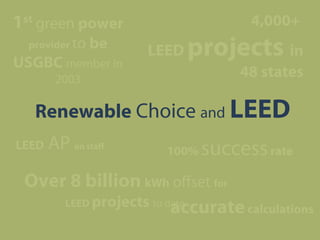
1st green power
provider to

be

USGBC member in

4,000+
LEED

projects in
48 states

2003

Renewable Choice and LEED
LEED

AP on staff

100%

success rate

Over 8 billion kWh offset for
LEED projects to date
accurate calculations
LEED® Green Power

4,000+

LEED® projects internationally

100%

success rate

Member

USGBC® & CaGBC®

LEED APs

on staff
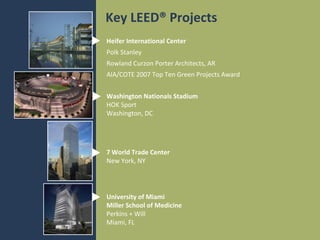
Key LEED® Projects
Heifer International Center
Polk Stanley
Rowland Curzon Porter Architects, AR
AIA/COTE 2007 Top Ten Green Projects Award
Washington Nationals Stadium
HOK Sport
Washington, DC

7 World Trade Center
New York, NY

University of Miami
Miller School of Medicine
Perkins + Will
Miami, FL
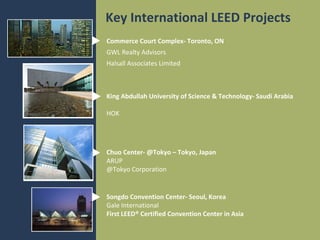
Key International LEED Projects
Commerce Court Complex- Toronto, ON
GWL Realty Advisors
Halsall Associates Limited

King Abdullah University of Science & Technology- Saudi Arabia
HOK

Chuo Center- @Tokyo – Tokyo, Japan
ARUP
@Tokyo Corporation

Songdo Convention Center- Seoul, Korea
Gale International
First LEED® Certified Convention Center in Asia
Renewable Choice LEED Clients
Trusted Source of Green Power
 Qualified sales team
 3 LEED® APs on staff
 Accurate calculations
 100% success rate
 Helped develop best standards
and practices
LEED and the related logo is a trademark owned by the U.S. Green Building
Council and is used with permission.
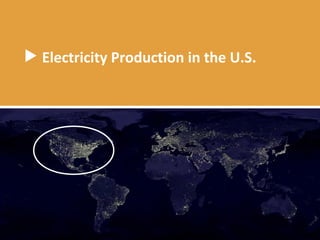
Electricity Production in the U.S.
Test your Energy IQ
? How is most domestic U.S. energy produced?

a.
b.
c.
d.
e.
f.

Wind
Coal
Natural gas
Solar
Hydroelectric
Nuclear
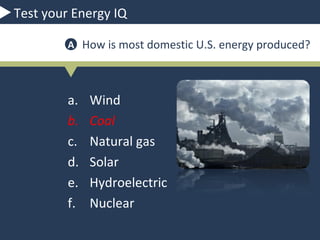
Test your Energy IQ
A How is most domestic U.S. energy produced?

a.
b.
c.
d.
e.
f.

Wind
Coal
Natural gas
Solar
Hydroelectric
Nuclear
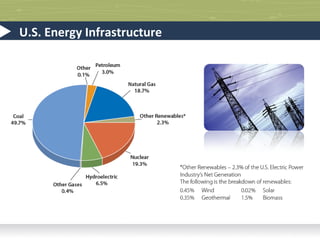
U.S. Energy Infrastructure
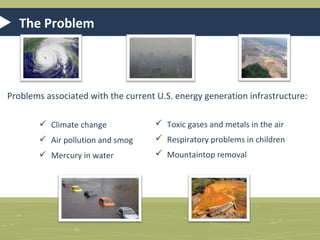
The Problem

Problems associated with the current U.S. energy generation infrastructure:
 Climate change

 Toxic gases and metals in the air

 Air pollution and smog

 Respiratory problems in children

 Mercury in water

 Mountaintop removal
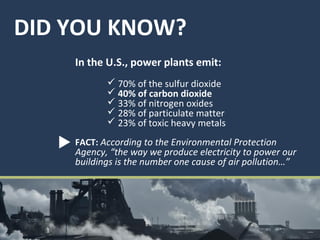
DID YOU KNOW?
In the U.S., power plants emit:
 70% of the sulfur dioxide
 40% of carbon dioxide
 33% of nitrogen oxides
 28% of particulate matter
 23% of toxic heavy metals
FACT: According to the Environmental Protection
Agency, “the way we produce electricity to power our
buildings is the number one cause of air pollution…”
Test your Energy IQ
? What is the largest consumer of energy in the U.S.?

a. Cell Phones
b. Appliances
c. Flat screen TVs
d. Buildings
e. Texas
Test your Energy IQ
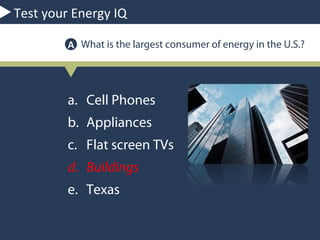
A What is the largest consumer of energy in the U.S.?

a. Cell Phones
b. Appliances
c. Flat screen TVs
d. Buildings
e. Texas
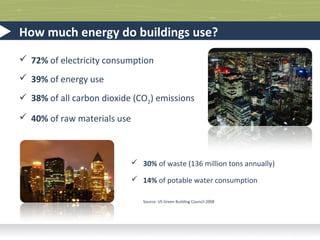
How much energy do buildings use?
 72% of electricity consumption
 39% of energy use
 38% of all carbon dioxide (CO2) emissions
 40% of raw materials use

 30% of waste (136 million tons annually)
 14% of potable water consumption
Source: US Green Building Council 2008
Test your Energy IQ
? According to the U.S. DOE and AWEA, which answer is true?

a.

Offshore wind farms could provide enough energy to
power the entire nation

b. Wind energy is the fastest growing form of electricity
generation in the U.S.
c.

For every MW of wind energy produced, $1 million in
economic development is generated

d. None of the above
e. All of the above
Test your Energy IQ
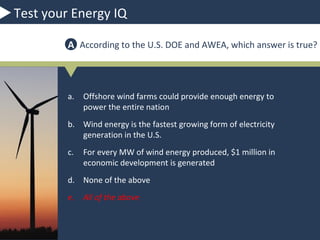
A According to the U.S. DOE and AWEA, which answer is true?

a.

Offshore wind farms could provide enough energy to
power the entire nation

b. Wind energy is the fastest growing form of electricity
generation in the U.S.
c.

For every MW of wind energy produced, $1 million in
economic development is generated

d. None of the above
e.

All of the above
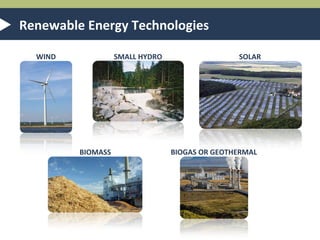
Renewable Energy Technologies
WIND

SMALL HYDRO

BIOMASS

SOLAR

BIOGAS OR GEOTHERMAL
Benefits of Renewable Energy
 No harmful pollution
 Supports domestic energy
 Protects natural resources
 Fights global climate change
 Stimulates economic growth and job
creation
 Secures our energy future
 Improves health and safety
 Social responsibility
Green Building
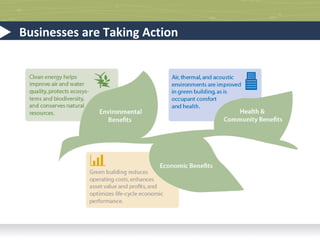
Businesses are Taking Action
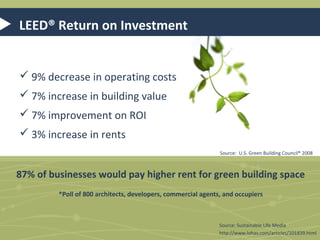
LEED® Return on Investment

 9% decrease in operating costs
 7% increase in building value
 7% improvement on ROI
 3% increase in rents
Source: U.S. Green Building Council® 2008

87% of businesses would pay higher rent for green building space
*Poll of 800 architects, developers, commercial agents, and occupiers

Source: Sustainable Life Media
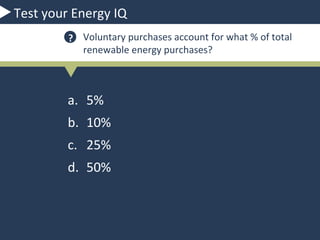
http://www.lohas.com/articles/101839.html
Test your Energy IQ
? Voluntary purchases account for what % of total
renewable energy purchases?

a. 5%
b. 10%
c. 25%
d. 50%
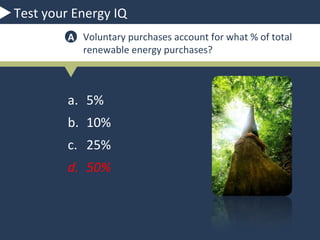
Test your Energy IQ
A Voluntary purchases account for what % of total
renewable energy purchases?

a. 5%
b. 10%
c. 25%
d. 50%
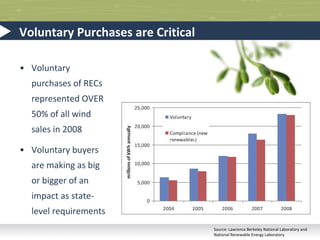
Voluntary Purchases are Critical
• Voluntary
purchases of RECs
represented OVER
50% of all wind
sales in 2008
• Voluntary buyers
are making as big
or bigger of an
impact as statelevel requirements
Source: Lawrence Berkeley National Laboratory and
National Renewable Energy Laboratory
Green Power
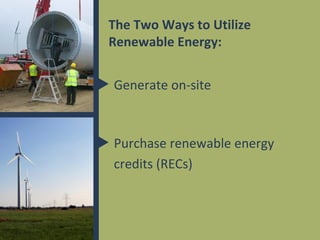
The Two Ways to Utilize
Renewable Energy:
Generate on-site

Purchase renewable energy
credits (RECs)
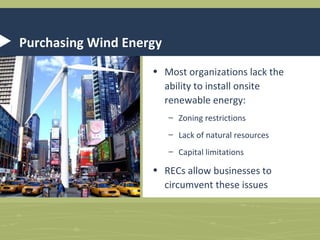
Purchasing Wind Energy
• Most organizations lack the
ability to install onsite
renewable energy:
– Zoning restrictions
– Lack of natural resources
– Capital limitations

• RECs allow businesses to
circumvent these issues
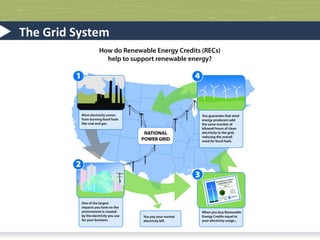
The Grid System
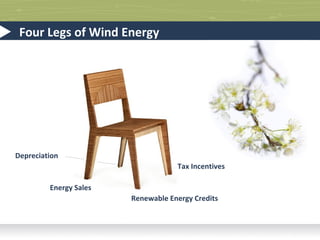
Four Legs of Wind Energy

Depreciation
Tax Incentives
Energy Sales
Renewable Energy Credits
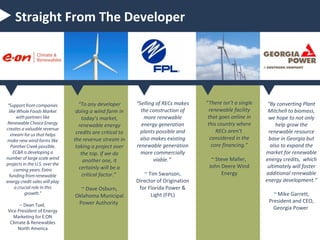
Straight From The Developer

“Support from companies
like Whole Foods Market
with partners like
Renewable Choice Energy
creates a valuable revenue
stream for us that helps
make new wind farms like
Panther Creek possible.
EC&R is developing a
number of large scale wind
projects in the U.S. over the
coming years. Extra
funding from renewable
energy credit sales will play
a crucial role in this
growth.”
~ Dean Tuel,
Vice President of Energy
Marketing for E.ON
Climate & Renewables
North America

“To any developer
doing a wind farm in
today’s market,
renewable energy
credits are critical to
the revenue stream in
taking a project over
the top. If we do
another one, it
certainly will be a
critical factor.”
~ Dave Osburn,
Oklahoma Municipal
Power Authority

“Selling of RECs makes
the construction of
more renewable
energy generation
plants possible and
also makes existing
renewable generation
more commercially
viable.”
~ Tim Swanson,
Director of Origination
for Florida Power &
Light (FPL)

“There isn’t a single
renewable facility
that goes online in
this country where
RECs aren’t
considered in the
core financing.”
~ Steve Maller,
John Deere Wind
Energy

"By converting Plant
Mitchell to biomass,
we hope to not only
help grow the
renewable resource
base in Georgia but
also to expand the
market for renewable
energy credits, which
ultimately will foster
additional renewable
energy development.“
~ Mike Garrett,
President and CEO,
Georgia Power
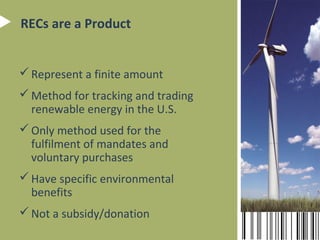
RECs are a Product
 Represent a finite amount
 Method for tracking and trading
renewable energy in the U.S.
 Only method used for the
fulfilment of mandates and
voluntary purchases
 Have specific environmental
benefits
 Not a subsidy/donation
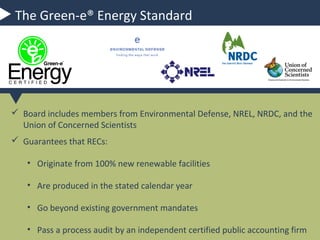
The Green-e® Energy Standard

 Board includes members from Environmental Defense, NREL, NRDC, and the
Union of Concerned Scientists
 Guarantees that RECs:
• Originate from 100% new renewable facilities
• Are produced in the stated calendar year
• Go beyond existing government mandates
• Pass a process audit by an independent certified public accounting firm
EAc6
The Green Power Point
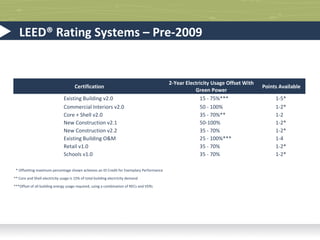
LEED® Rating Systems – Pre-2009

Certification
Existing Building v2.0
Commercial Interiors v2.0
Core + Shell v2.0
New Construction v2.1
New Construction v2.2
Existing Building O&M
Retail v1.0
Schools v1.0
* Offsetting maximum percentage shown achieves an ID Credit for Exemplary Performance
** Core and Shell electricity usage is 15% of total building electricity demand
***Offset of all building energy usage required, using a combination of RECs and VERs

2-Year Electricity Usage Offset With
Green Power
15 - 75%***
50 - 100%
35 - 70%**
50-100%
35 - 70%
25 - 100%***
35 - 70%
35 - 70%

Points Available
1-5*
1-2*
1-2
1-2*
1-2*
1-4
1-2*
1-2*
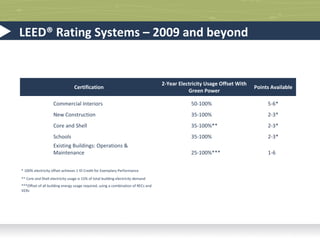
LEED® Rating Systems – 2009 and beyond

Certification

2-Year Electricity Usage Offset With
Green Power

Points Available

Commercial Interiors

50-100%

5-6*

New Construction

35-100%

2-3*

Core and Shell

35-100%**

2-3*

Schools

35-100%

2-3*

Existing Buildings: Operations &
Maintenance

25-100%***

1-6

* 100% electricity offset achieves 1 ID Credit for Exemplary Performance
** Core and Shell electricity usage is 15% of total building electricity demand
***Offset of all building energy usage required, using a combination of RECs and
VERs
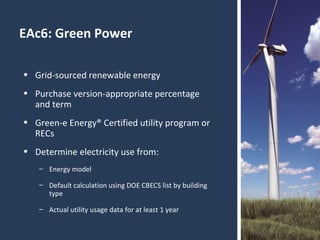
EAc6: Green Power
• Grid-sourced renewable energy
• Purchase version-appropriate percentage
and term
• Green-e Energy® Certified utility program or
RECs
• Determine electricity use from:
– Energy model
– Default calculation using DOE CBECS list by building
type
– Actual utility usage data for at least 1 year
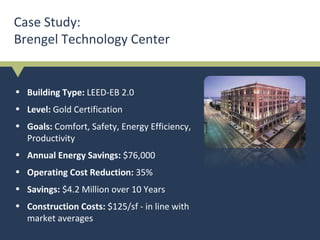
Case Study:
Brengel Technology Center

• Building Type: LEED-EB 2.0
• Level: Gold Certification
• Goals: Comfort, Safety, Energy Efficiency,
Productivity
• Annual Energy Savings: $76,000
• Operating Cost Reduction: 35%
• Savings: $4.2 Million over 10 Years
• Construction Costs: $125/sf - in line with
market averages
Sample:
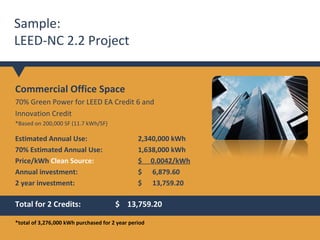
LEED-NC 2.2 Project
Commercial Office Space
70% Green Power for LEED EA Credit 6 and
Innovation Credit
*Based on 200,000 SF (11.7 kWh/SF)

Estimated Annual Use:
70% Estimated Annual Use:
Price/kWh Clean Source:
Annual investment:
2 year investment:

Total for 2 Credits:

2,340,000 kWh
1,638,000 kWh
$ 0.0042/kWh
$ 6,879.60
$ 13,759.20

$ 13,759.20

*total of 3,276,000 kWh purchased for 2 year period
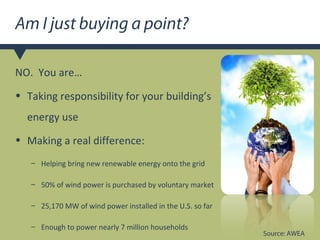
Am I just buying a point?
NO. You are…
• Taking responsibility for your building’s
energy use
• Making a real difference:
– Helping bring new renewable energy onto the grid
– 50% of wind power is purchased by voluntary market
– 25,170 MW of wind power installed in the U.S. so far
– Enough to power nearly 7 million households

Source: AWEA
LEED® & Emission Reductions
Offsetting Emissions: A Closer Look
What is a Carbon Offset?
 A carbon offset is a reduction in
greenhouse gas emissions
 One carbon offset represents the
reduction of one metric ton of
carbon dioxide, or its equivalent in
other greenhouse gases
Comparison of RECs & Carbon Offsets

How

REC

Carbon
Offsets

What

Geography

Units

Fund generation of
clean power

Renewable energy

U.S.

MWh

Fund reduction of
carbon emissions

Energy efficiency
Renewable energy
Methane capture
Fuel switching
Agriculture &
Forestry practices

Global

MTCO2e
LEED® EB Projects & Carbon
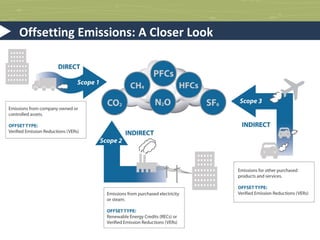
All LEED-EB projects (2.0, O&M, 2009) must offset:
Scope 1 & 3 emissions –
 with verified emission reductions (VERs)
Scope 2 emissions –
 with renewable energy credits (RECs)
Climate Neutral Products
IDc1.1 for Climate Neutral products
– Point awarded for using products
verified as having produced zeroemissions
– Must make up 5% of a project’s
total material value
ID Points and CIRs
• LEED-NC
– ID Point – purchase RECs to offset automobile CO2 emissions,
including all combustion type equipment

– CIR for carbon offset building – Engage in a two-year contract to

purchase carbon offsets for natural gas usage, fuel oil, or on-site coal
burning systems.

• LEED-CI
– ID Point – track office electricity, natural gas, refrigerant leakage,
employee commuting and business travel, and offset with RECs

• All LEED® rating systems
– ID Point – for exemplary performance
Regional Priority Credits
• Incentive for a project to address a pertinent environmental
issue
• Many LEED-EB Projects qualify for an RPC when a minimum
level of energy usage is offset
• Based on zip code
Emissions Reduction Reporting
LEED-EB EAc6:
• Point awarded for quantifying and
tracking emissions reductions attributed
to energy efficiency, renewable energy
and other building emissions reduction
measures over time
• Recommended to follow 3rd party
protocol such as EPA Climate Leaders,
ENERGY STAR or WRI/WBCSD
Why Renewable Choice?
Business Essentials
• Green power can achieve more
than environmental benefits
and certification points
• Renewable Choice helps
communicate and promote the
benefits of your purchase
Outreach Support – How It Works
1.

Determine commitment level

2.

Choose a program that fits with your
company’s or project’s communication &
outreach goals

3.

Renewable Choice customizes the
program you choose and provides ongoing consultation and support
Business Essentials
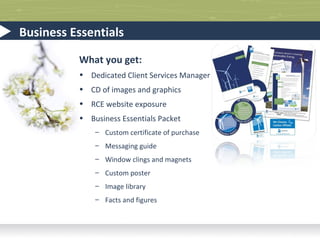
What you get:
• Dedicated Client Services Manager
• CD of images and graphics
• RCE website exposure
• Business Essentials Packet
– Custom certificate of purchase
– Messaging guide
– Window clings and magnets
– Custom poster
– Image library
– Facts and figures
Contact

Sales@renewablechoice.com
877.810.8670

4775 Walnut Street, Suite 230 . Boulder, CO 80301 . 877.810.8670 . www.renewablechoice.com

LEED Green Building Presentation - Renewable Choice

  • 1.
  • 2.
    Contents:  Renewable Choiceand LEED  Electricity production in the U.S.  Green building  Green power  Emission Reductions  Why Renewable Choice?
  • 3.
    1st green power providerto be USGBC member in 4,000+ LEED projects in 48 states 2003 Renewable Choice and LEED LEED AP on staff 100% success rate Over 8 billion kWh offset for LEED projects to date accurate calculations
  • 4.
    LEED® Green Power 4,000+ LEED®projects internationally 100% success rate Member USGBC® & CaGBC® LEED APs on staff
  • 5.
    Key LEED® Projects HeiferInternational Center Polk Stanley Rowland Curzon Porter Architects, AR AIA/COTE 2007 Top Ten Green Projects Award Washington Nationals Stadium HOK Sport Washington, DC 7 World Trade Center New York, NY University of Miami Miller School of Medicine Perkins + Will Miami, FL
  • 6.
    Key International LEEDProjects Commerce Court Complex- Toronto, ON GWL Realty Advisors Halsall Associates Limited King Abdullah University of Science & Technology- Saudi Arabia HOK Chuo Center- @Tokyo – Tokyo, Japan ARUP @Tokyo Corporation Songdo Convention Center- Seoul, Korea Gale International First LEED® Certified Convention Center in Asia
  • 7.
  • 8.
    Trusted Source ofGreen Power  Qualified sales team  3 LEED® APs on staff  Accurate calculations  100% success rate  Helped develop best standards and practices LEED and the related logo is a trademark owned by the U.S. Green Building Council and is used with permission.
  • 9.
  • 10.
    Test your EnergyIQ ? How is most domestic U.S. energy produced? a. b. c. d. e. f. Wind Coal Natural gas Solar Hydroelectric Nuclear
  • 11.
    Test your EnergyIQ A How is most domestic U.S. energy produced? a. b. c. d. e. f. Wind Coal Natural gas Solar Hydroelectric Nuclear
  • 12.
  • 13.
    The Problem Problems associatedwith the current U.S. energy generation infrastructure:  Climate change  Toxic gases and metals in the air  Air pollution and smog  Respiratory problems in children  Mercury in water  Mountaintop removal
  • 14.
    DID YOU KNOW? Inthe U.S., power plants emit:  70% of the sulfur dioxide  40% of carbon dioxide  33% of nitrogen oxides  28% of particulate matter  23% of toxic heavy metals FACT: According to the Environmental Protection Agency, “the way we produce electricity to power our buildings is the number one cause of air pollution…”
  • 16.
    Test your EnergyIQ ? What is the largest consumer of energy in the U.S.? a. Cell Phones b. Appliances c. Flat screen TVs d. Buildings e. Texas
  • 17.
    Test your EnergyIQ A What is the largest consumer of energy in the U.S.? a. Cell Phones b. Appliances c. Flat screen TVs d. Buildings e. Texas
  • 18.
    How much energydo buildings use?  72% of electricity consumption  39% of energy use  38% of all carbon dioxide (CO2) emissions  40% of raw materials use  30% of waste (136 million tons annually)  14% of potable water consumption Source: US Green Building Council 2008
  • 20.
    Test your EnergyIQ ? According to the U.S. DOE and AWEA, which answer is true? a. Offshore wind farms could provide enough energy to power the entire nation b. Wind energy is the fastest growing form of electricity generation in the U.S. c. For every MW of wind energy produced, $1 million in economic development is generated d. None of the above e. All of the above
  • 21.
    Test your EnergyIQ A According to the U.S. DOE and AWEA, which answer is true? a. Offshore wind farms could provide enough energy to power the entire nation b. Wind energy is the fastest growing form of electricity generation in the U.S. c. For every MW of wind energy produced, $1 million in economic development is generated d. None of the above e. All of the above
  • 22.
    Renewable Energy Technologies WIND SMALLHYDRO BIOMASS SOLAR BIOGAS OR GEOTHERMAL
  • 23.
    Benefits of RenewableEnergy  No harmful pollution  Supports domestic energy  Protects natural resources  Fights global climate change  Stimulates economic growth and job creation  Secures our energy future  Improves health and safety  Social responsibility
  • 25.
  • 26.
  • 27.
    LEED® Return onInvestment  9% decrease in operating costs  7% increase in building value  7% improvement on ROI  3% increase in rents Source: U.S. Green Building Council® 2008 87% of businesses would pay higher rent for green building space *Poll of 800 architects, developers, commercial agents, and occupiers Source: Sustainable Life Media http://www.lohas.com/articles/101839.html
  • 28.
    Test your EnergyIQ ? Voluntary purchases account for what % of total renewable energy purchases? a. 5% b. 10% c. 25% d. 50%
  • 29.
    Test your EnergyIQ A Voluntary purchases account for what % of total renewable energy purchases? a. 5% b. 10% c. 25% d. 50%
  • 30.
    Voluntary Purchases areCritical • Voluntary purchases of RECs represented OVER 50% of all wind sales in 2008 • Voluntary buyers are making as big or bigger of an impact as statelevel requirements Source: Lawrence Berkeley National Laboratory and National Renewable Energy Laboratory
  • 31.
  • 32.
    The Two Waysto Utilize Renewable Energy: Generate on-site Purchase renewable energy credits (RECs)
  • 33.
    Purchasing Wind Energy •Most organizations lack the ability to install onsite renewable energy: – Zoning restrictions – Lack of natural resources – Capital limitations • RECs allow businesses to circumvent these issues
  • 34.
  • 35.
    Four Legs ofWind Energy Depreciation Tax Incentives Energy Sales Renewable Energy Credits
  • 36.
    Straight From TheDeveloper “Support from companies like Whole Foods Market with partners like Renewable Choice Energy creates a valuable revenue stream for us that helps make new wind farms like Panther Creek possible. EC&R is developing a number of large scale wind projects in the U.S. over the coming years. Extra funding from renewable energy credit sales will play a crucial role in this growth.” ~ Dean Tuel, Vice President of Energy Marketing for E.ON Climate & Renewables North America “To any developer doing a wind farm in today’s market, renewable energy credits are critical to the revenue stream in taking a project over the top. If we do another one, it certainly will be a critical factor.” ~ Dave Osburn, Oklahoma Municipal Power Authority “Selling of RECs makes the construction of more renewable energy generation plants possible and also makes existing renewable generation more commercially viable.” ~ Tim Swanson, Director of Origination for Florida Power & Light (FPL) “There isn’t a single renewable facility that goes online in this country where RECs aren’t considered in the core financing.” ~ Steve Maller, John Deere Wind Energy "By converting Plant Mitchell to biomass, we hope to not only help grow the renewable resource base in Georgia but also to expand the market for renewable energy credits, which ultimately will foster additional renewable energy development.“ ~ Mike Garrett, President and CEO, Georgia Power
  • 37.
    RECs are aProduct  Represent a finite amount  Method for tracking and trading renewable energy in the U.S.  Only method used for the fulfilment of mandates and voluntary purchases  Have specific environmental benefits  Not a subsidy/donation
  • 38.
    The Green-e® EnergyStandard  Board includes members from Environmental Defense, NREL, NRDC, and the Union of Concerned Scientists  Guarantees that RECs: • Originate from 100% new renewable facilities • Are produced in the stated calendar year • Go beyond existing government mandates • Pass a process audit by an independent certified public accounting firm
  • 39.
  • 40.
    LEED® Rating Systems– Pre-2009 Certification Existing Building v2.0 Commercial Interiors v2.0 Core + Shell v2.0 New Construction v2.1 New Construction v2.2 Existing Building O&M Retail v1.0 Schools v1.0 * Offsetting maximum percentage shown achieves an ID Credit for Exemplary Performance ** Core and Shell electricity usage is 15% of total building electricity demand ***Offset of all building energy usage required, using a combination of RECs and VERs 2-Year Electricity Usage Offset With Green Power 15 - 75%*** 50 - 100% 35 - 70%** 50-100% 35 - 70% 25 - 100%*** 35 - 70% 35 - 70% Points Available 1-5* 1-2* 1-2 1-2* 1-2* 1-4 1-2* 1-2*
  • 41.
    LEED® Rating Systems– 2009 and beyond Certification 2-Year Electricity Usage Offset With Green Power Points Available Commercial Interiors 50-100% 5-6* New Construction 35-100% 2-3* Core and Shell 35-100%** 2-3* Schools 35-100% 2-3* Existing Buildings: Operations & Maintenance 25-100%*** 1-6 * 100% electricity offset achieves 1 ID Credit for Exemplary Performance ** Core and Shell electricity usage is 15% of total building electricity demand ***Offset of all building energy usage required, using a combination of RECs and VERs
  • 42.
    EAc6: Green Power •Grid-sourced renewable energy • Purchase version-appropriate percentage and term • Green-e Energy® Certified utility program or RECs • Determine electricity use from: – Energy model – Default calculation using DOE CBECS list by building type – Actual utility usage data for at least 1 year
  • 43.
    Case Study: Brengel TechnologyCenter • Building Type: LEED-EB 2.0 • Level: Gold Certification • Goals: Comfort, Safety, Energy Efficiency, Productivity • Annual Energy Savings: $76,000 • Operating Cost Reduction: 35% • Savings: $4.2 Million over 10 Years • Construction Costs: $125/sf - in line with market averages
  • 44.
    Sample: LEED-NC 2.2 Project CommercialOffice Space 70% Green Power for LEED EA Credit 6 and Innovation Credit *Based on 200,000 SF (11.7 kWh/SF) Estimated Annual Use: 70% Estimated Annual Use: Price/kWh Clean Source: Annual investment: 2 year investment: Total for 2 Credits: 2,340,000 kWh 1,638,000 kWh $ 0.0042/kWh $ 6,879.60 $ 13,759.20 $ 13,759.20 *total of 3,276,000 kWh purchased for 2 year period
  • 45.
    Am I justbuying a point? NO. You are… • Taking responsibility for your building’s energy use • Making a real difference: – Helping bring new renewable energy onto the grid – 50% of wind power is purchased by voluntary market – 25,170 MW of wind power installed in the U.S. so far – Enough to power nearly 7 million households Source: AWEA
  • 46.
  • 47.
  • 48.
    What is aCarbon Offset?  A carbon offset is a reduction in greenhouse gas emissions  One carbon offset represents the reduction of one metric ton of carbon dioxide, or its equivalent in other greenhouse gases
  • 49.
    Comparison of RECs& Carbon Offsets How REC Carbon Offsets What Geography Units Fund generation of clean power Renewable energy U.S. MWh Fund reduction of carbon emissions Energy efficiency Renewable energy Methane capture Fuel switching Agriculture & Forestry practices Global MTCO2e
  • 50.
    LEED® EB Projects& Carbon All LEED-EB projects (2.0, O&M, 2009) must offset: Scope 1 & 3 emissions –  with verified emission reductions (VERs) Scope 2 emissions –  with renewable energy credits (RECs)
  • 51.
    Climate Neutral Products IDc1.1for Climate Neutral products – Point awarded for using products verified as having produced zeroemissions – Must make up 5% of a project’s total material value
  • 52.
    ID Points andCIRs • LEED-NC – ID Point – purchase RECs to offset automobile CO2 emissions, including all combustion type equipment – CIR for carbon offset building – Engage in a two-year contract to purchase carbon offsets for natural gas usage, fuel oil, or on-site coal burning systems. • LEED-CI – ID Point – track office electricity, natural gas, refrigerant leakage, employee commuting and business travel, and offset with RECs • All LEED® rating systems – ID Point – for exemplary performance
  • 53.
    Regional Priority Credits •Incentive for a project to address a pertinent environmental issue • Many LEED-EB Projects qualify for an RPC when a minimum level of energy usage is offset • Based on zip code
  • 54.
    Emissions Reduction Reporting LEED-EBEAc6: • Point awarded for quantifying and tracking emissions reductions attributed to energy efficiency, renewable energy and other building emissions reduction measures over time • Recommended to follow 3rd party protocol such as EPA Climate Leaders, ENERGY STAR or WRI/WBCSD
  • 55.
  • 56.
    Business Essentials • Greenpower can achieve more than environmental benefits and certification points • Renewable Choice helps communicate and promote the benefits of your purchase
  • 57.
    Outreach Support –How It Works 1. Determine commitment level 2. Choose a program that fits with your company’s or project’s communication & outreach goals 3. Renewable Choice customizes the program you choose and provides ongoing consultation and support
  • 58.
    Business Essentials What youget: • Dedicated Client Services Manager • CD of images and graphics • RCE website exposure • Business Essentials Packet – Custom certificate of purchase – Messaging guide – Window clings and magnets – Custom poster – Image library – Facts and figures
  • 59.
    Contact Sales@renewablechoice.com 877.810.8670 4775 Walnut Street,Suite 230 . Boulder, CO 80301 . 877.810.8670 . www.renewablechoice.com

Editor's Notes

  • #7 New Projects to add: (Large International LEED deals) Commerce Court Complex- Ontario King Abdullah University of Science and Technology-LEED NC 2.2- Saudi Arabia At Tokyo-LEED CS 2009- Japan CCBIG China Yingkou City - LEED NC 2009- China Songdo Convention Center- Korea
  • #13 DOE Energy Information Administration - U.S. Electric Power Industry Net Generation, 2005
  • #14 Mercury picture is of New Idria - a ghost town located in a remote area of the Coast Range of California, outside of Hollister.­ It was once a center for mercury (quick silver) and asbestos mining. New Idria was at its peak well before the Gold Rush in California of the 1840s and 60s.­ There are still high levels of mercury and asbestos pollution in the area.
  • #23 Solar farm picture – Florida Gulf Coast University (16 acre solar farm).
  • #31 Main Point: Voluntary green power purchases match the support for renewable energy provided by compliance markets, making each REC market equally critical to the success of wind energy in this country. Recently, the voluntary market has been growing faster than the compliance market.
  • #34 Main Point: In most cases, RECs are the only feasible way to purchase renewable energy in the US, on a residential or commercial scale. Most parties interested in accessing renewable energy face zoning, resource, or capital restrictions that make such energy generation prohibitive. RECs provide an easy, effective method of obtaining clean, renewable energy.
  • #36 Main Point: Wind power projects are made possible by four distinct revenue streams. Taking away any one of those streams can cripple wind development. Wind power projects are made financially viable for developers through the existence of four financing streams: Energy Sales, Tax Incentives, Depreciation, and Renewable Energy Credits. Projects depend on all four of these streams in order to be successful; remove any one of them, and the project may not occur. Market data suggests that without the existence of REC’s, approximately 57% of wind projects would no longer be financially viable.
  • #37 NextEra Energy (formerly FPL) Main Point: The investors behind two of the largest wind farms of all time consider RECs to be critical to their projects success, and it is likely that without the existence of RECs, neither would be have been seen as a worthwhile investment. As one of the largest oil speculators in the history of Texas, Pickens has turned his attention to wind energy, this year investing $10 Billion in the largest wind farm on the planet. In 2005, Pickens said: “I was in wind energy for a minute…. I hate it. And when I got to looking at those damn things I said, I don't want to be a part of putting that on the horizon. I think it's homely and I don't like it. We took a loss and got out of it and I'm glad I did.” Given his history, his change in attitude is largely driven by the newfound profitability of wind energy, which is largely driven by the increased popularity and demand for RECs. The beauty of RECs is that on the small scale, RECs simply make a project financially sensible. However, on the large scale, RECs can make a project quite profitable, in turn drawing large investment from people such as Mr. Pickens who would otherwise be investing elsewhere. The existence of RECs made this project financially attractive to a man of Pickens’ investment capacity. Had it not been for RECs, Pickens may not have moved away from oil speculating.
  • #48 The appropriate offsetting strategy is based on industry guidelines for classifying emissions. Emissions are classified into three Scopes. The scopes were established for inventory and accounting purposes. Scope 1 - Direct emissions – company owned assets: fleet, cogeneration facility, boilers, other industrial processes 2) Scope 2 - Indirect emissions from purchased electricity 3) Scope 3 - “Everything else” The verifying and certifying standards for the voluntary market provide explicit guidelines on the type of offsets appropriate for the type of Scope of emissions. Scope 1 – Carbon offsets. Conceptually, and organization is emitting pollution and purchases a carbon offset to balance this emission. Scope 2 – Renewable Energy Credit. Primarily a US commodity. RECs ensure that renewable energy is put on grid for the energy you consume. Scope 3 – Carbon offsets. RECs only apply to purchased electricity.
  • #51 If we can find them, we should include: CIR for offsetting CO2 emissions during building process CIR for offsetting CO2 emissions from building as a whole