1
Earthquake
Engineering
Engr. Resurreccion V. Garrote, MSCE,
Structural Engineering
Chair- CE Dept.
FormerDEAN-CEA&CampusExec.Director
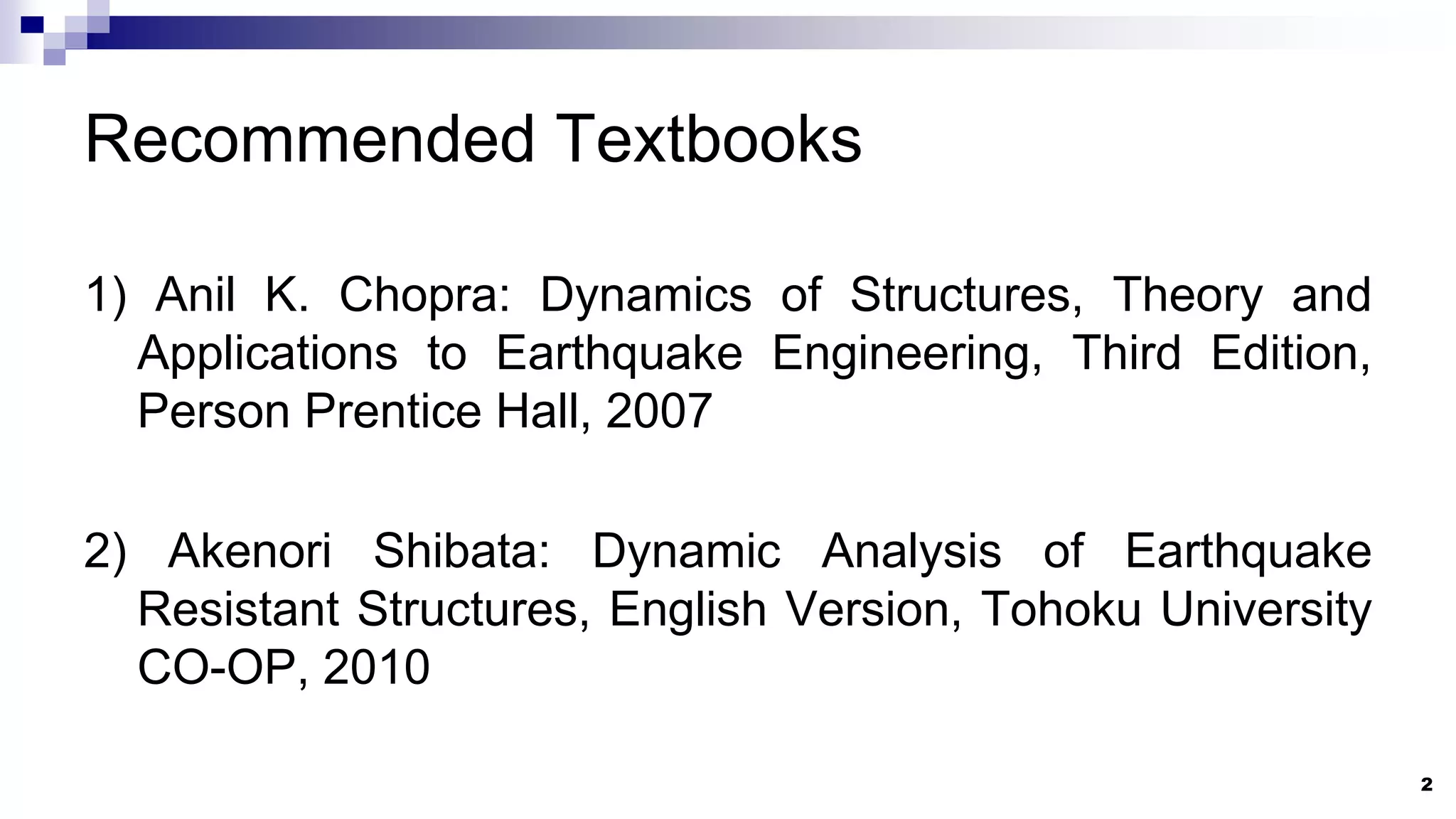
Recommended Textbooks
1) Anil K. Chopra: Dynamics of Structures, Theory and
Applications to Earthquake Engineering, Third Edition,
Person Prentice Hall, 2007
2) Akenori Shibata: Dynamic Analysis of Earthquake
Resistant Structures, English Version, Tohoku University
CO-OP, 2010
2
Contents
 10/10: Free vibration of SDOF systems
 10/13: Response to harmonic and arbitrary loading of
SDOF systems
 10/17: Multi Degree of Freedom systems
 11/1 : Modal response analysis and response history
analysis
 11/21: Examination
3
Time Schedule of the Lecture
4
Lecture
Exercise
Submission of Report
5
Equation of Motion
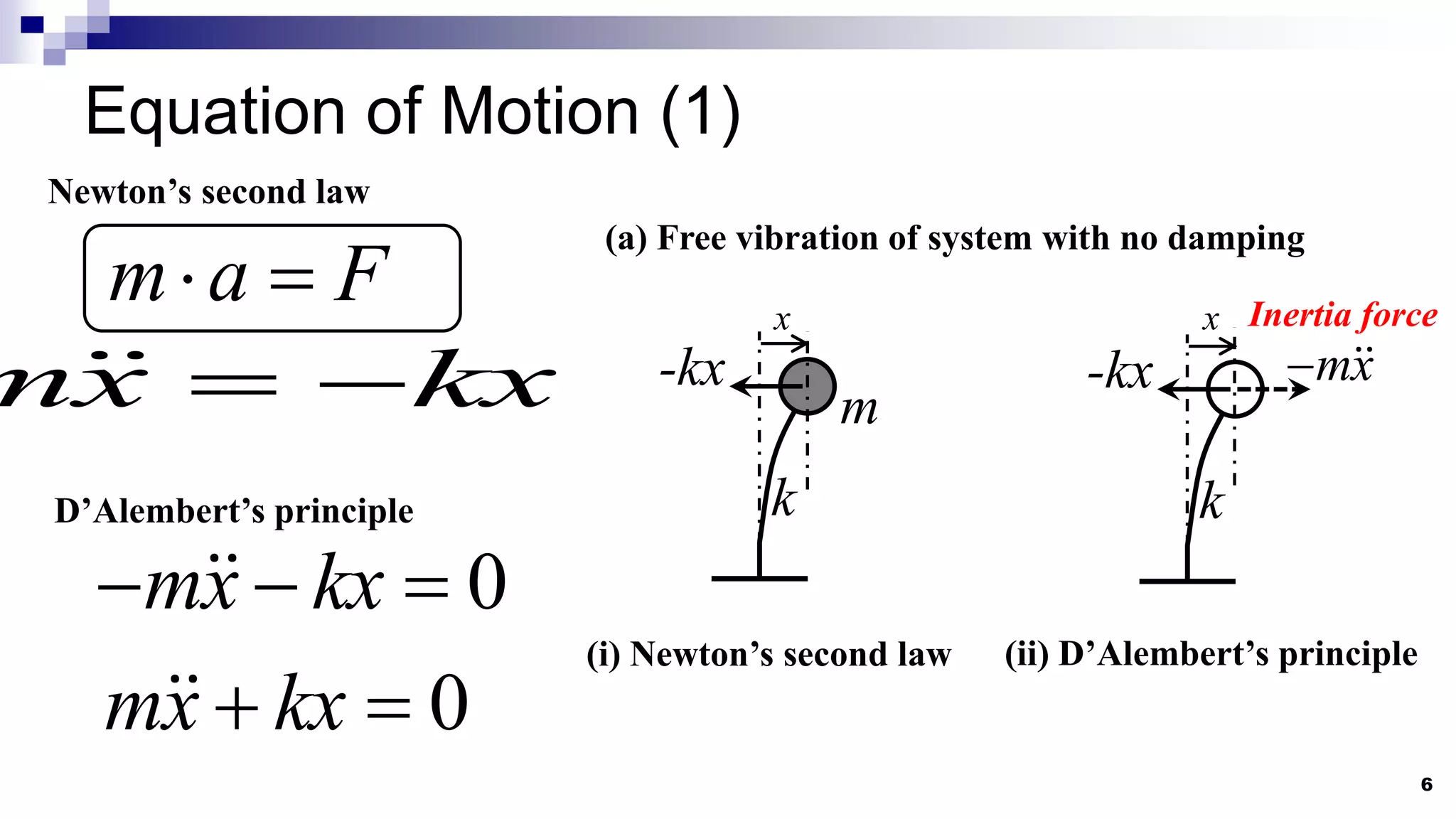
Equation of Motion (1)
6
Newton’s second law
m a F
 
mx kx
 
D’Alembert’s principle
0
mx kx
  
0
mx kx
 
x
m
k
-kx
(a) Free vibration of system with no damping
(i) Newton’s second law (ii) D’Alembert’s principle
x
k
-kx mx

Inertia force
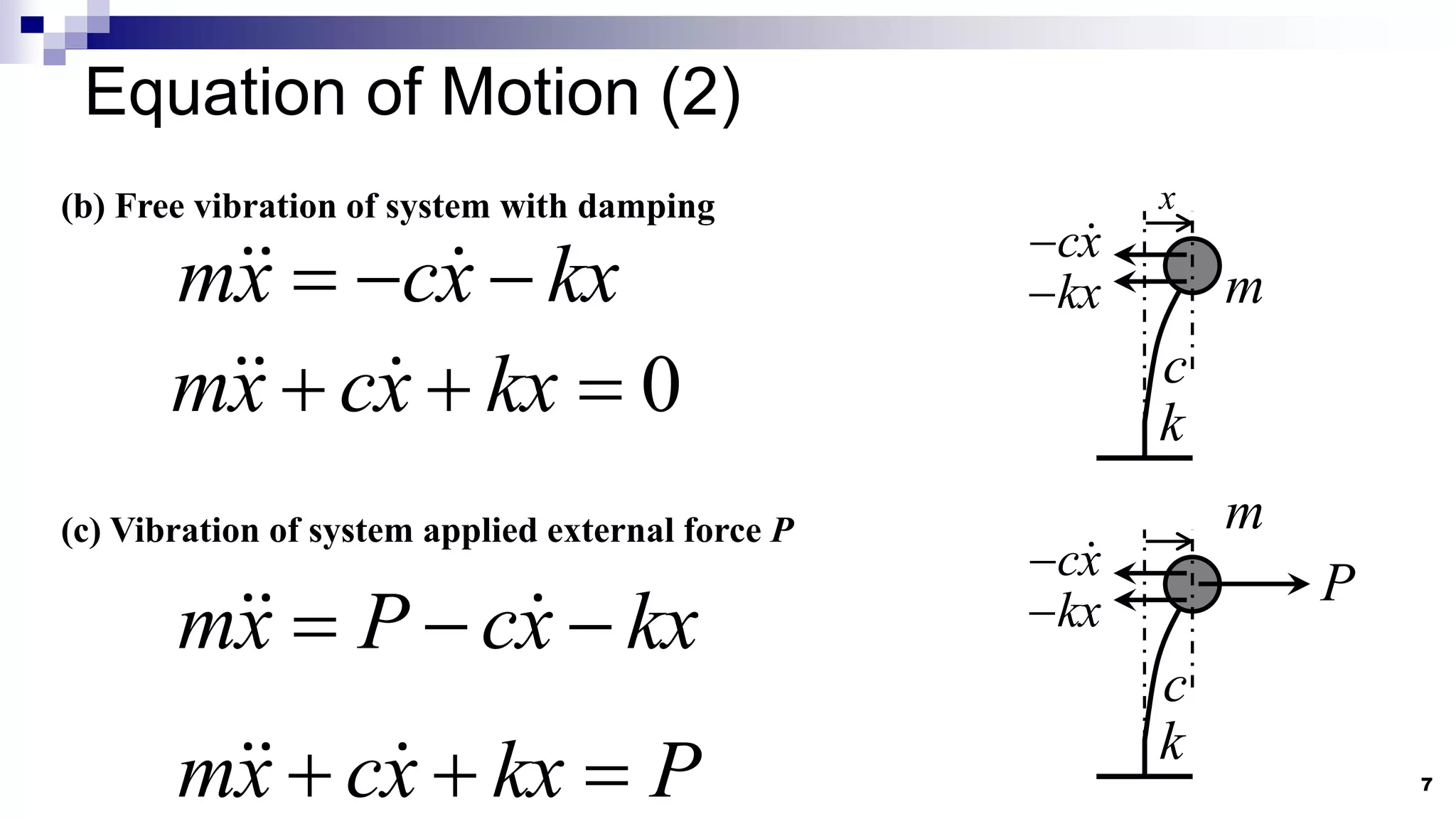
Equation of Motion (2)
7
x
m
k
(b) Free vibration of system with damping
(c) Vibration of system applied external force P
mx cx kx
  
0
mx cx kx
   c
cx

kx

m
k
c
cx

kx

P
mx P cx kx
  
mx cx kx P
  
Equation of Motion (3)
8
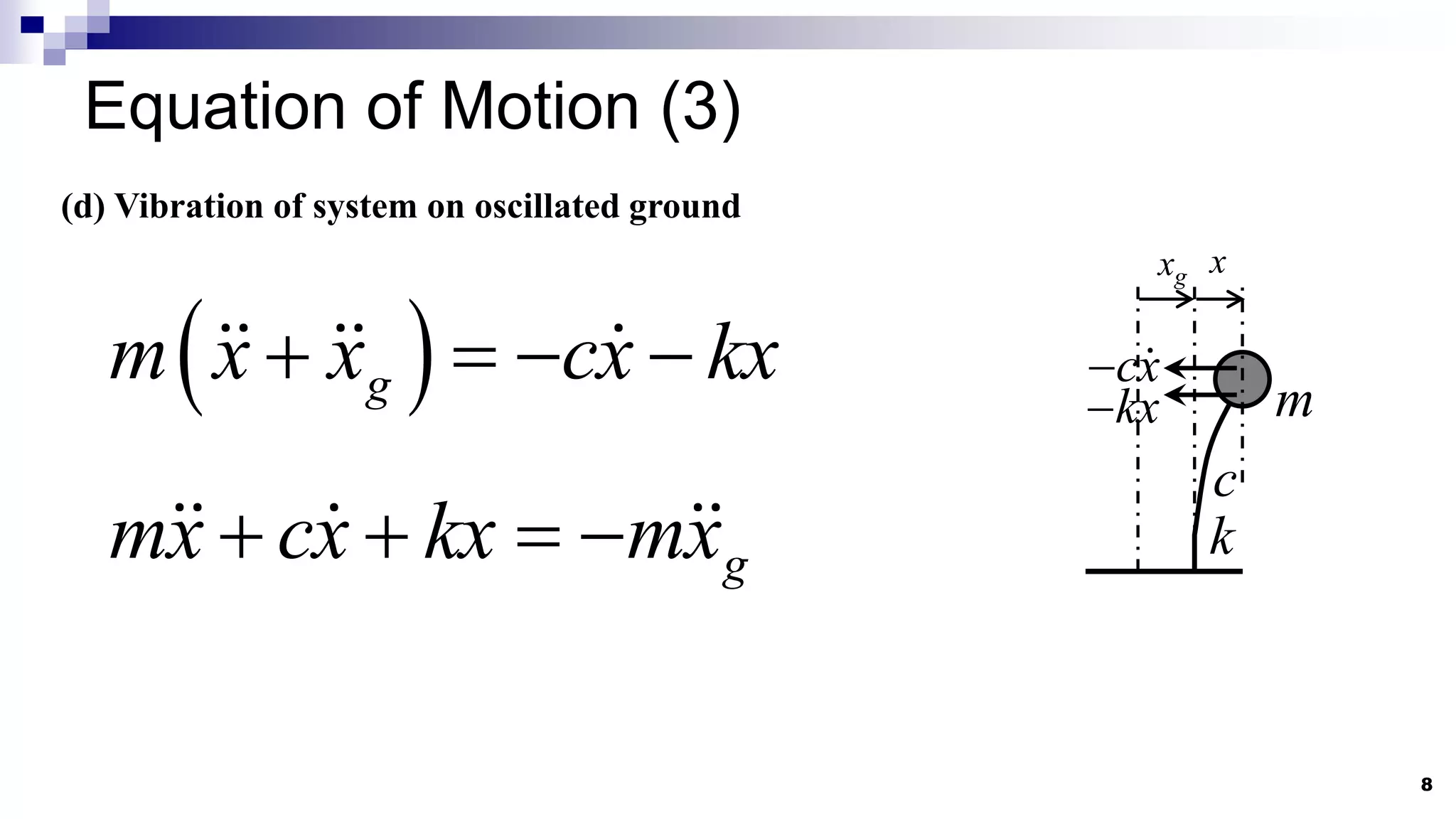
(d) Vibration of system on oscillated ground
 
g
m x x cx kx
   
x
m
k
c
cx

kx

xg
g
mx cx kx mx
   
9
Free Vibration
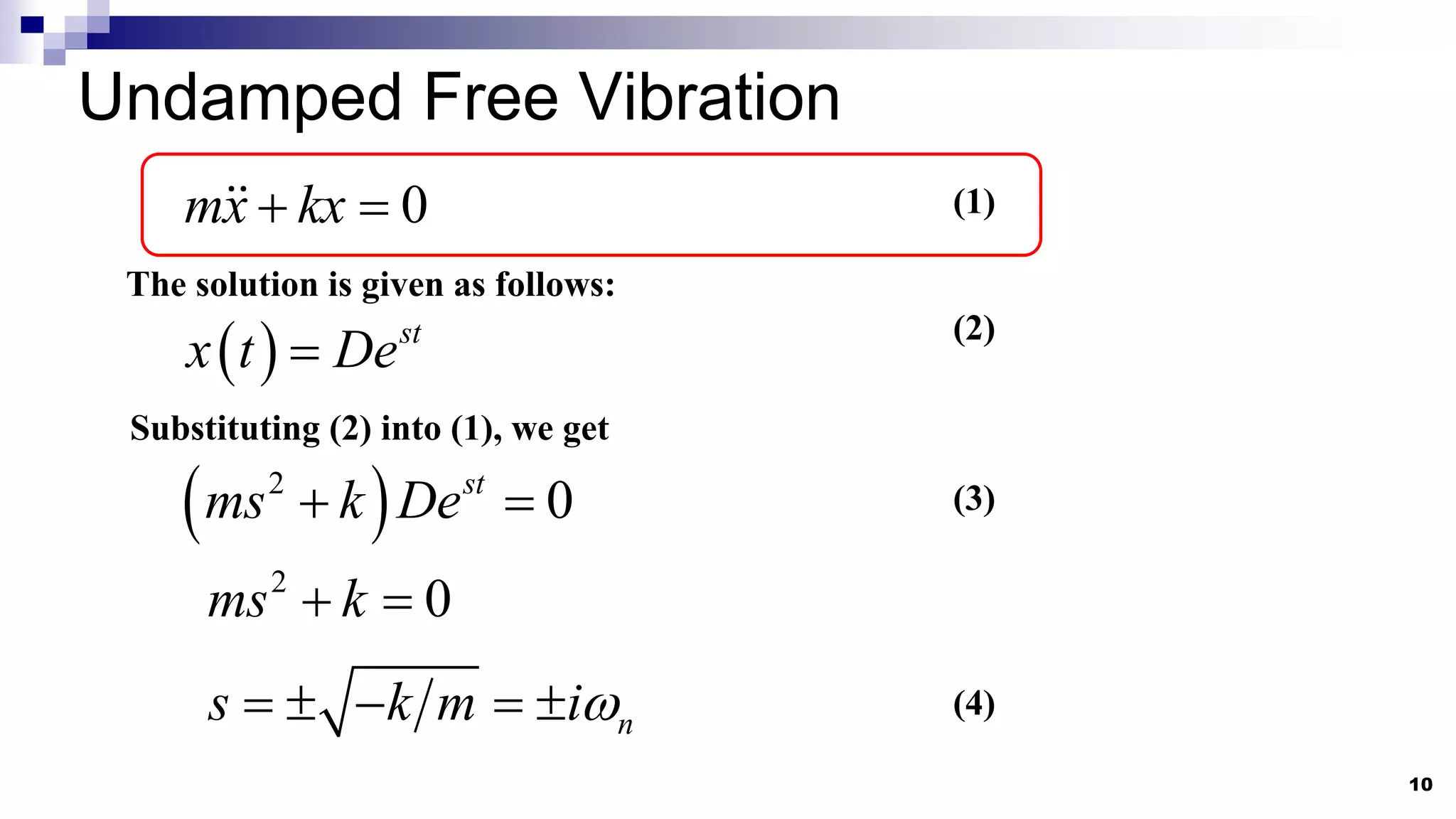
Undamped Free Vibration
10
0
mx kx
  (1)
The solution is given as follows:
  st
x t De

(2)
Substituting (2) into (1), we get
 
2
0
st
ms k De
 
2
0
ms k
 
(3)
n
s k m i
     (4)
11
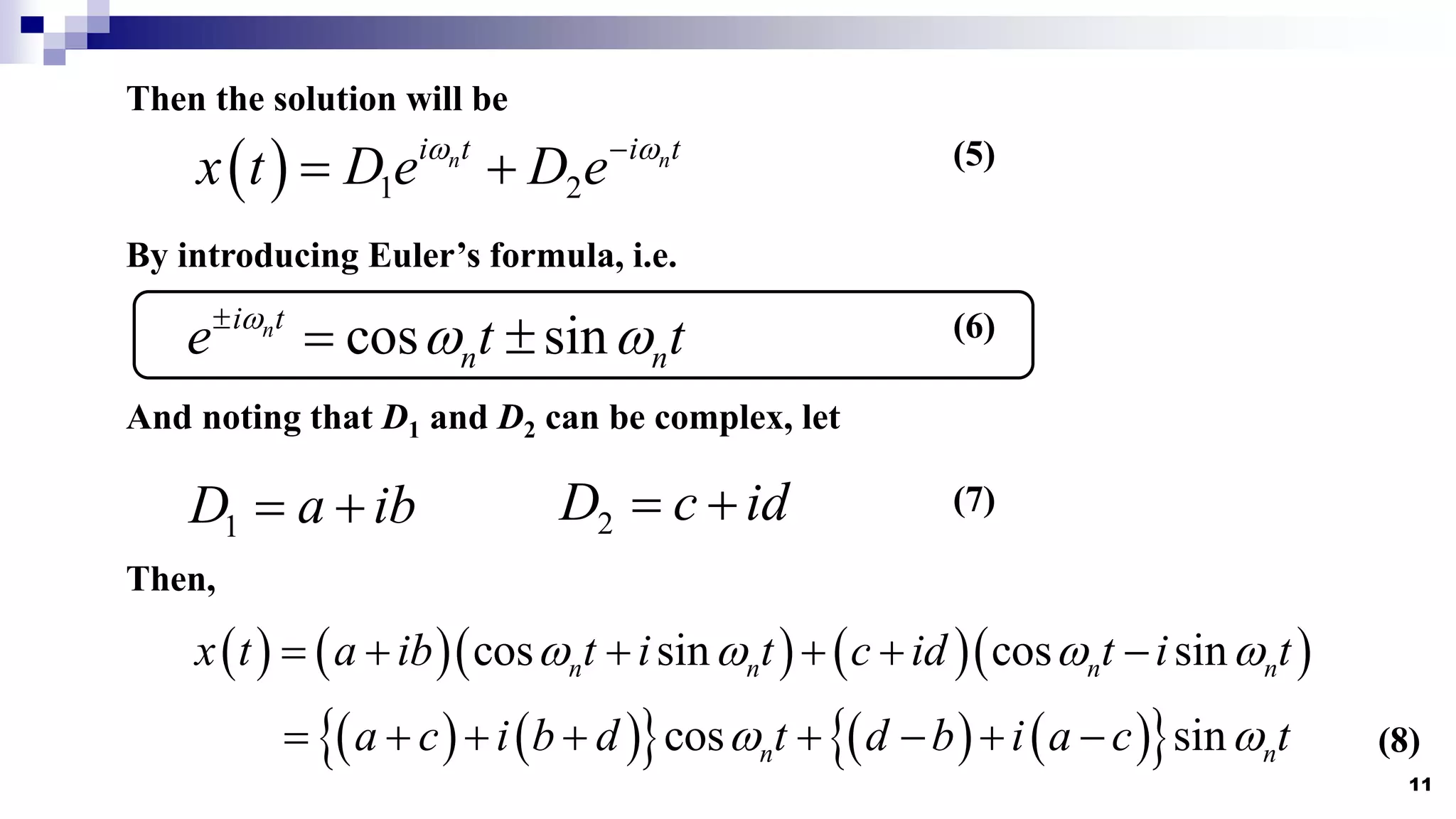
Then the solution will be
  1 2
n n
i t i t
x t D e D e
 

  (5)
cos sin
n
i t
n n
e t t

 

 
By introducing Euler’s formula, i.e.
(6)
And noting that D1 and D2 can be complex, let
1
D a ib
  2
D c id
 
Then,
       
cos sin cos sin
n n n n
x t a ib t i t c id t i t
   
     
(7)
   
     
 
cos sin
n n
a c i b d t d b i a c t
 
        (8)
12
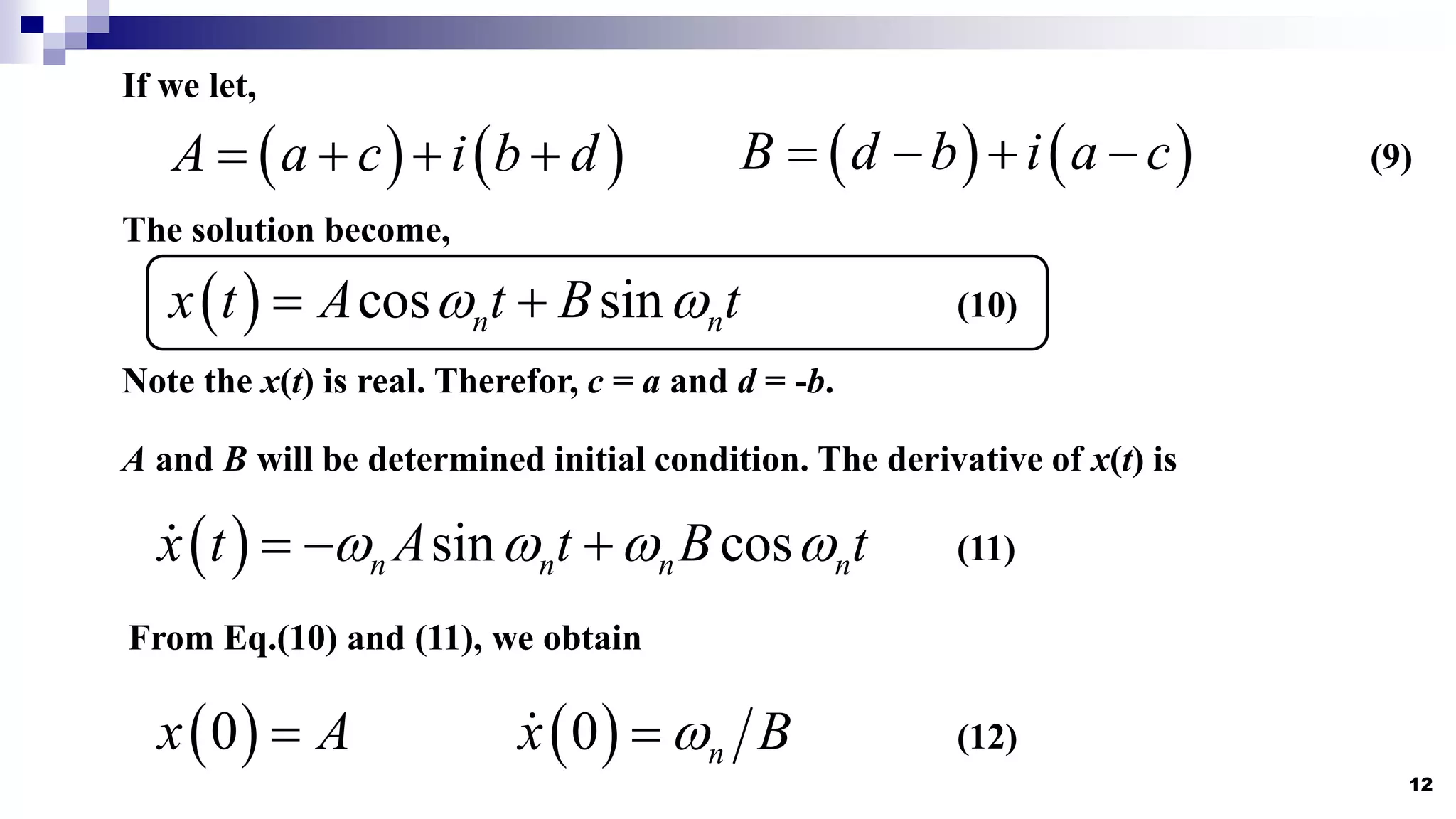
If we let,
   
A a c i b d
       
B d b i a c
   
The solution become,
  cos sin
n n
x t A t B t
 
 
Note the x(t) is real. Therefor, c = a and d = -b.
A and B will be determined initial condition. The derivative of x(t) is
  sin cos
n n n n
x t A t B t
   
  
(9)
(10)
(11)
From Eq.(10) and (11), we obtain
 
0
x A
  
0 n
x B

 (12)
13
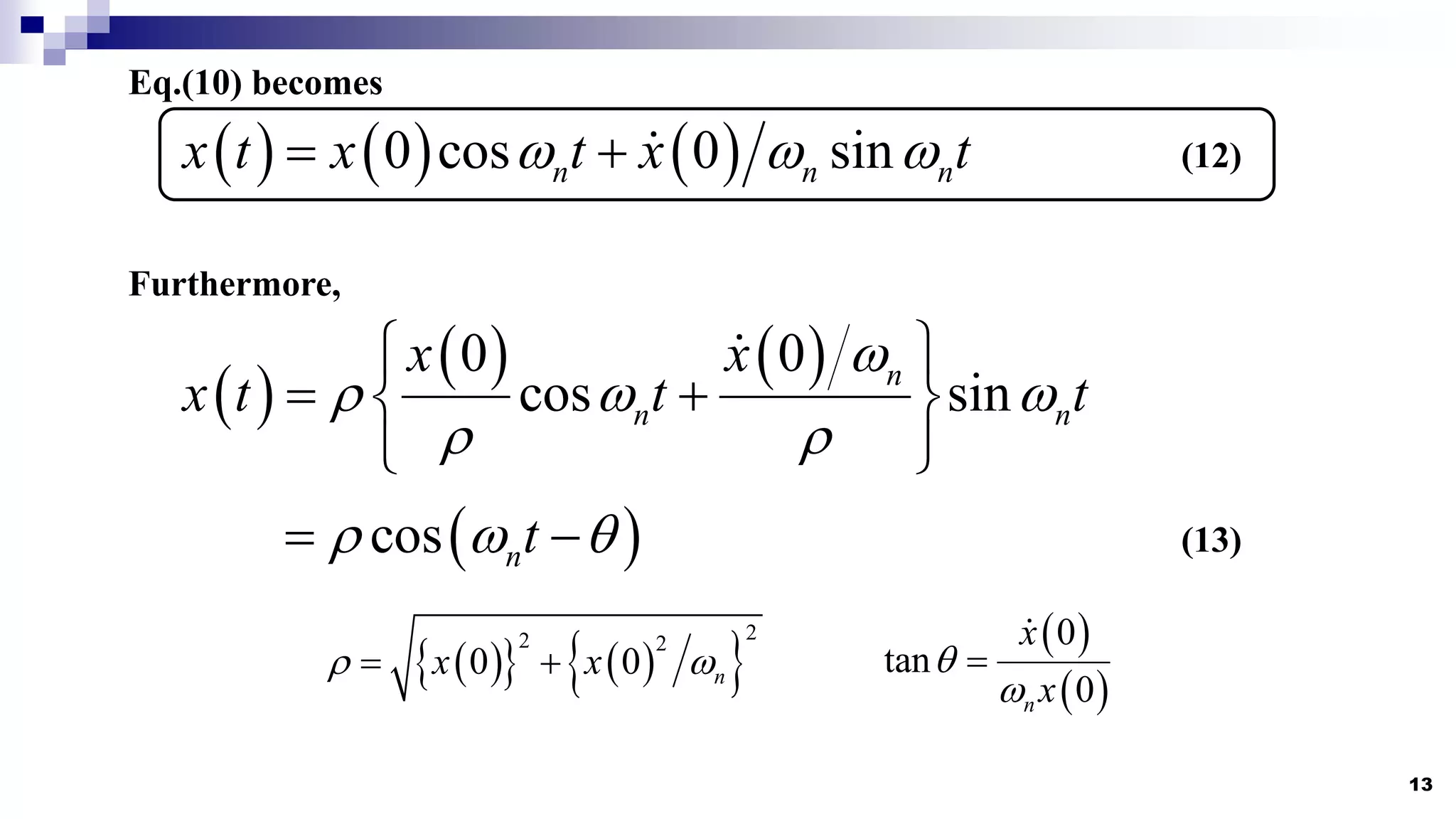
Eq.(10) becomes
     
0 cos 0 sin
n n n
x t x t x t
  
  (12)
Furthermore,
 
   
0 0
cos sin
n
n n
x x
x t t t

  
 
 
 
 
 
 
cos nt
  
  (13)
 
   
 
2
2 2
0 0 n
x x
 
 
 
 
0
tan
0
n
x
x



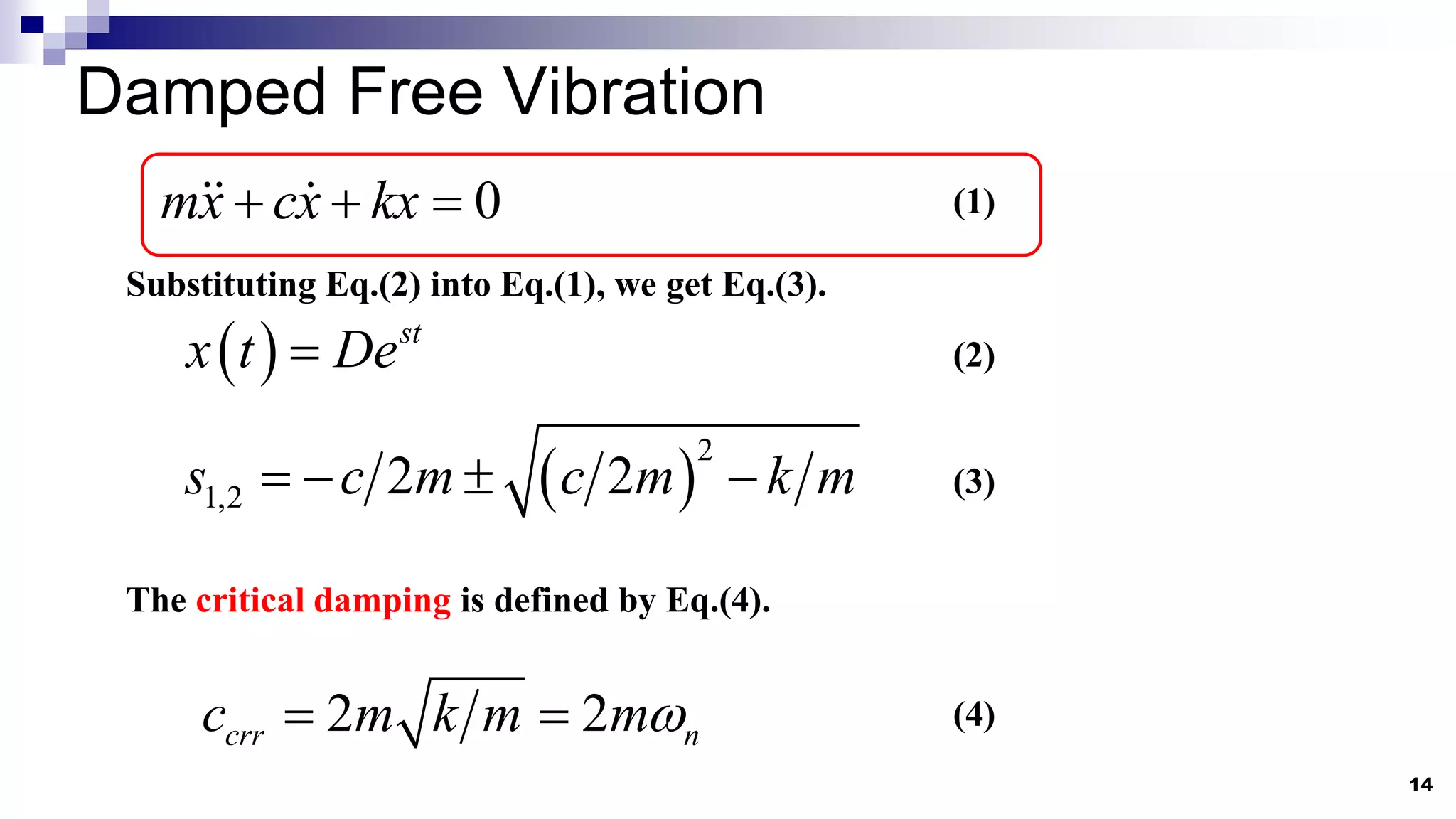
Damped Free Vibration
14
0
mx cx kx
   (1)
  st
x t De

Substituting Eq.(2) into Eq.(1), we get Eq.(3).
 
2
1,2 2 2
s c m c m k m
    (3)
(2)
The critical damping is defined by Eq.(4).
2 2
crr n
c m k m m
  (4)
15
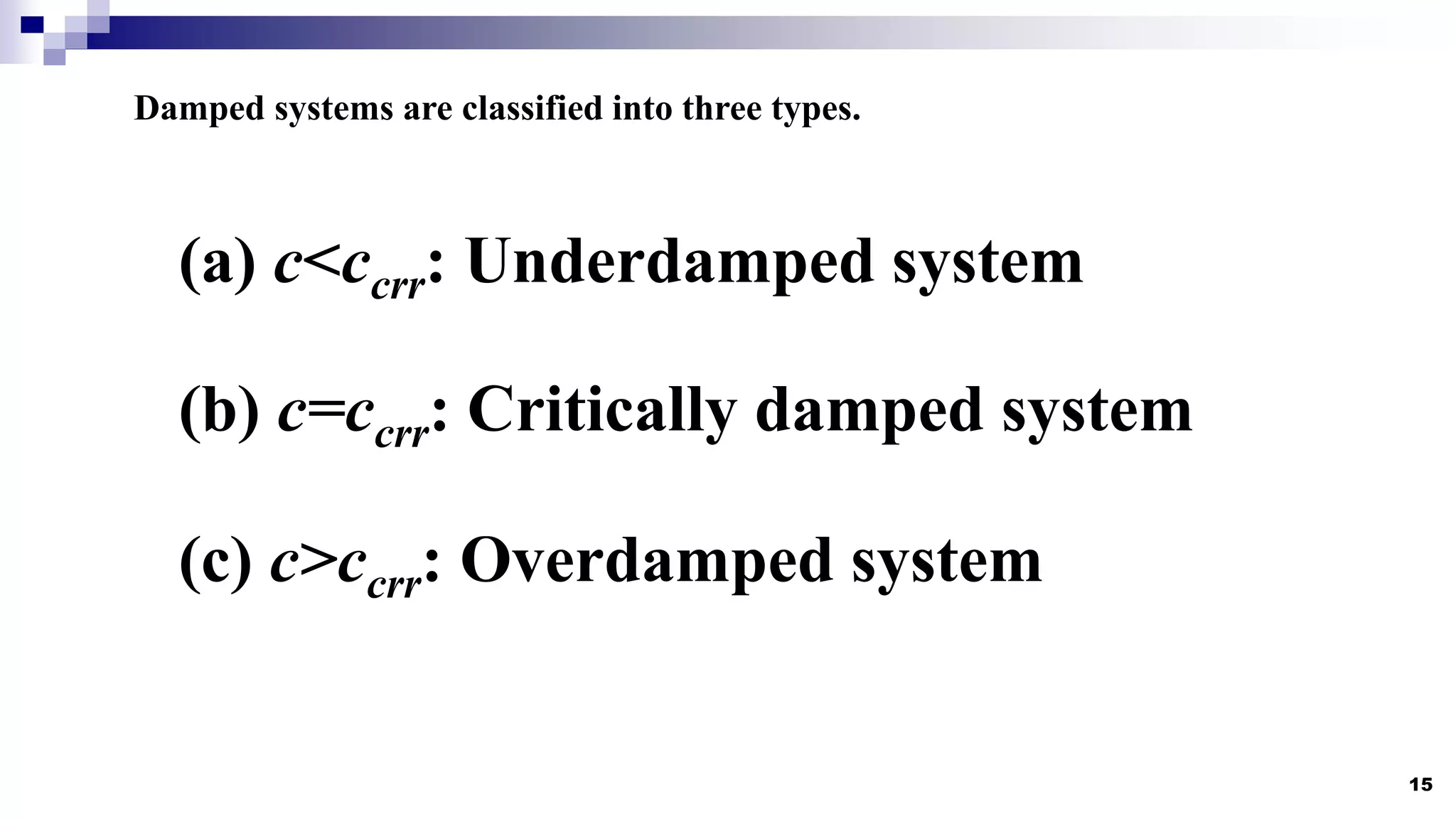
Damped systems are classified into three types.
(a) c<ccrr: Underdamped system
(b) c=ccrr: Critically damped system
(c) c>ccrr: Overdamped system
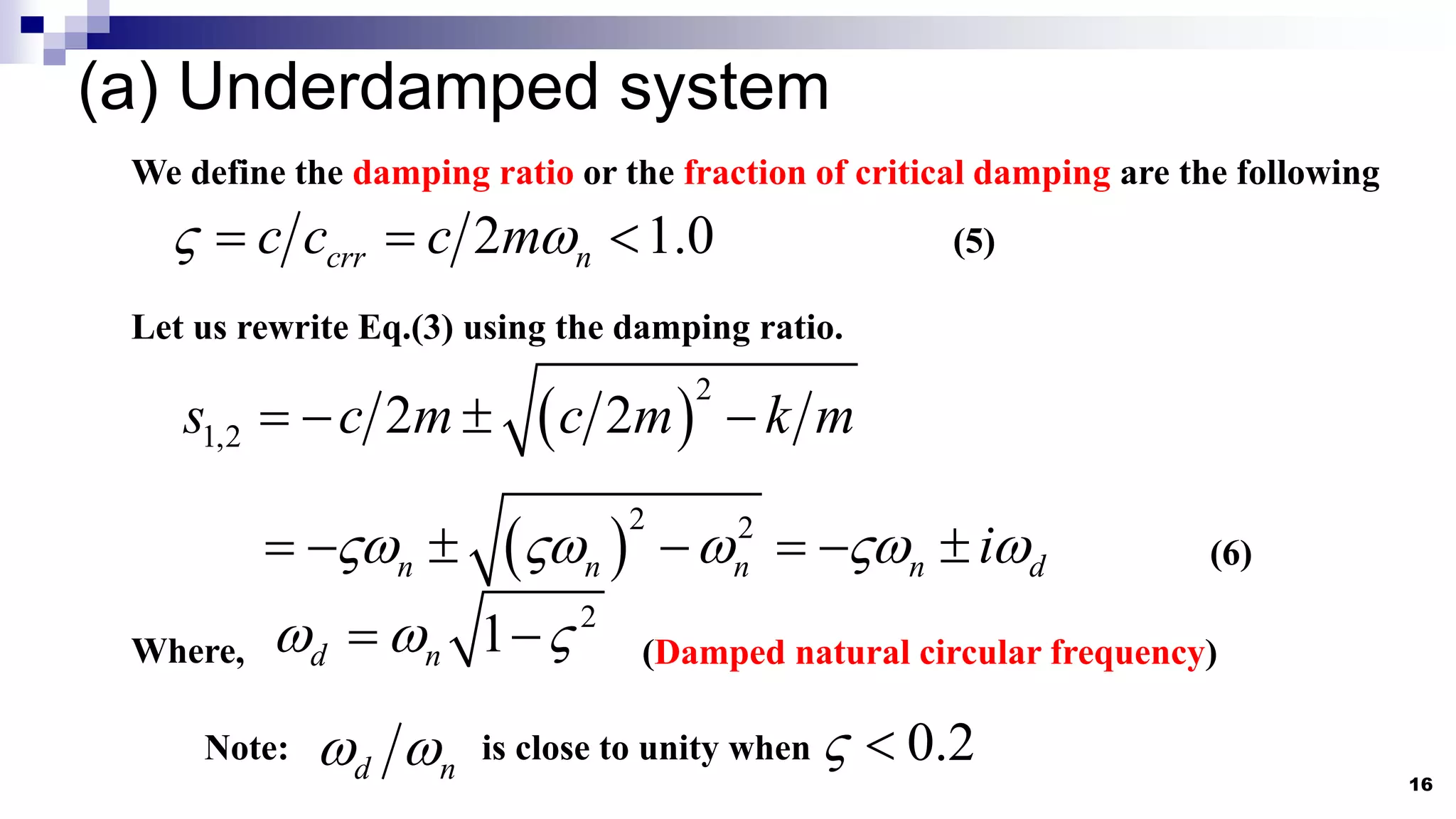
(a) Underdamped system
16
We define the damping ratio or the fraction of critical damping are the following
2 1.0
crr n
c c c m
 
   (5)
Let us rewrite Eq.(3) using the damping ratio.
 
2
1,2 2 2
s c m c m k m
   
 
2 2
n n n n d
i
    
       (6)
Where,
2
1
d n
  
  (Damped natural circular frequency)
Note: 0.2
 
d n
  is close to unity when
17
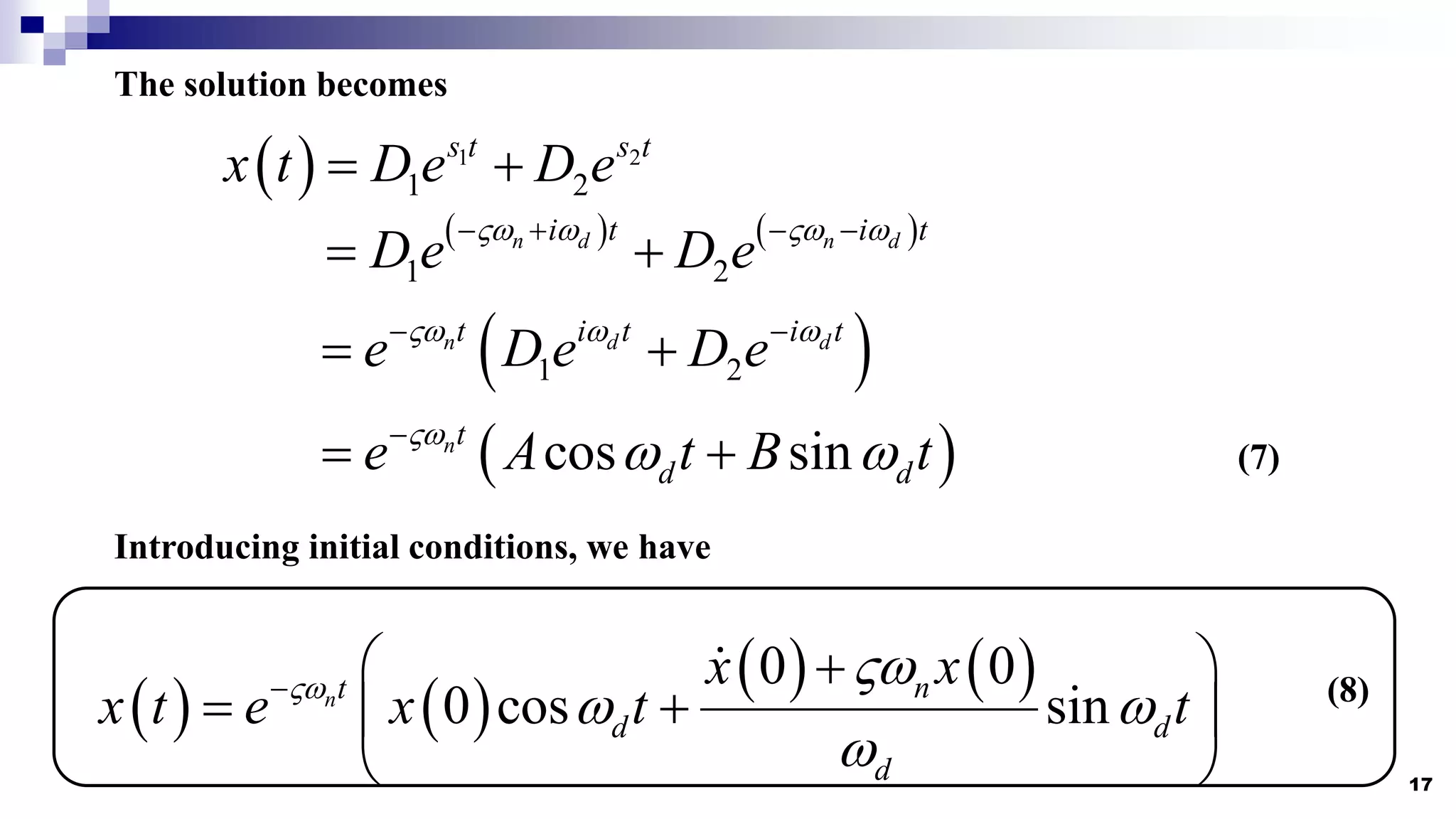
The solution becomes
  1 2
1 2
s t s t
x t D e D e
 
   
1 2
n d n d
i t i t
D e D e
   
   
 
 
1 2
n d d
t i t i t
e D e D e
  
 
 
 
cos sin
nt
d d
e A t B t

 

 
Introducing initial conditions, we have
   
   
0 0
0 cos sin
n n
t
d d
d
x x
x t e x t t
 
 

  

 
 
 
(7)
(8)
18
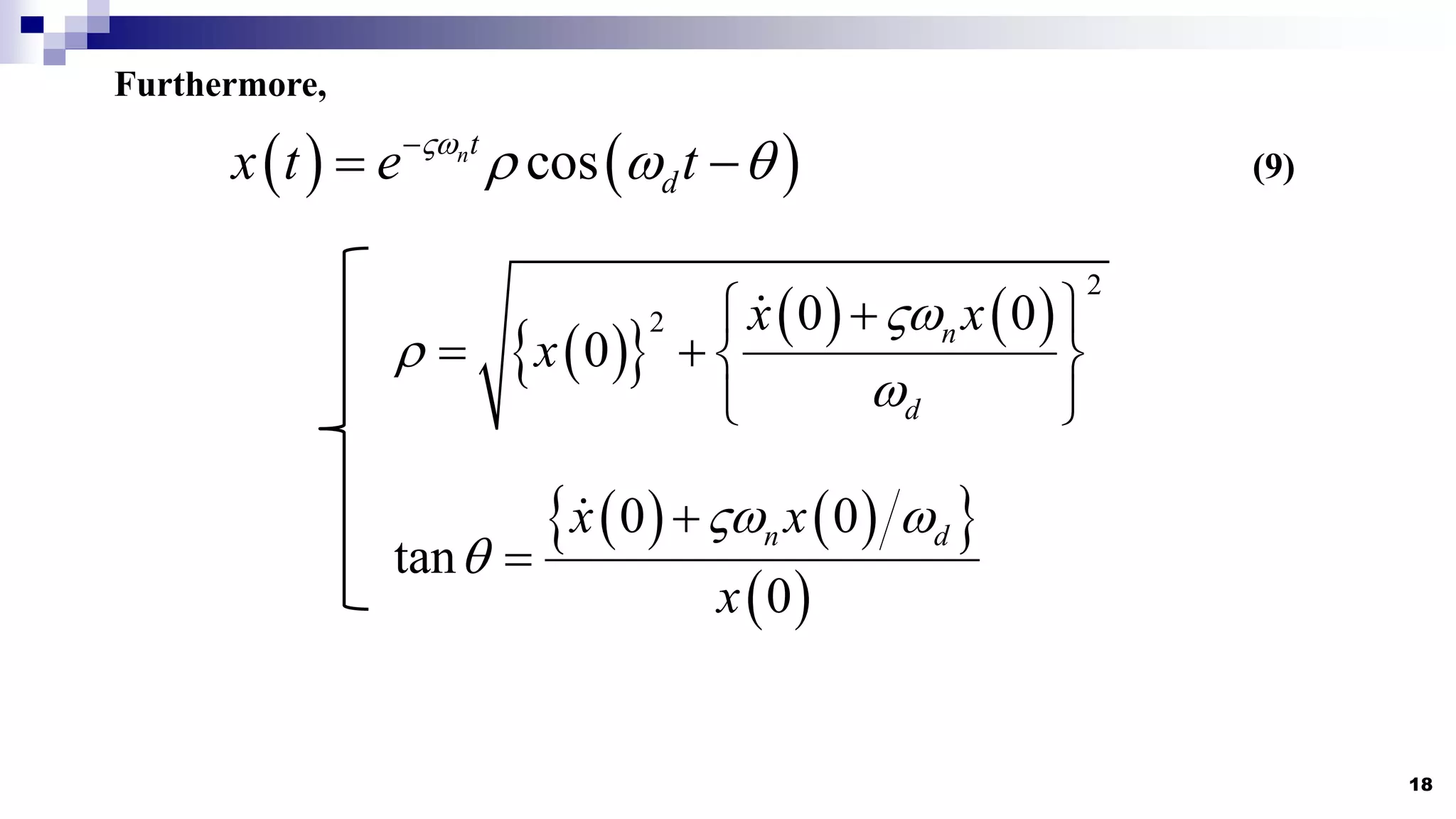
Furthermore,
   
cos
nt
d
x t e t

  

 
 
 
   
2
2 0 0
0 n
d
x x
x



 

   
 
   
 
 
0 0
tan
0
n d
x x
x
 



(9)
19
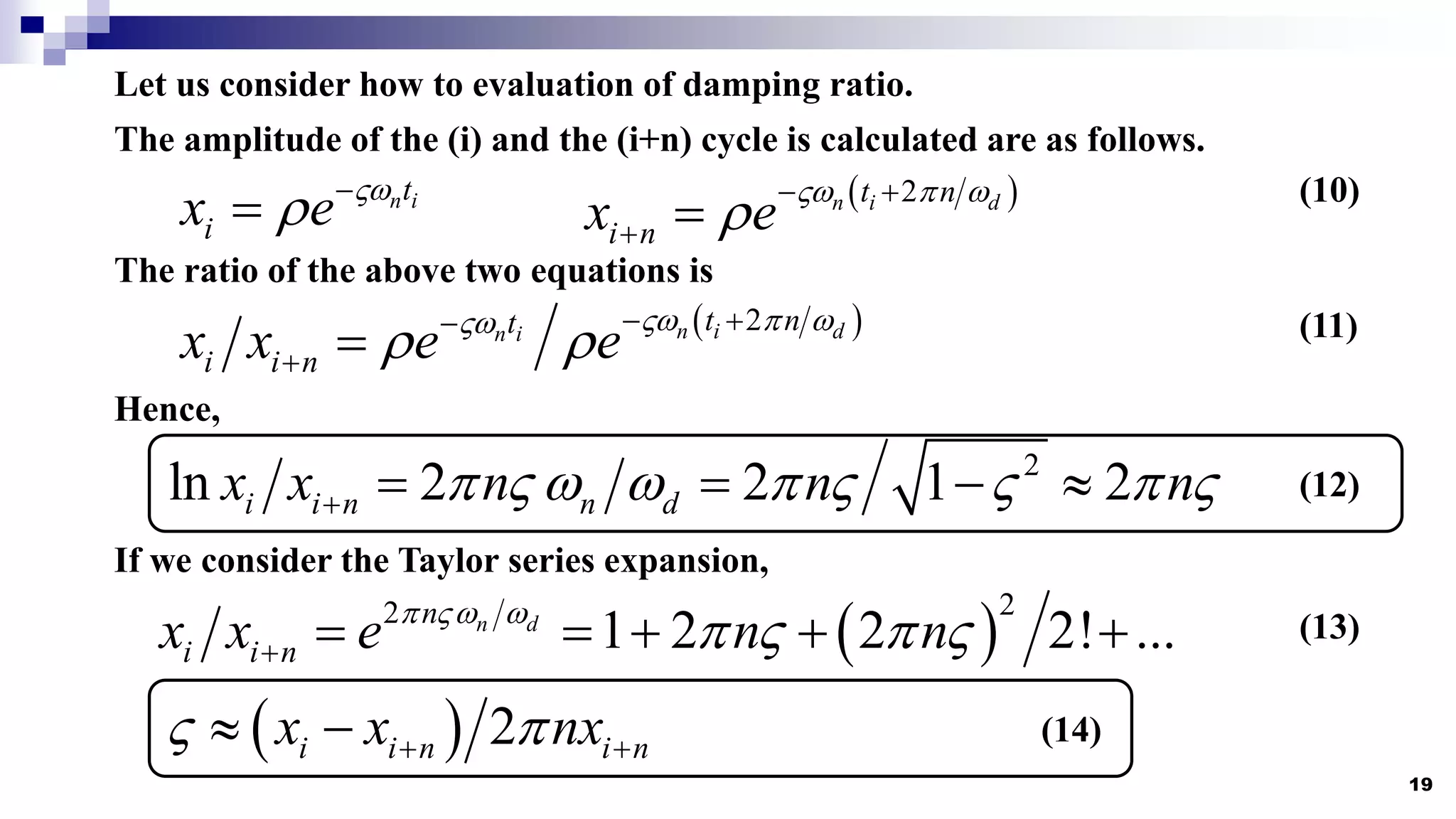
Let us consider how to evaluation of damping ratio.
The amplitude of the (i) and the (i+n) cycle is calculated are as follows.
n i
t
i
x e 
 
  
2
n i d
t n
i n
x e
  
  
 
The ratio of the above two equations is
 
2
n i d
n i t n
t
i i n
x x e e
  

   

 
Hence,
2
ln 2 2 1 2
i i n n d
x x n n n
        
    
If we consider the Taylor series expansion,
 
2
2
1 2 2 2! ...
n d
n
i i n
x x e n n
  
   
     
  2
i i n i n
x x nx
 
 
 
(10)
(11)
(12)
(13)
(14)
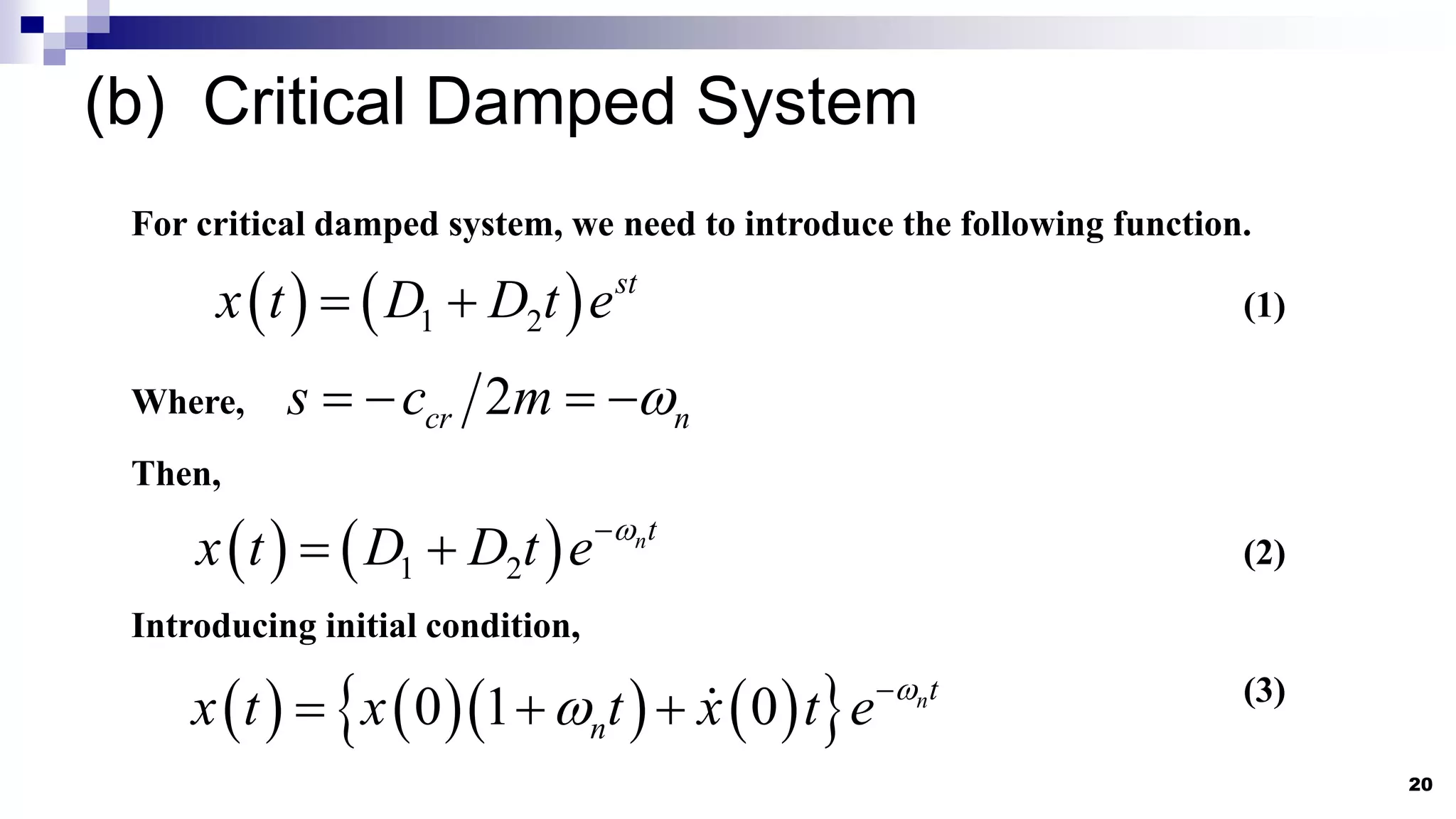
(b) Critical Damped System
20
For critical damped system, we need to introduce the following function.
   
1 2
st
x t D D t e
  (1)
Where, 2
cr n
s c m 
   
Then,
   
1 2
nt
x t D D t e 

  (2)
Introducing initial condition,
      
 
0 1 0 nt
n
x t x t x t e 
 
   (3)
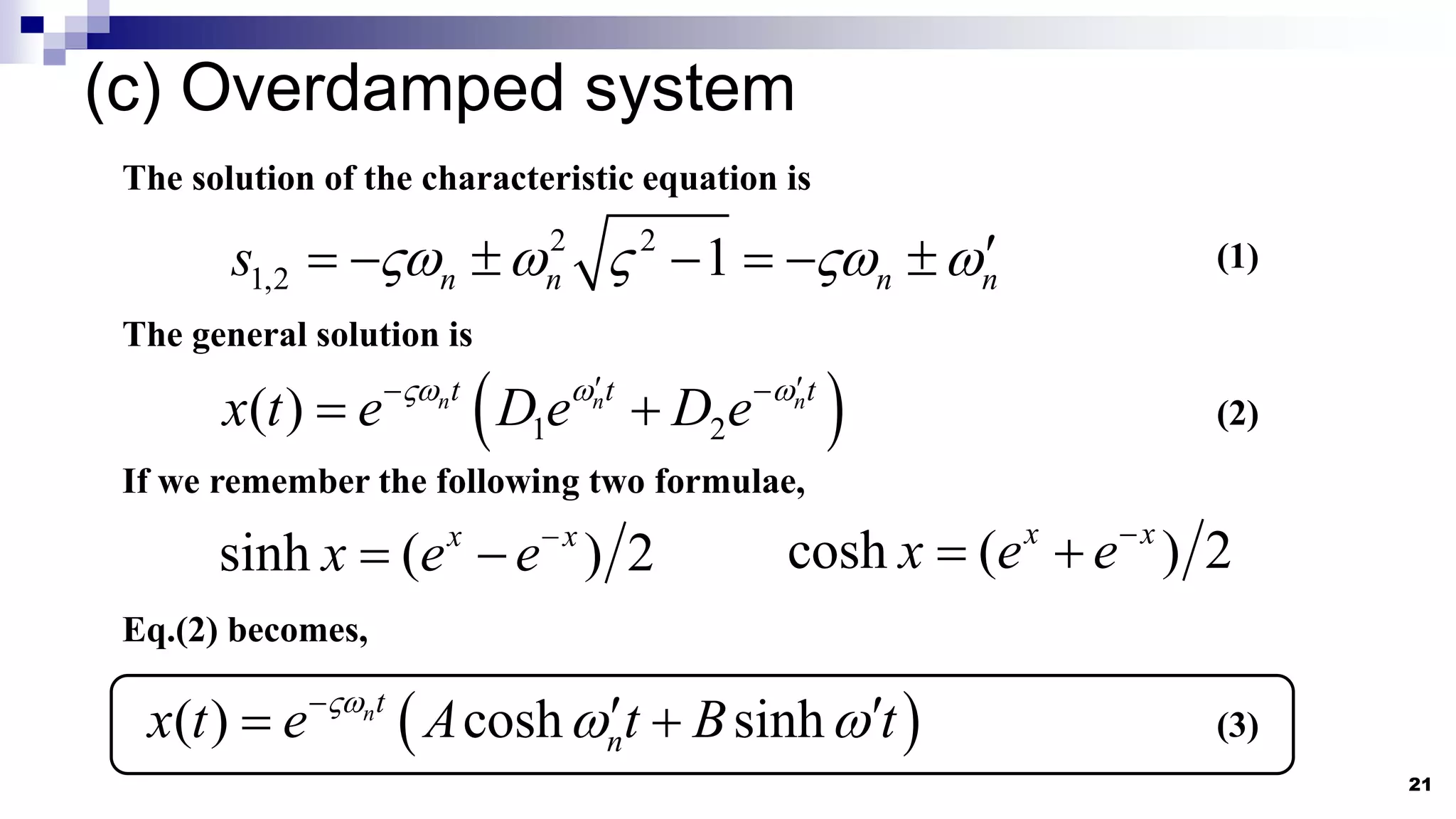
(c) Overdamped system
21
2 2
1,2 1
n n n n
s     
      
The solution of the characteristic equation is
(1)
The general solution is
 
1 2
( ) n n n
t t t
x t e D e D e
  
 
 
  (2)
If we remember the following two formulae,
sinh ( ) 2
x x
x e e
  cosh ( ) 2
x x
x e e
 
Eq.(2) becomes,
 
( ) cosh sinh
nt
n
x t e A t B t

 

 
  (3)
22
Response to Harmonic Loading
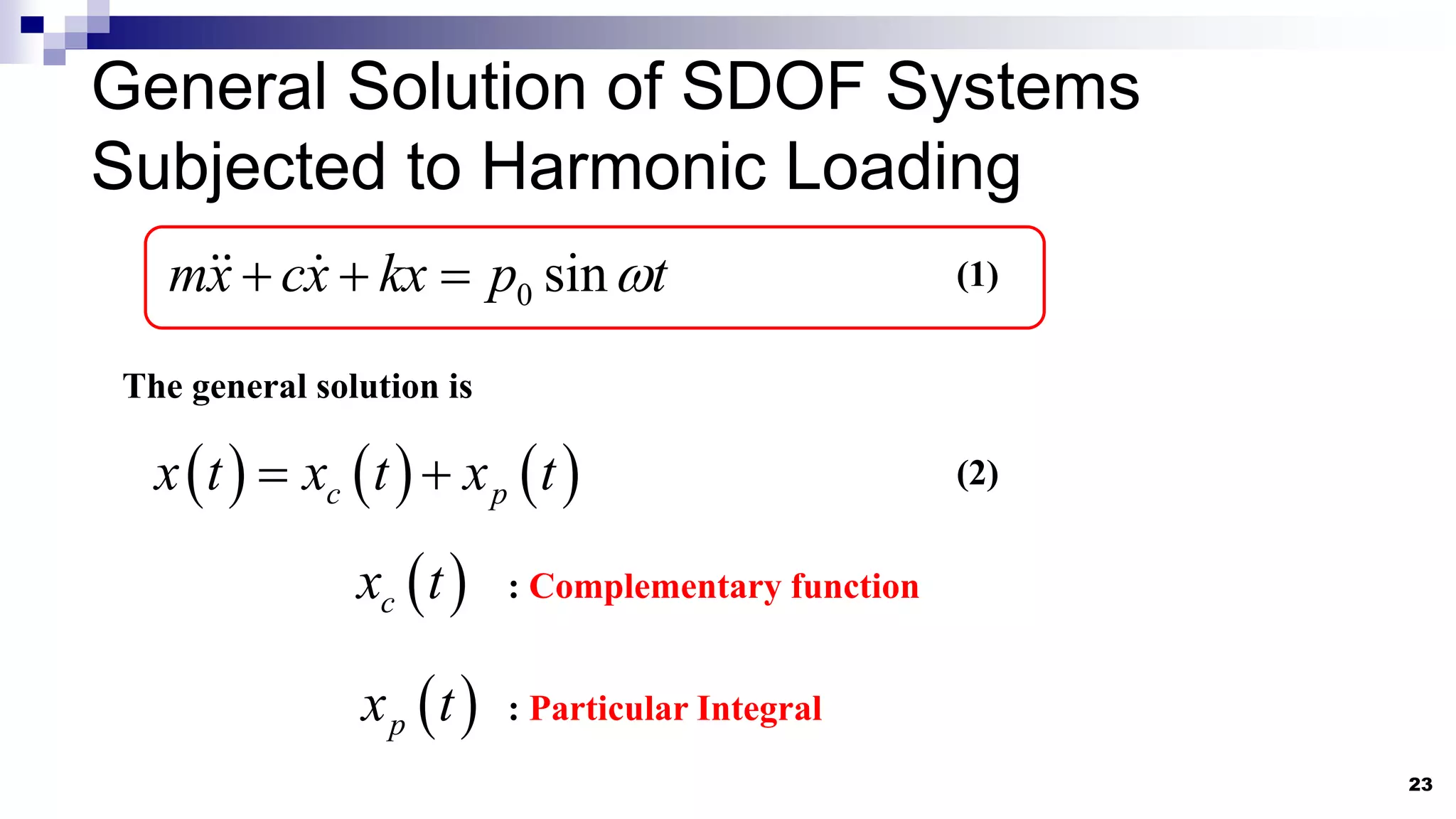
General Solution of SDOF Systems
Subjected to Harmonic Loading
23
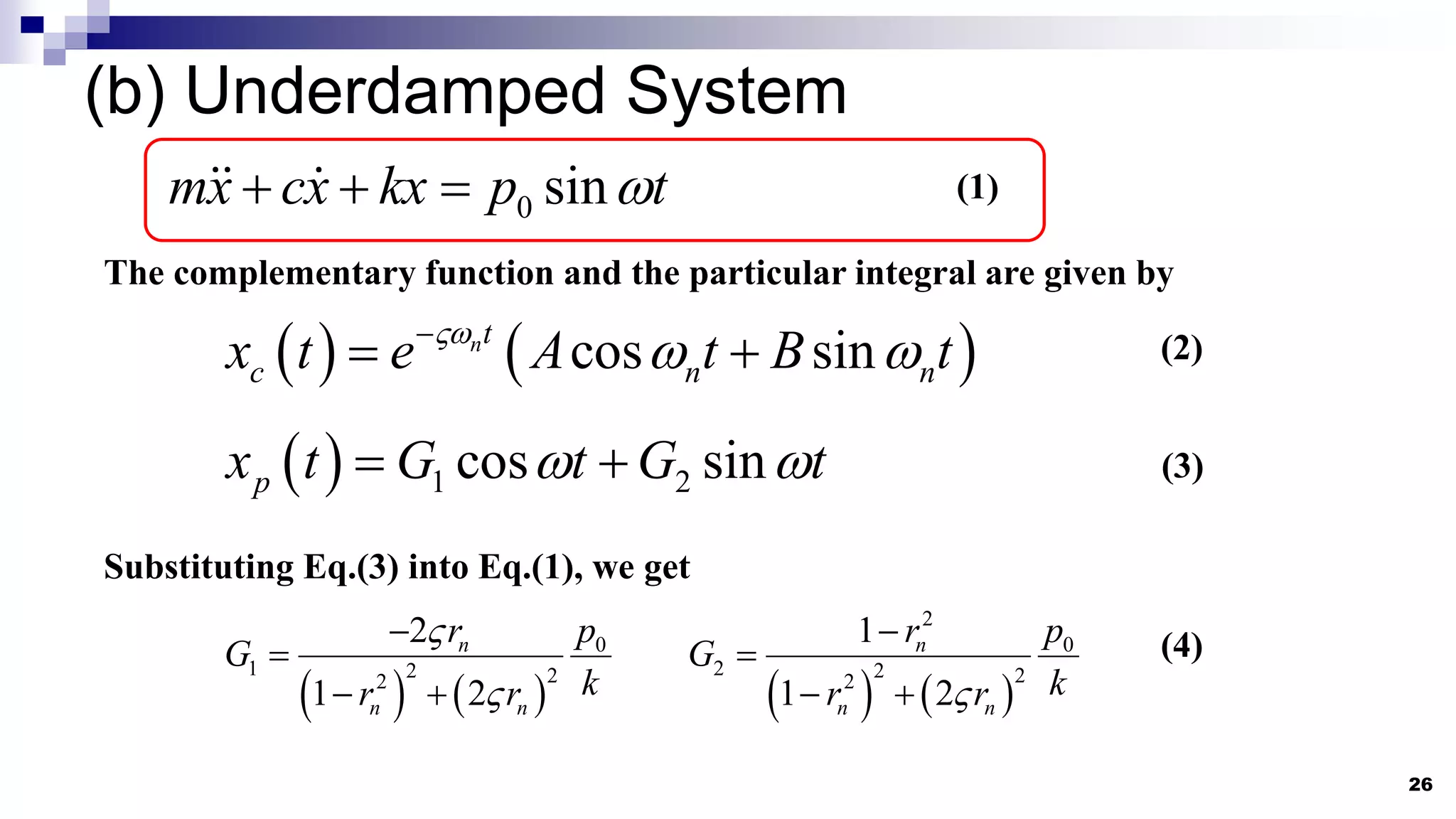
0 sin
mx cx kx p t

   (1)
The general solution is
     
c p
x t x t x t
 
 
c
x t
 
p
x t
: Complementary function
: Particular Integral
(2)
(a) Undamped Systems
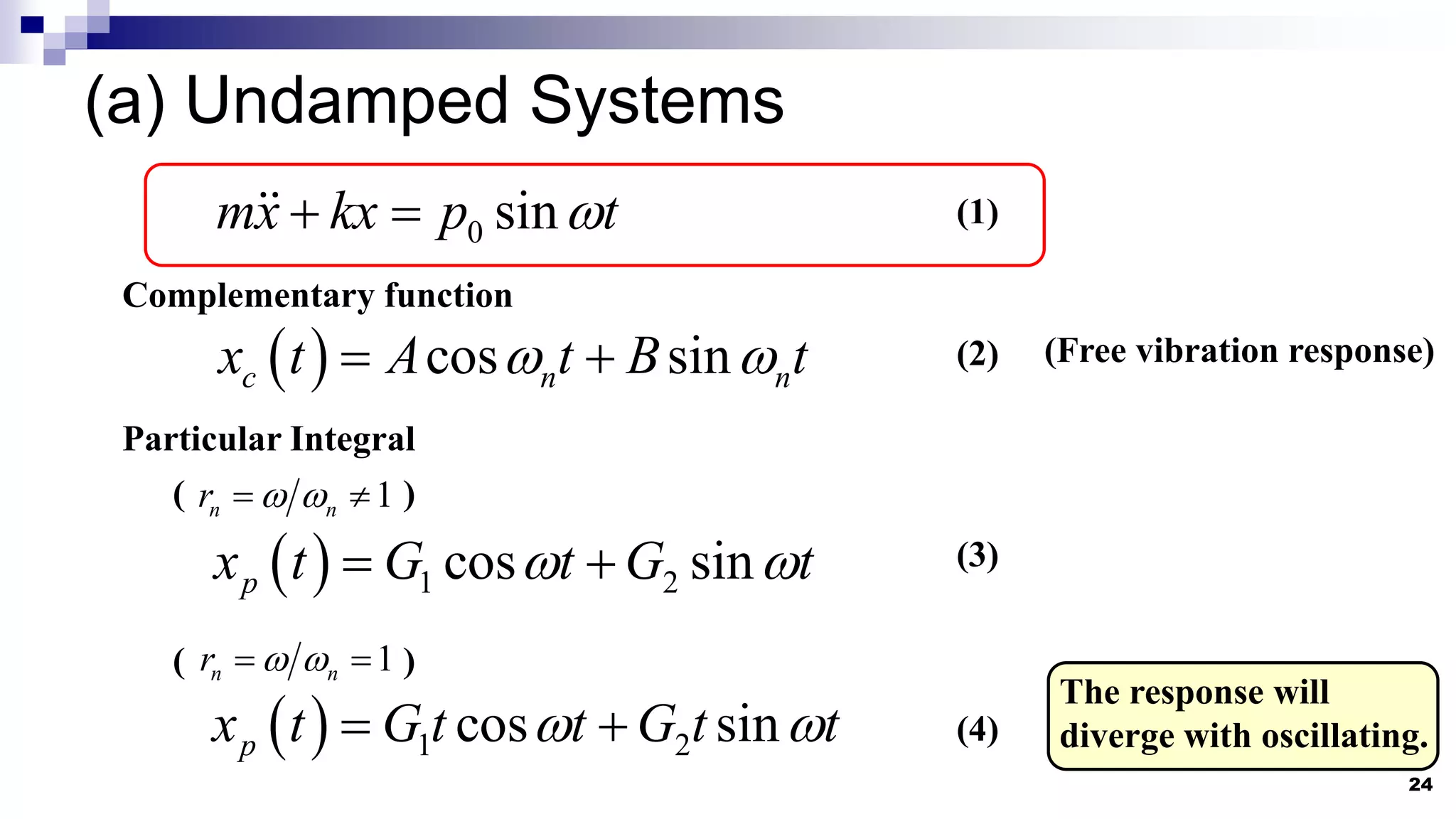
24
0 sin
mx kx p t

  (1)
Complementary function
  cos sin
c n n
x t A t B t
 
  (Free vibration response)
Particular Integral
  1 2
cos sin
p
x t G t G t
 
 
( )
1
n n
r  
 
( )
1
n n
r  
 
  1 2
cos sin
p
x t G t t G t t
 
 
The response will
diverge with oscillating.
(2)
(3)
(4)
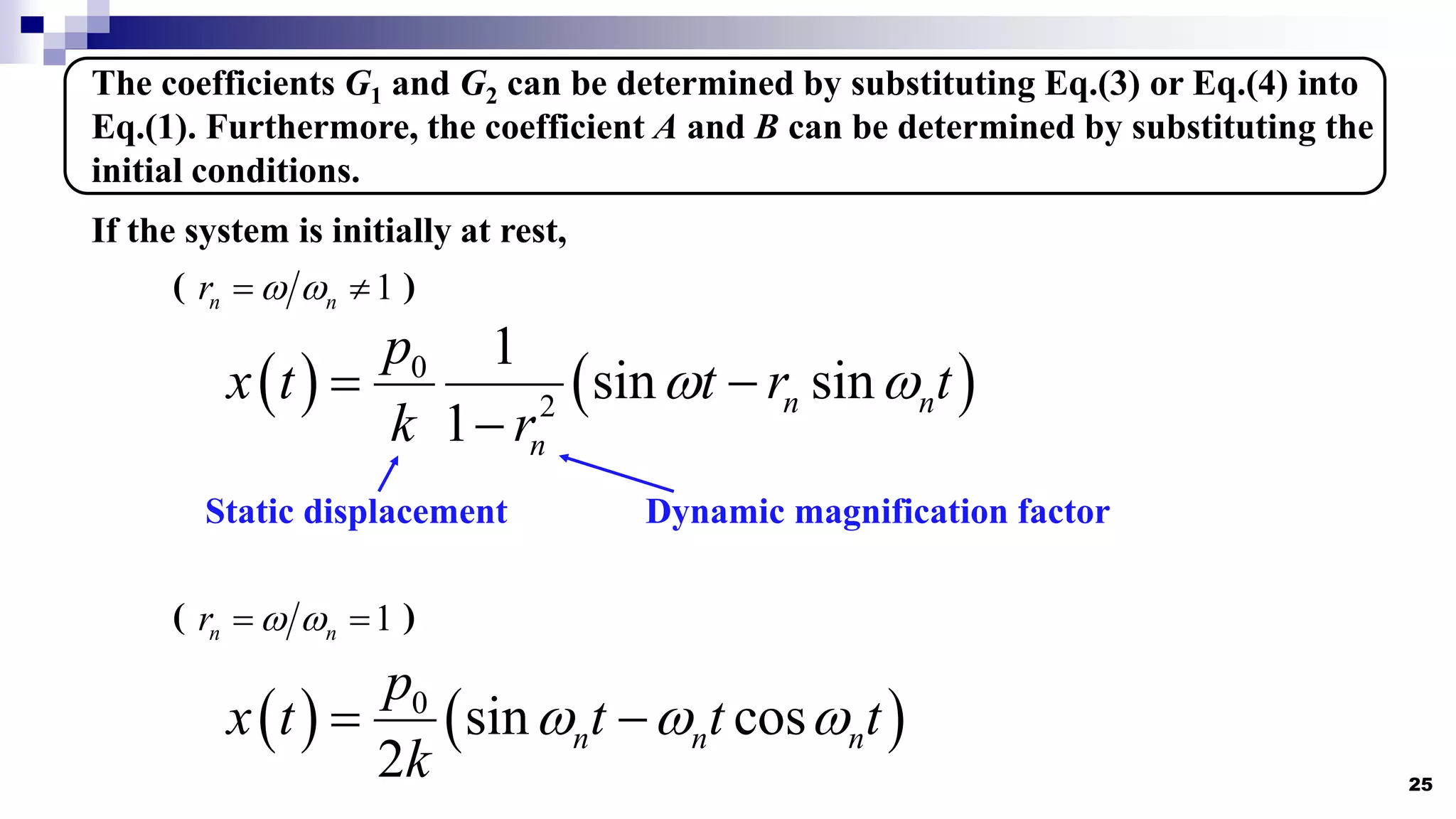
25
The coefficients G1 and G2 can be determined by substituting Eq.(3) or Eq.(4) into
Eq.(1). Furthermore, the coefficient A and B can be determined by substituting the
initial conditions.
If the system is initially at rest,
( )
1
n n
r  
 
( )
1
n n
r  
 
   
0
2
1
sin sin
1
n n
n
p
x t t r t
k r
 
 

Static displacement Dynamic magnification factor
   
0
sin cos
2
n n n
p
x t t t t
k
  
 
(b) Underdamped System
26
0 sin
mx cx kx p t

   (1)
   
cos sin
nt
c n n
x t e A t B t

 

 
  1 2
cos sin
p
x t G t G t
 
 
The complementary function and the particular integral are given by
(2)
(3)
   
0
1 2 2
2
2
1 2
n
n n
r p
G
k
r r




     
2
0
2 2 2
2
1
1 2
n
n n
r p
G
k
r r



 
Substituting Eq.(3) into Eq.(1), we get
(4)
27
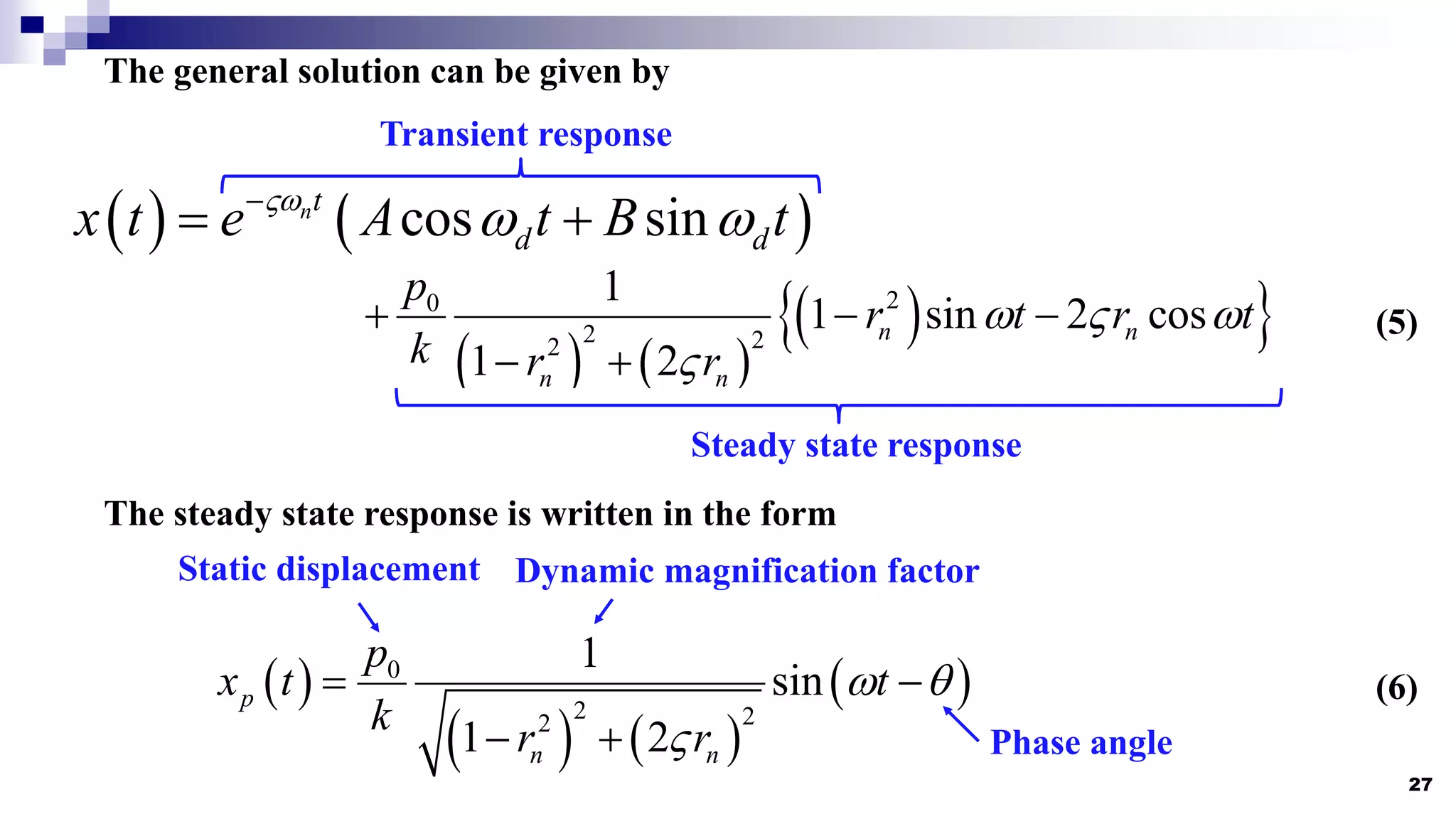
The general solution can be given by
   
cos sin
nt
d d
x t e A t B t

 

 
   
 
 
2
0
2 2
2
1
1 sin 2 cos
1 2
n n
n n
p
r t r t
k r r
  

  
 
Transient response
Steady state response
The steady state response is written in the form
 
   
 
0
2 2
2
1
sin
1 2
p
n n
p
x t t
k r r
 

 
 
Static displacement Dynamic magnification factor
Phase angle
(5)
(6)
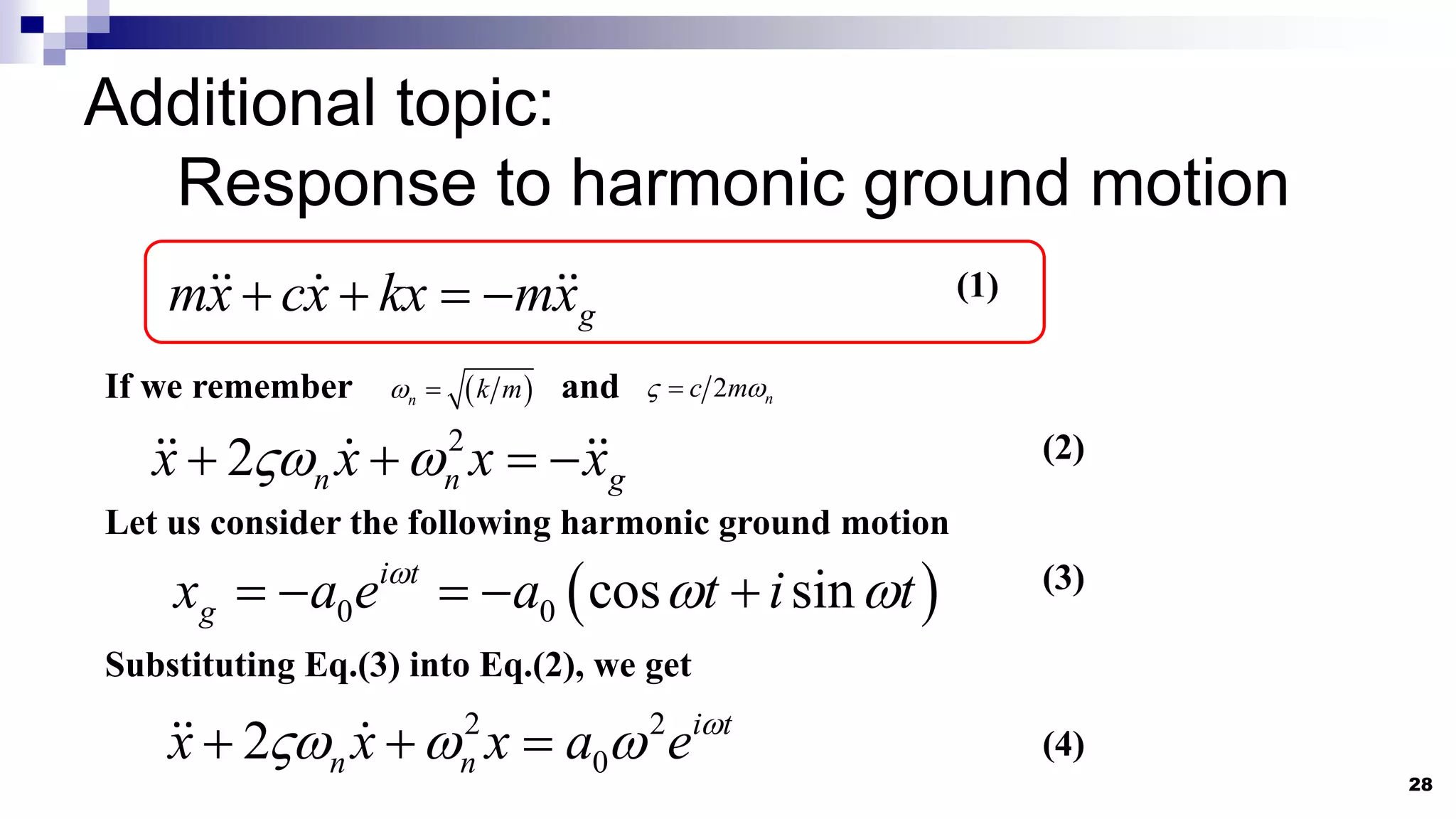
28
Additional topic:
Response to harmonic ground motion
g
mx cx kx mx
   
2
2 n n g
x x x x
 
   
If we remember and
 
n k m
  2 n
c m
 

Let us consider the following harmonic ground motion
 
0 0 cos sin
i t
g
x a e a t i t

 
    
(1)
(2)
(3)
Substituting Eq.(3) into Eq.(2), we get
2 2
0
2 i t
n n
x x x a e 
  
   (4)
29
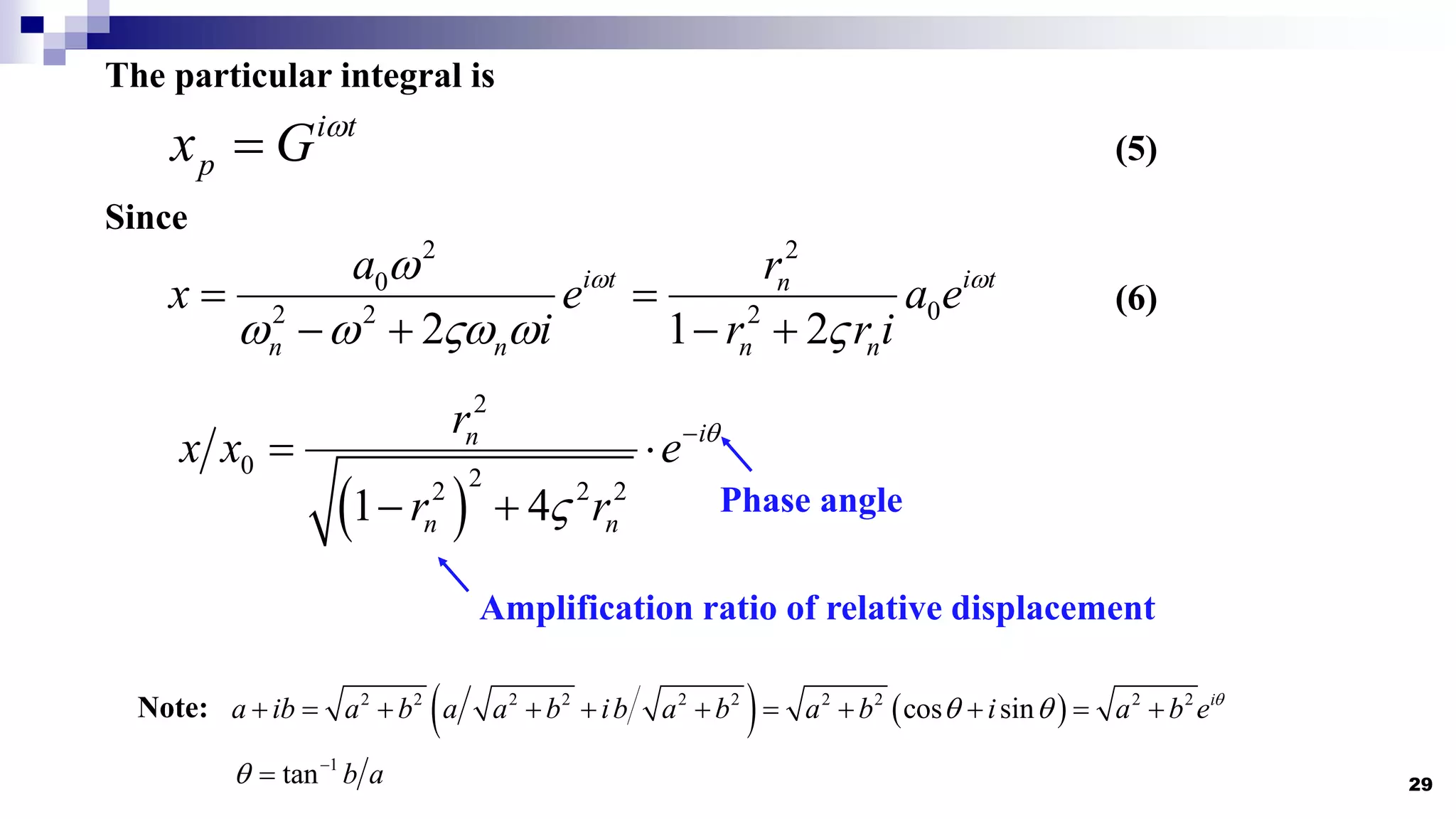
The particular integral is
i t
p
x G 
 (5)
Since
2 2
0
0
2 2 2
2 1 2
i t i t
n
n n n n
a r
x e a e
i r r i
 

    
 
   
(6)
 
2
0 2
2 2 2
1 4
i
n
n n
r
x x e
r r



 
 
   
2 2 2 2 2 2 2 2 2 2
cos sin i
a ib a b a a b ib a b a b i a b e
 
          
Note:
1
tan b a
 

Phase angle
Amplification ratio of relative displacement
30
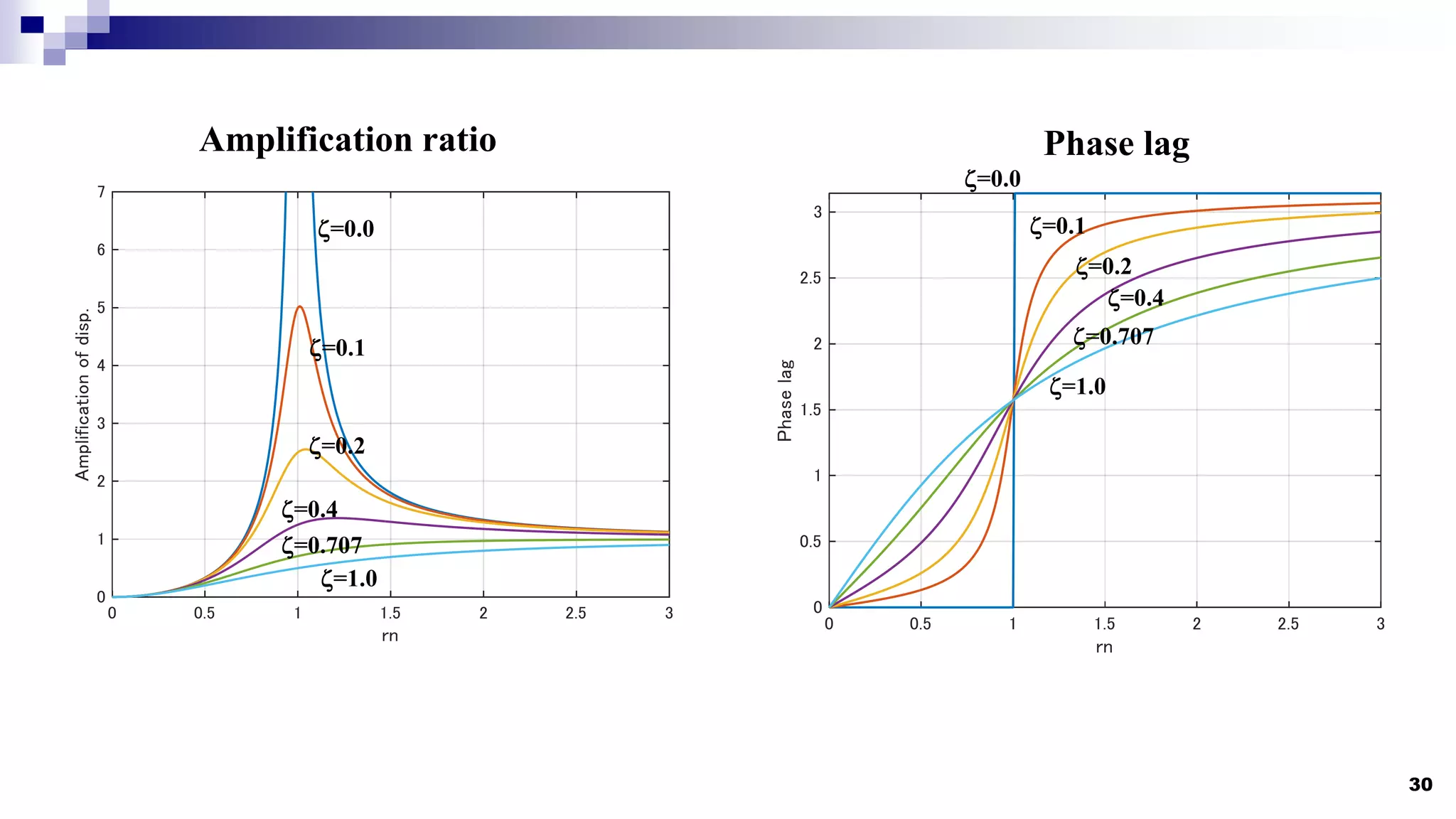
Amplification ratio Phase lag
z=0.0
z=0.1
z=0.2
z=0.4
z=0.707
z=1.0
z=0.0
z=1.0
z=0.1
z=0.2
z=0.707
z=0.4
31
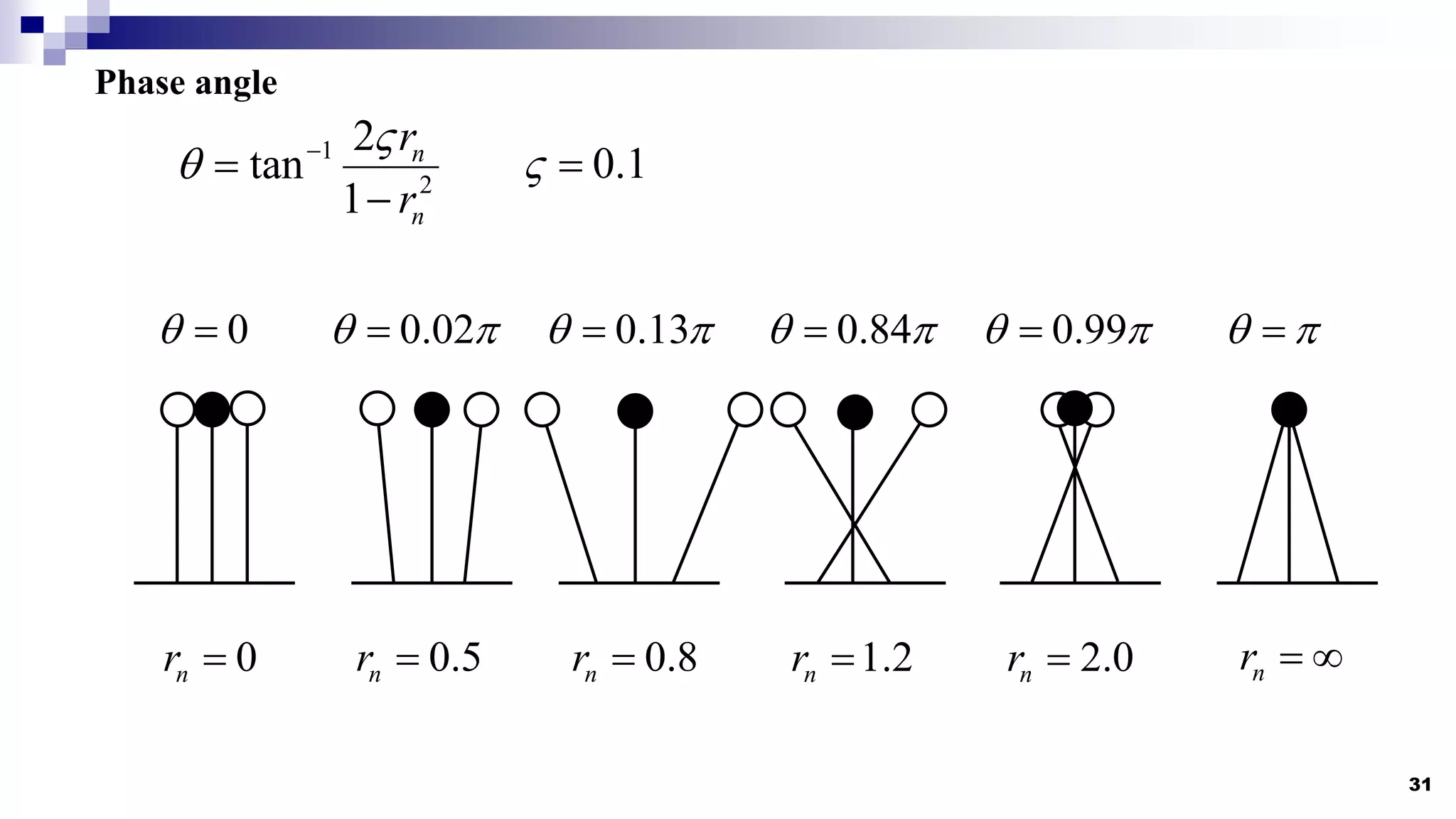
Phase angle
1
2
2
tan
1
n
n
r
r

 


0
n
r  0.5
n
r  0.8
n
r  1.2
n
r  2.0
n
r  n
r  
0
   

0.99
 

0.84
 

0.13
 

0.02
 

0.1
 
32
Tool for drawing a graph
rn=0.0:0.01:3.0;
h=[0.0, 0.1, 0.2, 0.4, 0.707, 1.0];
y_y0=zeros(length(rn),length(h));
for ii=1:1:length(h)
for jj=1:1:length(rn)
y_y0(jj,ii)=rn(jj)^2/sqrt((1-rn(jj)^2)^2 + 4*h(ii)^2*rn(jj)^2);
end
end
plot(rn, y_y0, 'linewidth',1.5)
grid on
xlabel('rn')
ylabel('Amplification of disp.')
ylim([0,7])
Definition of
resonance curve
Set of variable
Drawing a graph
Script of MATLAB
33
Response to Arbitrary Loading
Methodologies
34
(2) Duhamel Integral
(1) Response history analysis
(3) Frequency domain analysis
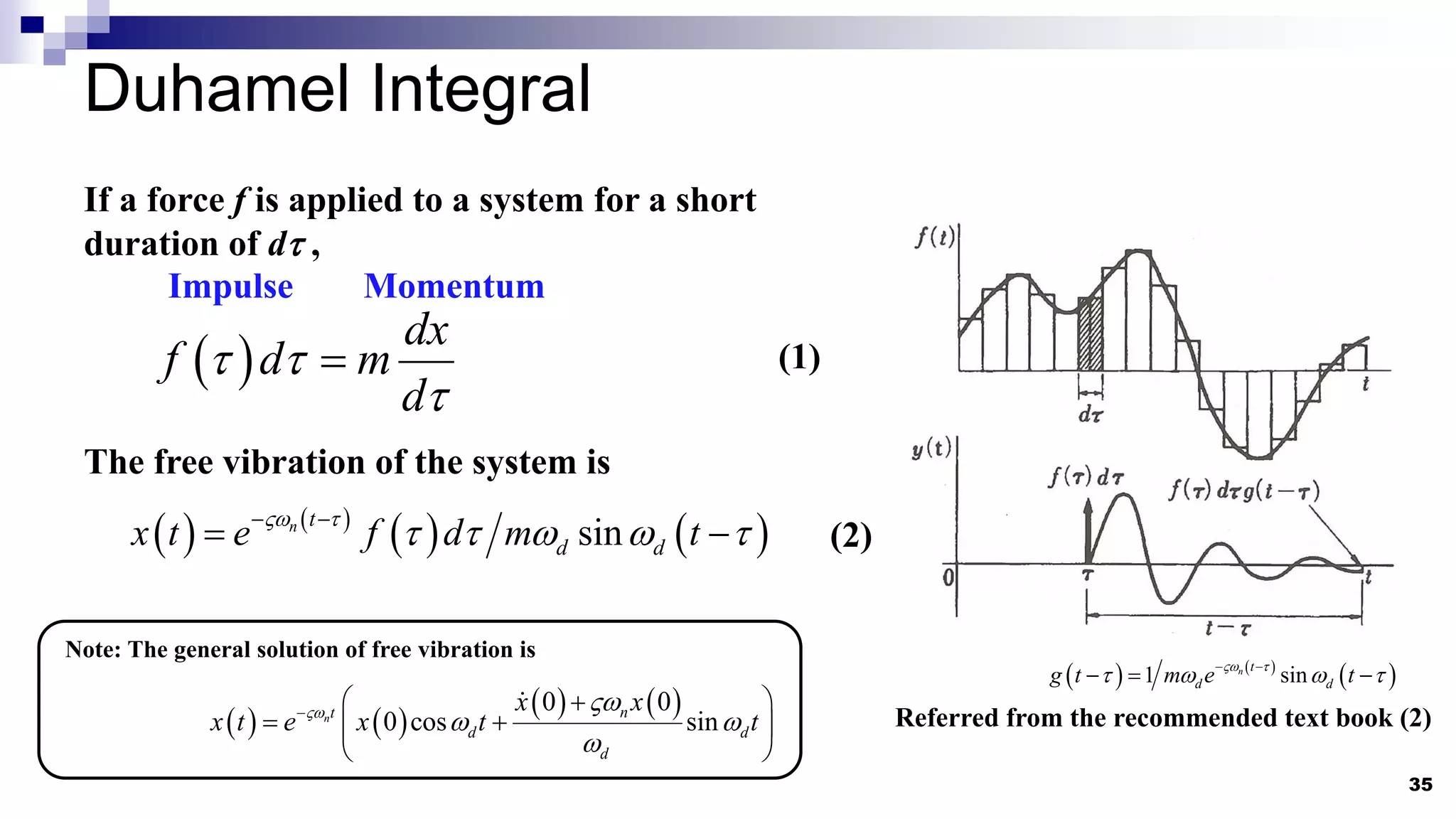
Duhamel Integral
35
Referred from the recommended text book (2)
If a force f is applied to a system for a short
duration of dt ,
 
dx
f d m
d
t t
t

Impulse Momentum
   
   
sin
n t
d d
x t e f d m t
 t
t t   t
 
 
The free vibration of the system is
Note: The general solution of free vibration is
   
   
0 0
0 cos sin
n n
t
d d
d
x x
x t e x t t
 
 

  

 
 
 
   
 
1 sin
n t
d d
g t m e t
 t
t   t
 
  
(1)
(2)
36
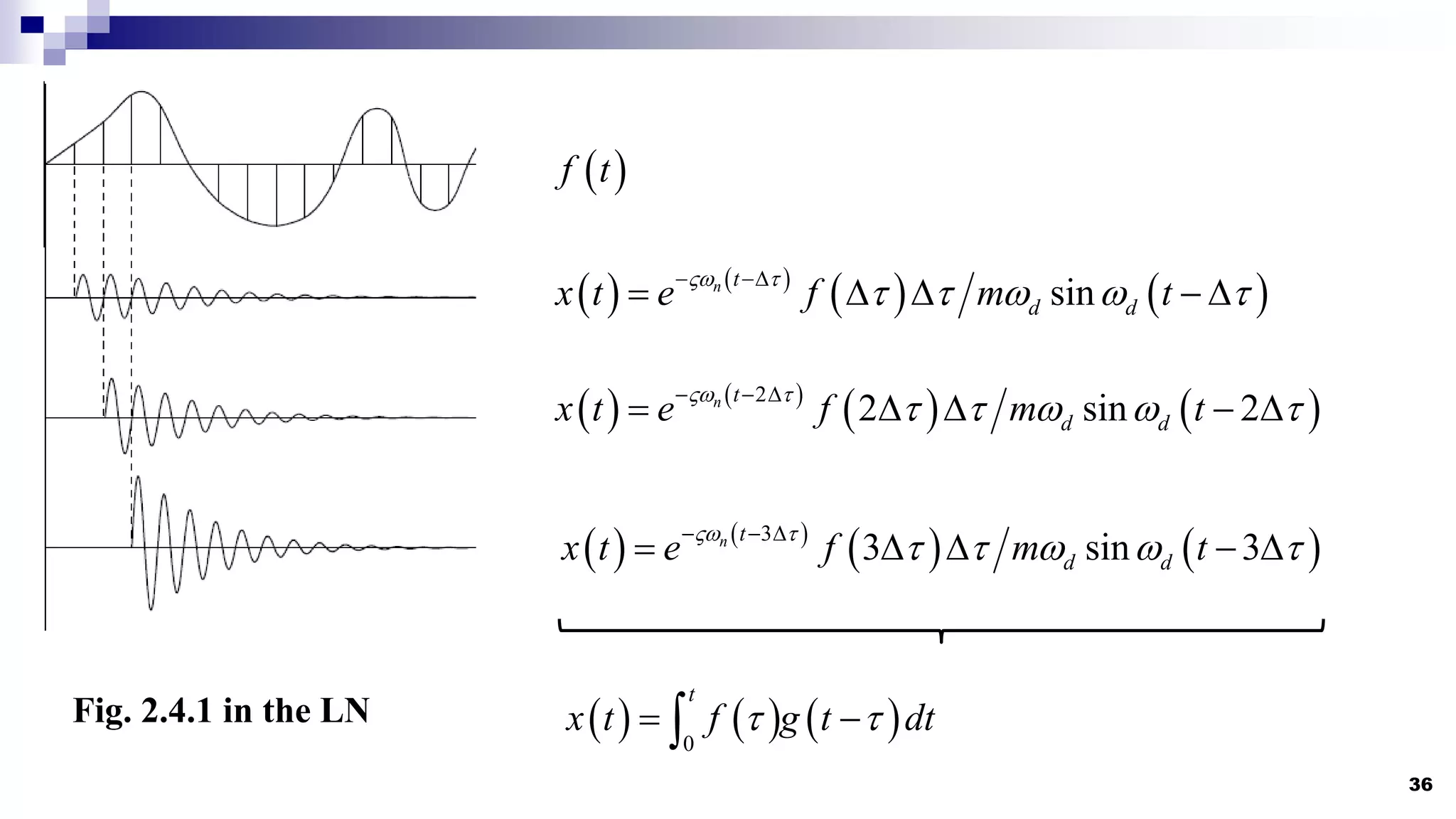
Fig. 2.4.1 in the LN
   
   
sin
n t
d d
x t e f m t
 t
t t   t
 
    
   
   
2
2 sin 2
n t
d d
x t e f m t
 t
t t   t
  
    
   
   
3
3 sin 3
n t
d d
x t e f m t
 t
t t   t
  
    
 
f t
     
0
t
x t f g t dt
t t
 

37
     
0
t
x t f g t dt
t t
 

   
 
1 sin
n t
d d
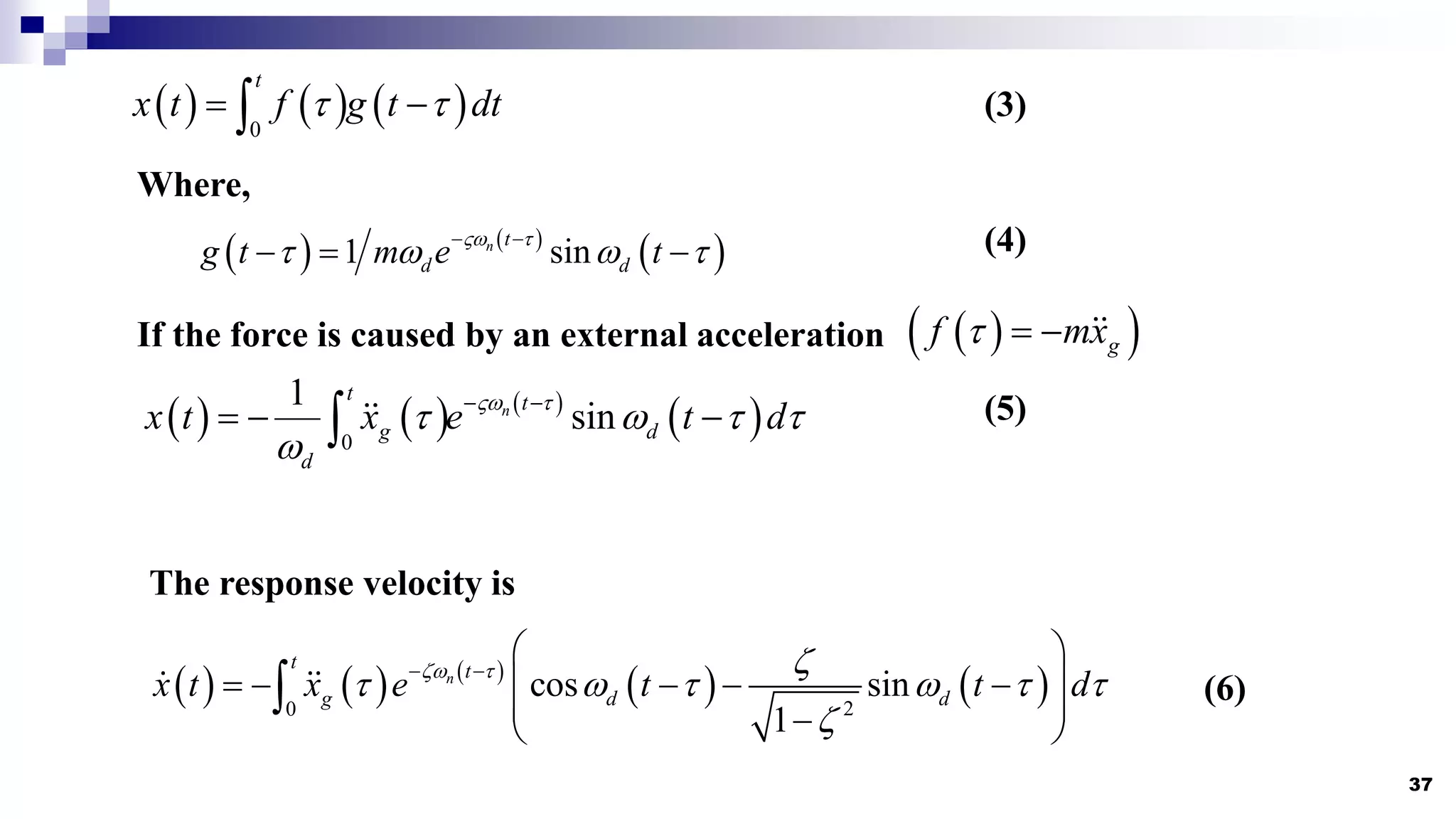
g t m e t
 t
t   t
 
  
Where,
(3)
(4)
If the force is caused by an external acceleration  
 
g
f mx
t  
     
 
0
1
sin
n
t t
g d
d
x t x e t d
 t
t  t t

 
  

The response velocity is
     
   
2
0
cos sin
1
n
t t
g d d
x t x e t t d
z t z
t  t  t t
z
 
 
 
    
 

 
 (6)
(5)
38
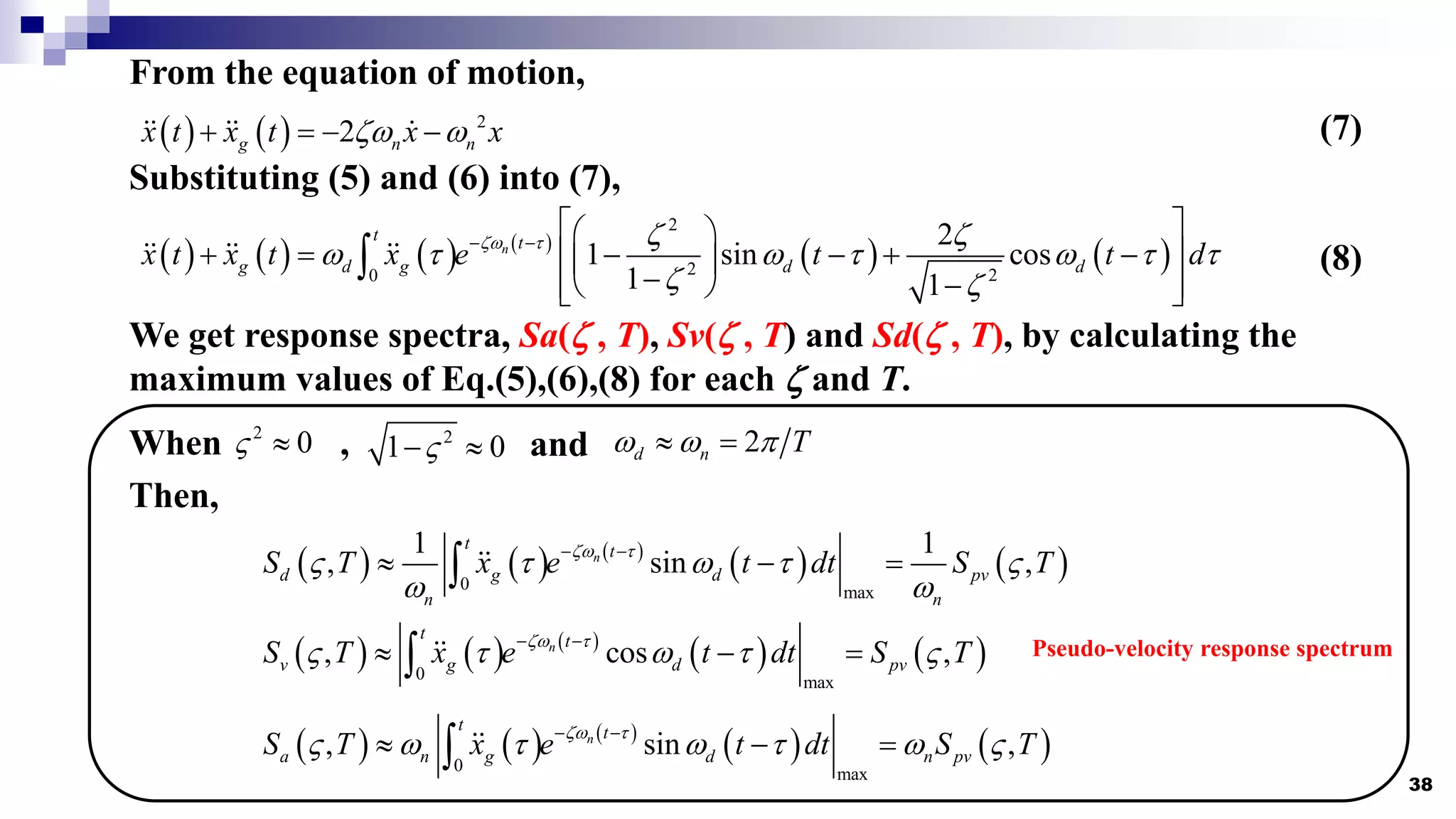
From the equation of motion,
    2
2
g n n
x t x t x x
z 
    (7)
Substituting (5) and (6) into (7),
       
   
2
2 2
0
2
1 sin cos
1 1
n
t t
g d g d d
x t x t x e t t d
z t z z
 t  t  t t
z z
 
 
 
     
 
 
 
 
 
 
 (8)
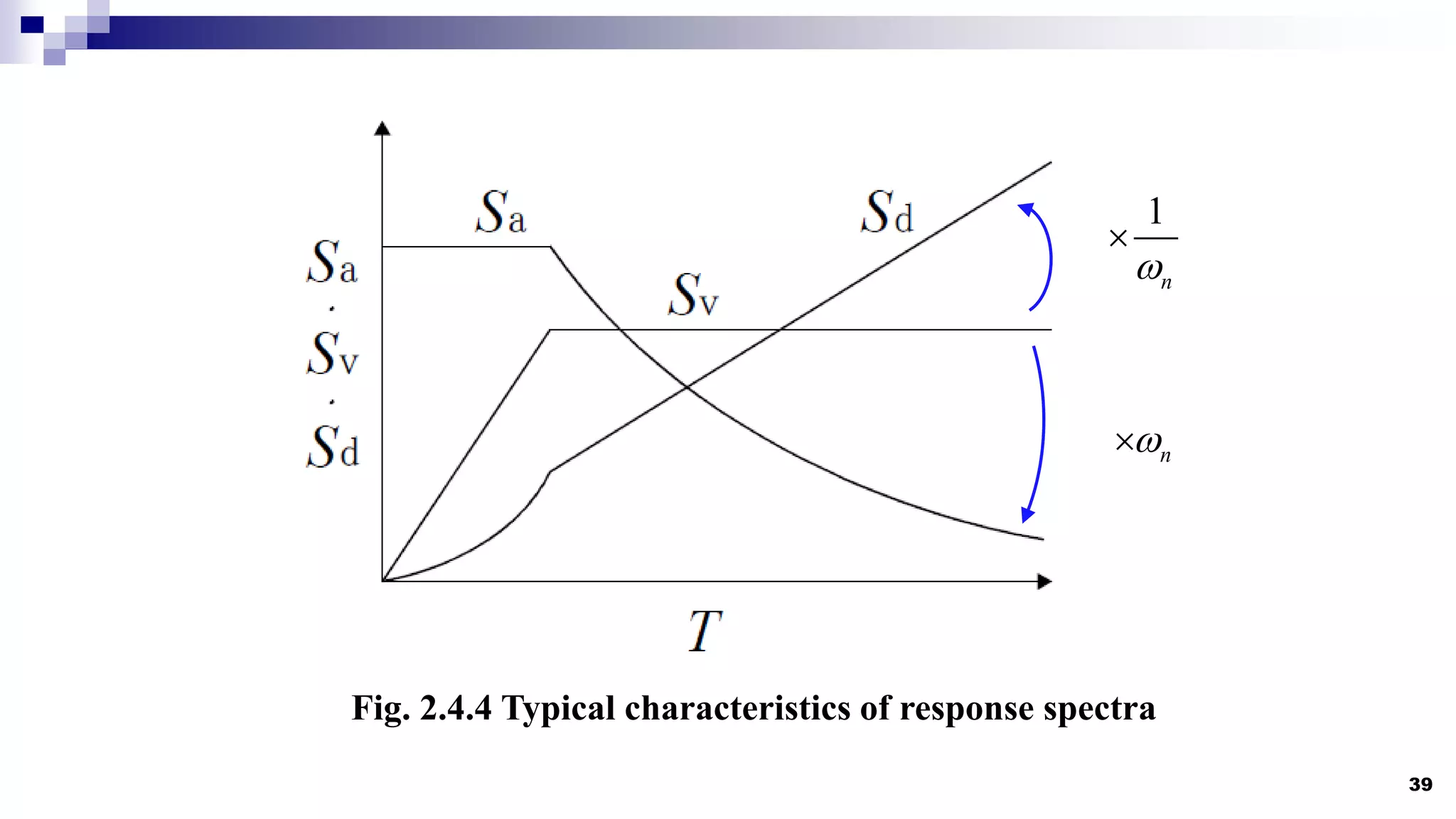
We get response spectra, Sa(z , T), Sv(z , T) and Sd(z , T), by calculating the
maximum values of Eq.(5),(6),(8) for each z and T.
When ,
2
0
  2
1 0

  and 2
d n T
  
 
Then,
     
   
0 max
1 1
, sin ,
n
t t
d g d pv
n n
S T x e t dt S T
z t
 t  t 
 
 
  

     
   
0 max
, cos ,
n
t t
v g d pv
S T x e t dt S T
z t
 t  t 
 
  

     
   
0 max
, sin ,
n
t t
a n g d n pv
S T x e t dt S T
z t
  t  t  
 
  

Pseudo-velocity response spectrum
39
Fig. 2.4.4 Typical characteristics of response spectra
1
n


n


40
Multi Degree Freedom Systems
(Modal response analysis)
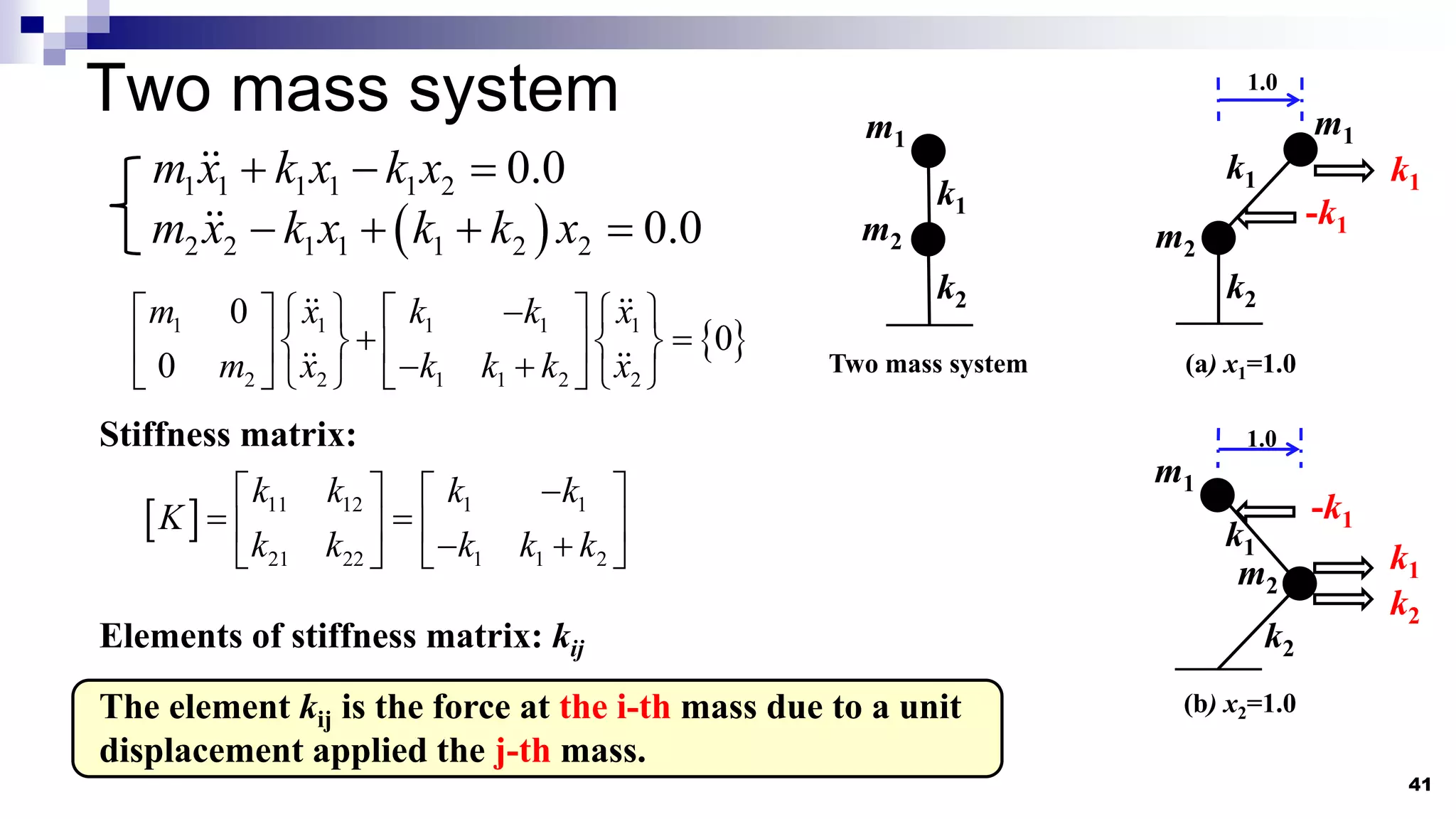
Two mass system
41
1.0
m1
m2
k1
k2
k1
-k1
1.0
m2
m1
k1
k2
-k1
k1
k2
1 1 1 1 1 2 0.0
m x k x k x
  
 
2 2 1 1 1 2 2 0.0
m x k x k k x
   
 
1 1 1 1 1
2 2 1 1 2 2
0
0
0
m x k k x
m x k k k x

       
 
   
   
 
       
Stiffness matrix:
m2
m1
k2
k1
Two mass system (a) x1=1.0
(b) x2=1.0
  11 12 1 1
21 22 1 1 2
k k k k
K
k k k k k

   
 
   
 
   
Elements of stiffness matrix: kij
The element kij is the force at the i-th mass due to a unit
displacement applied the j-th mass.
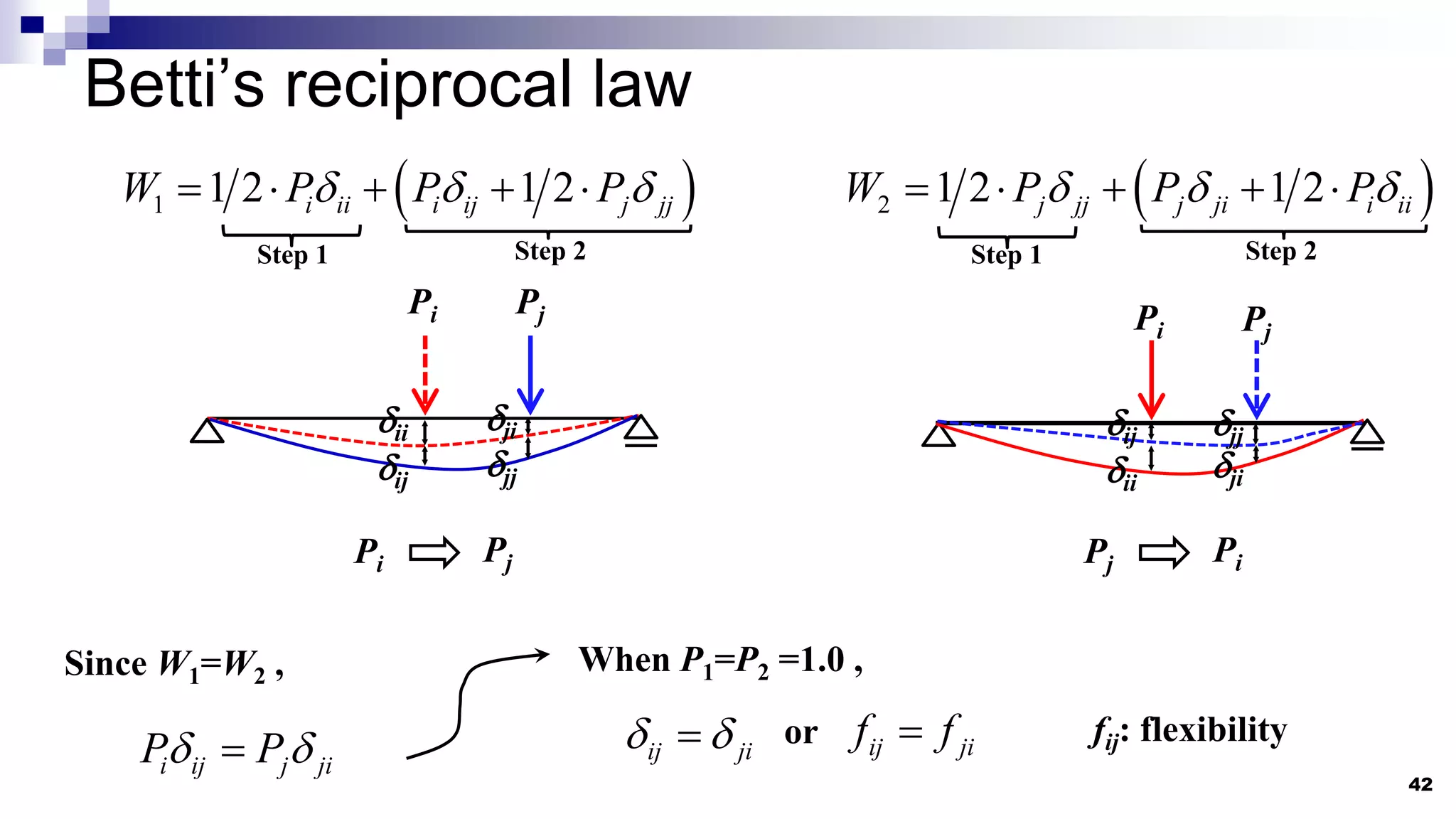
Betti’s reciprocal law
42
 
1 1 2 1 2
i ii i ij j jj
W P P P
  
      
2 1 2 1 2
j jj j ji i ii
W P P P
  
    
Pi Pj
ii
ij
ji
jj
Pi Pj
ij
ii
jj
ji
Pi Pj Pj Pi
Since W1=W2 ,
Step 1 Step 2 Step 2
Step 1
i ij j ji
P P
 

When P1=P2 =1.0 ,
ij ji
 
 or ij ji
f f
 fij: flexibility
43
   
1
K F


The stiffness matrix [K] is symmetry as well as the flexible matrix [F].
Example of stiffness matrix;
1
n
i
i-1
i+1
1 1
1 1
1 1
1 1
0
0
i i i i
i i i i
n n n
k k
k k k k
k k k k
k k k
 
 
 

  
  
 
i
i
Symmetric and Sparse
Undamped Free Vibration of MDOF Systems
44
       
0
M x K x
 
The general solution is
     
cos
x u t
 
 
(1)
(2)
Substituting Eq.(2) into Eq.(1),
   
      
2
cos 0
K M u t
  
  
   
    
2
0
K M u

  (3)
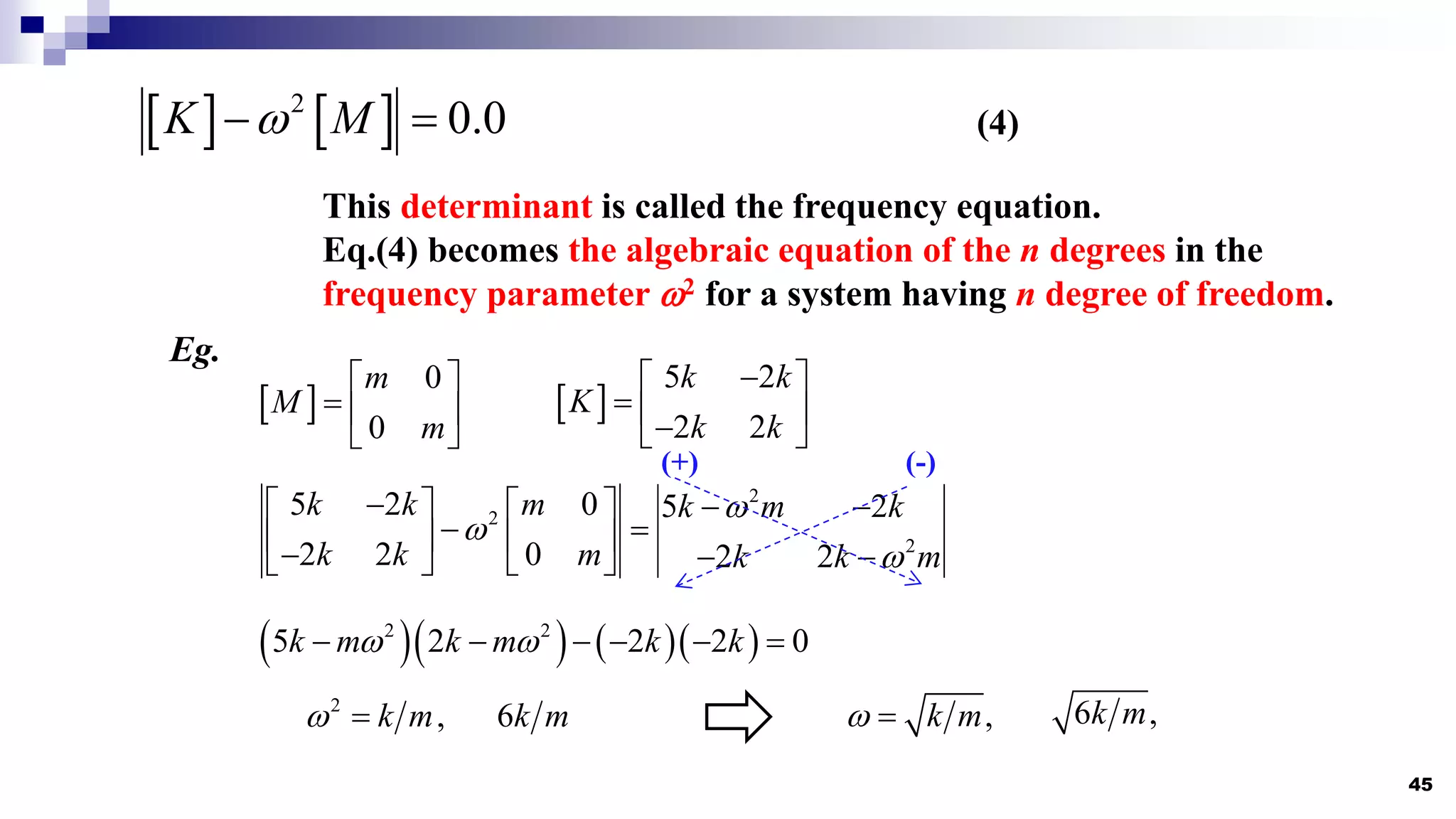
In order for a nontrivial solution of {u} to be possible,
45
   
2
0.0
K M

  (4)
This determinant is called the frequency equation.
Eq.(4) becomes the algebraic equation of the n degrees in the
frequency parameter 2 for a system having n degree of freedom.
 
0
0
m
M
m
 
  
 
 
5 2
2 2
k k
K
k k

 
  

 
Eg.
2
2
2
5 2 0 5 2
2 2 0 2 2
k k m k m k
k k m k k m



  
   
 
   
  
   
     
2 2
5 2 2 2 0
k m k m k k
 
     
2
,
k m
  6k m ,
k m
  6 ,
k m
(-)
(+)
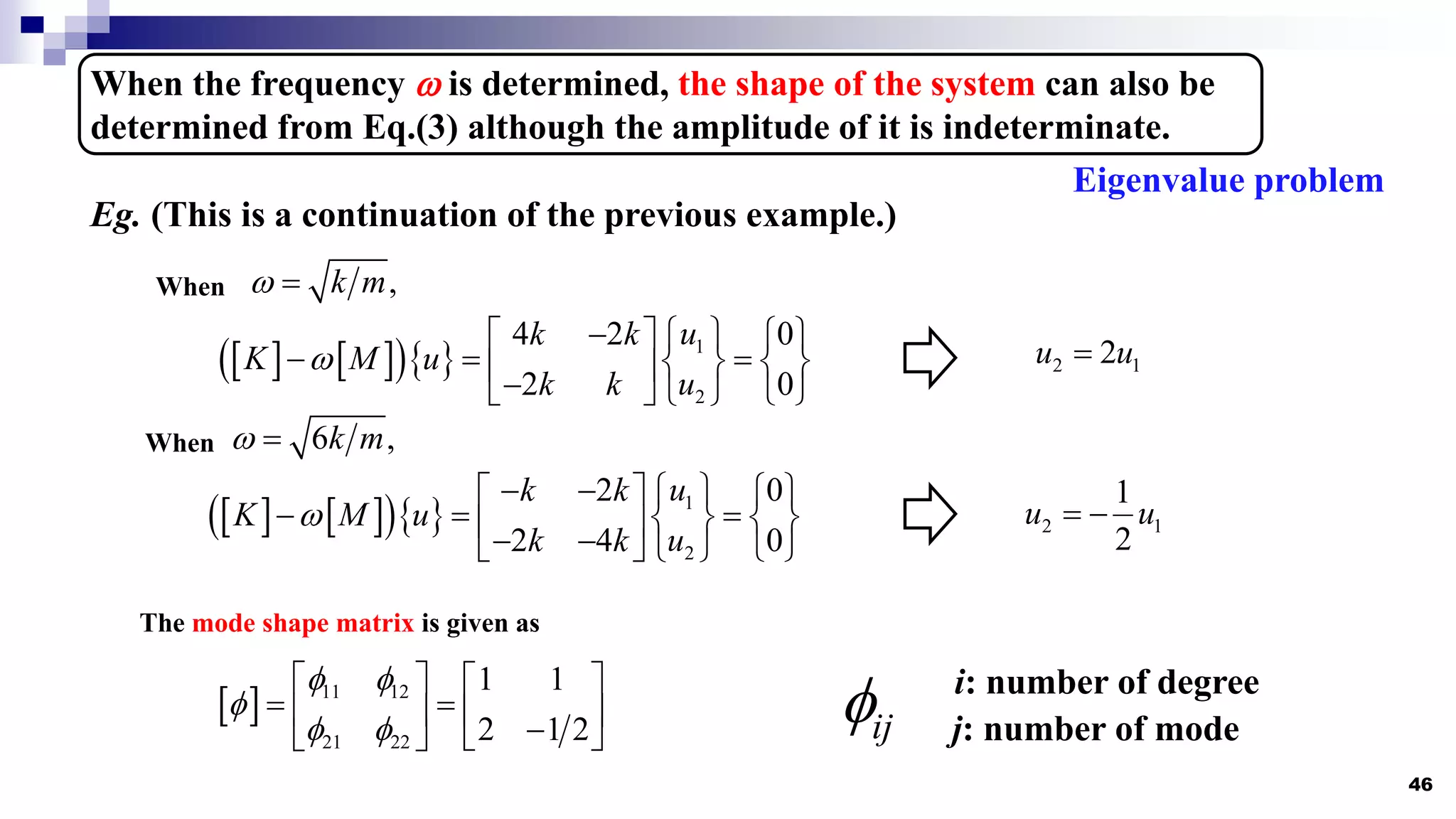
46
When the frequency  is determined, the shape of the system can also be
determined from Eq.(3) although the amplitude of it is indeterminate.
Eg. (This is a continuation of the previous example.)
,
k m
 
When
   
   1
2
4 2 0
2 0
u
k k
K M u
u
k k

  
   
  
   
 

   
 
2 1
2
u u

6 ,
k m
 
When
   
   1
2
2 0
2 4 0
u
k k
K M u
u
k k

   
   
  
   
 
 
   
 
2 1
1
2
u u
 
The mode shape matrix is given as
  11 12
21 22
1 1
2 1 2
 

 
   
 
   

 
 
Eigenvalue problem
ij
 i: number of degree
j: number of mode
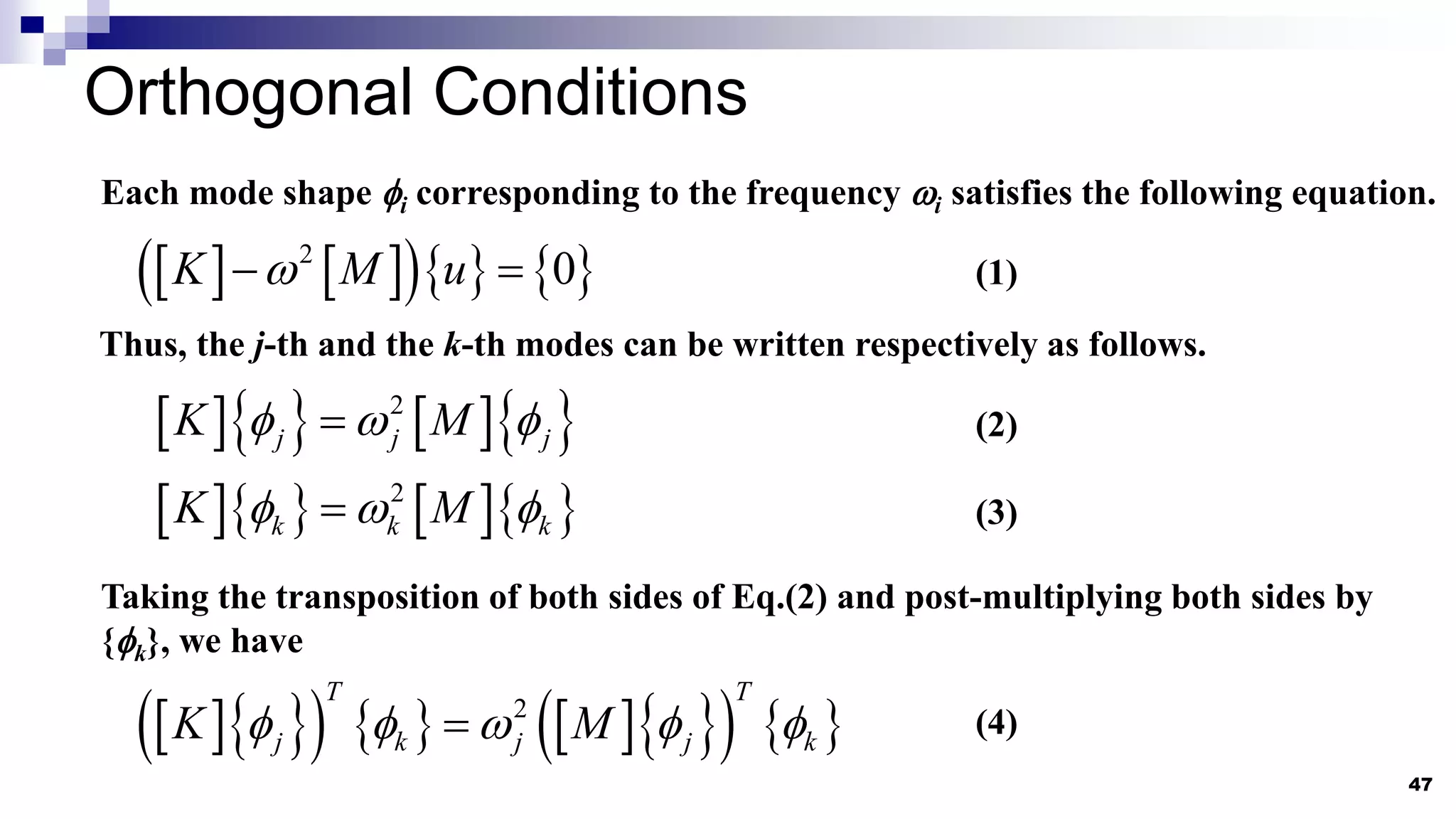
Orthogonal Conditions
47
   
    
2
0
K M u

 
Each mode shape i corresponding to the frequency i satisfies the following equation.
Thus, the j-th and the k-th modes can be written respectively as follows.
     
2
j j j
K M
  

     
2
k k k
K M
  

Taking the transposition of both sides of Eq.(2) and post-multiplying both sides by
{k}, we have
(1)
(2)
(3)
  
      
   
2
T T
j k j j k
K M
    
 (4)
48
Remembering the relation ([A][B])T=[B] T[A] T, and the matrices [K] and [M] are
symmetrical, i.e. [K] T =[K] and [M] T =[M], Eq.(4) becomes
         
2
T T
j k j j k
K M
    
 (5)
Pre-multiplying both sides of Eq.(3) by {j}T, we have
         
2
T T
j k k j k
K M
    
 (6)
Eq.(6) is subtracted from each side of Eq.(5).
     
2 2
0
T
j k j k
M
   
  (7)
Apparently, . We have for different mode shapes
2 2
j k
 

     0
T
j k
M
   (8)
for
2 2
j k
 

First orthogonality of
eigenvectors
49
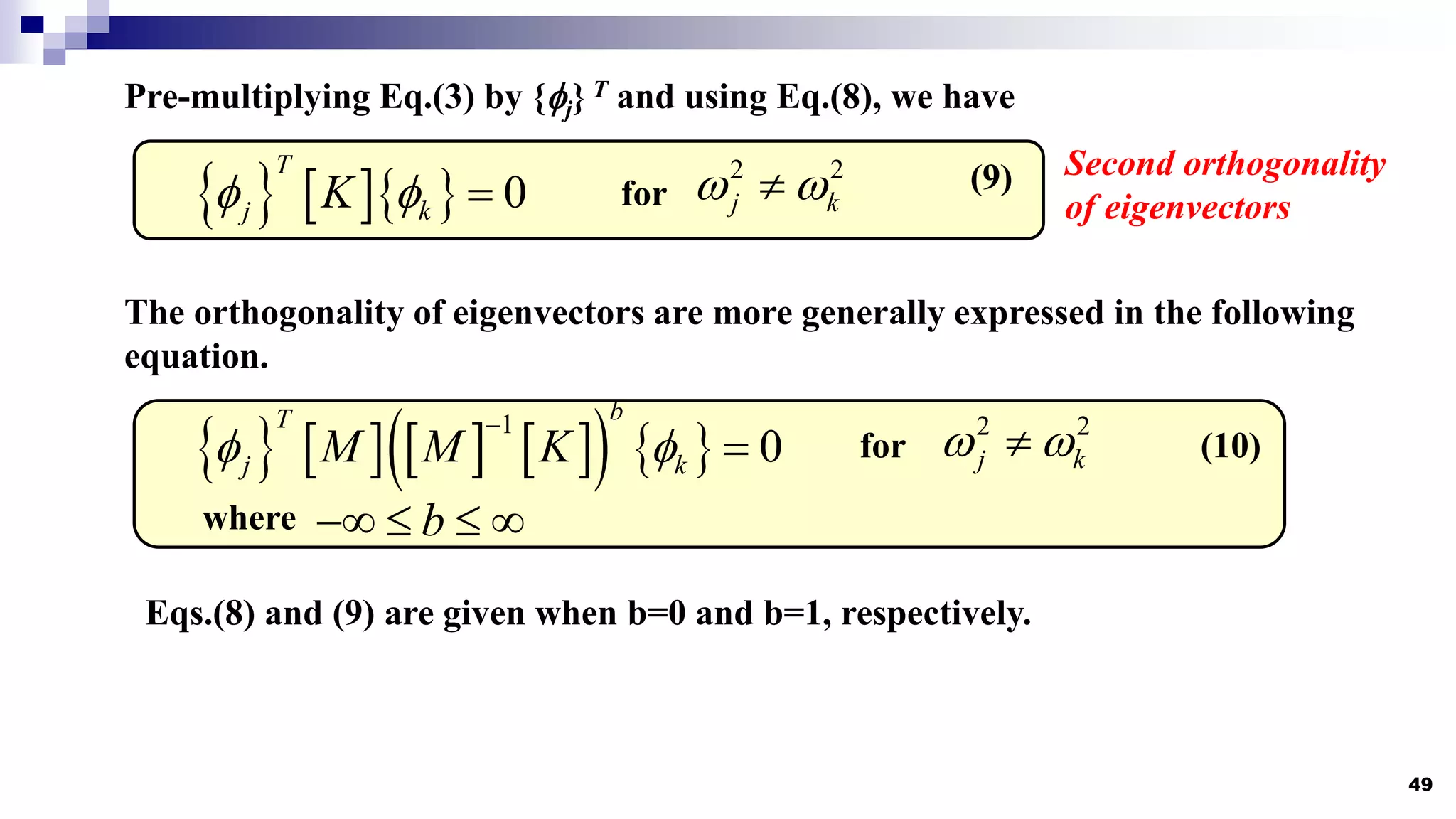
Pre-multiplying Eq.(3) by {j} T and using Eq.(8), we have
     0
T
j k
K
   (9)
for
2 2
j k
 

Second orthogonality
of eigenvectors
The orthogonality of eigenvectors are more generally expressed in the following
equation.
       
   
1
0
b
T
j k
M M K
 

 (10)
for
2 2
j k
 

where b
   
Eqs.(8) and (9) are given when b=0 and b=1, respectively.
50
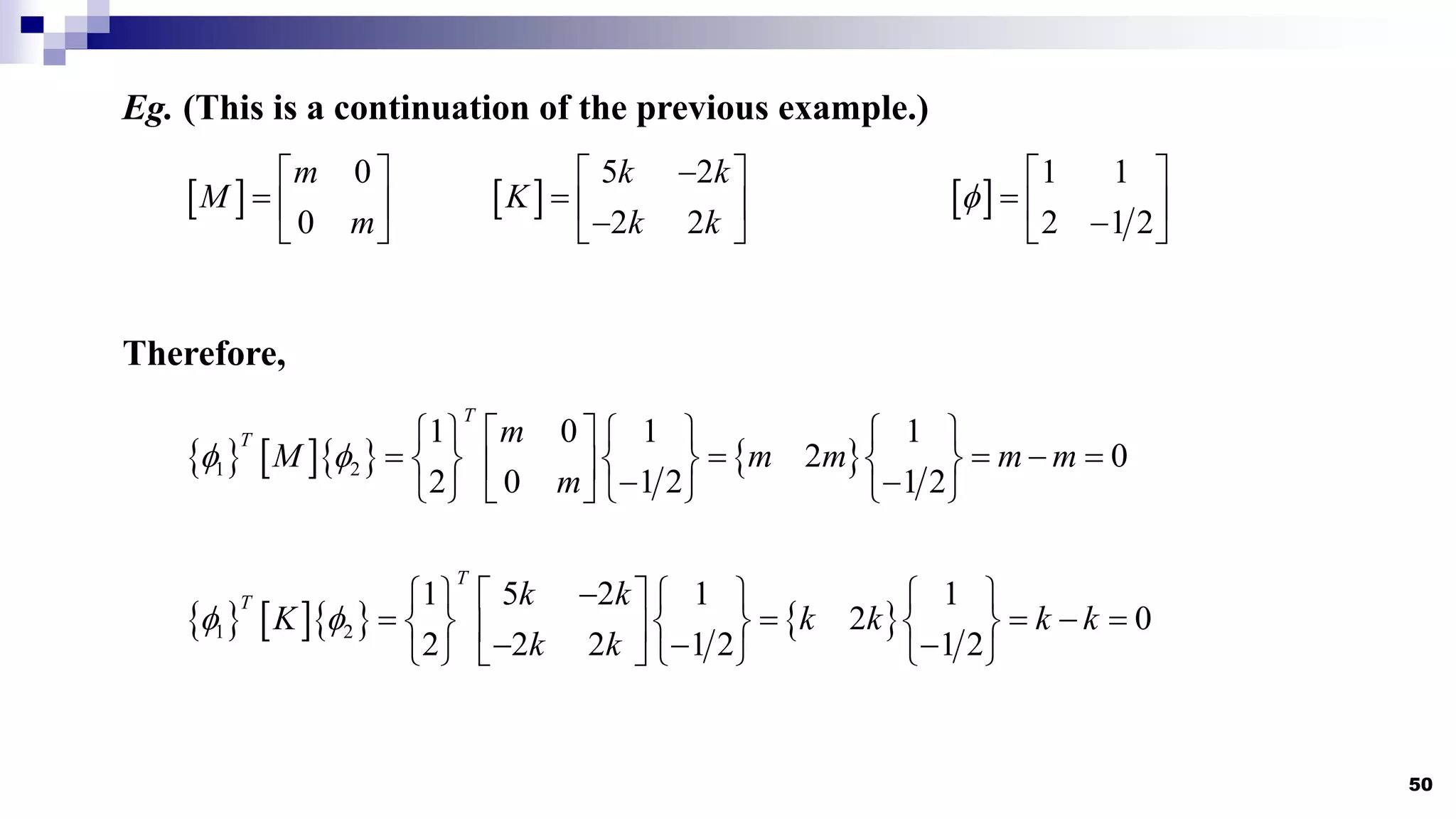
Eg. (This is a continuation of the previous example.)
 
5 2
2 2
k k
K
k k

 
  

 
 
0
0
m
M
m
 
  
 
 
1 1
2 1 2

 
  

 
Therefore,
      
1 2
1 0 1 1
2 0
2 0 1 2 1 2
T
T m
M m m m m
m
 
       
    
     
   
       
      
1 2
1 5 2 1 1
2 0
2 2 2 1 2 1 2
T
T k k
K k k k k
k k
 

       
    
     
 
  
       
Concept of Normal Coordinates
51
Coordinate transformation with mode shape matrix []:
            
1 1 2 2 n n i i
x q q q q q
    
    

Remembering orthogonality of the eigen vectors,
    
    
T
i
i T
i i
M x
q
M

 
 1
i n

Fig. 3.4.1 Concept of Normal Coordinates
q1× q2× q3×
(1)
52
The equation of motion of MDOF systems subjected to ground motions is
           
1 g
M x C x K x M x
   
Let us assume the damping is the “proportional damping”, which will be
explained in the later slides. Then, pre-multiplying {s}T the both side, we have
g
x
(1)
Substituting the Eq. in the previous page into the above equation,
           
1
i i i i i i g
M q C q K q M x
  
   
  
(2)
        
1
T T T T
s s s s s s s s s s g
M q C q K q M x
      
    (3)
Response Evaluation of MDOF Systems
with Normal Coordinates
53
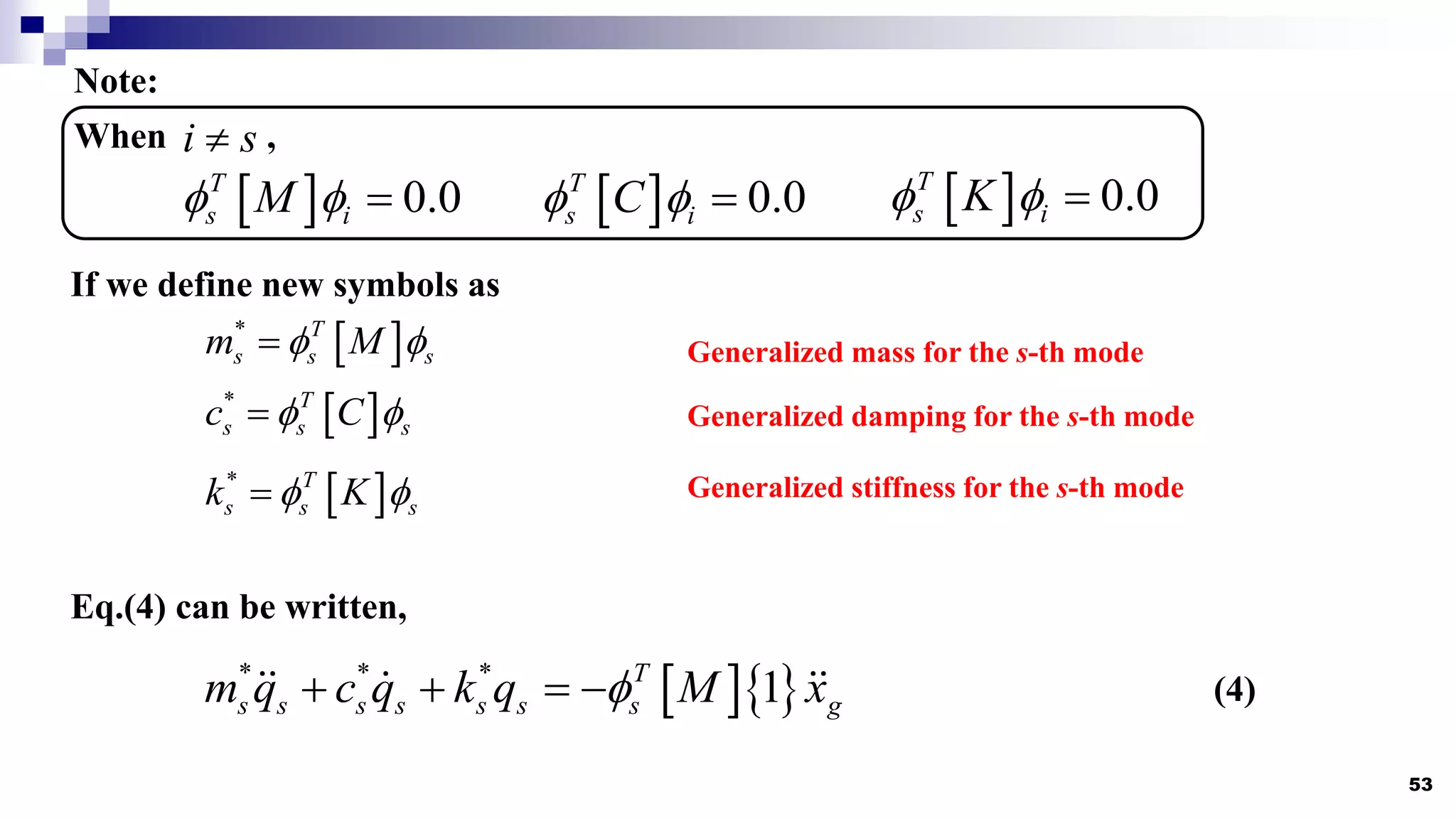
Note:
  0.0
T
s i
M
  
When ,
i s

  0.0
T
s i
C
     0.0
T
s i
K
  
If we define new symbols as
 
* T
s s s
m M
 

 
* T
s s s
c C
 

 
* T
s s s
k K
 

Eq.(4) can be written,
Generalized mass for the s-th mode
Generalized damping for the s-th mode
Generalized stiffness for the s-th mode
  
* * *
1
T
s s s s s s s g
m q c q k q M x

    (4)
54
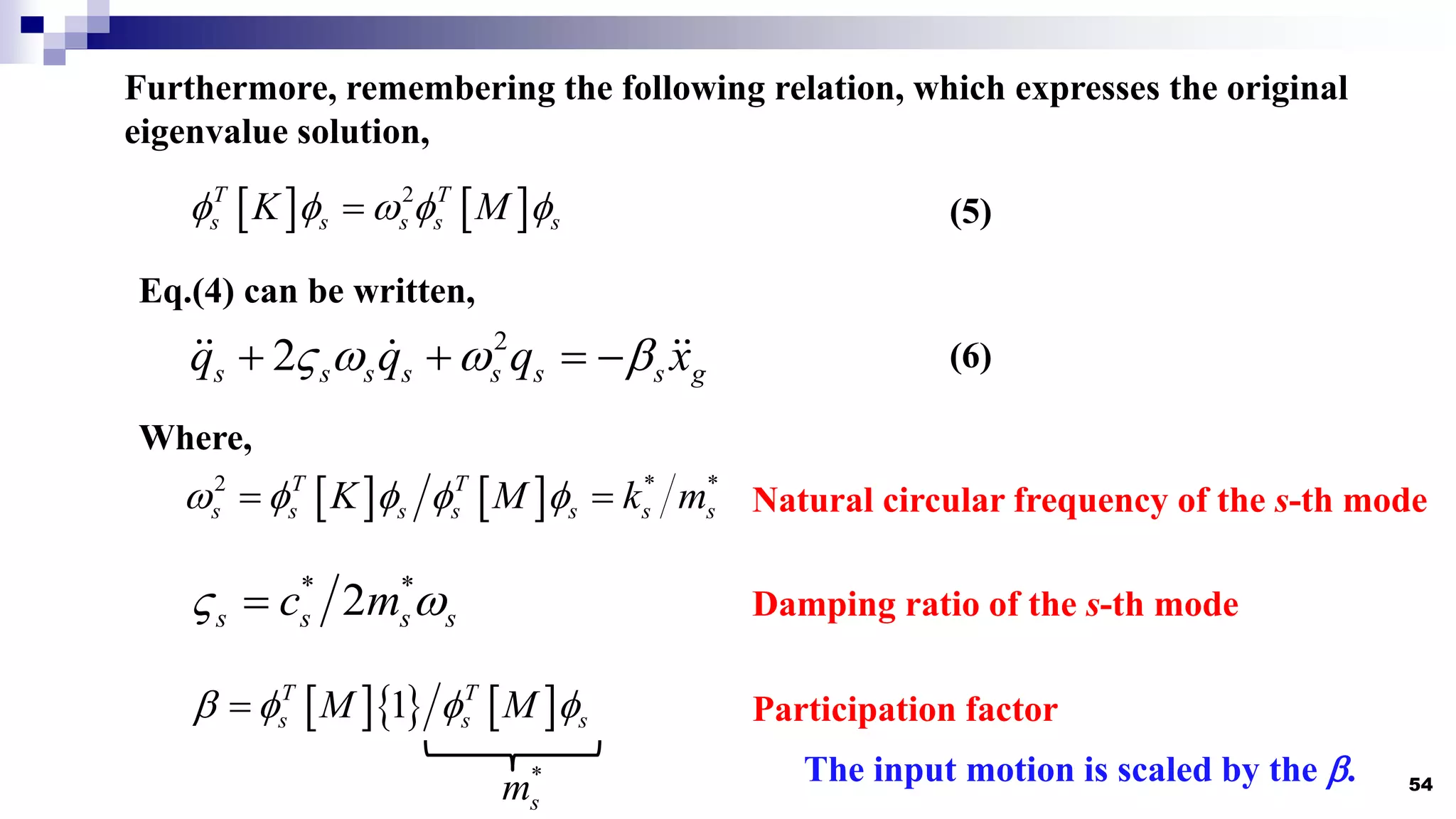
    
1
T T
s s s
M M
   

Furthermore, remembering the following relation, which expresses the original
eigenvalue solution,
   
2
T T
s s s s s
K M
    
 (5)
Eq.(4) can be written,
2
2
s s s s s s s g
q q q x
   
    (6)
Participation factor
The input motion is scaled by the .
Where,
* *
2
s s s s
c m
 
 Damping ratio of the s-th mode
   
2 * *
T T
s s s s s s s
K M k m
    
  Natural circular frequency of the s-th mode
*
s
m
55
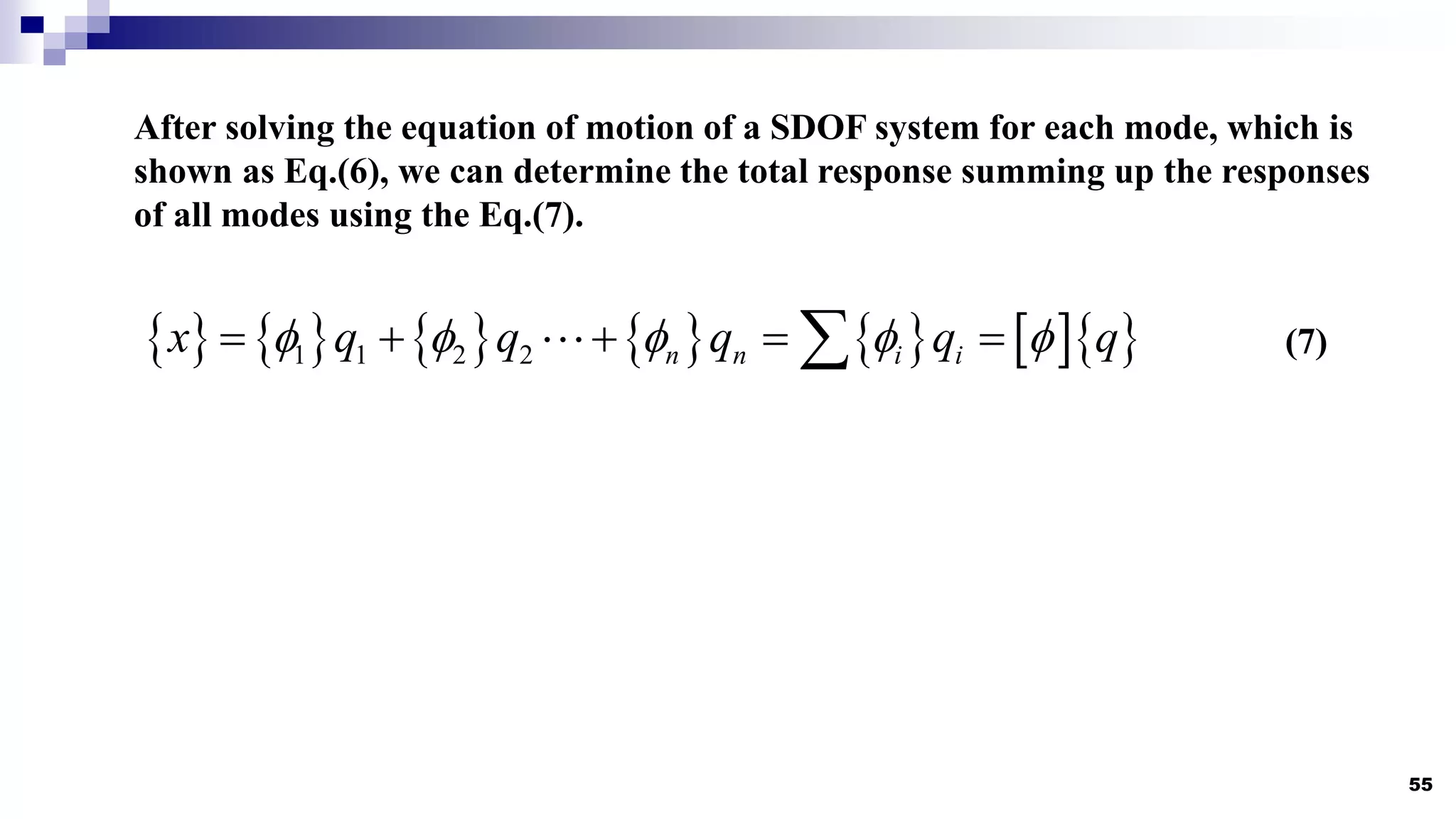
After solving the equation of motion of a SDOF system for each mode, which is
shown as Eq.(6), we can determine the total response summing up the responses
of all modes using the Eq.(7).
            
1 1 2 2 n n i i
x q q q q q
    
    
 (7)
Modal Analysis
56
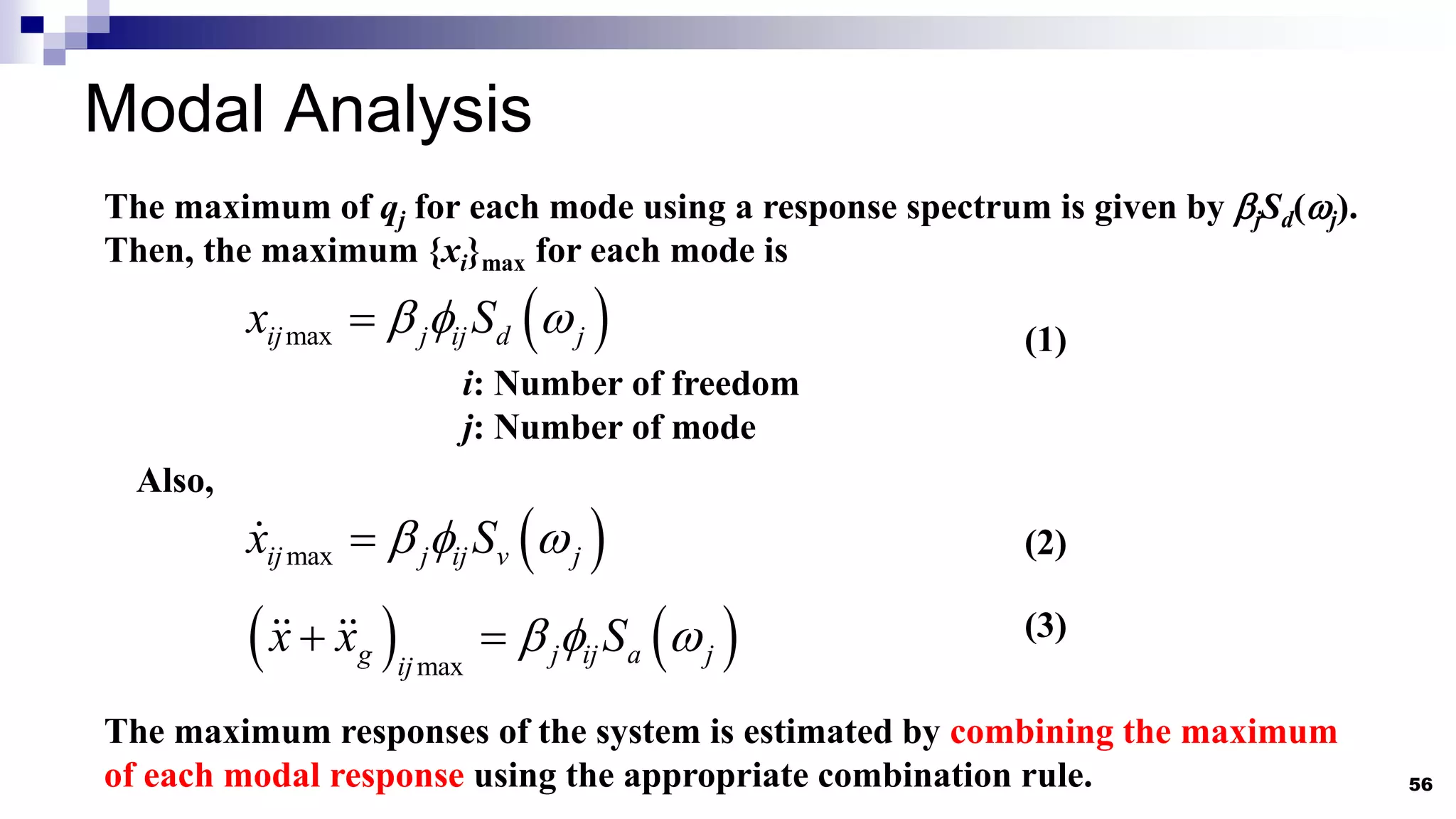
The maximum of qj for each mode using a response spectrum is given by jSd(j).
Then, the maximum {xi}max for each mode is
 
max
ij j ij d j
x S
  
 (1)
i: Number of freedom
j: Number of mode
The maximum responses of the system is estimated by combining the maximum
of each modal response using the appropriate combination rule.
Also,
 
max
ij j ij v j
x S
  

   
max
g j ij a j
ij
x x S
  
 
(2)
(3)
57
[SRSS]: Square Root of Sum of Squares
 
 
2
max( ) 1
n
i SRSS j ij d j
j
x S
  

 
[CQC]: Complete Quadratic Combination
 
   
 
max( ) 1 1
n n
i CQC j ij d j jk k ik d k
j k
x S S
      
 
  
: Factor for estimating correlation between natural frequencies
Additional Topic:
Proportional Damping
58
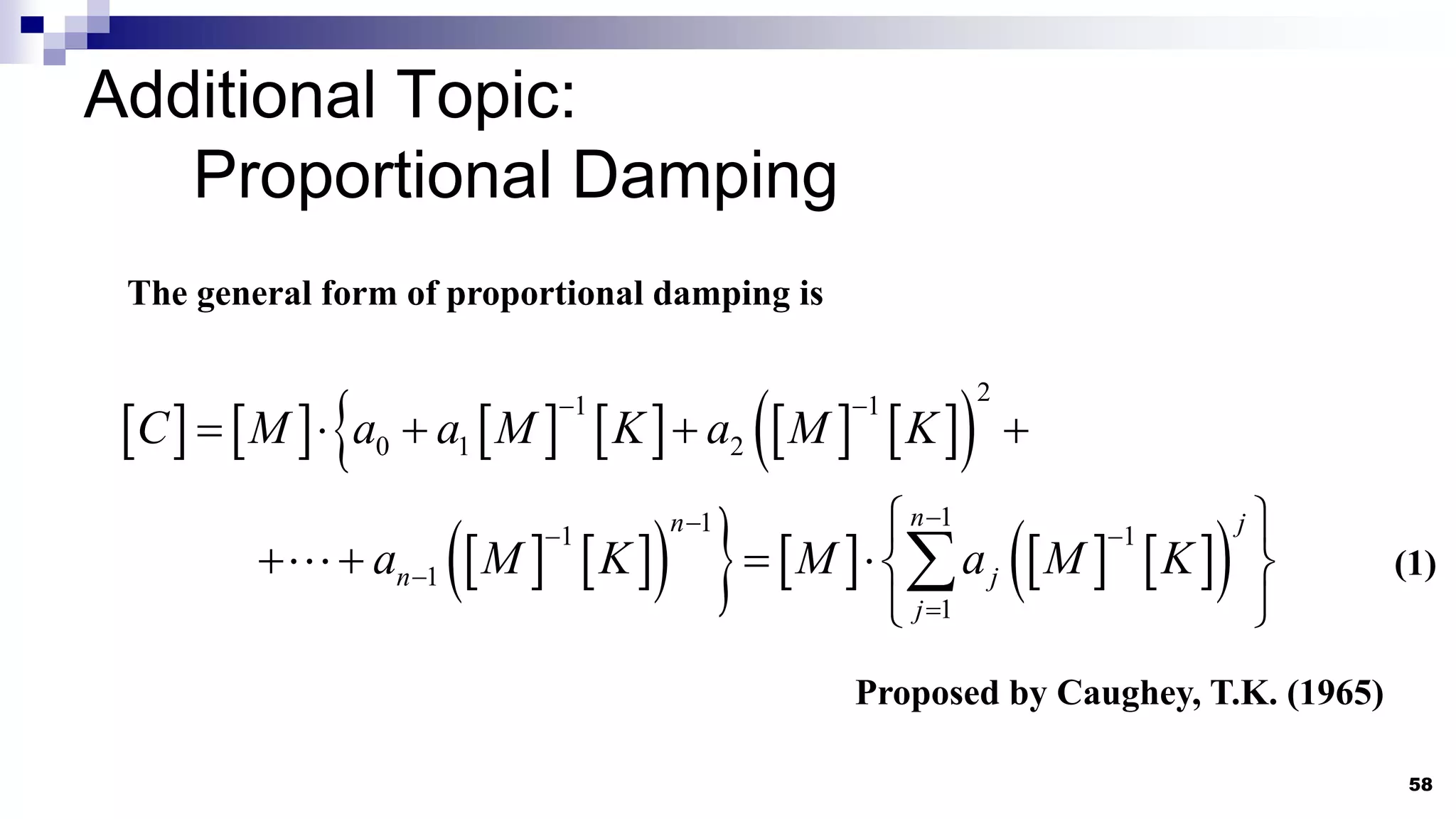
The general form of proportional damping is
       
    
 
2
1 1
0 1 2
C M a a M K a M K
 
    
   
        
 
1
1
1 1
1
1
n
n j
n j
j
a M K M a M K


 


 
    
 

Proposed by Caughey, T.K. (1965)
(1)
59
* *
2
s s s s
c m
 

 
* T
s s s
m M
 

Let us calculate the damping ratio for the s-th mode.
Where,  
* T
s s s
c C
 

(2)
Substituting the general form of [C] into the above equation,
 
* 2 4 2 2 *
0 1 2 1
( ) 2
n
s s s s n s s s
m a a a a m
    


  
 
3 2 1
0 1 2 1
1 2 n
s s s n s
a a a a
    

   (3)
Then
2 4 2( 1)
0 1 1
1 1 1
2 4 2( 1)
1 2 2
2 2 2
2 4 2( 1)
2
1
2
1
2
1
n
n
n
n n n
n n n
a
a
a
 
  
 
  
 
  



     
     
   
  
   
     
     
     
 
(4)
60
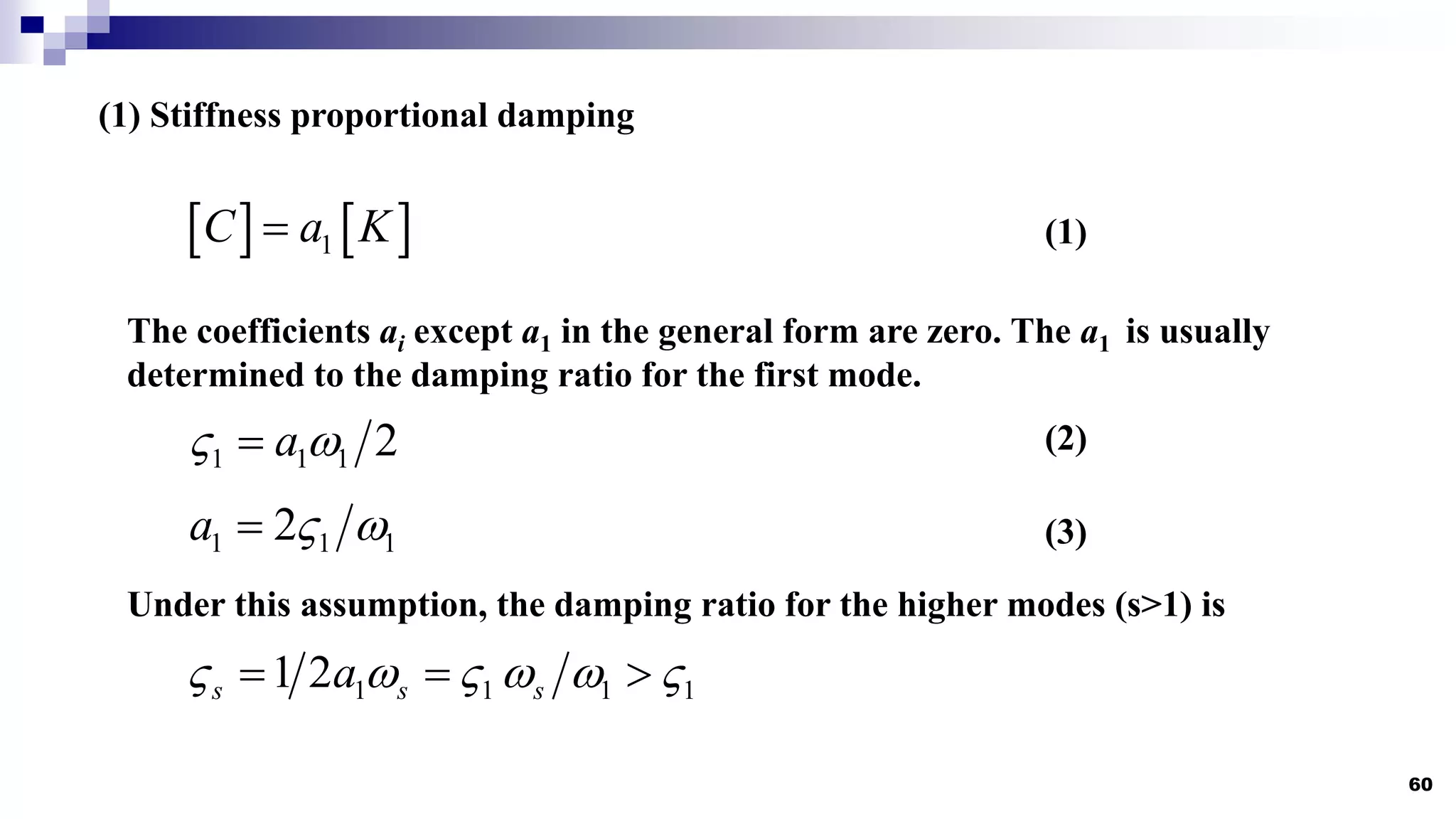
(1) Stiffness proportional damping
   
1
C a K

The coefficients ai except a1 in the general form are zero. The a1 is usually
determined to the damping ratio for the first mode.
1 1 1
2
a  

(1)
(2)
Under this assumption, the damping ratio for the higher modes (s>1) is
1 1 1 1
1 2
s s s
a
     
  
(3)
1 1 1 2
a
 

61
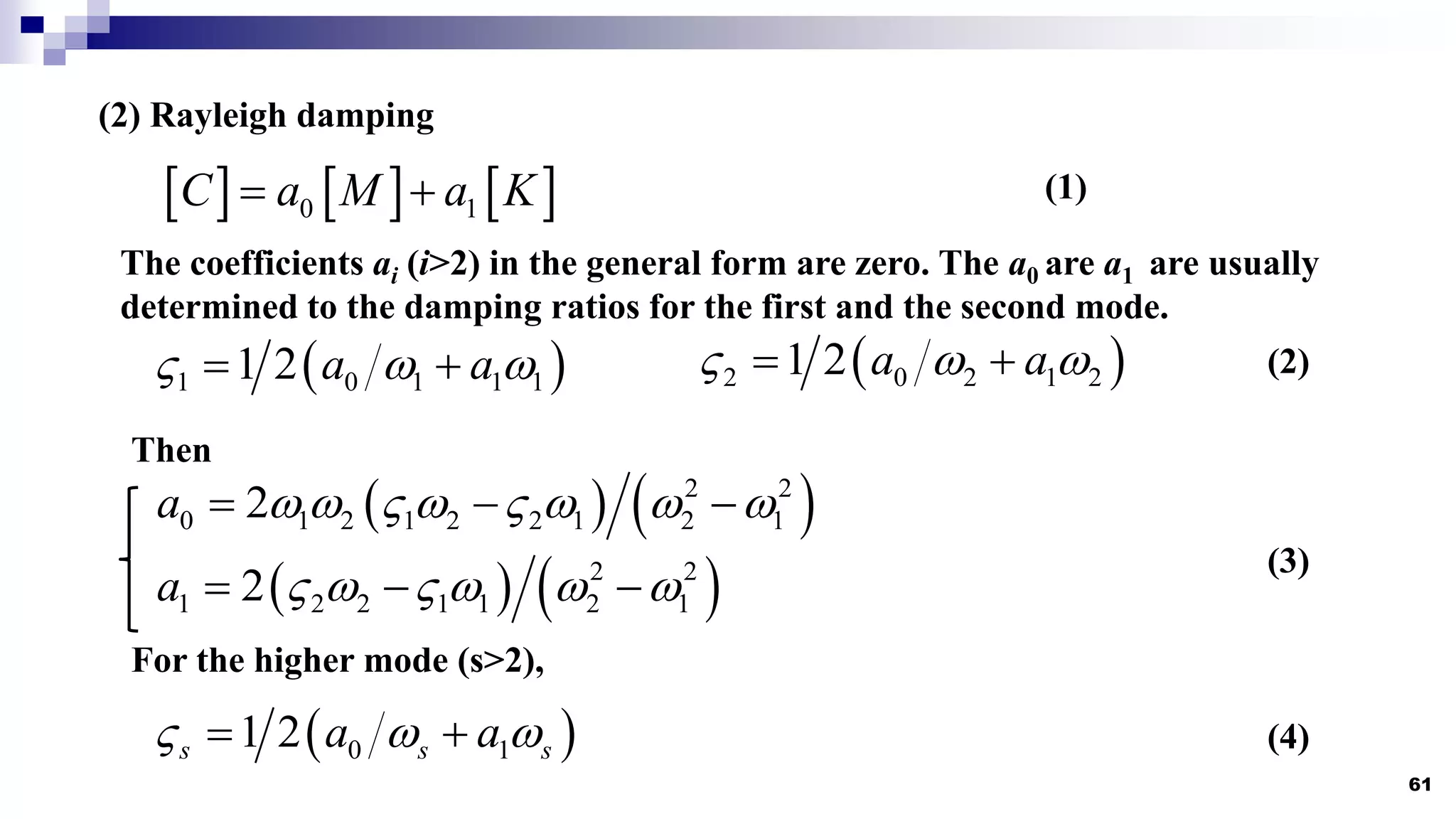
(2) Rayleigh damping
     
0 1
C a M a K
 
The coefficients ai (i>2) in the general form are zero. The a0 are a1 are usually
determined to the damping ratios for the first and the second mode.
 
1 0 1 1 1
1 2 a a
  
   
2 0 2 1 2
1 2 a a
  
 
   
2 2
0 1 2 1 2 2 1 2 1
2
a        
  
   
2 2
1 2 2 1 1 2 1
2
a      
  
Then
For the higher mode (s>2),
 
0 1
1 2
s s s
a a
  
 
(1)
(2)
(3)
(4)
Lecture -Earthquake Engineering (2).pdf

  • 1.
    1 Earthquake Engineering Engr. Resurreccion V.Garrote, MSCE, Structural Engineering Chair- CE Dept. FormerDEAN-CEA&CampusExec.Director
  • 2.
    Recommended Textbooks 1) AnilK. Chopra: Dynamics of Structures, Theory and Applications to Earthquake Engineering, Third Edition, Person Prentice Hall, 2007 2) Akenori Shibata: Dynamic Analysis of Earthquake Resistant Structures, English Version, Tohoku University CO-OP, 2010 2
  • 3.
    Contents  10/10: Freevibration of SDOF systems  10/13: Response to harmonic and arbitrary loading of SDOF systems  10/17: Multi Degree of Freedom systems  11/1 : Modal response analysis and response history analysis  11/21: Examination 3
  • 4.
    Time Schedule ofthe Lecture 4 Lecture Exercise Submission of Report
  • 5.
  • 6.
    Equation of Motion(1) 6 Newton’s second law m a F   mx kx   D’Alembert’s principle 0 mx kx    0 mx kx   x m k -kx (a) Free vibration of system with no damping (i) Newton’s second law (ii) D’Alembert’s principle x k -kx mx  Inertia force
  • 7.
    Equation of Motion(2) 7 x m k (b) Free vibration of system with damping (c) Vibration of system applied external force P mx cx kx    0 mx cx kx    c cx  kx  m k c cx  kx  P mx P cx kx    mx cx kx P   
  • 8.
    Equation of Motion(3) 8 (d) Vibration of system on oscillated ground   g m x x cx kx     x m k c cx  kx  xg g mx cx kx mx    
  • 9.
  • 10.
    Undamped Free Vibration 10 0 mxkx   (1) The solution is given as follows:   st x t De  (2) Substituting (2) into (1), we get   2 0 st ms k De   2 0 ms k   (3) n s k m i      (4)
  • 11.
    11 Then the solutionwill be   1 2 n n i t i t x t D e D e      (5) cos sin n i t n n e t t       By introducing Euler’s formula, i.e. (6) And noting that D1 and D2 can be complex, let 1 D a ib   2 D c id   Then,         cos sin cos sin n n n n x t a ib t i t c id t i t           (7)             cos sin n n a c i b d t d b i a c t           (8)
  • 12.
    12 If we let,    A a c i b d         B d b i a c     The solution become,   cos sin n n x t A t B t     Note the x(t) is real. Therefor, c = a and d = -b. A and B will be determined initial condition. The derivative of x(t) is   sin cos n n n n x t A t B t        (9) (10) (11) From Eq.(10) and (11), we obtain   0 x A    0 n x B   (12)
  • 13.
    13 Eq.(10) becomes      0 cos 0 sin n n n x t x t x t      (12) Furthermore,       0 0 cos sin n n n x x x t t t                 cos nt      (13)         2 2 2 0 0 n x x         0 tan 0 n x x   
  • 14.
    Damped Free Vibration 14 0 mxcx kx    (1)   st x t De  Substituting Eq.(2) into Eq.(1), we get Eq.(3).   2 1,2 2 2 s c m c m k m     (3) (2) The critical damping is defined by Eq.(4). 2 2 crr n c m k m m   (4)
  • 15.
    15 Damped systems areclassified into three types. (a) c<ccrr: Underdamped system (b) c=ccrr: Critically damped system (c) c>ccrr: Overdamped system
  • 16.
    (a) Underdamped system 16 Wedefine the damping ratio or the fraction of critical damping are the following 2 1.0 crr n c c c m      (5) Let us rewrite Eq.(3) using the damping ratio.   2 1,2 2 2 s c m c m k m       2 2 n n n n d i             (6) Where, 2 1 d n      (Damped natural circular frequency) Note: 0.2   d n   is close to unity when
  • 17.
    17 The solution becomes  1 2 1 2 s t s t x t D e D e       1 2 n d n d i t i t D e D e             1 2 n d d t i t i t e D e D e          cos sin nt d d e A t B t       Introducing initial conditions, we have         0 0 0 cos sin n n t d d d x x x t e x t t                (7) (8)
  • 18.
    18 Furthermore,    cos nt d x t e t                2 2 0 0 0 n d x x x                     0 0 tan 0 n d x x x      (9)
  • 19.
    19 Let us considerhow to evaluation of damping ratio. The amplitude of the (i) and the (i+n) cycle is calculated are as follows. n i t i x e       2 n i d t n i n x e         The ratio of the above two equations is   2 n i d n i t n t i i n x x e e            Hence, 2 ln 2 2 1 2 i i n n d x x n n n               If we consider the Taylor series expansion,   2 2 1 2 2 2! ... n d n i i n x x e n n                2 i i n i n x x nx       (10) (11) (12) (13) (14)
  • 20.
    (b) Critical DampedSystem 20 For critical damped system, we need to introduce the following function.     1 2 st x t D D t e   (1) Where, 2 cr n s c m      Then,     1 2 nt x t D D t e     (2) Introducing initial condition,          0 1 0 nt n x t x t x t e       (3)
  • 21.
    (c) Overdamped system 21 22 1,2 1 n n n n s             The solution of the characteristic equation is (1) The general solution is   1 2 ( ) n n n t t t x t e D e D e          (2) If we remember the following two formulae, sinh ( ) 2 x x x e e   cosh ( ) 2 x x x e e   Eq.(2) becomes,   ( ) cosh sinh nt n x t e A t B t         (3)
  • 22.
  • 23.
    General Solution ofSDOF Systems Subjected to Harmonic Loading 23 0 sin mx cx kx p t     (1) The general solution is       c p x t x t x t     c x t   p x t : Complementary function : Particular Integral (2)
  • 24.
    (a) Undamped Systems 24 0sin mx kx p t    (1) Complementary function   cos sin c n n x t A t B t     (Free vibration response) Particular Integral   1 2 cos sin p x t G t G t     ( ) 1 n n r     ( ) 1 n n r       1 2 cos sin p x t G t t G t t     The response will diverge with oscillating. (2) (3) (4)
  • 25.
    25 The coefficients G1and G2 can be determined by substituting Eq.(3) or Eq.(4) into Eq.(1). Furthermore, the coefficient A and B can be determined by substituting the initial conditions. If the system is initially at rest, ( ) 1 n n r     ( ) 1 n n r         0 2 1 sin sin 1 n n n p x t t r t k r      Static displacement Dynamic magnification factor     0 sin cos 2 n n n p x t t t t k     
  • 26.
    (b) Underdamped System 26 0sin mx cx kx p t     (1)     cos sin nt c n n x t e A t B t         1 2 cos sin p x t G t G t     The complementary function and the particular integral are given by (2) (3)     0 1 2 2 2 2 1 2 n n n r p G k r r           2 0 2 2 2 2 1 1 2 n n n r p G k r r      Substituting Eq.(3) into Eq.(1), we get (4)
  • 27.
    27 The general solutioncan be given by     cos sin nt d d x t e A t B t               2 0 2 2 2 1 1 sin 2 cos 1 2 n n n n p r t r t k r r          Transient response Steady state response The steady state response is written in the form         0 2 2 2 1 sin 1 2 p n n p x t t k r r        Static displacement Dynamic magnification factor Phase angle (5) (6)
  • 28.
    28 Additional topic: Response toharmonic ground motion g mx cx kx mx     2 2 n n g x x x x       If we remember and   n k m   2 n c m    Let us consider the following harmonic ground motion   0 0 cos sin i t g x a e a t i t         (1) (2) (3) Substituting Eq.(3) into Eq.(2), we get 2 2 0 2 i t n n x x x a e        (4)
  • 29.
    29 The particular integralis i t p x G   (5) Since 2 2 0 0 2 2 2 2 1 2 i t i t n n n n n a r x e a e i r r i               (6)   2 0 2 2 2 2 1 4 i n n n r x x e r r            2 2 2 2 2 2 2 2 2 2 cos sin i a ib a b a a b ib a b a b i a b e              Note: 1 tan b a    Phase angle Amplification ratio of relative displacement
  • 30.
    30 Amplification ratio Phaselag z=0.0 z=0.1 z=0.2 z=0.4 z=0.707 z=1.0 z=0.0 z=1.0 z=0.1 z=0.2 z=0.707 z=0.4
  • 31.
    31 Phase angle 1 2 2 tan 1 n n r r      0 n r 0.5 n r  0.8 n r  1.2 n r  2.0 n r  n r   0      0.99    0.84    0.13    0.02    0.1  
  • 32.
    32 Tool for drawinga graph rn=0.0:0.01:3.0; h=[0.0, 0.1, 0.2, 0.4, 0.707, 1.0]; y_y0=zeros(length(rn),length(h)); for ii=1:1:length(h) for jj=1:1:length(rn) y_y0(jj,ii)=rn(jj)^2/sqrt((1-rn(jj)^2)^2 + 4*h(ii)^2*rn(jj)^2); end end plot(rn, y_y0, 'linewidth',1.5) grid on xlabel('rn') ylabel('Amplification of disp.') ylim([0,7]) Definition of resonance curve Set of variable Drawing a graph Script of MATLAB
  • 33.
  • 34.
    Methodologies 34 (2) Duhamel Integral (1)Response history analysis (3) Frequency domain analysis
  • 35.
    Duhamel Integral 35 Referred fromthe recommended text book (2) If a force f is applied to a system for a short duration of dt ,   dx f d m d t t t  Impulse Momentum         sin n t d d x t e f d m t  t t t   t     The free vibration of the system is Note: The general solution of free vibration is         0 0 0 cos sin n n t d d d x x x t e x t t                      1 sin n t d d g t m e t  t t   t      (1) (2)
  • 36.
    36 Fig. 2.4.1 inthe LN         sin n t d d x t e f m t  t t t   t                2 2 sin 2 n t d d x t e f m t  t t t   t                 3 3 sin 3 n t d d x t e f m t  t t t   t           f t       0 t x t f g t dt t t   
  • 37.
    37      0 t x t f g t dt t t          1 sin n t d d g t m e t  t t   t      Where, (3) (4) If the force is caused by an external acceleration     g f mx t           0 1 sin n t t g d d x t x e t d  t t  t t        The response velocity is           2 0 cos sin 1 n t t g d d x t x e t t d z t z t  t  t t z                  (6) (5)
  • 38.
    38 From the equationof motion,     2 2 g n n x t x t x x z      (7) Substituting (5) and (6) into (7),             2 2 2 0 2 1 sin cos 1 1 n t t g d g d d x t x t x e t t d z t z z  t  t  t t z z                          (8) We get response spectra, Sa(z , T), Sv(z , T) and Sd(z , T), by calculating the maximum values of Eq.(5),(6),(8) for each z and T. When , 2 0   2 1 0    and 2 d n T      Then,           0 max 1 1 , sin , n t t d g d pv n n S T x e t dt S T z t  t  t                    0 max , cos , n t t v g d pv S T x e t dt S T z t  t  t                  0 max , sin , n t t a n g d n pv S T x e t dt S T z t   t  t         Pseudo-velocity response spectrum
  • 39.
    39 Fig. 2.4.4 Typicalcharacteristics of response spectra 1 n   n  
  • 40.
    40 Multi Degree FreedomSystems (Modal response analysis)
  • 41.
    Two mass system 41 1.0 m1 m2 k1 k2 k1 -k1 1.0 m2 m1 k1 k2 -k1 k1 k2 11 1 1 1 2 0.0 m x k x k x      2 2 1 1 1 2 2 0.0 m x k x k k x       1 1 1 1 1 2 2 1 1 2 2 0 0 0 m x k k x m x k k k x                              Stiffness matrix: m2 m1 k2 k1 Two mass system (a) x1=1.0 (b) x2=1.0   11 12 1 1 21 22 1 1 2 k k k k K k k k k k                  Elements of stiffness matrix: kij The element kij is the force at the i-th mass due to a unit displacement applied the j-th mass.
  • 42.
    Betti’s reciprocal law 42  1 1 2 1 2 i ii i ij j jj W P P P           2 1 2 1 2 j jj j ji i ii W P P P         Pi Pj ii ij ji jj Pi Pj ij ii jj ji Pi Pj Pj Pi Since W1=W2 , Step 1 Step 2 Step 2 Step 1 i ij j ji P P    When P1=P2 =1.0 , ij ji    or ij ji f f  fij: flexibility
  • 43.
    43    1 K F   The stiffness matrix [K] is symmetry as well as the flexible matrix [F]. Example of stiffness matrix; 1 n i i-1 i+1 1 1 1 1 1 1 1 1 0 0 i i i i i i i i n n n k k k k k k k k k k k k k                i i Symmetric and Sparse
  • 44.
    Undamped Free Vibrationof MDOF Systems 44         0 M x K x   The general solution is       cos x u t     (1) (2) Substituting Eq.(2) into Eq.(1),            2 cos 0 K M u t                2 0 K M u    (3) In order for a nontrivial solution of {u} to be possible,
  • 45.
    45    2 0.0 K M    (4) This determinant is called the frequency equation. Eq.(4) becomes the algebraic equation of the n degrees in the frequency parameter 2 for a system having n degree of freedom.   0 0 m M m          5 2 2 2 k k K k k          Eg. 2 2 2 5 2 0 5 2 2 2 0 2 2 k k m k m k k k m k k m                              2 2 5 2 2 2 0 k m k m k k         2 , k m   6k m , k m   6 , k m (-) (+)
  • 46.
    46 When the frequency is determined, the shape of the system can also be determined from Eq.(3) although the amplitude of it is indeterminate. Eg. (This is a continuation of the previous example.) , k m   When        1 2 4 2 0 2 0 u k k K M u u k k                         2 1 2 u u  6 , k m   When        1 2 2 0 2 4 0 u k k K M u u k k                           2 1 1 2 u u   The mode shape matrix is given as   11 12 21 22 1 1 2 1 2                     Eigenvalue problem ij  i: number of degree j: number of mode
  • 47.
    Orthogonal Conditions 47         2 0 K M u    Each mode shape i corresponding to the frequency i satisfies the following equation. Thus, the j-th and the k-th modes can be written respectively as follows.       2 j j j K M           2 k k k K M     Taking the transposition of both sides of Eq.(2) and post-multiplying both sides by {k}, we have (1) (2) (3)               2 T T j k j j k K M       (4)
  • 48.
    48 Remembering the relation([A][B])T=[B] T[A] T, and the matrices [K] and [M] are symmetrical, i.e. [K] T =[K] and [M] T =[M], Eq.(4) becomes           2 T T j k j j k K M       (5) Pre-multiplying both sides of Eq.(3) by {j}T, we have           2 T T j k k j k K M       (6) Eq.(6) is subtracted from each side of Eq.(5).       2 2 0 T j k j k M       (7) Apparently, . We have for different mode shapes 2 2 j k         0 T j k M    (8) for 2 2 j k    First orthogonality of eigenvectors
  • 49.
    49 Pre-multiplying Eq.(3) by{j} T and using Eq.(8), we have      0 T j k K    (9) for 2 2 j k    Second orthogonality of eigenvectors The orthogonality of eigenvectors are more generally expressed in the following equation.             1 0 b T j k M M K     (10) for 2 2 j k    where b     Eqs.(8) and (9) are given when b=0 and b=1, respectively.
  • 50.
    50 Eg. (This isa continuation of the previous example.)   5 2 2 2 k k K k k            0 0 m M m          1 1 2 1 2          Therefore,        1 2 1 0 1 1 2 0 2 0 1 2 1 2 T T m M m m m m m                                         1 2 1 5 2 1 1 2 0 2 2 2 1 2 1 2 T T k k K k k k k k k                                   
  • 51.
    Concept of NormalCoordinates 51 Coordinate transformation with mode shape matrix []:              1 1 2 2 n n i i x q q q q q            Remembering orthogonality of the eigen vectors,           T i i T i i M x q M     1 i n  Fig. 3.4.1 Concept of Normal Coordinates q1× q2× q3× (1)
  • 52.
    52 The equation ofmotion of MDOF systems subjected to ground motions is             1 g M x C x K x M x     Let us assume the damping is the “proportional damping”, which will be explained in the later slides. Then, pre-multiplying {s}T the both side, we have g x (1) Substituting the Eq. in the previous page into the above equation,             1 i i i i i i g M q C q K q M x           (2)          1 T T T T s s s s s s s s s s g M q C q K q M x            (3) Response Evaluation of MDOF Systems with Normal Coordinates
  • 53.
    53 Note:   0.0 T si M    When , i s    0.0 T s i C      0.0 T s i K    If we define new symbols as   * T s s s m M      * T s s s c C      * T s s s k K    Eq.(4) can be written, Generalized mass for the s-th mode Generalized damping for the s-th mode Generalized stiffness for the s-th mode    * * * 1 T s s s s s s s g m q c q k q M x      (4)
  • 54.
    54     1 T T s s s M M      Furthermore, remembering the following relation, which expresses the original eigenvalue solution,     2 T T s s s s s K M       (5) Eq.(4) can be written, 2 2 s s s s s s s g q q q x         (6) Participation factor The input motion is scaled by the . Where, * * 2 s s s s c m    Damping ratio of the s-th mode     2 * * T T s s s s s s s K M k m        Natural circular frequency of the s-th mode * s m
  • 55.
    55 After solving theequation of motion of a SDOF system for each mode, which is shown as Eq.(6), we can determine the total response summing up the responses of all modes using the Eq.(7).              1 1 2 2 n n i i x q q q q q            (7)
  • 56.
    Modal Analysis 56 The maximumof qj for each mode using a response spectrum is given by jSd(j). Then, the maximum {xi}max for each mode is   max ij j ij d j x S     (1) i: Number of freedom j: Number of mode The maximum responses of the system is estimated by combining the maximum of each modal response using the appropriate combination rule. Also,   max ij j ij v j x S         max g j ij a j ij x x S      (2) (3)
  • 57.
    57 [SRSS]: Square Rootof Sum of Squares     2 max( ) 1 n i SRSS j ij d j j x S       [CQC]: Complete Quadratic Combination         max( ) 1 1 n n i CQC j ij d j jk k ik d k j k x S S             : Factor for estimating correlation between natural frequencies
  • 58.
    Additional Topic: Proportional Damping 58 Thegeneral form of proportional damping is                2 1 1 0 1 2 C M a a M K a M K                       1 1 1 1 1 1 n n j n j j a M K M a M K                 Proposed by Caughey, T.K. (1965) (1)
  • 59.
    59 * * 2 s ss s c m      * T s s s m M    Let us calculate the damping ratio for the s-th mode. Where,   * T s s s c C    (2) Substituting the general form of [C] into the above equation,   * 2 4 2 2 * 0 1 2 1 ( ) 2 n s s s s n s s s m a a a a m             3 2 1 0 1 2 1 1 2 n s s s n s a a a a          (3) Then 2 4 2( 1) 0 1 1 1 1 1 2 4 2( 1) 1 2 2 2 2 2 2 4 2( 1) 2 1 2 1 2 1 n n n n n n n n n a a a                                                              (4)
  • 60.
    60 (1) Stiffness proportionaldamping     1 C a K  The coefficients ai except a1 in the general form are zero. The a1 is usually determined to the damping ratio for the first mode. 1 1 1 2 a    (1) (2) Under this assumption, the damping ratio for the higher modes (s>1) is 1 1 1 1 1 2 s s s a          (3) 1 1 1 2 a   
  • 61.
    61 (2) Rayleigh damping      0 1 C a M a K   The coefficients ai (i>2) in the general form are zero. The a0 are a1 are usually determined to the damping ratios for the first and the second mode.   1 0 1 1 1 1 2 a a        2 0 2 1 2 1 2 a a          2 2 0 1 2 1 2 2 1 2 1 2 a                2 2 1 2 2 1 1 2 1 2 a          Then For the higher mode (s>2),   0 1 1 2 s s s a a      (1) (2) (3) (4)