Lecture 1
Analysis Numeric
By: Bendito F. Ribeiro, M.Eng
8/15/2018 1
Electronic and Electrical Engineering Department
Faculty of Engineering Science and Technology
National University of Timor Leste
UNTL 2018
Mail: bennyfribeiro@gmail.com
Outline
• Supporting theory (basic math)
• Algorithm
• Precision and Accuracy ,
• Standard deviation
• Error propagation
• Exercise 1
8/15/2018 2
Analysis Numeric - Lecturer 1 (Bendito
Freitas Ribeiro, M.Eng)
ALGORITHMS
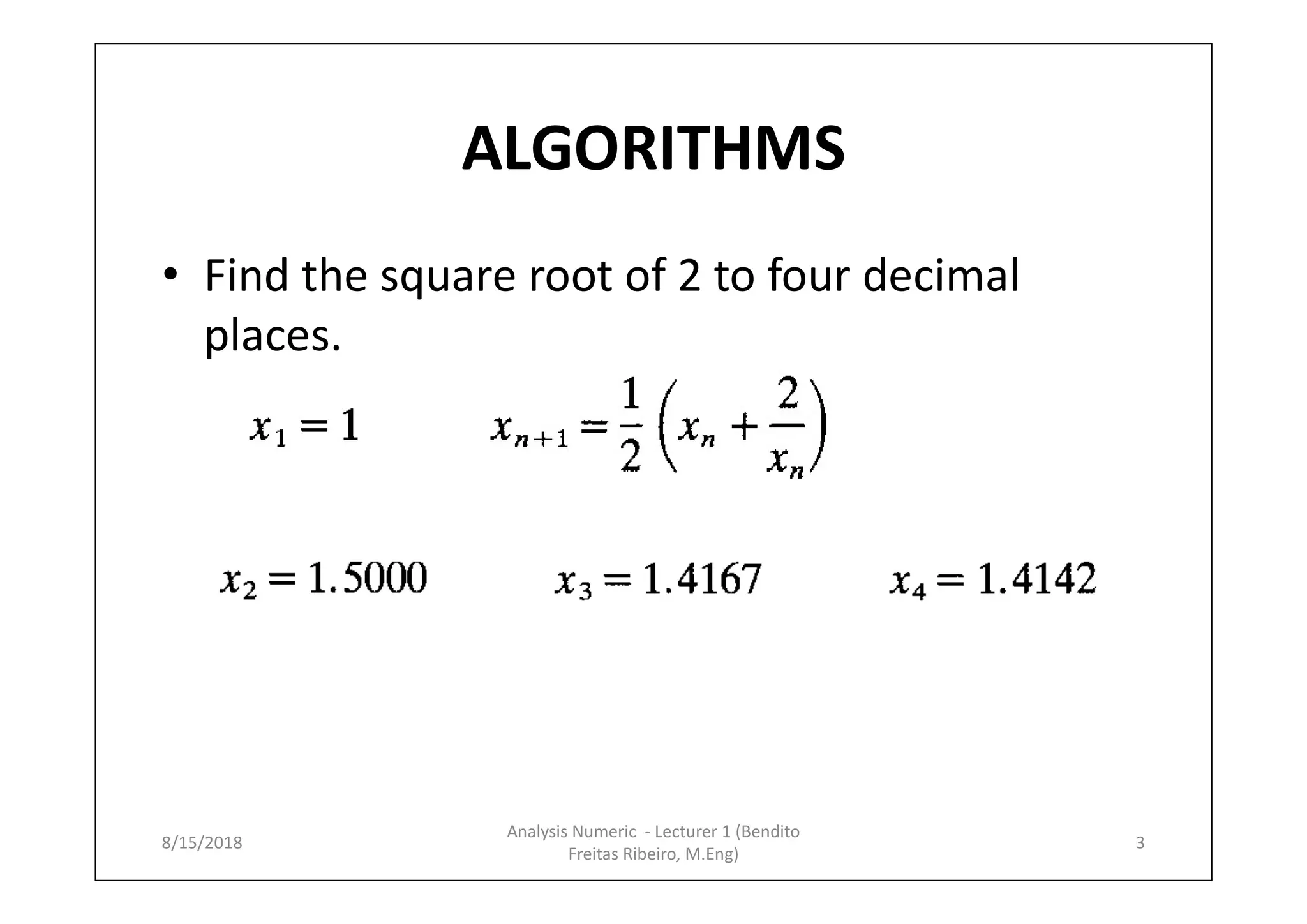
• Find the square root of 2 to four decimal
places.
8/15/2018 3
Analysis Numeric - Lecturer 1 (Bendito
Freitas Ribeiro, M.Eng)
ERROR
• Three general types of errors: random error,
systematic error, and gross errors.
• Error Analysis: – Error propagation, numerical
stability, Error estimation, Error cancellation,
Condition numbers.
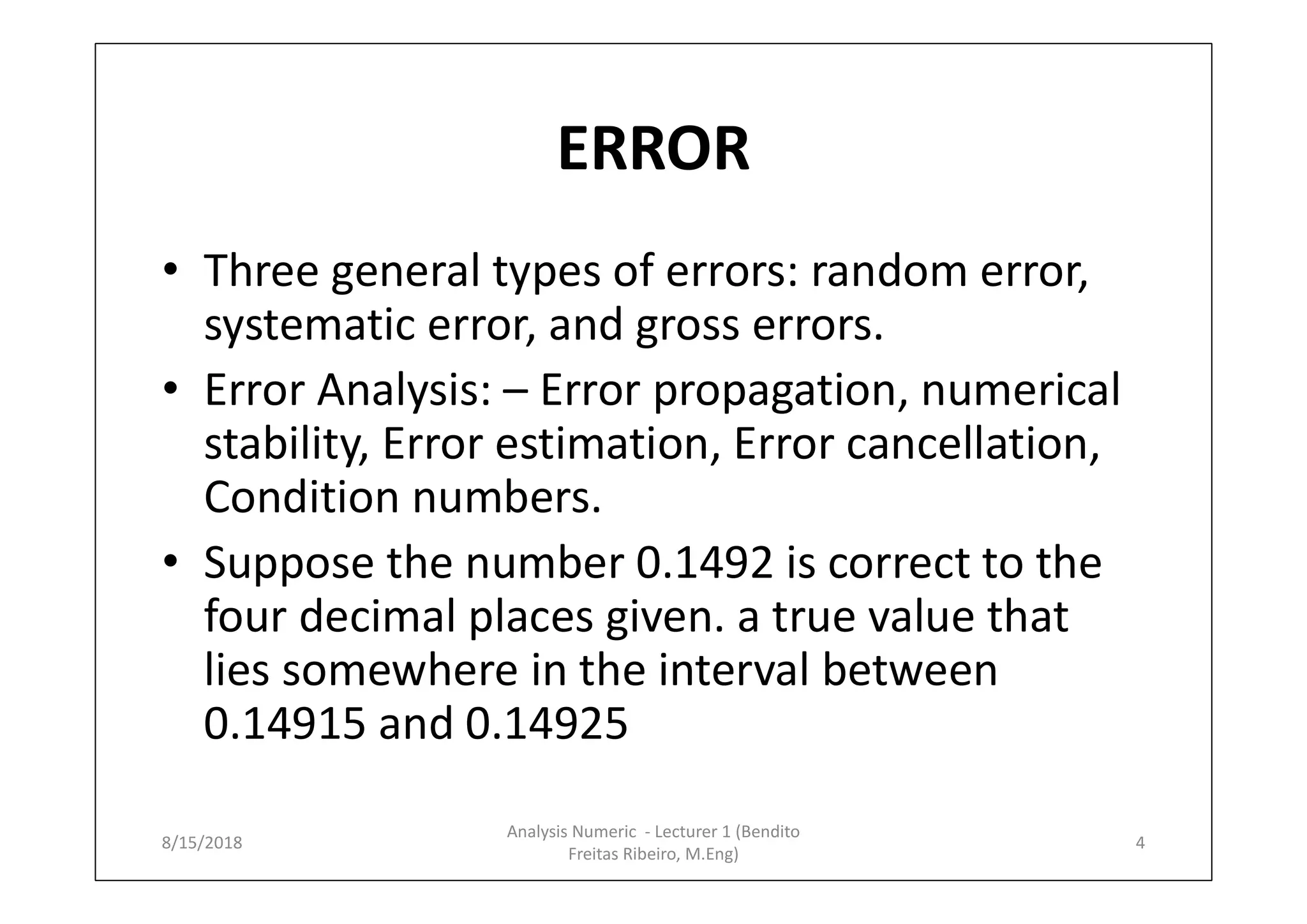
• Suppose the number 0.1492 is correct to the
four decimal places given. a true value that
lies somewhere in the interval between
0.14915 and 0.14925
8/15/2018 4
Analysis Numeric - Lecturer 1 (Bendito
Freitas Ribeiro, M.Eng)
Precision and Accuracy
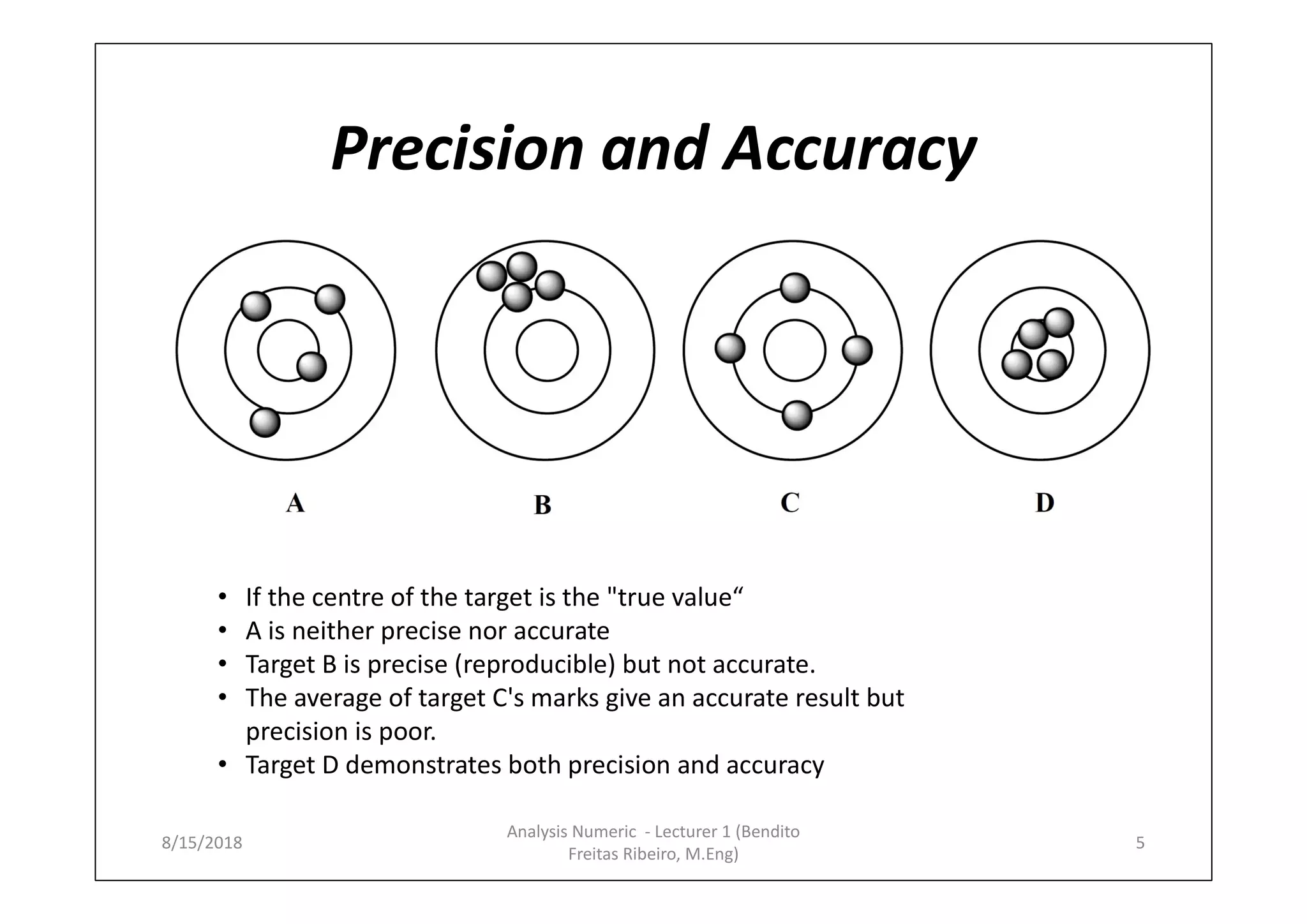
• If the centre of the target is the "true value“
• A is neither precise nor accurate
• Target B is precise (reproducible) but not accurate.
• The average of target C's marks give an accurate result but
precision is poor.
• Target D demonstrates both precision and accuracy
8/15/2018 5
Analysis Numeric - Lecturer 1 (Bendito
Freitas Ribeiro, M.Eng)
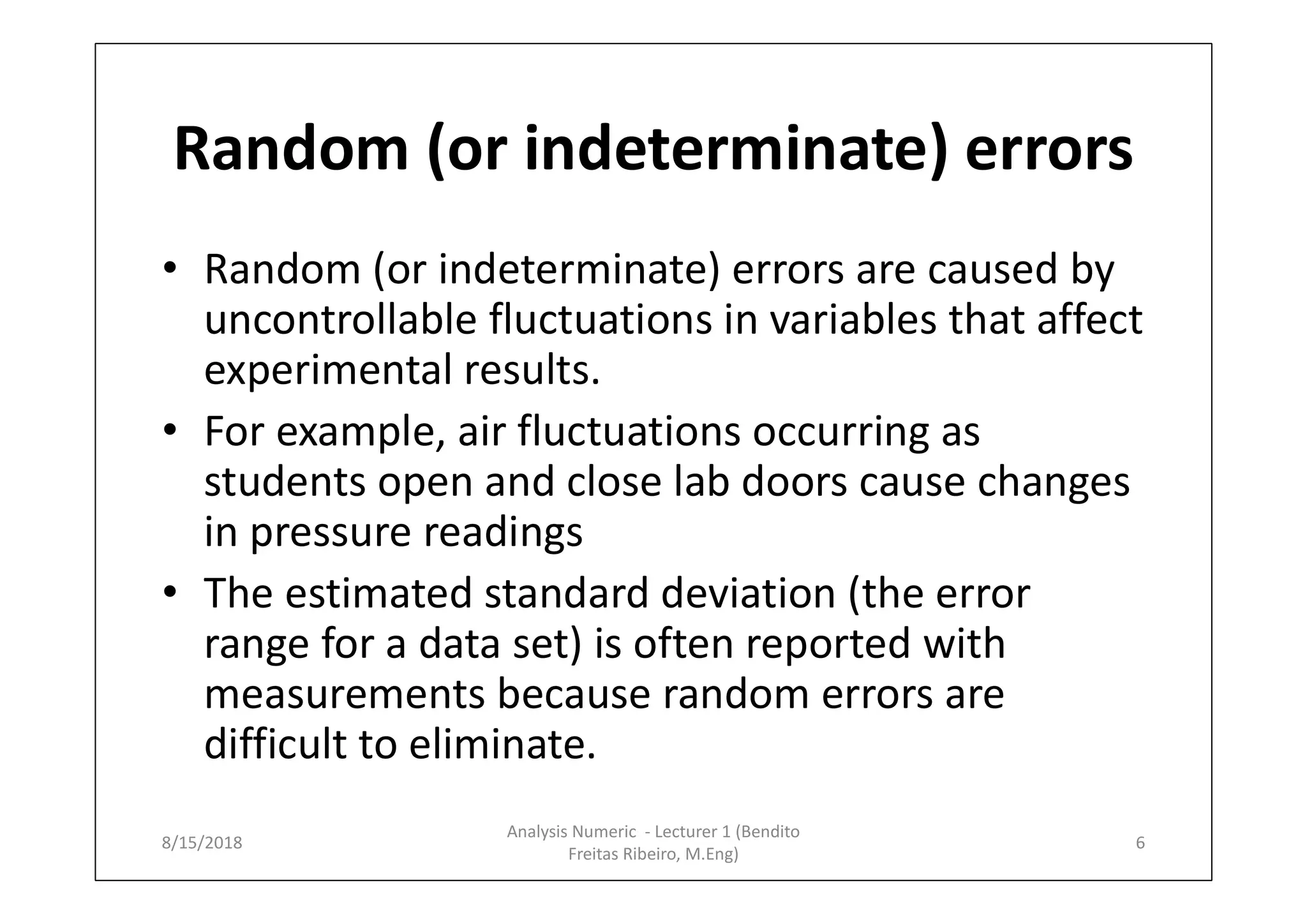
Random (or indeterminate) errors
• Random (or indeterminate) errors are caused by
uncontrollable fluctuations in variables that affect
experimental results.
• For example, air fluctuations occurring as
students open and close lab doors cause changes
in pressure readings
• The estimated standard deviation (the error
range for a data set) is often reported with
measurements because random errors are
difficult to eliminate.
8/15/2018 6
Analysis Numeric - Lecturer 1 (Bendito
Freitas Ribeiro, M.Eng)
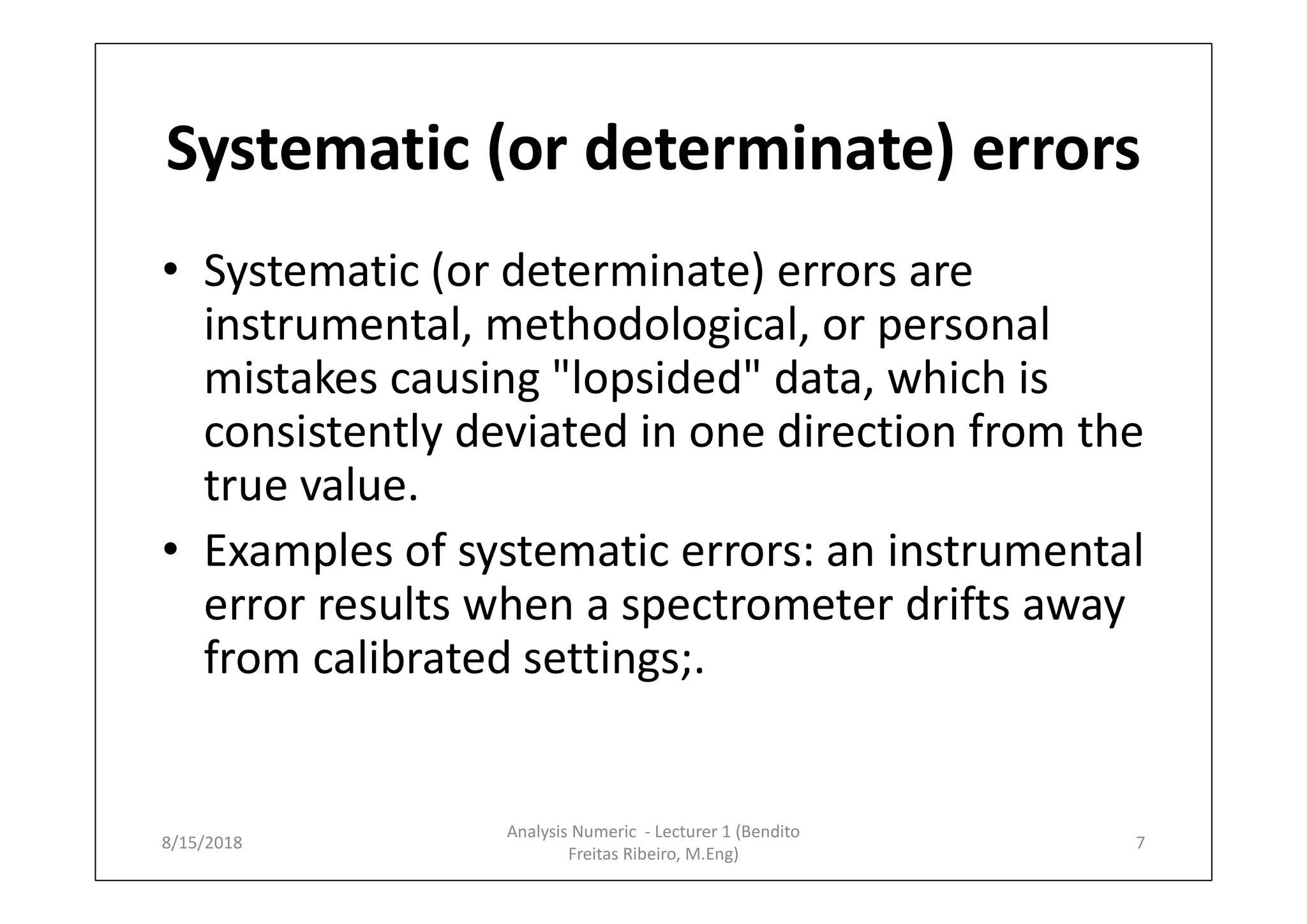
Systematic (or determinate) errors
• Systematic (or determinate) errors are
instrumental, methodological, or personal
mistakes causing "lopsided" data, which is
consistently deviated in one direction from the
true value.
• Examples of systematic errors: an instrumental
error results when a spectrometer drifts away
from calibrated settings;.
8/15/2018 7
Analysis Numeric - Lecturer 1 (Bendito
Freitas Ribeiro, M.Eng)
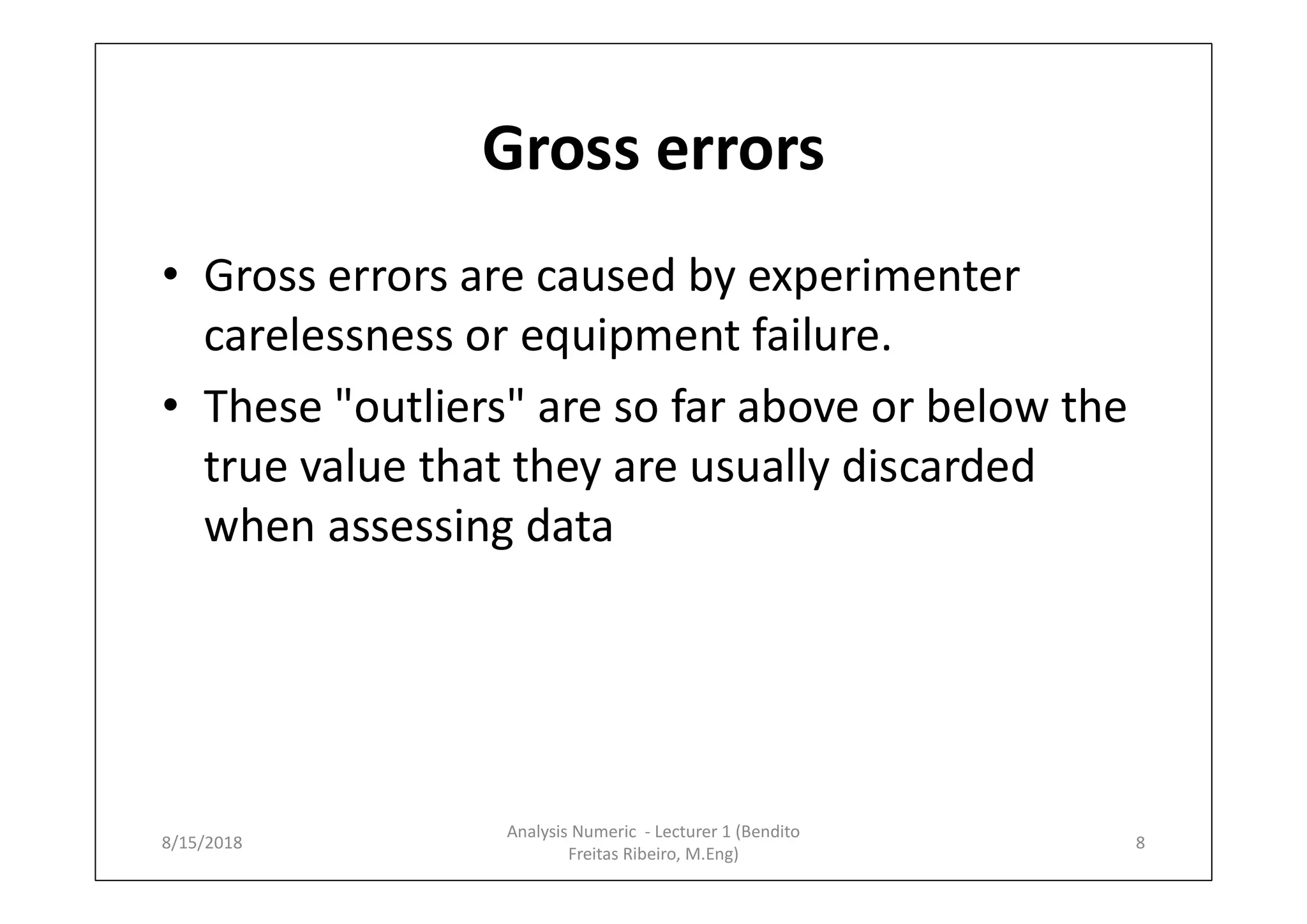
Gross errors
• Gross errors are caused by experimenter
carelessness or equipment failure.
• These "outliers" are so far above or below the
true value that they are usually discarded
when assessing data
8/15/2018 8
Analysis Numeric - Lecturer 1 (Bendito
Freitas Ribeiro, M.Eng)
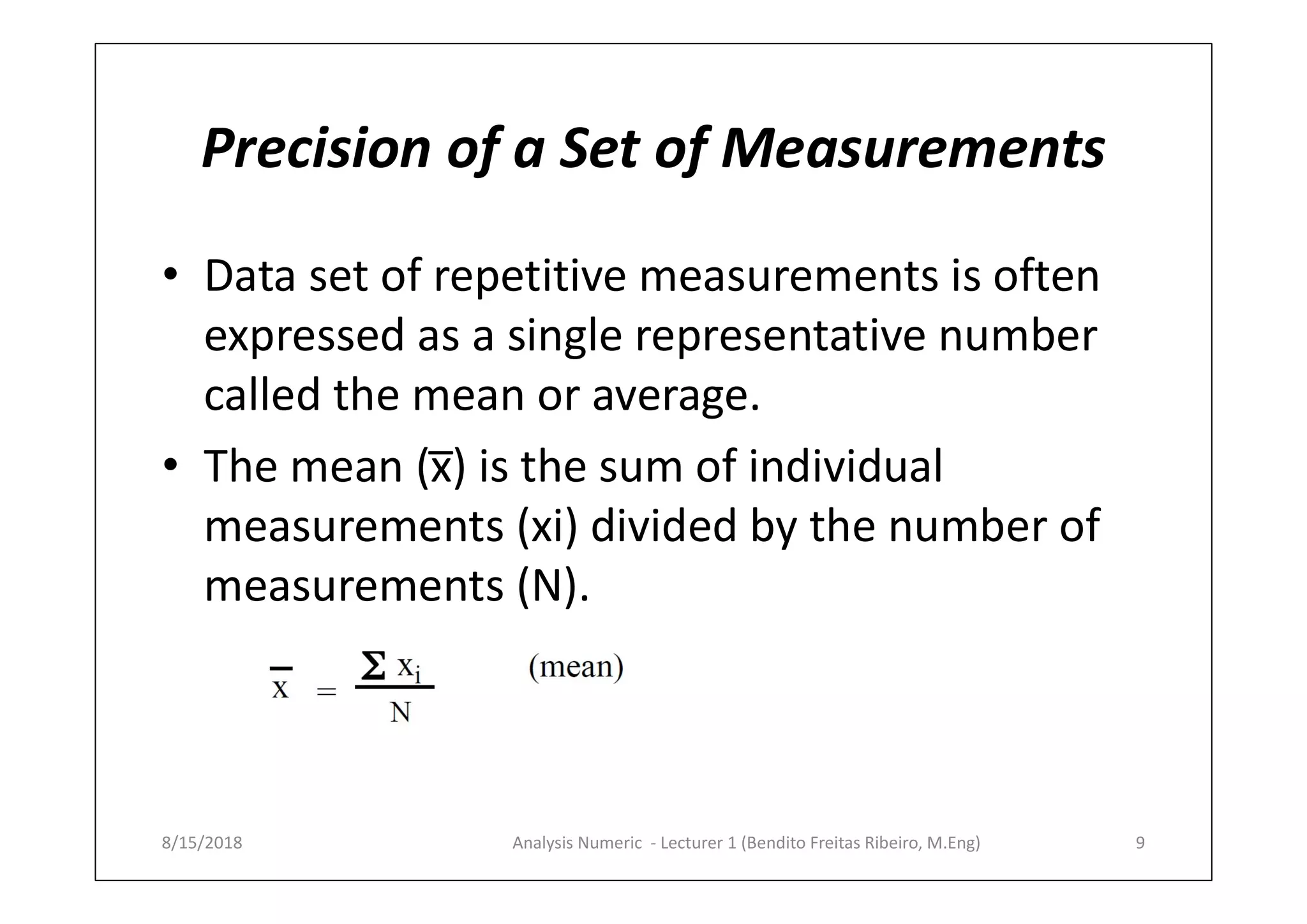
Precision of a Set of Measurements
• Data set of repetitive measurements is often
expressed as a single representative number
called the mean or average.
• The mean (x̅) is the sum of individual
measurements (xi) divided by the number of
measurements (N).
8/15/2018 9Analysis Numeric - Lecturer 1 (Bendito Freitas Ribeiro, M.Eng)
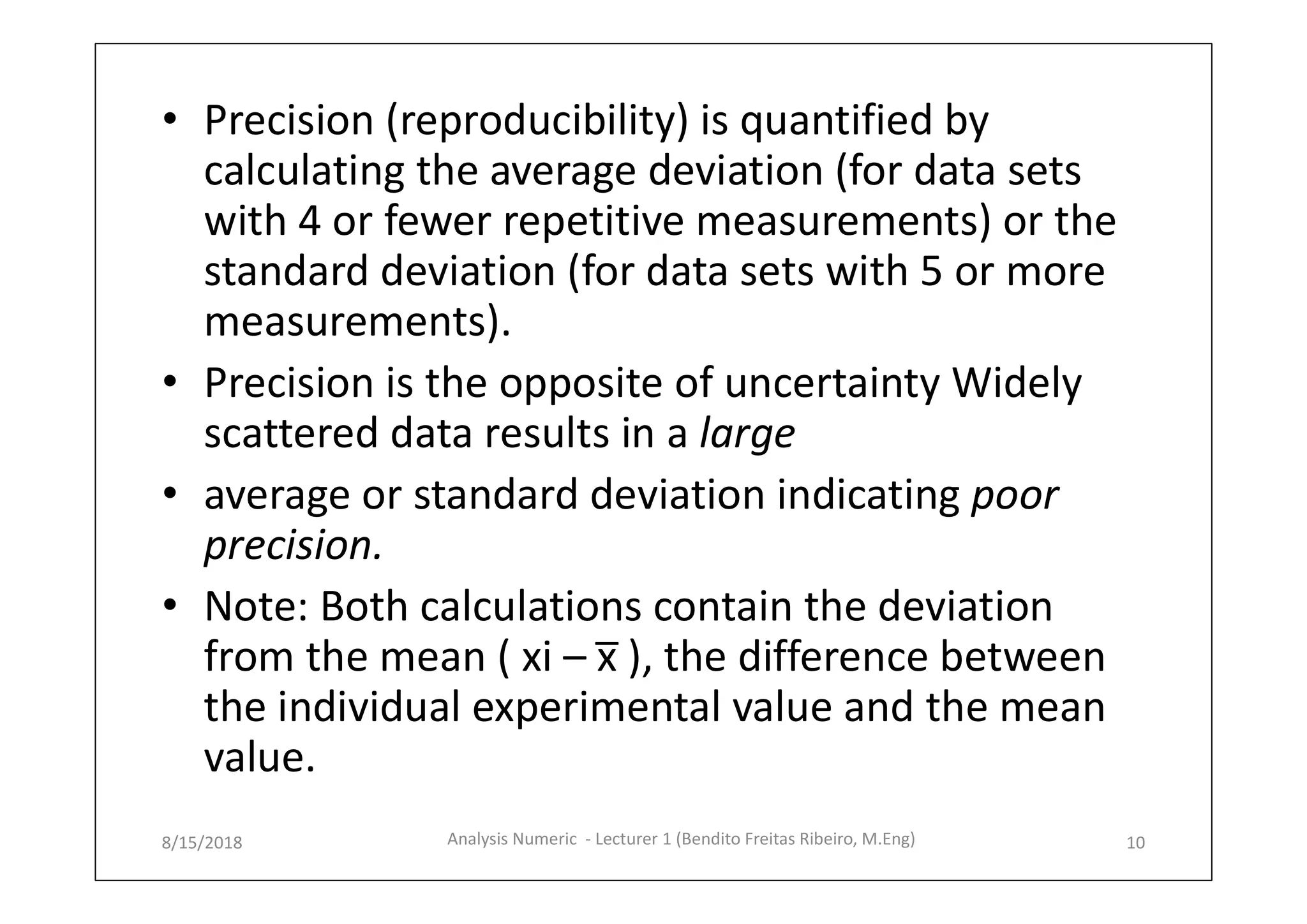
• Precision (reproducibility) is quantified by
calculating the average deviation (for data sets
with 4 or fewer repetitive measurements) or the
standard deviation (for data sets with 5 or more
measurements).
• Precision is the opposite of uncertainty Widely
scattered data results in a large
• average or standard deviation indicating poor
precision.
• Note: Both calculations contain the deviation
from the mean ( xi – x̅ ), the difference between
the individual experimental value and the mean
value.
8/15/2018 10Analysis Numeric - Lecturer 1 (Bendito Freitas Ribeiro, M.Eng)
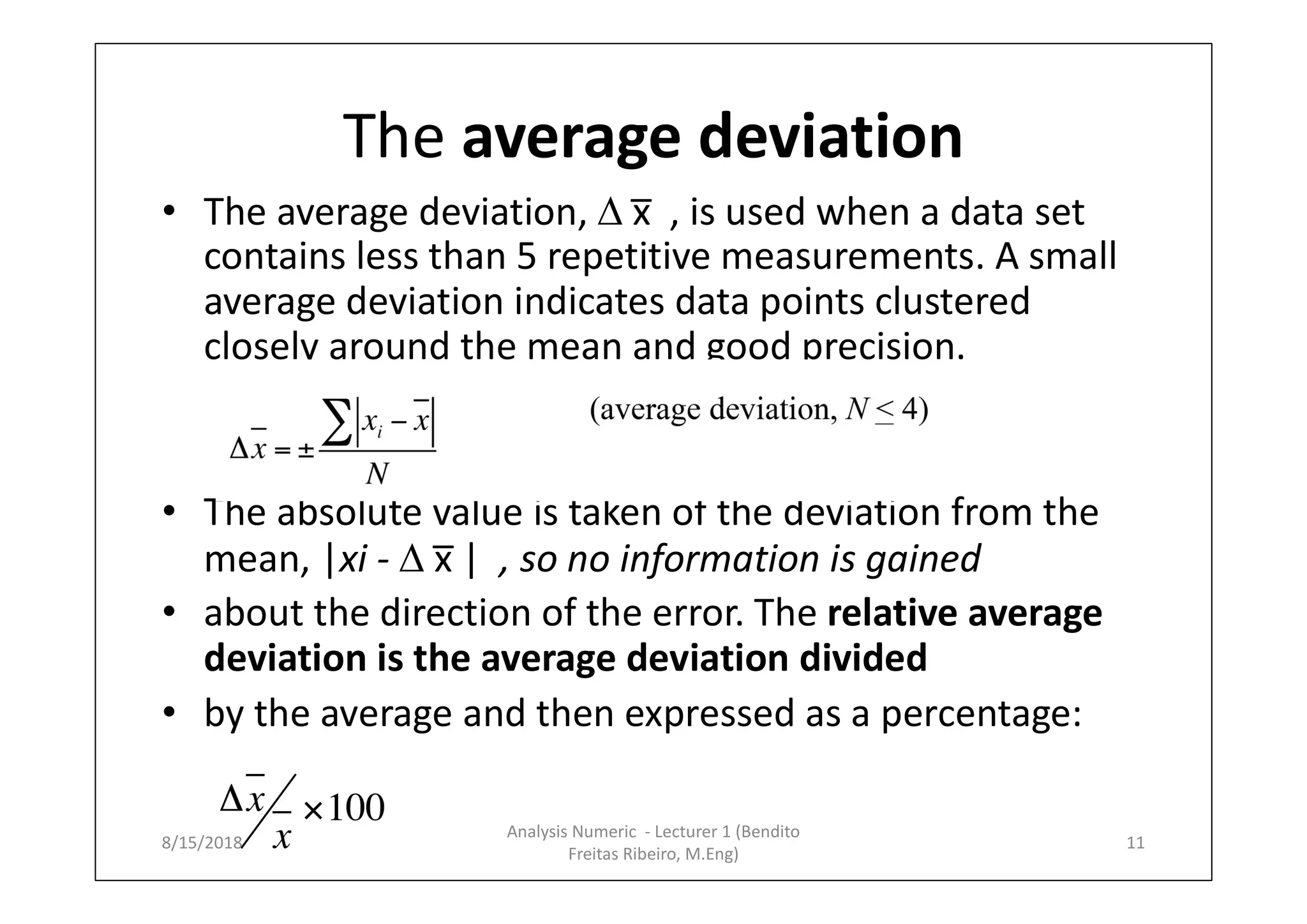
The average deviation
• The average deviation,  x̅ , is used when a data set
contains less than 5 repetitive measurements. A small
average deviation indicates data points clustered
closely around the mean and good precision.
• The absolute value is taken of the deviation from the
mean, |xi -  x̅ | , so no information is gained
• about the direction of the error. The relative average
deviation is the average deviation divided
• by the average and then expressed as a percentage:
8/15/2018 11
Analysis Numeric - Lecturer 1 (Bendito
Freitas Ribeiro, M.Eng)
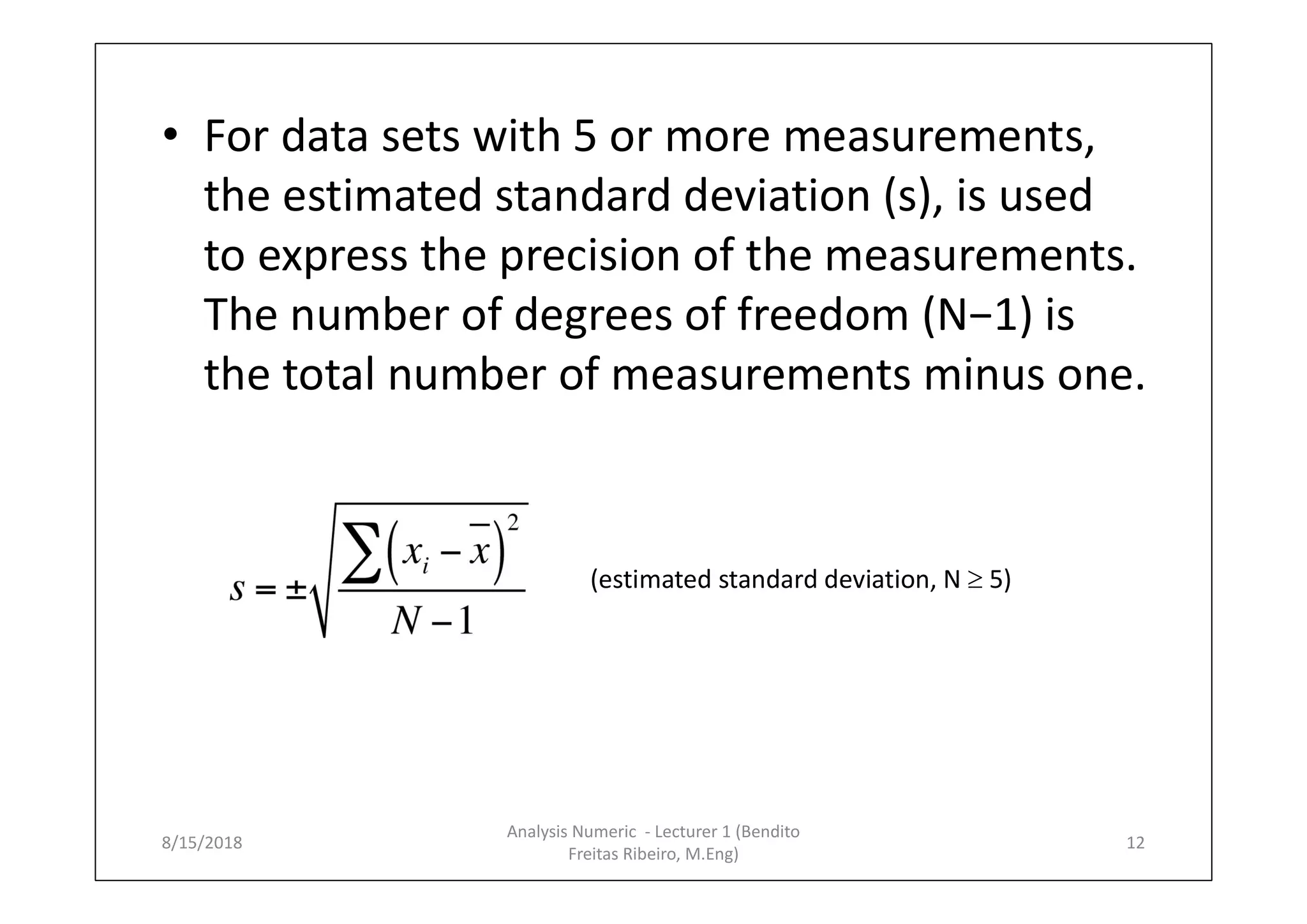
• For data sets with 5 or more measurements,
the estimated standard deviation (s), is used
to express the precision of the measurements.
The number of degrees of freedom (N−1) is
the total number of measurements minus one.
(estimated standard deviation, N  5)
8/15/2018 12
Analysis Numeric - Lecturer 1 (Bendito
Freitas Ribeiro, M.Eng)
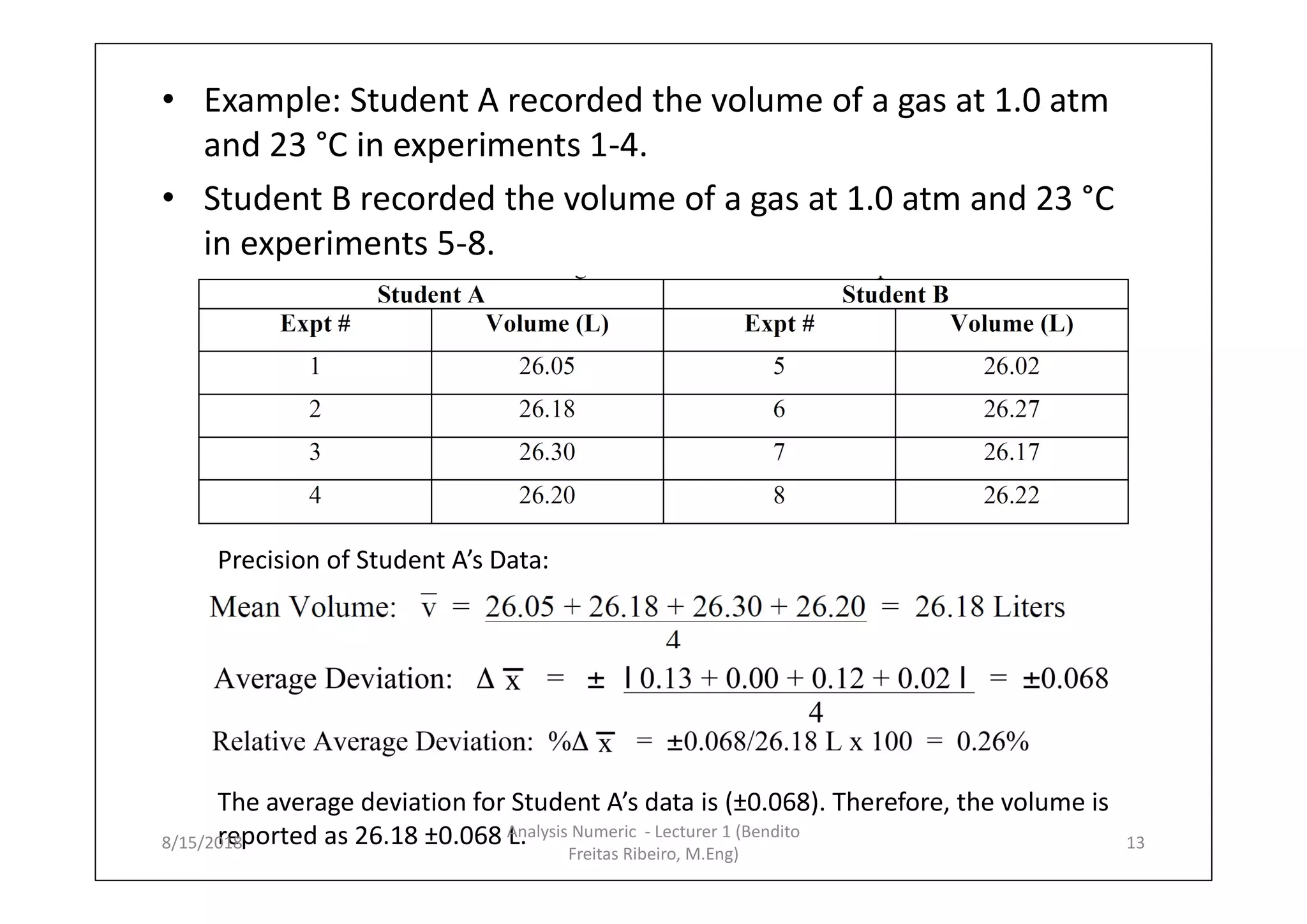
• Example: Student A recorded the volume of a gas at 1.0 atm
and 23 °C in experiments 1-4.
• Student B recorded the volume of a gas at 1.0 atm and 23 °C
in experiments 5-8.
Precision of Student A’s Data:
The average deviation for Student A’s data is (±0.068). Therefore, the volume is
reported as 26.18 ±0.068 L.8/15/2018 13
Analysis Numeric - Lecturer 1 (Bendito
Freitas Ribeiro, M.Eng)
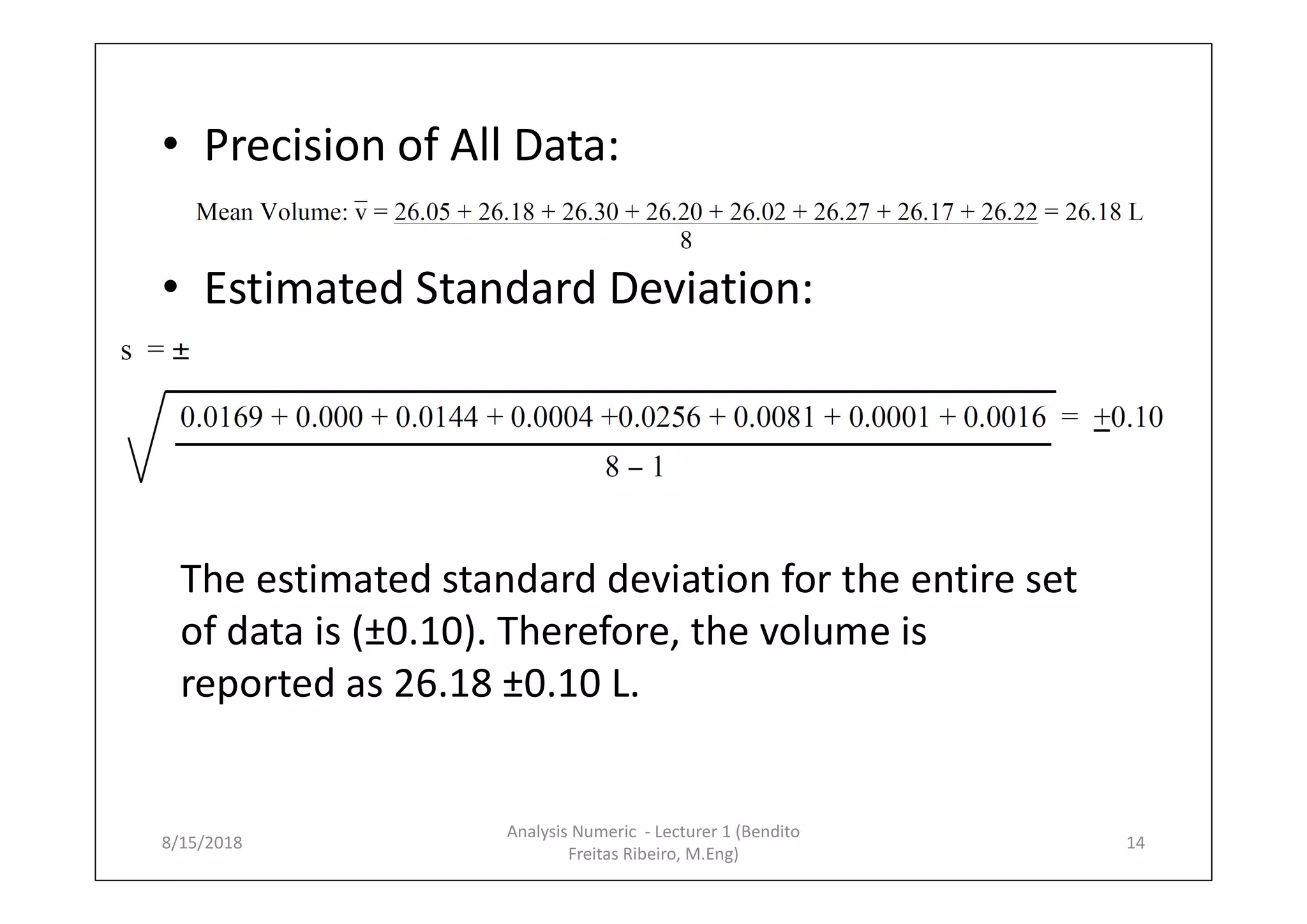
• Precision of All Data:
• Estimated Standard Deviation:
The estimated standard deviation for the entire set
of data is (±0.10). Therefore, the volume is
reported as 26.18 ±0.10 L.
8/15/2018 14
Analysis Numeric - Lecturer 1 (Bendito
Freitas Ribeiro, M.Eng)
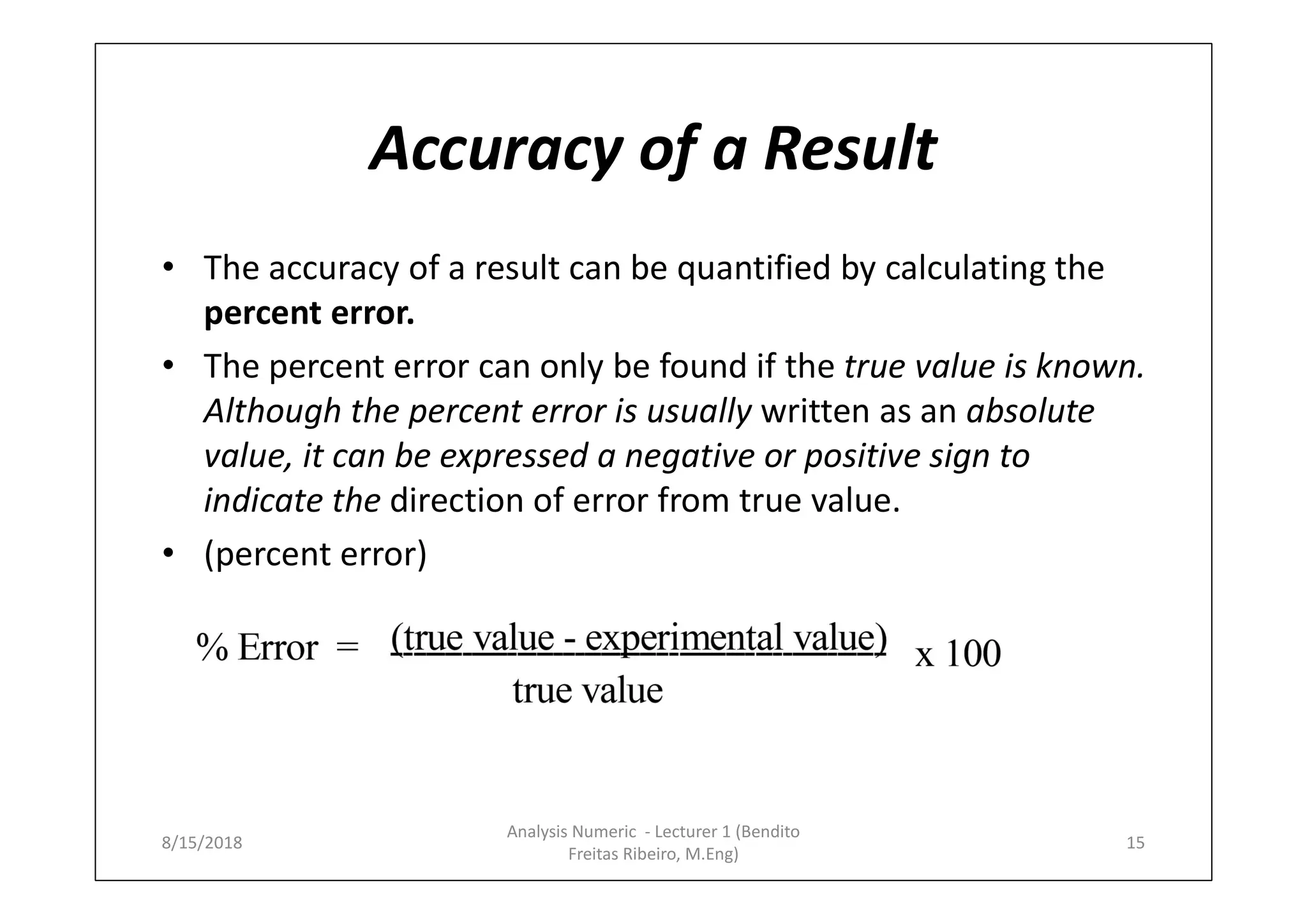
Accuracy of a Result
• The accuracy of a result can be quantified by calculating the
percent error.
• The percent error can only be found if the true value is known.
Although the percent error is usually written as an absolute
value, it can be expressed a negative or positive sign to
indicate the direction of error from true value.
• (percent error)
8/15/2018
Analysis Numeric - Lecturer 1 (Bendito
Freitas Ribeiro, M.Eng)
15
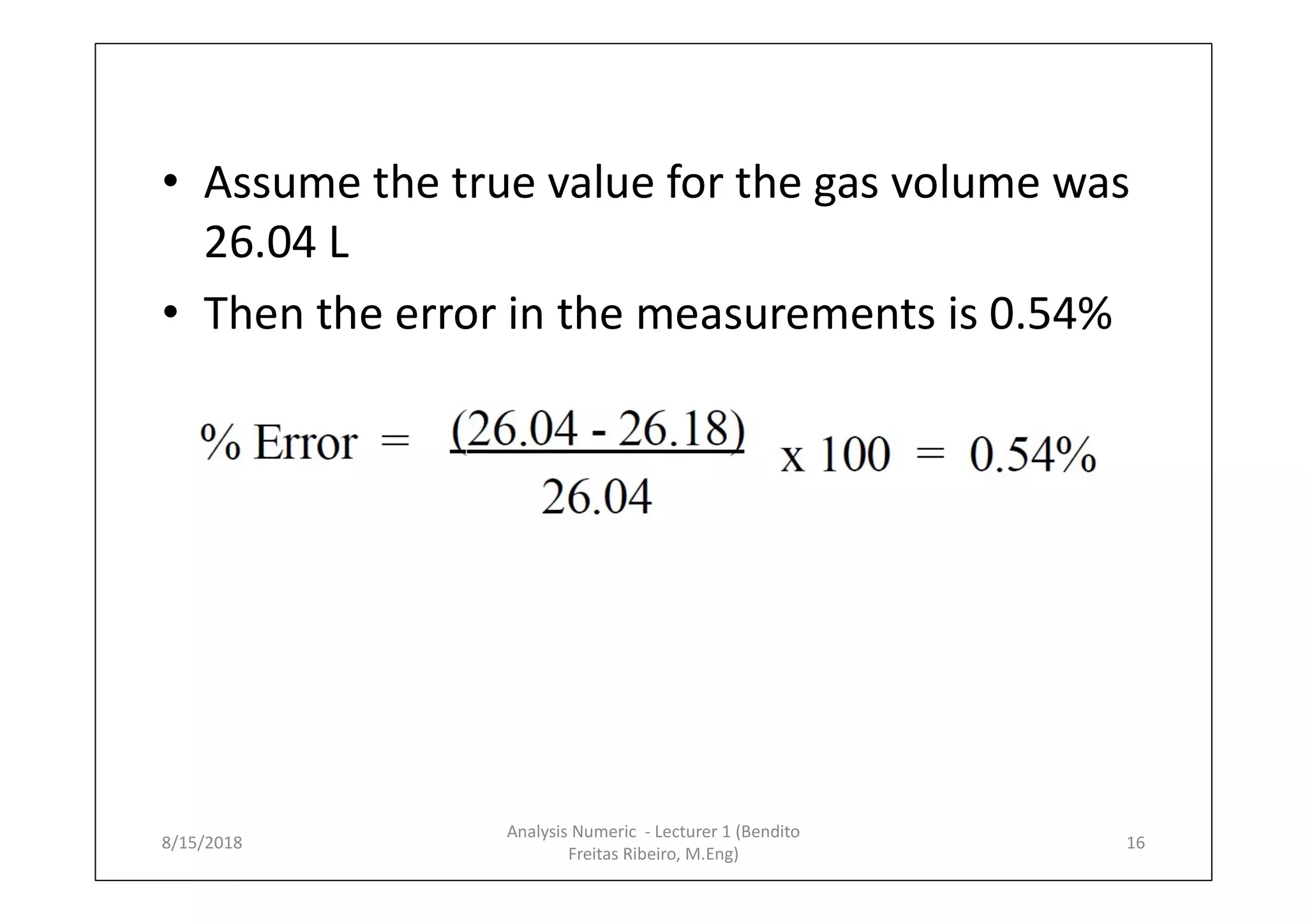
• Assume the true value for the gas volume was
26.04 L
• Then the error in the measurements is 0.54%
8/15/2018
Analysis Numeric - Lecturer 1 (Bendito
Freitas Ribeiro, M.Eng)
16
Error Propagation
• When combining measurements with
standard deviations in mathematical
operations, the answer’s standard deviation is
a combination of the standard deviations of
the initial measurements. In other words, the
error is "propagated".
8/15/2018 17
Analysis Numeric - Lecturer 1 (Bendito
Freitas Ribeiro, M.Eng)
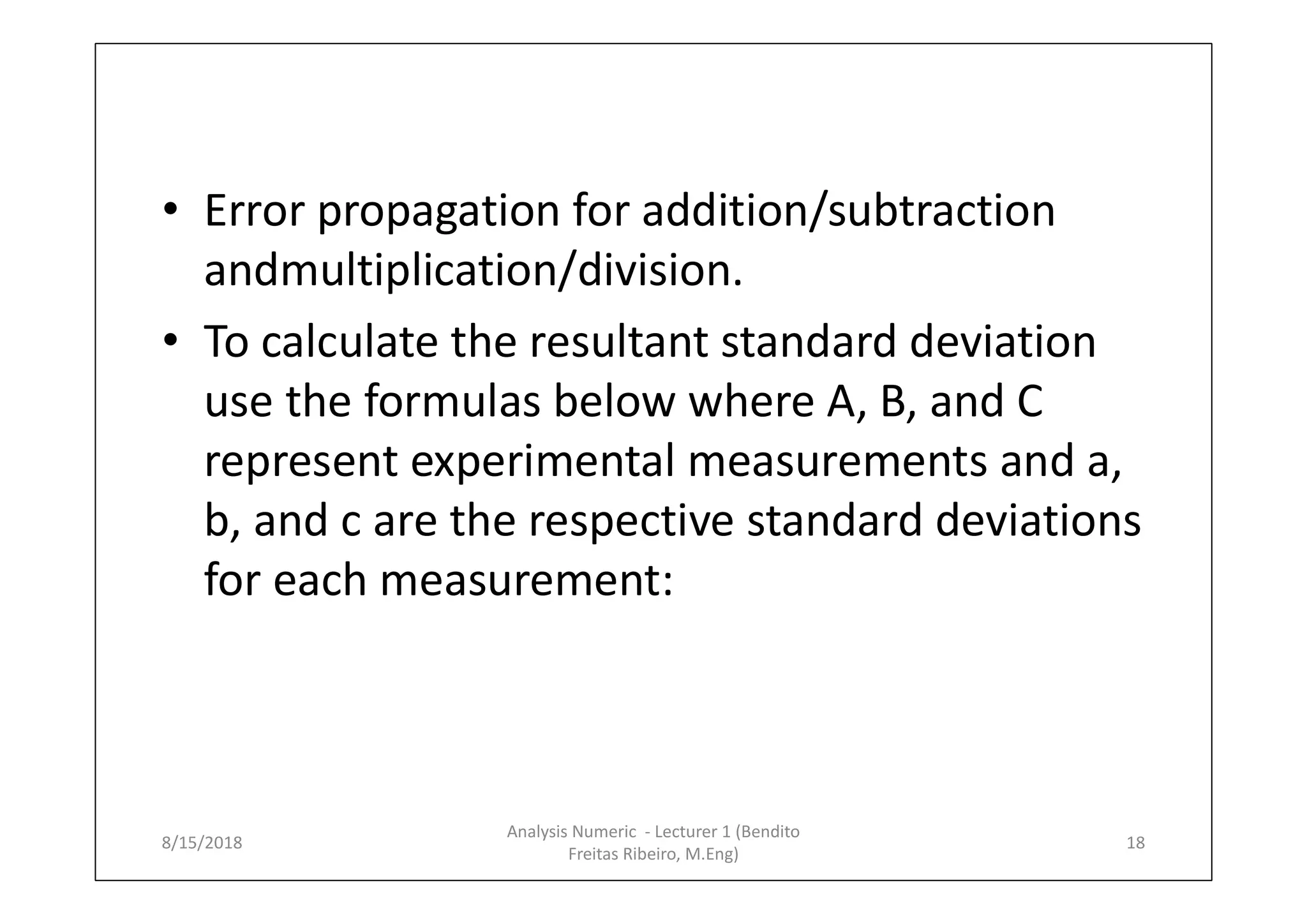
• Error propagation for addition/subtraction
andmultiplication/division.
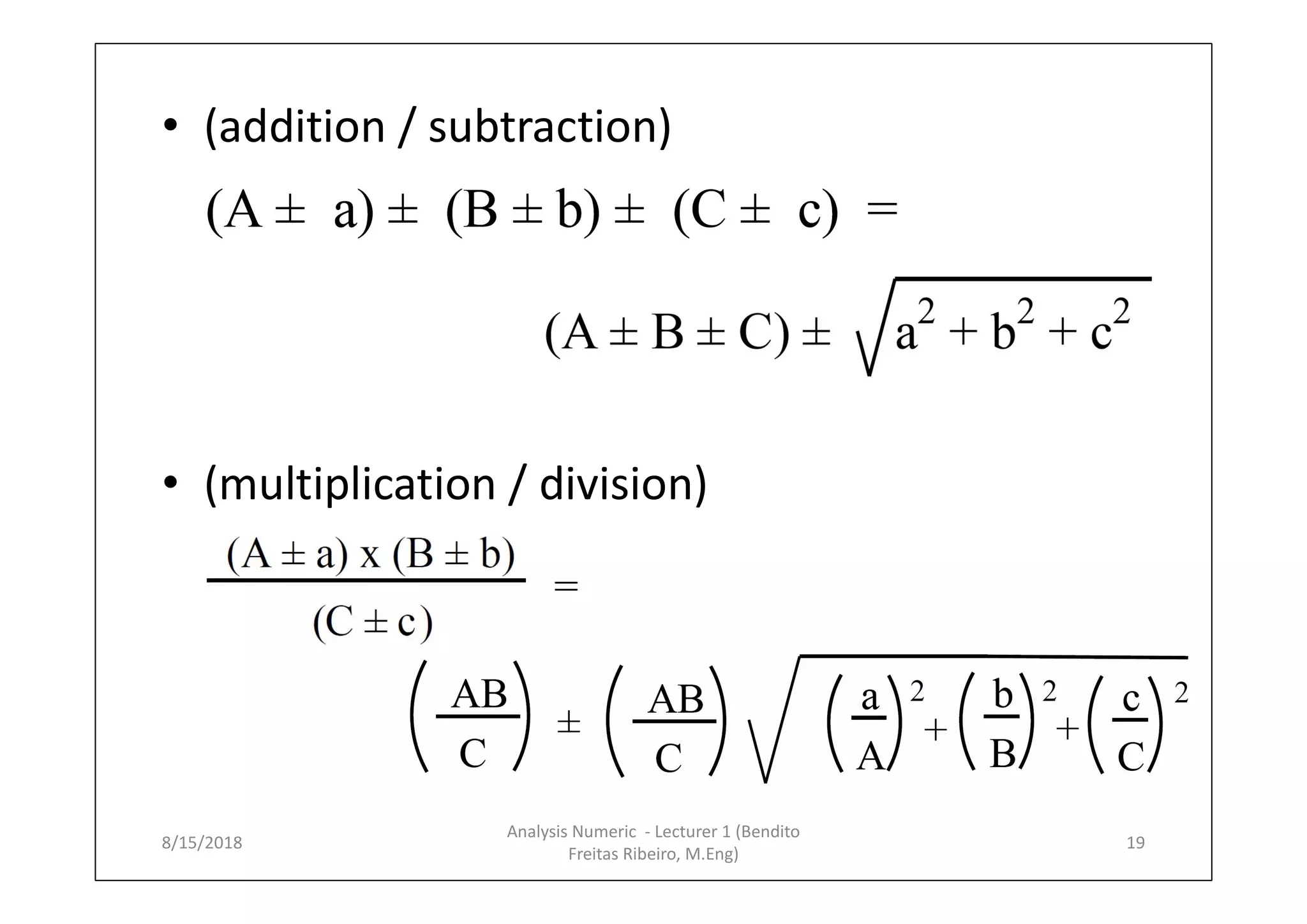
• To calculate the resultant standard deviation
use the formulas below where A, B, and C
represent experimental measurements and a,
b, and c are the respective standard deviations
for each measurement:
8/15/2018 18
Analysis Numeric - Lecturer 1 (Bendito
Freitas Ribeiro, M.Eng)
• (addition / subtraction)
• (multiplication / division)
8/15/2018 19
Analysis Numeric - Lecturer 1 (Bendito
Freitas Ribeiro, M.Eng)
Exercise 1
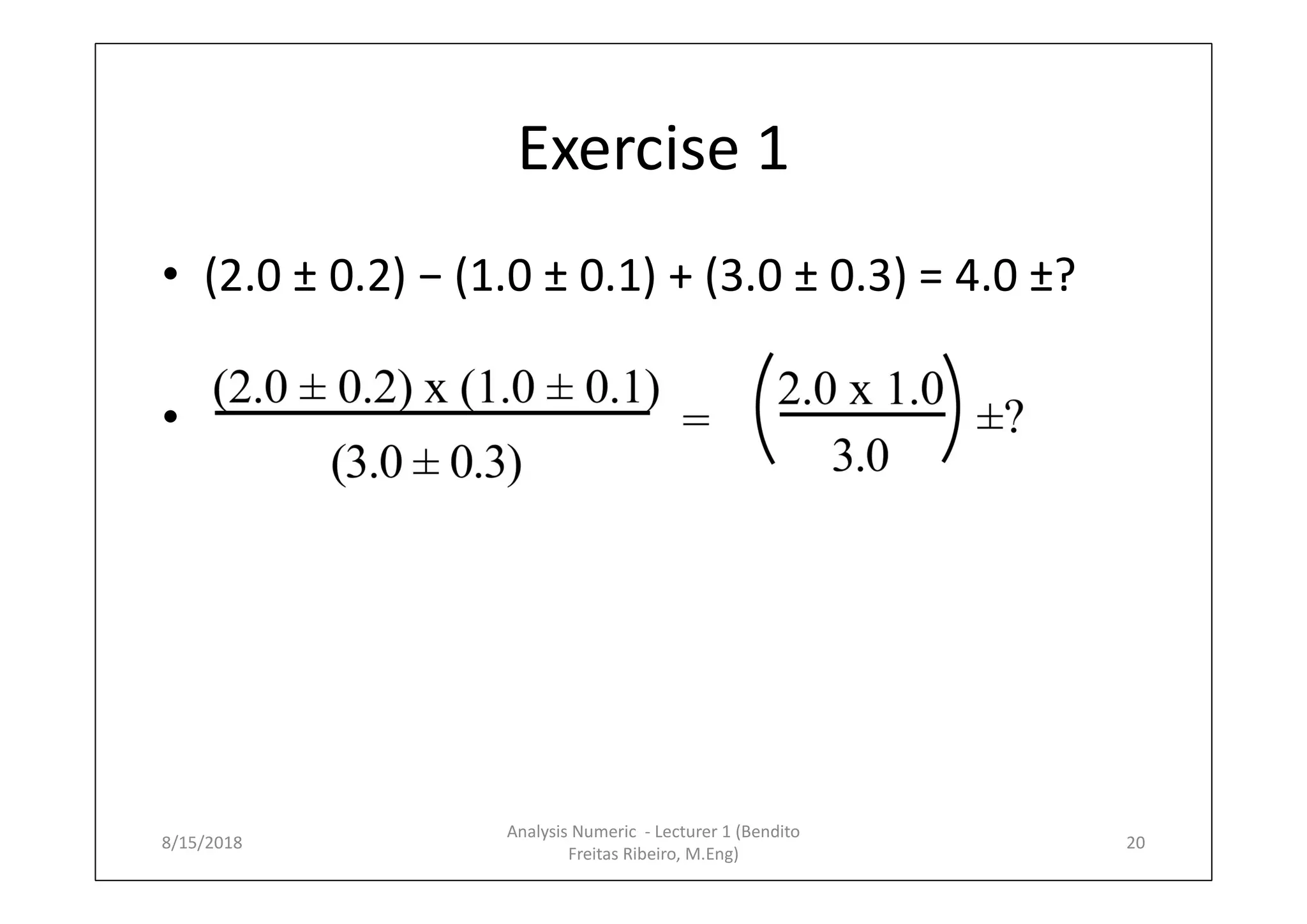
• (2.0 ± 0.2) − (1.0 ± 0.1) + (3.0 ± 0.3) = 4.0 ±?
• .
8/15/2018
Analysis Numeric - Lecturer 1 (Bendito
Freitas Ribeiro, M.Eng)
20
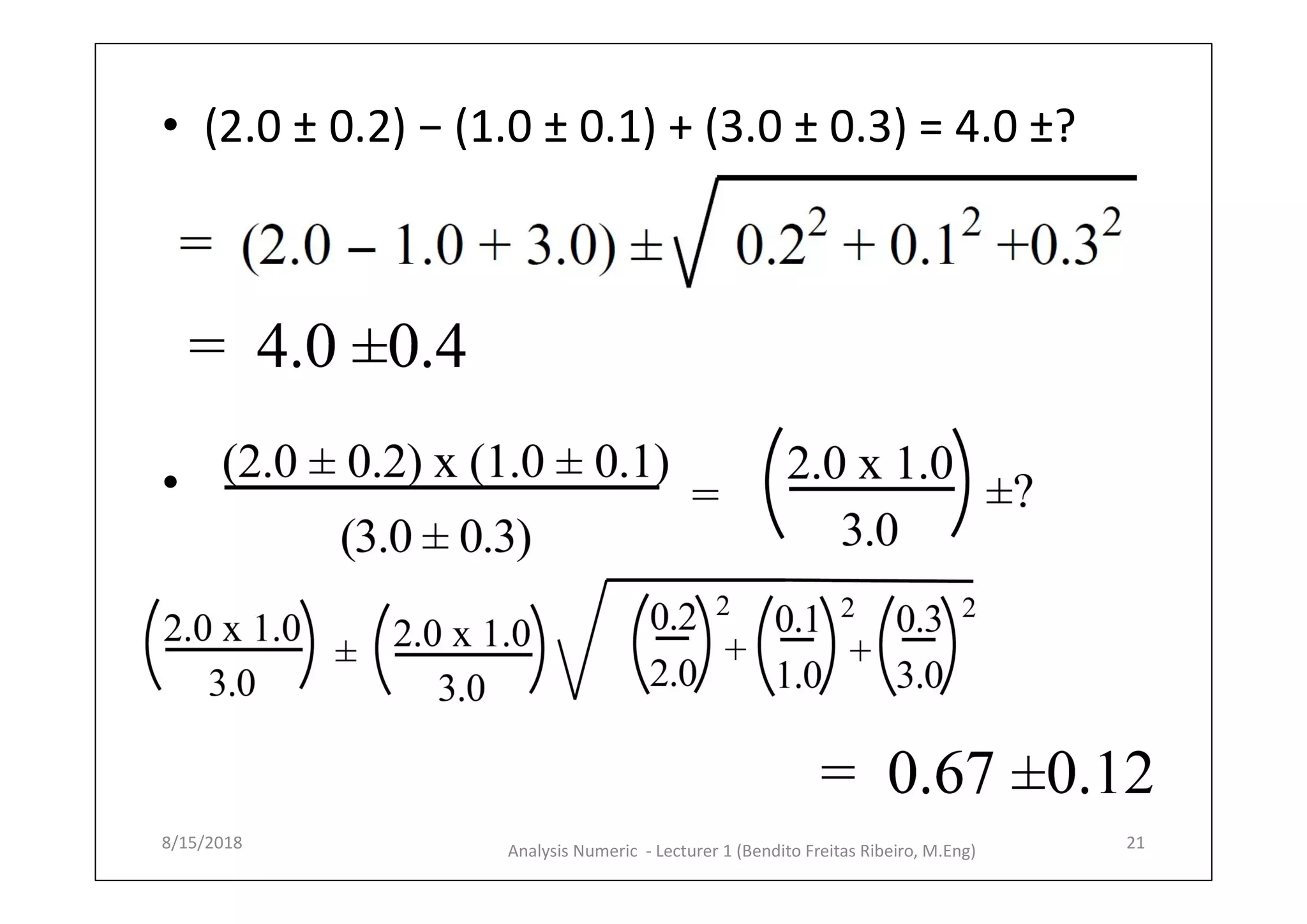
• (2.0 ± 0.2) − (1.0 ± 0.1) + (3.0 ± 0.3) = 4.0 ±?
• .
8/15/2018 Analysis Numeric - Lecturer 1 (Bendito Freitas Ribeiro, M.Eng) 21

Lecturer 1 numerical analysis

  • 1.
    Lecture 1 Analysis Numeric By:Bendito F. Ribeiro, M.Eng 8/15/2018 1 Electronic and Electrical Engineering Department Faculty of Engineering Science and Technology National University of Timor Leste UNTL 2018 Mail: bennyfribeiro@gmail.com
  • 2.
    Outline • Supporting theory(basic math) • Algorithm • Precision and Accuracy , • Standard deviation • Error propagation • Exercise 1 8/15/2018 2 Analysis Numeric - Lecturer 1 (Bendito Freitas Ribeiro, M.Eng)
  • 3.
    ALGORITHMS • Find thesquare root of 2 to four decimal places. 8/15/2018 3 Analysis Numeric - Lecturer 1 (Bendito Freitas Ribeiro, M.Eng)
  • 4.
    ERROR • Three generaltypes of errors: random error, systematic error, and gross errors. • Error Analysis: – Error propagation, numerical stability, Error estimation, Error cancellation, Condition numbers. • Suppose the number 0.1492 is correct to the four decimal places given. a true value that lies somewhere in the interval between 0.14915 and 0.14925 8/15/2018 4 Analysis Numeric - Lecturer 1 (Bendito Freitas Ribeiro, M.Eng)
  • 5.
    Precision and Accuracy •If the centre of the target is the "true value“ • A is neither precise nor accurate • Target B is precise (reproducible) but not accurate. • The average of target C's marks give an accurate result but precision is poor. • Target D demonstrates both precision and accuracy 8/15/2018 5 Analysis Numeric - Lecturer 1 (Bendito Freitas Ribeiro, M.Eng)
  • 6.
    Random (or indeterminate)errors • Random (or indeterminate) errors are caused by uncontrollable fluctuations in variables that affect experimental results. • For example, air fluctuations occurring as students open and close lab doors cause changes in pressure readings • The estimated standard deviation (the error range for a data set) is often reported with measurements because random errors are difficult to eliminate. 8/15/2018 6 Analysis Numeric - Lecturer 1 (Bendito Freitas Ribeiro, M.Eng)
  • 7.
    Systematic (or determinate)errors • Systematic (or determinate) errors are instrumental, methodological, or personal mistakes causing "lopsided" data, which is consistently deviated in one direction from the true value. • Examples of systematic errors: an instrumental error results when a spectrometer drifts away from calibrated settings;. 8/15/2018 7 Analysis Numeric - Lecturer 1 (Bendito Freitas Ribeiro, M.Eng)
  • 8.
    Gross errors • Grosserrors are caused by experimenter carelessness or equipment failure. • These "outliers" are so far above or below the true value that they are usually discarded when assessing data 8/15/2018 8 Analysis Numeric - Lecturer 1 (Bendito Freitas Ribeiro, M.Eng)
  • 9.
    Precision of aSet of Measurements • Data set of repetitive measurements is often expressed as a single representative number called the mean or average. • The mean (x̅) is the sum of individual measurements (xi) divided by the number of measurements (N). 8/15/2018 9Analysis Numeric - Lecturer 1 (Bendito Freitas Ribeiro, M.Eng)
  • 10.
    • Precision (reproducibility)is quantified by calculating the average deviation (for data sets with 4 or fewer repetitive measurements) or the standard deviation (for data sets with 5 or more measurements). • Precision is the opposite of uncertainty Widely scattered data results in a large • average or standard deviation indicating poor precision. • Note: Both calculations contain the deviation from the mean ( xi – x̅ ), the difference between the individual experimental value and the mean value. 8/15/2018 10Analysis Numeric - Lecturer 1 (Bendito Freitas Ribeiro, M.Eng)
  • 11.
    The average deviation •The average deviation,  x̅ , is used when a data set contains less than 5 repetitive measurements. A small average deviation indicates data points clustered closely around the mean and good precision. • The absolute value is taken of the deviation from the mean, |xi -  x̅ | , so no information is gained • about the direction of the error. The relative average deviation is the average deviation divided • by the average and then expressed as a percentage: 8/15/2018 11 Analysis Numeric - Lecturer 1 (Bendito Freitas Ribeiro, M.Eng)
  • 12.
    • For datasets with 5 or more measurements, the estimated standard deviation (s), is used to express the precision of the measurements. The number of degrees of freedom (N−1) is the total number of measurements minus one. (estimated standard deviation, N  5) 8/15/2018 12 Analysis Numeric - Lecturer 1 (Bendito Freitas Ribeiro, M.Eng)
  • 13.
    • Example: StudentA recorded the volume of a gas at 1.0 atm and 23 °C in experiments 1-4. • Student B recorded the volume of a gas at 1.0 atm and 23 °C in experiments 5-8. Precision of Student A’s Data: The average deviation for Student A’s data is (±0.068). Therefore, the volume is reported as 26.18 ±0.068 L.8/15/2018 13 Analysis Numeric - Lecturer 1 (Bendito Freitas Ribeiro, M.Eng)
  • 14.
    • Precision ofAll Data: • Estimated Standard Deviation: The estimated standard deviation for the entire set of data is (±0.10). Therefore, the volume is reported as 26.18 ±0.10 L. 8/15/2018 14 Analysis Numeric - Lecturer 1 (Bendito Freitas Ribeiro, M.Eng)
  • 15.
    Accuracy of aResult • The accuracy of a result can be quantified by calculating the percent error. • The percent error can only be found if the true value is known. Although the percent error is usually written as an absolute value, it can be expressed a negative or positive sign to indicate the direction of error from true value. • (percent error) 8/15/2018 Analysis Numeric - Lecturer 1 (Bendito Freitas Ribeiro, M.Eng) 15
  • 16.
    • Assume thetrue value for the gas volume was 26.04 L • Then the error in the measurements is 0.54% 8/15/2018 Analysis Numeric - Lecturer 1 (Bendito Freitas Ribeiro, M.Eng) 16
  • 17.
    Error Propagation • Whencombining measurements with standard deviations in mathematical operations, the answer’s standard deviation is a combination of the standard deviations of the initial measurements. In other words, the error is "propagated". 8/15/2018 17 Analysis Numeric - Lecturer 1 (Bendito Freitas Ribeiro, M.Eng)
  • 18.
    • Error propagationfor addition/subtraction andmultiplication/division. • To calculate the resultant standard deviation use the formulas below where A, B, and C represent experimental measurements and a, b, and c are the respective standard deviations for each measurement: 8/15/2018 18 Analysis Numeric - Lecturer 1 (Bendito Freitas Ribeiro, M.Eng)
  • 19.
    • (addition /subtraction) • (multiplication / division) 8/15/2018 19 Analysis Numeric - Lecturer 1 (Bendito Freitas Ribeiro, M.Eng)
  • 20.
    Exercise 1 • (2.0± 0.2) − (1.0 ± 0.1) + (3.0 ± 0.3) = 4.0 ±? • . 8/15/2018 Analysis Numeric - Lecturer 1 (Bendito Freitas Ribeiro, M.Eng) 20
  • 21.
    • (2.0 ±0.2) − (1.0 ± 0.1) + (3.0 ± 0.3) = 4.0 ±? • . 8/15/2018 Analysis Numeric - Lecturer 1 (Bendito Freitas Ribeiro, M.Eng) 21