By info@stefan-moser.com
You want to technically
investigate the causes of
complaints?
But ... Can‘t find a starting
point because of too many
factors?
By info@stefan-moser.com
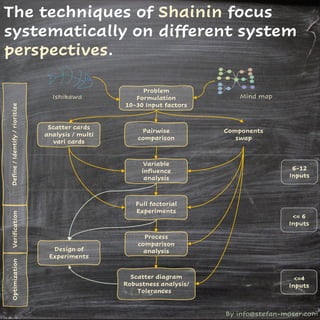
The techniques of Shainin focus
systematically on different system
perspectives.
Problem
Formulation
10-30 Input factors
Pairwise
comparison
Components
swap
Scatter cards
analysis / multi
vari cards
Variable
influence
analysis
Full factorial
Experiments
Process
comparison
analysis
Scatter diagram
Robustness analysis/
Tolerances
Design of
Experiments
Verification
Optimization
Ishikawa Mind map
6-12
Inputs
<= 6
Inputs
<=4
Inputs
Define
/
Identify
/
rioritize
By info@stefan-moser.com
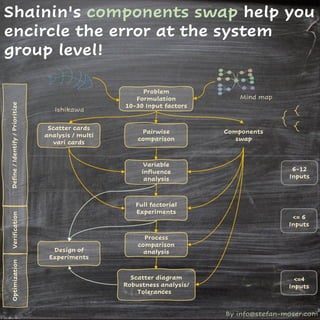
Shainin's components swap help you
encircle the error at the system
group level!
Problem
Formulation
10-30 Input factors
Pairwise
comparison
Components
swap
Scatter cards
analysis / multi
vari cards
Variable
influence
analysis
Full factorial
Experiments
Process
comparison
analysis
Scatter diagram
Robustness analysis/
Tolerances
Design of
Experiments
Verification
Optimization
Ishikawa
Mind map
6-12
Inputs
<= 6
Inputs
<=4
Inputs
Define
/
Identify
/
Prioritize
By info@stefan-moser.com
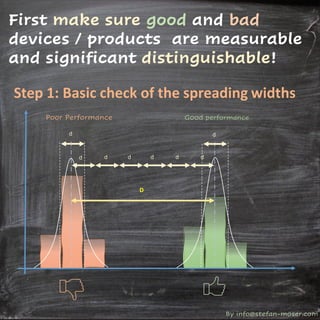
First make sure good and bad
devices / products are measurable
and significant distinguishable!
Step 1: Basic check of the spreading widths
d d d d d
d
D
d
Poor Performance Good performance
d
By info@stefan-moser.com
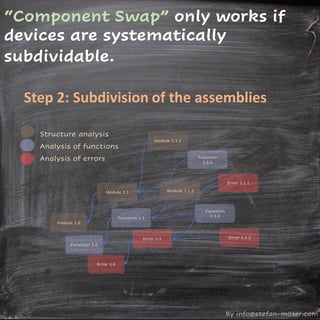
“Component Swap” only works if
devices are systematically
subdividable.
Step 2: Subdivision of the assemblies
Structure analysis
Analysis of functions
Analysis of errors
Module 1.1
Module 1.1.1
Module 1.0
Function 1.1
Function
1.1.1
Function 1.0
Error 1.1
Error 1.1.1
Error 1.0
Module 1.1.2
Function
1.1.2
Error 1.1.2
By info@stefan-moser.com
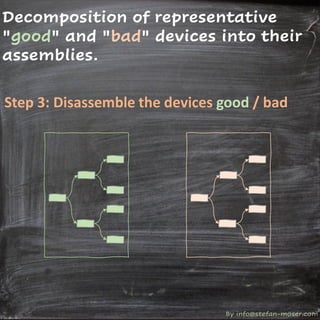
Decomposition of representative
"good" and "bad" devices into their
assemblies.
Step 3: Disassemble the devices good / bad
By info@stefan-moser.com
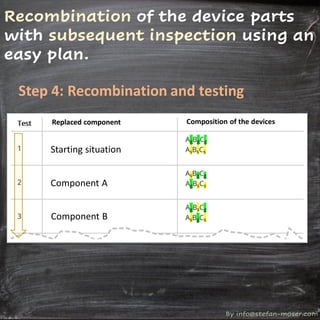
Recombination of the device parts
with subsequent inspection using an
easy plan.
Step 4: Recombination and testing
Starting situation
Component A
Component B
Replaced component Composition of the devices
By info@stefan-moser.com
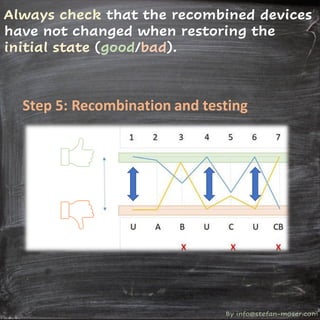
Always check that the recombined devices
have not changed when restoring the
initial state (good/bad).
Step 5: Recombination and testing
By info@stefan-moser.com
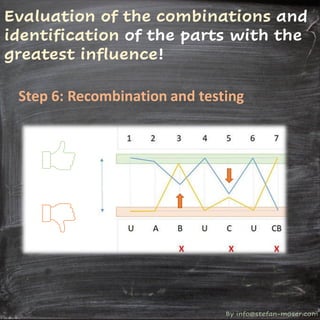
Evaluation of the combinations and
identification of the parts with the
greatest influence!
Step 6: Recombination and testing
By info@stefan-moser.com
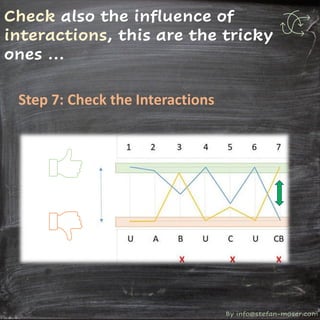
Check also the influence of
interactions, this are the tricky
ones …
Step 7: Check the Interactions
By info@stefan-moser.com
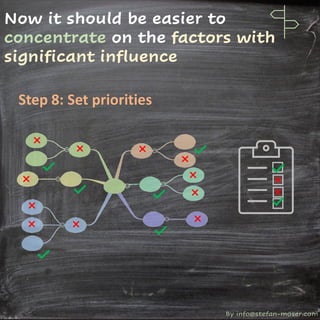
Now it should be easier to
concentrate on the factors with
significant influence
Step 8: Set priorities
By info@stefan-moser.com
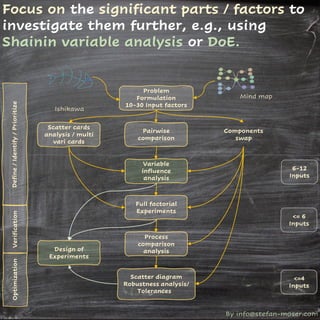
Focus on the significant parts / factors to
investigate them further, e.g., using
Shainin variable analysis or DoE.
Problem
Formulation
10-30 Input factors
Pairwise
comparison
Components
swap
Scatter cards
analysis / multi
vari cards
Variable
influence
analysis
Full factorial
Experiments
Process
comparison
analysis
Scatter diagram
Robustness analysis/
Tolerances
Design of
Experiments
Verification
Optimization
Ishikawa
Mind map
6-12
Inputs
<= 6
Inputs
<=4
Inputs
Define
/
Identify
/
Prioritize
By info@stefan-moser.com
Want to know more about
QBD/DFSS/DoE methods?
www.stefan-moser.com
... like it
and thanks for a
comment!

S01 Shainin component swap, DoE

  • 1.
    By info@stefan-moser.com You wantto technically investigate the causes of complaints? But ... Can‘t find a starting point because of too many factors?
  • 2.
    By info@stefan-moser.com The techniquesof Shainin focus systematically on different system perspectives. Problem Formulation 10-30 Input factors Pairwise comparison Components swap Scatter cards analysis / multi vari cards Variable influence analysis Full factorial Experiments Process comparison analysis Scatter diagram Robustness analysis/ Tolerances Design of Experiments Verification Optimization Ishikawa Mind map 6-12 Inputs <= 6 Inputs <=4 Inputs Define / Identify / rioritize
  • 3.
    By info@stefan-moser.com Shainin's componentsswap help you encircle the error at the system group level! Problem Formulation 10-30 Input factors Pairwise comparison Components swap Scatter cards analysis / multi vari cards Variable influence analysis Full factorial Experiments Process comparison analysis Scatter diagram Robustness analysis/ Tolerances Design of Experiments Verification Optimization Ishikawa Mind map 6-12 Inputs <= 6 Inputs <=4 Inputs Define / Identify / Prioritize
  • 4.
    By info@stefan-moser.com First makesure good and bad devices / products are measurable and significant distinguishable! Step 1: Basic check of the spreading widths d d d d d d D d Poor Performance Good performance d
  • 5.
    By info@stefan-moser.com “Component Swap”only works if devices are systematically subdividable. Step 2: Subdivision of the assemblies Structure analysis Analysis of functions Analysis of errors Module 1.1 Module 1.1.1 Module 1.0 Function 1.1 Function 1.1.1 Function 1.0 Error 1.1 Error 1.1.1 Error 1.0 Module 1.1.2 Function 1.1.2 Error 1.1.2
  • 6.
    By info@stefan-moser.com Decomposition ofrepresentative "good" and "bad" devices into their assemblies. Step 3: Disassemble the devices good / bad
  • 7.
    By info@stefan-moser.com Recombination ofthe device parts with subsequent inspection using an easy plan. Step 4: Recombination and testing Starting situation Component A Component B Replaced component Composition of the devices
  • 8.
    By info@stefan-moser.com Always checkthat the recombined devices have not changed when restoring the initial state (good/bad). Step 5: Recombination and testing
  • 9.
    By info@stefan-moser.com Evaluation ofthe combinations and identification of the parts with the greatest influence! Step 6: Recombination and testing
  • 10.
    By info@stefan-moser.com Check alsothe influence of interactions, this are the tricky ones … Step 7: Check the Interactions
  • 11.
    By info@stefan-moser.com Now itshould be easier to concentrate on the factors with significant influence Step 8: Set priorities
  • 12.
    By info@stefan-moser.com Focus onthe significant parts / factors to investigate them further, e.g., using Shainin variable analysis or DoE. Problem Formulation 10-30 Input factors Pairwise comparison Components swap Scatter cards analysis / multi vari cards Variable influence analysis Full factorial Experiments Process comparison analysis Scatter diagram Robustness analysis/ Tolerances Design of Experiments Verification Optimization Ishikawa Mind map 6-12 Inputs <= 6 Inputs <=4 Inputs Define / Identify / Prioritize
  • 13.
    By info@stefan-moser.com Want toknow more about QBD/DFSS/DoE methods? www.stefan-moser.com ... like it and thanks for a comment!