Arrays and Pointers in C
Alan L. Cox
alc@rice.edu
Objectives
Be able to use arrays, pointers, and strings in
C programs
Be able to explain the representation of these
data types at the machine level, including
their similarities and differences
Cox Arrays and Pointers 2
Cox Arrays and Pointers 3
Arrays in C
No bounds checking!
Allowed – usually causes no obvious error
array[10] may overwrite b
Unlike Java, array size in declaration
int array[10];
int b;
array[0] = 3;
array[9] = 4;
array[10] = 5;
array[-1] = 6;
Compare: C: int array[10];
Java: int[] array = new int[10];
All elements of same type – homogenous
First element (index 0)
Last element (index size - 1)
Cox Arrays and Pointers 4
Array Representation
Homogeneous  Each element same size – s bytes
 An array of m data values is a sequence of ms bytes
 Indexing: 0th value at byte s0, 1st value at byte s1, …
m and s are not part of representation
 Unlike in some other languages
 s known by compiler – usually irrelevant to programmer
 m often known by compiler – if not, must be saved by
programmer
a[0]
a[1]
a[2]
0x1000
0x1004
0x1008
int a[3];
Cox Arrays and Pointers 5
Array Representation
char c1;
int a[3];
char c2;
int i;
c1
a[0]
a[1]
a[2]
i
0x1000
0x1004
0x1008
0x100C
0x1014
c2
0x1010
Could be optimized by
making these adjacent,
and reducing padding
(by default, not)
Array aligned by
size of elements
Cox Arrays and Pointers 6
Array Sizes
What is
sizeof(array[3])?
sizeof(array)?
int array[10];
4
40
returns the size of
an object in bytes
Cox Arrays and Pointers 7
Multi-Dimensional Arrays
int matrix[2][3];
matrix[1][0] = 17;
matrix[0][0]
matrix[0][1]
matrix[0][2]
0x1000
0x1004
0x1008
matrix[1][0]
matrix[1][1]
matrix[1][2]
0x100C
0x1010
0x1014
Recall: no bounds checking
What happens when you write:
matrix[0][3] = 42;
“Row Major”
Organization
Cox Arrays and Pointers 8
Variable-Length Arrays
int
function(int n)
{
int array[n];
…
New C99 feature: Variable-length arrays
defined within functions
Global arrays must still have fixed (constant) length
Cox Arrays and Pointers 9
Memory Addresses
Storage cells are typically viewed as being
byte-sized
 Usually the smallest addressable unit of memory
• Few machines can directly address bits individually
 Such addresses are sometimes called byte-
addresses
Memory is often accessed as words
 Usually a word is the largest unit of memory access
by a single machine instruction
• CLEAR’s word size is 8 bytes (= sizeof(long))
 A word-address is simply the byte-address of the
word’s first byte
Cox Arrays and Pointers 10
Pointers
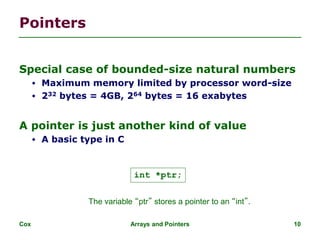
Special case of bounded-size natural numbers
 Maximum memory limited by processor word-size
 232 bytes = 4GB, 264 bytes = 16 exabytes
A pointer is just another kind of value
 A basic type in C
int *ptr;
The variable “ptr” stores a pointer to an “int”.
Cox Arrays and Pointers 11
Pointer Operations in C
Creation
& variable Returns variable’s memory address
Dereference
* pointer Returns contents stored at address
Indirect assignment
* pointer = val Stores value at address
Of course, still have...
Assignment
pointer = ptr Stores pointer in another variable
Cox Arrays and Pointers 12
Using Pointers
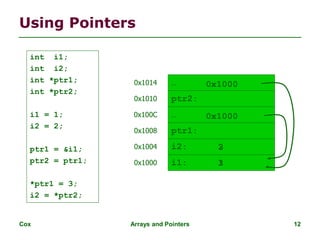
int i1;
int i2;
int *ptr1;
int *ptr2;
i1 = 1;
i2 = 2;
ptr1 = &i1;
ptr2 = ptr1;
*ptr1 = 3;
i2 = *ptr2;
i1:
i2:
ptr1:
0x1000
0x1004
0x1008
…
ptr2:
…
0x100C
0x1010
0x1014
1
2
0x1000
0x1000
3
3
Cox Arrays and Pointers 13
Using Pointers (cont.)
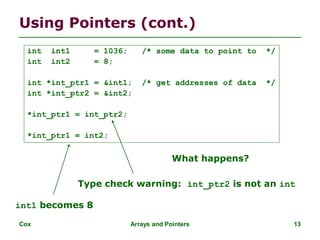
Type check warning: int_ptr2 is not an int
int1 becomes 8
int int1 = 1036; /* some data to point to */
int int2 = 8;
int *int_ptr1 = &int1; /* get addresses of data */
int *int_ptr2 = &int2;
*int_ptr1 = int_ptr2;
*int_ptr1 = int2;
What happens?
Cox Arrays and Pointers 14
Using Pointers (cont.)
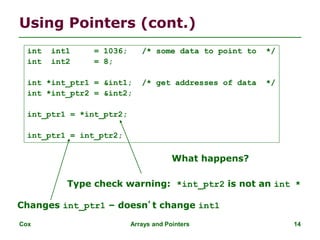
Type check warning: *int_ptr2 is not an int *
Changes int_ptr1 – doesn’t change int1
int int1 = 1036; /* some data to point to */
int int2 = 8;
int *int_ptr1 = &int1; /* get addresses of data */
int *int_ptr2 = &int2;
int_ptr1 = *int_ptr2;
int_ptr1 = int_ptr2;
What happens?
Cox Arrays and Pointers 15
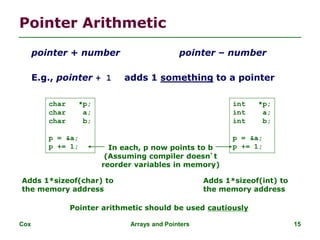
Pointer Arithmetic
pointer + number pointer – number
E.g., pointer + 1 adds 1 something to a pointer
char *p;
char a;
char b;
p = &a;
p += 1;
int *p;
int a;
int b;
p = &a;
p += 1;
In each, p now points to b
(Assuming compiler doesn’t
reorder variables in memory)
Adds 1*sizeof(char) to
the memory address
Adds 1*sizeof(int) to
the memory address
Pointer arithmetic should be used cautiously
Cox Arrays and Pointers 16
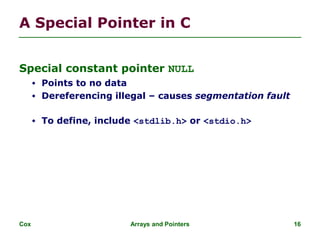
A Special Pointer in C
Special constant pointer NULL
 Points to no data
 Dereferencing illegal – causes segmentation fault
 To define, include <stdlib.h> or <stdio.h>
Cox Arrays and Pointers 17
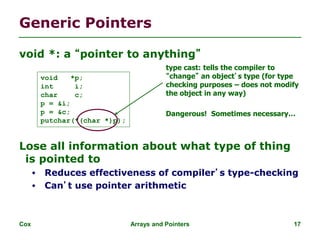
Generic Pointers
void *: a “pointer to anything”
Lose all information about what type of thing
is pointed to
 Reduces effectiveness of compiler’s type-checking
 Can’t use pointer arithmetic
void *p;
int i;
char c;
p = &i;
p = &c;
putchar(*(char *)p);
type cast: tells the compiler to
“change” an object’s type (for type
checking purposes – does not modify
the object in any way)
Dangerous! Sometimes necessary…
Cox Arrays and Pointers 18
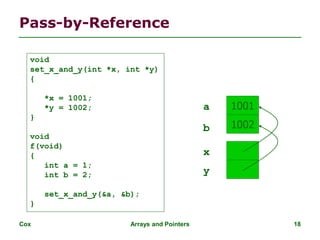
Pass-by-Reference
void
set_x_and_y(int *x, int *y)
{
*x = 1001;
*y = 1002;
}
void
f(void)
{
int a = 1;
int b = 2;
set_x_and_y(&a, &b);
}
1
2
a
b
x
y
1001
1002
Cox Arrays and Pointers 19
Arrays and Pointers
Dirty “secret”:
Array name  a pointer to the
initial (0th) array element
a[i]  *(a + i)
An array is passed to a function
as a pointer
 The array size is lost!
Usually bad style to interchange
arrays and pointers
 Avoid pointer arithmetic!
Really int *array
int
foo(int array[],
unsigned int size)
{
… array[size - 1] …
}
int
main(void)
{
int a[10], b[5];
… foo(a, 10)… foo(b, 5) …
}
Must explicitly
pass the size
Passing arrays:
Cox Arrays and Pointers 20
Arrays and Pointers
int
foo(int array[],
unsigned int size)
{
…
printf(“%dn”, sizeof(array));
}
int
main(void)
{
int a[10], b[5];
… foo(a, 10)… foo(b, 5) …
printf(“%dn”, sizeof(a));
}
What does this print?
8
40
... because array is really
a pointer
Cox Arrays and Pointers 21
Arrays and Pointers
int i;
int array[10];
for (i = 0; i < 10; i++) {
…
array[i] = …;
…
}
int *p;
int array[10];
for (p = array; p < &array[10]; p++) {
…
*p = …;
…
}
These two blocks of code are functionally equivalent
Cox Arrays and Pointers 22
Strings
In C, strings are just an array of characters
 Terminated with ‘0’ character
 Arrays for bounded-length strings
 Pointer for constant strings (or unknown length)
char str1[15] = “Hello, world!n”;
char *str2 = “Hello, world!n”;
H e l l o , w l
o r d !n
length
H e l l o , w l
o r d !nterminator
Pascal, Java, …
C, …
C terminator: ’0’
Cox Arrays and Pointers 23
String length
Must calculate length:
Provided by standard C library: #include <string.h>
int
strlen(char str[])
{
int len = 0;
while (str[len] != ‘0’)
len++;
return (len);
}
can pass an
array or pointer
Check for
terminator
array access
to pointer!
What is the size
of the array???
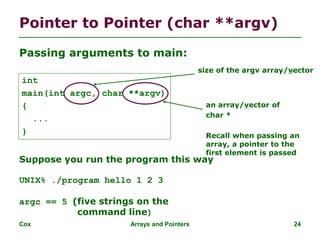
Pointer to Pointer (char **argv)
Cox Arrays and Pointers 24
Passing arguments to main:
int
main(int argc, char **argv)
{
...
}
an array/vector of
char *
Recall when passing an
array, a pointer to the
first element is passed
size of the argv array/vector
Suppose you run the program this way
UNIX% ./program hello 1 2 3
argc == 5 (five strings on the
command line)
Cox Arrays and Pointers 25
char **argv
argv[0]
argv[1]
argv[2]
0x1000
0x1008
0x1010
argv[3]
argv[4]
0x1018
0x1020
“./program”
“hello”
“1”
“2”
“3”
These are strings!!
Not integers!
Cox Arrays and Pointers 26
Next Time
Structures and Unions

arrays, pointers and operations pointers

  • 1.
    Arrays and Pointersin C Alan L. Cox alc@rice.edu
  • 2.
    Objectives Be able touse arrays, pointers, and strings in C programs Be able to explain the representation of these data types at the machine level, including their similarities and differences Cox Arrays and Pointers 2
  • 3.
    Cox Arrays andPointers 3 Arrays in C No bounds checking! Allowed – usually causes no obvious error array[10] may overwrite b Unlike Java, array size in declaration int array[10]; int b; array[0] = 3; array[9] = 4; array[10] = 5; array[-1] = 6; Compare: C: int array[10]; Java: int[] array = new int[10]; All elements of same type – homogenous First element (index 0) Last element (index size - 1)
  • 4.
    Cox Arrays andPointers 4 Array Representation Homogeneous  Each element same size – s bytes  An array of m data values is a sequence of ms bytes  Indexing: 0th value at byte s0, 1st value at byte s1, … m and s are not part of representation  Unlike in some other languages  s known by compiler – usually irrelevant to programmer  m often known by compiler – if not, must be saved by programmer a[0] a[1] a[2] 0x1000 0x1004 0x1008 int a[3];
  • 5.
    Cox Arrays andPointers 5 Array Representation char c1; int a[3]; char c2; int i; c1 a[0] a[1] a[2] i 0x1000 0x1004 0x1008 0x100C 0x1014 c2 0x1010 Could be optimized by making these adjacent, and reducing padding (by default, not) Array aligned by size of elements
  • 6.
    Cox Arrays andPointers 6 Array Sizes What is sizeof(array[3])? sizeof(array)? int array[10]; 4 40 returns the size of an object in bytes
  • 7.
    Cox Arrays andPointers 7 Multi-Dimensional Arrays int matrix[2][3]; matrix[1][0] = 17; matrix[0][0] matrix[0][1] matrix[0][2] 0x1000 0x1004 0x1008 matrix[1][0] matrix[1][1] matrix[1][2] 0x100C 0x1010 0x1014 Recall: no bounds checking What happens when you write: matrix[0][3] = 42; “Row Major” Organization
  • 8.
    Cox Arrays andPointers 8 Variable-Length Arrays int function(int n) { int array[n]; … New C99 feature: Variable-length arrays defined within functions Global arrays must still have fixed (constant) length
  • 9.
    Cox Arrays andPointers 9 Memory Addresses Storage cells are typically viewed as being byte-sized  Usually the smallest addressable unit of memory • Few machines can directly address bits individually  Such addresses are sometimes called byte- addresses Memory is often accessed as words  Usually a word is the largest unit of memory access by a single machine instruction • CLEAR’s word size is 8 bytes (= sizeof(long))  A word-address is simply the byte-address of the word’s first byte
  • 10.
    Cox Arrays andPointers 10 Pointers Special case of bounded-size natural numbers  Maximum memory limited by processor word-size  232 bytes = 4GB, 264 bytes = 16 exabytes A pointer is just another kind of value  A basic type in C int *ptr; The variable “ptr” stores a pointer to an “int”.
  • 11.
    Cox Arrays andPointers 11 Pointer Operations in C Creation & variable Returns variable’s memory address Dereference * pointer Returns contents stored at address Indirect assignment * pointer = val Stores value at address Of course, still have... Assignment pointer = ptr Stores pointer in another variable
  • 12.
    Cox Arrays andPointers 12 Using Pointers int i1; int i2; int *ptr1; int *ptr2; i1 = 1; i2 = 2; ptr1 = &i1; ptr2 = ptr1; *ptr1 = 3; i2 = *ptr2; i1: i2: ptr1: 0x1000 0x1004 0x1008 … ptr2: … 0x100C 0x1010 0x1014 1 2 0x1000 0x1000 3 3
  • 13.
    Cox Arrays andPointers 13 Using Pointers (cont.) Type check warning: int_ptr2 is not an int int1 becomes 8 int int1 = 1036; /* some data to point to */ int int2 = 8; int *int_ptr1 = &int1; /* get addresses of data */ int *int_ptr2 = &int2; *int_ptr1 = int_ptr2; *int_ptr1 = int2; What happens?
  • 14.
    Cox Arrays andPointers 14 Using Pointers (cont.) Type check warning: *int_ptr2 is not an int * Changes int_ptr1 – doesn’t change int1 int int1 = 1036; /* some data to point to */ int int2 = 8; int *int_ptr1 = &int1; /* get addresses of data */ int *int_ptr2 = &int2; int_ptr1 = *int_ptr2; int_ptr1 = int_ptr2; What happens?
  • 15.
    Cox Arrays andPointers 15 Pointer Arithmetic pointer + number pointer – number E.g., pointer + 1 adds 1 something to a pointer char *p; char a; char b; p = &a; p += 1; int *p; int a; int b; p = &a; p += 1; In each, p now points to b (Assuming compiler doesn’t reorder variables in memory) Adds 1*sizeof(char) to the memory address Adds 1*sizeof(int) to the memory address Pointer arithmetic should be used cautiously
  • 16.
    Cox Arrays andPointers 16 A Special Pointer in C Special constant pointer NULL  Points to no data  Dereferencing illegal – causes segmentation fault  To define, include <stdlib.h> or <stdio.h>
  • 17.
    Cox Arrays andPointers 17 Generic Pointers void *: a “pointer to anything” Lose all information about what type of thing is pointed to  Reduces effectiveness of compiler’s type-checking  Can’t use pointer arithmetic void *p; int i; char c; p = &i; p = &c; putchar(*(char *)p); type cast: tells the compiler to “change” an object’s type (for type checking purposes – does not modify the object in any way) Dangerous! Sometimes necessary…
  • 18.
    Cox Arrays andPointers 18 Pass-by-Reference void set_x_and_y(int *x, int *y) { *x = 1001; *y = 1002; } void f(void) { int a = 1; int b = 2; set_x_and_y(&a, &b); } 1 2 a b x y 1001 1002
  • 19.
    Cox Arrays andPointers 19 Arrays and Pointers Dirty “secret”: Array name  a pointer to the initial (0th) array element a[i]  *(a + i) An array is passed to a function as a pointer  The array size is lost! Usually bad style to interchange arrays and pointers  Avoid pointer arithmetic! Really int *array int foo(int array[], unsigned int size) { … array[size - 1] … } int main(void) { int a[10], b[5]; … foo(a, 10)… foo(b, 5) … } Must explicitly pass the size Passing arrays:
  • 20.
    Cox Arrays andPointers 20 Arrays and Pointers int foo(int array[], unsigned int size) { … printf(“%dn”, sizeof(array)); } int main(void) { int a[10], b[5]; … foo(a, 10)… foo(b, 5) … printf(“%dn”, sizeof(a)); } What does this print? What does this print? 8 40 ... because array is really a pointer
  • 21.
    Cox Arrays andPointers 21 Arrays and Pointers int i; int array[10]; for (i = 0; i < 10; i++) { … array[i] = …; … } int *p; int array[10]; for (p = array; p < &array[10]; p++) { … *p = …; … } These two blocks of code are functionally equivalent
  • 22.
    Cox Arrays andPointers 22 Strings In C, strings are just an array of characters  Terminated with ‘0’ character  Arrays for bounded-length strings  Pointer for constant strings (or unknown length) char str1[15] = “Hello, world!n”; char *str2 = “Hello, world!n”; H e l l o , w l o r d !n length H e l l o , w l o r d !nterminator Pascal, Java, … C, … C terminator: ’0’
  • 23.
    Cox Arrays andPointers 23 String length Must calculate length: Provided by standard C library: #include <string.h> int strlen(char str[]) { int len = 0; while (str[len] != ‘0’) len++; return (len); } can pass an array or pointer Check for terminator array access to pointer! What is the size of the array???
  • 24.
    Pointer to Pointer(char **argv) Cox Arrays and Pointers 24 Passing arguments to main: int main(int argc, char **argv) { ... } an array/vector of char * Recall when passing an array, a pointer to the first element is passed size of the argv array/vector Suppose you run the program this way UNIX% ./program hello 1 2 3 argc == 5 (five strings on the command line)
  • 25.
    Cox Arrays andPointers 25 char **argv argv[0] argv[1] argv[2] 0x1000 0x1008 0x1010 argv[3] argv[4] 0x1018 0x1020 “./program” “hello” “1” “2” “3” These are strings!! Not integers!
  • 26.
    Cox Arrays andPointers 26 Next Time Structures and Unions