Robert Collins
CSE486, Penn State


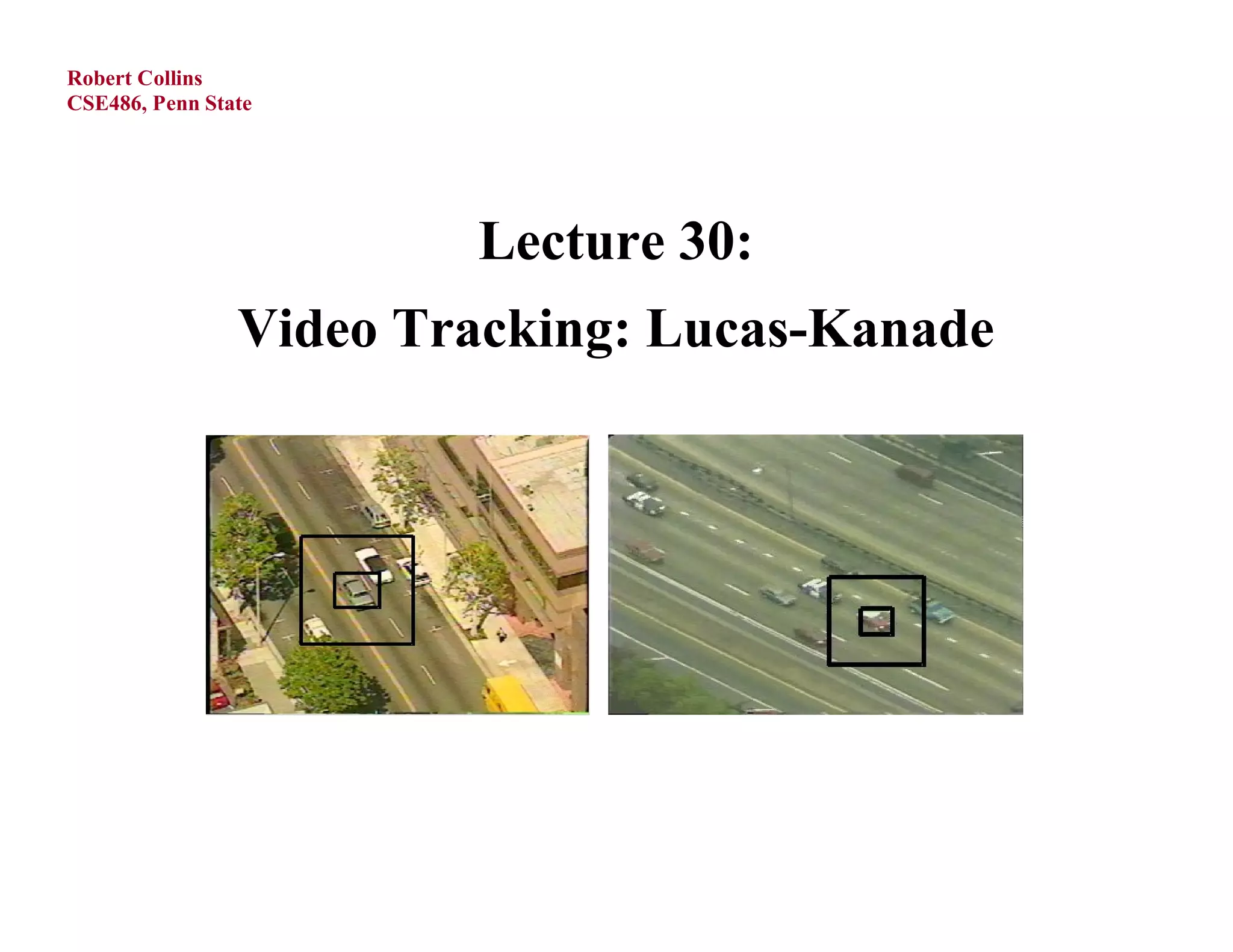
                        Lecture 30:
                Video Tracking: Lucas-Kanade
Robert Collins
CSE486, Penn State
                     Two Popular Tracking Methods


          • Mean-shift color histogram tracking (last time)

          • Lucas-Kanade template tracking (today)
Robert Collins
CSE486, Penn State


                     Lucas-Kanade Tracking
Robert Collins
CSE486, Penn State               Review: Lucas-Kanade
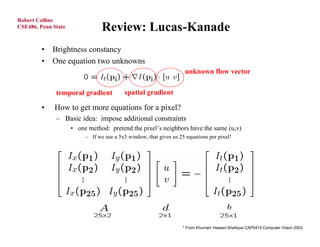
         •   Brightness constancy
         •   One equation two unknowns
                                                                     unknown flow vector

              temporal gradient           spatial gradient

         •   How to get more equations for a pixel?
              – Basic idea: impose additional constraints
                     • one method: pretend the pixel’s neighbors have the same (u,v)
                          – If we use a 5x5 window, that gives us 25 equations per pixel!


                                                                    * From Khurram Hassan-Shafique CAP5415 Computer Vision 2003
Robert Collins
CSE486, Penn State
                        Review: Lucas-Kanade (cont)
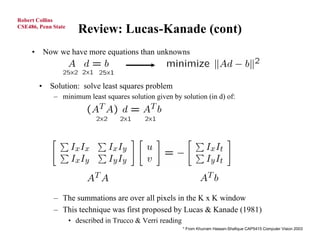
     •       Now we have more equations than unknowns


         •    Solution: solve least squares problem
               – minimum least squares solution given by solution (in d) of:


               – The summations are over all pixels in the K x K window
               – This technique was first proposed by Lucas & Kanade (1981)
                     • described in Trucco & Verri reading
                                                             * From Khurram Hassan-Shafique CAP5415 Computer Vision 2003
Robert Collins
CSE486, Penn State
                      Lucas Kanade Tracking
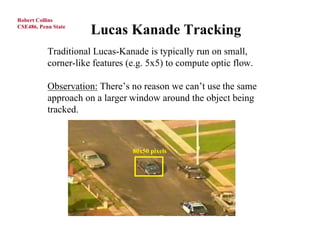
           Traditional Lucas-Kanade is typically run on small,
           corner-like features (e.g. 5x5) to compute optic flow.

           Observation: There’s no reason we can’t use the same
           approach on a larger window around the object being
           tracked.


                                 80x50 pixels
Robert Collins

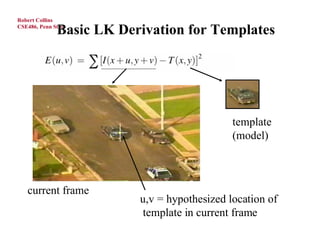
              Basic LK Derivation for Templates
CSE486, Penn State


                                              template
                                              (model)


   current frame
                          u,v = hypothesized location of
                          template in current frame
Robert Collins

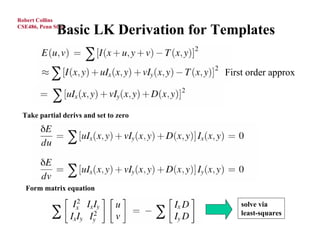
              Basic LK Derivation for Templates
CSE486, Penn State


                                       First order approx


 Take partial derivs and set to zero


   Form matrix equation

                                           solve via
                                           least-squares
Robert Collins
CSE486, Penn State
                     One Problem with this...
        Assumption of constant flow (pure translation) for
        all pixels in a larger window is unreasonable for
        long periods of time.


      However, we can easily generalize Lucas-Kanade
      approach to other 2D parametric motion models
      (like affine or projective) by introducing a “warp”
      function W.
                            generalize

                                 x
                                             [ I (W ([ x, y ]; P))  T ([ x, y ])]2
                                  within image patch
                                  y
                                  
Robert Collins
CSE486, Penn State
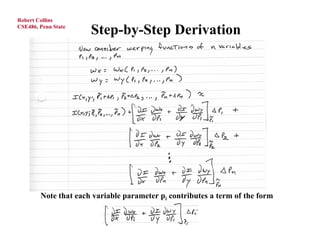
                        Step-by-Step Derivation
       The key to the derivation is Taylor series approximation:
                                                                    W
            [ I (W ([ x, y ]; P  P)) ~ [ I (W ([ x, y ]; P))  I
                                       ~                               P
                                                                    P
     We will derive this step-by-step. First, we need two background formula:
Robert Collins
CSE486, Penn State
                       Step-by-Step Derivation
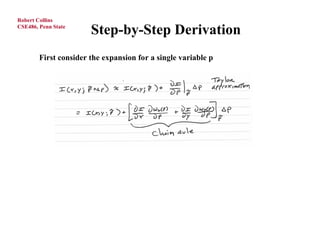
        First consider the expansion for a single variable p
Robert Collins
CSE486, Penn State
                      Step-by-Step Derivation


        Note that each variable parameter pi contributes a term of the form
Robert Collins
CSE486, Penn State
                      Step-by-Step Derivation
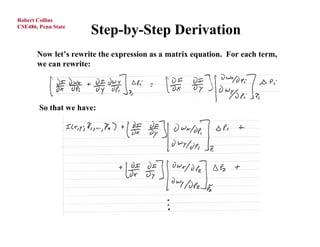
       Now let’s rewrite the expression as a matrix equation. For each term,
       we can rewrite:


        So that we have:
Robert Collins
CSE486, Penn State
                           Step-by-Step Derivation
       Further collecting the dw/dpi terms into a matrix, we can write:


       which are the terms in the matrix equation:
                                             ~                                W
                [ I (W ([ x, y ]; P  P))   ~   [ I (W ([ x, y ]; P))  I      P
                                                                              P
Robert Collins

              Example: Jacobian of Affine Warp
CSE486, Penn State


                                              Let W([x, y]; P)  [Wx , Wy ]

      general equation of Jacobian                Wx      Wx    Wx   Wx 
                                                                       
                                              W  P       P     P    P 
                                                 1          2      3     n
                                                                             
                                              P Wy       Wy    Wy   Wy 
                                                                       
                                                  P
                                                  1         P2   P3   P 
                                                                           n 


      affine warp function (6 parameters)
                                                              x  xP  yP3  P5 
                                                                     1
                                                            
                                        x             W     xP2  y  yP4  P6 
                    1  p1
 W ([ x, y ]; P )  
                            p3    p5   
                                      y                                      
                                 p6                 P            P
                     p2 1  p4       1
                                                            x 0 y 0 1 0
                                                            
                                                              0 x 0 y 0 1         
Source: “Lucas-Kanade 20 years on: A unifying framework” Baker and Mathews, IJCV 04
Robert Collins
CSE486, Penn State
      Iterate               Warp I to obtain I(W([x y];P))

                            Compute the error image T(x) – I(W([x y]; P))

                            Warp the gradient I with W([x y]; P)
                                        W
                            Evaluate           at ([x y]; P)          (Jacobian)
                                        P
                                                                                W
                            Compute steepest descent images I
                                                                                P
                                                                          W T     W
                            Compute Hessian matrix               (I     P
                                                                             ) (I
                                                                                   P
                                                                                      )

                                                   W T
                            Compute        ( I   P
                                                      ) (T ( x, y )  I (W ([ x, y ]; P )))

                            Compute P

                            Update P           P + P

        Until P magnitude is negligible

Dr. Ng Teck Khim
Robert Collins
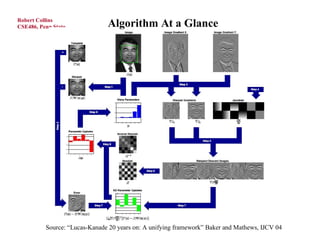
CSE486, Penn State             Algorithm At a Glance


          Source: “Lucas-Kanade 20 years on: A unifying framework” Baker and Mathews, IJCV 04
Robert Collins
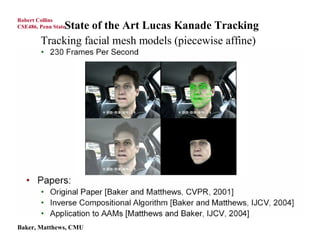
             State of the Art Lucas Kanade Tracking
CSE486, Penn State

        Tracking facial mesh models (piecewise affine)


                                    QuickTime™ and a
                              YUV420 codec decompressor
                             are needed to see this picture.


Baker, Matthews, CMU

Lecture30

  • 1.
    Robert Collins CSE486, PennState Lecture 30: Video Tracking: Lucas-Kanade
  • 2.
    Robert Collins CSE486, PennState Two Popular Tracking Methods • Mean-shift color histogram tracking (last time) • Lucas-Kanade template tracking (today)
  • 3.
    Robert Collins CSE486, PennState Lucas-Kanade Tracking
  • 4.
    Robert Collins CSE486, PennState Review: Lucas-Kanade • Brightness constancy • One equation two unknowns unknown flow vector temporal gradient spatial gradient • How to get more equations for a pixel? – Basic idea: impose additional constraints • one method: pretend the pixel’s neighbors have the same (u,v) – If we use a 5x5 window, that gives us 25 equations per pixel! * From Khurram Hassan-Shafique CAP5415 Computer Vision 2003
  • 5.
    Robert Collins CSE486, PennState Review: Lucas-Kanade (cont) • Now we have more equations than unknowns • Solution: solve least squares problem – minimum least squares solution given by solution (in d) of: – The summations are over all pixels in the K x K window – This technique was first proposed by Lucas & Kanade (1981) • described in Trucco & Verri reading * From Khurram Hassan-Shafique CAP5415 Computer Vision 2003
  • 6.
    Robert Collins CSE486, PennState Lucas Kanade Tracking Traditional Lucas-Kanade is typically run on small, corner-like features (e.g. 5x5) to compute optic flow. Observation: There’s no reason we can’t use the same approach on a larger window around the object being tracked. 80x50 pixels
  • 7.
    Robert Collins Basic LK Derivation for Templates CSE486, Penn State template (model) current frame u,v = hypothesized location of template in current frame
  • 8.
    Robert Collins Basic LK Derivation for Templates CSE486, Penn State First order approx Take partial derivs and set to zero Form matrix equation solve via least-squares
  • 9.
    Robert Collins CSE486, PennState One Problem with this... Assumption of constant flow (pure translation) for all pixels in a larger window is unreasonable for long periods of time. However, we can easily generalize Lucas-Kanade approach to other 2D parametric motion models (like affine or projective) by introducing a “warp” function W. generalize x  [ I (W ([ x, y ]; P))  T ([ x, y ])]2   within image patch  y  
  • 10.
    Robert Collins CSE486, PennState Step-by-Step Derivation The key to the derivation is Taylor series approximation: W [ I (W ([ x, y ]; P  P)) ~ [ I (W ([ x, y ]; P))  I ~ P P We will derive this step-by-step. First, we need two background formula:
  • 11.
    Robert Collins CSE486, PennState Step-by-Step Derivation First consider the expansion for a single variable p
  • 12.
    Robert Collins CSE486, PennState Step-by-Step Derivation Note that each variable parameter pi contributes a term of the form
  • 13.
    Robert Collins CSE486, PennState Step-by-Step Derivation Now let’s rewrite the expression as a matrix equation. For each term, we can rewrite: So that we have:
  • 14.
    Robert Collins CSE486, PennState Step-by-Step Derivation Further collecting the dw/dpi terms into a matrix, we can write: which are the terms in the matrix equation: ~ W [ I (W ([ x, y ]; P  P)) ~ [ I (W ([ x, y ]; P))  I P P
  • 15.
    Robert Collins Example: Jacobian of Affine Warp CSE486, Penn State Let W([x, y]; P)  [Wx , Wy ] general equation of Jacobian  Wx Wx Wx Wx   W  P P P P   1 2 3 n  P Wy Wy Wy Wy    P  1 P2 P3 P  n  affine warp function (6 parameters)  x  xP  yP3  P5  1   x W xP2  y  yP4  P6  1  p1 W ([ x, y ]; P )   p3 p5     y      p6    P P  p2 1  p4  1    x 0 y 0 1 0    0 x 0 y 0 1 
  • 16.
    Source: “Lucas-Kanade 20years on: A unifying framework” Baker and Mathews, IJCV 04 Robert Collins CSE486, Penn State Iterate Warp I to obtain I(W([x y];P)) Compute the error image T(x) – I(W([x y]; P)) Warp the gradient I with W([x y]; P) W Evaluate at ([x y]; P) (Jacobian) P W Compute steepest descent images I P W T W Compute Hessian matrix  (I P ) (I P ) W T Compute  ( I P ) (T ( x, y )  I (W ([ x, y ]; P ))) Compute P Update P P + P Until P magnitude is negligible Dr. Ng Teck Khim
  • 17.
    Robert Collins CSE486, PennState Algorithm At a Glance Source: “Lucas-Kanade 20 years on: A unifying framework” Baker and Mathews, IJCV 04
  • 18.
    Robert Collins State of the Art Lucas Kanade Tracking CSE486, Penn State Tracking facial mesh models (piecewise affine) QuickTime™ and a YUV420 codec decompressor are needed to see this picture. Baker, Matthews, CMU