International Journal of Mathematics and Statistics Invention (IJMSI)
E-ISSN: 2321 – 4767 P-ISSN: 2321 - 4759
www.ijmsi.org Volume 4 Issue 8 || October. 2016 || PP-20-26
www.ijmsi.org 20 | Page
Solving Poisson’s Equation Using Preconditioned Nine-Point
Group SOR Iterative Method
Abdulkafi Mohammed Saeed 1
Department of Mathematics, College of Science, Qassim University, Saudi Arabia
ABSTRACT: A well-designed preconditioning of the partial differential equations problems reduces the
number of iterations to reach convergence. Dramatic improvements are possible, but the difficulty is to
construct the suitable preconditioner.The construction of a specific splitting-type preconditioner in block
formulation for a class of group relaxation iterative methods derived from the finite difference approximations
have been shown to improve the convergence rates of these methods. This paper is concerned with the
application of suitable preconditioning techniques to the Nine-Point Group SOR (N-P SOR) iterative method for
solving Poisson’s Equation. Preconditioning strategies which improve the rate of convergence of these iterative
methods are investigated. The results reveal the improvements on the convergence rate and the efficiency of the
proposed preconditioned Group iterative method.
KEYWORDS - Poisson’s Equation, Preconditioned Nine-Point Group SOR Iterative Method.
I. INTRODUCTION
Elliptic equations describe problems in a closed region. The Poisson and Laplace equations are
examples of the elliptic equations. Only boundary conditions are considered because the dependent variable
does not depend on time. In this work, we will consider Poisson equation in the form:
2 2
2
2 2
( , ), ( , )
u u
u f x y x y
x y
 
     
 
(1.1)
with specific Dirichlet boundary conditions
( , ) ( , ),U x y g x y  ( x , y ) .
The well-known classical iterative methods are Jacobi, Gauss-Seidel and Successive Over Relaxation
(SOR) methods. The Jacobi and Gauss-Seidel methods could be used for such systems with some success, not
so much because of the reduction in the computational work, but mainly because of the limited amount of
memory that is required.
In SOR method, we have to determine the parameter w, where a suitable value of w could lead to
drastic improvements in convergence. Because of that, the SOR method became very popular and this method
was selected as the method in computer codes, in order to solve large practical problems such as weather
prediction and nuclear reactor diffusion [1].
It has been affirmed that the discretisation of PDEs using finite difference schemes normally yield a
system of linear equations, which are large and sparse in nature. Iterative methods are usually used to solve
these types of systems since these methods need less storage and are capable of preserving the sparsity property
of the large system. Many problems in various fields, such as engineering, science and the quantitative study of
business and economic problems associate with the linear systems of equations . In Yousif and Evans [2], the
explicit group over relaxation methods for the numerical solution of the sparse linear systems has been
presented. The group method has been shown computationally superior in comparison with the implicit one-line
and two-line block SOR iterative method.
Suppose (1.1) is discretised using some finite difference scheme, this will normally lead to a large,
block and sparse system of equations. Many researchers have considered preconditioners, applied to linear
systems ([3], [4], [5], [6]).
In Lee [7], preconditioners had been successfully applied on the standard five point formula in solving
the Poisson problem with Dirichlet boundary condition and the numerical experiments yield some encouraging
results.
Solving Poisson’s Equation Using Preconditioned…
www.ijmsi.org 21 | Page
Equation (1.1) may be approximated at the point ( , )i j
x y in many ways. Assume that a rectangular
grid in the (x,y) plane with equal grid spacing h in both directions with 0 1i
x ih , y jh ( i , j , , ....N )   are
used, where ,
( , )i j i j
u u x y and 1 /h N . By neglecting terms of 2
( )O h , we obtain the simplest approximation
for (1.1) which is known as the standard five-point difference formula:
2
, 1 , 1 1, 1,
4i j i j i j i j ij ij
u u u u u h f   
     (1.2)
The objective of this research is to find the most efficient group SOR iterative method for solving
elliptic partial differential equations. We will compare the point, the four-point group and the nine-point group
SOR iterative method in solving the two dimensional Poisson equation.
The outline of this paper is as follows: An overview of the formulation of the Nine-Point Group SOR
(NPSOR) iterative method for solving Poisson’s Equation will be given in Section 2. We proposed a new type
of preconditioned formula and apply it to the N-P SOR method for solving Poisson’s Equation in Section 3. The
numerical results are presented to show the efficiency of the preconditioned N-P SOR method in Section 4 and
the concluding remarks is given in Section 5.
II. FORMULATION OF THE NINE-POINT GROUP ITERATIVE METHOD
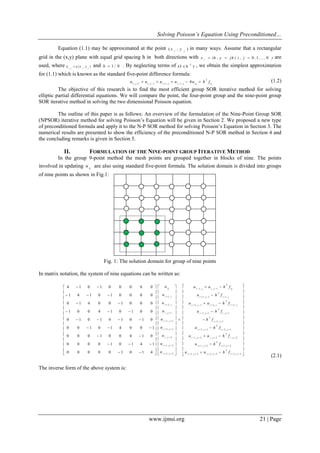
In the group 9-point method the mesh points are grouped together in blocks of nine. The points
involved in updating ij
u are also using standard five-point formula. The solution domain is divided into groups
of nine points as shown in Fig.1:
Fig. 1: The solution domain for group of nine points
In matrix notation, the system of nine equations can be written as:
1,
2 ,
, 1
1, 1
2 , 1
, 2
1, 2
2 , 2
4 1 0 1 0 0 0 0 0
1 4 1 0 1 0 0 0 0
0 1 4 0 0 1 0 0 0
1 0 0 4 1 0 1 0 0
0 1 0 1 4 1 0 1 0
0 0 1 0 1 4 0 0 1
0 0 0 1 0 0 4 1 0
0 0 0 0 1 0 1 4 1
0 0 0 0 0 1 0 1 4



 
 

 
 
   
 
  
 
  
 
    
    
 
   
  
 
   
 
   
ij
i j
i j
i j
i j
i j
i j
i j
i j
u
u
u
u
u
u
u
u
u
2
1, , 1
2
1, 1 1,
2
2 , 1 3 , 2 ,
2
1, 1 , 1
2
1, 1
2
3 , 1 2 , 1
2
1, 2 , 3 , 2
2
1, 3 1, 2
2
3 , 2 2 , 3 2 , 2
 
  
   
  
 
   
   
   
     
  



  


  
 
 
   
 
 
 
 
i j i j ij
i j i j
i j i j i j
i j i j
i j
i j i j
i j i j i j
i j i j
i j i j i j
u u h f
u h f
u u h f
u h f
h f
u h f
u u h f
u h f
u u h f

 
 
 
 
 
 
 
 
 
 
 
 
  (2.1)
The inverse form of the above system is:
Solving Poisson’s Equation Using Preconditioned…
www.ijmsi.org 22 | Page
1,
2 ,
, 1
1, 1
2 , 1
, 2
1, 2
2 , 2
6 7 2 2 7 2 2 1 4 2 2 2 2 2 2 2 2
2 2 4 2 2 4 2 2 4 2 2 4 2 2 4 2 2 4 2 2 4 2 2 4 2 2 4
1 1 3 7 1 1 7 1 4 7 3 5 3
1 1 2 1 1 2 1 1 2 1 1 2 1 1 2 1 1 2 1 1 2 1 1 2 1 1 2
7 2 2 6 7 6 1 4 2 2
2 2 4 2 2 4 2 2 4 2 2 4 2 2 4 2 2 4


 
 

 
 
 
 
 
 
 
 
  
 
 
 
 
 
 
 
ij
i j
i j
i j
i j
i j
i j
i j
i j
u
u
u
u
u
u
u
u
u
3 6 7
2 2 4 2 2 4 2 2 4
1 1 7 3 3 7 1 4 5 1 1 7 3
1 1 2 1 1 2 1 1 2 1 1 2 1 1 2 1 1 2 1 1 2 1 1 2 1 1 2
1 2 1 2 6 2 1 2 1
1 6 1 6 1 6 1 6 1 6 1 6 1 6 1 6 1 6
3 7 1 1 5 1 4 3 7 3 7 1 1
1 1 2 1 1 2 1 1 2 1 1 2 1 1 2 1 1 2 1 1 2 1 1 2 1 1 2
7 6 3 2 2 1 4 6 6 7 2 2 7
2 2 4 2 2 4 2 2 4 2 2 4 2 2 4 2 2 4 2 2 4 2 2 4 2 2 4
3 5 3 7 1 4 7 1 1 3 7 1 1
1 1 2 1 1 2 1 1 2 1 1 2 1 1 2 1 1 2 1 1 2 1 1 2 1 1 2
3
2
1, , 1
2
1, 1 1,
2
2 , 1 3 , 2 ,
2
1, 1 , 1
2
1, 1
2
3 , 1 2 , 1
1
6 7 6 1 4 2 2 7 2 2 6 7
2 2 4 2 2 4 2 2 4 2 2 4 2 2 4 2 2 4 2 2 4 2 2 4 2 2 4
 
  
   
  
 
   

 
 
 
 
 
 
 
 
  
 
 
 
  
 
 
  
 
 
 
 
 
 
 
 
 
 
 
i j i j ij
i j i j
i j i j i j
i j i j
i j
i j i j
i
u u h f
u h f
u u h f
u h f
h f
u h f
u
2
, 2 , 3 , 2
2
1, 3 1, 2
2
3 , 2 2 , 3 2 , 2
  
   
     
 
 
 
 
 
 
 
 
 
 
 
 
 
 
 
 
j i j i j
i j i j
i j i j i j
u h f
u h f
u u h f
Hence, the explicit 9-point group iterative equations are given by:
1 2 7 0 5 6
1
[6 7 2 2 7 1 4 6 3 ],
2 2 4
     ij
u t t t t t t 1, 1 9 8 9 0 2 0 1 0
1
[3 7 1 1 7 1 4 5 3 ],
1 1 2

     i j
u t t t t t t
2 , 3 1 3 1 8 0 1 4 4
1
[6 7 2 2 7 1 4 6 3 ],
2 2 4

     i j
u t t t t t t , 1 2 1 1 5 1 6 0 2 2 1 7
1
[3 7 1 1 7 1 4 5 3 ],
1 1 2

     i j
u t t t t t t
1, 1 1 1 0 1 2
1
[2 6 ],
1 6
 
  i j
u t t t ,
2 , 1 2 2 1 7 1 6 0 2 1 1 5
1
[3 7 1 1 7 1 4 5 3 ],
1 1 2
 
     i j
u t t t t t t
, 2 4 1 4 1 8 0 1 3 3
1
[6 7 2 2 7 1 4 6 3 ],
2 2 4

     i j
u t t t t t t 1, 2 2 0 1 0 9 0 1 9 8
1
[3 7 1 1 7 1 4 5 3 ],
1 1 2
 
     i j
u t t t t t t
2 , 2 6 5 7 0 2 1
1
[6 7 2 2 7 1 4 6 3 ]
2 2 4
 
     i j
u t t t t t t
(2.2)
where:
2
0 1, 1
, 
 i j
t h f
2
1 1, , 1 1, 1
,   
  i j i j i j
t u u h f
2 2
2 1, 1 1, 1 1, , 1
,     
   i j i j i j i j
t u u h f h f
2
3 2 , 1 3, 2 ,
,   
  i j i j i j
t u u h f
2
4 1, 2 , 3 , 2
,   
  i j i j i j
t u u h f
2 2
5 3, 1 1, 3 2 , 1 1, 2
,       
   i j i j i j i j
t u u h f h f
2
6 3, 2 2 , 3 2 , 2
,     
  i j i j i j
t u u h f 7 3 4
, t t t 8 1 3
, t t t
2 2
9 3, 1 1, 1 2 , 1 , 1
,      
   i j i j i j i j
t u u h f h f
1 0 4 6
, t t t 1 1 2 5
, t t t 1 2 8 1 0
, t t t
2 2
13 1, 1 3, 1 1, 2 , 1
,      
   i j i j i j i j
t u u h f h f
2 2
14 1, 1 1, 3 , 1 1, 2
,      
   i j i j i j i j
t u u h f h f 1 5 1 4
, t t t
2 2
16 1, 1 1, 3 1, 1, 2
,      
   i j i j i j i j
t u u h f h f
1 7 3 6
, t t t 1 8 1 6
, t t t
2
19 1, 1 1,
,  
 i j i j
t u h f
2
20 1, 3 1, 2
,   
 i j i j
t u h f
2
21 1, 1 , 1
,  
 i j i j
t u h f
2
22 3, 1 2 , 1   
 i j i j
t u h f
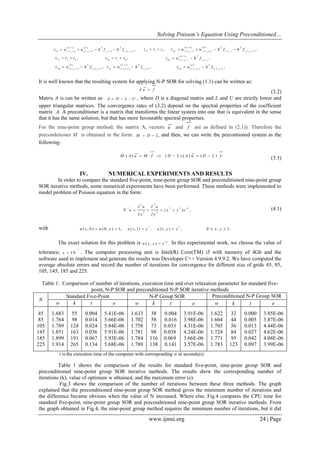
This method proceeds with iterative evaluation of solution in groups of nine points throughout the
entire solution domain using all nine equations (2.2). The process is continuous until convergence is achieved.
The nine-point group can be represented by the computational molecule shown in Fig. 2.
Solving Poisson’s Equation Using Preconditioned…
www.ijmsi.org 23 | Page
Fig. 2: The computational molecule for the nine- point group at point Q
III. DERIVATION OF THE PROPOSED PRECONDITIONED N-P SOR ITERATIVE METHOD
According to equation (1.2) in section 3.2, the SOR iterative scheme can be written as
( 1) ( ) ( ) ( 1) ( 1) 2 ( )
1, , 1 1, , 1
( ) (1 )
4
k k k k k k
ij i j i j i j i j ij ij
u u u u u h f u
  
   

       
Now, from (2.2), we can build the nine-point SOR iterative scheme as follows:
( 1) ( )
1 2 7 0 5 6
1
[ (67 22 7 14 6 3 )] (1 ) ,
224
k k
ij ij
u t t t t t t u

         
( 1) ( )
1, 19 8 9 0 20 10 1,
1
[ (3 7 1 1 7 1 4 5 3 )] (1 ) ,
1 1 2
k k
i j i j
u t t t t t t u

 
         
( 1) ( )
2 , 3 13 18 0 14 4 2 ,
1
[ (6 7 2 2 7 1 4 6 3 )] (1 ) ,
2 2 4
k k
i j i j
u t t t t t t u

 
         
( 1) ( )
, 1 21 15 16 0 22 17 , 1
1
[ (37 11 7 14 5 3 )] (1 ) ,
1 1 2
k k
i j i j
u t t t t t t u

 
         
( 1) ( )
1, 1 11 0 12 1, 1
1
[ (2 6 )] (1 ) ,
16
k k
i j i j
u t t t u

   
      
( 1) ( )
2 , 1 22 17 16 0 21 15 2 , 1
1
[ (3 7 1 1 7 1 4 5 3 )] (1 ) ,
1 1 2
k k
i j i j
u t t t t t t u

   
         
( 1) ( )
, 2 4 14 18 0 13 3 , 2
1
[ (67 22 7 14 6 3 )] (1 ) ,
2 2 4
k k
i j i j
u t t t t t t u

 
         
( 1) ( )
1, 2 20 10 9 0 19 8 1, 2
1
[ (3 7 1 1 7 1 4 5 3 )] (1 ) ,
1 1 2
k k
i j i j
u t t t t t t u

   
         
( 1) ( )
2 , 2 6 5 7 0 2 1 2 , 2
1
[ (67 22 7 14 6 3 )] (1 ) ,
224
k k
i j i j
u t t t t t t u

   
         
(3.1)
where
2
0 1, 1
,i j
t h f  

( 1) ( 1) 2
1 1, , 1 ,
,
k k
i j i j i j
t u u h f
 
 
  
( 1) ( 1) 2 2
2 1, 1 1, 1 1, , 1
,
k k
i j i j i j i j
t u u h f h f
 
     
   
( 1) ( ) 2 2
3 2 , 1 3, 3, 2 ,
,
k k
i j i j i j i j
t u u h f h f

    
   
( 1) ( ) 2
4 1, 2 , 3 , 2
,
k k
i j i j i j
t u u h f

   
  
( ) ( ) 2 2
5 3, 1 1, 3 2 , 1 1, 2
,
k k
i j i j i j i j
t u u h f h f       
   
( ) ( ) 2
6 2 , 2 2 , 3 2 , 2
,
k k
i j i j i j
t u u h f     
  
7 3 4
,t t t  8 1 3
,t t t 
( ) ( 1) 2 2
9 3, 1 1, 1 2 , 1 , 1
,
k k
i j i j i j i j
t u u h f h f

      
   
1 0 4 6
,t t t  1 1 2 5
,t t t  1 2 8 1 0
,t t t 
( 1) ( ) 2 2
13 1, 1 3, 1 1, 2 , 1
,
k k
i j i j i j i j
t u u h f h f

      
   
2 2
2 2 4
6 7
2 2 4
7
2 2 4
6
2 2 4
6
2 2 4
7
2 2 4
7
2 2 4
2 2
2 2 4
6 7
2 2 4
3
2 2 4
7
2 2 4
3
2 2 4
Q
Solving Poisson’s Equation Using Preconditioned…
www.ijmsi.org 24 | Page
( 1) ( ) 2 2
14 1, 1 1, 3 , 1 1, 2
,
k k
i j i j i j i j
t u u h f h f

      
    1 5 1 4
,t t t 
( 1) ( ) 2 2
16 1, 1 1, 3 1, 1, 2
,
k k
i j i j i j i j
t u u h f h f

      
   
1 7 3 6
,t t t  1 8 1 6
,t t t 
( 1) 2
19 1, 1 1,
,
k
i j i j
t u h f

  
 
( ) 2
20 1, 3 1, 2
,
k
i j i j
t u h f   
 
( 1) 2
21 1, 1 , 1
,
k
i j i j
t u h f

  
 
( ) 2
22 3, 1 2 , 1
,
k
i j i j
t u h f   
 
It is well known that the resulting system for applying N-P SOR for solving (1.1) can be written as:
A u f
(3.2)
Matrix A is can be written as ,  A D L U where D is a diagonal matrix and L and U are strictly lower and
upper triangular matrices. The convergence rates of (3.2) depend on the spectral properties of the coefficient
matrix A. A preconditioner is a matrix that transforms the linear system into one that is equivalent in the sense
that it has the same solution, but that has more favourable spectral properties.
For the nine-point group method, the matrix A, vectors u and f are as defined in (2.1)). Therefore the
precondetioner M is obtained in the form: ,M D L  and then, we can write the precontioned system as the
following:
( ) ( ) ( ) ( )M A u M f D L A u D L f    
(3.3)
IV. NUMERICAL EXPERIMENTS AND RESULTS
In order to compare the standard five-point, nine-point group SOR and preconditioned nine-point group
SOR iterative methods, some numerical experiments have been performed. These methods were implemented to
model problem of Poisson equation in the form:
2 2
2 2 2
2 2
( ) ,
xyu u
u x y e
x y
 
    
 
(4.1)
with ( , 0) (0, ) 1,u x u y  ( ,1) ,
x
u x e (1, ) ,
y
u y e 0 , 1.x y 
The exact solution for this problem is ( , ) .
xy
u x y e In this experimental work, we choose the value of
tolerance;
6
1 0

  . The computer processing unit is Intel(R) Core(TM) i5 with memory of 4Gb and the
software used to implement and generate the results was Developer C++ Version 4.9.9.2. We have computed the
average absolute errors and record the number of iterations for convergence for different size of grids 45, 85,
105, 145, 185 and 225.
Table 1: Comparison of number of iterations, execution time and over relaxation parameter for standard five-
point, N-P SOR and preconditioned N-P SOR iterative methods
N
Standard Five-Point N-P Group SOR Preconditioned N-P Group SOR
w k t e w k t e w k t e
45
85
105
145
185
225
1.683
1.764
1.789
1.851
1.899
1.914
55
98
124
163
191
265
0.004
0.014
0.024
0.036
0.067
0.134
5.41E-06
5.66E-06
5.84E-06
5.91E-06
5.93E-06
5.68E-06
1.633
1.702
1.758
1.781
1.784
1.789
38
58
73
98
116
138
0.004
0.016
0.033
0.038
0.069
0.141
3.91E-06
3.98E-06
4.31E-06
4.24E-06
3.66E-06
3.57E-06
1.622
1.604
1.705
1.724
1.771
1.783
32
44
56
84
95
123
0.000
0.005
0.013
0.027
0.042
0.097
3.85E-06
3.87E-06
4.44E-06
4.62E-06
4.04E-06
3.99E-06
t is the execution time of the computer with corresponding w in seconds(s).
Table 1 shows the comparison of the results for standard five-point, nine-point group SOR and
preconditioned nine-point group SOR iterative methods. The results show the corresponding number of
iterations (k), value of optimum w obtained, and the maximum error (e).
Fig.3 shows the comparison of the number of iterations between these three methods. The graph
explained that the preconditioned nine-point group SOR method gives the minimum number of iterations and
the difference became obvious when the value of N increased. Where else, Fig.4 compares the CPU time for
standard five-point, nine-point group SOR and preconditioned nine-point group SOR iterative methods. From
the graph obtained in Fig.4, the nine-point group method requires the minimum number of iterations, but it did
Solving Poisson’s Equation Using Preconditioned…
www.ijmsi.org 25 | Page
not give the lowest CPU time. This is because this method has larger amount of computing effort compared to
the preconditioned nine-point group SOR iterative method which requires the minimum CPU time amongst
other methods.
Fig. 3: Comparison of number of iterations (k) for Standard Five-Point, N-P SOR and preconditioned N-P SOR
iterative methods
Since the convergence of the iteration methods relies on the spectral radius, which is defined as the
largest of the moduli of the eigenvalues of the iteration matrix. It is stated and proven that a linear system with
smaller value of spectral radius will have better convergence rate ([8], [9], [10]). Thus, the spectral radius of the
coefficient matrix of the original system and the preconditioned system will be compared in order to justify the
performance and suitability of the preconditioner. Since there are no special theoretical formulas that can be
used to determine the spectral radiuses of the preconditioned matrices, therefore, we use Matlab software to
estimate the values of the spectral radius.
Table 2 shows the comparison of the spectral radius between the original N-P Group SOR and the
preconditioned N-P Group SOR systems. Clearly it can be seen that the spectral radius of the preconditioned
system is smaller compared to the original system, thus justifying our findings.
Fig. 4: Comparison of the CPU time (t) for Standard Five-Point, N-P SOR and preconditioned N-P SOR
iterative methods
Solving Poisson’s Equation Using Preconditioned…
www.ijmsi.org 26 | Page
Table 2: Comparison of spectral radius between the original and the preconditioned linear systems
N Original N-P Group
SOR system
Preconditioned N-P Group
SOR system
45
85
105
145
185
225
0.7741
0.8322
0.8603
0.8943
0.9402
0.9474
0.4231
0.4603
0.4934
0.5022
0.5791
0.6343
V. CONCLUSION
The application of the new preconditioner in block formulation for the N-P Group SOR iterative
method is presented to accelerate the convergence rate of this group method. We see that the resulted
preconditioned system showed improvements in the number of iterations and the execution time. Hence, we
conclude that the proposed preconditioner is suitable to be implemented on the N-P Group SOR method and is
able to accelerate the rate of convergence of this method. For future work, it would be worthwhile effort to
investigate the application of preconditioner for other types of explicit group methods.
ACKNOWLEDGEMENTS
Financial support provided by Qassim University for the completion of this research is gratefully acknowledged.
REFERENCES
[1] Y. Saad and H. A. Van der Vorst, Iterative Solution of Linear Systems in the 20th Century, Journal of Computational and
Applied Math, 123, 2000, 1-33.
[2] W. S. Yousif and D. J. Evans, Explicit Group Over Relaxation Methods for Solving Elliptic Partial Differential Equations,
Mathematics and Computers in Simulation, 28, 1986, 453-466.
[3] M. M. Martins, D. J. Evans and W. Yousif, Further results on the preconditioned SOR method, International Journal of
Computer Mathematics, 77(4), 2001, 603-610.
[4] N. H. M. Ali and A. M. Saeed, Convergence Analysis of the Preconditioned Group Splitting Methods in Boundary
Value ‎Problems, Abstract and Applied Analysis, 2012, 201‎2, 1-14.
[5] A. M. Saeed, Fast Iterative Solver for The 2-D Convection Diffusion Equations, Journal Of Advances In Mathematics, 9 (6),
2014, 2773-2782.
[6] A. M. Saeed, Efficient Group Iterative Method for Solving the Biharmonic Equation, British Journal of Mathematics &
Computer Science, 9 (3), 2014, 237-245.
[7] S. C. Lee, Point and group iterative method accelerated techniques for solving the Poisson problem, Master’s thesis, USM,
Malaysia, 2006.
[8] A. M. Saeed and N. H. M. Ali, Preconditioned ( )I S Group Iterative Methods On Rotated Grids, European Journal of
Scientific Research, 37(2), 2009, 278-287.
[9] D.M. Young, Iterative solutions of large linear systems (New York, Academic Press, 1971).
[10] D.S. Watkins, Fundamentals of Matrix Computations2nd
edn. (New York, John Wiley & Sons, 2002).

Solving Poisson’s Equation Using Preconditioned Nine-Point Group SOR Iterative Method

  • 1.
    International Journal ofMathematics and Statistics Invention (IJMSI) E-ISSN: 2321 – 4767 P-ISSN: 2321 - 4759 www.ijmsi.org Volume 4 Issue 8 || October. 2016 || PP-20-26 www.ijmsi.org 20 | Page Solving Poisson’s Equation Using Preconditioned Nine-Point Group SOR Iterative Method Abdulkafi Mohammed Saeed 1 Department of Mathematics, College of Science, Qassim University, Saudi Arabia ABSTRACT: A well-designed preconditioning of the partial differential equations problems reduces the number of iterations to reach convergence. Dramatic improvements are possible, but the difficulty is to construct the suitable preconditioner.The construction of a specific splitting-type preconditioner in block formulation for a class of group relaxation iterative methods derived from the finite difference approximations have been shown to improve the convergence rates of these methods. This paper is concerned with the application of suitable preconditioning techniques to the Nine-Point Group SOR (N-P SOR) iterative method for solving Poisson’s Equation. Preconditioning strategies which improve the rate of convergence of these iterative methods are investigated. The results reveal the improvements on the convergence rate and the efficiency of the proposed preconditioned Group iterative method. KEYWORDS - Poisson’s Equation, Preconditioned Nine-Point Group SOR Iterative Method. I. INTRODUCTION Elliptic equations describe problems in a closed region. The Poisson and Laplace equations are examples of the elliptic equations. Only boundary conditions are considered because the dependent variable does not depend on time. In this work, we will consider Poisson equation in the form: 2 2 2 2 2 ( , ), ( , ) u u u f x y x y x y           (1.1) with specific Dirichlet boundary conditions ( , ) ( , ),U x y g x y  ( x , y ) . The well-known classical iterative methods are Jacobi, Gauss-Seidel and Successive Over Relaxation (SOR) methods. The Jacobi and Gauss-Seidel methods could be used for such systems with some success, not so much because of the reduction in the computational work, but mainly because of the limited amount of memory that is required. In SOR method, we have to determine the parameter w, where a suitable value of w could lead to drastic improvements in convergence. Because of that, the SOR method became very popular and this method was selected as the method in computer codes, in order to solve large practical problems such as weather prediction and nuclear reactor diffusion [1]. It has been affirmed that the discretisation of PDEs using finite difference schemes normally yield a system of linear equations, which are large and sparse in nature. Iterative methods are usually used to solve these types of systems since these methods need less storage and are capable of preserving the sparsity property of the large system. Many problems in various fields, such as engineering, science and the quantitative study of business and economic problems associate with the linear systems of equations . In Yousif and Evans [2], the explicit group over relaxation methods for the numerical solution of the sparse linear systems has been presented. The group method has been shown computationally superior in comparison with the implicit one-line and two-line block SOR iterative method. Suppose (1.1) is discretised using some finite difference scheme, this will normally lead to a large, block and sparse system of equations. Many researchers have considered preconditioners, applied to linear systems ([3], [4], [5], [6]). In Lee [7], preconditioners had been successfully applied on the standard five point formula in solving the Poisson problem with Dirichlet boundary condition and the numerical experiments yield some encouraging results.
  • 2.
    Solving Poisson’s EquationUsing Preconditioned… www.ijmsi.org 21 | Page Equation (1.1) may be approximated at the point ( , )i j x y in many ways. Assume that a rectangular grid in the (x,y) plane with equal grid spacing h in both directions with 0 1i x ih , y jh ( i , j , , ....N )   are used, where , ( , )i j i j u u x y and 1 /h N . By neglecting terms of 2 ( )O h , we obtain the simplest approximation for (1.1) which is known as the standard five-point difference formula: 2 , 1 , 1 1, 1, 4i j i j i j i j ij ij u u u u u h f         (1.2) The objective of this research is to find the most efficient group SOR iterative method for solving elliptic partial differential equations. We will compare the point, the four-point group and the nine-point group SOR iterative method in solving the two dimensional Poisson equation. The outline of this paper is as follows: An overview of the formulation of the Nine-Point Group SOR (NPSOR) iterative method for solving Poisson’s Equation will be given in Section 2. We proposed a new type of preconditioned formula and apply it to the N-P SOR method for solving Poisson’s Equation in Section 3. The numerical results are presented to show the efficiency of the preconditioned N-P SOR method in Section 4 and the concluding remarks is given in Section 5. II. FORMULATION OF THE NINE-POINT GROUP ITERATIVE METHOD In the group 9-point method the mesh points are grouped together in blocks of nine. The points involved in updating ij u are also using standard five-point formula. The solution domain is divided into groups of nine points as shown in Fig.1: Fig. 1: The solution domain for group of nine points In matrix notation, the system of nine equations can be written as: 1, 2 , , 1 1, 1 2 , 1 , 2 1, 2 2 , 2 4 1 0 1 0 0 0 0 0 1 4 1 0 1 0 0 0 0 0 1 4 0 0 1 0 0 0 1 0 0 4 1 0 1 0 0 0 1 0 1 4 1 0 1 0 0 0 1 0 1 4 0 0 1 0 0 0 1 0 0 4 1 0 0 0 0 0 1 0 1 4 1 0 0 0 0 0 1 0 1 4                                                            ij i j i j i j i j i j i j i j i j u u u u u u u u u 2 1, , 1 2 1, 1 1, 2 2 , 1 3 , 2 , 2 1, 1 , 1 2 1, 1 2 3 , 1 2 , 1 2 1, 2 , 3 , 2 2 1, 3 1, 2 2 3 , 2 2 , 3 2 , 2                                                               i j i j ij i j i j i j i j i j i j i j i j i j i j i j i j i j i j i j i j i j i j u u h f u h f u u h f u h f h f u h f u u h f u h f u u h f                            (2.1) The inverse form of the above system is:
  • 3.
    Solving Poisson’s EquationUsing Preconditioned… www.ijmsi.org 22 | Page 1, 2 , , 1 1, 1 2 , 1 , 2 1, 2 2 , 2 6 7 2 2 7 2 2 1 4 2 2 2 2 2 2 2 2 2 2 4 2 2 4 2 2 4 2 2 4 2 2 4 2 2 4 2 2 4 2 2 4 2 2 4 1 1 3 7 1 1 7 1 4 7 3 5 3 1 1 2 1 1 2 1 1 2 1 1 2 1 1 2 1 1 2 1 1 2 1 1 2 1 1 2 7 2 2 6 7 6 1 4 2 2 2 2 4 2 2 4 2 2 4 2 2 4 2 2 4 2 2 4                                         ij i j i j i j i j i j i j i j i j u u u u u u u u u 3 6 7 2 2 4 2 2 4 2 2 4 1 1 7 3 3 7 1 4 5 1 1 7 3 1 1 2 1 1 2 1 1 2 1 1 2 1 1 2 1 1 2 1 1 2 1 1 2 1 1 2 1 2 1 2 6 2 1 2 1 1 6 1 6 1 6 1 6 1 6 1 6 1 6 1 6 1 6 3 7 1 1 5 1 4 3 7 3 7 1 1 1 1 2 1 1 2 1 1 2 1 1 2 1 1 2 1 1 2 1 1 2 1 1 2 1 1 2 7 6 3 2 2 1 4 6 6 7 2 2 7 2 2 4 2 2 4 2 2 4 2 2 4 2 2 4 2 2 4 2 2 4 2 2 4 2 2 4 3 5 3 7 1 4 7 1 1 3 7 1 1 1 1 2 1 1 2 1 1 2 1 1 2 1 1 2 1 1 2 1 1 2 1 1 2 1 1 2 3 2 1, , 1 2 1, 1 1, 2 2 , 1 3 , 2 , 2 1, 1 , 1 2 1, 1 2 3 , 1 2 , 1 1 6 7 6 1 4 2 2 7 2 2 6 7 2 2 4 2 2 4 2 2 4 2 2 4 2 2 4 2 2 4 2 2 4 2 2 4 2 2 4                                                                             i j i j ij i j i j i j i j i j i j i j i j i j i j i u u h f u h f u u h f u h f h f u h f u 2 , 2 , 3 , 2 2 1, 3 1, 2 2 3 , 2 2 , 3 2 , 2                                              j i j i j i j i j i j i j i j u h f u h f u u h f Hence, the explicit 9-point group iterative equations are given by: 1 2 7 0 5 6 1 [6 7 2 2 7 1 4 6 3 ], 2 2 4      ij u t t t t t t 1, 1 9 8 9 0 2 0 1 0 1 [3 7 1 1 7 1 4 5 3 ], 1 1 2       i j u t t t t t t 2 , 3 1 3 1 8 0 1 4 4 1 [6 7 2 2 7 1 4 6 3 ], 2 2 4       i j u t t t t t t , 1 2 1 1 5 1 6 0 2 2 1 7 1 [3 7 1 1 7 1 4 5 3 ], 1 1 2       i j u t t t t t t 1, 1 1 1 0 1 2 1 [2 6 ], 1 6     i j u t t t , 2 , 1 2 2 1 7 1 6 0 2 1 1 5 1 [3 7 1 1 7 1 4 5 3 ], 1 1 2        i j u t t t t t t , 2 4 1 4 1 8 0 1 3 3 1 [6 7 2 2 7 1 4 6 3 ], 2 2 4       i j u t t t t t t 1, 2 2 0 1 0 9 0 1 9 8 1 [3 7 1 1 7 1 4 5 3 ], 1 1 2        i j u t t t t t t 2 , 2 6 5 7 0 2 1 1 [6 7 2 2 7 1 4 6 3 ] 2 2 4        i j u t t t t t t (2.2) where: 2 0 1, 1 ,   i j t h f 2 1 1, , 1 1, 1 ,      i j i j i j t u u h f 2 2 2 1, 1 1, 1 1, , 1 ,         i j i j i j i j t u u h f h f 2 3 2 , 1 3, 2 , ,      i j i j i j t u u h f 2 4 1, 2 , 3 , 2 ,      i j i j i j t u u h f 2 2 5 3, 1 1, 3 2 , 1 1, 2 ,           i j i j i j i j t u u h f h f 2 6 3, 2 2 , 3 2 , 2 ,        i j i j i j t u u h f 7 3 4 , t t t 8 1 3 , t t t 2 2 9 3, 1 1, 1 2 , 1 , 1 ,          i j i j i j i j t u u h f h f 1 0 4 6 , t t t 1 1 2 5 , t t t 1 2 8 1 0 , t t t 2 2 13 1, 1 3, 1 1, 2 , 1 ,          i j i j i j i j t u u h f h f 2 2 14 1, 1 1, 3 , 1 1, 2 ,          i j i j i j i j t u u h f h f 1 5 1 4 , t t t 2 2 16 1, 1 1, 3 1, 1, 2 ,          i j i j i j i j t u u h f h f 1 7 3 6 , t t t 1 8 1 6 , t t t 2 19 1, 1 1, ,    i j i j t u h f 2 20 1, 3 1, 2 ,     i j i j t u h f 2 21 1, 1 , 1 ,    i j i j t u h f 2 22 3, 1 2 , 1     i j i j t u h f This method proceeds with iterative evaluation of solution in groups of nine points throughout the entire solution domain using all nine equations (2.2). The process is continuous until convergence is achieved. The nine-point group can be represented by the computational molecule shown in Fig. 2.
  • 4.
    Solving Poisson’s EquationUsing Preconditioned… www.ijmsi.org 23 | Page Fig. 2: The computational molecule for the nine- point group at point Q III. DERIVATION OF THE PROPOSED PRECONDITIONED N-P SOR ITERATIVE METHOD According to equation (1.2) in section 3.2, the SOR iterative scheme can be written as ( 1) ( ) ( ) ( 1) ( 1) 2 ( ) 1, , 1 1, , 1 ( ) (1 ) 4 k k k k k k ij i j i j i j i j ij ij u u u u u h f u                 Now, from (2.2), we can build the nine-point SOR iterative scheme as follows: ( 1) ( ) 1 2 7 0 5 6 1 [ (67 22 7 14 6 3 )] (1 ) , 224 k k ij ij u t t t t t t u            ( 1) ( ) 1, 19 8 9 0 20 10 1, 1 [ (3 7 1 1 7 1 4 5 3 )] (1 ) , 1 1 2 k k i j i j u t t t t t t u              ( 1) ( ) 2 , 3 13 18 0 14 4 2 , 1 [ (6 7 2 2 7 1 4 6 3 )] (1 ) , 2 2 4 k k i j i j u t t t t t t u              ( 1) ( ) , 1 21 15 16 0 22 17 , 1 1 [ (37 11 7 14 5 3 )] (1 ) , 1 1 2 k k i j i j u t t t t t t u              ( 1) ( ) 1, 1 11 0 12 1, 1 1 [ (2 6 )] (1 ) , 16 k k i j i j u t t t u             ( 1) ( ) 2 , 1 22 17 16 0 21 15 2 , 1 1 [ (3 7 1 1 7 1 4 5 3 )] (1 ) , 1 1 2 k k i j i j u t t t t t t u                ( 1) ( ) , 2 4 14 18 0 13 3 , 2 1 [ (67 22 7 14 6 3 )] (1 ) , 2 2 4 k k i j i j u t t t t t t u              ( 1) ( ) 1, 2 20 10 9 0 19 8 1, 2 1 [ (3 7 1 1 7 1 4 5 3 )] (1 ) , 1 1 2 k k i j i j u t t t t t t u                ( 1) ( ) 2 , 2 6 5 7 0 2 1 2 , 2 1 [ (67 22 7 14 6 3 )] (1 ) , 224 k k i j i j u t t t t t t u                (3.1) where 2 0 1, 1 ,i j t h f    ( 1) ( 1) 2 1 1, , 1 , , k k i j i j i j t u u h f        ( 1) ( 1) 2 2 2 1, 1 1, 1 1, , 1 , k k i j i j i j i j t u u h f h f             ( 1) ( ) 2 2 3 2 , 1 3, 3, 2 , , k k i j i j i j i j t u u h f h f           ( 1) ( ) 2 4 1, 2 , 3 , 2 , k k i j i j i j t u u h f         ( ) ( ) 2 2 5 3, 1 1, 3 2 , 1 1, 2 , k k i j i j i j i j t u u h f h f            ( ) ( ) 2 6 2 , 2 2 , 3 2 , 2 , k k i j i j i j t u u h f         7 3 4 ,t t t  8 1 3 ,t t t  ( ) ( 1) 2 2 9 3, 1 1, 1 2 , 1 , 1 , k k i j i j i j i j t u u h f h f             1 0 4 6 ,t t t  1 1 2 5 ,t t t  1 2 8 1 0 ,t t t  ( 1) ( ) 2 2 13 1, 1 3, 1 1, 2 , 1 , k k i j i j i j i j t u u h f h f             2 2 2 2 4 6 7 2 2 4 7 2 2 4 6 2 2 4 6 2 2 4 7 2 2 4 7 2 2 4 2 2 2 2 4 6 7 2 2 4 3 2 2 4 7 2 2 4 3 2 2 4 Q
  • 5.
    Solving Poisson’s EquationUsing Preconditioned… www.ijmsi.org 24 | Page ( 1) ( ) 2 2 14 1, 1 1, 3 , 1 1, 2 , k k i j i j i j i j t u u h f h f             1 5 1 4 ,t t t  ( 1) ( ) 2 2 16 1, 1 1, 3 1, 1, 2 , k k i j i j i j i j t u u h f h f             1 7 3 6 ,t t t  1 8 1 6 ,t t t  ( 1) 2 19 1, 1 1, , k i j i j t u h f       ( ) 2 20 1, 3 1, 2 , k i j i j t u h f      ( 1) 2 21 1, 1 , 1 , k i j i j t u h f       ( ) 2 22 3, 1 2 , 1 , k i j i j t u h f      It is well known that the resulting system for applying N-P SOR for solving (1.1) can be written as: A u f (3.2) Matrix A is can be written as ,  A D L U where D is a diagonal matrix and L and U are strictly lower and upper triangular matrices. The convergence rates of (3.2) depend on the spectral properties of the coefficient matrix A. A preconditioner is a matrix that transforms the linear system into one that is equivalent in the sense that it has the same solution, but that has more favourable spectral properties. For the nine-point group method, the matrix A, vectors u and f are as defined in (2.1)). Therefore the precondetioner M is obtained in the form: ,M D L  and then, we can write the precontioned system as the following: ( ) ( ) ( ) ( )M A u M f D L A u D L f     (3.3) IV. NUMERICAL EXPERIMENTS AND RESULTS In order to compare the standard five-point, nine-point group SOR and preconditioned nine-point group SOR iterative methods, some numerical experiments have been performed. These methods were implemented to model problem of Poisson equation in the form: 2 2 2 2 2 2 2 ( ) , xyu u u x y e x y          (4.1) with ( , 0) (0, ) 1,u x u y  ( ,1) , x u x e (1, ) , y u y e 0 , 1.x y  The exact solution for this problem is ( , ) . xy u x y e In this experimental work, we choose the value of tolerance; 6 1 0    . The computer processing unit is Intel(R) Core(TM) i5 with memory of 4Gb and the software used to implement and generate the results was Developer C++ Version 4.9.9.2. We have computed the average absolute errors and record the number of iterations for convergence for different size of grids 45, 85, 105, 145, 185 and 225. Table 1: Comparison of number of iterations, execution time and over relaxation parameter for standard five- point, N-P SOR and preconditioned N-P SOR iterative methods N Standard Five-Point N-P Group SOR Preconditioned N-P Group SOR w k t e w k t e w k t e 45 85 105 145 185 225 1.683 1.764 1.789 1.851 1.899 1.914 55 98 124 163 191 265 0.004 0.014 0.024 0.036 0.067 0.134 5.41E-06 5.66E-06 5.84E-06 5.91E-06 5.93E-06 5.68E-06 1.633 1.702 1.758 1.781 1.784 1.789 38 58 73 98 116 138 0.004 0.016 0.033 0.038 0.069 0.141 3.91E-06 3.98E-06 4.31E-06 4.24E-06 3.66E-06 3.57E-06 1.622 1.604 1.705 1.724 1.771 1.783 32 44 56 84 95 123 0.000 0.005 0.013 0.027 0.042 0.097 3.85E-06 3.87E-06 4.44E-06 4.62E-06 4.04E-06 3.99E-06 t is the execution time of the computer with corresponding w in seconds(s). Table 1 shows the comparison of the results for standard five-point, nine-point group SOR and preconditioned nine-point group SOR iterative methods. The results show the corresponding number of iterations (k), value of optimum w obtained, and the maximum error (e). Fig.3 shows the comparison of the number of iterations between these three methods. The graph explained that the preconditioned nine-point group SOR method gives the minimum number of iterations and the difference became obvious when the value of N increased. Where else, Fig.4 compares the CPU time for standard five-point, nine-point group SOR and preconditioned nine-point group SOR iterative methods. From the graph obtained in Fig.4, the nine-point group method requires the minimum number of iterations, but it did
  • 6.
    Solving Poisson’s EquationUsing Preconditioned… www.ijmsi.org 25 | Page not give the lowest CPU time. This is because this method has larger amount of computing effort compared to the preconditioned nine-point group SOR iterative method which requires the minimum CPU time amongst other methods. Fig. 3: Comparison of number of iterations (k) for Standard Five-Point, N-P SOR and preconditioned N-P SOR iterative methods Since the convergence of the iteration methods relies on the spectral radius, which is defined as the largest of the moduli of the eigenvalues of the iteration matrix. It is stated and proven that a linear system with smaller value of spectral radius will have better convergence rate ([8], [9], [10]). Thus, the spectral radius of the coefficient matrix of the original system and the preconditioned system will be compared in order to justify the performance and suitability of the preconditioner. Since there are no special theoretical formulas that can be used to determine the spectral radiuses of the preconditioned matrices, therefore, we use Matlab software to estimate the values of the spectral radius. Table 2 shows the comparison of the spectral radius between the original N-P Group SOR and the preconditioned N-P Group SOR systems. Clearly it can be seen that the spectral radius of the preconditioned system is smaller compared to the original system, thus justifying our findings. Fig. 4: Comparison of the CPU time (t) for Standard Five-Point, N-P SOR and preconditioned N-P SOR iterative methods
  • 7.
    Solving Poisson’s EquationUsing Preconditioned… www.ijmsi.org 26 | Page Table 2: Comparison of spectral radius between the original and the preconditioned linear systems N Original N-P Group SOR system Preconditioned N-P Group SOR system 45 85 105 145 185 225 0.7741 0.8322 0.8603 0.8943 0.9402 0.9474 0.4231 0.4603 0.4934 0.5022 0.5791 0.6343 V. CONCLUSION The application of the new preconditioner in block formulation for the N-P Group SOR iterative method is presented to accelerate the convergence rate of this group method. We see that the resulted preconditioned system showed improvements in the number of iterations and the execution time. Hence, we conclude that the proposed preconditioner is suitable to be implemented on the N-P Group SOR method and is able to accelerate the rate of convergence of this method. For future work, it would be worthwhile effort to investigate the application of preconditioner for other types of explicit group methods. ACKNOWLEDGEMENTS Financial support provided by Qassim University for the completion of this research is gratefully acknowledged. REFERENCES [1] Y. Saad and H. A. Van der Vorst, Iterative Solution of Linear Systems in the 20th Century, Journal of Computational and Applied Math, 123, 2000, 1-33. [2] W. S. Yousif and D. J. Evans, Explicit Group Over Relaxation Methods for Solving Elliptic Partial Differential Equations, Mathematics and Computers in Simulation, 28, 1986, 453-466. [3] M. M. Martins, D. J. Evans and W. Yousif, Further results on the preconditioned SOR method, International Journal of Computer Mathematics, 77(4), 2001, 603-610. [4] N. H. M. Ali and A. M. Saeed, Convergence Analysis of the Preconditioned Group Splitting Methods in Boundary Value ‎Problems, Abstract and Applied Analysis, 2012, 201‎2, 1-14. [5] A. M. Saeed, Fast Iterative Solver for The 2-D Convection Diffusion Equations, Journal Of Advances In Mathematics, 9 (6), 2014, 2773-2782. [6] A. M. Saeed, Efficient Group Iterative Method for Solving the Biharmonic Equation, British Journal of Mathematics & Computer Science, 9 (3), 2014, 237-245. [7] S. C. Lee, Point and group iterative method accelerated techniques for solving the Poisson problem, Master’s thesis, USM, Malaysia, 2006. [8] A. M. Saeed and N. H. M. Ali, Preconditioned ( )I S Group Iterative Methods On Rotated Grids, European Journal of Scientific Research, 37(2), 2009, 278-287. [9] D.M. Young, Iterative solutions of large linear systems (New York, Academic Press, 1971). [10] D.S. Watkins, Fundamentals of Matrix Computations2nd edn. (New York, John Wiley & Sons, 2002).