
Federation and Navigation in SPARQL 1.1
Jorge P´erez
Assistant Professor
Department of Computer Science
Universidad de Chile
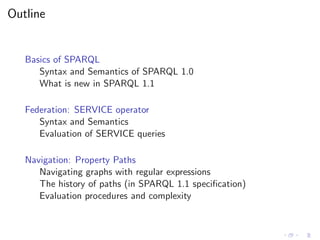
Outline
Basics of SPARQL
Syntax and Semantics of SPARQL 1.0
What is new in SPARQL 1.1
Federation: SERVICE operator
Syntax and Semantics
Evaluation of SERVICE queries
Navigation: Property Paths
Navigating graphs with regular expressions
The history of paths (in SPARQL 1.1 specification)
Evaluation procedures and complexity
SPARQL query language for RDF
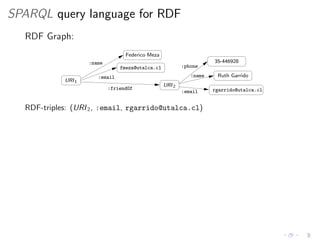
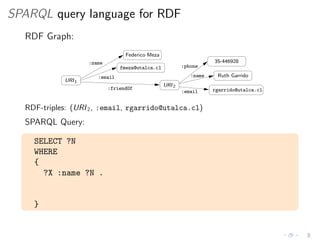
RDF Graph:
fmeza@utalca.cl
:name
:email
:phone
:name
:friendOf rgarrido@utalca.cl:email
Federico Meza
35-446928
Ruth Garrido
URI2
URI1
RDF-triples: (URI2, :email, rgarrido@utalca.cl)
SPARQL query language for RDF
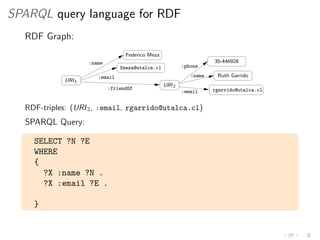
RDF Graph:
fmeza@utalca.cl
:name
:email
:phone
:name
:friendOf rgarrido@utalca.cl:email
Federico Meza
35-446928
Ruth Garrido
URI2
URI1
RDF-triples: (URI2, :email, rgarrido@utalca.cl)
SPARQL Query:
SELECT ?N
WHERE
{
?X :name ?N .
}
SPARQL query language for RDF
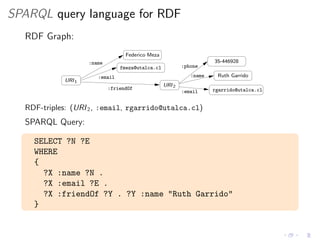
RDF Graph:
fmeza@utalca.cl
:name
:email
:phone
:name
:friendOf rgarrido@utalca.cl:email
Federico Meza
35-446928
Ruth Garrido
URI2
URI1
RDF-triples: (URI2, :email, rgarrido@utalca.cl)
SPARQL Query:
SELECT ?N ?E
WHERE
{
?X :name ?N .
?X :email ?E .
}
SPARQL query language for RDF
RDF Graph:
fmeza@utalca.cl
:name
:email
:phone
:name
:friendOf rgarrido@utalca.cl:email
Federico Meza
35-446928
Ruth Garrido
URI2
URI1
RDF-triples: (URI2, :email, rgarrido@utalca.cl)
SPARQL Query:
SELECT ?N ?E
WHERE
{
?X :name ?N .
?X :email ?E .
?X :friendOf ?Y . ?Y :name "Ruth Garrido"
}
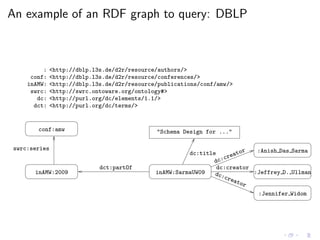
An example of an RDF graph to query: DBLP
inAMW:SarmaUW09 :Jeffrey D. Ullman
:Anish Das Sarma
:Jennifer Widom
inAMW:2009
"Schema Design for ..."
dc:creator
dc:creator
dc:creator
dct:partOf
dc:title
swrc:series
conf:amw
<http://purl.org/dc/terms/>
: <http://dblp.l3s.de/d2r/resource/authors/>
conf: <http://dblp.l3s.de/d2r/resource/conferences/>
inAMW: <http://dblp.l3s.de/d2r/resource/publications/conf/amw/>
swrc: <http://swrc.ontoware.org/ontology#>
dc:
dct:
<http://purl.org/dc/elements/1.1/>
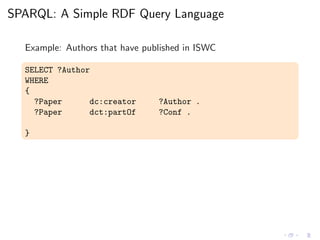
SPARQL: A Simple RDF Query Language
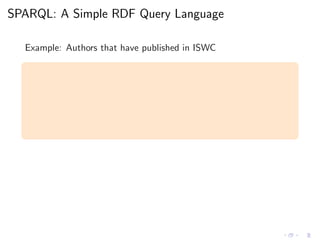
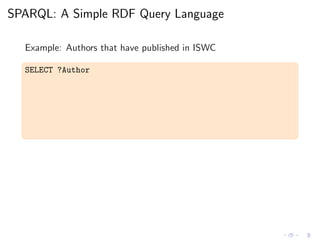
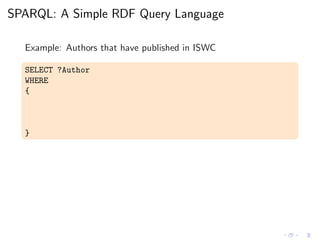
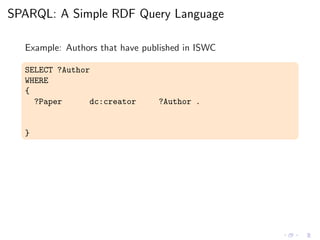
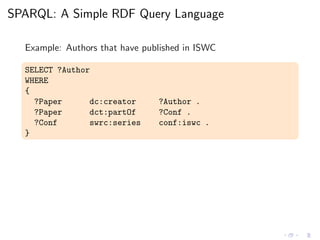
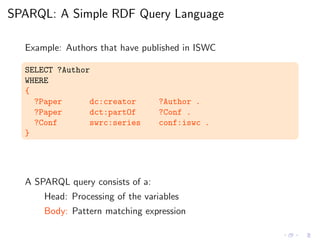
Example: Authors that have published in ISWC
SPARQL: A Simple RDF Query Language
Example: Authors that have published in ISWC
SELECT ?Author
SPARQL: A Simple RDF Query Language
Example: Authors that have published in ISWC
SELECT ?Author
WHERE
{
}
SPARQL: A Simple RDF Query Language
Example: Authors that have published in ISWC
SELECT ?Author
WHERE
{
?Paper dc:creator ?Author .
}
SPARQL: A Simple RDF Query Language
Example: Authors that have published in ISWC
SELECT ?Author
WHERE
{
?Paper dc:creator ?Author .
?Paper dct:partOf ?Conf .
}
SPARQL: A Simple RDF Query Language
Example: Authors that have published in ISWC
SELECT ?Author
WHERE
{
?Paper dc:creator ?Author .
?Paper dct:partOf ?Conf .
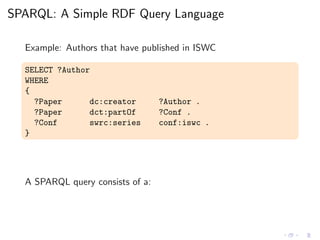
?Conf swrc:series conf:iswc .
}
SPARQL: A Simple RDF Query Language
Example: Authors that have published in ISWC
SELECT ?Author
WHERE
{
?Paper dc:creator ?Author .
?Paper dct:partOf ?Conf .
?Conf swrc:series conf:iswc .
}
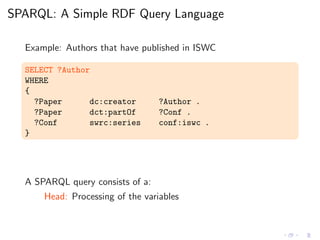
A SPARQL query consists of a:
SPARQL: A Simple RDF Query Language
Example: Authors that have published in ISWC
SELECT ?Author
WHERE
{
?Paper dc:creator ?Author .
?Paper dct:partOf ?Conf .
?Conf swrc:series conf:iswc .
}
A SPARQL query consists of a:
Head: Processing of the variables
SPARQL: A Simple RDF Query Language
Example: Authors that have published in ISWC
SELECT ?Author
WHERE
{
?Paper dc:creator ?Author .
?Paper dct:partOf ?Conf .
?Conf swrc:series conf:iswc .
}
A SPARQL query consists of a:
Head: Processing of the variables
Body: Pattern matching expression
SPARQL: A Simple RDF Query Language
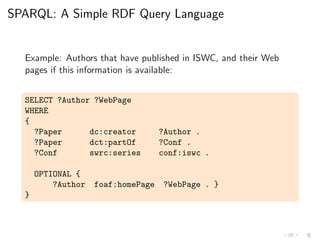
Example: Authors that have published in ISWC, and their Web
pages if this information is available:
SELECT ?Author ?WebPage
WHERE
{
?Paper dc:creator ?Author .
?Paper dct:partOf ?Conf .
?Conf swrc:series conf:iswc .
OPTIONAL {
?Author foaf:homePage ?WebPage . }
}
SPARQL: A Simple RDF Query Language
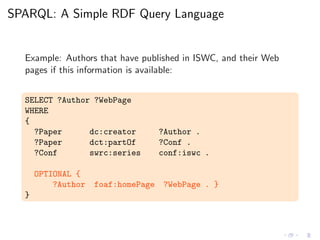
Example: Authors that have published in ISWC, and their Web
pages if this information is available:
SELECT ?Author ?WebPage
WHERE
{
?Paper dc:creator ?Author .
?Paper dct:partOf ?Conf .
?Conf swrc:series conf:iswc .
OPTIONAL {
?Author foaf:homePage ?WebPage . }
}
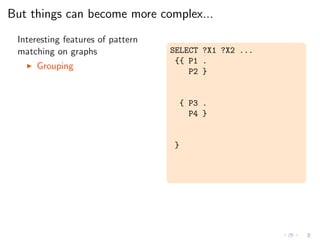
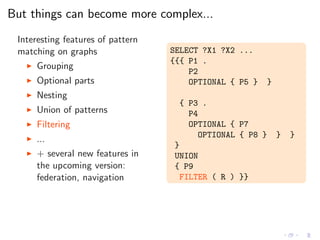
But things can become more complex...
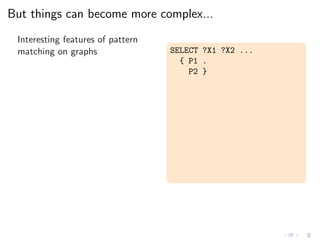
Interesting features of pattern
matching on graphs SELECT ?X1 ?X2 ...
{ P1 .
P2 }
But things can become more complex...
Interesting features of pattern
matching on graphs
◮ Grouping
SELECT ?X1 ?X2 ...
{{ P1 .
P2 }
{ P3 .
P4 }
}
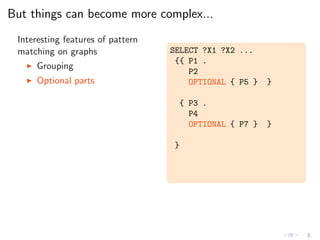
But things can become more complex...
Interesting features of pattern
matching on graphs
◮ Grouping
◮ Optional parts
SELECT ?X1 ?X2 ...
{{ P1 .
P2
OPTIONAL { P5 } }
{ P3 .
P4
OPTIONAL { P7 } }
}
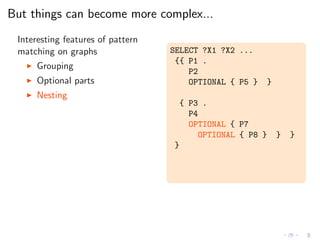
But things can become more complex...
Interesting features of pattern
matching on graphs
◮ Grouping
◮ Optional parts
◮ Nesting
SELECT ?X1 ?X2 ...
{{ P1 .
P2
OPTIONAL { P5 } }
{ P3 .
P4
OPTIONAL { P7
OPTIONAL { P8 } } }
}
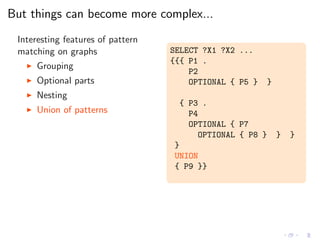
But things can become more complex...
Interesting features of pattern
matching on graphs
◮ Grouping
◮ Optional parts
◮ Nesting
◮ Union of patterns
SELECT ?X1 ?X2 ...
{{{ P1 .
P2
OPTIONAL { P5 } }
{ P3 .
P4
OPTIONAL { P7
OPTIONAL { P8 } } }
}
UNION
{ P9 }}
But things can become more complex...
Interesting features of pattern
matching on graphs
◮ Grouping
◮ Optional parts
◮ Nesting
◮ Union of patterns
◮ Filtering
◮ ...
◮ + several new features in
the upcoming version:
federation, navigation
SELECT ?X1 ?X2 ...
{{{ P1 .
P2
OPTIONAL { P5 } }
{ P3 .
P4
OPTIONAL { P7
OPTIONAL { P8 } } }
}
UNION
{ P9
FILTER ( R ) }}
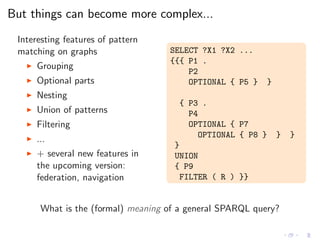
But things can become more complex...
Interesting features of pattern
matching on graphs
◮ Grouping
◮ Optional parts
◮ Nesting
◮ Union of patterns
◮ Filtering
◮ ...
◮ + several new features in
the upcoming version:
federation, navigation
SELECT ?X1 ?X2 ...
{{{ P1 .
P2
OPTIONAL { P5 } }
{ P3 .
P4
OPTIONAL { P7
OPTIONAL { P8 } } }
}
UNION
{ P9
FILTER ( R ) }}
What is the (formal) meaning of a general SPARQL query?
Outline
Basics of SPARQL
Syntax and Semantics of SPARQL 1.0
What is new in SPARQL 1.1
Federation: SERVICE operator
Syntax and Semantics
Evaluation of SERVICE queries
Navigation: Property Paths
Navigating graphs with regular expressions
The history of paths (in SPARQL 1.1 specification)
Evaluation procedures and complexity
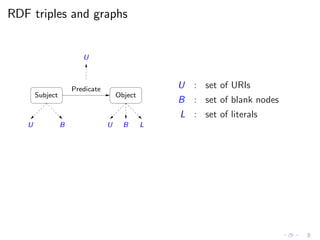
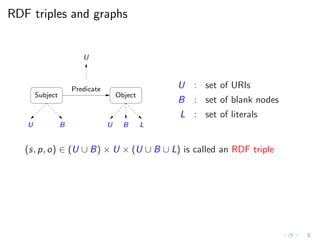
RDF triples and graphs
Subject Object
Predicate
LB
U
U UB
U : set of URIs
B : set of blank nodes
L : set of literals
RDF triples and graphs
Subject Object
Predicate
LB
U
U UB
U : set of URIs
B : set of blank nodes
L : set of literals
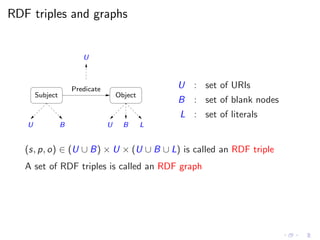
(s, p, o) ∈ (U ∪ B) × U × (U ∪ B ∪ L) is called an RDF triple
RDF triples and graphs
Subject Object
Predicate
LB
U
U UB
U : set of URIs
B : set of blank nodes
L : set of literals
(s, p, o) ∈ (U ∪ B) × U × (U ∪ B ∪ L) is called an RDF triple
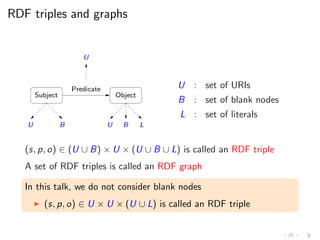
A set of RDF triples is called an RDF graph
RDF triples and graphs
Subject Object
Predicate
LB
U
U UB
U : set of URIs
B : set of blank nodes
L : set of literals
(s, p, o) ∈ (U ∪ B) × U × (U ∪ B ∪ L) is called an RDF triple
A set of RDF triples is called an RDF graph
In this talk, we do not consider blank nodes
◮ (s, p, o) ∈ U × U × (U ∪ L) is called an RDF triple
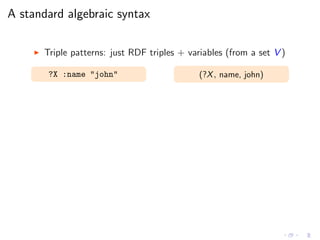
A standard algebraic syntax
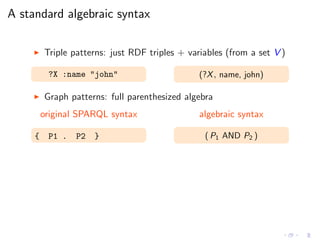
◮ Triple patterns: just RDF triples + variables (from a set V )
?X :name "john" (?X, name, john)
A standard algebraic syntax
◮ Triple patterns: just RDF triples + variables (from a set V )
?X :name "john" (?X, name, john)
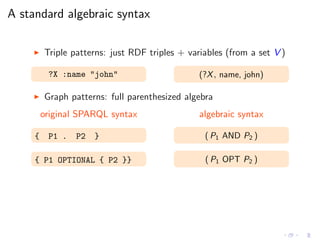
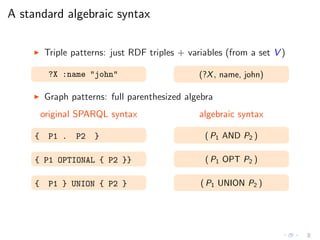
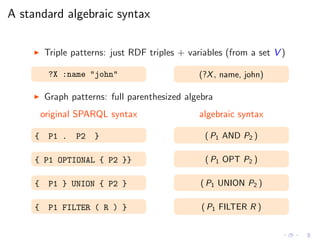
◮ Graph patterns: full parenthesized algebra
original SPARQL syntax algebraic syntax
{ P1 . P2 } ( P1 AND P2 )
A standard algebraic syntax
◮ Triple patterns: just RDF triples + variables (from a set V )
?X :name "john" (?X, name, john)
◮ Graph patterns: full parenthesized algebra
original SPARQL syntax algebraic syntax
{ P1 . P2 } ( P1 AND P2 )
{ P1 OPTIONAL { P2 }} ( P1 OPT P2 )
A standard algebraic syntax
◮ Triple patterns: just RDF triples + variables (from a set V )
?X :name "john" (?X, name, john)
◮ Graph patterns: full parenthesized algebra
original SPARQL syntax algebraic syntax
{ P1 . P2 } ( P1 AND P2 )
{ P1 OPTIONAL { P2 }} ( P1 OPT P2 )
{ P1 } UNION { P2 } ( P1 UNION P2 )
A standard algebraic syntax
◮ Triple patterns: just RDF triples + variables (from a set V )
?X :name "john" (?X, name, john)
◮ Graph patterns: full parenthesized algebra
original SPARQL syntax algebraic syntax
{ P1 . P2 } ( P1 AND P2 )
{ P1 OPTIONAL { P2 }} ( P1 OPT P2 )
{ P1 } UNION { P2 } ( P1 UNION P2 )
{ P1 FILTER ( R ) } ( P1 FILTER R )
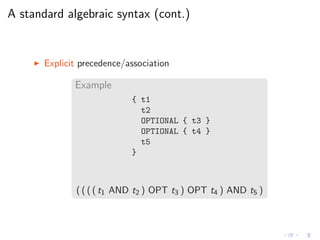
A standard algebraic syntax (cont.)
◮ Explicit precedence/association
Example
{ t1
t2
OPTIONAL { t3 }
OPTIONAL { t4 }
t5
}
( ( ( ( t1 AND t2 ) OPT t3 ) OPT t4 ) AND t5 )
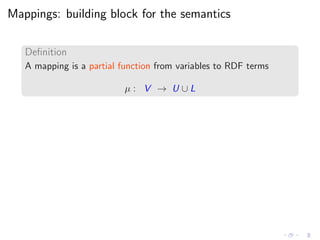
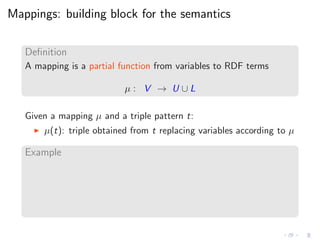
Mappings: building block for the semantics
Definition
A mapping is a partial function from variables to RDF terms
µ : V → U ∪ L
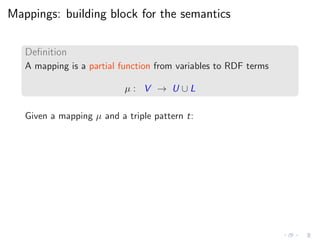
Mappings: building block for the semantics
Definition
A mapping is a partial function from variables to RDF terms
µ : V → U ∪ L
Given a mapping µ and a triple pattern t:
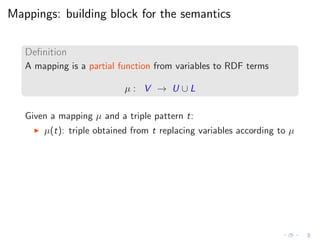
Mappings: building block for the semantics
Definition
A mapping is a partial function from variables to RDF terms
µ : V → U ∪ L
Given a mapping µ and a triple pattern t:
◮ µ(t): triple obtained from t replacing variables according to µ
Mappings: building block for the semantics
Definition
A mapping is a partial function from variables to RDF terms
µ : V → U ∪ L
Given a mapping µ and a triple pattern t:
◮ µ(t): triple obtained from t replacing variables according to µ
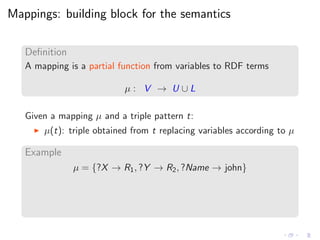
Example
Mappings: building block for the semantics
Definition
A mapping is a partial function from variables to RDF terms
µ : V → U ∪ L
Given a mapping µ and a triple pattern t:
◮ µ(t): triple obtained from t replacing variables according to µ
Example
µ = {?X → R1, ?Y → R2, ?Name → john}
Mappings: building block for the semantics
Definition
A mapping is a partial function from variables to RDF terms
µ : V → U ∪ L
Given a mapping µ and a triple pattern t:
◮ µ(t): triple obtained from t replacing variables according to µ
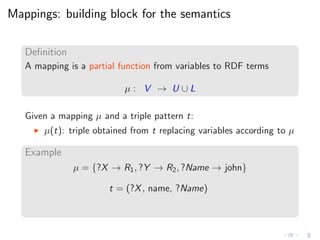
Example
µ = {?X → R1, ?Y → R2, ?Name → john}
t = (?X, name, ?Name)
Mappings: building block for the semantics
Definition
A mapping is a partial function from variables to RDF terms
µ : V → U ∪ L
Given a mapping µ and a triple pattern t:
◮ µ(t): triple obtained from t replacing variables according to µ
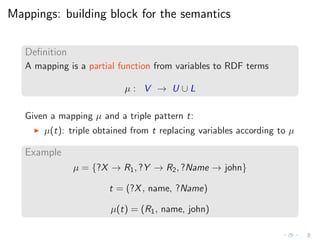
Example
µ = {?X → R1, ?Y → R2, ?Name → john}
t = (?X, name, ?Name)
µ(t) = (R1, name, john)
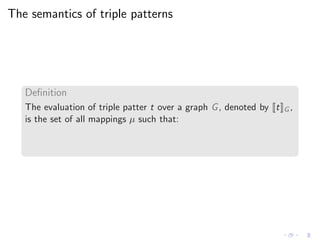
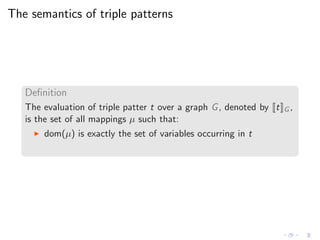
The semantics of triple patterns
Definition
The evaluation of triple patter t over a graph G, denoted by t G ,
is the set of all mappings µ such that:
The semantics of triple patterns
Definition
The evaluation of triple patter t over a graph G, denoted by t G ,
is the set of all mappings µ such that:
◮ dom(µ) is exactly the set of variables occurring in t
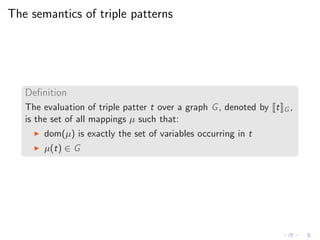
The semantics of triple patterns
Definition
The evaluation of triple patter t over a graph G, denoted by t G ,
is the set of all mappings µ such that:
◮ dom(µ) is exactly the set of variables occurring in t
◮ µ(t) ∈ G
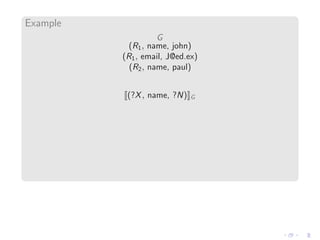
Example
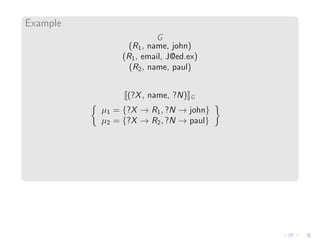
G
(R1, name, john)
(R1, email, J@ed.ex)
(R2, name, paul)
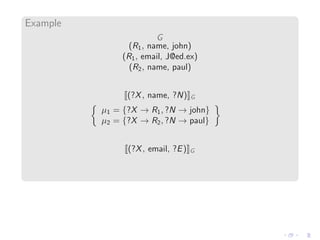
(?X, name, ?N) G
Example
G
(R1, name, john)
(R1, email, J@ed.ex)
(R2, name, paul)
(?X, name, ?N) G
µ1 = {?X → R1, ?N → john}
µ2 = {?X → R2, ?N → paul}
Example
G
(R1, name, john)
(R1, email, J@ed.ex)
(R2, name, paul)
(?X, name, ?N) G
µ1 = {?X → R1, ?N → john}
µ2 = {?X → R2, ?N → paul}
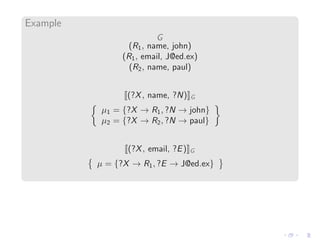
(?X, email, ?E) G
Example
G
(R1, name, john)
(R1, email, J@ed.ex)
(R2, name, paul)
(?X, name, ?N) G
µ1 = {?X → R1, ?N → john}
µ2 = {?X → R2, ?N → paul}
(?X, email, ?E) G
µ = {?X → R1, ?E → J@ed.ex}
Example
G
(R1, name, john)
(R1, email, J@ed.ex)
(R2, name, paul)
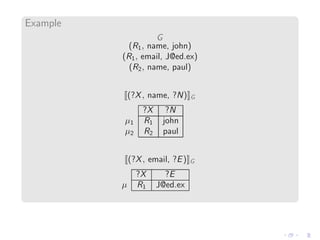
(?X, name, ?N) G
?X ?N
µ1 R1 john
µ2 R2 paul
(?X, email, ?E) G
?X ?E
µ R1 J@ed.ex
Example
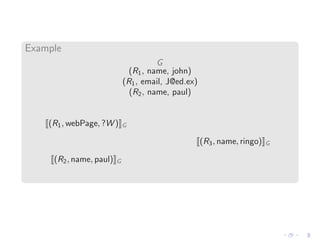
G
(R1, name, john)
(R1, email, J@ed.ex)
(R2, name, paul)
(R1, webPage, ?W ) G
(R2, name, paul) G
(R3, name, ringo) G
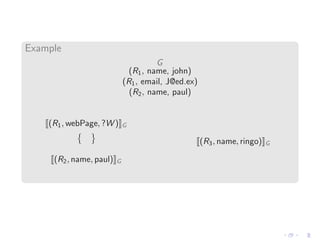
Example
G
(R1, name, john)
(R1, email, J@ed.ex)
(R2, name, paul)
(R1, webPage, ?W ) G
(R2, name, paul) G
(R3, name, ringo) G
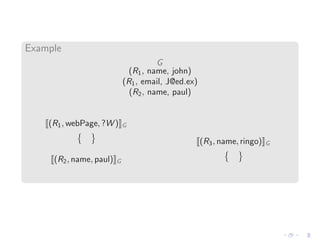
Example
G
(R1, name, john)
(R1, email, J@ed.ex)
(R2, name, paul)
(R1, webPage, ?W ) G
(R2, name, paul) G
(R3, name, ringo) G
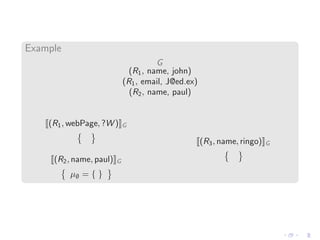
Example
G
(R1, name, john)
(R1, email, J@ed.ex)
(R2, name, paul)
(R1, webPage, ?W ) G
(R2, name, paul) G
µ∅ = { }
(R3, name, ringo) G
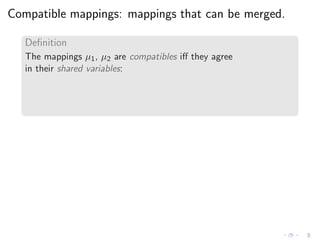
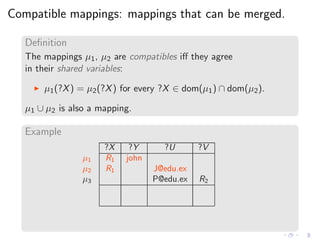
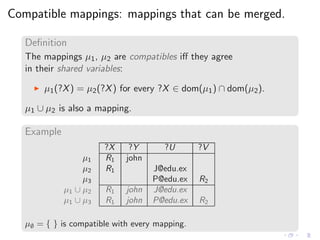
Compatible mappings: mappings that can be merged.
Definition
The mappings µ1, µ2 are compatibles iff they agree
in their shared variables:
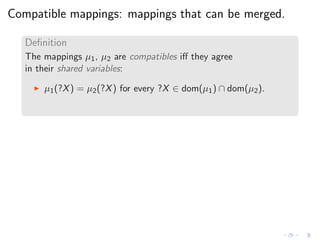
Compatible mappings: mappings that can be merged.
Definition
The mappings µ1, µ2 are compatibles iff they agree
in their shared variables:
◮ µ1(?X) = µ2(?X) for every ?X ∈ dom(µ1) ∩ dom(µ2).
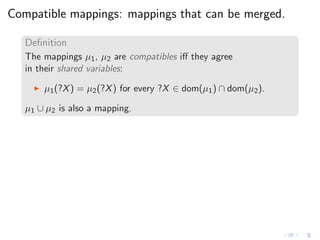
Compatible mappings: mappings that can be merged.
Definition
The mappings µ1, µ2 are compatibles iff they agree
in their shared variables:
◮ µ1(?X) = µ2(?X) for every ?X ∈ dom(µ1) ∩ dom(µ2).
µ1 ∪ µ2 is also a mapping.
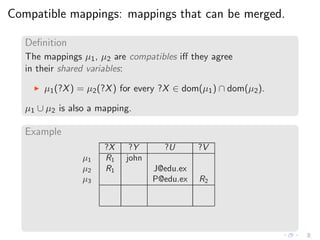
Compatible mappings: mappings that can be merged.
Definition
The mappings µ1, µ2 are compatibles iff they agree
in their shared variables:
◮ µ1(?X) = µ2(?X) for every ?X ∈ dom(µ1) ∩ dom(µ2).
µ1 ∪ µ2 is also a mapping.
Example
?X ?Y ?U ?V
µ1 R1 john
µ2 R1 J@edu.ex
µ3 P@edu.ex R2
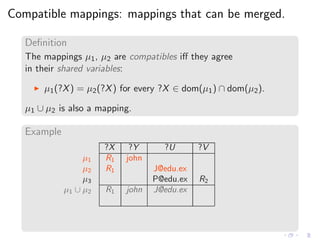
Compatible mappings: mappings that can be merged.
Definition
The mappings µ1, µ2 are compatibles iff they agree
in their shared variables:
◮ µ1(?X) = µ2(?X) for every ?X ∈ dom(µ1) ∩ dom(µ2).
µ1 ∪ µ2 is also a mapping.
Example
?X ?Y ?U ?V
µ1 R1 john
µ2 R1 J@edu.ex
µ3 P@edu.ex R2
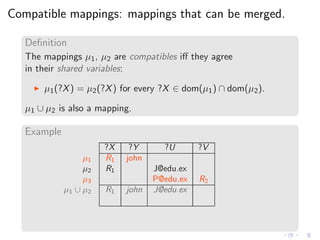
Compatible mappings: mappings that can be merged.
Definition
The mappings µ1, µ2 are compatibles iff they agree
in their shared variables:
◮ µ1(?X) = µ2(?X) for every ?X ∈ dom(µ1) ∩ dom(µ2).
µ1 ∪ µ2 is also a mapping.
Example
?X ?Y ?U ?V
µ1 R1 john
µ2 R1 J@edu.ex
µ3 P@edu.ex R2
µ1 ∪ µ2 R1 john J@edu.ex
Compatible mappings: mappings that can be merged.
Definition
The mappings µ1, µ2 are compatibles iff they agree
in their shared variables:
◮ µ1(?X) = µ2(?X) for every ?X ∈ dom(µ1) ∩ dom(µ2).
µ1 ∪ µ2 is also a mapping.
Example
?X ?Y ?U ?V
µ1 R1 john
µ2 R1 J@edu.ex
µ3 P@edu.ex R2
µ1 ∪ µ2 R1 john J@edu.ex
Compatible mappings: mappings that can be merged.
Definition
The mappings µ1, µ2 are compatibles iff they agree
in their shared variables:
◮ µ1(?X) = µ2(?X) for every ?X ∈ dom(µ1) ∩ dom(µ2).
µ1 ∪ µ2 is also a mapping.
Example
?X ?Y ?U ?V
µ1 R1 john
µ2 R1 J@edu.ex
µ3 P@edu.ex R2
µ1 ∪ µ2 R1 john J@edu.ex
µ1 ∪ µ3 R1 john P@edu.ex R2
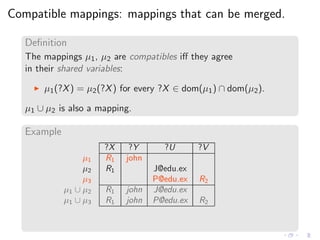
Compatible mappings: mappings that can be merged.
Definition
The mappings µ1, µ2 are compatibles iff they agree
in their shared variables:
◮ µ1(?X) = µ2(?X) for every ?X ∈ dom(µ1) ∩ dom(µ2).
µ1 ∪ µ2 is also a mapping.
Example
?X ?Y ?U ?V
µ1 R1 john
µ2 R1 J@edu.ex
µ3 P@edu.ex R2
µ1 ∪ µ2 R1 john J@edu.ex
µ1 ∪ µ3 R1 john P@edu.ex R2
µ∅ = { } is compatible with every mapping.
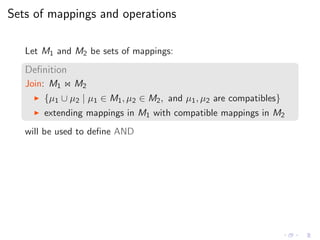
Sets of mappings and operations
Let M1 and M2 be sets of mappings:
Definition
Join: M1 ⋊⋉ M2
◮ {µ1 ∪ µ2 | µ1 ∈ M1, µ2 ∈ M2, and µ1, µ2 are compatibles}
◮ extending mappings in M1 with compatible mappings in M2
will be used to define AND
Sets of mappings and operations
Let M1 and M2 be sets of mappings:
Definition
Join: M1 ⋊⋉ M2
◮ {µ1 ∪ µ2 | µ1 ∈ M1, µ2 ∈ M2, and µ1, µ2 are compatibles}
◮ extending mappings in M1 with compatible mappings in M2
will be used to define AND
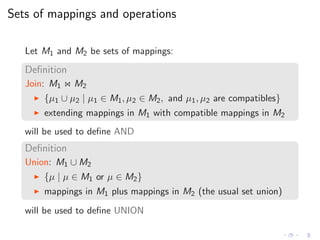
Definition
Union: M1 ∪ M2
◮ {µ | µ ∈ M1 or µ ∈ M2}
◮ mappings in M1 plus mappings in M2 (the usual set union)
will be used to define UNION
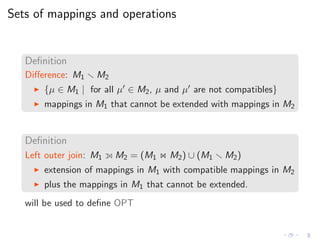
Sets of mappings and operations
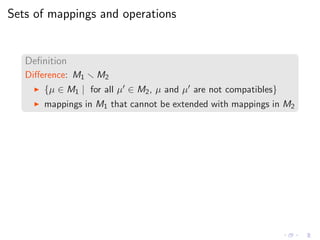
Definition
Difference: M1 M2
◮ {µ ∈ M1 | for all µ′ ∈ M2, µ and µ′ are not compatibles}
◮ mappings in M1 that cannot be extended with mappings in M2
Sets of mappings and operations
Definition
Difference: M1 M2
◮ {µ ∈ M1 | for all µ′ ∈ M2, µ and µ′ are not compatibles}
◮ mappings in M1 that cannot be extended with mappings in M2
Definition
Left outer join: M1 M2 = (M1 ⋊⋉ M2) ∪ (M1 M2)
◮ extension of mappings in M1 with compatible mappings in M2
◮ plus the mappings in M1 that cannot be extended.
will be used to define OPT
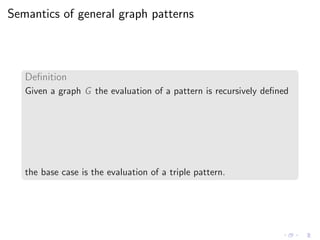
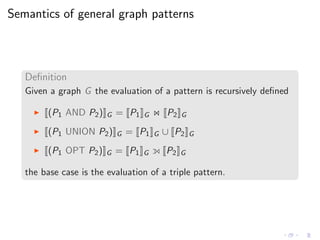
Semantics of general graph patterns
Definition
Given a graph G the evaluation of a pattern is recursively defined
the base case is the evaluation of a triple pattern.
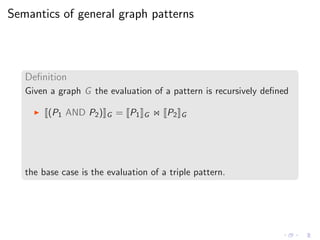
Semantics of general graph patterns
Definition
Given a graph G the evaluation of a pattern is recursively defined
◮ (P1 AND P2) G = P1 G ⋊⋉ P2 G
the base case is the evaluation of a triple pattern.
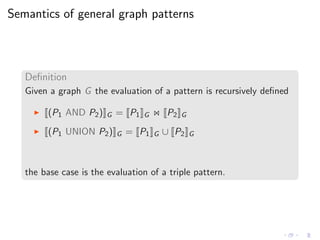
Semantics of general graph patterns
Definition
Given a graph G the evaluation of a pattern is recursively defined
◮ (P1 AND P2) G = P1 G ⋊⋉ P2 G
◮ (P1 UNION P2) G = P1 G ∪ P2 G
the base case is the evaluation of a triple pattern.
Semantics of general graph patterns
Definition
Given a graph G the evaluation of a pattern is recursively defined
◮ (P1 AND P2) G = P1 G ⋊⋉ P2 G
◮ (P1 UNION P2) G = P1 G ∪ P2 G
◮ (P1 OPT P2) G = P1 G P2 G
the base case is the evaluation of a triple pattern.
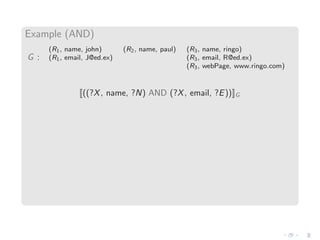
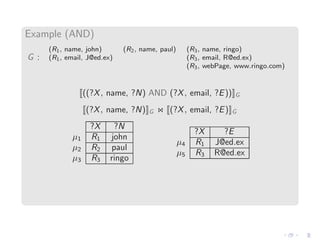
Example (AND)
G :
(R1, name, john) (R2, name, paul) (R3, name, ringo)
(R1, email, J@ed.ex) (R3, email, R@ed.ex)
(R3, webPage, www.ringo.com)
((?X, name, ?N) AND (?X, email, ?E)) G
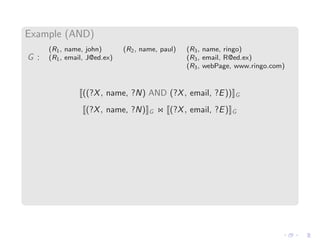
Example (AND)
G :
(R1, name, john) (R2, name, paul) (R3, name, ringo)
(R1, email, J@ed.ex) (R3, email, R@ed.ex)
(R3, webPage, www.ringo.com)
((?X, name, ?N) AND (?X, email, ?E)) G
(?X, name, ?N) G ⋊⋉ (?X, email, ?E) G
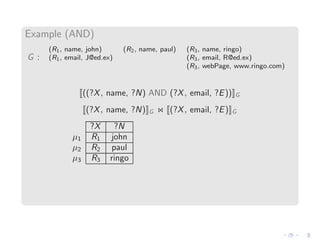
Example (AND)
G :
(R1, name, john) (R2, name, paul) (R3, name, ringo)
(R1, email, J@ed.ex) (R3, email, R@ed.ex)
(R3, webPage, www.ringo.com)
((?X, name, ?N) AND (?X, email, ?E)) G
(?X, name, ?N) G ⋊⋉ (?X, email, ?E) G
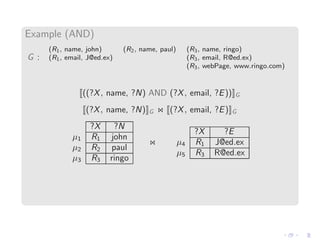
?X ?N
µ1 R1 john
µ2 R2 paul
µ3 R3 ringo
Example (AND)
G :
(R1, name, john) (R2, name, paul) (R3, name, ringo)
(R1, email, J@ed.ex) (R3, email, R@ed.ex)
(R3, webPage, www.ringo.com)
((?X, name, ?N) AND (?X, email, ?E)) G
(?X, name, ?N) G ⋊⋉ (?X, email, ?E) G
?X ?N
µ1 R1 john
µ2 R2 paul
µ3 R3 ringo
?X ?E
µ4 R1 J@ed.ex
µ5 R3 R@ed.ex
Example (AND)
G :
(R1, name, john) (R2, name, paul) (R3, name, ringo)
(R1, email, J@ed.ex) (R3, email, R@ed.ex)
(R3, webPage, www.ringo.com)
((?X, name, ?N) AND (?X, email, ?E)) G
(?X, name, ?N) G ⋊⋉ (?X, email, ?E) G
?X ?N
µ1 R1 john
µ2 R2 paul
µ3 R3 ringo
⋊⋉
?X ?E
µ4 R1 J@ed.ex
µ5 R3 R@ed.ex
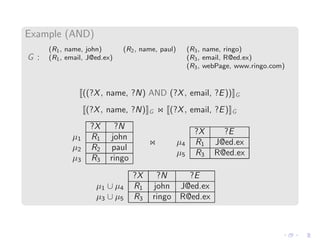
Example (AND)
G :
(R1, name, john) (R2, name, paul) (R3, name, ringo)
(R1, email, J@ed.ex) (R3, email, R@ed.ex)
(R3, webPage, www.ringo.com)
((?X, name, ?N) AND (?X, email, ?E)) G
(?X, name, ?N) G ⋊⋉ (?X, email, ?E) G
?X ?N
µ1 R1 john
µ2 R2 paul
µ3 R3 ringo
⋊⋉
?X ?E
µ4 R1 J@ed.ex
µ5 R3 R@ed.ex
?X ?N ?E
µ1 ∪ µ4 R1 john J@ed.ex
µ3 ∪ µ5 R3 ringo R@ed.ex
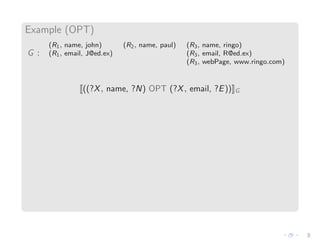
Example (OPT)
G :
(R1, name, john) (R2, name, paul) (R3, name, ringo)
(R1, email, J@ed.ex) (R3, email, R@ed.ex)
(R3, webPage, www.ringo.com)
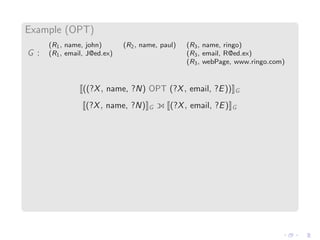
((?X, name, ?N) OPT (?X, email, ?E)) G
Example (OPT)
G :
(R1, name, john) (R2, name, paul) (R3, name, ringo)
(R1, email, J@ed.ex) (R3, email, R@ed.ex)
(R3, webPage, www.ringo.com)
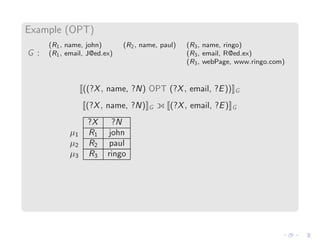
((?X, name, ?N) OPT (?X, email, ?E)) G
(?X, name, ?N) G (?X, email, ?E) G
Example (OPT)
G :
(R1, name, john) (R2, name, paul) (R3, name, ringo)
(R1, email, J@ed.ex) (R3, email, R@ed.ex)
(R3, webPage, www.ringo.com)
((?X, name, ?N) OPT (?X, email, ?E)) G
(?X, name, ?N) G (?X, email, ?E) G
?X ?N
µ1 R1 john
µ2 R2 paul
µ3 R3 ringo
Example (OPT)
G :
(R1, name, john) (R2, name, paul) (R3, name, ringo)
(R1, email, J@ed.ex) (R3, email, R@ed.ex)
(R3, webPage, www.ringo.com)
((?X, name, ?N) OPT (?X, email, ?E)) G
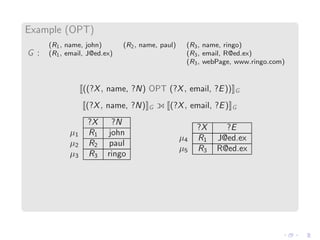
(?X, name, ?N) G (?X, email, ?E) G
?X ?N
µ1 R1 john
µ2 R2 paul
µ3 R3 ringo
?X ?E
µ4 R1 J@ed.ex
µ5 R3 R@ed.ex
Example (OPT)
G :
(R1, name, john) (R2, name, paul) (R3, name, ringo)
(R1, email, J@ed.ex) (R3, email, R@ed.ex)
(R3, webPage, www.ringo.com)
((?X, name, ?N) OPT (?X, email, ?E)) G
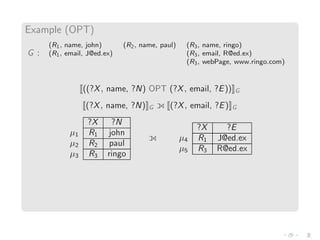
(?X, name, ?N) G (?X, email, ?E) G
?X ?N
µ1 R1 john
µ2 R2 paul
µ3 R3 ringo
?X ?E
µ4 R1 J@ed.ex
µ5 R3 R@ed.ex
Example (OPT)
G :
(R1, name, john) (R2, name, paul) (R3, name, ringo)
(R1, email, J@ed.ex) (R3, email, R@ed.ex)
(R3, webPage, www.ringo.com)
((?X, name, ?N) OPT (?X, email, ?E)) G
(?X, name, ?N) G (?X, email, ?E) G
?X ?N
µ1 R1 john
µ2 R2 paul
µ3 R3 ringo
?X ?E
µ4 R1 J@ed.ex
µ5 R3 R@ed.ex
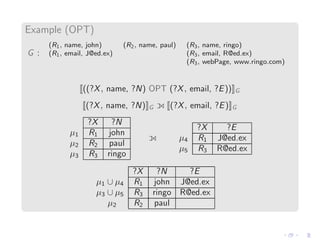
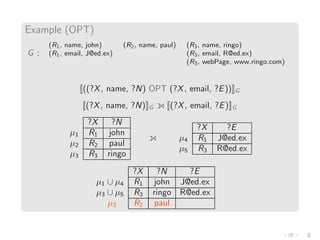
?X ?N ?E
µ1 ∪ µ4 R1 john J@ed.ex
µ3 ∪ µ5 R3 ringo R@ed.ex
µ2 R2 paul
Example (OPT)
G :
(R1, name, john) (R2, name, paul) (R3, name, ringo)
(R1, email, J@ed.ex) (R3, email, R@ed.ex)
(R3, webPage, www.ringo.com)
((?X, name, ?N) OPT (?X, email, ?E)) G
(?X, name, ?N) G (?X, email, ?E) G
?X ?N
µ1 R1 john
µ2 R2 paul
µ3 R3 ringo
?X ?E
µ4 R1 J@ed.ex
µ5 R3 R@ed.ex
?X ?N ?E
µ1 ∪ µ4 R1 john J@ed.ex
µ3 ∪ µ5 R3 ringo R@ed.ex
µ2 R2 paul
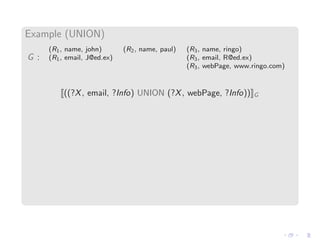
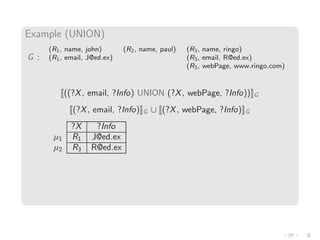
Example (UNION)
G :
(R1, name, john) (R2, name, paul) (R3, name, ringo)
(R1, email, J@ed.ex) (R3, email, R@ed.ex)
(R3, webPage, www.ringo.com)
((?X, email, ?Info) UNION (?X, webPage, ?Info)) G
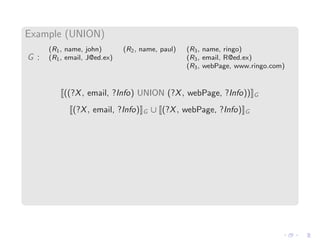
Example (UNION)
G :
(R1, name, john) (R2, name, paul) (R3, name, ringo)
(R1, email, J@ed.ex) (R3, email, R@ed.ex)
(R3, webPage, www.ringo.com)
((?X, email, ?Info) UNION (?X, webPage, ?Info)) G
(?X, email, ?Info) G ∪ (?X, webPage, ?Info) G
Example (UNION)
G :
(R1, name, john) (R2, name, paul) (R3, name, ringo)
(R1, email, J@ed.ex) (R3, email, R@ed.ex)
(R3, webPage, www.ringo.com)
((?X, email, ?Info) UNION (?X, webPage, ?Info)) G
(?X, email, ?Info) G ∪ (?X, webPage, ?Info) G
?X ?Info
µ1 R1 J@ed.ex
µ2 R3 R@ed.ex
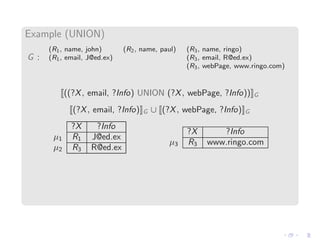
Example (UNION)
G :
(R1, name, john) (R2, name, paul) (R3, name, ringo)
(R1, email, J@ed.ex) (R3, email, R@ed.ex)
(R3, webPage, www.ringo.com)
((?X, email, ?Info) UNION (?X, webPage, ?Info)) G
(?X, email, ?Info) G ∪ (?X, webPage, ?Info) G
?X ?Info
µ1 R1 J@ed.ex
µ2 R3 R@ed.ex
?X ?Info
µ3 R3 www.ringo.com
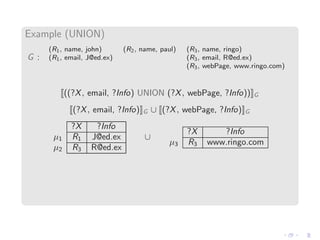
Example (UNION)
G :
(R1, name, john) (R2, name, paul) (R3, name, ringo)
(R1, email, J@ed.ex) (R3, email, R@ed.ex)
(R3, webPage, www.ringo.com)
((?X, email, ?Info) UNION (?X, webPage, ?Info)) G
(?X, email, ?Info) G ∪ (?X, webPage, ?Info) G
?X ?Info
µ1 R1 J@ed.ex
µ2 R3 R@ed.ex
∪
?X ?Info
µ3 R3 www.ringo.com
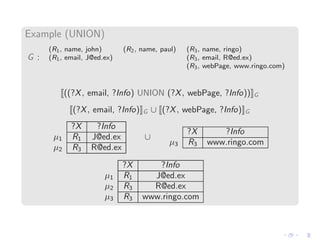
Example (UNION)
G :
(R1, name, john) (R2, name, paul) (R3, name, ringo)
(R1, email, J@ed.ex) (R3, email, R@ed.ex)
(R3, webPage, www.ringo.com)
((?X, email, ?Info) UNION (?X, webPage, ?Info)) G
(?X, email, ?Info) G ∪ (?X, webPage, ?Info) G
?X ?Info
µ1 R1 J@ed.ex
µ2 R3 R@ed.ex
∪
?X ?Info
µ3 R3 www.ringo.com
?X ?Info
µ1 R1 J@ed.ex
µ2 R3 R@ed.ex
µ3 R3 www.ringo.com
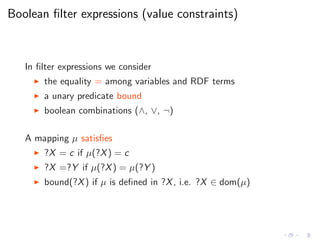
Boolean filter expressions (value constraints)
In filter expressions we consider
◮ the equality = among variables and RDF terms
◮ a unary predicate bound
◮ boolean combinations (∧, ∨, ¬)
A mapping µ satisfies
◮ ?X = c if µ(?X) = c
◮ ?X =?Y if µ(?X) = µ(?Y )
◮ bound(?X) if µ is defined in ?X, i.e. ?X ∈ dom(µ)
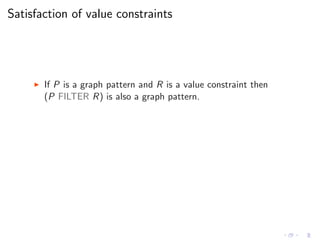
Satisfaction of value constraints
◮ If P is a graph pattern and R is a value constraint then
(P FILTER R) is also a graph pattern.
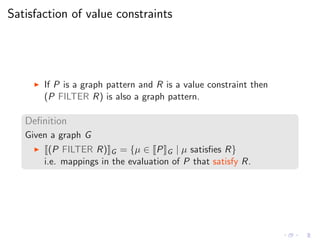
Satisfaction of value constraints
◮ If P is a graph pattern and R is a value constraint then
(P FILTER R) is also a graph pattern.
Definition
Given a graph G
◮ (P FILTER R) G = {µ ∈ P G | µ satisfies R}
i.e. mappings in the evaluation of P that satisfy R.
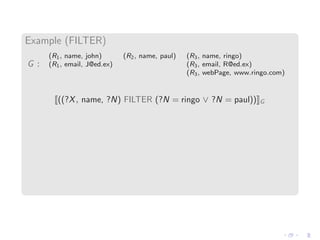
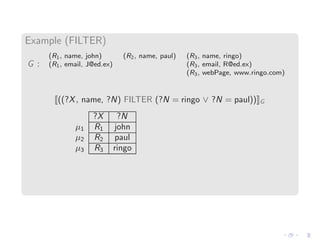
Example (FILTER)
G :
(R1, name, john) (R2, name, paul) (R3, name, ringo)
(R1, email, J@ed.ex) (R3, email, R@ed.ex)
(R3, webPage, www.ringo.com)
((?X, name, ?N) FILTER (?N = ringo ∨ ?N = paul)) G
Example (FILTER)
G :
(R1, name, john) (R2, name, paul) (R3, name, ringo)
(R1, email, J@ed.ex) (R3, email, R@ed.ex)
(R3, webPage, www.ringo.com)
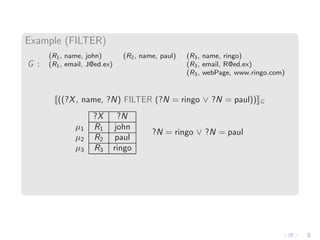
((?X, name, ?N) FILTER (?N = ringo ∨ ?N = paul)) G
?X ?N
µ1 R1 john
µ2 R2 paul
µ3 R3 ringo
Example (FILTER)
G :
(R1, name, john) (R2, name, paul) (R3, name, ringo)
(R1, email, J@ed.ex) (R3, email, R@ed.ex)
(R3, webPage, www.ringo.com)
((?X, name, ?N) FILTER (?N = ringo ∨ ?N = paul)) G
?X ?N
µ1 R1 john
µ2 R2 paul
µ3 R3 ringo
?N = ringo ∨ ?N = paul
Example (FILTER)
G :
(R1, name, john) (R2, name, paul) (R3, name, ringo)
(R1, email, J@ed.ex) (R3, email, R@ed.ex)
(R3, webPage, www.ringo.com)
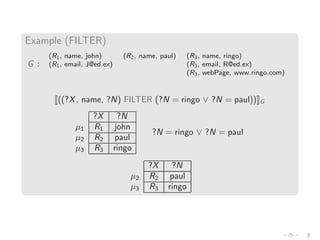
((?X, name, ?N) FILTER (?N = ringo ∨ ?N = paul)) G
?X ?N
µ1 R1 john
µ2 R2 paul
µ3 R3 ringo
?N = ringo ∨ ?N = paul
?X ?N
µ2 R2 paul
µ3 R3 ringo
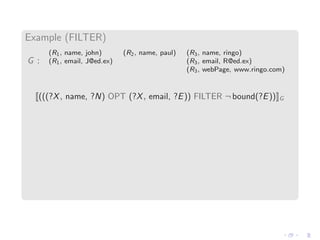
Example (FILTER)
G :
(R1, name, john) (R2, name, paul) (R3, name, ringo)
(R1, email, J@ed.ex) (R3, email, R@ed.ex)
(R3, webPage, www.ringo.com)
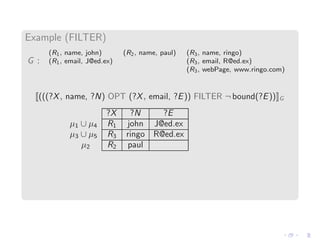
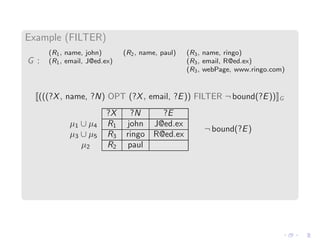
(((?X, name, ?N) OPT (?X, email, ?E)) FILTER ¬ bound(?E)) G
Example (FILTER)
G :
(R1, name, john) (R2, name, paul) (R3, name, ringo)
(R1, email, J@ed.ex) (R3, email, R@ed.ex)
(R3, webPage, www.ringo.com)
(((?X, name, ?N) OPT (?X, email, ?E)) FILTER ¬ bound(?E)) G
?X ?N ?E
µ1 ∪ µ4 R1 john J@ed.ex
µ3 ∪ µ5 R3 ringo R@ed.ex
µ2 R2 paul
Example (FILTER)
G :
(R1, name, john) (R2, name, paul) (R3, name, ringo)
(R1, email, J@ed.ex) (R3, email, R@ed.ex)
(R3, webPage, www.ringo.com)
(((?X, name, ?N) OPT (?X, email, ?E)) FILTER ¬ bound(?E)) G
?X ?N ?E
µ1 ∪ µ4 R1 john J@ed.ex
µ3 ∪ µ5 R3 ringo R@ed.ex
µ2 R2 paul
¬ bound(?E)
Example (FILTER)
G :
(R1, name, john) (R2, name, paul) (R3, name, ringo)
(R1, email, J@ed.ex) (R3, email, R@ed.ex)
(R3, webPage, www.ringo.com)
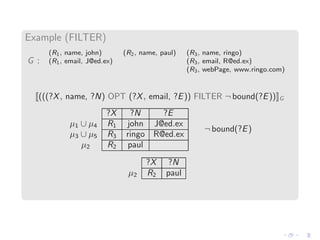
(((?X, name, ?N) OPT (?X, email, ?E)) FILTER ¬ bound(?E)) G
?X ?N ?E
µ1 ∪ µ4 R1 john J@ed.ex
µ3 ∪ µ5 R3 ringo R@ed.ex
µ2 R2 paul
¬ bound(?E)
?X ?N
µ2 R2 paul
Example (FILTER)
G :
(R1, name, john) (R2, name, paul) (R3, name, ringo)
(R1, email, J@ed.ex) (R3, email, R@ed.ex)
(R3, webPage, www.ringo.com)
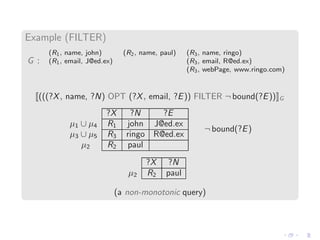
(((?X, name, ?N) OPT (?X, email, ?E)) FILTER ¬ bound(?E)) G
?X ?N ?E
µ1 ∪ µ4 R1 john J@ed.ex
µ3 ∪ µ5 R3 ringo R@ed.ex
µ2 R2 paul
¬ bound(?E)
?X ?N
µ2 R2 paul
(a non-monotonic query)
Why do we need/want to formalize SPARQL
A formalization is beneficial
◮ clarifying corner cases
◮ helping in the implementation process
◮ providing solid foundations (we can actually prove properties!)
The evaluation decision problem
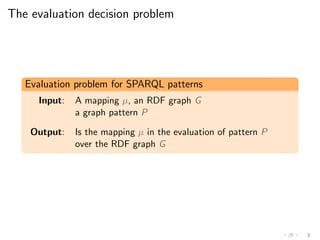
Evaluation problem for SPARQL patterns
Input: A mapping µ, an RDF graph G
a graph pattern P
Output: Is the mapping µ in the evaluation of pattern P
over the RDF graph G
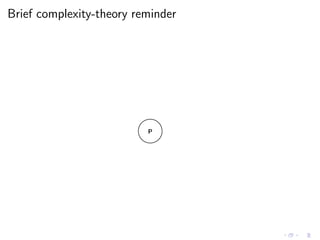
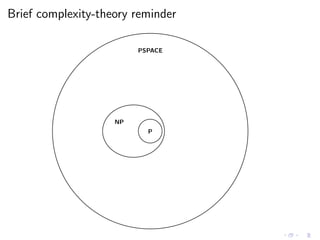
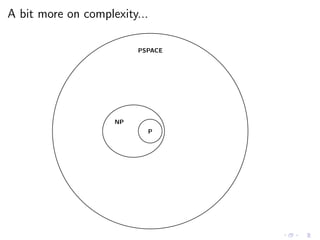
Brief complexity-theory reminder
P
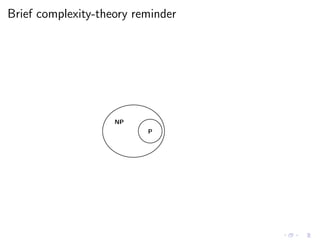
Brief complexity-theory reminder
NP
P
Brief complexity-theory reminder
PSPACE
NP
P
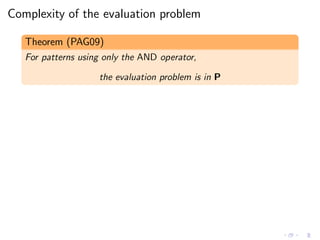
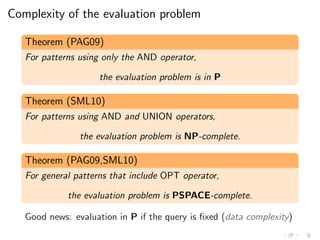
Complexity of the evaluation problem
Theorem (PAG09)
For patterns using only the AND operator,
the evaluation problem is in P
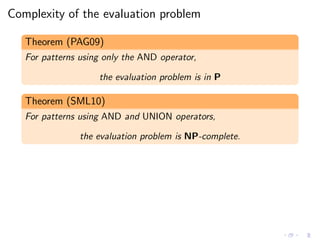
Complexity of the evaluation problem
Theorem (PAG09)
For patterns using only the AND operator,
the evaluation problem is in P
Theorem (SML10)
For patterns using AND and UNION operators,
the evaluation problem is NP-complete.
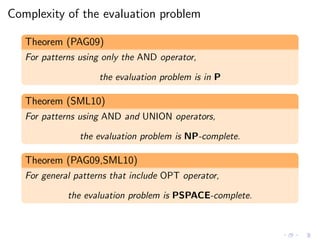
Complexity of the evaluation problem
Theorem (PAG09)
For patterns using only the AND operator,
the evaluation problem is in P
Theorem (SML10)
For patterns using AND and UNION operators,
the evaluation problem is NP-complete.
Theorem (PAG09,SML10)
For general patterns that include OPT operator,
the evaluation problem is PSPACE-complete.
Complexity of the evaluation problem
Theorem (PAG09)
For patterns using only the AND operator,
the evaluation problem is in P
Theorem (SML10)
For patterns using AND and UNION operators,
the evaluation problem is NP-complete.
Theorem (PAG09,SML10)
For general patterns that include OPT operator,
the evaluation problem is PSPACE-complete.
Good news: evaluation in P if the query is fixed (data complexity)
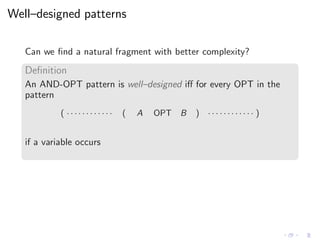
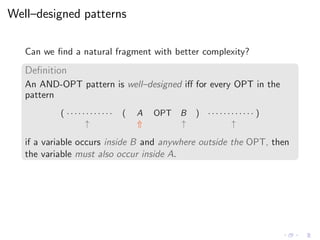
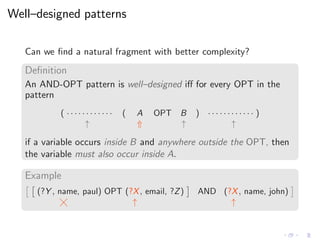
Well–designed patterns
Can we find a natural fragment with better complexity?
Definition
An AND-OPT pattern is well–designed iff for every OPT in the
pattern
( · · · · · · · · · · · · ( A OPT B ) · · · · · · · · · · · · )
if a variable occurs
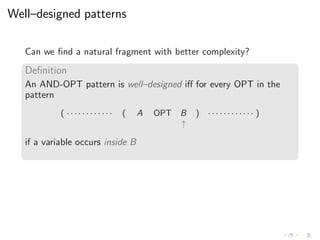
Well–designed patterns
Can we find a natural fragment with better complexity?
Definition
An AND-OPT pattern is well–designed iff for every OPT in the
pattern
( · · · · · · · · · · · · ( A OPT B ) · · · · · · · · · · · · )
↑
if a variable occurs inside B
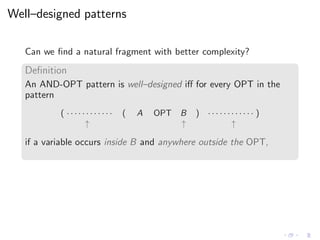
Well–designed patterns
Can we find a natural fragment with better complexity?
Definition
An AND-OPT pattern is well–designed iff for every OPT in the
pattern
( · · · · · · · · · · · · ( A OPT B ) · · · · · · · · · · · · )
↑ ↑ ↑
if a variable occurs inside B and anywhere outside the OPT,
Well–designed patterns
Can we find a natural fragment with better complexity?
Definition
An AND-OPT pattern is well–designed iff for every OPT in the
pattern
( · · · · · · · · · · · · ( A OPT B ) · · · · · · · · · · · · )
↑ ⇑ ↑ ↑
if a variable occurs inside B and anywhere outside the OPT, then
the variable must also occur inside A.
Well–designed patterns
Can we find a natural fragment with better complexity?
Definition
An AND-OPT pattern is well–designed iff for every OPT in the
pattern
( · · · · · · · · · · · · ( A OPT B ) · · · · · · · · · · · · )
↑ ⇑ ↑ ↑
if a variable occurs inside B and anywhere outside the OPT, then
the variable must also occur inside A.
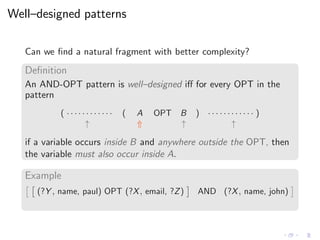
Example
(?Y , name, paul) OPT (?X, email, ?Z) AND (?X, name, john)
Well–designed patterns
Can we find a natural fragment with better complexity?
Definition
An AND-OPT pattern is well–designed iff for every OPT in the
pattern
( · · · · · · · · · · · · ( A OPT B ) · · · · · · · · · · · · )
↑ ⇑ ↑ ↑
if a variable occurs inside B and anywhere outside the OPT, then
the variable must also occur inside A.
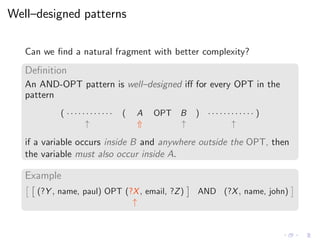
Example
(?Y , name, paul) OPT (?X, email, ?Z) AND (?X, name, john)
↑
Well–designed patterns
Can we find a natural fragment with better complexity?
Definition
An AND-OPT pattern is well–designed iff for every OPT in the
pattern
( · · · · · · · · · · · · ( A OPT B ) · · · · · · · · · · · · )
↑ ⇑ ↑ ↑
if a variable occurs inside B and anywhere outside the OPT, then
the variable must also occur inside A.
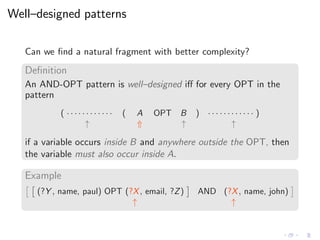
Example
(?Y , name, paul) OPT (?X, email, ?Z) AND (?X, name, john)
↑ ↑
Well–designed patterns
Can we find a natural fragment with better complexity?
Definition
An AND-OPT pattern is well–designed iff for every OPT in the
pattern
( · · · · · · · · · · · · ( A OPT B ) · · · · · · · · · · · · )
↑ ⇑ ↑ ↑
if a variable occurs inside B and anywhere outside the OPT, then
the variable must also occur inside A.
Example
(?Y , name, paul) OPT (?X, email, ?Z) AND (?X, name, john)
↑ ↑
A bit more on complexity...
PSPACE
NP
P
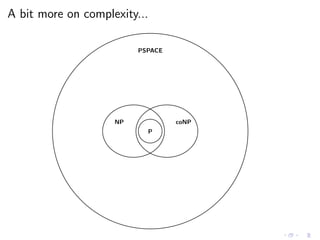
A bit more on complexity...
PSPACE
coNPNP
P
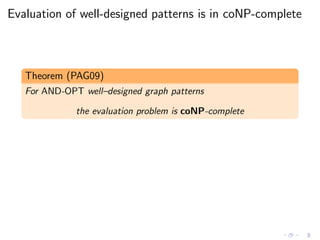
Evaluation of well-designed patterns is in coNP-complete
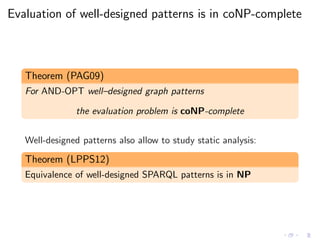
Theorem (PAG09)
For AND-OPT well–designed graph patterns
the evaluation problem is coNP-complete
Evaluation of well-designed patterns is in coNP-complete
Theorem (PAG09)
For AND-OPT well–designed graph patterns
the evaluation problem is coNP-complete
Well-designed patterns also allow to study static analysis:
Theorem (LPPS12)
Equivalence of well-designed SPARQL patterns is in NP
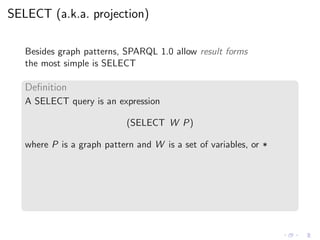
SELECT (a.k.a. projection)
Besides graph patterns, SPARQL 1.0 allow result forms
the most simple is SELECT
Definition
A SELECT query is an expression
(SELECT W P)
where P is a graph pattern and W is a set of variables, or *
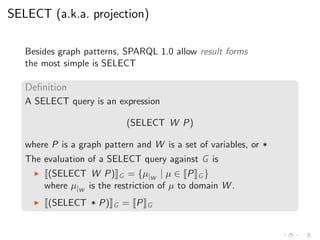
SELECT (a.k.a. projection)
Besides graph patterns, SPARQL 1.0 allow result forms
the most simple is SELECT
Definition
A SELECT query is an expression
(SELECT W P)
where P is a graph pattern and W is a set of variables, or *
The evaluation of a SELECT query against G is
◮ (SELECT W P) G = {µ|W
| µ ∈ P G }
where µ|W
is the restriction of µ to domain W .
◮ (SELECT * P) G = P G
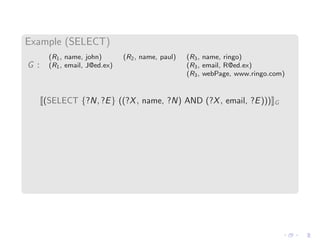
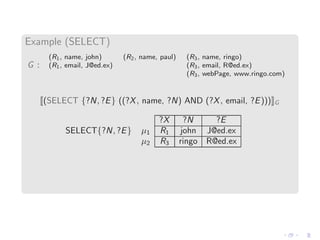
Example (SELECT)
G :
(R1, name, john) (R2, name, paul) (R3, name, ringo)
(R1, email, J@ed.ex) (R3, email, R@ed.ex)
(R3, webPage, www.ringo.com)
(SELECT {?N, ?E} ((?X, name, ?N) AND (?X, email, ?E))) G
Example (SELECT)
G :
(R1, name, john) (R2, name, paul) (R3, name, ringo)
(R1, email, J@ed.ex) (R3, email, R@ed.ex)
(R3, webPage, www.ringo.com)
(SELECT {?N, ?E} ((?X, name, ?N) AND (?X, email, ?E))) G
SELECT{?N, ?E}
?X ?N ?E
µ1 R1 john J@ed.ex
µ2 R3 ringo R@ed.ex
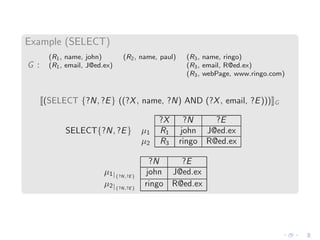
Example (SELECT)
G :
(R1, name, john) (R2, name, paul) (R3, name, ringo)
(R1, email, J@ed.ex) (R3, email, R@ed.ex)
(R3, webPage, www.ringo.com)
(SELECT {?N, ?E} ((?X, name, ?N) AND (?X, email, ?E))) G
SELECT{?N, ?E}
?X ?N ?E
µ1 R1 john J@ed.ex
µ2 R3 ringo R@ed.ex
?N ?E
µ1|{?N,?E}
john J@ed.ex
µ2|{?N,?E}
ringo R@ed.ex
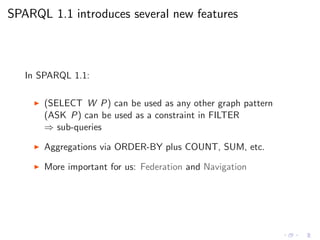
SPARQL 1.1 introduces several new features
In SPARQL 1.1:
◮ (SELECT W P) can be used as any other graph pattern
(ASK P) can be used as a constraint in FILTER
⇒ sub-queries
◮ Aggregations via ORDER-BY plus COUNT, SUM, etc.
◮ More important for us: Federation and Navigation
Outline
Basics of SPARQL
Syntax and Semantics of SPARQL 1.0
What is new in SPARQL 1.1
Federation: SERVICE operator
Syntax and Semantics
Evaluation of SERVICE queries
Navigation: Property Paths
Navigating graphs with regular expressions
The history of paths (in SPARQL 1.1 specification)
Evaluation procedures and complexity
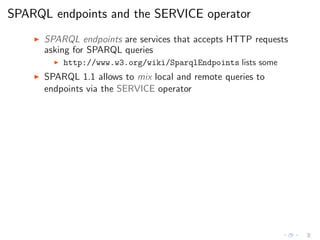
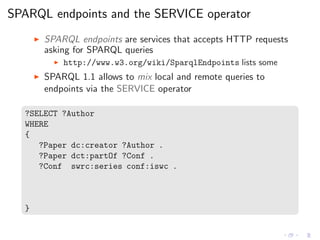
SPARQL endpoints and the SERVICE operator
◮ SPARQL endpoints are services that accepts HTTP requests
asking for SPARQL queries
◮ http://www.w3.org/wiki/SparqlEndpoints lists some
◮ SPARQL 1.1 allows to mix local and remote queries to
endpoints via the SERVICE operator
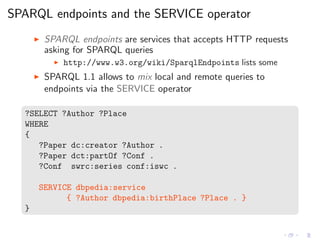
SPARQL endpoints and the SERVICE operator
◮ SPARQL endpoints are services that accepts HTTP requests
asking for SPARQL queries
◮ http://www.w3.org/wiki/SparqlEndpoints lists some
◮ SPARQL 1.1 allows to mix local and remote queries to
endpoints via the SERVICE operator
?SELECT ?Author
WHERE
{
?Paper dc:creator ?Author .
?Paper dct:partOf ?Conf .
?Conf swrc:series conf:iswc .
}
SPARQL endpoints and the SERVICE operator
◮ SPARQL endpoints are services that accepts HTTP requests
asking for SPARQL queries
◮ http://www.w3.org/wiki/SparqlEndpoints lists some
◮ SPARQL 1.1 allows to mix local and remote queries to
endpoints via the SERVICE operator
?SELECT ?Author ?Place
WHERE
{
?Paper dc:creator ?Author .
?Paper dct:partOf ?Conf .
?Conf swrc:series conf:iswc .
SERVICE dbpedia:service
{ ?Author dbpedia:birthPlace ?Place . }
}
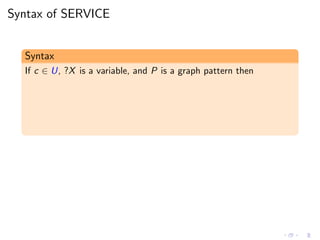
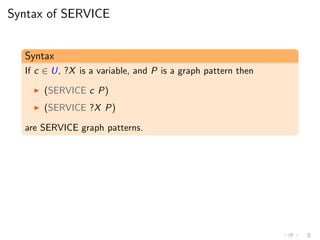
Syntax of SERVICE
Syntax
If c ∈ U, ?X is a variable, and P is a graph pattern then
Syntax of SERVICE
Syntax
If c ∈ U, ?X is a variable, and P is a graph pattern then
◮ (SERVICE c P)
◮ (SERVICE ?X P)
are SERVICE graph patterns.
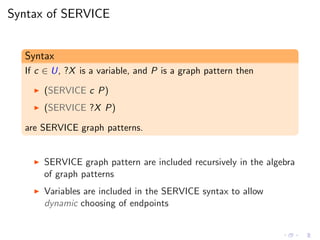
Syntax of SERVICE
Syntax
If c ∈ U, ?X is a variable, and P is a graph pattern then
◮ (SERVICE c P)
◮ (SERVICE ?X P)
are SERVICE graph patterns.
◮ SERVICE graph pattern are included recursively in the algebra
of graph patterns
◮ Variables are included in the SERVICE syntax to allow
dynamic choosing of endpoints
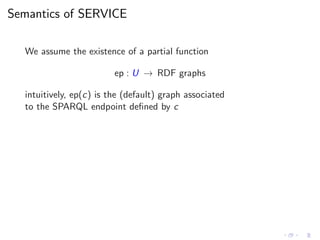
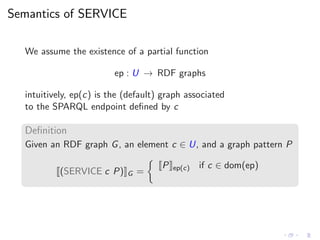
Semantics of SERVICE
We assume the existence of a partial function
ep : U → RDF graphs
intuitively, ep(c) is the (default) graph associated
to the SPARQL endpoint defined by c
Semantics of SERVICE
We assume the existence of a partial function
ep : U → RDF graphs
intuitively, ep(c) is the (default) graph associated
to the SPARQL endpoint defined by c
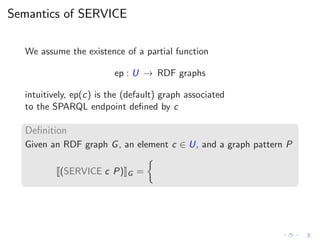
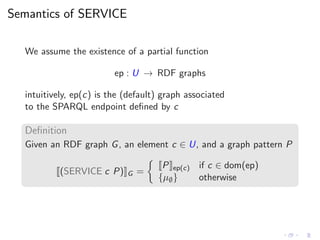
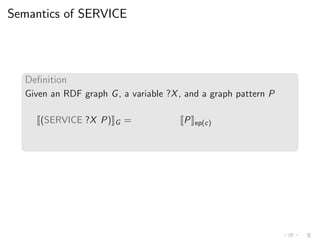
Definition
Given an RDF graph G, an element c ∈ U, and a graph pattern P
(SERVICE c P) G =
Semantics of SERVICE
We assume the existence of a partial function
ep : U → RDF graphs
intuitively, ep(c) is the (default) graph associated
to the SPARQL endpoint defined by c
Definition
Given an RDF graph G, an element c ∈ U, and a graph pattern P
(SERVICE c P) G =
P ep(c) if c ∈ dom(ep)
Semantics of SERVICE
We assume the existence of a partial function
ep : U → RDF graphs
intuitively, ep(c) is the (default) graph associated
to the SPARQL endpoint defined by c
Definition
Given an RDF graph G, an element c ∈ U, and a graph pattern P
(SERVICE c P) G =
P ep(c) if c ∈ dom(ep)
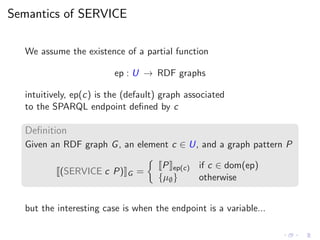
{µ∅} otherwise
Semantics of SERVICE
We assume the existence of a partial function
ep : U → RDF graphs
intuitively, ep(c) is the (default) graph associated
to the SPARQL endpoint defined by c
Definition
Given an RDF graph G, an element c ∈ U, and a graph pattern P
(SERVICE c P) G =
P ep(c) if c ∈ dom(ep)
{µ∅} otherwise
but the interesting case is when the endpoint is a variable...
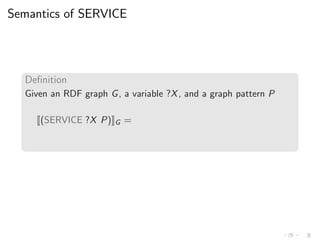
Semantics of SERVICE
Definition
Given an RDF graph G, a variable ?X, and a graph pattern P
(SERVICE ?X P) G =
Semantics of SERVICE
Definition
Given an RDF graph G, a variable ?X, and a graph pattern P
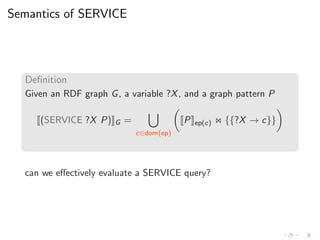
(SERVICE ?X P) G = P ep(c)
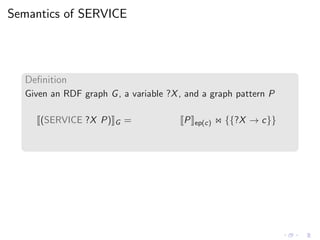
Semantics of SERVICE
Definition
Given an RDF graph G, a variable ?X, and a graph pattern P
(SERVICE ?X P) G = P ep(c) ⋊⋉ {{?X → c}}
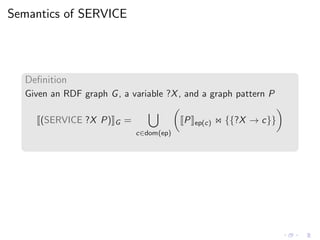
Semantics of SERVICE
Definition
Given an RDF graph G, a variable ?X, and a graph pattern P
(SERVICE ?X P) G =
c∈dom(ep)
P ep(c) ⋊⋉ {{?X → c}}
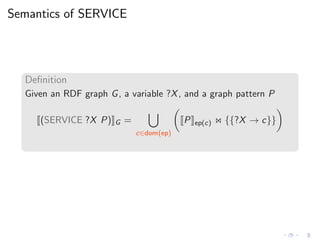
Semantics of SERVICE
Definition
Given an RDF graph G, a variable ?X, and a graph pattern P
(SERVICE ?X P) G =
c∈dom(ep)
P ep(c) ⋊⋉ {{?X → c}}
Semantics of SERVICE
Definition
Given an RDF graph G, a variable ?X, and a graph pattern P
(SERVICE ?X P) G =
c∈dom(ep)
P ep(c) ⋊⋉ {{?X → c}}
can we effectively evaluate a SERVICE query?
SERVICE example
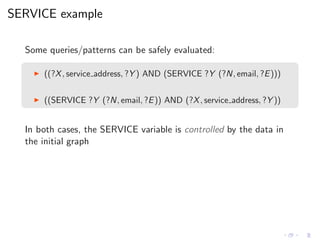
Some queries/patterns can be safely evaluated:
SERVICE example
Some queries/patterns can be safely evaluated:
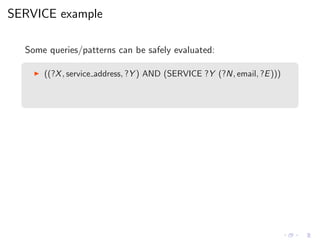
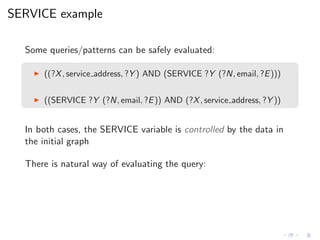
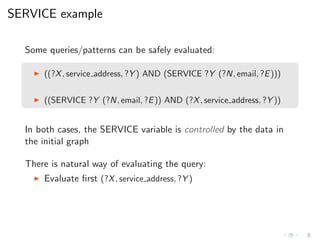
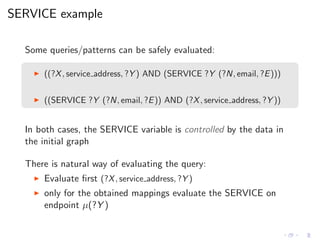
◮ ((?X, service address, ?Y ) AND (SERVICE ?Y (?N, email, ?E)))
SERVICE example
Some queries/patterns can be safely evaluated:
◮ ((?X, service address, ?Y ) AND (SERVICE ?Y (?N, email, ?E)))
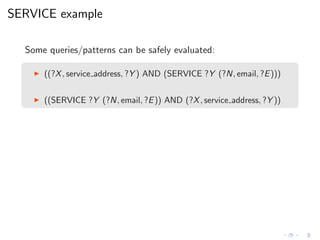
◮ ((SERVICE ?Y (?N, email, ?E)) AND (?X, service address, ?Y ))
SERVICE example
Some queries/patterns can be safely evaluated:
◮ ((?X, service address, ?Y ) AND (SERVICE ?Y (?N, email, ?E)))
◮ ((SERVICE ?Y (?N, email, ?E)) AND (?X, service address, ?Y ))
In both cases, the SERVICE variable is controlled by the data in
the initial graph
SERVICE example
Some queries/patterns can be safely evaluated:
◮ ((?X, service address, ?Y ) AND (SERVICE ?Y (?N, email, ?E)))
◮ ((SERVICE ?Y (?N, email, ?E)) AND (?X, service address, ?Y ))
In both cases, the SERVICE variable is controlled by the data in
the initial graph
There is natural way of evaluating the query:
SERVICE example
Some queries/patterns can be safely evaluated:
◮ ((?X, service address, ?Y ) AND (SERVICE ?Y (?N, email, ?E)))
◮ ((SERVICE ?Y (?N, email, ?E)) AND (?X, service address, ?Y ))
In both cases, the SERVICE variable is controlled by the data in
the initial graph
There is natural way of evaluating the query:
◮ Evaluate first (?X, service address, ?Y )
SERVICE example
Some queries/patterns can be safely evaluated:
◮ ((?X, service address, ?Y ) AND (SERVICE ?Y (?N, email, ?E)))
◮ ((SERVICE ?Y (?N, email, ?E)) AND (?X, service address, ?Y ))
In both cases, the SERVICE variable is controlled by the data in
the initial graph
There is natural way of evaluating the query:
◮ Evaluate first (?X, service address, ?Y )
◮ only for the obtained mappings evaluate the SERVICE on
endpoint µ(?Y )
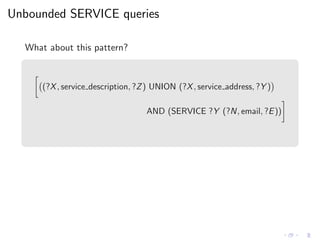
Unbounded SERVICE queries
What about this pattern?
(?X, service description, ?Z) UNION (?X, service address, ?Y )
AND (SERVICE ?Y (?N, email, ?E))
Unbounded SERVICE queries
What about this pattern?
(?X, service description, ?Z) UNION (?X, service address, ?Y )
AND (SERVICE ?Y (?N, email, ?E))
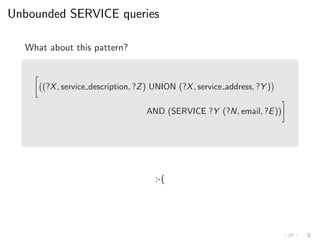
:-(
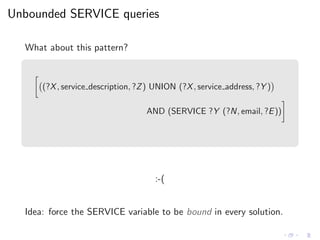
Unbounded SERVICE queries
What about this pattern?
(?X, service description, ?Z) UNION (?X, service address, ?Y )
AND (SERVICE ?Y (?N, email, ?E))
:-(
Idea: force the SERVICE variable to be bound in every solution.
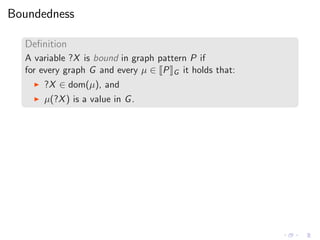
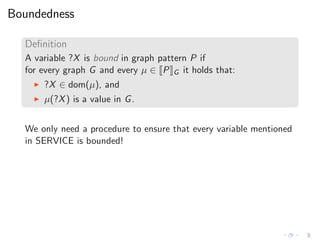
Boundedness
Definition
A variable ?X is bound in graph pattern P if
for every graph G and every µ ∈ P G it holds that:
◮ ?X ∈ dom(µ), and
◮ µ(?X) is a value in G.
Boundedness
Definition
A variable ?X is bound in graph pattern P if
for every graph G and every µ ∈ P G it holds that:
◮ ?X ∈ dom(µ), and
◮ µ(?X) is a value in G.
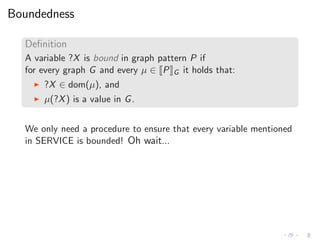
We only need a procedure to ensure that every variable mentioned
in SERVICE is bounded!
Boundedness
Definition
A variable ?X is bound in graph pattern P if
for every graph G and every µ ∈ P G it holds that:
◮ ?X ∈ dom(µ), and
◮ µ(?X) is a value in G.
We only need a procedure to ensure that every variable mentioned
in SERVICE is bounded! Oh wait...
Boundedness
Definition
A variable ?X is bound in graph pattern P if
for every graph G and every µ ∈ P G it holds that:
◮ ?X ∈ dom(µ), and
◮ µ(?X) is a value in G.
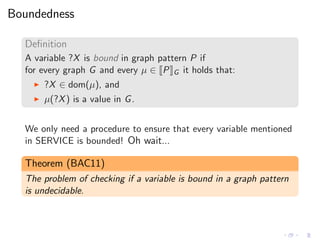
We only need a procedure to ensure that every variable mentioned
in SERVICE is bounded! Oh wait...
Theorem (BAC11)
The problem of checking if a variable is bound in a graph pattern
is undecidable.
Boundedness
Definition
A variable ?X is bound in graph pattern P if
for every graph G and every µ ∈ P G it holds that:
◮ ?X ∈ dom(µ), and
◮ µ(?X) is a value in G.
We only need a procedure to ensure that every variable mentioned
in SERVICE is bounded! Oh wait...
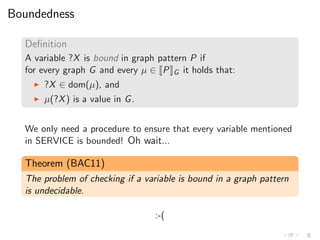
Theorem (BAC11)
The problem of checking if a variable is bound in a graph pattern
is undecidable.
:-(
Undecidability of boundedness
Proof idea
◮ From [AG08]: it is undecidable to check if a SPARQL pattern
P is satisfiable (if P G = ∅ for some G).
Undecidability of boundedness
Proof idea
◮ From [AG08]: it is undecidable to check if a SPARQL pattern
P is satisfiable (if P G = ∅ for some G).
◮ Assume P does not mention ?X, and let
Q = ((?X, ?Y , ?Z) UNION P):
Undecidability of boundedness
Proof idea
◮ From [AG08]: it is undecidable to check if a SPARQL pattern
P is satisfiable (if P G = ∅ for some G).
◮ Assume P does not mention ?X, and let
Q = ((?X, ?Y , ?Z) UNION P):
?X is bound in Q iff P is not satisfiable.
Undecidability of boundedness
Proof idea
◮ From [AG08]: it is undecidable to check if a SPARQL pattern
P is satisfiable (if P G = ∅ for some G).
◮ Assume P does not mention ?X, and let
Q = ((?X, ?Y , ?Z) UNION P):
?X is bound in Q iff P is not satisfiable.
Undecidable: the SPARQL engine cannot check for boundedness...
A sufficient condition for boundedness
Definition [BAC11]
The set of strongly bounded variables in a pattern P, denoted by
SB(P) is defined recursively as follows.
◮ if P is a triple pattern t, then SB(P) = var(t)
◮ if P = (P1 AND P2), then
A sufficient condition for boundedness
Definition [BAC11]
The set of strongly bounded variables in a pattern P, denoted by
SB(P) is defined recursively as follows.
◮ if P is a triple pattern t, then SB(P) = var(t)
◮ if P = (P1 AND P2), then SB(P) = SB(P1) ∪ SB(P2)
A sufficient condition for boundedness
Definition [BAC11]
The set of strongly bounded variables in a pattern P, denoted by
SB(P) is defined recursively as follows.
◮ if P is a triple pattern t, then SB(P) = var(t)
◮ if P = (P1 AND P2), then SB(P) = SB(P1) ∪ SB(P2)
◮ if P = (P1 OPT P2), then
A sufficient condition for boundedness
Definition [BAC11]
The set of strongly bounded variables in a pattern P, denoted by
SB(P) is defined recursively as follows.
◮ if P is a triple pattern t, then SB(P) = var(t)
◮ if P = (P1 AND P2), then SB(P) = SB(P1) ∪ SB(P2)
◮ if P = (P1 OPT P2), then SB(P) = SB(P1)
A sufficient condition for boundedness
Definition [BAC11]
The set of strongly bounded variables in a pattern P, denoted by
SB(P) is defined recursively as follows.
◮ if P is a triple pattern t, then SB(P) = var(t)
◮ if P = (P1 AND P2), then SB(P) = SB(P1) ∪ SB(P2)
◮ if P = (P1 OPT P2), then SB(P) = SB(P1)
◮ if P = (P1 UNION P2), then
A sufficient condition for boundedness
Definition [BAC11]
The set of strongly bounded variables in a pattern P, denoted by
SB(P) is defined recursively as follows.
◮ if P is a triple pattern t, then SB(P) = var(t)
◮ if P = (P1 AND P2), then SB(P) = SB(P1) ∪ SB(P2)
◮ if P = (P1 OPT P2), then SB(P) = SB(P1)
◮ if P = (P1 UNION P2), then SB(P) = SB(P1) ∩ SB(P2)
A sufficient condition for boundedness
Definition [BAC11]
The set of strongly bounded variables in a pattern P, denoted by
SB(P) is defined recursively as follows.
◮ if P is a triple pattern t, then SB(P) = var(t)
◮ if P = (P1 AND P2), then SB(P) = SB(P1) ∪ SB(P2)
◮ if P = (P1 OPT P2), then SB(P) = SB(P1)
◮ if P = (P1 UNION P2), then SB(P) = SB(P1) ∩ SB(P2)
◮ if P = (SELECT W P1), then
A sufficient condition for boundedness
Definition [BAC11]
The set of strongly bounded variables in a pattern P, denoted by
SB(P) is defined recursively as follows.
◮ if P is a triple pattern t, then SB(P) = var(t)
◮ if P = (P1 AND P2), then SB(P) = SB(P1) ∪ SB(P2)
◮ if P = (P1 OPT P2), then SB(P) = SB(P1)
◮ if P = (P1 UNION P2), then SB(P) = SB(P1) ∩ SB(P2)
◮ if P = (SELECT W P1), then SB(P) = W ∩ SB(P1)
A sufficient condition for boundedness
Definition [BAC11]
The set of strongly bounded variables in a pattern P, denoted by
SB(P) is defined recursively as follows.
◮ if P is a triple pattern t, then SB(P) = var(t)
◮ if P = (P1 AND P2), then SB(P) = SB(P1) ∪ SB(P2)
◮ if P = (P1 OPT P2), then SB(P) = SB(P1)
◮ if P = (P1 UNION P2), then SB(P) = SB(P1) ∩ SB(P2)
◮ if P = (SELECT W P1), then SB(P) = W ∩ SB(P1)
◮ if P is a SERVICE pattern, then
A sufficient condition for boundedness
Definition [BAC11]
The set of strongly bounded variables in a pattern P, denoted by
SB(P) is defined recursively as follows.
◮ if P is a triple pattern t, then SB(P) = var(t)
◮ if P = (P1 AND P2), then SB(P) = SB(P1) ∪ SB(P2)
◮ if P = (P1 OPT P2), then SB(P) = SB(P1)
◮ if P = (P1 UNION P2), then SB(P) = SB(P1) ∩ SB(P2)
◮ if P = (SELECT W P1), then SB(P) = W ∩ SB(P1)
◮ if P is a SERVICE pattern, then SB(P) = ∅
A sufficient condition for boundedness
Definition [BAC11]
The set of strongly bounded variables in a pattern P, denoted by
SB(P) is defined recursively as follows.
◮ if P is a triple pattern t, then SB(P) = var(t)
◮ if P = (P1 AND P2), then SB(P) = SB(P1) ∪ SB(P2)
◮ if P = (P1 OPT P2), then SB(P) = SB(P1)
◮ if P = (P1 UNION P2), then SB(P) = SB(P1) ∩ SB(P2)
◮ if P = (SELECT W P1), then SB(P) = W ∩ SB(P1)
◮ if P is a SERVICE pattern, then SB(P) = ∅
Proposition (BAC11)
If ?X ∈ SB(P) then ?X is bound in P.
A sufficient condition for boundedness
Definition [BAC11]
The set of strongly bounded variables in a pattern P, denoted by
SB(P) is defined recursively as follows.
◮ if P is a triple pattern t, then SB(P) = var(t)
◮ if P = (P1 AND P2), then SB(P) = SB(P1) ∪ SB(P2)
◮ if P = (P1 OPT P2), then SB(P) = SB(P1)
◮ if P = (P1 UNION P2), then SB(P) = SB(P1) ∩ SB(P2)
◮ if P = (SELECT W P1), then SB(P) = W ∩ SB(P1)
◮ if P is a SERVICE pattern, then SB(P) = ∅
Proposition (BAC11)
If ?X ∈ SB(P) then ?X is bound in P.
(SB(P) can be efficiently computed)
(Strongly) boundedness is not enough
Are we happy now?
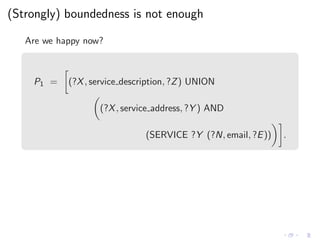
P1 = (?X, service description, ?Z) UNION
(?X, service address, ?Y ) AND
(SERVICE ?Y (?N, email, ?E)) .
(Strongly) boundedness is not enough
Are we happy now?
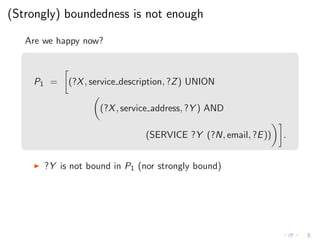
P1 = (?X, service description, ?Z) UNION
(?X, service address, ?Y ) AND
(SERVICE ?Y (?N, email, ?E)) .
◮ ?Y is not bound in P1 (nor strongly bound)
(Strongly) boundedness is not enough
Are we happy now?
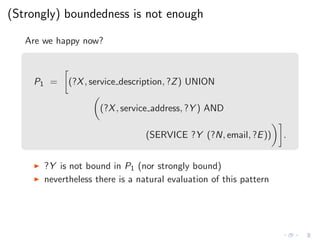
P1 = (?X, service description, ?Z) UNION
(?X, service address, ?Y ) AND
(SERVICE ?Y (?N, email, ?E)) .
◮ ?Y is not bound in P1 (nor strongly bound)
◮ nevertheless there is a natural evaluation of this pattern
(Strongly) boundedness is not enough
Are we happy now?
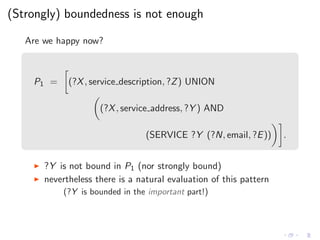
P1 = (?X, service description, ?Z) UNION
(?X, service address, ?Y ) AND
(SERVICE ?Y (?N, email, ?E)) .
◮ ?Y is not bound in P1 (nor strongly bound)
◮ nevertheless there is a natural evaluation of this pattern
(?Y is bounded in the important part!)
(Strongly) boundedness is not enough
Are we happy now?
(Strongly) boundedness is not enough
Are we happy now?
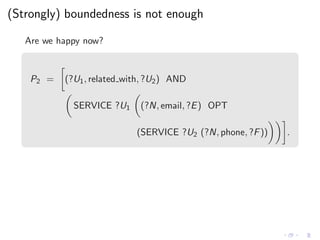
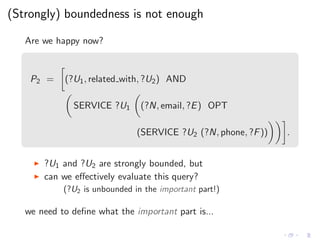
P2 = (?U1, related with, ?U2) AND
SERVICE ?U1 (?N, email, ?E) OPT
(SERVICE ?U2 (?N, phone, ?F)) .
(Strongly) boundedness is not enough
Are we happy now?
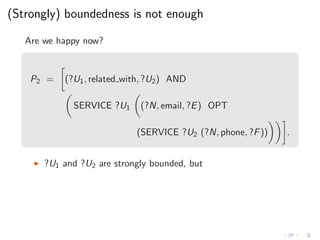
P2 = (?U1, related with, ?U2) AND
SERVICE ?U1 (?N, email, ?E) OPT
(SERVICE ?U2 (?N, phone, ?F)) .
◮ ?U1 and ?U2 are strongly bounded, but
(Strongly) boundedness is not enough
Are we happy now?
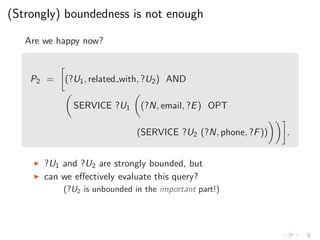
P2 = (?U1, related with, ?U2) AND
SERVICE ?U1 (?N, email, ?E) OPT
(SERVICE ?U2 (?N, phone, ?F)) .
◮ ?U1 and ?U2 are strongly bounded, but
◮ can we effectively evaluate this query?
(?U2 is unbounded in the important part!)
(Strongly) boundedness is not enough
Are we happy now?
P2 = (?U1, related with, ?U2) AND
SERVICE ?U1 (?N, email, ?E) OPT
(SERVICE ?U2 (?N, phone, ?F)) .
◮ ?U1 and ?U2 are strongly bounded, but
◮ can we effectively evaluate this query?
(?U2 is unbounded in the important part!)
we need to define what the important part is...
Parse tree of a pattern
We need first to formalize the tree of subexpressions of a pattern
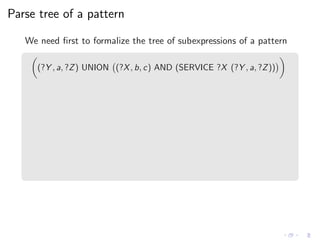
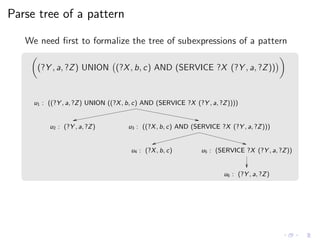
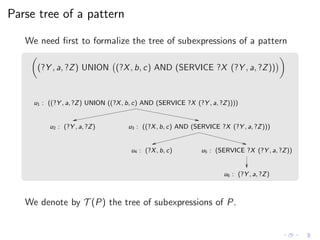
(?Y , a, ?Z) UNION (?X, b, c) AND (SERVICE ?X (?Y , a, ?Z))
Parse tree of a pattern
We need first to formalize the tree of subexpressions of a pattern
(?Y , a, ?Z) UNION (?X, b, c) AND (SERVICE ?X (?Y , a, ?Z))
u6 : (?Y , a, ?Z)
u1 : ((?Y , a, ?Z) UNION ((?X, b, c) AND (SERVICE ?X (?Y , a, ?Z))))
u2 : (?Y , a, ?Z) u3 : ((?X, b, c) AND (SERVICE ?X (?Y , a, ?Z)))
u4 : (?X, b, c) u5 : (SERVICE ?X (?Y , a, ?Z))
Parse tree of a pattern
We need first to formalize the tree of subexpressions of a pattern
(?Y , a, ?Z) UNION (?X, b, c) AND (SERVICE ?X (?Y , a, ?Z))
u6 : (?Y , a, ?Z)
u1 : ((?Y , a, ?Z) UNION ((?X, b, c) AND (SERVICE ?X (?Y , a, ?Z))))
u2 : (?Y , a, ?Z) u3 : ((?X, b, c) AND (SERVICE ?X (?Y , a, ?Z)))
u4 : (?X, b, c) u5 : (SERVICE ?X (?Y , a, ?Z))
We denote by T (P) the tree of subexpressions of P.
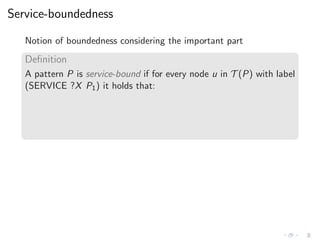
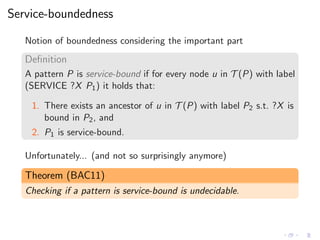
Service-boundedness
Notion of boundedness considering the important part
Definition
A pattern P is service-bound if for every node u in T (P) with label
(SERVICE ?X P1) it holds that:
Service-boundedness
Notion of boundedness considering the important part
Definition
A pattern P is service-bound if for every node u in T (P) with label
(SERVICE ?X P1) it holds that:
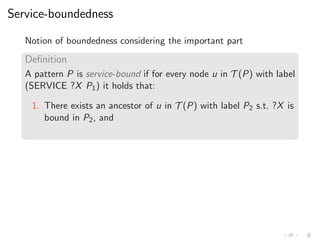
1. There exists an ancestor of u in T (P) with label P2 s.t. ?X is
bound in P2, and
Service-boundedness
Notion of boundedness considering the important part
Definition
A pattern P is service-bound if for every node u in T (P) with label
(SERVICE ?X P1) it holds that:
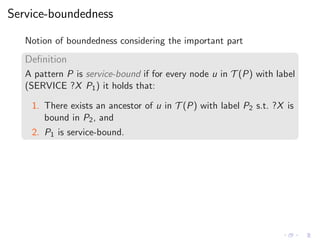
1. There exists an ancestor of u in T (P) with label P2 s.t. ?X is
bound in P2, and
2. P1 is service-bound.
Service-boundedness
Notion of boundedness considering the important part
Definition
A pattern P is service-bound if for every node u in T (P) with label
(SERVICE ?X P1) it holds that:
1. There exists an ancestor of u in T (P) with label P2 s.t. ?X is
bound in P2, and
2. P1 is service-bound.
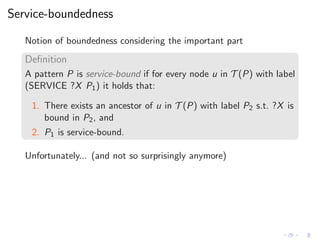
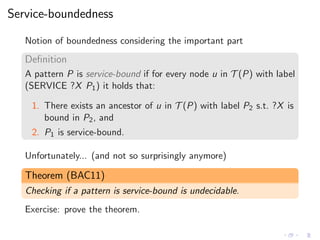
Unfortunately... (and not so surprisingly anymore)
Service-boundedness
Notion of boundedness considering the important part
Definition
A pattern P is service-bound if for every node u in T (P) with label
(SERVICE ?X P1) it holds that:
1. There exists an ancestor of u in T (P) with label P2 s.t. ?X is
bound in P2, and
2. P1 is service-bound.
Unfortunately... (and not so surprisingly anymore)
Theorem (BAC11)
Checking if a pattern is service-bound is undecidable.
Service-boundedness
Notion of boundedness considering the important part
Definition
A pattern P is service-bound if for every node u in T (P) with label
(SERVICE ?X P1) it holds that:
1. There exists an ancestor of u in T (P) with label P2 s.t. ?X is
bound in P2, and
2. P1 is service-bound.
Unfortunately... (and not so surprisingly anymore)
Theorem (BAC11)
Checking if a pattern is service-bound is undecidable.
Exercise: prove the theorem.
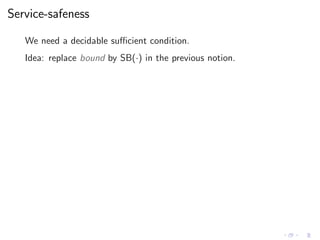
Service-safeness
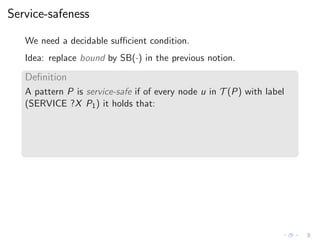
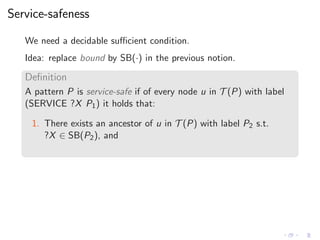
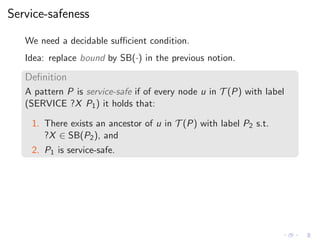
We need a decidable sufficient condition.
Idea: replace bound by SB(·) in the previous notion.
Service-safeness
We need a decidable sufficient condition.
Idea: replace bound by SB(·) in the previous notion.
Definition
A pattern P is service-safe if of every node u in T (P) with label
(SERVICE ?X P1) it holds that:
Service-safeness
We need a decidable sufficient condition.
Idea: replace bound by SB(·) in the previous notion.
Definition
A pattern P is service-safe if of every node u in T (P) with label
(SERVICE ?X P1) it holds that:
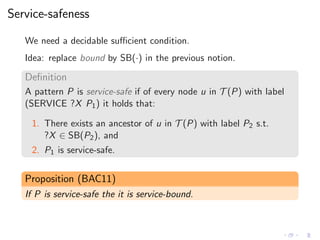
1. There exists an ancestor of u in T (P) with label P2 s.t.
?X ∈ SB(P2), and
Service-safeness
We need a decidable sufficient condition.
Idea: replace bound by SB(·) in the previous notion.
Definition
A pattern P is service-safe if of every node u in T (P) with label
(SERVICE ?X P1) it holds that:
1. There exists an ancestor of u in T (P) with label P2 s.t.
?X ∈ SB(P2), and
2. P1 is service-safe.
Service-safeness
We need a decidable sufficient condition.
Idea: replace bound by SB(·) in the previous notion.
Definition
A pattern P is service-safe if of every node u in T (P) with label
(SERVICE ?X P1) it holds that:
1. There exists an ancestor of u in T (P) with label P2 s.t.
?X ∈ SB(P2), and
2. P1 is service-safe.
Proposition (BAC11)
If P is service-safe the it is service-bound.
Service-safeness
We need a decidable sufficient condition.
Idea: replace bound by SB(·) in the previous notion.
Definition
A pattern P is service-safe if of every node u in T (P) with label
(SERVICE ?X P1) it holds that:
1. There exists an ancestor of u in T (P) with label P2 s.t.
?X ∈ SB(P2), and
2. P1 is service-safe.
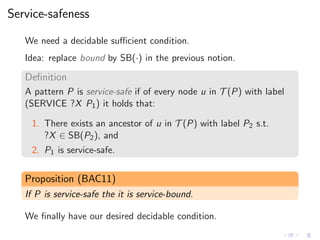
Proposition (BAC11)
If P is service-safe the it is service-bound.
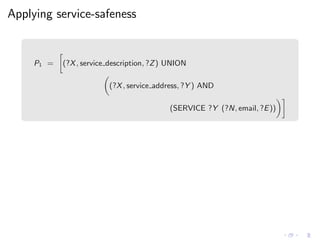
We finally have our desired decidable condition.
Applying service-safeness
P1 = (?X, service description, ?Z) UNION
(?X, service address, ?Y ) AND
(SERVICE ?Y (?N, email, ?E))
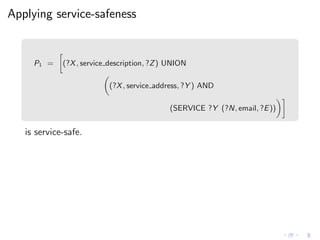
Applying service-safeness
P1 = (?X, service description, ?Z) UNION
(?X, service address, ?Y ) AND
(SERVICE ?Y (?N, email, ?E))
is service-safe.
Applying service-safeness
P1 = (?X, service description, ?Z) UNION
(?X, service address, ?Y ) AND
(SERVICE ?Y (?N, email, ?E))
is service-safe.
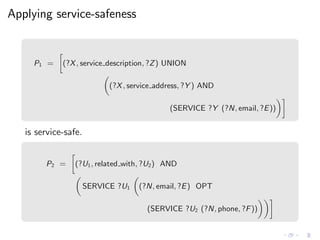
P2 = (?U1, related with, ?U2) AND
SERVICE ?U1 (?N, email, ?E) OPT
(SERVICE ?U2 (?N, phone, ?F))
Applying service-safeness
P1 = (?X, service description, ?Z) UNION
(?X, service address, ?Y ) AND
(SERVICE ?Y (?N, email, ?E))
is service-safe.
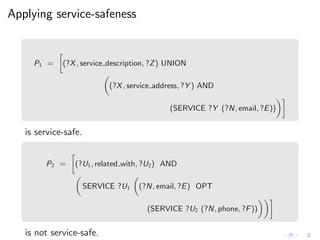
P2 = (?U1, related with, ?U2) AND
SERVICE ?U1 (?N, email, ?E) OPT
(SERVICE ?U2 (?N, phone, ?F))
is not service-safe.
Closing words on SERVICE
SERVICE: several interesting research question
◮ Optimization (rewriting, reordering, containment?)
◮ Cost analysis: in practice we cannot query all that we may
want
◮ Different endpoints provide different completeness certificates
(regarding the data they return)
◮ Several implementations challenges
Outline
Basics of SPARQL
Syntax and Semantics of SPARQL 1.0
What is new in SPARQL 1.1
Federation: SERVICE operator
Syntax and Semantics
Evaluation of SERVICE queries
Navigation: Property Paths
Navigating graphs with regular expressions
The history of paths (in SPARQL 1.1 specification)
Evaluation procedures and complexity
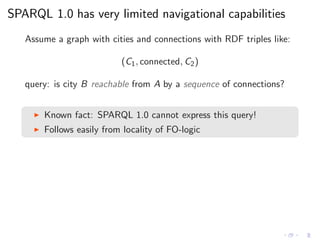
SPARQL 1.0 has very limited navigational capabilities
Assume a graph with cities and connections with RDF triples like:
(C1, connected, C2)
SPARQL 1.0 has very limited navigational capabilities
Assume a graph with cities and connections with RDF triples like:
(C1, connected, C2)
query: is city B reachable from A by a sequence of connections?
SPARQL 1.0 has very limited navigational capabilities
Assume a graph with cities and connections with RDF triples like:
(C1, connected, C2)
query: is city B reachable from A by a sequence of connections?
◮ Known fact: SPARQL 1.0 cannot express this query!
◮ Follows easily from locality of FO-logic
SPARQL 1.0 has very limited navigational capabilities
Assume a graph with cities and connections with RDF triples like:
(C1, connected, C2)
query: is city B reachable from A by a sequence of connections?
◮ Known fact: SPARQL 1.0 cannot express this query!
◮ Follows easily from locality of FO-logic
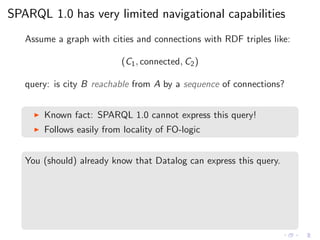
You (should) already know that Datalog can express this query.
SPARQL 1.0 has very limited navigational capabilities
Assume a graph with cities and connections with RDF triples like:
(C1, connected, C2)
query: is city B reachable from A by a sequence of connections?
◮ Known fact: SPARQL 1.0 cannot express this query!
◮ Follows easily from locality of FO-logic
You (should) already know that Datalog can express this query.
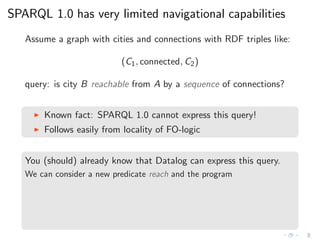
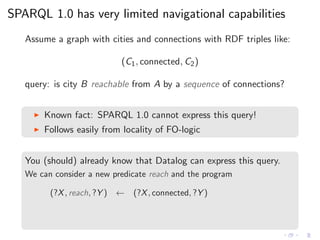
We can consider a new predicate reach and the program
SPARQL 1.0 has very limited navigational capabilities
Assume a graph with cities and connections with RDF triples like:
(C1, connected, C2)
query: is city B reachable from A by a sequence of connections?
◮ Known fact: SPARQL 1.0 cannot express this query!
◮ Follows easily from locality of FO-logic
You (should) already know that Datalog can express this query.
We can consider a new predicate reach and the program
(?X, reach, ?Y ) ← (?X, connected, ?Y )
SPARQL 1.0 has very limited navigational capabilities
Assume a graph with cities and connections with RDF triples like:
(C1, connected, C2)
query: is city B reachable from A by a sequence of connections?
◮ Known fact: SPARQL 1.0 cannot express this query!
◮ Follows easily from locality of FO-logic
You (should) already know that Datalog can express this query.
We can consider a new predicate reach and the program
(?X, reach, ?Y ) ← (?X, connected, ?Y )
(?X, reach, ?Y ) ← (?X, reach, ?Z), (?Z, connected, ?Y )
SPARQL 1.0 has very limited navigational capabilities
Assume a graph with cities and connections with RDF triples like:
(C1, connected, C2)
query: is city B reachable from A by a sequence of connections?
◮ Known fact: SPARQL 1.0 cannot express this query!
◮ Follows easily from locality of FO-logic
You (should) already know that Datalog can express this query.
We can consider a new predicate reach and the program
(?X, reach, ?Y ) ← (?X, connected, ?Y )
(?X, reach, ?Y ) ← (?X, reach, ?Z), (?Z, connected, ?Y )
but do we want to integrate Datalog and SPARQL?
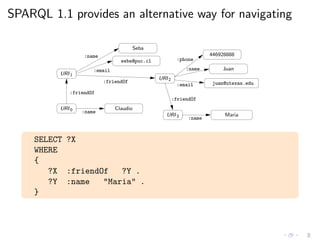
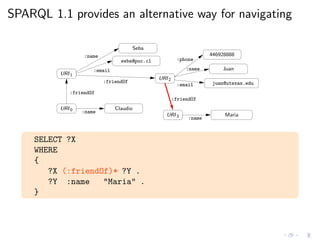
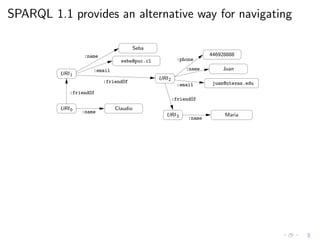
SPARQL 1.1 provides an alternative way for navigating
URI2
:email
seba@puc.cl
:name
:email
:phone
:name
:friendOf juan@utexas.edu
URI1
Seba
446928888
Juan
Claudio
:name
:name
Maria
URI0
:friendOf
URI3
:friendOf
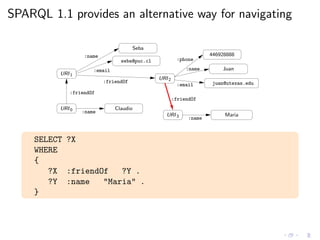
SPARQL 1.1 provides an alternative way for navigating
URI2
:email
seba@puc.cl
:name
:email
:phone
:name
:friendOf juan@utexas.edu
URI1
Seba
446928888
Juan
Claudio
:name
:name
Maria
URI0
:friendOf
URI3
:friendOf
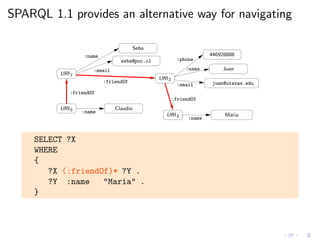
SELECT ?X
WHERE
{
?X :friendOf ?Y .
?Y :name "Maria" .
}
SPARQL 1.1 provides an alternative way for navigating
URI2
:email
seba@puc.cl
:name
:email
:phone
:name
:friendOf juan@utexas.edu
URI1
Seba
446928888
Juan
Claudio
:name
:name
Maria
URI0
:friendOf
URI3
:friendOf
SELECT ?X
WHERE
{
?X :friendOf ?Y .
?Y :name "Maria" .
}
SPARQL 1.1 provides an alternative way for navigating
URI2
:email
seba@puc.cl
:name
:email
:phone
:name
:friendOf juan@utexas.edu
URI1
Seba
446928888
Juan
Claudio
:name
:name
Maria
URI0
:friendOf
URI3
:friendOf
SELECT ?X
WHERE
{
?X (:friendOf)* ?Y .
?Y :name "Maria" .
}
SPARQL 1.1 provides an alternative way for navigating
URI2
:email
seba@puc.cl
:name
:email
:phone
:name
:friendOf juan@utexas.edu
URI1
Seba
446928888
Juan
Claudio
:name
:name
Maria
URI0
:friendOf
URI3
:friendOf
SELECT ?X
WHERE
{
?X (:friendOf)* ?Y .
?Y :name "Maria" .
}
SPARQL 1.1 provides an alternative way for navigating
URI2
:email
seba@puc.cl
:name
:email
:phone
:name
:friendOf juan@utexas.edu
URI1
Seba
446928888
Juan
Claudio
:name
:name
Maria
URI0
:friendOf
URI3
:friendOf
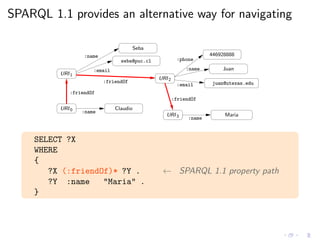
SELECT ?X
WHERE
{
?X (:friendOf)* ?Y . ← SPARQL 1.1 property path
?Y :name "Maria" .
}
SPARQL 1.1 provides an alternative way for navigating
URI2
:email
seba@puc.cl
:name
:email
:phone
:name
:friendOf juan@utexas.edu
URI1
Seba
446928888
Juan
Claudio
:name
:name
Maria
URI0
:friendOf
URI3
:friendOf
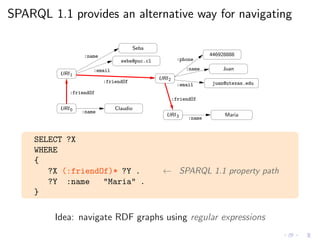
SELECT ?X
WHERE
{
?X (:friendOf)* ?Y . ← SPARQL 1.1 property path
?Y :name "Maria" .
}
Idea: navigate RDF graphs using regular expressions
General navigation using regular expressions
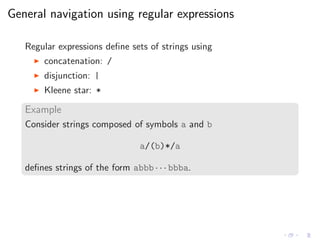
Regular expressions define sets of strings using
◮ concatenation: /
◮ disjunction: |
◮ Kleene star: *
Example
Consider strings composed of symbols a and b
a/(b)*/a
defines strings of the form abbb · · · bbba.
General navigation using regular expressions
Regular expressions define sets of strings using
◮ concatenation: /
◮ disjunction: |
◮ Kleene star: *
Example
Consider strings composed of symbols a and b
a/(b)*/a
defines strings of the form abbb · · · bbba.
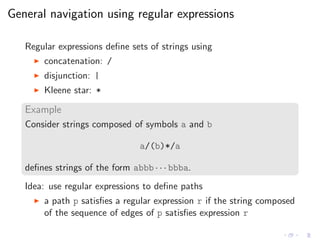
Idea: use regular expressions to define paths
◮ a path p satisfies a regular expression r if the string composed
of the sequence of edges of p satisfies expression r
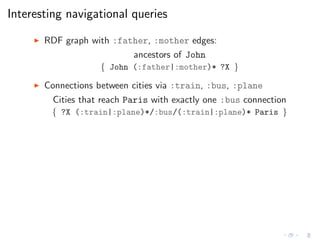
Interesting navigational queries
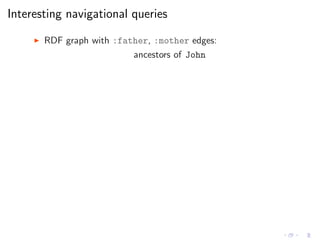
◮ RDF graph with :father, :mother edges:
ancestors of John
Interesting navigational queries
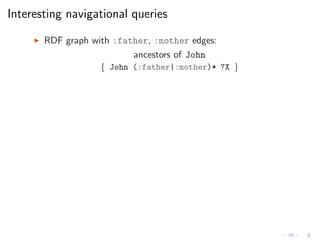
◮ RDF graph with :father, :mother edges:
ancestors of John
{ John (:father|:mother)* ?X }
Interesting navigational queries
◮ RDF graph with :father, :mother edges:
ancestors of John
{ John (:father|:mother)* ?X }
◮ Connections between cities via :train, :bus, :plane
Cities that reach Paris with exactly one :bus connection
Interesting navigational queries
◮ RDF graph with :father, :mother edges:
ancestors of John
{ John (:father|:mother)* ?X }
◮ Connections between cities via :train, :bus, :plane
Cities that reach Paris with exactly one :bus connection
{ ?X Paris }
Interesting navigational queries
◮ RDF graph with :father, :mother edges:
ancestors of John
{ John (:father|:mother)* ?X }
◮ Connections between cities via :train, :bus, :plane
Cities that reach Paris with exactly one :bus connection
{ ?X (:train|:plane)* Paris }
Interesting navigational queries
◮ RDF graph with :father, :mother edges:
ancestors of John
{ John (:father|:mother)* ?X }
◮ Connections between cities via :train, :bus, :plane
Cities that reach Paris with exactly one :bus connection
{ ?X (:train|:plane)*/:bus Paris }
Interesting navigational queries
◮ RDF graph with :father, :mother edges:
ancestors of John
{ John (:father|:mother)* ?X }
◮ Connections between cities via :train, :bus, :plane
Cities that reach Paris with exactly one :bus connection
{ ?X (:train|:plane)*/:bus/(:train|:plane)* Paris }
Interesting navigational queries
◮ RDF graph with :father, :mother edges:
ancestors of John
{ John (:father|:mother)* ?X }
◮ Connections between cities via :train, :bus, :plane
Cities that reach Paris with exactly one :bus connection
{ ?X (:train|:plane)*/:bus/(:train|:plane)* Paris }
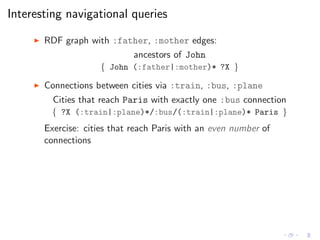
Exercise: cities that reach Paris with an even number of
connections
Interesting navigational queries
◮ RDF graph with :father, :mother edges:
ancestors of John
{ John (:father|:mother)* ?X }
◮ Connections between cities via :train, :bus, :plane
Cities that reach Paris with exactly one :bus connection
{ ?X (:train|:plane)*/:bus/(:train|:plane)* Paris }
Exercise: cities that reach Paris with an even number of
connections
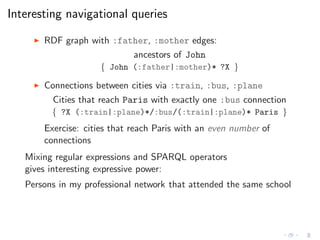
Mixing regular expressions and SPARQL operators
gives interesting expressive power:
Persons in my professional network that attended the same school
Interesting navigational queries
◮ RDF graph with :father, :mother edges:
ancestors of John
{ John (:father|:mother)* ?X }
◮ Connections between cities via :train, :bus, :plane
Cities that reach Paris with exactly one :bus connection
{ ?X (:train|:plane)*/:bus/(:train|:plane)* Paris }
Exercise: cities that reach Paris with an even number of
connections
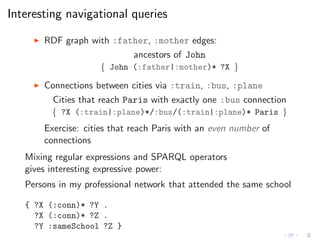
Mixing regular expressions and SPARQL operators
gives interesting expressive power:
Persons in my professional network that attended the same school
{ ?X (:conn)* ?Y .
?X (:conn)* ?Z .
?Y :sameSchool ?Z }
As always, we need a (formal) semantics
◮ Regular expressions in SPARQL queries seem reasonable
◮ We need to agree in the meaning of these new queries
As always, we need a (formal) semantics
◮ Regular expressions in SPARQL queries seem reasonable
◮ We need to agree in the meaning of these new queries
A bit of history on W3C standardization of property paths:
◮ Mid 2010: W3C defines an informal semantics for paths
As always, we need a (formal) semantics
◮ Regular expressions in SPARQL queries seem reasonable
◮ We need to agree in the meaning of these new queries
A bit of history on W3C standardization of property paths:
◮ Mid 2010: W3C defines an informal semantics for paths
◮ Late 2010: several discussions on possible drawbacks on the
non-standard definition by the W3C
As always, we need a (formal) semantics
◮ Regular expressions in SPARQL queries seem reasonable
◮ We need to agree in the meaning of these new queries
A bit of history on W3C standardization of property paths:
◮ Mid 2010: W3C defines an informal semantics for paths
◮ Late 2010: several discussions on possible drawbacks on the
non-standard definition by the W3C
◮ Early 2011: first formal semantics by the W3C
As always, we need a (formal) semantics
◮ Regular expressions in SPARQL queries seem reasonable
◮ We need to agree in the meaning of these new queries
A bit of history on W3C standardization of property paths:
◮ Mid 2010: W3C defines an informal semantics for paths
◮ Late 2010: several discussions on possible drawbacks on the
non-standard definition by the W3C
◮ Early 2011: first formal semantics by the W3C
◮ Late 2011: empirical and theoretical study on SPARQL 1.1
property paths showing unfeasibility of evaluation
As always, we need a (formal) semantics
◮ Regular expressions in SPARQL queries seem reasonable
◮ We need to agree in the meaning of these new queries
A bit of history on W3C standardization of property paths:
◮ Mid 2010: W3C defines an informal semantics for paths
◮ Late 2010: several discussions on possible drawbacks on the
non-standard definition by the W3C
◮ Early 2011: first formal semantics by the W3C
◮ Late 2011: empirical and theoretical study on SPARQL 1.1
property paths showing unfeasibility of evaluation
◮ Mid 2012: semantics change to overcome the raised issues
As always, we need a (formal) semantics
◮ Regular expressions in SPARQL queries seem reasonable
◮ We need to agree in the meaning of these new queries
A bit of history on W3C standardization of property paths:
◮ Mid 2010: W3C defines an informal semantics for paths
◮ Late 2010: several discussions on possible drawbacks on the
non-standard definition by the W3C
◮ Early 2011: first formal semantics by the W3C
◮ Late 2011: empirical and theoretical study on SPARQL 1.1
property paths showing unfeasibility of evaluation
◮ Mid 2012: semantics change to overcome the raised issues
The following experimental study is based on [ACP12].
SPARQL 1.1 implementations
had a poor performance
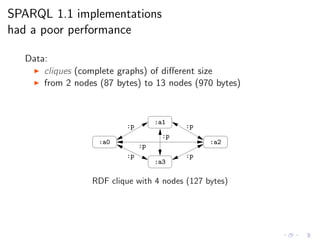
Data:
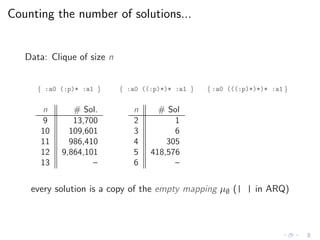
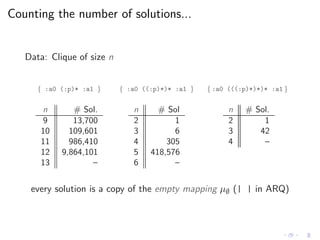
◮ cliques (complete graphs) of different size
◮ from 2 nodes (87 bytes) to 13 nodes (970 bytes)
:p
:a0
:a1
:a3
:p
:p
:p
:p
:p
:a2
RDF clique with 4 nodes (127 bytes)
SPARQL 1.1 implementations
had a poor performance
1
10
100
1000
2 4 6 8 10 12 14 16
ARQ
+ + + + + + +
+
+
+
+
+
RDFQ
× × × ×
×
×
×
×
×
×
KGram
∗ ∗ ∗ ∗ ∗
∗
∗
∗
∗
∗
Sesame
[ACP12]
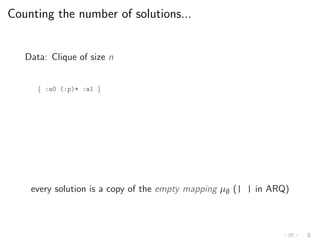
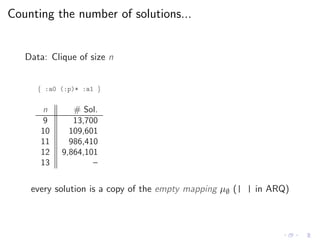
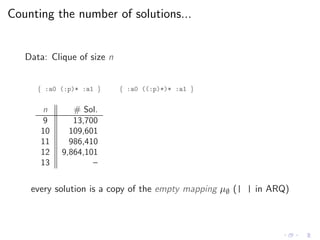
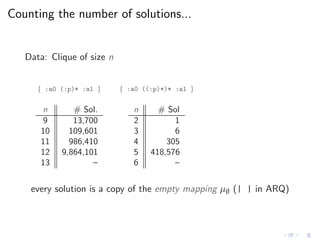
SELECT * WHERE { :a0 (:p)* :a1 }
Poor performance with real Web data of small size
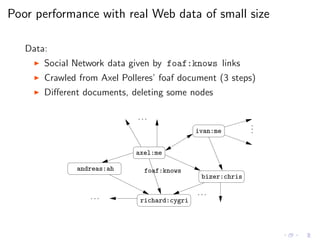
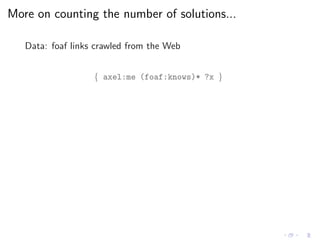
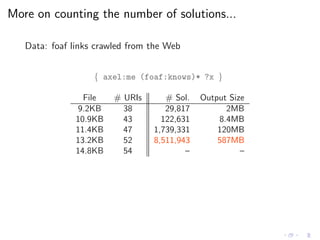
Data:
◮ Social Network data given by foaf:knows links
◮ Crawled from Axel Polleres’ foaf document (3 steps)
◮ Different documents, deleting some nodes
foaf:knows
axel:me
ivan:me
bizer:chris
richard:cygri
...
· · ·
andreas:ah
· · ·
· · ·
Poor performance with real Web data of small size
SELECT * WHERE { axel:me (foaf:knows)* ?x }
Poor performance with real Web data of small size
SELECT * WHERE { axel:me (foaf:knows)* ?x }
Input ARQ RDFQ Kgram Sesame
9.2KB 5.13 75.70 313.37 –
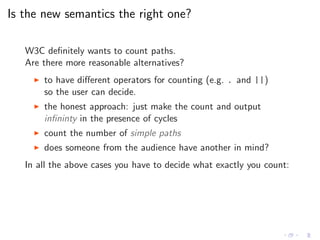
10.9KB 8.20 325.83 – –
11.4KB 65.87 – – –
13.2KB 292.43 – – –
14.8KB – – – –
17.2KB – – – –
20.5KB – – – –
25.8KB – – – – [ACP12]
(time in seconds, timeout = 1hr)
Poor performance with real Web data of small size
SELECT * WHERE { axel:me (foaf:knows)* ?x }
Input ARQ RDFQ Kgram Sesame
9.2KB 5.13 75.70 313.37 –
10.9KB 8.20 325.83 – –
11.4KB 65.87 – – –
13.2KB 292.43 – – –
14.8KB – – – –
17.2KB – – – –
20.5KB – – – –
25.8KB – – – – [ACP12]
(time in seconds, timeout = 1hr)
Is this a problem of these particular implementations?
This is a problem of the specification
[ACP12]
Any implementation that follows SPARQL 1.1 standard
(as of January 2012) is doomed to show the same behavior
This is a problem of the specification
[ACP12]
Any implementation that follows SPARQL 1.1 standard
(as of January 2012) is doomed to show the same behavior
The main sources of complexity is counting
This is a problem of the specification
[ACP12]
Any implementation that follows SPARQL 1.1 standard
(as of January 2012) is doomed to show the same behavior
The main sources of complexity is counting
Impact on W3C standard:
◮ Standard semantics of SPARQL 1.1 property paths
was changed in July 2012 to overcome these issues
SPARQL 1.1 property paths match regular expressions
but also count
:a
:b
:c
:p
:p
:p
:p
:d
SELECT ?X
WHERE { :a (:p)* ?X }
SPARQL 1.1 property paths match regular expressions
but also count
:a
:b
:c
:p
:p
:p
:p
:d
SELECT ?X
WHERE { :a (:p)* ?X }
?X
:a
:b
:c
:d
:d
SPARQL 1.1 property paths match regular expressions
but also count
:a
:b
:c
:p
:p
:p
:p
:d
SELECT ?X
WHERE { :a (:p)* ?X }
?X
:a
:b
:c
:d
:d
SPARQL 1.1 property paths match regular expressions
but also count
:p:a
:b
:c
:p
:p
:p
:p
:d
SELECT ?X
WHERE { :a (:p)* ?X }
?X
:a
:b
:c
:d
:d
SPARQL 1.1 property paths match regular expressions
but also count
:p:a
:b
:c
:p
:p
:p
:p
:d
SELECT ?X
WHERE { :a (:p)* ?X }
?X
:a
:b
:c
:d
:d
:c
:d
SPARQL 1.1 property paths match regular expressions
but also count
:p:a
:b
:c
:p
:p
:p
:p
:d
SELECT ?X
WHERE { :a (:p)* ?X }
?X
:a
:b
:c
:d
:d
:c
:d
But what if we have cycles?
SPARQL 1.1 document provides a special procedure
to handle cycles (and make the count)
Evaluation of path*
“the algorithm extends the multiset of results by one application of path.
If a node has been visited for path, it is not a candidate for another step.
A node can be visited multiple times if different paths visit it.”
SPARQL 1.1 Last Call (Jan 2012)
SPARQL 1.1 document provides a special procedure
to handle cycles (and make the count)
Evaluation of path*
“the algorithm extends the multiset of results by one application of path.
If a node has been visited for path, it is not a candidate for another step.
A node can be visited multiple times if different paths visit it.”
SPARQL 1.1 Last Call (Jan 2012)
◮ W3C document provides a procedure (ArbitraryLengthPath)
◮ This procedure was formalized in [ACP12]
Counting the number of solutions...
Data: Clique of size n
{ :a0 (:p)* :a1 }
every solution is a copy of the empty mapping µ∅ (| | in ARQ)
Counting the number of solutions...
Data: Clique of size n
{ :a0 (:p)* :a1 }
n # Sol.
9 13,700
10 109,601
11 986,410
12 9,864,101
13 –
every solution is a copy of the empty mapping µ∅ (| | in ARQ)
Counting the number of solutions...
Data: Clique of size n
{ :a0 (:p)* :a1 } { :a0 ((:p)*)* :a1 }
n # Sol.
9 13,700
10 109,601
11 986,410
12 9,864,101
13 –
every solution is a copy of the empty mapping µ∅ (| | in ARQ)
Counting the number of solutions...
Data: Clique of size n
{ :a0 (:p)* :a1 } { :a0 ((:p)*)* :a1 }
n # Sol.
9 13,700
10 109,601
11 986,410
12 9,864,101
13 –
n # Sol
2 1
3 6
4 305
5 418,576
6 –
every solution is a copy of the empty mapping µ∅ (| | in ARQ)
Counting the number of solutions...
Data: Clique of size n
{ :a0 (:p)* :a1 } { :a0 ((:p)*)* :a1 } { :a0 (((:p)*)*)* :a1 }
n # Sol.
9 13,700
10 109,601
11 986,410
12 9,864,101
13 –
n # Sol
2 1
3 6
4 305
5 418,576
6 –
every solution is a copy of the empty mapping µ∅ (| | in ARQ)
Counting the number of solutions...
Data: Clique of size n
{ :a0 (:p)* :a1 } { :a0 ((:p)*)* :a1 } { :a0 (((:p)*)*)* :a1 }
n # Sol.
9 13,700
10 109,601
11 986,410
12 9,864,101
13 –
n # Sol
2 1
3 6
4 305
5 418,576
6 –
n # Sol.
2 1
3 42
4 –
every solution is a copy of the empty mapping µ∅ (| | in ARQ)
More on counting the number of solutions...
Data: foaf links crawled from the Web
{ axel:me (foaf:knows)* ?x }
More on counting the number of solutions...
Data: foaf links crawled from the Web
{ axel:me (foaf:knows)* ?x }
File # URIs # Sol. Output Size
9.2KB 38 29,817 2MB
10.9KB 43 122,631 8.4MB
11.4KB 47 1,739,331 120MB
13.2KB 52 8,511,943 587MB
14.8KB 54 – –
More on counting the number of solutions...
Data: foaf links crawled from the Web
{ axel:me (foaf:knows)* ?x }
File # URIs # Sol. Output Size
9.2KB 38 29,817 2MB
10.9KB 43 122,631 8.4MB
11.4KB 47 1,739,331 120MB
13.2KB 52 8,511,943 587MB
14.8KB 54 – –
What is really happening here?
More on counting the number of solutions...
Data: foaf links crawled from the Web
{ axel:me (foaf:knows)* ?x }
File # URIs # Sol. Output Size
9.2KB 38 29,817 2MB
10.9KB 43 122,631 8.4MB
11.4KB 47 1,739,331 120MB
13.2KB 52 8,511,943 587MB
14.8KB 54 – –
What is really happening here?
Theory can help!
A bit more on complexity classes...
Complexity can be measured by using counting-complexity classes
NP #P
Sat: is a propositional CountSat: how many assignments
formula satisfiable? satisfy a propositional formula?
A bit more on complexity classes...
Complexity can be measured by using counting-complexity classes
NP #P
Sat: is a propositional CountSat: how many assignments
formula satisfiable? satisfy a propositional formula?
Formally
A function f (·) on strings is in #P if there exists a
polynomial-time non-deterministic TM M such that
f (x) = number of accepting computations of M with input x
A bit more on complexity classes...
Complexity can be measured by using counting-complexity classes
NP #P
Sat: is a propositional CountSat: how many assignments
formula satisfiable? satisfy a propositional formula?
Formally
A function f (·) on strings is in #P if there exists a
polynomial-time non-deterministic TM M such that
f (x) = number of accepting computations of M with input x
◮ CountSat is #P-complete
Counting problem for property paths
CountW3C
Input: RDF graph G
Property path triple { :a path :b }
Output: Count the number of solutions of { :a path :b } over G
(according to the semantics proposed by W3C)
The complexity of property paths is intractable
Theorem (ACP12)
CountW3C is outside #P
The complexity of property paths is intractable
Theorem (ACP12)
CountW3C is outside #P
CountW3C is hard to solve even if P = NP
A doubly exponential lower bound for counting
◮ Let paths be a property path of the form
(· · · ((:p)*)*)· · ·)*
with s nested stars
A doubly exponential lower bound for counting
◮ Let paths be a property path of the form
(· · · ((:p)*)*)· · ·)*
with s nested stars
◮ Let Kn be a clique with n nodes
A doubly exponential lower bound for counting
◮ Let paths be a property path of the form
(· · · ((:p)*)*)· · ·)*
with s nested stars
◮ Let Kn be a clique with n nodes
◮ Let CountClique(s, n) be the number of solutions of
{ :a0 paths :a1 } over Kn
A doubly exponential lower bound for counting
◮ Let paths be a property path of the form
(· · · ((:p)*)*)· · ·)*
with s nested stars
◮ Let Kn be a clique with n nodes
◮ Let CountClique(s, n) be the number of solutions of
{ :a0 paths :a1 } over Kn
Lemma (ACP12)
CountClique(s, n) ≥ (n − 2)!(n−1)s−1
A doubly exponential lower bound for counting
◮ Let paths be a property path of the form
(· · · ((:p)*)*)· · ·)*
with s nested stars
◮ Let Kn be a clique with n nodes
◮ Let CountClique(s, n) be the number of solutions of
{ :a0 paths :a1 } over Kn
Lemma (ACP12)
CountClique(s, n) ≥ (n − 2)!(n−1)s−1
In [ACP12]: A recursive formula for calculating CountClique(s, n)
We can explain the experimental results
CountClique(s, n) allows to fill in the blanks
{ :a0 ((:p)*)* :a1 }
n # Sol.
2 1
3 6
4 305
5 418,576
6 –
7 –
8 –
We can explain the experimental results
CountClique(s, n) allows to fill in the blanks
{ :a0 ((:p)*)* :a1 }
n # Sol.
2 1
3 6
4 305
5 418,576
6 –
7 –
8 –
We can explain the experimental results
CountClique(s, n) allows to fill in the blanks
{ :a0 ((:p)*)* :a1 }
n # Sol.
2 1
3 6
4 305
5 418,576
6 –
7 –
8 –
We can explain the experimental results
CountClique(s, n) allows to fill in the blanks
{ :a0 ((:p)*)* :a1 }
n # Sol.
2 1
3 6
4 305
5 418,576
6 –
7 –
8 –
We can explain the experimental results
CountClique(s, n) allows to fill in the blanks
{ :a0 ((:p)*)* :a1 }
n # Sol.
2 1
3 6
4 305
5 418,576
6 –
7 –
8 –
We can explain the experimental results
CountClique(s, n) allows to fill in the blanks
{ :a0 ((:p)*)* :a1 }
n # Sol.
2 1
3 6
4 305
5 418,576
6 – ← 28 × 109
7 –
8 –
We can explain the experimental results
CountClique(s, n) allows to fill in the blanks
{ :a0 ((:p)*)* :a1 }
n # Sol.
2 1
3 6
4 305
5 418,576
6 – ← 28 × 109
7 – ← 144 × 1015
8 –
We can explain the experimental results
CountClique(s, n) allows to fill in the blanks
{ :a0 ((:p)*)* :a1 }
n # Sol.
2 1
3 6
4 305
5 418,576
6 – ← 28 × 109
7 – ← 144 × 1015
8 – ← 79 × 1024
We can explain the experimental results
CountClique(s, n) allows to fill in the blanks
{ :a0 ((:p)*)* :a1 }
n # Sol.
2 1
3 6
4 305
5 418,576
6 – ← 28 × 109
7 – ← 144 × 1015
8 – ← 79 × 1024
79 Yottabytes for the answer over a file of 379 bytes
We can explain the experimental results
CountClique(s, n) allows to fill in the blanks
{ :a0 ((:p)*)* :a1 }
n # Sol.
2 1
3 6
4 305
5 418,576
6 – ← 28 × 109
7 – ← 144 × 1015
8 – ← 79 × 1024
79 Yottabytes for the answer over a file of 379 bytes
1 Yottabyte > the estimated capacity of all digital storage in the world
Data complexity of property path is still intractable
Common assumption in Databases:
◮ queries are much smaller than data sources
Data complexity of property path is still intractable
Common assumption in Databases:
◮ queries are much smaller than data sources
Data complexity
◮ measure the complexity considering the query fixed
Data complexity of property path is still intractable
Common assumption in Databases:
◮ queries are much smaller than data sources
Data complexity
◮ measure the complexity considering the query fixed
◮ Data complexity of SQL, XPath, SPARQL 1.0, etc.
are all polynomial
Data complexity of property path is still intractable
Common assumption in Databases:
◮ queries are much smaller than data sources
Data complexity
◮ measure the complexity considering the query fixed
◮ Data complexity of SQL, XPath, SPARQL 1.0, etc.
are all polynomial
Theorem (ACP12)
Data complexity of CountW3C is #P-complete
Data complexity of property path is still intractable
Common assumption in Databases:
◮ queries are much smaller than data sources
Data complexity
◮ measure the complexity considering the query fixed
◮ Data complexity of SQL, XPath, SPARQL 1.0, etc.
are all polynomial
Theorem (ACP12)
Data complexity of CountW3C is #P-complete
Corollary
SPARQL 1.1 query evaluation (as of January 2012)
is intractable in Data Complexity
Existential semantics: a possible alternative
Possible solution
Do not count
Just check whether there exists a path
satisfying the property path expression
Existential semantics: a possible alternative
Possible solution
Do not count
Just check whether there exists a path
satisfying the property path expression
Years of experiences (theory and practice) in:
◮ Graph Databases
◮ XML
◮ SPARQL 1.0 (PSPARQL, Gleen)
+ equivalent regular expressions giving equivalent results
Existential semantics: decision problems
Input: RDF graph G
Property path triple { :a path :b }
ExistsPath
Question: Is there a path from :a to :b in G satisfying
the regular expression path?
ExistsW3C
Question: Is the number of solutions of { :a path :b } over G
greater than 0 (according to W3C semantics)?
Evaluating existential paths is tractable
Theorem (well-known result)
ExistsPath can be solved in O(|G| × |path|)
Can be proved by using automata theory:
Evaluating existential paths is tractable
Theorem (well-known result)
ExistsPath can be solved in O(|G| × |path|)
Can be proved by using automata theory:
1. consider G as an NFA with :a initial state and :b final state
Evaluating existential paths is tractable
Theorem (well-known result)
ExistsPath can be solved in O(|G| × |path|)
Can be proved by using automata theory:
1. consider G as an NFA with :a initial state and :b final state
2. construct from path an NFA Apath
Evaluating existential paths is tractable
Theorem (well-known result)
ExistsPath can be solved in O(|G| × |path|)
Can be proved by using automata theory:
1. consider G as an NFA with :a initial state and :b final state
2. construct from path an NFA Apath
3. construct the product automaton G × Apath:
Evaluating existential paths is tractable
Theorem (well-known result)
ExistsPath can be solved in O(|G| × |path|)
Can be proved by using automata theory:
1. consider G as an NFA with :a initial state and :b final state
2. construct from path an NFA Apath
3. construct the product automaton G × Apath:
◮ whenever (x, r, y) ∈ G and (p, r, q) is a transition in Apath
add a transition ((x, p), r, (y, q)) to G × Apath
Evaluating existential paths is tractable
Theorem (well-known result)
ExistsPath can be solved in O(|G| × |path|)
Can be proved by using automata theory:
1. consider G as an NFA with :a initial state and :b final state
2. construct from path an NFA Apath
3. construct the product automaton G × Apath:
◮ whenever (x, r, y) ∈ G and (p, r, q) is a transition in Apath
add a transition ((x, p), r, (y, q)) to G × Apath
4. check if we can go from (:a, q0) to (:b, qf ) in G × Apath
Evaluating existential paths is tractable
Theorem (well-known result)
ExistsPath can be solved in O(|G| × |path|)
Can be proved by using automata theory:
1. consider G as an NFA with :a initial state and :b final state
2. construct from path an NFA Apath
3. construct the product automaton G × Apath:
◮ whenever (x, r, y) ∈ G and (p, r, q) is a transition in Apath
add a transition ((x, p), r, (y, q)) to G × Apath
4. check if we can go from (:a, q0) to (:b, qf ) in G × Apath
with q0 initial state of Apath and qf some final state of Apath
Relationship between ExistsPath and ExistsW3C
Theorem (ACP12)
ExistsPath and ExistsW3C are equivalent decision problems
Relationship between ExistsPath and ExistsW3C
Theorem (ACP12)
ExistsPath and ExistsW3C are equivalent decision problems
Corollary (ACP12)
ExistsW3C can be solved in O(|G| × |path|)
So there are possibilities for optimization
SPARQL includes an operator to eliminate duplicates (DISTINCT)
So there are possibilities for optimization
SPARQL includes an operator to eliminate duplicates (DISTINCT)
Corollary
Property path queries with SELECT DISTINCT
can be efficiently evaluated
So there are possibilities for optimization
SPARQL includes an operator to eliminate duplicates (DISTINCT)
Corollary
Property path queries with SELECT DISTINCT
can be efficiently evaluated
And we can also use DISTINCT over general queries
Theorem
SELECT DISTINCT SPARQL 1.1 queries are tractable in Data Complexity
SPARQL 1.1 implementations
do not take advantage of SELECT DISTINCT
SELECT DISTINCT * WHERE { axel:me (foaf:knows)* ?x }
Input ARQ RDFQ Kgram Sesame Psparql Gleen
SPARQL 1.1 implementations
do not take advantage of SELECT DISTINCT
SELECT DISTINCT * WHERE { axel:me (foaf:knows)* ?x }
Input ARQ RDFQ Kgram Sesame Psparql Gleen
SPARQL 1.1 implementations
do not take advantage of SELECT DISTINCT
SELECT DISTINCT * WHERE { axel:me (foaf:knows)* ?x }
Input ARQ RDFQ Kgram Sesame Psparql Gleen
9.2KB 2.24 47.31 2.37 – 0.29 1.39
10.9KB 2.60 204.95 6.43 – 0.30 1.32
11.4KB 6.88 3222.47 80.73 – 0.30 1.34
13.2KB 24.42 – 394.61 – 0.31 1.38
14.8KB – – – – 0.33 1.38
17.2KB – – – – 0.35 1.42
20.5KB – – – – 0.44 1.50
25.8KB – – – – 0.45 1.52
SPARQL 1.1 implementations
do not take advantage of SELECT DISTINCT
SELECT DISTINCT * WHERE { axel:me (foaf:knows)* ?x }
Input ARQ RDFQ Kgram Sesame Psparql Gleen
9.2KB 2.24 47.31 2.37 – 0.29 1.39
10.9KB 2.60 204.95 6.43 – 0.30 1.32
11.4KB 6.88 3222.47 80.73 – 0.30 1.34
13.2KB 24.42 – 394.61 – 0.31 1.38
14.8KB – – – – 0.33 1.38
17.2KB – – – – 0.35 1.42
20.5KB – – – – 0.44 1.50
25.8KB – – – – 0.45 1.52
Optimization possibilities can remain hidden
in a complicated specification
New semantics for property paths (July 2012)
◮ Paths constructed only from / and | should be counted
◮ As soon as * is used, duplicates are eliminated (from that part
of the expression)
New semantics for property paths (July 2012)
◮ Paths constructed only from / and | should be counted
◮ As soon as * is used, duplicates are eliminated (from that part
of the expression)
For example, consider path1, path2, and path3 not using * then
when evaluating
{ :a path1/(path2)*/path3 :b }
one should (intuitively):
New semantics for property paths (July 2012)
◮ Paths constructed only from / and | should be counted
◮ As soon as * is used, duplicates are eliminated (from that part
of the expression)
For example, consider path1, path2, and path3 not using * then
when evaluating
{ :a path1/(path2)*/path3 :b }
one should (intuitively):
◮ consider all the paths from :a to some intermediate :c1
satisfying path1
New semantics for property paths (July 2012)
◮ Paths constructed only from / and | should be counted
◮ As soon as * is used, duplicates are eliminated (from that part
of the expression)
For example, consider path1, path2, and path3 not using * then
when evaluating
{ :a path1/(path2)*/path3 :b }
one should (intuitively):
◮ consider all the paths from :a to some intermediate :c1
satisfying path1
◮ check if there exists :c2 reachable from :c1 following
(path2)*
New semantics for property paths (July 2012)
◮ Paths constructed only from / and | should be counted
◮ As soon as * is used, duplicates are eliminated (from that part
of the expression)
For example, consider path1, path2, and path3 not using * then
when evaluating
{ :a path1/(path2)*/path3 :b }
one should (intuitively):
◮ consider all the paths from :a to some intermediate :c1
satisfying path1
◮ check if there exists :c2 reachable from :c1 following
(path2)*
◮ consider all the paths from :c2 to :b satisfying path3
New semantics for property paths (July 2012)
◮ Paths constructed only from / and | should be counted
◮ As soon as * is used, duplicates are eliminated (from that part
of the expression)
For example, consider path1, path2, and path3 not using * then
when evaluating
{ :a path1/(path2)*/path3 :b }
one should (intuitively):
◮ consider all the paths from :a to some intermediate :c1
satisfying path1
◮ check if there exists :c2 reachable from :c1 following
(path2)*
◮ consider all the paths from :c2 to :b satisfying path3
◮ make the count (to produce copies)
Is the new semantics the right one?
W3C definitely wants to count paths.
Are there more reasonable alternatives?
Is the new semantics the right one?
W3C definitely wants to count paths.
Are there more reasonable alternatives?
◮ to have different operators for counting (e.g. . and ||)
so the user can decide.
Is the new semantics the right one?
W3C definitely wants to count paths.
Are there more reasonable alternatives?
◮ to have different operators for counting (e.g. . and ||)
so the user can decide.
◮ the honest approach: just make the count and output
infininty in the presence of cycles
Is the new semantics the right one?
W3C definitely wants to count paths.
Are there more reasonable alternatives?
◮ to have different operators for counting (e.g. . and ||)
so the user can decide.
◮ the honest approach: just make the count and output
infininty in the presence of cycles
◮ count the number of simple paths
Is the new semantics the right one?
W3C definitely wants to count paths.
Are there more reasonable alternatives?
◮ to have different operators for counting (e.g. . and ||)
so the user can decide.
◮ the honest approach: just make the count and output
infininty in the presence of cycles
◮ count the number of simple paths
◮ does someone from the audience have another in mind?
Is the new semantics the right one?
W3C definitely wants to count paths.
Are there more reasonable alternatives?
◮ to have different operators for counting (e.g. . and ||)
so the user can decide.
◮ the honest approach: just make the count and output
infininty in the presence of cycles
◮ count the number of simple paths
◮ does someone from the audience have another in mind?
In all the above cases you have to decide what exactly you count:
Is the new semantics the right one?
W3C definitely wants to count paths.
Are there more reasonable alternatives?
◮ to have different operators for counting (e.g. . and ||)
so the user can decide.
◮ the honest approach: just make the count and output
infininty in the presence of cycles
◮ count the number of simple paths
◮ does someone from the audience have another in mind?
In all the above cases you have to decide what exactly you count:
◮ the number of paths satisfying the expression?
◮ the number of ways that the expr can be satisfied? (W3C)
Is the new semantics the right one?
W3C definitely wants to count paths.
Are there more reasonable alternatives?
◮ to have different operators for counting (e.g. . and ||)
so the user can decide.
◮ the honest approach: just make the count and output
infininty in the presence of cycles
◮ count the number of simple paths
◮ does someone from the audience have another in mind?
In all the above cases you have to decide what exactly you count:
◮ the number of paths satisfying the expression?
◮ the number of ways that the expr can be satisfied? (W3C)
(they are not the same! consider for example (a|a) )
Several work to do on navigational queries for graphs!
Other lines of research with open questions:
◮ Nested regular expressions and nSPARQL [PAG09,BPR12]
◮ Queries that can output paths (e.g. ECRPQs [BLHW10])
◮ More complexity results on counting paths [LM12]
What is the right language (and the right semantics)
for navigating RDF graphs?
Outline
Basics of SPARQL
Syntax and Semantics of SPARQL 1.0
What is new in SPARQL 1.1
Federation: SERVICE operator
Syntax and Semantics
Evaluation of SERVICE queries
Navigation: Property Paths
Navigating graphs with regular expressions
The history of paths (in SPARQL 1.1 specification)
Evaluation procedures and complexity
Concluding remarks
◮ Federation and Navigation are fundamental features in
SPARQL 1.1
◮ They need formalization and (serious) study
Concluding remarks
◮ Federation and Navigation are fundamental features in
SPARQL 1.1
◮ They need formalization and (serious) study
◮ Do not runaway from Theory! it can really help (and has
helped) to understand the implications of design decisions
Concluding remarks
◮ Federation and Navigation are fundamental features in
SPARQL 1.1
◮ They need formalization and (serious) study
◮ Do not runaway from Theory! it can really help (and has
helped) to understand the implications of design decisions
Big challenge:
◮ Can we integrate everything to effectively query Linked Data?
◮ Is SPARQL 1.1 the ultimate query language for Linked Data?
Concluding remarks
◮ Federation and Navigation are fundamental features in
SPARQL 1.1
◮ They need formalization and (serious) study
◮ Do not runaway from Theory! it can really help (and has
helped) to understand the implications of design decisions
Big challenge:
◮ Can we integrate everything to effectively query Linked Data?
◮ Is SPARQL 1.1 the ultimate query language for Linked Data?
A lot of work to do, so lets start! and I’m happy to collaborate! :-)
Federation and Navigation in SPARQL 1.1
Jorge P´erez
Assistant Professor
Department of Computer Science
Universidad de Chile
References
ACP12 Counting Beyond a Yottabyte ..., WWW 2012
AG08 The Expressive Power of SPARQL, ISWC 2008
BAC11 Sem & Opt of SPARQL 1.1 Federation Extensions, ISWC 2011
BLHMW10 Expressive Query Languages for Path Queries, PODS 2010
BPR12 Relative Expressiveness of Nested Regular Expressions, AMW 2012
LPSS12 Static Analysis and Optimization of SemWeb Queries, PODS 2012
LM12 Complexity of Evaluating Path Expressions in SPARQL, PODS 2012
PAG06-09 Semantics and Complexity of SPARQL, ISWC 2006, TODS 2009

Federation and Navigation in SPARQL 1.1

  • 1.
    Federation and Navigationin SPARQL 1.1 Jorge P´erez Assistant Professor Department of Computer Science Universidad de Chile
  • 2.
    Outline Basics of SPARQL Syntaxand Semantics of SPARQL 1.0 What is new in SPARQL 1.1 Federation: SERVICE operator Syntax and Semantics Evaluation of SERVICE queries Navigation: Property Paths Navigating graphs with regular expressions The history of paths (in SPARQL 1.1 specification) Evaluation procedures and complexity
  • 3.
  • 4.
    SPARQL query languagefor RDF RDF Graph: fmeza@utalca.cl :name :email :phone :name :friendOf rgarrido@utalca.cl:email Federico Meza 35-446928 Ruth Garrido URI2 URI1 RDF-triples: (URI2, :email, rgarrido@utalca.cl)
  • 5.
    SPARQL query languagefor RDF RDF Graph: fmeza@utalca.cl :name :email :phone :name :friendOf rgarrido@utalca.cl:email Federico Meza 35-446928 Ruth Garrido URI2 URI1 RDF-triples: (URI2, :email, rgarrido@utalca.cl) SPARQL Query: SELECT ?N WHERE { ?X :name ?N . }
  • 6.
    SPARQL query languagefor RDF RDF Graph: fmeza@utalca.cl :name :email :phone :name :friendOf rgarrido@utalca.cl:email Federico Meza 35-446928 Ruth Garrido URI2 URI1 RDF-triples: (URI2, :email, rgarrido@utalca.cl) SPARQL Query: SELECT ?N ?E WHERE { ?X :name ?N . ?X :email ?E . }
  • 7.
    SPARQL query languagefor RDF RDF Graph: fmeza@utalca.cl :name :email :phone :name :friendOf rgarrido@utalca.cl:email Federico Meza 35-446928 Ruth Garrido URI2 URI1 RDF-triples: (URI2, :email, rgarrido@utalca.cl) SPARQL Query: SELECT ?N ?E WHERE { ?X :name ?N . ?X :email ?E . ?X :friendOf ?Y . ?Y :name "Ruth Garrido" }
  • 8.
    An example ofan RDF graph to query: DBLP inAMW:SarmaUW09 :Jeffrey D. Ullman :Anish Das Sarma :Jennifer Widom inAMW:2009 "Schema Design for ..." dc:creator dc:creator dc:creator dct:partOf dc:title swrc:series conf:amw <http://purl.org/dc/terms/> : <http://dblp.l3s.de/d2r/resource/authors/> conf: <http://dblp.l3s.de/d2r/resource/conferences/> inAMW: <http://dblp.l3s.de/d2r/resource/publications/conf/amw/> swrc: <http://swrc.ontoware.org/ontology#> dc: dct: <http://purl.org/dc/elements/1.1/>
  • 9.
    SPARQL: A SimpleRDF Query Language Example: Authors that have published in ISWC
  • 10.
    SPARQL: A SimpleRDF Query Language Example: Authors that have published in ISWC SELECT ?Author
  • 11.
    SPARQL: A SimpleRDF Query Language Example: Authors that have published in ISWC SELECT ?Author WHERE { }
  • 12.
    SPARQL: A SimpleRDF Query Language Example: Authors that have published in ISWC SELECT ?Author WHERE { ?Paper dc:creator ?Author . }
  • 13.
    SPARQL: A SimpleRDF Query Language Example: Authors that have published in ISWC SELECT ?Author WHERE { ?Paper dc:creator ?Author . ?Paper dct:partOf ?Conf . }
  • 14.
    SPARQL: A SimpleRDF Query Language Example: Authors that have published in ISWC SELECT ?Author WHERE { ?Paper dc:creator ?Author . ?Paper dct:partOf ?Conf . ?Conf swrc:series conf:iswc . }
  • 15.
    SPARQL: A SimpleRDF Query Language Example: Authors that have published in ISWC SELECT ?Author WHERE { ?Paper dc:creator ?Author . ?Paper dct:partOf ?Conf . ?Conf swrc:series conf:iswc . } A SPARQL query consists of a:
  • 16.
    SPARQL: A SimpleRDF Query Language Example: Authors that have published in ISWC SELECT ?Author WHERE { ?Paper dc:creator ?Author . ?Paper dct:partOf ?Conf . ?Conf swrc:series conf:iswc . } A SPARQL query consists of a: Head: Processing of the variables
  • 17.
    SPARQL: A SimpleRDF Query Language Example: Authors that have published in ISWC SELECT ?Author WHERE { ?Paper dc:creator ?Author . ?Paper dct:partOf ?Conf . ?Conf swrc:series conf:iswc . } A SPARQL query consists of a: Head: Processing of the variables Body: Pattern matching expression
  • 18.
    SPARQL: A SimpleRDF Query Language Example: Authors that have published in ISWC, and their Web pages if this information is available: SELECT ?Author ?WebPage WHERE { ?Paper dc:creator ?Author . ?Paper dct:partOf ?Conf . ?Conf swrc:series conf:iswc . OPTIONAL { ?Author foaf:homePage ?WebPage . } }
  • 19.
    SPARQL: A SimpleRDF Query Language Example: Authors that have published in ISWC, and their Web pages if this information is available: SELECT ?Author ?WebPage WHERE { ?Paper dc:creator ?Author . ?Paper dct:partOf ?Conf . ?Conf swrc:series conf:iswc . OPTIONAL { ?Author foaf:homePage ?WebPage . } }
  • 20.
    But things canbecome more complex... Interesting features of pattern matching on graphs SELECT ?X1 ?X2 ... { P1 . P2 }
  • 21.
    But things canbecome more complex... Interesting features of pattern matching on graphs ◮ Grouping SELECT ?X1 ?X2 ... {{ P1 . P2 } { P3 . P4 } }
  • 22.
    But things canbecome more complex... Interesting features of pattern matching on graphs ◮ Grouping ◮ Optional parts SELECT ?X1 ?X2 ... {{ P1 . P2 OPTIONAL { P5 } } { P3 . P4 OPTIONAL { P7 } } }
  • 23.
    But things canbecome more complex... Interesting features of pattern matching on graphs ◮ Grouping ◮ Optional parts ◮ Nesting SELECT ?X1 ?X2 ... {{ P1 . P2 OPTIONAL { P5 } } { P3 . P4 OPTIONAL { P7 OPTIONAL { P8 } } } }
  • 24.
    But things canbecome more complex... Interesting features of pattern matching on graphs ◮ Grouping ◮ Optional parts ◮ Nesting ◮ Union of patterns SELECT ?X1 ?X2 ... {{{ P1 . P2 OPTIONAL { P5 } } { P3 . P4 OPTIONAL { P7 OPTIONAL { P8 } } } } UNION { P9 }}
  • 25.
    But things canbecome more complex... Interesting features of pattern matching on graphs ◮ Grouping ◮ Optional parts ◮ Nesting ◮ Union of patterns ◮ Filtering ◮ ... ◮ + several new features in the upcoming version: federation, navigation SELECT ?X1 ?X2 ... {{{ P1 . P2 OPTIONAL { P5 } } { P3 . P4 OPTIONAL { P7 OPTIONAL { P8 } } } } UNION { P9 FILTER ( R ) }}
  • 26.
    But things canbecome more complex... Interesting features of pattern matching on graphs ◮ Grouping ◮ Optional parts ◮ Nesting ◮ Union of patterns ◮ Filtering ◮ ... ◮ + several new features in the upcoming version: federation, navigation SELECT ?X1 ?X2 ... {{{ P1 . P2 OPTIONAL { P5 } } { P3 . P4 OPTIONAL { P7 OPTIONAL { P8 } } } } UNION { P9 FILTER ( R ) }} What is the (formal) meaning of a general SPARQL query?
  • 27.
    Outline Basics of SPARQL Syntaxand Semantics of SPARQL 1.0 What is new in SPARQL 1.1 Federation: SERVICE operator Syntax and Semantics Evaluation of SERVICE queries Navigation: Property Paths Navigating graphs with regular expressions The history of paths (in SPARQL 1.1 specification) Evaluation procedures and complexity
  • 28.
    RDF triples andgraphs Subject Object Predicate LB U U UB U : set of URIs B : set of blank nodes L : set of literals
  • 29.
    RDF triples andgraphs Subject Object Predicate LB U U UB U : set of URIs B : set of blank nodes L : set of literals (s, p, o) ∈ (U ∪ B) × U × (U ∪ B ∪ L) is called an RDF triple
  • 30.
    RDF triples andgraphs Subject Object Predicate LB U U UB U : set of URIs B : set of blank nodes L : set of literals (s, p, o) ∈ (U ∪ B) × U × (U ∪ B ∪ L) is called an RDF triple A set of RDF triples is called an RDF graph
  • 31.
    RDF triples andgraphs Subject Object Predicate LB U U UB U : set of URIs B : set of blank nodes L : set of literals (s, p, o) ∈ (U ∪ B) × U × (U ∪ B ∪ L) is called an RDF triple A set of RDF triples is called an RDF graph In this talk, we do not consider blank nodes ◮ (s, p, o) ∈ U × U × (U ∪ L) is called an RDF triple
  • 32.
    A standard algebraicsyntax ◮ Triple patterns: just RDF triples + variables (from a set V ) ?X :name "john" (?X, name, john)
  • 33.
    A standard algebraicsyntax ◮ Triple patterns: just RDF triples + variables (from a set V ) ?X :name "john" (?X, name, john) ◮ Graph patterns: full parenthesized algebra original SPARQL syntax algebraic syntax { P1 . P2 } ( P1 AND P2 )
  • 34.
    A standard algebraicsyntax ◮ Triple patterns: just RDF triples + variables (from a set V ) ?X :name "john" (?X, name, john) ◮ Graph patterns: full parenthesized algebra original SPARQL syntax algebraic syntax { P1 . P2 } ( P1 AND P2 ) { P1 OPTIONAL { P2 }} ( P1 OPT P2 )
  • 35.
    A standard algebraicsyntax ◮ Triple patterns: just RDF triples + variables (from a set V ) ?X :name "john" (?X, name, john) ◮ Graph patterns: full parenthesized algebra original SPARQL syntax algebraic syntax { P1 . P2 } ( P1 AND P2 ) { P1 OPTIONAL { P2 }} ( P1 OPT P2 ) { P1 } UNION { P2 } ( P1 UNION P2 )
  • 36.
    A standard algebraicsyntax ◮ Triple patterns: just RDF triples + variables (from a set V ) ?X :name "john" (?X, name, john) ◮ Graph patterns: full parenthesized algebra original SPARQL syntax algebraic syntax { P1 . P2 } ( P1 AND P2 ) { P1 OPTIONAL { P2 }} ( P1 OPT P2 ) { P1 } UNION { P2 } ( P1 UNION P2 ) { P1 FILTER ( R ) } ( P1 FILTER R )
  • 37.
    A standard algebraicsyntax (cont.) ◮ Explicit precedence/association Example { t1 t2 OPTIONAL { t3 } OPTIONAL { t4 } t5 } ( ( ( ( t1 AND t2 ) OPT t3 ) OPT t4 ) AND t5 )
  • 38.
    Mappings: building blockfor the semantics Definition A mapping is a partial function from variables to RDF terms µ : V → U ∪ L
  • 39.
    Mappings: building blockfor the semantics Definition A mapping is a partial function from variables to RDF terms µ : V → U ∪ L Given a mapping µ and a triple pattern t:
  • 40.
    Mappings: building blockfor the semantics Definition A mapping is a partial function from variables to RDF terms µ : V → U ∪ L Given a mapping µ and a triple pattern t: ◮ µ(t): triple obtained from t replacing variables according to µ
  • 41.
    Mappings: building blockfor the semantics Definition A mapping is a partial function from variables to RDF terms µ : V → U ∪ L Given a mapping µ and a triple pattern t: ◮ µ(t): triple obtained from t replacing variables according to µ Example
  • 42.
    Mappings: building blockfor the semantics Definition A mapping is a partial function from variables to RDF terms µ : V → U ∪ L Given a mapping µ and a triple pattern t: ◮ µ(t): triple obtained from t replacing variables according to µ Example µ = {?X → R1, ?Y → R2, ?Name → john}
  • 43.
    Mappings: building blockfor the semantics Definition A mapping is a partial function from variables to RDF terms µ : V → U ∪ L Given a mapping µ and a triple pattern t: ◮ µ(t): triple obtained from t replacing variables according to µ Example µ = {?X → R1, ?Y → R2, ?Name → john} t = (?X, name, ?Name)
  • 44.
    Mappings: building blockfor the semantics Definition A mapping is a partial function from variables to RDF terms µ : V → U ∪ L Given a mapping µ and a triple pattern t: ◮ µ(t): triple obtained from t replacing variables according to µ Example µ = {?X → R1, ?Y → R2, ?Name → john} t = (?X, name, ?Name) µ(t) = (R1, name, john)
  • 45.
    The semantics oftriple patterns Definition The evaluation of triple patter t over a graph G, denoted by t G , is the set of all mappings µ such that:
  • 46.
    The semantics oftriple patterns Definition The evaluation of triple patter t over a graph G, denoted by t G , is the set of all mappings µ such that: ◮ dom(µ) is exactly the set of variables occurring in t
  • 47.
    The semantics oftriple patterns Definition The evaluation of triple patter t over a graph G, denoted by t G , is the set of all mappings µ such that: ◮ dom(µ) is exactly the set of variables occurring in t ◮ µ(t) ∈ G
  • 48.
    Example G (R1, name, john) (R1,email, J@ed.ex) (R2, name, paul) (?X, name, ?N) G
  • 49.
    Example G (R1, name, john) (R1,email, J@ed.ex) (R2, name, paul) (?X, name, ?N) G µ1 = {?X → R1, ?N → john} µ2 = {?X → R2, ?N → paul}
  • 50.
    Example G (R1, name, john) (R1,email, J@ed.ex) (R2, name, paul) (?X, name, ?N) G µ1 = {?X → R1, ?N → john} µ2 = {?X → R2, ?N → paul} (?X, email, ?E) G
  • 51.
    Example G (R1, name, john) (R1,email, J@ed.ex) (R2, name, paul) (?X, name, ?N) G µ1 = {?X → R1, ?N → john} µ2 = {?X → R2, ?N → paul} (?X, email, ?E) G µ = {?X → R1, ?E → J@ed.ex}
  • 52.
    Example G (R1, name, john) (R1,email, J@ed.ex) (R2, name, paul) (?X, name, ?N) G ?X ?N µ1 R1 john µ2 R2 paul (?X, email, ?E) G ?X ?E µ R1 J@ed.ex
  • 53.
    Example G (R1, name, john) (R1,email, J@ed.ex) (R2, name, paul) (R1, webPage, ?W ) G (R2, name, paul) G (R3, name, ringo) G
  • 54.
    Example G (R1, name, john) (R1,email, J@ed.ex) (R2, name, paul) (R1, webPage, ?W ) G (R2, name, paul) G (R3, name, ringo) G
  • 55.
    Example G (R1, name, john) (R1,email, J@ed.ex) (R2, name, paul) (R1, webPage, ?W ) G (R2, name, paul) G (R3, name, ringo) G
  • 56.
    Example G (R1, name, john) (R1,email, J@ed.ex) (R2, name, paul) (R1, webPage, ?W ) G (R2, name, paul) G µ∅ = { } (R3, name, ringo) G
  • 57.
    Compatible mappings: mappingsthat can be merged. Definition The mappings µ1, µ2 are compatibles iff they agree in their shared variables:
  • 58.
    Compatible mappings: mappingsthat can be merged. Definition The mappings µ1, µ2 are compatibles iff they agree in their shared variables: ◮ µ1(?X) = µ2(?X) for every ?X ∈ dom(µ1) ∩ dom(µ2).
  • 59.
    Compatible mappings: mappingsthat can be merged. Definition The mappings µ1, µ2 are compatibles iff they agree in their shared variables: ◮ µ1(?X) = µ2(?X) for every ?X ∈ dom(µ1) ∩ dom(µ2). µ1 ∪ µ2 is also a mapping.
  • 60.
    Compatible mappings: mappingsthat can be merged. Definition The mappings µ1, µ2 are compatibles iff they agree in their shared variables: ◮ µ1(?X) = µ2(?X) for every ?X ∈ dom(µ1) ∩ dom(µ2). µ1 ∪ µ2 is also a mapping. Example ?X ?Y ?U ?V µ1 R1 john µ2 R1 J@edu.ex µ3 P@edu.ex R2
  • 61.
    Compatible mappings: mappingsthat can be merged. Definition The mappings µ1, µ2 are compatibles iff they agree in their shared variables: ◮ µ1(?X) = µ2(?X) for every ?X ∈ dom(µ1) ∩ dom(µ2). µ1 ∪ µ2 is also a mapping. Example ?X ?Y ?U ?V µ1 R1 john µ2 R1 J@edu.ex µ3 P@edu.ex R2
  • 62.
    Compatible mappings: mappingsthat can be merged. Definition The mappings µ1, µ2 are compatibles iff they agree in their shared variables: ◮ µ1(?X) = µ2(?X) for every ?X ∈ dom(µ1) ∩ dom(µ2). µ1 ∪ µ2 is also a mapping. Example ?X ?Y ?U ?V µ1 R1 john µ2 R1 J@edu.ex µ3 P@edu.ex R2 µ1 ∪ µ2 R1 john J@edu.ex
  • 63.
    Compatible mappings: mappingsthat can be merged. Definition The mappings µ1, µ2 are compatibles iff they agree in their shared variables: ◮ µ1(?X) = µ2(?X) for every ?X ∈ dom(µ1) ∩ dom(µ2). µ1 ∪ µ2 is also a mapping. Example ?X ?Y ?U ?V µ1 R1 john µ2 R1 J@edu.ex µ3 P@edu.ex R2 µ1 ∪ µ2 R1 john J@edu.ex
  • 64.
    Compatible mappings: mappingsthat can be merged. Definition The mappings µ1, µ2 are compatibles iff they agree in their shared variables: ◮ µ1(?X) = µ2(?X) for every ?X ∈ dom(µ1) ∩ dom(µ2). µ1 ∪ µ2 is also a mapping. Example ?X ?Y ?U ?V µ1 R1 john µ2 R1 J@edu.ex µ3 P@edu.ex R2 µ1 ∪ µ2 R1 john J@edu.ex µ1 ∪ µ3 R1 john P@edu.ex R2
  • 65.
    Compatible mappings: mappingsthat can be merged. Definition The mappings µ1, µ2 are compatibles iff they agree in their shared variables: ◮ µ1(?X) = µ2(?X) for every ?X ∈ dom(µ1) ∩ dom(µ2). µ1 ∪ µ2 is also a mapping. Example ?X ?Y ?U ?V µ1 R1 john µ2 R1 J@edu.ex µ3 P@edu.ex R2 µ1 ∪ µ2 R1 john J@edu.ex µ1 ∪ µ3 R1 john P@edu.ex R2 µ∅ = { } is compatible with every mapping.
  • 66.
    Sets of mappingsand operations Let M1 and M2 be sets of mappings: Definition Join: M1 ⋊⋉ M2 ◮ {µ1 ∪ µ2 | µ1 ∈ M1, µ2 ∈ M2, and µ1, µ2 are compatibles} ◮ extending mappings in M1 with compatible mappings in M2 will be used to define AND
  • 67.
    Sets of mappingsand operations Let M1 and M2 be sets of mappings: Definition Join: M1 ⋊⋉ M2 ◮ {µ1 ∪ µ2 | µ1 ∈ M1, µ2 ∈ M2, and µ1, µ2 are compatibles} ◮ extending mappings in M1 with compatible mappings in M2 will be used to define AND Definition Union: M1 ∪ M2 ◮ {µ | µ ∈ M1 or µ ∈ M2} ◮ mappings in M1 plus mappings in M2 (the usual set union) will be used to define UNION
  • 68.
    Sets of mappingsand operations Definition Difference: M1 M2 ◮ {µ ∈ M1 | for all µ′ ∈ M2, µ and µ′ are not compatibles} ◮ mappings in M1 that cannot be extended with mappings in M2
  • 69.
    Sets of mappingsand operations Definition Difference: M1 M2 ◮ {µ ∈ M1 | for all µ′ ∈ M2, µ and µ′ are not compatibles} ◮ mappings in M1 that cannot be extended with mappings in M2 Definition Left outer join: M1 M2 = (M1 ⋊⋉ M2) ∪ (M1 M2) ◮ extension of mappings in M1 with compatible mappings in M2 ◮ plus the mappings in M1 that cannot be extended. will be used to define OPT
  • 70.
    Semantics of generalgraph patterns Definition Given a graph G the evaluation of a pattern is recursively defined the base case is the evaluation of a triple pattern.
  • 71.
    Semantics of generalgraph patterns Definition Given a graph G the evaluation of a pattern is recursively defined ◮ (P1 AND P2) G = P1 G ⋊⋉ P2 G the base case is the evaluation of a triple pattern.
  • 72.
    Semantics of generalgraph patterns Definition Given a graph G the evaluation of a pattern is recursively defined ◮ (P1 AND P2) G = P1 G ⋊⋉ P2 G ◮ (P1 UNION P2) G = P1 G ∪ P2 G the base case is the evaluation of a triple pattern.
  • 73.
    Semantics of generalgraph patterns Definition Given a graph G the evaluation of a pattern is recursively defined ◮ (P1 AND P2) G = P1 G ⋊⋉ P2 G ◮ (P1 UNION P2) G = P1 G ∪ P2 G ◮ (P1 OPT P2) G = P1 G P2 G the base case is the evaluation of a triple pattern.
  • 74.
    Example (AND) G : (R1,name, john) (R2, name, paul) (R3, name, ringo) (R1, email, J@ed.ex) (R3, email, R@ed.ex) (R3, webPage, www.ringo.com) ((?X, name, ?N) AND (?X, email, ?E)) G
  • 75.
    Example (AND) G : (R1,name, john) (R2, name, paul) (R3, name, ringo) (R1, email, J@ed.ex) (R3, email, R@ed.ex) (R3, webPage, www.ringo.com) ((?X, name, ?N) AND (?X, email, ?E)) G (?X, name, ?N) G ⋊⋉ (?X, email, ?E) G
  • 76.
    Example (AND) G : (R1,name, john) (R2, name, paul) (R3, name, ringo) (R1, email, J@ed.ex) (R3, email, R@ed.ex) (R3, webPage, www.ringo.com) ((?X, name, ?N) AND (?X, email, ?E)) G (?X, name, ?N) G ⋊⋉ (?X, email, ?E) G ?X ?N µ1 R1 john µ2 R2 paul µ3 R3 ringo
  • 77.
    Example (AND) G : (R1,name, john) (R2, name, paul) (R3, name, ringo) (R1, email, J@ed.ex) (R3, email, R@ed.ex) (R3, webPage, www.ringo.com) ((?X, name, ?N) AND (?X, email, ?E)) G (?X, name, ?N) G ⋊⋉ (?X, email, ?E) G ?X ?N µ1 R1 john µ2 R2 paul µ3 R3 ringo ?X ?E µ4 R1 J@ed.ex µ5 R3 R@ed.ex
  • 78.
    Example (AND) G : (R1,name, john) (R2, name, paul) (R3, name, ringo) (R1, email, J@ed.ex) (R3, email, R@ed.ex) (R3, webPage, www.ringo.com) ((?X, name, ?N) AND (?X, email, ?E)) G (?X, name, ?N) G ⋊⋉ (?X, email, ?E) G ?X ?N µ1 R1 john µ2 R2 paul µ3 R3 ringo ⋊⋉ ?X ?E µ4 R1 J@ed.ex µ5 R3 R@ed.ex
  • 79.
    Example (AND) G : (R1,name, john) (R2, name, paul) (R3, name, ringo) (R1, email, J@ed.ex) (R3, email, R@ed.ex) (R3, webPage, www.ringo.com) ((?X, name, ?N) AND (?X, email, ?E)) G (?X, name, ?N) G ⋊⋉ (?X, email, ?E) G ?X ?N µ1 R1 john µ2 R2 paul µ3 R3 ringo ⋊⋉ ?X ?E µ4 R1 J@ed.ex µ5 R3 R@ed.ex ?X ?N ?E µ1 ∪ µ4 R1 john J@ed.ex µ3 ∪ µ5 R3 ringo R@ed.ex
  • 80.
    Example (OPT) G : (R1,name, john) (R2, name, paul) (R3, name, ringo) (R1, email, J@ed.ex) (R3, email, R@ed.ex) (R3, webPage, www.ringo.com) ((?X, name, ?N) OPT (?X, email, ?E)) G
  • 81.
    Example (OPT) G : (R1,name, john) (R2, name, paul) (R3, name, ringo) (R1, email, J@ed.ex) (R3, email, R@ed.ex) (R3, webPage, www.ringo.com) ((?X, name, ?N) OPT (?X, email, ?E)) G (?X, name, ?N) G (?X, email, ?E) G
  • 82.
    Example (OPT) G : (R1,name, john) (R2, name, paul) (R3, name, ringo) (R1, email, J@ed.ex) (R3, email, R@ed.ex) (R3, webPage, www.ringo.com) ((?X, name, ?N) OPT (?X, email, ?E)) G (?X, name, ?N) G (?X, email, ?E) G ?X ?N µ1 R1 john µ2 R2 paul µ3 R3 ringo
  • 83.
    Example (OPT) G : (R1,name, john) (R2, name, paul) (R3, name, ringo) (R1, email, J@ed.ex) (R3, email, R@ed.ex) (R3, webPage, www.ringo.com) ((?X, name, ?N) OPT (?X, email, ?E)) G (?X, name, ?N) G (?X, email, ?E) G ?X ?N µ1 R1 john µ2 R2 paul µ3 R3 ringo ?X ?E µ4 R1 J@ed.ex µ5 R3 R@ed.ex
  • 84.
    Example (OPT) G : (R1,name, john) (R2, name, paul) (R3, name, ringo) (R1, email, J@ed.ex) (R3, email, R@ed.ex) (R3, webPage, www.ringo.com) ((?X, name, ?N) OPT (?X, email, ?E)) G (?X, name, ?N) G (?X, email, ?E) G ?X ?N µ1 R1 john µ2 R2 paul µ3 R3 ringo ?X ?E µ4 R1 J@ed.ex µ5 R3 R@ed.ex
  • 85.
    Example (OPT) G : (R1,name, john) (R2, name, paul) (R3, name, ringo) (R1, email, J@ed.ex) (R3, email, R@ed.ex) (R3, webPage, www.ringo.com) ((?X, name, ?N) OPT (?X, email, ?E)) G (?X, name, ?N) G (?X, email, ?E) G ?X ?N µ1 R1 john µ2 R2 paul µ3 R3 ringo ?X ?E µ4 R1 J@ed.ex µ5 R3 R@ed.ex ?X ?N ?E µ1 ∪ µ4 R1 john J@ed.ex µ3 ∪ µ5 R3 ringo R@ed.ex µ2 R2 paul
  • 86.
    Example (OPT) G : (R1,name, john) (R2, name, paul) (R3, name, ringo) (R1, email, J@ed.ex) (R3, email, R@ed.ex) (R3, webPage, www.ringo.com) ((?X, name, ?N) OPT (?X, email, ?E)) G (?X, name, ?N) G (?X, email, ?E) G ?X ?N µ1 R1 john µ2 R2 paul µ3 R3 ringo ?X ?E µ4 R1 J@ed.ex µ5 R3 R@ed.ex ?X ?N ?E µ1 ∪ µ4 R1 john J@ed.ex µ3 ∪ µ5 R3 ringo R@ed.ex µ2 R2 paul
  • 87.
    Example (UNION) G : (R1,name, john) (R2, name, paul) (R3, name, ringo) (R1, email, J@ed.ex) (R3, email, R@ed.ex) (R3, webPage, www.ringo.com) ((?X, email, ?Info) UNION (?X, webPage, ?Info)) G
  • 88.
    Example (UNION) G : (R1,name, john) (R2, name, paul) (R3, name, ringo) (R1, email, J@ed.ex) (R3, email, R@ed.ex) (R3, webPage, www.ringo.com) ((?X, email, ?Info) UNION (?X, webPage, ?Info)) G (?X, email, ?Info) G ∪ (?X, webPage, ?Info) G
  • 89.
    Example (UNION) G : (R1,name, john) (R2, name, paul) (R3, name, ringo) (R1, email, J@ed.ex) (R3, email, R@ed.ex) (R3, webPage, www.ringo.com) ((?X, email, ?Info) UNION (?X, webPage, ?Info)) G (?X, email, ?Info) G ∪ (?X, webPage, ?Info) G ?X ?Info µ1 R1 J@ed.ex µ2 R3 R@ed.ex
  • 90.
    Example (UNION) G : (R1,name, john) (R2, name, paul) (R3, name, ringo) (R1, email, J@ed.ex) (R3, email, R@ed.ex) (R3, webPage, www.ringo.com) ((?X, email, ?Info) UNION (?X, webPage, ?Info)) G (?X, email, ?Info) G ∪ (?X, webPage, ?Info) G ?X ?Info µ1 R1 J@ed.ex µ2 R3 R@ed.ex ?X ?Info µ3 R3 www.ringo.com
  • 91.
    Example (UNION) G : (R1,name, john) (R2, name, paul) (R3, name, ringo) (R1, email, J@ed.ex) (R3, email, R@ed.ex) (R3, webPage, www.ringo.com) ((?X, email, ?Info) UNION (?X, webPage, ?Info)) G (?X, email, ?Info) G ∪ (?X, webPage, ?Info) G ?X ?Info µ1 R1 J@ed.ex µ2 R3 R@ed.ex ∪ ?X ?Info µ3 R3 www.ringo.com
  • 92.
    Example (UNION) G : (R1,name, john) (R2, name, paul) (R3, name, ringo) (R1, email, J@ed.ex) (R3, email, R@ed.ex) (R3, webPage, www.ringo.com) ((?X, email, ?Info) UNION (?X, webPage, ?Info)) G (?X, email, ?Info) G ∪ (?X, webPage, ?Info) G ?X ?Info µ1 R1 J@ed.ex µ2 R3 R@ed.ex ∪ ?X ?Info µ3 R3 www.ringo.com ?X ?Info µ1 R1 J@ed.ex µ2 R3 R@ed.ex µ3 R3 www.ringo.com
  • 93.
    Boolean filter expressions(value constraints) In filter expressions we consider ◮ the equality = among variables and RDF terms ◮ a unary predicate bound ◮ boolean combinations (∧, ∨, ¬) A mapping µ satisfies ◮ ?X = c if µ(?X) = c ◮ ?X =?Y if µ(?X) = µ(?Y ) ◮ bound(?X) if µ is defined in ?X, i.e. ?X ∈ dom(µ)
  • 94.
    Satisfaction of valueconstraints ◮ If P is a graph pattern and R is a value constraint then (P FILTER R) is also a graph pattern.
  • 95.
    Satisfaction of valueconstraints ◮ If P is a graph pattern and R is a value constraint then (P FILTER R) is also a graph pattern. Definition Given a graph G ◮ (P FILTER R) G = {µ ∈ P G | µ satisfies R} i.e. mappings in the evaluation of P that satisfy R.
  • 96.
    Example (FILTER) G : (R1,name, john) (R2, name, paul) (R3, name, ringo) (R1, email, J@ed.ex) (R3, email, R@ed.ex) (R3, webPage, www.ringo.com) ((?X, name, ?N) FILTER (?N = ringo ∨ ?N = paul)) G
  • 97.
    Example (FILTER) G : (R1,name, john) (R2, name, paul) (R3, name, ringo) (R1, email, J@ed.ex) (R3, email, R@ed.ex) (R3, webPage, www.ringo.com) ((?X, name, ?N) FILTER (?N = ringo ∨ ?N = paul)) G ?X ?N µ1 R1 john µ2 R2 paul µ3 R3 ringo
  • 98.
    Example (FILTER) G : (R1,name, john) (R2, name, paul) (R3, name, ringo) (R1, email, J@ed.ex) (R3, email, R@ed.ex) (R3, webPage, www.ringo.com) ((?X, name, ?N) FILTER (?N = ringo ∨ ?N = paul)) G ?X ?N µ1 R1 john µ2 R2 paul µ3 R3 ringo ?N = ringo ∨ ?N = paul
  • 99.
    Example (FILTER) G : (R1,name, john) (R2, name, paul) (R3, name, ringo) (R1, email, J@ed.ex) (R3, email, R@ed.ex) (R3, webPage, www.ringo.com) ((?X, name, ?N) FILTER (?N = ringo ∨ ?N = paul)) G ?X ?N µ1 R1 john µ2 R2 paul µ3 R3 ringo ?N = ringo ∨ ?N = paul ?X ?N µ2 R2 paul µ3 R3 ringo
  • 100.
    Example (FILTER) G : (R1,name, john) (R2, name, paul) (R3, name, ringo) (R1, email, J@ed.ex) (R3, email, R@ed.ex) (R3, webPage, www.ringo.com) (((?X, name, ?N) OPT (?X, email, ?E)) FILTER ¬ bound(?E)) G
  • 101.
    Example (FILTER) G : (R1,name, john) (R2, name, paul) (R3, name, ringo) (R1, email, J@ed.ex) (R3, email, R@ed.ex) (R3, webPage, www.ringo.com) (((?X, name, ?N) OPT (?X, email, ?E)) FILTER ¬ bound(?E)) G ?X ?N ?E µ1 ∪ µ4 R1 john J@ed.ex µ3 ∪ µ5 R3 ringo R@ed.ex µ2 R2 paul
  • 102.
    Example (FILTER) G : (R1,name, john) (R2, name, paul) (R3, name, ringo) (R1, email, J@ed.ex) (R3, email, R@ed.ex) (R3, webPage, www.ringo.com) (((?X, name, ?N) OPT (?X, email, ?E)) FILTER ¬ bound(?E)) G ?X ?N ?E µ1 ∪ µ4 R1 john J@ed.ex µ3 ∪ µ5 R3 ringo R@ed.ex µ2 R2 paul ¬ bound(?E)
  • 103.
    Example (FILTER) G : (R1,name, john) (R2, name, paul) (R3, name, ringo) (R1, email, J@ed.ex) (R3, email, R@ed.ex) (R3, webPage, www.ringo.com) (((?X, name, ?N) OPT (?X, email, ?E)) FILTER ¬ bound(?E)) G ?X ?N ?E µ1 ∪ µ4 R1 john J@ed.ex µ3 ∪ µ5 R3 ringo R@ed.ex µ2 R2 paul ¬ bound(?E) ?X ?N µ2 R2 paul
  • 104.
    Example (FILTER) G : (R1,name, john) (R2, name, paul) (R3, name, ringo) (R1, email, J@ed.ex) (R3, email, R@ed.ex) (R3, webPage, www.ringo.com) (((?X, name, ?N) OPT (?X, email, ?E)) FILTER ¬ bound(?E)) G ?X ?N ?E µ1 ∪ µ4 R1 john J@ed.ex µ3 ∪ µ5 R3 ringo R@ed.ex µ2 R2 paul ¬ bound(?E) ?X ?N µ2 R2 paul (a non-monotonic query)
  • 105.
    Why do weneed/want to formalize SPARQL A formalization is beneficial ◮ clarifying corner cases ◮ helping in the implementation process ◮ providing solid foundations (we can actually prove properties!)
  • 106.
    The evaluation decisionproblem Evaluation problem for SPARQL patterns Input: A mapping µ, an RDF graph G a graph pattern P Output: Is the mapping µ in the evaluation of pattern P over the RDF graph G
  • 107.
  • 108.
  • 109.
  • 110.
    Complexity of theevaluation problem Theorem (PAG09) For patterns using only the AND operator, the evaluation problem is in P
  • 111.
    Complexity of theevaluation problem Theorem (PAG09) For patterns using only the AND operator, the evaluation problem is in P Theorem (SML10) For patterns using AND and UNION operators, the evaluation problem is NP-complete.
  • 112.
    Complexity of theevaluation problem Theorem (PAG09) For patterns using only the AND operator, the evaluation problem is in P Theorem (SML10) For patterns using AND and UNION operators, the evaluation problem is NP-complete. Theorem (PAG09,SML10) For general patterns that include OPT operator, the evaluation problem is PSPACE-complete.
  • 113.
    Complexity of theevaluation problem Theorem (PAG09) For patterns using only the AND operator, the evaluation problem is in P Theorem (SML10) For patterns using AND and UNION operators, the evaluation problem is NP-complete. Theorem (PAG09,SML10) For general patterns that include OPT operator, the evaluation problem is PSPACE-complete. Good news: evaluation in P if the query is fixed (data complexity)
  • 114.
    Well–designed patterns Can wefind a natural fragment with better complexity? Definition An AND-OPT pattern is well–designed iff for every OPT in the pattern ( · · · · · · · · · · · · ( A OPT B ) · · · · · · · · · · · · ) if a variable occurs
  • 115.
    Well–designed patterns Can wefind a natural fragment with better complexity? Definition An AND-OPT pattern is well–designed iff for every OPT in the pattern ( · · · · · · · · · · · · ( A OPT B ) · · · · · · · · · · · · ) ↑ if a variable occurs inside B
  • 116.
    Well–designed patterns Can wefind a natural fragment with better complexity? Definition An AND-OPT pattern is well–designed iff for every OPT in the pattern ( · · · · · · · · · · · · ( A OPT B ) · · · · · · · · · · · · ) ↑ ↑ ↑ if a variable occurs inside B and anywhere outside the OPT,
  • 117.
    Well–designed patterns Can wefind a natural fragment with better complexity? Definition An AND-OPT pattern is well–designed iff for every OPT in the pattern ( · · · · · · · · · · · · ( A OPT B ) · · · · · · · · · · · · ) ↑ ⇑ ↑ ↑ if a variable occurs inside B and anywhere outside the OPT, then the variable must also occur inside A.
  • 118.
    Well–designed patterns Can wefind a natural fragment with better complexity? Definition An AND-OPT pattern is well–designed iff for every OPT in the pattern ( · · · · · · · · · · · · ( A OPT B ) · · · · · · · · · · · · ) ↑ ⇑ ↑ ↑ if a variable occurs inside B and anywhere outside the OPT, then the variable must also occur inside A. Example (?Y , name, paul) OPT (?X, email, ?Z) AND (?X, name, john)
  • 119.
    Well–designed patterns Can wefind a natural fragment with better complexity? Definition An AND-OPT pattern is well–designed iff for every OPT in the pattern ( · · · · · · · · · · · · ( A OPT B ) · · · · · · · · · · · · ) ↑ ⇑ ↑ ↑ if a variable occurs inside B and anywhere outside the OPT, then the variable must also occur inside A. Example (?Y , name, paul) OPT (?X, email, ?Z) AND (?X, name, john) ↑
  • 120.
    Well–designed patterns Can wefind a natural fragment with better complexity? Definition An AND-OPT pattern is well–designed iff for every OPT in the pattern ( · · · · · · · · · · · · ( A OPT B ) · · · · · · · · · · · · ) ↑ ⇑ ↑ ↑ if a variable occurs inside B and anywhere outside the OPT, then the variable must also occur inside A. Example (?Y , name, paul) OPT (?X, email, ?Z) AND (?X, name, john) ↑ ↑
  • 121.
    Well–designed patterns Can wefind a natural fragment with better complexity? Definition An AND-OPT pattern is well–designed iff for every OPT in the pattern ( · · · · · · · · · · · · ( A OPT B ) · · · · · · · · · · · · ) ↑ ⇑ ↑ ↑ if a variable occurs inside B and anywhere outside the OPT, then the variable must also occur inside A. Example (?Y , name, paul) OPT (?X, email, ?Z) AND (?X, name, john) ↑ ↑
  • 122.
    A bit moreon complexity... PSPACE NP P
  • 123.
    A bit moreon complexity... PSPACE coNPNP P
  • 124.
    Evaluation of well-designedpatterns is in coNP-complete Theorem (PAG09) For AND-OPT well–designed graph patterns the evaluation problem is coNP-complete
  • 125.
    Evaluation of well-designedpatterns is in coNP-complete Theorem (PAG09) For AND-OPT well–designed graph patterns the evaluation problem is coNP-complete Well-designed patterns also allow to study static analysis: Theorem (LPPS12) Equivalence of well-designed SPARQL patterns is in NP
  • 126.
    SELECT (a.k.a. projection) Besidesgraph patterns, SPARQL 1.0 allow result forms the most simple is SELECT Definition A SELECT query is an expression (SELECT W P) where P is a graph pattern and W is a set of variables, or *
  • 127.
    SELECT (a.k.a. projection) Besidesgraph patterns, SPARQL 1.0 allow result forms the most simple is SELECT Definition A SELECT query is an expression (SELECT W P) where P is a graph pattern and W is a set of variables, or * The evaluation of a SELECT query against G is ◮ (SELECT W P) G = {µ|W | µ ∈ P G } where µ|W is the restriction of µ to domain W . ◮ (SELECT * P) G = P G
  • 128.
    Example (SELECT) G : (R1,name, john) (R2, name, paul) (R3, name, ringo) (R1, email, J@ed.ex) (R3, email, R@ed.ex) (R3, webPage, www.ringo.com) (SELECT {?N, ?E} ((?X, name, ?N) AND (?X, email, ?E))) G
  • 129.
    Example (SELECT) G : (R1,name, john) (R2, name, paul) (R3, name, ringo) (R1, email, J@ed.ex) (R3, email, R@ed.ex) (R3, webPage, www.ringo.com) (SELECT {?N, ?E} ((?X, name, ?N) AND (?X, email, ?E))) G SELECT{?N, ?E} ?X ?N ?E µ1 R1 john J@ed.ex µ2 R3 ringo R@ed.ex
  • 130.
    Example (SELECT) G : (R1,name, john) (R2, name, paul) (R3, name, ringo) (R1, email, J@ed.ex) (R3, email, R@ed.ex) (R3, webPage, www.ringo.com) (SELECT {?N, ?E} ((?X, name, ?N) AND (?X, email, ?E))) G SELECT{?N, ?E} ?X ?N ?E µ1 R1 john J@ed.ex µ2 R3 ringo R@ed.ex ?N ?E µ1|{?N,?E} john J@ed.ex µ2|{?N,?E} ringo R@ed.ex
  • 131.
    SPARQL 1.1 introducesseveral new features In SPARQL 1.1: ◮ (SELECT W P) can be used as any other graph pattern (ASK P) can be used as a constraint in FILTER ⇒ sub-queries ◮ Aggregations via ORDER-BY plus COUNT, SUM, etc. ◮ More important for us: Federation and Navigation
  • 132.
    Outline Basics of SPARQL Syntaxand Semantics of SPARQL 1.0 What is new in SPARQL 1.1 Federation: SERVICE operator Syntax and Semantics Evaluation of SERVICE queries Navigation: Property Paths Navigating graphs with regular expressions The history of paths (in SPARQL 1.1 specification) Evaluation procedures and complexity
  • 133.
    SPARQL endpoints andthe SERVICE operator ◮ SPARQL endpoints are services that accepts HTTP requests asking for SPARQL queries ◮ http://www.w3.org/wiki/SparqlEndpoints lists some ◮ SPARQL 1.1 allows to mix local and remote queries to endpoints via the SERVICE operator
  • 134.
    SPARQL endpoints andthe SERVICE operator ◮ SPARQL endpoints are services that accepts HTTP requests asking for SPARQL queries ◮ http://www.w3.org/wiki/SparqlEndpoints lists some ◮ SPARQL 1.1 allows to mix local and remote queries to endpoints via the SERVICE operator ?SELECT ?Author WHERE { ?Paper dc:creator ?Author . ?Paper dct:partOf ?Conf . ?Conf swrc:series conf:iswc . }
  • 135.
    SPARQL endpoints andthe SERVICE operator ◮ SPARQL endpoints are services that accepts HTTP requests asking for SPARQL queries ◮ http://www.w3.org/wiki/SparqlEndpoints lists some ◮ SPARQL 1.1 allows to mix local and remote queries to endpoints via the SERVICE operator ?SELECT ?Author ?Place WHERE { ?Paper dc:creator ?Author . ?Paper dct:partOf ?Conf . ?Conf swrc:series conf:iswc . SERVICE dbpedia:service { ?Author dbpedia:birthPlace ?Place . } }
  • 136.
    Syntax of SERVICE Syntax Ifc ∈ U, ?X is a variable, and P is a graph pattern then
  • 137.
    Syntax of SERVICE Syntax Ifc ∈ U, ?X is a variable, and P is a graph pattern then ◮ (SERVICE c P) ◮ (SERVICE ?X P) are SERVICE graph patterns.
  • 138.
    Syntax of SERVICE Syntax Ifc ∈ U, ?X is a variable, and P is a graph pattern then ◮ (SERVICE c P) ◮ (SERVICE ?X P) are SERVICE graph patterns. ◮ SERVICE graph pattern are included recursively in the algebra of graph patterns ◮ Variables are included in the SERVICE syntax to allow dynamic choosing of endpoints
  • 139.
    Semantics of SERVICE Weassume the existence of a partial function ep : U → RDF graphs intuitively, ep(c) is the (default) graph associated to the SPARQL endpoint defined by c
  • 140.
    Semantics of SERVICE Weassume the existence of a partial function ep : U → RDF graphs intuitively, ep(c) is the (default) graph associated to the SPARQL endpoint defined by c Definition Given an RDF graph G, an element c ∈ U, and a graph pattern P (SERVICE c P) G =
  • 141.
    Semantics of SERVICE Weassume the existence of a partial function ep : U → RDF graphs intuitively, ep(c) is the (default) graph associated to the SPARQL endpoint defined by c Definition Given an RDF graph G, an element c ∈ U, and a graph pattern P (SERVICE c P) G = P ep(c) if c ∈ dom(ep)
  • 142.
    Semantics of SERVICE Weassume the existence of a partial function ep : U → RDF graphs intuitively, ep(c) is the (default) graph associated to the SPARQL endpoint defined by c Definition Given an RDF graph G, an element c ∈ U, and a graph pattern P (SERVICE c P) G = P ep(c) if c ∈ dom(ep) {µ∅} otherwise
  • 143.
    Semantics of SERVICE Weassume the existence of a partial function ep : U → RDF graphs intuitively, ep(c) is the (default) graph associated to the SPARQL endpoint defined by c Definition Given an RDF graph G, an element c ∈ U, and a graph pattern P (SERVICE c P) G = P ep(c) if c ∈ dom(ep) {µ∅} otherwise but the interesting case is when the endpoint is a variable...
  • 144.
    Semantics of SERVICE Definition Givenan RDF graph G, a variable ?X, and a graph pattern P (SERVICE ?X P) G =
  • 145.
    Semantics of SERVICE Definition Givenan RDF graph G, a variable ?X, and a graph pattern P (SERVICE ?X P) G = P ep(c)
  • 146.
    Semantics of SERVICE Definition Givenan RDF graph G, a variable ?X, and a graph pattern P (SERVICE ?X P) G = P ep(c) ⋊⋉ {{?X → c}}
  • 147.
    Semantics of SERVICE Definition Givenan RDF graph G, a variable ?X, and a graph pattern P (SERVICE ?X P) G = c∈dom(ep) P ep(c) ⋊⋉ {{?X → c}}
  • 148.
    Semantics of SERVICE Definition Givenan RDF graph G, a variable ?X, and a graph pattern P (SERVICE ?X P) G = c∈dom(ep) P ep(c) ⋊⋉ {{?X → c}}
  • 149.
    Semantics of SERVICE Definition Givenan RDF graph G, a variable ?X, and a graph pattern P (SERVICE ?X P) G = c∈dom(ep) P ep(c) ⋊⋉ {{?X → c}} can we effectively evaluate a SERVICE query?
  • 150.
    SERVICE example Some queries/patternscan be safely evaluated:
  • 151.
    SERVICE example Some queries/patternscan be safely evaluated: ◮ ((?X, service address, ?Y ) AND (SERVICE ?Y (?N, email, ?E)))
  • 152.
    SERVICE example Some queries/patternscan be safely evaluated: ◮ ((?X, service address, ?Y ) AND (SERVICE ?Y (?N, email, ?E))) ◮ ((SERVICE ?Y (?N, email, ?E)) AND (?X, service address, ?Y ))
  • 153.
    SERVICE example Some queries/patternscan be safely evaluated: ◮ ((?X, service address, ?Y ) AND (SERVICE ?Y (?N, email, ?E))) ◮ ((SERVICE ?Y (?N, email, ?E)) AND (?X, service address, ?Y )) In both cases, the SERVICE variable is controlled by the data in the initial graph
  • 154.
    SERVICE example Some queries/patternscan be safely evaluated: ◮ ((?X, service address, ?Y ) AND (SERVICE ?Y (?N, email, ?E))) ◮ ((SERVICE ?Y (?N, email, ?E)) AND (?X, service address, ?Y )) In both cases, the SERVICE variable is controlled by the data in the initial graph There is natural way of evaluating the query:
  • 155.
    SERVICE example Some queries/patternscan be safely evaluated: ◮ ((?X, service address, ?Y ) AND (SERVICE ?Y (?N, email, ?E))) ◮ ((SERVICE ?Y (?N, email, ?E)) AND (?X, service address, ?Y )) In both cases, the SERVICE variable is controlled by the data in the initial graph There is natural way of evaluating the query: ◮ Evaluate first (?X, service address, ?Y )
  • 156.
    SERVICE example Some queries/patternscan be safely evaluated: ◮ ((?X, service address, ?Y ) AND (SERVICE ?Y (?N, email, ?E))) ◮ ((SERVICE ?Y (?N, email, ?E)) AND (?X, service address, ?Y )) In both cases, the SERVICE variable is controlled by the data in the initial graph There is natural way of evaluating the query: ◮ Evaluate first (?X, service address, ?Y ) ◮ only for the obtained mappings evaluate the SERVICE on endpoint µ(?Y )
  • 157.
    Unbounded SERVICE queries Whatabout this pattern? (?X, service description, ?Z) UNION (?X, service address, ?Y ) AND (SERVICE ?Y (?N, email, ?E))
  • 158.
    Unbounded SERVICE queries Whatabout this pattern? (?X, service description, ?Z) UNION (?X, service address, ?Y ) AND (SERVICE ?Y (?N, email, ?E)) :-(
  • 159.
    Unbounded SERVICE queries Whatabout this pattern? (?X, service description, ?Z) UNION (?X, service address, ?Y ) AND (SERVICE ?Y (?N, email, ?E)) :-( Idea: force the SERVICE variable to be bound in every solution.
  • 160.
    Boundedness Definition A variable ?Xis bound in graph pattern P if for every graph G and every µ ∈ P G it holds that: ◮ ?X ∈ dom(µ), and ◮ µ(?X) is a value in G.
  • 161.
    Boundedness Definition A variable ?Xis bound in graph pattern P if for every graph G and every µ ∈ P G it holds that: ◮ ?X ∈ dom(µ), and ◮ µ(?X) is a value in G. We only need a procedure to ensure that every variable mentioned in SERVICE is bounded!
  • 162.
    Boundedness Definition A variable ?Xis bound in graph pattern P if for every graph G and every µ ∈ P G it holds that: ◮ ?X ∈ dom(µ), and ◮ µ(?X) is a value in G. We only need a procedure to ensure that every variable mentioned in SERVICE is bounded! Oh wait...
  • 163.
    Boundedness Definition A variable ?Xis bound in graph pattern P if for every graph G and every µ ∈ P G it holds that: ◮ ?X ∈ dom(µ), and ◮ µ(?X) is a value in G. We only need a procedure to ensure that every variable mentioned in SERVICE is bounded! Oh wait... Theorem (BAC11) The problem of checking if a variable is bound in a graph pattern is undecidable.
  • 164.
    Boundedness Definition A variable ?Xis bound in graph pattern P if for every graph G and every µ ∈ P G it holds that: ◮ ?X ∈ dom(µ), and ◮ µ(?X) is a value in G. We only need a procedure to ensure that every variable mentioned in SERVICE is bounded! Oh wait... Theorem (BAC11) The problem of checking if a variable is bound in a graph pattern is undecidable. :-(
  • 165.
    Undecidability of boundedness Proofidea ◮ From [AG08]: it is undecidable to check if a SPARQL pattern P is satisfiable (if P G = ∅ for some G).
  • 166.
    Undecidability of boundedness Proofidea ◮ From [AG08]: it is undecidable to check if a SPARQL pattern P is satisfiable (if P G = ∅ for some G). ◮ Assume P does not mention ?X, and let Q = ((?X, ?Y , ?Z) UNION P):
  • 167.
    Undecidability of boundedness Proofidea ◮ From [AG08]: it is undecidable to check if a SPARQL pattern P is satisfiable (if P G = ∅ for some G). ◮ Assume P does not mention ?X, and let Q = ((?X, ?Y , ?Z) UNION P): ?X is bound in Q iff P is not satisfiable.
  • 168.
    Undecidability of boundedness Proofidea ◮ From [AG08]: it is undecidable to check if a SPARQL pattern P is satisfiable (if P G = ∅ for some G). ◮ Assume P does not mention ?X, and let Q = ((?X, ?Y , ?Z) UNION P): ?X is bound in Q iff P is not satisfiable. Undecidable: the SPARQL engine cannot check for boundedness...
  • 169.
    A sufficient conditionfor boundedness Definition [BAC11] The set of strongly bounded variables in a pattern P, denoted by SB(P) is defined recursively as follows. ◮ if P is a triple pattern t, then SB(P) = var(t) ◮ if P = (P1 AND P2), then
  • 170.
    A sufficient conditionfor boundedness Definition [BAC11] The set of strongly bounded variables in a pattern P, denoted by SB(P) is defined recursively as follows. ◮ if P is a triple pattern t, then SB(P) = var(t) ◮ if P = (P1 AND P2), then SB(P) = SB(P1) ∪ SB(P2)
  • 171.
    A sufficient conditionfor boundedness Definition [BAC11] The set of strongly bounded variables in a pattern P, denoted by SB(P) is defined recursively as follows. ◮ if P is a triple pattern t, then SB(P) = var(t) ◮ if P = (P1 AND P2), then SB(P) = SB(P1) ∪ SB(P2) ◮ if P = (P1 OPT P2), then
  • 172.
    A sufficient conditionfor boundedness Definition [BAC11] The set of strongly bounded variables in a pattern P, denoted by SB(P) is defined recursively as follows. ◮ if P is a triple pattern t, then SB(P) = var(t) ◮ if P = (P1 AND P2), then SB(P) = SB(P1) ∪ SB(P2) ◮ if P = (P1 OPT P2), then SB(P) = SB(P1)
  • 173.
    A sufficient conditionfor boundedness Definition [BAC11] The set of strongly bounded variables in a pattern P, denoted by SB(P) is defined recursively as follows. ◮ if P is a triple pattern t, then SB(P) = var(t) ◮ if P = (P1 AND P2), then SB(P) = SB(P1) ∪ SB(P2) ◮ if P = (P1 OPT P2), then SB(P) = SB(P1) ◮ if P = (P1 UNION P2), then
  • 174.
    A sufficient conditionfor boundedness Definition [BAC11] The set of strongly bounded variables in a pattern P, denoted by SB(P) is defined recursively as follows. ◮ if P is a triple pattern t, then SB(P) = var(t) ◮ if P = (P1 AND P2), then SB(P) = SB(P1) ∪ SB(P2) ◮ if P = (P1 OPT P2), then SB(P) = SB(P1) ◮ if P = (P1 UNION P2), then SB(P) = SB(P1) ∩ SB(P2)
  • 175.
    A sufficient conditionfor boundedness Definition [BAC11] The set of strongly bounded variables in a pattern P, denoted by SB(P) is defined recursively as follows. ◮ if P is a triple pattern t, then SB(P) = var(t) ◮ if P = (P1 AND P2), then SB(P) = SB(P1) ∪ SB(P2) ◮ if P = (P1 OPT P2), then SB(P) = SB(P1) ◮ if P = (P1 UNION P2), then SB(P) = SB(P1) ∩ SB(P2) ◮ if P = (SELECT W P1), then
  • 176.
    A sufficient conditionfor boundedness Definition [BAC11] The set of strongly bounded variables in a pattern P, denoted by SB(P) is defined recursively as follows. ◮ if P is a triple pattern t, then SB(P) = var(t) ◮ if P = (P1 AND P2), then SB(P) = SB(P1) ∪ SB(P2) ◮ if P = (P1 OPT P2), then SB(P) = SB(P1) ◮ if P = (P1 UNION P2), then SB(P) = SB(P1) ∩ SB(P2) ◮ if P = (SELECT W P1), then SB(P) = W ∩ SB(P1)
  • 177.
    A sufficient conditionfor boundedness Definition [BAC11] The set of strongly bounded variables in a pattern P, denoted by SB(P) is defined recursively as follows. ◮ if P is a triple pattern t, then SB(P) = var(t) ◮ if P = (P1 AND P2), then SB(P) = SB(P1) ∪ SB(P2) ◮ if P = (P1 OPT P2), then SB(P) = SB(P1) ◮ if P = (P1 UNION P2), then SB(P) = SB(P1) ∩ SB(P2) ◮ if P = (SELECT W P1), then SB(P) = W ∩ SB(P1) ◮ if P is a SERVICE pattern, then
  • 178.
    A sufficient conditionfor boundedness Definition [BAC11] The set of strongly bounded variables in a pattern P, denoted by SB(P) is defined recursively as follows. ◮ if P is a triple pattern t, then SB(P) = var(t) ◮ if P = (P1 AND P2), then SB(P) = SB(P1) ∪ SB(P2) ◮ if P = (P1 OPT P2), then SB(P) = SB(P1) ◮ if P = (P1 UNION P2), then SB(P) = SB(P1) ∩ SB(P2) ◮ if P = (SELECT W P1), then SB(P) = W ∩ SB(P1) ◮ if P is a SERVICE pattern, then SB(P) = ∅
  • 179.
    A sufficient conditionfor boundedness Definition [BAC11] The set of strongly bounded variables in a pattern P, denoted by SB(P) is defined recursively as follows. ◮ if P is a triple pattern t, then SB(P) = var(t) ◮ if P = (P1 AND P2), then SB(P) = SB(P1) ∪ SB(P2) ◮ if P = (P1 OPT P2), then SB(P) = SB(P1) ◮ if P = (P1 UNION P2), then SB(P) = SB(P1) ∩ SB(P2) ◮ if P = (SELECT W P1), then SB(P) = W ∩ SB(P1) ◮ if P is a SERVICE pattern, then SB(P) = ∅ Proposition (BAC11) If ?X ∈ SB(P) then ?X is bound in P.
  • 180.
    A sufficient conditionfor boundedness Definition [BAC11] The set of strongly bounded variables in a pattern P, denoted by SB(P) is defined recursively as follows. ◮ if P is a triple pattern t, then SB(P) = var(t) ◮ if P = (P1 AND P2), then SB(P) = SB(P1) ∪ SB(P2) ◮ if P = (P1 OPT P2), then SB(P) = SB(P1) ◮ if P = (P1 UNION P2), then SB(P) = SB(P1) ∩ SB(P2) ◮ if P = (SELECT W P1), then SB(P) = W ∩ SB(P1) ◮ if P is a SERVICE pattern, then SB(P) = ∅ Proposition (BAC11) If ?X ∈ SB(P) then ?X is bound in P. (SB(P) can be efficiently computed)
  • 181.
    (Strongly) boundedness isnot enough Are we happy now? P1 = (?X, service description, ?Z) UNION (?X, service address, ?Y ) AND (SERVICE ?Y (?N, email, ?E)) .
  • 182.
    (Strongly) boundedness isnot enough Are we happy now? P1 = (?X, service description, ?Z) UNION (?X, service address, ?Y ) AND (SERVICE ?Y (?N, email, ?E)) . ◮ ?Y is not bound in P1 (nor strongly bound)
  • 183.
    (Strongly) boundedness isnot enough Are we happy now? P1 = (?X, service description, ?Z) UNION (?X, service address, ?Y ) AND (SERVICE ?Y (?N, email, ?E)) . ◮ ?Y is not bound in P1 (nor strongly bound) ◮ nevertheless there is a natural evaluation of this pattern
  • 184.
    (Strongly) boundedness isnot enough Are we happy now? P1 = (?X, service description, ?Z) UNION (?X, service address, ?Y ) AND (SERVICE ?Y (?N, email, ?E)) . ◮ ?Y is not bound in P1 (nor strongly bound) ◮ nevertheless there is a natural evaluation of this pattern (?Y is bounded in the important part!)
  • 185.
    (Strongly) boundedness isnot enough Are we happy now?
  • 186.
    (Strongly) boundedness isnot enough Are we happy now? P2 = (?U1, related with, ?U2) AND SERVICE ?U1 (?N, email, ?E) OPT (SERVICE ?U2 (?N, phone, ?F)) .
  • 187.
    (Strongly) boundedness isnot enough Are we happy now? P2 = (?U1, related with, ?U2) AND SERVICE ?U1 (?N, email, ?E) OPT (SERVICE ?U2 (?N, phone, ?F)) . ◮ ?U1 and ?U2 are strongly bounded, but
  • 188.
    (Strongly) boundedness isnot enough Are we happy now? P2 = (?U1, related with, ?U2) AND SERVICE ?U1 (?N, email, ?E) OPT (SERVICE ?U2 (?N, phone, ?F)) . ◮ ?U1 and ?U2 are strongly bounded, but ◮ can we effectively evaluate this query? (?U2 is unbounded in the important part!)
  • 189.
    (Strongly) boundedness isnot enough Are we happy now? P2 = (?U1, related with, ?U2) AND SERVICE ?U1 (?N, email, ?E) OPT (SERVICE ?U2 (?N, phone, ?F)) . ◮ ?U1 and ?U2 are strongly bounded, but ◮ can we effectively evaluate this query? (?U2 is unbounded in the important part!) we need to define what the important part is...
  • 190.
    Parse tree ofa pattern We need first to formalize the tree of subexpressions of a pattern (?Y , a, ?Z) UNION (?X, b, c) AND (SERVICE ?X (?Y , a, ?Z))
  • 191.
    Parse tree ofa pattern We need first to formalize the tree of subexpressions of a pattern (?Y , a, ?Z) UNION (?X, b, c) AND (SERVICE ?X (?Y , a, ?Z)) u6 : (?Y , a, ?Z) u1 : ((?Y , a, ?Z) UNION ((?X, b, c) AND (SERVICE ?X (?Y , a, ?Z)))) u2 : (?Y , a, ?Z) u3 : ((?X, b, c) AND (SERVICE ?X (?Y , a, ?Z))) u4 : (?X, b, c) u5 : (SERVICE ?X (?Y , a, ?Z))
  • 192.
    Parse tree ofa pattern We need first to formalize the tree of subexpressions of a pattern (?Y , a, ?Z) UNION (?X, b, c) AND (SERVICE ?X (?Y , a, ?Z)) u6 : (?Y , a, ?Z) u1 : ((?Y , a, ?Z) UNION ((?X, b, c) AND (SERVICE ?X (?Y , a, ?Z)))) u2 : (?Y , a, ?Z) u3 : ((?X, b, c) AND (SERVICE ?X (?Y , a, ?Z))) u4 : (?X, b, c) u5 : (SERVICE ?X (?Y , a, ?Z)) We denote by T (P) the tree of subexpressions of P.
  • 193.
    Service-boundedness Notion of boundednessconsidering the important part Definition A pattern P is service-bound if for every node u in T (P) with label (SERVICE ?X P1) it holds that:
  • 194.
    Service-boundedness Notion of boundednessconsidering the important part Definition A pattern P is service-bound if for every node u in T (P) with label (SERVICE ?X P1) it holds that: 1. There exists an ancestor of u in T (P) with label P2 s.t. ?X is bound in P2, and
  • 195.
    Service-boundedness Notion of boundednessconsidering the important part Definition A pattern P is service-bound if for every node u in T (P) with label (SERVICE ?X P1) it holds that: 1. There exists an ancestor of u in T (P) with label P2 s.t. ?X is bound in P2, and 2. P1 is service-bound.
  • 196.
    Service-boundedness Notion of boundednessconsidering the important part Definition A pattern P is service-bound if for every node u in T (P) with label (SERVICE ?X P1) it holds that: 1. There exists an ancestor of u in T (P) with label P2 s.t. ?X is bound in P2, and 2. P1 is service-bound. Unfortunately... (and not so surprisingly anymore)
  • 197.
    Service-boundedness Notion of boundednessconsidering the important part Definition A pattern P is service-bound if for every node u in T (P) with label (SERVICE ?X P1) it holds that: 1. There exists an ancestor of u in T (P) with label P2 s.t. ?X is bound in P2, and 2. P1 is service-bound. Unfortunately... (and not so surprisingly anymore) Theorem (BAC11) Checking if a pattern is service-bound is undecidable.
  • 198.
    Service-boundedness Notion of boundednessconsidering the important part Definition A pattern P is service-bound if for every node u in T (P) with label (SERVICE ?X P1) it holds that: 1. There exists an ancestor of u in T (P) with label P2 s.t. ?X is bound in P2, and 2. P1 is service-bound. Unfortunately... (and not so surprisingly anymore) Theorem (BAC11) Checking if a pattern is service-bound is undecidable. Exercise: prove the theorem.
  • 199.
    Service-safeness We need adecidable sufficient condition. Idea: replace bound by SB(·) in the previous notion.
  • 200.
    Service-safeness We need adecidable sufficient condition. Idea: replace bound by SB(·) in the previous notion. Definition A pattern P is service-safe if of every node u in T (P) with label (SERVICE ?X P1) it holds that:
  • 201.
    Service-safeness We need adecidable sufficient condition. Idea: replace bound by SB(·) in the previous notion. Definition A pattern P is service-safe if of every node u in T (P) with label (SERVICE ?X P1) it holds that: 1. There exists an ancestor of u in T (P) with label P2 s.t. ?X ∈ SB(P2), and
  • 202.
    Service-safeness We need adecidable sufficient condition. Idea: replace bound by SB(·) in the previous notion. Definition A pattern P is service-safe if of every node u in T (P) with label (SERVICE ?X P1) it holds that: 1. There exists an ancestor of u in T (P) with label P2 s.t. ?X ∈ SB(P2), and 2. P1 is service-safe.
  • 203.
    Service-safeness We need adecidable sufficient condition. Idea: replace bound by SB(·) in the previous notion. Definition A pattern P is service-safe if of every node u in T (P) with label (SERVICE ?X P1) it holds that: 1. There exists an ancestor of u in T (P) with label P2 s.t. ?X ∈ SB(P2), and 2. P1 is service-safe. Proposition (BAC11) If P is service-safe the it is service-bound.
  • 204.
    Service-safeness We need adecidable sufficient condition. Idea: replace bound by SB(·) in the previous notion. Definition A pattern P is service-safe if of every node u in T (P) with label (SERVICE ?X P1) it holds that: 1. There exists an ancestor of u in T (P) with label P2 s.t. ?X ∈ SB(P2), and 2. P1 is service-safe. Proposition (BAC11) If P is service-safe the it is service-bound. We finally have our desired decidable condition.
  • 205.
    Applying service-safeness P1 =(?X, service description, ?Z) UNION (?X, service address, ?Y ) AND (SERVICE ?Y (?N, email, ?E))
  • 206.
    Applying service-safeness P1 =(?X, service description, ?Z) UNION (?X, service address, ?Y ) AND (SERVICE ?Y (?N, email, ?E)) is service-safe.
  • 207.
    Applying service-safeness P1 =(?X, service description, ?Z) UNION (?X, service address, ?Y ) AND (SERVICE ?Y (?N, email, ?E)) is service-safe. P2 = (?U1, related with, ?U2) AND SERVICE ?U1 (?N, email, ?E) OPT (SERVICE ?U2 (?N, phone, ?F))
  • 208.
    Applying service-safeness P1 =(?X, service description, ?Z) UNION (?X, service address, ?Y ) AND (SERVICE ?Y (?N, email, ?E)) is service-safe. P2 = (?U1, related with, ?U2) AND SERVICE ?U1 (?N, email, ?E) OPT (SERVICE ?U2 (?N, phone, ?F)) is not service-safe.
  • 209.
    Closing words onSERVICE SERVICE: several interesting research question ◮ Optimization (rewriting, reordering, containment?) ◮ Cost analysis: in practice we cannot query all that we may want ◮ Different endpoints provide different completeness certificates (regarding the data they return) ◮ Several implementations challenges
  • 210.
    Outline Basics of SPARQL Syntaxand Semantics of SPARQL 1.0 What is new in SPARQL 1.1 Federation: SERVICE operator Syntax and Semantics Evaluation of SERVICE queries Navigation: Property Paths Navigating graphs with regular expressions The history of paths (in SPARQL 1.1 specification) Evaluation procedures and complexity
  • 211.
    SPARQL 1.0 hasvery limited navigational capabilities Assume a graph with cities and connections with RDF triples like: (C1, connected, C2)
  • 212.
    SPARQL 1.0 hasvery limited navigational capabilities Assume a graph with cities and connections with RDF triples like: (C1, connected, C2) query: is city B reachable from A by a sequence of connections?
  • 213.
    SPARQL 1.0 hasvery limited navigational capabilities Assume a graph with cities and connections with RDF triples like: (C1, connected, C2) query: is city B reachable from A by a sequence of connections? ◮ Known fact: SPARQL 1.0 cannot express this query! ◮ Follows easily from locality of FO-logic
  • 214.
    SPARQL 1.0 hasvery limited navigational capabilities Assume a graph with cities and connections with RDF triples like: (C1, connected, C2) query: is city B reachable from A by a sequence of connections? ◮ Known fact: SPARQL 1.0 cannot express this query! ◮ Follows easily from locality of FO-logic You (should) already know that Datalog can express this query.
  • 215.
    SPARQL 1.0 hasvery limited navigational capabilities Assume a graph with cities and connections with RDF triples like: (C1, connected, C2) query: is city B reachable from A by a sequence of connections? ◮ Known fact: SPARQL 1.0 cannot express this query! ◮ Follows easily from locality of FO-logic You (should) already know that Datalog can express this query. We can consider a new predicate reach and the program
  • 216.
    SPARQL 1.0 hasvery limited navigational capabilities Assume a graph with cities and connections with RDF triples like: (C1, connected, C2) query: is city B reachable from A by a sequence of connections? ◮ Known fact: SPARQL 1.0 cannot express this query! ◮ Follows easily from locality of FO-logic You (should) already know that Datalog can express this query. We can consider a new predicate reach and the program (?X, reach, ?Y ) ← (?X, connected, ?Y )
  • 217.
    SPARQL 1.0 hasvery limited navigational capabilities Assume a graph with cities and connections with RDF triples like: (C1, connected, C2) query: is city B reachable from A by a sequence of connections? ◮ Known fact: SPARQL 1.0 cannot express this query! ◮ Follows easily from locality of FO-logic You (should) already know that Datalog can express this query. We can consider a new predicate reach and the program (?X, reach, ?Y ) ← (?X, connected, ?Y ) (?X, reach, ?Y ) ← (?X, reach, ?Z), (?Z, connected, ?Y )
  • 218.
    SPARQL 1.0 hasvery limited navigational capabilities Assume a graph with cities and connections with RDF triples like: (C1, connected, C2) query: is city B reachable from A by a sequence of connections? ◮ Known fact: SPARQL 1.0 cannot express this query! ◮ Follows easily from locality of FO-logic You (should) already know that Datalog can express this query. We can consider a new predicate reach and the program (?X, reach, ?Y ) ← (?X, connected, ?Y ) (?X, reach, ?Y ) ← (?X, reach, ?Z), (?Z, connected, ?Y ) but do we want to integrate Datalog and SPARQL?
  • 219.
    SPARQL 1.1 providesan alternative way for navigating URI2 :email seba@puc.cl :name :email :phone :name :friendOf juan@utexas.edu URI1 Seba 446928888 Juan Claudio :name :name Maria URI0 :friendOf URI3 :friendOf
  • 220.
    SPARQL 1.1 providesan alternative way for navigating URI2 :email seba@puc.cl :name :email :phone :name :friendOf juan@utexas.edu URI1 Seba 446928888 Juan Claudio :name :name Maria URI0 :friendOf URI3 :friendOf SELECT ?X WHERE { ?X :friendOf ?Y . ?Y :name "Maria" . }
  • 221.
    SPARQL 1.1 providesan alternative way for navigating URI2 :email seba@puc.cl :name :email :phone :name :friendOf juan@utexas.edu URI1 Seba 446928888 Juan Claudio :name :name Maria URI0 :friendOf URI3 :friendOf SELECT ?X WHERE { ?X :friendOf ?Y . ?Y :name "Maria" . }
  • 222.
    SPARQL 1.1 providesan alternative way for navigating URI2 :email seba@puc.cl :name :email :phone :name :friendOf juan@utexas.edu URI1 Seba 446928888 Juan Claudio :name :name Maria URI0 :friendOf URI3 :friendOf SELECT ?X WHERE { ?X (:friendOf)* ?Y . ?Y :name "Maria" . }
  • 223.
    SPARQL 1.1 providesan alternative way for navigating URI2 :email seba@puc.cl :name :email :phone :name :friendOf juan@utexas.edu URI1 Seba 446928888 Juan Claudio :name :name Maria URI0 :friendOf URI3 :friendOf SELECT ?X WHERE { ?X (:friendOf)* ?Y . ?Y :name "Maria" . }
  • 224.
    SPARQL 1.1 providesan alternative way for navigating URI2 :email seba@puc.cl :name :email :phone :name :friendOf juan@utexas.edu URI1 Seba 446928888 Juan Claudio :name :name Maria URI0 :friendOf URI3 :friendOf SELECT ?X WHERE { ?X (:friendOf)* ?Y . ← SPARQL 1.1 property path ?Y :name "Maria" . }
  • 225.
    SPARQL 1.1 providesan alternative way for navigating URI2 :email seba@puc.cl :name :email :phone :name :friendOf juan@utexas.edu URI1 Seba 446928888 Juan Claudio :name :name Maria URI0 :friendOf URI3 :friendOf SELECT ?X WHERE { ?X (:friendOf)* ?Y . ← SPARQL 1.1 property path ?Y :name "Maria" . } Idea: navigate RDF graphs using regular expressions
  • 226.
    General navigation usingregular expressions Regular expressions define sets of strings using ◮ concatenation: / ◮ disjunction: | ◮ Kleene star: * Example Consider strings composed of symbols a and b a/(b)*/a defines strings of the form abbb · · · bbba.
  • 227.
    General navigation usingregular expressions Regular expressions define sets of strings using ◮ concatenation: / ◮ disjunction: | ◮ Kleene star: * Example Consider strings composed of symbols a and b a/(b)*/a defines strings of the form abbb · · · bbba. Idea: use regular expressions to define paths ◮ a path p satisfies a regular expression r if the string composed of the sequence of edges of p satisfies expression r
  • 228.
    Interesting navigational queries ◮RDF graph with :father, :mother edges: ancestors of John
  • 229.
    Interesting navigational queries ◮RDF graph with :father, :mother edges: ancestors of John { John (:father|:mother)* ?X }
  • 230.
    Interesting navigational queries ◮RDF graph with :father, :mother edges: ancestors of John { John (:father|:mother)* ?X } ◮ Connections between cities via :train, :bus, :plane Cities that reach Paris with exactly one :bus connection
  • 231.
    Interesting navigational queries ◮RDF graph with :father, :mother edges: ancestors of John { John (:father|:mother)* ?X } ◮ Connections between cities via :train, :bus, :plane Cities that reach Paris with exactly one :bus connection { ?X Paris }
  • 232.
    Interesting navigational queries ◮RDF graph with :father, :mother edges: ancestors of John { John (:father|:mother)* ?X } ◮ Connections between cities via :train, :bus, :plane Cities that reach Paris with exactly one :bus connection { ?X (:train|:plane)* Paris }
  • 233.
    Interesting navigational queries ◮RDF graph with :father, :mother edges: ancestors of John { John (:father|:mother)* ?X } ◮ Connections between cities via :train, :bus, :plane Cities that reach Paris with exactly one :bus connection { ?X (:train|:plane)*/:bus Paris }
  • 234.
    Interesting navigational queries ◮RDF graph with :father, :mother edges: ancestors of John { John (:father|:mother)* ?X } ◮ Connections between cities via :train, :bus, :plane Cities that reach Paris with exactly one :bus connection { ?X (:train|:plane)*/:bus/(:train|:plane)* Paris }
  • 235.
    Interesting navigational queries ◮RDF graph with :father, :mother edges: ancestors of John { John (:father|:mother)* ?X } ◮ Connections between cities via :train, :bus, :plane Cities that reach Paris with exactly one :bus connection { ?X (:train|:plane)*/:bus/(:train|:plane)* Paris } Exercise: cities that reach Paris with an even number of connections
  • 236.
    Interesting navigational queries ◮RDF graph with :father, :mother edges: ancestors of John { John (:father|:mother)* ?X } ◮ Connections between cities via :train, :bus, :plane Cities that reach Paris with exactly one :bus connection { ?X (:train|:plane)*/:bus/(:train|:plane)* Paris } Exercise: cities that reach Paris with an even number of connections Mixing regular expressions and SPARQL operators gives interesting expressive power: Persons in my professional network that attended the same school
  • 237.
    Interesting navigational queries ◮RDF graph with :father, :mother edges: ancestors of John { John (:father|:mother)* ?X } ◮ Connections between cities via :train, :bus, :plane Cities that reach Paris with exactly one :bus connection { ?X (:train|:plane)*/:bus/(:train|:plane)* Paris } Exercise: cities that reach Paris with an even number of connections Mixing regular expressions and SPARQL operators gives interesting expressive power: Persons in my professional network that attended the same school { ?X (:conn)* ?Y . ?X (:conn)* ?Z . ?Y :sameSchool ?Z }
  • 238.
    As always, weneed a (formal) semantics ◮ Regular expressions in SPARQL queries seem reasonable ◮ We need to agree in the meaning of these new queries
  • 239.
    As always, weneed a (formal) semantics ◮ Regular expressions in SPARQL queries seem reasonable ◮ We need to agree in the meaning of these new queries A bit of history on W3C standardization of property paths: ◮ Mid 2010: W3C defines an informal semantics for paths
  • 240.
    As always, weneed a (formal) semantics ◮ Regular expressions in SPARQL queries seem reasonable ◮ We need to agree in the meaning of these new queries A bit of history on W3C standardization of property paths: ◮ Mid 2010: W3C defines an informal semantics for paths ◮ Late 2010: several discussions on possible drawbacks on the non-standard definition by the W3C
  • 241.
    As always, weneed a (formal) semantics ◮ Regular expressions in SPARQL queries seem reasonable ◮ We need to agree in the meaning of these new queries A bit of history on W3C standardization of property paths: ◮ Mid 2010: W3C defines an informal semantics for paths ◮ Late 2010: several discussions on possible drawbacks on the non-standard definition by the W3C ◮ Early 2011: first formal semantics by the W3C
  • 242.
    As always, weneed a (formal) semantics ◮ Regular expressions in SPARQL queries seem reasonable ◮ We need to agree in the meaning of these new queries A bit of history on W3C standardization of property paths: ◮ Mid 2010: W3C defines an informal semantics for paths ◮ Late 2010: several discussions on possible drawbacks on the non-standard definition by the W3C ◮ Early 2011: first formal semantics by the W3C ◮ Late 2011: empirical and theoretical study on SPARQL 1.1 property paths showing unfeasibility of evaluation
  • 243.
    As always, weneed a (formal) semantics ◮ Regular expressions in SPARQL queries seem reasonable ◮ We need to agree in the meaning of these new queries A bit of history on W3C standardization of property paths: ◮ Mid 2010: W3C defines an informal semantics for paths ◮ Late 2010: several discussions on possible drawbacks on the non-standard definition by the W3C ◮ Early 2011: first formal semantics by the W3C ◮ Late 2011: empirical and theoretical study on SPARQL 1.1 property paths showing unfeasibility of evaluation ◮ Mid 2012: semantics change to overcome the raised issues
  • 244.
    As always, weneed a (formal) semantics ◮ Regular expressions in SPARQL queries seem reasonable ◮ We need to agree in the meaning of these new queries A bit of history on W3C standardization of property paths: ◮ Mid 2010: W3C defines an informal semantics for paths ◮ Late 2010: several discussions on possible drawbacks on the non-standard definition by the W3C ◮ Early 2011: first formal semantics by the W3C ◮ Late 2011: empirical and theoretical study on SPARQL 1.1 property paths showing unfeasibility of evaluation ◮ Mid 2012: semantics change to overcome the raised issues The following experimental study is based on [ACP12].
  • 245.
    SPARQL 1.1 implementations hada poor performance Data: ◮ cliques (complete graphs) of different size ◮ from 2 nodes (87 bytes) to 13 nodes (970 bytes) :p :a0 :a1 :a3 :p :p :p :p :p :a2 RDF clique with 4 nodes (127 bytes)
  • 246.
    SPARQL 1.1 implementations hada poor performance 1 10 100 1000 2 4 6 8 10 12 14 16 ARQ + + + + + + + + + + + + RDFQ × × × × × × × × × × KGram ∗ ∗ ∗ ∗ ∗ ∗ ∗ ∗ ∗ ∗ Sesame [ACP12] SELECT * WHERE { :a0 (:p)* :a1 }
  • 247.
    Poor performance withreal Web data of small size Data: ◮ Social Network data given by foaf:knows links ◮ Crawled from Axel Polleres’ foaf document (3 steps) ◮ Different documents, deleting some nodes foaf:knows axel:me ivan:me bizer:chris richard:cygri ... · · · andreas:ah · · · · · ·
  • 248.
    Poor performance withreal Web data of small size SELECT * WHERE { axel:me (foaf:knows)* ?x }
  • 249.
    Poor performance withreal Web data of small size SELECT * WHERE { axel:me (foaf:knows)* ?x } Input ARQ RDFQ Kgram Sesame 9.2KB 5.13 75.70 313.37 – 10.9KB 8.20 325.83 – – 11.4KB 65.87 – – – 13.2KB 292.43 – – – 14.8KB – – – – 17.2KB – – – – 20.5KB – – – – 25.8KB – – – – [ACP12] (time in seconds, timeout = 1hr)
  • 250.
    Poor performance withreal Web data of small size SELECT * WHERE { axel:me (foaf:knows)* ?x } Input ARQ RDFQ Kgram Sesame 9.2KB 5.13 75.70 313.37 – 10.9KB 8.20 325.83 – – 11.4KB 65.87 – – – 13.2KB 292.43 – – – 14.8KB – – – – 17.2KB – – – – 20.5KB – – – – 25.8KB – – – – [ACP12] (time in seconds, timeout = 1hr) Is this a problem of these particular implementations?
  • 251.
    This is aproblem of the specification [ACP12] Any implementation that follows SPARQL 1.1 standard (as of January 2012) is doomed to show the same behavior
  • 252.
    This is aproblem of the specification [ACP12] Any implementation that follows SPARQL 1.1 standard (as of January 2012) is doomed to show the same behavior The main sources of complexity is counting
  • 253.
    This is aproblem of the specification [ACP12] Any implementation that follows SPARQL 1.1 standard (as of January 2012) is doomed to show the same behavior The main sources of complexity is counting Impact on W3C standard: ◮ Standard semantics of SPARQL 1.1 property paths was changed in July 2012 to overcome these issues
  • 254.
    SPARQL 1.1 propertypaths match regular expressions but also count :a :b :c :p :p :p :p :d SELECT ?X WHERE { :a (:p)* ?X }
  • 255.
    SPARQL 1.1 propertypaths match regular expressions but also count :a :b :c :p :p :p :p :d SELECT ?X WHERE { :a (:p)* ?X } ?X :a :b :c :d :d
  • 256.
    SPARQL 1.1 propertypaths match regular expressions but also count :a :b :c :p :p :p :p :d SELECT ?X WHERE { :a (:p)* ?X } ?X :a :b :c :d :d
  • 257.
    SPARQL 1.1 propertypaths match regular expressions but also count :p:a :b :c :p :p :p :p :d SELECT ?X WHERE { :a (:p)* ?X } ?X :a :b :c :d :d
  • 258.
    SPARQL 1.1 propertypaths match regular expressions but also count :p:a :b :c :p :p :p :p :d SELECT ?X WHERE { :a (:p)* ?X } ?X :a :b :c :d :d :c :d
  • 259.
    SPARQL 1.1 propertypaths match regular expressions but also count :p:a :b :c :p :p :p :p :d SELECT ?X WHERE { :a (:p)* ?X } ?X :a :b :c :d :d :c :d But what if we have cycles?
  • 260.
    SPARQL 1.1 documentprovides a special procedure to handle cycles (and make the count) Evaluation of path* “the algorithm extends the multiset of results by one application of path. If a node has been visited for path, it is not a candidate for another step. A node can be visited multiple times if different paths visit it.” SPARQL 1.1 Last Call (Jan 2012)
  • 261.
    SPARQL 1.1 documentprovides a special procedure to handle cycles (and make the count) Evaluation of path* “the algorithm extends the multiset of results by one application of path. If a node has been visited for path, it is not a candidate for another step. A node can be visited multiple times if different paths visit it.” SPARQL 1.1 Last Call (Jan 2012) ◮ W3C document provides a procedure (ArbitraryLengthPath) ◮ This procedure was formalized in [ACP12]
  • 262.
    Counting the numberof solutions... Data: Clique of size n { :a0 (:p)* :a1 } every solution is a copy of the empty mapping µ∅ (| | in ARQ)
  • 263.
    Counting the numberof solutions... Data: Clique of size n { :a0 (:p)* :a1 } n # Sol. 9 13,700 10 109,601 11 986,410 12 9,864,101 13 – every solution is a copy of the empty mapping µ∅ (| | in ARQ)
  • 264.
    Counting the numberof solutions... Data: Clique of size n { :a0 (:p)* :a1 } { :a0 ((:p)*)* :a1 } n # Sol. 9 13,700 10 109,601 11 986,410 12 9,864,101 13 – every solution is a copy of the empty mapping µ∅ (| | in ARQ)
  • 265.
    Counting the numberof solutions... Data: Clique of size n { :a0 (:p)* :a1 } { :a0 ((:p)*)* :a1 } n # Sol. 9 13,700 10 109,601 11 986,410 12 9,864,101 13 – n # Sol 2 1 3 6 4 305 5 418,576 6 – every solution is a copy of the empty mapping µ∅ (| | in ARQ)
  • 266.
    Counting the numberof solutions... Data: Clique of size n { :a0 (:p)* :a1 } { :a0 ((:p)*)* :a1 } { :a0 (((:p)*)*)* :a1 } n # Sol. 9 13,700 10 109,601 11 986,410 12 9,864,101 13 – n # Sol 2 1 3 6 4 305 5 418,576 6 – every solution is a copy of the empty mapping µ∅ (| | in ARQ)
  • 267.
    Counting the numberof solutions... Data: Clique of size n { :a0 (:p)* :a1 } { :a0 ((:p)*)* :a1 } { :a0 (((:p)*)*)* :a1 } n # Sol. 9 13,700 10 109,601 11 986,410 12 9,864,101 13 – n # Sol 2 1 3 6 4 305 5 418,576 6 – n # Sol. 2 1 3 42 4 – every solution is a copy of the empty mapping µ∅ (| | in ARQ)
  • 268.
    More on countingthe number of solutions... Data: foaf links crawled from the Web { axel:me (foaf:knows)* ?x }
  • 269.
    More on countingthe number of solutions... Data: foaf links crawled from the Web { axel:me (foaf:knows)* ?x } File # URIs # Sol. Output Size 9.2KB 38 29,817 2MB 10.9KB 43 122,631 8.4MB 11.4KB 47 1,739,331 120MB 13.2KB 52 8,511,943 587MB 14.8KB 54 – –
  • 270.
    More on countingthe number of solutions... Data: foaf links crawled from the Web { axel:me (foaf:knows)* ?x } File # URIs # Sol. Output Size 9.2KB 38 29,817 2MB 10.9KB 43 122,631 8.4MB 11.4KB 47 1,739,331 120MB 13.2KB 52 8,511,943 587MB 14.8KB 54 – – What is really happening here?
  • 271.
    More on countingthe number of solutions... Data: foaf links crawled from the Web { axel:me (foaf:knows)* ?x } File # URIs # Sol. Output Size 9.2KB 38 29,817 2MB 10.9KB 43 122,631 8.4MB 11.4KB 47 1,739,331 120MB 13.2KB 52 8,511,943 587MB 14.8KB 54 – – What is really happening here? Theory can help!
  • 272.
    A bit moreon complexity classes... Complexity can be measured by using counting-complexity classes NP #P Sat: is a propositional CountSat: how many assignments formula satisfiable? satisfy a propositional formula?
  • 273.
    A bit moreon complexity classes... Complexity can be measured by using counting-complexity classes NP #P Sat: is a propositional CountSat: how many assignments formula satisfiable? satisfy a propositional formula? Formally A function f (·) on strings is in #P if there exists a polynomial-time non-deterministic TM M such that f (x) = number of accepting computations of M with input x
  • 274.
    A bit moreon complexity classes... Complexity can be measured by using counting-complexity classes NP #P Sat: is a propositional CountSat: how many assignments formula satisfiable? satisfy a propositional formula? Formally A function f (·) on strings is in #P if there exists a polynomial-time non-deterministic TM M such that f (x) = number of accepting computations of M with input x ◮ CountSat is #P-complete
  • 275.
    Counting problem forproperty paths CountW3C Input: RDF graph G Property path triple { :a path :b } Output: Count the number of solutions of { :a path :b } over G (according to the semantics proposed by W3C)
  • 276.
    The complexity ofproperty paths is intractable Theorem (ACP12) CountW3C is outside #P
  • 277.
    The complexity ofproperty paths is intractable Theorem (ACP12) CountW3C is outside #P CountW3C is hard to solve even if P = NP
  • 278.
    A doubly exponentiallower bound for counting ◮ Let paths be a property path of the form (· · · ((:p)*)*)· · ·)* with s nested stars
  • 279.
    A doubly exponentiallower bound for counting ◮ Let paths be a property path of the form (· · · ((:p)*)*)· · ·)* with s nested stars ◮ Let Kn be a clique with n nodes
  • 280.
    A doubly exponentiallower bound for counting ◮ Let paths be a property path of the form (· · · ((:p)*)*)· · ·)* with s nested stars ◮ Let Kn be a clique with n nodes ◮ Let CountClique(s, n) be the number of solutions of { :a0 paths :a1 } over Kn
  • 281.
    A doubly exponentiallower bound for counting ◮ Let paths be a property path of the form (· · · ((:p)*)*)· · ·)* with s nested stars ◮ Let Kn be a clique with n nodes ◮ Let CountClique(s, n) be the number of solutions of { :a0 paths :a1 } over Kn Lemma (ACP12) CountClique(s, n) ≥ (n − 2)!(n−1)s−1
  • 282.
    A doubly exponentiallower bound for counting ◮ Let paths be a property path of the form (· · · ((:p)*)*)· · ·)* with s nested stars ◮ Let Kn be a clique with n nodes ◮ Let CountClique(s, n) be the number of solutions of { :a0 paths :a1 } over Kn Lemma (ACP12) CountClique(s, n) ≥ (n − 2)!(n−1)s−1 In [ACP12]: A recursive formula for calculating CountClique(s, n)
  • 283.
    We can explainthe experimental results CountClique(s, n) allows to fill in the blanks { :a0 ((:p)*)* :a1 } n # Sol. 2 1 3 6 4 305 5 418,576 6 – 7 – 8 –
  • 284.
    We can explainthe experimental results CountClique(s, n) allows to fill in the blanks { :a0 ((:p)*)* :a1 } n # Sol. 2 1 3 6 4 305 5 418,576 6 – 7 – 8 –
  • 285.
    We can explainthe experimental results CountClique(s, n) allows to fill in the blanks { :a0 ((:p)*)* :a1 } n # Sol. 2 1 3 6 4 305 5 418,576 6 – 7 – 8 –
  • 286.
    We can explainthe experimental results CountClique(s, n) allows to fill in the blanks { :a0 ((:p)*)* :a1 } n # Sol. 2 1 3 6 4 305 5 418,576 6 – 7 – 8 –
  • 287.
    We can explainthe experimental results CountClique(s, n) allows to fill in the blanks { :a0 ((:p)*)* :a1 } n # Sol. 2 1 3 6 4 305 5 418,576 6 – 7 – 8 –
  • 288.
    We can explainthe experimental results CountClique(s, n) allows to fill in the blanks { :a0 ((:p)*)* :a1 } n # Sol. 2 1 3 6 4 305 5 418,576 6 – ← 28 × 109 7 – 8 –
  • 289.
    We can explainthe experimental results CountClique(s, n) allows to fill in the blanks { :a0 ((:p)*)* :a1 } n # Sol. 2 1 3 6 4 305 5 418,576 6 – ← 28 × 109 7 – ← 144 × 1015 8 –
  • 290.
    We can explainthe experimental results CountClique(s, n) allows to fill in the blanks { :a0 ((:p)*)* :a1 } n # Sol. 2 1 3 6 4 305 5 418,576 6 – ← 28 × 109 7 – ← 144 × 1015 8 – ← 79 × 1024
  • 291.
    We can explainthe experimental results CountClique(s, n) allows to fill in the blanks { :a0 ((:p)*)* :a1 } n # Sol. 2 1 3 6 4 305 5 418,576 6 – ← 28 × 109 7 – ← 144 × 1015 8 – ← 79 × 1024 79 Yottabytes for the answer over a file of 379 bytes
  • 292.
    We can explainthe experimental results CountClique(s, n) allows to fill in the blanks { :a0 ((:p)*)* :a1 } n # Sol. 2 1 3 6 4 305 5 418,576 6 – ← 28 × 109 7 – ← 144 × 1015 8 – ← 79 × 1024 79 Yottabytes for the answer over a file of 379 bytes 1 Yottabyte > the estimated capacity of all digital storage in the world
  • 293.
    Data complexity ofproperty path is still intractable Common assumption in Databases: ◮ queries are much smaller than data sources
  • 294.
    Data complexity ofproperty path is still intractable Common assumption in Databases: ◮ queries are much smaller than data sources Data complexity ◮ measure the complexity considering the query fixed
  • 295.
    Data complexity ofproperty path is still intractable Common assumption in Databases: ◮ queries are much smaller than data sources Data complexity ◮ measure the complexity considering the query fixed ◮ Data complexity of SQL, XPath, SPARQL 1.0, etc. are all polynomial
  • 296.
    Data complexity ofproperty path is still intractable Common assumption in Databases: ◮ queries are much smaller than data sources Data complexity ◮ measure the complexity considering the query fixed ◮ Data complexity of SQL, XPath, SPARQL 1.0, etc. are all polynomial Theorem (ACP12) Data complexity of CountW3C is #P-complete
  • 297.
    Data complexity ofproperty path is still intractable Common assumption in Databases: ◮ queries are much smaller than data sources Data complexity ◮ measure the complexity considering the query fixed ◮ Data complexity of SQL, XPath, SPARQL 1.0, etc. are all polynomial Theorem (ACP12) Data complexity of CountW3C is #P-complete Corollary SPARQL 1.1 query evaluation (as of January 2012) is intractable in Data Complexity
  • 298.
    Existential semantics: apossible alternative Possible solution Do not count Just check whether there exists a path satisfying the property path expression
  • 299.
    Existential semantics: apossible alternative Possible solution Do not count Just check whether there exists a path satisfying the property path expression Years of experiences (theory and practice) in: ◮ Graph Databases ◮ XML ◮ SPARQL 1.0 (PSPARQL, Gleen) + equivalent regular expressions giving equivalent results
  • 300.
    Existential semantics: decisionproblems Input: RDF graph G Property path triple { :a path :b } ExistsPath Question: Is there a path from :a to :b in G satisfying the regular expression path? ExistsW3C Question: Is the number of solutions of { :a path :b } over G greater than 0 (according to W3C semantics)?
  • 301.
    Evaluating existential pathsis tractable Theorem (well-known result) ExistsPath can be solved in O(|G| × |path|) Can be proved by using automata theory:
  • 302.
    Evaluating existential pathsis tractable Theorem (well-known result) ExistsPath can be solved in O(|G| × |path|) Can be proved by using automata theory: 1. consider G as an NFA with :a initial state and :b final state
  • 303.
    Evaluating existential pathsis tractable Theorem (well-known result) ExistsPath can be solved in O(|G| × |path|) Can be proved by using automata theory: 1. consider G as an NFA with :a initial state and :b final state 2. construct from path an NFA Apath
  • 304.
    Evaluating existential pathsis tractable Theorem (well-known result) ExistsPath can be solved in O(|G| × |path|) Can be proved by using automata theory: 1. consider G as an NFA with :a initial state and :b final state 2. construct from path an NFA Apath 3. construct the product automaton G × Apath:
  • 305.
    Evaluating existential pathsis tractable Theorem (well-known result) ExistsPath can be solved in O(|G| × |path|) Can be proved by using automata theory: 1. consider G as an NFA with :a initial state and :b final state 2. construct from path an NFA Apath 3. construct the product automaton G × Apath: ◮ whenever (x, r, y) ∈ G and (p, r, q) is a transition in Apath add a transition ((x, p), r, (y, q)) to G × Apath
  • 306.
    Evaluating existential pathsis tractable Theorem (well-known result) ExistsPath can be solved in O(|G| × |path|) Can be proved by using automata theory: 1. consider G as an NFA with :a initial state and :b final state 2. construct from path an NFA Apath 3. construct the product automaton G × Apath: ◮ whenever (x, r, y) ∈ G and (p, r, q) is a transition in Apath add a transition ((x, p), r, (y, q)) to G × Apath 4. check if we can go from (:a, q0) to (:b, qf ) in G × Apath
  • 307.
    Evaluating existential pathsis tractable Theorem (well-known result) ExistsPath can be solved in O(|G| × |path|) Can be proved by using automata theory: 1. consider G as an NFA with :a initial state and :b final state 2. construct from path an NFA Apath 3. construct the product automaton G × Apath: ◮ whenever (x, r, y) ∈ G and (p, r, q) is a transition in Apath add a transition ((x, p), r, (y, q)) to G × Apath 4. check if we can go from (:a, q0) to (:b, qf ) in G × Apath with q0 initial state of Apath and qf some final state of Apath
  • 308.
    Relationship between ExistsPathand ExistsW3C Theorem (ACP12) ExistsPath and ExistsW3C are equivalent decision problems
  • 309.
    Relationship between ExistsPathand ExistsW3C Theorem (ACP12) ExistsPath and ExistsW3C are equivalent decision problems Corollary (ACP12) ExistsW3C can be solved in O(|G| × |path|)
  • 310.
    So there arepossibilities for optimization SPARQL includes an operator to eliminate duplicates (DISTINCT)
  • 311.
    So there arepossibilities for optimization SPARQL includes an operator to eliminate duplicates (DISTINCT) Corollary Property path queries with SELECT DISTINCT can be efficiently evaluated
  • 312.
    So there arepossibilities for optimization SPARQL includes an operator to eliminate duplicates (DISTINCT) Corollary Property path queries with SELECT DISTINCT can be efficiently evaluated And we can also use DISTINCT over general queries Theorem SELECT DISTINCT SPARQL 1.1 queries are tractable in Data Complexity
  • 313.
    SPARQL 1.1 implementations donot take advantage of SELECT DISTINCT SELECT DISTINCT * WHERE { axel:me (foaf:knows)* ?x } Input ARQ RDFQ Kgram Sesame Psparql Gleen
  • 314.
    SPARQL 1.1 implementations donot take advantage of SELECT DISTINCT SELECT DISTINCT * WHERE { axel:me (foaf:knows)* ?x } Input ARQ RDFQ Kgram Sesame Psparql Gleen
  • 315.
    SPARQL 1.1 implementations donot take advantage of SELECT DISTINCT SELECT DISTINCT * WHERE { axel:me (foaf:knows)* ?x } Input ARQ RDFQ Kgram Sesame Psparql Gleen 9.2KB 2.24 47.31 2.37 – 0.29 1.39 10.9KB 2.60 204.95 6.43 – 0.30 1.32 11.4KB 6.88 3222.47 80.73 – 0.30 1.34 13.2KB 24.42 – 394.61 – 0.31 1.38 14.8KB – – – – 0.33 1.38 17.2KB – – – – 0.35 1.42 20.5KB – – – – 0.44 1.50 25.8KB – – – – 0.45 1.52
  • 316.
    SPARQL 1.1 implementations donot take advantage of SELECT DISTINCT SELECT DISTINCT * WHERE { axel:me (foaf:knows)* ?x } Input ARQ RDFQ Kgram Sesame Psparql Gleen 9.2KB 2.24 47.31 2.37 – 0.29 1.39 10.9KB 2.60 204.95 6.43 – 0.30 1.32 11.4KB 6.88 3222.47 80.73 – 0.30 1.34 13.2KB 24.42 – 394.61 – 0.31 1.38 14.8KB – – – – 0.33 1.38 17.2KB – – – – 0.35 1.42 20.5KB – – – – 0.44 1.50 25.8KB – – – – 0.45 1.52 Optimization possibilities can remain hidden in a complicated specification
  • 317.
    New semantics forproperty paths (July 2012) ◮ Paths constructed only from / and | should be counted ◮ As soon as * is used, duplicates are eliminated (from that part of the expression)
  • 318.
    New semantics forproperty paths (July 2012) ◮ Paths constructed only from / and | should be counted ◮ As soon as * is used, duplicates are eliminated (from that part of the expression) For example, consider path1, path2, and path3 not using * then when evaluating { :a path1/(path2)*/path3 :b } one should (intuitively):
  • 319.
    New semantics forproperty paths (July 2012) ◮ Paths constructed only from / and | should be counted ◮ As soon as * is used, duplicates are eliminated (from that part of the expression) For example, consider path1, path2, and path3 not using * then when evaluating { :a path1/(path2)*/path3 :b } one should (intuitively): ◮ consider all the paths from :a to some intermediate :c1 satisfying path1
  • 320.
    New semantics forproperty paths (July 2012) ◮ Paths constructed only from / and | should be counted ◮ As soon as * is used, duplicates are eliminated (from that part of the expression) For example, consider path1, path2, and path3 not using * then when evaluating { :a path1/(path2)*/path3 :b } one should (intuitively): ◮ consider all the paths from :a to some intermediate :c1 satisfying path1 ◮ check if there exists :c2 reachable from :c1 following (path2)*
  • 321.
    New semantics forproperty paths (July 2012) ◮ Paths constructed only from / and | should be counted ◮ As soon as * is used, duplicates are eliminated (from that part of the expression) For example, consider path1, path2, and path3 not using * then when evaluating { :a path1/(path2)*/path3 :b } one should (intuitively): ◮ consider all the paths from :a to some intermediate :c1 satisfying path1 ◮ check if there exists :c2 reachable from :c1 following (path2)* ◮ consider all the paths from :c2 to :b satisfying path3
  • 322.
    New semantics forproperty paths (July 2012) ◮ Paths constructed only from / and | should be counted ◮ As soon as * is used, duplicates are eliminated (from that part of the expression) For example, consider path1, path2, and path3 not using * then when evaluating { :a path1/(path2)*/path3 :b } one should (intuitively): ◮ consider all the paths from :a to some intermediate :c1 satisfying path1 ◮ check if there exists :c2 reachable from :c1 following (path2)* ◮ consider all the paths from :c2 to :b satisfying path3 ◮ make the count (to produce copies)
  • 323.
    Is the newsemantics the right one? W3C definitely wants to count paths. Are there more reasonable alternatives?
  • 324.
    Is the newsemantics the right one? W3C definitely wants to count paths. Are there more reasonable alternatives? ◮ to have different operators for counting (e.g. . and ||) so the user can decide.
  • 325.
    Is the newsemantics the right one? W3C definitely wants to count paths. Are there more reasonable alternatives? ◮ to have different operators for counting (e.g. . and ||) so the user can decide. ◮ the honest approach: just make the count and output infininty in the presence of cycles
  • 326.
    Is the newsemantics the right one? W3C definitely wants to count paths. Are there more reasonable alternatives? ◮ to have different operators for counting (e.g. . and ||) so the user can decide. ◮ the honest approach: just make the count and output infininty in the presence of cycles ◮ count the number of simple paths
  • 327.
    Is the newsemantics the right one? W3C definitely wants to count paths. Are there more reasonable alternatives? ◮ to have different operators for counting (e.g. . and ||) so the user can decide. ◮ the honest approach: just make the count and output infininty in the presence of cycles ◮ count the number of simple paths ◮ does someone from the audience have another in mind?
  • 328.
    Is the newsemantics the right one? W3C definitely wants to count paths. Are there more reasonable alternatives? ◮ to have different operators for counting (e.g. . and ||) so the user can decide. ◮ the honest approach: just make the count and output infininty in the presence of cycles ◮ count the number of simple paths ◮ does someone from the audience have another in mind? In all the above cases you have to decide what exactly you count:
  • 329.
    Is the newsemantics the right one? W3C definitely wants to count paths. Are there more reasonable alternatives? ◮ to have different operators for counting (e.g. . and ||) so the user can decide. ◮ the honest approach: just make the count and output infininty in the presence of cycles ◮ count the number of simple paths ◮ does someone from the audience have another in mind? In all the above cases you have to decide what exactly you count: ◮ the number of paths satisfying the expression? ◮ the number of ways that the expr can be satisfied? (W3C)
  • 330.
    Is the newsemantics the right one? W3C definitely wants to count paths. Are there more reasonable alternatives? ◮ to have different operators for counting (e.g. . and ||) so the user can decide. ◮ the honest approach: just make the count and output infininty in the presence of cycles ◮ count the number of simple paths ◮ does someone from the audience have another in mind? In all the above cases you have to decide what exactly you count: ◮ the number of paths satisfying the expression? ◮ the number of ways that the expr can be satisfied? (W3C) (they are not the same! consider for example (a|a) )
  • 331.
    Several work todo on navigational queries for graphs! Other lines of research with open questions: ◮ Nested regular expressions and nSPARQL [PAG09,BPR12] ◮ Queries that can output paths (e.g. ECRPQs [BLHW10]) ◮ More complexity results on counting paths [LM12] What is the right language (and the right semantics) for navigating RDF graphs?
  • 332.
    Outline Basics of SPARQL Syntaxand Semantics of SPARQL 1.0 What is new in SPARQL 1.1 Federation: SERVICE operator Syntax and Semantics Evaluation of SERVICE queries Navigation: Property Paths Navigating graphs with regular expressions The history of paths (in SPARQL 1.1 specification) Evaluation procedures and complexity
  • 333.
    Concluding remarks ◮ Federationand Navigation are fundamental features in SPARQL 1.1 ◮ They need formalization and (serious) study
  • 334.
    Concluding remarks ◮ Federationand Navigation are fundamental features in SPARQL 1.1 ◮ They need formalization and (serious) study ◮ Do not runaway from Theory! it can really help (and has helped) to understand the implications of design decisions
  • 335.
    Concluding remarks ◮ Federationand Navigation are fundamental features in SPARQL 1.1 ◮ They need formalization and (serious) study ◮ Do not runaway from Theory! it can really help (and has helped) to understand the implications of design decisions Big challenge: ◮ Can we integrate everything to effectively query Linked Data? ◮ Is SPARQL 1.1 the ultimate query language for Linked Data?
  • 336.
    Concluding remarks ◮ Federationand Navigation are fundamental features in SPARQL 1.1 ◮ They need formalization and (serious) study ◮ Do not runaway from Theory! it can really help (and has helped) to understand the implications of design decisions Big challenge: ◮ Can we integrate everything to effectively query Linked Data? ◮ Is SPARQL 1.1 the ultimate query language for Linked Data? A lot of work to do, so lets start! and I’m happy to collaborate! :-)
  • 337.
    Federation and Navigationin SPARQL 1.1 Jorge P´erez Assistant Professor Department of Computer Science Universidad de Chile
  • 338.
    References ACP12 Counting Beyonda Yottabyte ..., WWW 2012 AG08 The Expressive Power of SPARQL, ISWC 2008 BAC11 Sem & Opt of SPARQL 1.1 Federation Extensions, ISWC 2011 BLHMW10 Expressive Query Languages for Path Queries, PODS 2010 BPR12 Relative Expressiveness of Nested Regular Expressions, AMW 2012 LPSS12 Static Analysis and Optimization of SemWeb Queries, PODS 2012 LM12 Complexity of Evaluating Path Expressions in SPARQL, PODS 2012 PAG06-09 Semantics and Complexity of SPARQL, ISWC 2006, TODS 2009