Lecture 3: Membrane Signaling and TransportLecture 3: Membrane Signaling and Transport
Reading: Ch 3, section: membrane transport
Ch 4, intercellular communication and signal transduction
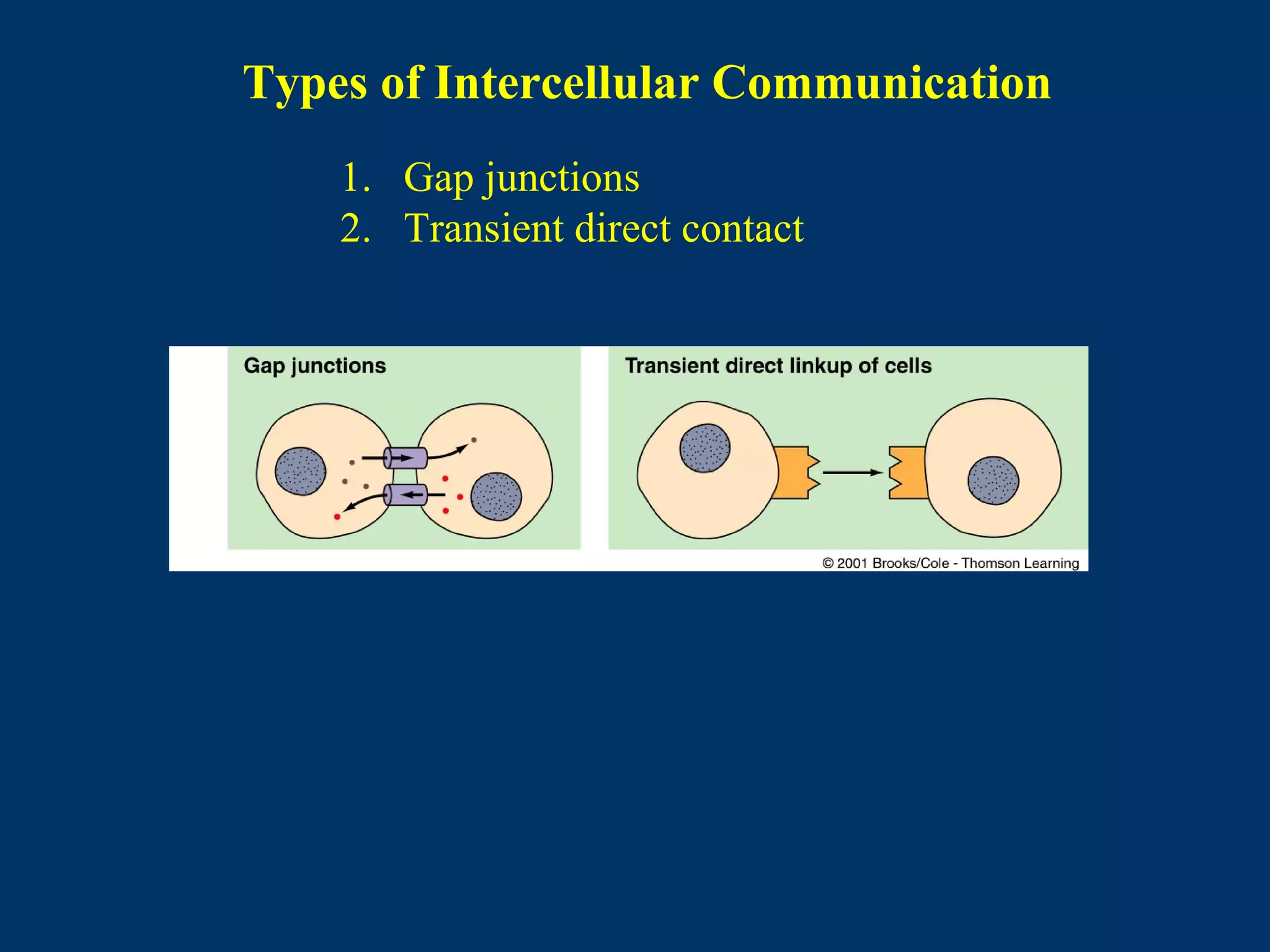
Types of Intercellular Communication
1. Gap junctions
2. Transient direct contact
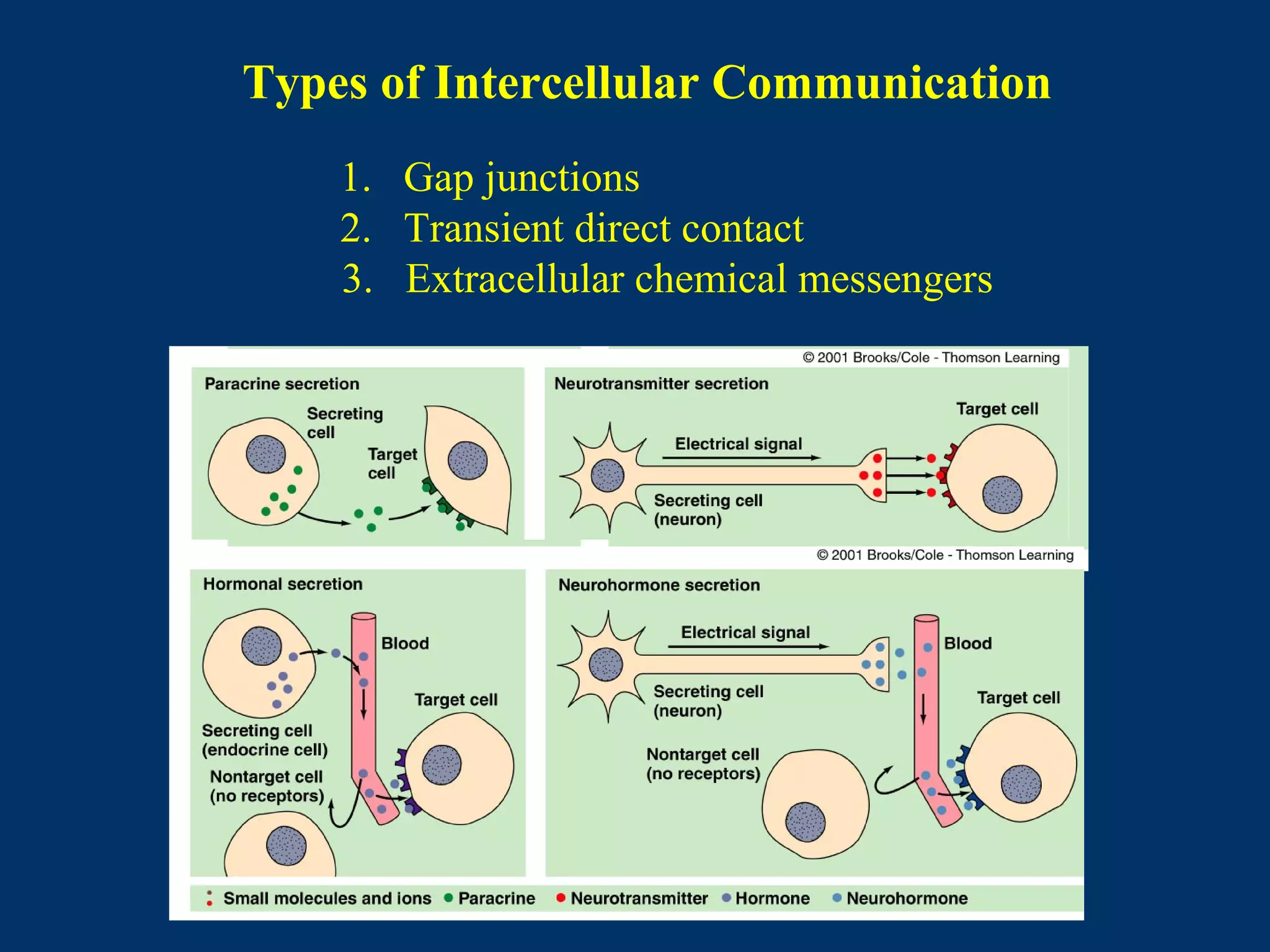
Types of Intercellular Communication
1. Gap junctions
2. Transient direct contact
3. Extracellular chemical messengers
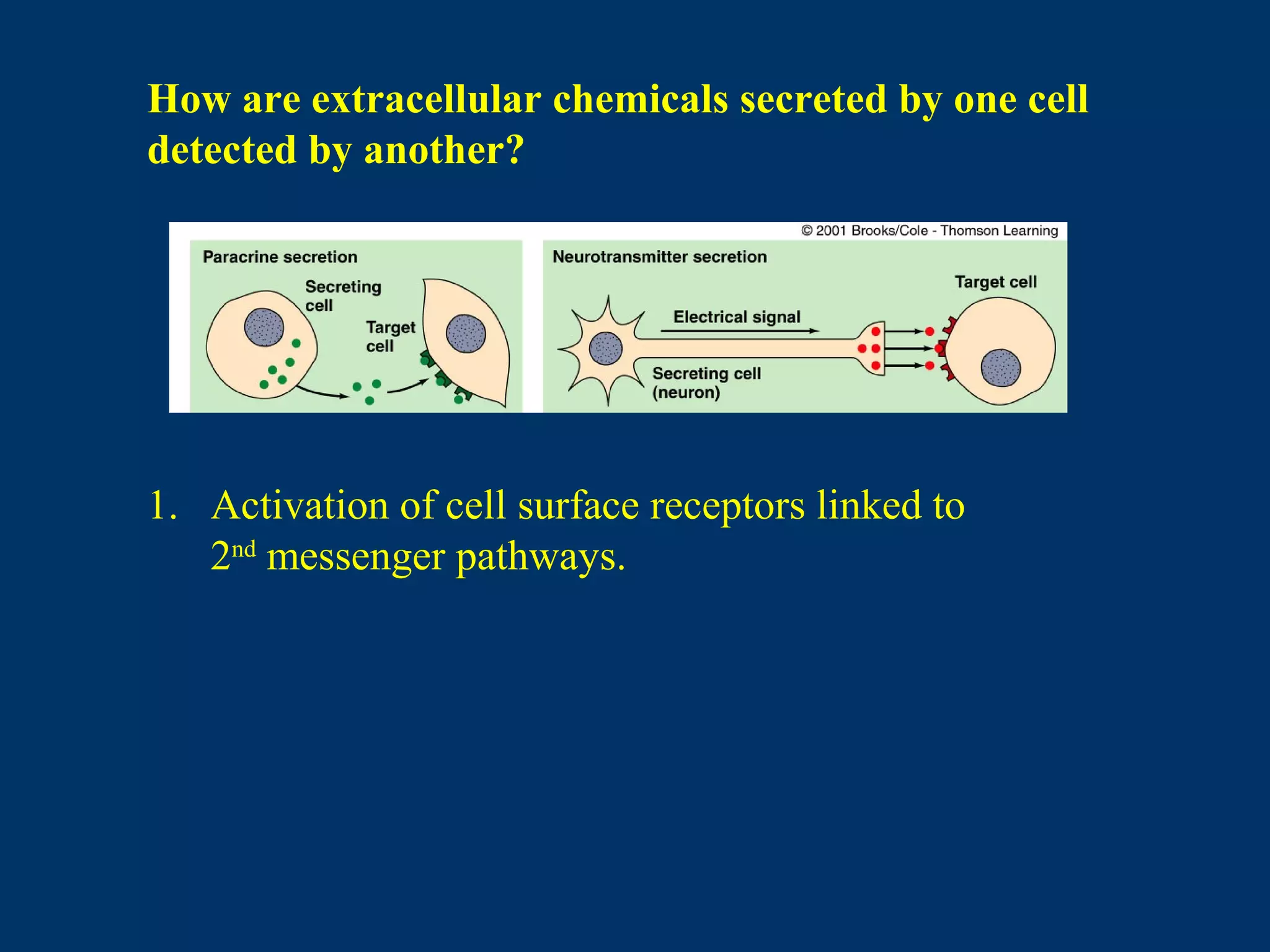
How are extracellular chemicals secreted by one cell
detected by another?
1. Activation of cell surface receptors linked to
2nd
messenger pathways.
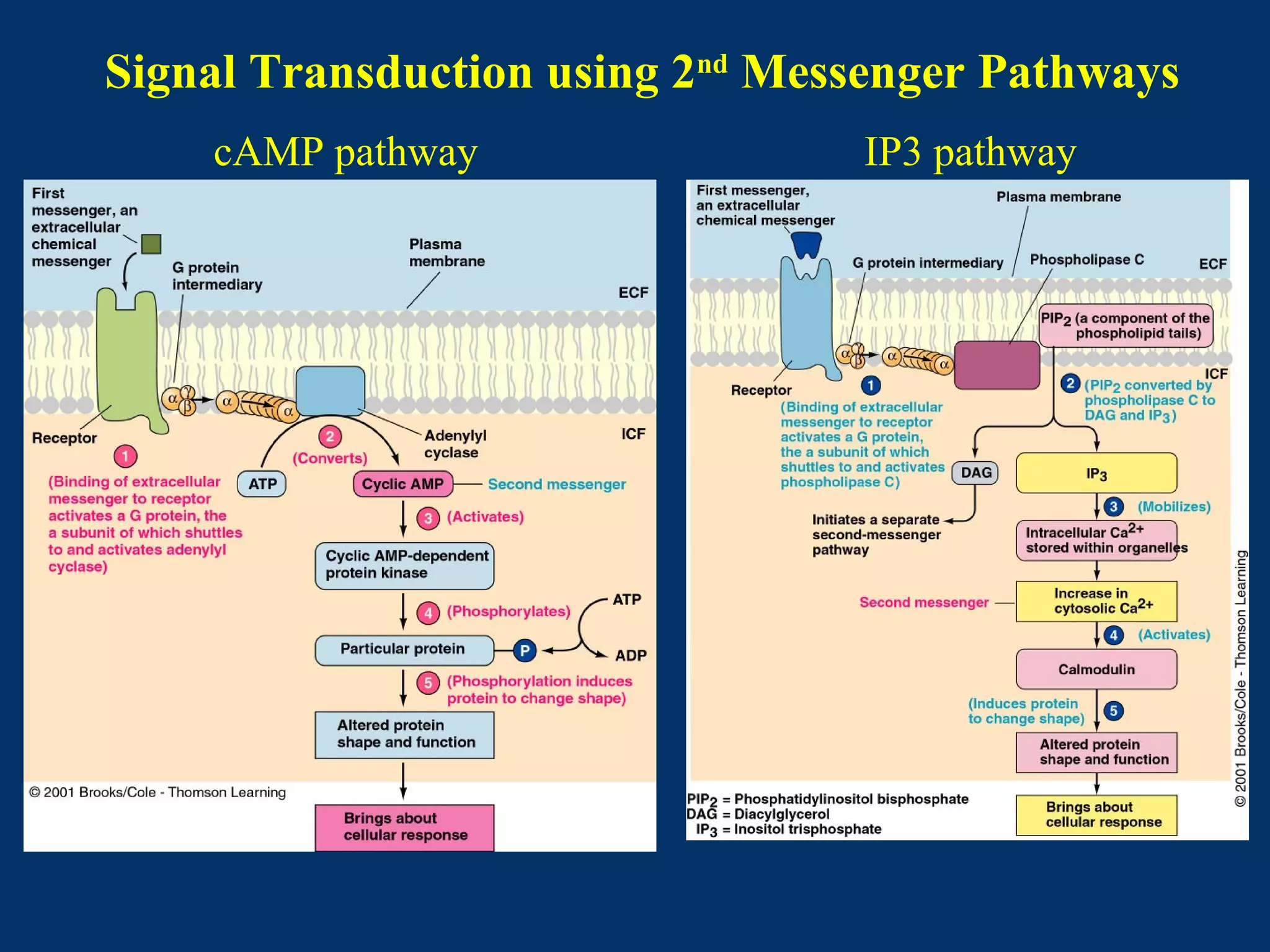
Signal Transduction using 2nd
Messenger Pathways
cAMP pathway IP3 pathway
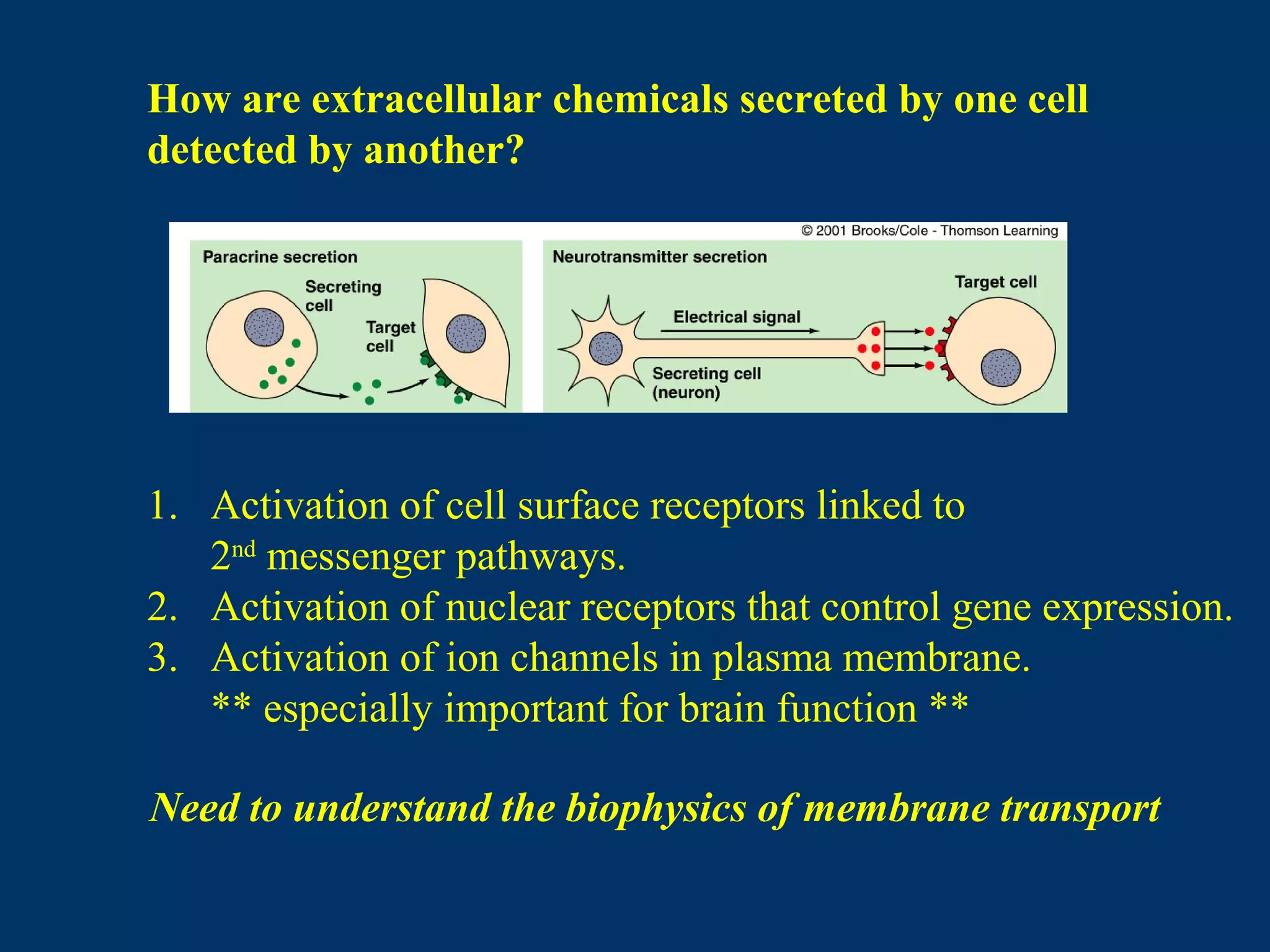
How are extracellular chemicals secreted by one cell
detected by another?
1. Activation of cell surface receptors linked to
2nd
messenger pathways.
2. Activation of nuclear receptors that control gene expression.
3. Activation of ion channels in plasma membrane.
** especially important for brain function **
Need to understand the biophysics of membrane transport
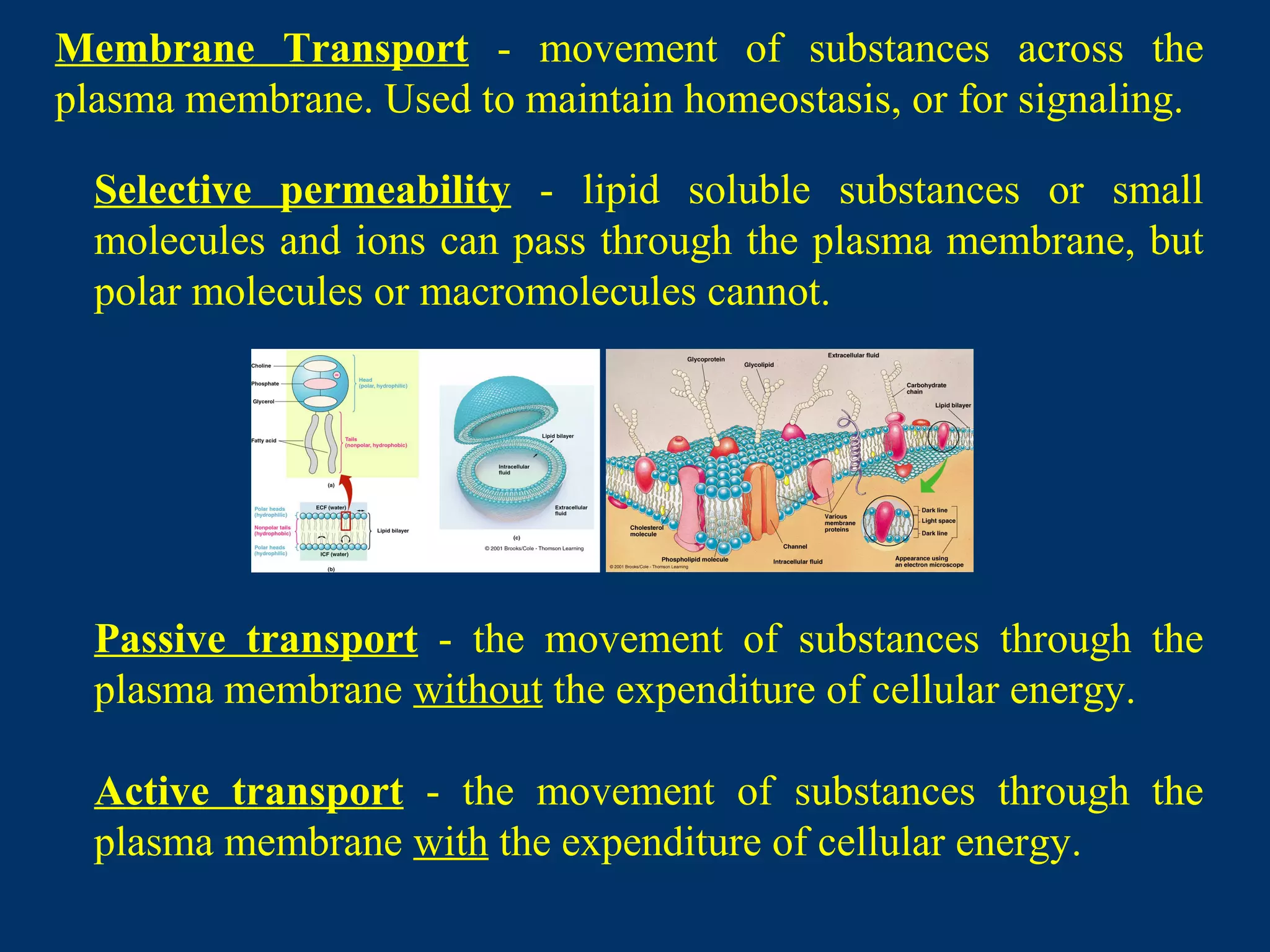
Membrane Transport - movement of substances across the
plasma membrane. Used to maintain homeostasis, or for signaling.
Selective permeability - lipid soluble substances or small
molecules and ions can pass through the plasma membrane, but
polar molecules or macromolecules cannot.
Passive transport - the movement of substances through the
plasma membrane without the expenditure of cellular energy.
Active transport - the movement of substances through the
plasma membrane with the expenditure of cellular energy.
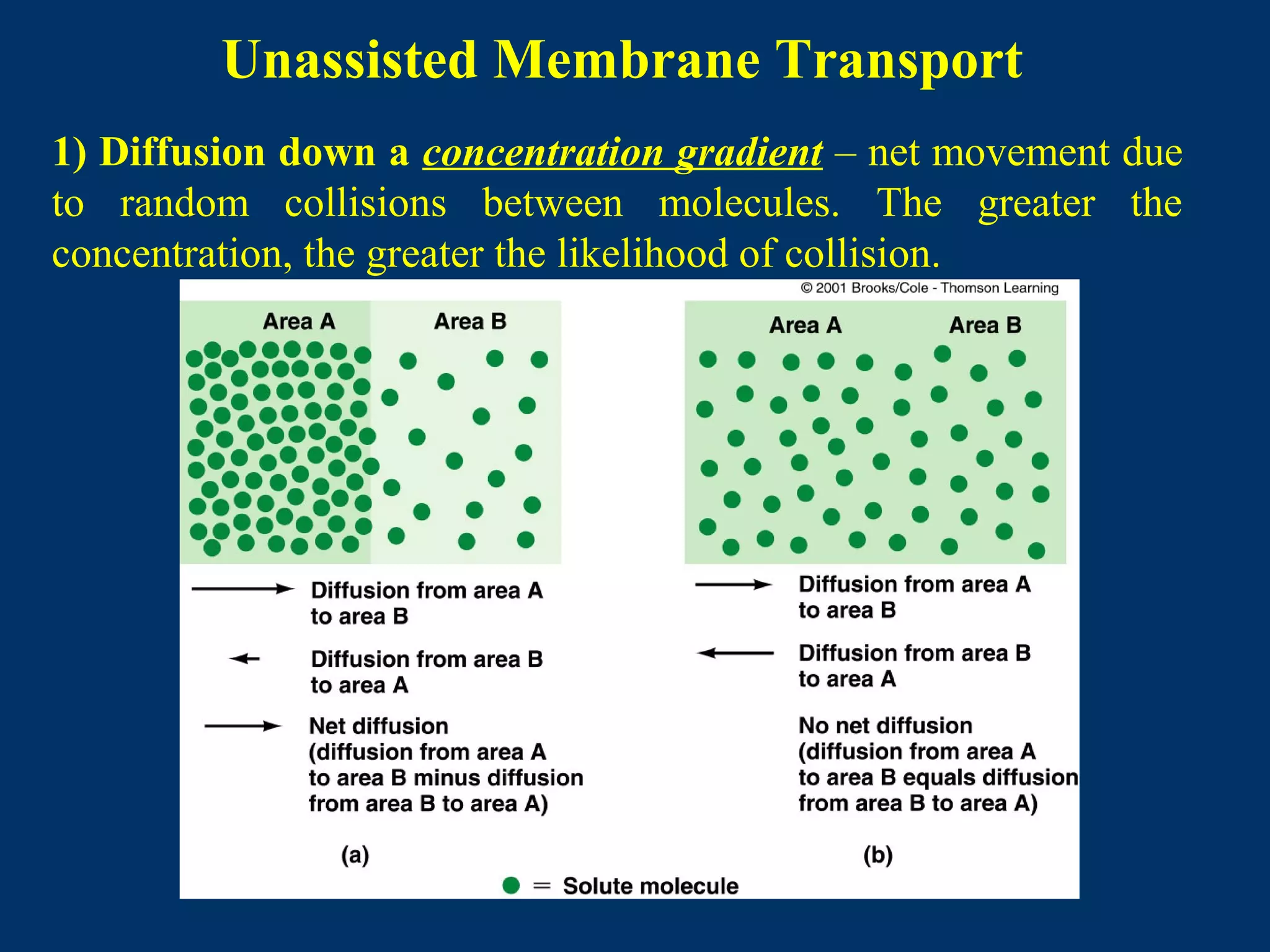
Unassisted Membrane Transport
1) Diffusion down a concentration gradient – net movement due
to random collisions between molecules. The greater the
concentration, the greater the likelihood of collision.
Unassisted Membrane Transport
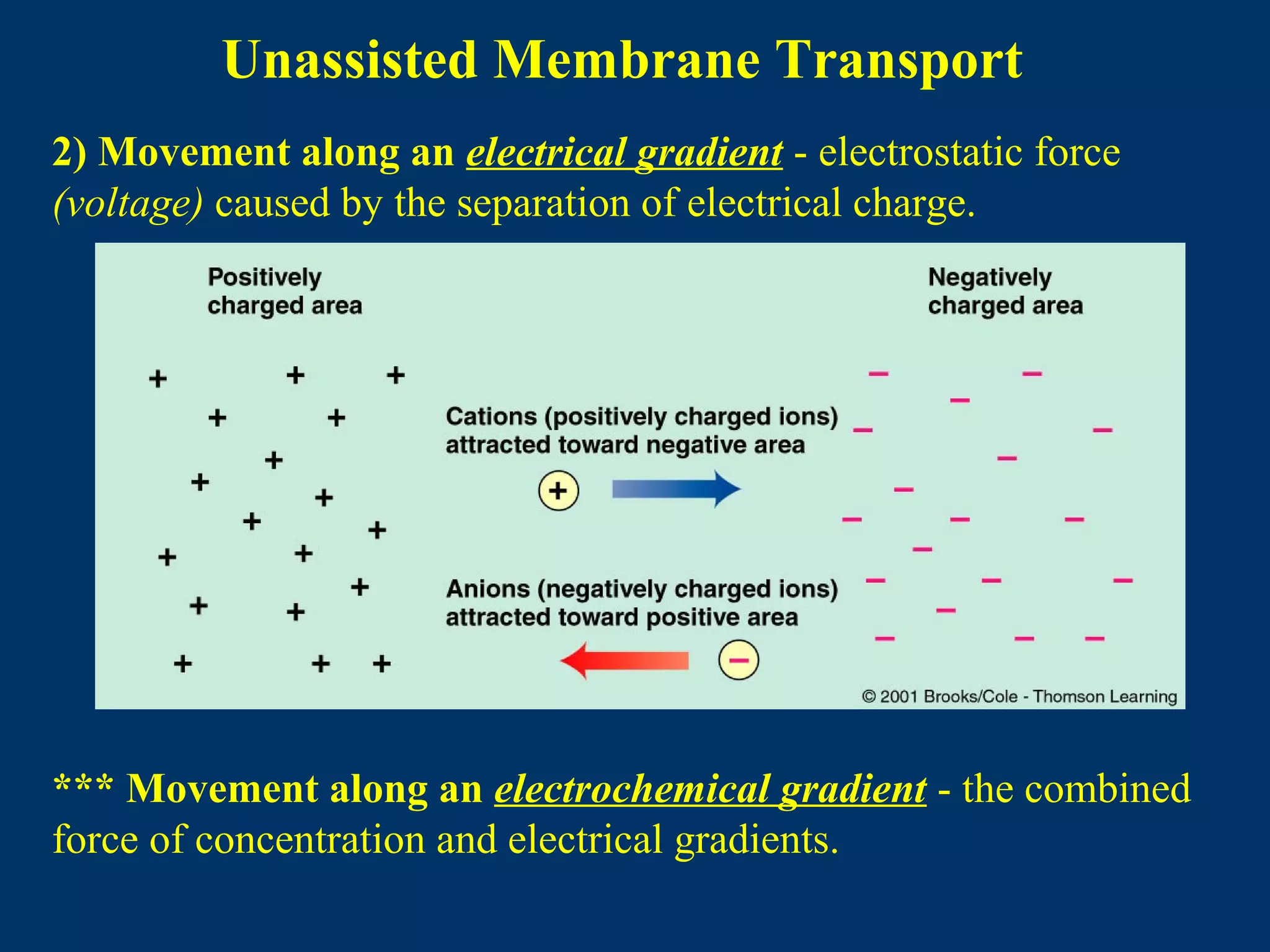
2) Movement along an electrical gradient - electrostatic force
(voltage) caused by the separation of electrical charge.
*** Movement along an electrochemical gradient - the combined
force of concentration and electrical gradients.
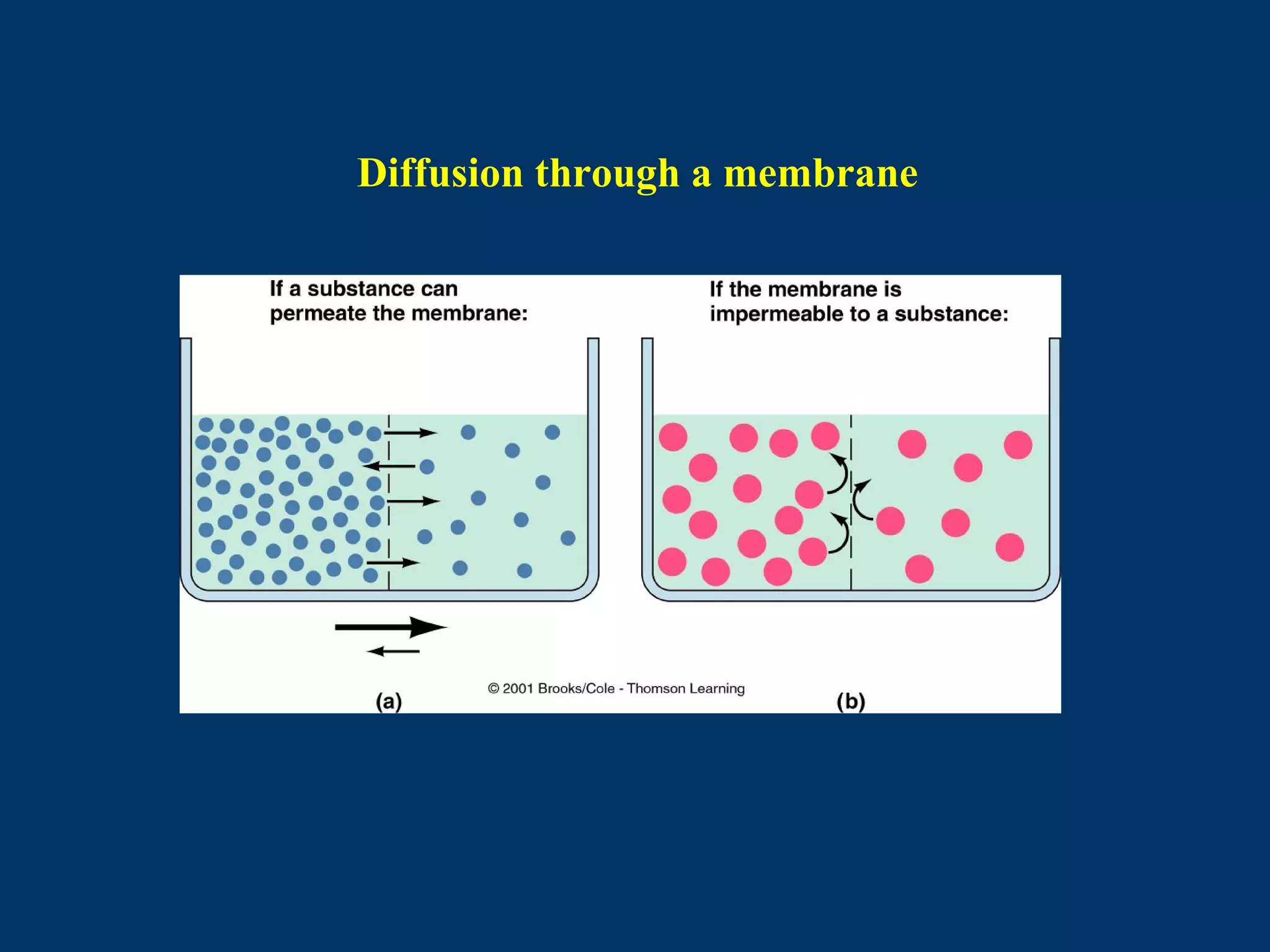
Diffusion through a membrane
How quickly a substance can diffuse across the
membrane is a critical factor for carrying out the
functions of homeostasis or signaling.
i.e. Rate of diffusion is important.
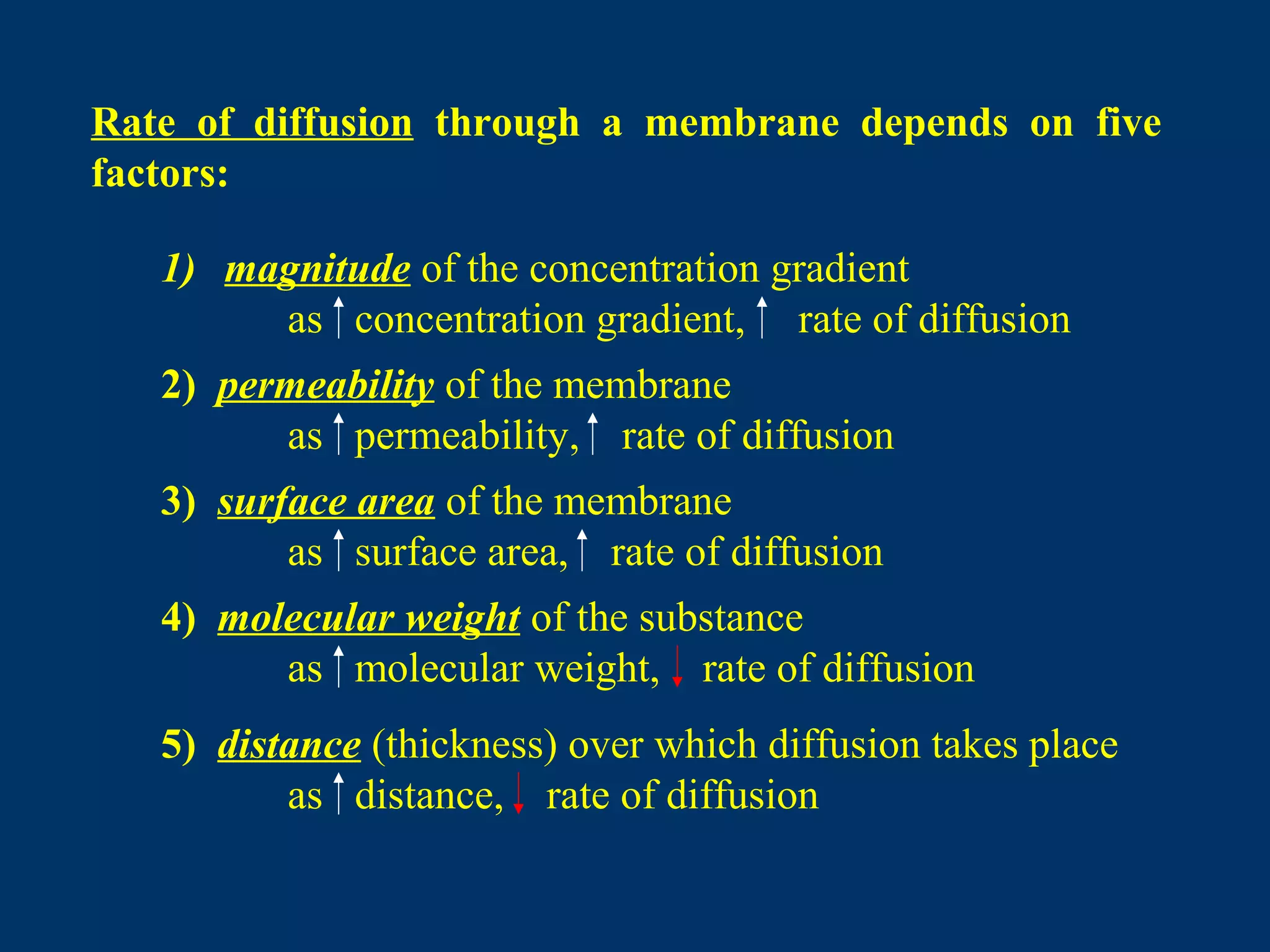
Rate of diffusion through a membrane depends on five
factors:
1) magnitude of the concentration gradient
as concentration gradient, rate of diffusion
2) permeability of the membrane
as permeability, rate of diffusion
3) surface area of the membrane
as surface area, rate of diffusion
4) molecular weight of the substance
as molecular weight, rate of diffusion
5) distance (thickness) over which diffusion takes place
as distance, rate of diffusion
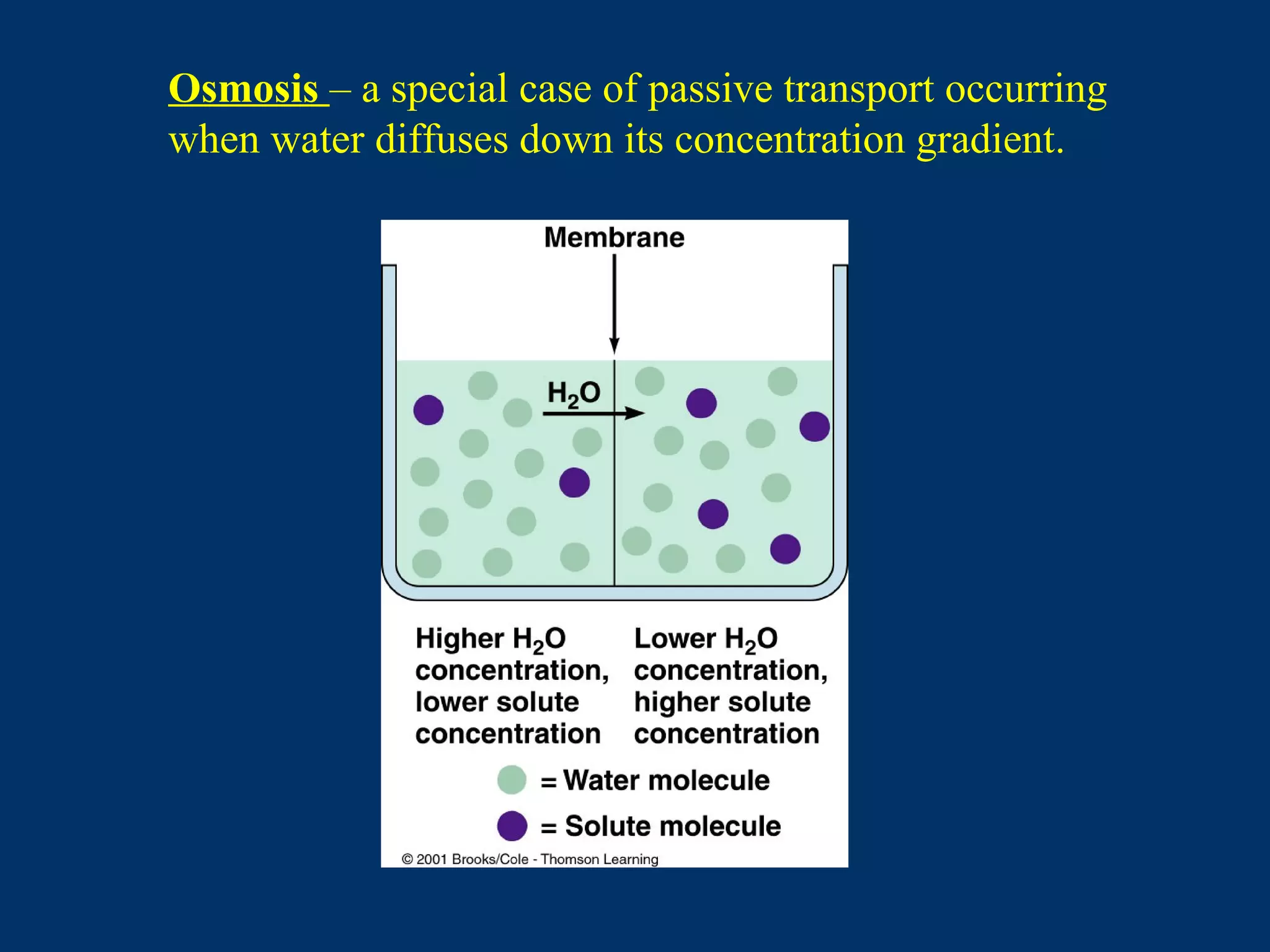
Osmosis – a special case of passive transport occurring
when water diffuses down its concentration gradient.
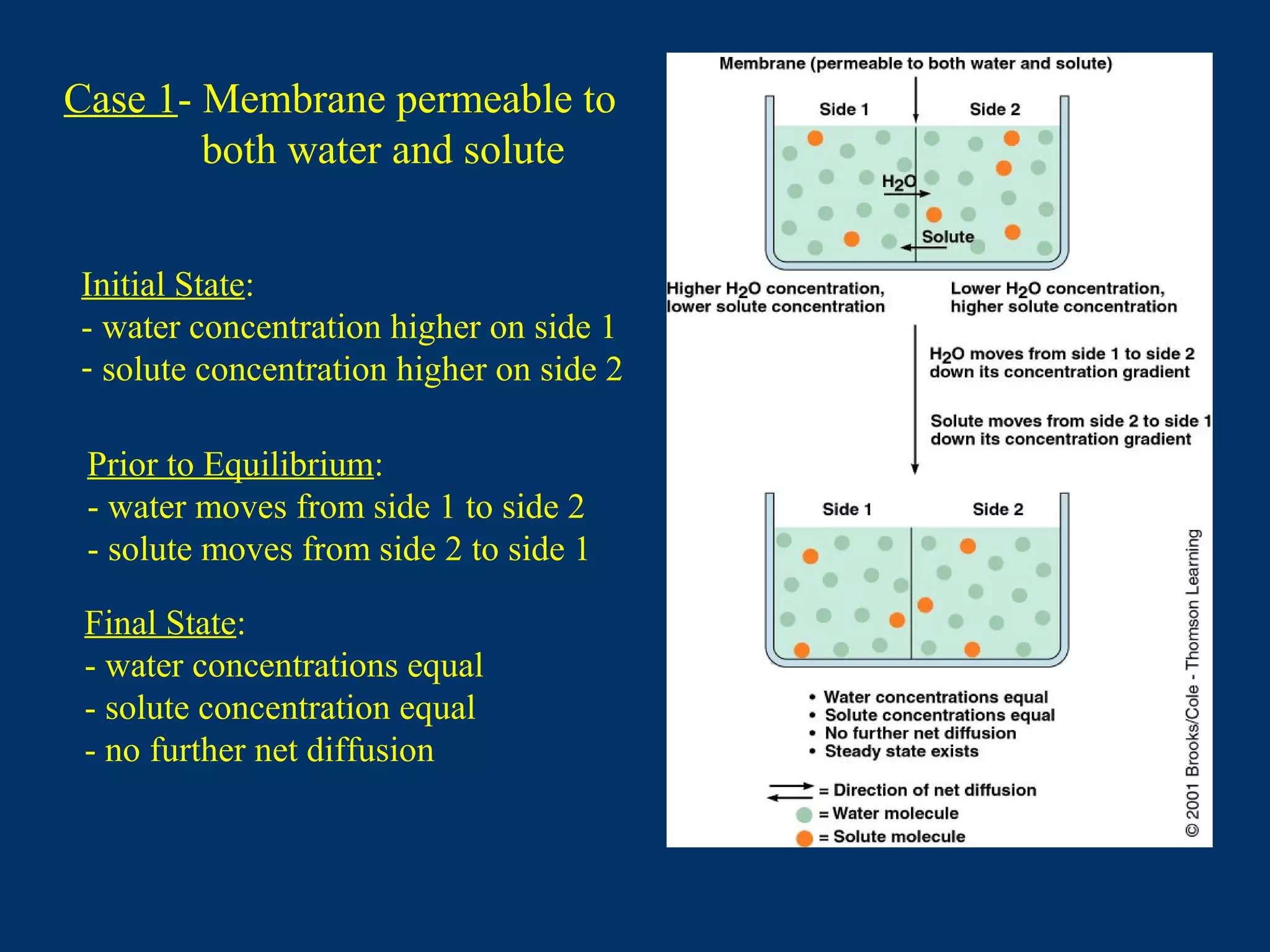
Case 1- Membrane permeable to
both water and solute
Prior to Equilibrium:
- water moves from side 1 to side 2
- solute moves from side 2 to side 1
Initial State:
- water concentration higher on side 1
- solute concentration higher on side 2
Final State:
- water concentrations equal
- solute concentration equal
- no further net diffusion
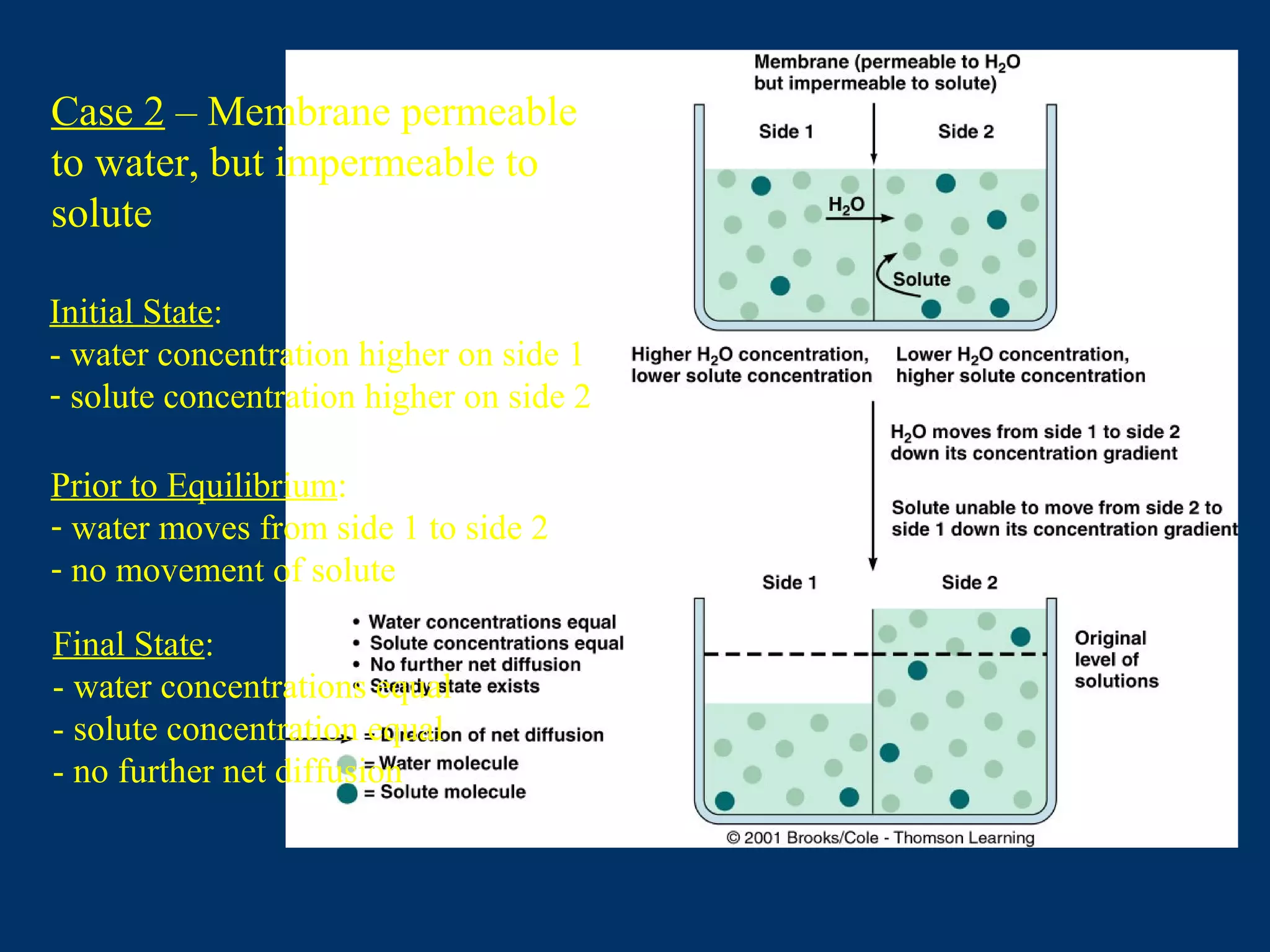
Case 2 – Membrane permeable
to water, but impermeable to
solute
Prior to Equilibrium:
- water moves from side 1 to side 2
- no movement of solute
Initial State:
- water concentration higher on side 1
- solute concentration higher on side 2
Final State:
- water concentrations equal
- solute concentration equal
- no further net diffusion
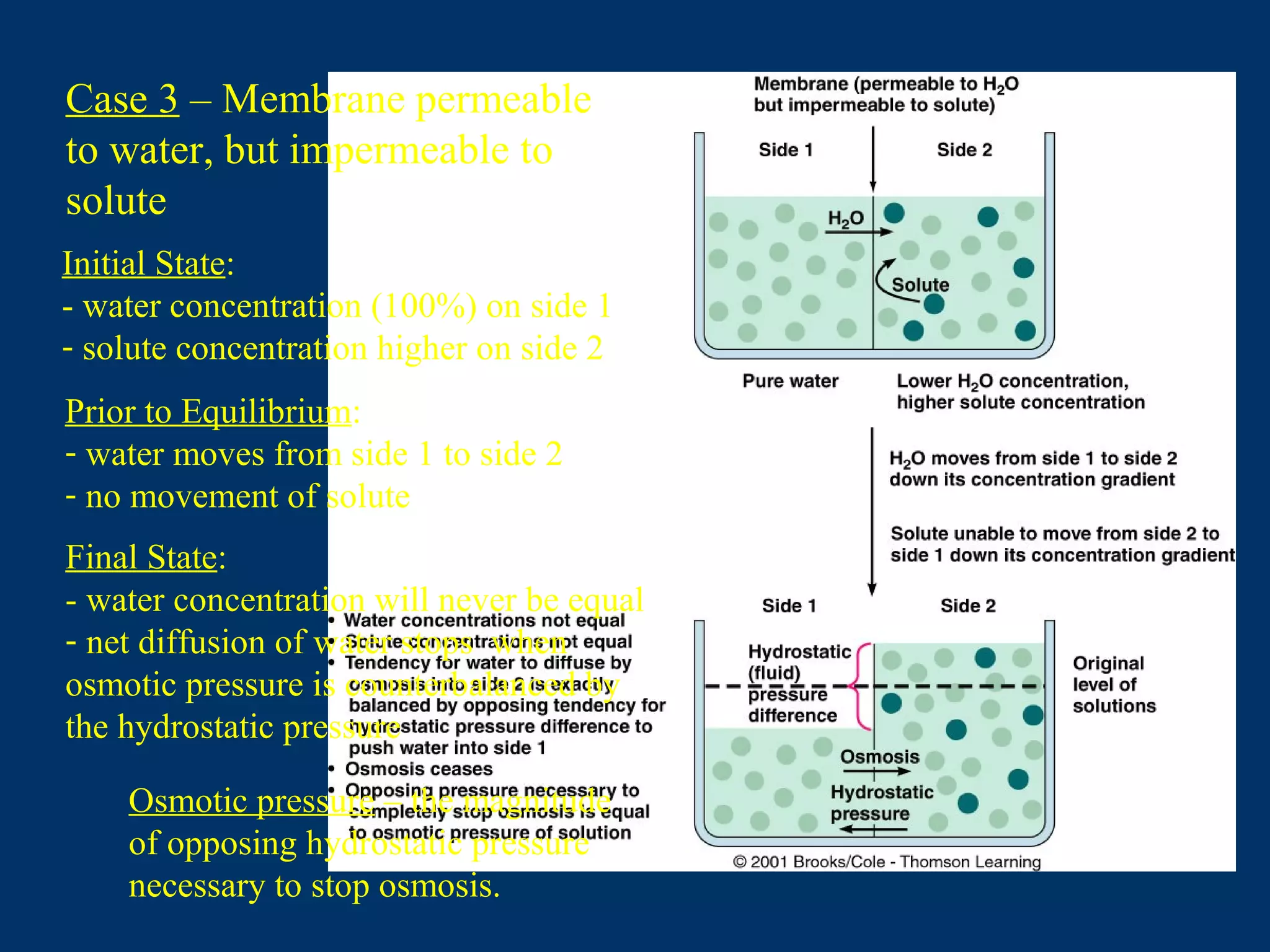
Osmotic pressure – the magnitude
of opposing hydrostatic pressure
necessary to stop osmosis.
Case 3 – Membrane permeable
to water, but impermeable to
solute
Initial State:
- water concentration (100%) on side 1
- solute concentration higher on side 2
Prior to Equilibrium:
- water moves from side 1 to side 2
- no movement of solute
Final State:
- water concentration will never be equal
- net diffusion of water stops when
osmotic pressure is counterbalanced by
the hydrostatic pressure
Carrier Mediated Transport – method of moving substances across
a membrane when the substance can not simply diffuse “unassisted”
through the membrane. 2 General Types:
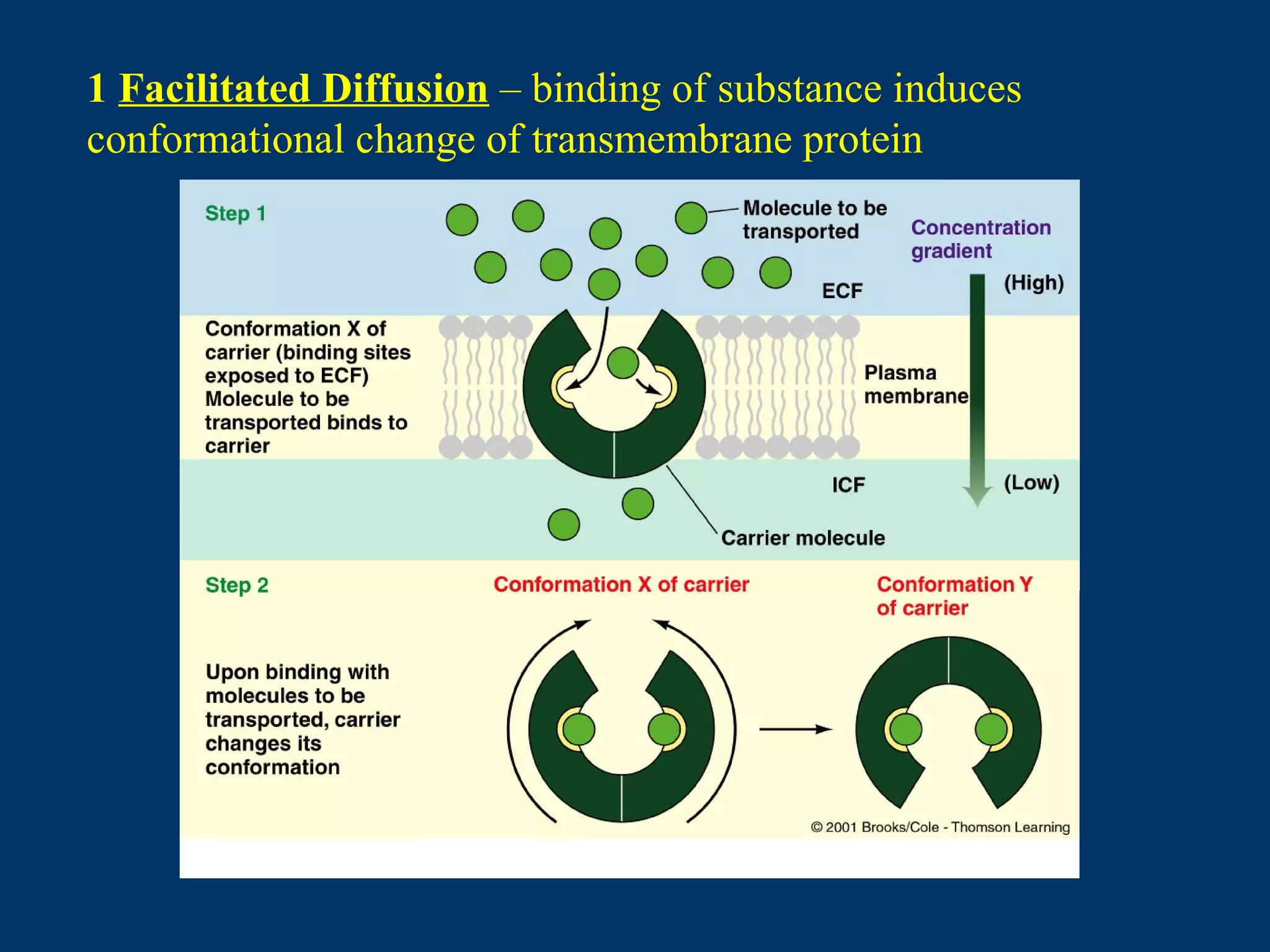
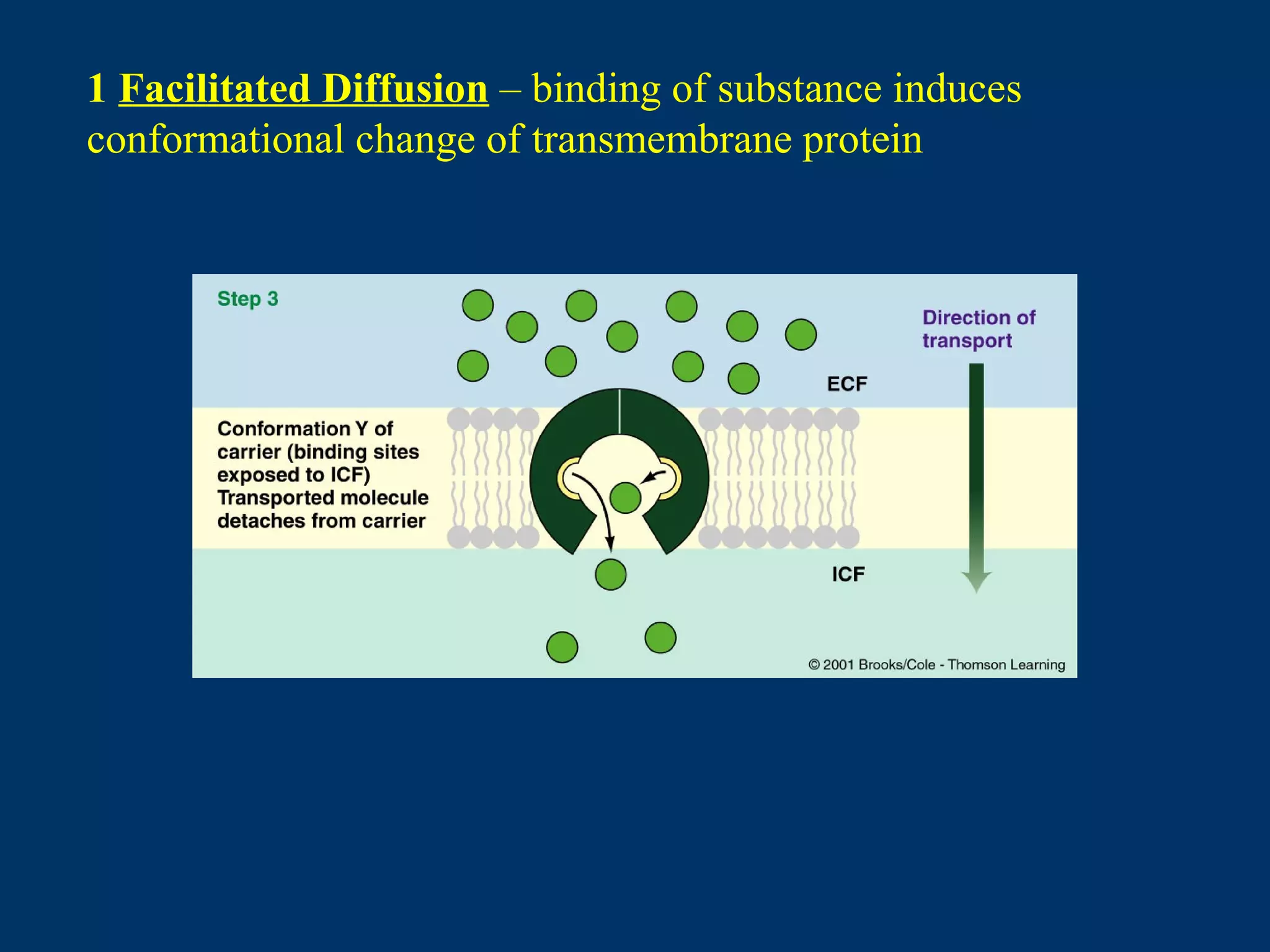
1) Facilitated Diffusion – occurs when a substance binds to a
transmembrane protein that undergoes a conformational change such
that the substance is released on the other side of the membrane.
Substances are transported down their concentration gradient. No
energy is required. Passive Transport
2) Membrane Pumps – transmembrane proteins that bind a
substance, undergo a conformational change, and move substances
across the membrane against their concentration gradient. Process
requires energy. Active Transport
1 Facilitated Diffusion – binding of substance induces
conformational change of transmembrane protein
1 Facilitated Diffusion – binding of substance induces
conformational change of transmembrane protein
2 Membrane Pumps - conformational change of transmembrane
protein is induced by a separate energy-dependent process (e.g.
phosphorylation).
Hydrogen-Ion pump
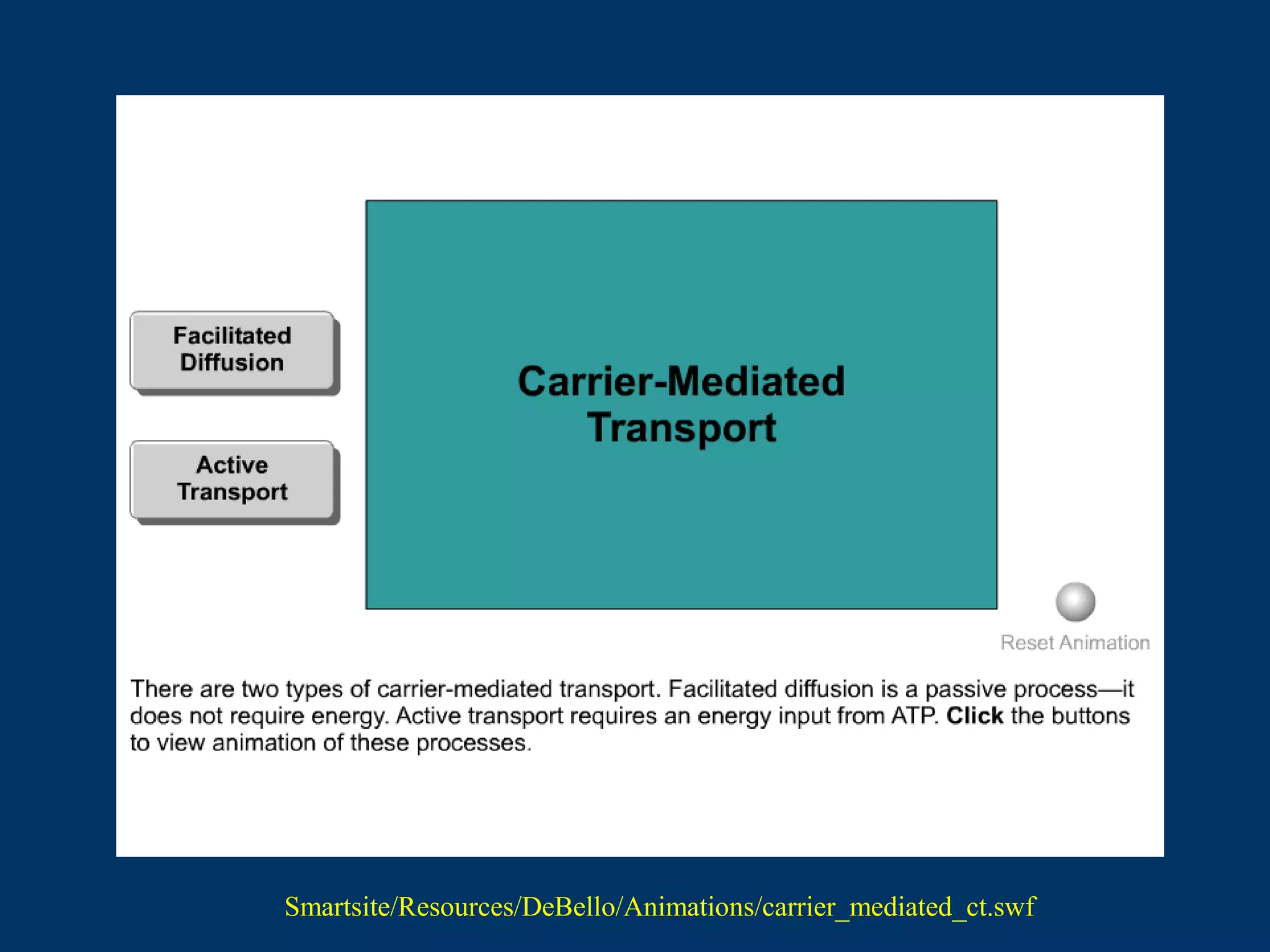
Smartsite/Resources/DeBello/Animations/carrier_mediated_ct.swf
Na+
/K+
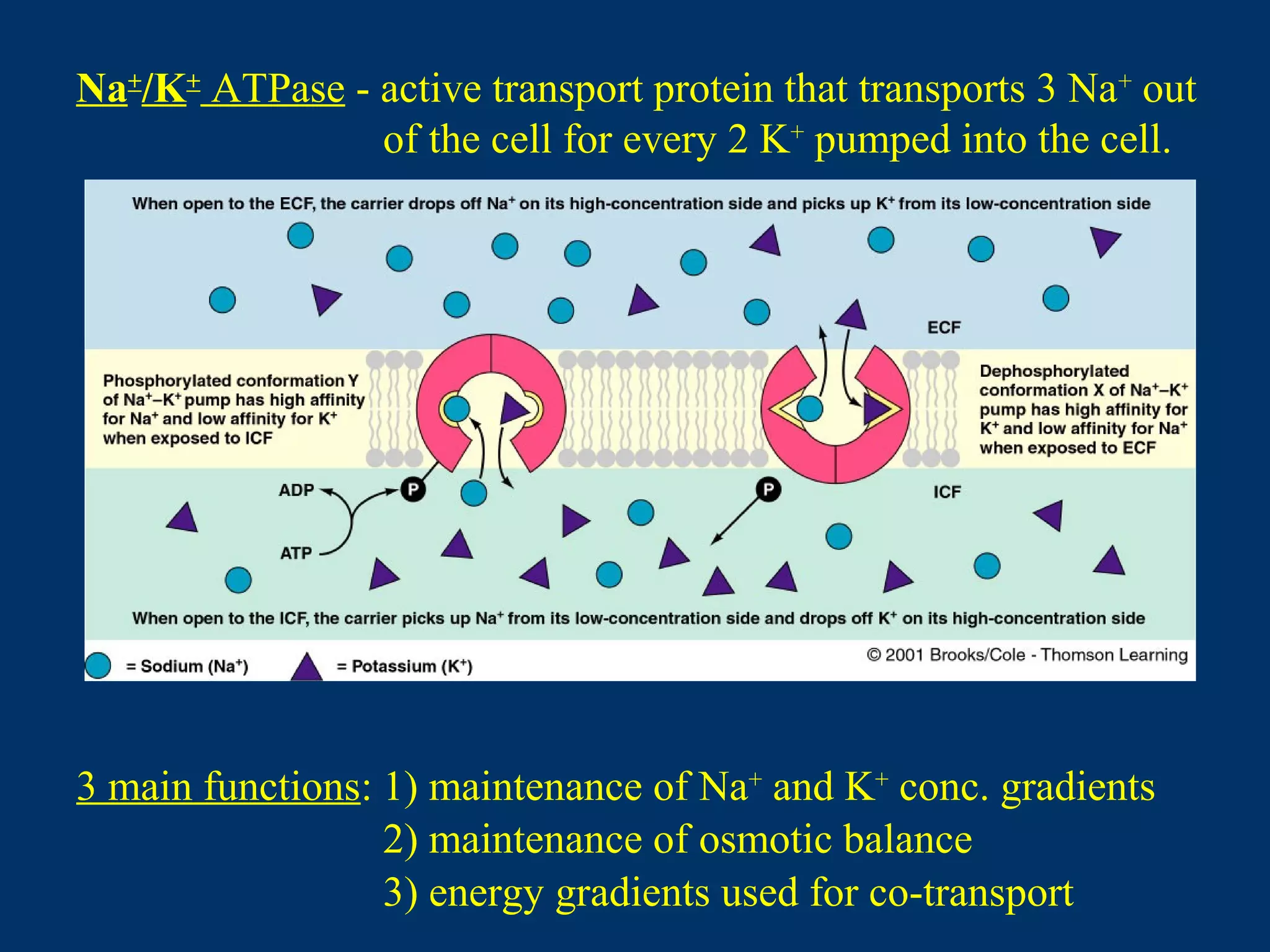
ATPase - active transport protein that transports 3 Na+
out
of the cell for every 2 K+
pumped into the cell.
1) maintenance of Na+
and K+
conc. gradients
2) maintenance of osmotic balance
3) energy gradients used for co-transport
3 main functions:
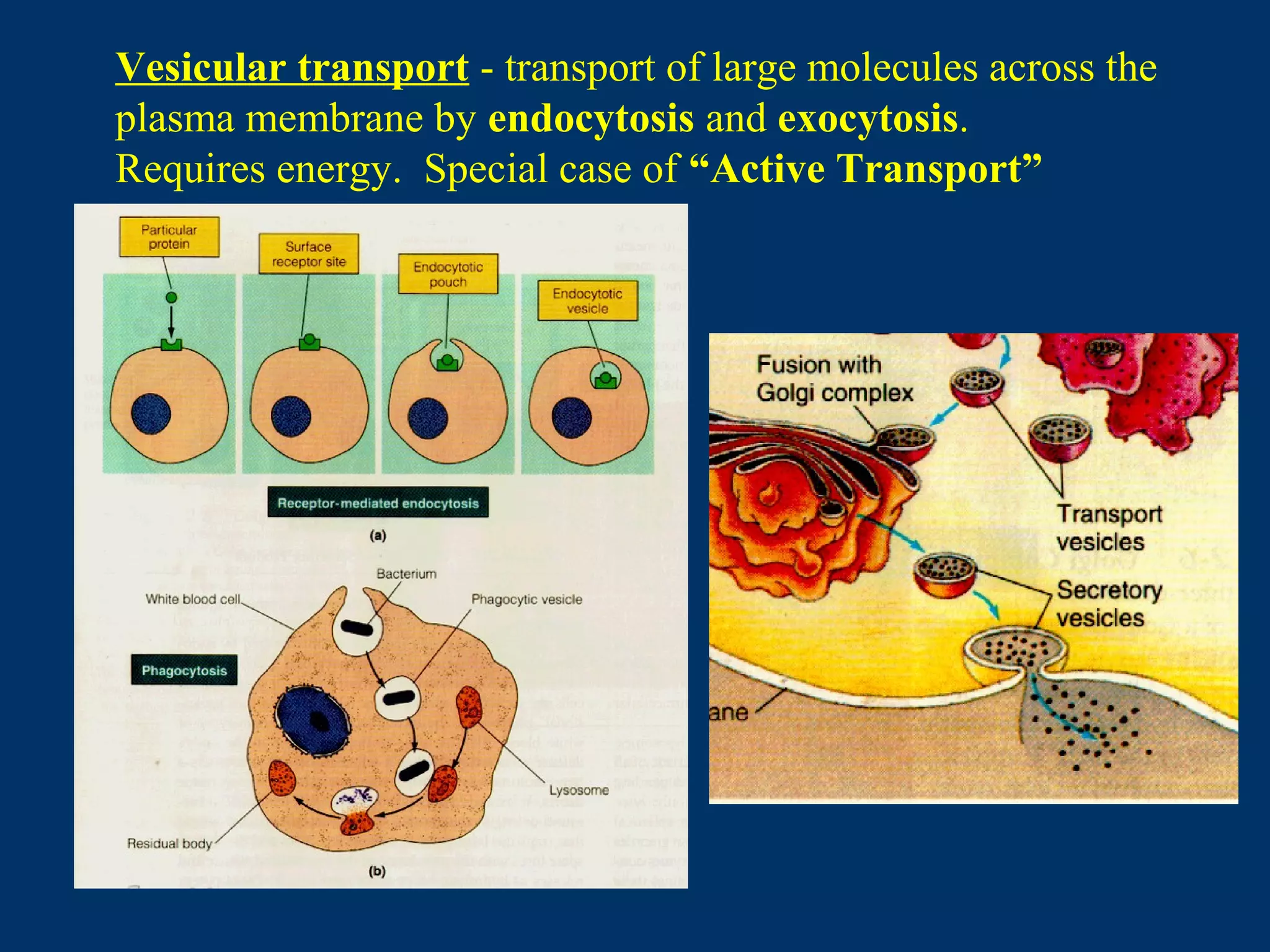
Vesicular transport - transport of large molecules across the
plasma membrane by endocytosis and exocytosis.
Requires energy. Special case of “Active Transport”
SUMMARY: Membrane Signaling and Transport
1. Intercellular signaling
2. Membranes are selectively permeable
3. Passive transport:
- diffusion down concentration/electrical gradients
- osmosis (diffusion of water down its conc. gradient)
- facilitated diffusion
4. Active transport
- membrane pumps
- vesicular transport

Lecture3

  • 1.
    Lecture 3: MembraneSignaling and TransportLecture 3: Membrane Signaling and Transport Reading: Ch 3, section: membrane transport Ch 4, intercellular communication and signal transduction
  • 2.
    Types of IntercellularCommunication 1. Gap junctions 2. Transient direct contact
  • 3.
    Types of IntercellularCommunication 1. Gap junctions 2. Transient direct contact 3. Extracellular chemical messengers
  • 4.
    How are extracellularchemicals secreted by one cell detected by another? 1. Activation of cell surface receptors linked to 2nd messenger pathways.
  • 5.
    Signal Transduction using2nd Messenger Pathways cAMP pathway IP3 pathway
  • 6.
    How are extracellularchemicals secreted by one cell detected by another? 1. Activation of cell surface receptors linked to 2nd messenger pathways. 2. Activation of nuclear receptors that control gene expression. 3. Activation of ion channels in plasma membrane. ** especially important for brain function ** Need to understand the biophysics of membrane transport
  • 7.
    Membrane Transport -movement of substances across the plasma membrane. Used to maintain homeostasis, or for signaling. Selective permeability - lipid soluble substances or small molecules and ions can pass through the plasma membrane, but polar molecules or macromolecules cannot. Passive transport - the movement of substances through the plasma membrane without the expenditure of cellular energy. Active transport - the movement of substances through the plasma membrane with the expenditure of cellular energy.
  • 8.
    Unassisted Membrane Transport 1)Diffusion down a concentration gradient – net movement due to random collisions between molecules. The greater the concentration, the greater the likelihood of collision.
  • 9.
    Unassisted Membrane Transport 2)Movement along an electrical gradient - electrostatic force (voltage) caused by the separation of electrical charge. *** Movement along an electrochemical gradient - the combined force of concentration and electrical gradients.
  • 10.
  • 11.
    How quickly asubstance can diffuse across the membrane is a critical factor for carrying out the functions of homeostasis or signaling. i.e. Rate of diffusion is important.
  • 12.
    Rate of diffusionthrough a membrane depends on five factors: 1) magnitude of the concentration gradient as concentration gradient, rate of diffusion 2) permeability of the membrane as permeability, rate of diffusion 3) surface area of the membrane as surface area, rate of diffusion 4) molecular weight of the substance as molecular weight, rate of diffusion 5) distance (thickness) over which diffusion takes place as distance, rate of diffusion
  • 13.
    Osmosis – aspecial case of passive transport occurring when water diffuses down its concentration gradient.
  • 14.
    Case 1- Membranepermeable to both water and solute Prior to Equilibrium: - water moves from side 1 to side 2 - solute moves from side 2 to side 1 Initial State: - water concentration higher on side 1 - solute concentration higher on side 2 Final State: - water concentrations equal - solute concentration equal - no further net diffusion
  • 15.
    Case 2 –Membrane permeable to water, but impermeable to solute Prior to Equilibrium: - water moves from side 1 to side 2 - no movement of solute Initial State: - water concentration higher on side 1 - solute concentration higher on side 2 Final State: - water concentrations equal - solute concentration equal - no further net diffusion
  • 16.
    Osmotic pressure –the magnitude of opposing hydrostatic pressure necessary to stop osmosis. Case 3 – Membrane permeable to water, but impermeable to solute Initial State: - water concentration (100%) on side 1 - solute concentration higher on side 2 Prior to Equilibrium: - water moves from side 1 to side 2 - no movement of solute Final State: - water concentration will never be equal - net diffusion of water stops when osmotic pressure is counterbalanced by the hydrostatic pressure
  • 17.
    Carrier Mediated Transport– method of moving substances across a membrane when the substance can not simply diffuse “unassisted” through the membrane. 2 General Types: 1) Facilitated Diffusion – occurs when a substance binds to a transmembrane protein that undergoes a conformational change such that the substance is released on the other side of the membrane. Substances are transported down their concentration gradient. No energy is required. Passive Transport 2) Membrane Pumps – transmembrane proteins that bind a substance, undergo a conformational change, and move substances across the membrane against their concentration gradient. Process requires energy. Active Transport
  • 18.
    1 Facilitated Diffusion– binding of substance induces conformational change of transmembrane protein
  • 19.
    1 Facilitated Diffusion– binding of substance induces conformational change of transmembrane protein
  • 20.
    2 Membrane Pumps- conformational change of transmembrane protein is induced by a separate energy-dependent process (e.g. phosphorylation). Hydrogen-Ion pump
  • 21.
  • 22.
    Na+ /K+ ATPase - activetransport protein that transports 3 Na+ out of the cell for every 2 K+ pumped into the cell. 1) maintenance of Na+ and K+ conc. gradients 2) maintenance of osmotic balance 3) energy gradients used for co-transport 3 main functions:
  • 23.
    Vesicular transport -transport of large molecules across the plasma membrane by endocytosis and exocytosis. Requires energy. Special case of “Active Transport”
  • 24.
    SUMMARY: Membrane Signalingand Transport 1. Intercellular signaling 2. Membranes are selectively permeable 3. Passive transport: - diffusion down concentration/electrical gradients - osmosis (diffusion of water down its conc. gradient) - facilitated diffusion 4. Active transport - membrane pumps - vesicular transport