1
Bottom-Up Parsing
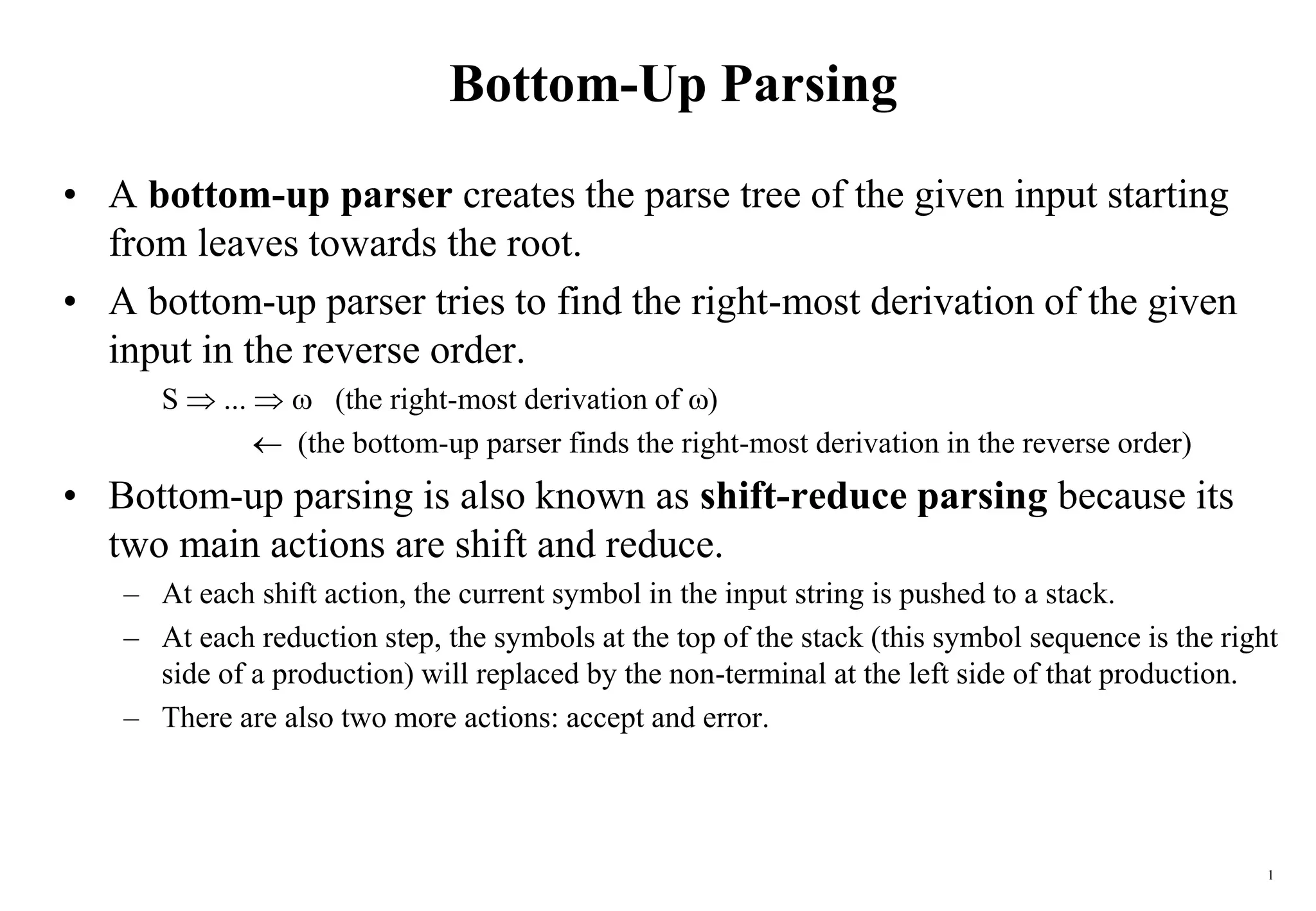
• A bottom-up parser creates the parse tree of the given input starting
from leaves towards the root.
• A bottom-up parser tries to find the right-most derivation of the given
input in the reverse order.
S  ...   (the right-most derivation of )
 (the bottom-up parser finds the right-most derivation in the reverse order)
• Bottom-up parsing is also known as shift-reduce parsing because its
two main actions are shift and reduce.
– At each shift action, the current symbol in the input string is pushed to a stack.
– At each reduction step, the symbols at the top of the stack (this symbol sequence is the right
side of a production) will replaced by the non-terminal at the left side of that production.
– There are also two more actions: accept and error.
2
Shift-Reduce Parsing
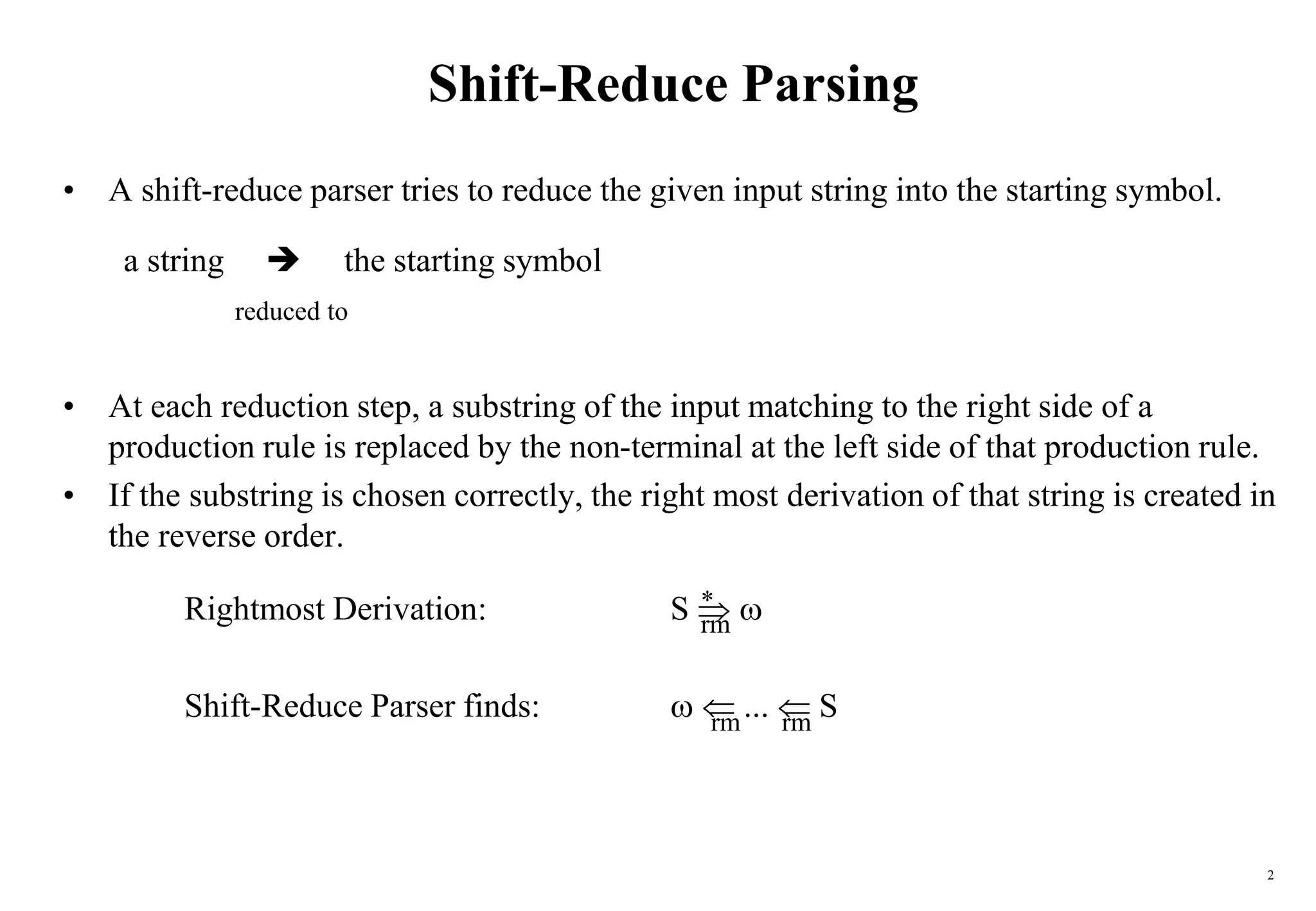
• A shift-reduce parser tries to reduce the given input string into the starting symbol.
a string  the starting symbol
reduced to
• At each reduction step, a substring of the input matching to the right side of a
production rule is replaced by the non-terminal at the left side of that production rule.
• If the substring is chosen correctly, the right most derivation of that string is created in
the reverse order.
Rightmost Derivation: S  
Shift-Reduce Parser finds:   ...  S
*
rm
rm rm
3
Shift-Reduce Parsing -- Example
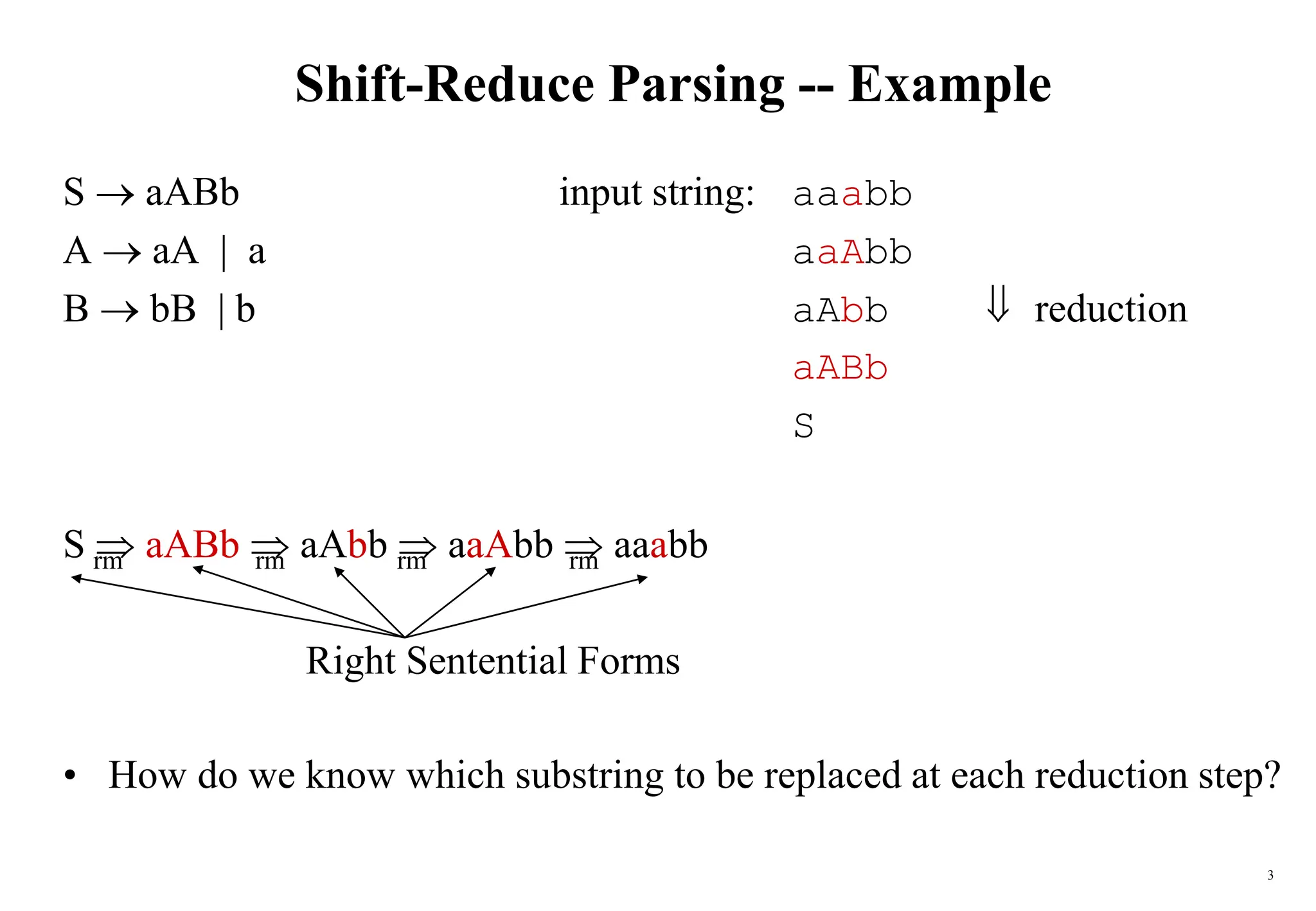
S  aABb input string: aaabb
A  aA | a aaAbb
B  bB | b aAbb  reduction
aABb
S
S  aABb  aAbb  aaAbb  aaabb
Right Sentential Forms
• How do we know which substring to be replaced at each reduction step?
rm
rm
rm
rm
4
Handle
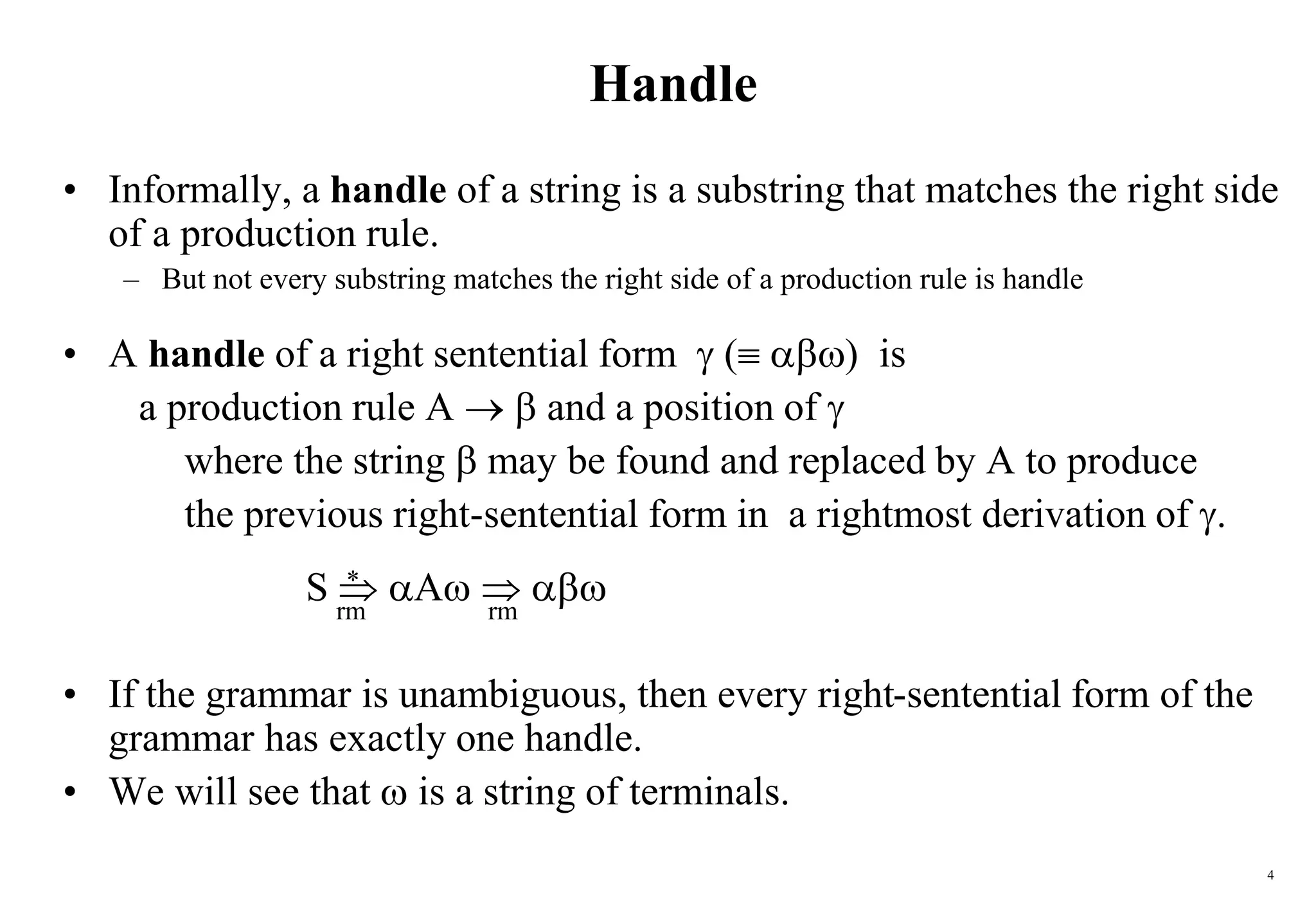
• Informally, a handle of a string is a substring that matches the right side
of a production rule.
– But not every substring matches the right side of a production rule is handle
• A handle of a right sentential form  ( ) is
a production rule A   and a position of 
where the string  may be found and replaced by A to produce
the previous right-sentential form in a rightmost derivation of .
S  A  
• If the grammar is unambiguous, then every right-sentential form of the
grammar has exactly one handle.
• We will see that  is a string of terminals.
rm rm
*
5
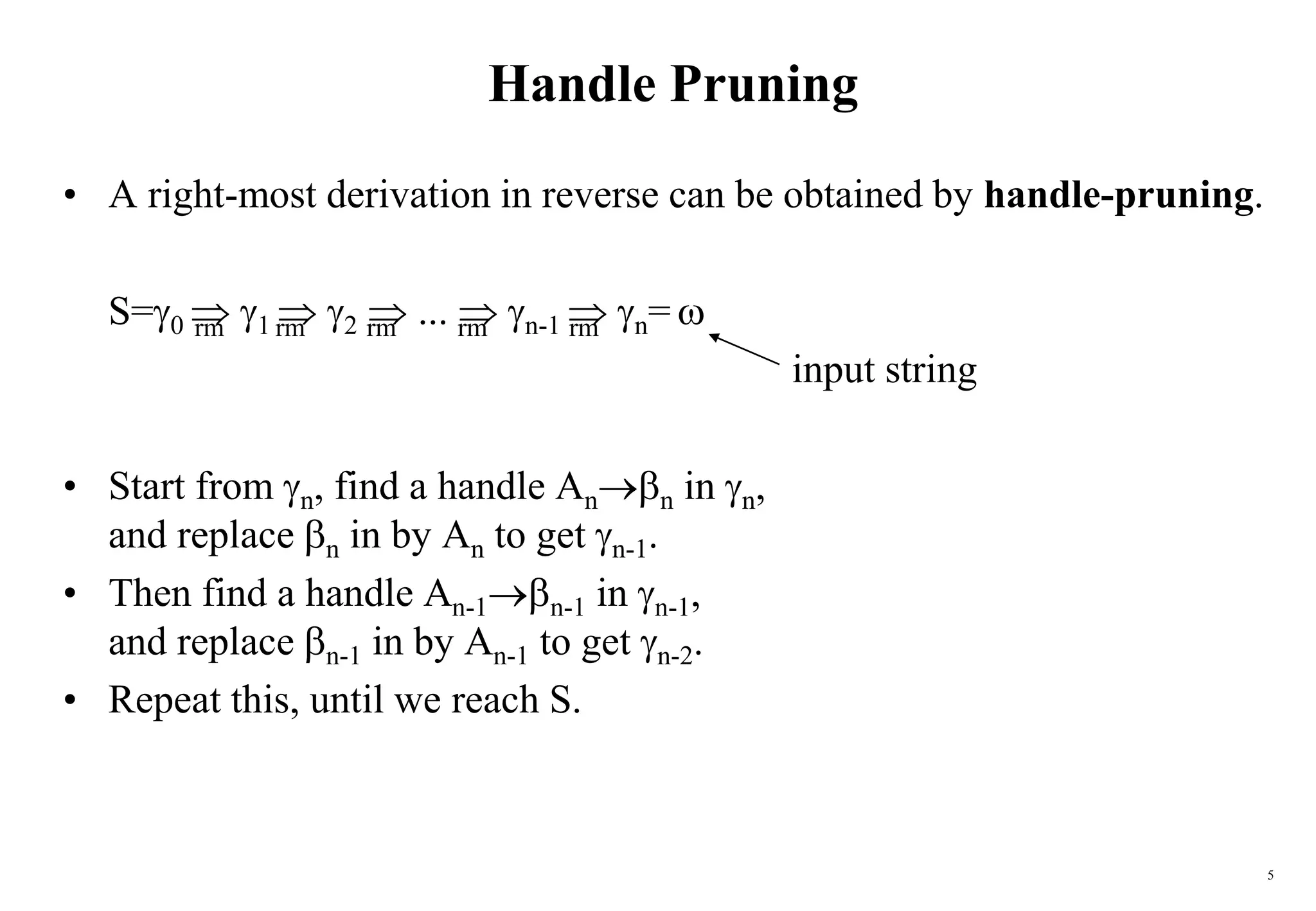
Handle Pruning
• A right-most derivation in reverse can be obtained by handle-pruning.
S=0  1  2  ...  n-1  n= 
input string
• Start from n, find a handle Ann in n,
and replace n in by An to get n-1.
• Then find a handle An-1n-1 in n-1,
and replace n-1 in by An-1 to get n-2.
• Repeat this, until we reach S.
rm
rm
rm rm
rm
6
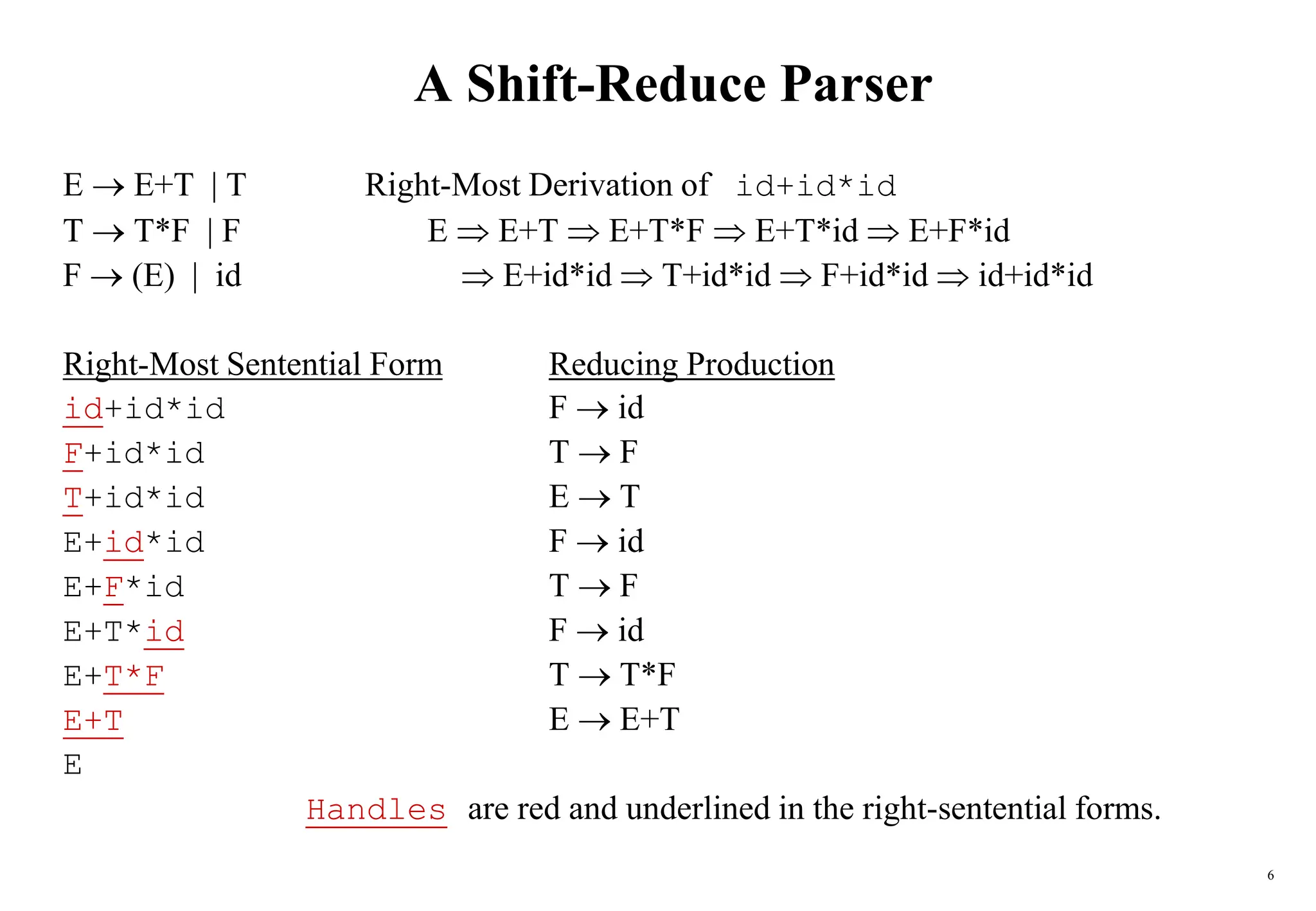
A Shift-Reduce Parser
E  E+T | T Right-Most Derivation of id+id*id
T  T*F | F E  E+T  E+T*F  E+T*id  E+F*id
F  (E) | id  E+id*id  T+id*id  F+id*id  id+id*id
Right-Most Sentential Form Reducing Production
id+id*id F  id
F+id*id T  F
T+id*id E  T
E+id*id F  id
E+F*id T  F
E+T*id F  id
E+T*F T  T*F
E+T E  E+T
E
Handles are red and underlined in the right-sentential forms.
7
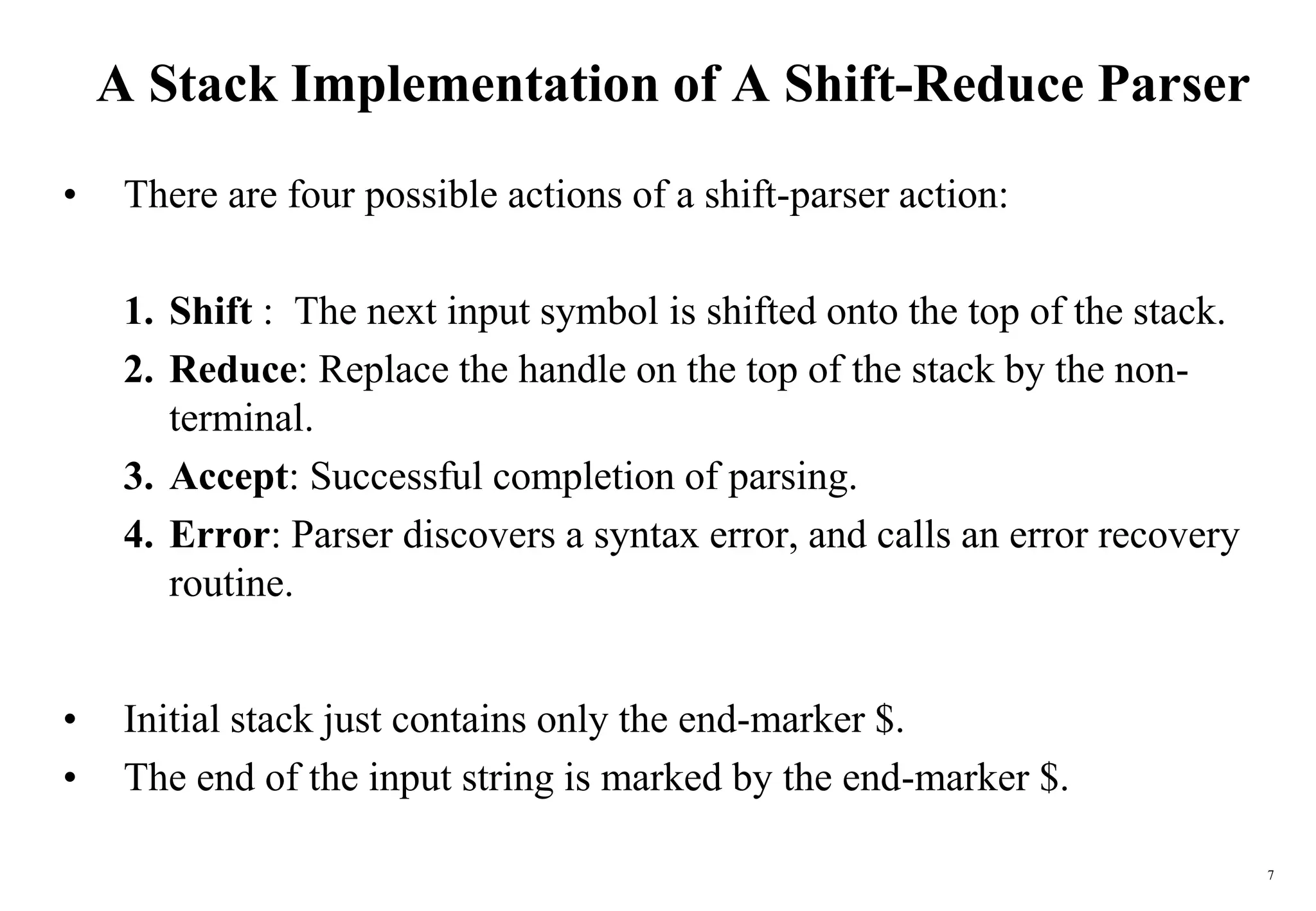
A Stack Implementation of A Shift-Reduce Parser
• There are four possible actions of a shift-parser action:
1. Shift : The next input symbol is shifted onto the top of the stack.
2. Reduce: Replace the handle on the top of the stack by the non-
terminal.
3. Accept: Successful completion of parsing.
4. Error: Parser discovers a syntax error, and calls an error recovery
routine.
• Initial stack just contains only the end-marker $.
• The end of the input string is marked by the end-marker $.
8
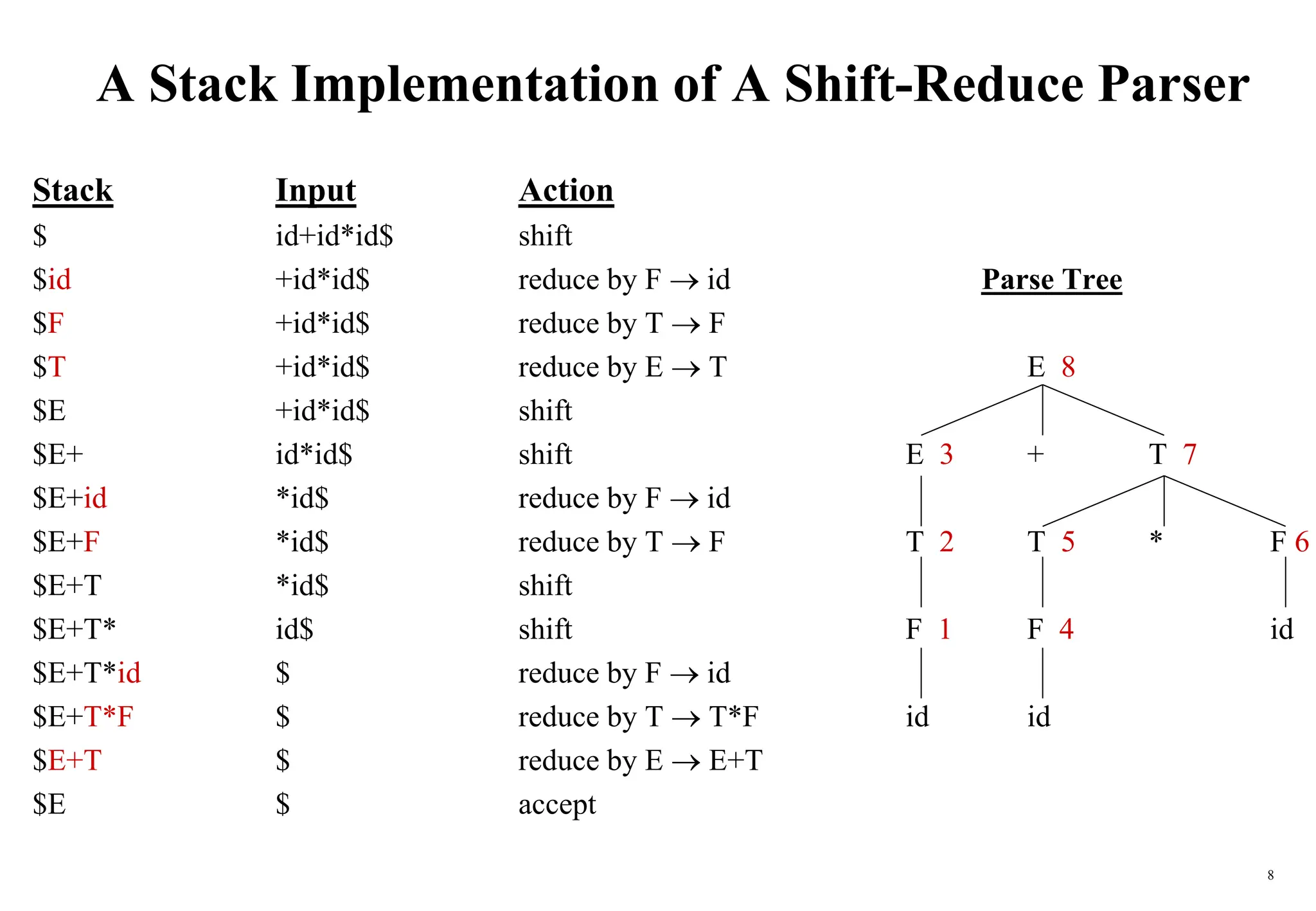
A Stack Implementation of A Shift-Reduce Parser
Stack Input Action
$ id+id*id$ shift
$id +id*id$ reduce by F  id Parse Tree
$F +id*id$ reduce by T  F
$T +id*id$ reduce by E  T E 8
$E +id*id$ shift
$E+ id*id$ shift E 3 + T 7
$E+id *id$ reduce by F  id
$E+F *id$ reduce by T  F T 2 T 5 * F 6
$E+T *id$ shift
$E+T* id$ shift F 1 F 4 id
$E+T*id $ reduce by F  id
$E+T*F $ reduce by T  T*F id id
$E+T $ reduce by E  E+T
$E $ accept
9
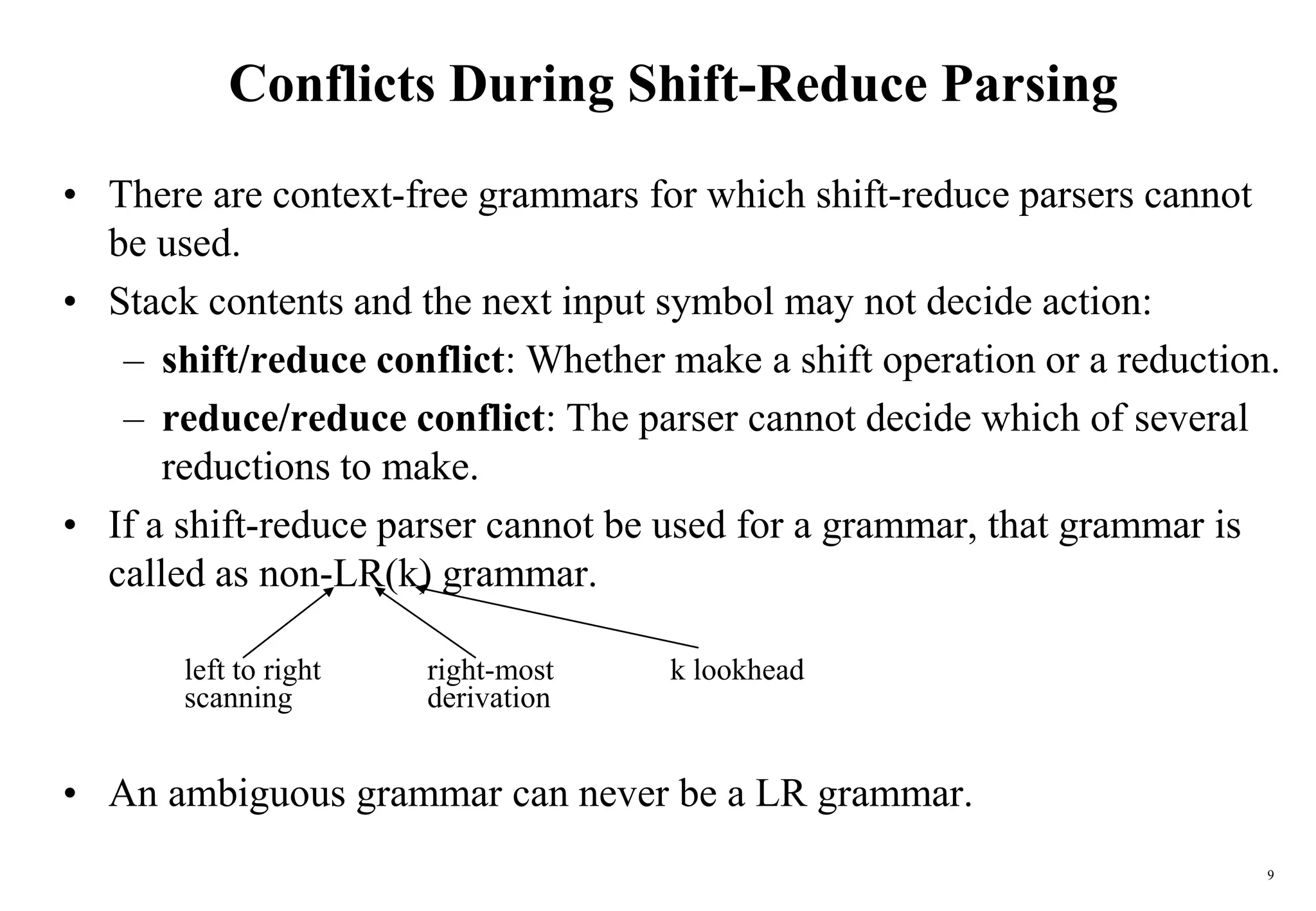
Conflicts During Shift-Reduce Parsing
• There are context-free grammars for which shift-reduce parsers cannot
be used.
• Stack contents and the next input symbol may not decide action:
– shift/reduce conflict: Whether make a shift operation or a reduction.
– reduce/reduce conflict: The parser cannot decide which of several
reductions to make.
• If a shift-reduce parser cannot be used for a grammar, that grammar is
called as non-LR(k) grammar.
left to right right-most k lookhead
scanning derivation
• An ambiguous grammar can never be a LR grammar.
10
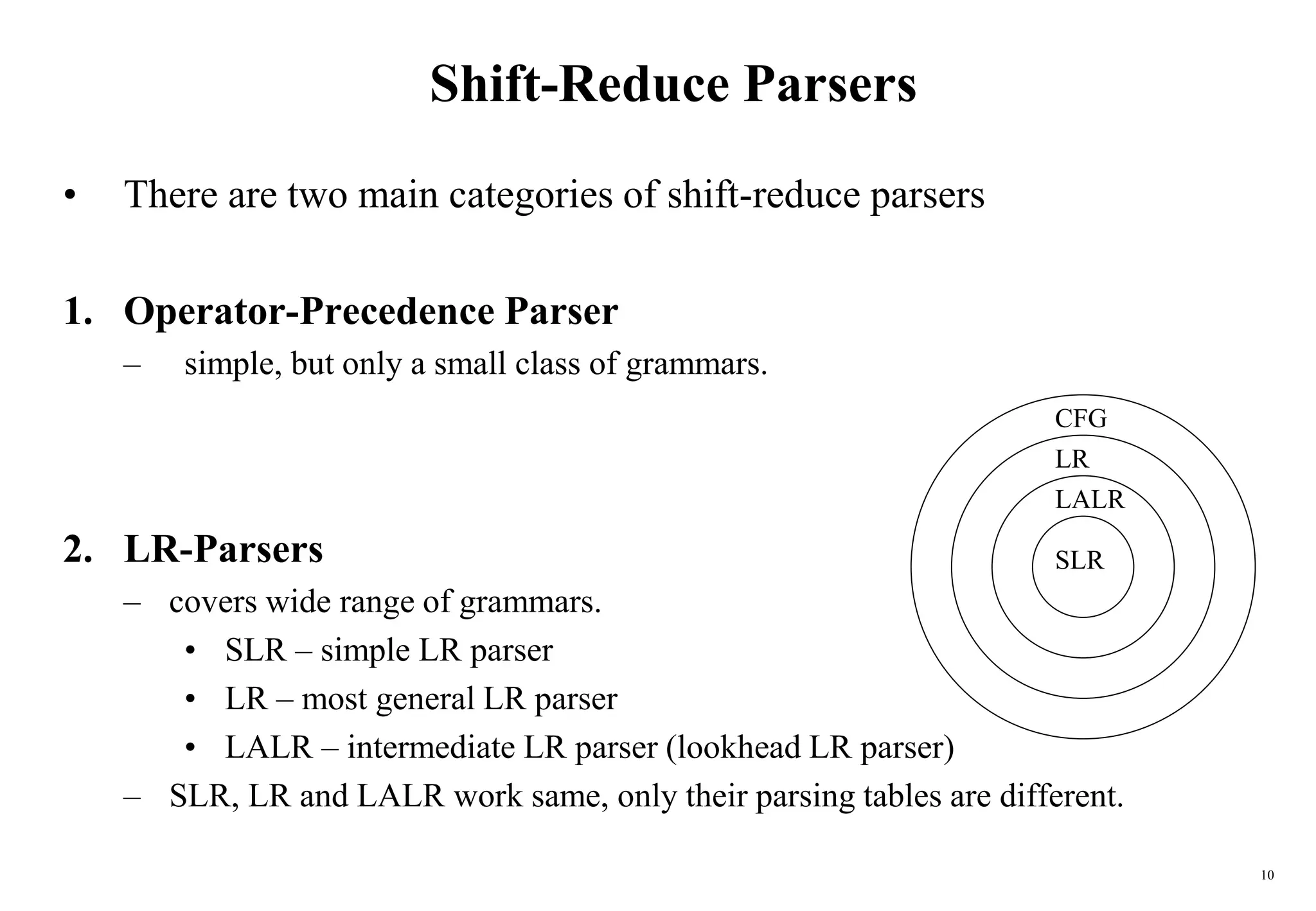
Shift-Reduce Parsers
• There are two main categories of shift-reduce parsers
1. Operator-Precedence Parser
– simple, but only a small class of grammars.
2. LR-Parsers
– covers wide range of grammars.
• SLR – simple LR parser
• LR – most general LR parser
• LALR – intermediate LR parser (lookhead LR parser)
– SLR, LR and LALR work same, only their parsing tables are different.
SLR
CFG
LR
LALR
11
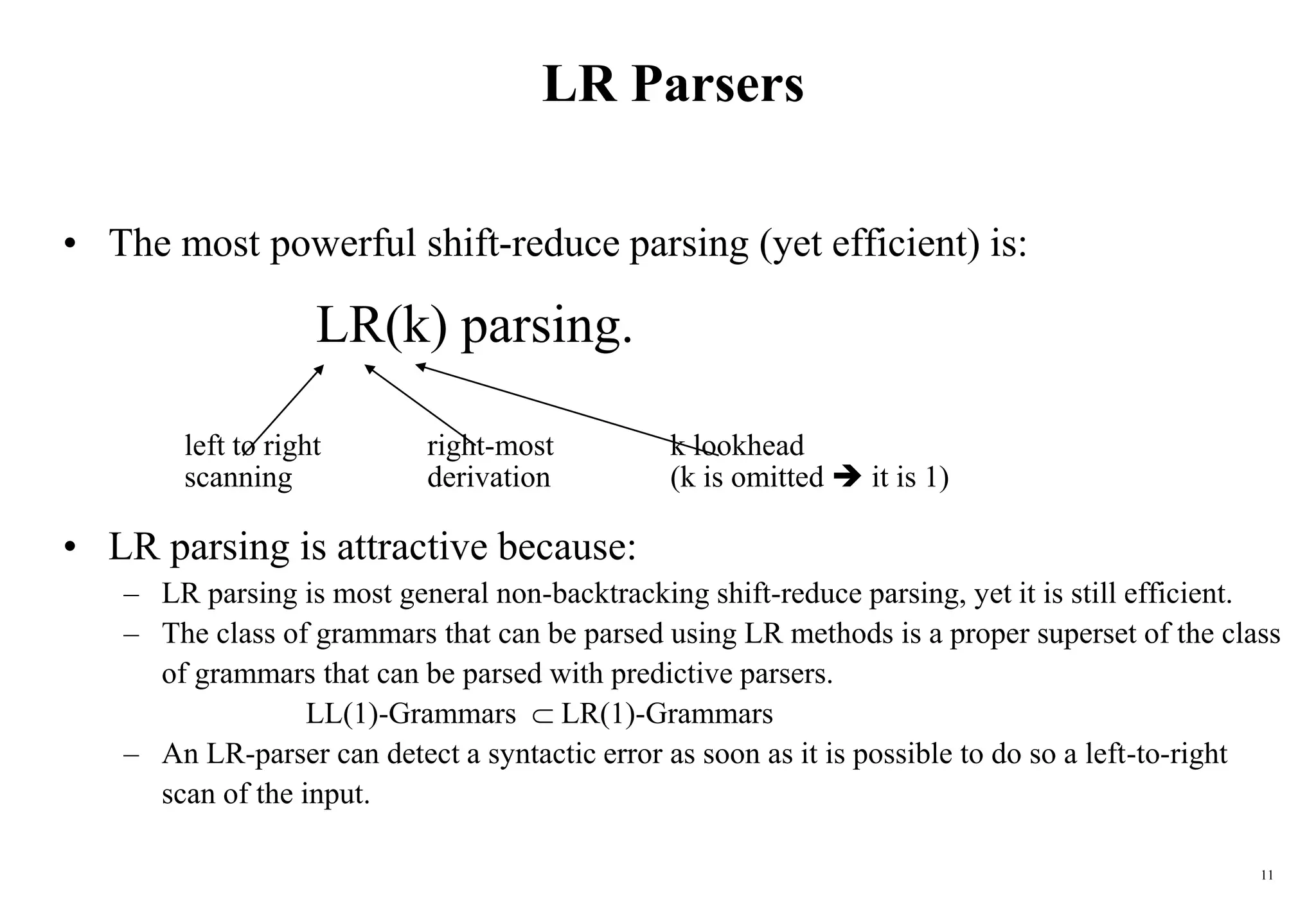
LR Parsers
• The most powerful shift-reduce parsing (yet efficient) is:
LR(k) parsing.
left to right right-most k lookhead
scanning derivation (k is omitted  it is 1)
• LR parsing is attractive because:
– LR parsing is most general non-backtracking shift-reduce parsing, yet it is still efficient.
– The class of grammars that can be parsed using LR methods is a proper superset of the class
of grammars that can be parsed with predictive parsers.
LL(1)-Grammars  LR(1)-Grammars
– An LR-parser can detect a syntactic error as soon as it is possible to do so a left-to-right
scan of the input.
12
LR Parsers
• LR-Parsers
– covers wide range of grammars.
– SLR – simple LR parser
– LR – most general LR parser
– LALR – intermediate LR parser (look-head LR parser)
– SLR, LR and LALR work same (they used the same algorithm),
only their parsing tables are different.
13
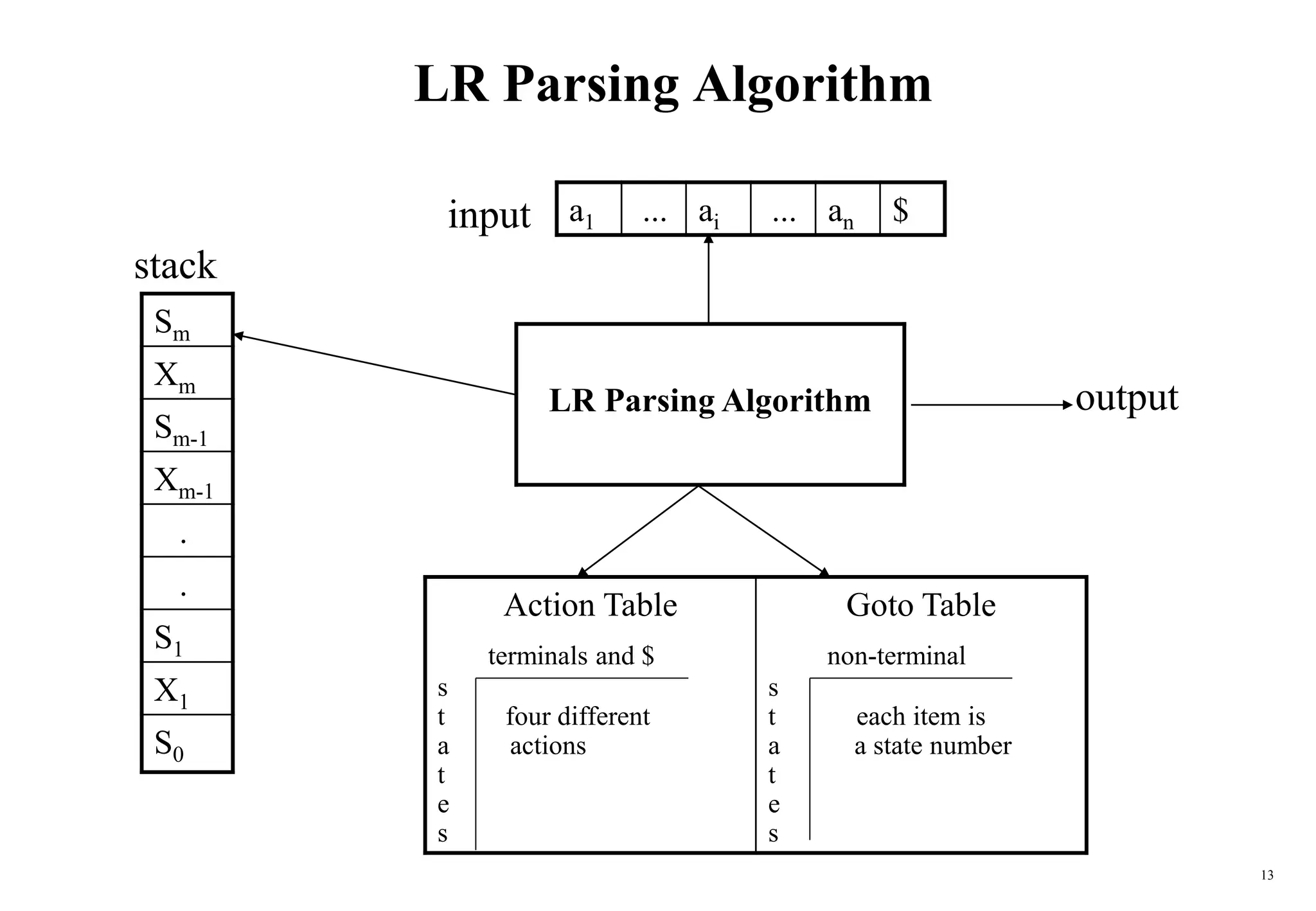
LR Parsing Algorithm
Sm
Xm
Sm-1
Xm-1
.
.
S1
X1
S0
a1 ... ai ... an $
Action Table
terminals and $
s
t four different
a actions
t
e
s
Goto Table
non-terminal
s
t each item is
a a state number
t
e
s
LR Parsing Algorithm
stack
input
output
14
A Configuration of LR Parsing Algorithm
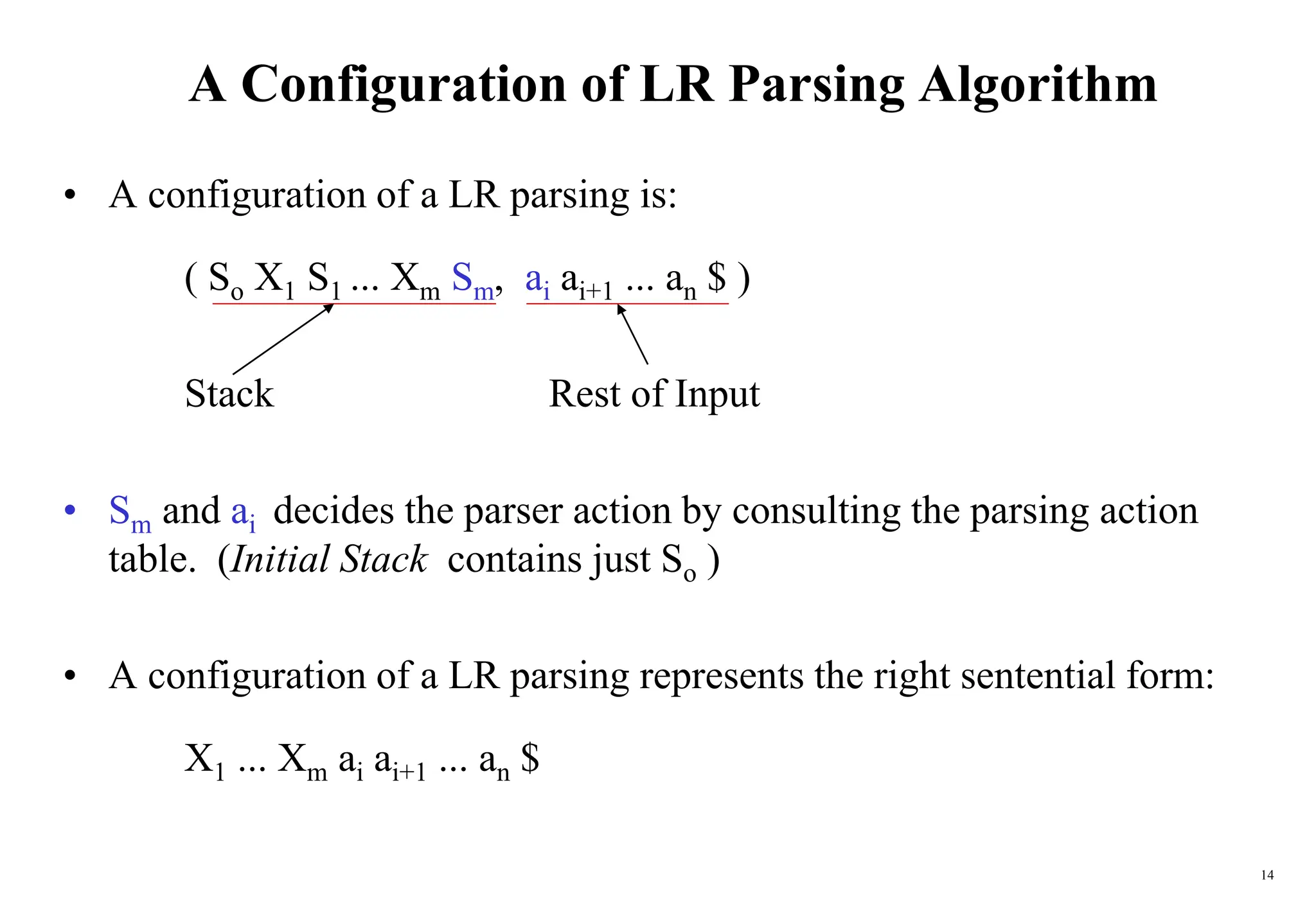
• A configuration of a LR parsing is:
( So X1 S1 ... Xm Sm, ai ai+1 ... an $ )
Stack Rest of Input
• Sm and ai decides the parser action by consulting the parsing action
table. (Initial Stack contains just So )
• A configuration of a LR parsing represents the right sentential form:
X1 ... Xm ai ai+1 ... an $
15
Actions of A LR-Parser
1. shift s -- shifts the next input symbol and the state s onto the stack
( So X1 S1 ... Xm Sm, ai ai+1 ... an $ )  ( So X1 S1 ... Xm Sm ai s, ai+1 ... an $ )
2. reduce A (or rn where n is a production number)
– pop 2|| (=r) items from the stack;
– then push A and s where s=goto[sm-r,A]
( So X1 S1 ... Xm Sm, ai ai+1 ... an $ )  ( So X1 S1 ... Xm-r Sm-r A s, ai ... an $ )
– Output is the reducing production reduce A
3. Accept – Parsing successfully completed
4. Error -- Parser detected an error (an empty entry in the action table)
16
Reduce Action
• pop 2|| (=r) items from the stack; let us assume that  = Y1Y2...Yr
• then push A and s where s=goto[sm-r,A]
( So X1 S1 ... Xm-r Sm-r Y1 Sm-r ...Yr Sm, ai ai+1 ... an $ )
 ( So X1 S1 ... Xm-r Sm-r A s, ai ... an $ )
• In fact, Y1Y2...Yr is a handle.
X1 ... Xm-r A ai ... an $  X1 ... Xm Y1...Yr ai ai+1 ... an $
17
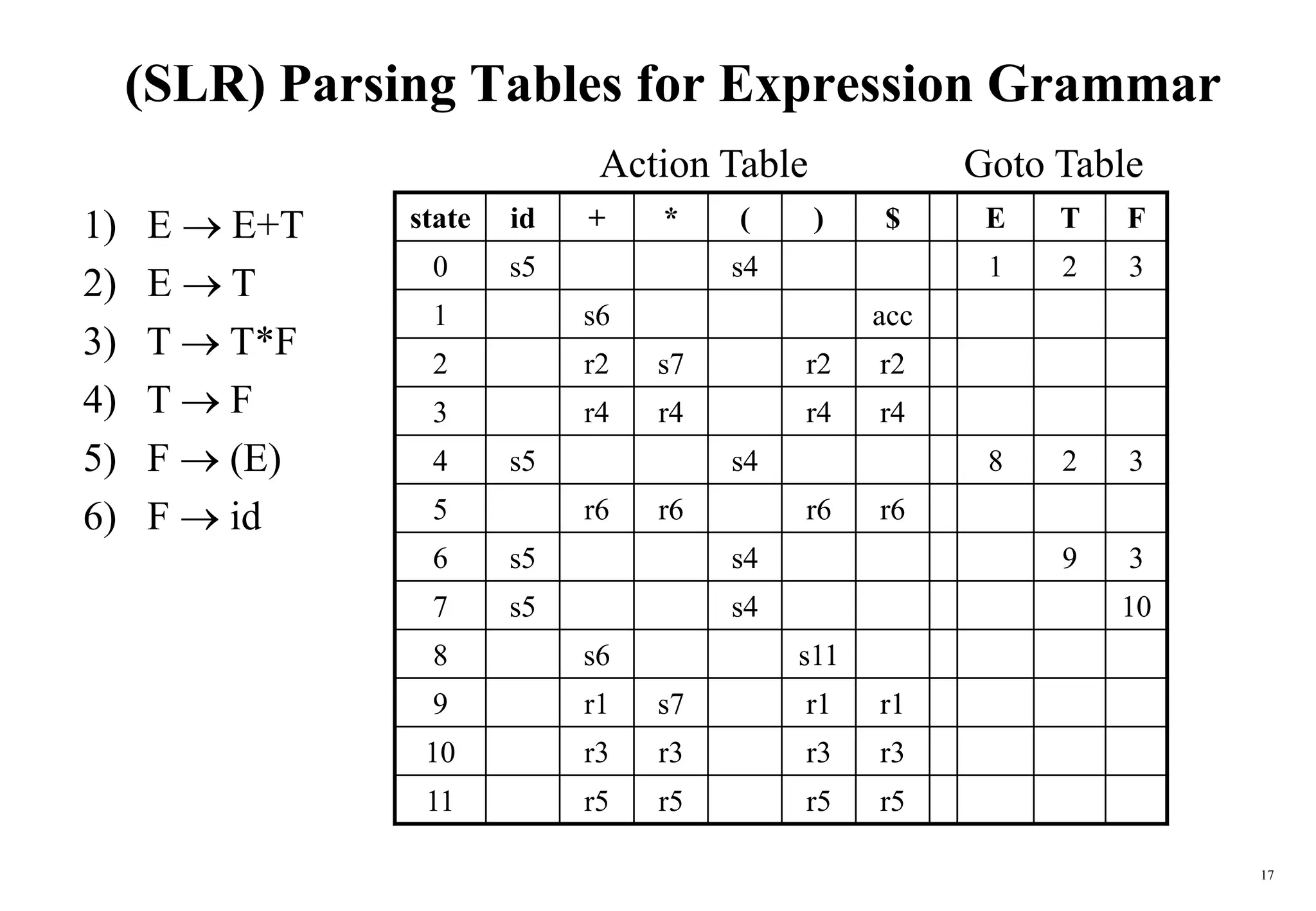
(SLR) Parsing Tables for Expression Grammar
state id + * ( ) $ E T F
0 s5 s4 1 2 3
1 s6 acc
2 r2 s7 r2 r2
3 r4 r4 r4 r4
4 s5 s4 8 2 3
5 r6 r6 r6 r6
6 s5 s4 9 3
7 s5 s4 10
8 s6 s11
9 r1 s7 r1 r1
10 r3 r3 r3 r3
11 r5 r5 r5 r5
Action Table Goto Table
1) E  E+T
2) E  T
3) T  T*F
4) T  F
5) F  (E)
6) F  id
18
19
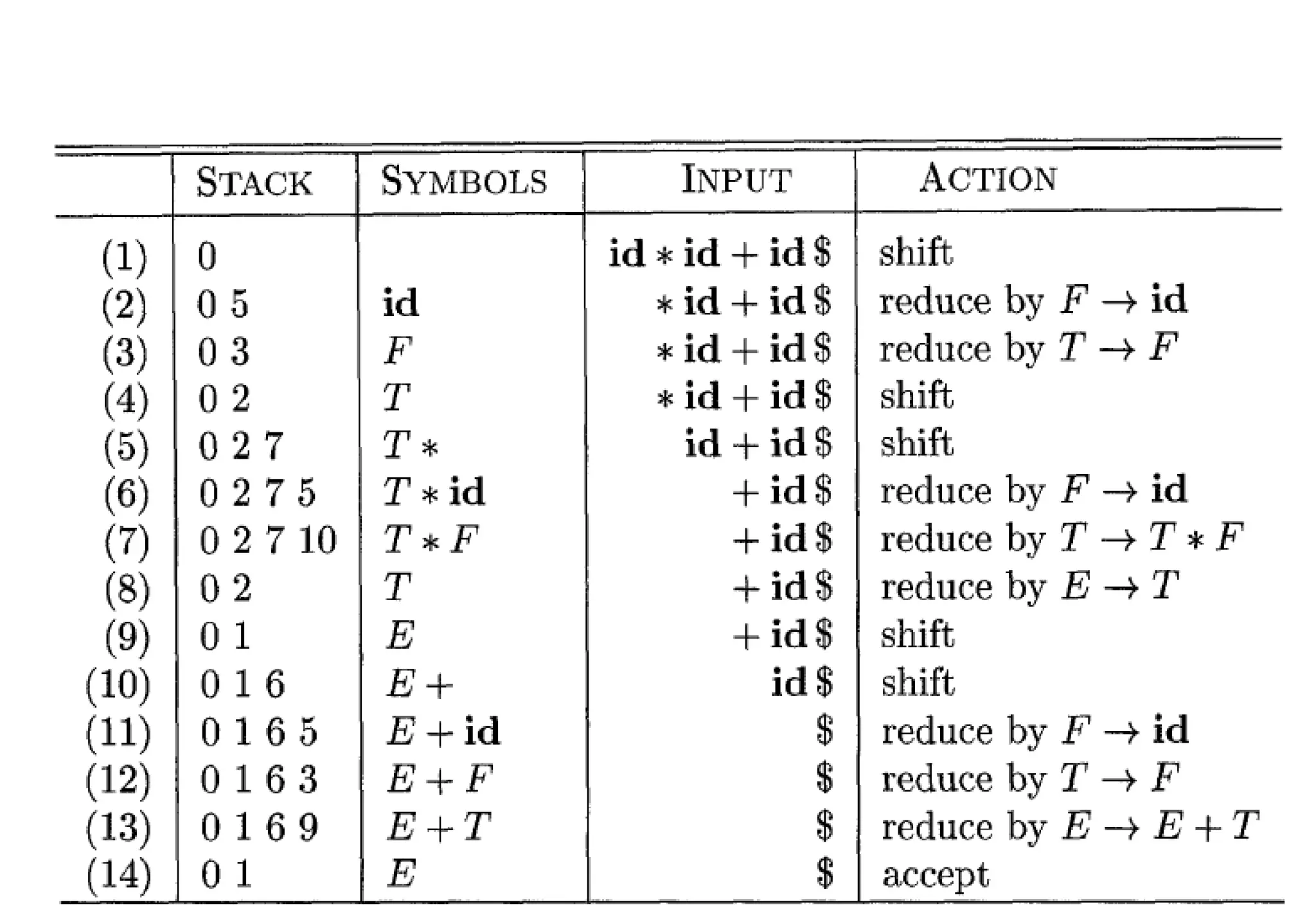
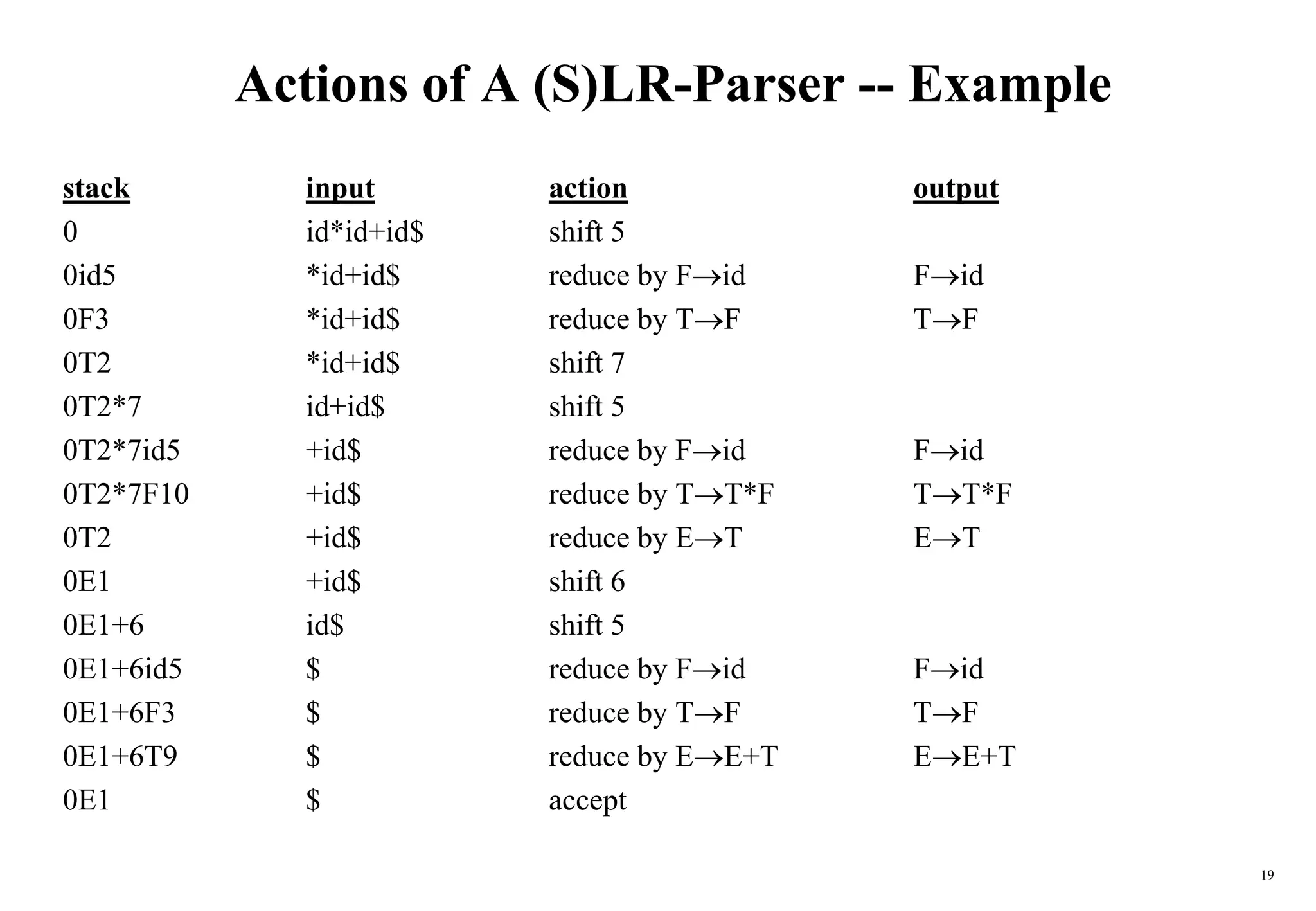
Actions of A (S)LR-Parser -- Example
stack input action output
0 id*id+id$ shift 5
0id5 *id+id$ reduce by Fid Fid
0F3 *id+id$ reduce by TF TF
0T2 *id+id$ shift 7
0T2*7 id+id$ shift 5
0T2*7id5 +id$ reduce by Fid Fid
0T2*7F10 +id$ reduce by TT*F TT*F
0T2 +id$ reduce by ET ET
0E1 +id$ shift 6
0E1+6 id$ shift 5
0E1+6id5 $ reduce by Fid Fid
0E1+6F3 $ reduce by TF TF
0E1+6T9 $ reduce by EE+T EE+T
0E1 $ accept
20
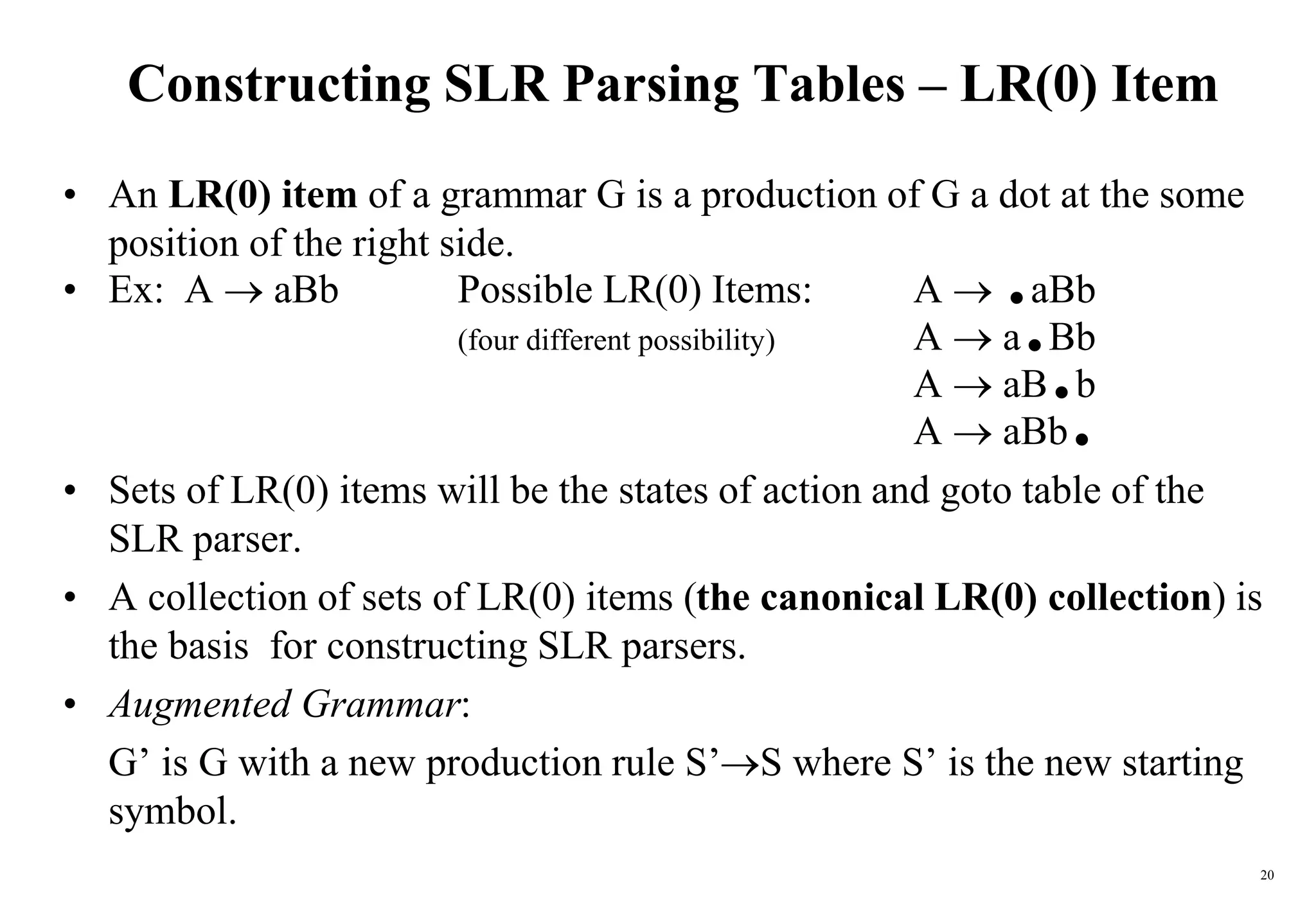
Constructing SLR Parsing Tables – LR(0) Item
• An LR(0) item of a grammar G is a production of G a dot at the some
position of the right side.
• Ex: A  aBb Possible LR(0) Items: A  .aBb
(four different possibility) A  a.Bb
A  aB.b
A  aBb.
• Sets of LR(0) items will be the states of action and goto table of the
SLR parser.
• A collection of sets of LR(0) items (the canonical LR(0) collection) is
the basis for constructing SLR parsers.
• Augmented Grammar:
G’ is G with a new production rule S’S where S’ is the new starting
symbol.
21
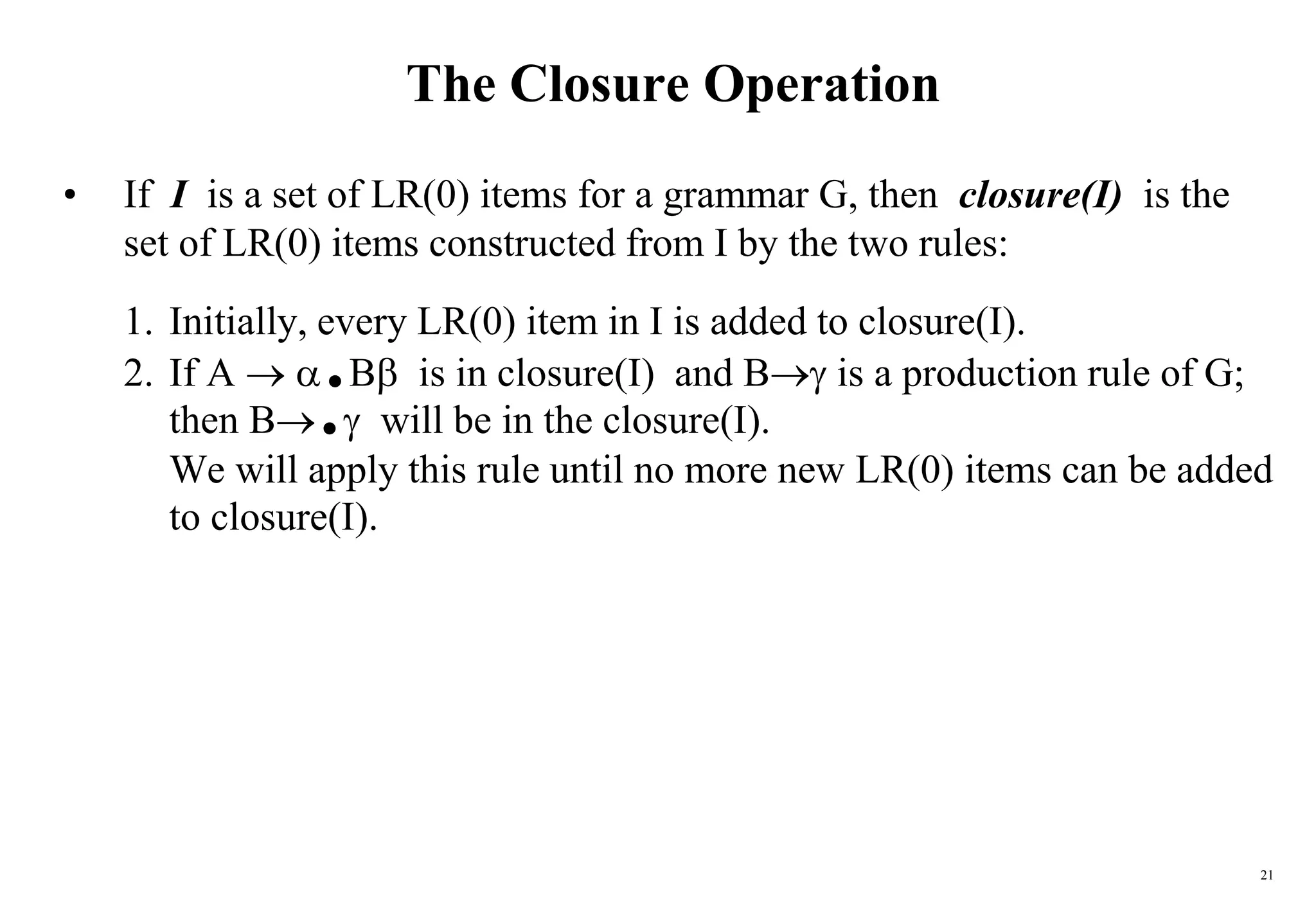
The Closure Operation
• If I is a set of LR(0) items for a grammar G, then closure(I) is the
set of LR(0) items constructed from I by the two rules:
1. Initially, every LR(0) item in I is added to closure(I).
2. If A  .B is in closure(I) and B is a production rule of G;
then B. will be in the closure(I).
We will apply this rule until no more new LR(0) items can be added
to closure(I).
22
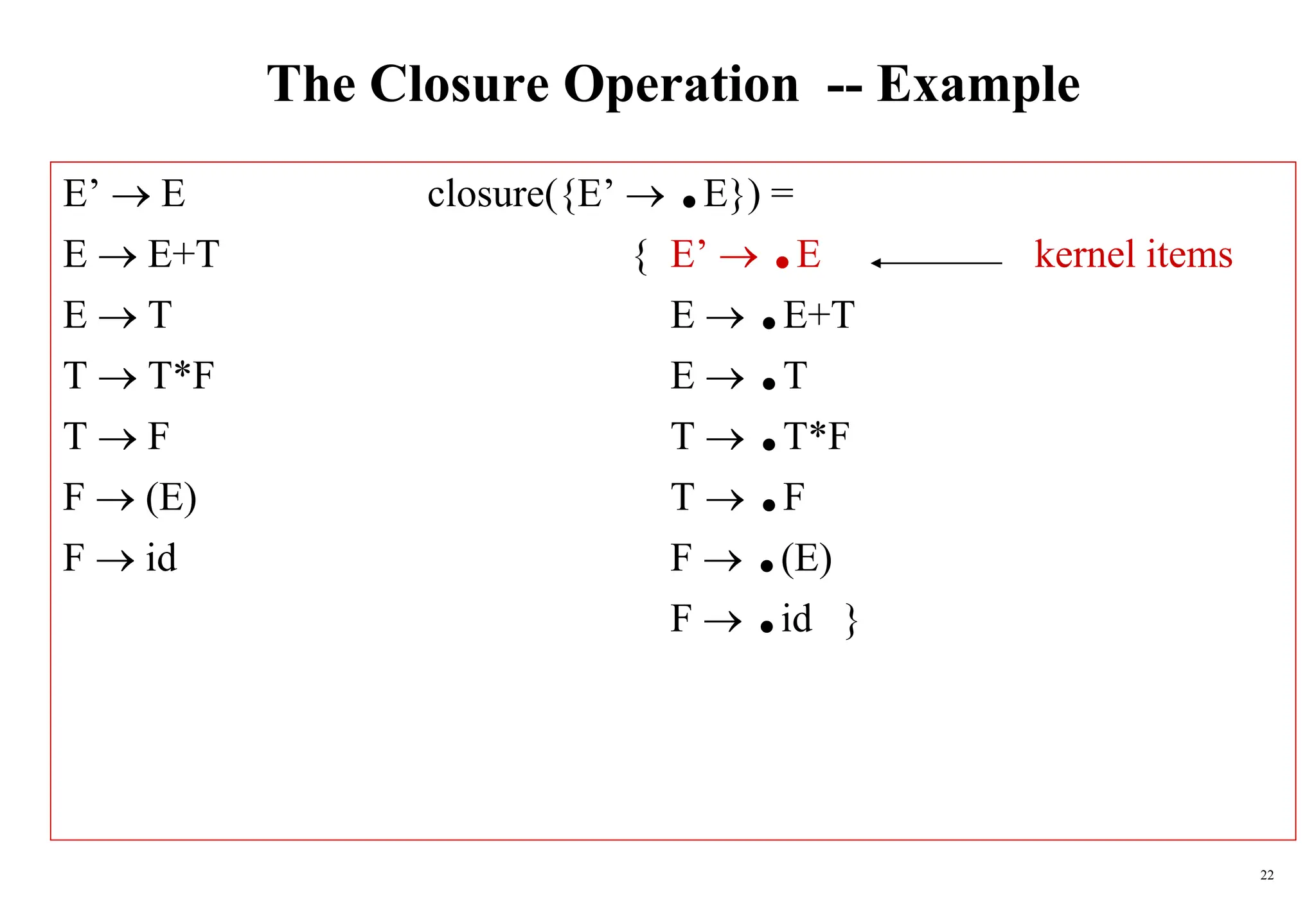
The Closure Operation -- Example
E’  E closure({E’  .E}) =
E  E+T { E’  .E kernel items
E  T E  .E+T
T  T*F E  .T
T  F T  .T*F
F  (E) T  .F
F  id F  .(E)
F  .id }
23
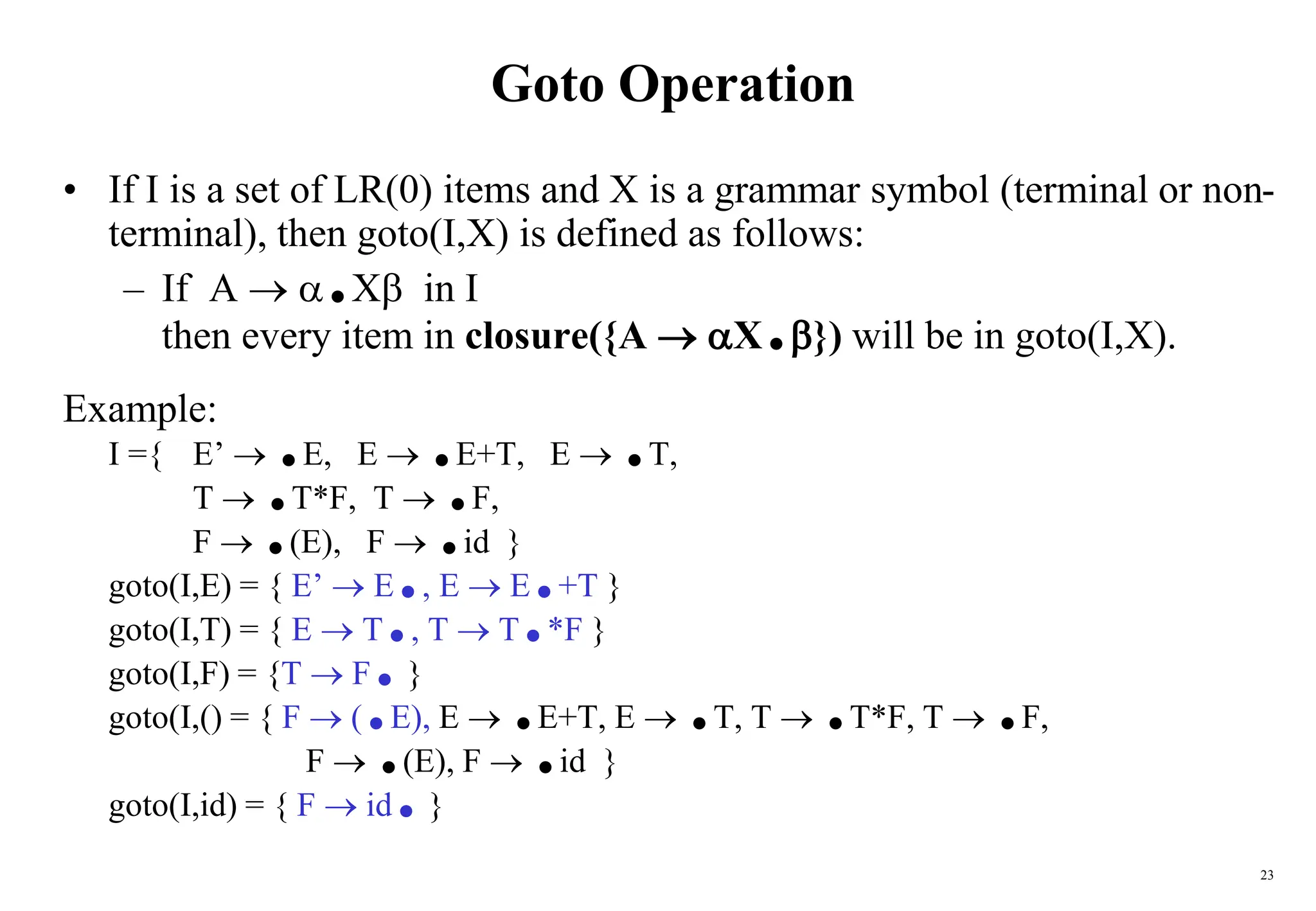
Goto Operation
• If I is a set of LR(0) items and X is a grammar symbol (terminal or non-
terminal), then goto(I,X) is defined as follows:
– If A  .X in I
then every item in closure({A  X.}) will be in goto(I,X).
Example:
I ={ E’  .E, E  .E+T, E  .T,
T  .T*F, T  .F,
F  .(E), F  .id }
goto(I,E) = { E’  E., E  E.+T }
goto(I,T) = { E  T., T  T.*F }
goto(I,F) = {T  F.}
goto(I,() = { F  (.E), E  .E+T, E  .T, T  .T*F, T  .F,
F  .(E), F  .id }
goto(I,id) = { F  id.}
24
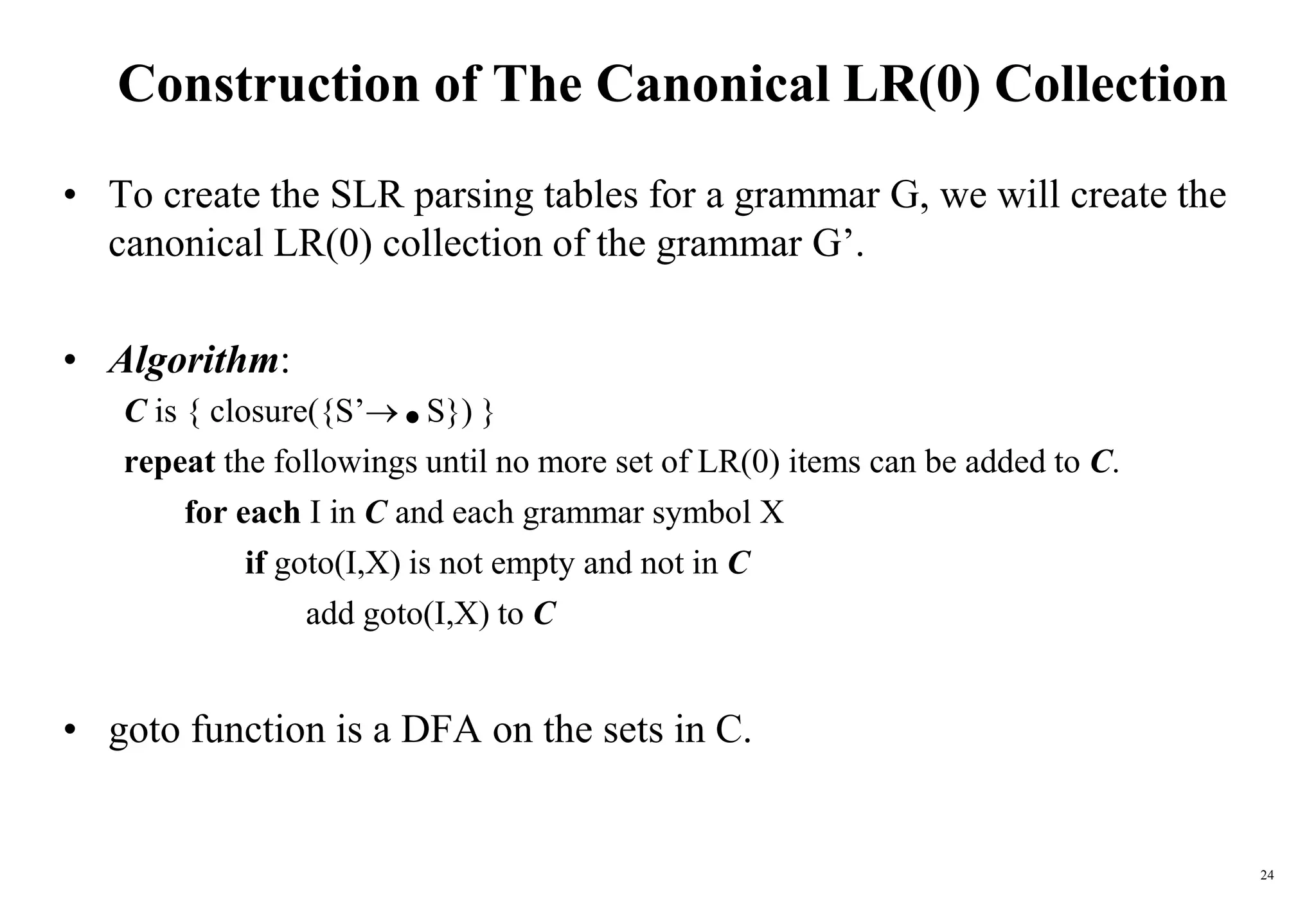
Construction of The Canonical LR(0) Collection
• To create the SLR parsing tables for a grammar G, we will create the
canonical LR(0) collection of the grammar G’.
• Algorithm:
C is { closure({S’.S}) }
repeat the followings until no more set of LR(0) items can be added to C.
for each I in C and each grammar symbol X
if goto(I,X) is not empty and not in C
add goto(I,X) to C
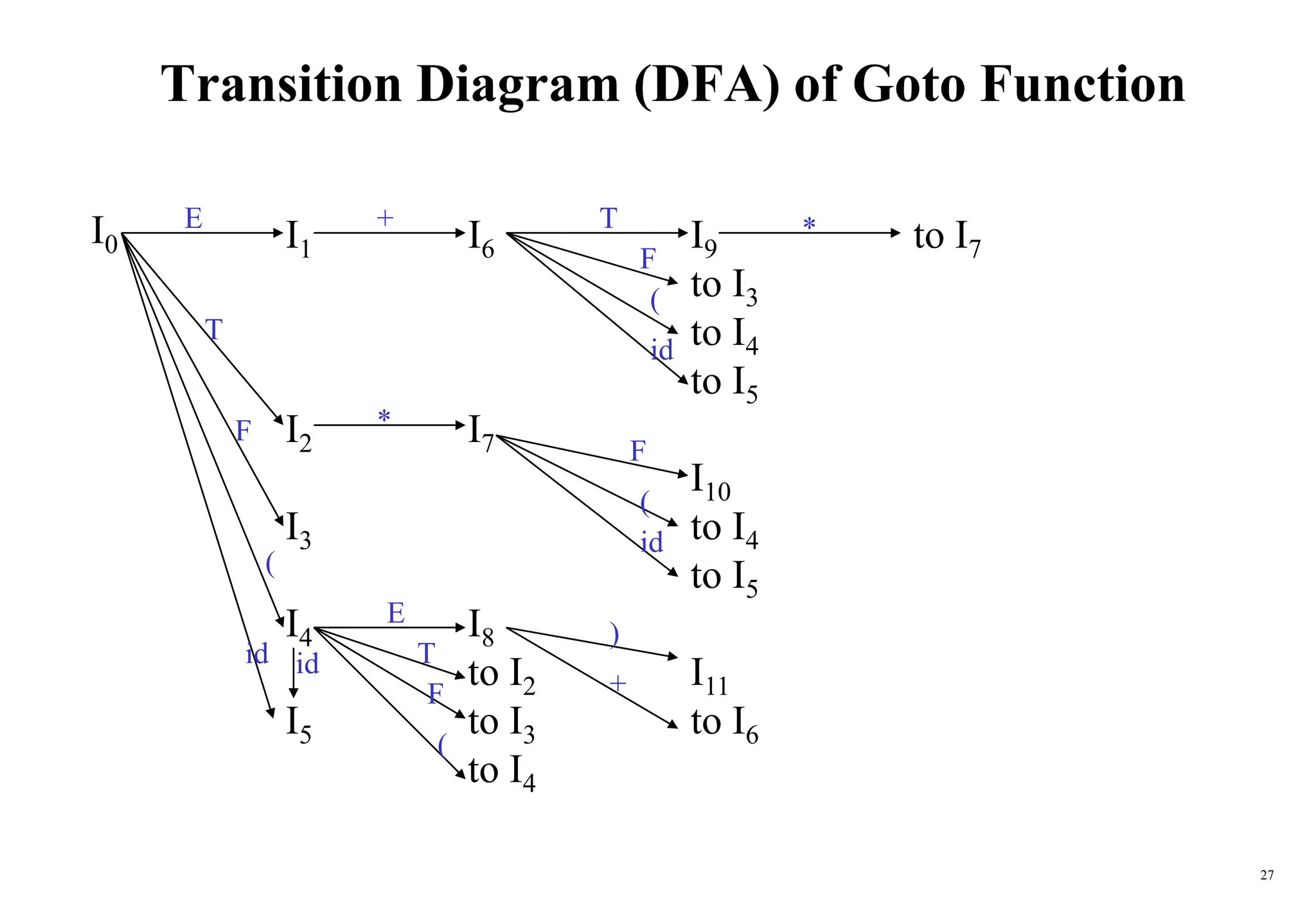
• goto function is a DFA on the sets in C.
25
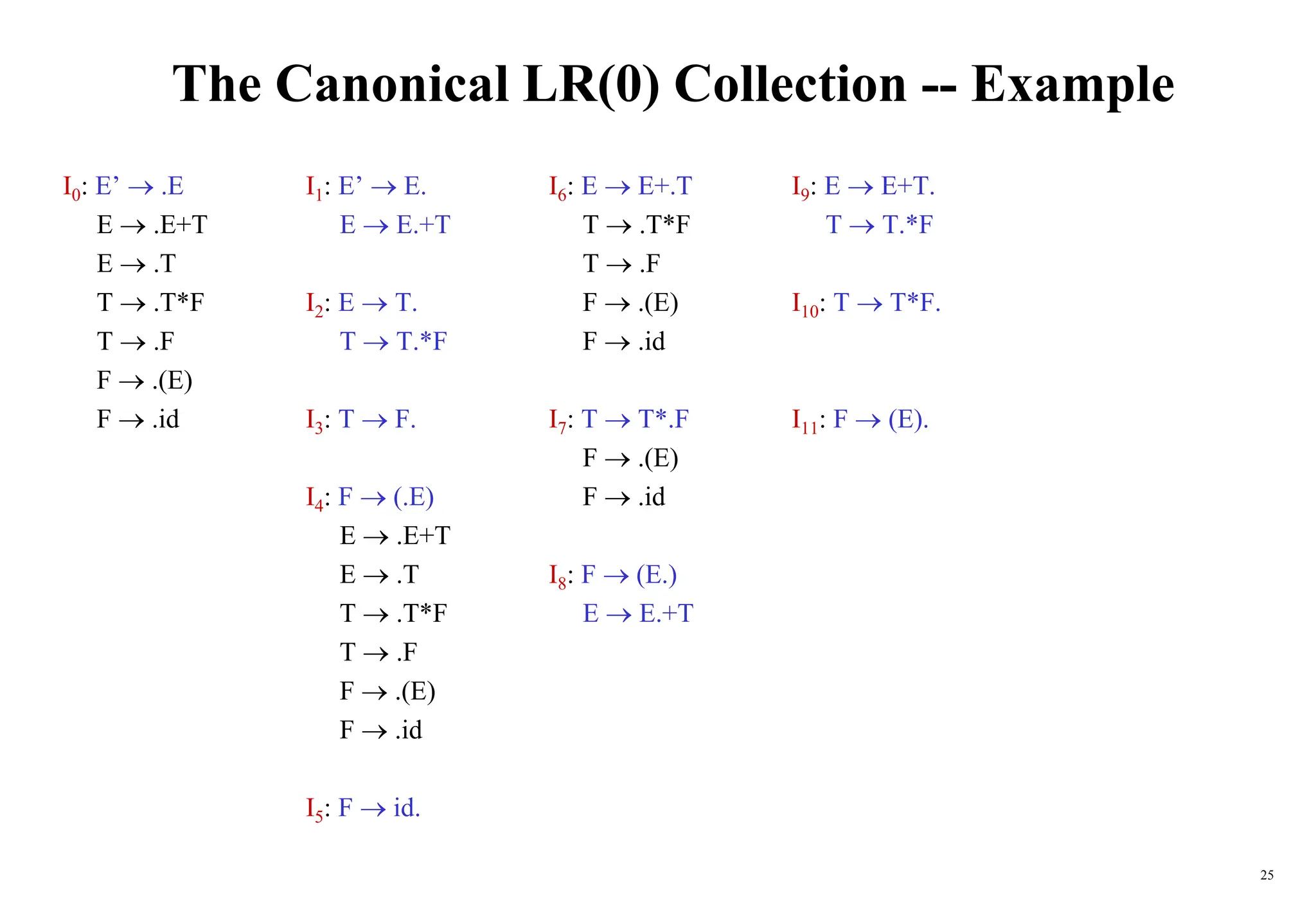
The Canonical LR(0) Collection -- Example
I0: E’  .E I1: E’  E. I6: E  E+.T I9: E  E+T.
E  .E+T E  E.+T T  .T*F T  T.*F
E  .T T  .F
T  .T*F I2: E  T. F  .(E) I10: T  T*F.
T  .F T  T.*F F  .id
F  .(E)
F  .id I3: T  F. I7: T  T*.F I11: F  (E).
F  .(E)
I4: F  (.E) F  .id
E  .E+T
E  .T I8: F  (E.)
T  .T*F E  E.+T
T  .F
F  .(E)
F  .id
I5: F  id.
26
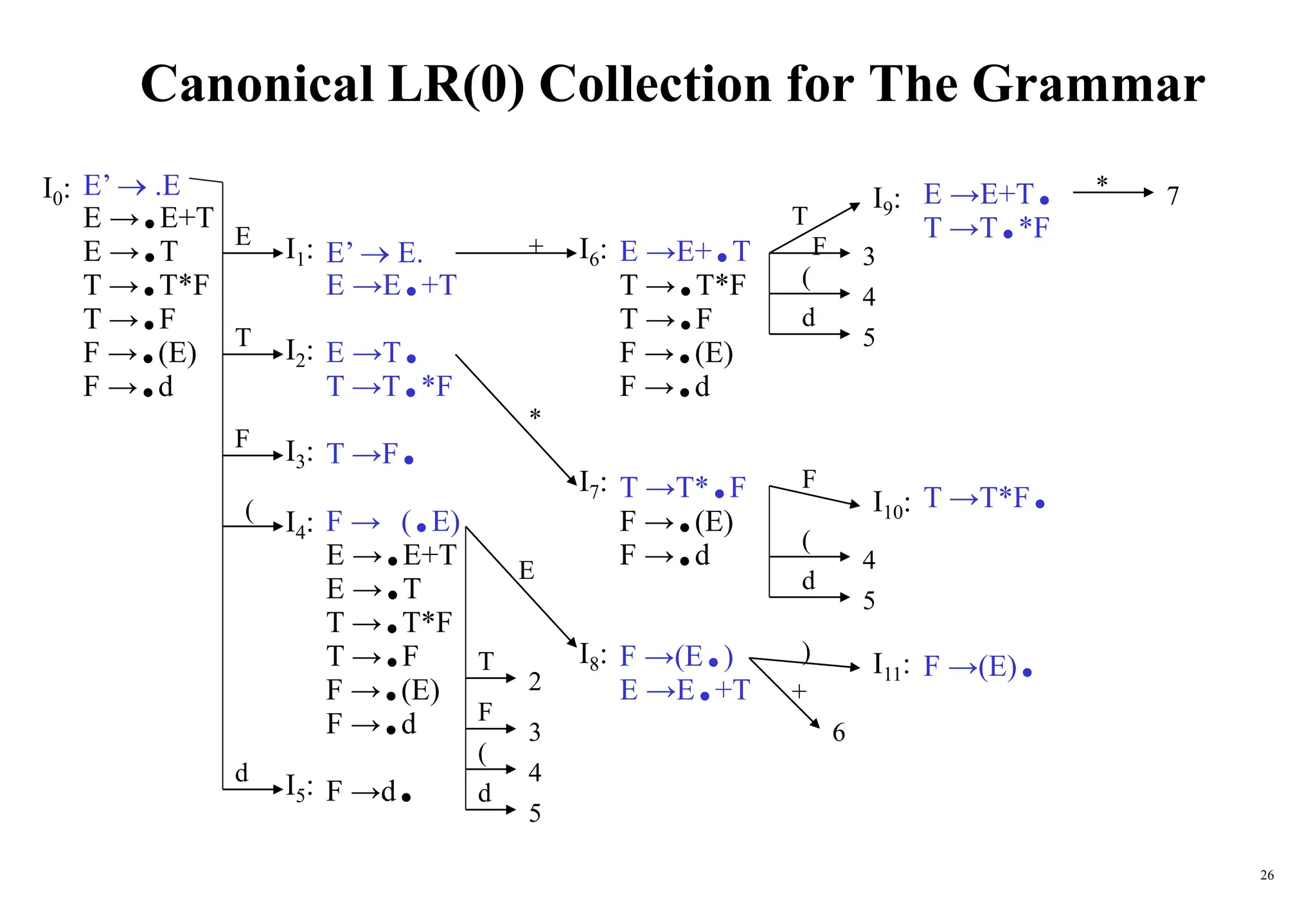
Canonical LR(0) Collection for The Grammar
E’  .E
E →.E+T
E →.T
T →.T*F
T →.F
F →.(E)
F →.d
E’  E.
E →E.+T
E →T.
T →T.*F
T →F.
F → (.E)
E →.E+T
E →.T
T →.T*F
T →.F
F →.(E)
F →.d
F →d.
E →E+.T
T →.T*F
T →.F
F →.(E)
F →.d
T →T*.F
F →.(E)
F →.d
F →(E.)
E →E.+T
E →E+T.
T →T.*F
T →T*F.
F →(E).
I0:
I1:
I3:
I2:
I4:
I5:
I10:
I9:
I8:
I7:
I11:
I6:
E
E
T
T
T
F
F
F
F
(
(
(
(
d
d
d
d
)
*
+
+
*
5
2
4
3
5
5
4
4
6
7
3
27
Transition Diagram (DFA) of Goto Function
I0 I1
I2
I3
I4
I5
I6
I7
I8
to I2
to I3
to I4
I9
to I3
to I4
to I5
I10
to I4
to I5
I11
to I6
to I7
id
(
F
*
E
E
+
T
T
T
)
F
F
F
(
id
id
(
*
(
id
+
28
Constructing SLR Parsing Table
(of an augumented grammar G’)
1. Construct the canonical collection of sets of LR(0) items for G’.
C{I0,...,In}
2. Create the parsing action table as follows
• If a is a terminal, A.a in Ii and goto(Ii,a)=Ij then action[i,a] is shift j.
• If A. is in Ii , then action[i,a] is reduce A for all a in FOLLOW(A)
where AS’.
• If S’S. is in Ii , then action[i,$] is accept.
• If any conflicting actions generated by these rules, the grammar is not SLR(1).
3. Create the parsing goto table
• for all non-terminals A, if goto(Ii,A)=Ij then goto[i,A]=j
4. All entries not defined by (2) and (3) are errors.
5. Initial state of the parser contains S’.S
29
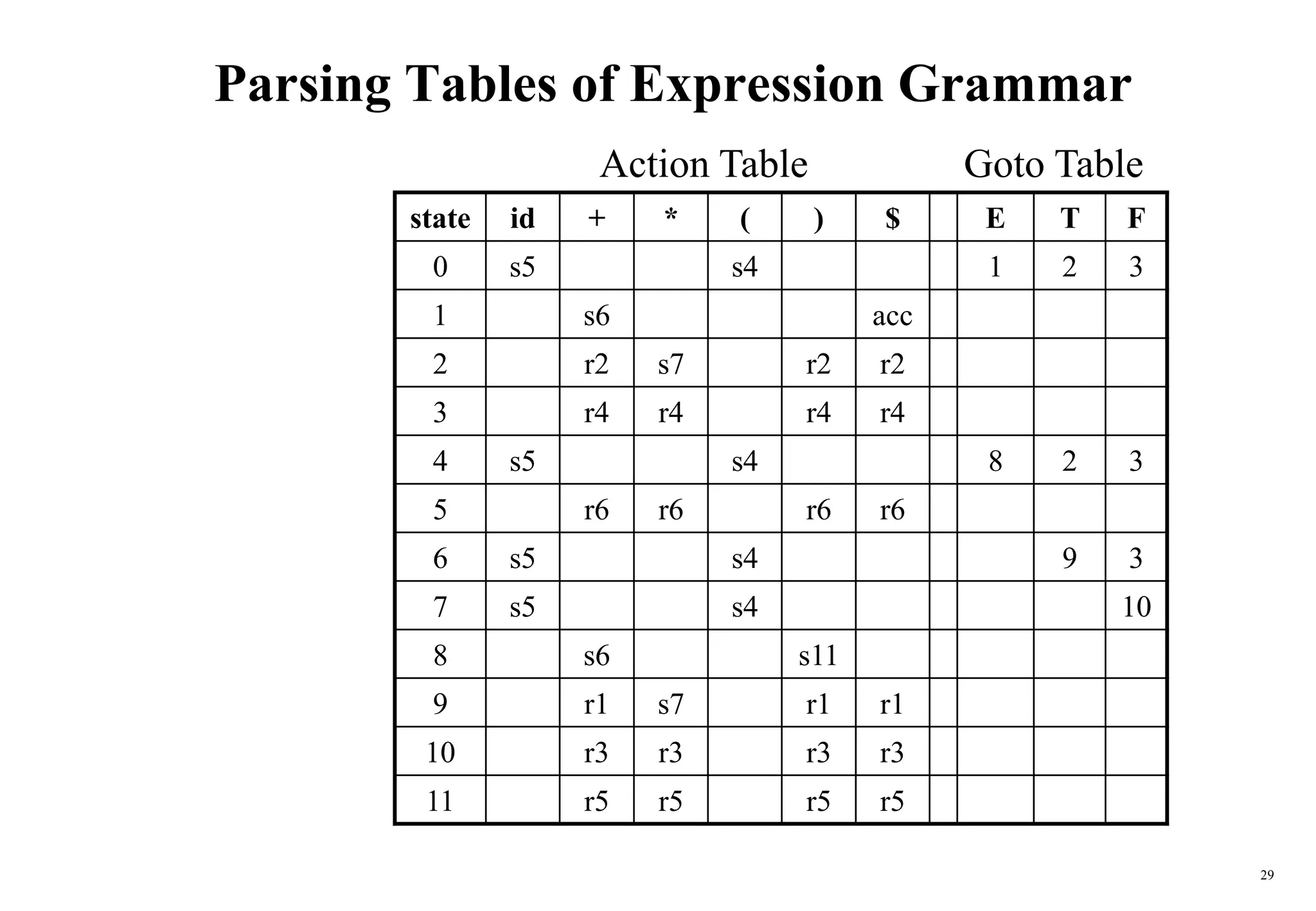
Parsing Tables of Expression Grammar
state id + * ( ) $ E T F
0 s5 s4 1 2 3
1 s6 acc
2 r2 s7 r2 r2
3 r4 r4 r4 r4
4 s5 s4 8 2 3
5 r6 r6 r6 r6
6 s5 s4 9 3
7 s5 s4 10
8 s6 s11
9 r1 s7 r1 r1
10 r3 r3 r3 r3
11 r5 r5 r5 r5
Action Table Goto Table
30
SLR(1) Grammar
• An LR parser using SLR(1) parsing tables for a grammar G is called as
the SLR(1) parser for G.
• If a grammar G has an SLR(1) parsing table, it is called SLR(1)
grammar (or SLR grammar in short).
• Every SLR grammar is unambiguous, but every unambiguous grammar
is not a SLR grammar.
31
shift/reduce and reduce/reduce conflicts
• If a state does not know whether it will make a shift operation or
reduction for a terminal, we say that there is a shift/reduce conflict.
• If a state does not know whether it will make a reduction operation
using the production rule i or j for a terminal, we say that there is a
reduce/reduce conflict.
• If the SLR parsing table of a grammar G has a conflict, we say that that
grammar is not SLR grammar.
32
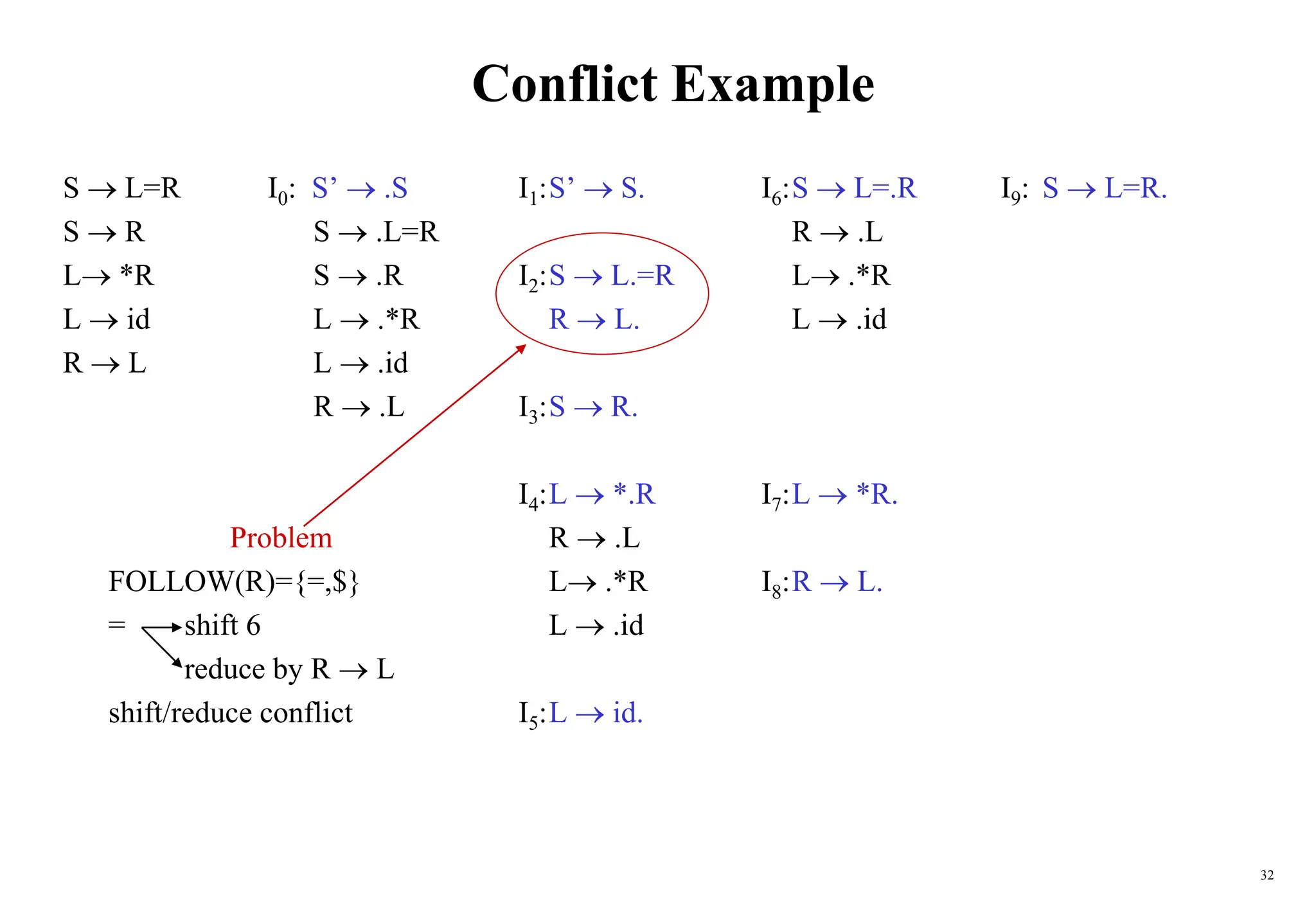
Conflict Example
S  L=R I0: S’  .S I1:S’  S. I6:S  L=.R I9: S  L=R.
S  R S  .L=R R  .L
L *R S  .R I2:S  L.=R L .*R
L  id L  .*R R  L. L  .id
R  L L  .id
R  .L I3:S  R.
I4:L  *.R I7:L  *R.
Problem R  .L
FOLLOW(R)={=,$} L .*R I8:R  L.
= shift 6 L  .id
reduce by R  L
shift/reduce conflict I5:L  id.
33
Conflict Example2
S  AaAb I0: S’  .S
S  BbBa S  .AaAb
A   S  .BbBa
B   A  .
B  .
Problem
FOLLOW(A)={a,b}
FOLLOW(B)={a,b}
a reduce by A   b reduce by A  
reduce by B   reduce by B  
reduce/reduce conflict reduce/reduce conflict
34
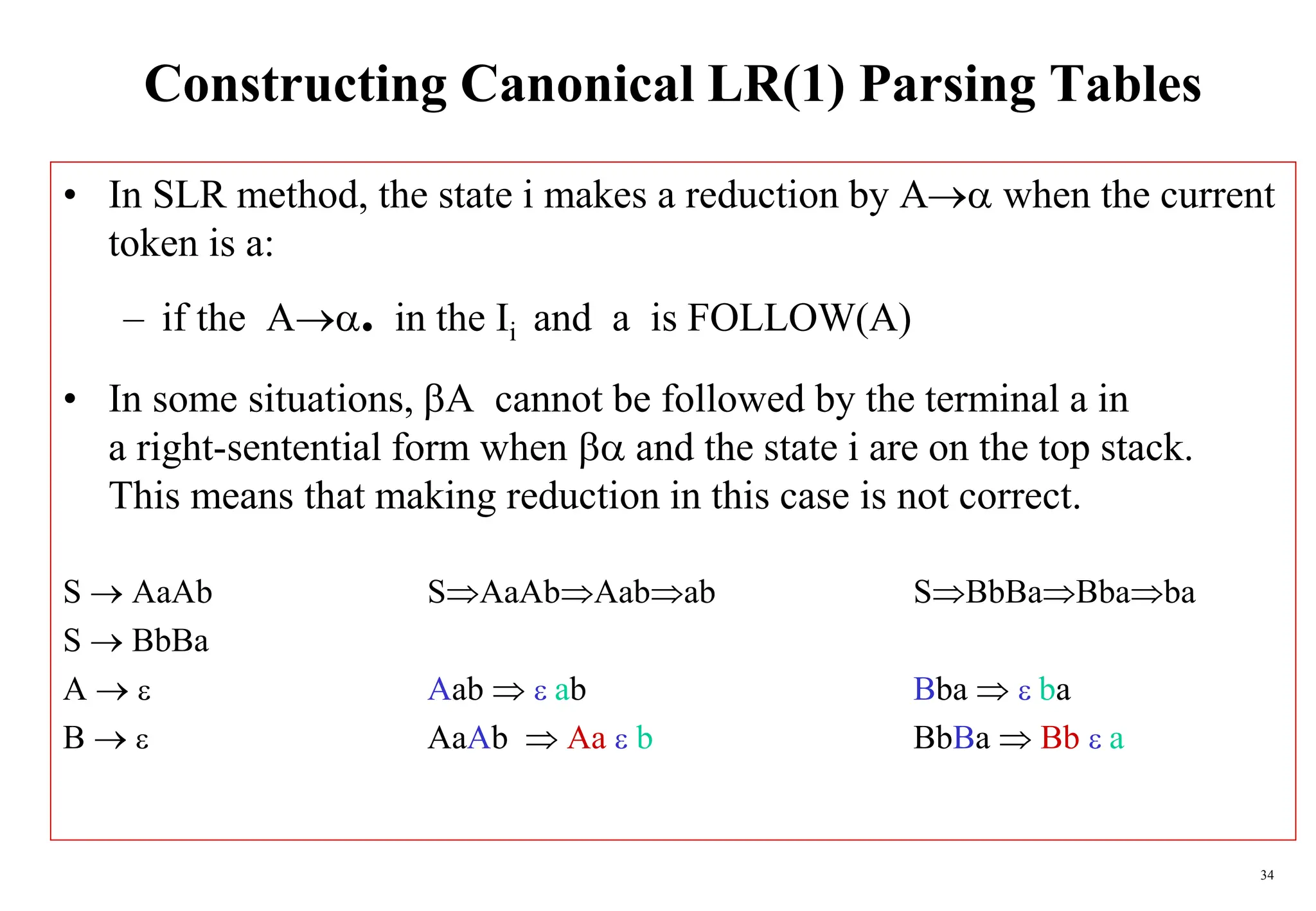
Constructing Canonical LR(1) Parsing Tables
• In SLR method, the state i makes a reduction by A when the current
token is a:
– if the A. in the Ii and a is FOLLOW(A)
• In some situations, A cannot be followed by the terminal a in
a right-sentential form when  and the state i are on the top stack.
This means that making reduction in this case is not correct.
S  AaAb SAaAbAabab SBbBaBbaba
S  BbBa
A   Aab   ab Bba   ba
B   AaAb  Aa  b BbBa  Bb  a
35
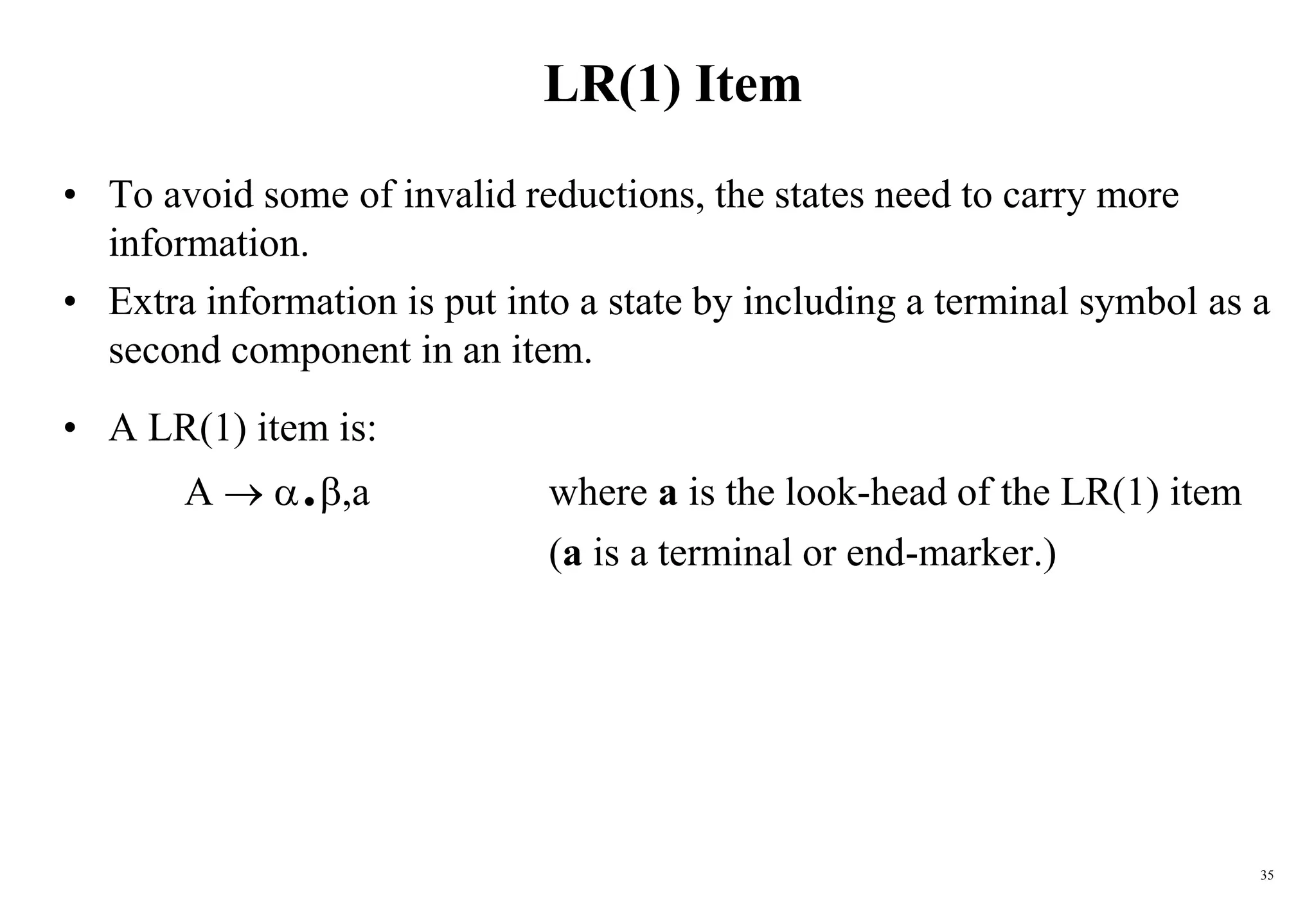
LR(1) Item
• To avoid some of invalid reductions, the states need to carry more
information.
• Extra information is put into a state by including a terminal symbol as a
second component in an item.
• A LR(1) item is:
A  .,a where a is the look-head of the LR(1) item
(a is a terminal or end-marker.)
36
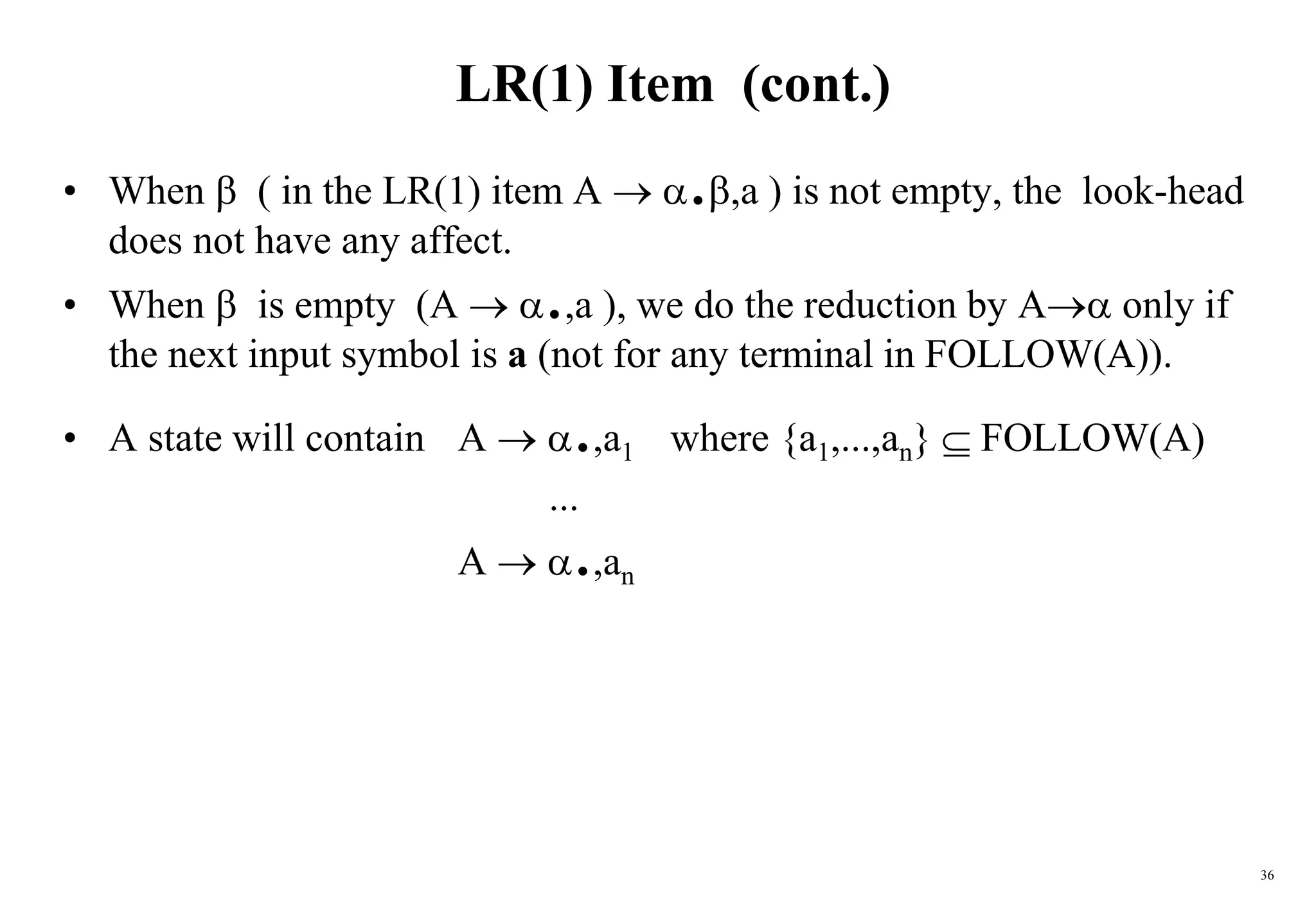
LR(1) Item (cont.)
• When  ( in the LR(1) item A  .,a ) is not empty, the look-head
does not have any affect.
• When  is empty (A  .,a ), we do the reduction by A only if
the next input symbol is a (not for any terminal in FOLLOW(A)).
• A state will contain A  .,a1 where {a1,...,an}  FOLLOW(A)
...
A  .,an
37
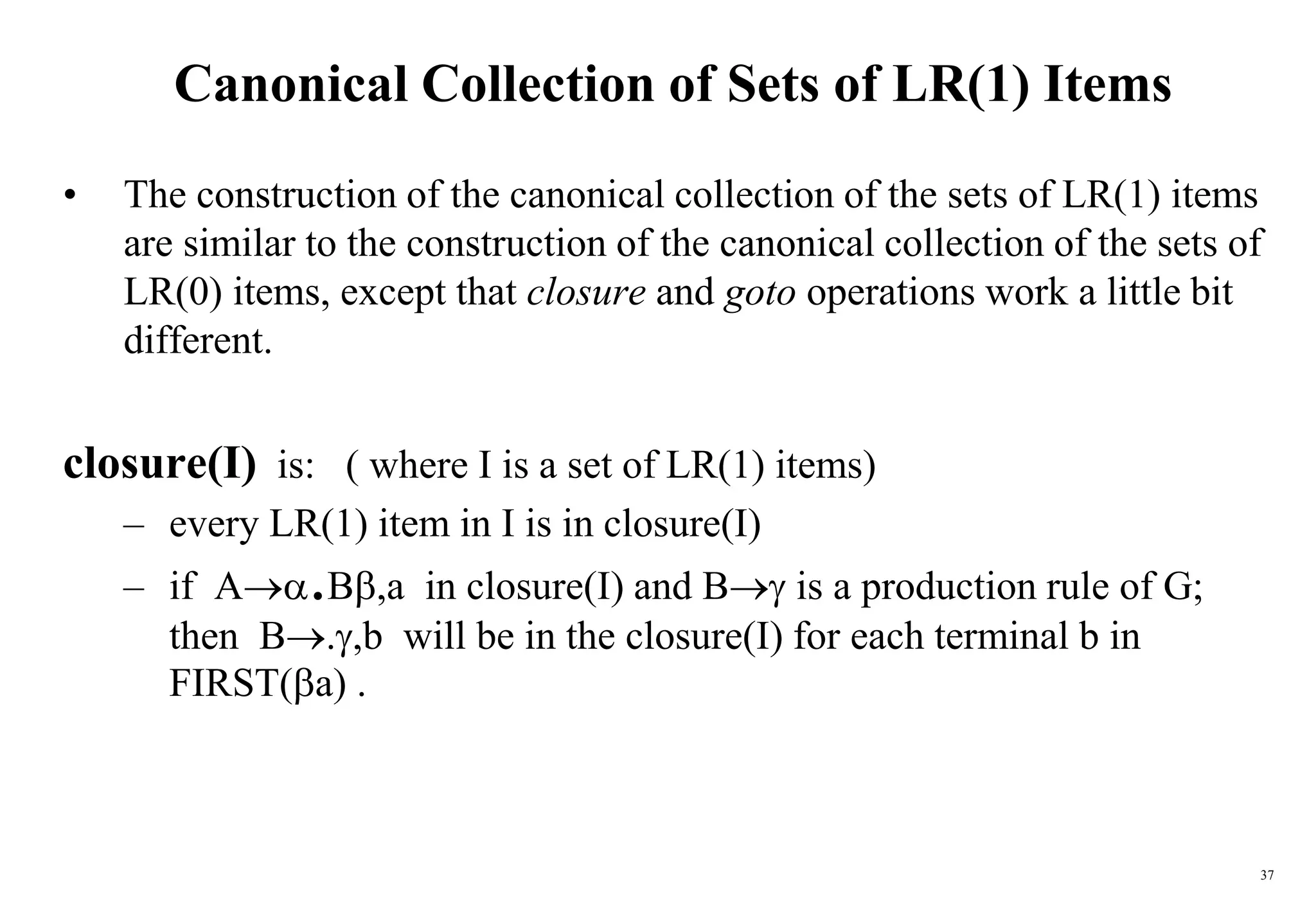
Canonical Collection of Sets of LR(1) Items
• The construction of the canonical collection of the sets of LR(1) items
are similar to the construction of the canonical collection of the sets of
LR(0) items, except that closure and goto operations work a little bit
different.
closure(I) is: ( where I is a set of LR(1) items)
– every LR(1) item in I is in closure(I)
– if A.B,a in closure(I) and B is a production rule of G;
then B.,b will be in the closure(I) for each terminal b in
FIRST(a) .
38
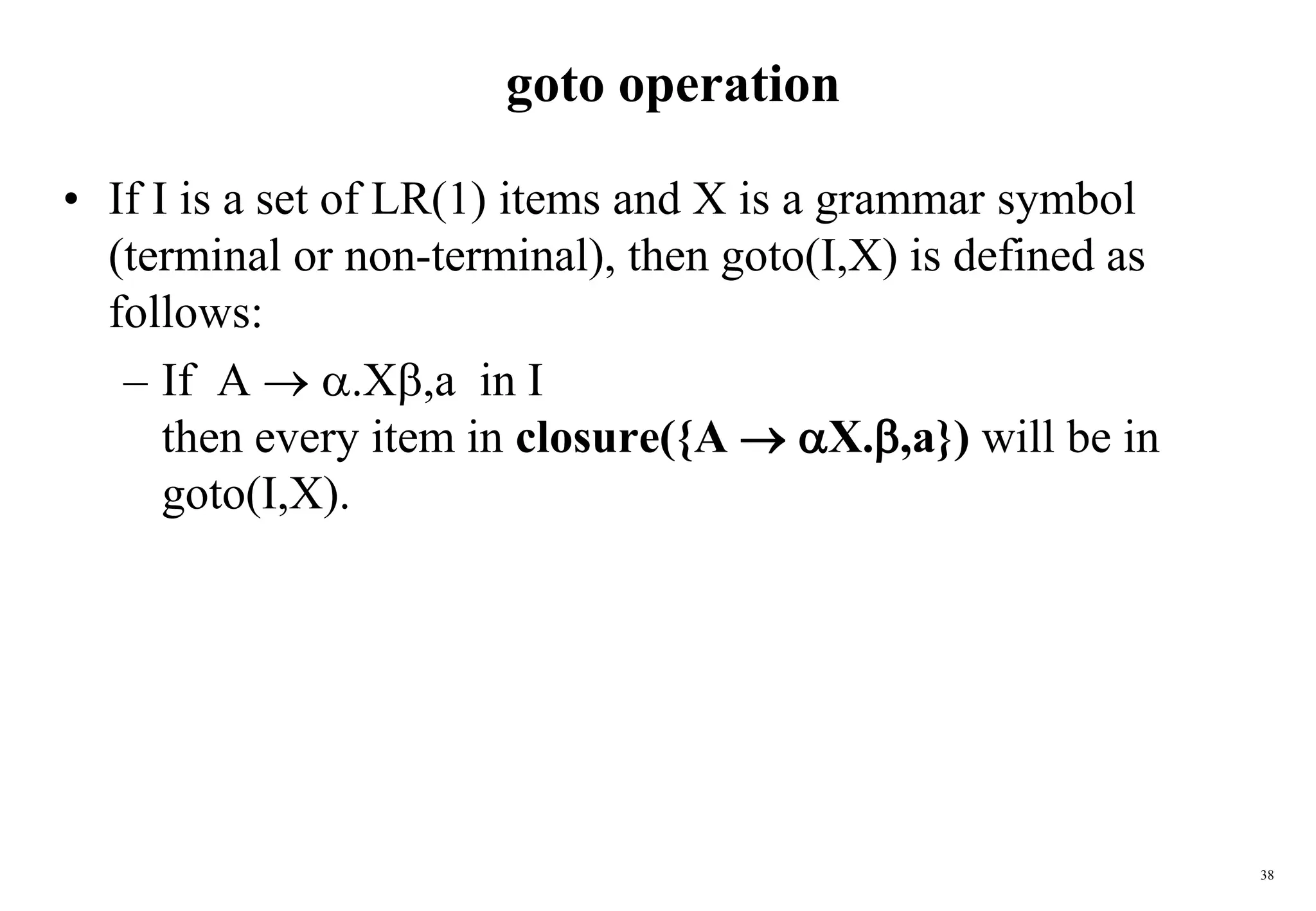
goto operation
• If I is a set of LR(1) items and X is a grammar symbol
(terminal or non-terminal), then goto(I,X) is defined as
follows:
– If A  .X,a in I
then every item in closure({A  X.,a}) will be in
goto(I,X).
39
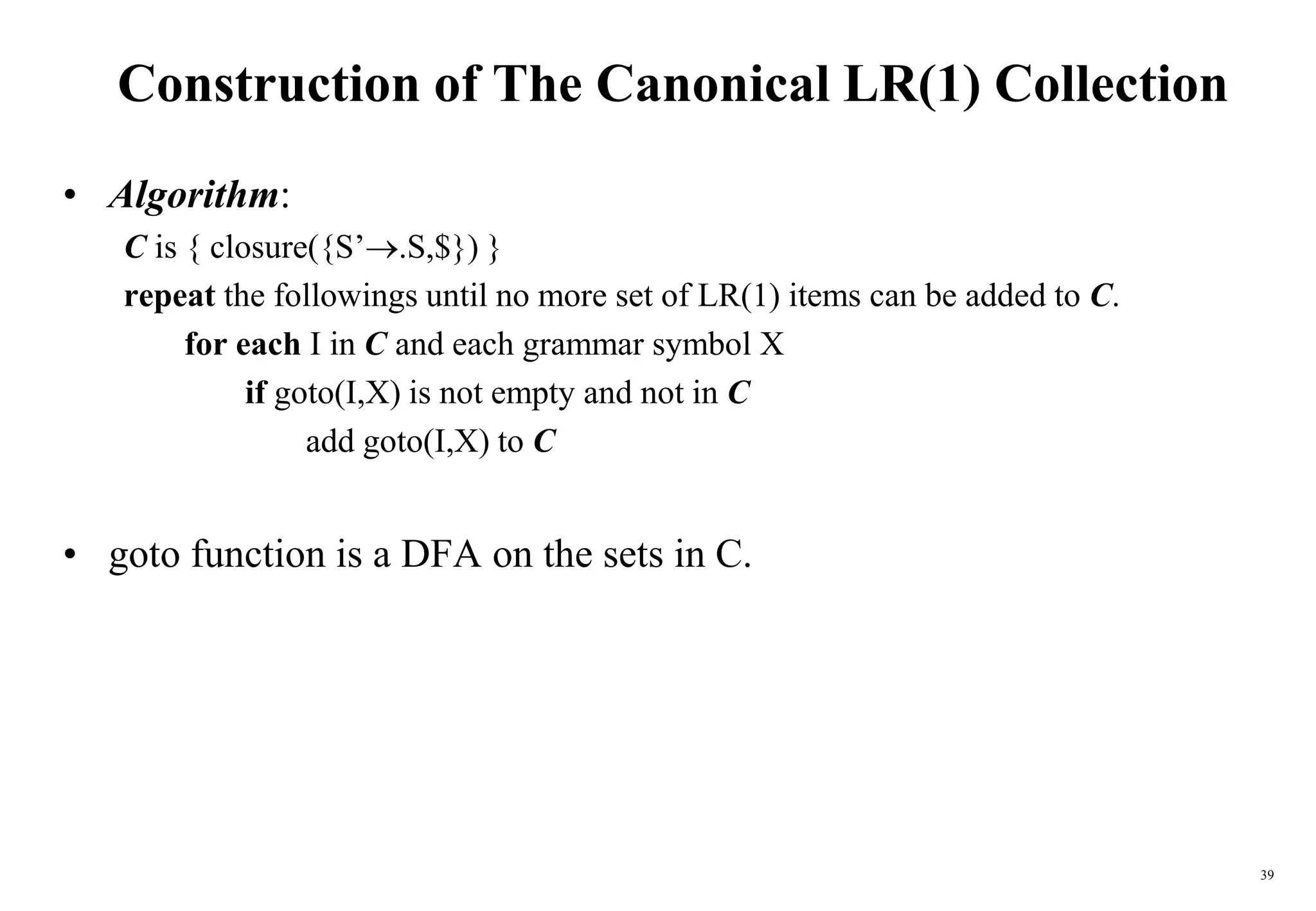
Construction of The Canonical LR(1) Collection
• Algorithm:
C is { closure({S’.S,$}) }
repeat the followings until no more set of LR(1) items can be added to C.
for each I in C and each grammar symbol X
if goto(I,X) is not empty and not in C
add goto(I,X) to C
• goto function is a DFA on the sets in C.
40
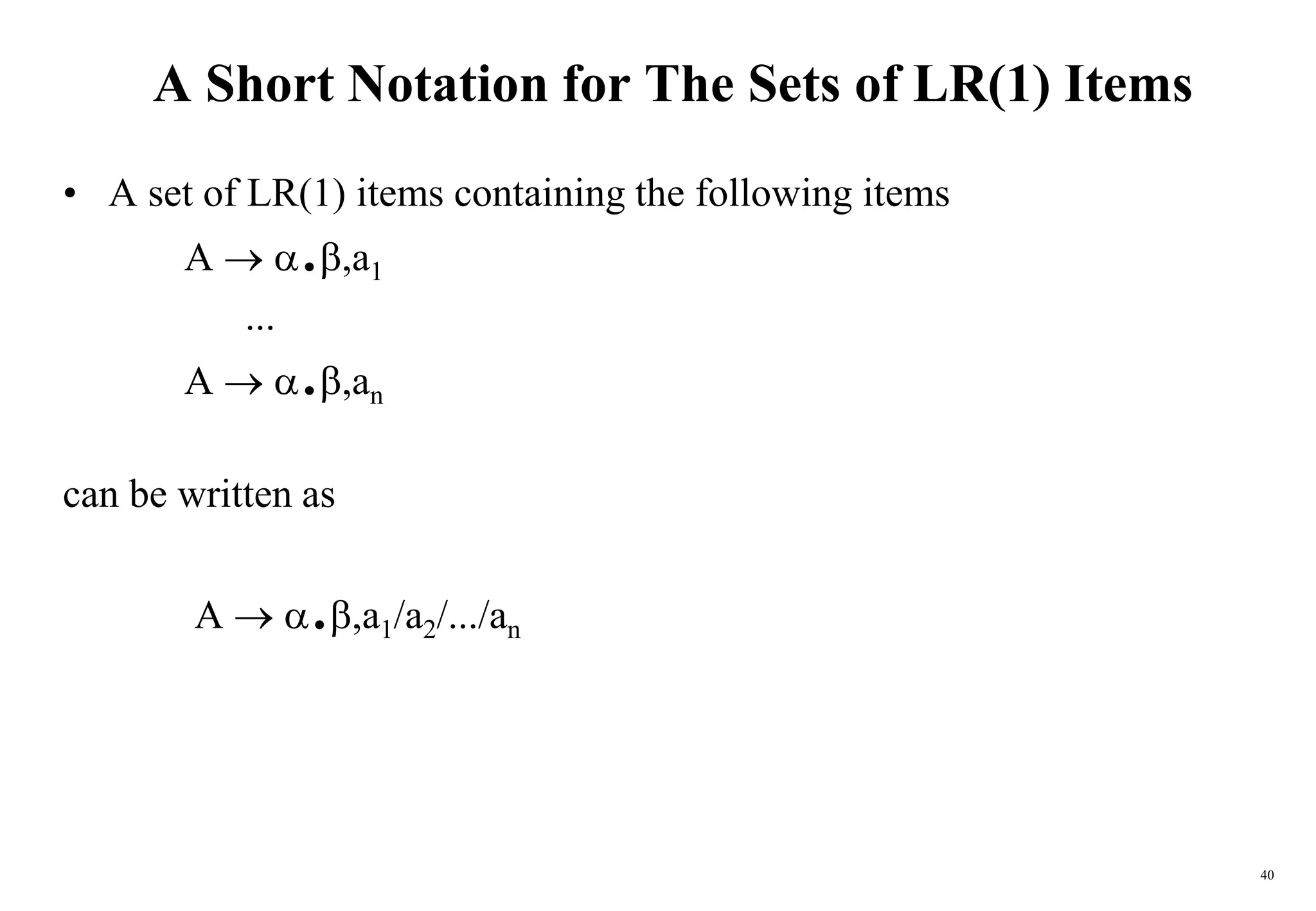
A Short Notation for The Sets of LR(1) Items
• A set of LR(1) items containing the following items
A  .,a1
...
A  .,an
can be written as
A  .,a1/a2/.../an
41
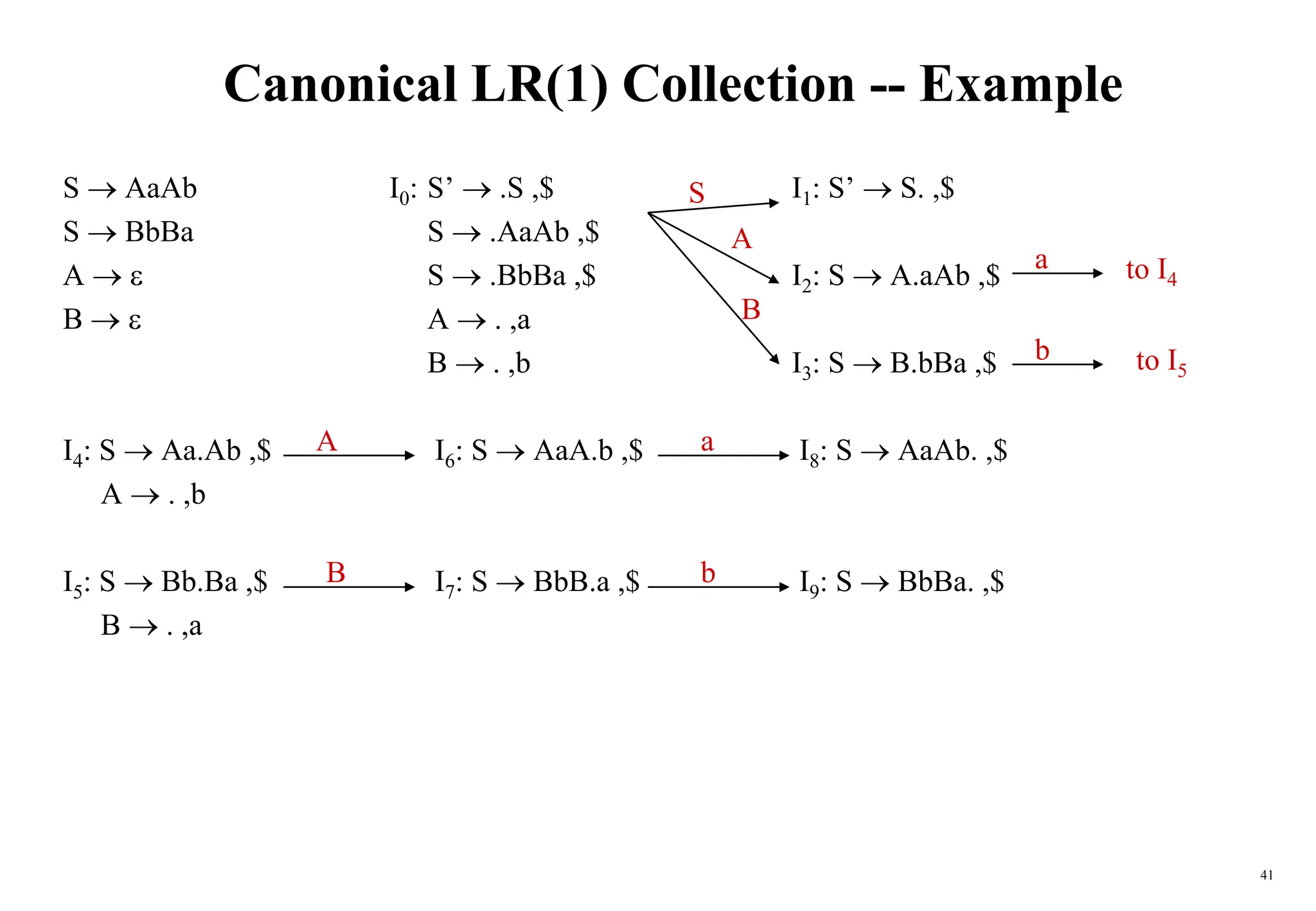
Canonical LR(1) Collection -- Example
S  AaAb I0: S’  .S ,$ I1: S’  S. ,$
S  BbBa S  .AaAb ,$
A   S  .BbBa ,$ I2: S  A.aAb ,$
B   A  . ,a
B  . ,b I3: S  B.bBa ,$
I4: S  Aa.Ab ,$ I6: S  AaA.b ,$ I8: S  AaAb. ,$
A  . ,b
I5: S  Bb.Ba ,$ I7: S  BbB.a ,$ I9: S  BbBa. ,$
B  . ,a
S
A
B
a
b
A
B
a
b
to I4
to I5
42
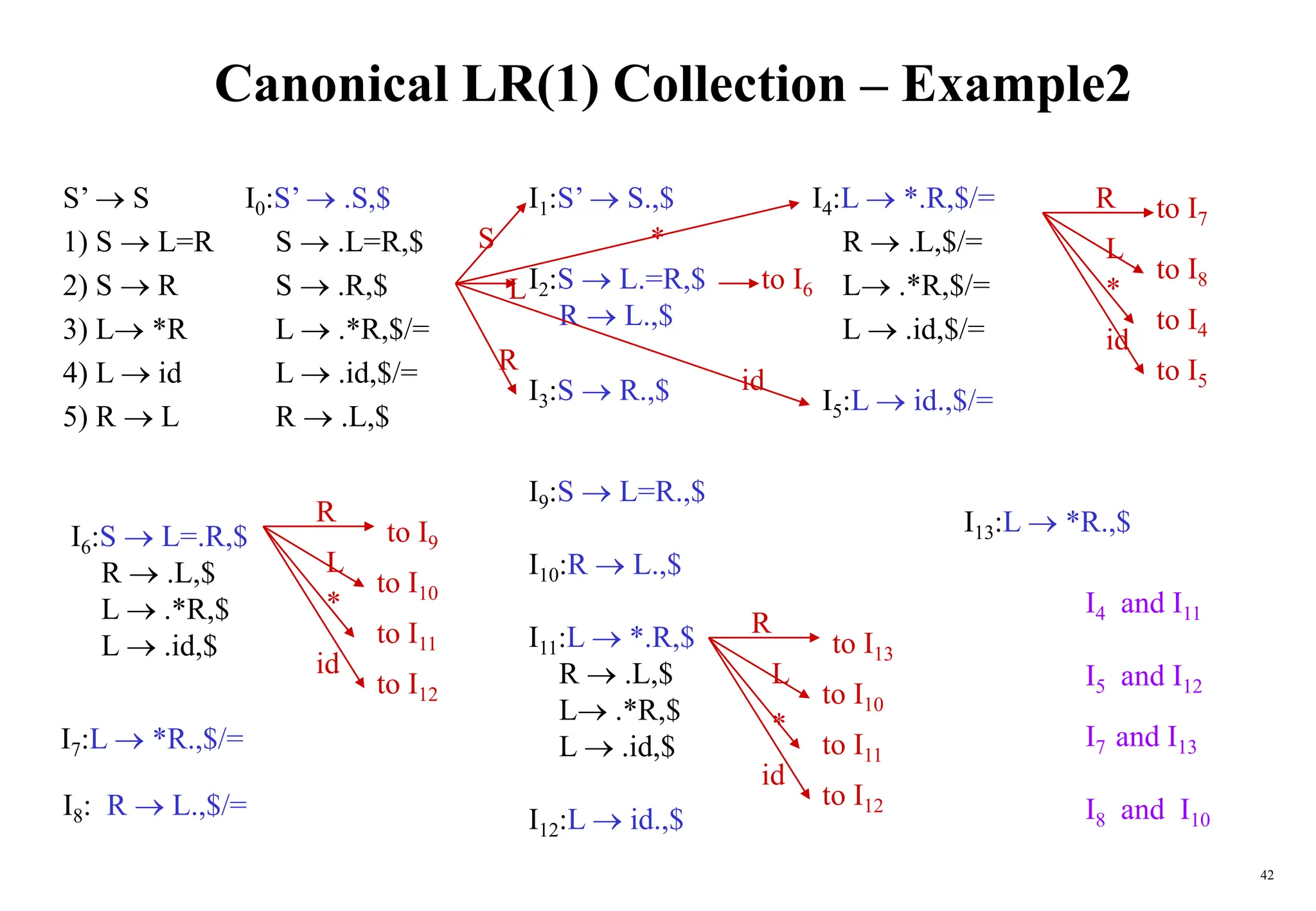
Canonical LR(1) Collection – Example2
S’  S
1) S  L=R
2) S  R
3) L *R
4) L  id
5) R  L
I0:S’  .S,$
S  .L=R,$
S  .R,$
L  .*R,$/=
L  .id,$/=
R  .L,$
I1:S’  S.,$
I2:S  L.=R,$
R  L.,$
I3:S  R.,$
I4:L  *.R,$/=
R  .L,$/=
L .*R,$/=
L  .id,$/=
I5:L  id.,$/=
I6:S  L=.R,$
R  .L,$
L  .*R,$
L  .id,$
I7:L  *R.,$/=
I8: R  L.,$/=
I9:S  L=R.,$
I10:R  L.,$
I11:L  *.R,$
R  .L,$
L .*R,$
L  .id,$
I12:L  id.,$
I13:L  *R.,$
to I6
to I7
to I8
to I4
to I5
to I10
to I11
to I12
to I9
to I10
to I11
to I12
to I13
id
S
L
L
L
R
R
R
id
id
id
R
L
*
*
*
*
I4 and I11
I5 and I12
I7 and I13
I8 and I10
43
Construction of LR(1) Parsing Tables
1. Construct the canonical collection of sets of LR(1) items for G’.
C{I0,...,In}
2. Create the parsing action table as follows
• If a is a terminal, A.a,b in Ii and goto(Ii,a)=Ij then action[i,a] is shift j.
• If A.,a is in Ii , then action[i,a] is reduce A where AS’.
• If S’S.,$ is in Ii , then action[i,$] is accept.
• If any conflicting actions generated by these rules, the grammar is not LR(1).
3. Create the parsing goto table
• for all non-terminals A, if goto(Ii,A)=Ij then goto[i,A]=j
4. All entries not defined by (2) and (3) are errors.
5. Initial state of the parser contains S’.S,$
44
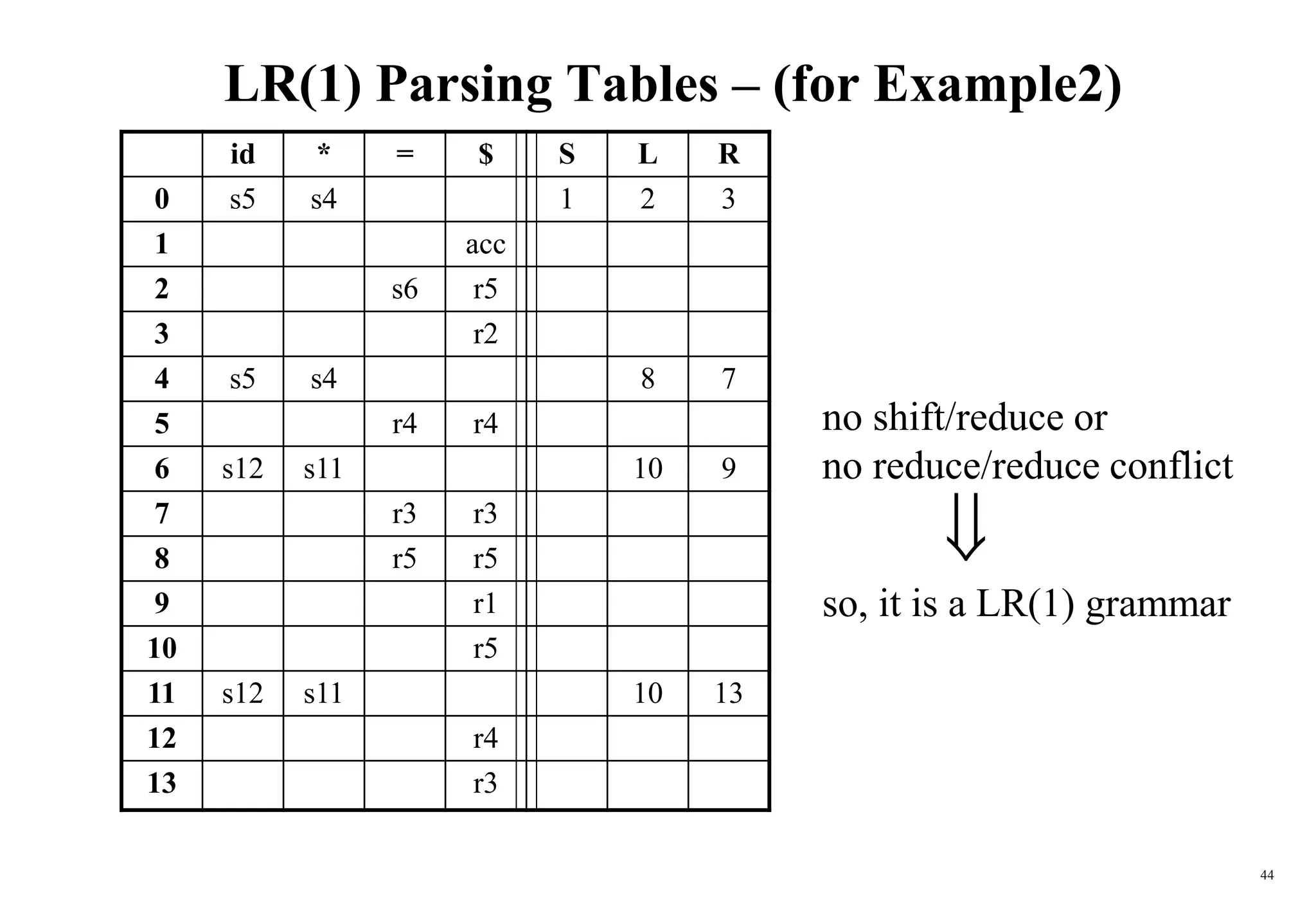
LR(1) Parsing Tables – (for Example2)
id * = $ S L R
0 s5 s4 1 2 3
1 acc
2 s6 r5
3 r2
4 s5 s4 8 7
5 r4 r4
6 s12 s11 10 9
7 r3 r3
8 r5 r5
9 r1
10 r5
11 s12 s11 10 13
12 r4
13 r3
no shift/reduce or
no reduce/reduce conflict

so, it is a LR(1) grammar
45
LALR Parsing Tables
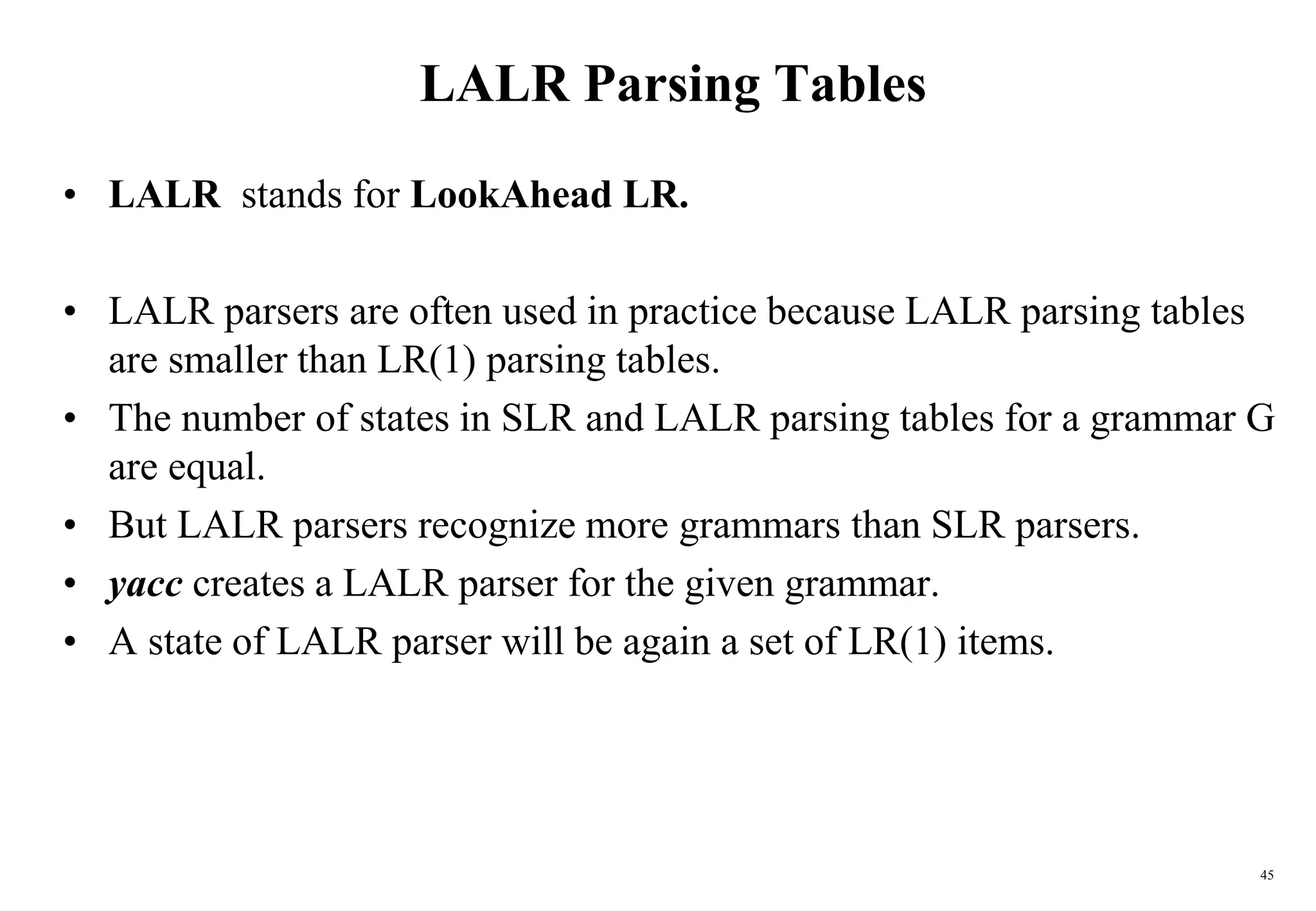
• LALR stands for LookAhead LR.
• LALR parsers are often used in practice because LALR parsing tables
are smaller than LR(1) parsing tables.
• The number of states in SLR and LALR parsing tables for a grammar G
are equal.
• But LALR parsers recognize more grammars than SLR parsers.
• yacc creates a LALR parser for the given grammar.
• A state of LALR parser will be again a set of LR(1) items.
46
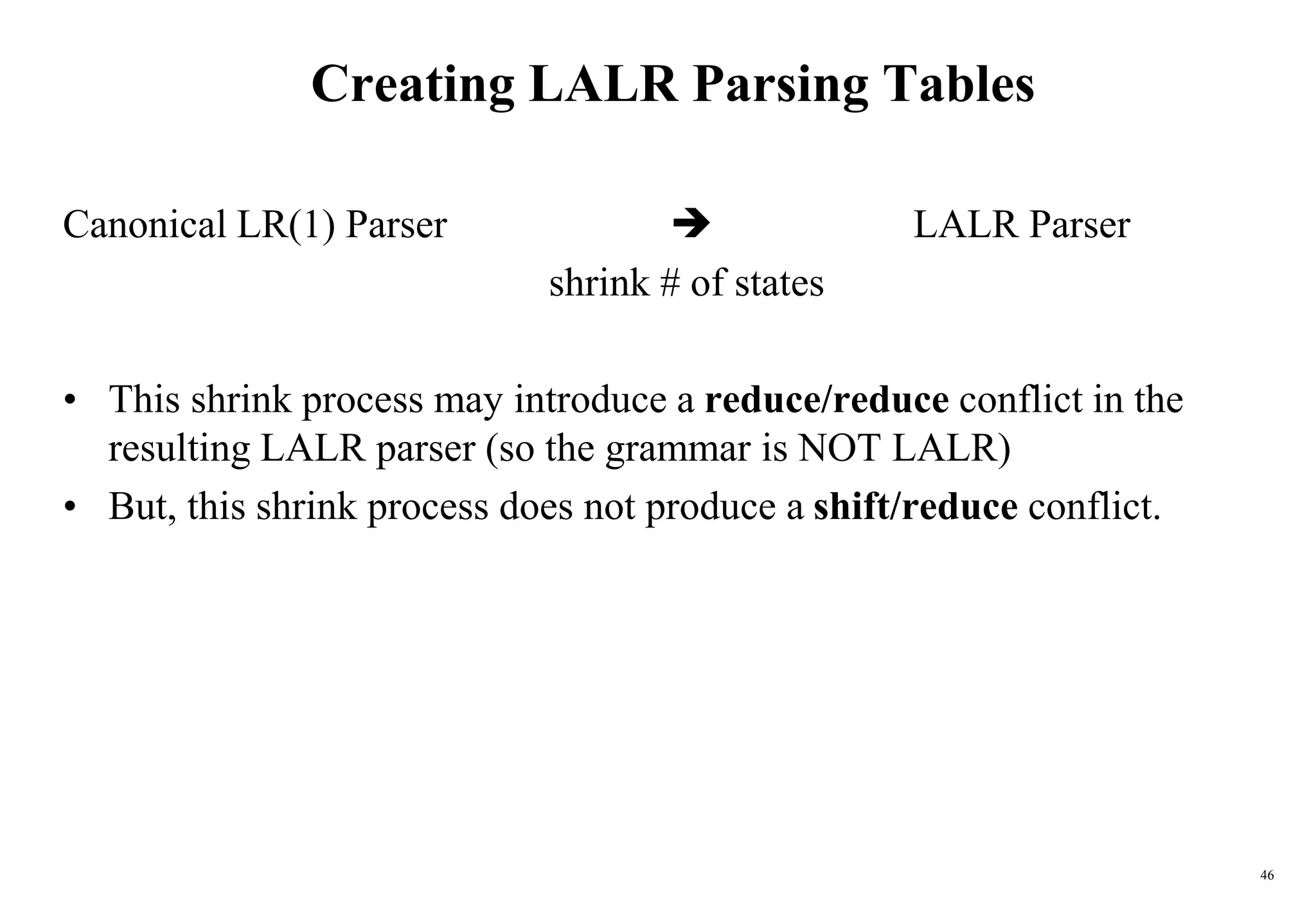
Creating LALR Parsing Tables
Canonical LR(1) Parser  LALR Parser
shrink # of states
• This shrink process may introduce a reduce/reduce conflict in the
resulting LALR parser (so the grammar is NOT LALR)
• But, this shrink process does not produce a shift/reduce conflict.
47
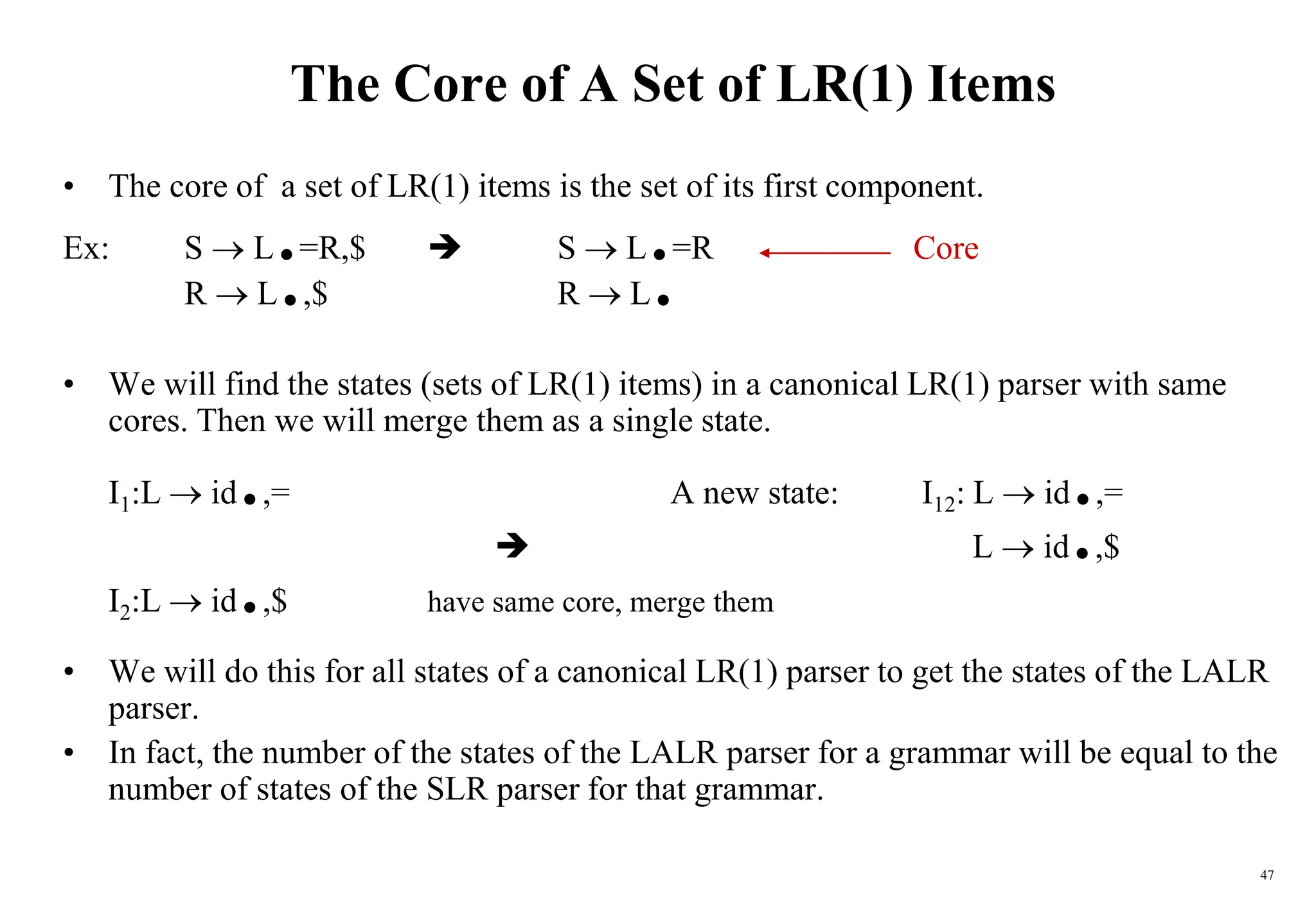
The Core of A Set of LR(1) Items
• The core of a set of LR(1) items is the set of its first component.
Ex: S  L.=R,$  S  L.=R Core
R  L.,$ R  L.
• We will find the states (sets of LR(1) items) in a canonical LR(1) parser with same
cores. Then we will merge them as a single state.
I1:L  id.,= A new state: I12: L  id.,=
 L  id.,$
I2:L  id.,$ have same core, merge them
• We will do this for all states of a canonical LR(1) parser to get the states of the LALR
parser.
• In fact, the number of the states of the LALR parser for a grammar will be equal to the
number of states of the SLR parser for that grammar.
48
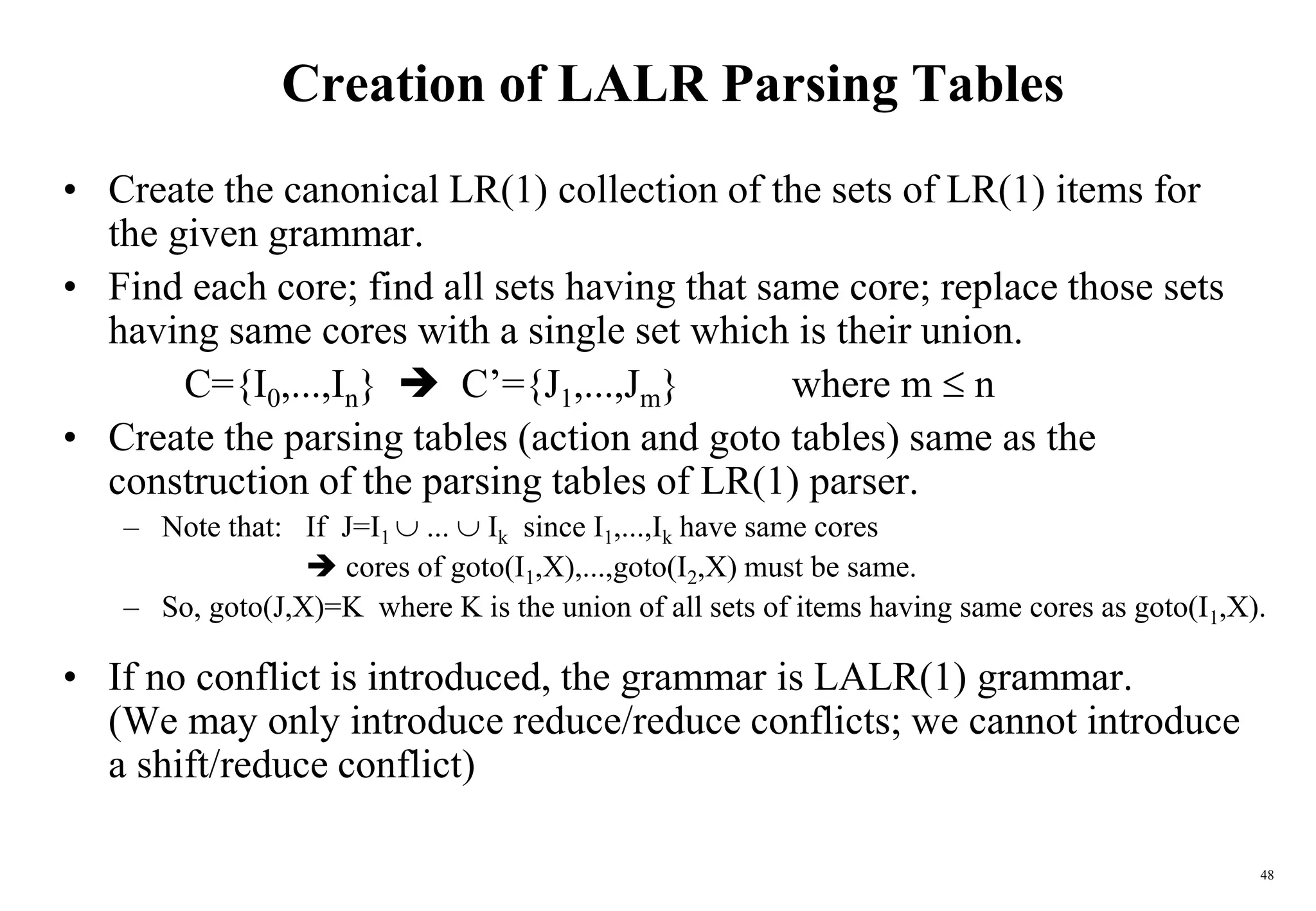
Creation of LALR Parsing Tables
• Create the canonical LR(1) collection of the sets of LR(1) items for
the given grammar.
• Find each core; find all sets having that same core; replace those sets
having same cores with a single set which is their union.
C={I0,...,In}  C’={J1,...,Jm} where m  n
• Create the parsing tables (action and goto tables) same as the
construction of the parsing tables of LR(1) parser.
– Note that: If J=I1  ...  Ik since I1,...,Ik have same cores
 cores of goto(I1,X),...,goto(I2,X) must be same.
– So, goto(J,X)=K where K is the union of all sets of items having same cores as goto(I1,X).
• If no conflict is introduced, the grammar is LALR(1) grammar.
(We may only introduce reduce/reduce conflicts; we cannot introduce
a shift/reduce conflict)
49
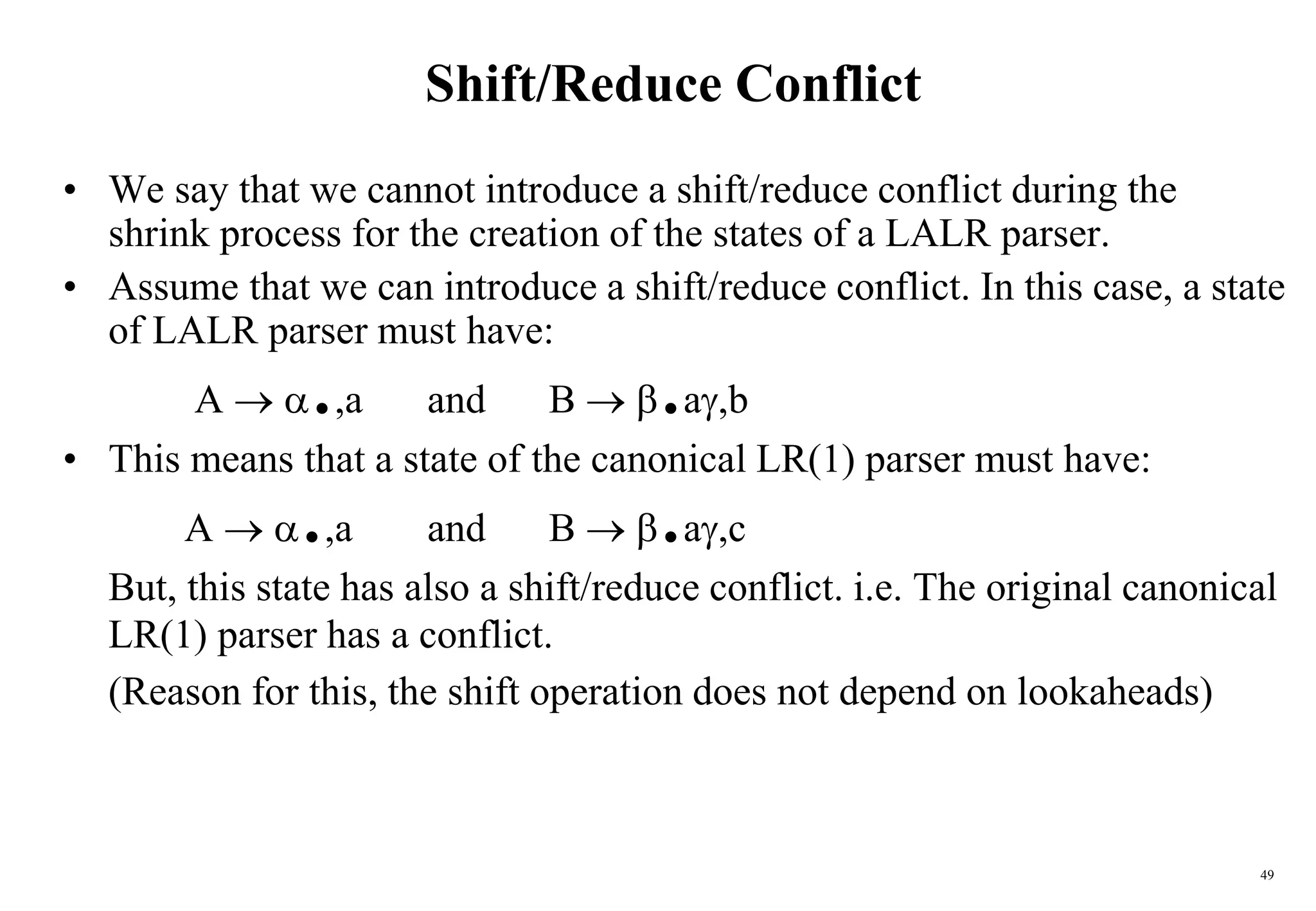
Shift/Reduce Conflict
• We say that we cannot introduce a shift/reduce conflict during the
shrink process for the creation of the states of a LALR parser.
• Assume that we can introduce a shift/reduce conflict. In this case, a state
of LALR parser must have:
A  .,a and B  .a,b
• This means that a state of the canonical LR(1) parser must have:
A  .,a and B  .a,c
But, this state has also a shift/reduce conflict. i.e. The original canonical
LR(1) parser has a conflict.
(Reason for this, the shift operation does not depend on lookaheads)
50
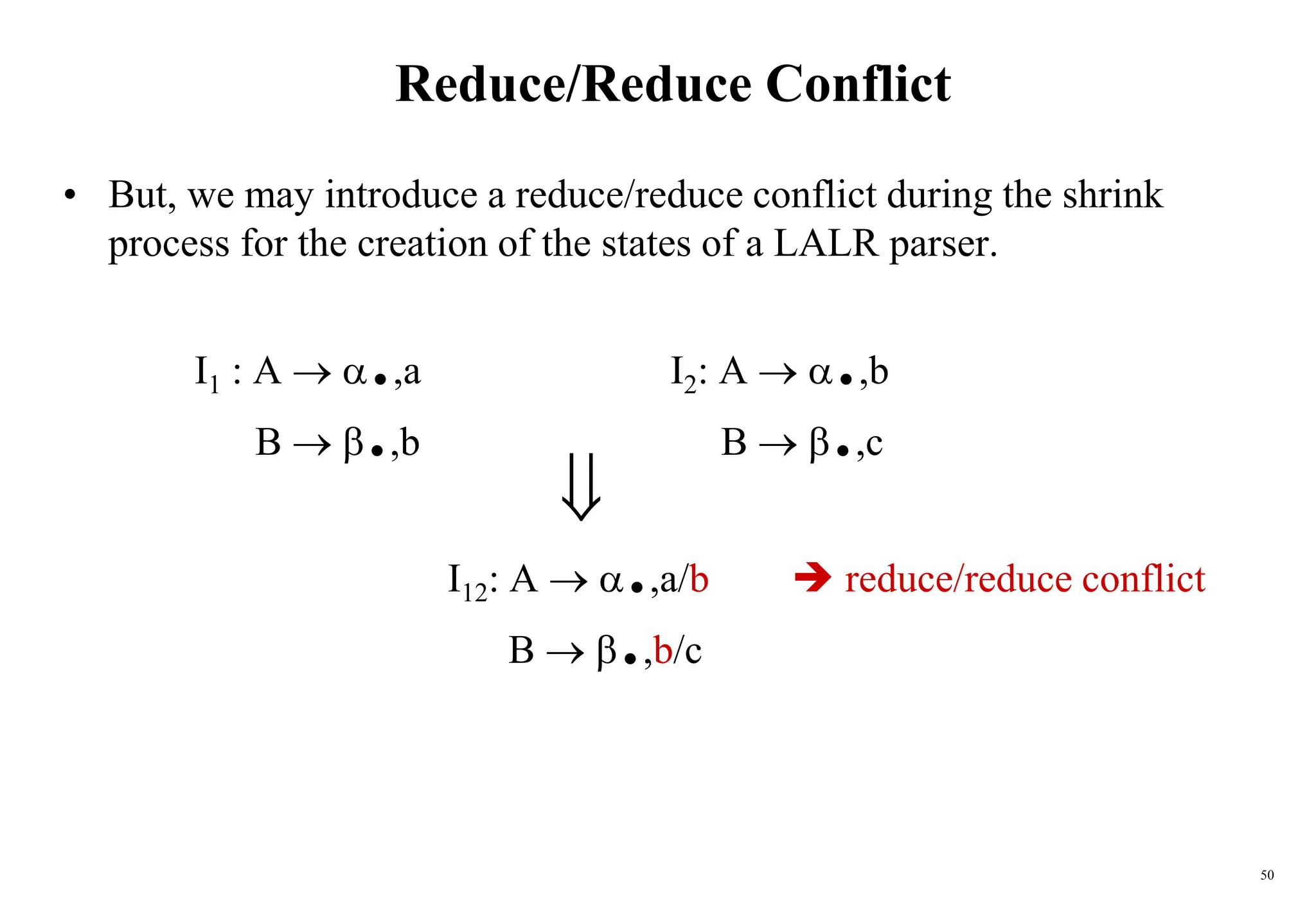
Reduce/Reduce Conflict
• But, we may introduce a reduce/reduce conflict during the shrink
process for the creation of the states of a LALR parser.
I1 : A  .,a I2: A  .,b
B  .,b B  .,c

I12: A  .,a/b  reduce/reduce conflict
B  .,b/c
51
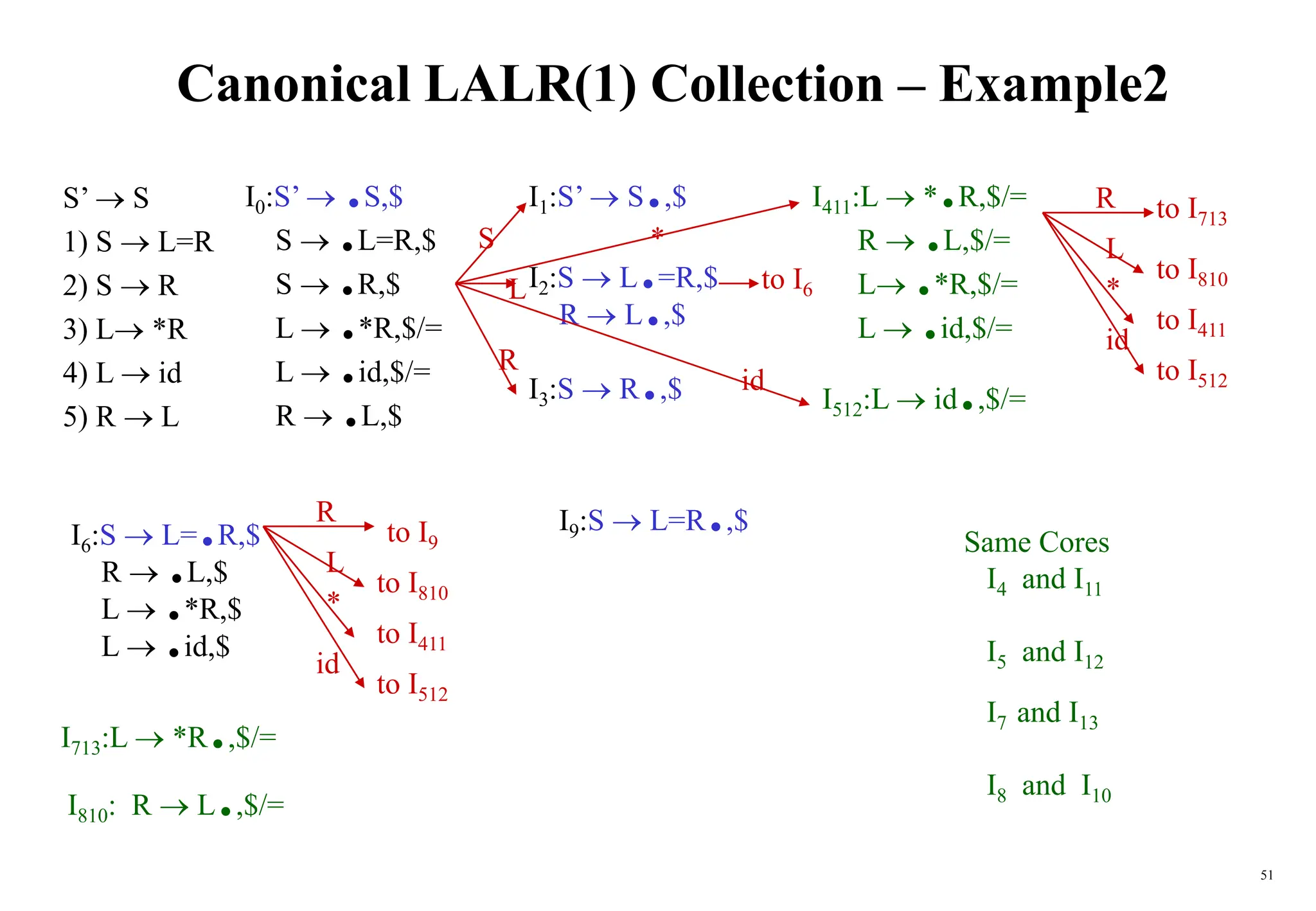
Canonical LALR(1) Collection – Example2
S’  S
1) S  L=R
2) S  R
3) L *R
4) L  id
5) R  L
I0:S’  .S,$
S  .L=R,$
S  .R,$
L  .*R,$/=
L  .id,$/=
R  .L,$
I1:S’  S.,$
I2:S  L.=R,$
R  L.,$
I3:S  R.,$
I411:L  *.R,$/=
R  .L,$/=
L .*R,$/=
L  .id,$/=
I512:L  id.,$/=
I6:S  L=.R,$
R  .L,$
L  .*R,$
L  .id,$
I713:L  *R.,$/=
I810: R  L.,$/=
I9:S  L=R.,$
to I6
to I713
to I810
to I411
to I512
to I810
to I411
to I512
to I9
S
L
L
L
R
R
id
id
id
R
*
*
*
Same Cores
I4 and I11
I5 and I12
I7 and I13
I8 and I10
52
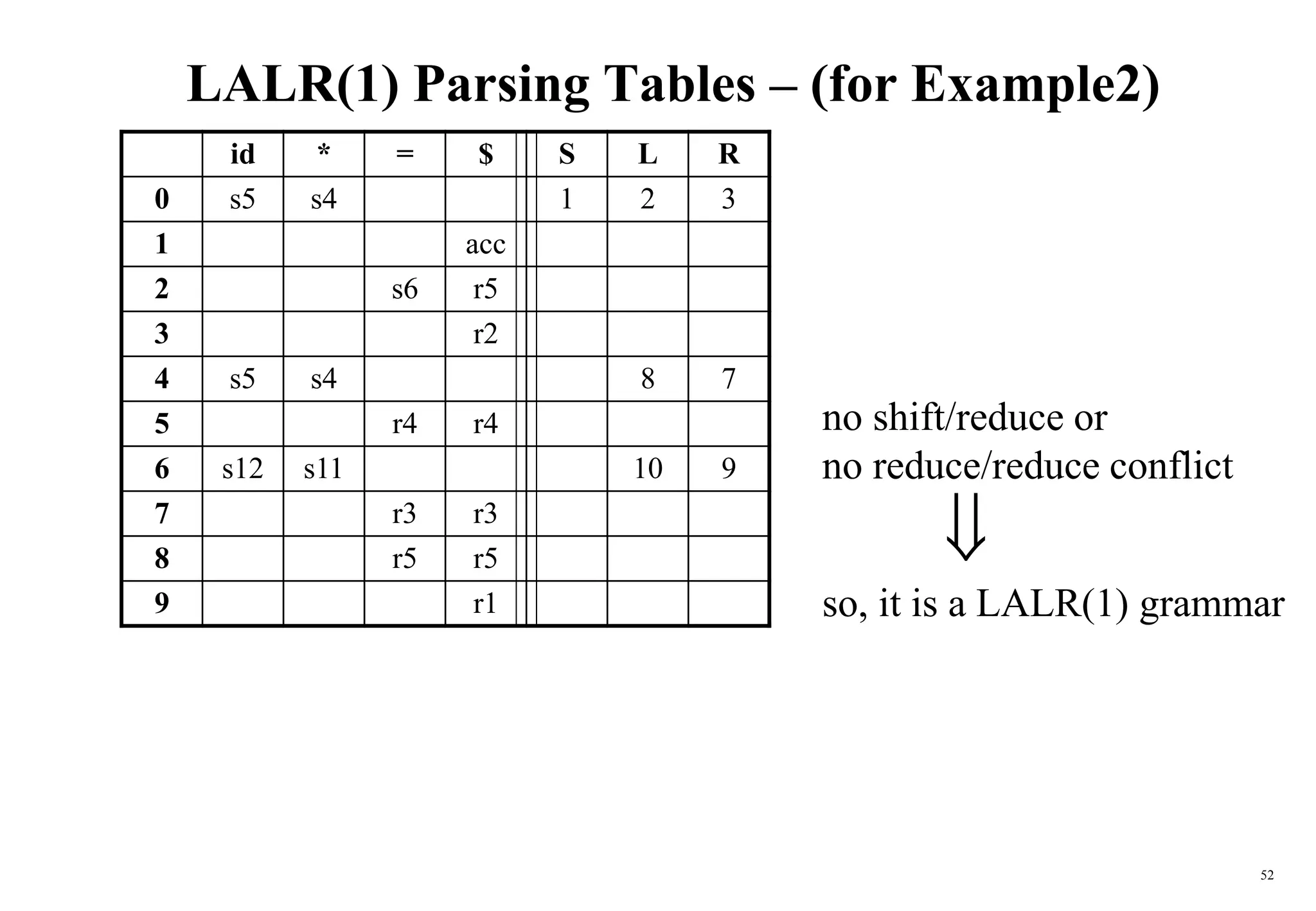
LALR(1) Parsing Tables – (for Example2)
id * = $ S L R
0 s5 s4 1 2 3
1 acc
2 s6 r5
3 r2
4 s5 s4 8 7
5 r4 r4
6 s12 s11 10 9
7 r3 r3
8 r5 r5
9 r1
no shift/reduce or
no reduce/reduce conflict

so, it is a LALR(1) grammar
53
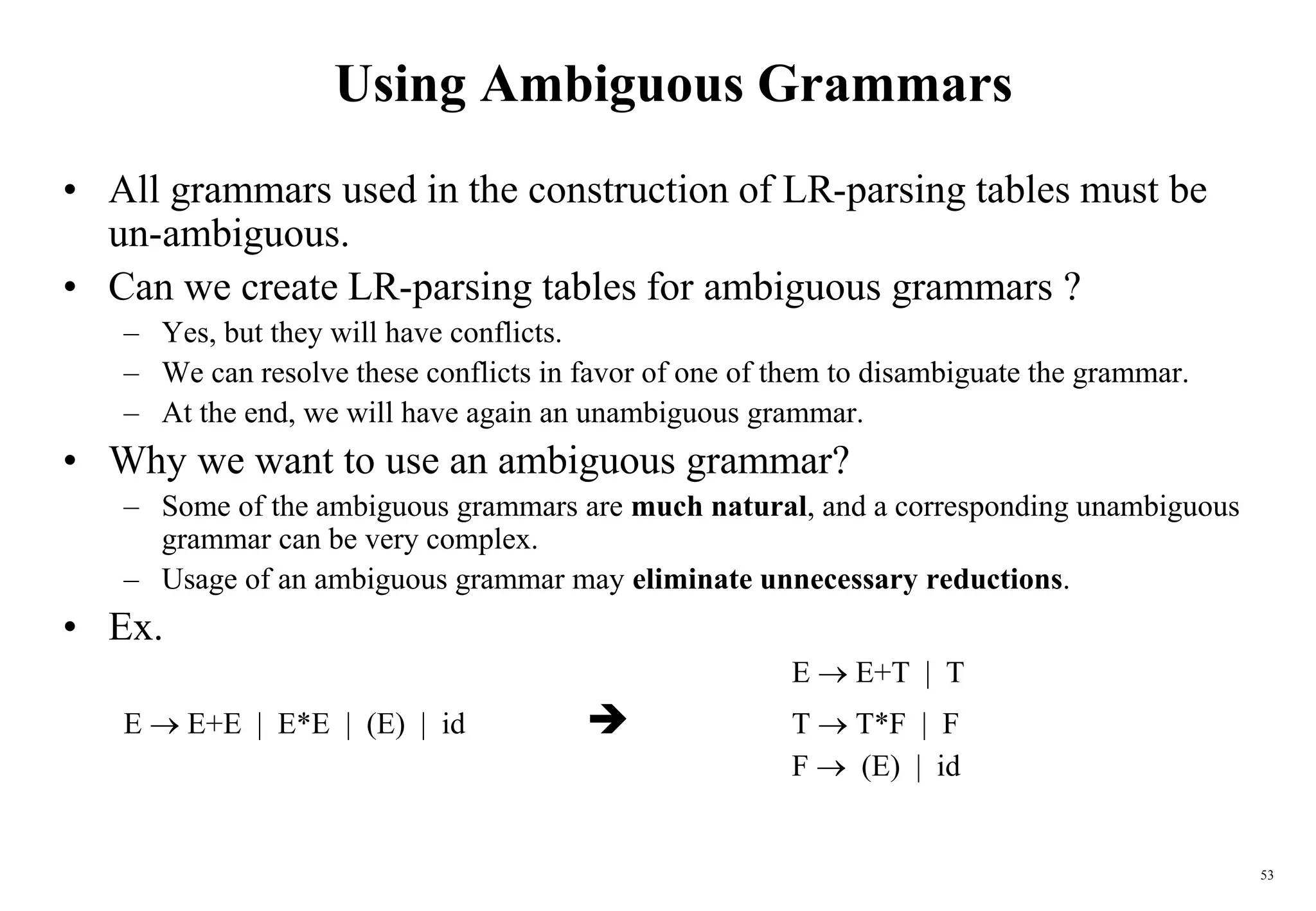
Using Ambiguous Grammars
• All grammars used in the construction of LR-parsing tables must be
un-ambiguous.
• Can we create LR-parsing tables for ambiguous grammars ?
– Yes, but they will have conflicts.
– We can resolve these conflicts in favor of one of them to disambiguate the grammar.
– At the end, we will have again an unambiguous grammar.
• Why we want to use an ambiguous grammar?
– Some of the ambiguous grammars are much natural, and a corresponding unambiguous
grammar can be very complex.
– Usage of an ambiguous grammar may eliminate unnecessary reductions.
• Ex.
E  E+T | T
E  E+E | E*E | (E) | id  T  T*F | F
F  (E) | id
54
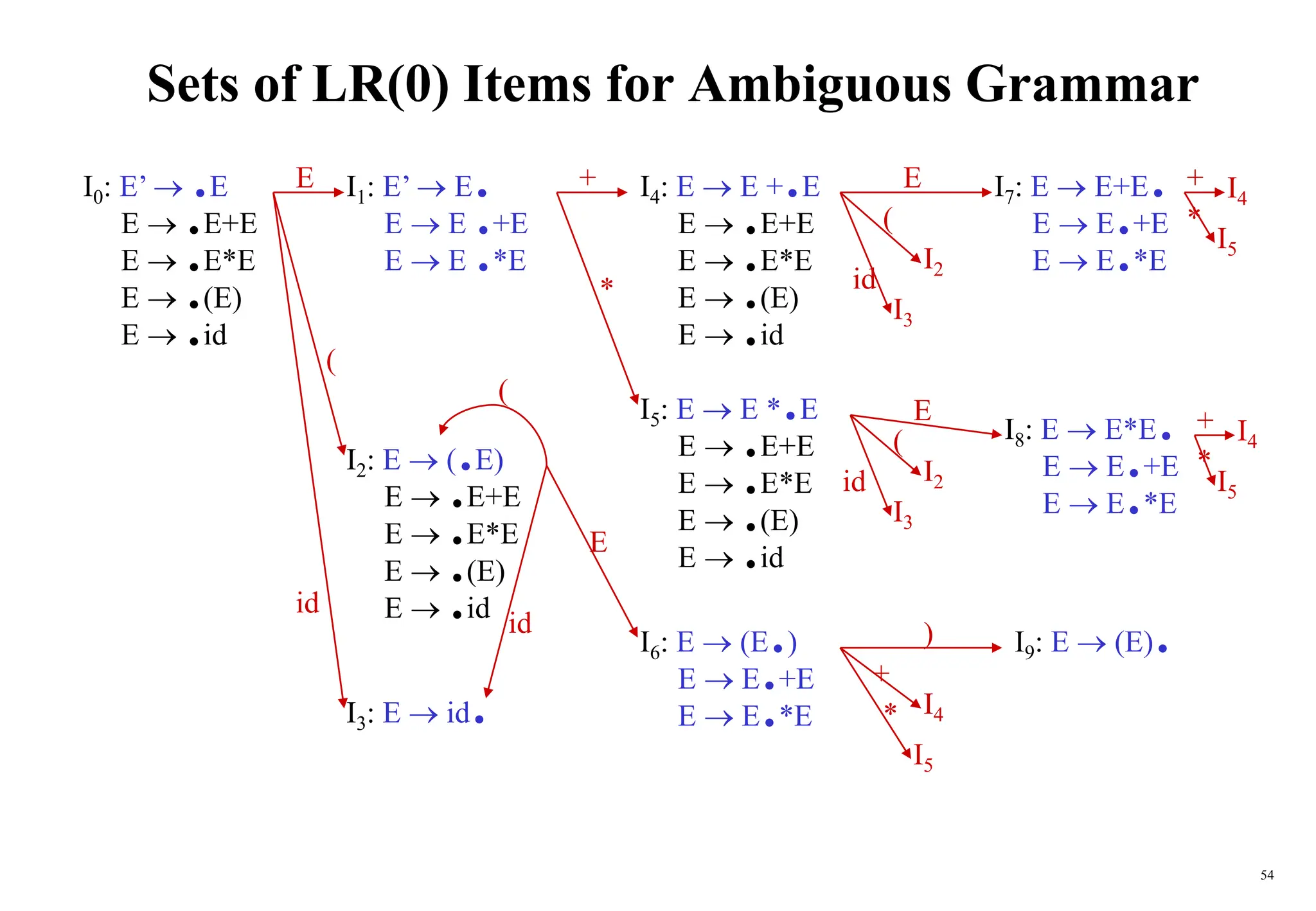
Sets of LR(0) Items for Ambiguous Grammar
I0: E’  .E
E  .E+E
E  .E*E
E  .(E)
E  .id
I1: E’  E.
E  E .+E
E  E .*E
I2: E  (.E)
E  .E+E
E  .E*E
E  .(E)
E  .id
I3: E  id.
I4: E  E +.E
E  .E+E
E  .E*E
E  .(E)
E  .id
I5: E  E *.E
E  .E+E
E  .E*E
E  .(E)
E  .id
I6: E  (E.)
E  E.+E
E  E.*E
I7: E  E+E.
E  E.+E
E  E.*E
I8: E  E*E.
E  E.+E
E  E.*E
I9: E  (E).
I5
)
E
E
E
E
*
+
+
+
+
*
*
*
(
(
(
(
id
id
id
id
I4
I2
I2
I3
I3
I4
I4
I5
I5
55
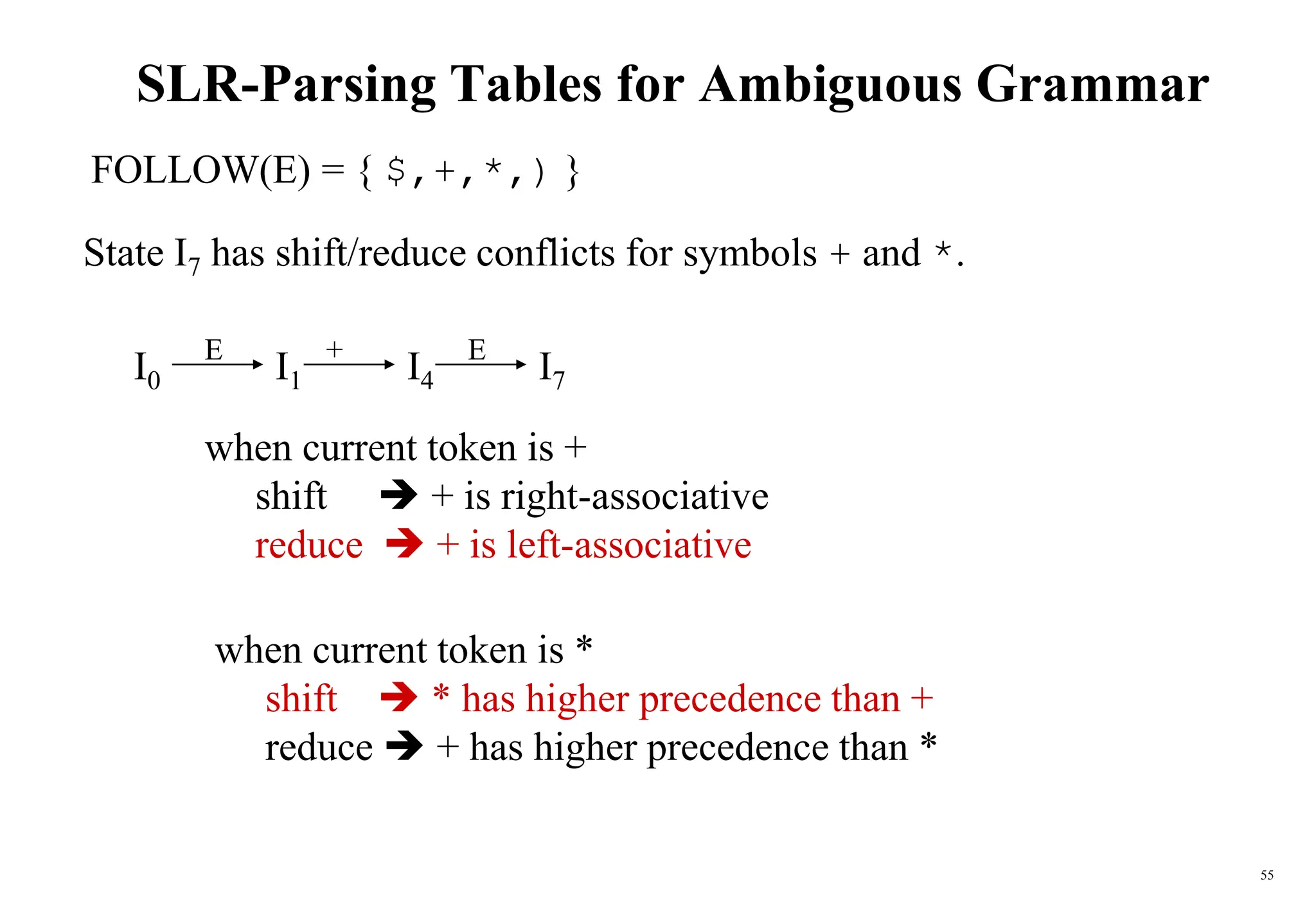
SLR-Parsing Tables for Ambiguous Grammar
FOLLOW(E) = { $,+,*,) }
State I7 has shift/reduce conflicts for symbols + and *.
I0 I1 I7
I4
E
+
E
when current token is +
shift  + is right-associative
reduce  + is left-associative
when current token is *
shift  * has higher precedence than +
reduce  + has higher precedence than *
56
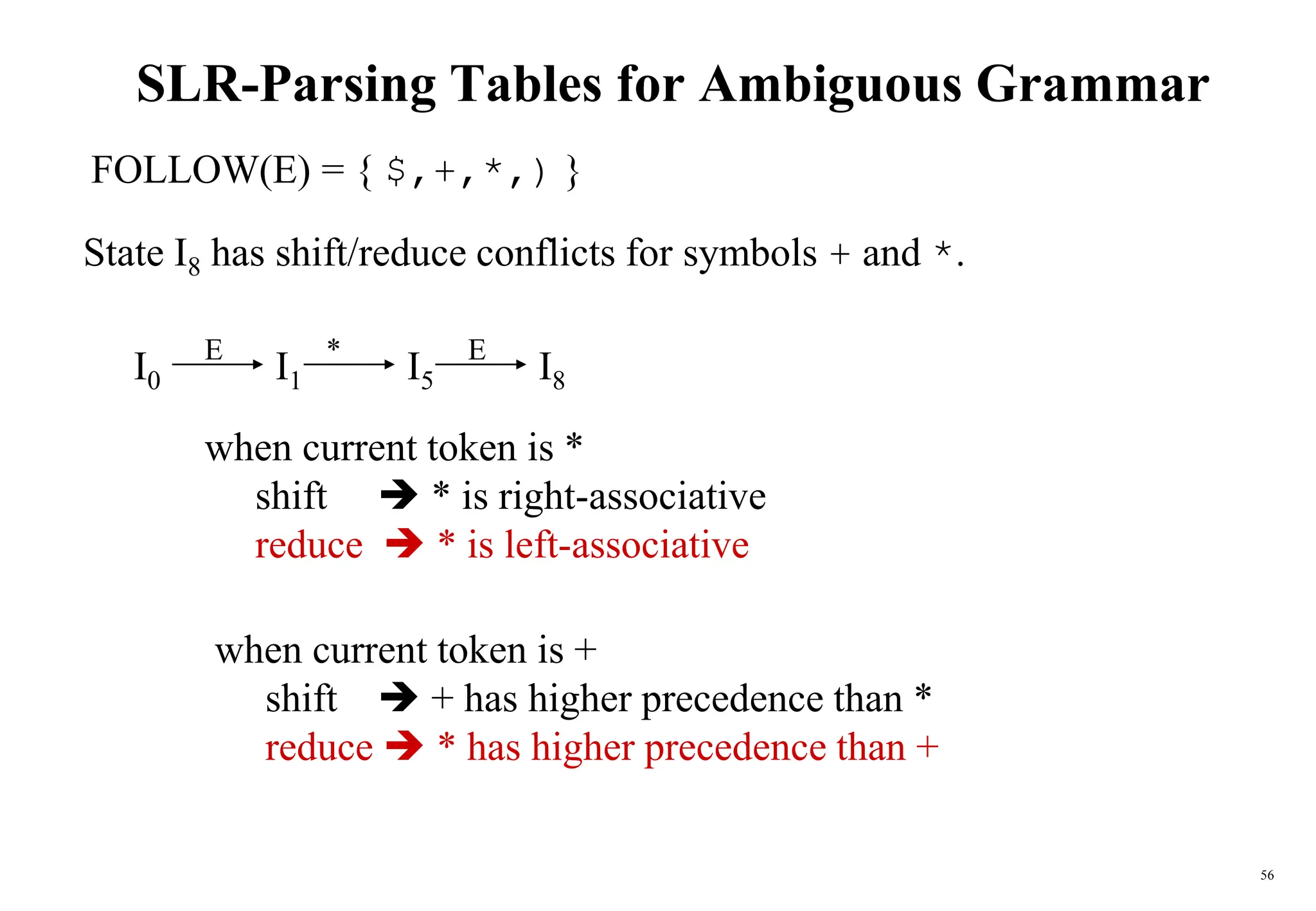
SLR-Parsing Tables for Ambiguous Grammar
FOLLOW(E) = { $,+,*,) }
State I8 has shift/reduce conflicts for symbols + and *.
I0 I1 I8
I5
E
*
E
when current token is *
shift  * is right-associative
reduce  * is left-associative
when current token is +
shift  + has higher precedence than *
reduce  * has higher precedence than +
57
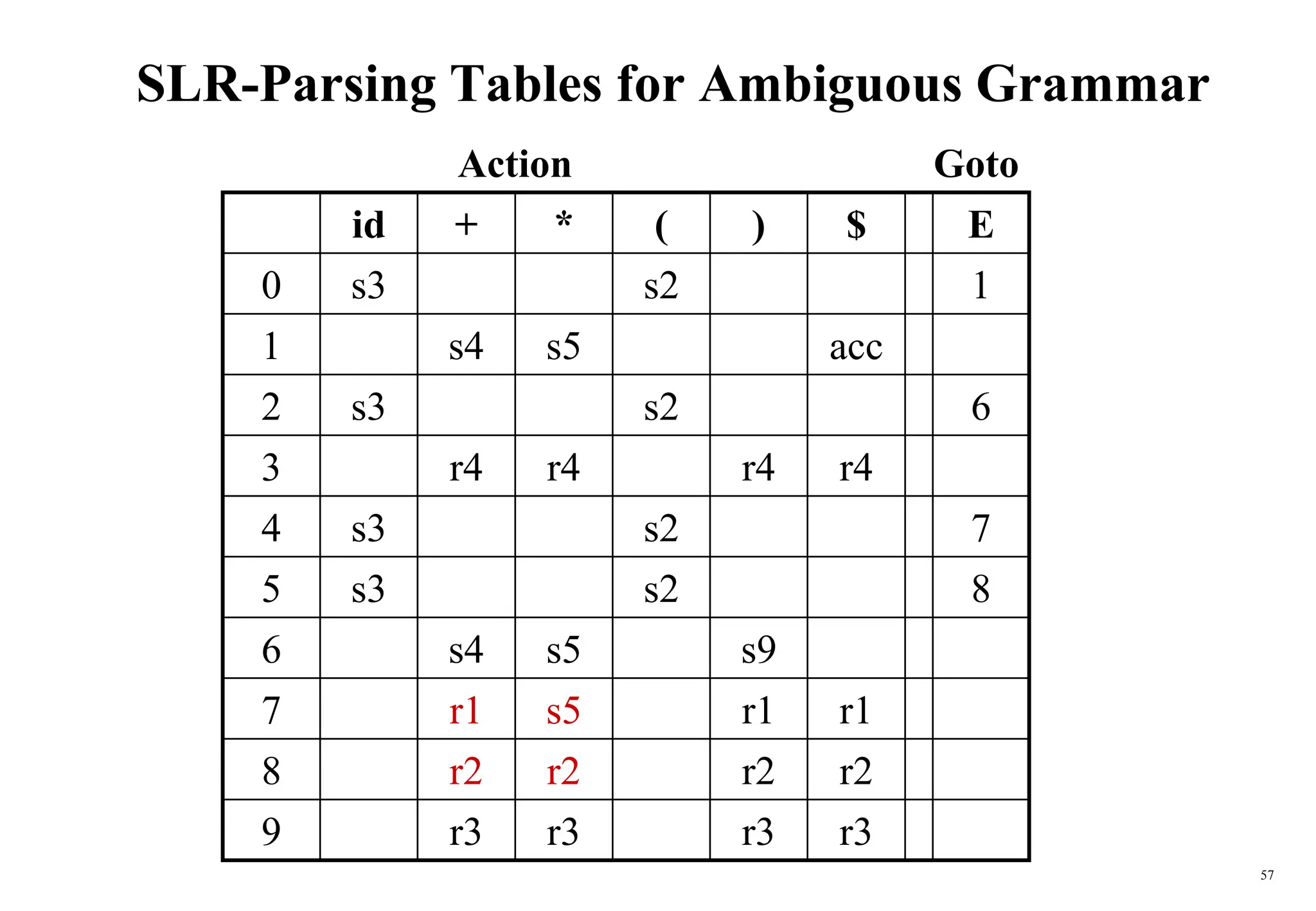
SLR-Parsing Tables for Ambiguous Grammar
id + * ( ) $ E
0 s3 s2 1
1 s4 s5 acc
2 s3 s2 6
3 r4 r4 r4 r4
4 s3 s2 7
5 s3 s2 8
6 s4 s5 s9
7 r1 s5 r1 r1
8 r2 r2 r2 r2
9 r3 r3 r3 r3
Action Goto
58
Error Recovery in LR Parsing
• An LR parser will detect an error when it consults the parsing action
table and finds an error entry. All empty entries in the action table are
error entries.
• Errors are never detected by consulting the goto table.
• An LR parser will announce error as soon as there is no valid
continuation for the scanned portion of the input.
• A canonical LR parser (LR(1) parser) will never make even a single
reduction before announcing an error.
• The SLR and LALR parsers may make several reductions before
announcing an error.
• But, all LR parsers (LR(1), LALR and SLR parsers) will never shift an
erroneous input symbol onto the stack.
59
Panic Mode Error Recovery in LR Parsing
• Scan down the stack until a state s with a goto on a particular
nonterminal A is found. (Get rid of everything from the stack before this
state s).
• Discard zero or more input symbols until a symbol a is found that can
legitimately follow A.
– The symbol a is simply in FOLLOW(A), but this may not work for all situations.
• The parser stacks the nonterminal A and the state goto[s,A], and it
resumes the normal parsing.
• This nonterminal A is normally is a basic programming block (there can
be more than one choice for A).
– stmt, expr, block, ...
60
Phrase-Level Error Recovery in LR Parsing
• Each empty entry in the action table is marked with a specific error
routine.
• An error routine reflects the error that the user most likely will make in
that case.
• An error routine inserts the symbols into the stack or the input (or it
deletes the symbols from the stack and the input, or it can do both
insertion and deletion).
– missing operand
– unbalanced right parenthesis

ch5-bottomupparser_jfdrhgfrfyyssf-gfrrt.PPT

  • 1.
    1 Bottom-Up Parsing • Abottom-up parser creates the parse tree of the given input starting from leaves towards the root. • A bottom-up parser tries to find the right-most derivation of the given input in the reverse order. S  ...   (the right-most derivation of )  (the bottom-up parser finds the right-most derivation in the reverse order) • Bottom-up parsing is also known as shift-reduce parsing because its two main actions are shift and reduce. – At each shift action, the current symbol in the input string is pushed to a stack. – At each reduction step, the symbols at the top of the stack (this symbol sequence is the right side of a production) will replaced by the non-terminal at the left side of that production. – There are also two more actions: accept and error.
  • 2.
    2 Shift-Reduce Parsing • Ashift-reduce parser tries to reduce the given input string into the starting symbol. a string  the starting symbol reduced to • At each reduction step, a substring of the input matching to the right side of a production rule is replaced by the non-terminal at the left side of that production rule. • If the substring is chosen correctly, the right most derivation of that string is created in the reverse order. Rightmost Derivation: S   Shift-Reduce Parser finds:   ...  S * rm rm rm
  • 3.
    3 Shift-Reduce Parsing --Example S  aABb input string: aaabb A  aA | a aaAbb B  bB | b aAbb  reduction aABb S S  aABb  aAbb  aaAbb  aaabb Right Sentential Forms • How do we know which substring to be replaced at each reduction step? rm rm rm rm
  • 4.
    4 Handle • Informally, ahandle of a string is a substring that matches the right side of a production rule. – But not every substring matches the right side of a production rule is handle • A handle of a right sentential form  ( ) is a production rule A   and a position of  where the string  may be found and replaced by A to produce the previous right-sentential form in a rightmost derivation of . S  A   • If the grammar is unambiguous, then every right-sentential form of the grammar has exactly one handle. • We will see that  is a string of terminals. rm rm *
  • 5.
    5 Handle Pruning • Aright-most derivation in reverse can be obtained by handle-pruning. S=0  1  2  ...  n-1  n=  input string • Start from n, find a handle Ann in n, and replace n in by An to get n-1. • Then find a handle An-1n-1 in n-1, and replace n-1 in by An-1 to get n-2. • Repeat this, until we reach S. rm rm rm rm rm
  • 6.
    6 A Shift-Reduce Parser E E+T | T Right-Most Derivation of id+id*id T  T*F | F E  E+T  E+T*F  E+T*id  E+F*id F  (E) | id  E+id*id  T+id*id  F+id*id  id+id*id Right-Most Sentential Form Reducing Production id+id*id F  id F+id*id T  F T+id*id E  T E+id*id F  id E+F*id T  F E+T*id F  id E+T*F T  T*F E+T E  E+T E Handles are red and underlined in the right-sentential forms.
  • 7.
    7 A Stack Implementationof A Shift-Reduce Parser • There are four possible actions of a shift-parser action: 1. Shift : The next input symbol is shifted onto the top of the stack. 2. Reduce: Replace the handle on the top of the stack by the non- terminal. 3. Accept: Successful completion of parsing. 4. Error: Parser discovers a syntax error, and calls an error recovery routine. • Initial stack just contains only the end-marker $. • The end of the input string is marked by the end-marker $.
  • 8.
    8 A Stack Implementationof A Shift-Reduce Parser Stack Input Action $ id+id*id$ shift $id +id*id$ reduce by F  id Parse Tree $F +id*id$ reduce by T  F $T +id*id$ reduce by E  T E 8 $E +id*id$ shift $E+ id*id$ shift E 3 + T 7 $E+id *id$ reduce by F  id $E+F *id$ reduce by T  F T 2 T 5 * F 6 $E+T *id$ shift $E+T* id$ shift F 1 F 4 id $E+T*id $ reduce by F  id $E+T*F $ reduce by T  T*F id id $E+T $ reduce by E  E+T $E $ accept
  • 9.
    9 Conflicts During Shift-ReduceParsing • There are context-free grammars for which shift-reduce parsers cannot be used. • Stack contents and the next input symbol may not decide action: – shift/reduce conflict: Whether make a shift operation or a reduction. – reduce/reduce conflict: The parser cannot decide which of several reductions to make. • If a shift-reduce parser cannot be used for a grammar, that grammar is called as non-LR(k) grammar. left to right right-most k lookhead scanning derivation • An ambiguous grammar can never be a LR grammar.
  • 10.
    10 Shift-Reduce Parsers • Thereare two main categories of shift-reduce parsers 1. Operator-Precedence Parser – simple, but only a small class of grammars. 2. LR-Parsers – covers wide range of grammars. • SLR – simple LR parser • LR – most general LR parser • LALR – intermediate LR parser (lookhead LR parser) – SLR, LR and LALR work same, only their parsing tables are different. SLR CFG LR LALR
  • 11.
    11 LR Parsers • Themost powerful shift-reduce parsing (yet efficient) is: LR(k) parsing. left to right right-most k lookhead scanning derivation (k is omitted  it is 1) • LR parsing is attractive because: – LR parsing is most general non-backtracking shift-reduce parsing, yet it is still efficient. – The class of grammars that can be parsed using LR methods is a proper superset of the class of grammars that can be parsed with predictive parsers. LL(1)-Grammars  LR(1)-Grammars – An LR-parser can detect a syntactic error as soon as it is possible to do so a left-to-right scan of the input.
  • 12.
    12 LR Parsers • LR-Parsers –covers wide range of grammars. – SLR – simple LR parser – LR – most general LR parser – LALR – intermediate LR parser (look-head LR parser) – SLR, LR and LALR work same (they used the same algorithm), only their parsing tables are different.
  • 13.
    13 LR Parsing Algorithm Sm Xm Sm-1 Xm-1 . . S1 X1 S0 a1... ai ... an $ Action Table terminals and $ s t four different a actions t e s Goto Table non-terminal s t each item is a a state number t e s LR Parsing Algorithm stack input output
  • 14.
    14 A Configuration ofLR Parsing Algorithm • A configuration of a LR parsing is: ( So X1 S1 ... Xm Sm, ai ai+1 ... an $ ) Stack Rest of Input • Sm and ai decides the parser action by consulting the parsing action table. (Initial Stack contains just So ) • A configuration of a LR parsing represents the right sentential form: X1 ... Xm ai ai+1 ... an $
  • 15.
    15 Actions of ALR-Parser 1. shift s -- shifts the next input symbol and the state s onto the stack ( So X1 S1 ... Xm Sm, ai ai+1 ... an $ )  ( So X1 S1 ... Xm Sm ai s, ai+1 ... an $ ) 2. reduce A (or rn where n is a production number) – pop 2|| (=r) items from the stack; – then push A and s where s=goto[sm-r,A] ( So X1 S1 ... Xm Sm, ai ai+1 ... an $ )  ( So X1 S1 ... Xm-r Sm-r A s, ai ... an $ ) – Output is the reducing production reduce A 3. Accept – Parsing successfully completed 4. Error -- Parser detected an error (an empty entry in the action table)
  • 16.
    16 Reduce Action • pop2|| (=r) items from the stack; let us assume that  = Y1Y2...Yr • then push A and s where s=goto[sm-r,A] ( So X1 S1 ... Xm-r Sm-r Y1 Sm-r ...Yr Sm, ai ai+1 ... an $ )  ( So X1 S1 ... Xm-r Sm-r A s, ai ... an $ ) • In fact, Y1Y2...Yr is a handle. X1 ... Xm-r A ai ... an $  X1 ... Xm Y1...Yr ai ai+1 ... an $
  • 17.
    17 (SLR) Parsing Tablesfor Expression Grammar state id + * ( ) $ E T F 0 s5 s4 1 2 3 1 s6 acc 2 r2 s7 r2 r2 3 r4 r4 r4 r4 4 s5 s4 8 2 3 5 r6 r6 r6 r6 6 s5 s4 9 3 7 s5 s4 10 8 s6 s11 9 r1 s7 r1 r1 10 r3 r3 r3 r3 11 r5 r5 r5 r5 Action Table Goto Table 1) E  E+T 2) E  T 3) T  T*F 4) T  F 5) F  (E) 6) F  id
  • 18.
  • 19.
    19 Actions of A(S)LR-Parser -- Example stack input action output 0 id*id+id$ shift 5 0id5 *id+id$ reduce by Fid Fid 0F3 *id+id$ reduce by TF TF 0T2 *id+id$ shift 7 0T2*7 id+id$ shift 5 0T2*7id5 +id$ reduce by Fid Fid 0T2*7F10 +id$ reduce by TT*F TT*F 0T2 +id$ reduce by ET ET 0E1 +id$ shift 6 0E1+6 id$ shift 5 0E1+6id5 $ reduce by Fid Fid 0E1+6F3 $ reduce by TF TF 0E1+6T9 $ reduce by EE+T EE+T 0E1 $ accept
  • 20.
    20 Constructing SLR ParsingTables – LR(0) Item • An LR(0) item of a grammar G is a production of G a dot at the some position of the right side. • Ex: A  aBb Possible LR(0) Items: A  .aBb (four different possibility) A  a.Bb A  aB.b A  aBb. • Sets of LR(0) items will be the states of action and goto table of the SLR parser. • A collection of sets of LR(0) items (the canonical LR(0) collection) is the basis for constructing SLR parsers. • Augmented Grammar: G’ is G with a new production rule S’S where S’ is the new starting symbol.
  • 21.
    21 The Closure Operation •If I is a set of LR(0) items for a grammar G, then closure(I) is the set of LR(0) items constructed from I by the two rules: 1. Initially, every LR(0) item in I is added to closure(I). 2. If A  .B is in closure(I) and B is a production rule of G; then B. will be in the closure(I). We will apply this rule until no more new LR(0) items can be added to closure(I).
  • 22.
    22 The Closure Operation-- Example E’  E closure({E’  .E}) = E  E+T { E’  .E kernel items E  T E  .E+T T  T*F E  .T T  F T  .T*F F  (E) T  .F F  id F  .(E) F  .id }
  • 23.
    23 Goto Operation • IfI is a set of LR(0) items and X is a grammar symbol (terminal or non- terminal), then goto(I,X) is defined as follows: – If A  .X in I then every item in closure({A  X.}) will be in goto(I,X). Example: I ={ E’  .E, E  .E+T, E  .T, T  .T*F, T  .F, F  .(E), F  .id } goto(I,E) = { E’  E., E  E.+T } goto(I,T) = { E  T., T  T.*F } goto(I,F) = {T  F.} goto(I,() = { F  (.E), E  .E+T, E  .T, T  .T*F, T  .F, F  .(E), F  .id } goto(I,id) = { F  id.}
  • 24.
    24 Construction of TheCanonical LR(0) Collection • To create the SLR parsing tables for a grammar G, we will create the canonical LR(0) collection of the grammar G’. • Algorithm: C is { closure({S’.S}) } repeat the followings until no more set of LR(0) items can be added to C. for each I in C and each grammar symbol X if goto(I,X) is not empty and not in C add goto(I,X) to C • goto function is a DFA on the sets in C.
  • 25.
    25 The Canonical LR(0)Collection -- Example I0: E’  .E I1: E’  E. I6: E  E+.T I9: E  E+T. E  .E+T E  E.+T T  .T*F T  T.*F E  .T T  .F T  .T*F I2: E  T. F  .(E) I10: T  T*F. T  .F T  T.*F F  .id F  .(E) F  .id I3: T  F. I7: T  T*.F I11: F  (E). F  .(E) I4: F  (.E) F  .id E  .E+T E  .T I8: F  (E.) T  .T*F E  E.+T T  .F F  .(E) F  .id I5: F  id.
  • 26.
    26 Canonical LR(0) Collectionfor The Grammar E’  .E E →.E+T E →.T T →.T*F T →.F F →.(E) F →.d E’  E. E →E.+T E →T. T →T.*F T →F. F → (.E) E →.E+T E →.T T →.T*F T →.F F →.(E) F →.d F →d. E →E+.T T →.T*F T →.F F →.(E) F →.d T →T*.F F →.(E) F →.d F →(E.) E →E.+T E →E+T. T →T.*F T →T*F. F →(E). I0: I1: I3: I2: I4: I5: I10: I9: I8: I7: I11: I6: E E T T T F F F F ( ( ( ( d d d d ) * + + * 5 2 4 3 5 5 4 4 6 7 3
  • 27.
    27 Transition Diagram (DFA)of Goto Function I0 I1 I2 I3 I4 I5 I6 I7 I8 to I2 to I3 to I4 I9 to I3 to I4 to I5 I10 to I4 to I5 I11 to I6 to I7 id ( F * E E + T T T ) F F F ( id id ( * ( id +
  • 28.
    28 Constructing SLR ParsingTable (of an augumented grammar G’) 1. Construct the canonical collection of sets of LR(0) items for G’. C{I0,...,In} 2. Create the parsing action table as follows • If a is a terminal, A.a in Ii and goto(Ii,a)=Ij then action[i,a] is shift j. • If A. is in Ii , then action[i,a] is reduce A for all a in FOLLOW(A) where AS’. • If S’S. is in Ii , then action[i,$] is accept. • If any conflicting actions generated by these rules, the grammar is not SLR(1). 3. Create the parsing goto table • for all non-terminals A, if goto(Ii,A)=Ij then goto[i,A]=j 4. All entries not defined by (2) and (3) are errors. 5. Initial state of the parser contains S’.S
  • 29.
    29 Parsing Tables ofExpression Grammar state id + * ( ) $ E T F 0 s5 s4 1 2 3 1 s6 acc 2 r2 s7 r2 r2 3 r4 r4 r4 r4 4 s5 s4 8 2 3 5 r6 r6 r6 r6 6 s5 s4 9 3 7 s5 s4 10 8 s6 s11 9 r1 s7 r1 r1 10 r3 r3 r3 r3 11 r5 r5 r5 r5 Action Table Goto Table
  • 30.
    30 SLR(1) Grammar • AnLR parser using SLR(1) parsing tables for a grammar G is called as the SLR(1) parser for G. • If a grammar G has an SLR(1) parsing table, it is called SLR(1) grammar (or SLR grammar in short). • Every SLR grammar is unambiguous, but every unambiguous grammar is not a SLR grammar.
  • 31.
    31 shift/reduce and reduce/reduceconflicts • If a state does not know whether it will make a shift operation or reduction for a terminal, we say that there is a shift/reduce conflict. • If a state does not know whether it will make a reduction operation using the production rule i or j for a terminal, we say that there is a reduce/reduce conflict. • If the SLR parsing table of a grammar G has a conflict, we say that that grammar is not SLR grammar.
  • 32.
    32 Conflict Example S L=R I0: S’  .S I1:S’  S. I6:S  L=.R I9: S  L=R. S  R S  .L=R R  .L L *R S  .R I2:S  L.=R L .*R L  id L  .*R R  L. L  .id R  L L  .id R  .L I3:S  R. I4:L  *.R I7:L  *R. Problem R  .L FOLLOW(R)={=,$} L .*R I8:R  L. = shift 6 L  .id reduce by R  L shift/reduce conflict I5:L  id.
  • 33.
    33 Conflict Example2 S AaAb I0: S’  .S S  BbBa S  .AaAb A   S  .BbBa B   A  . B  . Problem FOLLOW(A)={a,b} FOLLOW(B)={a,b} a reduce by A   b reduce by A   reduce by B   reduce by B   reduce/reduce conflict reduce/reduce conflict
  • 34.
    34 Constructing Canonical LR(1)Parsing Tables • In SLR method, the state i makes a reduction by A when the current token is a: – if the A. in the Ii and a is FOLLOW(A) • In some situations, A cannot be followed by the terminal a in a right-sentential form when  and the state i are on the top stack. This means that making reduction in this case is not correct. S  AaAb SAaAbAabab SBbBaBbaba S  BbBa A   Aab   ab Bba   ba B   AaAb  Aa  b BbBa  Bb  a
  • 35.
    35 LR(1) Item • Toavoid some of invalid reductions, the states need to carry more information. • Extra information is put into a state by including a terminal symbol as a second component in an item. • A LR(1) item is: A  .,a where a is the look-head of the LR(1) item (a is a terminal or end-marker.)
  • 36.
    36 LR(1) Item (cont.) •When  ( in the LR(1) item A  .,a ) is not empty, the look-head does not have any affect. • When  is empty (A  .,a ), we do the reduction by A only if the next input symbol is a (not for any terminal in FOLLOW(A)). • A state will contain A  .,a1 where {a1,...,an}  FOLLOW(A) ... A  .,an
  • 37.
    37 Canonical Collection ofSets of LR(1) Items • The construction of the canonical collection of the sets of LR(1) items are similar to the construction of the canonical collection of the sets of LR(0) items, except that closure and goto operations work a little bit different. closure(I) is: ( where I is a set of LR(1) items) – every LR(1) item in I is in closure(I) – if A.B,a in closure(I) and B is a production rule of G; then B.,b will be in the closure(I) for each terminal b in FIRST(a) .
  • 38.
    38 goto operation • IfI is a set of LR(1) items and X is a grammar symbol (terminal or non-terminal), then goto(I,X) is defined as follows: – If A  .X,a in I then every item in closure({A  X.,a}) will be in goto(I,X).
  • 39.
    39 Construction of TheCanonical LR(1) Collection • Algorithm: C is { closure({S’.S,$}) } repeat the followings until no more set of LR(1) items can be added to C. for each I in C and each grammar symbol X if goto(I,X) is not empty and not in C add goto(I,X) to C • goto function is a DFA on the sets in C.
  • 40.
    40 A Short Notationfor The Sets of LR(1) Items • A set of LR(1) items containing the following items A  .,a1 ... A  .,an can be written as A  .,a1/a2/.../an
  • 41.
    41 Canonical LR(1) Collection-- Example S  AaAb I0: S’  .S ,$ I1: S’  S. ,$ S  BbBa S  .AaAb ,$ A   S  .BbBa ,$ I2: S  A.aAb ,$ B   A  . ,a B  . ,b I3: S  B.bBa ,$ I4: S  Aa.Ab ,$ I6: S  AaA.b ,$ I8: S  AaAb. ,$ A  . ,b I5: S  Bb.Ba ,$ I7: S  BbB.a ,$ I9: S  BbBa. ,$ B  . ,a S A B a b A B a b to I4 to I5
  • 42.
    42 Canonical LR(1) Collection– Example2 S’  S 1) S  L=R 2) S  R 3) L *R 4) L  id 5) R  L I0:S’  .S,$ S  .L=R,$ S  .R,$ L  .*R,$/= L  .id,$/= R  .L,$ I1:S’  S.,$ I2:S  L.=R,$ R  L.,$ I3:S  R.,$ I4:L  *.R,$/= R  .L,$/= L .*R,$/= L  .id,$/= I5:L  id.,$/= I6:S  L=.R,$ R  .L,$ L  .*R,$ L  .id,$ I7:L  *R.,$/= I8: R  L.,$/= I9:S  L=R.,$ I10:R  L.,$ I11:L  *.R,$ R  .L,$ L .*R,$ L  .id,$ I12:L  id.,$ I13:L  *R.,$ to I6 to I7 to I8 to I4 to I5 to I10 to I11 to I12 to I9 to I10 to I11 to I12 to I13 id S L L L R R R id id id R L * * * * I4 and I11 I5 and I12 I7 and I13 I8 and I10
  • 43.
    43 Construction of LR(1)Parsing Tables 1. Construct the canonical collection of sets of LR(1) items for G’. C{I0,...,In} 2. Create the parsing action table as follows • If a is a terminal, A.a,b in Ii and goto(Ii,a)=Ij then action[i,a] is shift j. • If A.,a is in Ii , then action[i,a] is reduce A where AS’. • If S’S.,$ is in Ii , then action[i,$] is accept. • If any conflicting actions generated by these rules, the grammar is not LR(1). 3. Create the parsing goto table • for all non-terminals A, if goto(Ii,A)=Ij then goto[i,A]=j 4. All entries not defined by (2) and (3) are errors. 5. Initial state of the parser contains S’.S,$
  • 44.
    44 LR(1) Parsing Tables– (for Example2) id * = $ S L R 0 s5 s4 1 2 3 1 acc 2 s6 r5 3 r2 4 s5 s4 8 7 5 r4 r4 6 s12 s11 10 9 7 r3 r3 8 r5 r5 9 r1 10 r5 11 s12 s11 10 13 12 r4 13 r3 no shift/reduce or no reduce/reduce conflict  so, it is a LR(1) grammar
  • 45.
    45 LALR Parsing Tables •LALR stands for LookAhead LR. • LALR parsers are often used in practice because LALR parsing tables are smaller than LR(1) parsing tables. • The number of states in SLR and LALR parsing tables for a grammar G are equal. • But LALR parsers recognize more grammars than SLR parsers. • yacc creates a LALR parser for the given grammar. • A state of LALR parser will be again a set of LR(1) items.
  • 46.
    46 Creating LALR ParsingTables Canonical LR(1) Parser  LALR Parser shrink # of states • This shrink process may introduce a reduce/reduce conflict in the resulting LALR parser (so the grammar is NOT LALR) • But, this shrink process does not produce a shift/reduce conflict.
  • 47.
    47 The Core ofA Set of LR(1) Items • The core of a set of LR(1) items is the set of its first component. Ex: S  L.=R,$  S  L.=R Core R  L.,$ R  L. • We will find the states (sets of LR(1) items) in a canonical LR(1) parser with same cores. Then we will merge them as a single state. I1:L  id.,= A new state: I12: L  id.,=  L  id.,$ I2:L  id.,$ have same core, merge them • We will do this for all states of a canonical LR(1) parser to get the states of the LALR parser. • In fact, the number of the states of the LALR parser for a grammar will be equal to the number of states of the SLR parser for that grammar.
  • 48.
    48 Creation of LALRParsing Tables • Create the canonical LR(1) collection of the sets of LR(1) items for the given grammar. • Find each core; find all sets having that same core; replace those sets having same cores with a single set which is their union. C={I0,...,In}  C’={J1,...,Jm} where m  n • Create the parsing tables (action and goto tables) same as the construction of the parsing tables of LR(1) parser. – Note that: If J=I1  ...  Ik since I1,...,Ik have same cores  cores of goto(I1,X),...,goto(I2,X) must be same. – So, goto(J,X)=K where K is the union of all sets of items having same cores as goto(I1,X). • If no conflict is introduced, the grammar is LALR(1) grammar. (We may only introduce reduce/reduce conflicts; we cannot introduce a shift/reduce conflict)
  • 49.
    49 Shift/Reduce Conflict • Wesay that we cannot introduce a shift/reduce conflict during the shrink process for the creation of the states of a LALR parser. • Assume that we can introduce a shift/reduce conflict. In this case, a state of LALR parser must have: A  .,a and B  .a,b • This means that a state of the canonical LR(1) parser must have: A  .,a and B  .a,c But, this state has also a shift/reduce conflict. i.e. The original canonical LR(1) parser has a conflict. (Reason for this, the shift operation does not depend on lookaheads)
  • 50.
    50 Reduce/Reduce Conflict • But,we may introduce a reduce/reduce conflict during the shrink process for the creation of the states of a LALR parser. I1 : A  .,a I2: A  .,b B  .,b B  .,c  I12: A  .,a/b  reduce/reduce conflict B  .,b/c
  • 51.
    51 Canonical LALR(1) Collection– Example2 S’  S 1) S  L=R 2) S  R 3) L *R 4) L  id 5) R  L I0:S’  .S,$ S  .L=R,$ S  .R,$ L  .*R,$/= L  .id,$/= R  .L,$ I1:S’  S.,$ I2:S  L.=R,$ R  L.,$ I3:S  R.,$ I411:L  *.R,$/= R  .L,$/= L .*R,$/= L  .id,$/= I512:L  id.,$/= I6:S  L=.R,$ R  .L,$ L  .*R,$ L  .id,$ I713:L  *R.,$/= I810: R  L.,$/= I9:S  L=R.,$ to I6 to I713 to I810 to I411 to I512 to I810 to I411 to I512 to I9 S L L L R R id id id R * * * Same Cores I4 and I11 I5 and I12 I7 and I13 I8 and I10
  • 52.
    52 LALR(1) Parsing Tables– (for Example2) id * = $ S L R 0 s5 s4 1 2 3 1 acc 2 s6 r5 3 r2 4 s5 s4 8 7 5 r4 r4 6 s12 s11 10 9 7 r3 r3 8 r5 r5 9 r1 no shift/reduce or no reduce/reduce conflict  so, it is a LALR(1) grammar
  • 53.
    53 Using Ambiguous Grammars •All grammars used in the construction of LR-parsing tables must be un-ambiguous. • Can we create LR-parsing tables for ambiguous grammars ? – Yes, but they will have conflicts. – We can resolve these conflicts in favor of one of them to disambiguate the grammar. – At the end, we will have again an unambiguous grammar. • Why we want to use an ambiguous grammar? – Some of the ambiguous grammars are much natural, and a corresponding unambiguous grammar can be very complex. – Usage of an ambiguous grammar may eliminate unnecessary reductions. • Ex. E  E+T | T E  E+E | E*E | (E) | id  T  T*F | F F  (E) | id
  • 54.
    54 Sets of LR(0)Items for Ambiguous Grammar I0: E’  .E E  .E+E E  .E*E E  .(E) E  .id I1: E’  E. E  E .+E E  E .*E I2: E  (.E) E  .E+E E  .E*E E  .(E) E  .id I3: E  id. I4: E  E +.E E  .E+E E  .E*E E  .(E) E  .id I5: E  E *.E E  .E+E E  .E*E E  .(E) E  .id I6: E  (E.) E  E.+E E  E.*E I7: E  E+E. E  E.+E E  E.*E I8: E  E*E. E  E.+E E  E.*E I9: E  (E). I5 ) E E E E * + + + + * * * ( ( ( ( id id id id I4 I2 I2 I3 I3 I4 I4 I5 I5
  • 55.
    55 SLR-Parsing Tables forAmbiguous Grammar FOLLOW(E) = { $,+,*,) } State I7 has shift/reduce conflicts for symbols + and *. I0 I1 I7 I4 E + E when current token is + shift  + is right-associative reduce  + is left-associative when current token is * shift  * has higher precedence than + reduce  + has higher precedence than *
  • 56.
    56 SLR-Parsing Tables forAmbiguous Grammar FOLLOW(E) = { $,+,*,) } State I8 has shift/reduce conflicts for symbols + and *. I0 I1 I8 I5 E * E when current token is * shift  * is right-associative reduce  * is left-associative when current token is + shift  + has higher precedence than * reduce  * has higher precedence than +
  • 57.
    57 SLR-Parsing Tables forAmbiguous Grammar id + * ( ) $ E 0 s3 s2 1 1 s4 s5 acc 2 s3 s2 6 3 r4 r4 r4 r4 4 s3 s2 7 5 s3 s2 8 6 s4 s5 s9 7 r1 s5 r1 r1 8 r2 r2 r2 r2 9 r3 r3 r3 r3 Action Goto
  • 58.
    58 Error Recovery inLR Parsing • An LR parser will detect an error when it consults the parsing action table and finds an error entry. All empty entries in the action table are error entries. • Errors are never detected by consulting the goto table. • An LR parser will announce error as soon as there is no valid continuation for the scanned portion of the input. • A canonical LR parser (LR(1) parser) will never make even a single reduction before announcing an error. • The SLR and LALR parsers may make several reductions before announcing an error. • But, all LR parsers (LR(1), LALR and SLR parsers) will never shift an erroneous input symbol onto the stack.
  • 59.
    59 Panic Mode ErrorRecovery in LR Parsing • Scan down the stack until a state s with a goto on a particular nonterminal A is found. (Get rid of everything from the stack before this state s). • Discard zero or more input symbols until a symbol a is found that can legitimately follow A. – The symbol a is simply in FOLLOW(A), but this may not work for all situations. • The parser stacks the nonterminal A and the state goto[s,A], and it resumes the normal parsing. • This nonterminal A is normally is a basic programming block (there can be more than one choice for A). – stmt, expr, block, ...
  • 60.
    60 Phrase-Level Error Recoveryin LR Parsing • Each empty entry in the action table is marked with a specific error routine. • An error routine reflects the error that the user most likely will make in that case. • An error routine inserts the symbols into the stack or the input (or it deletes the symbols from the stack and the input, or it can do both insertion and deletion). – missing operand – unbalanced right parenthesis

Editor's Notes