ME 111: EngineeringDrawing
Lecture 10
29.08.2011
1
Projection of Solids
Indian Institute of Technology Guwahati
Guwahati – 781039
2.
Solids
A 3-D objecthaving length, breadth and thickness and bounded
by surfaces which may be either plane or curved, or combination
of the two.
Classified under two main headings
Polyhedron
Solids of revolution
Regular polyhedron – solid bounded only by plane surfaces
(faces). Its faces are formed by regular polygons of same size and
all dihedral angles are equal to one another.
Other polyhedra – when faces of a polyhedron are not formed by
equal identical faces, they may be classified into prisms and
pyramids.
Prism – apolyhedron formed by two equal parallel
regular polygon, end faces connected by side faces
which are either rectangles or parallelograms.
Different types of prisms
5.
Pyramids – apolyhedron formed by a plane surface as
its base and a number of triangles as its side faces, all
meeting at a point, called vertex or apex.
Axis – the imaginary line connecting the apex and the
center of the base.
Inclined/slant faces – inclined triangular side faces.
Inclined/slant/longer edges – the edges which connect
Inclined/slant/longer edges – the edges which connect
the apex and the base corners.
Right pyramid – when the axis of the pyramid is
perpendicular to its base.
Oblique pyramid – when the axis of the pyramid is
inclined to its base.
Solids of revolution– when some of the plane figures are
revolved about one of their sides – solids of revolution is generated.
Cylinder – when a rectangle
is revolved about one of its sides, Cone – when a right triangle is
Sphere – when a semi-circle
is revolved about one of its
is revolved about one of its sides,
the other parallel side generates a
cylinder.
Cone – when a right triangle is
revolved about one of its sides,
the hypotenuse of the right
triangle generates a cone.
is revolved about one of its
diameter, a sphere is generated..
Oblique cylinder –
when a parallelogram is
revolved about one of its
sides, the other parallel side
generates a cylinder.
Oblique cone
8.
Truncated and frustumsof solids – when prisms,
pyramids, cylinders are cut by cutting planes, the lower portion of
the solids (without their top portions) are called, either truncated or
frustum of these solids.
9.
Visibility – whendrawing the orthographic views of an
object, it will be required to show some of the hidden details
as invisible and are shown on the orthographic views by
dashed lines
dashed lines
Rules of visibility
All outlines of every view are visible – the outlines of all
the views are shown by full lines.
10.
In the topview, the highest portions of the object are visible.
Frustum of a pentagonal pyramid – the top
face ABCDE is the highest, it is completely
visible in the top view.
In the top view, edges ab, bc, cd, de and ea
are shown as full lines. The bottom
pentagonal faces A1B1C1D1E1 is smaller
than the top face, hence invisible.
than the top face, hence invisible.
The slant edges AA1, BB1, CC1, DD1 and
EE1 are invisible in the top view, hence they
are shown as lines of dashes.
The line connecting a visible point and an
invisible point is shown as an invisible
line of dashes unless they are outlines.
11.
In the frontview - the front faces of the object are visible.
In the front view – the faces
ABB1A1 and BCC1B1 are the
front faces, hence are visible.
In the front view, the corners a,
b, c and a1, b1, c1 are visible to
the observer. Hence in the front
view, the lines a’a’1, b’b’1 and
c’c’ are shown as full lines.
c’c’1 are shown as full lines.
The corners d, e, d1 and e1 are
invisible in the front view. The
lines, e’e’1, d’d’1 are invisible,
hence shown as dashed lines.
The top rear edges a’e’, e’d’
and d’c’ coincide with the top
front visible edges a’b’ and b’c’.
Object
12.
In the sideview - the face lying on that side are visible.
As sheen in the left side
view, the corners e, a, b
and e1, a1, b1 lie on left
side and are visible in
the left view.
Hence the lines, e”e1”,
Hence the lines, e”e1”,
a”a1” and b”b1” are
shown as full lines. The
edges d”d1”, c”c1”
coincide with the visible
edges e”e1” and a”a1”
respectively.
13.
Projections of solidsplaced in different positions
The solids may be placed on HP in various positions
(1) The way the axis of the solid is held with respect to HP or VP or
both -
Perpendicular to HP or VP
Parallel to either HP or VP and inclined to the other
Inclined to both HP and VP
14.
Axis of thesolid perpendicular to HP
A solid when placed on HP with its axis perpendicular to it, then it
will have its base on HP. This is the simplest position in which a
solid can be placed.
When the solid is placed with the base on HP position, in the
top view, the base will be projected in its true shape.
Hence, when the base of the solid is on HP, the top view is drawn
first and then the front view and the side views are projected from it.
15.
Only one positionin which a cylinder or a cone may be placed
with its base on HP.
Axis of thesolid perpendicular to VP
When a solid is placed with its axis perpendicular to VP, the
base of the solid will always be perpendicular to HP and
parallel to VP.
Hence in the front view, base will be projected in true
shape
Therefore, when the axis of the solid is perpendicular to VP,
the front view is drawn first and then the top and side views
are drawn from it.
19.
When a cylinderrests on HP with
its axis perpendicular to VP, one of
its generators will be on HP.
When a cone rests on HP with its axis
perpendicular to VP, one of the points on
the circumference of the base will be on
HP.
20.
Prism placed withtheir axis perpendicular to VP in three different
positions.
21.
Pyramid placed withtheir axis perpendicular to VP in three
different positions.
22.
Axis of thesolid inclined to HP and parallel to VP
When a solid is placed on
HP with its axis inclined to
HP, the elemental portion
of the solid that lies on
HP depends upon the
type of the solid.
When a prism is placed on
HP with its axis inclined to
it, then it will lie either on
one of its base edges or
on one of its corners on
HP.
When a pyramid is placed on HP with its
axis inclined to HP, then we will have
one of its base edges on HP or one of its
base corners on HP or one of its slant
edges on HP or one of its triangular
faces on HP or an apex on HP.
23.
Case 1. Whenthe solid lies with an edge of
base on HP
If the solid is required to be placed with an
edge of the base on HP, then initially the
solid has to be placed with its base on HP
such that an edge of the base is
such that an edge of the base is
perpendicular to VP, i.e., to XY line in top view
preferably to lie on the right side.
24.
When the solidlies with an edge of base on HP
When a pentagonal prism
has to be placed with an
edge of base on HP such
that the base or axis is
inclined to HP, then initially,
the prism is placed with its
base on HP with an edge of
the base perpendicular to
VP and the lying on the
VP and the lying on the
right side.
In this position, the first set of
top and front views are
drawn with the base edges
(c1)(d1) perpendicular to XY
line in the top view. In the
front view, this edge c1’(d1’)
appears as a point.
25.
Since the prismhas to lie with an
edge of the base on HP, the front
view of the prism is tilted on the
edge c1’(d1’) such that the axis is
inclined at θ
θ
θ
θ to HP.
Redraw the first front view in the
tilted position.
Whenever the inclination of axis θ
θ
θ
θ
with HP is given, first the base is
drawn at (90- θ
θ
θ
θ) in the front view,
drawn at (90- θ
θ
θ
θ) in the front view,
otherwise improper selection of the
position of the axis may result in
the base edge c1’(d1’) lying above
or below the XY line.
The second top view is projected
by drawing the vertical projectors
from the corners of the second
front view and the horizontal
projectors from the first top view.
26.
Top and thefront views of a hexagonal pyramid when it lies on HP on one
of its base edges with its axis or the base inclined to HP.
27.
Case.2 : Whenthe solid lies on one of its corners
of the base on HP
When a solid lies on one of its corners of the base on HP, then the two
edges of the base containing the corner on which it lies make either equal
inclinations or different inclination with HP.
Corner of the base on HP with two base edges containing the corner
Corner of the base on HP with two base edges containing the corner
on which it rests make equal inclinations with HP
Initially the solid should be placed with its base on HP such that an
imaginary line connecting the center of the base and one of its
corners is parallel to VP, i.e. to XY line in the top view, and preferably to
lie on the right side.
28.
For example, whena
hexagonal prism has to
be placed with a corner
of the base on HP such
that the base or the
axis is inclined to HP,
then initially the the prism
is placed with its base on
HP such that an
imaginary line
connecting the center
connecting the center
of the base and a
corner is parallel to VP
and it lies on the right
side.
In this position, the first
set of top and front views
are drawn – the line
(o1)(d1) is parallel to the
XY line in the top view.
29.
Since the prismhas to lie
on one of its corners of
the base on HP, the front
view of the prism is tilted
on the corner d1’ such
that the axis is inclined at
θ
θ
θ
θ to HP.
Redraw the front view in
the tilted position. The
base edge is drawn at
base edge is drawn at
(90- θ) in the front view.
The second top view is
projected by drawing the
vertical projectors from
the corners of the second
front view and horizontal
projectors from the first
top view.
30.
Case.2 for Pyramid:The top and front views of the pyramid when it
rests on HP on one of its base corners such that the two base
edges containing the corner on which it rests make equal
inclinations with HP.
31.
Case-3 When apyramid lies on one of its triangular faces on
HP
If a pyramid has to be
placed on one of its
triangular faces on
HP, then initially let
the pyramid be
placed with its base
on HP.
In the first front view,
the right side inclined
the right side inclined
line, i.e., o’c’(d’)
represents a
triangular face.
Redraw the front view
such that the
triangular face
o’c’(d’) lies on HP.
Project the top view in
this position.
32.
CASE-4: When apyramid lies on one of its slant edges on HP
When a pyramid lies with one of its slant edges on HP, then two
triangular faces containing the slant edge on which it rests make
either equal inclinations or different inclinations with HP.
33.
Methods of drawingthe projections of solids
Two methods
1. Change of position method - the solids are placed first in the
simple position and then tilted successively in two or three stages
to obtain the final position.
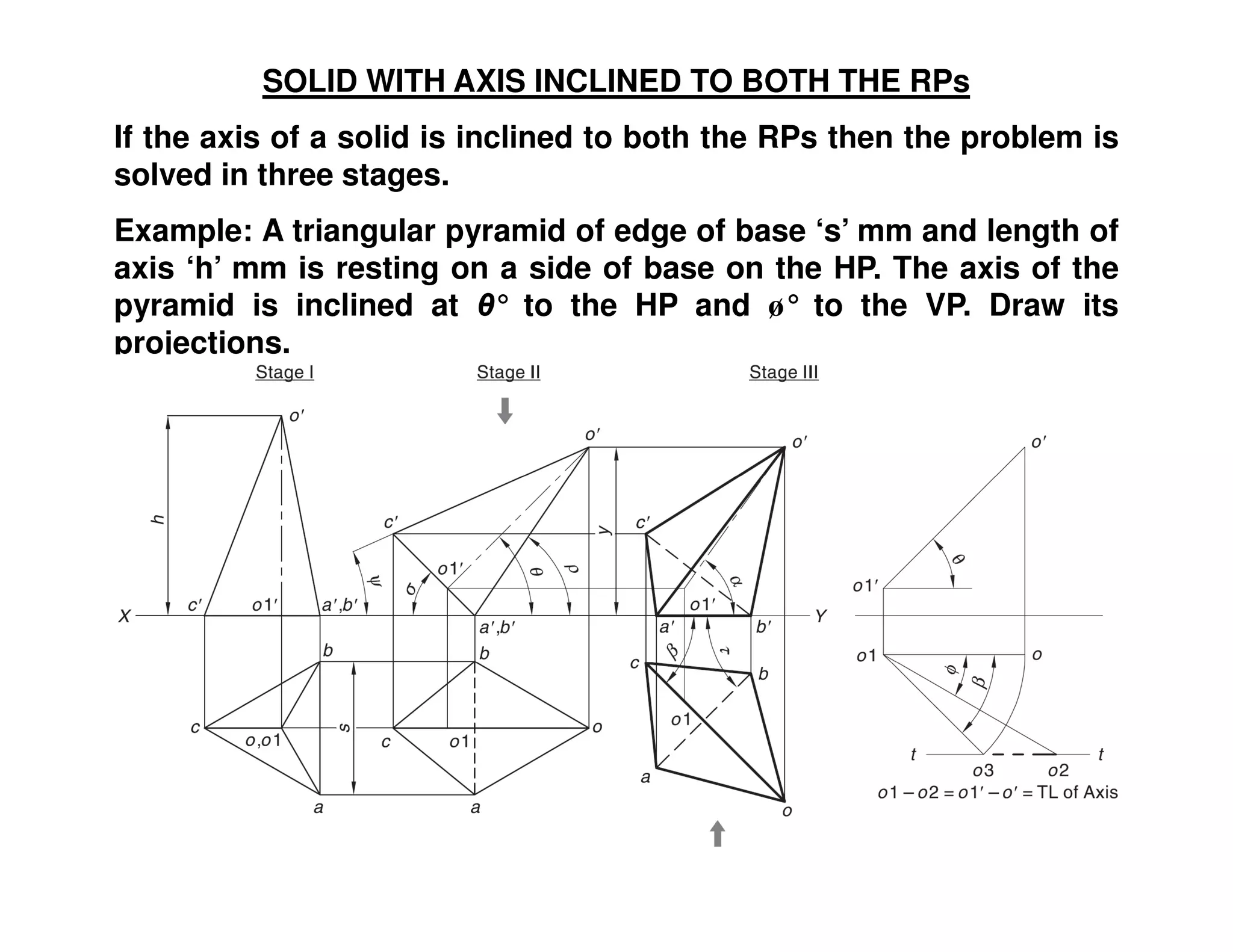
SOLID WITH AXIS INCLINED TO BOTH THE RPs
to obtain the final position.
2. Auxiliary plane method (Change of reference-line method) –
the solids are placed initially in the simple position and then one or
two auxiliary planes are setup to obtain the views in the required
position.
34.
Problem.1 A cubeof 30 mm side rests with one of its edges on HP such that
one of the square faces containing that edge is inclined at 300 to HP and
the edge on which it rests being inclined to 600 to VP. Draw its
projections.
35.
Problem2. Draw thetop and front views of a rectangular pyramid of sides
of base 40x 50 mm and height 70 mm when it lies on one of its larger
triangular faces on HP. The longer edge of the base of the triangular face
lying on HP is inclined at 600 to VP in the top view with the apex of the
pyramid being nearer to VP.
36.
Problem-3: A HexagonalPyramid, base 25 mm side and axis 55
mm long, has one of its slant edges on the ground. A plane
containing that edge and the axis is perpendicular to the HP and
inclined at 450 to VP. Draw the projections when the apex is
nearer to the VP than the base.
Draw the TV of the pyramid
with a side of base parallel to
XY. The slant edges AO and DO
will also be parallel to XY. Draw
will also be parallel to XY. Draw
FV also.
Tilt the FV so that d’o’ is in XY.
Project the second TV.
Draw a new reference line X1Y1
making 45o angle with o1p1 (the
top view of the axis) and project
the final FV.
37.
Problems on cones
Problem4.A cone of base 80 mm diameter and height 100 mm lies with
one of its generators on HP and the axis appears to be inclined to VP
at an angle of 400 in the top view. Draw its top and front views.
38.
Problem5.
A cone ofbase 60 mm diameter and the axis 80 mm long lies on HP with its axis
inclined at 450 and 300 to HP and VP, respectively. Draw the top and front
views of the cone.
39.
SOLID WITH AXISINCLINED TO BOTH THE RPs
If the axis of a solid is inclined to both the RPs then the problem is
solved in three stages.
Example: A triangular pyramid of edge of base ‘s’ mm and length of
axis ‘h’ mm is resting on a side of base on the HP. The axis of the
pyramid is inclined at ° to the HP and ø° to the VP. Draw its
projections.





![Geotechnical Engineering-II [Lec #18: Terzaghi Bearing Capacity Equation]](https://cdn.slidesharecdn.com/ss_thumbnails/18-181123045854-thumbnail.jpg?width=640&height=640&fit=bounds)


