Object Oriented Analysis
and Design
Lecture 1
INTRODUCTION
Inam Ul Haq, inam.bth@gmail.com
University of Education Okara
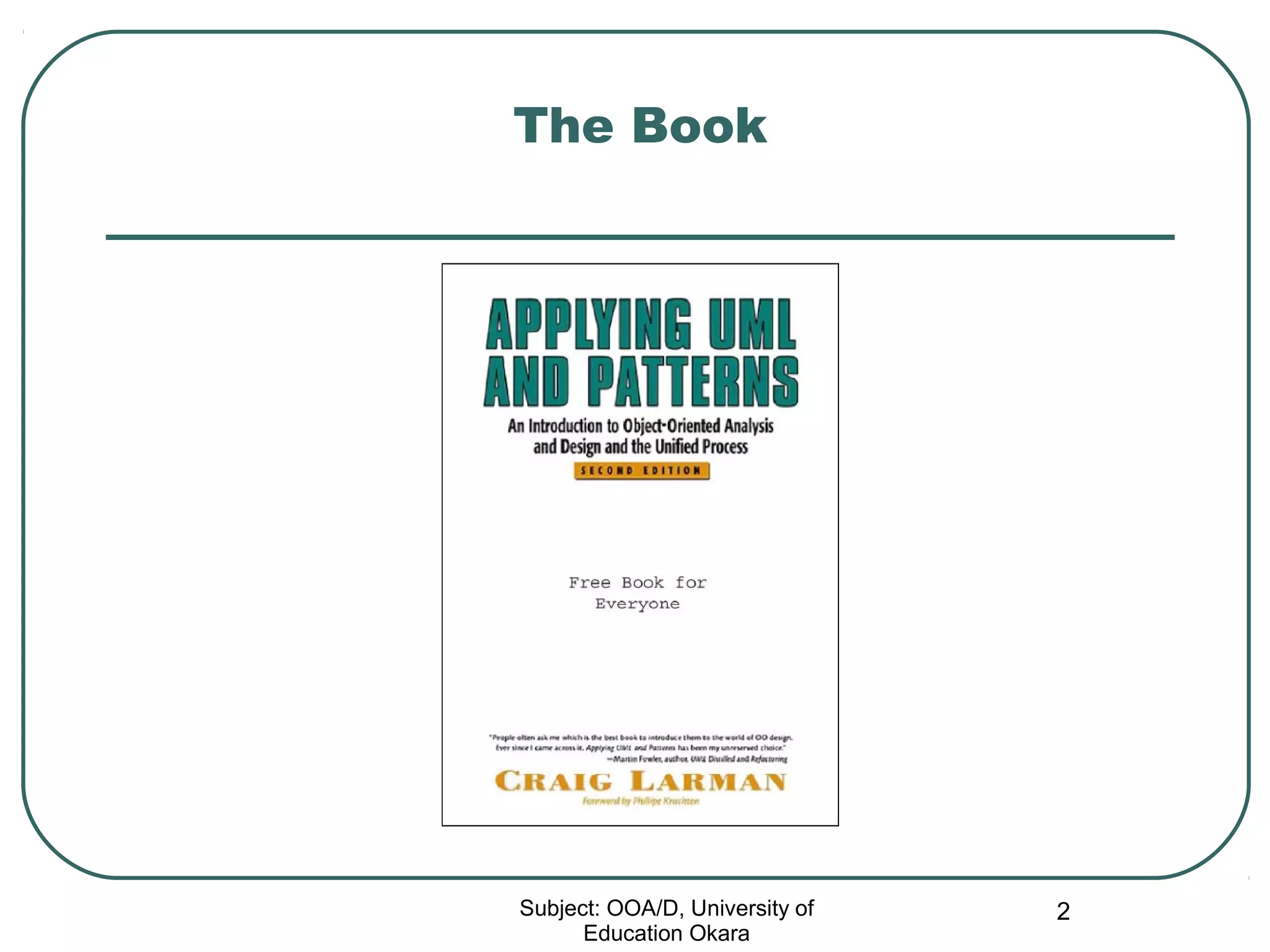
Book: Applying UML and Patterns
Thanks-Craig Larman
The Book
Subject: OOA/D, University of
Education Okara
2
Applying UML
 UML is just a standard diagramming language.
 It is just a tool, not a skill that is valuable in itself.
 Knowing UML helps you communicate with others in
creating software, but the real work in this course is
learning Object-Oriented Analysis and Design, not
how to draw diagrams.
Subject: OOA/D, University of Education Okara 3
Assigning Responsibilities
 The most important skill in OOA / D is assigning
responsibilities to objects.
 That determines how objects interact and what
classes should perform what operations.
Subject: OOA/D, University of Education
Okara
4
Requirements Analysis
 All Software Analysis and Design is preceded by the
analysis of requirements.
 One of the basic principles of good design is to defer
decisions as long as possible. The more you know
before you make a design decision, the more likely it
will be that the decision is a good one.
 TFCL: Think First, Code Later!
Subject: OOA/D, University of Education
Okara
5
Use Cases
 Writing Use Cases is not a specifically Object
Oriented practice.
 But it is a best practice for elaborating and
understanding requirements. So we will study Use
Cases.
Subject: OOA/D, University of Education
Okara
6
The Unified Process (UP)
 Definition: A standardized approach to analysis and
design helps to ensure that all necessary tasks are
understood and completed in software development.
• A language that uses UP is called UML.
 The Unified Modeling Language (UML) is a language for specifying,
visualizing, constructing, and documenting the artifacts of software
systems, as well as for business modeling and other non-software
systems.
Subject: OOA/D, University of Education
Okara
7
Other Necessary Skills
 Requirements Analysis, Object-Oriented Analysis
and Object-Oriented Design are not a complete
toolkit for a software developer.
 There are many other skills necessary in Software
development, including programming. This course
only covers a subset of the necessary skills.
Subject: OOA/D, University of Education
Okara
8
What is Object Oriented Analysis?
 The emphasis is on finding and describing the
objects (or concepts) in the problem domain.
 E.g. In a Library Information System, some of the
concepts include Book, Library, and Patron.
Subject: OOA/D, University of Education
Okara
9
What is Object Oriented Design?
 The emphasis is defining software objects and how
they collaborate to fulfill the requirements.
 In a Library Information System, a Book object may
have a title attribute and a get Chapter method.
Subject: OOA/D, University of Education
Okara
10
Implementation
 During Implementation, or Object-Oriented
Programming, design objects are implemented, such
as a book object in Java.
 Implementation is also known as Coding or
Construction.
Subject: OOA/D, University of Education
Okara
11
Example Tasks
 Define Use Cases
 Define a Domain Model
 Define Design Class Diagrams
 Define Interaction Diagrams
 The End
Subject: OOA/D, University of Education
Okara
12

OOA&D Lecture1

  • 1.
    Object Oriented Analysis andDesign Lecture 1 INTRODUCTION Inam Ul Haq, inam.bth@gmail.com University of Education Okara Book: Applying UML and Patterns Thanks-Craig Larman
  • 2.
    The Book Subject: OOA/D,University of Education Okara 2
  • 3.
    Applying UML  UMLis just a standard diagramming language.  It is just a tool, not a skill that is valuable in itself.  Knowing UML helps you communicate with others in creating software, but the real work in this course is learning Object-Oriented Analysis and Design, not how to draw diagrams. Subject: OOA/D, University of Education Okara 3
  • 4.
    Assigning Responsibilities  Themost important skill in OOA / D is assigning responsibilities to objects.  That determines how objects interact and what classes should perform what operations. Subject: OOA/D, University of Education Okara 4
  • 5.
    Requirements Analysis  AllSoftware Analysis and Design is preceded by the analysis of requirements.  One of the basic principles of good design is to defer decisions as long as possible. The more you know before you make a design decision, the more likely it will be that the decision is a good one.  TFCL: Think First, Code Later! Subject: OOA/D, University of Education Okara 5
  • 6.
    Use Cases  WritingUse Cases is not a specifically Object Oriented practice.  But it is a best practice for elaborating and understanding requirements. So we will study Use Cases. Subject: OOA/D, University of Education Okara 6
  • 7.
    The Unified Process(UP)  Definition: A standardized approach to analysis and design helps to ensure that all necessary tasks are understood and completed in software development. • A language that uses UP is called UML.  The Unified Modeling Language (UML) is a language for specifying, visualizing, constructing, and documenting the artifacts of software systems, as well as for business modeling and other non-software systems. Subject: OOA/D, University of Education Okara 7
  • 8.
    Other Necessary Skills Requirements Analysis, Object-Oriented Analysis and Object-Oriented Design are not a complete toolkit for a software developer.  There are many other skills necessary in Software development, including programming. This course only covers a subset of the necessary skills. Subject: OOA/D, University of Education Okara 8
  • 9.
    What is ObjectOriented Analysis?  The emphasis is on finding and describing the objects (or concepts) in the problem domain.  E.g. In a Library Information System, some of the concepts include Book, Library, and Patron. Subject: OOA/D, University of Education Okara 9
  • 10.
    What is ObjectOriented Design?  The emphasis is defining software objects and how they collaborate to fulfill the requirements.  In a Library Information System, a Book object may have a title attribute and a get Chapter method. Subject: OOA/D, University of Education Okara 10
  • 11.
    Implementation  During Implementation,or Object-Oriented Programming, design objects are implemented, such as a book object in Java.  Implementation is also known as Coding or Construction. Subject: OOA/D, University of Education Okara 11
  • 12.
    Example Tasks  DefineUse Cases  Define a Domain Model  Define Design Class Diagrams  Define Interaction Diagrams  The End Subject: OOA/D, University of Education Okara 12