LLiiggaammeennttoouuss aanndd TTeennddoonn 
IInnjjuurriieess AAbboouutt tthhee AAnnkkllee 
UCMC Trauma Conference 5/2/12
Talus
Medial 
 Superficial 
Superficial 
talotibial, 
naviculotibial, and 
calcaneotibial 
fibers 
 Deep 
–Deep anterior 
talotibial and 
posterior talotibial 
fibers from 
posterior colliculus 
to talus 
–Strongest portion 
of the Deltoid 
ligament
Lateral Collateral 
Ligaments 
 Anterior Talofibular 
Ligament 
– First injured in 
lateral sprain 
with 
plantarflexed 
ankle 
 Calcaneofibular 
Ligament 
– Strongest 
lateral ligament 
– First injured in 
lateral sprain 
with dorsiflexed 
ankle 
 Posterior Talofibular 
Ligament
Syndesmosis 
 Anterior inferior 
tibiofibular 
ligament 
 Posterior inferior 
tibiofibular 
ligament 
 Transverse 
tibiofibular 
ligament 
 Interosseous 
membrane
Ankle Sprains 
 Most common ligamentous injury 
 One sprain per day per 10,000 people 
 40% will have intermittent chronic problems (Garrick, Am J Sports Med, 1977) 
 More common on the lateral aspect of the ankle
 Physical Exam 
– Palpation over medial and 
lateral malleoli 
– Palpation over deltoid ligament 
– Palpation over ATFL, CFL, and 
PTFL 
– Neurovascular exam 
– Anterior drawer test for ATFL 
– Talar tilt to assess CFL 
– Squeeze test to look for 
syndesmotic injury 
EXAM
 Most common mechanism of ankle 
injury is inversion stress with 
plantarflexion 
– May lead to ankle fracture, 
sprain, or syndesmotic injury 
 Abduction or adduction are other 
mechanisms
 AP of the Ankle 
– Tibio-Fibular Clear 
Space 
 AB < 5mm is 
normal 
– Tibio-Fibular 
Overlap 
 BC > 10 mm is 
normal
 Mortise View 
– Ankle internally 
rotated 
– AB clear space 
– BC overlap 
– Talocrural angle (83 
degrees) 
– Medial clear space 
<4 mm
Ankle Stress 
Radiographs 
 Talar tilt view 
– Demonstrates complete 
ligamentous instability 
– Talar tilt <2 mm 
 External rotation view 
– Useful in identifying 
syndesmotic injury
Ankle Stress 
Radiographs 
Anterior drawer 
stress view 
– No fracture seen 
– >3 mm anterior 
translation compared 
to contralateral side 
or >10 mm 
translation 
– Incongruency of 
ankle joint present 
– Ligamentous 
instability present
Lateral Ankle Sprains 
 Commonly missed diagnoses 
– Peroneal tendon injuries 
– Achilles injuries 
– FX’s 
 Lateral process of talus 
 Anterior process of 
calcaneus 
 Fifth metatarsal 
 Lisfranc injuries 
– Osteochondral Lesion of the 
Talus
Lateral Ankle Sprains 
Lateral Process FX of the Talus 
“Snowboarders” injury
Ankle Sprain Treatment 
 RICE ROM exercises 
 Peroneal strengthening and proprioceptive training
Ligament Reconstructions 
 These procedures use the peroneal tendons to 
reconstruct the lateral ligamentous complex 
 Higher complication rates than Brostrom 
 More restricted ankle and subtalar motion (Colville, JAAOS, 
1998)
Medial Ankle 
Sprain 
 5% ankle sprains 
 Forced eversion 
 Injury to deltoid ligament 
 May be associated with 
syndesmotic injury 
and/or Weber C fibula 
FX
Syndesmotic (High) Ankle Sprains
Syndesmosis 
Exam 
 Squeeze Test 
– Squeeze the 
syndesmosis above the 
ankle®pain 
 Abduction-External Rotation 
Stress Test 
– Further instability with 
external rotation (may be 
shown with x-ray) 
 Gravity Stress Test 
– Foot hanging free in 
lateral position with 
mortise view taken
Stress Radiograph - 
Technique
Stress View 
SER-2 
+ Stress View 
Negative Stress view 
External Widened Medial rotation Clear 
of foot 
with ankle Space 
in neutral 
flexion (00) 
Stable  Treatment 
FWBAT
Syndesmosis Injury 
 Surgical Treatment 
– Maximally dorsiflex 
hindfoot 
– Reduce the syndesmosis 
with a large clamp under 
fluoro by internally 
rotating the fibula and 
compressing it to the 
tibia 
– Perform medial 
arthrotomy if unable to 
reduce in order to 
debride medial ankle 
joint
Fixation 
Screws are not 
lagged!
Syndesmosis Controversies 
Number of Screws 
– One vs. two, 3.5 mm screw vs. 4.5 mm 
screw 
Number of Cortices 
– Three vs. four cortices 
Ankle position during placement 
– Classically dorsiflexion was advocated 
– Tornetta showed no difference with 
plantarflexion
EEnnddoobbuuttttoonn aanndd HHeeaavvyy SSuuttuurree 
– PPootteennttiiaall BBeenneeffiittss 
 fflleexxiibbllee ffiixxaattiioonn,, nnoo nneeeedd ffoorr iimmppllaanntt 
rreemmoovvaall,, eeaarrlliieerr wweeiigghhtt bbeeaarriinngg 
 IImmpprroovveedd ssuubbjjeeccttiivvee oouuttccoommeess ssiimmiillaarr 
oobbjjeeccttiivvee oouuttccoommeess
Ankle Dislocations 
 Isolated ankle dislocation is rare 
 Mechanism is forced inversion 
that results in a posteromedial 
dislocation 
 Anterolateral ligaments 
damaged 
 Commonly open 30 - 90% 
 Rule out neurovascular injury
Tibiotalar 
Dislocations 
 Management closed 
injury 
– Check neurovascular 
status 
– Prompt closed 
reduction 
– Cast for 6 weeks in 
plantigrade position 
– Results generally 
good 
– Results not improved 
with acute ligament 
repair 
– Late instability rare
Achilles Tendon Ruptures 
 AAnnaattoommyy 
– 1100-1122 ccmm lloonngg 
– 00..55-11..00 ccmm ddiiaammeetteerr 
– AAvvaassccuullaarr zzoonnee 22-66 ccmm pprrooxxiimmaall ttoo 
iinnsseerrttiioonn 
– FFiibbeerrss rroottaattee 9900 ddeeggrreeeess aatt iinnsseerrttiioonn
Achilles Tendon Rupture 
– Acute pain in the back of the ankle with contraction, no antecedent history of calf or heal pain 
– Average age 35 
– Steroids, fluorquinolones, and chronic overuse may predispose to rupture 
Pathology 
– Rupture occurs 3-4 cm above the Achilles insertion in a watershed area
Achilles Tendon Rupture 
 Physical Exam 
– Tenderness over 
achilles tendon 
– Palpable defect 
– Positive Thompson’s 
test 
– No evidence to support 
routine use of MRI, 
U/S, or Xray
Achilles Tendon Ruptures 
 SSuurrggiiccaall rreeppaaiirr 
– YYoouunnggeerr aaccttiivvee ppaattiieennttss 
 NNoonnooppeerraattiivvee ttrreeaattmmeenntt 
– OOllddeerr sseeddeennttaarryy ppaattiieennttss 
– PPaattiieennttss wwiitthh iinnccrreeaasseedd rriisskk ooff ssoofftt ttiissssuuee ccoommpplliiccaattiioonnss 
 IIDDDDMM 
 SSmmookkeerrss 
 VVaassccuullaarr ddiisseeaassee 
 BBMMII >> 3300
Management of Non-Operative 
Tx Short leg cast strategy (SLC) 
– SLC is applied w/ ankle in plantarflexion 
– Cast is brought out of equinus over 8-10 
weeks 
– Walking is allowed (in the cast) at 4-6 weeks 
– Alternatively, consider using functional brace 
starting in 45 degrees of flexion 
– Following casting, a 2 cm heel lift is worn for 
an additional 2-4 months 
Long leg cast (LLC) 
– Initial LLC in gravity equinus for 6 weeks, 
followed by short leg cast for 4 weeks
Clinical Evidence to Support Nonoperative Treatment 
 Benefits: no wound complications, no scar, decreased patient cost. 
 Disadvantage: up to 39% re-rupture rate, increased patient dissatisfaction, decreased power, strength and 
endurance. 
 Gillies and Chalmers- 
– 80% vs. 84.3% return of strength compared to unaffected side, non-op and operative, respectively 
 Wills, 775 patients the overall complication rate of surgically treated Achilles tendon ruptures was 20%. 
– skin necrosis, wound infection, sural neuromas, adhesions of the scar to the skin, and the usual 
anesthesia risks
 SSuurrggiiccaall ttrreeaattmmeenntt 
– PPrreeffeerrrreedd ffoorr 
aatthhlleetteess 
– MMeeddiiaall iinncciissiioonn 
aavvooiiddss tthhee ssuurraall 
nneerrvvee 
– PPeerrccuuttaanneeoouuss vvss.. 
OOppeenn ttrreeaattmmeennttss 
ddeessccrriibbeedd 
– IIssoollaattee tthhee 
ppaarraatteennoonn aass aa 
sseeppaarraattee layer
CClliinniiccaall RReessuullttss SSuurrggiiccaall 
RReeccoonnssttrruuccttiioonn 
 BBeenneeffiittss:: 00--55%% rree--rruuppttuurree rraattee,, >> ppeerrcceennttaaggee ppaattiieennttss 
rreettuurrnn ttoo ssppoorrtt,, iimmpprroovveedd ppoowweerr,, ssttrreennggtthh,, aanndd eenndduurraannccee.. 
 DDiissaaddvvaannttaaggeess:: >> ppaattiieenntt ccoosstt aanndd wwoouunndd ccoommpplliiccaattiioonnss 
 CClliinniiccaall sseerriieess:: mmaannyy tteecchhnniiqquueess 
– MMoosstt BBuunnnneell oorr MMooddiiffiieedd KKeesssslleerr ssuuttuurree 
– SSoommee wwiitthh aauuggmmeennttaattiioonn EEHHLL vvss.. GGaassttrrooccnneemmiiuuss
Operative Support 
 Cetti et al. compared operative versus 
non-operative treatment in a prospective 
study with 111 patients 
– In the operative group (56 
patients), there were three re-ruptures 
(5%) and two deep 
infections, as compared with eight 
re-ruptures (15%) in the non-operative 
group (55 patients) 
– The operative group had a 
significantly higher rate of 
resuming sports activities at same 
level prior to rupture (57.1% vs 
29.1% of pts), a lesser degree of 
calf atrophy (1.6 cm vs 1.1 cm calf 
circum.), significantly fewer 
complaints at 1 year (29% vs 49% 
of pts), and better ankle movement 
at 1 year (82% vs 53% of pts, op 
vs non-op, respectively)
Percutaneous Achilles Repair
Chronic Achilles Tendon 
Rupture 
 History 
– Remote hx trauma, post 
pain, gradual improvement 
of symptoms, palpable 
tendon defect. 
– No hx trauma, gradual 
thickening of tendon, AM 
startup pain, pain 
ascending/descending 
stairs. 
 Physical Exam 
– “Hatchet” posterior calf at 
site of defect at resolution of 
swelling 
– Positive Thompson test 
– Weakened plantar flexion
MRI 
 <3 cm gap, <3 months old— 
primary repair 
 >3cm gap—scar tissue 
debridement and V-Y lengthening 
of proximal gastroc tendon granted 
that remaining tissue no evidence 
inflammation 
 Evidence chronic inflammation— 
augmentation with FHL tendon
Chronic Achilles Rupture 
Chronic rupture may 
be reconstructed 
with FHL, FDL, or 
slip from 
gastrocnemius
Achilles Tendon Ruptures 
Reconstruction of neglected rruuppttuurree wwiitthh 
ppeerroonneeuuss lloonngguuss aanndd ppllaannttaarriiss wweeaavvee
V-Y Lengthening: >3 cm 
Debride necrotic tissue 
Advance Tendon 
Suture Repair
FHL Transfer: >3cm with 
tendinopathy 
•Reflect abductor 
hallucis and flexor 
hallucis brevis 
•FHL medial to FDL
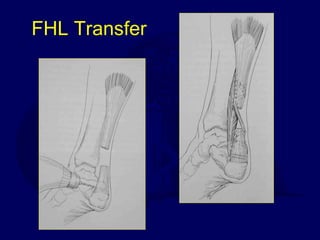
FHL Transfer 
Tag each end 
of tendon
FHL Transfer 
Distal FHL sutured to FDL with 
ankle and toes in neutral 
Confirm full hallux MTP dorsiflexion, otherwise 
retension and residual clawing
FHL Transfer
 PPeerroonneeaall tteennddoonnss ccoouurrssee bbeehhiinndd tthhee ddiissttaall 
Peroneal TTeennddoonn DDiissllooccaattiioonn 
ffiibbuullaa 
 TThhee ppeerroonneeuuss bbrreevviiss mmaayy hhaavvee 
ddeeggeenneerraattiivvee cchhaannggeess iiff tthhee iinnjjuurryy iiss nnoott 
iiddeennttiiffiieedd iinn aa ttiimmeellyy ffaasshhiioonn
Peroneal Tendon Dislocation 
X-ray 
– May show avulsion of retinaculum from 
fibula 
Conservative treatment 
– Casting in slight plantarflexion and 
inversion for 6 weeks non weight bearing 
– Allows the retinaculum to heal if the 
tendons can be reduced closed 
– Successful if the injury is identified early
PPeerroonneeaall TTeennddoonn DDiissllooccaattiioonn  SSuurrggeerryy 
– OORRIIFF rreettiinnaaccuullaarr ppiieeccee iiff ppoossssiibbllee 
– RReeppaaiirr rreettiinnaaccuulluumm iiff ppoossssiibbllee 
– SSoofftt ttiissssuuee rreeccoonnssttrruuccttiioonn wwiitthh sslliinngg ffoorr 
rreettiinnaaccuulluumm
Peroneal Tendon Dislocation
Posterior Tibial Tendon Rupture 
 AAnnaattoommyy 
– AArriisseess ffrroomm ppoosstteerriioorr aassppeecctt iinntteerrmmuussccuullaarr sseeppttuumm 
– IInnsseerrttss oonn ttaarrssaall bboonneess 
– AAvvaassccuullaarr zzoonnee ppoosstteerriioorr ttoo mmeeddiiaall mmaalllleeoolluuss 
– HHiigghh ffrriiccttiioonnaall llooaadd ppoosstteerriioorr ttoo mmeeddiiaall mmaalllleeoolluuss
Posterior Tibial Tendon Rupture 
 Function 
– Inverter of hindfoot 
– Locks transverse tarsal joint 
– Maintains height longitudinal arch 
– Maintains neutral position of hindfoot at degrees
Posterior Tibial Tendon 
 History 
– More commonly an attritional rupture over time than an acute rupture 
– Patient may complain of flat foot and midfoot pain 
– Sports with quick changes of direction may put increased force on tendon 
 X-ray 
– Foot x-ray may show medial talar displacement
AP Radiograph 
 Talonavicular 
coverage- as arch 
collapses the talarhead 
coverage by the 
navicular is lost 
Talus-1st MT 
diverges or angle 
increases 
Anterior 
talocalcaneal 
angle increases
Lateral Radiograph 
A. Increased Talus-forefoot 
angle 
B. Increased Talus 
Calcaneous angle 
- plantarflexed talus 
C. Decreased Calcaneal 
Pitch 
Negative Med Cun-5th MT 
- normally the 5th MT is 
more plantar than the 
medial cuneiform 
A 
B 
C
Talus-1st MT and Calcaneal 
Pitch 
Colinear Talus-1st 
MT 
Normal calcaneal 
pitch 
Divergent Talus- 
1st MT 
Loss of calcaneal 
pitch
Posterior Tibialis Reconstruction 
Surgery for the 
flexible deformity 
– Reconstruction of the 
posterior tibial 
tendon with FDL or 
FHL 
– Medial calcaneal 
wedge osteotomy or 
lateral column 
lengthening through 
the calcaneus 
– Fig 14, page 1705 from “Acquired adult 
flatfoot deformity” in Orthopaedics, 2002
Posterior Tibial Tendon Rupture 
Chronic rupture 
– Develop gradually 
– Women over 40 
– Tenderness/swelling 
over tendon 
– Forefoot abduction 
– “too many toes” sign 
– Absent single heel 
raise 
–Loss 
of 
height 
of arch 
–Hindfoot valgus
Posterior Tibial Tendon Rupture 
 Chronic rupture 
– Stage I 
 Pain, weakness, no 
deformity 
– Stage II 
 Flexible flatfoot deformity 
– Stage III 
 Rigid flatfoot deformity 
 Radiographic 
subluxation/arthritis
Posterior Tibial Tendon Rupture 
Management 
– Chronic rupture 
Stage I 
– Nonop (NSAID, arch support, AFO) 
– Tenosynovectomy if SXs persist 
Stage II 
tenosynovectomy 
– nonop (medial wedge, arch support, or AFO) 
– Surgical TX controversial 
– Reconstruction utilizing FDL or split anterior tibial tendon 
– Deformity frequently recurs 
– Calcaneal osteotomies hold promise
Thanks!

Lecture trauma ankle_tendon

  • 1.
    LLiiggaammeennttoouuss aanndd TTeennddoonn IInnjjuurriieess AAbboouutt tthhee AAnnkkllee UCMC Trauma Conference 5/2/12
  • 2.
  • 3.
    Medial  Superficial Superficial talotibial, naviculotibial, and calcaneotibial fibers  Deep –Deep anterior talotibial and posterior talotibial fibers from posterior colliculus to talus –Strongest portion of the Deltoid ligament
  • 4.
    Lateral Collateral Ligaments  Anterior Talofibular Ligament – First injured in lateral sprain with plantarflexed ankle  Calcaneofibular Ligament – Strongest lateral ligament – First injured in lateral sprain with dorsiflexed ankle  Posterior Talofibular Ligament
  • 5.
    Syndesmosis  Anteriorinferior tibiofibular ligament  Posterior inferior tibiofibular ligament  Transverse tibiofibular ligament  Interosseous membrane
  • 6.
    Ankle Sprains Most common ligamentous injury  One sprain per day per 10,000 people  40% will have intermittent chronic problems (Garrick, Am J Sports Med, 1977)  More common on the lateral aspect of the ankle
  • 7.
     Physical Exam – Palpation over medial and lateral malleoli – Palpation over deltoid ligament – Palpation over ATFL, CFL, and PTFL – Neurovascular exam – Anterior drawer test for ATFL – Talar tilt to assess CFL – Squeeze test to look for syndesmotic injury EXAM
  • 8.
     Most commonmechanism of ankle injury is inversion stress with plantarflexion – May lead to ankle fracture, sprain, or syndesmotic injury  Abduction or adduction are other mechanisms
  • 9.
     AP ofthe Ankle – Tibio-Fibular Clear Space  AB < 5mm is normal – Tibio-Fibular Overlap  BC > 10 mm is normal
  • 10.
     Mortise View – Ankle internally rotated – AB clear space – BC overlap – Talocrural angle (83 degrees) – Medial clear space <4 mm
  • 11.
    Ankle Stress Radiographs  Talar tilt view – Demonstrates complete ligamentous instability – Talar tilt <2 mm  External rotation view – Useful in identifying syndesmotic injury
  • 12.
    Ankle Stress Radiographs Anterior drawer stress view – No fracture seen – >3 mm anterior translation compared to contralateral side or >10 mm translation – Incongruency of ankle joint present – Ligamentous instability present
  • 13.
    Lateral Ankle Sprains  Commonly missed diagnoses – Peroneal tendon injuries – Achilles injuries – FX’s  Lateral process of talus  Anterior process of calcaneus  Fifth metatarsal  Lisfranc injuries – Osteochondral Lesion of the Talus
  • 14.
    Lateral Ankle Sprains Lateral Process FX of the Talus “Snowboarders” injury
  • 15.
    Ankle Sprain Treatment  RICE ROM exercises  Peroneal strengthening and proprioceptive training
  • 16.
    Ligament Reconstructions These procedures use the peroneal tendons to reconstruct the lateral ligamentous complex  Higher complication rates than Brostrom  More restricted ankle and subtalar motion (Colville, JAAOS, 1998)
  • 17.
    Medial Ankle Sprain  5% ankle sprains  Forced eversion  Injury to deltoid ligament  May be associated with syndesmotic injury and/or Weber C fibula FX
  • 18.
  • 19.
    Syndesmosis Exam Squeeze Test – Squeeze the syndesmosis above the ankle®pain  Abduction-External Rotation Stress Test – Further instability with external rotation (may be shown with x-ray)  Gravity Stress Test – Foot hanging free in lateral position with mortise view taken
  • 20.
  • 21.
    Stress View SER-2 + Stress View Negative Stress view External Widened Medial rotation Clear of foot with ankle Space in neutral flexion (00) Stable  Treatment FWBAT
  • 22.
    Syndesmosis Injury Surgical Treatment – Maximally dorsiflex hindfoot – Reduce the syndesmosis with a large clamp under fluoro by internally rotating the fibula and compressing it to the tibia – Perform medial arthrotomy if unable to reduce in order to debride medial ankle joint
  • 23.
  • 24.
    Syndesmosis Controversies Numberof Screws – One vs. two, 3.5 mm screw vs. 4.5 mm screw Number of Cortices – Three vs. four cortices Ankle position during placement – Classically dorsiflexion was advocated – Tornetta showed no difference with plantarflexion
  • 25.
    EEnnddoobbuuttttoonn aanndd HHeeaavvyySSuuttuurree – PPootteennttiiaall BBeenneeffiittss  fflleexxiibbllee ffiixxaattiioonn,, nnoo nneeeedd ffoorr iimmppllaanntt rreemmoovvaall,, eeaarrlliieerr wweeiigghhtt bbeeaarriinngg  IImmpprroovveedd ssuubbjjeeccttiivvee oouuttccoommeess ssiimmiillaarr oobbjjeeccttiivvee oouuttccoommeess
  • 26.
    Ankle Dislocations Isolated ankle dislocation is rare  Mechanism is forced inversion that results in a posteromedial dislocation  Anterolateral ligaments damaged  Commonly open 30 - 90%  Rule out neurovascular injury
  • 27.
    Tibiotalar Dislocations Management closed injury – Check neurovascular status – Prompt closed reduction – Cast for 6 weeks in plantigrade position – Results generally good – Results not improved with acute ligament repair – Late instability rare
  • 28.
    Achilles Tendon Ruptures  AAnnaattoommyy – 1100-1122 ccmm lloonngg – 00..55-11..00 ccmm ddiiaammeetteerr – AAvvaassccuullaarr zzoonnee 22-66 ccmm pprrooxxiimmaall ttoo iinnsseerrttiioonn – FFiibbeerrss rroottaattee 9900 ddeeggrreeeess aatt iinnsseerrttiioonn
  • 29.
    Achilles Tendon Rupture – Acute pain in the back of the ankle with contraction, no antecedent history of calf or heal pain – Average age 35 – Steroids, fluorquinolones, and chronic overuse may predispose to rupture Pathology – Rupture occurs 3-4 cm above the Achilles insertion in a watershed area
  • 30.
    Achilles Tendon Rupture  Physical Exam – Tenderness over achilles tendon – Palpable defect – Positive Thompson’s test – No evidence to support routine use of MRI, U/S, or Xray
  • 31.
    Achilles Tendon Ruptures  SSuurrggiiccaall rreeppaaiirr – YYoouunnggeerr aaccttiivvee ppaattiieennttss  NNoonnooppeerraattiivvee ttrreeaattmmeenntt – OOllddeerr sseeddeennttaarryy ppaattiieennttss – PPaattiieennttss wwiitthh iinnccrreeaasseedd rriisskk ooff ssoofftt ttiissssuuee ccoommpplliiccaattiioonnss  IIDDDDMM  SSmmookkeerrss  VVaassccuullaarr ddiisseeaassee  BBMMII >> 3300
  • 32.
    Management of Non-Operative Tx Short leg cast strategy (SLC) – SLC is applied w/ ankle in plantarflexion – Cast is brought out of equinus over 8-10 weeks – Walking is allowed (in the cast) at 4-6 weeks – Alternatively, consider using functional brace starting in 45 degrees of flexion – Following casting, a 2 cm heel lift is worn for an additional 2-4 months Long leg cast (LLC) – Initial LLC in gravity equinus for 6 weeks, followed by short leg cast for 4 weeks
  • 33.
    Clinical Evidence toSupport Nonoperative Treatment  Benefits: no wound complications, no scar, decreased patient cost.  Disadvantage: up to 39% re-rupture rate, increased patient dissatisfaction, decreased power, strength and endurance.  Gillies and Chalmers- – 80% vs. 84.3% return of strength compared to unaffected side, non-op and operative, respectively  Wills, 775 patients the overall complication rate of surgically treated Achilles tendon ruptures was 20%. – skin necrosis, wound infection, sural neuromas, adhesions of the scar to the skin, and the usual anesthesia risks
  • 34.
     SSuurrggiiccaall ttrreeaattmmeenntt – PPrreeffeerrrreedd ffoorr aatthhlleetteess – MMeeddiiaall iinncciissiioonn aavvooiiddss tthhee ssuurraall nneerrvvee – PPeerrccuuttaanneeoouuss vvss.. OOppeenn ttrreeaattmmeennttss ddeessccrriibbeedd – IIssoollaattee tthhee ppaarraatteennoonn aass aa sseeppaarraattee layer
  • 35.
    CClliinniiccaall RReessuullttss SSuurrggiiccaall RReeccoonnssttrruuccttiioonn  BBeenneeffiittss:: 00--55%% rree--rruuppttuurree rraattee,, >> ppeerrcceennttaaggee ppaattiieennttss rreettuurrnn ttoo ssppoorrtt,, iimmpprroovveedd ppoowweerr,, ssttrreennggtthh,, aanndd eenndduurraannccee..  DDiissaaddvvaannttaaggeess:: >> ppaattiieenntt ccoosstt aanndd wwoouunndd ccoommpplliiccaattiioonnss  CClliinniiccaall sseerriieess:: mmaannyy tteecchhnniiqquueess – MMoosstt BBuunnnneell oorr MMooddiiffiieedd KKeesssslleerr ssuuttuurree – SSoommee wwiitthh aauuggmmeennttaattiioonn EEHHLL vvss.. GGaassttrrooccnneemmiiuuss
  • 36.
    Operative Support Cetti et al. compared operative versus non-operative treatment in a prospective study with 111 patients – In the operative group (56 patients), there were three re-ruptures (5%) and two deep infections, as compared with eight re-ruptures (15%) in the non-operative group (55 patients) – The operative group had a significantly higher rate of resuming sports activities at same level prior to rupture (57.1% vs 29.1% of pts), a lesser degree of calf atrophy (1.6 cm vs 1.1 cm calf circum.), significantly fewer complaints at 1 year (29% vs 49% of pts), and better ankle movement at 1 year (82% vs 53% of pts, op vs non-op, respectively)
  • 37.
  • 38.
    Chronic Achilles Tendon Rupture  History – Remote hx trauma, post pain, gradual improvement of symptoms, palpable tendon defect. – No hx trauma, gradual thickening of tendon, AM startup pain, pain ascending/descending stairs.  Physical Exam – “Hatchet” posterior calf at site of defect at resolution of swelling – Positive Thompson test – Weakened plantar flexion
  • 39.
    MRI  <3cm gap, <3 months old— primary repair  >3cm gap—scar tissue debridement and V-Y lengthening of proximal gastroc tendon granted that remaining tissue no evidence inflammation  Evidence chronic inflammation— augmentation with FHL tendon
  • 40.
    Chronic Achilles Rupture Chronic rupture may be reconstructed with FHL, FDL, or slip from gastrocnemius
  • 41.
    Achilles Tendon Ruptures Reconstruction of neglected rruuppttuurree wwiitthh ppeerroonneeuuss lloonngguuss aanndd ppllaannttaarriiss wweeaavvee
  • 42.
    V-Y Lengthening: >3cm Debride necrotic tissue Advance Tendon Suture Repair
  • 43.
    FHL Transfer: >3cmwith tendinopathy •Reflect abductor hallucis and flexor hallucis brevis •FHL medial to FDL
  • 44.
    FHL Transfer Tageach end of tendon
  • 45.
    FHL Transfer DistalFHL sutured to FDL with ankle and toes in neutral Confirm full hallux MTP dorsiflexion, otherwise retension and residual clawing
  • 46.
  • 47.
     PPeerroonneeaall tteennddoonnssccoouurrssee bbeehhiinndd tthhee ddiissttaall Peroneal TTeennddoonn DDiissllooccaattiioonn ffiibbuullaa  TThhee ppeerroonneeuuss bbrreevviiss mmaayy hhaavvee ddeeggeenneerraattiivvee cchhaannggeess iiff tthhee iinnjjuurryy iiss nnoott iiddeennttiiffiieedd iinn aa ttiimmeellyy ffaasshhiioonn
  • 48.
    Peroneal Tendon Dislocation X-ray – May show avulsion of retinaculum from fibula Conservative treatment – Casting in slight plantarflexion and inversion for 6 weeks non weight bearing – Allows the retinaculum to heal if the tendons can be reduced closed – Successful if the injury is identified early
  • 49.
    PPeerroonneeaall TTeennddoonn DDiissllooccaattiioonn SSuurrggeerryy – OORRIIFF rreettiinnaaccuullaarr ppiieeccee iiff ppoossssiibbllee – RReeppaaiirr rreettiinnaaccuulluumm iiff ppoossssiibbllee – SSoofftt ttiissssuuee rreeccoonnssttrruuccttiioonn wwiitthh sslliinngg ffoorr rreettiinnaaccuulluumm
  • 50.
  • 51.
  • 52.
    Posterior Tibial TendonRupture  AAnnaattoommyy – AArriisseess ffrroomm ppoosstteerriioorr aassppeecctt iinntteerrmmuussccuullaarr sseeppttuumm – IInnsseerrttss oonn ttaarrssaall bboonneess – AAvvaassccuullaarr zzoonnee ppoosstteerriioorr ttoo mmeeddiiaall mmaalllleeoolluuss – HHiigghh ffrriiccttiioonnaall llooaadd ppoosstteerriioorr ttoo mmeeddiiaall mmaalllleeoolluuss
  • 53.
    Posterior Tibial TendonRupture  Function – Inverter of hindfoot – Locks transverse tarsal joint – Maintains height longitudinal arch – Maintains neutral position of hindfoot at degrees
  • 54.
    Posterior Tibial Tendon  History – More commonly an attritional rupture over time than an acute rupture – Patient may complain of flat foot and midfoot pain – Sports with quick changes of direction may put increased force on tendon  X-ray – Foot x-ray may show medial talar displacement
  • 55.
    AP Radiograph Talonavicular coverage- as arch collapses the talarhead coverage by the navicular is lost Talus-1st MT diverges or angle increases Anterior talocalcaneal angle increases
  • 56.
    Lateral Radiograph A.Increased Talus-forefoot angle B. Increased Talus Calcaneous angle - plantarflexed talus C. Decreased Calcaneal Pitch Negative Med Cun-5th MT - normally the 5th MT is more plantar than the medial cuneiform A B C
  • 57.
    Talus-1st MT andCalcaneal Pitch Colinear Talus-1st MT Normal calcaneal pitch Divergent Talus- 1st MT Loss of calcaneal pitch
  • 58.
    Posterior Tibialis Reconstruction Surgery for the flexible deformity – Reconstruction of the posterior tibial tendon with FDL or FHL – Medial calcaneal wedge osteotomy or lateral column lengthening through the calcaneus – Fig 14, page 1705 from “Acquired adult flatfoot deformity” in Orthopaedics, 2002
  • 59.
    Posterior Tibial TendonRupture Chronic rupture – Develop gradually – Women over 40 – Tenderness/swelling over tendon – Forefoot abduction – “too many toes” sign – Absent single heel raise –Loss of height of arch –Hindfoot valgus
  • 60.
    Posterior Tibial TendonRupture  Chronic rupture – Stage I  Pain, weakness, no deformity – Stage II  Flexible flatfoot deformity – Stage III  Rigid flatfoot deformity  Radiographic subluxation/arthritis
  • 61.
    Posterior Tibial TendonRupture Management – Chronic rupture Stage I – Nonop (NSAID, arch support, AFO) – Tenosynovectomy if SXs persist Stage II tenosynovectomy – nonop (medial wedge, arch support, or AFO) – Surgical TX controversial – Reconstruction utilizing FDL or split anterior tibial tendon – Deformity frequently recurs – Calcaneal osteotomies hold promise
  • 62.