Power System
(Generation, Transmission and
Distribution)
Lecture 1:Introduction
Muhammad Saleh Rashid
Dept. of Electrical Engineering
GIFT University, Gujranwala
saleh.rashid@gift.edu.pk
HEC recommendation…!
https://hec.gov.pk/english/services/universities/RevisedCurricula/Documents/
2016-2017/ELECTRICAL-ENGINEERING.pdf
Electrical
Engineering
(Foundation
knowledge)
Telecom/
Com.
System
Electronics
Computer
Architecture
Power
System
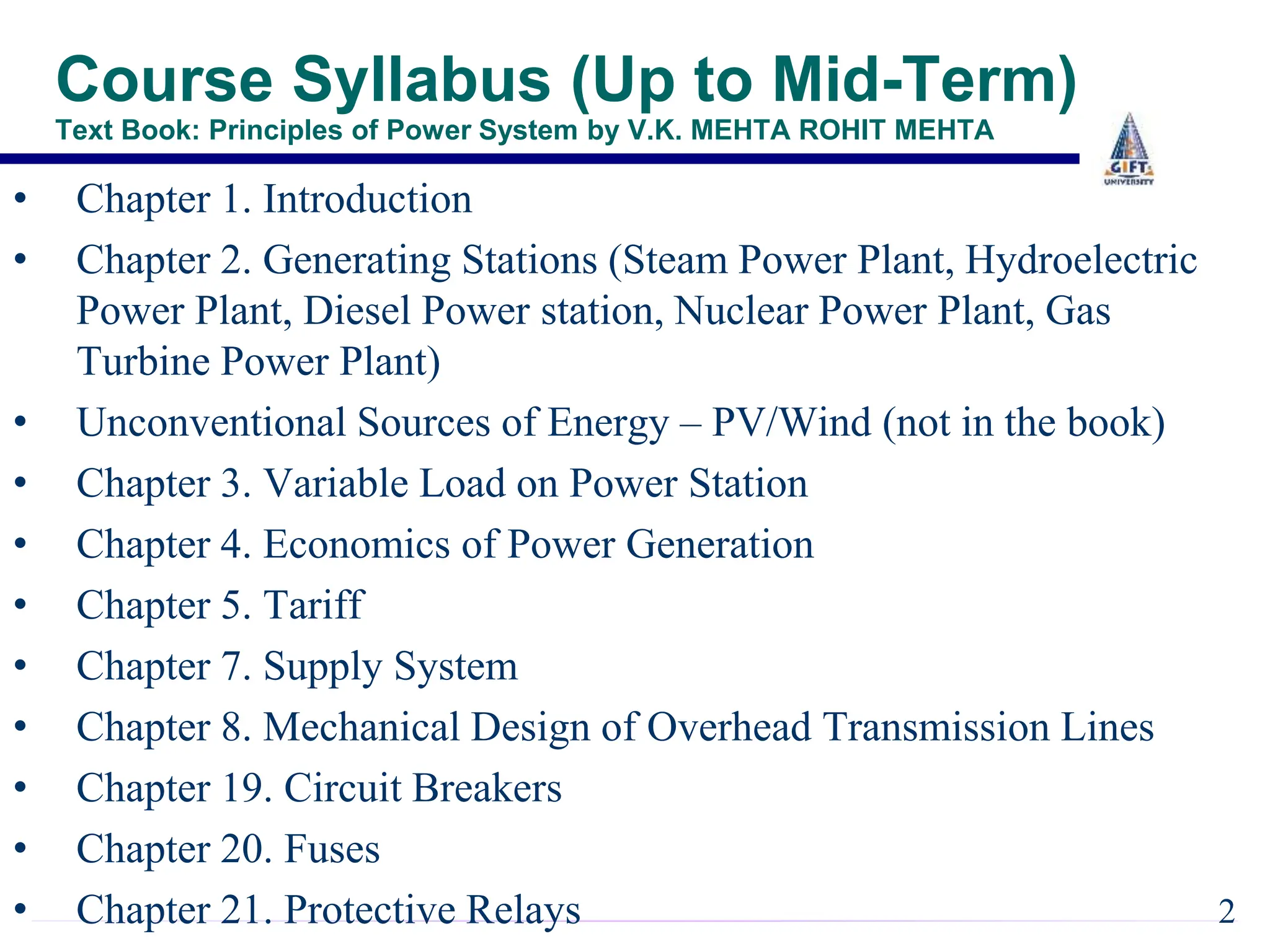
Course Syllabus (Up to Mid-Term)
Text Book: Principles of Power System by V.K. MEHTA ROHIT MEHTA
• Chapter 1. Introduction
• Chapter 2. Generating Stations (Steam Power Plant, Hydroelectric
Power Plant, Diesel Power station, Nuclear Power Plant, Gas
Turbine Power Plant)
• Unconventional Sources of Energy – PV/Wind (not in the book)
• Chapter 3. Variable Load on Power Station
• Chapter 4. Economics of Power Generation
• Chapter 5. Tariff
• Chapter 7. Supply System
• Chapter 8. Mechanical Design of Overhead Transmission Lines
• Chapter 19. Circuit Breakers
• Chapter 20. Fuses
• Chapter 21. Protective Relays 2
Course Syllabus (from Mid to Finals)
Text Book: Principles of Power System by V.K. MEHTA ROHIT MEHTA
• Chapter 9. Electrical Design of Overhead Transmission Lines
• Chapter 10. Performance of Transmission lines
• Chapter 11. Underground Cables
• Chapter 12. Distribution System General
• Chapter 14. AC distribution
• Chapter 15. Voltage Control
• Chapter 17. Symmetrical Faults Calculation
• Chapter 18. Un-Symmetrical Faults Calculation
• Chapter 25. Sub-Stations
3
Simple Power System
Every power system has three major
components
– Generation: source of power, ideally with a
specified voltage and frequency
– Transmission system: transmits power; ideally
as a perfect conductor
– Distribution to Load centers: consumes
power; ideally with a constant resistive value
4
1.1 Importance of Electrical Energy
Why Electricity Energy is better form of Energy?
• Versatility
• Easy to control and precision
• Can be distributed and Accessible.
• Greater flexibility in scalability
• Safer than other form of energies
• Clean form of energy (High conversion efficiency)
• High transmission efficiency
• Indication of growth:
– Per capita Electricity consumption ∝ Country's growth
Electricity is a clean form of Energy
Heat
Energy
• Thermo
cycle
Mech.
Energy
• Generators
Electrical
Energy
η < 40% η ~ 100%
(Direct conversion
from electrical to heat)
Some Complications with
Electrical Energy …!
• Electrical Hazards
• Energy Loss (Voltage drop due to I2R losses).
• Grid instability (Loads are seldom constant, intermittent
sources, voltage fluctuation, Equipment failure)
• Huge infrastructure and investment required
• Electromagnetic interference
• Worst of all: Storage - We cannot store Electrical
Energy (Economically)
Unbalance load and inefficient storage results in lots of
complications i.e. Load forecast and feasibility studies, to 7
1.3 Sources of Electrical Energy
• Conventional (‫)روایتی‬ Sources of Electrical Energy
Following Power Plant are used to generate electricity in bulk:
– Nuclear Power Plants
– Hydro Electric Power Plants
– Thermal Power Plants
(Also known as Coal Fired Power Plant)
Following Power Plant are used to generate electricity but
typically not in bulk:
– Diesel Power Plants
– Gas Turbine Power Plants
1.3 Sources of Electrical Energy
• Un-Conventional (‫روایتی‬ ‫)غیر‬ Sources of Electrical
Energy:
– Solar
– Wind
– Concentrated Thermal
– Geothermal
– Tidal
– Bio-Mass Energy
Electrical Energy Mix (Spain)
Energy Mix (Pakistan)
Installed Pakistan generation capacity 2017-
2018 (source NTDC) :
Hydro : 8341 MW
Hydro IPPs : 348 MW
Thermal Public : 5662 MW
Thermal IPPs : 15138 MW
Nuclear IPPs : 1345 MW
Wind IPPs : 985 MW
Solar IPPs : 400 MW
Bagasse IPPs : 306 MW
Pakistan’s per capita energy consumption is around 500 kilowatts (KW), almost 700KW less than the
region, while 2,400KW less than China and more than 7,000KW less than developed countries
Over view of Pakistan Power System
Two Power System
Existing Gen. Cap. Of NTDC in MW(as of Jan. 2014)
Over view of Pakistan Power System
NTDC system historical Surplus/deficit (MW)
Over view of Pakistan Power System
Country wide load forecast (MW)
Over view of Pakistan Power System
Government Priorities to improve Power Supply Position
Over view of Pakistan Power System
List of Generation Projects (as of Jan. 2014)
Over view of Pakistan Power System
List of Generation Projects (as of Jan. 2014)
Over view of Pakistan Power System
List of Generation Projects (as of Jan. 2014)
Over view of Pakistan Power System
1.4 Brief Comparison
• Unconventional:
– Low efficiency
– Intermittent
– Location dependent
• Conventional Source:
– High efficiency
– Obsolete
– Cause air pollution
How to Curtain of Electrical Energy
1. Tariffs
2. Obsolete Technology should be discarded
3. Recycling of Nuclear waste
4. Intensification effects to develop alternate renewable
source of energy
5. Development and application of antipollution
technologies.
(Bulk production is an option – Economy of scale)
Why it is important for Pakistan to avoid thermal power plant
and encourage renewable resources !
1. Environment Impact
2. Energy Security:
1. Import Fossil Fuels (compromise on self-sufficiency)
2. Price fluctuation
3. Geopolitical situations
3. Cost Effectiveness
4. Job creation and economic growth
5. International Commitments (Paris Agreement)
6. Sustainable Development
1.5 Units of Energy
• Energy: Integration of power over time; energy is what
people really want from a power system
• Energy Units
– Joule = 1 Watt-second (J)
– kWh = Kilo Watt hour (3.6 x 10⁶ J)
– Btu = 1055 J; 1 MBtu=0.292 MWh
– One gallon of gas has about 0.125 MBtu (36.5 kWh);
• U.S. electric energy consumption is about 3600 billion
kWh (about 13,333 kWh per person, which means on
average each one use 1.5 kW of power continuously)
23
Power and Energy
Unit of Power:
Power: Instantaneous consumption of energy
• Watts = Voltage x Current for dc (W)
• kW – 1 x 10³ Watt
• MW – 1 x 10⁶ Watt
• GW – 1 x 10⁹ Watt
24
The amount of heat produced by the complete combustion of a unit weight of fuel
is known as its calorific value. Unit: cal/gm or kcal/kg
1.9 Advantages of Liquid Fuels
over Solid Fuels
(i) The handling of liquid fuels is easier and they require less
storage space.
(ii) The combustion of liquid fuels is uniform.
(iii) The solid fuels have higher percentage of moisture and
consequently they burn with great difficulty. However,
liquid fuels can be burnt with a fair degree of ease and
attain high temperature very quickly compared to solid
fuels.
(iv) The waste product of solid fuels is a large quantity of ash
and its disposal becomes a problem. However, liquid fuels
leave no or very little ash after burning.
(v) The firing of liquid fuels can be easily controlled. This
permits to meet the variation in load demand easily.
1.10 Advantages of Solid Fuels over
Liquid Fuels
(i) In case of liquid fuels, there is a danger of explosion.
(ii) Liquids fuels are costlier as compared to solid fuels.
(iii) Sometimes liquid fuels give unpleasant odors during
burning.
(iv) Liquid fuels require special types of burners for burning.
(v) Liquid fuels pose problems in cold climates since the oil
stored in the tanks is to be heated in order to avoid the
stoppage of oil flow

Ch#1_Power Generation, Transmission and Distribution System_MS.Rashid.pptx

  • 1.
    Power System (Generation, Transmissionand Distribution) Lecture 1:Introduction Muhammad Saleh Rashid Dept. of Electrical Engineering GIFT University, Gujranwala saleh.rashid@gift.edu.pk
  • 2.
  • 3.
    Course Syllabus (Upto Mid-Term) Text Book: Principles of Power System by V.K. MEHTA ROHIT MEHTA • Chapter 1. Introduction • Chapter 2. Generating Stations (Steam Power Plant, Hydroelectric Power Plant, Diesel Power station, Nuclear Power Plant, Gas Turbine Power Plant) • Unconventional Sources of Energy – PV/Wind (not in the book) • Chapter 3. Variable Load on Power Station • Chapter 4. Economics of Power Generation • Chapter 5. Tariff • Chapter 7. Supply System • Chapter 8. Mechanical Design of Overhead Transmission Lines • Chapter 19. Circuit Breakers • Chapter 20. Fuses • Chapter 21. Protective Relays 2
  • 4.
    Course Syllabus (fromMid to Finals) Text Book: Principles of Power System by V.K. MEHTA ROHIT MEHTA • Chapter 9. Electrical Design of Overhead Transmission Lines • Chapter 10. Performance of Transmission lines • Chapter 11. Underground Cables • Chapter 12. Distribution System General • Chapter 14. AC distribution • Chapter 15. Voltage Control • Chapter 17. Symmetrical Faults Calculation • Chapter 18. Un-Symmetrical Faults Calculation • Chapter 25. Sub-Stations 3
  • 5.
    Simple Power System Everypower system has three major components – Generation: source of power, ideally with a specified voltage and frequency – Transmission system: transmits power; ideally as a perfect conductor – Distribution to Load centers: consumes power; ideally with a constant resistive value 4
  • 6.
    1.1 Importance ofElectrical Energy Why Electricity Energy is better form of Energy? • Versatility • Easy to control and precision • Can be distributed and Accessible. • Greater flexibility in scalability • Safer than other form of energies • Clean form of energy (High conversion efficiency) • High transmission efficiency • Indication of growth: – Per capita Electricity consumption ∝ Country's growth
  • 7.
    Electricity is aclean form of Energy Heat Energy • Thermo cycle Mech. Energy • Generators Electrical Energy η < 40% η ~ 100% (Direct conversion from electrical to heat)
  • 8.
    Some Complications with ElectricalEnergy …! • Electrical Hazards • Energy Loss (Voltage drop due to I2R losses). • Grid instability (Loads are seldom constant, intermittent sources, voltage fluctuation, Equipment failure) • Huge infrastructure and investment required • Electromagnetic interference • Worst of all: Storage - We cannot store Electrical Energy (Economically) Unbalance load and inefficient storage results in lots of complications i.e. Load forecast and feasibility studies, to 7
  • 9.
    1.3 Sources ofElectrical Energy • Conventional (‫)روایتی‬ Sources of Electrical Energy Following Power Plant are used to generate electricity in bulk: – Nuclear Power Plants – Hydro Electric Power Plants – Thermal Power Plants (Also known as Coal Fired Power Plant) Following Power Plant are used to generate electricity but typically not in bulk: – Diesel Power Plants – Gas Turbine Power Plants
  • 10.
    1.3 Sources ofElectrical Energy • Un-Conventional (‫روایتی‬ ‫)غیر‬ Sources of Electrical Energy: – Solar – Wind – Concentrated Thermal – Geothermal – Tidal – Bio-Mass Energy
  • 11.
  • 12.
    Energy Mix (Pakistan) InstalledPakistan generation capacity 2017- 2018 (source NTDC) : Hydro : 8341 MW Hydro IPPs : 348 MW Thermal Public : 5662 MW Thermal IPPs : 15138 MW Nuclear IPPs : 1345 MW Wind IPPs : 985 MW Solar IPPs : 400 MW Bagasse IPPs : 306 MW Pakistan’s per capita energy consumption is around 500 kilowatts (KW), almost 700KW less than the region, while 2,400KW less than China and more than 7,000KW less than developed countries
  • 13.
    Over view ofPakistan Power System Two Power System
  • 14.
    Existing Gen. Cap.Of NTDC in MW(as of Jan. 2014) Over view of Pakistan Power System
  • 15.
    NTDC system historicalSurplus/deficit (MW) Over view of Pakistan Power System
  • 16.
    Country wide loadforecast (MW) Over view of Pakistan Power System
  • 17.
    Government Priorities toimprove Power Supply Position Over view of Pakistan Power System
  • 18.
    List of GenerationProjects (as of Jan. 2014) Over view of Pakistan Power System
  • 19.
    List of GenerationProjects (as of Jan. 2014) Over view of Pakistan Power System
  • 20.
    List of GenerationProjects (as of Jan. 2014) Over view of Pakistan Power System
  • 21.
    1.4 Brief Comparison •Unconventional: – Low efficiency – Intermittent – Location dependent • Conventional Source: – High efficiency – Obsolete – Cause air pollution
  • 22.
    How to Curtainof Electrical Energy 1. Tariffs 2. Obsolete Technology should be discarded 3. Recycling of Nuclear waste 4. Intensification effects to develop alternate renewable source of energy 5. Development and application of antipollution technologies. (Bulk production is an option – Economy of scale)
  • 23.
    Why it isimportant for Pakistan to avoid thermal power plant and encourage renewable resources ! 1. Environment Impact 2. Energy Security: 1. Import Fossil Fuels (compromise on self-sufficiency) 2. Price fluctuation 3. Geopolitical situations 3. Cost Effectiveness 4. Job creation and economic growth 5. International Commitments (Paris Agreement) 6. Sustainable Development
  • 24.
    1.5 Units ofEnergy • Energy: Integration of power over time; energy is what people really want from a power system • Energy Units – Joule = 1 Watt-second (J) – kWh = Kilo Watt hour (3.6 x 10⁶ J) – Btu = 1055 J; 1 MBtu=0.292 MWh – One gallon of gas has about 0.125 MBtu (36.5 kWh); • U.S. electric energy consumption is about 3600 billion kWh (about 13,333 kWh per person, which means on average each one use 1.5 kW of power continuously) 23
  • 25.
    Power and Energy Unitof Power: Power: Instantaneous consumption of energy • Watts = Voltage x Current for dc (W) • kW – 1 x 10³ Watt • MW – 1 x 10⁶ Watt • GW – 1 x 10⁹ Watt 24 The amount of heat produced by the complete combustion of a unit weight of fuel is known as its calorific value. Unit: cal/gm or kcal/kg
  • 26.
    1.9 Advantages ofLiquid Fuels over Solid Fuels (i) The handling of liquid fuels is easier and they require less storage space. (ii) The combustion of liquid fuels is uniform. (iii) The solid fuels have higher percentage of moisture and consequently they burn with great difficulty. However, liquid fuels can be burnt with a fair degree of ease and attain high temperature very quickly compared to solid fuels. (iv) The waste product of solid fuels is a large quantity of ash and its disposal becomes a problem. However, liquid fuels leave no or very little ash after burning. (v) The firing of liquid fuels can be easily controlled. This permits to meet the variation in load demand easily.
  • 27.
    1.10 Advantages ofSolid Fuels over Liquid Fuels (i) In case of liquid fuels, there is a danger of explosion. (ii) Liquids fuels are costlier as compared to solid fuels. (iii) Sometimes liquid fuels give unpleasant odors during burning. (iv) Liquid fuels require special types of burners for burning. (v) Liquid fuels pose problems in cold climates since the oil stored in the tanks is to be heated in order to avoid the stoppage of oil flow