“
”
Biotechnology Unit:
Genetic Engineering Techniques 1
What is Biotechnology?
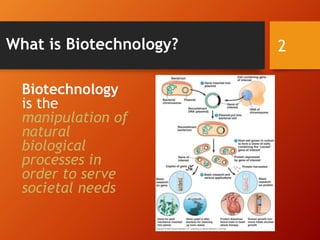
Biotechnology
is the
manipulation of
natural
biological
processes in
order to serve
societal needs.
2
Types of Biotechnology 3
4 MAIN AREAS OF BIOTECHNOLOGY
Transgenic
Biotechnology
Mixing genetic material from multiple
sources (species)
Reproductive
cloning
Techniques used to clone certain species
(mammals)
Reprogramming
of Cells
Reprogramming differentiated cells or
using stem cells to become needed tissues
in patients with diseases or physical harm
Forensic
Biotechnology
Use of restriction enzymes and
electrophoresis to distinguish one person
from another
Where is your line?
As we go through the following slides, you will be
presented with different techniques and examples of how
biotechnology is being used in our global society.
It is your job to decide…how far is too far? Where is your
ethical line and what factors dictate when your line is
crossed?
Remember, if your line is different from somebody else’s
that is perfectly fine. Are you ready?
4
Transgenic Biotechnology
Where is your line?
5
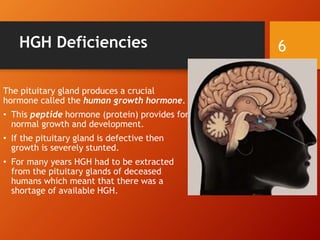
HGH Deficiencies
The pituitary gland produces a crucial
hormone called the human growth hormone.
• This peptide hormone (protein) provides for
normal growth and development.
• If the pituitary gland is defective then
growth is severely stunted.
• For many years HGH had to be extracted
from the pituitary glands of deceased
humans which meant that there was a
shortage of available HGH.
6
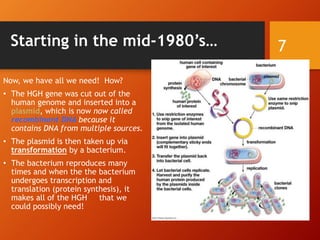
Starting in the mid-1980’s…
Now, we have all we need! How?
• The HGH gene was cut out of the
human genome and inserted into a
plasmid, which is now now called
recombinant DNA because it
contains DNA from multiple sources.
• The plasmid is then taken up via
transformation by a bacterium.
• The bacterium reproduces many
times and when the the bacterium
undergoes transcription and
translation (protein synthesis), it
makes all of the HGH that we
could possibly need!
7
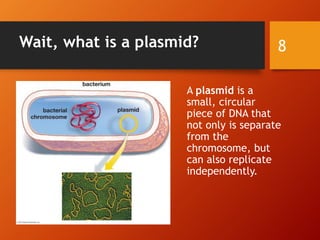
Wait, what is a plasmid?
A plasmid is a
small, circular
piece of DNA that
not only is separate
from the
chromosome, but
can also replicate
independently.
8
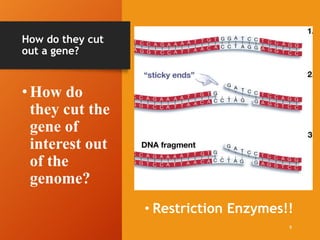
How do they cut
out a gene?
9
•How do
they cut the
gene of
interest out
of the
genome?
• Restriction Enzymes!!
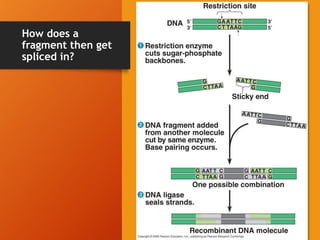
How does a
fragment then get
spliced in?
10
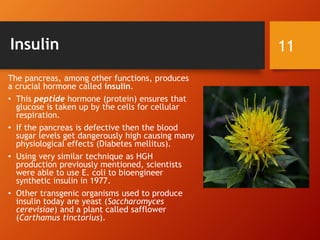
Insulin
The pancreas, among other functions, produces
a crucial hormone called insulin.
• This peptide hormone (protein) ensures that
glucose is taken up by the cells for cellular
respiration.
• If the pancreas is defective then the blood
sugar levels get dangerously high causing many
physiological effects (Diabetes mellitus).
• Using very similar technique as HGH
production previously mentioned, scientists
were able to use E. coli to bioengineer
synthetic insulin in 1977.
• Other transgenic organisms used to produce
insulin today are yeast (Saccharomyces
cerevisiae) and a plant called safflower
(Carthamus tinctorius).
11
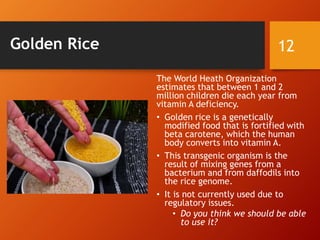
Golden Rice
The World Heath Organization
estimates that between 1 and 2
million children die each year from
vitamin A deficiency.
• Golden rice is a genetically
modified food that is fortified with
beta carotene, which the human
body converts into vitamin A.
• This transgenic organism is the
result of mixing genes from a
bacterium and from daffodils into
the rice genome.
• It is not currently used due to
regulatory issues.
• Do you think we should be able
to use it?
12
Reproductive
Cloning
Where is your line?
13
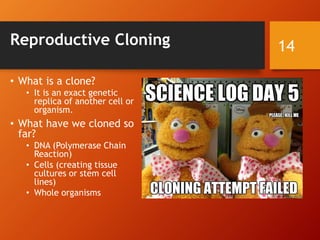
Reproductive Cloning
• What is a clone?
• It is an exact genetic
replica of another cell or
organism.
• What have we cloned so
far?
• DNA (Polymerase Chain
Reaction)
• Cells (creating tissue
cultures or stem cell
lines)
• Whole organisms
14
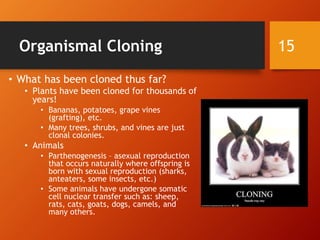
Organismal Cloning
• What has been cloned thus far?
• Plants have been cloned for thousands of
years!
• Bananas, potatoes, grape vines
(grafting), etc.
• Many trees, shrubs, and vines are just
clonal colonies.
• Animals
• Parthenogenesis – asexual reproduction
that occurs naturally where offspring is
born with sexual reproduction (sharks,
anteaters, some insects, etc.)
• Some animals have undergone somatic
cell nuclear transfer such as: sheep,
rats, cats, goats, dogs, camels, and
many others.
15
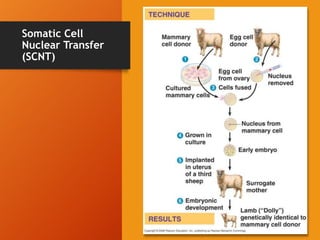
Somatic Cell
Nuclear Transfer
(SCNT)
16
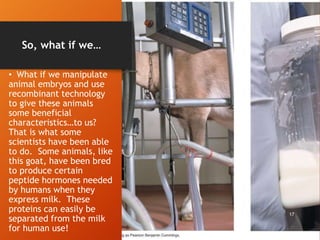
So, what if we…
• What if we manipulate
animal embryos and use
recombinant technology
to give these animals
some beneficial
characteristics…to us?
That is what some
scientists have been able
to do. Some animals, like
this goat, have been bred
to produce certain
peptide hormones needed
by humans when they
express milk. These
proteins can easily be
separated from the milk
for human use!
17
Reprogramming
cells
Where is your line?
18
What can stem cell research
do for us?
Stem cells could help us in many medical applications
such as:
• Organ and tissue regeneration
• Fighting the following diseases:
• Cardiovascular disease
• Brain diseases like Parkinson’s and Alzheimer's
• Blood diseases like leukemia and sickle-cell anemia
So…what’s all the fuss about?
The stems cells that work the best come from
embryos.
19
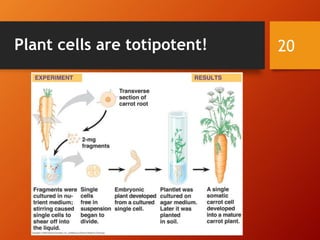
Plant cells are totipotent! 20
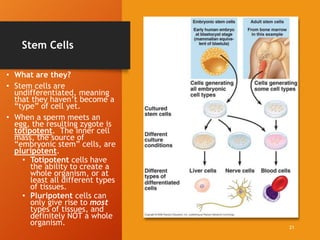
Stem Cells
• What are they?
• Stem cells are
undifferentiated, meaning
that they haven’t become a
“type” of cell yet.
• When a sperm meets an
egg, the resulting zygote is
totipotent. The inner cell
mass, the source of
“embryonic stem” cells, are
pluripotent.
• Totipotent cells have
the ability to create a
whole organism, or at
least all different types
of tissues.
• Pluripotent cells can
only give rise to most
types of tissues, and
definitely NOT a whole
organism. 21
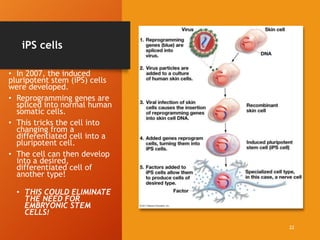
iPS cells
• In 2007, the induced
pluripotent stem (iPS) cells
were developed.
• Reprogramming genes are
spliced into normal human
somatic cells.
• This tricks the cell into
changing from a
differentiated cell into a
pluripotent cell.
• The cell can then develop
into a desired,
differentiated cell of
another type!
• THIS COULD ELIMINATE
THE NEED FOR
EMBRYONIC STEM
CELLS!
22
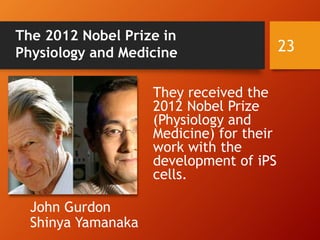
John Gurdon
Shinya Yamanaka
They received the
2012 Nobel Prize
(Physiology and
Medicine) for their
work with the
development of iPS
cells.
23
The 2012 Nobel Prize in
Physiology and Medicine
Forensic Biotechnology
Where is your line?
24
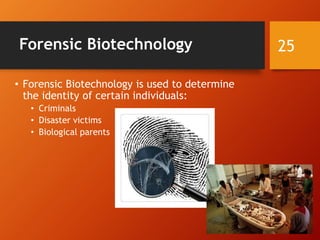
Forensic Biotechnology
• Forensic Biotechnology is used to determine
the identity of certain individuals:
• Criminals
• Disaster victims
• Biological parents
25
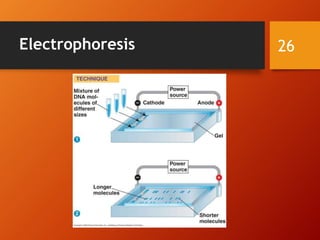
Electrophoresis 26
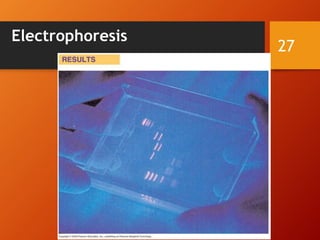
Electrophoresis
27
28
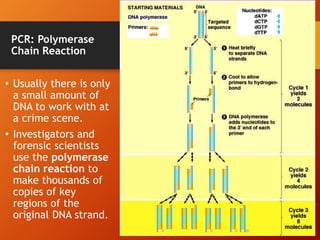
PCR: Polymerase
Chain Reaction
• Usually there is only
a small amount of
DNA to work with at
a crime scene.
• Investigators and
forensic scientists
use the polymerase
chain reaction to
make thousands of
copies of key
regions of the
original DNA strand.
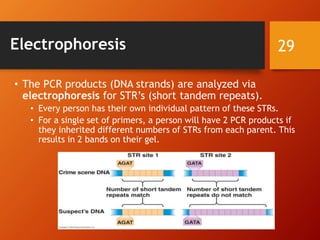
Electrophoresis
• The PCR products (DNA strands) are analyzed via
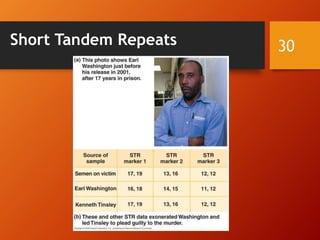
electrophoresis for STR’s (short tandem repeats).
• Every person has their own individual pattern of these STRs.
• For a single set of primers, a person will have 2 PCR products if
they inherited different numbers of STRs from each parent. This
results in 2 bands on their gel.
29
Short Tandem Repeats 30
DNA Analysis
We have the ability to “sequence
DNA.” This means that if we know
the gene we are looking for we can
analyze someone’s DNA for a specific
sequence, i.e. allele.
• Therefore, we could tell you
definitively if you have a disorder
like Huntington’s, an autosomal
dominant disorder, or not.
• Huntington’s Disorder is a
degenerative brain disorder that
“usually” starts causing telltale
symptoms around age 35. There is
no cure for Huntington’s and it is
eventually fatal.
Would you want to know?
31
Where is your line?
Other than the ones already mentioned, here are some other “real-life”
examples of biotechnology. Do any of these cross your line?
• Injecting human brain cells into monkey brains
• for brain disease research
• Xenotransplantation
• using animal “parts” for our parts (for instance using a pig valve to replace
a defective heart valve in a human)
• Adding human stem cells to sheep fetuses
• to produce sheep with livers made of mostly human tissue
• Bt crops
• these crops contain genes from the bacterium Bacillus thuringiensis which
produces proteins toxic to pest insects
• Roundup Ready crops
• contain genes that protect them from Roundup (herbicide)
32

Biotechnology and Genetic Engineering.pptx

  • 1.
  • 2.
    What is Biotechnology? Biotechnology isthe manipulation of natural biological processes in order to serve societal needs. 2
  • 3.
    Types of Biotechnology3 4 MAIN AREAS OF BIOTECHNOLOGY Transgenic Biotechnology Mixing genetic material from multiple sources (species) Reproductive cloning Techniques used to clone certain species (mammals) Reprogramming of Cells Reprogramming differentiated cells or using stem cells to become needed tissues in patients with diseases or physical harm Forensic Biotechnology Use of restriction enzymes and electrophoresis to distinguish one person from another
  • 4.
    Where is yourline? As we go through the following slides, you will be presented with different techniques and examples of how biotechnology is being used in our global society. It is your job to decide…how far is too far? Where is your ethical line and what factors dictate when your line is crossed? Remember, if your line is different from somebody else’s that is perfectly fine. Are you ready? 4
  • 5.
  • 6.
    HGH Deficiencies The pituitarygland produces a crucial hormone called the human growth hormone. • This peptide hormone (protein) provides for normal growth and development. • If the pituitary gland is defective then growth is severely stunted. • For many years HGH had to be extracted from the pituitary glands of deceased humans which meant that there was a shortage of available HGH. 6
  • 7.
    Starting in themid-1980’s… Now, we have all we need! How? • The HGH gene was cut out of the human genome and inserted into a plasmid, which is now now called recombinant DNA because it contains DNA from multiple sources. • The plasmid is then taken up via transformation by a bacterium. • The bacterium reproduces many times and when the the bacterium undergoes transcription and translation (protein synthesis), it makes all of the HGH that we could possibly need! 7
  • 8.
    Wait, what isa plasmid? A plasmid is a small, circular piece of DNA that not only is separate from the chromosome, but can also replicate independently. 8
  • 9.
    How do theycut out a gene? 9 •How do they cut the gene of interest out of the genome? • Restriction Enzymes!!
  • 10.
    How does a fragmentthen get spliced in? 10
  • 11.
    Insulin The pancreas, amongother functions, produces a crucial hormone called insulin. • This peptide hormone (protein) ensures that glucose is taken up by the cells for cellular respiration. • If the pancreas is defective then the blood sugar levels get dangerously high causing many physiological effects (Diabetes mellitus). • Using very similar technique as HGH production previously mentioned, scientists were able to use E. coli to bioengineer synthetic insulin in 1977. • Other transgenic organisms used to produce insulin today are yeast (Saccharomyces cerevisiae) and a plant called safflower (Carthamus tinctorius). 11
  • 12.
    Golden Rice The WorldHeath Organization estimates that between 1 and 2 million children die each year from vitamin A deficiency. • Golden rice is a genetically modified food that is fortified with beta carotene, which the human body converts into vitamin A. • This transgenic organism is the result of mixing genes from a bacterium and from daffodils into the rice genome. • It is not currently used due to regulatory issues. • Do you think we should be able to use it? 12
  • 13.
  • 14.
    Reproductive Cloning • Whatis a clone? • It is an exact genetic replica of another cell or organism. • What have we cloned so far? • DNA (Polymerase Chain Reaction) • Cells (creating tissue cultures or stem cell lines) • Whole organisms 14
  • 15.
    Organismal Cloning • Whathas been cloned thus far? • Plants have been cloned for thousands of years! • Bananas, potatoes, grape vines (grafting), etc. • Many trees, shrubs, and vines are just clonal colonies. • Animals • Parthenogenesis – asexual reproduction that occurs naturally where offspring is born with sexual reproduction (sharks, anteaters, some insects, etc.) • Some animals have undergone somatic cell nuclear transfer such as: sheep, rats, cats, goats, dogs, camels, and many others. 15
  • 16.
  • 17.
    So, what ifwe… • What if we manipulate animal embryos and use recombinant technology to give these animals some beneficial characteristics…to us? That is what some scientists have been able to do. Some animals, like this goat, have been bred to produce certain peptide hormones needed by humans when they express milk. These proteins can easily be separated from the milk for human use! 17
  • 18.
  • 19.
    What can stemcell research do for us? Stem cells could help us in many medical applications such as: • Organ and tissue regeneration • Fighting the following diseases: • Cardiovascular disease • Brain diseases like Parkinson’s and Alzheimer's • Blood diseases like leukemia and sickle-cell anemia So…what’s all the fuss about? The stems cells that work the best come from embryos. 19
  • 20.
    Plant cells aretotipotent! 20
  • 21.
    Stem Cells • Whatare they? • Stem cells are undifferentiated, meaning that they haven’t become a “type” of cell yet. • When a sperm meets an egg, the resulting zygote is totipotent. The inner cell mass, the source of “embryonic stem” cells, are pluripotent. • Totipotent cells have the ability to create a whole organism, or at least all different types of tissues. • Pluripotent cells can only give rise to most types of tissues, and definitely NOT a whole organism. 21
  • 22.
    iPS cells • In2007, the induced pluripotent stem (iPS) cells were developed. • Reprogramming genes are spliced into normal human somatic cells. • This tricks the cell into changing from a differentiated cell into a pluripotent cell. • The cell can then develop into a desired, differentiated cell of another type! • THIS COULD ELIMINATE THE NEED FOR EMBRYONIC STEM CELLS! 22
  • 23.
    John Gurdon Shinya Yamanaka Theyreceived the 2012 Nobel Prize (Physiology and Medicine) for their work with the development of iPS cells. 23 The 2012 Nobel Prize in Physiology and Medicine
  • 24.
  • 25.
    Forensic Biotechnology • ForensicBiotechnology is used to determine the identity of certain individuals: • Criminals • Disaster victims • Biological parents 25
  • 26.
  • 27.
  • 28.
    28 PCR: Polymerase Chain Reaction •Usually there is only a small amount of DNA to work with at a crime scene. • Investigators and forensic scientists use the polymerase chain reaction to make thousands of copies of key regions of the original DNA strand.
  • 29.
    Electrophoresis • The PCRproducts (DNA strands) are analyzed via electrophoresis for STR’s (short tandem repeats). • Every person has their own individual pattern of these STRs. • For a single set of primers, a person will have 2 PCR products if they inherited different numbers of STRs from each parent. This results in 2 bands on their gel. 29
  • 30.
  • 31.
    DNA Analysis We havethe ability to “sequence DNA.” This means that if we know the gene we are looking for we can analyze someone’s DNA for a specific sequence, i.e. allele. • Therefore, we could tell you definitively if you have a disorder like Huntington’s, an autosomal dominant disorder, or not. • Huntington’s Disorder is a degenerative brain disorder that “usually” starts causing telltale symptoms around age 35. There is no cure for Huntington’s and it is eventually fatal. Would you want to know? 31
  • 32.
    Where is yourline? Other than the ones already mentioned, here are some other “real-life” examples of biotechnology. Do any of these cross your line? • Injecting human brain cells into monkey brains • for brain disease research • Xenotransplantation • using animal “parts” for our parts (for instance using a pig valve to replace a defective heart valve in a human) • Adding human stem cells to sheep fetuses • to produce sheep with livers made of mostly human tissue • Bt crops • these crops contain genes from the bacterium Bacillus thuringiensis which produces proteins toxic to pest insects • Roundup Ready crops • contain genes that protect them from Roundup (herbicide) 32

Editor's Notes

  • #3 Briefly go over what biotechnology is and a brief overview of some of the “products” that we have been able to produce.
  • #4 Briefly describe the four main areas of biotechnology.
  • #5 What we want to do is engage the students in a conversation/discussion over where their line is regarding bioethics and biotechnology. We use this method to give them a reason to learn more about the content in this unit. They need to know that decisions that are made regarding biotechnology are shaping the global marketplace even as they are learning this material. Give them the opportunity to speak their opinion as long as there is no judgment. The ultimate goal here is to have students think about their own opinion, listen to the opinions of others, and hopefully…decide whether their “line” has moved by the end of the lesson.
  • #7 You could probably review the pituitary gland, the hormones it produces, and their effects by asking what other issues a defective pituitary gland might have. Posterior pituitary Oxytocin – stimulates growth and metabolic functions Antidiuretic hormone – promotes water retention in the kidneys Anterior pituitary Growth hormone – stimulates growth and metabolic functions Prolactin – stimulates milk production Follicle stimulating hormone – stimulates production of ova and sperm Luteinizing hormone – simulates ovaries and testes Thyroid-stimulating hormone – stimulates the thyroid gland Adrenocorticotropic hormone – stimulates the adrenal cortex to secrete glucocorticoids
  • #8 This slide shows the students how transgenic bacteria are made. Go through the process with them and make sure that they fully understand the following concepts before going on: Recombinant DNA and how it is made Where does the plasmid come from? What is transformation and what role is it playing in this process? We can make “proteins” with this method as the bacteria are undergoing the same process that our cells do, i.e. transcription, translation, etc. You might stop here and ask, “Does this cross anyone’s line?” Remember that the students do NOT have to memorize or learn each individual step. The main thing they need to know for the AP Biology Exam is to be able to use this as an illustrative example of genetic engineering techniques that can be used to manipulate the heritable information of DNA, and in some cases, RNA.
  • #10 Go over the process with them and explain how fragments without “sticky ends” are not able to be spliced in. Go back over DNA ligase. Where have they seen that before? (DNA replication) Remember that the students do NOT have to memorize or learn each individual step. The main thing they need to know for the AP Biology Exam is to be able to use this as an illustrative example of genetic engineering techniques that can be used to manipulate the heritable information of DNA, and in some cases, RNA.
  • #11 Go over the process with them and explain how fragments without “sticky ends” are not able to be spliced in. Go back over DNA ligase. Where have they seen that before? (DNA replication) Remember that the students do NOT have to memorize or learn each individual step. The main thing they need to know for the AP Biology Exam is to be able to use this as an illustrative example of genetic engineering techniques that can be used to manipulate the heritable information of DNA, and in some cases, RNA.
  • #12 Go over what insulin does, where its made, and what diabetes is. Engage them in a discussion of the different ways in which it can be made synthetically. Make sure that you engage the students in a brief discussion of “Does this cross your line?” Again, this could be done by a show of hands and anyone raising their hands can give a brief explanation of why.
  • #13 Go over what golden rice is, how its made, and what possible good it might could do. Make sure they know that because of issue with regulation, it is not “currently” being used. Much like several other GMF (Franken foods) available today. Make sure that you engage the students in a brief discussion of “Does this cross your line?” Again, this could be done by a show of hands and anyone raising their hands can give a brief explanation of why.
  • #15 You might start by asking what the students “think” cloning is and what they feel about it.
  • #17 Go over the process of cloning outlined by the figure. Engage the students in discussion by asking the following questions: Is a male needed for this process? Why or why not? Why is an egg cell used? What is the difference between the DNA in the egg and the DNA in the somatic cell? Make sure that you engage the students in a brief discussion of “Does this cross your line?” Again, this could be done by a show of hands and anyone raising their hands can give a brief explanation of why. Remember that the students do NOT have to memorize or learn each individual step. The main thing they need to know for the AP Biology Exam is to be able to use this as an illustrative example of genetic engineering techniques that can be used to manipulate the heritable information of DNA, and in some cases, RNA.
  • #18 Make sure that you engage the students in a brief discussion of “Does this cross your line?” Again, this could be done by a show of hands and anyone raising their hands can give a brief explanation of why.
  • #21 Explain how a plant, such as this carrot, can be fragmented and then used to produce a whole carrot again. Ask the students if they have ever heard of the word totipotent and ask them what they think it means.
  • #22 Make sure the students understand the difference between a pluripotent cell and a totipotent cell.
  • #23 Really engage the students and ask if iPS cells were used instead of embryonic stem cells…would they be for their use to help cure/fight diseases? Remember that the students do NOT have to memorize or learn each individual step. The main thing they need to know for the AP Biology Exam is to be able to use this as an illustrative example of genetic engineering techniques that can be used to manipulate the heritable information of DNA, and in some cases, RNA.
  • #24 This slides stresses that the concepts and technologies discussed in this lesson are changing rapidly everyday.
  • #27 Engage the students in a discussion of this process by asking them the following questions: Why is the DNA being placed on the negative side? Why does it travel toward the positive side? Explain that the gel is like a matrix of tunnels, some large and some small. Ask: Why are the large molecules closer to the start than the smaller ones? How can we use this to identify certain fragments. One way to analyze a sample of DNA via electrophoresis involves cutting the sample with restriction enzymes. This requires a large sample of DNA, such as from a test tube of blood. Cutting with the enzymes will produce fragments of DNA. The length of those fragments will differ between individuals. Those differences are called restriction fragment length polymorphisms (RFLP). The illustration in this slide and the next could be RFLPs. How can this be used to do paternity tests or crime scene analysis? (compare banding patterns between samples) Make sure that you engage the students in a brief discussion of “Does this cross your line?” Again, this could be done by a show of hands and anyone raising his or her hands can give a brief explanation of why.   Remember that the students do NOT have to memorize or learn each individual step. The main thing they need to know for the AP Biology Exam is to be able to use this as an illustrative example of genetic engineering techniques that can be used to manipulate the heritable information of DNA, and in some cases, RNA.
  • #29 For a great animations showing how PCR works, see http://www.dnalc.org/view/15924-Making-many-copies-of-DNA.html and http://www.dnalc.org/view/15475-The-cycles-of-the-polymerase-chain-reaction-PCR-3D-animation-with-no-audio.html (the first is in 2D and the second is in 3D) Take some time going over this figure and the animation(s). It is important to realize that only a relatively short (up to 20,000 base pairs, but typically much shorter than that) “target sequence” is being amplified. The area between the two primers is the target sequence. In the image on the slide, point out that the chromosome goes on for a very long distance both above and below the stretch being shown in the illustration. PCR can not be used to copy an entire chromosome. Make sure the student understands what is going on here by prompting them to explain the following: What is a primer used for? How is DNA polymerase used in this process? What else must be in the test tube for the process to work? (template DNA; nucleotides – A,C,G,T) What does heating up the test tube mixture do? What does cooling the test tube mixture do? Remember that the students do NOT have to memorize or learn each individual step. The main thing they need to know for the AP Biology Exam is to be able to use this as an illustrative example of genetic engineering techniques that can be used to manipulate the heritable information of DNA, and in some cases, RNA. Make sure that you engage the students in a brief discussion of “Does this cross your line?” Again, this could be done by a show of hands and anyone raising his or her hands can give a brief explanation of why.
  • #30 Each PCR reaction typically amplifies a single locus (there are some researchers using multiple primers in a single mixture, but that is not important for our level of discussion). Since we all have two copies of each locus (thanks to our maternal and paternal homologous chromosomes), we will get two separate products from a single PCR reaction. If the region between the primers on our paternal chromosome differs in length from the region between those same primers on our maternal chromosome then we get products of different sizes which then show up as two separate bands on a gel. If the products happen to be the same length, then only one band results. One of the most common regions for pcr analysis are those containing short repeated segments of DNA between the primer sites. These are called STRs. One might have 15 repeats of that sequence between the primer sites on the paternal chromosome and 18 repeats of that same sequence between the same primer sites on the maternal chromosome. This would then result in two bands on a gel when these PCR products are analyzed. By using multiple sets of primers, one can get numerous bands to compare between samples. Numerous other differences could be analyzed other than STRs, such as SNPs (single nucleotide polymorphisms), etc. but students do not need to know every possible method of analyzing DNA differences. They DO need to know that differences exist and why they exist.
  • #31 Earl Washington, Jr. was sentenced in 1982 for rape and murder. In 1994, DNA from the crime scene was tested and in the analysis of the DNA on the victim and the two suspect, it was found that Mr. Washington was NOT guilty. Shortly before his execution the governor of Virginia gave him clemency and commuted his sentence to life in prison. Years later he was given a full pardon and released from prison…after 17 years. In the table, the numbers refer to the number of repeats at each locus. For instance, at locus 1 (STR marker 1), Earl had 16 repeats on one of his chromosomes and 18 on the other. The evidence DNA had 17 and 19 repeats, meaning it could not have come from Earl. But it did match Kenneth Tinsley. Note that STR marker 1 was enough to eliminate Earl as a suspect, but that single site would not be conclusive as to it coming from Kenneth. Numerous sites were used and all matched Kenneth Tinsley.
  • #32 Make sure that you engage the students in a brief discussion of “Does this cross your line?” Again, this could be done by a show of hands and anyone raising his or her hands can give a brief explanation of why.  Remember that the students do NOT have to memorize or learn each individual step. The main thing they need to know for the AP Biology Exam is to be able to use this as an illustrative example of genetic engineering techniques that can be used to manipulate the heritable information of DNA, and in some cases, RNA.
  • #33 Again, the goal is to get students to find their “line” and ask themselves why their line is where it is and most importantly…what circumstances could make my line change.