PORTALFRAMESFOR INDUSTRIALBUILDINGS
C.Teleman_ICE_S.S.III_Lecture7
1
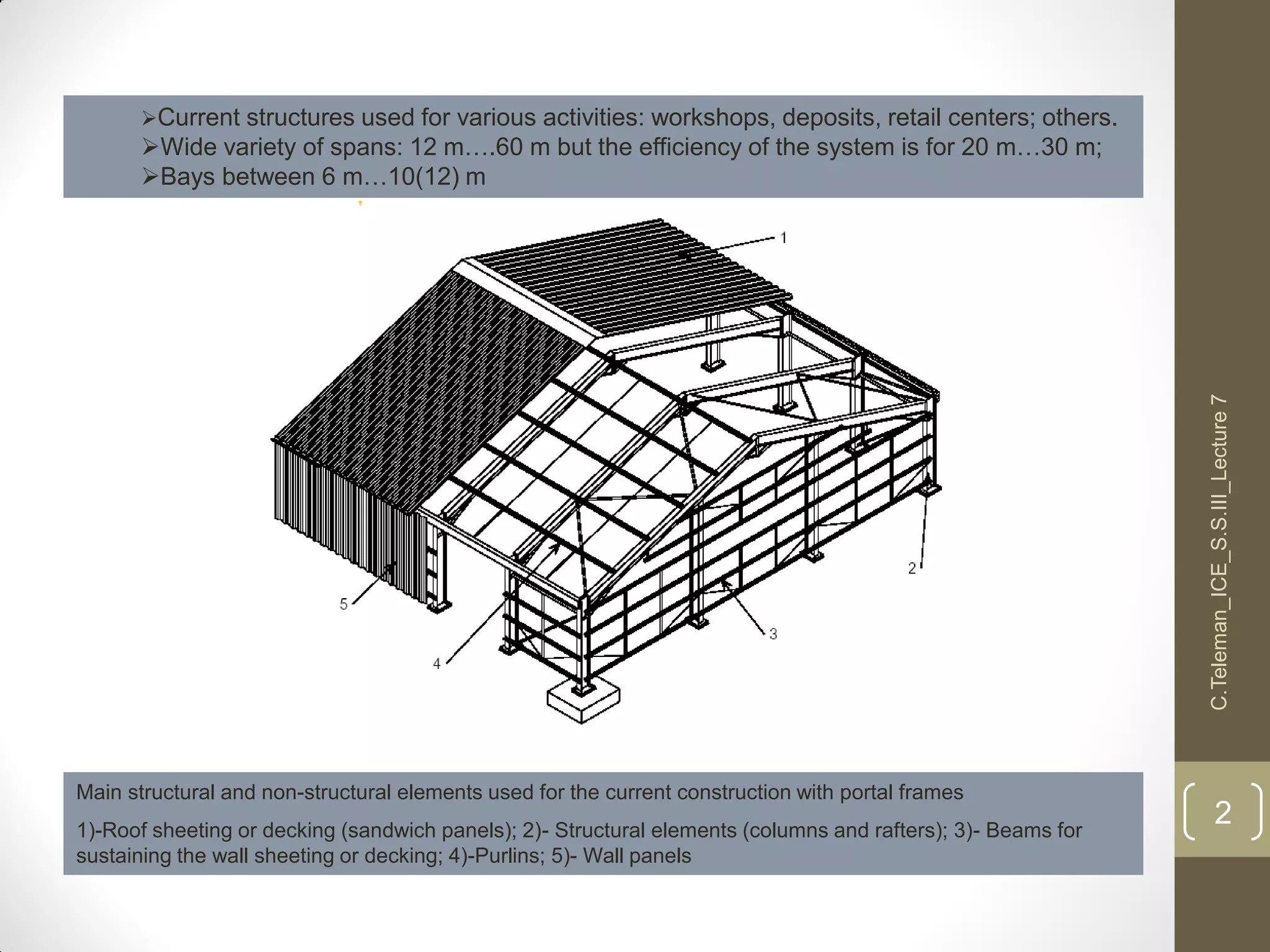
Main structural and non-structural elements used for the current construction with portal frames
1)-Roof sheeting or decking (sandwich panels); 2)- Structural elements (columns and rafters); 3)- Beams for
sustaining the wall sheeting or decking; 4)-Purlins; 5)- Wall panels
Current structures used for various activities: workshops, deposits, retail centers; others.
Wide variety of spans: 12 m….60 m but the efficiency of the system is for 20 m…30 m;
Bays between 6 m…10(12) m
C.Teleman_ICE_S.S.III_Lecture7
2
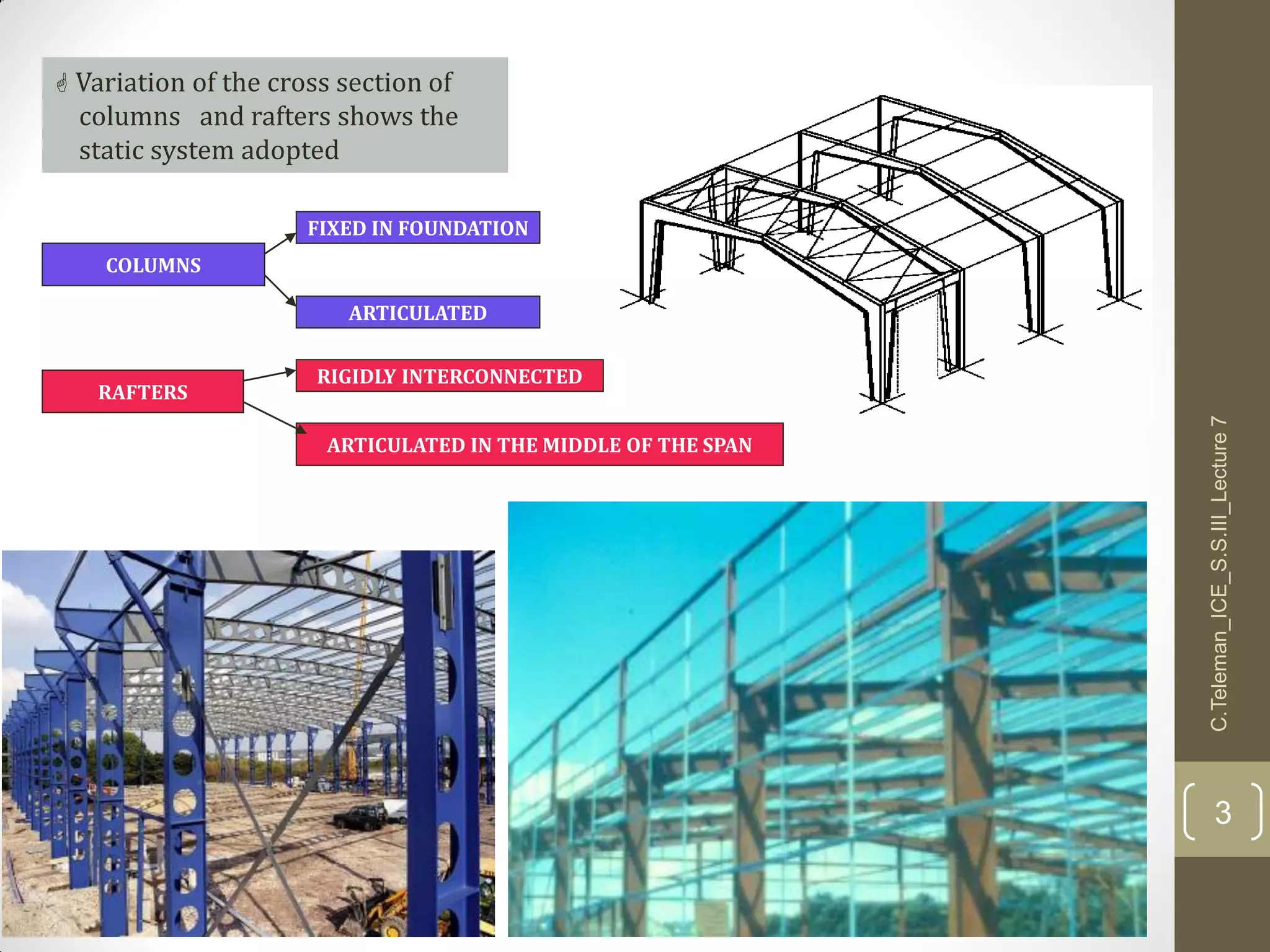
 Variation of the cross section of
columns and rafters shows the
static system adopted
COLUMNS
FIXED IN FOUNDATION
ARTICULATED
RAFTERS
RIGIDLY INTERCONNECTED
ARTICULATED IN THE MIDDLE OF THE SPAN
C.Teleman_ICE_S.S.III_Lecture7
3
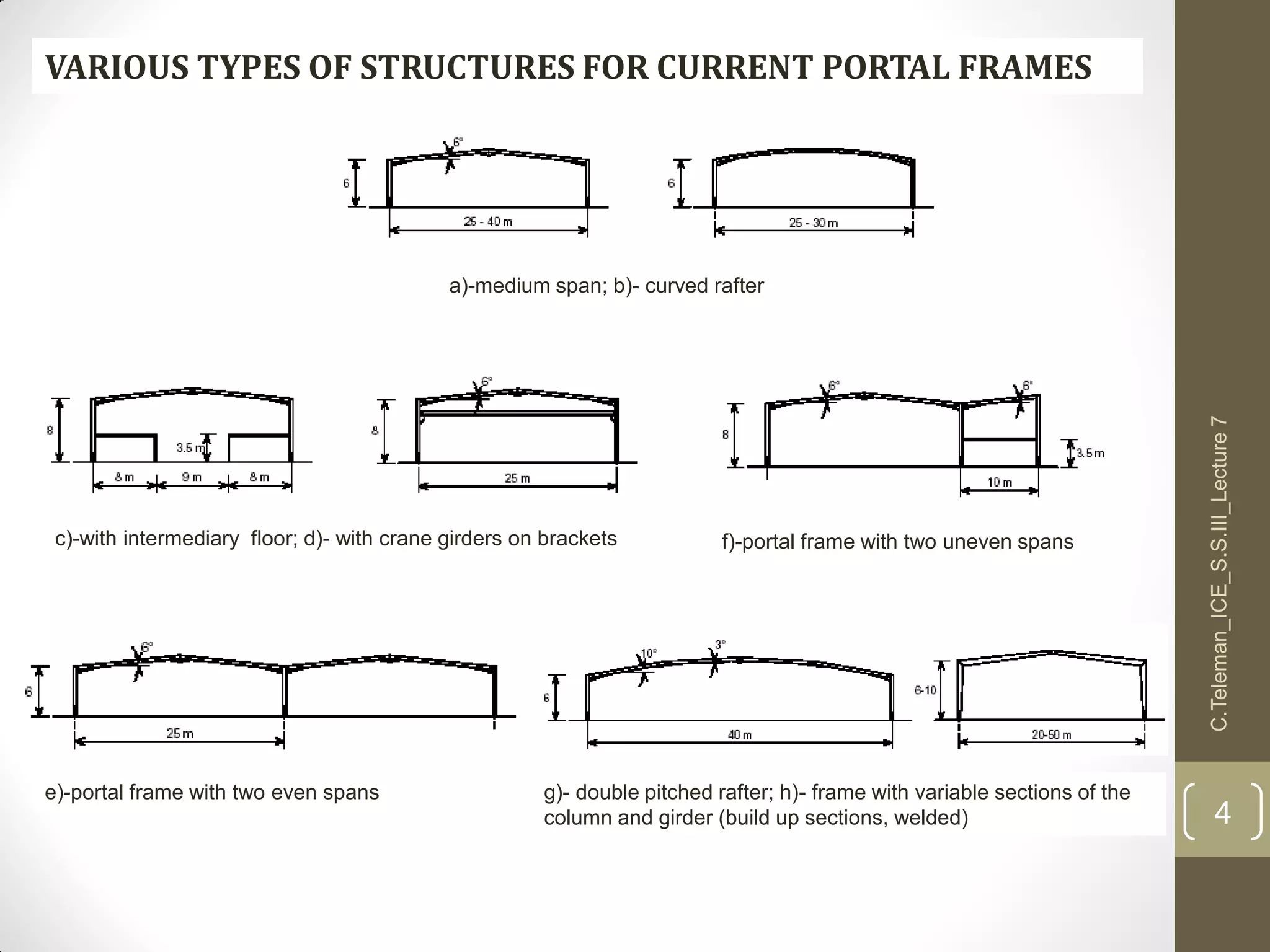
a)-medium span; b)- curved rafter
c)-with intermediary floor; d)- with crane girders on brackets
e)-portal frame with two even spans
f)-portal frame with two uneven spans
g)- double pitched rafter; h)- frame with variable sections of the
column and girder (build up sections, welded)
VARIOUS TYPES OF STRUCTURES FOR CURRENT PORTAL FRAMES
C.Teleman_ICE_S.S.III_Lecture7
4
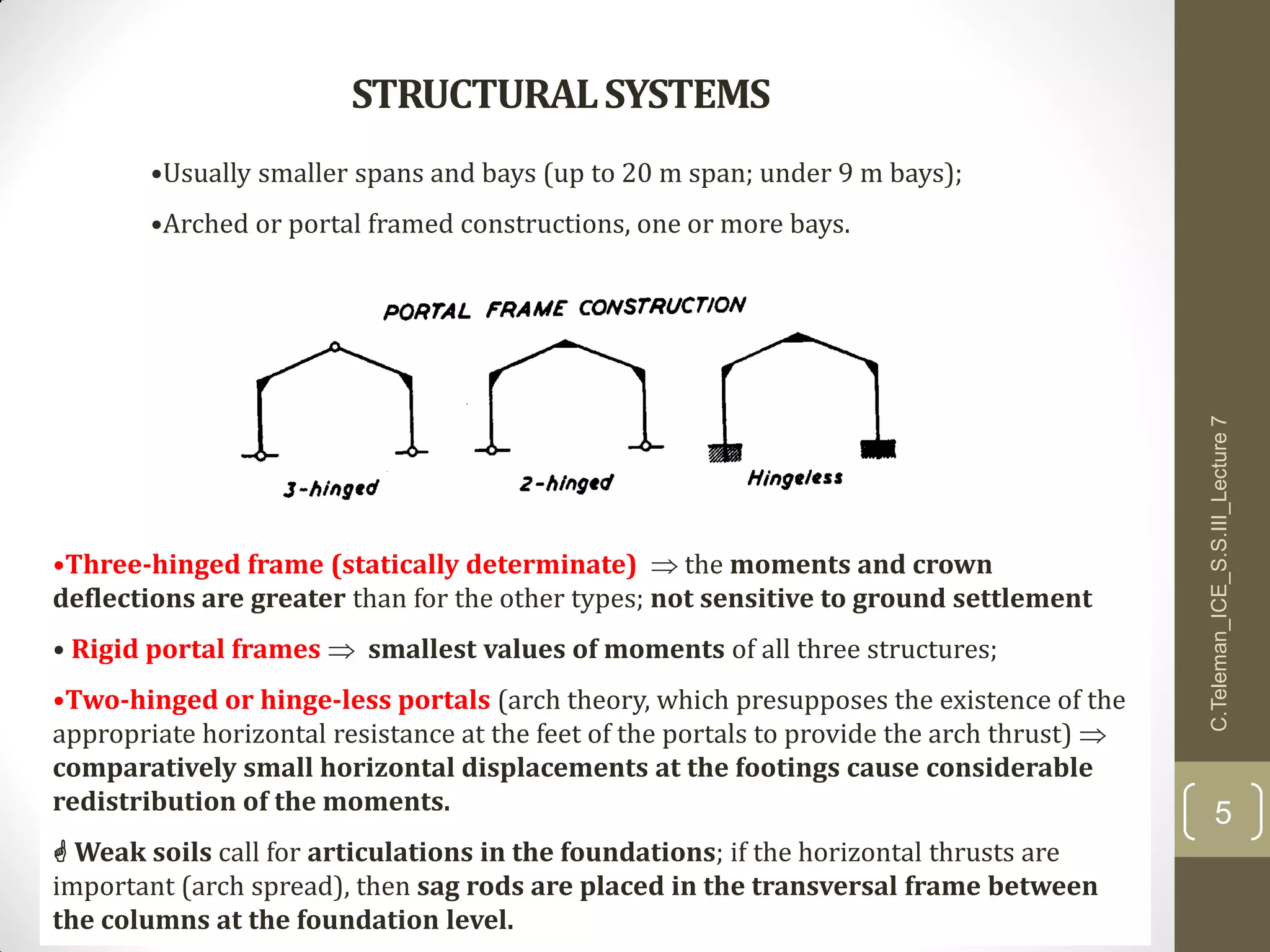
STRUCTURALSYSTEMS
•Usually smaller spans and bays (up to 20 m span; under 9 m bays);
•Arched or portal framed constructions, one or more bays.
•Three-hinged frame (statically determinate)  the moments and crown
deflections are greater than for the other types; not sensitive to ground settlement
• Rigid portal frames  smallest values of moments of all three structures;
•Two-hinged or hinge-less portals (arch theory, which presupposes the existence of the
appropriate horizontal resistance at the feet of the portals to provide the arch thrust) 
comparatively small horizontal displacements at the footings cause considerable
redistribution of the moments.
 Weak soils call for articulations in the foundations; if the horizontal thrusts are
important (arch spread), then sag rods are placed in the transversal frame between
the columns at the foundation level.
C.Teleman_ICE_S.S.III_Lecture7
5
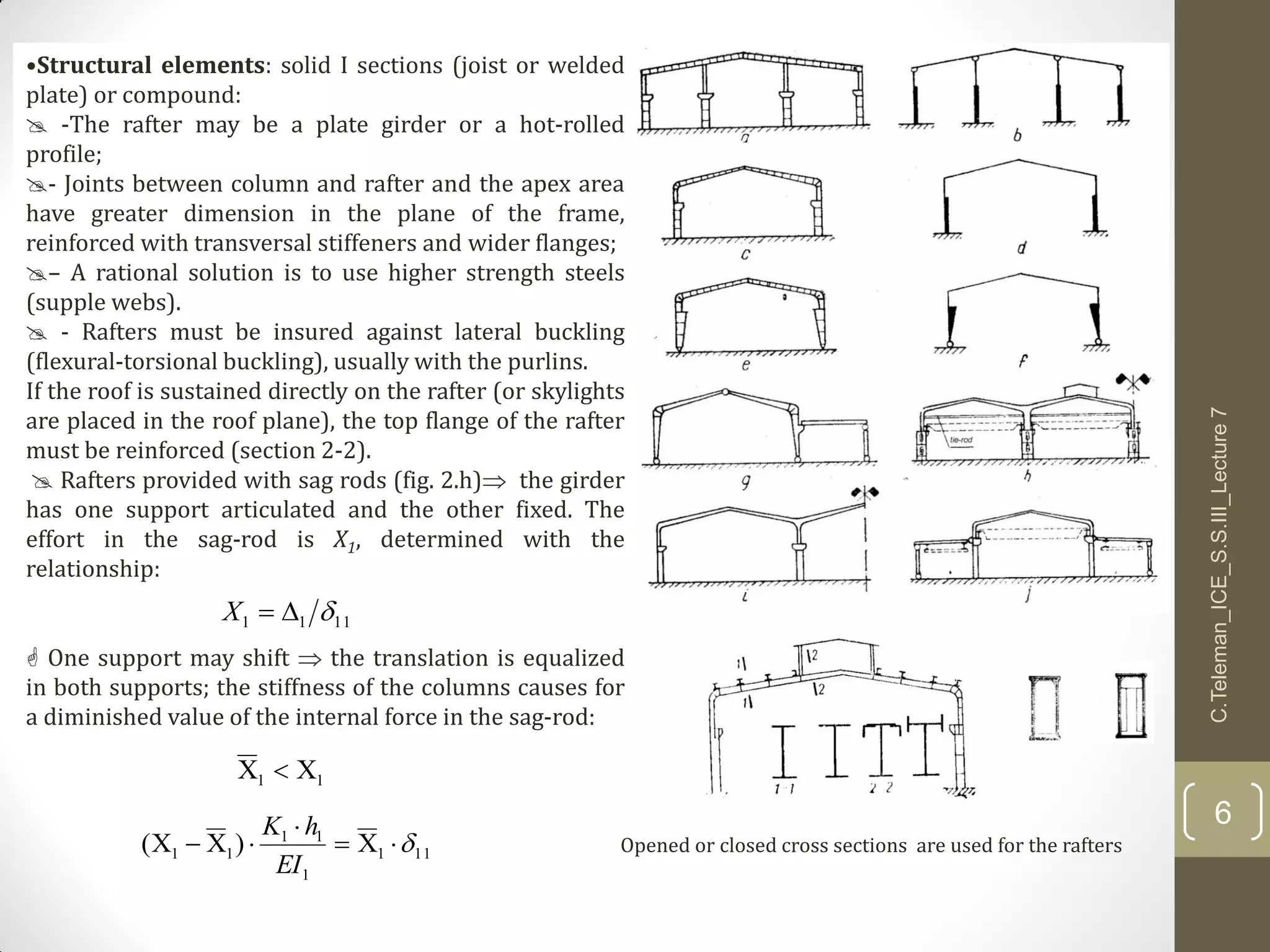
•Structural elements: solid I sections (joist or welded
plate) or compound:
 -The rafter may be a plate girder or a hot-rolled
profile;
- Joints between column and rafter and the apex area
have greater dimension in the plane of the frame,
reinforced with transversal stiffeners and wider flanges;
– A rational solution is to use higher strength steels
(supple webs).
 - Rafters must be insured against lateral buckling
(flexural-torsional buckling), usually with the purlins.
If the roof is sustained directly on the rafter (or skylights
are placed in the roof plane), the top flange of the rafter
must be reinforced (section 2-2).
 Rafters provided with sag rods (fig. 2.h) the girder
has one support articulated and the other fixed. The
effort in the sag-rod is X1, determined with the
relationship:
 One support may shift  the translation is equalized
in both supports; the stiffness of the columns causes for
a diminished value of the internal force in the sag-rod:
1111 X
11 
111
1
11
11 )( 


EI
hK
Opened or closed cross sections are used for the rafters
C.Teleman_ICE_S.S.III_Lecture7
6
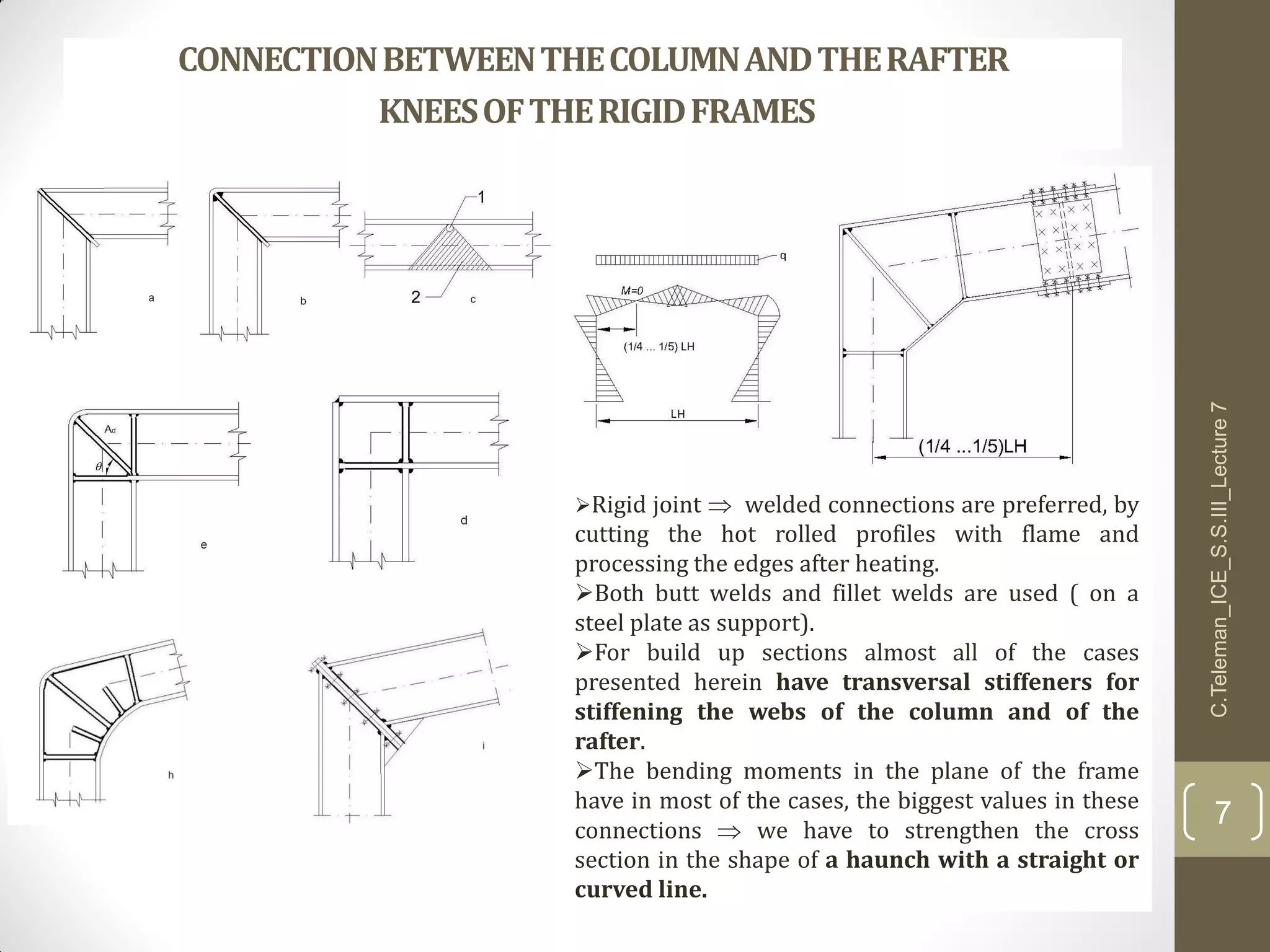
CONNECTIONBETWEENTHECOLUMNANDTHERAFTER
KNEESOFTHERIGIDFRAMES
Rigid joint  welded connections are preferred, by
cutting the hot rolled profiles with flame and
processing the edges after heating.
Both butt welds and fillet welds are used ( on a
steel plate as support).
For build up sections almost all of the cases
presented herein have transversal stiffeners for
stiffening the webs of the column and of the
rafter.
The bending moments in the plane of the frame
have in most of the cases, the biggest values in these
connections  we have to strengthen the cross
section in the shape of a haunch with a straight or
curved line.
C.Teleman_ICE_S.S.III_Lecture7
7
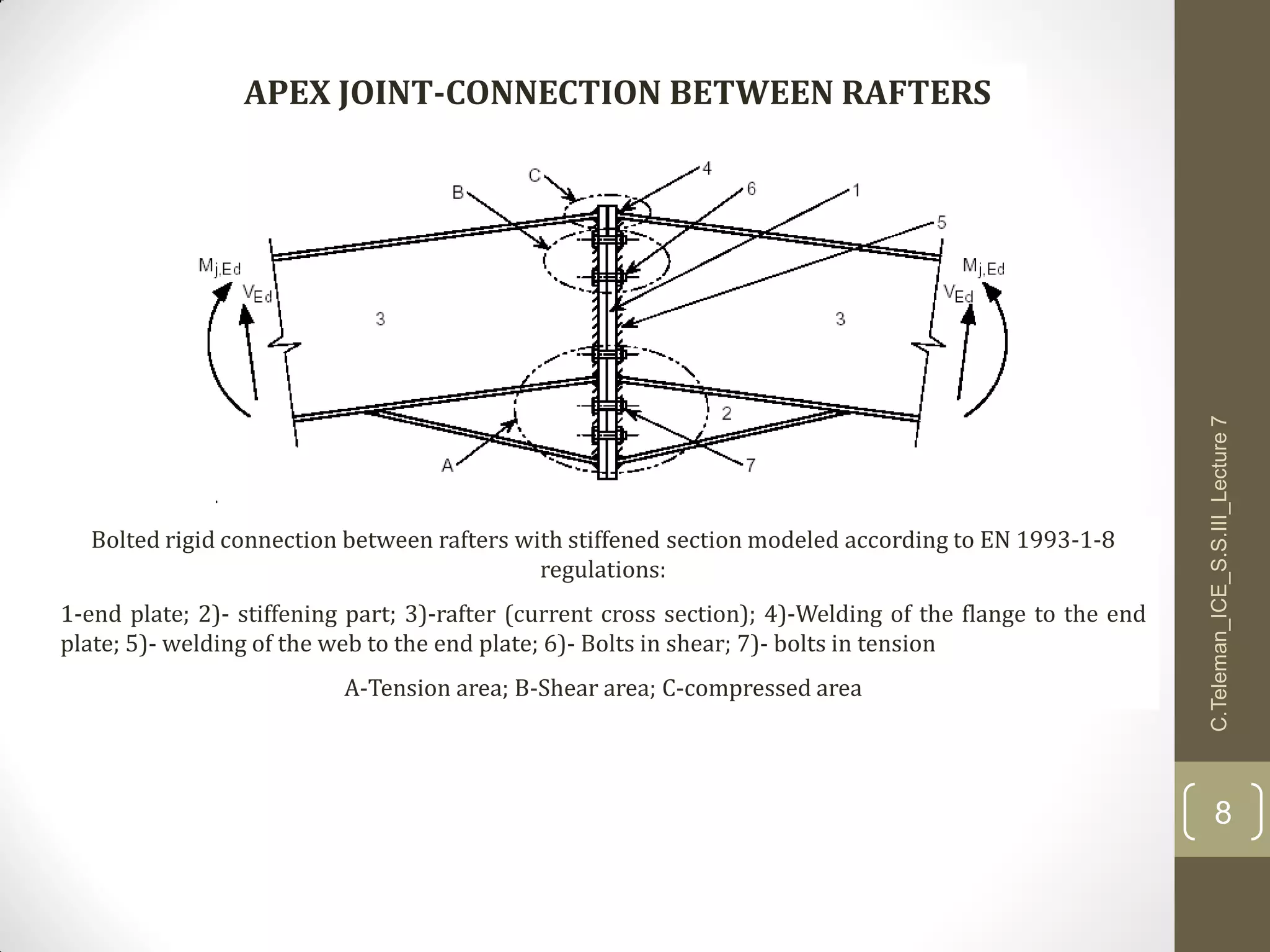
APEX JOINT-CONNECTION BETWEEN RAFTERS
Bolted rigid connection between rafters with stiffened section modeled according to EN 1993-1-8
regulations:
1-end plate; 2)- stiffening part; 3)-rafter (current cross section); 4)-Welding of the flange to the end
plate; 5)- welding of the web to the end plate; 6)- Bolts in shear; 7)- bolts in tension
A-Tension area; B-Shear area; C-compressed area
C.Teleman_ICE_S.S.III_Lecture7
8
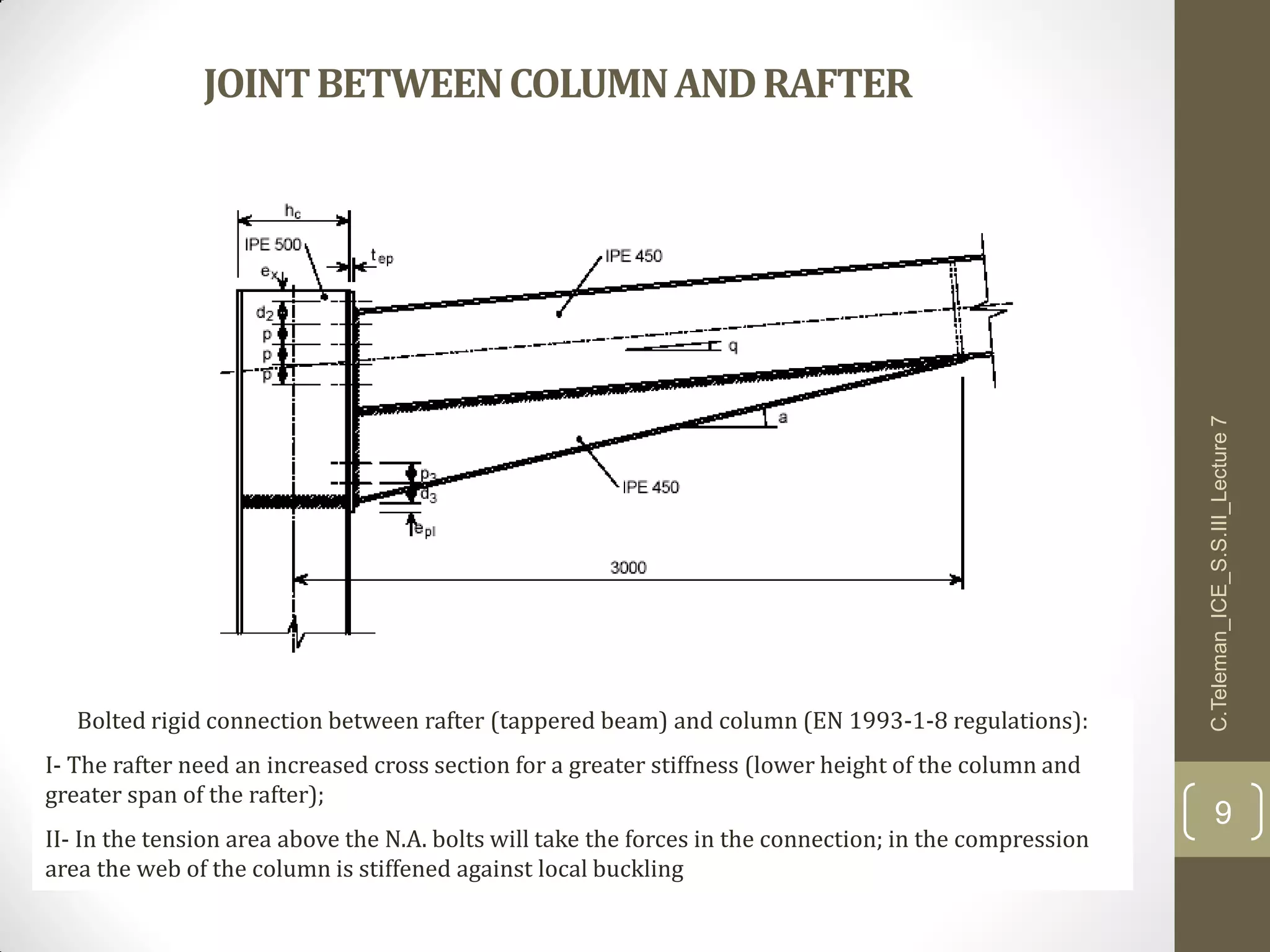
JOINTBETWEENCOLUMNANDRAFTER
Bolted rigid connection between rafter (tappered beam) and column (EN 1993-1-8 regulations):
I- The rafter need an increased cross section for a greater stiffness (lower height of the column and
greater span of the rafter);
II- In the tension area above the N.A. bolts will take the forces in the connection; in the compression
area the web of the column is stiffened against local buckling
C.Teleman_ICE_S.S.III_Lecture7
9
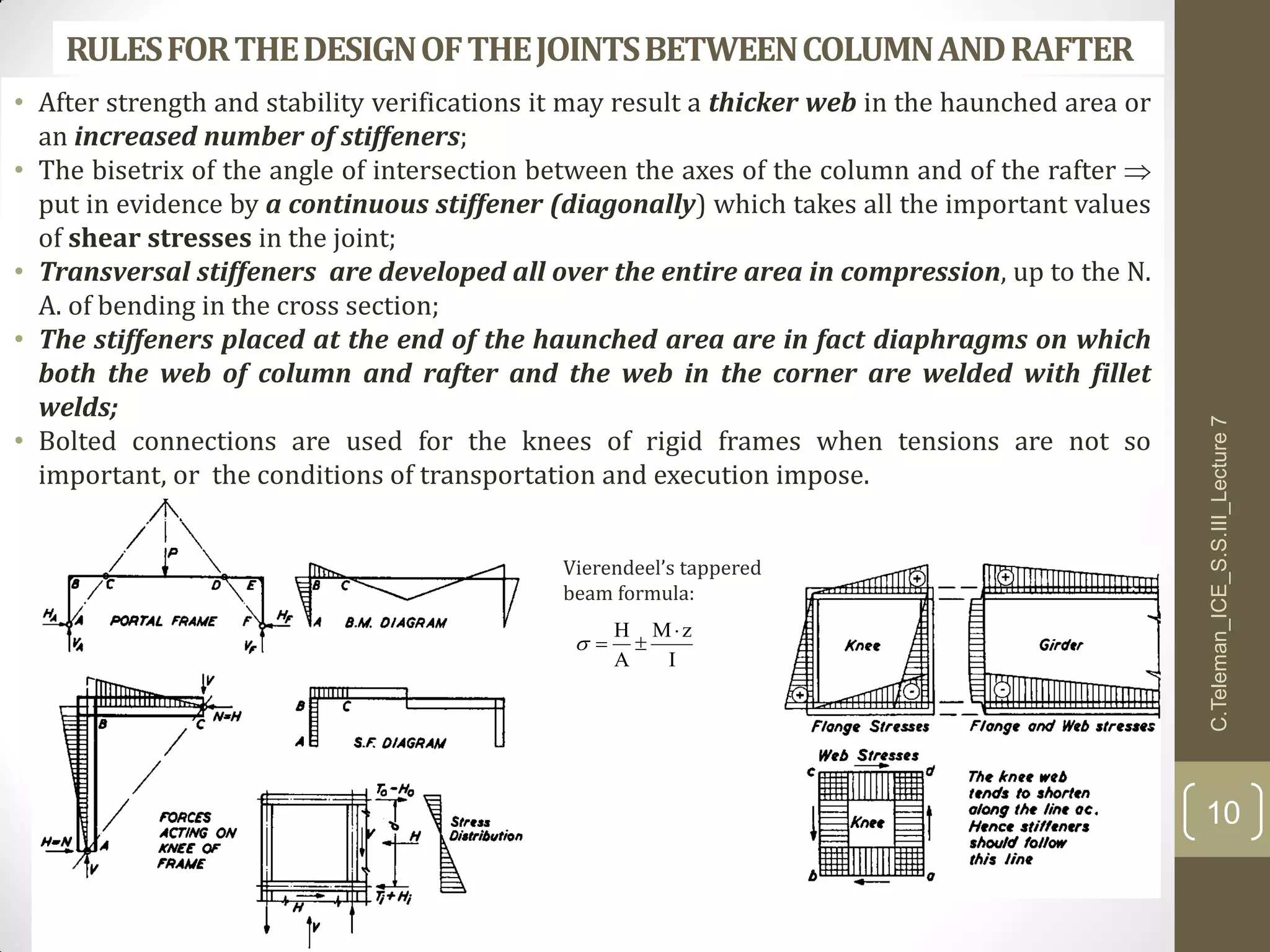
RULESFORTHEDESIGNOFTHEJOINTSBETWEENCOLUMNANDRAFTER
• After strength and stability verifications it may result a thicker web in the haunched area or
an increased number of stiffeners;
• The bisetrix of the angle of intersection between the axes of the column and of the rafter 
put in evidence by a continuous stiffener (diagonally) which takes all the important values
of shear stresses in the joint;
• Transversal stiffeners are developed all over the entire area in compression, up to the N.
A. of bending in the cross section;
• The stiffeners placed at the end of the haunched area are in fact diaphragms on which
both the web of column and rafter and the web in the corner are welded with fillet
welds;
• Bolted connections are used for the knees of rigid frames when tensions are not so
important, or the conditions of transportation and execution impose.
I
zM
A
H 

Vierendeel’s tappered
beam formula:
C.Teleman_ICE_S.S.III_Lecture7
10
H
A
A
HH
A
A
H
ATAT
i
i
iii


;
;
0
0
000 
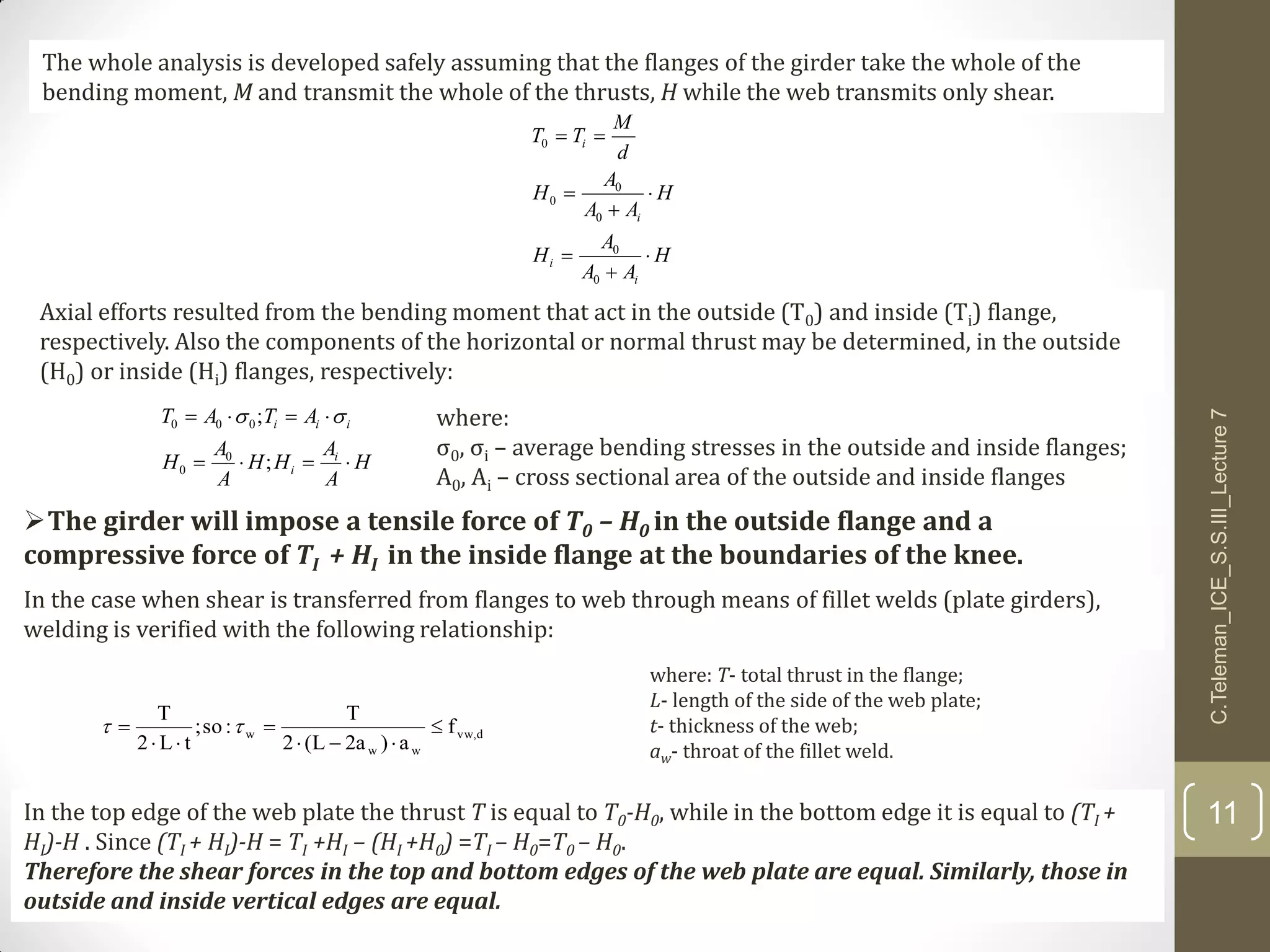
Axial efforts resulted from the bending moment that act in the outside (T0) and inside (Ti) flange,
respectively. Also the components of the horizontal or normal thrust may be determined, in the outside
(H0) or inside (Hi) flanges, respectively:
The whole analysis is developed safely assuming that the flanges of the girder take the whole of the
bending moment, M and transmit the whole of the thrusts, H while the web transmits only shear.
where:
σ0, σi – average bending stresses in the outside and inside flanges;
A0, Ai – cross sectional area of the outside and inside flanges
The girder will impose a tensile force of T0 – H0 in the outside flange and a
compressive force of TI + HI in the inside flange at the boundaries of the knee.
H
AA
A
H
H
AA
A
H
d
M
TT
i
i
i
i







0
0
0
0
0
0
In the case when shear is transferred from flanges to web through means of fillet welds (plate girders),
welding is verified with the following relationship:
In the top edge of the web plate the thrust T is equal to T0-H0, while in the bottom edge it is equal to (TI +
HI)-H . Since (TI + HI)-H = TI +HI – (HI +H0) =TI – H0=T0 – H0.
Therefore the shear forces in the top and bottom edges of the web plate are equal. Similarly, those in
outside and inside vertical edges are equal.
where: T- total thrust in the flange;
L- length of the side of the web plate;
t- thickness of the web;
aw- throat of the fillet weld.
d,vw
ww
w f
a)a2L(2
T
:so;
tL2
T




 
C.Teleman_ICE_S.S.III_Lecture7
11
SPECIFICRULESFORTHEDESIGNOFTHEJOINTSBETWEEN
COLUMNANDRAFTER-contin
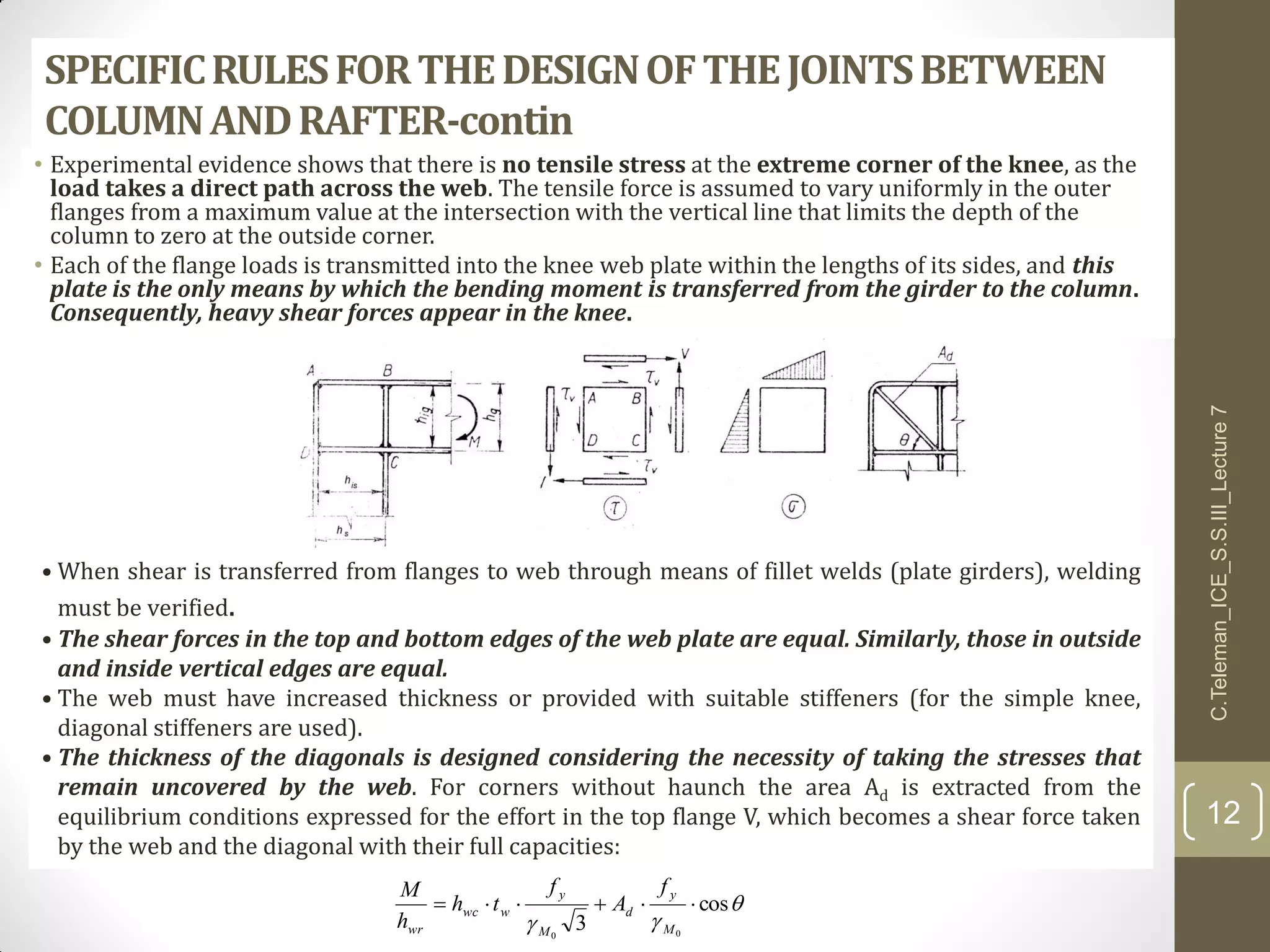
• Experimental evidence shows that there is no tensile stress at the extreme corner of the knee, as the
load takes a direct path across the web. The tensile force is assumed to vary uniformly in the outer
flanges from a maximum value at the intersection with the vertical line that limits the depth of the
column to zero at the outside corner.
• Each of the flange loads is transmitted into the knee web plate within the lengths of its sides, and this
plate is the only means by which the bending moment is transferred from the girder to the column.
Consequently, heavy shear forces appear in the knee.
• When shear is transferred from flanges to web through means of fillet welds (plate girders), welding
must be verified.
• The shear forces in the top and bottom edges of the web plate are equal. Similarly, those in outside
and inside vertical edges are equal.
• The web must have increased thickness or provided with suitable stiffeners (for the simple knee,
diagonal stiffeners are used).
• The thickness of the diagonals is designed considering the necessity of taking the stresses that
remain uncovered by the web. For corners without haunch the area Ad is extracted from the
equilibrium conditions expressed for the effort in the top flange V, which becomes a shear force taken
by the web and the diagonal with their full capacities:


cos
3 00

M
y
d
M
y
wwc
wr
f
A
f
th
h
M
C.Teleman_ICE_S.S.III_Lecture7
12
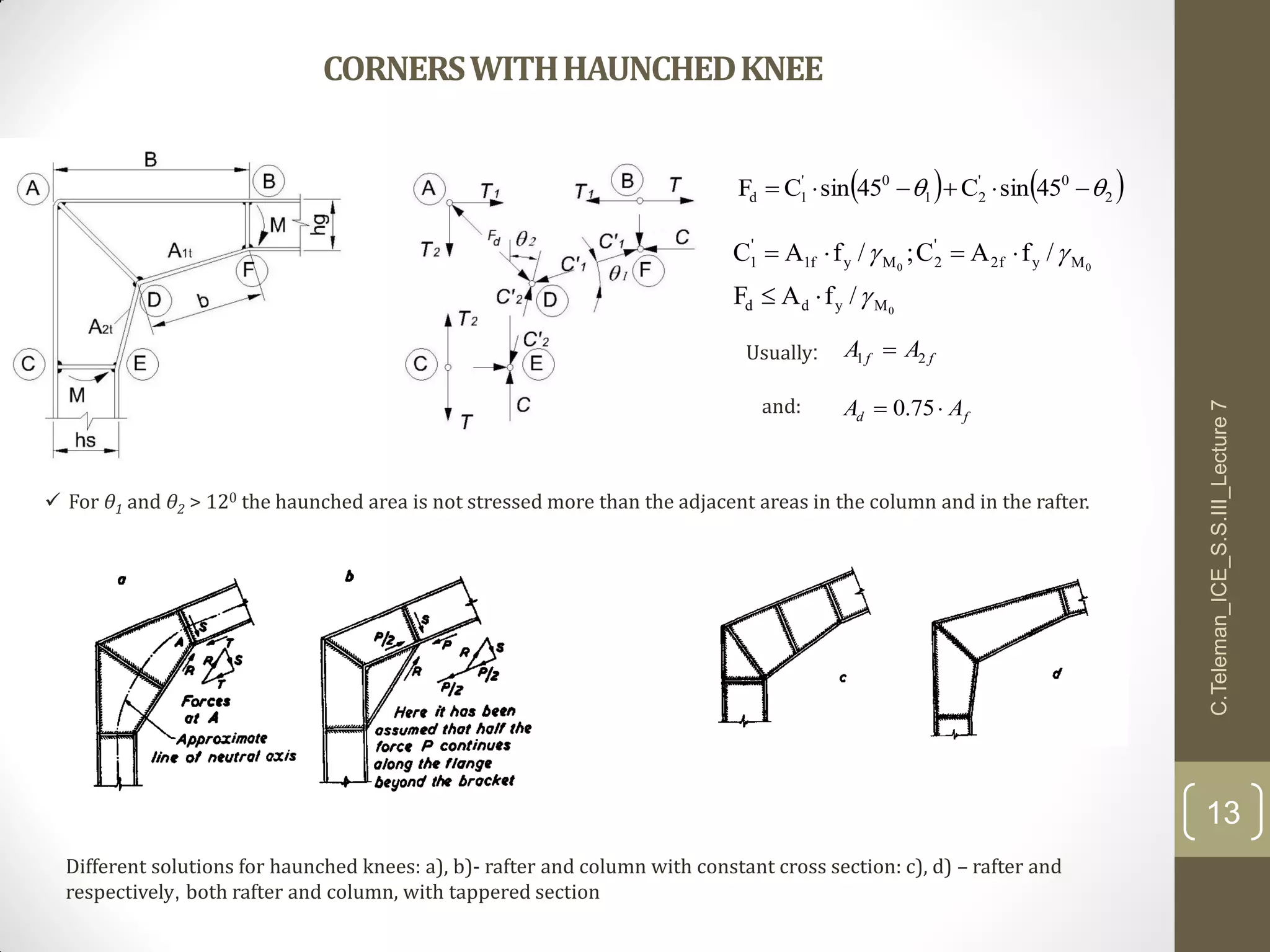
CORNERSWITHHAUNCHEDKNEE
   2
0'
21
0'
1d 45sinC45sinCF  
0
00
Mydd
Myf2
'
2Myf1
'
1
/fAF
/fAC;/fAC




ff AA 21 
fd AA  75.0
Usually:
and:
 For θ1 and θ2 > 120 the haunched area is not stressed more than the adjacent areas in the column and in the rafter.
C.Teleman_ICE_S.S.III_Lecture7
13
Different solutions for haunched knees: a), b)- rafter and column with constant cross section: c), d) – rafter and
respectively, both rafter and column, with tappered section
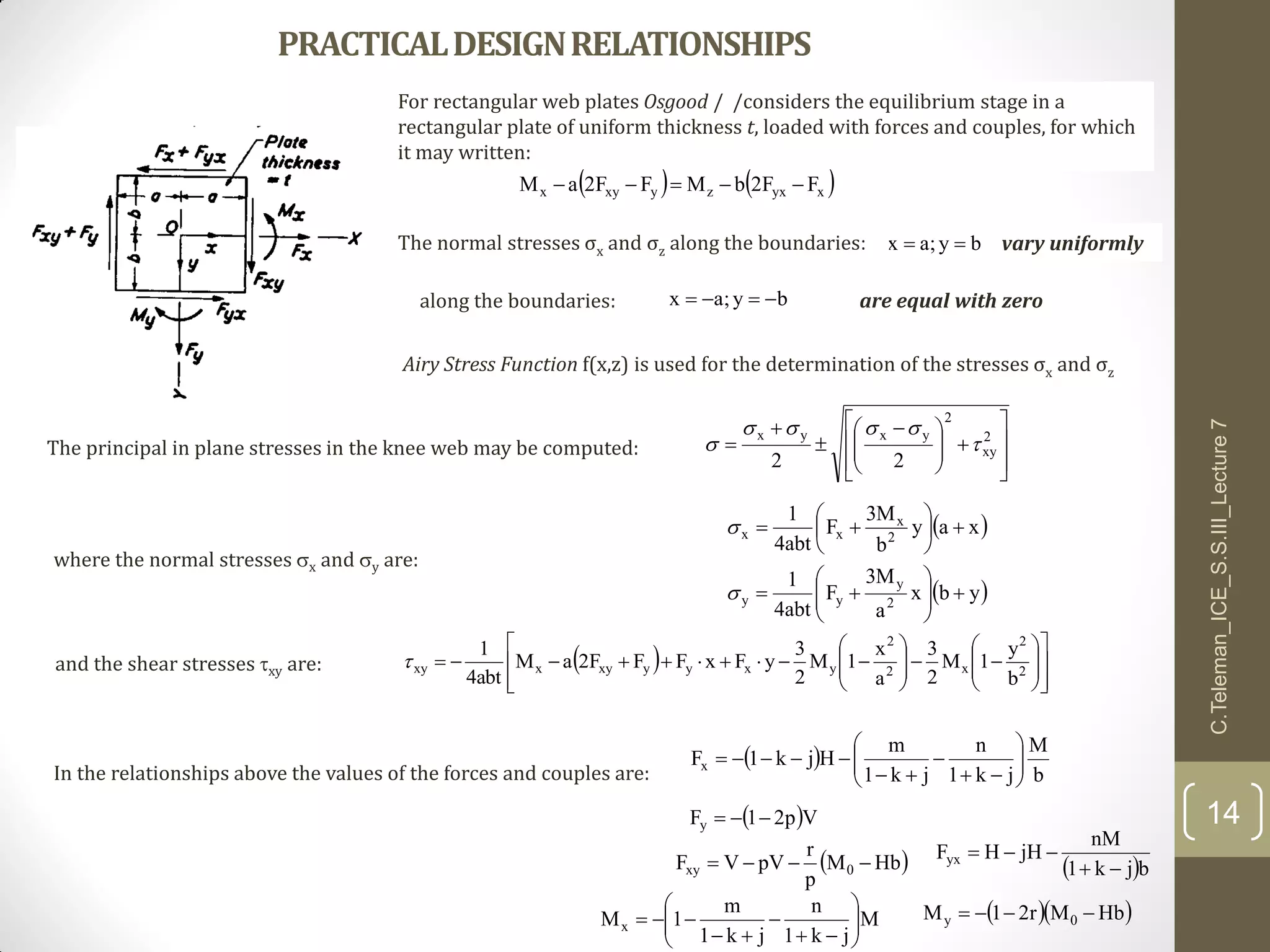
PRACTICALDESIGNRELATIONSHIPS
For rectangular web plates Osgood / /considers the equilibrium stage in a
rectangular plate of uniform thickness t, loaded with forces and couples, for which
it may written:
   xyxzyxyx FF2bMFF2aM 
by;ax 
by;ax 
The normal stresses σx and σz along the boundaries: vary uniformly
along the boundaries: are equal with zero
Airy Stress Function f(x,z) is used for the determination of the stresses σx and σz













 


 2
xy
2
yxyx
22


The principal in plane stresses in the knee web may be computed:
C.Teleman_ICE_S.S.III_Lecture7
14
 
 ybx
a
M3
F
abt4
1
xay
b
M3
F
abt4
1
2
y
yy
2
x
xx
















where the normal stresses x and y are:
and the shear stresses xy are:  
























 2
2
x2
2
yxyyxyxxy
b
y
1M
2
3
a
x
1M
2
3
yFxFFF2aM
abt4
1

In the relationships above the values of the forces and couples are:
 
b
M
jk1
n
jk1
m
Hjk1Fx 









 Vp21Fy 
 HbM
p
r
pVVF 0xy   bjk1
nM
jHHFyx


M
jk1
n
jk1
m
1Mx 








   HbMr21M 0y 
15
C.Teleman_ICE_S.S.III_Lecture7
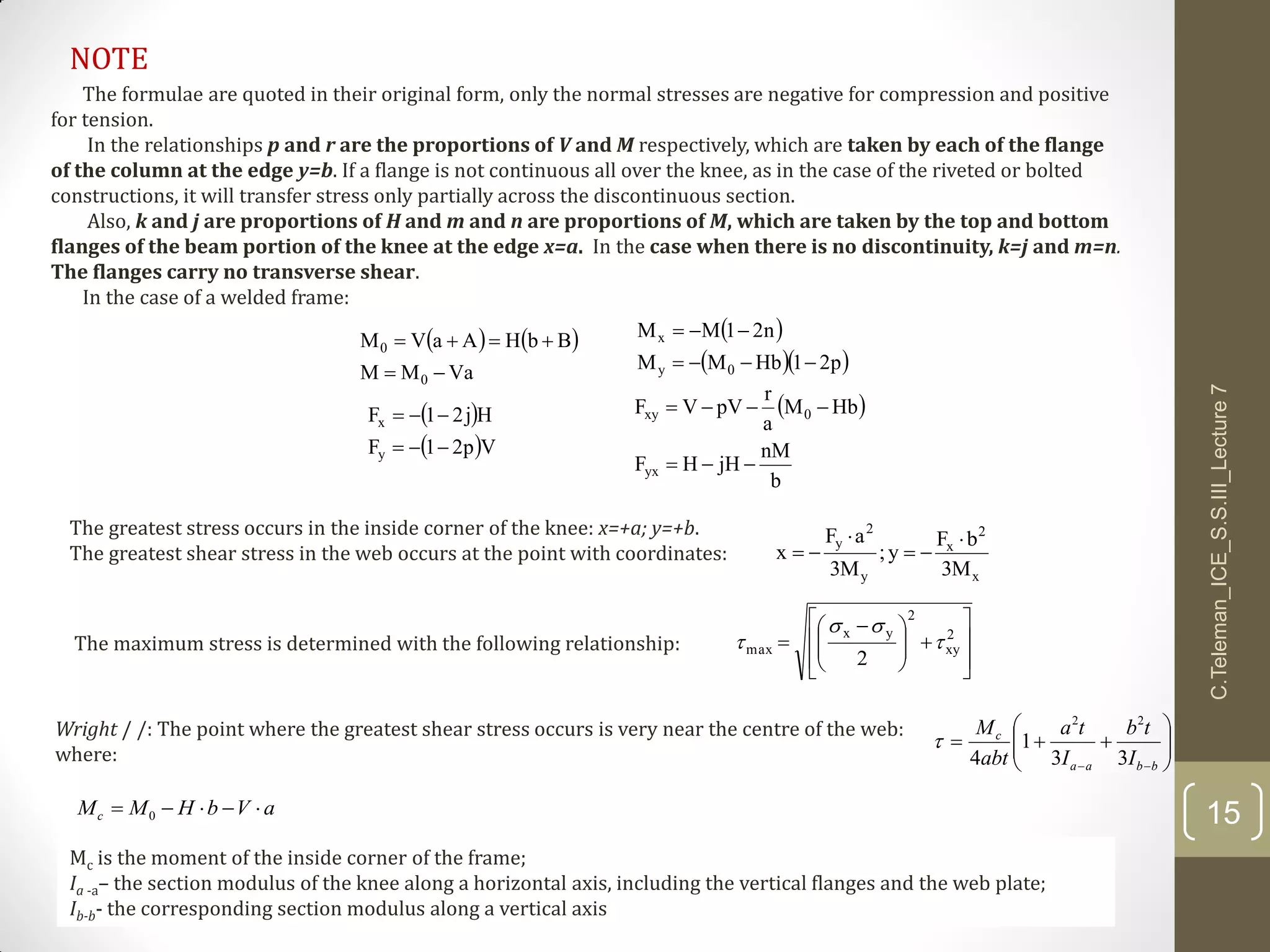
The formulae are quoted in their original form, only the normal stresses are negative for compression and positive
for tension.
In the relationships p and r are the proportions of V and M respectively, which are taken by each of the flange
of the column at the edge y=b. If a flange is not continuous all over the knee, as in the case of the riveted or bolted
constructions, it will transfer stress only partially across the discontinuous section.
Also, k and j are proportions of H and m and n are proportions of M, which are taken by the top and bottom
flanges of the beam portion of the knee at the edge x=a. In the case when there is no discontinuity, k=j and m=n.
The flanges carry no transverse shear.
In the case of a welded frame:
   
VaMM
BbHAaVM
0
0

  
  p21HbMM
n21MM
0y
x


 
 Vp21F
Hj21F
y
x

  
b
nM
jHHF
HbM
a
r
pVVF
yx
0xy


The greatest stress occurs in the inside corner of the knee: x=+a; y=+b.
The greatest shear stress in the web occurs at the point with coordinates:
x
2
x
y
2
y
M3
bF
y;
M3
aF
x




The maximum stress is determined with the following relationship:













 
 2
xy
2
yx
max
2



Wright / /: The point where the greatest shear stress occurs is very near the centre of the web:
where: 






 bbaa
c
I
tb
I
ta
abt
M
33
1
4
22

aVbHMMc  0
Mc is the moment of the inside corner of the frame;
Ia -a– the section modulus of the knee along a horizontal axis, including the vertical flanges and the web plate;
Ib-b- the corresponding section modulus along a vertical axis
NOTE
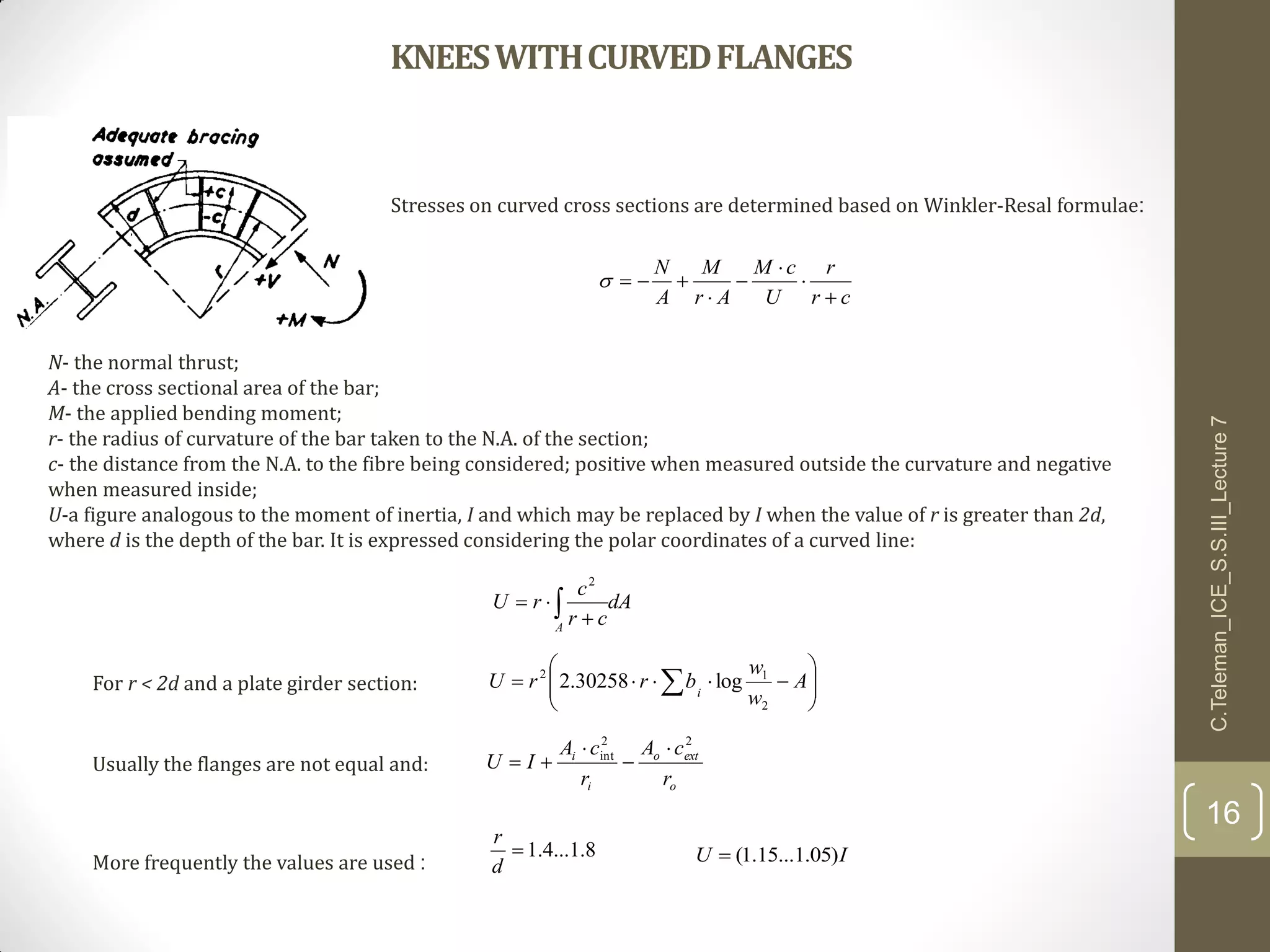
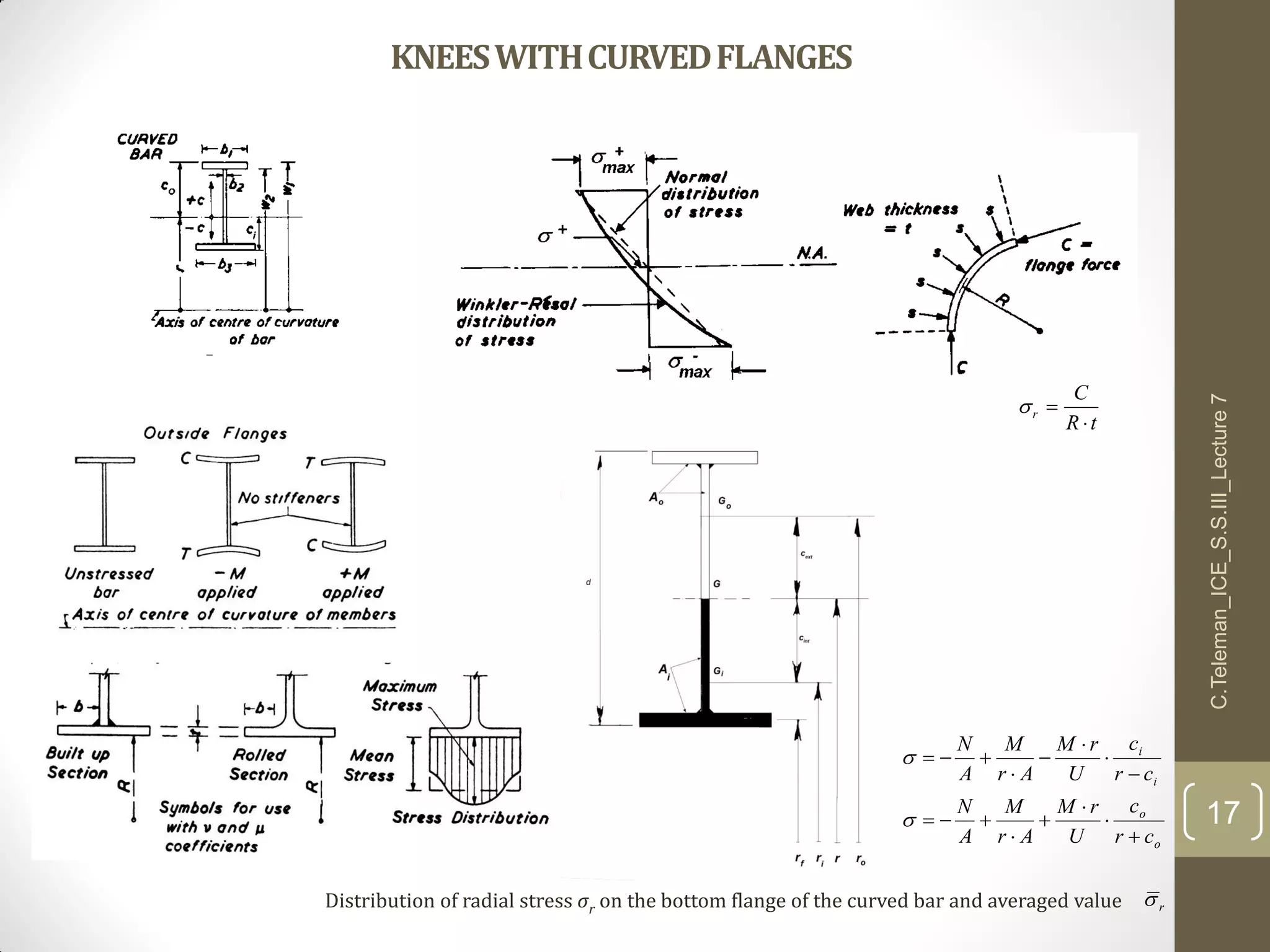
KNEESWITHCURVEDFLANGES
cr
r
U
cM
Ar
M
A
N






Stresses on curved cross sections are determined based on Winkler-Resal formulae:
N- the normal thrust;
A- the cross sectional area of the bar;
M- the applied bending moment;
r- the radius of curvature of the bar taken to the N.A. of the section;
c- the distance from the N.A. to the fibre being considered; positive when measured outside the curvature and negative
when measured inside;
U-a figure analogous to the moment of inertia, I and which may be replaced by I when the value of r is greater than 2d,
where d is the depth of the bar. It is expressed considering the polar coordinates of a curved line:
dA
cr
c
rU
A
 

2






  A
w
w
brrU i
2
12
log30258.2For r < 2d and a plate girder section:
o
exto
i
i
r
cA
r
cA
IU
22
int 



8.1...4.1
d
r
IU )05.1...15.1(
C.Teleman_ICE_S.S.III_Lecture7
16
Usually the flanges are not equal and:
More frequently the values are used :
o
o
i
i
cr
c
U
rM
Ar
M
A
N
cr
c
U
rM
Ar
M
A
N














Distribution of radial stress σr on the bottom flange of the curved bar and averaged value r
C.Teleman_ICE_S.S.III_Lecture7
17
tR
C
r


KNEESWITHCURVEDFLANGES
18
C.Teleman_ICE_S.S.III_Lecture7
r
b
0
t
'
'
dx
b




 316.1k);k(f
'b
'b

 
f
2'
rt
b


fr
dsrt'b
2
d
rt'b2
2
d
sinrt'b2N






dsb
N
p 'r


R
t
p r
r


2
)b(
R
t
M
2'
r
t 

 2
t
f
t
t
t1
M6
W
M


tr
2
t
2
rechiv 
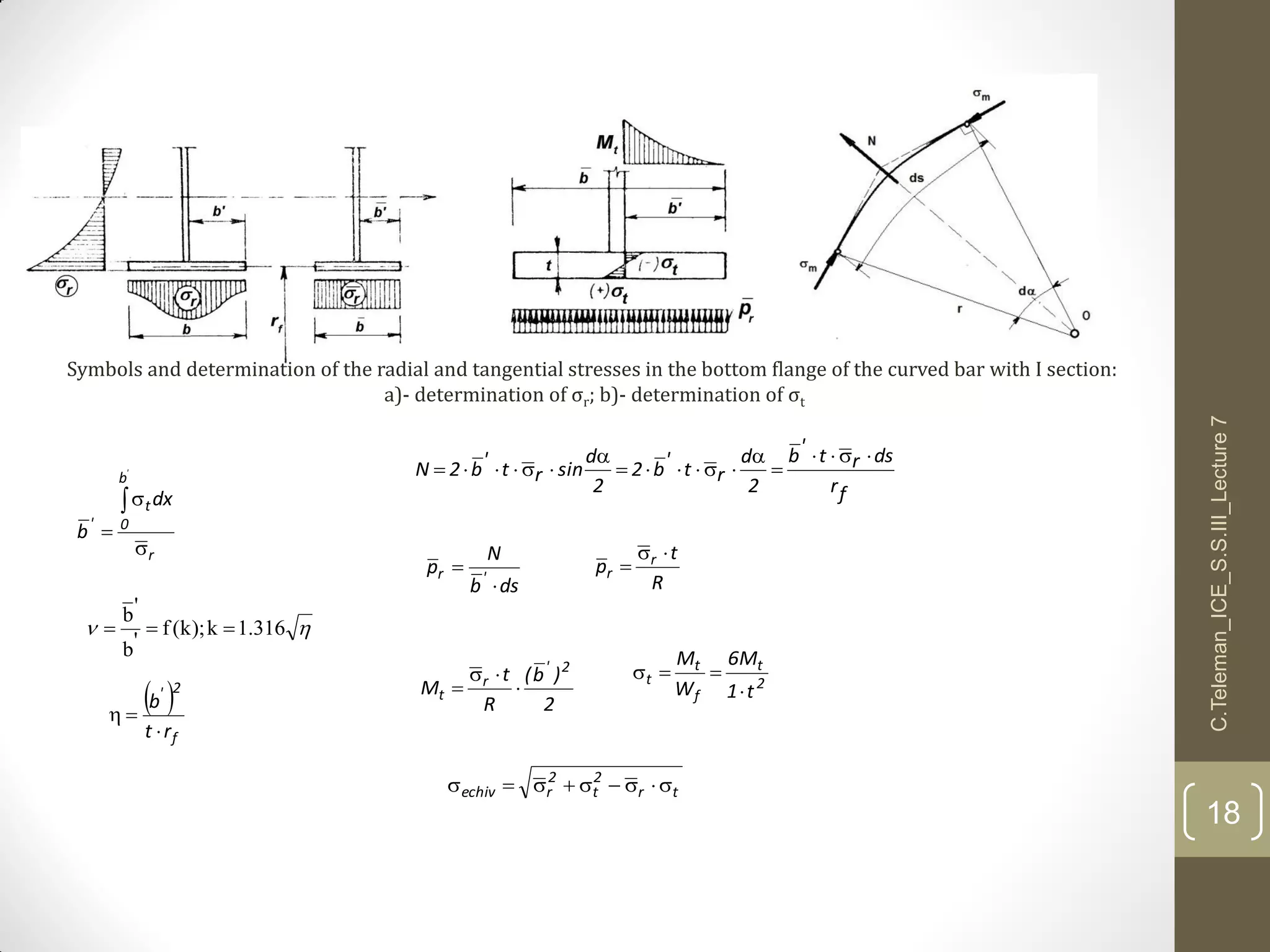
Symbols and determination of the radial and tangential stresses in the bottom flange of the curved bar with I section:
a)- determination of σr; b)- determination of σt
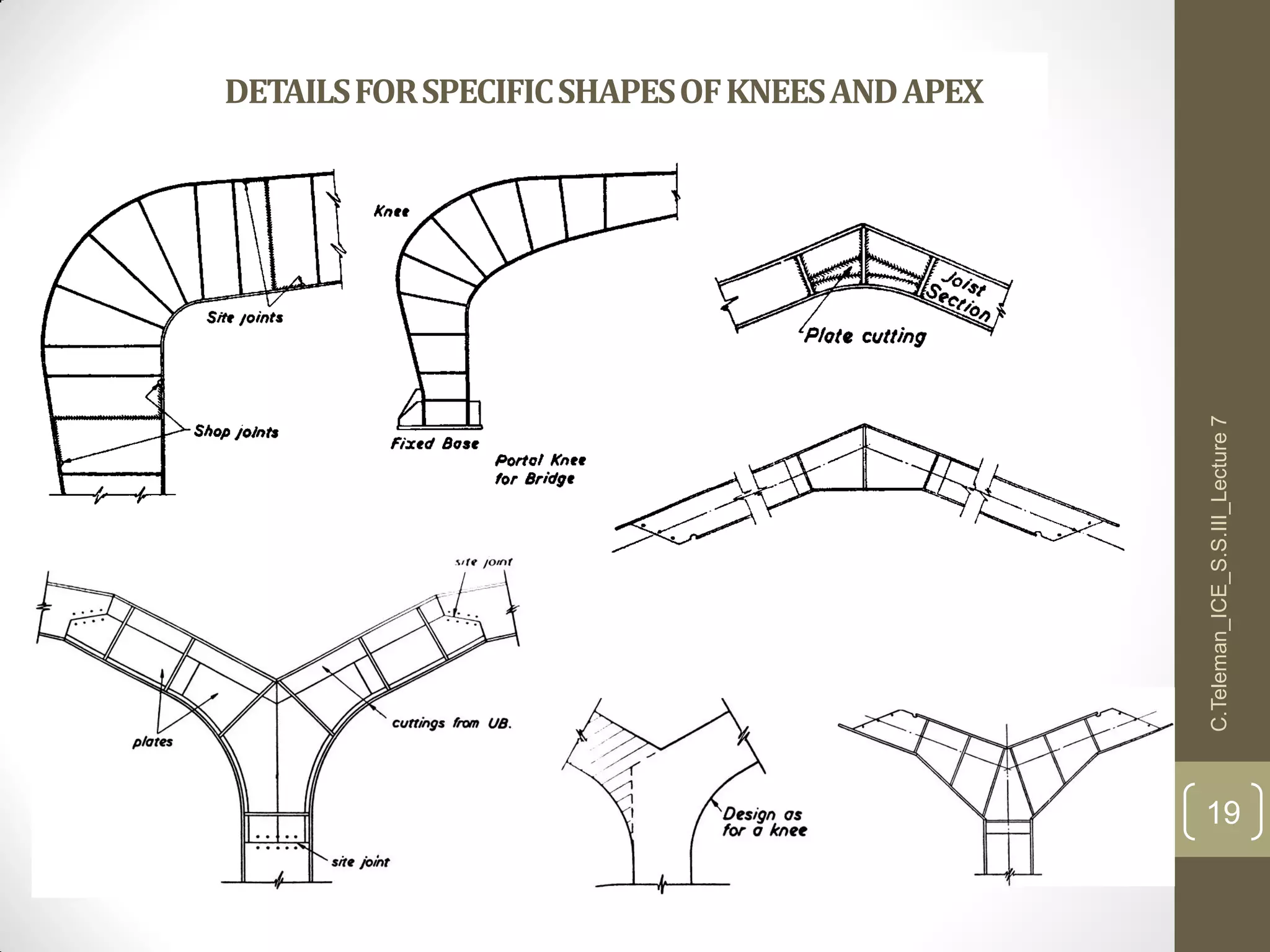
DETAILSFORSPECIFICSHAPESOFKNEESANDAPEX
C.Teleman_ICE_S.S.III_Lecture7
19
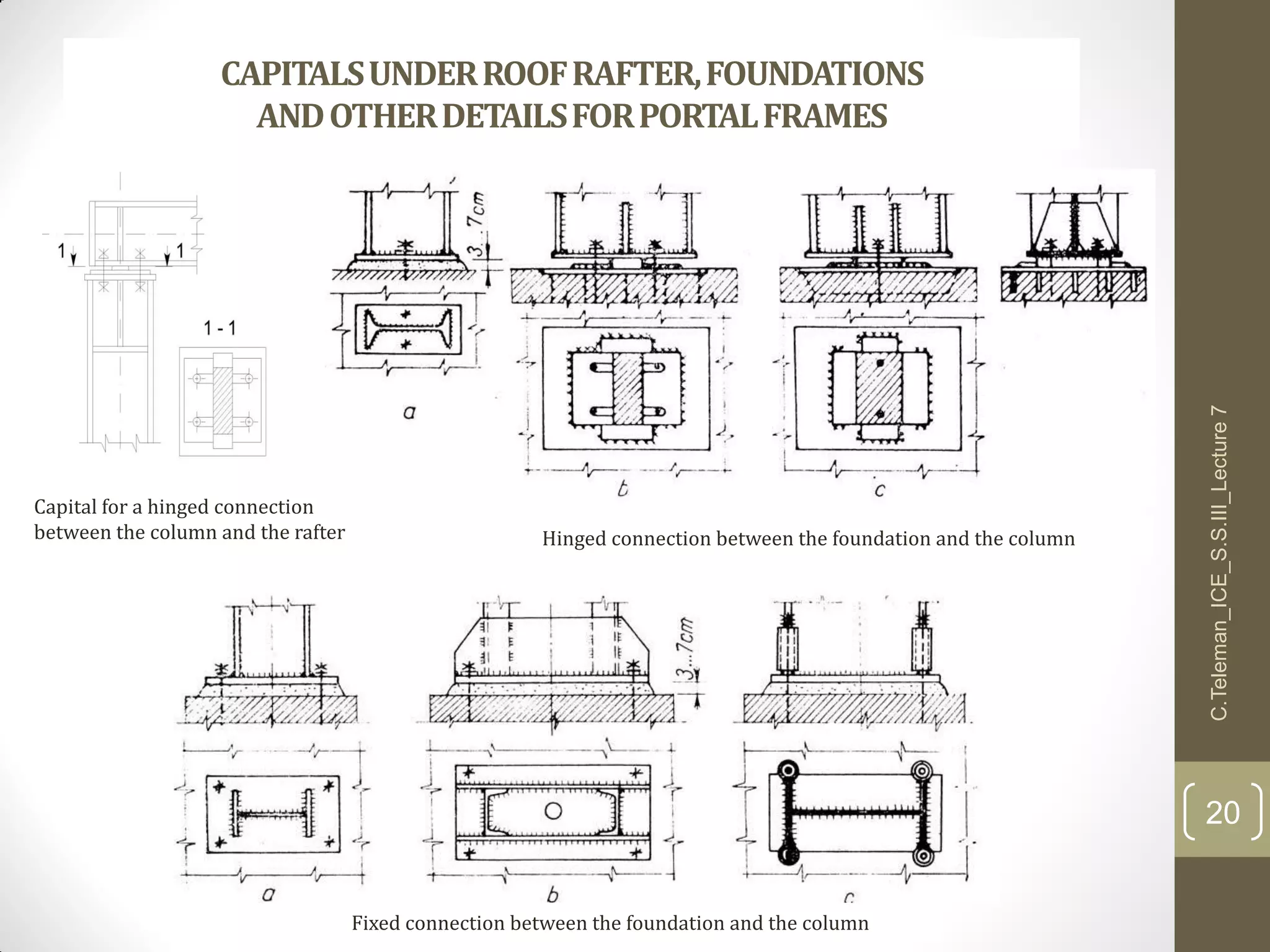
CAPITALSUNDERROOFRAFTER,FOUNDATIONS
ANDOTHERDETAILSFORPORTALFRAMES
Capital for a hinged connection
between the column and the rafter Hinged connection between the foundation and the column
Fixed connection between the foundation and the column
C.Teleman_ICE_S.S.III_Lecture7
20
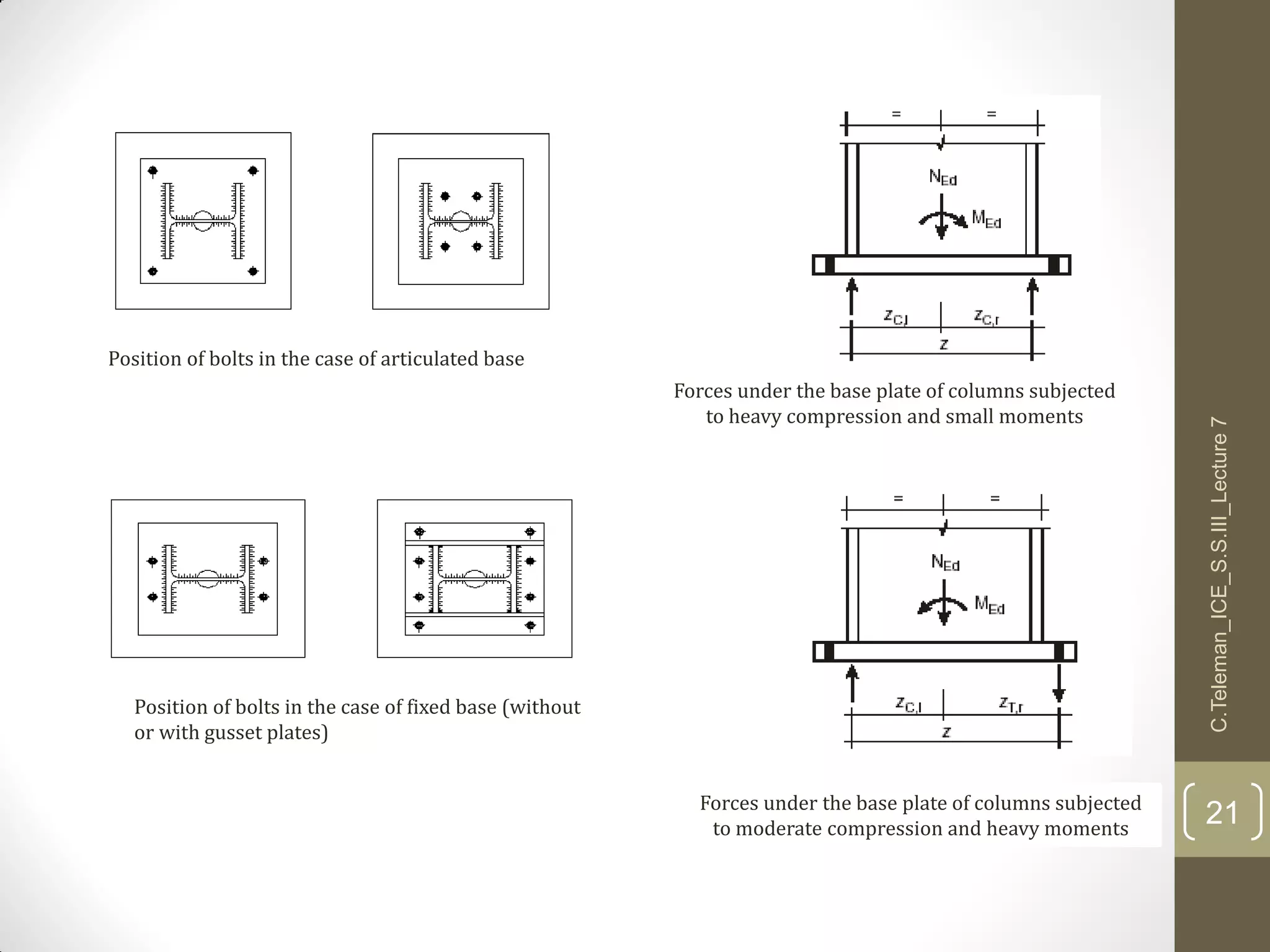
Position of bolts in the case of articulated base
Forces under the base plate of columns subjected
to heavy compression and small moments
C.Teleman_ICE_S.S.III_Lecture7
21
Position of bolts in the case of fixed base (without
or with gusset plates)
Forces under the base plate of columns subjected
to moderate compression and heavy moments
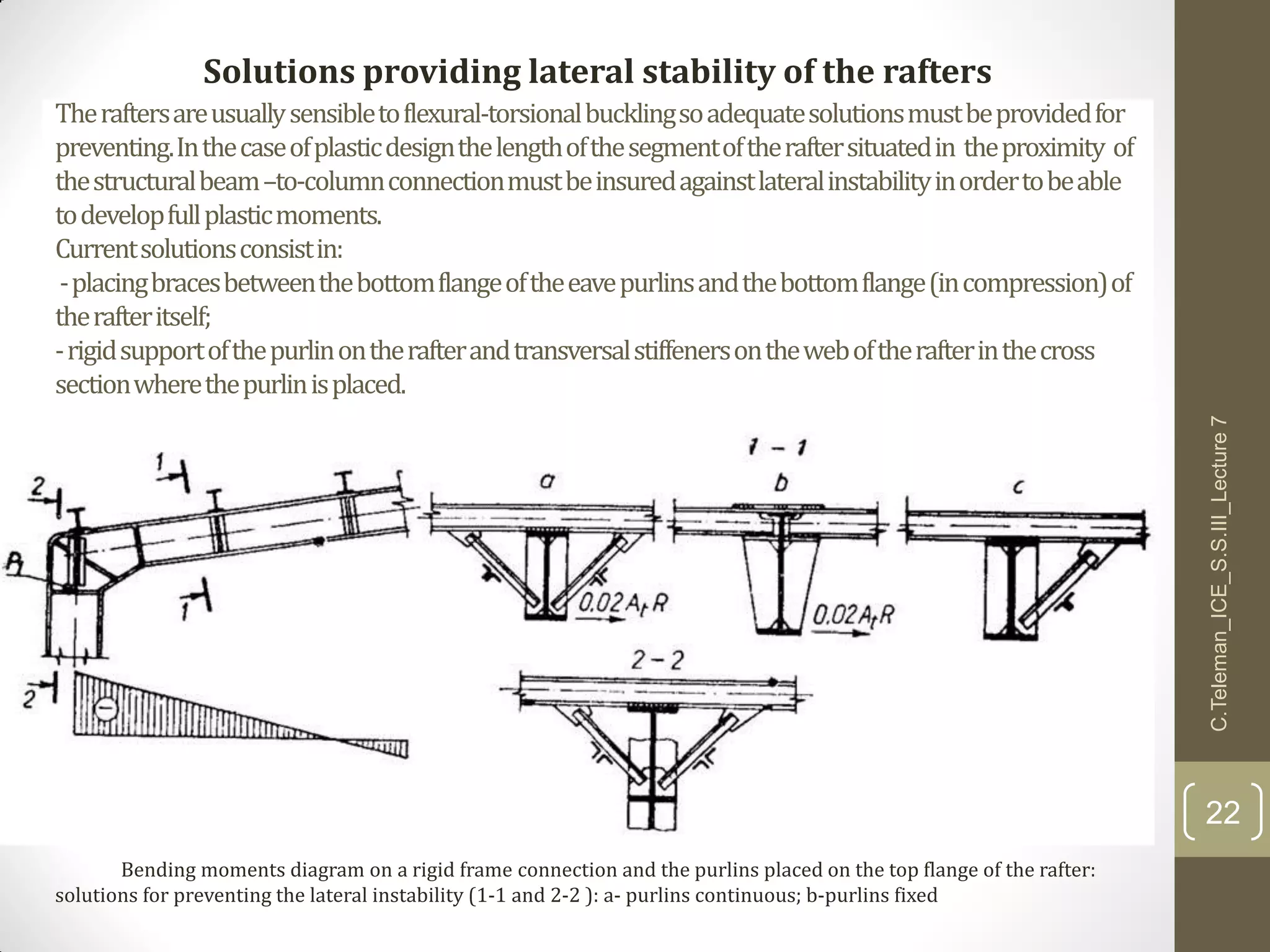
Theraftersareusuallysensibletoflexural-torsionalbucklingsoadequatesolutionsmustbeprovidedfor
preventing.Inthecaseofplasticdesignthelengthofthesegmentoftheraftersituatedin theproximity of
thestructuralbeam–to-columnconnectionmustbeinsuredagainstlateralinstabilityinordertobeable
todevelopfullplasticmoments.
Currentsolutionsconsistin:
-placingbracesbetweenthebottomflangeoftheeavepurlinsandthebottomflange(incompression)of
therafteritself;
-rigidsupportofthepurlinontherafterandtransversalstiffenersontheweboftherafterinthecross
sectionwherethepurlinisplaced.
C.Teleman_ICE_S.S.III_Lecture7
22
Solutions providing lateral stability of the rafters
Bending moments diagram on a rigid frame connection and the purlins placed on the top flange of the rafter:
solutions for preventing the lateral instability (1-1 and 2-2 ): a- purlins continuous; b-purlins fixed

Lecture 7 s.s.iii Design of Steel Structures - Faculty of Civil Engineering Iaşi

  • 1.
  • 2.
    Main structural andnon-structural elements used for the current construction with portal frames 1)-Roof sheeting or decking (sandwich panels); 2)- Structural elements (columns and rafters); 3)- Beams for sustaining the wall sheeting or decking; 4)-Purlins; 5)- Wall panels Current structures used for various activities: workshops, deposits, retail centers; others. Wide variety of spans: 12 m….60 m but the efficiency of the system is for 20 m…30 m; Bays between 6 m…10(12) m C.Teleman_ICE_S.S.III_Lecture7 2
  • 3.
     Variation ofthe cross section of columns and rafters shows the static system adopted COLUMNS FIXED IN FOUNDATION ARTICULATED RAFTERS RIGIDLY INTERCONNECTED ARTICULATED IN THE MIDDLE OF THE SPAN C.Teleman_ICE_S.S.III_Lecture7 3
  • 4.
    a)-medium span; b)-curved rafter c)-with intermediary floor; d)- with crane girders on brackets e)-portal frame with two even spans f)-portal frame with two uneven spans g)- double pitched rafter; h)- frame with variable sections of the column and girder (build up sections, welded) VARIOUS TYPES OF STRUCTURES FOR CURRENT PORTAL FRAMES C.Teleman_ICE_S.S.III_Lecture7 4
  • 5.
    STRUCTURALSYSTEMS •Usually smaller spansand bays (up to 20 m span; under 9 m bays); •Arched or portal framed constructions, one or more bays. •Three-hinged frame (statically determinate)  the moments and crown deflections are greater than for the other types; not sensitive to ground settlement • Rigid portal frames  smallest values of moments of all three structures; •Two-hinged or hinge-less portals (arch theory, which presupposes the existence of the appropriate horizontal resistance at the feet of the portals to provide the arch thrust)  comparatively small horizontal displacements at the footings cause considerable redistribution of the moments.  Weak soils call for articulations in the foundations; if the horizontal thrusts are important (arch spread), then sag rods are placed in the transversal frame between the columns at the foundation level. C.Teleman_ICE_S.S.III_Lecture7 5
  • 6.
    •Structural elements: solidI sections (joist or welded plate) or compound:  -The rafter may be a plate girder or a hot-rolled profile; - Joints between column and rafter and the apex area have greater dimension in the plane of the frame, reinforced with transversal stiffeners and wider flanges; – A rational solution is to use higher strength steels (supple webs).  - Rafters must be insured against lateral buckling (flexural-torsional buckling), usually with the purlins. If the roof is sustained directly on the rafter (or skylights are placed in the roof plane), the top flange of the rafter must be reinforced (section 2-2).  Rafters provided with sag rods (fig. 2.h) the girder has one support articulated and the other fixed. The effort in the sag-rod is X1, determined with the relationship:  One support may shift  the translation is equalized in both supports; the stiffness of the columns causes for a diminished value of the internal force in the sag-rod: 1111 X 11  111 1 11 11 )(    EI hK Opened or closed cross sections are used for the rafters C.Teleman_ICE_S.S.III_Lecture7 6
  • 7.
    CONNECTIONBETWEENTHECOLUMNANDTHERAFTER KNEESOFTHERIGIDFRAMES Rigid joint welded connections are preferred, by cutting the hot rolled profiles with flame and processing the edges after heating. Both butt welds and fillet welds are used ( on a steel plate as support). For build up sections almost all of the cases presented herein have transversal stiffeners for stiffening the webs of the column and of the rafter. The bending moments in the plane of the frame have in most of the cases, the biggest values in these connections  we have to strengthen the cross section in the shape of a haunch with a straight or curved line. C.Teleman_ICE_S.S.III_Lecture7 7
  • 8.
    APEX JOINT-CONNECTION BETWEENRAFTERS Bolted rigid connection between rafters with stiffened section modeled according to EN 1993-1-8 regulations: 1-end plate; 2)- stiffening part; 3)-rafter (current cross section); 4)-Welding of the flange to the end plate; 5)- welding of the web to the end plate; 6)- Bolts in shear; 7)- bolts in tension A-Tension area; B-Shear area; C-compressed area C.Teleman_ICE_S.S.III_Lecture7 8
  • 9.
    JOINTBETWEENCOLUMNANDRAFTER Bolted rigid connectionbetween rafter (tappered beam) and column (EN 1993-1-8 regulations): I- The rafter need an increased cross section for a greater stiffness (lower height of the column and greater span of the rafter); II- In the tension area above the N.A. bolts will take the forces in the connection; in the compression area the web of the column is stiffened against local buckling C.Teleman_ICE_S.S.III_Lecture7 9
  • 10.
    RULESFORTHEDESIGNOFTHEJOINTSBETWEENCOLUMNANDRAFTER • After strengthand stability verifications it may result a thicker web in the haunched area or an increased number of stiffeners; • The bisetrix of the angle of intersection between the axes of the column and of the rafter  put in evidence by a continuous stiffener (diagonally) which takes all the important values of shear stresses in the joint; • Transversal stiffeners are developed all over the entire area in compression, up to the N. A. of bending in the cross section; • The stiffeners placed at the end of the haunched area are in fact diaphragms on which both the web of column and rafter and the web in the corner are welded with fillet welds; • Bolted connections are used for the knees of rigid frames when tensions are not so important, or the conditions of transportation and execution impose. I zM A H   Vierendeel’s tappered beam formula: C.Teleman_ICE_S.S.III_Lecture7 10
  • 11.
    H A A HH A A H ATAT i i iii   ; ; 0 0 000  Axial effortsresulted from the bending moment that act in the outside (T0) and inside (Ti) flange, respectively. Also the components of the horizontal or normal thrust may be determined, in the outside (H0) or inside (Hi) flanges, respectively: The whole analysis is developed safely assuming that the flanges of the girder take the whole of the bending moment, M and transmit the whole of the thrusts, H while the web transmits only shear. where: σ0, σi – average bending stresses in the outside and inside flanges; A0, Ai – cross sectional area of the outside and inside flanges The girder will impose a tensile force of T0 – H0 in the outside flange and a compressive force of TI + HI in the inside flange at the boundaries of the knee. H AA A H H AA A H d M TT i i i i        0 0 0 0 0 0 In the case when shear is transferred from flanges to web through means of fillet welds (plate girders), welding is verified with the following relationship: In the top edge of the web plate the thrust T is equal to T0-H0, while in the bottom edge it is equal to (TI + HI)-H . Since (TI + HI)-H = TI +HI – (HI +H0) =TI – H0=T0 – H0. Therefore the shear forces in the top and bottom edges of the web plate are equal. Similarly, those in outside and inside vertical edges are equal. where: T- total thrust in the flange; L- length of the side of the web plate; t- thickness of the web; aw- throat of the fillet weld. d,vw ww w f a)a2L(2 T :so; tL2 T       C.Teleman_ICE_S.S.III_Lecture7 11
  • 12.
    SPECIFICRULESFORTHEDESIGNOFTHEJOINTSBETWEEN COLUMNANDRAFTER-contin • Experimental evidenceshows that there is no tensile stress at the extreme corner of the knee, as the load takes a direct path across the web. The tensile force is assumed to vary uniformly in the outer flanges from a maximum value at the intersection with the vertical line that limits the depth of the column to zero at the outside corner. • Each of the flange loads is transmitted into the knee web plate within the lengths of its sides, and this plate is the only means by which the bending moment is transferred from the girder to the column. Consequently, heavy shear forces appear in the knee. • When shear is transferred from flanges to web through means of fillet welds (plate girders), welding must be verified. • The shear forces in the top and bottom edges of the web plate are equal. Similarly, those in outside and inside vertical edges are equal. • The web must have increased thickness or provided with suitable stiffeners (for the simple knee, diagonal stiffeners are used). • The thickness of the diagonals is designed considering the necessity of taking the stresses that remain uncovered by the web. For corners without haunch the area Ad is extracted from the equilibrium conditions expressed for the effort in the top flange V, which becomes a shear force taken by the web and the diagonal with their full capacities:   cos 3 00  M y d M y wwc wr f A f th h M C.Teleman_ICE_S.S.III_Lecture7 12
  • 13.
    CORNERSWITHHAUNCHEDKNEE   2 0' 21 0' 1d 45sinC45sinCF   0 00 Mydd Myf2 ' 2Myf1 ' 1 /fAF /fAC;/fAC     ff AA 21  fd AA  75.0 Usually: and:  For θ1 and θ2 > 120 the haunched area is not stressed more than the adjacent areas in the column and in the rafter. C.Teleman_ICE_S.S.III_Lecture7 13 Different solutions for haunched knees: a), b)- rafter and column with constant cross section: c), d) – rafter and respectively, both rafter and column, with tappered section
  • 14.
    PRACTICALDESIGNRELATIONSHIPS For rectangular webplates Osgood / /considers the equilibrium stage in a rectangular plate of uniform thickness t, loaded with forces and couples, for which it may written:    xyxzyxyx FF2bMFF2aM  by;ax  by;ax  The normal stresses σx and σz along the boundaries: vary uniformly along the boundaries: are equal with zero Airy Stress Function f(x,z) is used for the determination of the stresses σx and σz                   2 xy 2 yxyx 22   The principal in plane stresses in the knee web may be computed: C.Teleman_ICE_S.S.III_Lecture7 14    ybx a M3 F abt4 1 xay b M3 F abt4 1 2 y yy 2 x xx                 where the normal stresses x and y are: and the shear stresses xy are:                            2 2 x2 2 yxyyxyxxy b y 1M 2 3 a x 1M 2 3 yFxFFF2aM abt4 1  In the relationships above the values of the forces and couples are:   b M jk1 n jk1 m Hjk1Fx            Vp21Fy   HbM p r pVVF 0xy   bjk1 nM jHHFyx   M jk1 n jk1 m 1Mx             HbMr21M 0y 
  • 15.
    15 C.Teleman_ICE_S.S.III_Lecture7 The formulae arequoted in their original form, only the normal stresses are negative for compression and positive for tension. In the relationships p and r are the proportions of V and M respectively, which are taken by each of the flange of the column at the edge y=b. If a flange is not continuous all over the knee, as in the case of the riveted or bolted constructions, it will transfer stress only partially across the discontinuous section. Also, k and j are proportions of H and m and n are proportions of M, which are taken by the top and bottom flanges of the beam portion of the knee at the edge x=a. In the case when there is no discontinuity, k=j and m=n. The flanges carry no transverse shear. In the case of a welded frame:     VaMM BbHAaVM 0 0       p21HbMM n21MM 0y x      Vp21F Hj21F y x     b nM jHHF HbM a r pVVF yx 0xy   The greatest stress occurs in the inside corner of the knee: x=+a; y=+b. The greatest shear stress in the web occurs at the point with coordinates: x 2 x y 2 y M3 bF y; M3 aF x     The maximum stress is determined with the following relationship:                 2 xy 2 yx max 2    Wright / /: The point where the greatest shear stress occurs is very near the centre of the web: where:         bbaa c I tb I ta abt M 33 1 4 22  aVbHMMc  0 Mc is the moment of the inside corner of the frame; Ia -a– the section modulus of the knee along a horizontal axis, including the vertical flanges and the web plate; Ib-b- the corresponding section modulus along a vertical axis NOTE
  • 16.
    KNEESWITHCURVEDFLANGES cr r U cM Ar M A N       Stresses on curvedcross sections are determined based on Winkler-Resal formulae: N- the normal thrust; A- the cross sectional area of the bar; M- the applied bending moment; r- the radius of curvature of the bar taken to the N.A. of the section; c- the distance from the N.A. to the fibre being considered; positive when measured outside the curvature and negative when measured inside; U-a figure analogous to the moment of inertia, I and which may be replaced by I when the value of r is greater than 2d, where d is the depth of the bar. It is expressed considering the polar coordinates of a curved line: dA cr c rU A    2         A w w brrU i 2 12 log30258.2For r < 2d and a plate girder section: o exto i i r cA r cA IU 22 int     8.1...4.1 d r IU )05.1...15.1( C.Teleman_ICE_S.S.III_Lecture7 16 Usually the flanges are not equal and: More frequently the values are used :
  • 17.
    o o i i cr c U rM Ar M A N cr c U rM Ar M A N               Distribution of radialstress σr on the bottom flange of the curved bar and averaged value r C.Teleman_ICE_S.S.III_Lecture7 17 tR C r   KNEESWITHCURVEDFLANGES
  • 18.
    18 C.Teleman_ICE_S.S.III_Lecture7 r b 0 t ' ' dx b      316.1k);k(f 'b 'b    f 2' rt b   fr dsrt'b 2 d rt'b2 2 d sinrt'b2N       dsb N p'r   R t p r r   2 )b( R t M 2' r t    2 t f t t t1 M6 W M   tr 2 t 2 rechiv  Symbols and determination of the radial and tangential stresses in the bottom flange of the curved bar with I section: a)- determination of σr; b)- determination of σt
  • 19.
  • 20.
    CAPITALSUNDERROOFRAFTER,FOUNDATIONS ANDOTHERDETAILSFORPORTALFRAMES Capital for ahinged connection between the column and the rafter Hinged connection between the foundation and the column Fixed connection between the foundation and the column C.Teleman_ICE_S.S.III_Lecture7 20
  • 21.
    Position of boltsin the case of articulated base Forces under the base plate of columns subjected to heavy compression and small moments C.Teleman_ICE_S.S.III_Lecture7 21 Position of bolts in the case of fixed base (without or with gusset plates) Forces under the base plate of columns subjected to moderate compression and heavy moments
  • 22.
    Theraftersareusuallysensibletoflexural-torsionalbucklingsoadequatesolutionsmustbeprovidedfor preventing.Inthecaseofplasticdesignthelengthofthesegmentoftheraftersituatedin theproximity of thestructuralbeam–to-columnconnectionmustbeinsuredagainstlateralinstabilityinordertobeable todevelopfullplasticmoments. Currentsolutionsconsistin: -placingbracesbetweenthebottomflangeoftheeavepurlinsandthebottomflange(incompression)of therafteritself; -rigidsupportofthepurlinontherafterandtransversalstiffenersontheweboftherafterinthecross sectionwherethepurlinisplaced. C.Teleman_ICE_S.S.III_Lecture7 22 Solutionsproviding lateral stability of the rafters Bending moments diagram on a rigid frame connection and the purlins placed on the top flange of the rafter: solutions for preventing the lateral instability (1-1 and 2-2 ): a- purlins continuous; b-purlins fixed